Tuesday, December 23, 2025
Home Blog Page 4314

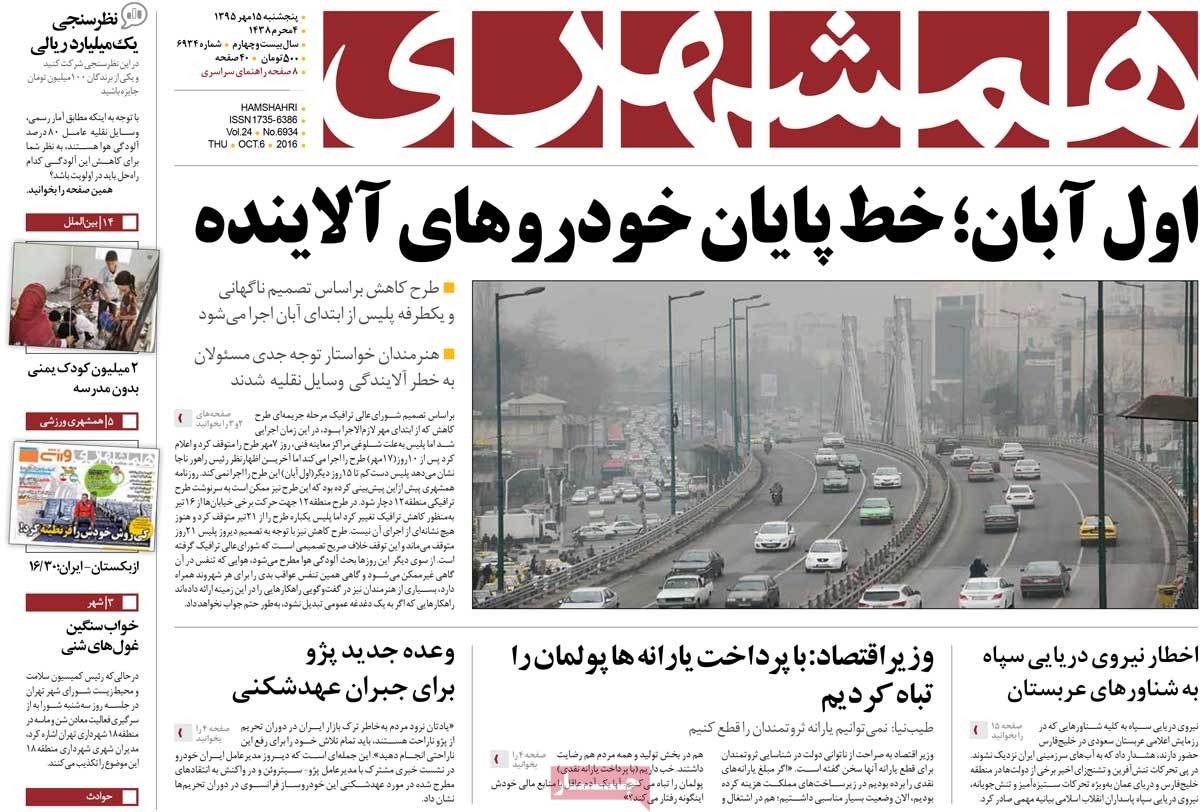
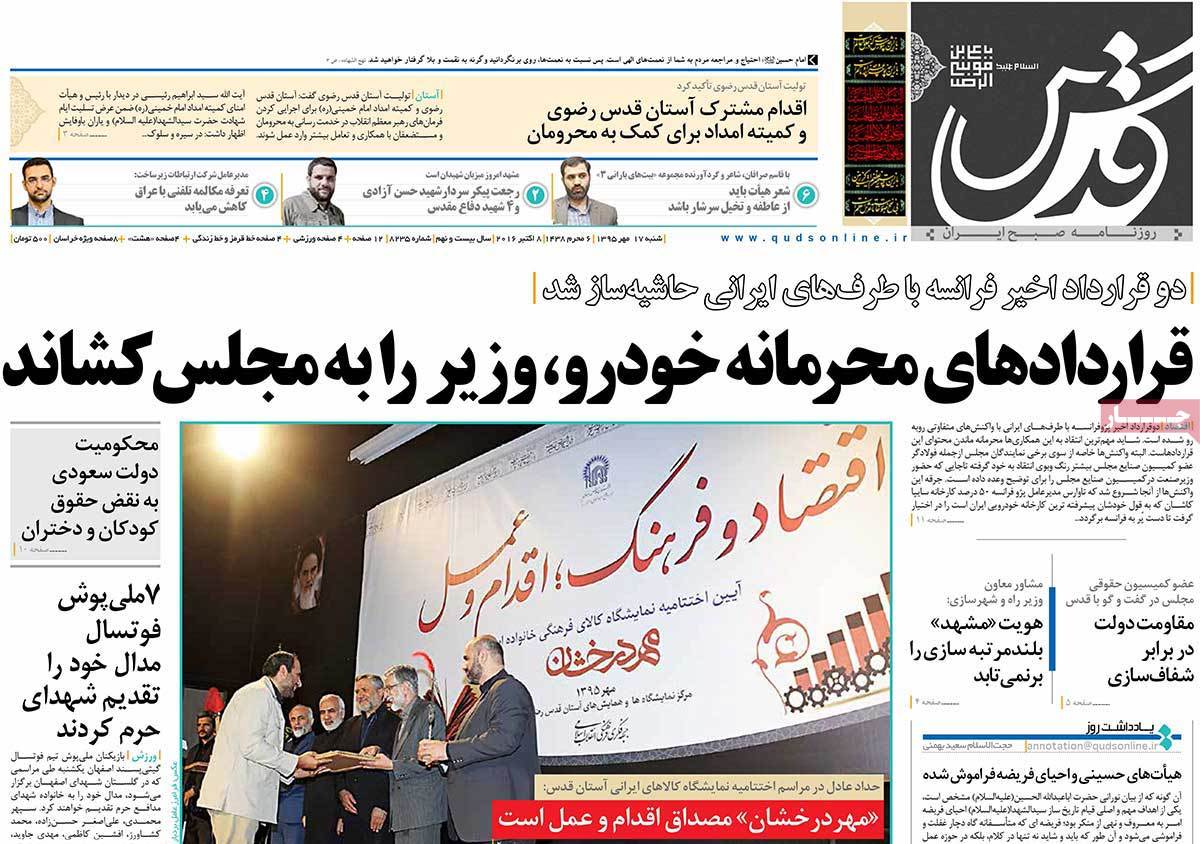
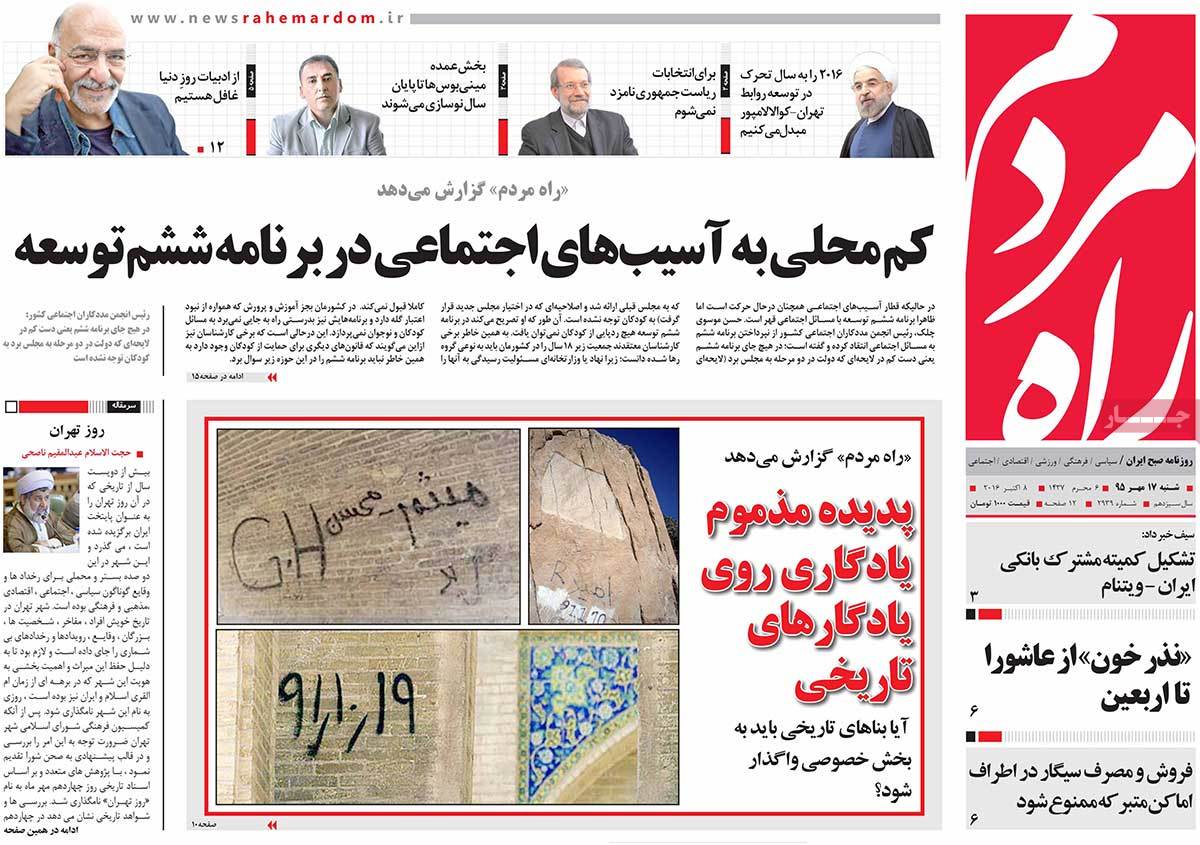
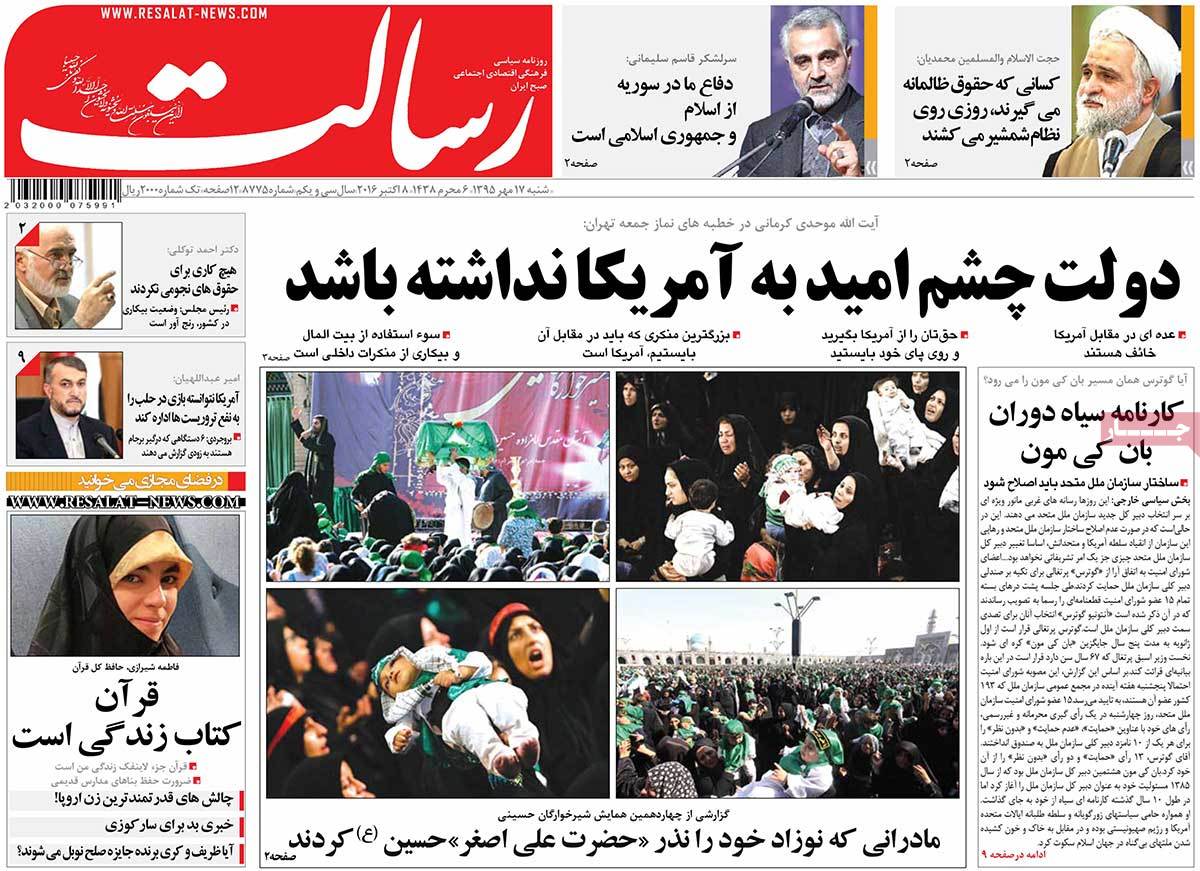
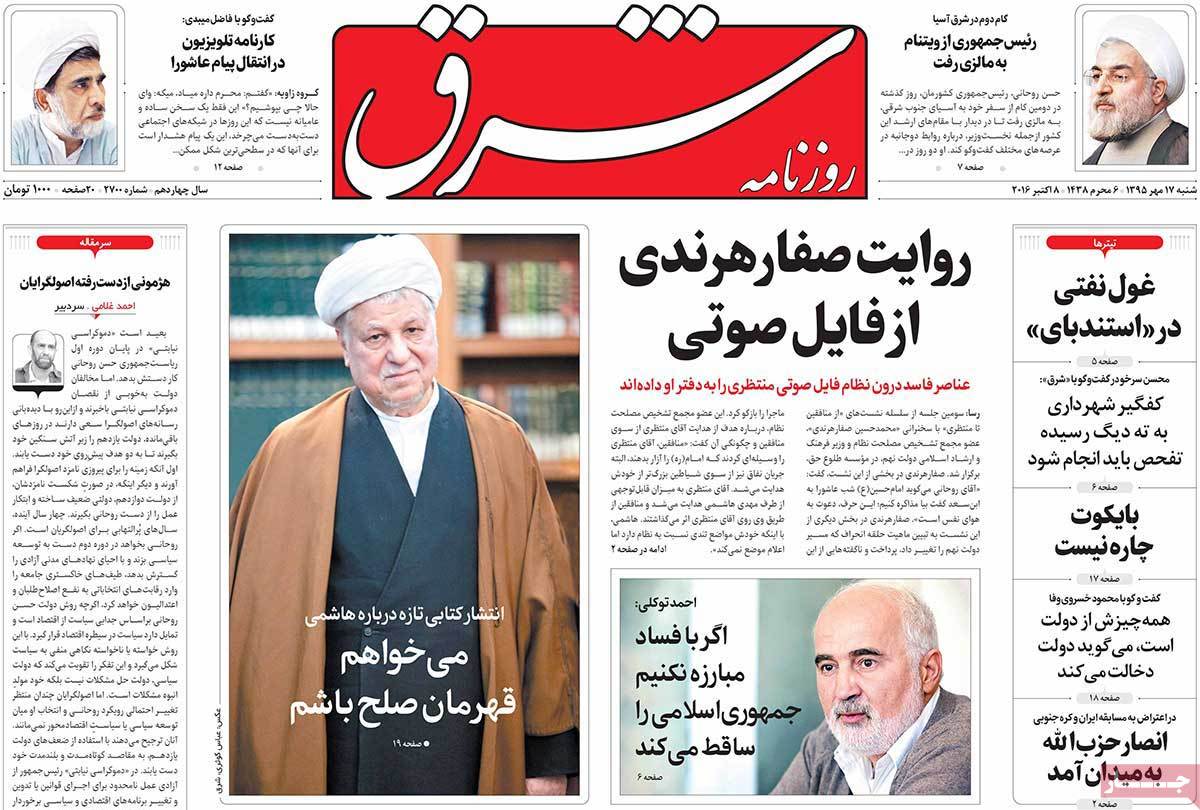
A Look at Iranian Newspaper Front Pages on September 15

Iran Newspaper front pages

Newspapers on Thursday covered the remarks made by Ali Motahari, the outspoken Vice-Speaker of Iranian Parliament, in reaction to a recent letter of apology by Saeid Mortazavi, the former prosecutor-general of Tehran who allegedly had a role in the deaths of three Iranian protesters during the 2009 Iranian election protests.

They also referred to the statements made by IRGC Major General Yahya Rahim Safavi who warned Saudi Arabia against testing Iran’s patience.

Secretary of Iran’s Supreme National Security Council Ali Shamkhani’s remarks about FATF also received great coverage. Shamkhani stressed that the SNSC has reached conclusion over the deal with Financial Action Task Force, but it should be signed by the Leader of the Islamic Revolution Ayatollah Seyyed Ali Khamenei as well.

The above issues as well as many more are highlighted in the following headlines:


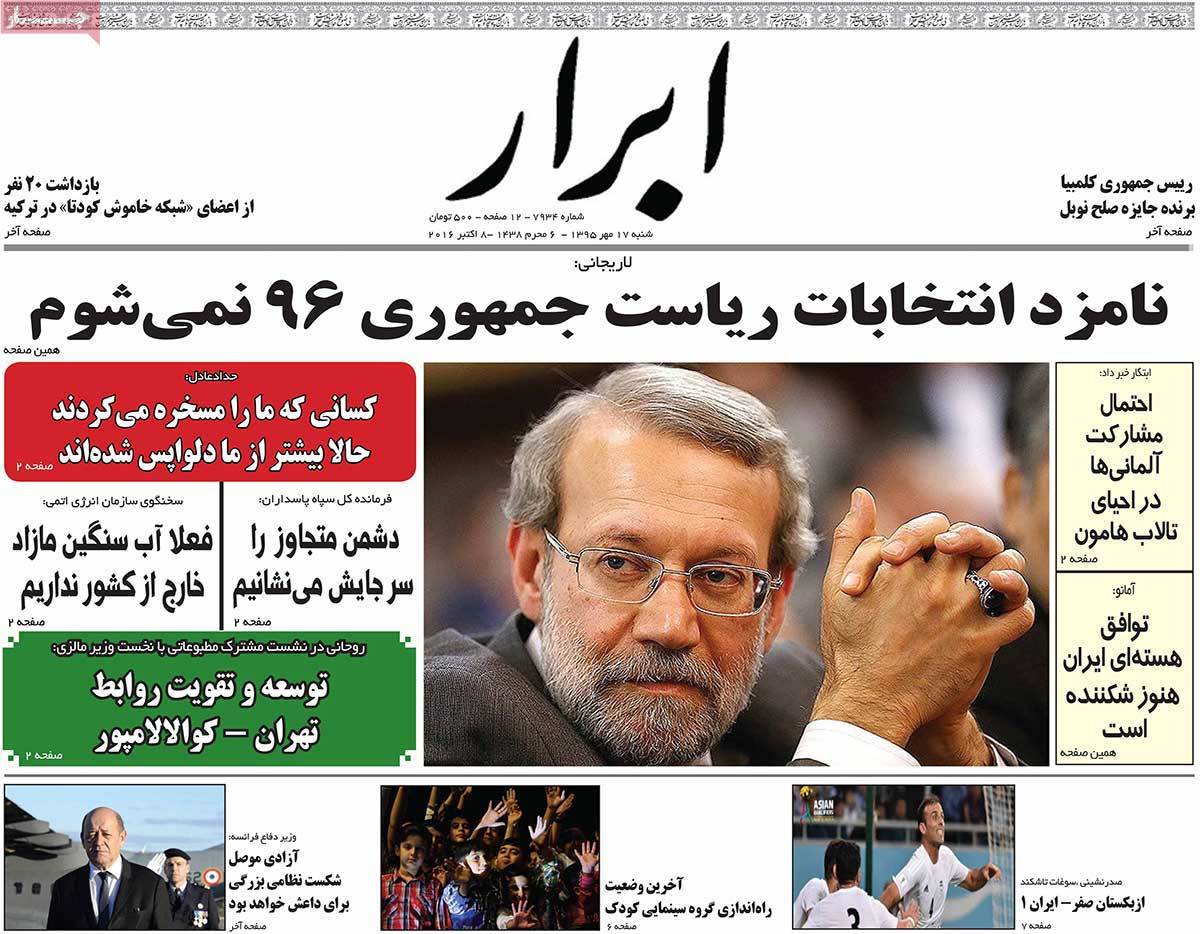
Abrar:

1- Russian Agents Once Again Hack US Democrats

2- Saudi Rulers Shouldn’t Test Iran’s Patience: IRGC General Safavi

3- We’ve Informed Iran of Our Concerns: US State Dept.

4- No Plan for a Meeting between Iran’s Zarif and USA’s Kerry

5- IRGC Fully Prepared to Counter Any Threat against Islamic Revolution: Commander

A Look at Iranian Newspaper Front Pages on September 15


Abrar-e Eqtesadi:

1- 5 European Countries in List of New Customers of Iran’s Petchem Products

2- Iran’s Kish Island Didn’t Replace Turkey [as a regional tourist destination]

3- UK Pays Iran’s Revenue from Rhum Gas Field

4- Iran to Rent Gas Pipeline: New Plans for Gas Export to Europe

A Look at Iranian Newspaper Front Pages on September 15


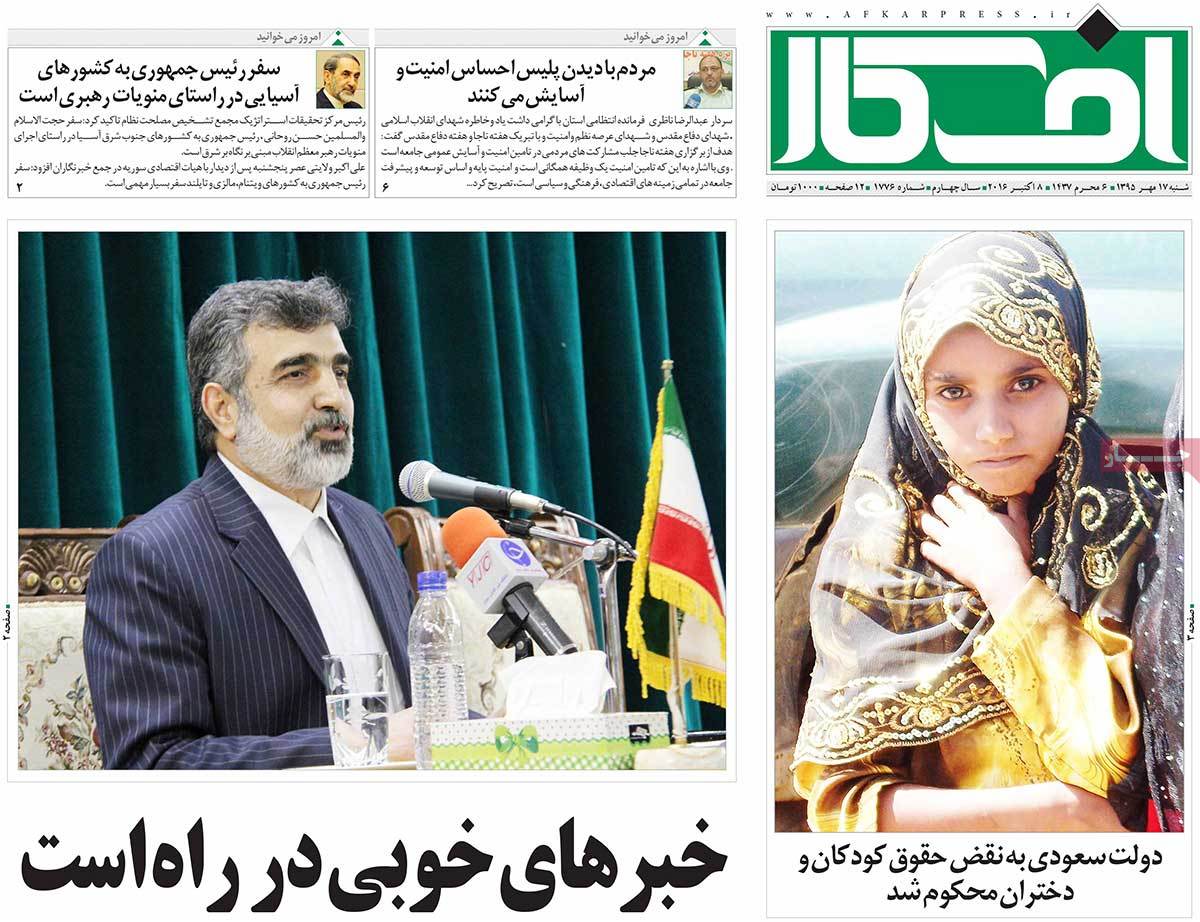
Afkar:

1- We’ve Had No Contact and Consultation with US: Foreign Ministry Spokesman

2- Major Military Deal [between US and Russia] amid Cold Political Ties

3- 8 Iranian Films Nominated as Iran’s Submission to Academy Awards

4- Adviser to Parliament Speaker Criticizes US Efforts to Save MKO Terrorists

A Look at Iranian Newspaper Front Pages on September 15


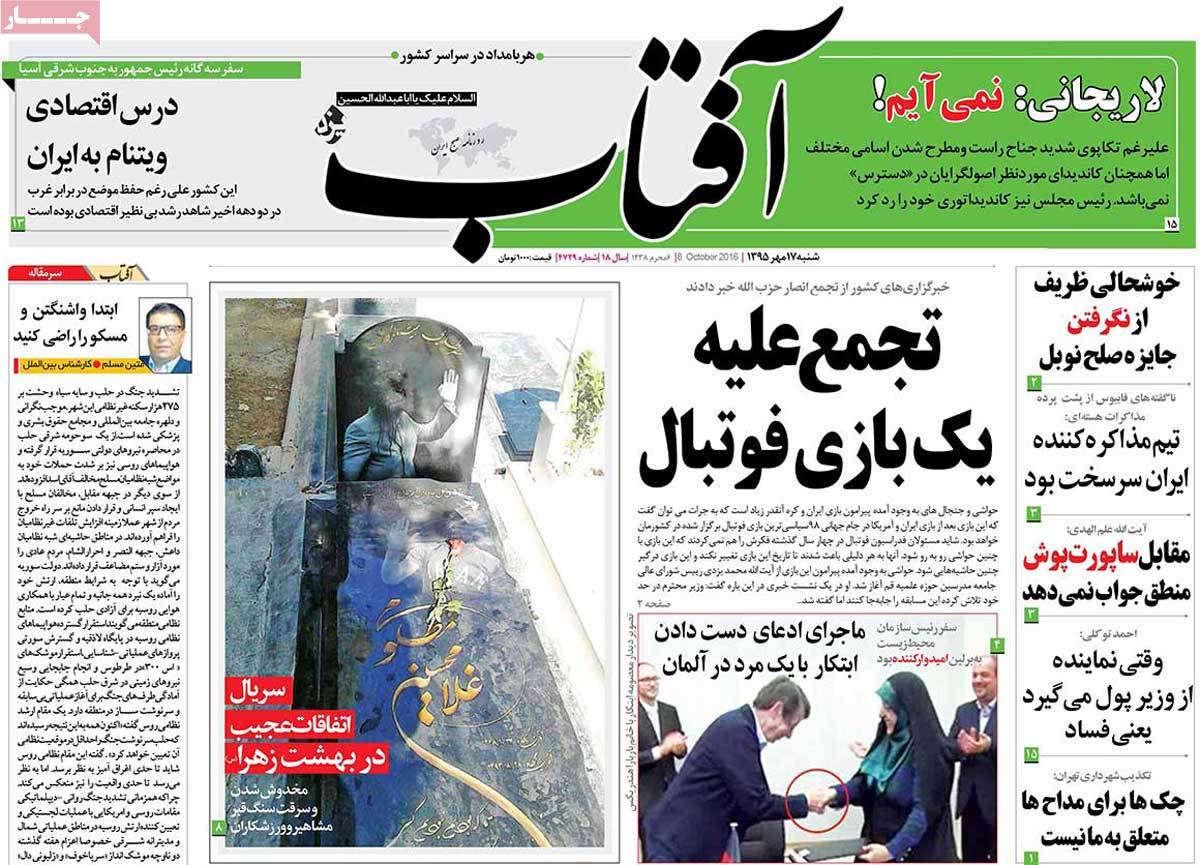
Aftab-e Yazd:

1- Tehran Has Hundreds of Unknown Faults: Capital City Should Be Moved to Somewhere between Arak and Isfahan

2- Dangerous Dichotomy: Some Conservative Media Are Trying to Put Rouhani and General Soleimani against Each Other

3- Tolerating Saudi Arabia, an Economic Necessity: Tense Conditions Would Discourage Timid Investors

4- More than 40m Iranians Deprived of Cinema

5- Ahmadinejad Knows He’ll Be Disqualified from Running for Presidency: Reformist Figure

6- Difference between Iranian and French Youths in Using Social Media: Why Are We Just Looking for Dates?

7- FATF Deal Should Be Approved by Leader: Shamkhani

A Look at Iranian Newspaper Front Pages on September 15


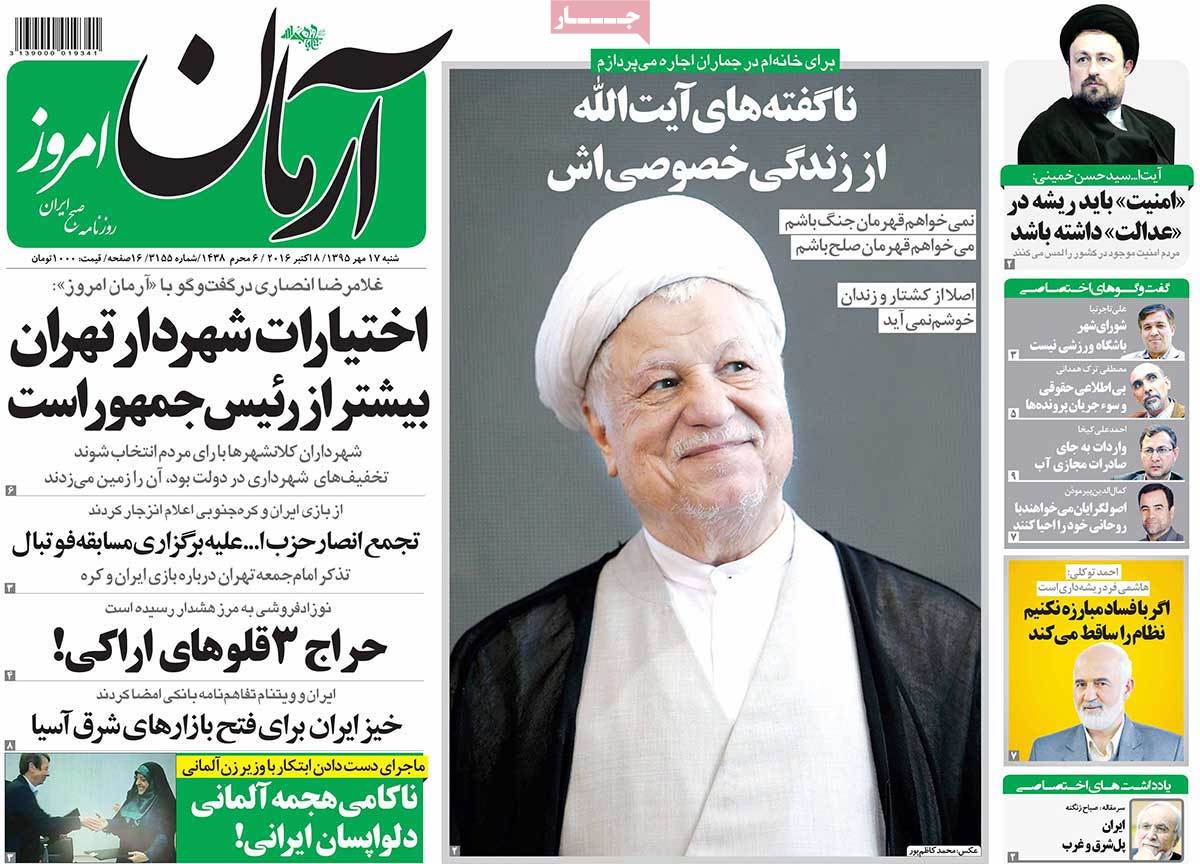
Arman-e Emrooz:

1- Vice-Speaker Motahari: Mortazavi’s Letter of Apology Was a Positive Move; Why Are His Supporters Silent? He’d Better Write another Letter about Zahra Kazemi

[Iranian-Canadian freelance photographer whose death in 2003 became controversial. Mortazavi, the then Tehran prosecutor, announced that Kazemi had died of a stroke, while there were rumours that she had been raped and murdered.]

2- Zarif: Let’s Rid the World of Wahhabism

3- Attracting Foreign Investment by Joining FATF: Iran’s Economy Is Out of Downturn

4- Expert: Saudi Arabia Moving towards Disintegration

A Look at Iranian Newspaper Front Pages on September 15


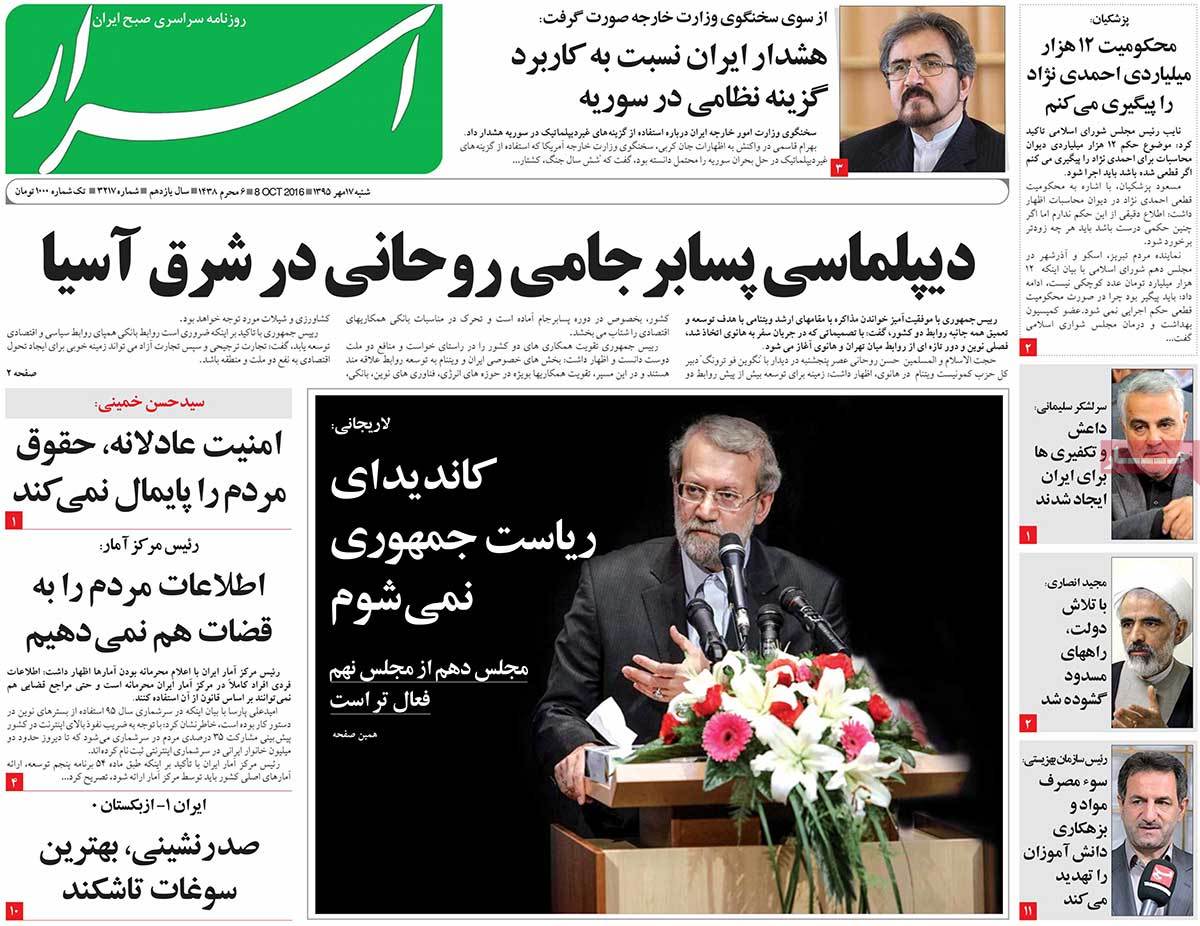
Asrar:

1- FATF Implementation Hinges on Leader’s Signature: Shamkhani

2- President’s Aide: Accountability Strengthens Iranian Establishment’s Foundation and Decreases Corruption

3- 28m Iranians Are Using Telegram Messaging App

A Look at Iranian Newspaper Front Pages on September 15


Emtiaz:

1- Iranian Schools May Be Shut Down for 2 Weeks in Autumn Because of Air Pollution

2- 10 Iranians Die of Drug Overdose per Day

3- 400,000 Tons of Milk to Be Distributed in Iranian Schools in New Academic Year

4- Internet Speed in Iran to Be Doubled

5- 100 Tons of Smuggled Goods Set on Fire in Tehran

A Look at Iranian Newspaper Front Pages on September 15


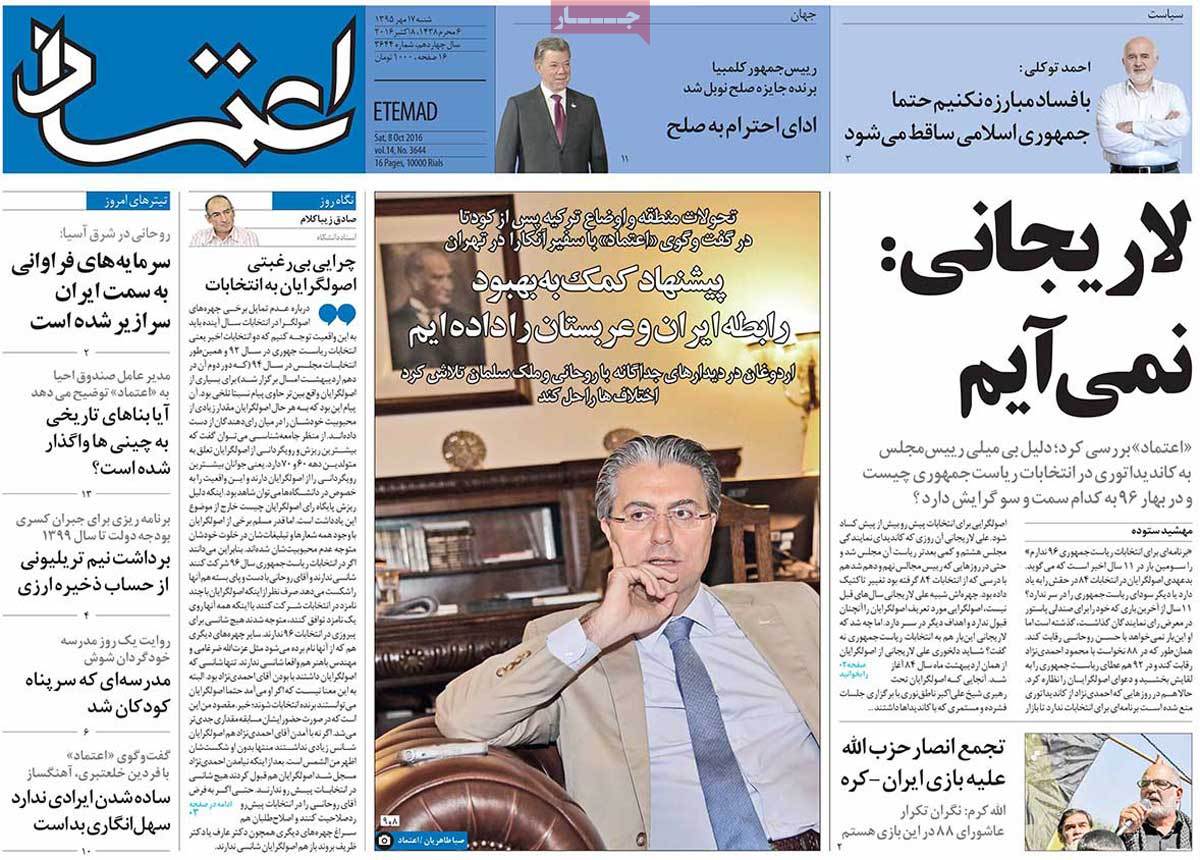
Etemad:

1- Attack on Wahhabism through US Media Heart: Zarif in Op-Ed in New York Times Calls for Getting Rid of Wahhabism

2- Ahmadinejad Will Fail in Competition with Rouhani: Reformist Figure

3- Mortazavi Should Explain about Zahra Kazemi’s Death as Well: Motahari

A Look at Iranian Newspaper Front Pages on September 15


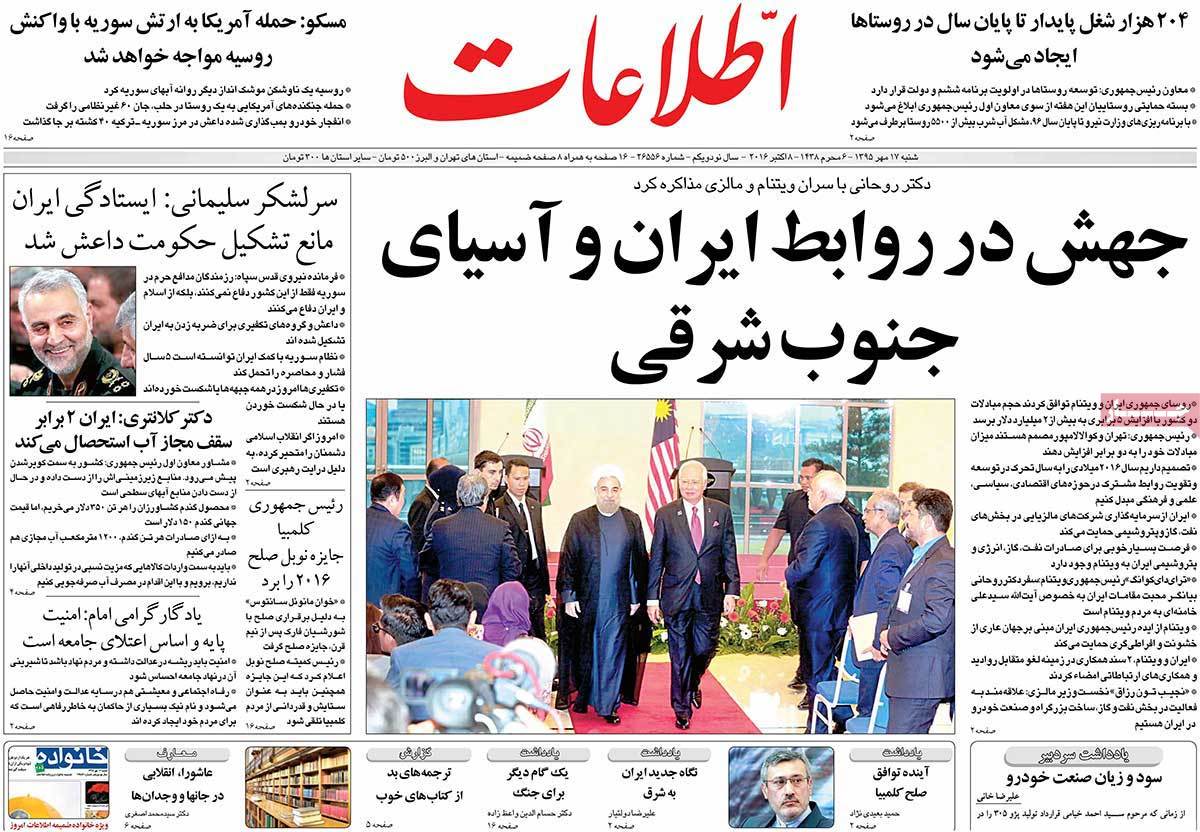
Ettela’at:

1- Congress in Letter to Obama: Don’t Disgrace US by Supporting Saudi Arabia

2- Shamkhani: Supreme National Security Council Has Reached Conclusion over FATF

3- ISIS’ Centre for Production of Chemical Weapons Destroyed in US Airstrike on Mosul

4- 7,500 Industrial Units Back to Production Cycle

5- Iranian Archers’ Brilliant Performance in Paralympics

A Look at Iranian Newspaper Front Pages on September 15


Hemayat:

1- Weapon-Sellers Renounce Saudi Child-Killing: Congress’ Letter to Obama against Riyadh’s War Crimes

2- Iran Is in Frontline of Fight against Terrorism: Javad Larijani in Rome

3- Italian Senate President Praises Iran’s Serious Fight against Illicit Drugs

A Look at Iranian Newspaper Front Pages on September 15


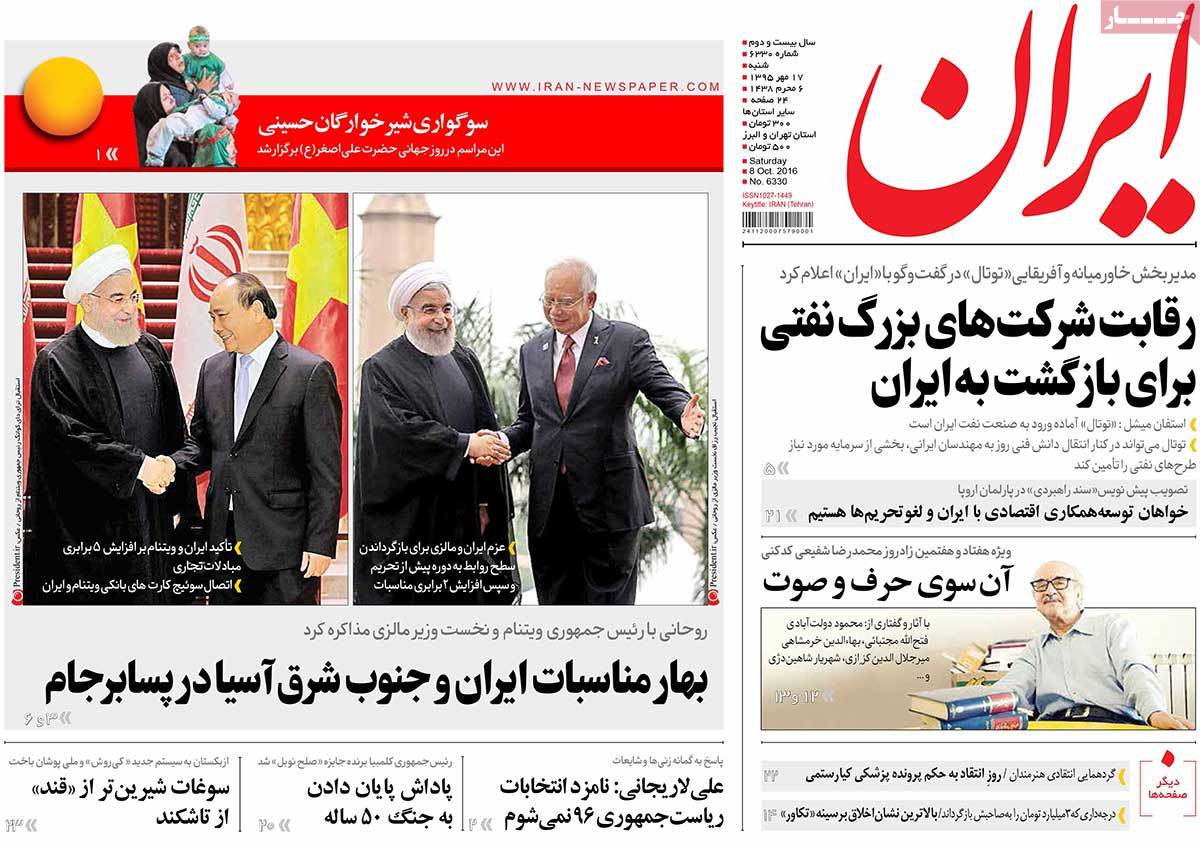
Iran:

1- Rouhani’s Different Visit to New York; President to Depart for Venezuela Tomorrow to Attend NAM Summit

2- Health Minister’s Warning about Iranians’ Lifestyle

3- David Cameron Inquired about Overthrow of Gaddafi

A Look at Iranian Newspaper Front Pages on September 15


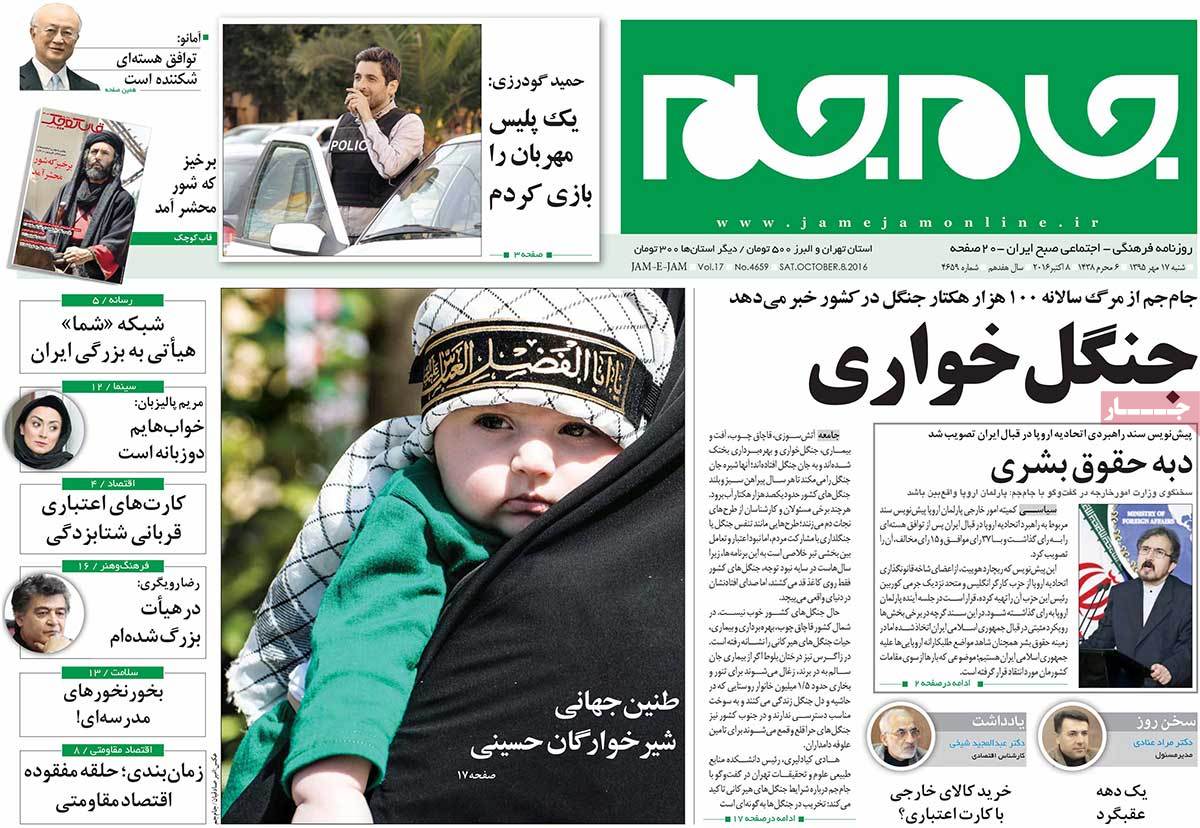
Jame Jam:

1- Roads in Red Condition: 3,400 Accident-Prone Areas in Iran; 2,000 Passengers Die in Car Crashes in Accident-Prone Areas Each Year

2- IRGC Navy Commander Urges Americans to Leave Persian Gulf

A Look at Iranian Newspaper Front Pages on September 15


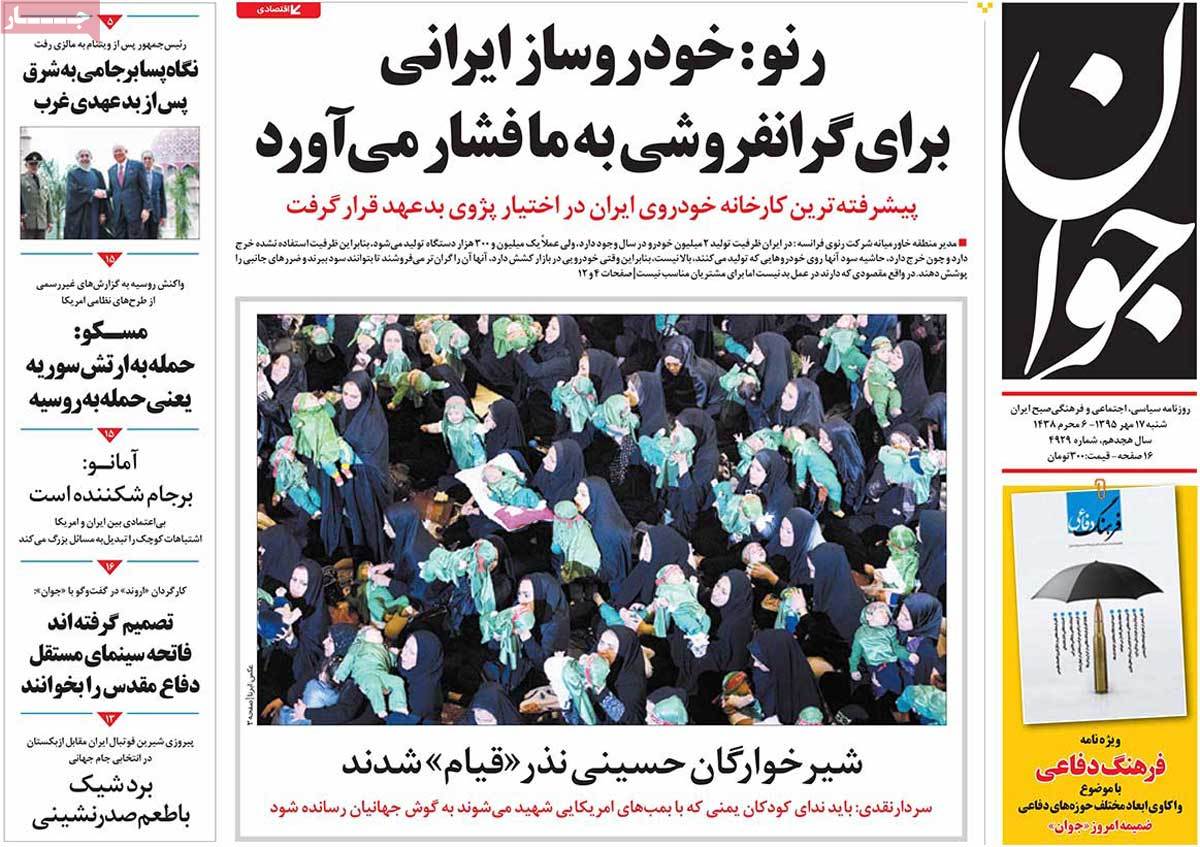
Javan:

1- NSA Chief: A Mideast-Like Instability Has Begun in US

2- $50m, the Maximum Amount of LCs Opened for Iran

3- 50% Decrease in Number of Hajj Pilgrims Confirms Al Saud’s Incompetence

A Look at Iranian Newspaper Front Pages on September 15


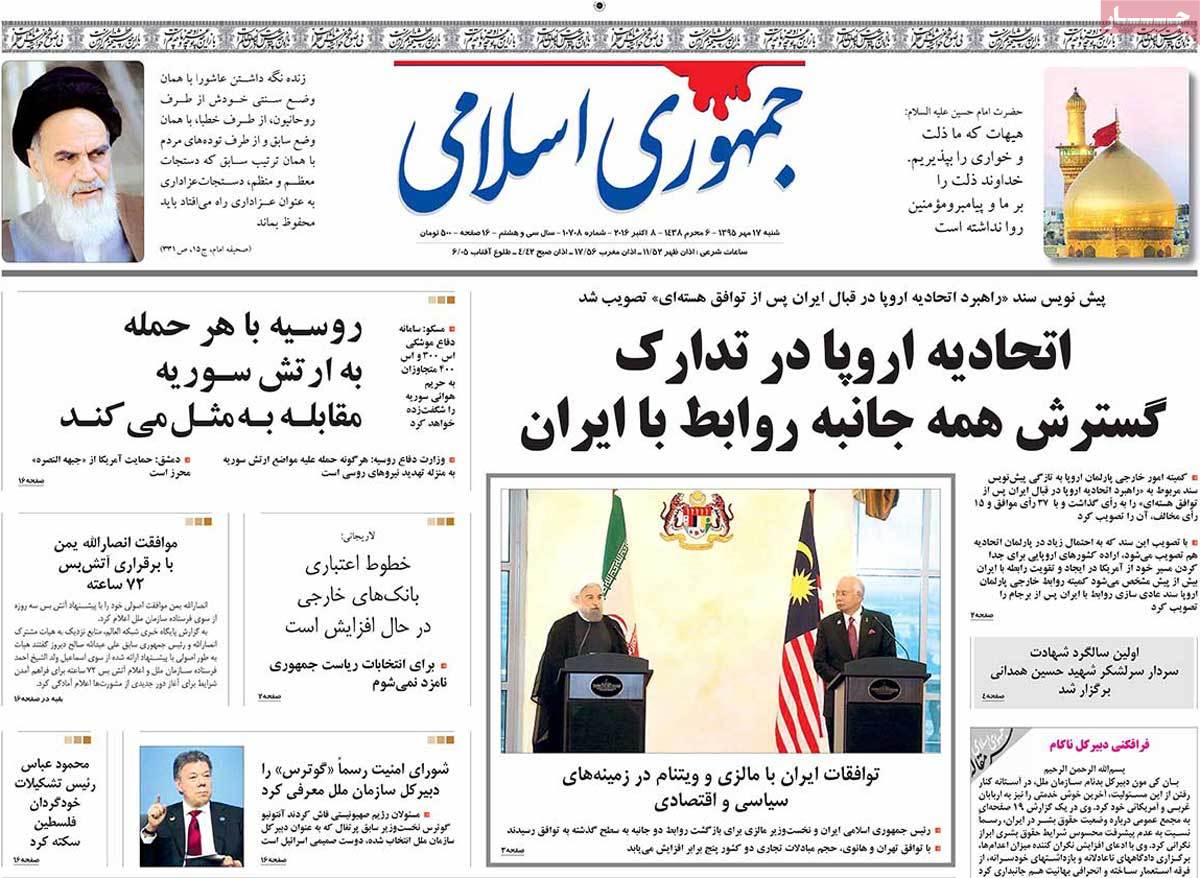
Jomhouri Eslami:

1- JCPOA Is Government’s Major Achievement in Foreign Policy: Ayatollah Mazaheri

2- We Should Return to Islamic Ethics and Iranian Traditions: Ayatollah Rafsanjani

3- West’s Pressures Have Made UN Inefficient; Leaders of Countries, rather than People, Are Main Reason for Current Chaos in the World: Ban Ki-moon

A Look at Iranian Newspaper Front Pages on September 15


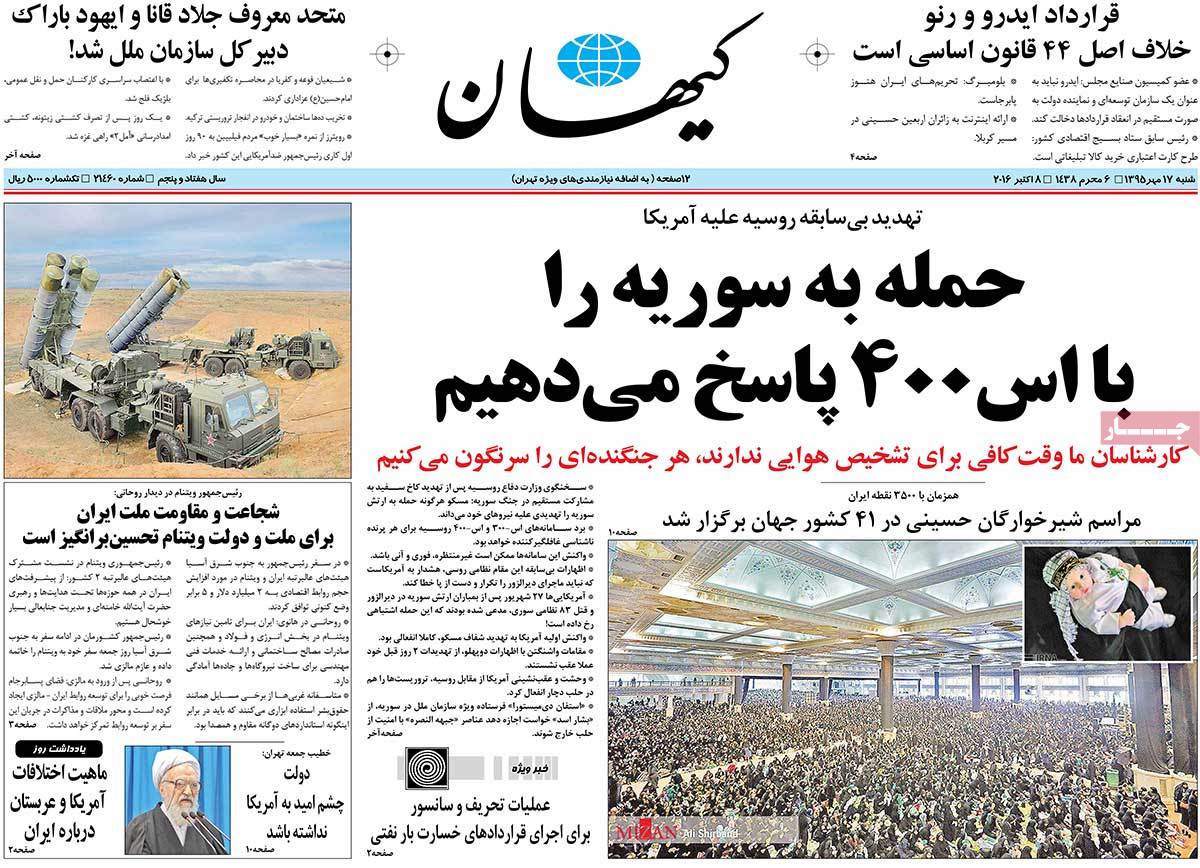
Kayhan:

1- Ship of Resistance Economy Won’t Arrive at the Coast If They [Rouhani’s statesmen] Are the Sailors

2- UN’s Reaction to Brutal Oppression of Bahraini Shiites: We’re Worried!

3- Strong Opposition of 40 Iranian Economists with Iran’s FATF Accession

4- Saudi King: We Stay Awake Overnight for Welfare of Hajj Pilgrims!

A Look at Iranian Newspaper Front Pages on September 15


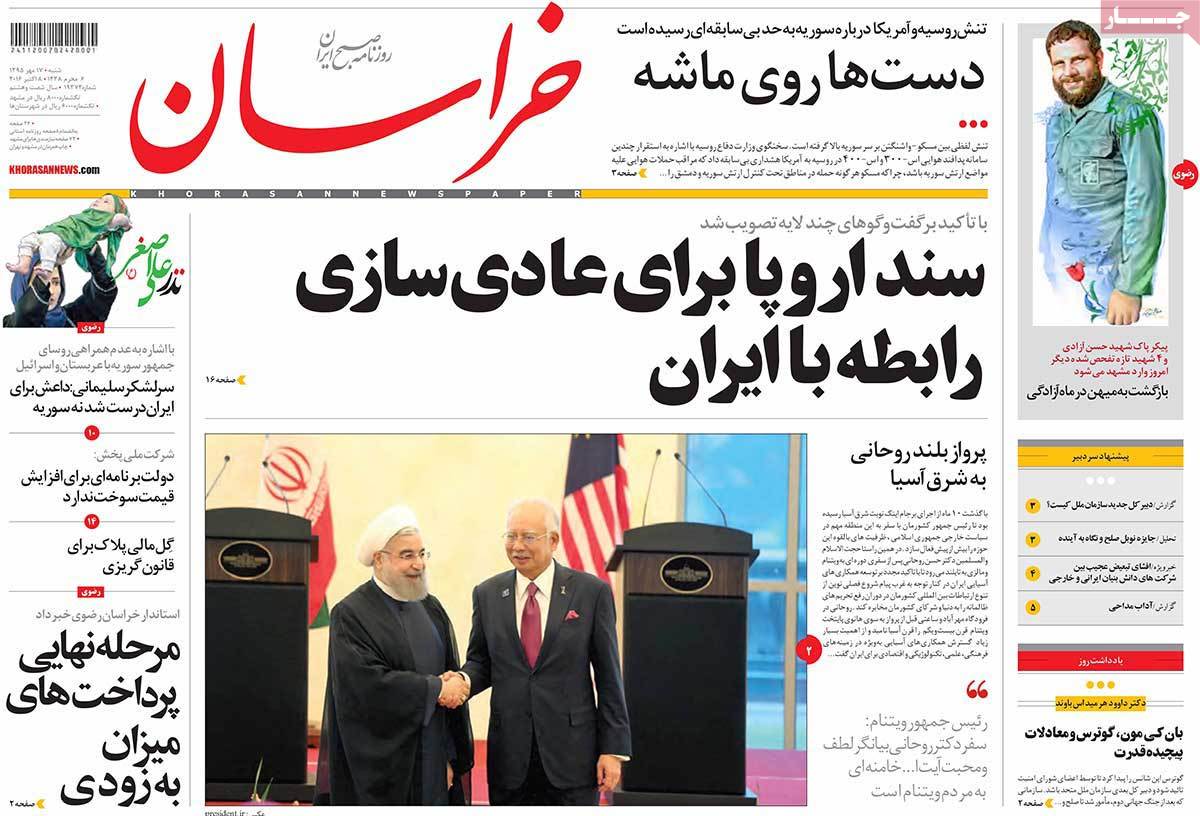
Khorasan:

1- Zarif Calls for Formation of an Int’l Coalition against Wahhabism

2- Clinton’s Illness: A Winning Card or Nightmare of Defeat?

A Look at Iranian Newspaper Front Pages on September 15


Resalat:

1- People Suffering from Severe Economic Pressure: Ayatollah Mazaheri

2- Liberals Still Waiting for US Help: IRGC General Rezaei

3- European Banks Have Doubts about Doing Business with Iran: VP

4- Wahhabism Is a Fabricated Cult and Has Nothing to Do with Islam: Ayatollah Makarem Shirazi

5- Signs of Ageing and Senility in World’s Biggest Democracy: When Young People Have No Place in US Government

A Look at Iranian Newspaper Front Pages on September 15


Roozan:

1- Fragile Ceasefire: Second Day of Truce in Syria

2- Ambiguous Fate of Gas Dollars: UK Blocks Bank Account of Iran Oil Company

A Look at Iranian Newspaper Front Pages on September 15


Shargh:

1- Ahmadinejad’s Support of Mortazavi Was Weird to Me: Motahari

2- IRGC’s Negative Response to an Offer for Establishment of Direct Shipping Line to US

3- Sex Education in Iran’s School Books: +18 in Schools

A Look at Iranian Newspaper Front Pages on September 15


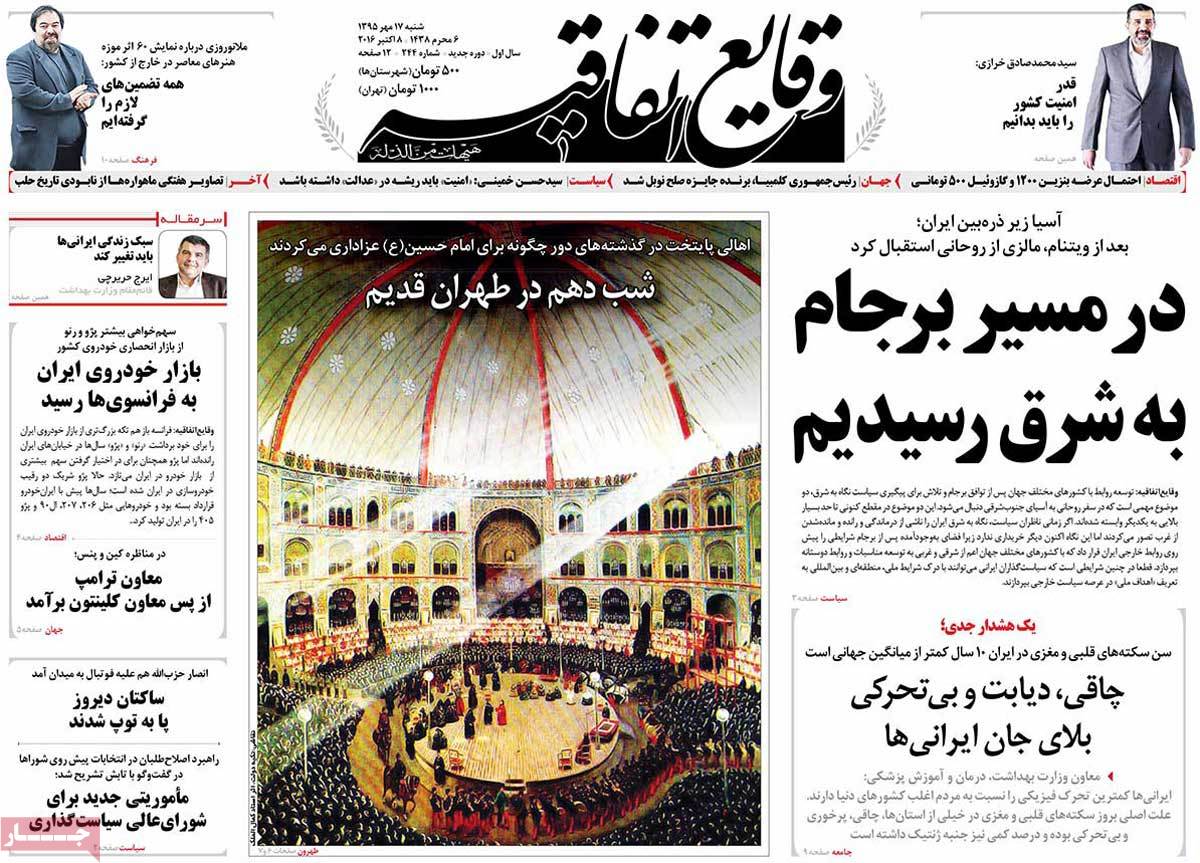
Vaghaye Ettefaghieh:

1- A Report on Need for Happiness and Staying Away from Negative Thoughts among Iranians: Society in Turn of Thinking Positively

2- Emergency Meeting between Mortazavi and Ahmadinejad in the Latter’s Office

3- Oil Freeze Waiting for Iran’s Decision

4- Saudi Arabia Wants Middle East to Return to Saddam Hussein’s Era

A Look at Iranian Newspaper Front Pages on September 15


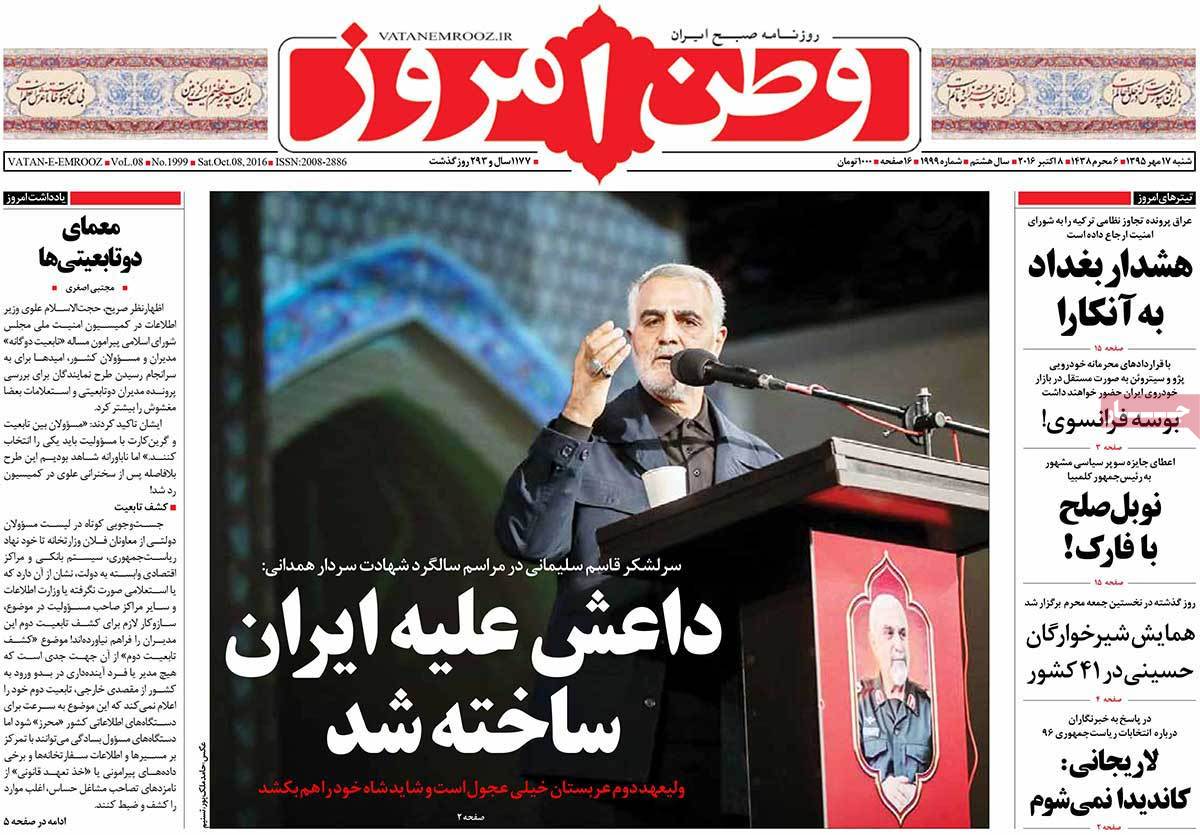
Vatan-e Emrooz:

1- US Doping Stars: Leakage of Secret WADA Documents Showing Positive Doping Tests of Famous American Athletes

2- Dennis Ross: If We Want Rouhani’s Success, We Should Weaken Resistance Front: Netanyahu’s Recommendation

3- Suspicious and Beautiful Statistics: A Report on Rouhani Government’s Performance

A Look at Iranian Newspaper Front Pages on September 15


Iran Reaffirms Support for Afghan Prosperity

gholam-ali-khoshroo

Strengthening regional cooperation with Afghanistan is a priority and a major pathway to consolidate peace and economy in the region, the Iranian envoy said in a speech to a United Nations Security Council session on “The Situation in Afghanistan”, held in New York on Wednesday.

The following is the full text of Mr. Khoshroo’s speech:

In the Name of God, the Compassionate, the Merciful

Mr. President

I would like to express my appreciations to New Zealand for organizing this debate on the situation in Afghanistan. My thanks also go to the distinguished Ambassador of Afghanistan for his statement. I would like to welcome and thank Mr. Yamamoto, Special Representative of the Secretary-General for Afghanistan and head of the United Nations Assistance Mission in Afghanistan (UNAMA) for his briefing and presenting SG’s latest Report, as contained in document S/2016/768.

Unfortunately, security and instability remain the major challenges for Afghanistan. The SG’s latest report refers to 24 percent increase in the number of armed clashes comparing to the same period last year, while last year was reported as the highest number recorded since 2001 in terms of intensity of armed clashes. This continuing deterioration of the security situation in the country indicates that Afghanistan and the region is not any safer than a decade after its invasion.

Peace talks between the Afghan Government and Taliban, uncertainty prevails over any prospect for making peace with them. Iran reiterates its support for any Afghan-led peace process, at the same time, we condemn all violent attacks committed by Taliban and all other terrorist groups as well as any cooperation with them, since we believe this will encourage them in their odious behavior and thus counterproductive to establishing peace in Afghanistan.

In my pervious statement in June, I had warned about the emergence of ISIS and its offshoots in Afghanistan. During the same period we witnessed that the so-called Islamic State of Iraq and the Levant-Khorasan Province (ISIL KP) claimed the responsibility of the terrorist attack against a demonstration by ethnic Hazaras on July 23 which was the deadliest single incident recorded by the United Nations in Afghanistan since 2001. This is just another indication of this threat. ISIL-KP, along with the spectrum of other terrorist and extremist groups, such as the Islamic Movement of Uzbekistan in north and the Islamic Movement of Eastern Turkistan appear as an emerging security threat in Afghanistan.

Today, the Afghan National Unity Government is in forefront of fighting terrorism. The sustained support of the international community is much more needed to support the Afghan Government in its fight against terrorism and extremism, as well as to address its security, economic and political challenges.

Mr. President

Strengthening our regional cooperation with Afghanistan is a priority and a major pathway to consolidate peace and economy in the region. During the past decade, Iran has spent millions of dollars to help Afghanistan with the completion of almost 300 projects, ranging from infrastructure to training and capacity building in human resources, especially through offering hundreds of scholarships each year.

Afghanistan and Iran continue their cooperation in these fields. Following 23 May trilateral agreement with India, focused on the Iranian port of Chabahar, we held coordination meetings, at the governor’s level of the border provinces on 25 and 26 July to discuss security and new trade opportunities involving the Port. Afghan Deputy Minister of Foreign Affairs visited Tehran on 3 August for discussions on trade, infrastructure, and the presence of Afghan nationals in Iran and Afghan National Security Advisor visited Iran on 6 and 7 August to discuss border security and countering violent extremism. The fifth Afghanistan-Iran Joint Economic Commission was held on 10 August in Tehran after a four-year interval.

Iran and Afghanistan are also committed to increase their connectivity with emphasis on the Khaf-Herat Railway, Mile 78 railroad project in Farah and the second bridge over Hirmand River.

Narcotic is a real threat for this region and beyond and should be addressed by the international community in a very serious and comprehensive manner. Any increase in narcotics is a reflection of the prevailing insecurity and poverty. Strong support and commitment from the international donors, the Afghan authorities and the United Nations Office on Drugs and Crime (UNODC) is essential to deter the menace of narcotics as a social health challenge and more importantly, a major source of income for extremist and terrorist groups.

Iran continues to participate in the work of Tripartite Commission in order to plan for voluntary, safe, dignified and gradual repatriation of Afghan refugees. According to the latest SG’s report, year 2016 continues to be the lowest recorded returnee rate since the establishment of the voluntary return program in 2002, with many of the returnees choosing not to return to their areas of origin, including many who settled in urban centers.

The augmentation of the individual repatriation grant from $150 to $350 seems not to be enough. We welcome any effort to help overcome the main reintegration challenges faced by returnees and to formulate a Comprehensive Voluntary Repatriation and Reintegration Strategy. Success in voluntary repatriation first and foremost depends on providing the reasonable needs of repatriated refugees in Afghanistan, and underscores the necessity for mobilizing more international support for this purpose.
Meanwhile, we continue our support to hundreds of thousands of Afghan refugees, especially in the fields of education and medical services. Last year we enrolled 386,000 Afghan students in our schools and universities, regardless of their legal status. In the field of health care and medical services, we continue to provide services to hundreds of thousands each year, in some areas, the number of Afghan refugees receiving these services exceeds the Iranians.

Mr. President

Iran continues its full support for the promotion of security, stability and comprehensive and sustainable development in Afghanistan since we consider the security in Afghanistan to be the security of our borders and the region.

We support UNAMA as well as UN agencies in their efforts to provide development and reconstruction assistance to Afghanistan through a genuine commitment by the United Nations to a sustained partnership with Afghanistan, as set forth in Final Report of the Tripartite Review Commission on the United Nations in Afghanistan. We need to utilize the UNAMA mandate and its good offices for strengthening national institutions and capacities in priority areas as requested by the Government.

I thank you Mr. President

General Soleimani Says Will Remain A Soldier Serving Islamic Revolution

General Soleimani

In a statement on Thursday, General Soleimani described media speculations about his plans to run in the upcoming presidential election as “divisive” reports by the enemies with the purpose of fomenting discord within the Iranian nation.

The enemies of the Islamic Revolution always seek to create division within Iran, provoke confrontation between Iranian revolutionary people and upset their unity, the commander added, saying that is why such foreign comments do not merit attention.

General Soleimani also made it clear that he will keep serving the Islamic Republic and the Iranian nation as a soldier until the last day of his life.

Top Iranian, Mexican Diplomats Hold Talks in Mexico City

Iranian Foreign Minister Mohammad Javad Zarif speaks at the New York University (NYU) Center on International Cooperation in New York

The two senior diplomats explored avenues for the expansion of relations between Iran and Mexico in various fields, including economic and trade ties, particularly in banking sector, as well as closer academic and scientific collaborations.

zarif

They also called for efforts to implement a document reached after political negotiations between the two countries’ deputy foreign ministers and for reciprocal visits by political and parliamentary delegations.

Zarif and Ruiz Massieu also stressed the need for stronger interaction on social matters, such as the fight on narcotics and combatting poverty.

Heading a high-ranking diplomatic delegation, Zarif arrived in Mexico on Wednesday.

He is scheduled to attend a meeting of foreign ministers of the Non-Aligned Movement (NAM) in Venezuela later this week.

UK Blocks Iran’s Gas Revenues Over Bans

gas

Ali Kardor, the managing director of the National Iranian Oil Company (NIOC), was quoted by Iranian media as saying that the revenues obtained from selling Iran’s share of the products of Rhum gas field have been deposited into an overseas NIOC account, stressing however that the same account is currently frozen.

Kardor added that Iran is currently negotiating with Britain to unfreeze the account which was established at a British bank before the 1979 Islamic Revolution after Iran and BP signed a deal to jointly invest in Rhum field.

The field started producing 190 million cubic feet of natural gas a day in 2005. However, the British government ordered it shut down in 2010 as a result of sanctions against Iran.

Production from the field resumed in 2013 and is presently supporting about five percent of the gas needs of Britain.

In September 2015, Iran’s Deputy Petroleum Minister for International Affairs and Trading Amir-Hossein Zamaninia told reporters that UK’s then Chargé d’Affaires to Iran Ajay Sharma had told him London would pay Iran its share of revenues from Rhum field after the removal of sanctions against Iran.

Zamaninia also discussed the issue with UK’s trade envoy to Iran and chairman of the British-Iranian Chamber of Commerce Lord Norman Lamont this past April. He told reporters that Britain had pledged to remove the barriers on the way of Iran’s access to revenues made from sales of natural gas from Rhum gas field.

Anti-Iran Claims Meant to Divert Attention from Saudi’s 9/11 Role: Diplomat

senator-joseph-lieberman

n an op-ed published in The Wall Street Journal last week, former US Senator Joseph Lieberman claimed that Iran had played “an enabling role” in the September 11 terror attacks, and accused Tehran of rendering assistance to terror groups, including al-Qaeda, across the world.

In a column published in the same US daily, the head of the Press Office of Iran’s permanent mission to the United Nations, Hamid Babaei, said Lieberman had been long making “unsubstantiated allegations” against Tehran with the help of certain “militaristic” think tanks in Washington.

He added that such claims were aimed at diverting attention from the real culprits behind the 9/11 attacks.

In doing so, Lieberman “is hoping to direct readers’ attention away from new information brought to light about the involvement of a new anti-Iran, the Kingdom of Saudi Arabia, in the events of 9/11,” he said.

Babaei described the al-Qaeda terrorist group as a “sworn enemy of Iran,” which has, along with its allies, been committing crimes all over the world.

The Iranian official concluded that such anti-Iran claims aim to use the “emotions” raised by the 9/11 attacks “to manipulate the American public into pursuing militaristic adventures.”

The September 11, 2001 attacks were a series of hijacked-plane strikes in New York, the Washington D.C. area and Pennsylvania, which killed nearly 3,000 people.

None of the 19 hijackers on September 11 were Iranian citizens. Fifteen were from Saudi Arabia while the others were from the United Arab Emirates, Egypt and Lebanon.

In July, excerpts of a long-classified congressional report on 9/11 were released, indicating that some of the hijackers had ties to Saudi government officials. However, no definitive comment has been made about the Saudi involvement.

The Saudi government has strongly denied any role in the incidents.

Last week, the US House of Representatives voted on a bill that would allow the family members of the 9/11 victims to sue the Saudi government. The bill will head to the White House, where US President Barack Obama is expected to veto it.

US Presence in Persian Gulf Unwarranted: Iran Official

He rejected claims about what Washington described as Iran’s “provocations” in the Persian Gulf, dismissing the US allegations as part of the White House’s “media hue and cry.”

The US claims about Iranian vessels getting too close to American warships in the Strait of Hormuz and Iran’s threats against US aircraft approaching the Iranian airspace are mere propaganda, Shamkhani noted.

On September 6, the Pentagon spokesman, Captain Jeff Davis, said that an American patrol ship had changed its course after a speedboat from Iran’s Islamic Revolution Guards Corps (IRGC) came within 91 meters of the vessel near the Strait of Hormuz in the Persian Gulf.

Davis claimed the Iranian vessel had sailed directly in front of the USS Firebolt, forcing the ship to change course. He said the incident began when seven Iranian ships “harassed” the Firebolt.

Meanwhile, a US military official claimed that Iran had threatened to shoot down two US Navy aircraft over the weekend as they were flying over the Strait of Hormuz “near the Iranian airspace.”

Rear Admiral Ali Fadavi, the commander of the IRGC Navy, dismissed the US claims as untrue.

On September 11, Deputy Chief of Staff of Iran’s Armed Forces Brigadier General Massoud Jazayeri also rejected the claims that any US ship had been harassed by Iranian forces.

“Vessels belonging to the Islamic Republic of Iran are fully aware of international laws and regulations and have always acted based on stipulated standards, so the [US] claims are not only fictitious, but stem from their fear of the might of the Islamic Republic of Iran’s forces,” Jazayeri said.

Iranian Athletes Win Three Gold and Silver Medals in Rio Paralympics

siamand-rahman

Iran’s Siamand Rahman wrote his name into the history books after doing what no man had ever done before – he cleared the bar at 310kg in the men’s over 107kg, setting a new world record and claiming his second consecutive Paralympic gold.

The world’s strongest Paralympian, who had lifted 296kg at a World Cup in Dubai, the United Arab Emirates, last February, was widely expected to break the 300kg barrier after years systematically improving his marks.

Rahman won gold at London 2012 with a 280kg lift. Two years later, he registered 285kg at the World Championships in Dubai, the United Arab Emirates, and 290kg at the Asian Para Games in Incheon, Korea.

In Rio, the 28-year-old proved again that nothing can stop him in front of a noisy crowd that had gathered to witness the historic moment and never stopped chanting “Iran, Iran”.

“I feel very happy and proud for having broken the 300kg barrier and for being the strongest Paralympian in the world,” said Rahman afterwards. “I want to be an inspiration for all people with impairment who stay at home and don’t lead an active life, and especially for the youth.”

Iran’s Sareh Javanmardi also won her second gold medal of the Rio 2016 Paralympic Games on Wednesday.

In the competition took place at the Olympic Shooting Centre in Deodoro, Javanmardi wrapped up her second gold medal in what was enthralling final for fans.

Javanmardi set a new finals Paralympic record (189.5) at the P4 – Mixed 50m Pistol SH1 en-route to winning her second gold of the Games.

The silver medal went to China’s Chao Yang who finished with 186.5 points ahead of young Ukrainian Oleksii Denysiuk on 160.8.

“I’m very happy that I could get a very good result in this event,” said Javamardi. “Besides a gold medal in 10m air pistol, one of my biggest wishes was to get a gold medal in 50m as well and I achieved this!”

At the javelin F13 in the Paralympic Games, Sajad Nikparast also managed to win a silver medal on Wednesday.

Iran’s reigning Paralympic silver medallist Nikparast claimed the silver with a throw of 62.74.

Iran has participated at the 2016 Summer Paralympics with 111 athletes in 12 sports, Tasnim reported.

The Iranian delegation finished in 11th place in the previous edition, winning 10 gold medals, seven silvers and seven bronze medals.

Traditional Wedding in Tribal Regions of Iran’s Northern Khorasan

wedding-northern-khorasan-9

Tribes in North Khorasan, a province located in northeastern Iran, have their own centuries-old customs and traditions to celebrate wedding ceremonies.


From Rigi the Terrorist, to Rigi the Teacher

Rigi

In Iran, ‘Rigi’ is a name intertwined with terrorism. The ripple effect of the name throughout Iran and its dominance over the front pages across the world came when Iranian intelligence and security apparatus intercepted Rigi’s flight to one of the central Asian countries and forced his airplane to land in an Iranian airport.

Abdolmalek Rigi was the leader of Jundallah, a group of insurgent extremist militants which is an offshoot of the Taliban and al-Qaeda terrorist groups, though there is no organizational links between them. He was allegedly leaving one of the Persian Gulf littoral states to a destination beyond the northern borders of Iran in order to negotiate with some CIA and Mossad intelligence and security agents, but to his dismay, he was caught in an ambush by Iranian security forces.

After several months of detention and trial, he was sentenced to death for carrying out several terrorist attacks and abducting many people along Iran’s borders with Pakistan and Afghanistan. Despite all the threats made by his affiliates, he was executed on June 20, 2010, as the family members of the victims [martyrs] of Jundallah’s terrorist attacks were demanding absolute retaliation.

The following report by Mehr depicts a whole new image of Rigi’s birthplace. Men and women in Rigi’s large tribe in Iran’s south-eastern province of Sistan and Baluchestan are striving for brighter future for their children by enduring hardship. They have recognized the root cause of the misery and deprivation that has gripped the people of their land; they have come to know that the eradication of poverty, deprivation and injustice hinges on abolishment of ignorance.

Therefore, they have rolled up sleeves and picked up pens and papers instead of guns and bullets.

Here’s IFP’s translation of the story of a teacher whose family name is Rigi too:

His full name is Ramin Rigi. He is 42 years old and has 23 years of teaching experience. Rigi is the father of three children who go to primary and secondary schools. As a teacher who has devoted himself to education of children, he has found contentment in this job.

RigiI Couldn’t Bear Seeing Children’s Pain Anymore

A few years ago, Rigi used to teach at a girls’ school in the zero point border where among 13 female teachers he was the only male one. Although he liked it there, he decided to leave the area on account of poor physical health.

Among the students of that school, he talks about a girl who left a profound impact on his life.

“This little girl used to clean the chairs, desks and even the heater before I entered the class; at first however, I thought she was doing it because she knew me and my family.”

“There was a void in her life which I was completely ignorant of,” Rigi regretted.

“Before leaving the zero point border, I asked my students to bring on paper whatever crosses their minds about me, the school and even their city,” he said.

Rigi went on to say that on the 25th of Ramadan (Muslims’ month of fasting), this girl wrote to him, “You’ve always said that you were like a father to us, that you have a daughter in our age and we shouldn’t feel like a stranger around you. I, nevertheless, have a few questions for you. Do you have any idea how my family is making a living? Do you know how we cover the costs of living or from where I get something to eat?”

He said, “Up until then, I used to believe that I don’t have to interfere in students’ personal lives; however, the letter enlightened me and I found that I am not a teacher because the first and foremost step in being a teacher is to know your children.”

The letter tugged at his heart insomuch as he couldn’t fight back his tears on the way back home.

He didn’t know how to help the little girl because it was not appropriate to give present only to one student among 300 students and 13 other teachers.

Rigi
Grappling with Depression for Three Years

After this incident, Rigi found that there are four orphaned children in the school; he thus made a decision.

“I bought fabrics for four chadors and handed them to the school principal so that she would give them to the orphan girls.”

“I swore the principal to secrecy because I wanted the children to think that the presents are from the Ministry of Education,” Rigi stressed.

He said the students were wearing the chadors in the class a few days later, and that made him very happy. Nonetheless, he was getting more and more sunk into depression which took him 3 years to recover.

RigiChanging the School Wasn’t Enough

Rigi said that upon his friends’ suggestion, he changed the school but to no avail.

“I was allowed to refrain from going to school on any days that I wasn’t feeling well, especially in the early days of school, because some students would appear in brand-new clothes while some others had to walk into the class in torn-out slippers.”

Rigi went to a primary boys’ school but the same thing happened there too.

“I noticed that one of the students was always late to school and when I asked for explanation, I found that his family was living below the subsistence level,” he regretted.

According to him, it was beyond the capability of the Ministry of Education to provide breakfast for the students more than two to three times per month.

“On that day, I looked up into the sky and asked God to show me the path of helping these children,” Rigi added.

The schoolboy’s tragic story gave Rigi a reason to take his breakfast to school.

“One day, I bought bread and cheese and took them with me to school which made students overjoyed so much so that I decided to continue the tradition of preparing breakfast,” he said, adding that they would buy bread and butter, bread and Halva, bread and dates, traditional pastries and other traditional cookies.

“It has become six years now,” Rigi smiled.

According to him, the entire primary school, from grade one to six, has breakfast at school and even the children who are passing by are invited to join the students eating breakfast.

“4 to 5-year old children have become familiar with the tradition and appear at the school door on time and we invite them in,” Rigi added.

RigiGod Replenishes Livelihood

One may wonder that how Rigi can afford all these while the teachers are being paid a pittance in Sistan and Baluchestan.

“I believe that teachers’ salaries are very high; however, that depends on their intentions.”

“Indeed, it is an onerous job when you are all on your own, but if every teacher chips in only 50,000 tomans [less than $15] of their salary per month, it would become feasible.”

“My wife is a teacher and my father owns a shop. We have decided to put aside 2% – 3% of its sales for the children and God knows that since we made this decision our livelihood has increased 10 times bigger.”

“Livelihood is in the hands of God,” Rigi said.