Saturday, April 25, 2026
Home Blog Page 4300

Iran’s President: US Election A Choice between Bad, Worse

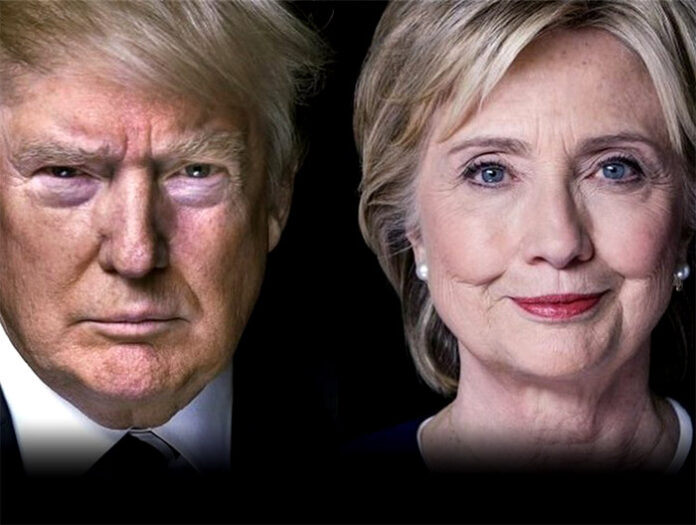
Clinton and Trump

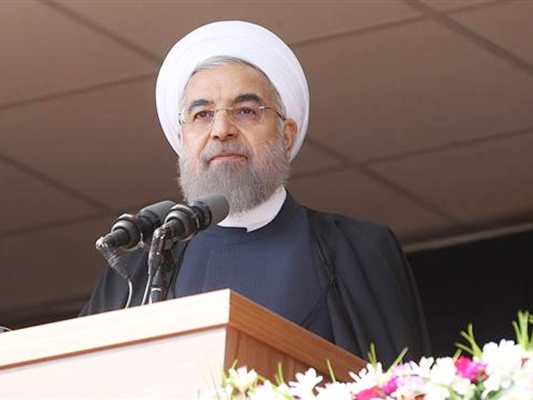
Addressing a crowd of people in the central city of Arak on Sunday, President Rouhani deplored lack of morality in the presidential campaigns in the US, a large and industrial country that claims to have enjoyed democracy for more than 200 years.

The lack of ethical standards in the US was obvious in the presidential debates, he said, adding, “We have seen the way the (US presidential) candidates speak, accuse and mock (one another); and this is the American democracy and election.”

The Iranian president also said that during the UN General Assembly in September, he was asked by a foreign leader about his preferable choice between Clinton and Trump, and his reply was: “Should I prefer the bad to worse or worse to bad?”

His comments came after Leader of the Islamic Revolution Ayatollah Seyed Ali Khamenei lashed out at the US presidential candidates for their comments during the debates.

“The (ongoing) election campaigns in America and issues raised by the two candidates constitute a clear and evident example of the consequences of lack of spirituality and faith among those in power,” the Leader said on October 20.

“During the coming weeks, one of these two candidates of America’s (presidential) election, whose remarks and condition you observe, will become the president of a country which has power and wealth and the biggest amount of nuclear weapons as well as the biggest media in the world,” Imam Khamenei said.

The US presidential election will be held on November 8.

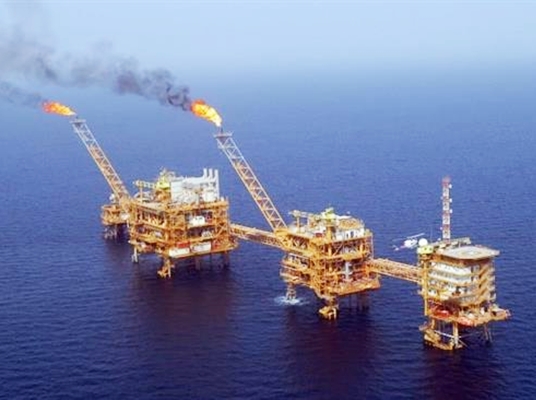
Iran to sign 6 oil deals with intl. firms

e2cafd22-f90d-4429-974e-09946672b784

Gholam-Reza Manouchehri, the deputy for engineering and development affairs of the National Iranian Oil Company (NIOC), neither specified the companies nor the projects. Nevertheless, he did indicate that the projects are large scale.

Manouchehri further emphasized that the companies that win oil sector deals in Iran will have to team up with locals.

“The foreign companies will play a central role in the development of major fields,” Manouchehri. “Still, they will have to use the help of Iranian companies for their projects”.

The official also added that Iranian companies can be only the project leader for the development of small fields and can to the same effect use the help of foreign enterprises.

Elsewhere in his remarks, Manouchehri said that Iran has so far signed memorandums of understanding (MoUs) with 10 companies over the development of certain oil sector projects.  However, he did not name the companies and the projects for which they have signed the MoUs.

Last week, the NIOC invited eligible international companies to participate in the pre-qualification phase of a tender for 50 exploration and development targets across the country.

The targets include a variety of low and average risk oil and gas fields. They include lucrative oil targets like South Azadegan, Changuleh, and Ahwaz-Bangestan as well as promising gas fields such as Kish, Farzad-A, North Pars, Golshan and Ferdowsi.

The tender is a central part of Iran’s plans to increase its production to above four million barrels per day – the same level that existed before a series of draconian US-led economic sanctions were imposed against the country in 2012.

The Real Iran: Belgian Photographer’s Account of ‘Unparalleled Hospitality’ and ‘Rich Culture’ of Modern Iranians

According to a report by Faradid, as covered by IFP using barcroft.tv website, after meeting with Iranian people, Belgian photographer Pascal Mannaerts, 38, was enchanted by the warm hospitality of Iranians and had to visit the country and explore its rich cultural heritage.
Starting in the capital of Tehran, Pascal travelled across the vast country, stopping off in Yazd, Fahraj, Shiraz, Isfahan and Kashan.
He said, “Meeting the Iranians was truly amazing. It’s so crazy how the image that has been shown about the country in the worldwide media for years, because of politics and international relations, could have given people a totally wrong idea about the people of the country.
“They are among the sweetest and most welcoming people you could find on this planet, believe me!”
Settlements in Iran date back to as early as 4,000 BC, making it one of the oldest continuous civilisations in the world.
In the contemporary era, Iranians are eager for other countries to see beyond their conflicted past and enjoy the stunning architecture and welcoming culture of modern Iran.
Pascal said, “I really felt that they were so happy to meet foreigners and sincerely eager to know about you, about where you come from, about what you think about them, what you have heard about their country before arriving and what your impressions are once inside the country.”
“It was a true, sincere and enriching experience. I really felt this will of the Iranians to be known by you for what they are and not according to the image some people may have had in the past.”
The fast-growing country was once the centre of the Persian Empire, the first established by Cyrus the Great in 550BC when he conquered Media, Lydia and Babylonia, and it now houses countless ancient relics.
While Pascal travelled, he found all Iranians happy to have their photo taken and recalls meeting one particularly memorable group of students.
Mannaerts said, “I remember I was in an old mosque in Fahraj and suddenly, a group of students came in. There was no one else around except them and me and they ran to me like crazies, asking me questions. It was so funny.”
“Of course, they then started to take pictures and selfies together. Surprises like this just demolished all the clichés you could imagine about Iran.”
Iran is made up of a broad spectrum of people, including Shiite and Sunni Muslims and a small Jewish, Christian and Zoroastrian population.
Mannaerts said, “I think it’s very important for anyone to share his experiences once back home but for Iran, it’s probably even more important.
“There has been a lot of press about the country and its people for years that was not especially flattering or was totally wrong.”
“The people you’ll meet there are among the most welcoming and friendly people you’ll be able to meet when travelling around the globe.”


Iran’s Diplomatic Leverage Inspired by Defense Power: Commander

general-gholam-reza-jalali

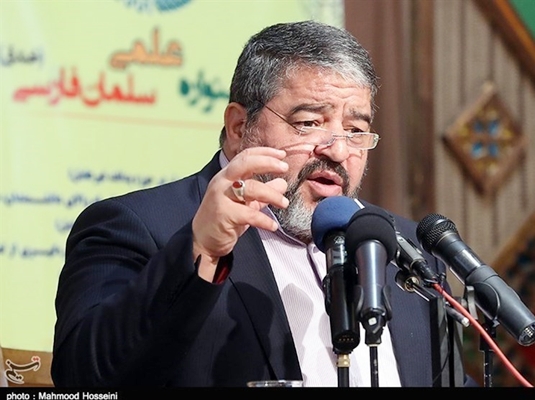
Iranian politicians sitting at the negotiating table with a smile are encouraged by the country’s reliable defense power, General Jalali said in an academic conference in Tehran on Sunday.

“The fact that our enemies rule out ground attacks against us does not result from the political smile (of Iranian diplomats), but from the strong military defense in the ground sphere,” he underlined.

Jalali also touched on the display of underground missile facilities of the Islamic Revolution Guards Corps (IRGC), stressing the need for putting part of the country’s military capabilities on display to shatter the enemy’s illusions.

However, the commander noted, part of Iran’s military capabilities should be kept dark to serve as a surprise element.

Leader of the Islamic Revolution Ayatollah Seyed Ali Khamenei has frequently underlined the need for strengthening the country’s military capabilities, saying Iran has “an inalienable and absolute right” to reinforce its defensive and offensive power.

Iranian President Nominates Three New Ministers

ministers

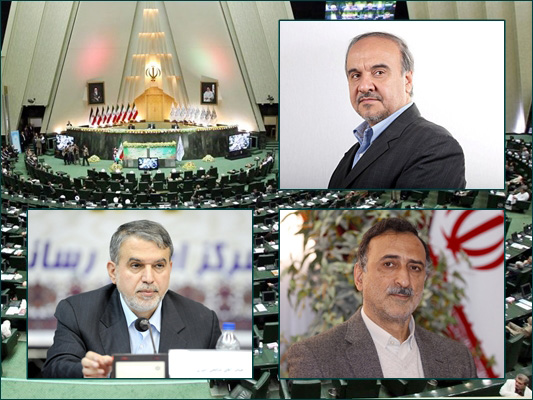
In a letter to Parliament Speaker Ali Larijani released on Sunday, President Rouhani named Seyed Reza Salehi Amiri, Masoud Soltanifar, and Fakhreddin Ahmadi Danesh Ashtiani as the ministers of culture and Islamic guidance, sports and youth affairs, and education respectively.

The ministerial nominees will take office after they win confidence vote from the Iranian lawmakers.

In separate decrees on Wednesday, Rouhani had appointed Seyed Abbas Salehi, Nasrollah Sajjadi and Seyed Mohammad Bathaei as the acting ministers of culture and Islamic guidance, sports and youth affairs, and education.

The appointments followed resignation of Ali Jannati, Mahmoud Goudarzi, and Ali Asghar Fani after serving as minsters for over three years.

The developments come as the current administration’s term in office will end next year.

Iran’s upcoming presidential elections are due to be held on May 19, 2017.

World Countries Racing to Promote Ties With Iran: Rouhani

rouhani

The Iranian chief executive made the remarks in an address to a large crowd of people in the central city of Arak in Markazi Province on Sunday during his 32nd provincial visit ever since assuming office in 2013.

“In previous years, there was a competition across the world for threatening Iran, exercising pressure on it, and subjecting it to sanctions. Today, there is, instead, a global competition for communications with Iran,” he said.

Over the past three years, the country has attracted more than $3.8 billion in foreign investment for 133 development projects, 58 of which have been completed, Rouhani noted.

“Ever since the conclusion of the JCPOA, [as much as] $1.6 billion has found its way into the country in the form of foreign investment in the fields of mining and industry,” he said.

The Joint Comprehensive Plan of Action (JCPOA) was inked between Tehran and the P5+1 group of world powers, namely Russia, China, France, Britain, the US and Germany on July 14, 2015.

The accord, which took effect in January, ended decades of economic sanctions against Iran in exchange for restrictions on its nuclear program.

“The JCPOA is the result of Leader of the Islamic Revolution [Ayatollah Khamenei]’s tactfulness, the Iranian nation’s 10- to 12-year-long resistance [during related nuclear talks] and the policy employed by the Islamic Republic’s establishment,” Rouhani asserted.

In other remarks, President Rouhani pointed to the election campaign ahead of the US presidential race next month, and criticized debates between the two main candidates as immoral.

“The US claims to have 200 years of democracy… There is no morality in that country. We can see to what level they have scooped. You watched the presidential debates. Everybody saw the way they talked… Look at their discourse, accusations and belittlement!”

A Look at Iranian Newspaper Front Pages on October 23

Almost all newspapers on Sunday covered the Venezuelan President Nicolas Maduro’s visit to Tehran and his separate meetings with the Leader of the Islamic Revolution Ayatollah Seyyed Ali Khamenei and President Hassan Rouhani.

They also covered the remarks made by President Rouhani about his cabinet reshuffle and the ongoing problems in the country, including unemployment.

The latest developments of the ongoing operation in Iraq to retake the northern city of Mosul also remained a top story today.

The above issues, as well as many more, are highlighted in the following headlines:

Abrar:

1- Deputy Health Minister: 38m Iranians Exposed to Air Pollutants

2- ISIS Leader Executes 59 Senior Commanders

3- Erdogan: Mosul Historically Belongs to Turkey
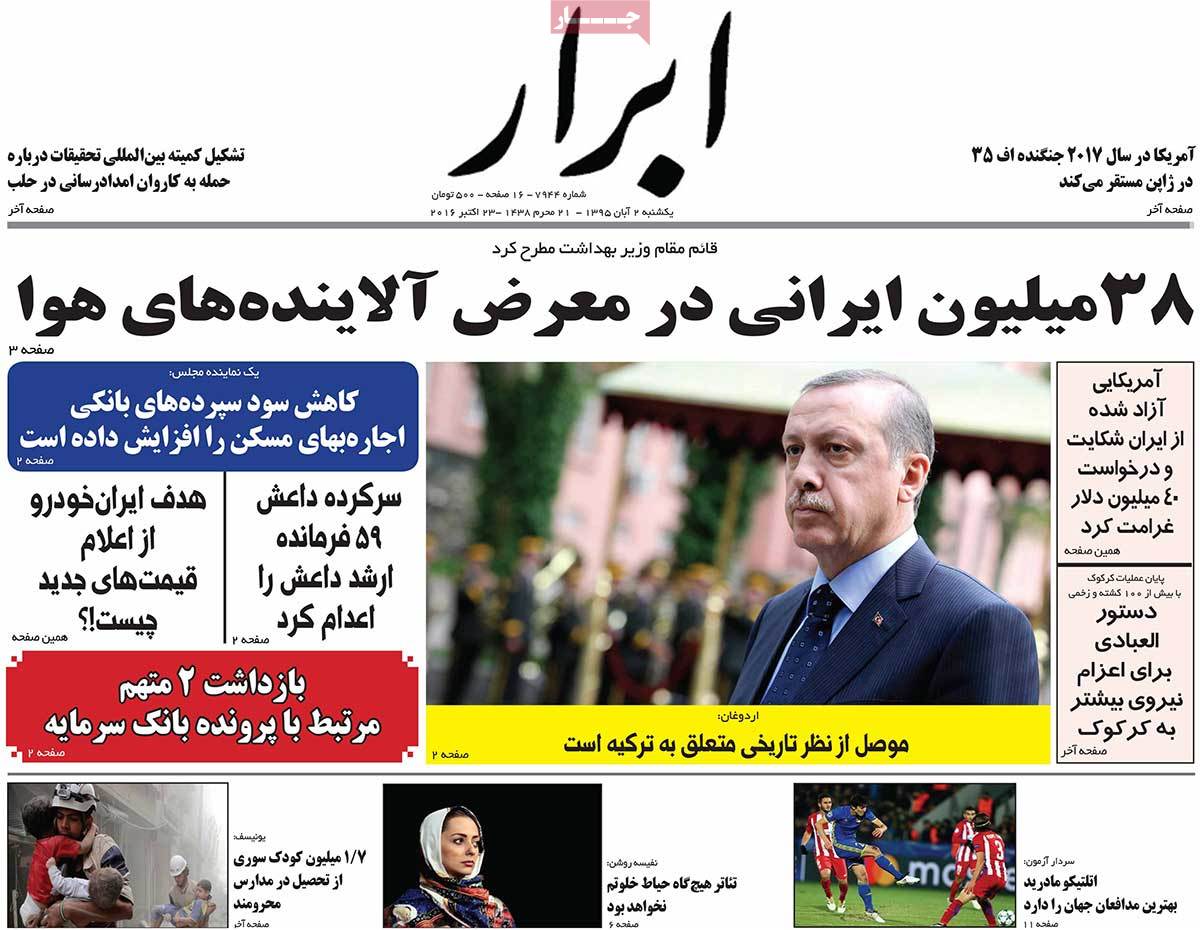
A Look at Iranian Newspaper Front Pages on October 23


Abrar-e Eqtesadi:

1- Deputy Oil Minister: Return of Deutsche Bank to Iran’s Oil Deals
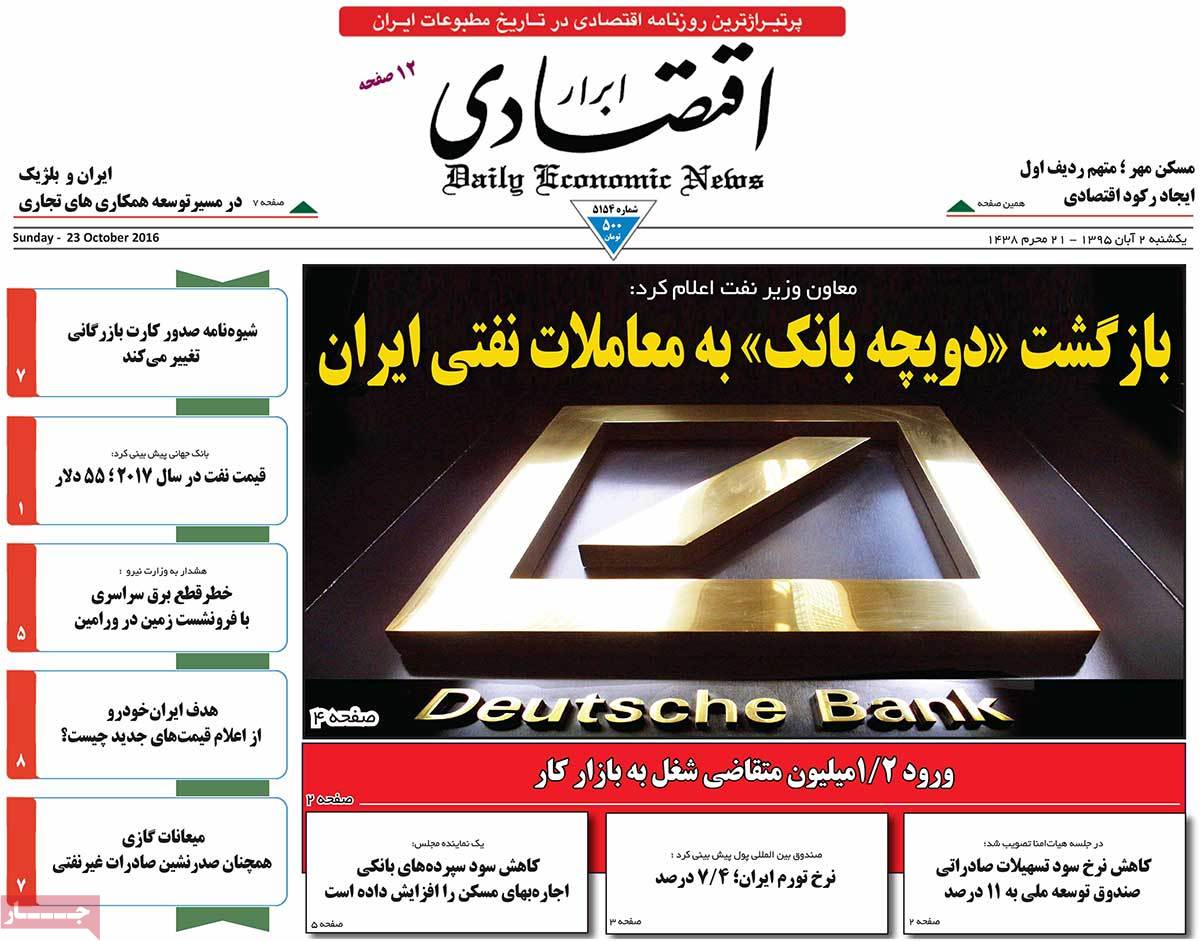
A Look at Iranian Newspaper Front Pages on October 23


Aftab-e Yazd:

1- Rouhani: Media Should Stop Telling Lies
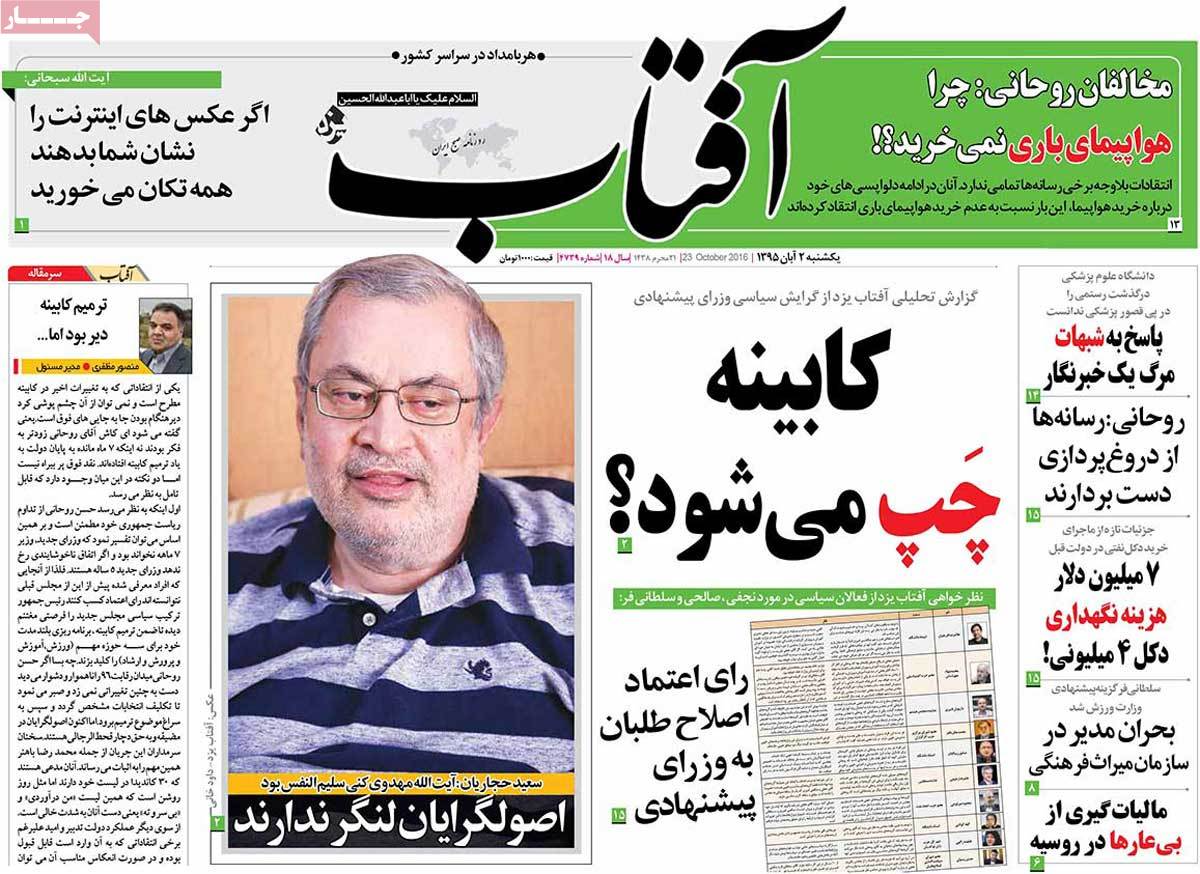
A Look at Iranian Newspaper Front Pages on October 23


Amin:

1- Wives of 12 Foreign Ambassadors Join “I’m Lake Urmia” Campaign
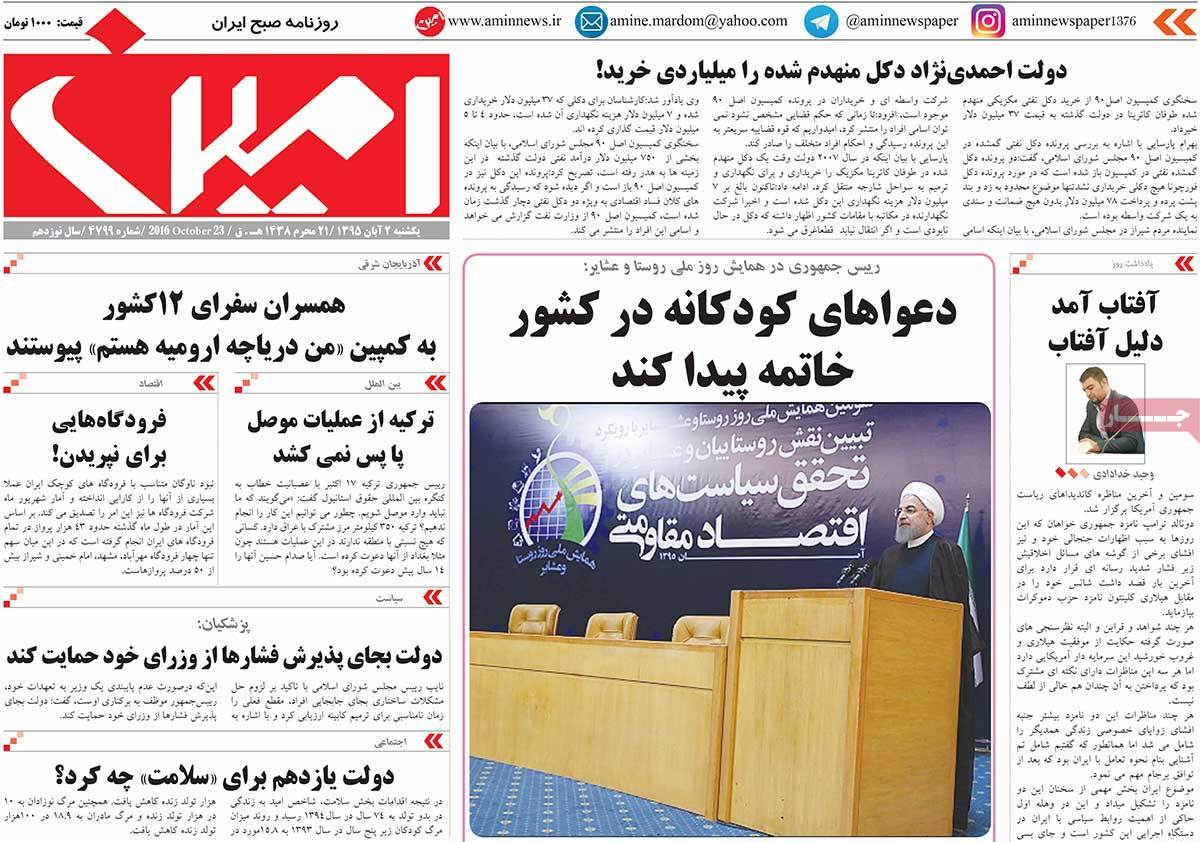
A Look at Iranian Newspaper Front Pages on October 23


Arman-e Emrooz:

1- Leader in Meeting with Maduro: West Is Using Oil as a Weapon

2- Violation of Law in Oil Industry during Ahmadinejad’s Gov’t Continues to Be Revealed: Paying $37m for an Oil Rig that Was Worth $5m
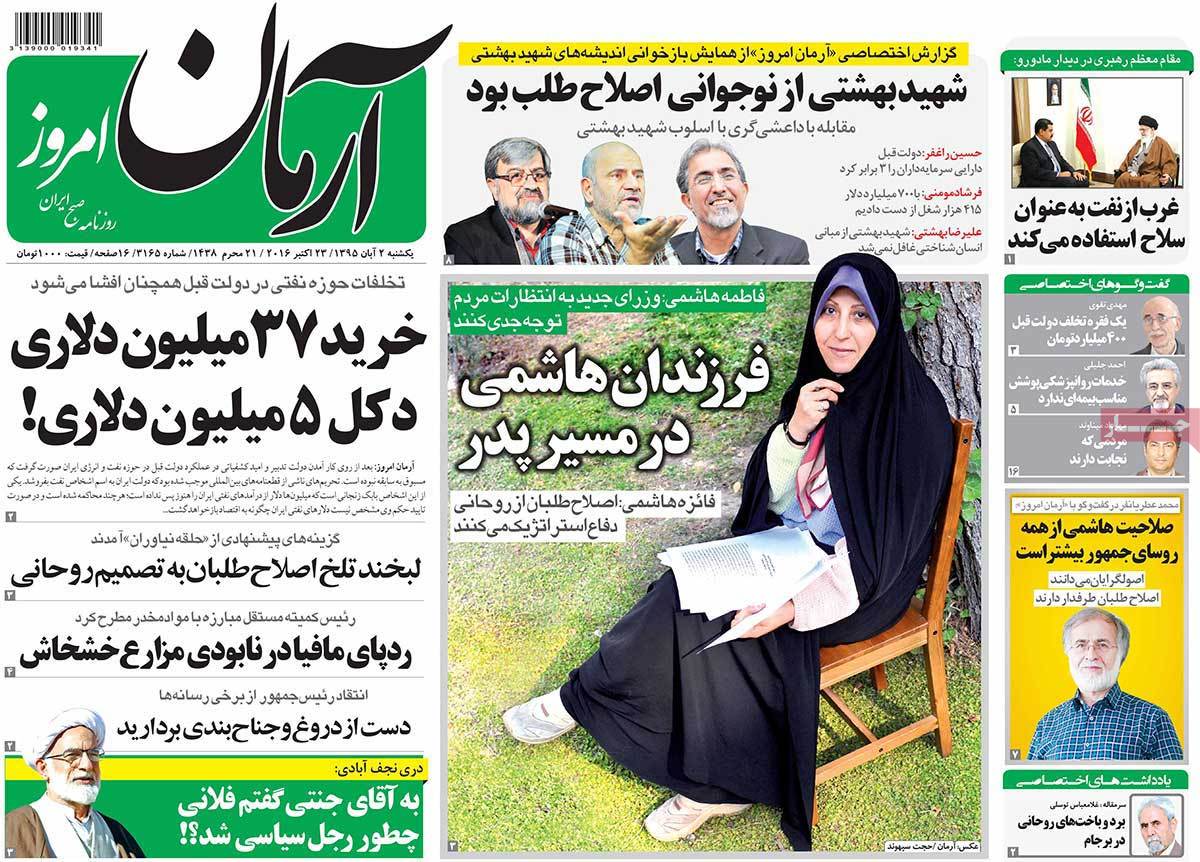
A Look at Iranian Newspaper Front Pages on October 23


Asrar:

1- Rouhani: Childish Fights in Iran Should End

2- 5 Presidents from 3 Continents En Route to Iran

3- Velayati: Al Saud Doesn’t Understand Anything but Force

4- Deputy FM: Iran Has No Problem with Human Rights Talks with Europe
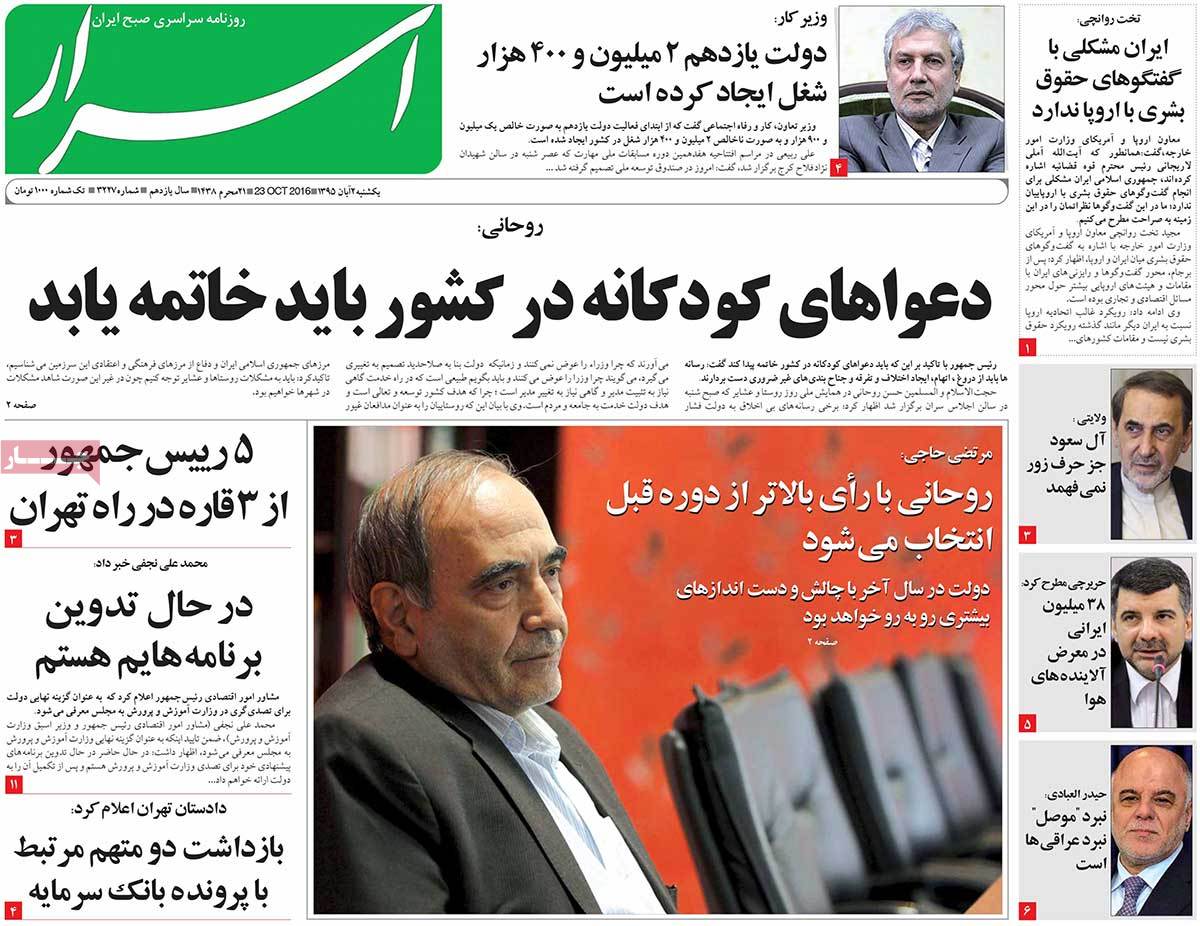
A Look at Iranian Newspaper Front Pages on October 23


Ettela’at:

1- Leader: With Wise Policies, Plots Can Be Overcome

2- Rouhani in Meeting with Venezuelan President: Iran Supports Any Move towards Fair Oil Price

3- IMF’s Prediction about Continued Decrease of Inflation Rate in Iran
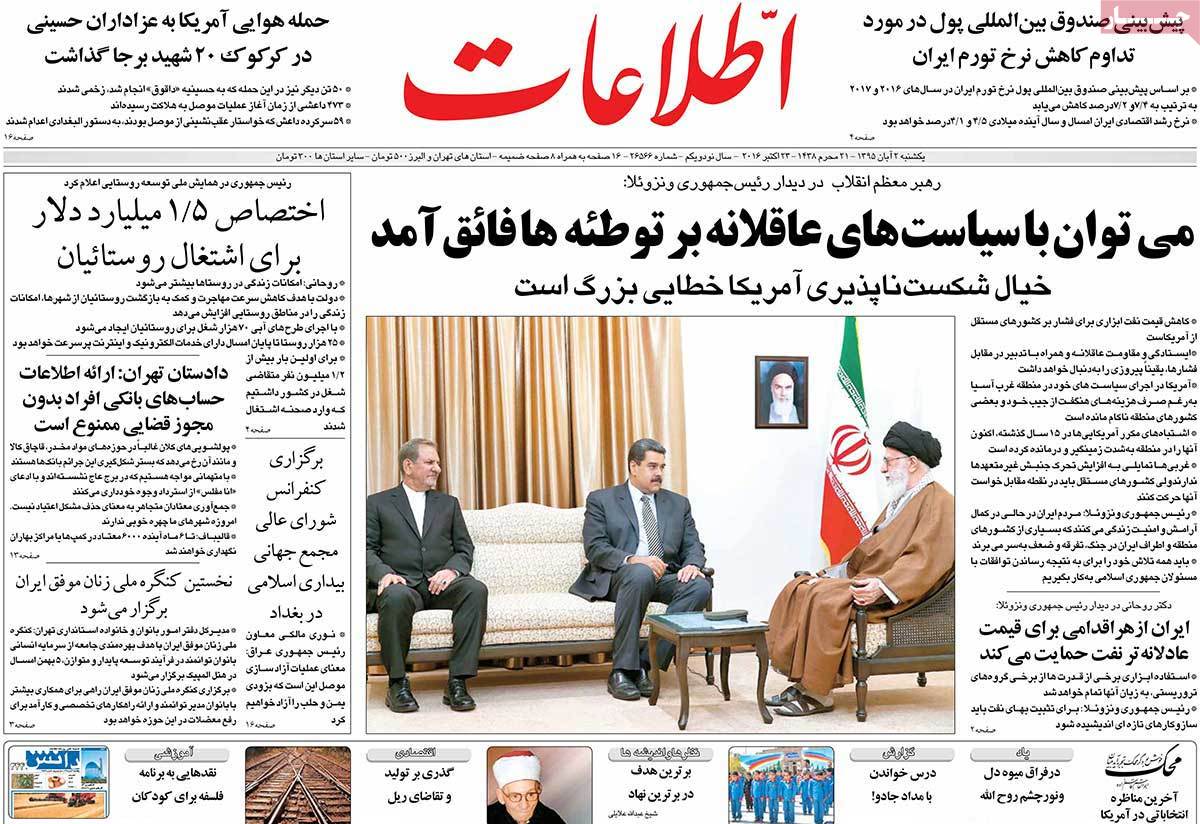
A Look at Iranian Newspaper Front Pages on October 23


Hemayat:

1- Germany Ready to Exchange Anti-Corruption Experts with Iran

2- Ramadan Abdullah: Iran Is the Only Country that Supports Palestine

3- Deputy of US Treasury: Imposition of Heavy Sanctions against Countries Affiliated with Iran
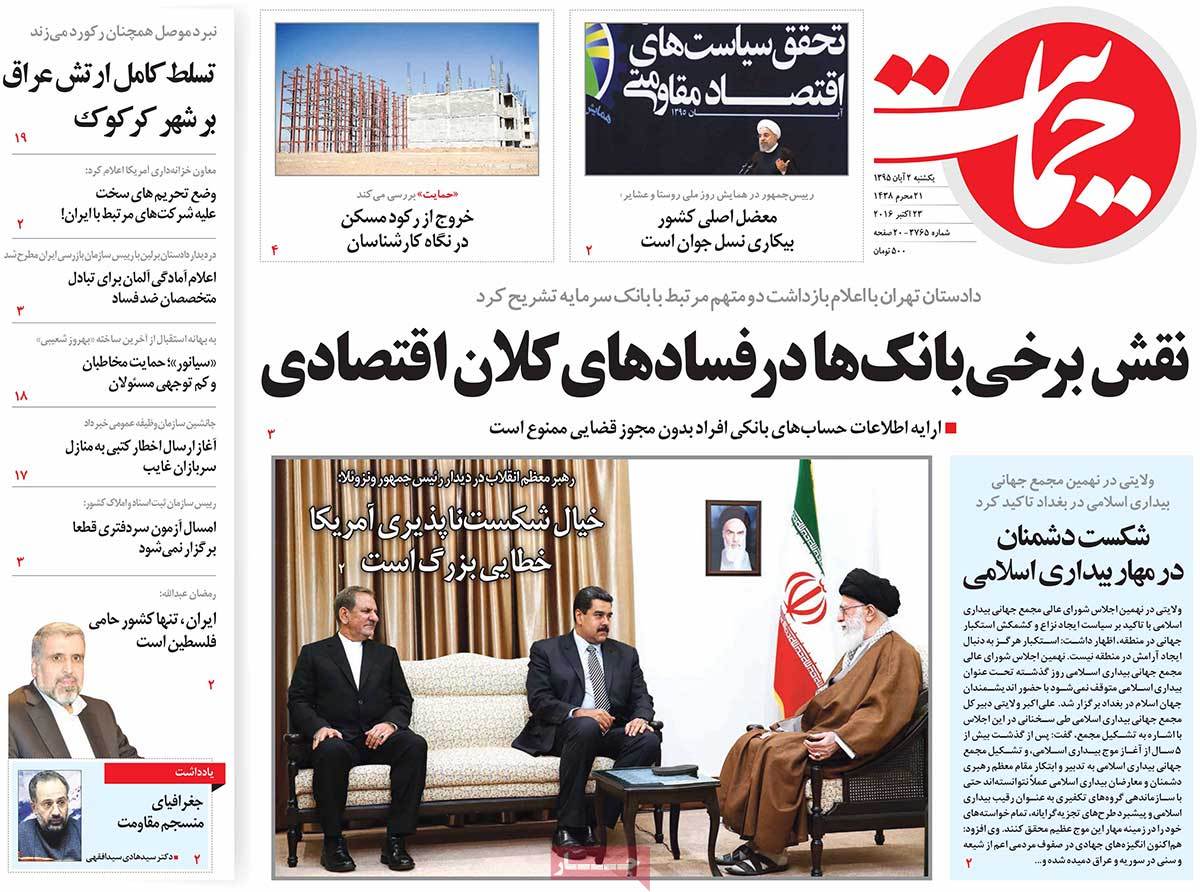
A Look at Iranian Newspaper Front Pages on October 23


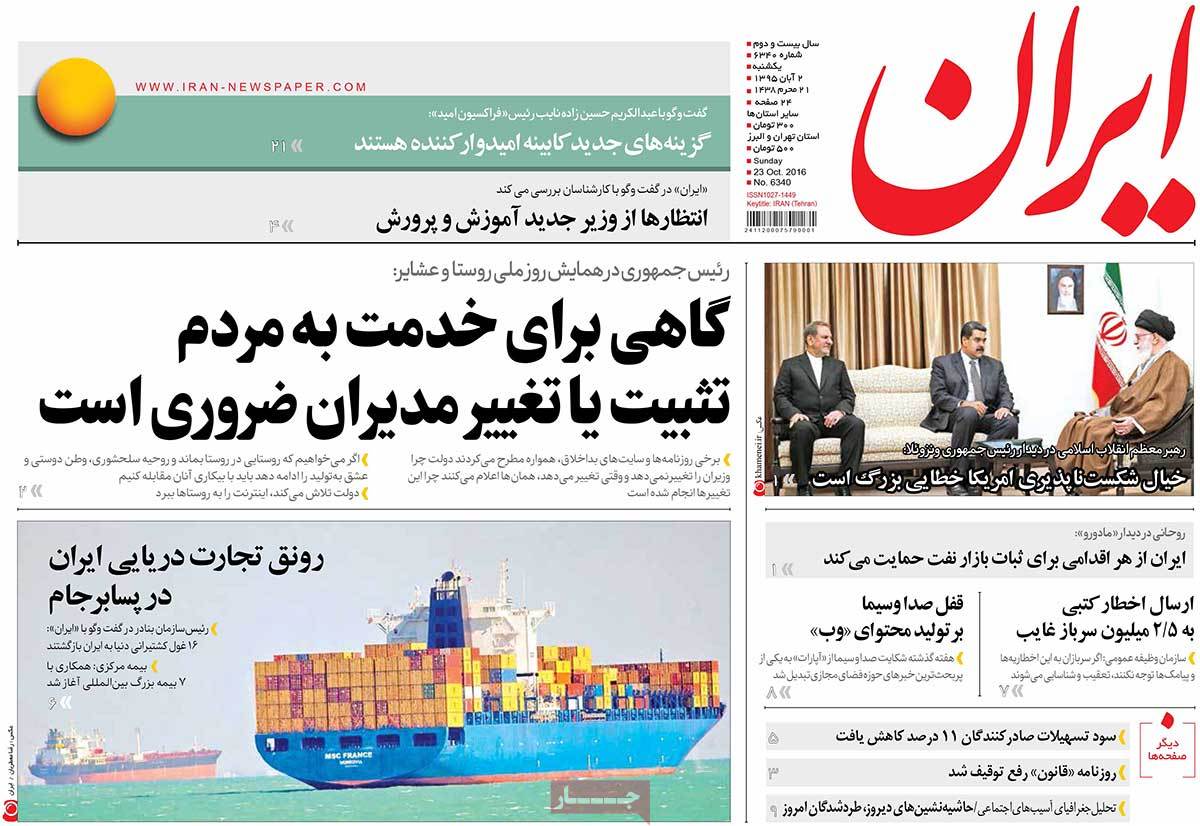
Iran:

1- Iran’s Marine Trade Flourish in Post-JCPOA Era: 16 Giant Shipping Companies Return to Iran

2- Central Insurance: Iran Starts Cooperation with 7 Major Int’l Insurance Companies

3- President: Both Changing the Executives or Keeping Them Are Sometimes Required for Giving Better Services to People
A Look at Iranian Newspaper Front Pages on October 23


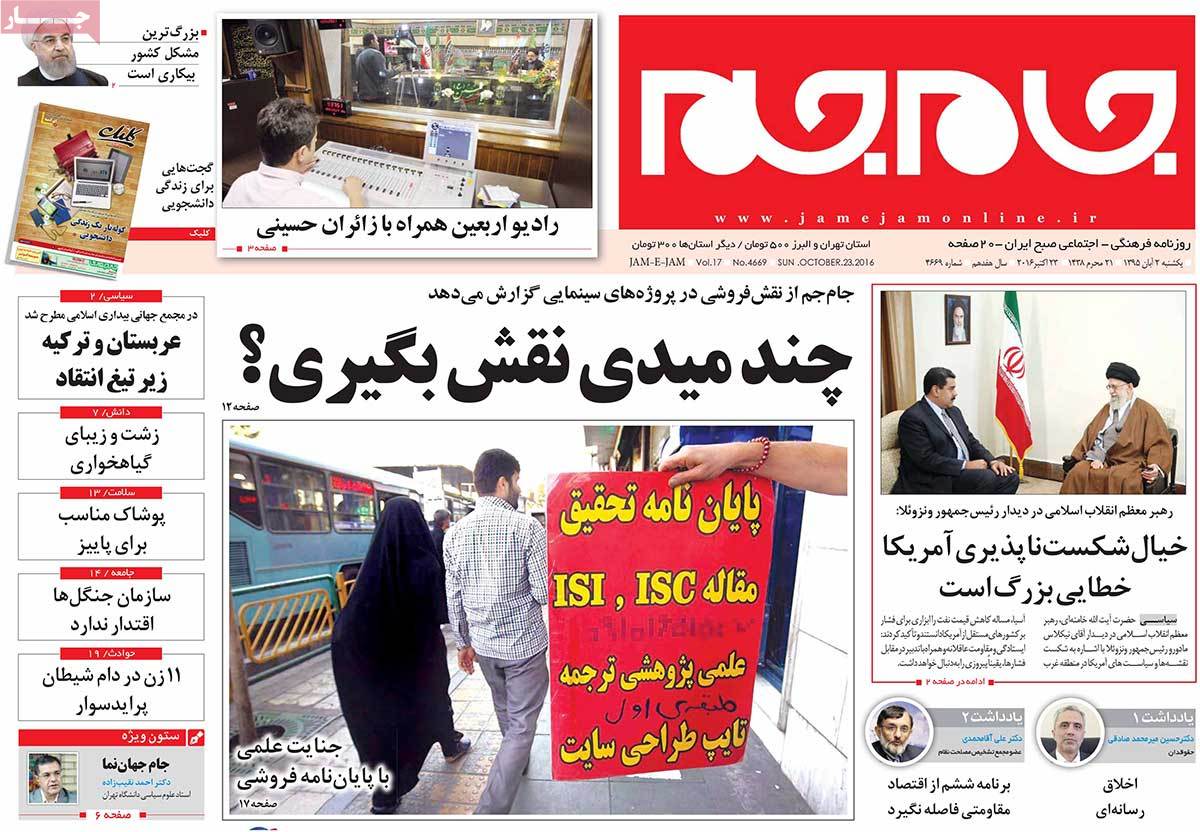
Jame Jam:

1- Leader: It’s a Big Mistake to Think that US Is Invincible

2- Selling Theses Is a Scientific Crime

3- Rouhani: Unemployment Is Iran’s Biggest Problem

4- Saudi Arabia and Turkey Sharply Criticized in World Assembly of Islamic Awakening
A Look at Iranian Newspaper Front Pages on October 23


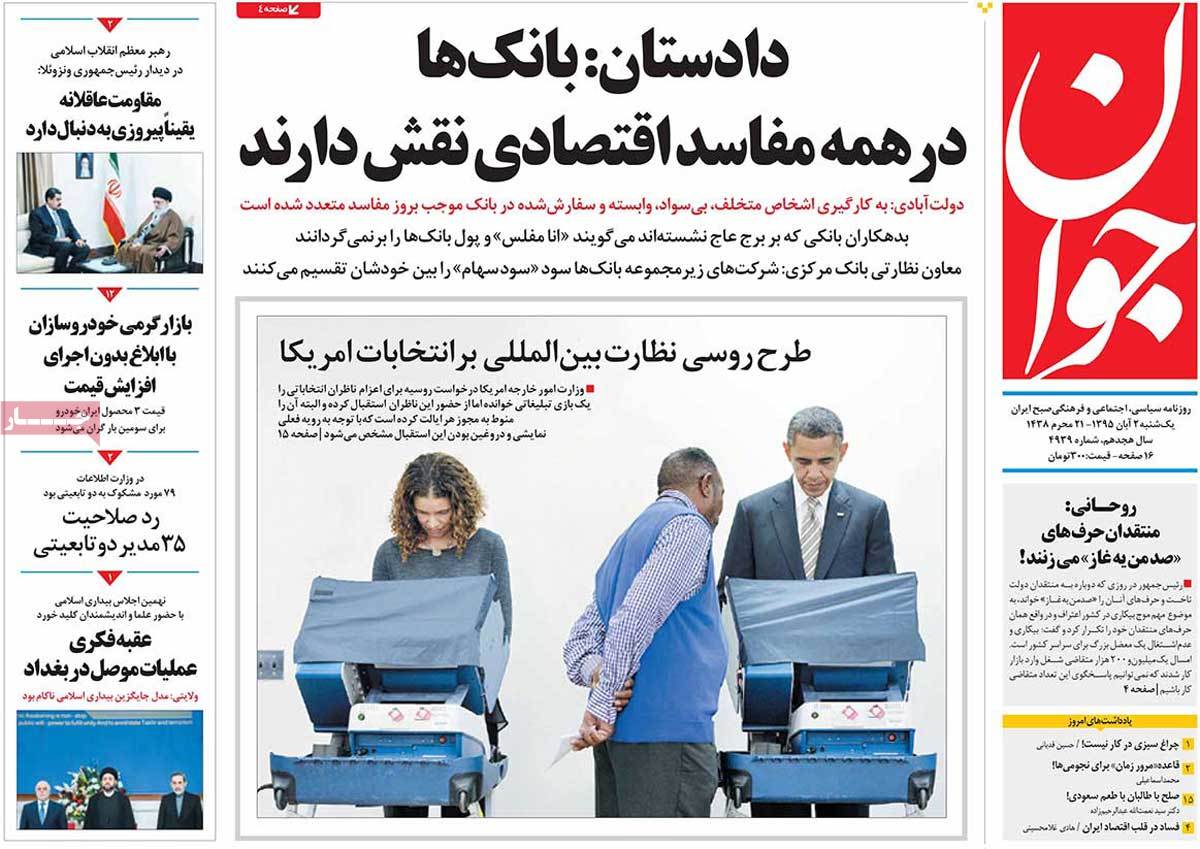
Javan:

1- Banks Have Roles in All Economic Corruption Cases

2- Russian Plant for International Monitoring over US Elections: US State Department Says It Is for Show, But It Welcomes Such Supervisors
A Look at Iranian Newspaper Front Pages on October 23


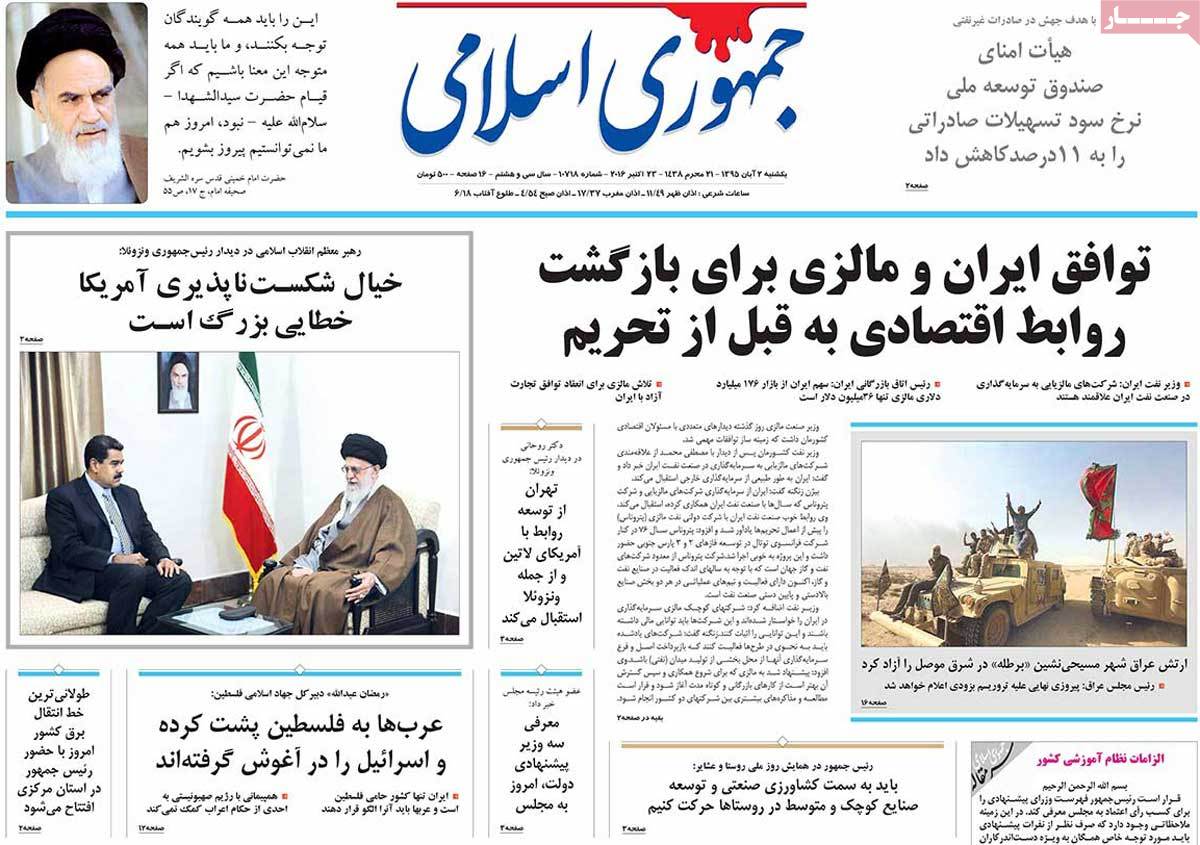
Jomhouri Eslami:

1- Iran and Malaysia Agree on Return to Pre-Sanction Level of Economic Ties

2- Rouhani: Tehran Welcomes Expansion of Ties with Latin America, Including Venezuela

3- 3 Candidates to Be Introduced Today by Government to the Parliament for Ministries of Education, Sports, and Culture

4- Rouhani to Inaugurate Longest Power Transmission Line Today


A Look at Iranian Newspaper Front Pages on October 23


Kayhan:

1- Based on Transport Ministry’s Statistics: 8 Months after JCPOA, Transit of Goods from Iran Sharply Declined

2- US Analyst in Interview with Kayhan: Why US Was Engaged in Yemen War

3- Third Released American Also Sues Iran
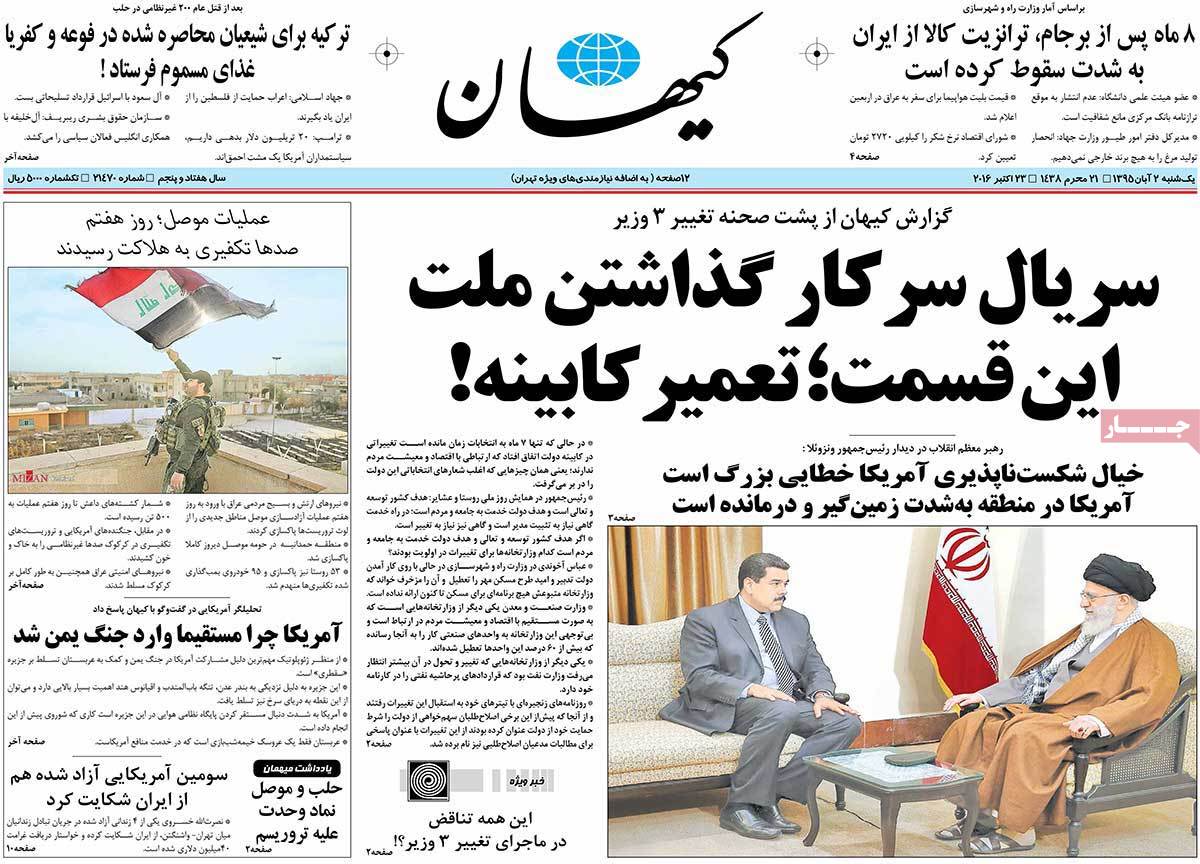


A Look at Iranian Newspaper Front Pages on October 23


Resalat:

1- Rouhani: We Can’t Respond to the Demands of Those Seeking a Job

2- Head of Civil Defence Organization: Biological Attack Is Possible in Iran

3- Ayatollah Sobhani: Beliefs of Young People in Iran Are Bombarded in Cyberspace

4- US Psychological War Defeated in Mosul: Reports of a Deal between Turkey and Iraq Dismissed
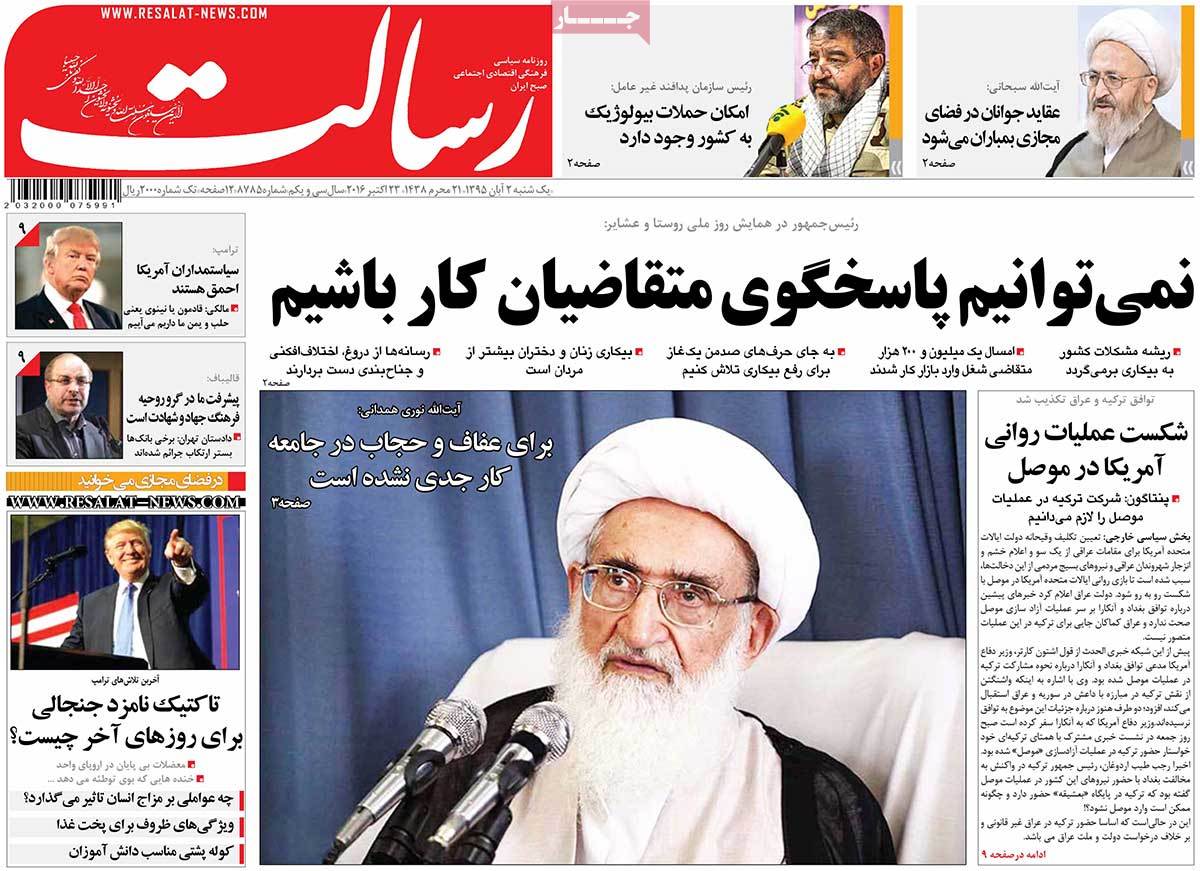


A Look at Iranian Newspaper Front Pages on October 23


Sepid:

1- Iran’s Special Advantages in Medical Tourism: Health Tourism, the Lucrative Sleeping Dragon

2- Decrease in Deaths Caused by Air Pollution in Past Two Years
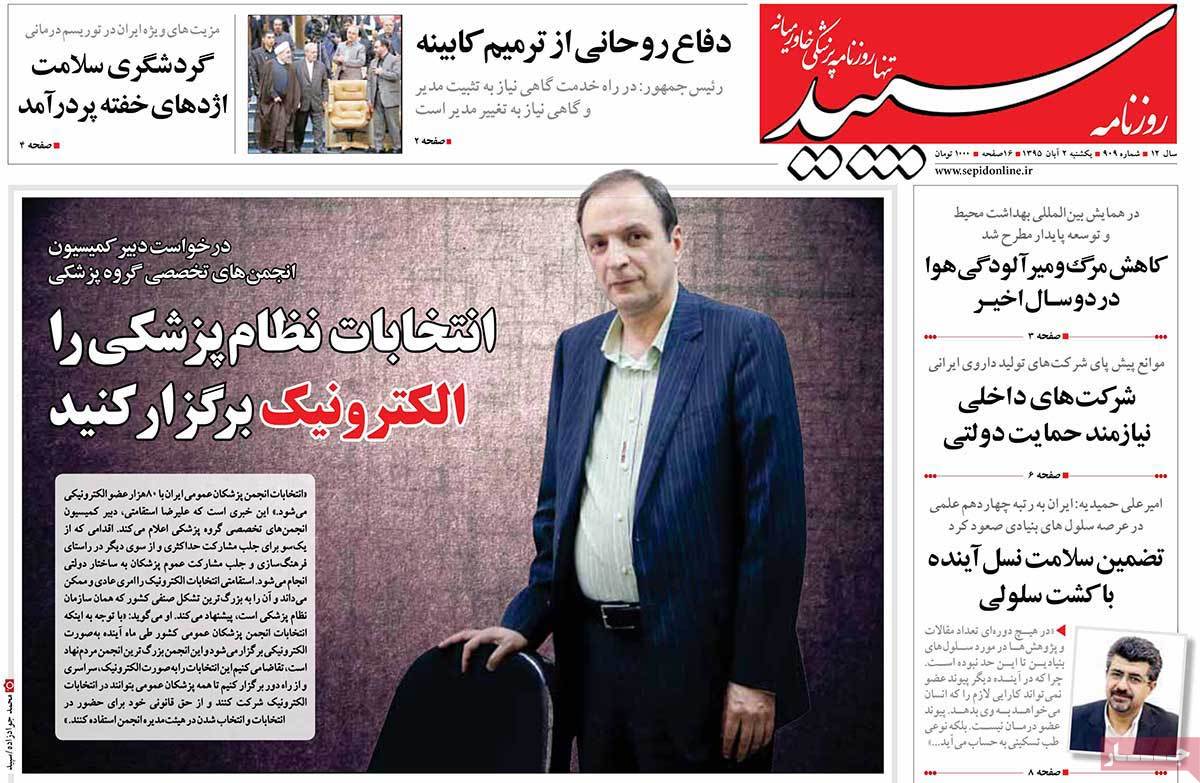


A Look at Iranian Newspaper Front Pages on October 23


Shahrvand:

1- One President in Iran Every 35 Days: A Report on Reciprocal Visits of Rouhani’s Gov’t in Past 19 Months

2- Football without Pain: About the Campaign ’90 Minutes without Cigarettes’ Launched in Iran by FIFA’s Medical Centre
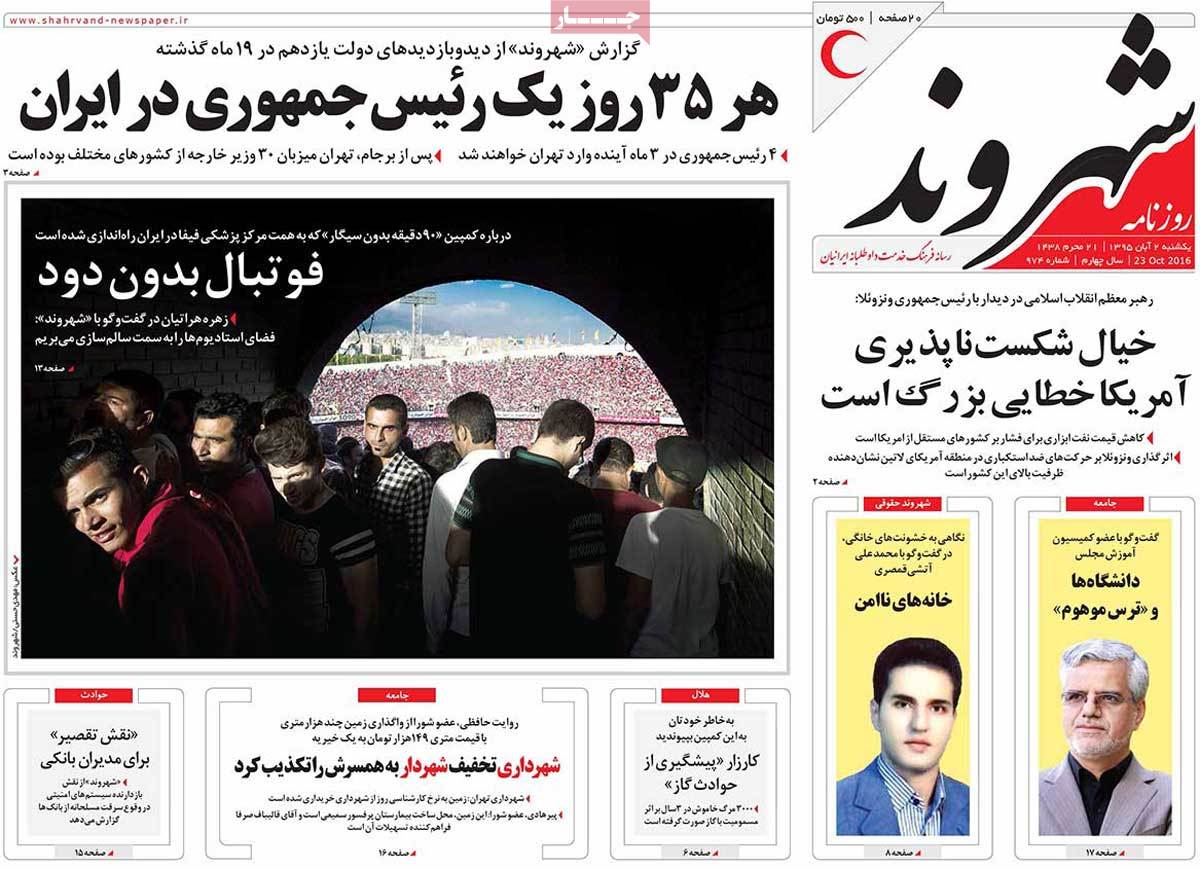
 

A Look at Iranian Newspaper Front Pages on October 23


Vaghaye Ettefaghieh:

1- Tehran Waiting for a Less-Polluted Winter: Predictions Suggest Some Measures in Controlling Tehran’s Air Pollution Have Borne Fruits

2- Happiness among Kurds Is Much More than Many Other Areas: Sociologist
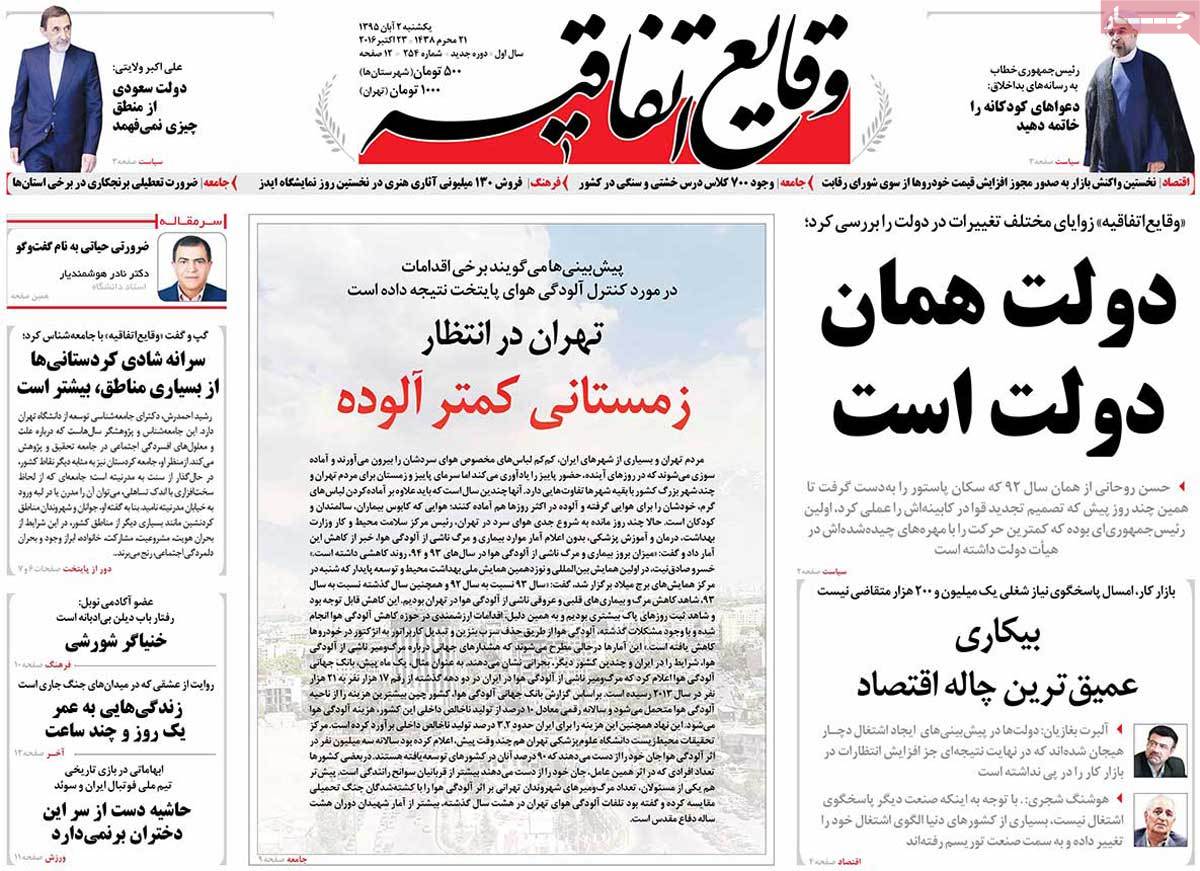
A Look at Iranian Newspaper Front Pages on October 23

Iraqis May Be Fined Up to $21,000 for Alcoholic Drinks

Iraq Parliament

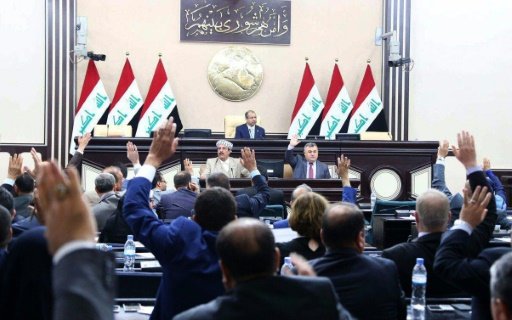
Based on the new law passed by the Iraqi Parliament, whoever imports, produces, buys, or sells alcoholic drinks in Iraq may be fined from $8,500 to $21,000.

According to a report by Al Alam News Website, as translated by IFP, tens of companies in different parts of the Arab country, particularly in Baghdad, are in the business of producing and selling alcoholic drinks.

However, Iraqi officials say they will introduce alternative jobs for those working in this illegal business.

German Officials to Be Banned from Wearing Burqa

12

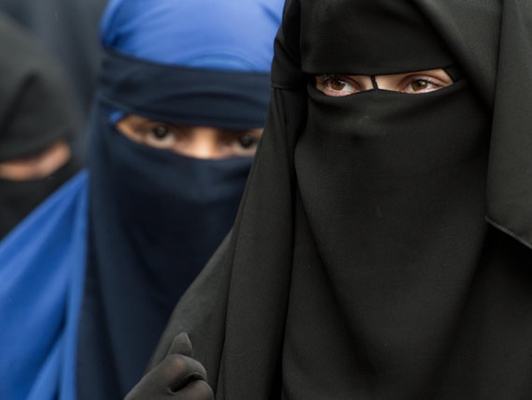
According to a report by Der Spiegel, citing a representative of the Ministry of internal Affairs of Germany, a bill has been proposed to ban public officials from wearing full Islamic face veils on the grounds that it obstructs clear communication.

The authors of the bill emphasize that the hidden face “restricts the ability of travellers and does not allow to assess the personality”.

“Open communication is a formative part of the ability to live together in a free, democratic society,” the draft bill read.

The proposal, presented by the German interior ministry on Friday, further states that the face veil hinders “the possibility to get to know and evaluate someone’s personality,” as reported by i24news and covered by YJC.

The bill calls on state officials to not wear “clothing that makes open communication impossible or more difficult,” including women employed as public officials.

It further stipulates that women who wear the veil show their faces during passport control, court rulings, and at polling stations.

German Interior Minister Thomas de Maiziere came in favour of a partial ban on the burqa in August amid a fierce national debate on integration.

“We agree that we reject the burqa, we agree that we want to introduce a legal requirement to show one’s face in places where it is necessary for our society’s coexistence — at the wheel, at public offices, at the registry office, in schools and universities, in the civil service, in court,” he said at the time.

According to official data collected in 2009, 28 percent of women in German identifying as Muslim wore some kind of covering, including either a headscarf or full face veil.

The number of women who wear full face veils in Germany is thought to be fairly small.

Inclusion of Egypt in Lausanne Talks Was Iran’s Pre-Condition: Report

Iran FM

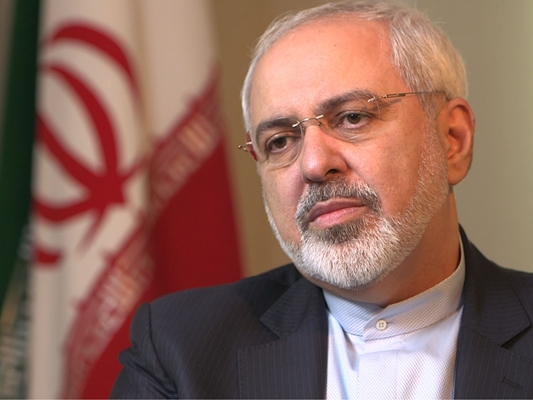
According to a Thursday report by The Guardian, as covered on Sunday by Jomhoori Eslami newspaper, the Iranian Foreign Minister Mohammad Javad Zarif personally requested that Egypt attend last weekend’s key Syria talks – a move that has sparked concerns that Cairo is being wooed away from its traditional pro-western stance in the region.

Talks convened by the US Secretary of State, John Kerry, in the Swiss city of Lausanne last Saturday evening failed to agree on a common strategy with Russia to end the conflict in Syria, now in its sixth year.

The Guardian has seen emails indicating that the Iranian foreign minister asked Kerry for Cairo’s team to attend the Lausanne talks. When the US secretary of state proposed six-nation talks to “see if a new reasonableness can manifest itself” in Syria, Zarif replied: “Why not Egypt too?”

Iran agreed to attend the talks only once it had secured places for the foreign ministers of Egypt and Iraq at the discussions. Both countries back the pro-Assad stance of Iran but Egypt is seen as significant because it is the most populous Sunni Arab nation in the Middle East.

Iran was also keen not to be outnumbered by an anti-Assad coalition – comprising Turkey, Qatar, Saudi Arabia and the United States – at the Lausanne talks.