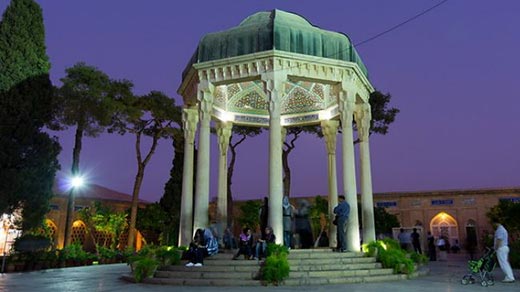
The tomb was awarded with certificate of excellence for the site’s unique architecture and the perfect behavior of its staff, said the director of Fars Province Cultural Heritage, Handicraft and Tourism Organization, Mosayyeb Amiri.
The agency also expressed its positive view on the historical tomb for the great facilities offered to its visitors.
While the view released after conducting a survey from visitors who are members of TripAdvisor, the website has recently named Hafez Tomb one of the world’s top historical sites, Amiri added.
Hafez tomb (Hafezieh) is one of the most popular attractions of Iranian southern city of Shiraz that is situated in a garden on the banks of Rukn-Abad river.
Built in 1773, the mausoleum acquired its present form in 1935 and designed by the French architect and archaeologist André Godard.
Hafez (1315-1390) is best known for his melodious sonnets and for intertwining a taste of Persian culture into his poetry.
Hafez has greatly influenced Persian and Western writers including Ralph Waldo Emerson and Goethe.
His collected works composed of series of Persian poetry (Divan) was first translated into English in 1771 by William Jones.
His poetry has also inspired many artists and musicians and his verses are recited during national occasions such as the Persian new year (Nowruz).
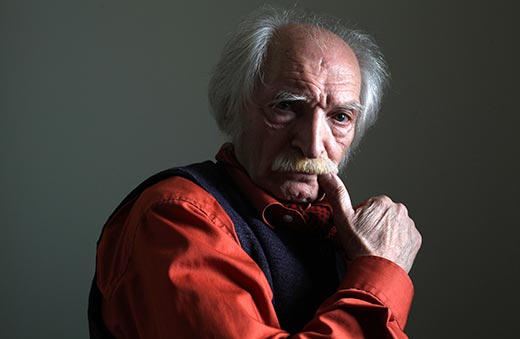
Mahmoud Dowlatabadi is an Iranian writer and actor, known for his promotion of social and artistic freedom in contemporary Iran and his realist depictions of rural life, drawn from personal experience.
‘Passed Times of the Elderly’ illustrates the lives of trees generation of a rural family who describe the past events from their own views. One of the main characters of the novel is Abdous, A MAN who has had to work from childhood as the breadwinner of his family and the harsh realities he has faced has turned him into a hard-boiled man.
Dowlatabadi who has an international reputation, is a master of combining rural speech with the lyrical feature of Persian poetry. He is particularly gifted in portraying the social and moral difficulties of the poor specially in rustic areas where he has himself lived.
His key works such as ‘Kelidar’; ‘The Colonel’ and ‘Missing Soluch’ were translated into Norwegian, German, English, Italian and have been released in the West.
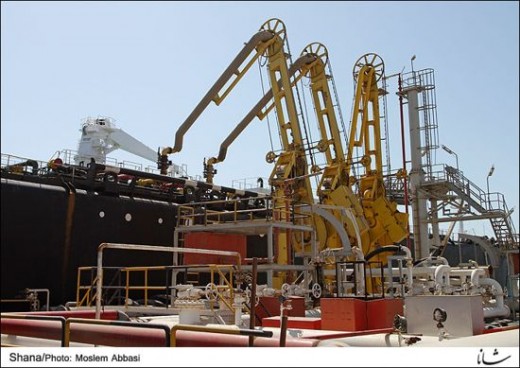
The exports, which involved 3.079 million tons of products, show a 10 percent rise from a year ago, Bushehr customs chief officer Ahmad Pour-Heydar said.
The products were mainly exported to the United Arab Emirates, India, China and Qatar, he said.
The Commodities included petrochemicals, chemicals, fishes, agricultural produce and cement.
During the same period, Pour-Heydar said, more than 412,000 tons of commodities worth 2.179 billion dollars were imported through Bushehr, showing 282 percent rise in value compared with the preceding year.
The imported products – cement, vehicles, audiovisual kits, banana and rice – mainly came from South Korea, UAE, China and India.
According to the poll conducted by The University of Maryland’s School of Public Policy and the Program for Public Consultation, 61 percent of the American people believe Washington should seek to cooperate with Iran in Iraq, according to Press TV.
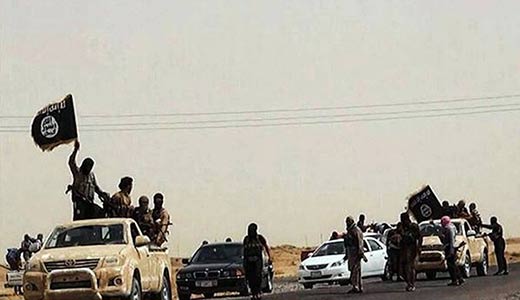
The Takfiri militants from the so-called Islamic State of Iraq and the Levant (ISIL) have been wreaking havoc in Iraq since June 10 when they took control of Mosul, Iraq’s second largest city, which was followed by the fall of Tikrit, the birthplace of former Baathist dictator Saddam Hussein.
Iraqi armed forces have been pushing back the ISIL terrorist militants, who enjoy support from loyalists of Iraq’s former Baathist regime. Media reports said on Tuesday that the Iraqi army regained full control of Tikrit during a major offensive against the terrorist militants.
Last month, US Secretary of State John Kerry said the Obama administration is “open to discussions” with Iran and does “not rule out” military cooperation with the Islamic Republic to help the Iraqi government beat back ISIL militants.
However, Iran said the Iraqi army is capable of dealing with the crisis itself and Tehran sees no need to negotiate with Washington on the issue.
Several reports, observers, and even some US officials like Senator Rand Paul (R-Kentucky) have said that the US has been behind the rise of ISIL.
Last month, Paul said the US has been arming the ISIL militants in Syria. “I think we have to understand first how we got here,” Paul said on CNN’s ‘State of the Union.’ “We have been arming ISIS in Syria.”
In a phone interview with Press TV on June 30, Wayne Madsen, an American investigative journalist, said that CIA director John Brennan who is “a known Saudiphile” has been instrumental in training and arming these militants in Iraq and Syria.
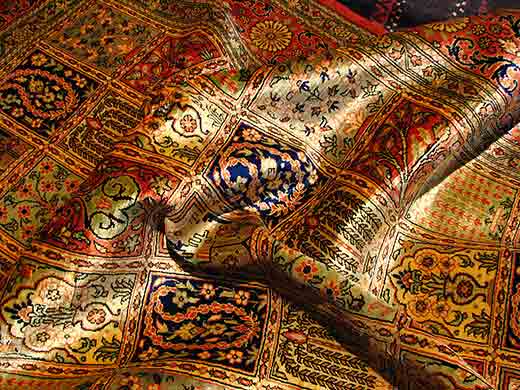
The exports amounted to $57 million in value in spring 2014, which corresponds to the first quarter of current Iranian calendar year, the Tasnim news agency quoted Hamid Karegar as saying.
He said Iran exported $314 million worth of hand-made carpets in the past Iranian calendar year, which ended on March 20, 2014.
Iran’s carpet exports declined in recent years, mainly because of the Western sanctions imposed against the country over its nuclear program, he added.
In February, the former director of Iran’s National Carpet Center said sanctions against exports of Iranian carpet may be lifted in the second half of 2014.
Mohammad Baqer Alikhani added that the Ministry of Foreign Affairs has negotiated with the 5+1 group (the five permanent members of the UN Security Council plus Germany) to lift the sanction in the second half of the current year.
Sanctions against exports of Iranian carpets had been imposed directly by the U.S., he noted.
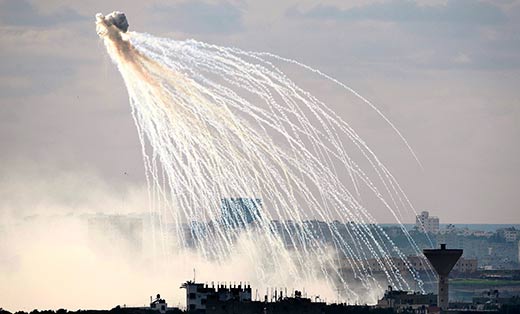
The little-known stockpile is officially known as War Reserve Stockpile Ammunition-Israel (WRSA-I) and has been maintained inside Occupied Territories since the 1990s by United States European Command. It is a congressionally approved program that has grown in scope in recent years.
US Weapons Arsenal
The location of the stockpile as well as the types and quantities of ammunition it stores are classified. However, a Congressional Research Service report from April says “the United States stores missiles, armored vehicles and artillery ammunition” in the stockpile.
A U.S. defense official says “this program consists of U.S. owned and U.S. managed ammunition stockpiles in Israel for use by either U.S. or Israeli forces”. Though the weapons in the stockpile belong to the United States they are essentially for the Zionist regime’s use when they ask for it should they run low on certain stocks of ammunition in emergency situations.
The official said the occupying regime of Israel has not requested to use ammunition stored in this stockpile as it did during the 2006 war with Hezbollah.
The size and scope of the arsenal has grown since it was first established in the 1990s. It initially held $100 million worth of ammunition, but by 2010 Congress had authorized $800 million worth of ammunition to be stored there. The defense official says the amount of ammunition in the stockpile is now worth about $1 billion.
The Zionist regime’s access to the American ammunition can be done fairly quickly once there is presidential approval.
“If the president authorizes release to Israel, an “emergency” Foreign Military Sales case is processed by the DoD (Department of Defense) and the ammunition is sold to Israel,” said the official.
Use of the stockpile in case of an emergency “is defined and authorized by the president”, said the official. The transfer of the munitions to Israeli control “can take place in a matter of hours of a presidential authorization”.
The Congressional Research Service Report says “the government of Israel pays for approximately 90% of transportation, storage and maintenance costs associated with the WRSA-I program”.
Iran Condemns Israeli Atrocities
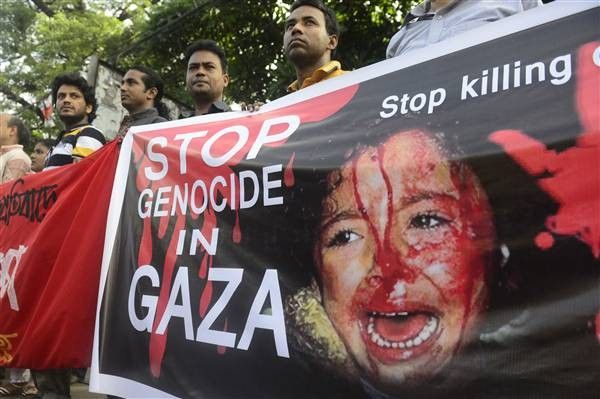
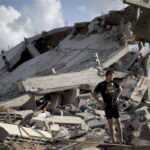
Iran strongly condemned the killing of Palestinians in the besieged Gaza Strip, urging an immediate end to the Zionist airstrikes and the years-long blockade on the coastal enclave.
“I have made my views clear on other occasions; the President (Hassan Rouhani) has made his views very clear. It is incumbent upon the international community to stop the Israeli aggression against the defenseless people of Gaza, to stop the siege on Gaza, to stop this humanitarian nightmare that has been prevailing in Gaza for the last many years,” Foreign Minister Muhammad Javad Zarif said at a press conference in Vienna.
He added that the UN Security Council and other forces within the international community must put all the pressure that can be brought to stop the siege of a population under “inhuman” conditions and to end Israel’s atrocities.
“That is our position, and we will continue to insist on it,” the Iranian foreign minister said.
He emphasized that every Iranian has his heart go out for the people in the Gaza Strip, particularly for children, women and elderly who are being massacred.
“We support ending Israeli aggression against the people of Gaza and ending the siege which has tried to, in fact, strangulate a whole population,” Zarif pointed out.
Mohammad Karimi and Ezzatollah Najafi were researchers of the project.
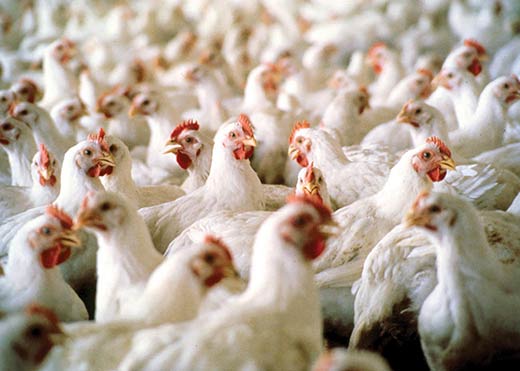
Sulfonamides are fed to chickens to increase growth but its excessive use in chicken feed may lead to gastrointestinal problems, backache, headache, vertigo, diarrhea, anorexia, nausea and jaundice.
Fe3O4 magnetic nanoparticles were synthesized by a molecularly imprinted polymer for easy extraction and determination of sulfonamides in the samples of chicken meat.
The magnetic nanoparticles were characterized by X-ray diffraction pattern, thermal analysis and scanning of electron micrograph.
The template was removed by methanol elution. Sulfonamide separation was performed by liquid chromatography–UV.
Results of the study indicated that the nanoabsorbent is useful in quick determination of sulfonamides in chicken meat.
Sulfonamides (sulfa drugs) are derived from sulfanilamide, a sulfur-containing chemical.
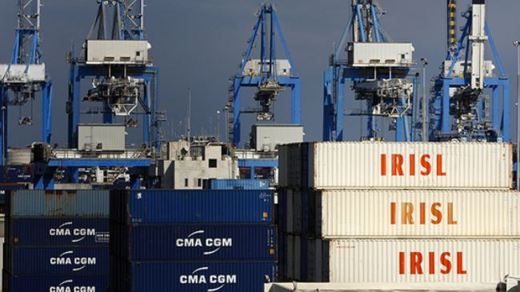
The Islamic Republic of Iran Shipping Lines (IRISL) containers are seen at Malta Freeport in the Port of Marsaxlokk outside Valletta. (File photo)
“The United States is by far the biggest loser of all sanctions enforcing nations. From 1995 [when the US imposed trade embargo on Iran] to 2012, the US sacrificed between USD 134.7 and USD 175.3 billion in potential export revenue to Iran,” the National Iranian American Council (NIAC) concluded in a report.
During the same period, the report said, the United States lost 51,000 to 280,000 jobs a year due to the sanctions slapped on Iran.
Texas and California are likely the biggest losers in terms of lost employment, due to their size as well as the attractiveness of their industries to Iran’s economy.
The US sanctions also cost the European economies billions of dollars in losses through the 2010-2012 period.
In Europe, Germany was hit the hardest, losing between USD 23.1 and USD 73.0 billion between 2010 and 2012, with Italy and France following at USD 13.6-USD 42.8 billion and USD 10.9-USD 34.2 billion respectively.
The think-tank recommended that the US government consider lifting sanctions against Iran as nuclear negotiations are under way between Iran and the five permanent members of the UN Security Council – the Unites States, Britain, France, Russia and China – plus Germany.
“Decision-makers must… ask themselves if the cost of sanctions to the US economy is worth shouldering if other options do exist,” it said.
At the beginning of 2012, the United States and the European Union imposed sanctions on Iran’s oil and financial sectors with the goal of preventing other countries from purchasing Iranian oil and conducting transactions with the Central Bank of Iran.
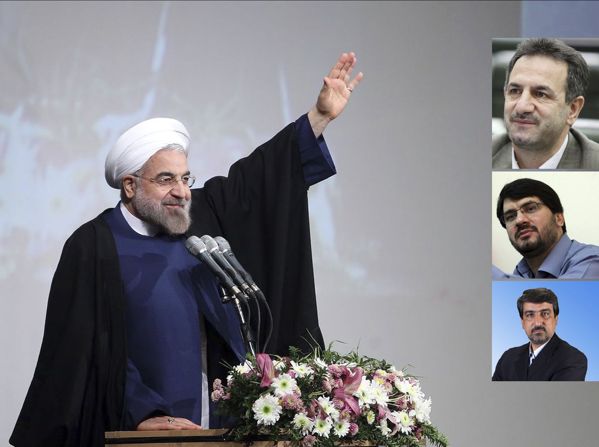
One year on since Hassan Rouhani’s undisputed victory in Iran’s presidential election, a 92nd issue of Tejarat-e Farda weekly, which appeared on newsstands on June 29, 2014, ran a report on the promises candidate Rouhani made on the campaign trail and on how successful he has been thus far in fulfilling those pledges. The report, which opens with an article by Seyyed Hamid Motaghi, features the viewpoints of three officials, including two senior MPs. In the article Motaghi likens electoral campaigns in Iran, and elsewhere in the world for that matter, to what unfolded in “Alice’s Adventures in Wonderland”. Here is an excerpt of the report which reflects a variety of opinions about the Iranian president’s performance during his almost one year in office.
“More than 12 months have passed since Hassan Rouhani pulled off a win in Iran’s 11th presidential elections in 2013. Without a doubt, one key reason why this career politician emerged victorious in his bid for presidency was that he ran on a platform that appealed to the public.
“To find out whether or not the Iranian president resorted to unrealistic and populist slogans to win the vote, one needs to categorize election promises first. To that end, three different criteria should be taken into account. 1. How compatible are a candidate’s campaign promises with his goals and mentality? 2. How practical are those promises, considering the situation on the ground? And 3. Are they within the jurisdiction of the chief executive at all?
“Accordingly, practical pledges that are in line with the goals of a president and within his powers should be billed as realistic. The promises which seem practical but do not chime in with the chief executive’s intended plans and credentials – and are probably made to win over a chunk of the electorate – should be classified as populist. And finally, slogans that are compatible with the president’s plans and line of thinking but do not fall within his jurisdiction should be branded unrealistic.
“Many of the issues candidate Rouhani raised in his stump speeches are evidently what every administration should focus on to get things straight, slogans which were both in line with his set goals and within his jurisdiction. That the country’s nuclear centrifuges should not operate at the expense of the livelihood of a nation was one of the most important statements Rouhani made when he was running for elected office. […]
“Before Mohammad Javad Zarif was placed at the helm of the country’s diplomacy machine some were swift to label that statement unrealistic. But the fact that senior state officials threw their weight behind President Rouhani’s push [to have the nuclear case settled once and for all] along the way proves that candidate Rouhani’s campaign statement as far as the nuclear issue was concerned was not an empty promise.
“Recent months have also seen some progress on the economic front, especially when it comes to containment of inflation. Unfortunately though, there has been little headway in job creation. Some experts blame the administration’s failure in this regard on the recession gripping the Iranian economy and suggest one cannot pin much hope on any breakthrough down the line.
“Recent months have also seen some progress on the economic front, especially when it comes to containment of inflation.
“Another campaign promise of Hassan Rouhani focused on the environment. His administration seems to have come a long way on that front over the past 10 months. […]
“Stopping the production of [the so-called] petrochemical gasoline was another campaign promise that came true, giving the residents of the capital an opportunity, a first in almost five years, to breathe in unpolluted air.
“Stopping the production of [the so-called] petrochemical gasoline was another campaign promise that came true
“Giant steps have been taken toward the realization of universal healthcare insurance which was swiftly dismissed as another ‘Pie in the sky’ when it was floated by candidate Rouhani in May 2013. […]
“No doubt, Rouhani’s promise to sustain the monthly provision of cash subsidies to citizens was populist in nature. A closer look at the track record of Rouhani and his team shows that a majority of them are opposed to provision of ‘targeted subsidies’ in their current form and are pushing back a vital operation on the country’s ailing economy only to keep voters satisfied. For now, the holdup may stop many voters from turning their back on Rouhani, but it is bound to deal a very heavy blow to Iran’s economy down the road. In the meanwhile, several of candidate Rouhani’s promises including those aimed at streamlining partisan activities, re-opening the House of Parties and the Journalists Guild, and raising the minimum wage proportionate to inflation have been put on hold.
“No doubt, Rouhani’s promise to sustain the monthly provision of cash subsidies to citizens was populist in nature.
“Another pledge candidate Rouhani made was to establish a Ministry of Women. The pledge which seems to have been aimed at winning over the urban middle class came against the advice of his aides who appealed for measures to trim the government. […] The fact that there is no female minister in President Rouhani’s cabinet is proof that the pledge to set up a Ministry of Women was merely designed to secure more votes. The pledge to set up an academy of minority languages was placed on ice too and is unlikely to be acted on in the remaining three years of his presidency.
“The so-called pie-in-the-sky list includes Rouhani’s pledge, in the run-up to the election, to stop vetting books before they go to press or to put experts in charge of vetting films before they hit the screen. Certainly, these things are not part of the executive authority; the legislature and the judiciary have more powerful tools at their disposal to run the show. That means critics have rightly dismissed those promises as impractical.
“Another unrealistic pledge was the allocation of as much as 3 percent of GDP to research. Although that promise falls well within the executive jurisdiction, realities on the ground render it unlikely, if not impossible.
“Mr. Rouhani and his campaign repeatedly described an ‘opening’ in social networking as one of their ‘loftiest goals’. Although everyone thought the opening in question would be on the horizon once he stepped into the presidential office, the ban on Facebook and Twitter remained in place, and the president along with his deputy and foreign policy chief had to make an end run around regulations to remain active on social networks. […]
“The president is trying to end the house arrest of some political figures and pave the way for the return home of Iranian expatriates. But making these objectives a reality is not as easy as it may sound and these two items belong in the unrealistic promises column.”
Anoushirvan Mohseni-Bandpei
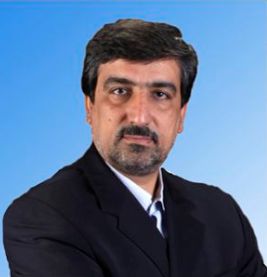
Anoushirvan Mohseni-Bandpei, the managing director of Iranian Health Insurance Organization, has been interviewed for this report by Tejarat-e Farda’s Masoumeh Sotudeh. Obviously, healthcare has taken center stage in this interview. Here is part of what Mohseni-Bandpei, who is a physician, had to say:
“Allegations that many of President Rouhani’s pledges were unrealistic are not true. The launch of Iranian Health Insurance Organization amounted to realization of the better part of the pledges he made as a candidate. Of course, the government has a long way ahead, and the president has instructed the Iranian Health Insurance Organization, the Ministry of Health and the Ministry of Labor and Social Welfare to redouble their efforts to make his health-related promises a reality. Sustainability of financial resources channeled to the health sector holds the key to future success. Allocation of part of government revenues that have started to come in following the launch of the ‘targeted subsidies initiative’ and VAT has helped us along the way. But to speed things up we need sustainable financial resources.
The launch of Iranian Health Insurance Organization amounted to realization of the better part of the pledges he made as a candidate.
“The president put a lot of emphasis on healthcare during his election campaign. After victory in the polls he put in a lot of time and effort to remain true to his word. The main problem we’re faced with is that insurance is not universal and co-payments are rather high. The idea of universal healthcare was intended to help realize Article 38 of the Fifth Development Plan which requires the government to provide universal healthcare. The previous government did nothing to implement that provision of the law. Thanks to the efforts of the current administration, some 5.1 million Iranians have already signed up for healthcare and are set to get their healthcare cards shortly. […] The budget the current government has allocated to healthcare has seen co-payments decline to 30 percent, with the government paying the remaining 70 percent of the bills. The move has also helped prolong the period doctors spend in less-developed areas and resulted in higher quality services to patients. […] Ministry of Health and Iranian Health Insurance Organization have concluded a memorandum of understanding to further improve the quality of healthcare services.
“I would describe the registration of up to 5.1 million Iranians for health insurance as a renaissance. Dr. Rouhani’s government is implementing a law that was gathering dust for almost two decades. His government has focused its attention on lowering the fees patients have to pay for each visit to a doctor’s office.
“Despite claims that the new arrangements mostly benefit the urban population, residents of rural areas and towns home to less than 20,000 people are the main beneficiaries of this recent healthcare push.[…]
“The government is covering at least 70 percent of the price of medicines taken by people suffering from hard-to-cure diseases. […] This initiative has resulted in relative satisfaction of many of the patients who are grappling with such ailments.”
Mehrdad Bazrpash
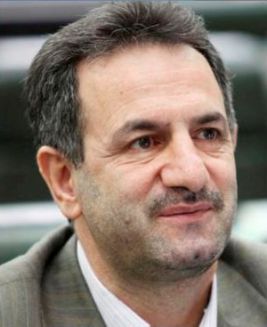
Mehrdad Bazrpash, a member of the Presiding Board of the Islamic Consultative Assembly, believes that President Rouhani’s administration has many unfulfilled economic promises on its hand and that the president’s failure to honor his promises has proven to the public that those pledges have merely been part of a strategy to win more votes. The following is part of an article he has written on whether the president has been successful in fulfilling his electoral promises.
“The most important reason why his promises remain unfulfilled is that the president made those promises merely to dismiss his opponents and cast doubts on the achievements of his predecessor. The tactic to question the achievements of the previous government came to light when it became clear that the president and his team had no alternatives for what they were lashing out at. I believe the president’s blind rejection of the achievements of his predecessor is rooted in the fact that he is out of touch. […] In the heat of last year’s electoral campaign, the president promised to settle the country’s problems one after another if and when he took office.
“The most important reason why his promises remain unfulfilled is that the president made those promises merely to dismiss his opponents and cast doubts on the achievements of his predecessor.
“The president has made several promises. He has been unable to keep those promises or at least set the stage for their realization. For instance, immediately after victory in the polls, he said he would pave the way for the reinstatement of the Management and Planning Organization, citing that the country’s problems had worsened following the dissolution of the planning body. […] What is interesting is that 11 months into his presidency, Rouhani has not only done nothing tangible to revive the organization, but has opposed a plan floated by some MPs to recreate the budget and planning agency. […]
“Shortly after being inaugurated, the president recalled the hurdles businesses and entrepreneurs were faced with and vowed to make those problems a thing of the past. His government also promised that it would require banks to offer credit lines to companies that pay 30 percent of the total amount of credit in cash. […]
“Last year [ended March 21, 2014] President Rouhani’s government also spontaneously decided to offer ‘goods baskets’ to members of the public on two occasions, but only one materialized. […] Advocacy groups around the world no longer approve of such approaches. Besides, it came right after the president and his team accused the administration of President Ahmadinejad of using the ploy of [cash] subsidies to win votes. […] One main question that arises here is ‘How did his government come by the money to pay for the goods basket?’ [….]
“Another unrealistic promise the current government made on the campaign trail centered on freedom of speech and on the right of the public to critique the executive branch. The approach the government has adopted over the past few months – calling the critics ‘illiterate’, ‘a bunch of extremists’ and ‘individuals who have attended lowbrow universities’ – suggests that the promise to promote free speech and welcome criticism was an empty one. Unfortunately, the president and his team are promoting the notion that the 50 percent or so of the electorate who did not vote for him advocate violence and that they should not dare critique his governance. […]
“The president promised to keep centrifuges running and in tandem prop up the livelihoods of the public. In some of our nuclear sites, centrifuges are reputedly on life support and according to reports by our nuclear scientists the pulse of our nuclear energy is fading. The question that arises here is whether the livelihood of the public has been propped up. […] With the US dollar selling for 33,000 rials and prices of consumer goods up 30 percent, no one can believe government assertions that inflation is under control.
“The president has denounced Mehr Housing Scheme as ‘failing to live up to expert criteria’. Does the current government, which seems determined to kill the housing plan, have any alternative? The Constitution requires the government to take care of the housing needs of less-fortunate people. A government that offers no alternative to a plan it dislikes will certainly be unable to administer justice. In other words, owning a place to live in has become a pipe dream for impoverished people.”
Seyyed Sharif Hosseini
Seyyed Sharif Hosseini, who has a seat on the Presiding Board of the Iranian parliament, also weighed in on the level of President Rouhani’s commitment to his campaign promises.
“When candidate Rouhani was running for office, he criticized the way the Iranian nuclear negotiating team was being managed. Regardless of the accuracy of his assessment of the previous negotiating team, one can certainly say the nuclear case has no longer a security air about it and is placed on a reasonable track. That is thanks to the instructions of the supreme leader as well as the skillfulness of the president and his negotiators led by Mohammad Javad Zarif.
“Despite expressions of concern by some about the Geneva agreement […] the fact that the Supreme National Security Council closely watches the negotiations and the supreme leader monitors the developments leaves no room for concern.
“As promised by the president in his election campaign, the nuclear case has landed on a legal track. The fact that the supreme leader has urged support for the nuclear negotiators shows that the promises of the Government of Prudence and Hope have been fulfilled as far as the nuclear issue is concerned.
“During the election campaign the president talked of hostility in relations between Iran and the rest of the world. It seems that over the past year, that hostility has eased. Of course, there is a long way ahead before all foreign policy promises of the president are fulfilled.
“The president also said he would initiate a long-term plan to help return calm to the foreign currency market. […] Immediately after the president took office, rial gained ground against major foreign currencies, but government plans to keep the price of the greenback at around 30,000 rials did not succeed.
“The government’s pledge to systematize the distribution of cash subsidies has remained unfulfilled, too. Of course, one should not forget that to that end the legislative branch too has some responsibilities that need to be fulfilled in parallel with government efforts.
“Although the president has focused part of his attention on efforts to create jobs, the scourge of unemployment is still out there and the jobless rate remains unchanged in small and big cities alike. Unemployment is not merely an economic problem, it is to blame for many psychological and mental woes. Thus, creation of jobs is not only an economic objective, but a key social, cultural and political necessity.
“The campaign-trail promises of the president and his team seem to be on track. But one should not forget that realization of all pledges the executive branch has made requires contribution by the other two branches of government as well.”