Saturday, April 25, 2026
Home Blog Page 4001

Iran’s President Hopes for Promotion of Peace in Muslim World

On Sunday, the Iranian president sent separate congratulatory messages to Muslim countries’ heads of state on the auspicious occasion of Eid al-Fitr.

“I hope that, with the blessings of this … Eid, we can more than before present a bright picture of this merciful religion (Islam) to the world through empathy, fraternity and establishment of peace, stability and security among all Muslims,” he said in the message.

“I am certain that by benefiting from the sublime teachings of Islam … we, together, will be able to eliminate violence, extremism and terrorism from Muslim lands,” he said.

President Rouhani further prayed for prosperity and happiness for all Muslims world over.

Eid al-Fitr, also called Feast of Breaking the Fast, is an important religious holiday celebrated by Muslims around the world.

The observance traditionally begins with the sighting of the new moon of the 10th month of the Islamic lunar calendar. This year, the Eid falls on June 26 in Iran.

Iran FM Congratulates World Muslims on Eid al-Fitr

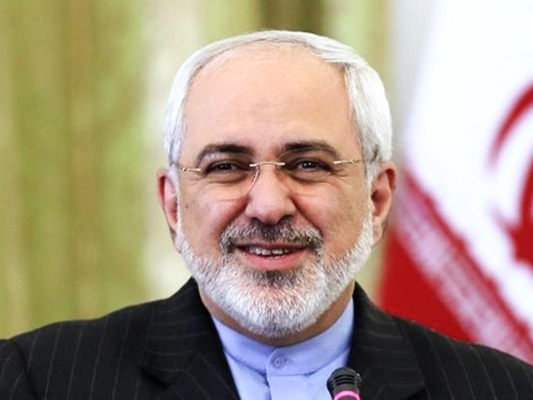
Mohammad Javad Zarif

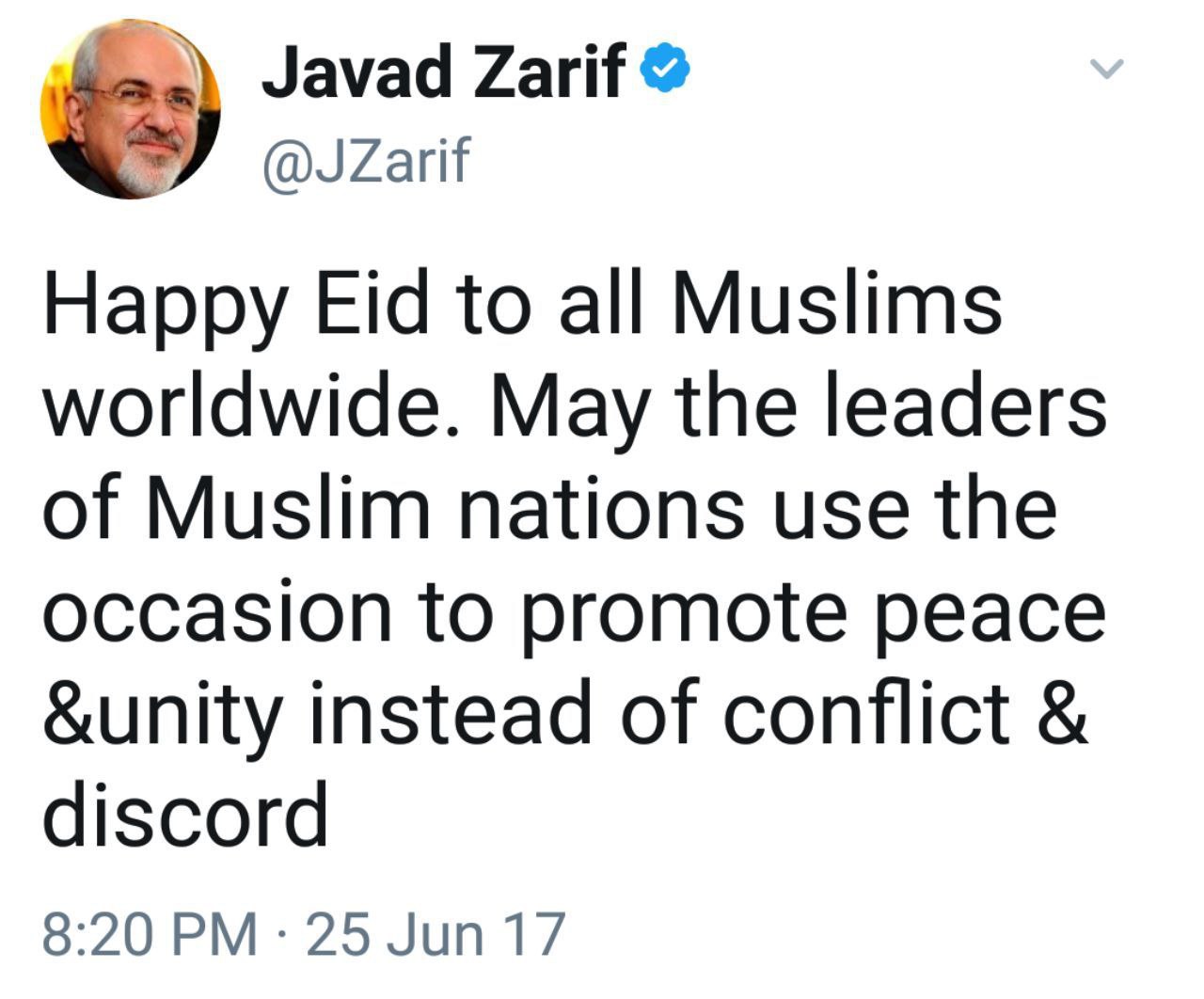
“Happy Eid to all Muslims worldwide,” Foreign Minister Mohammad Javad Zarif wrote in a message on his Twitter account on Sunday.

“May the leader of Muslim nations use the occasion to promote peace and unity instead of conflict and discord,” he added.

Iran FM Congratulates World Muslims on Eid al-Fitr

Eid al-Fitr, also called the Feast of Breaking the Fast, is an important religious holiday celebrated by Muslims worldwide.

The religious festival is a holiday when Muslims are not permitted to fast on that specific day.

The holiday celebrates the conclusion of the 29 or 30 days of dawn-to-sunset fasting during the entire month of Ramadan. The day of Eid, therefore, falls on the first day of the month of Shawwal.

Rouhani’s Swearing-in Ceremony to Be Held on Schedule

Mehdi Kiaee, a public relations official at Iran’s Parliament, dismissed as baseless the media reports casting doubt on holding the swearing-in ceremony of Rouhani as Iran’s next president and said the ceremony would be held under previous procedures.

“President Rouhani’s swearing-in ceremony is set to be held during the first public meeting of the Iranian parliament immediately after the confirmation of his mandate by the Leader of Islamic Revolution, Ayatollah Seyyed Ali Khamenei,” he noted.

Rouhani was re-elected as Iran’s president for a second term on May 19.

All Political Camps Condemn Insults to Rouhani

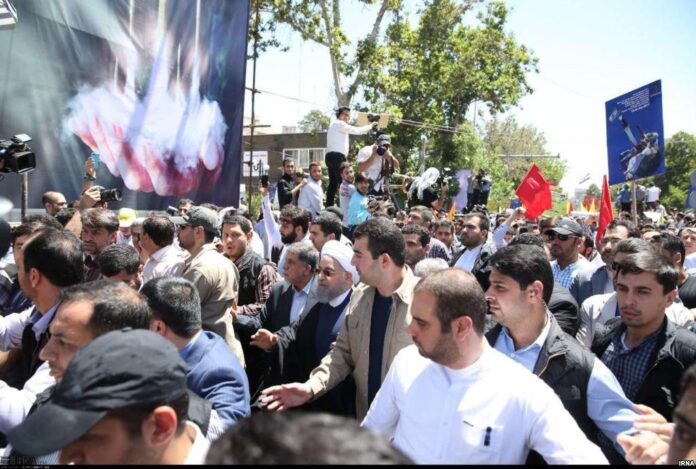
During the International Quds Day rallies held across Iran on June 23, 2017, a few people tried to create tension by chanting slogans against President Hassan Rouhani, forcing him to leave the demonstrations.

However, their efforts failed thanks to the demonstrators’ objection and strong reaction by the public, media, and political figures.

Less than two dozen of the hundreds of thousands of Tehrani citizens who had participated in Friday’s rallies chanted slogans against the president and drew a comparison between him and the first Iranian president Abulhassan Banisader, who was removed from office in the early years following Iran’s 1979 Islamic Revolution because of incompetence.

The move met objection not only from reformists, but from conservatives as well. Some observers believe those few people who chanted slogans against President Rouhani had misinterpreted the recent remarks by Leader of the Islamic Revolution Ayatollah Seyyed Ali Khamenei who emphasized the need to refrain from polarizing the society and dividing people into two opposing groups, the same mistake that Banisadr made back in 1980.
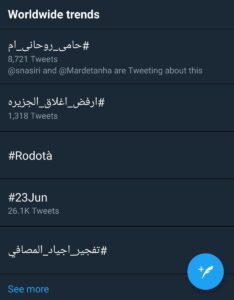
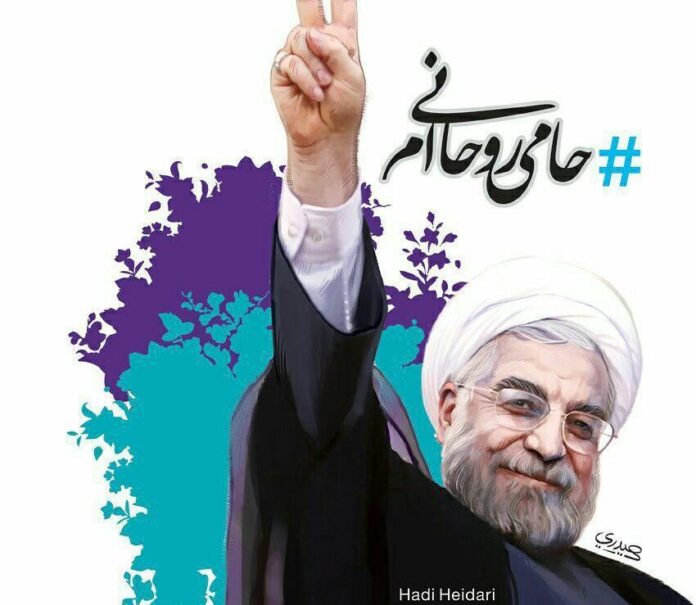
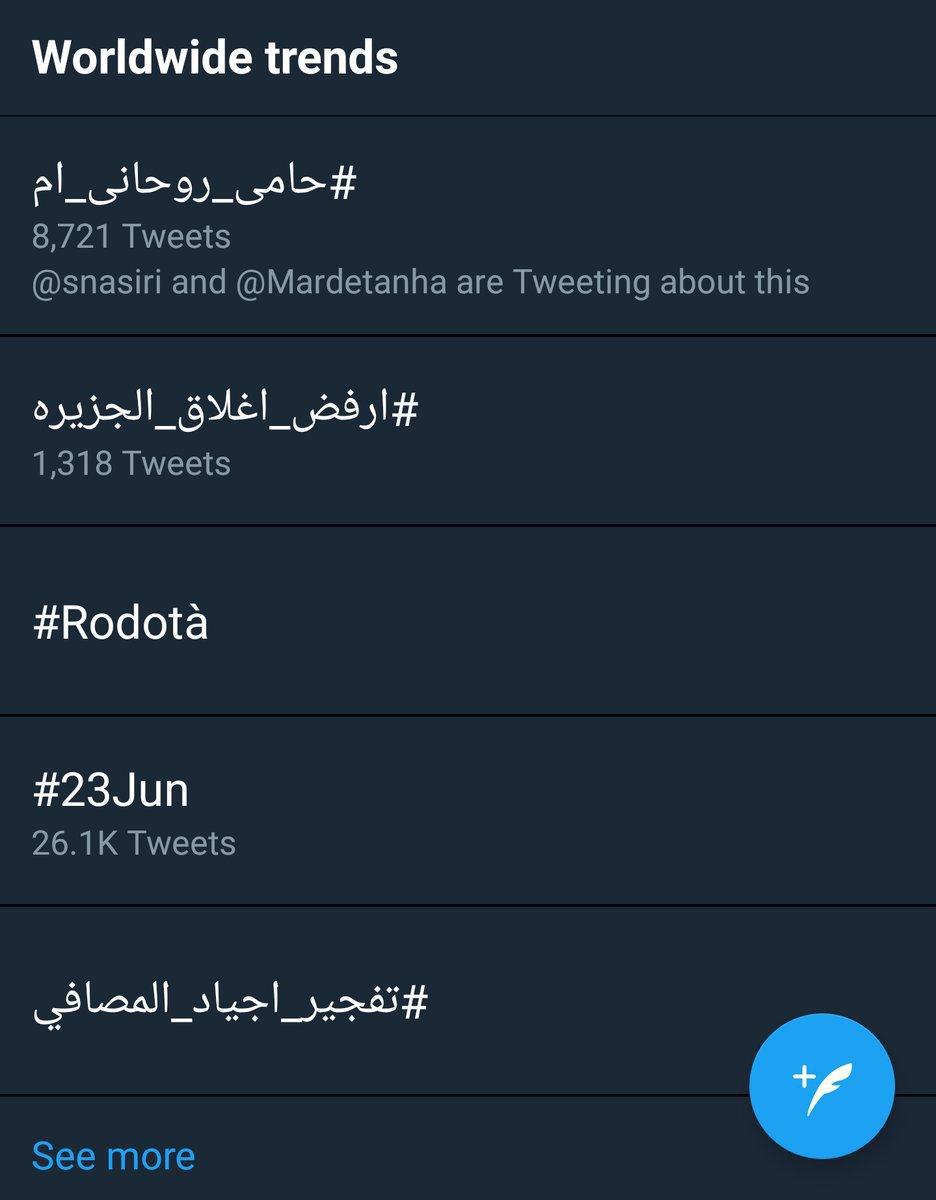
All Political Camps Condemn Insults to RouhaniIn reaction to the insults, sympathizers of Rouhani expressed their support for the president by launching an online campaign in Twitter. They posted tweets with a Farsi hashtag – “I’m a supporter of Rouhani” – which was widely welcomed, so much so that it turned into the users’ number-one trend on Twitter across the world.

Meanwhile, the conservative Javan daily, close to the Islamic Revolution Guards Corps (IRGC), touched upon the issue in its editorial. It wrote a handful of people chanting slogans against the president on the International Quds Day touched the heart of any person loyal to the Islamic Revolution.

“A few short-sighted people who just inflict costs through their untimely and unwise actions have tarnished the image of real revolutionaries,” it added.

You can read more highlights from Javan’s editorial piece here.

This is not the first time that Leader of the Islamic Revolution Ayatollah Seyyed Ali Khamenei and political activists are seeking to highlight the mistakes that some politicians made in the early years following the Islamic Revolution in order to prevent a repeat of similar incidents. Around 5 years ago during the presidency of Mahmoud Ahmadinejad, the Iranian state TV broadcast a documentary on provocative speeches by Banisadr, and openly criticized the language used by Ahmadinejad and warned him not the repeat the mistakes made by Banisadr.

But how is it that some people chanted slogans against the president-elect on the International Quds Day which symbolizes Iranians’ unity against Israeli crimes?

The answer to this question can also be found in remarks and warnings by the Leader. Over the past few years, he has, time and again, warned against the danger of divisions breaking out among people, and also against insulting officials, particularly the president.

Political commentator and historian Abdollah Shahbazi believes the divisive move by a handful of people on the Quds Day – which coincided with organized efforts by certain institutions and high-profile figures residing in the US to introduce hashtags against the important day – was a war of nerves aimed at undermining Iranians’ unity against foreign enemies, sidelining the Int’l Quds Day and fueling domestic differences.

Insults to Rouhani Similar to Saudi Embassy Attack

The Khabar Online News Agency also weighed in on the issue in an opinion piece. The highlights of the article are as follows:

“There is no end in sight to the saga of rogue individuals. Saudi Arabia came under a barrage of international criticism in January 2016 for executing Shiite cleric Sheikh Nimr al-Nimr, who was an opponent of Riyadh. In that incident, the world public opinion denounced the Al Saud regime as a government against human rights. But the tables were turned in a matter of days because a handful of rogue individuals claiming to be protesting Sheikh Nimr’s execution stormed the Saudi embassy in Tehran, set Saudi Arabia’s flag on fire and destroyed parts of the building. The move turned the spotlight on Iran at the international stage.

Two years on since that event, now rogue individuals once again did something that played into the enemy’s hands on the International Quds Day, which symbolizes Muslims’ unity against oppressors.

At a time when, in the eyes of international analysts, Saudi Arabia is gripped by a soft coup and once again the country’s decisions have come under spotlight by the world public opinion, rogue elements deflected attention from Saudi Arabia to Iran. Before hundreds of foreign media outlets and on the Quds Day, which symbolizes unity and integrity, rouge individuals depicted Iran as a country gripped by tension and divisions.

I wish masterminds and planners of such arbitrary moves would answer the question: “Harming the establishment’s international status? At what price?’

Slogans against Rouhani “Suspicious”

Hassan Rouhani - Iran President

The Javan daily newspaper has, in a Farsi article, weighed in on certain individuals’ recent insults to the president. The highlights of the article follow:

If we do not consider this move suspicious, superficiality is undoubtedly a shortcoming which continues to take its toll on individuals loyal to the Islamic Revolution. It is only deep-rooted revolutionary people that can redeem the status quo. The individuals who have been repeatedly warned by the Leader not to act that way as “such actions will harm the country” have shown their non-compliance and, hence, are not regarded as revolutionaries.

A handful of individuals chanting slogans against Iranian President Hassan Rouhani during International Quds Day rallies touches the heart of any person loyal to the revolution. A few superficial people, in a costly and untimely move, depicted revolutionary forces as illogical and uncontrollable people.

The saga of chanting slogans against the president is condemned from two perspectives:

First of all, a handful of individuals are unfortunately trying to attribute the action to recent remarks by Leader of the Islamic Revolution Ayatollah Seyyed Ali Khamenei, and accordingly, some superficial people claim their actions are in accordance with the Leader’s comments. What the Leader said about the year 1980 was based on historical experience to boost the logic of warning. The Leader has, over the past 28 years, stressed the need to refrain from polarizing the society and to maintain national unity. Non-polarization of the society is so important to the Leader that he kept the former president [Ahmadinejad] from entering the presidential race. So, the Leader’s approach has been consistent.

Therefore, to interpret “preventive warning” as permission to do what they did and take to the streets would be the worst possible interpretation of the Leader’s illuminating comments and would amount to the hijacking of the “fire at will” strategy [Ayatollah Khamenei had urged revolutionaries to be ‘fire at will’ and act spontaneously on cultural affairs whenever they see the country’s authorities are not doing enough]. The Leader has, on numerous occasions, referred to positive and negative characters in history to further clarify his remarks, but one should not look at these examples superficially.

Second, the International Quds Day rallies symbolize the Iranian nation’s integrity against Zionists and their supporters. However, a handful of people claiming to be supporters of the revolution tried to hijack the Quds Day and its objectives, and present dozens of false analyses to justify their action. Real revolutionary individuals have, time and again, been harmed by these rogue elements, especially when it comes to the trend of democracy. The evolutionary people should express their disavowal the first chance they get.

Renowned Iranian martyr Morteza Avini would say that revolutionary individuals know the costs and benefits of their actions, and have a logic for whatever they do.

ISIS Awarding Suicide Attackers ‘Passports to Paradise’

ISIS Pasports

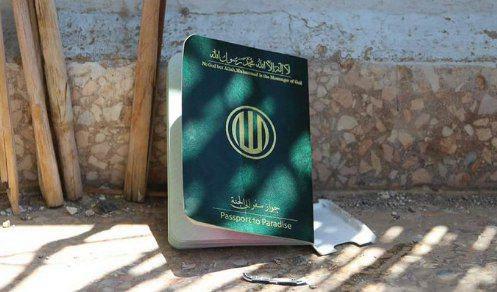
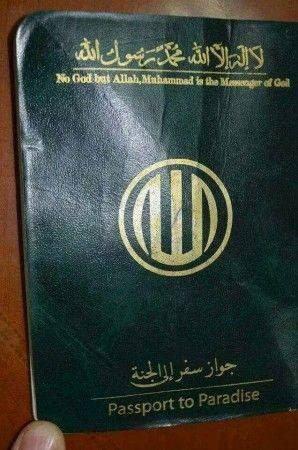
Photos of the ISIS elements’ “passports to heaven”, found in the newly liberated neighbourhoods of the northern Syrian city of Raqqa – the terrorist group’s self-proclaimed capital in Syria – have gone viral on social media.

ISIS PasportThe ISIS rewarded their suicide attackers with these passports to motivate them to carry out more terror attacks by wearing explosive belts or driving bomb-laden cars into the desired places, according to a report by the Russian TV channel RT Arabic.

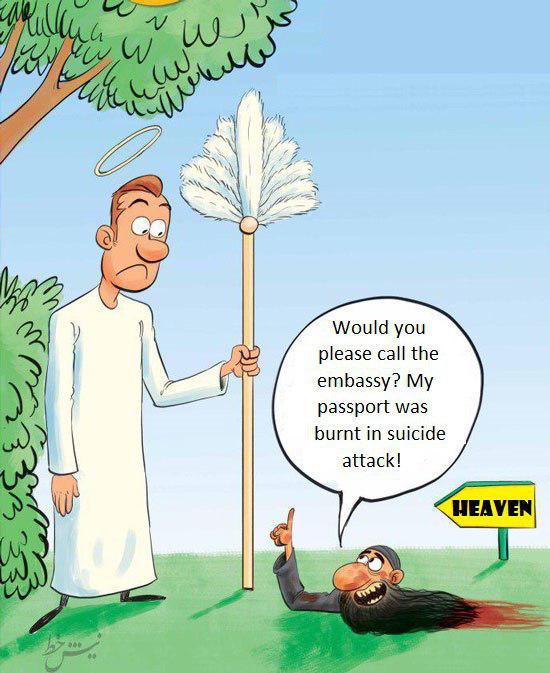
By giving their suicide attackers these passports, the ISIS had managed to convince them that following their death, their entry into the heaven would be guaranteed.

These passports contain no personal information of the ISIS elements. The only data they include are the different names of heaven and hell in Arabic.

It is written in the passports that their owners are only allowed to travel to heaven, and not hell. A number of sentences have also been written in some of the pages of the passports encouraging the terrorists to carry out suicide attacks.

ISIS Awarding Suicide Attackers ‘Passports to Paradise’
ISIS’ main problem for entering heaven revealed! According to ISIS leaders, the holders of ISIS passports can only enter the heaven, not the hell!

‘Saudis Fabricate Mecca Blast Story to Deflect Attentions’

Broujerdi

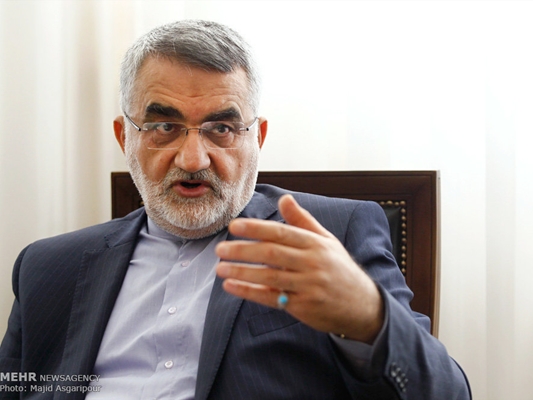
Chairman of the Iranian Parliament’s National Security and Foreign Policy Commission, Alaeddin Boroujerdi, says the fabricated attack on Mecca’s Grand Mosque was part of an evil plan by Saudis.

The Saudis fabricated the story about the holy city, which is highly sensitive for Muslims, to deflect attentions from the new developments in the country’s politics triggered by the elevation of Mohammad bin Salman to the crown prince.

Speaking in a Farsi interview with ICANA, Boroujerdi added, “Fabricating a sensitive news story like the foiled attack on Mecca’s Grand Mosque was the best tactic used by the Saudis to distract the public attention from the appointment of the new crown prince as the change is very dramatic in Saudi Arabia’s politics.”

He then denounced the Saudis’ move to arrest three Iranians in connection with the blast and said this is part of Riyadh’s evil plan to embroil Iran into the attack.

He went on to say that the current political turmoil in Saudi Arabia amounts to a governmental crisis in the country by sparking widespread outrage in the political circles of the kingdom.

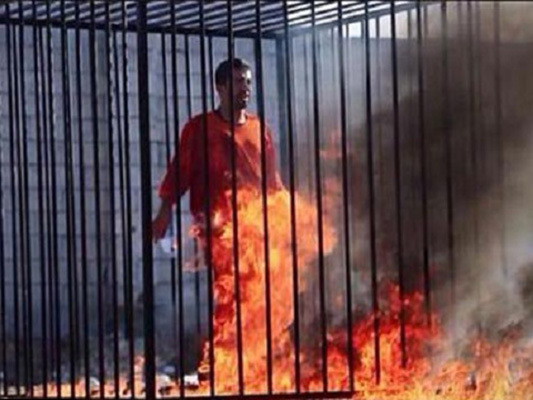
Iran Attacks on ISIS Revenge for Jordanian Pilot’s Burning Alive

Iran Attacks on ISIS Revenge for Jordanian Pilot’s Burning Alive

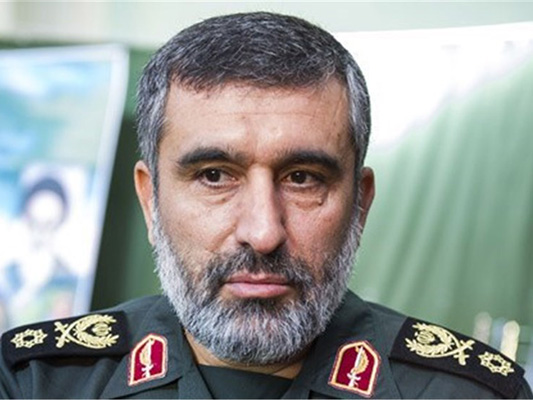
ali-hajizadehBrigadier General Amir-Ali Hajizadeh, the Commander of the Islamic Revolution Guards Corps (IRGC) Aerospace Force, said on Saturday that Iran took revenge from ISIS on behalf of the victims of its heinous crimes by firing missiles at its positions in eastern Syria last Sunday.

“We did a duty, and our intention was to take revenge on behalf of the whole nation of Iran against Takfiri terrorists over their evil acts,” he noted.

“When thinking why these ISIS terrorists had to die in agony, I remembered the Jordanian pilot who was burnt alive in a cage,” Hajizadeh said.

He was referring to an ISIS video released in February 2015, appearing to show the burning alive of Muath al-Kasasbeh who was captured after his F-16 crashed in Syria.

The missiles were the first launched from Iran at targets outside the country, drawing enormous international attention. The strike came shortly after ISIS terrorists carried out simultaneous attacks on the parliament building and the Mausoleum of Imam Khomeini in Tehran.

Elsewhere in his remarks, Hajizadeh dismissed Israeli reports that some of the projectiles had fallen short of their targets and landed in Iraq.

He said what is being claimed in “Zionist circles” is in fact the detachable bodies of the missiles which had been programmed to fall in Iraqi territory.

“All the missiles successfully struck their targets and in this regard, we released videos recorded by unmanned aircraft,” Hajizadeh added.

The commander said the attacks had inflicted “tremendous damage” on the terrorists, adding Iran had got new information in this regard which would be released soon, Press TV reported.

“It is interesting to know that four minutes after the first missile struck, American planes immediately flew over the area – after being informed by our allies, possibly the Russians – indicating that the operation had been accomplished,” Hajizadeh said.

According to the commander, one of the missiles caused a huge fire which surprised Iranian commanders.

ISIS-Linked Terrorists Planning to Attack Iran’s Religious Cities Arrested

According to a statement by Iran’s Intelligence Ministry on Saturday, Iranian security forces managed to identify and arrest the Daesh-linked terrorists, who were planning to carry out terrorist acts in provinces deep in the country as well as religious cities.

They were nabbed on International Quds Day, which falls on the last Friday of Ramadan, and ahead of the Eid al-Fitr, which marks the end of the holy Muslim fasting month, it added.

The terrorists were arrested during a series of mixed intelligence operations, the ministry said, adding that some explosive and suicide attack equipment were also seized from the Takfiris.

The Iranian forces confiscated three Kalashnikov rifles, a bertha machine gun with silencer, a night vision camera, three explosive belts, three cellphones used to trigger bombs, a huge amount of ammunition, bomb-making material, explosive fuses and kits, electronic devices and walkie-talkies as well as other technical bomb-making equipment.

Iran has arrested dozens of terrorists since twin terrorist attacks in the Iranian capital Tehran earlier this month, which killed 17 people and injured over 50 others.

On June 7, gunmen mounted almost simultaneous assaults on Iran’s Parliament and the Mausoleum of the late Founder of the Islamic Republic Imam Khomeini. The Daesh Takfiri terrorist group claimed responsibility for the assaults.

Iranian lawmaker Nader Qazipour told ISNA on Tuesday that 40 Daesh terrorists have been arrested in the country’s northwestern province of West Azarbaijan in continuation of the Islamic Republic’s measures to fight terrorism.

He added that the terrorists intended to carry out acts of terror inside the country in the holy month of Ramadan, but they were identified and arrested before making any move.

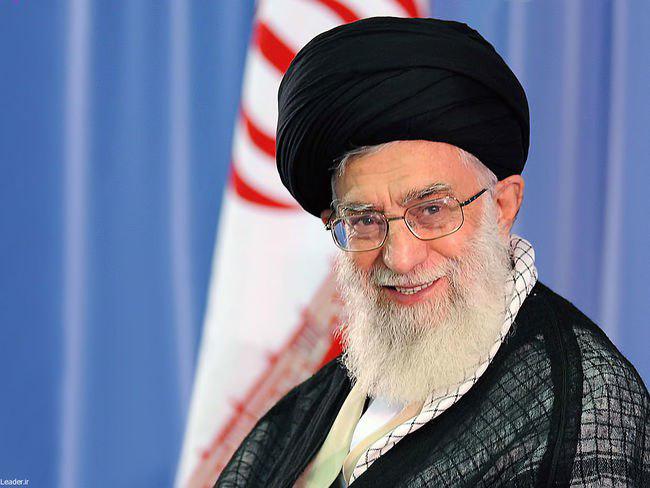
Iran Leader Pardons 1049 Prisoners on Eid al-Fitr

The pardon was granted at the request of the country’s Judiciary Chief Ayatollah Sadeq Amoli Larijani on the occasion of Eid al-Fitr, one of the most important Islamic festivals.

Article 110 of the Constitution grants the Leader the right to pardon or reduce the sentences of convicts upon a recommendation from the head of the Judiciary.

The clemency, however, does not apply to all types of convicts, including those who have been sentenced for their role in armed struggle against the country, armed or organized drug trafficking, rape, armed robbery, arms smuggling, abduction, bribery and embezzlement.

Eid al-Fitr, also called the Feast of Breaking the Fast, is an important religious holiday celebrated by Muslims worldwide.

The religious festival is a day that Muslims are not permitted to fast on that specific day.

The holiday celebrates the conclusion of the 29 or 30 days of dawn-to-sunset fasting during the entire month of Ramadan. The day of Eid, therefore, falls on the first day of the month of Shawwal.