Friday, April 10, 2026
Home Blog Page 4000

Europe Can Help Resolve Persian Gulf Conflicts: Iran FM

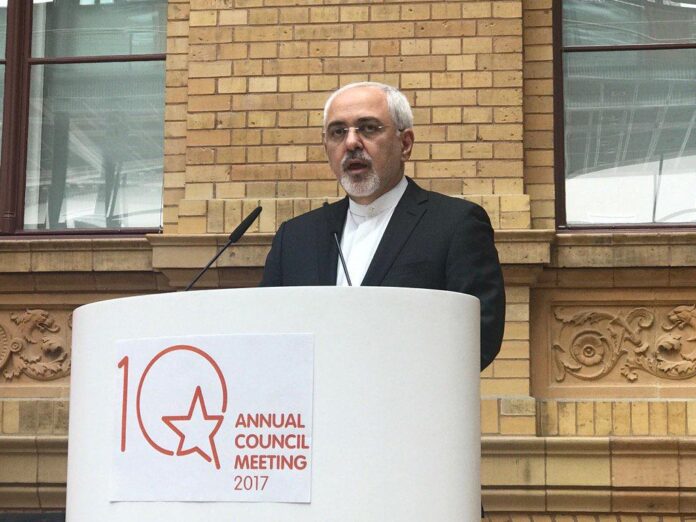
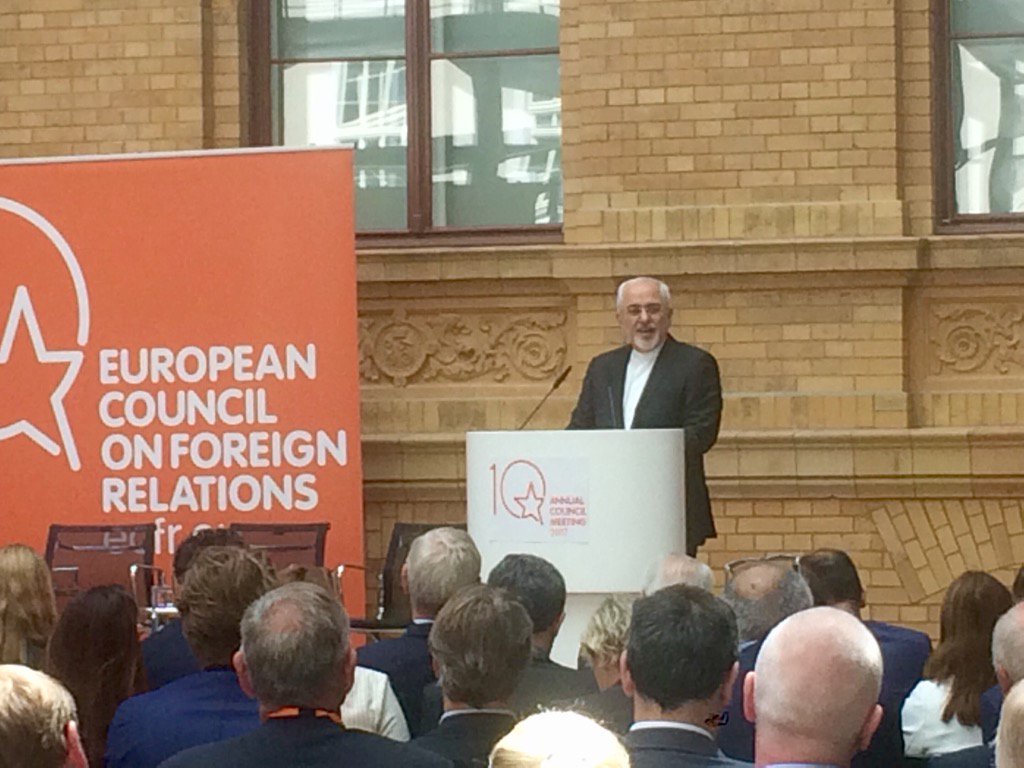
“Europe has the capabilities and values to help resolve Persian Gulf conflicts,” Foreign Minister Mohammad Javad Zarif said in a Monday address to the European Council on Foreign Relations (ECFR) in Berlin.

“With the nuclear issue we had a lose-lose game with the US until we redefined the problem with Europe’s active participation,” the Iranian foreign minister added.

“The nuclear deal between Tehran and world powers worked because it was a victory for all. We must remember the importance of positive-sum thinking,” he went on to say.

“We have to abandon delusions of zero-sum foreign policy, that geography can be changed, and that we can overcome our neighbours,” Zarif noted.Europe Can Help Resolve Persian Gulf Conflicts: Iran FM
The Iranian foreign minister further called for regional security order in wider Persian Gulf region.

“Our region needs a regional security framework. Europe should work on establishing such a framework,” he added.

Zarif stressed that “we need a Persian Gulf regional security forum to promote dialogue over demonization.”

The Iranian foreign minister further pointed to the countries who claimed that Iran and Qatar were supporting terrorism, saying they were trying to shun responsibility for their own failures in addressing the demands of their own people.

“One day it’s Iran, today it’s Qatar,” Zarif said, adding, “It’s an attempt to evade responsibility, escape accountability for this very fundamental … failure of the state system to address, to respond to the demands of its population.”

He said no one can purchase its security from outside, and that foreign policy is not a commodity.

“Arms deals are not partnerships. […] Too many are afflicted by the misconception that security can be purchased.”

“When foreign policy becomes a commodity, then purchasing military equipment becomes your yardstick for measuring who is a terrorist or who isn’t a terrorist,” the Iranian minister added.

Zarif went on saying that the discourse of blame promoted by Saudi Arabia is very much similar to that promoted by the ISIS terrorist group.

“Personal hope is the crucial ingredient for social and international stability. Hopelessness leads to hate,” he added.

The countries in the Middle East have failed to address needs of populace to participate in national life, and this leads to violent reaction of youth, the Iranian top diplomat noted.

Middle East and North Africa region suffers from structural problems, including asymmetry in size, wealth, population, Zarif said.

“The discourse of hate and discourse of exclusion in our region can be exported worldwide creating disaster beyond what you imagine,” he stressed.

Qatar Not to Cut Ties with Iran: Report

A report by Kuwait’s Al-Seyassah daily says that Kuwaiti officials have continued their efforts to provide an atmosphere of agreement to settle the crisis in the Persian Gulf.

This comes as Qataris have not accepted Saudi Arabia’s main demands for ending tension in the region.

Al-Seyassah quoted informed diplomatic sources as saying that Doha did not accept to pay compensation to Saudi Arabia, the UAE, and Bahrain and stressed that it will continue its good relations with the Islamic Republic of Iran.

Saudi Arabia had earlier rejected the possibility of any mediation between Riyadh and Doha.

Qatar Not to Cut Ties with Iran: Report

The split among the Arab states erupted last month after US President Donald Trump visited Saudi Arabia where he accused Iran of “destabilizing interventions” in Arab territories.

Then Saudi Arabia, the UAE, Bahrain, Egypt, Libya, and several other countries broke diplomatic ties with Qatar over allegations that Doha is sponsoring terrorism.

Back in late May, Qatar’s state-run news agency released comments attributed to the country’s Emir Tamim bin Hamad Al Thani in which he described Iran as a force for stability.

Afterwards, Saudi Arabia and the UAE blocked access to Qatari media, including Al Jazeera.

However, the Qatari government claimed that hackers had broken into the QNA website and published the “fake news.”

Tehran-Doha Ties Beneficial to All Mideast Nations: Rouhani

In a telephone conversation with Qatari Emir Sheikh Tamim bin Hamad Al Thani on Sunday, Rouhani said the Iranian government and nation would stand by Qatar.

He added that Iran sought continued cooperation with Qatar and stressed the importance of making use of the enormous bilateral capacities to further strengthen relations.

“[Iran’s] help for Qatar’s economy and the expansion of ties, particularly between the two countries’ private sectors, can be among our common goals,” Rouhani said.

The Iranian chief executive added that the Islamic Republic wanted the rule of moderation and rationality in relations among countries in the region and expressed hope that the existing regional issues would be solved through dialogue.

“We believe that if there is a dispute among regional countries, pressure, threat or sanctions are not an appropriate way to settle disputes,” Rouhani said.

He expressed the Islamic Republic’s readiness to contribute to and help the establishment of peace in the region.

Rouhani further criticized as unacceptable the Saudi-led embargo on Qatar, saying, “Our country’s airspace, land and [territorial] waters will always be open to Qatar as a brotherly and neighboring country.”

The Iranian president also highlighted the significance of unity and integrity in the Muslim world and said Tehran and Doha can undoubtedly cooperate with each other in this field.

Saudi Arabia, Bahrain, Egypt, and the UAE severed ties with Qatar on June 5, officially accusing Doha of supporting “terrorism” and destabilizing the region. Qatar, however, has slammed the measures as unjustified, saying they are based on false claims and assumptions.

In their apparent bid to secure US support and that of Israel, Riyadh, Manama, Cairo and Abu Dhabi suspended all land, air and sea traffic with Qatar, expelled its diplomats and ordered Qatari citizens to leave their countries.

To further pressure Qatar, Saudi Arabia has totally closed its land border with its tiny neighbor, through which much of Qatar’s food supply crossed.

The Qatari emir, for his part, extended his congratulations to the Iranian president on the occasion of Eid al-Fitr, which marks the end of the holy Muslim fasting month of Ramadan.

Al Thani praised Iran’s support for his country and expressed Doha’s readiness to bolster cooperation with Tehran and help solve problems in the Muslim world.

Iran and Turkey are now providing Qatar’s required food supplies.

Iran’s President Hopes for Promotion of Peace in Muslim World

On Sunday, the Iranian president sent separate congratulatory messages to Muslim countries’ heads of state on the auspicious occasion of Eid al-Fitr.

“I hope that, with the blessings of this … Eid, we can more than before present a bright picture of this merciful religion (Islam) to the world through empathy, fraternity and establishment of peace, stability and security among all Muslims,” he said in the message.

“I am certain that by benefiting from the sublime teachings of Islam … we, together, will be able to eliminate violence, extremism and terrorism from Muslim lands,” he said.

President Rouhani further prayed for prosperity and happiness for all Muslims world over.

Eid al-Fitr, also called Feast of Breaking the Fast, is an important religious holiday celebrated by Muslims around the world.

The observance traditionally begins with the sighting of the new moon of the 10th month of the Islamic lunar calendar. This year, the Eid falls on June 26 in Iran.

Iran FM Congratulates World Muslims on Eid al-Fitr

Mohammad Javad Zarif

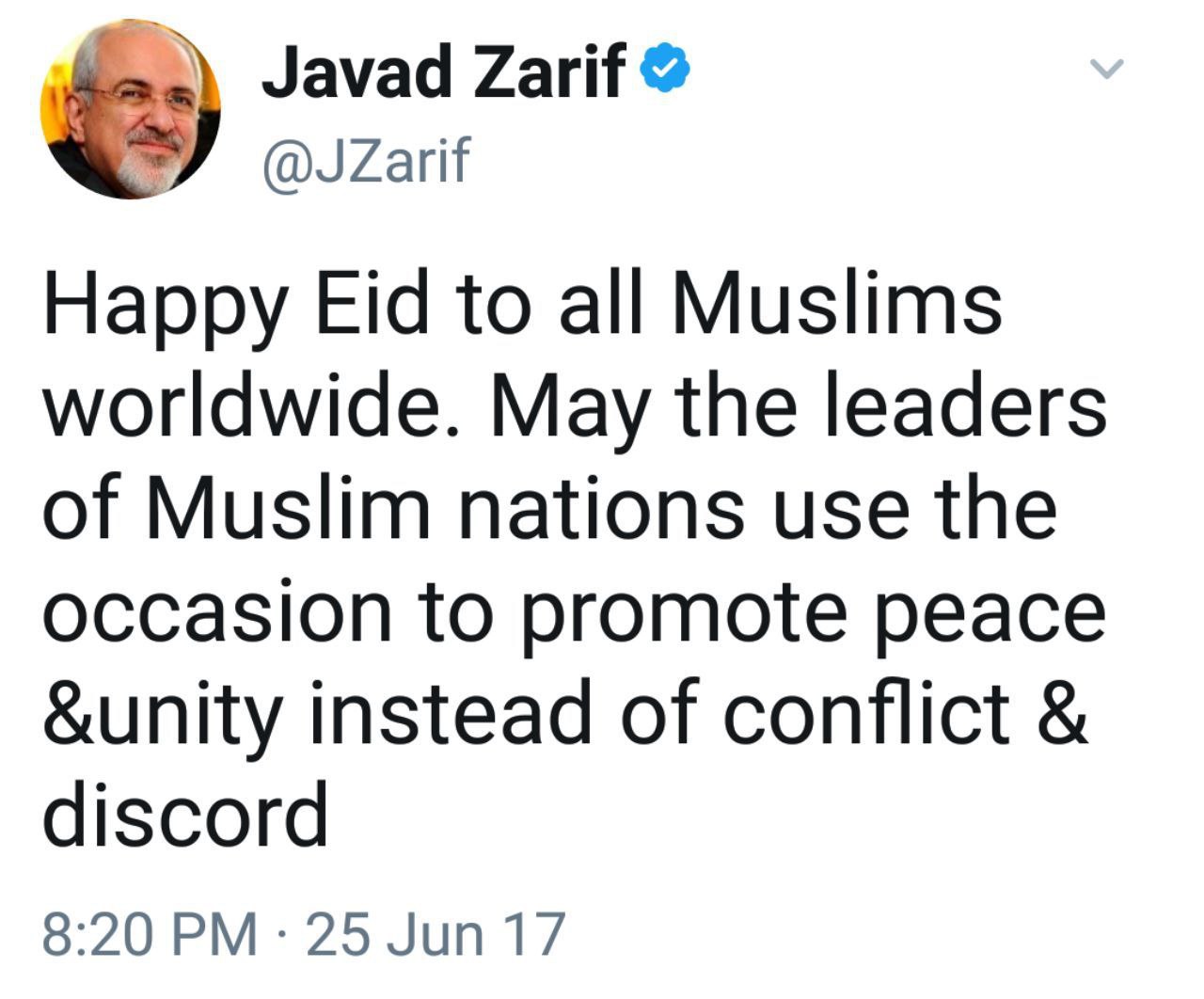
“Happy Eid to all Muslims worldwide,” Foreign Minister Mohammad Javad Zarif wrote in a message on his Twitter account on Sunday.

“May the leader of Muslim nations use the occasion to promote peace and unity instead of conflict and discord,” he added.

Iran FM Congratulates World Muslims on Eid al-Fitr

Eid al-Fitr, also called the Feast of Breaking the Fast, is an important religious holiday celebrated by Muslims worldwide.

The religious festival is a holiday when Muslims are not permitted to fast on that specific day.

The holiday celebrates the conclusion of the 29 or 30 days of dawn-to-sunset fasting during the entire month of Ramadan. The day of Eid, therefore, falls on the first day of the month of Shawwal.

Rouhani’s Swearing-in Ceremony to Be Held on Schedule

Mehdi Kiaee, a public relations official at Iran’s Parliament, dismissed as baseless the media reports casting doubt on holding the swearing-in ceremony of Rouhani as Iran’s next president and said the ceremony would be held under previous procedures.

“President Rouhani’s swearing-in ceremony is set to be held during the first public meeting of the Iranian parliament immediately after the confirmation of his mandate by the Leader of Islamic Revolution, Ayatollah Seyyed Ali Khamenei,” he noted.

Rouhani was re-elected as Iran’s president for a second term on May 19.

All Political Camps Condemn Insults to Rouhani

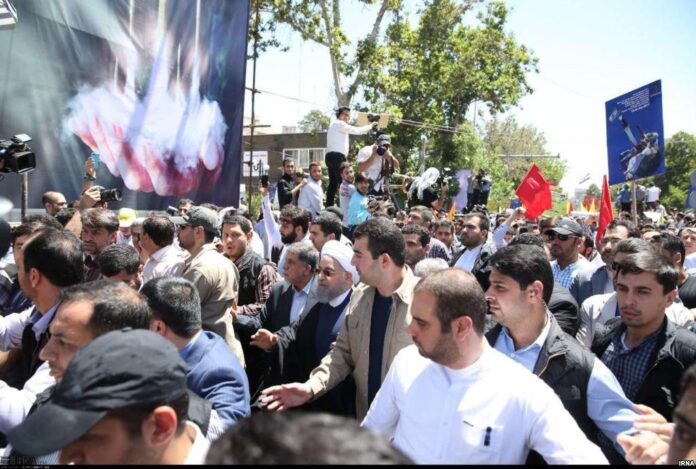
During the International Quds Day rallies held across Iran on June 23, 2017, a few people tried to create tension by chanting slogans against President Hassan Rouhani, forcing him to leave the demonstrations.

However, their efforts failed thanks to the demonstrators’ objection and strong reaction by the public, media, and political figures.

Less than two dozen of the hundreds of thousands of Tehrani citizens who had participated in Friday’s rallies chanted slogans against the president and drew a comparison between him and the first Iranian president Abulhassan Banisader, who was removed from office in the early years following Iran’s 1979 Islamic Revolution because of incompetence.

The move met objection not only from reformists, but from conservatives as well. Some observers believe those few people who chanted slogans against President Rouhani had misinterpreted the recent remarks by Leader of the Islamic Revolution Ayatollah Seyyed Ali Khamenei who emphasized the need to refrain from polarizing the society and dividing people into two opposing groups, the same mistake that Banisadr made back in 1980.

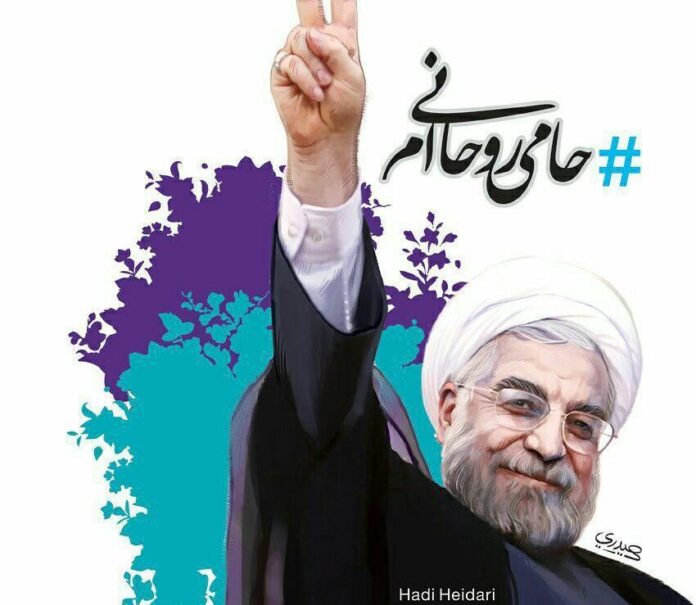
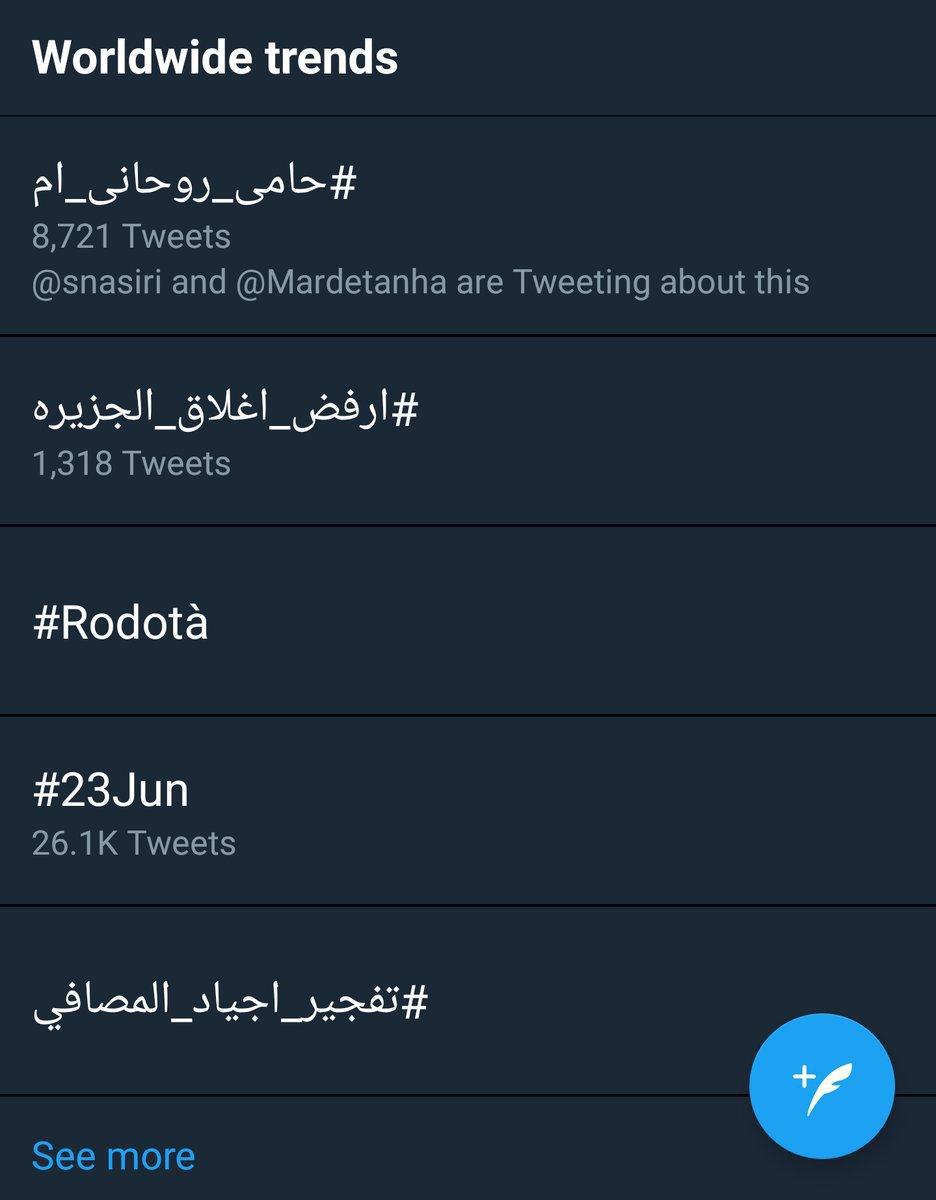
All Political Camps Condemn Insults to RouhaniIn reaction to the insults, sympathizers of Rouhani expressed their support for the president by launching an online campaign in Twitter. They posted tweets with a Farsi hashtag – “I’m a supporter of Rouhani” – which was widely welcomed, so much so that it turned into the users’ number-one trend on Twitter across the world.

Meanwhile, the conservative Javan daily, close to the Islamic Revolution Guards Corps (IRGC), touched upon the issue in its editorial. It wrote a handful of people chanting slogans against the president on the International Quds Day touched the heart of any person loyal to the Islamic Revolution.

“A few short-sighted people who just inflict costs through their untimely and unwise actions have tarnished the image of real revolutionaries,” it added.

You can read more highlights from Javan’s editorial piece here.

This is not the first time that Leader of the Islamic Revolution Ayatollah Seyyed Ali Khamenei and political activists are seeking to highlight the mistakes that some politicians made in the early years following the Islamic Revolution in order to prevent a repeat of similar incidents. Around 5 years ago during the presidency of Mahmoud Ahmadinejad, the Iranian state TV broadcast a documentary on provocative speeches by Banisadr, and openly criticized the language used by Ahmadinejad and warned him not the repeat the mistakes made by Banisadr.

But how is it that some people chanted slogans against the president-elect on the International Quds Day which symbolizes Iranians’ unity against Israeli crimes?

The answer to this question can also be found in remarks and warnings by the Leader. Over the past few years, he has, time and again, warned against the danger of divisions breaking out among people, and also against insulting officials, particularly the president.

Political commentator and historian Abdollah Shahbazi believes the divisive move by a handful of people on the Quds Day – which coincided with organized efforts by certain institutions and high-profile figures residing in the US to introduce hashtags against the important day – was a war of nerves aimed at undermining Iranians’ unity against foreign enemies, sidelining the Int’l Quds Day and fueling domestic differences.

Insults to Rouhani Similar to Saudi Embassy Attack

The Khabar Online News Agency also weighed in on the issue in an opinion piece. The highlights of the article are as follows:

“There is no end in sight to the saga of rogue individuals. Saudi Arabia came under a barrage of international criticism in January 2016 for executing Shiite cleric Sheikh Nimr al-Nimr, who was an opponent of Riyadh. In that incident, the world public opinion denounced the Al Saud regime as a government against human rights. But the tables were turned in a matter of days because a handful of rogue individuals claiming to be protesting Sheikh Nimr’s execution stormed the Saudi embassy in Tehran, set Saudi Arabia’s flag on fire and destroyed parts of the building. The move turned the spotlight on Iran at the international stage.

Two years on since that event, now rogue individuals once again did something that played into the enemy’s hands on the International Quds Day, which symbolizes Muslims’ unity against oppressors.

At a time when, in the eyes of international analysts, Saudi Arabia is gripped by a soft coup and once again the country’s decisions have come under spotlight by the world public opinion, rogue elements deflected attention from Saudi Arabia to Iran. Before hundreds of foreign media outlets and on the Quds Day, which symbolizes unity and integrity, rouge individuals depicted Iran as a country gripped by tension and divisions.

I wish masterminds and planners of such arbitrary moves would answer the question: “Harming the establishment’s international status? At what price?’

Slogans against Rouhani “Suspicious”

Hassan Rouhani - Iran President

The Javan daily newspaper has, in a Farsi article, weighed in on certain individuals’ recent insults to the president. The highlights of the article follow:

If we do not consider this move suspicious, superficiality is undoubtedly a shortcoming which continues to take its toll on individuals loyal to the Islamic Revolution. It is only deep-rooted revolutionary people that can redeem the status quo. The individuals who have been repeatedly warned by the Leader not to act that way as “such actions will harm the country” have shown their non-compliance and, hence, are not regarded as revolutionaries.

A handful of individuals chanting slogans against Iranian President Hassan Rouhani during International Quds Day rallies touches the heart of any person loyal to the revolution. A few superficial people, in a costly and untimely move, depicted revolutionary forces as illogical and uncontrollable people.

The saga of chanting slogans against the president is condemned from two perspectives:

First of all, a handful of individuals are unfortunately trying to attribute the action to recent remarks by Leader of the Islamic Revolution Ayatollah Seyyed Ali Khamenei, and accordingly, some superficial people claim their actions are in accordance with the Leader’s comments. What the Leader said about the year 1980 was based on historical experience to boost the logic of warning. The Leader has, over the past 28 years, stressed the need to refrain from polarizing the society and to maintain national unity. Non-polarization of the society is so important to the Leader that he kept the former president [Ahmadinejad] from entering the presidential race. So, the Leader’s approach has been consistent.

Therefore, to interpret “preventive warning” as permission to do what they did and take to the streets would be the worst possible interpretation of the Leader’s illuminating comments and would amount to the hijacking of the “fire at will” strategy [Ayatollah Khamenei had urged revolutionaries to be ‘fire at will’ and act spontaneously on cultural affairs whenever they see the country’s authorities are not doing enough]. The Leader has, on numerous occasions, referred to positive and negative characters in history to further clarify his remarks, but one should not look at these examples superficially.

Second, the International Quds Day rallies symbolize the Iranian nation’s integrity against Zionists and their supporters. However, a handful of people claiming to be supporters of the revolution tried to hijack the Quds Day and its objectives, and present dozens of false analyses to justify their action. Real revolutionary individuals have, time and again, been harmed by these rogue elements, especially when it comes to the trend of democracy. The evolutionary people should express their disavowal the first chance they get.

Renowned Iranian martyr Morteza Avini would say that revolutionary individuals know the costs and benefits of their actions, and have a logic for whatever they do.

ISIS Awarding Suicide Attackers ‘Passports to Paradise’

ISIS Pasports

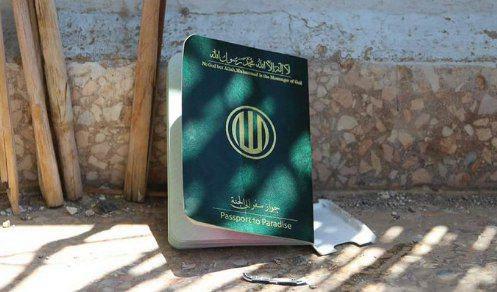
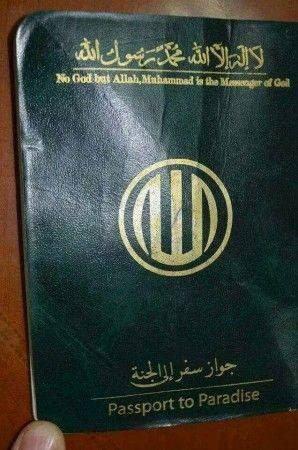
Photos of the ISIS elements’ “passports to heaven”, found in the newly liberated neighbourhoods of the northern Syrian city of Raqqa – the terrorist group’s self-proclaimed capital in Syria – have gone viral on social media.

ISIS PasportThe ISIS rewarded their suicide attackers with these passports to motivate them to carry out more terror attacks by wearing explosive belts or driving bomb-laden cars into the desired places, according to a report by the Russian TV channel RT Arabic.

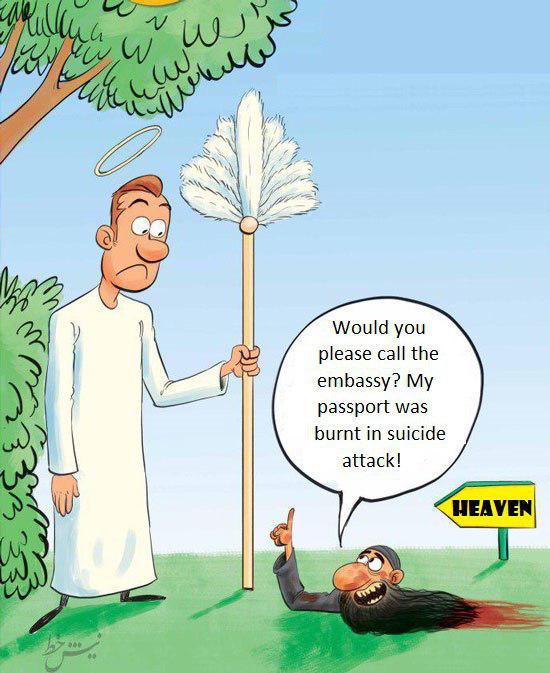
By giving their suicide attackers these passports, the ISIS had managed to convince them that following their death, their entry into the heaven would be guaranteed.

These passports contain no personal information of the ISIS elements. The only data they include are the different names of heaven and hell in Arabic.

It is written in the passports that their owners are only allowed to travel to heaven, and not hell. A number of sentences have also been written in some of the pages of the passports encouraging the terrorists to carry out suicide attacks.

ISIS Awarding Suicide Attackers ‘Passports to Paradise’
ISIS’ main problem for entering heaven revealed! According to ISIS leaders, the holders of ISIS passports can only enter the heaven, not the hell!

‘Saudis Fabricate Mecca Blast Story to Deflect Attentions’

Broujerdi

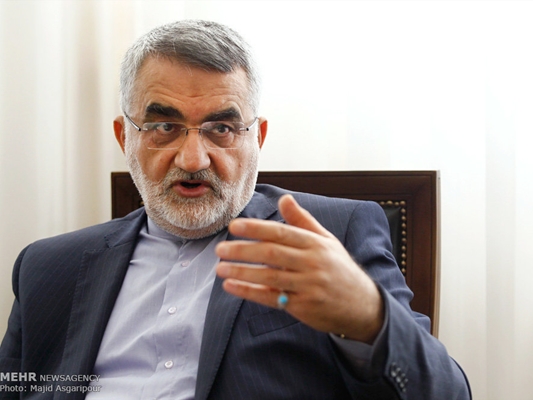
Chairman of the Iranian Parliament’s National Security and Foreign Policy Commission, Alaeddin Boroujerdi, says the fabricated attack on Mecca’s Grand Mosque was part of an evil plan by Saudis.

The Saudis fabricated the story about the holy city, which is highly sensitive for Muslims, to deflect attentions from the new developments in the country’s politics triggered by the elevation of Mohammad bin Salman to the crown prince.

Speaking in a Farsi interview with ICANA, Boroujerdi added, “Fabricating a sensitive news story like the foiled attack on Mecca’s Grand Mosque was the best tactic used by the Saudis to distract the public attention from the appointment of the new crown prince as the change is very dramatic in Saudi Arabia’s politics.”

He then denounced the Saudis’ move to arrest three Iranians in connection with the blast and said this is part of Riyadh’s evil plan to embroil Iran into the attack.

He went on to say that the current political turmoil in Saudi Arabia amounts to a governmental crisis in the country by sparking widespread outrage in the political circles of the kingdom.