Thursday, April 23, 2026
Home Blog Page 3959

Russia to Lift Visa Requirements for Iranians Soon

Russia to Lift Visa Requirements for Iranians Soon

Dzhagaryan on Monday declared that Iranian people will be able to visit Russia without a visa within the next two or three months based on an agreement with Iran’s Foreign Ministry officials in the tourism sector.

He made the remarks on the sidelines of a ceremony in Tehran, held to sign a contract between Iran and Russia on the joint production of train cars.

Under a previous agreement, Iranian tourists, in groups of 5 to 50 people, can travel to Russia without an entry visa for up to 15 days.

‘Turkey Puzzled by US’ Inconsistent Policies on Syria’

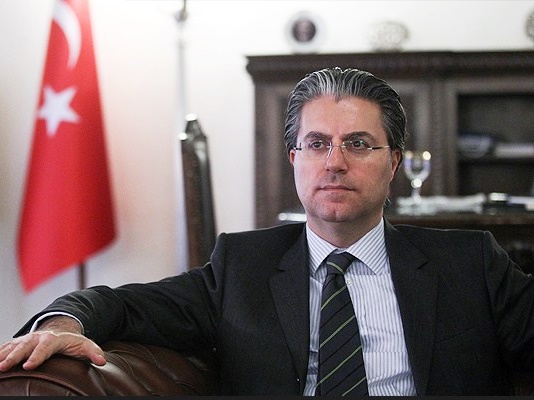
In an exclusive interview with the Etemad daily newspaper, Turkish Ambassador to Tehran Reza Hakan Tekin has discussed a range of issues, from Turkey’s stance towards the Iraqi Kurdistan’s independence to the US policies on the Syria crisis and armed opposition groups in the Arab country.

The Turkish ambassador gave the interview to Etemad’s Sara Massoumi on July 23. The first part of the interview was earlier published by IFP News.

What follows is the second part of his remarks:

In recent years, Turkey has backed the Iraqi Kurdistan politically and militarily, so much so that the central government in Baghdad had to complain, which in turn led into tensions between the two countries. The Iraqi Kurdistan is preparing for an independence referendum in September. Do you see its independence a national security threat for Turkey? What kind of talks have you had with Kurdish officials to stop the referendum?

We do have in fact extensive contacts with the KRG, Kurdish Regional Government of Iraq. But when they made that announcement, we both showed our reaction publicly by making statements and also by talking to them. Our policy in the region is to preserve the territorial integrity of all countries in our region. When we start redrawing borders, you will never know where it’ll end up. Besides, it will further complicate the existing problems. That is our main concern. Iraq and Syria, two important regional countries, which we share over 1300 kilometers of borders with, and these two countries are in deep instability, conflict for many years which is also affecting our national security. What we want both in Iraq and Syria is unified governments which take care of and satisfy all the legitimate aspirations of their own people, with all the sects, ethnic groups and all political thoughts. That is what we want. And for the KRG, we don’t believe secession from Iraq would help the situation. We want Iraqi constitution to be abided by. There are many other things which can be said about that decision, but we believe especially when we’re dealing with a lot of problems in the region, fighting terrorism, instability, inner conflicts and so on, adding to all this the Kurdish independence issue in Iraq could further inflame the existing problems. That’s why we are against it. And we told it very clearly to them.

If that referendum leads to Kurdistan Independence, do you consider it as a threat to affect the Kurdish minority in Turkey too?

This is another country. We don’t think that it will happen, and we don’t think that it should happen.  Of course, you cannot resist the will of the people. So if a country’s people decide on their future, we have to respect that. But the problem here is this decision should be taken by the consent of the whole of the population, or at least by the overwhelming majority of the population, especially if it is about radical measures like secession. And in Iraq when we look at that, nobody wants Iraq to be divided except the Kurds. So that is a fundamental problem of the situation. You know that there are sizable Kurdish population in Turkey, Iraq, Iran and Syria, the biggest community in our country, and they may have some affinity or tribal links among themselves, but at the end of the day they are citizens of different countries. And we have our own system, our Kurds enjoy their democratic rights, fundamental freedoms. We have of course some problems in this regard mainly due to the terrorist activity of PKK in the last forty years. But our government, our state, is doing its best both to fight and defeat PKK as well as to improve the conditions of all our citizens including our Kurdish compatriots.

The US has just announced it would end arming the Syrian opposition groups. Turkey, some Arab states, and the US have been advocating the arming of opposition in the past seven years. How do you evaluate the US’ new approach?

The US’ approach is really sometimes not easy to understand. There is not much of a consistency and there is not much of a continuity when you look at US policies in the last few years towards Syria. So we are like many others around the world a bit puzzled on what is the real policy, real strategy of the US. When you look at the steps they take on the ground, like arming, especially with heavy arms, the PKK branch of Syria PYD/YPG, because they believe it’s the only group that can fight ISIS, which is nonsense in our opinion. And we had a lot of talks with the US on this issue. And just recently it was acknowledged by a US general, you might have heard about it, I think yesterday. Answering a question about the US links with the Syrian PYD/YPG group, he said that there was a problem with their link with PKK, so they advised them to change their name, and that’s how he said Syrian Democratic Forces, the so-called umbrella group, was established. Basically this is also a PKK-controlled group, and he acknowledged that this name was given by their own advice in order not to show that it has links with the PKK. This is ridiculous. So we have a lot of differences with the United States on this issue. But at the same time United States is our ally since many decades. We have extensive relations, including in the military field with the United States. So we keep telling them how wrong some policies they pursue, some steps they take in the region, and how it would further complicate the situation.

Do you consider this new decision as a green light to Russia?

When you look at the last few years, what’s going on in Syria, you may make your own conclusions. I mean this is one of the fundamental principles of international relations, when there is a vacuum there will always be some other power to fill that vacuum.

Do you think this new strategy will give Bashar Assad more power and maybe it’s a sign which means US accepts the presence of Bashar Assad?

He may seem to be more confident than before and when you hear some remarks of some western leaders like Macron or even some US officials that it’s not a priority for them to topple Assad and so on, he may feel that. But I think these are wrong thoughts because after all that has been going on in Syria, nobody with a clear sense of mind would think that Syria can be ruled in the same way as before,  and just continue as if nothing happened and Bashar al-Assad continues to rule the country. This will not work. This would also be an affront to the Syrian people. That’s why we think a real and meaningful transition is necessary, the first step for a lasting peace, conciliation in Syria. How can you expect a big chunk of the Syrian population, the majority of the Syrian population actually, to trust the system when the most powerful person who was basically responsible of all that has been lived through in the last six or seven years of war to continue in his position?

Well the Syrian war is 7 years old now and still we don’t have any strong and unified opposition there. Don’t you think it’s time to accept the realities on the ground?

This is a really unfair evaluation. What meaningful support has been given to the opposition? What were they provided with?

By meaningful support you mean politically or militarily?

Both militarily and politically. Politically is more important I think.

They have the whole world support in all these years.

It was mainly support without being backed by meaningful action. If you only make statements without backing it up it does not work. You know the carrot and stick approach. That is one of the fundamentals of international policies. Remember Obama. He said the use of chemical weapons was a red-line. What happened after Assad used chemical weapons? He just took a step back. So you cannot say that, it’s just one simple but a very brutal example of international approach towards Syria. What can you expect from the opposition? They’re put in a position, at the mercy of a brutal government.

The opposition has been enjoying political statement and military equipment. So why couldn’t they make even a qualified union? They have the support of all regional players and international ones.

The nature of the support is quite different. I mean you see Russia and Iran on the ground. You don’t see the others on the ground.

So what about thousands of dollars of weapons they received in all these years?

Look. There is an existing national army, with all its inventory of heavy weapons and everything. And then there is a variety of groups which do not have a unified structure, they receive some occasional support let’s say from certain countries. So this is not an even fight. But despite these facts, we have to acknowledge that against a very powerful army with all these heavy weapons, structure, and intelligence strength plus the on-ground support of a big country like Russia as well as Iran and some other militias coming from some other countries on the side of the regime forces and then you have this. So despite these imbalances, I think we have to acknowledge that the opposition, despite also the lack of political support they have resisted and continue to resist. You mentioned that all the world support them except a few countries, but this support is meaningless when you don’t show something in behind. No sanctions, no nothing…

Well different sanctions are imposed on Syrian government in these years.

It does not have an effect. When you cannot isolate a regime, it does not mean anything.

So you mean the whole world couldn’t isolate Bashar Assad just because of Russia and Iran?

There was not a unified approach; we cannot say that it was the whole world and Assad. This is not the case. Compare the policies of the United States and Russia. There are a lot of differences.

US-Turkey relations were not in really good terms under the Obama administration and the sides frequently criticized each other. How satisfied are you with the Trump administration?

We had a lot of disappointments with the Obama administration; despite we worked closely with them. With Trump, it’s still early to tell I should say, because although it has been almost now seven months since Trump started his presidency, it seems they have not yet formulated an overall policy, a strategy, both towards the region and on some other issues. So they are still like in a transition period. We hope that it would be better but we have to wait and see. It’s still early to say that we are satisfied or we are not.

In contrast with what Trump said during his presidential campaign, he has boosted the United States’ military and political role in our region. In Syria for instance, we have seen direct military interference and arms deals suspended under the Obama administration are being resumed. Iran is among countries that believe regional players should resolve regional issues and oppose the US military involvement in the region. How does Turkey view this military involvement?

Look, the United States is the most powerful country in the world and we believe that the US should have an involvement, a role, in our region along with the regional countries. But that role should be constructive, that role should be clear-cut, and that role should not be in a way that it imposes its policies on the regional countries, but rather in a partnership nature. Because we need that. If the US withdraws itself, we don’t believe that we’ll have a better environment in the region.

Don’t you think that their presence affects the power balance in the region in a negative way? For example they sold thousands of dollars of weapons to Saudi Arabia but at the same time imposed sanctions on Iran because of a simple defensive missile test?

We are not for increased armament in the region. Those billions of dollars should be spent in a much better way. I mean, look at our region. Beside all this instability and all this bloodshed, there is also a lot of poverty, lack of education, lack of basic needs for a big chunk of population in our region. So we need those resources to be spent for the people of our countries. But then of course, there is the other reality of you know tensions, perceptions, threat perceptions. So, some countries which may have legitimate concerns about what’s going on in the region may feel the need to strengthen their army because they don’t want to be run over by some other country or some other power. So, we have to put all these things in context. In an ideal world of course there will be zero budgets on armament with all money on these economic, cultural and social projects. But unfortunately, we are not living in an ideal world.

The third and final part of the interview will be published soon …

US Court Ruling Part of Anti-Iran War of Nerves: MP

Mohammad-Ebrahim Rezaee

Iranian lawmaker Mohammad-Ebrahim Rezaee has, in a Farsi interview with ICANA, reacted to a US court verdict sentencing Iran to pay $209 million in damages for the victims allegedly killed in a bombing claimed to have been conducted by the Islamic Resistance Movement, Hamas, in al-Quds.

“US measures show their (US officials) decisions were made out of anger and rage, and have no logic based on international law,” said Rezaee, who sits on the Parliament’s National Security and Foreign Policy Commission.

He said the US has launched a war of nerves against Iran through pressure.

“Washington seeks to provoke Iran psychologically,” said the MP.

The top legislator underlined that the US court seeks to drag Iran into a “game of psychological warfare.”

“The Islamic Republic of Iran has nothing to do with Israeli people [families of the victims]. So, the holding of the court session in the United States is pointless, and by doing this the US simply wants to show it supports Israel.”

Rezaee said the White House directly backs terrorist elements.

He noted the US was directly involved in the killing of some 17 thousand Iranian people who were killed in acts of terror or in the Iraqi imposed war on Iran in the 1980s.

He added Iran can claim compensation for them and added, “This will be put on Tehran’s agenda soon.”

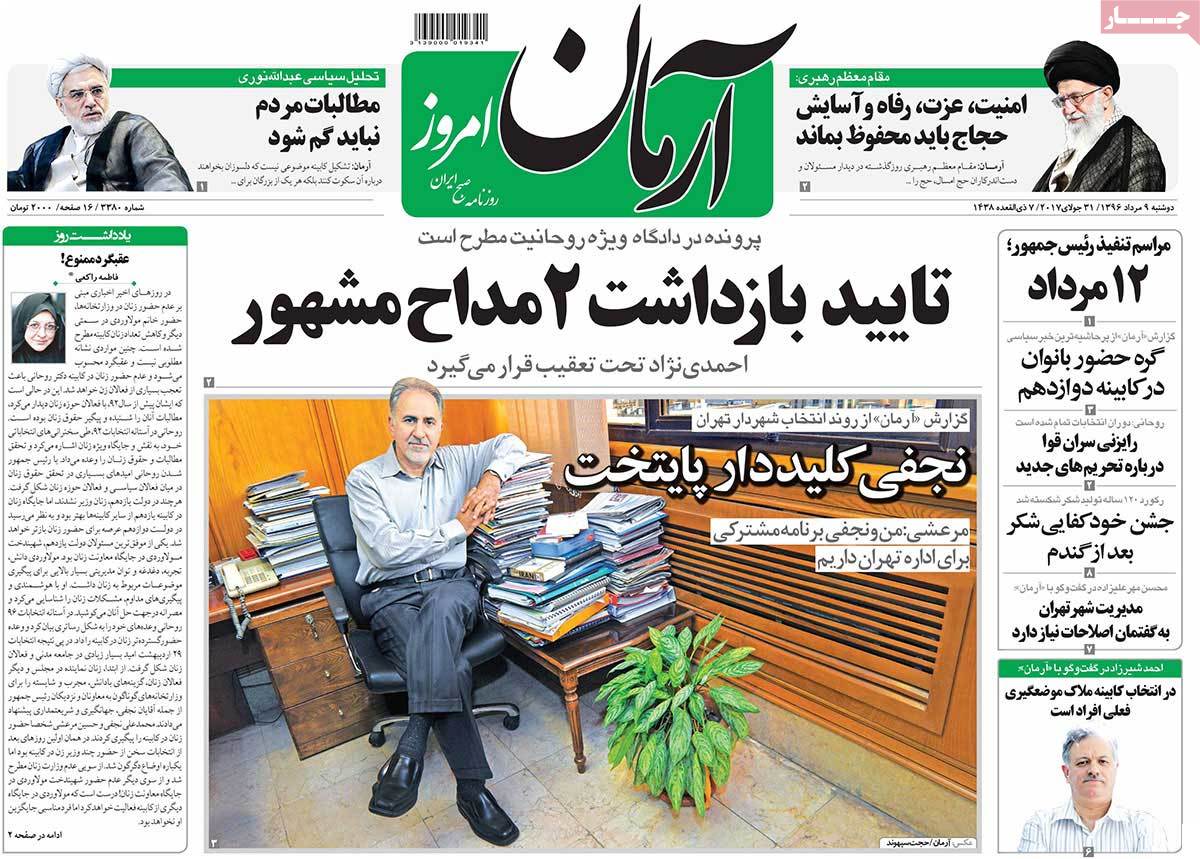
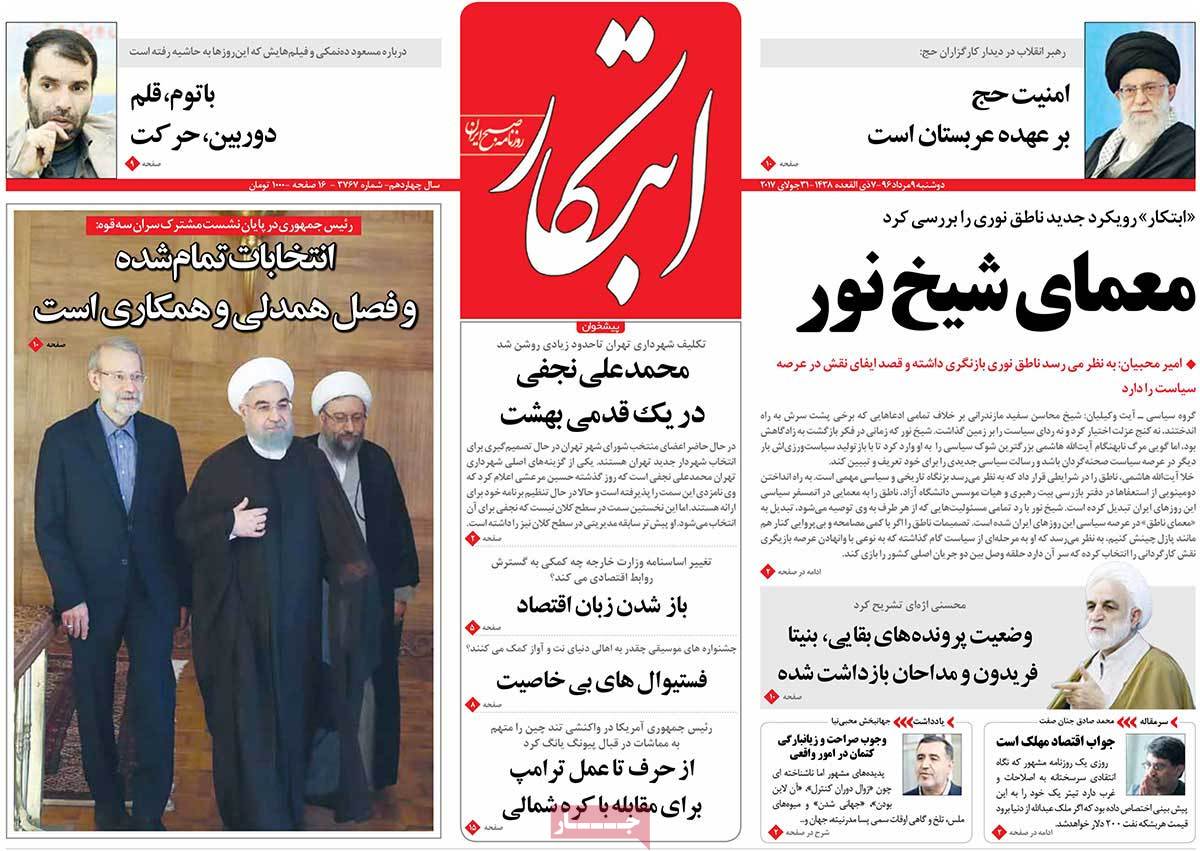
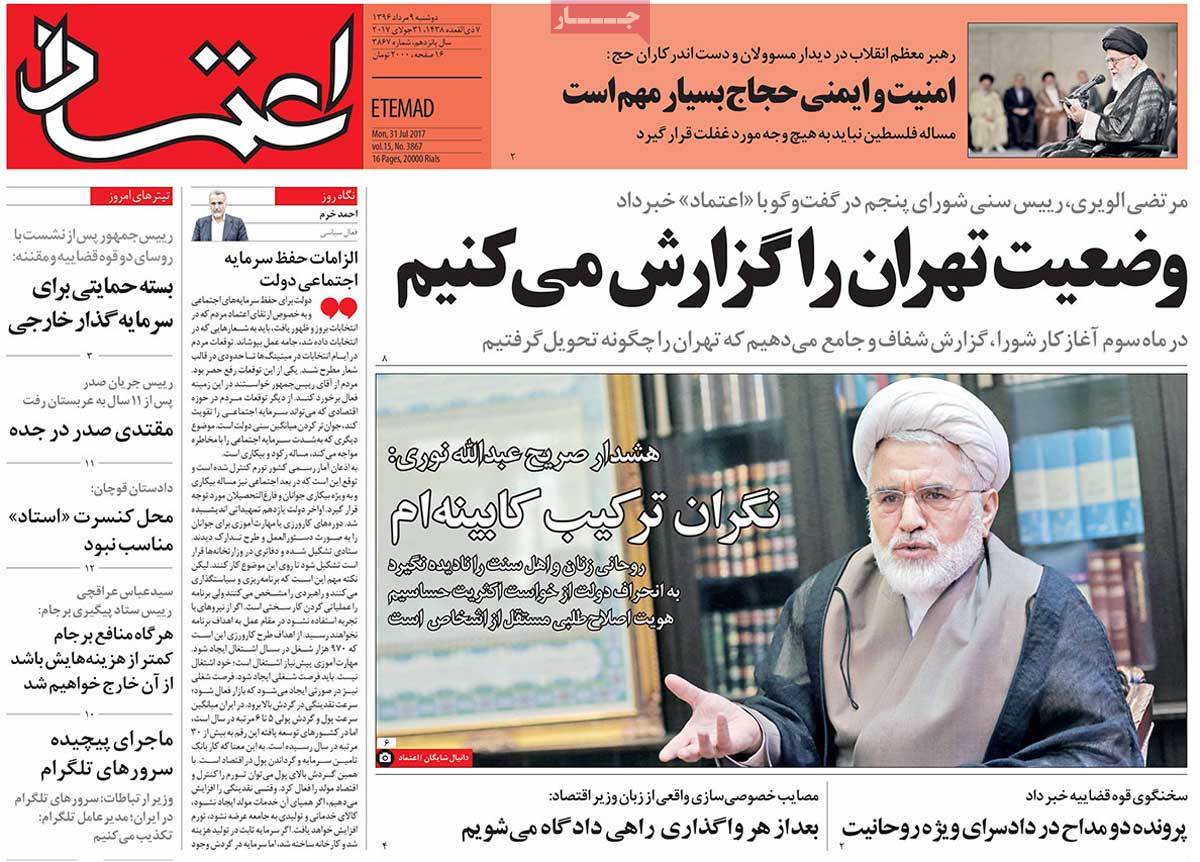
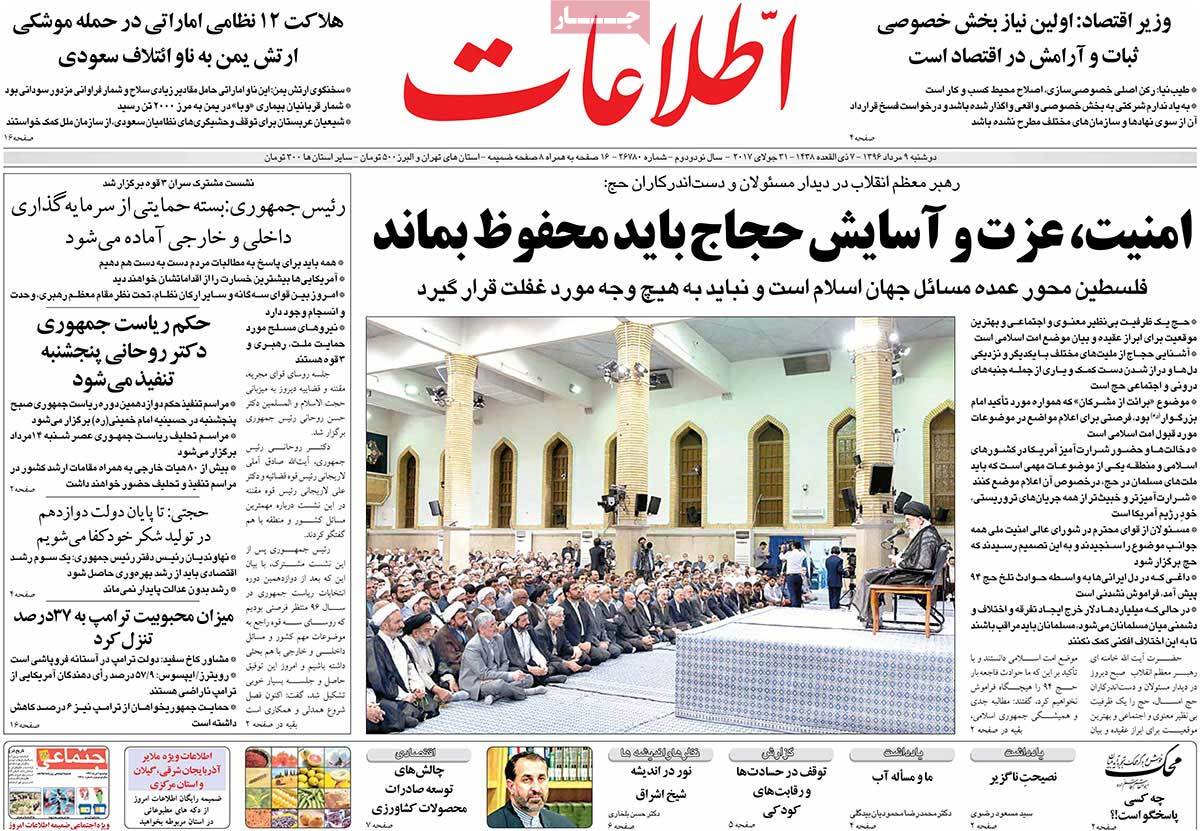
A Look at Iranian Newspaper Front Pages on July 31

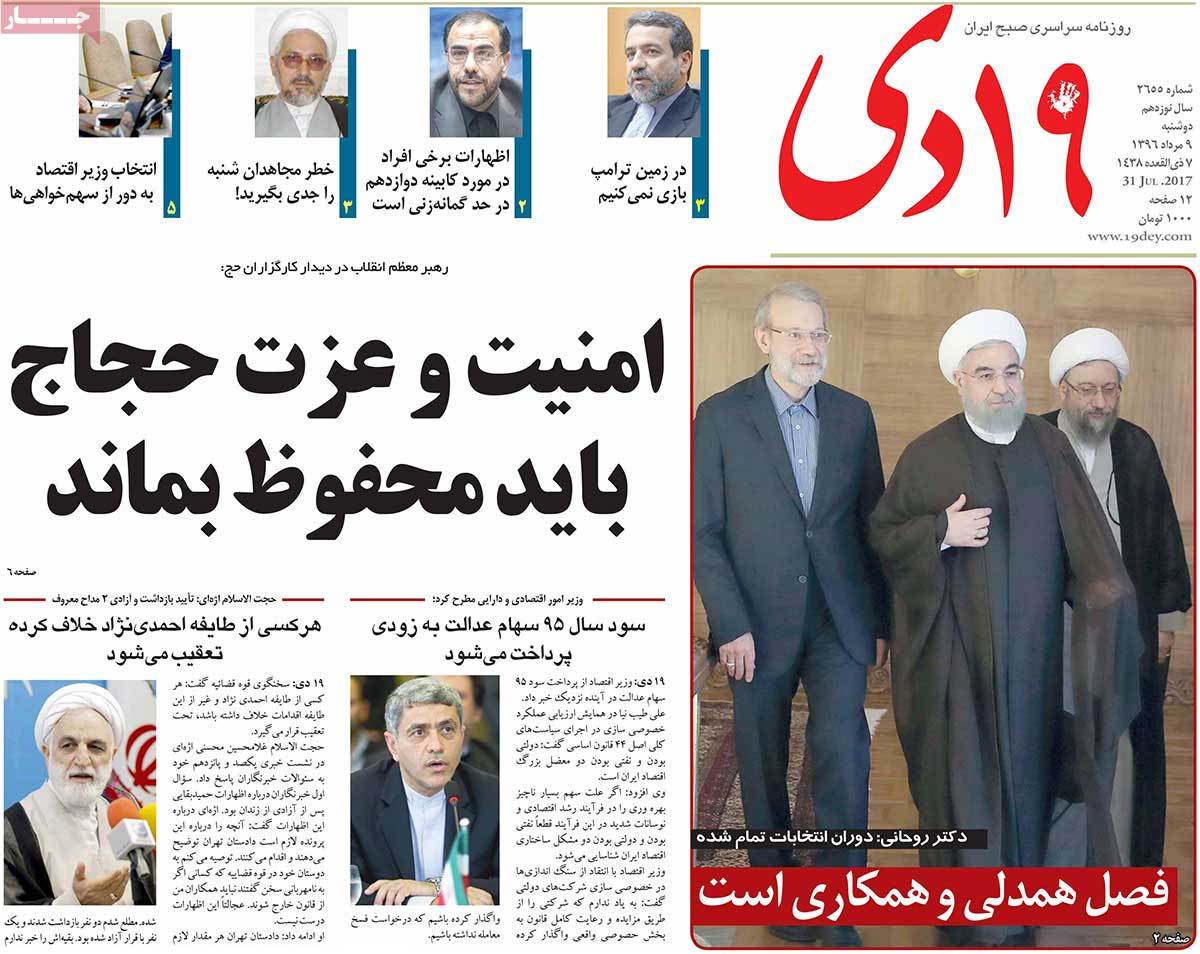
Almost all newspapers today covered the remarks made by Ayatollah Seyyed Ali Khamenei, the Leader of the Islamic Revolution, about this year’s Hajj pilgrimage and his call on pilgrims to denounce the Israeli regime’s crimes against Palestinians.

The controversial visit of Iraqi Shiite leader Muqtada al-Sadr to Saudi Arabia was also a top story today. Analysts are discussing Baghdad’s close ties with Riyadh and its impacts on its relations with Tehran.

A trilateral meeting between President Hassan Rouhani, Parliament Speaker Ali Larijani, and Judiciary Chief Ayatollah Sadeq Amoli Larijani also received great coverage.

The above issues, as well as many more, are highlighted in the following headlines and top stories:


19 Dey:

1- Iran Leader: Security, Dignity of Hajj Pilgrims Should Be Ensured

A Look at Iranian Newspaper Front Pages on July 31 - 19dey


Abrar:

1- Prosecutor Reveals Shocking Details of Ahmadinejad’s Violation of Law

2- Iraq’s Close Ties with Arab States Doesn’t Mean Abandoning Iran: Politician

3- Tillerson: We Hope Iran, Russia, North Korea Understand Our Message

A Look at Iranian Newspaper Front Pages on July 31 - abrar


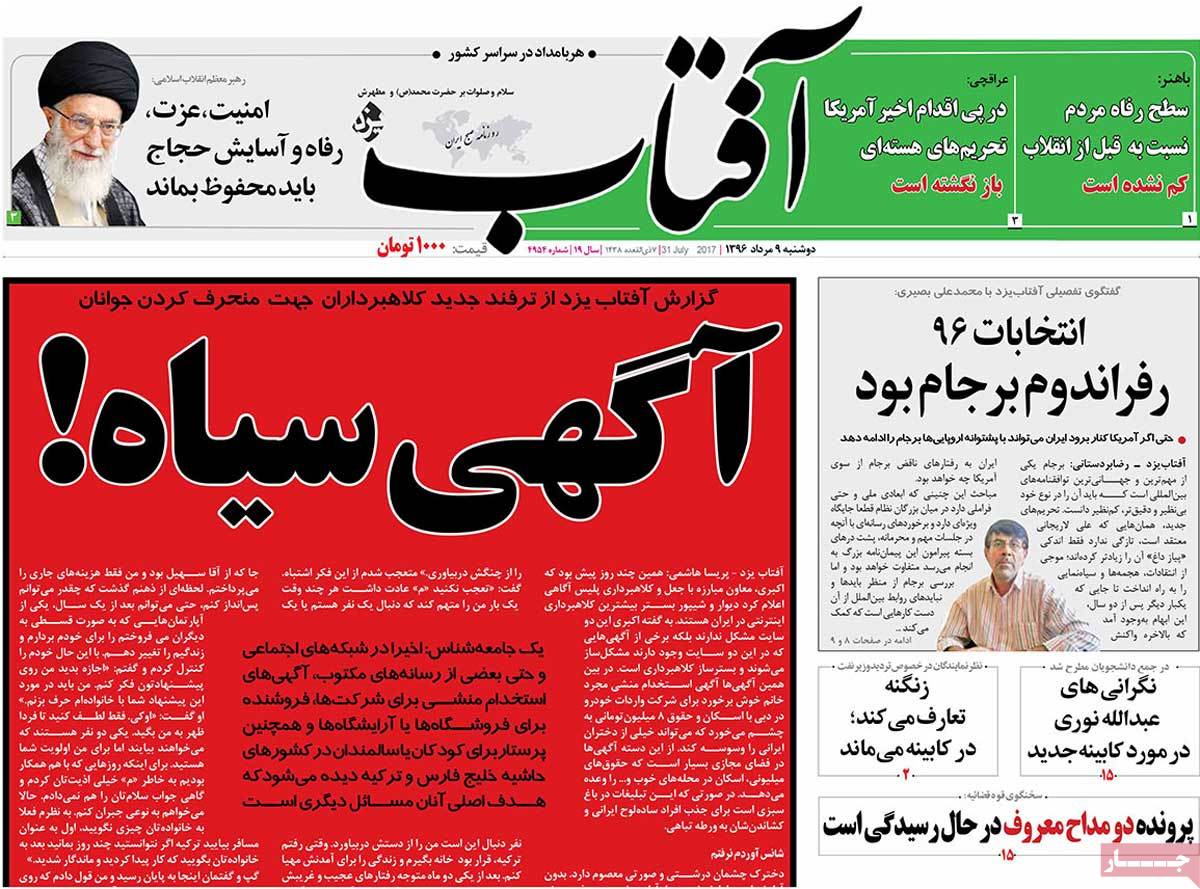
Aftab-e Yazd:

1- A Report on Dirty Job Vacancy Ads

  • Job vacancy ads are being published in certain social media, offering job opportunities to [female] secretaries who want to work at firms in Persian Gulf countries and Turkey. Sociologist says they are looking for something else
  • A Look at Iranian Newspaper Front Pages on July 31 - aftab


Arman-e Emrooz:

1- Najafi to Become Tehran’s Mayor: A Report on Election Process

2- Rouhani to Be Inaugurated by Iran Leader on August 3

3- Barriers to Women’s Presence in Rouhani’s Next Cabinet

A Look at Iranian Newspaper Front Pages on July 31 - arman


Ebtekar:

1- Rouhani: Elections Over. It’s Time to Work

2- From Talking to Doing: Trump’s Plans to Counter North Korea

A Look at Iranian Newspaper Front Pages on July 31 - ebtekar


Etemad:

1- Senior Reformist Warns: I’m Worried about Cabinet Line-up

  • Rouhani Shouldn’t Ignore Women, Sunni Muslims

2- Muqtada al-Sadr in Jeddah: Sadr Movement Leader in Saudi Arabia after 11 Years

3- Deputy FM: Iran to Withdraw from JCPOA If Costs Exceed Benefits

A Look at Iranian Newspaper Front Pages on July 31 - etemad


Ettela’at:

1- Iran Leader: Palestine Major Issue of Muslim World, Shouldn’t Be Ignored

2- Rouhani to Be Inaugurated on Thursday

A Look at Iranian Newspaper Front Pages on July 31 - etelaat


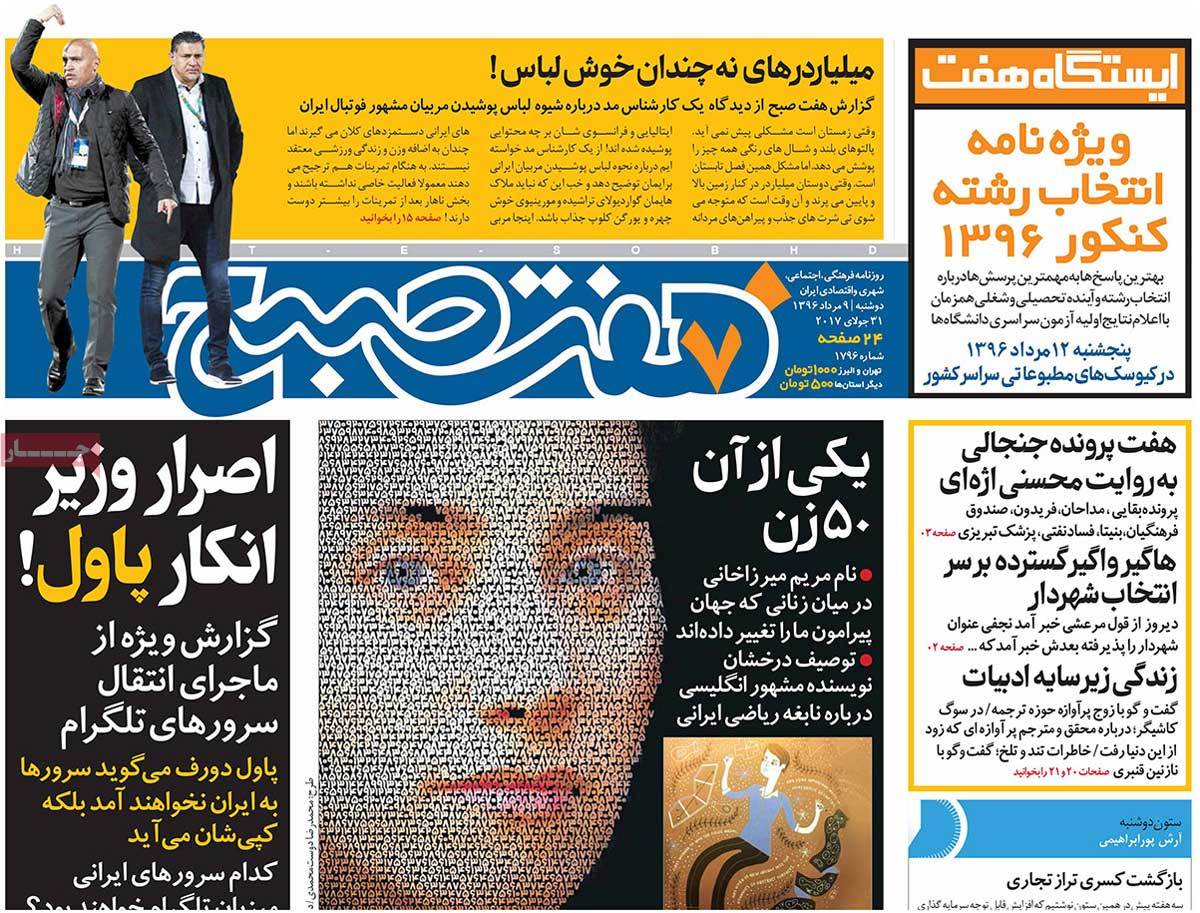
Haft-e Sobh:

1- One of Those 50 Women: Mirzakhani’s Name among Women Who Changed World around Us

A Look at Iranian Newspaper Front Pages on July 31 - haftesobh


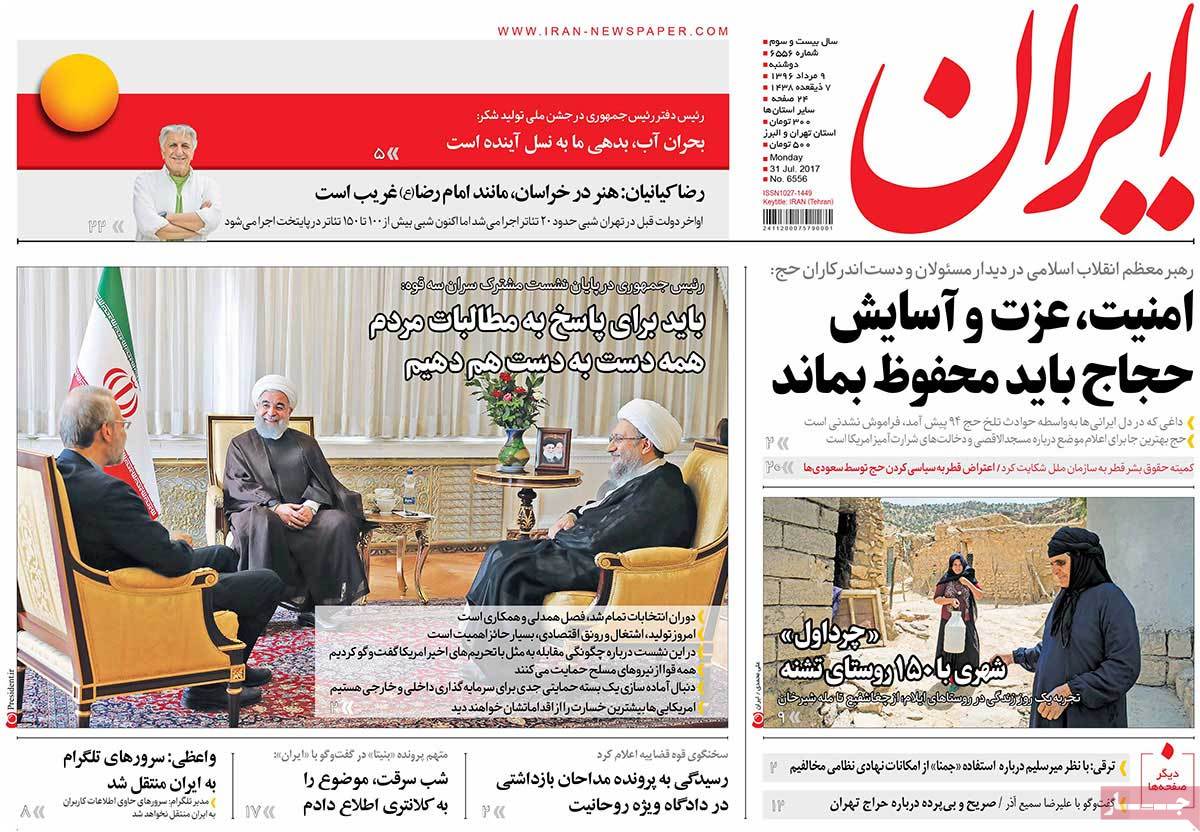
Iran:

1- President Rouhani, Parliament Speaker, Judiciary Chief Hold Meeting

  • Rouhani: We Should All Join Hands to Meet People’s Demands
  • A Look at Iranian Newspaper Front Pages on July 31 - iran


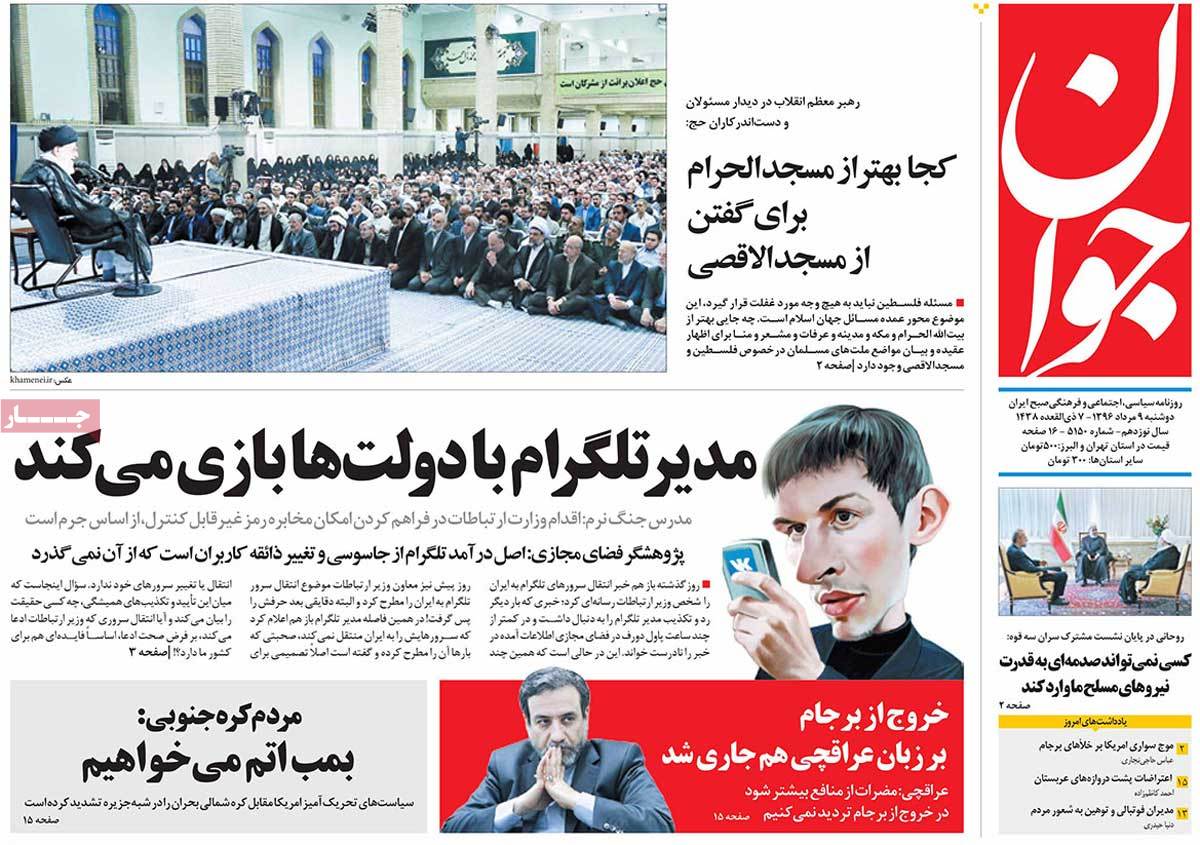
Javan:

1- Iran Leader: Great Mosque of Mecca Best Place to Talk about Aqsa Mosque

2- Even Araqchi Talks about Iran’s Withdrawal from JCPOA

3- South Korean People: We Want Nuclear Bomb

A Look at Iranian Newspaper Front Pages on July 31 - javan


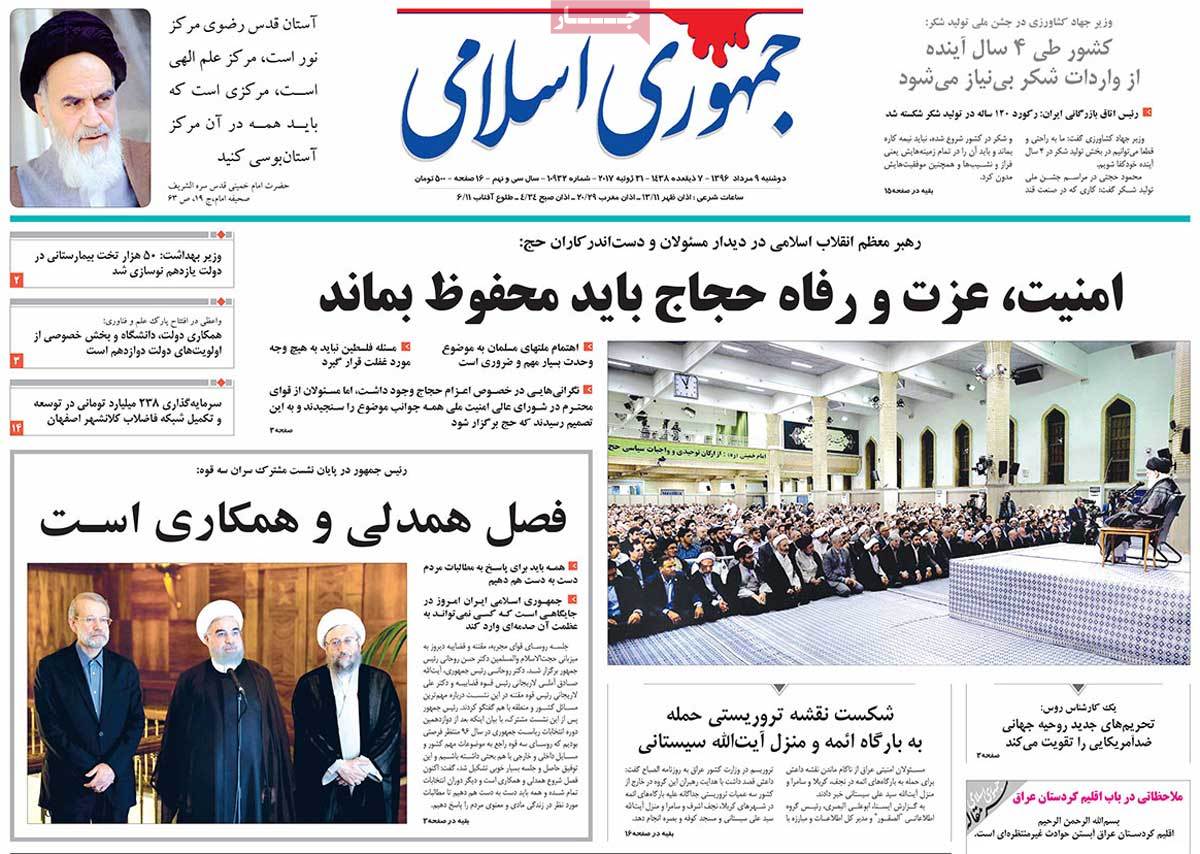
Jomhouri Eslami:

1- Terrorist Attack on Shrine of Imams, Ayatollah Sistani Foiled

2- Agriculture Ministry: Iran to Become Self-Sufficient in Sugar Production

A Look at Iranian Newspaper Front Pages on July 31 - jomhori


Ka’enat:

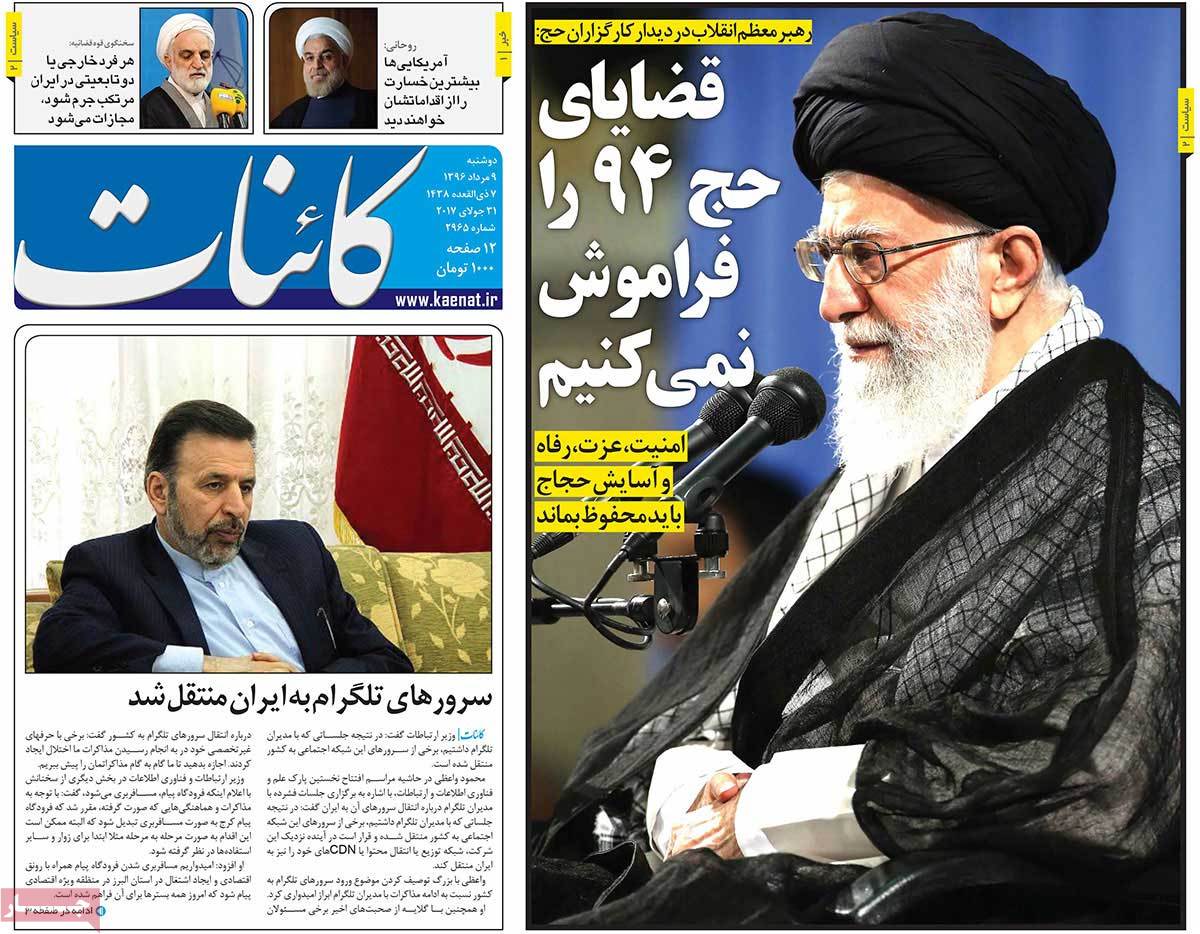
1- Leader: Iran Not to Forget 2015 Hajj Incidents

A Look at Iranian Newspaper Front Pages on July 31 - kaenat


Kayhan:

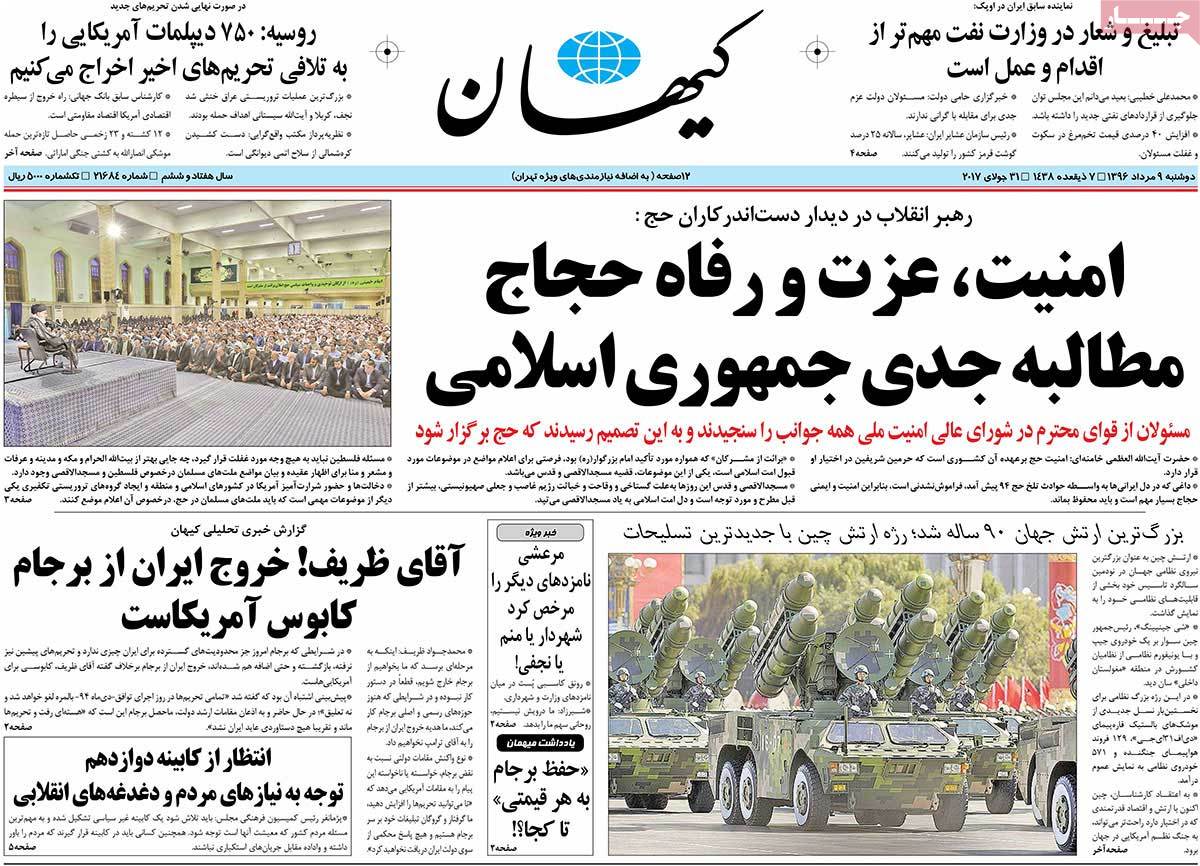
1- Russia: We’ll Deport 750 American Diplomats in Retaliation for Recent Sanctions

2- World’s Biggest Army Celebrates 90th Birthday

  • Chinese Army’s Parade with Latest Weapons
  • A Look at Iranian Newspaper Front Pages on July 31 - kayhan


Setareh Sobh:

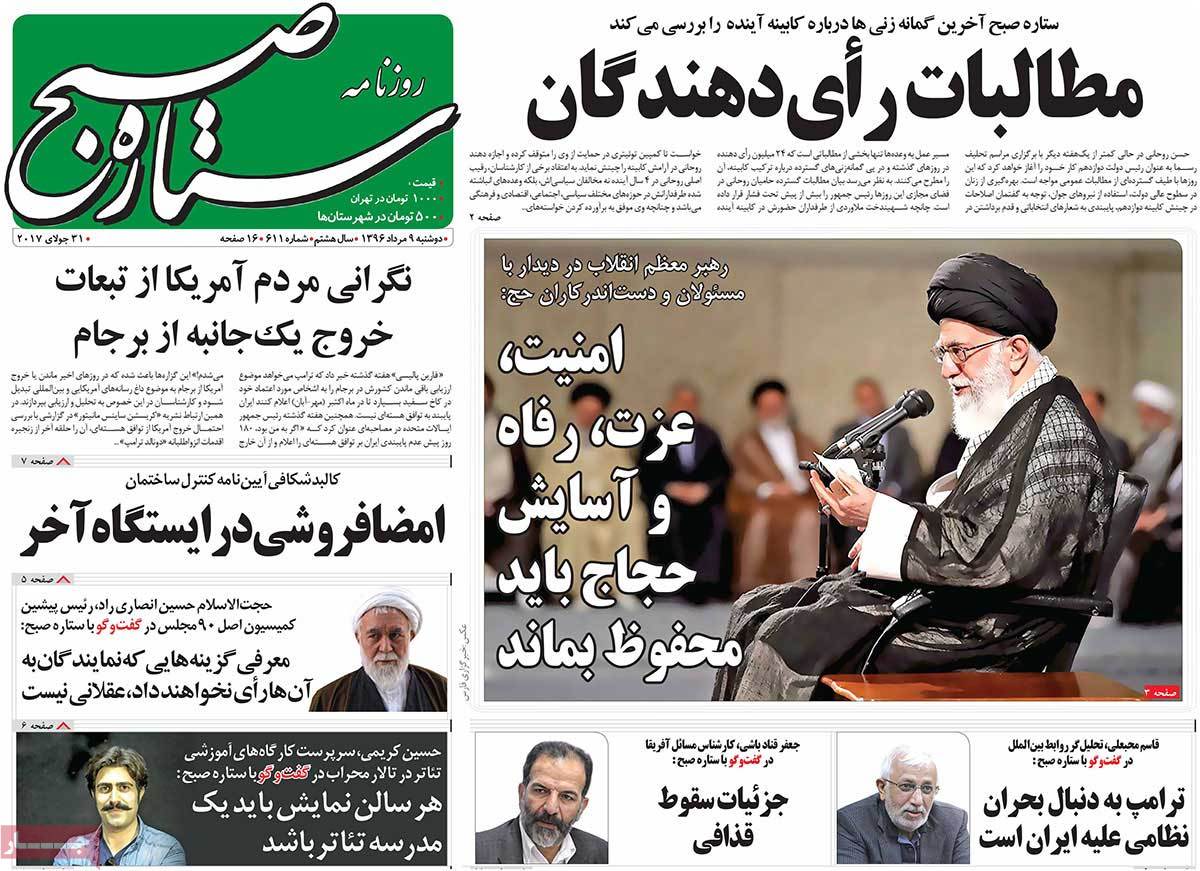
1- US Worried about Consequences of Unilateral Withdrawal from JCPOA

2- Analyst: Trump Seeks to Create Military Crisis against Iran

A Look at Iranian Newspaper Front Pages on July 31 - setaresobh


Shahrvand:

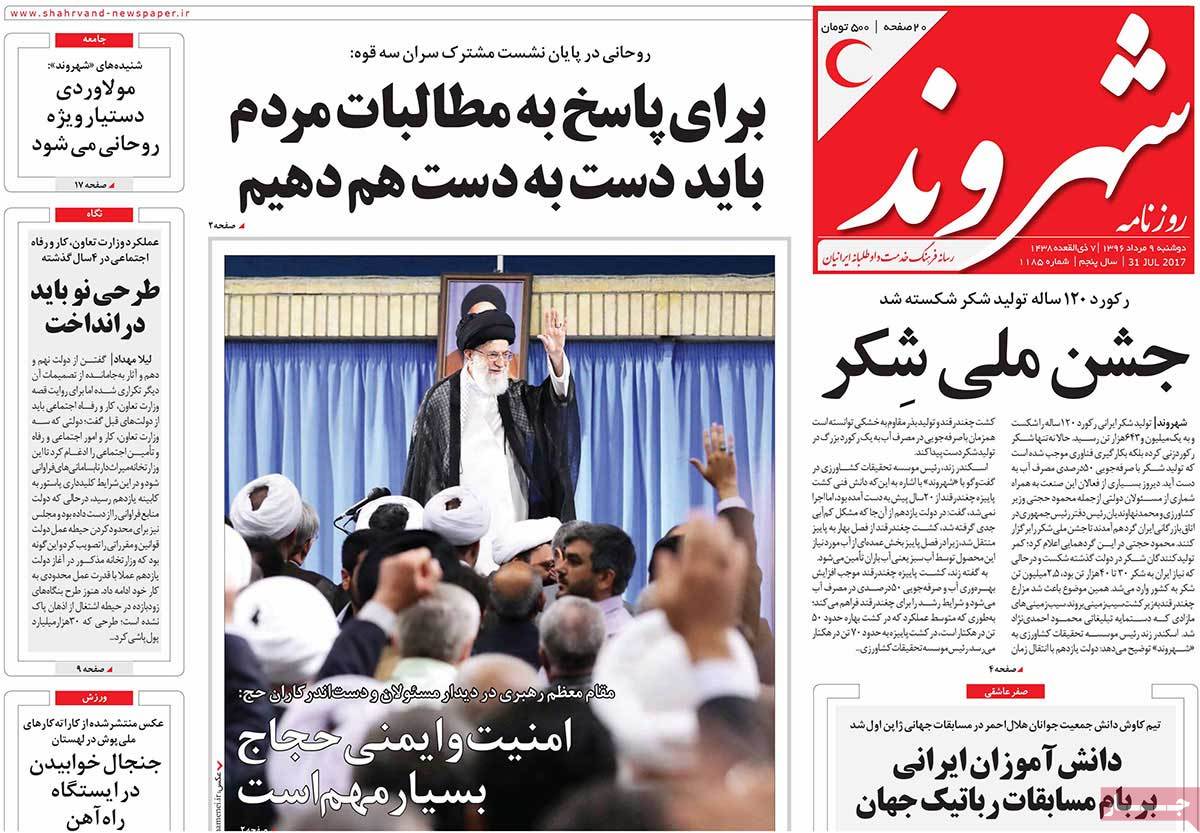
1- Iranian Students Claim World Robotic Title

2- National Sugar Celebration: Iran Breaks 120-Year Record

A Look at Iranian Newspaper Front Pages on July 31 -shahrvand


Shargh:

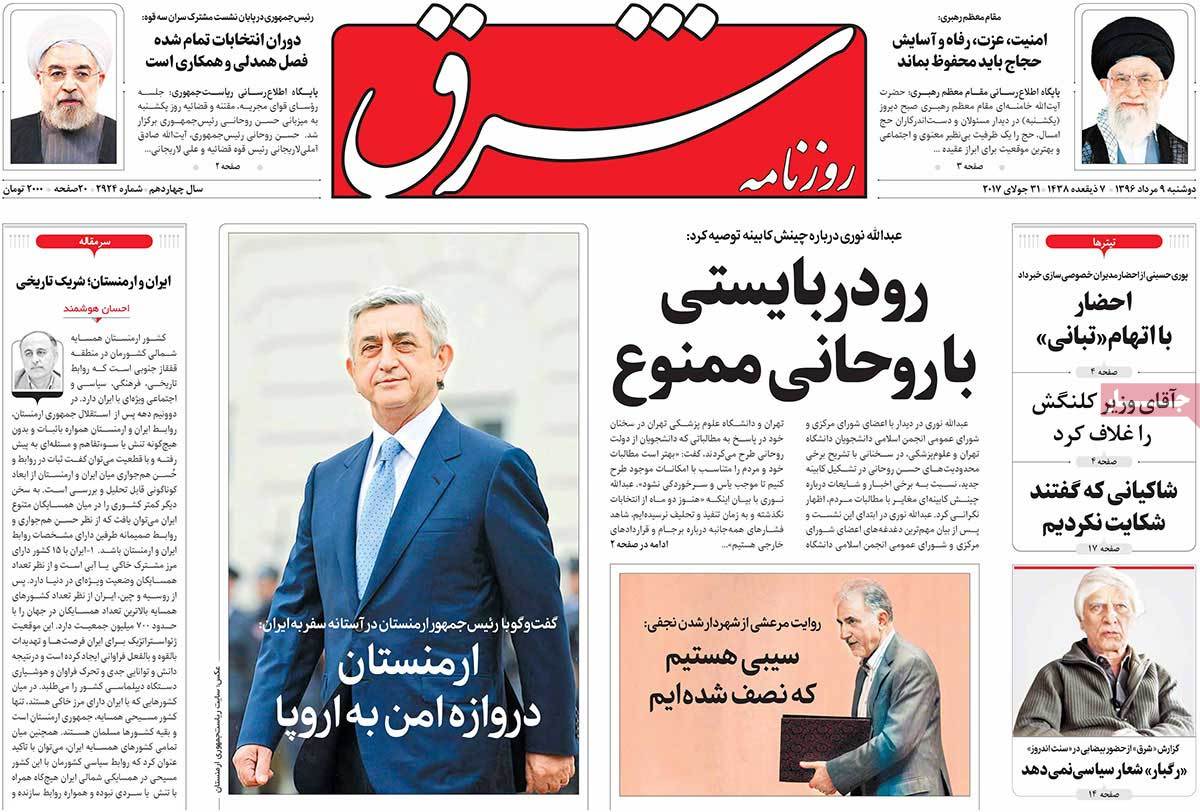
1- Armenian President ahead of Visiting Iran: Armenia, Secure Gateway to Europe

A Look at Iranian Newspaper Front Pages on July 31 - shargh


Sobh-e Now:

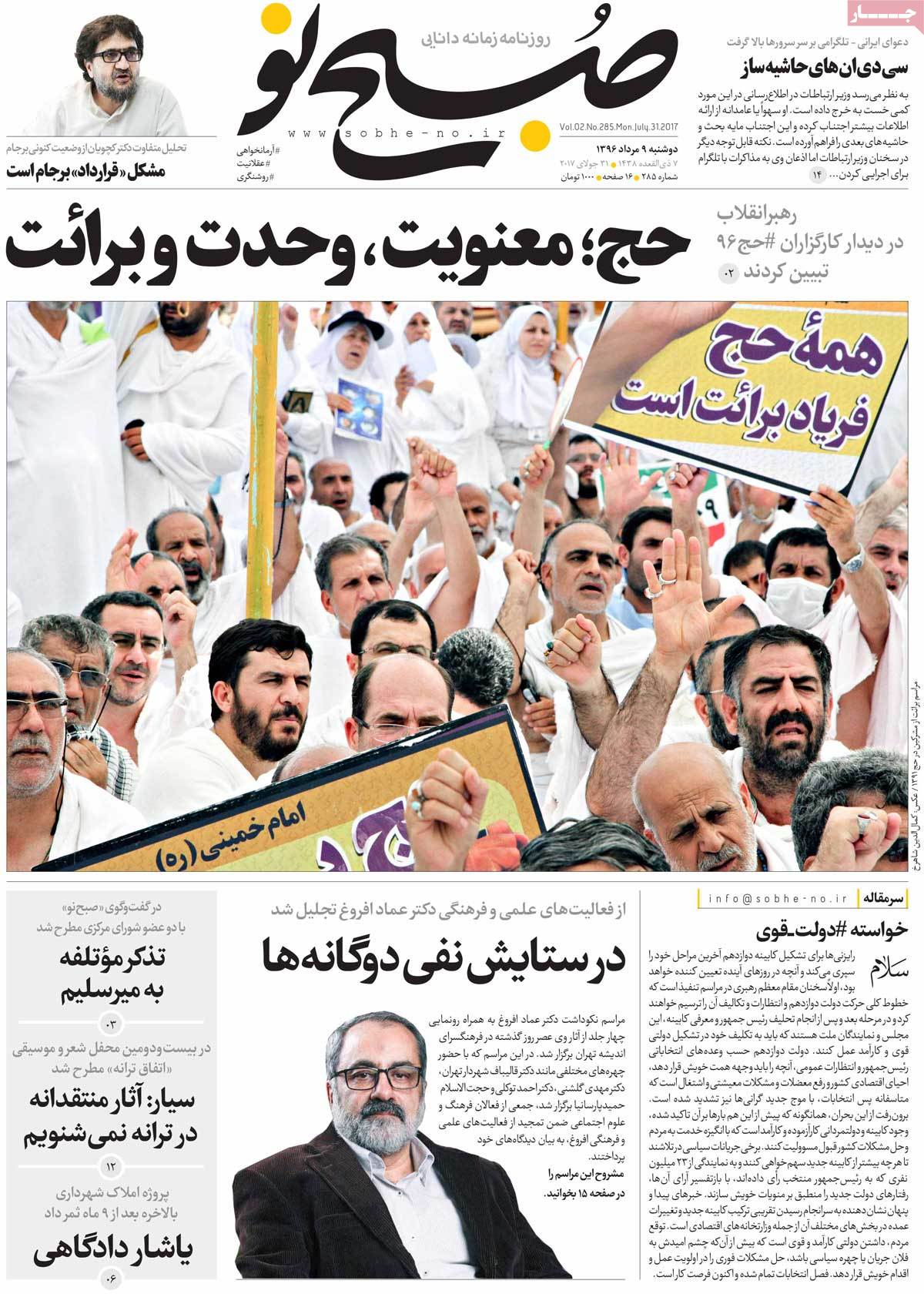
1- Iran Leader: Hajj Means Spirituality, Unity, Distancing [Ourselves from Mushrikīn]

A Look at Iranian Newspaper Front Pages on July 31 - sobheno


Vaghaye Ettefaghieh:

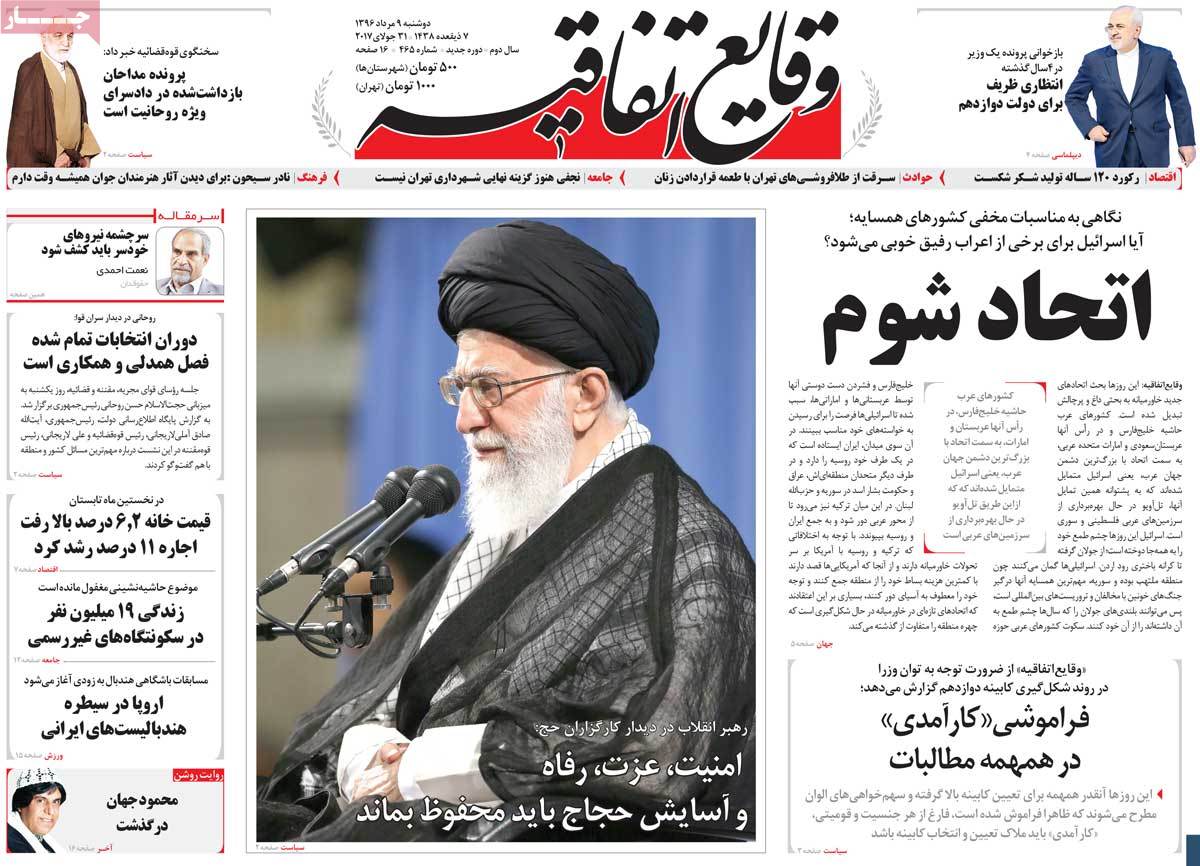
1- Zarif’s Challenge for Next Gov’t: Will He Still Accompany Rouhani?

2- Ominous Unity: Will Israel Be a Good Friend for Certain Arab States?

  • A Look at Neighbouring Countries’ Secret Ties with Tel Aviv
  • A Look at Iranian Newspaper Front Pages on July 31 - vagaye


Vatan-e Emrooz:

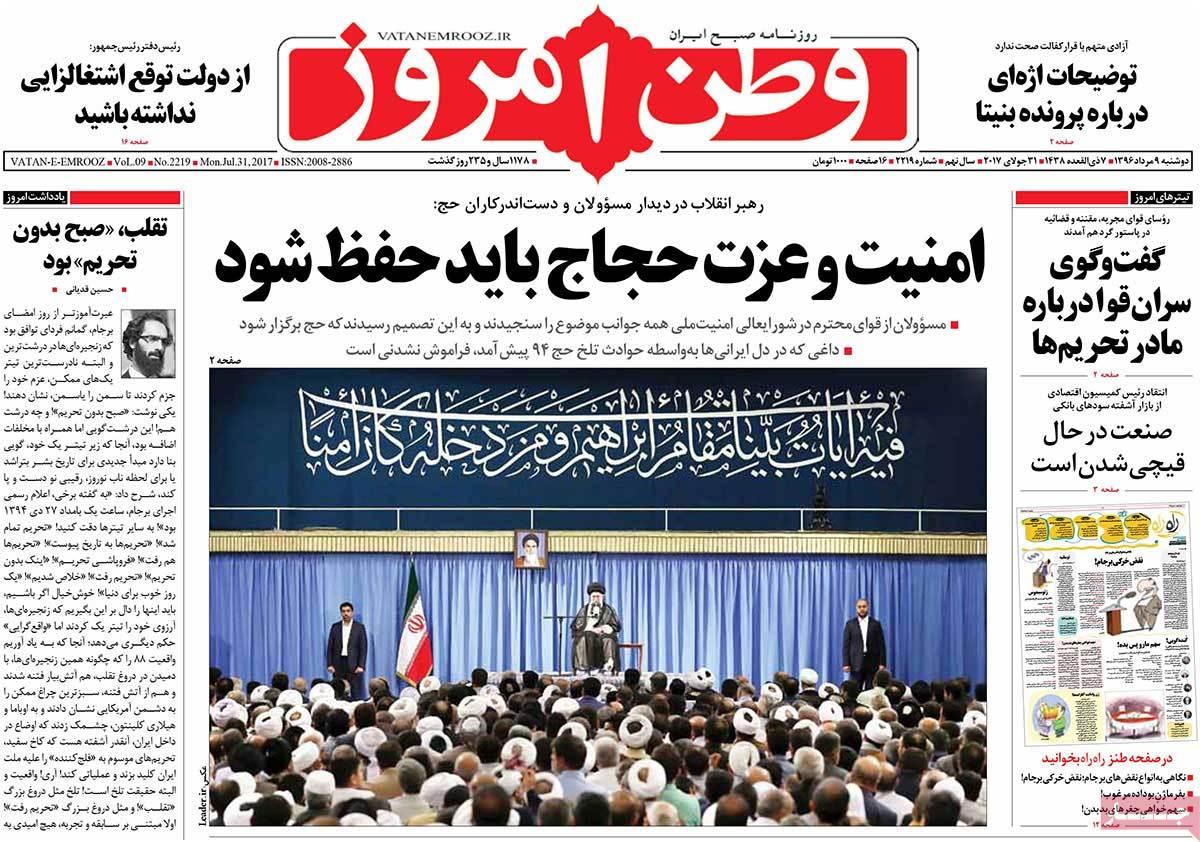
1- Real Cheating Was ‘the Morning without Sanctions’ [Editorial]

A Look at Iranian Newspaper Front Pages on July 31 - vatan

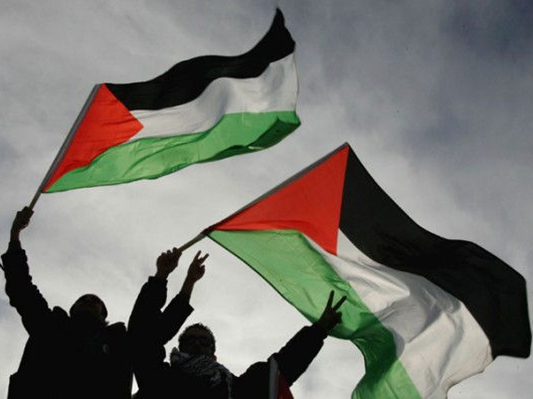
Hamas Sends Letter to Iran President on Al-Quds Developments

palestine

Khaled Qaddoumi, the Hamas representative in Iran, sat down with Iranian Deputy Foreign Minister for Arab and African Affairs Hossein Jaberi Ansari on Sunday.

During the meeting held in Tehran, Qaddoumi presented to the Iranian official a written message from Hamas’ political bureau chief Ismail Haniya addressing Iranian President Hassan Rouhani.

The message was related to the latest developments in al-Quds and at al-Aqsa mosque.

The two sides also discussed the latest developments in the occupied Palestine as well as the region.

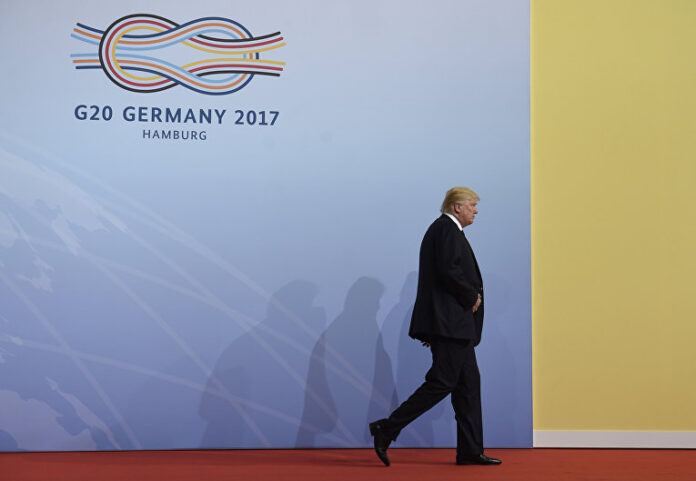
US Moving towards Int’l Isolation: Analyst

Trump - Isolation

Political analyst and former Iranian diplomat Mohsen Paakaein has, in a Farsi peace published in the Jame Jam daily newspaper, weighed in on the repercussions of the US Congress’ move to impose new sanctions on Iran, Russia and North Korea. The following is the full text of the article:

The US House of Representatives’ slapping fresh sanctions on Russia, Iran and North Korea can be reviewed from different perspectives.

  1. Although the motion needs to be signed by the US president to come into force, Iran will definitely react to the US lawmakers’ move and will reciprocate through necessary measures at the Parliament.
  2. The US Congress passing the legislation at a time when Takfiri terrorists in Syria and Iraq have suffered crushing defeats indicate neo-conservatives’ anger and proves the White House lacks serious determination to tackle terrorism. It goes without saying that by imposing sanctions on Iran and Russia, which are at the forefront of the campaign against terrorism, the US is targeting countries which are fighting terrorists.
  3. The Congress’s recent move, which has raised serious opposition and concern in Europe, will increase Washington’s divisions with European states and speed up the trend of Washington becoming isolated on the international stage. Moreover, the United States’ animosity with Russia and North Korea, which has somehow targeted China as well, will reduce the number of Washington’s friends. All these developments have set the stage for Iran to take diplomatic action in the face of Washington’s breach of promises. Iran’s diplomacy apparatus can take advantage of the situation to turn US threats into opportunities.
  4. The reality is that the nuclear deal signed between Iran and six world powers known as the Joint Comprehensive Plan of Action (JCPOA), which is an international agreement, has circumscribed the United States’ chances of exerting pressure on Iran. The Capitol Hill’s recent move also looks more like a cold war and is much less likely to go into effect now compared to the time before the JCPOA was signed. By slapping sanctions on Iran, Washington seeks to make the Islamic Republic pull out of the JCPOA, so that it will be able to get other European countries on board and form an international coalition against Iran. By pressing ahead with its prudent diplomacy, Iran should get European countries, Russia and China to realize that the US is impeding the implementation of the JCPOA by reneging on its commitments. At this juncture, Iran should avoid any move which might be regarded as non-compliance with the JCPOA, and, hence, prevent the formation of any global consensus against itself.
  5. US media are seeking to blow the new bans out of all proportion, call them the “mother of sanctions” and, in their estimation, intimidate Iran with a war of nerves. But the reality is that the possible new sanctions against Iran are a far cry from the possible bans against North Korea or Russia. The sanctions on Iran would, in fact, be a repeat of past sanctions without the approval of the UN Security Council, and show that using sanctions as a tool is more inefficient than in the past.
  6. The Islamic Republic of Iran will definitely show reciprocal reaction to the US Congress’ new move. In the meantime, boosting national solidarity and unity as well as reinforcing the country’s defense capability will be the strongest and most serious response to the US sanctions. We need to improve our defense capability and national solidarity, and at the same time press ahead with our activities in the defense sector. Some 40 years ago, the Americans put pressure on Iran with different tools, namely sanctions, but, by God’s grace, they suffered defeats in all stages. Washington’s recent sanctions, too, will end up having the same fate.


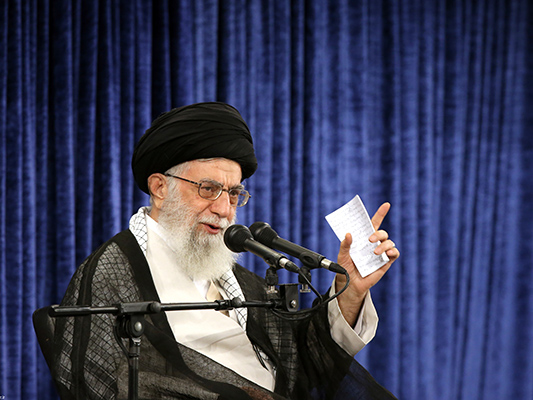
Iran Leader Calls on Hajj Pilgrims to Take United Stand against Israel

Tensions are still high at Islam’s third holiest site in Jerusalem al-Quds where Israel deployed troops last week to restrict access to Palestinian worshipers but had to retreat amid fears that the standoff could turn to a large-scale revolt.

“The Zionists have become emboldened and rude, giving themselves the right to get tough with the owners of the al-Aqsa Mosque and prevent them,” Ayatollah Khamenei told a group of officials in charge of annual Hajj in Tehran Sunday.

“Where can the Islamic Ummah find a better venue than Hajj to comment on the al-Aqsa Mosque? Where is the place to take a position against the mischievous presence of America in the region? Hajj is the best venue,” the Leader added.

Ayatollah Khamenei also recommended that the pilgrims focus on the issue of unity, saying no one should do anything which may help create friction.

The Leader further asked pilgrims to participate in congregational prayers in the Masjid al-Haram in Mecca which surrounds Islam’s holiest site and the Masjid al-Nabawi which is the second holiest site to Muslims, situated in Medina.

“While billions of dollars are spent to create disunity, friction and hostility among Muslims, Muslims should be careful not to help this effort, because each Islamic nation that contributes to this plot will be a partner in the consequences of this great sin.”

The Leader stressed that the security of pilgrims is very important and must be guaranteed. “The pain left in the hearts of Iranians due to the 2015 Hajj tragic incidents is unforgettable,” he said.

Ayatollah Khamenei was referring to two deadly incidents in September 2015, when more than 100 pilgrims lost their lives after the collapse of a massive construction crane into Mecca’s Grand Mosque and about 4,700 people who died later in a human crush, according to the figures provided by Iran.

The Leader said the ritual of the “disavowal of disbelievers” which was always emphasized by the late founder of the Islamic Republic Imam Khomeini is an opportunity to declare positions on the subjects on which there is consensus among the Islamic Ummah.

“One of these issues is the case of al-Aqsa Mosque and al-Quds, which these days because of the insolence, brazenness and wickedness of the usurious and fake Zionist regime, has become  the focus of attention more than before.

“The meddling and mischievous presence of America in the Islamic countries and the region and the creation of Takfiri terrorist groups is another important issue that Muslim nations should take a stand on during the Hajj,” Ayatollah Khamenei said.

“More mischievous and wicked than all terrorist currents is the American regime itself,” the Leader added.

International Olympiad in Informatics Kicks Off in Tehran

The 29th International Olympiad in Informatics (IOI 2017) was kicked off in Tehran on Friday, July 28, and will last until Friday, 4th of August, 2017. The IOI 2017 is hosted and organized by the Iranian Ministry of Education.

The IOI aims to discover, encourage, bring together, challenge, and give recognition to young people who are exceptionally talented in the field of informatics.

It also seeks to foster friendly international relationships among computer scientists and informatics educators and bring the discipline of informatics to the attention of young people.

Here are the Fars News Agency’s photos of the opening ceremony:

400 Firms to Attend West Asia’s Biggest Furniture Expo in Tehran

Tehran’s International Permanent Fairground will host the 26th International Exhibition of Home Furniture (HOFEX 2017) from August 1 to 4.

According to a Farsi report by the Azad News Agency (ANA), more than 400 domestic and foreign production units will participate in the fair which is the biggest and most important furniture industry exposition in Iran and West Asia.

Foreign production units to take part in the exhibition will come from Italy, Spain, China, Turkey and Switzerland. They will put their latest capabilities and products on show in an area extending over 40,000 square metres.

The fair will play host to most of the leading Iranian and foreign export brands. Organized by Iran’s Furniture Manufacturers and Exporters Association, Iran’s Trade Promotion Organization has granted the permit for holding the expo.

The motto of this edition of the exhibition is “Furniture Exports, National Project”. The holding of the exposition is aimed at securing the Iranian government’s support the for domestic furniture industry to improve the quality and increase the quantity of the country’s furniture exports.

Among the other aims of the exposition are to encourage export-oriented industrial activities, prepare the grounds for raising the quality of the Iranian furniture’s designs and boost the production of such products.

A number of foreign trade delegations have also been invited to visit this year’s exhibition, which may lead to the signing of MoUs. The exhibition will be open to visitors from 10 am to 6 pm during the four-day period.

Giving Ultimatums Not to Resolve Qatar Crisis: Turkish Envoy

Reza Hakan Tekin

In an exclusive interview with the Etemad daily newspaper, Turkey’s Ambassador to Tehran Reza Hakan Tekin has discussed a range of issues including Ankara’s role in the ongoing crises in the region and the relations between Iran and Turkey.

The Turkish ambassador gave the interview to Etemad’s Sara Massoumi on July 23. What follows is the first part of his remarks:

President Erdogan recently visited Saudi Arabia and Qatar. The Qatari crisis escalates every day and none of the sides seems willing to accept conditions set by the other. Turkey insists on having deep ties with Saudi Arabia but it seems to be more strongly siding with Doha. Where does Turkey stand in the crisis?

As you said, we do have very close relations with all countries who are party to this dispute, especially Saudi Arabia and Qatar but I cannot say that we are taking sides in this conflict. But we are not happy the way it has evolved, I mean, how it has erupted. Any country may have some concerns about other countries’ policies, some steps they take, but the way to overcome those differences is not suddenly one day taking up a stance and putting on ultimatum like demands to the other country without engaging in a meaningful dialogue. Actually this was what we were not happy with. Furthermore, these are a group of countries which have very close relations, contacts among themselves, I mean through the [P]GCC. Yes, they did have similar problems in the recent past, but still this is not the way to solve problems. That’s why while not taking sides, we were not agreeing with the approach of the other parties against Qatar.

And we wanted to contribute to overcoming this problem. As you know, within the [P]GCC a reconciliation effort was spearheaded by Kuwait. We may not have much progress in our efforts at this point, but we still hope that we can resolve this problem. Our president visited Saudi Arabia, Kuwait and Doha. So at the highest level we will see where we stand and what we can do to resolve it. Because we already have a lot of problems in our region and we don’t need another tension. So these are the parameters of our approach to this problem.

Do you think Turkey is in a position to play a positive mediation role in this conflict?

Absolutely. We hope so. But of course we cannot be sure about the outcome as it’s not solely in our power to do that. These are sovereign countries and they have to make their own decisions for themselves. We can only facilitate the process, contribute to any existing process or to start a new process in terms of achieving a meaningful result. So that is our main aim. President Erdogan is a respected statesman by both parties, especially by Saudi Arabia. He has very close personal relationship both with the king of Saudi Arabia and also with the ruling family of Qatar. So let’s hope that we will achieve something. Although it is not easy; we are not naïve, we understand the challenges, complexities of the existing situation. But we believe that we cannot sit idle, we have to make some efforts.

Saudi Arabia has demanded that Qatar downgrade its ties with Tehran. How does Turkey view such preconditions for ties between countries in the region?

Of course, we stick to the principal rule of international law. Every country has its sovereign right to develop its relationships with other countries. Hence you cannot impose on any other country to control, or either upgrade or downgrade your relationship with a certain country or a group of countries. We don’t believe that is a right approach. So we don’t agree with that approach and traditionally as you know our policy, especially vis-à-vis Iran, has always been for engagement. Even though when we do not agree with Iran on many issues, on regional issues, we have never pursued a policy of isolating Iran. This is not right. And in addition to that of course, when you see some of those countries in that group having quite extensive relations with Iran, it doesn’t also make sense to ask for another country to downgrade their relations with Iran.


At the beginning of Bahrain crisis when Saudi Arabia had sent troops to Manama, Erdogan made a very strong statement by saying we do not want another Karbala. This is a very important statement by a Sunni-majority country’s leader drawing parallels with Karbala in Bahrain.


In recent days, we have seen a downgrade in Iran-Kuwait ties and there is some analysis about Saudi Arabia’s role in this new crisis. How do you see Saudi Arabia’s recruiting allies against Iran?

I’m not sure if that is the real reason. I mean, of course, you have to ask that from Kuwaiti or Saudi officials. Kuwait’s position has always been a little bit different, more nuanced, towards Iran within the [P]GCC. I’m sure you are aware of that. Even after this recent crisis, Kuwait did not take a hardline approach to Iran as the others. They were not among those four countries anyway. And as I said earlier, they started a reconciliation process. According to the information I have seen in the press and some other reports, there has been some legal process in Kuwait regarding some terrorist activity in the country and they had some conclusions that these steps had to be taken. So it is their sovereign right to do so. I think it would be a bit of an oversimplification to present the recent decision of Kuwait as ordered by Saudi Arabia or as a result of Saudi pressure on Kuwait. I think it could be more complicated than that.

In recent years, Saudi Arabia has accused Iran of destructive activities in the region. We have heard similar remarks from President Erdogan. Is Turkey siding with Saudi Arabia and the UAE?

We believe Iran is a very important country in the region and it has to have a stake on the affairs of the region. Nobody can ignore Iran. Nobody can say Iran should have no role in our region. This is not a realistic policy, not a right policy and not a legitimate demand. But how that role should be played is another question. Yes, we also do have some concerns about Iran’s policies in the region. We believe Iran should play a more constructive role for strengthening stability in our part of the world. It has influential actors on the ground in several countries in our region. And the perception about Iran’s role in the region is not positive, this is not a secret. So, there are lots of concerns about Iran’s activities in the region and we share some of them. We don’t say all of them are fully right, but there is indeed a point in this approach and we also share those concerns. We say this to our counterparts when we have, even at the highest levels, meetings with Iran that you know this should not be the way it is. But of course those perceptions could be both ways. So we have to make efforts to change this mentality in the region. I mean, if there exists a mistrust on Iran, Iranian leaders and the Iranian government should also think why this is the case, why is there such a perception. You cannot make a conclusion that all of them are just making it up, that because there is a sectarian tension, Iran is Shiite, they are Sunni, so they don’t want Iran to be powerful so that’s why they are exaggerating Iran’s activity and role in the region. This is not the way to deal with it in my opinion. Iran should also think about why this is the case.

Does Turkey have same concerns about Saudi Arabia‘s activities in the region too? Don’t you think closing our eyes on what Saudis do in Yemen and Bahrain couldn’t be the solution anymore?

Every issue has a different background and different context. We are not happy when there is bloodshed, be it in Yemen, or in Bahrain, or in Syria or in Iraq. And the blood spilled or the oppression done is always among Muslims themselves. So we are not happy with that and we want to change this situation. But when you look at the background of all these issues, it is not always black and white, that one party is fully innocent and the other party has the full responsibility of the situation. Reality is always more complicated.

Yes it’s not black and white but president Erdogan criticized Iran so many times but we never heard a word from him about Saudis’ actions in the region, especially in Yemen.

Some things are done in different ways. With any country, when we have concerns, you can do it in different ways. Sometimes, publicly, sometimes privately. You remember when Bahrain crisis was simmering a few years ago, and Saudi Arabia and some other countries had sent troops to Bahrain. At that time Erdogan was Prime Minister and he made a very strong statement. That was at the beginning of the crisis, he said we do not want another Karbala. This is very important, I mean, you would not hear from any Sunni-majority country leader such a statement, drawing parallels with Karbala in Bahrain. So it would be unfair to criticize us that we’re being not objective on these issues. There are some nuances in our reactions, so that is what it is.


You can read the second part of the interview here.