
Monday, April 13, 2026
Home Blog Page 3950

Iran’s Missile Program Not Violating UNSC Resolutions

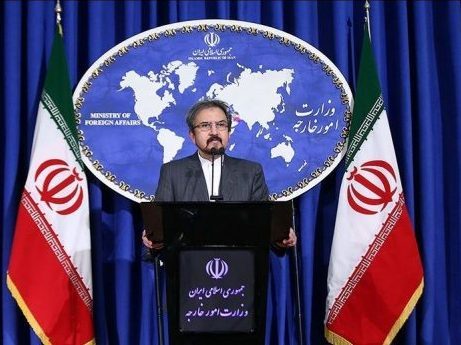
Bahram Qassemi

“The issue of the Iranian missile [program] is an entirely defensive and deterrent matter and in no way contravenes Resolution 2231,” said Foreign Ministry Spokesman Bahram Qassemi in his weekly press briefing on Monday.

Resolution 2231 was adopted by the UNSC in July 2015 to endorse a nuclear agreement between Iran and six other countries, the so-called P5+1.

The UNSC document terminated the provisions of seven previous UNSC resolutions against Iran, some of which had imposed restrictions on Iranian missile activities. Such activities are not prohibited under the newer document, which merely calls on Iran “to refrain from any activity related to ballistic missiles designed to be capable of delivering nuclear weapons.”

Iran says it has no such warheads and no such missiles. It has put its nuclear program under enhanced international monitoring as part of the nuclear deal. And Iranian compliance with the deal has been consistently verified by the International Atomic Energy Agency (IAEA). Yet, the United States, a party to the agreement, has attempted to portray Iranian missile tests as a violation of the resolution.

While it has failed to get other countries on board, in main part because the text of the resolution is unambiguous, Washington has not stoppedclaiming that the Iranian missile program breaches Resolution 2231.

Such claims, Qassemi said in his Monday presser, were “unwarranted” and were “often made because of… [the accusers’] ill will toward Iran’s might, particularly its defensive power.”

Responding to a question about the potential violations of the nuclear deal by the US, Qassemi said Iranian decisions on whether violations had occurred rested with the high-level Supervisory Board that has been formed to monitor the implementation of the deal, officially known as the Joint Comprehensive Plan of Action (JCPOA).

He said decisions in that regard were technical and the Supervisory Board would be making relevant comments in the due time.

Iran and the P5+1 countries (Russia, the US, the UK, China, Britain, and France) reached the JCPOA on July 14, 2015 and began implementing it in January 2016.

Iran has been complaining that the US, under the administration of its new president, has been seeking to sabotage international trade with Iran. This is while according to the deal, the US must “refrain from any policy specifically intended to directly and adversely affect the normalisation of trade and economic relations with Iran.”

The US has also imposed sanctions on Iran over the country’s missile activities, including most recently on July 28.

Qassemi said that Iran and the US harbored mistrust of one another and that the recent measures adopted by Washington further deepened Tehran’s mistrust.

‘Banking difficulties persist’

A reporter asked Qassemi what measures had been taken to end banking restrictions on Iran.

He explained that certain difficulties still existed because of various technical and political reasons.

“Problems with big banks are still there,” he acknowledged, adding that “active economic diplomacy” was needed to facilitate banking transactions involving major banks.

‘Iran not delaying Saudi delegation’s visit’

The Iranian Foreign Ministry spokesman also rejected media reports that Iran has been behind a delay in the planned trip by a Saudi Arabian delegation to the country to visit the sites of Saudi Arabia’s former diplomatic perimeters.

He said visas had been issued for the Saudi delegates long before, and they were scheduled to arrive on a private jet. A permit had been issued for the flight at short notice but the Saudis could not be immediately notified because there were no direct communication channels, hence the delay, Qassemi said.

“They can travel to Tehran whenever they decide to,” he said of the Saudi delegates. “There is no prohibition on their visit.”

Iran, in the meanwhile, was awaiting the issuance of visas for its own delegation, which he said was due shortly.

Saudi Arabia severed its diplomatic relations with Iran in January 2016. Saudi Arabia had just executed a prominent Shia cleric back then, and protests were staged in front of the Saudi diplomatic premises in the cities of Tehran and Mashhad over the killing. A number of individuals attacked the two perimeters while they were vacant and caused some damage.

The attackers were arrested by Iran and received prison terms. But relations have remained tense.

‘Iran holds superior status in region’

Qassemi said the huge turnout by foreign officials in the recent inauguration ceremony of President Hassan Rouhani signified “the world’s new approach toward Iran.”

Senior representatives, including presidents and prime ministers, from 105 countries and nine international organizations took part in the inauguration ceremony on Saturday.

Qassemi said the participation of that many officials was “a clear signal of the defeat of the policy of Iranophobia. And one could say we hold a superior position in the region.”

‘Sadr entitled to his opinion’

Qassemi was asked about a recent visit by Iraqi cleric Mudtada Sadr to Saudi Arabia and anti-Iran remarks he reportedly made after the trip.

The Iranian spokesman said trips by Iraqi figures were an internal Iraqi matter.

He added that Sadr could express his opinions, but, “one should not take seriously the comments he has made about Iran.”

He said mistakes might have been made in reporting or translating Sadr’s remarks and said he hoped no such things had actually been said.

DR Congo Calls for Greater Cooperation with Iran

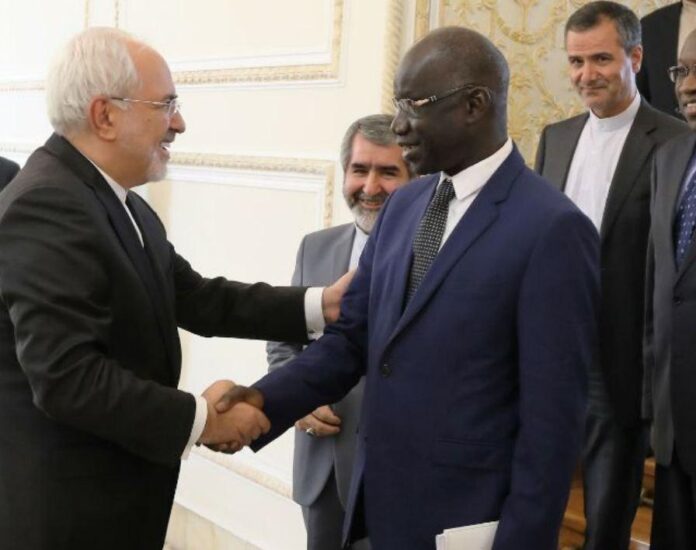
During the Monday meeting, the DR Congolese official hailed the good relations between the two countries, and pointed to Tehran-Kinshasa cooperation within the framework of international organizations.

“We have always been opposed to the sanctions against the countries, and during the negotiations over Iran’s nuclear deal we were supporting the positions of the Islamic Republic,” Okitundu noted.

“DR Congo is interested in boosting ties with the Islamic Republic in various fields, especially in the areas of energy, construction and equipment of hospitals, sanitation, road construction, holding trade fairs in Kinshasa, reconstruction of public buildings and participation in urban planning projects.”

Okitundu also invited FM Zarif to visit his country and the idea was welcomed by the Iranian official.

In turn, Zarif appreciated the DR Congo’s support for the Islamic Republic in the international organizations.

He also stressed the importance of the development of economic cooperation in various fields including energy, power (electricity generation), health and pharmaceutical production, road construction, trade fairs, science , technology, export of technological services and other areas of mutual interest.

Iran, Mongolia Eager to Forge Closer Ties

During the Monday meeting, Mongolian president’s special envoy Lundeg Purevsuren said he was pleased to be on a visit to Iran.

He went on to say that his country is keen to enhance its political relations with Tehran and forge closer cooperation in other areas, particularly in agriculture, transportation, culture and academic areas.

Zarif, in turn, touched upon the age-old relations between the two countries and stressed the need to boost political, cultural, and economic relations.

He also underlined the importance of cooperation between private and state-run companies of both sides while emphasizing the need to work together closely in the fields of technology, banking, and oil as well as fighting terrorism and extremism.

Iran Reiterates Support for Palestinian Resistance

In a meeting with a delegation of the Islamic Resistance Movement, Hamas, in Tehran, Zarif reiterated Iran’s support for the Palestinian cause and resistance, and said, “The Islamic Republic’s stance towards Palestine is principled and unchangeable.”

Iran Reiterates Support for Palestinian ResistanceThe Hamas envoys, for their part, praised Iran for its principled stances towards Palestine and the country’s resistance.
The Hamas delegation arrived in Tehran a couple of days ago to take part in Iranian President Hassan Rouhani’s inauguration ceremony held on Saturday.

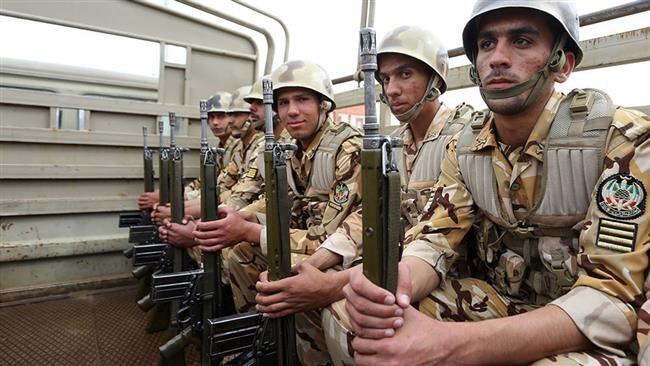
4 Killed, 8 Wounded after Iranian Draftee Opens Fire on Comrades

The Iranian Army’s Air Force said in a statement on Sunday that a military officer was among the wounded in the incident, which took place earlier in the day in Kahrizak training field, located about 10 kilometers southeast of Tehran.

It said all other casualties were conscripts, adding that the soldier who opened fire on fellow conscripts could have been suffering from a psychological disorder. It said the firing could also have come as a result of misfiring.

The army said a special investigation team would probe the case and the results would be announced soon. It said all the injured had been moved to hospital for treatment.

Iran relies on hundreds of thousands of conscripts for many of its semi-professional military duties. The soldiers are mostly conscripted by the army, although other branches of the armed forces, including police and prison guard, can also recruit Iranian men who turn 19. The period of the mandatory service is two years.

The shooting on Sunday is the second such rare attack to occur in the Iranian armed forces. Three soldiers were killed last month, when a conscript opened fire on them. Medics said the attacker, who shot himself but survived his injuries, had been suffering from “temporary psychosis.”

Iran President Warns of Spread of Terror in Caucasus

“After suffering a complete defeat in Iraq and Syria, terrorists are likely to try to permeate across the region. Thus, all of us should be wary of such a threat (in the region), as in the Caucasus and Central Asia,” President Rouhani said in a meeting with his Armenian counterpart Serzh Sargsyan in Tehran on Sunday.

It is necessary for all regional countries to coordinate efforts in the fight against terrorism, a challenge that threatens the security of the entire region, Rouhani added.

The Iranian president also reiterated that the Nagorno-Karabakh conflict between Armenia and the Republic of Azerbaijan has only “political solutions.”

The Armenian president, for his part, congratulated Rouhani on taking the office for the second term, voicing his country’s readiness to enhance economic relations with Iran.

Sargsyan called for efforts to raise the level of Tehran-Yerevan trade ties, pointing to the opportunities available for cooperation in the energy industry and transportation.

The Armenian president was among more than 130 foreign dignitaries attending President Rouhani’s inauguration in the Iranian parliament on Saturday.

Iran Ready to Boost Cooperation with Angola: FM

During the Monday meeting, Chicoti expressed his pleasure of being in Iran and participating in Iranian President Hassan Rouhani’s inauguration ceremony.

“We are always interested in expanding our bilateral ties. This is the first time I am visiting Tehran, and I was surprised to see Iran’s advancements,” the Angolan minister noted.

Chicoti also invited the Iranian top diplomat to visit the African country.

For his part, Zarif said, “We will try to promote bilateral relations [between Tehran and Luanda].”

He further voiced Iran’s preparedness to enhance its cooperation with Angola in the fields of business relations, pharmaceuticals, and technology.

“Banking cooperation needs to be developed so that we would be able to accelerate our economic collaborations,” he said.

“There are important grounds for mutual cooperation in technical and engineering sectors,” Zarif added.


Iran Attaches Great Importance to Ties with Africa: FM

Iran Attaches Great Importance to Ties with Africa: FM

In a Sunday meeting with Senegal’s Minister of Culture and Communications Mbagnick Ndiaye in Tehran, Zarif said the African continent, Senegal in particular, is important for the Islamic Republic of Iran.

“We are ready to cooperate bilaterally and within the framework of international organizations and the Organization of Islamic Cooperation (OIC),” Iranian foreign minister added.

Zarif went on to say that both Iran and Senegal are opposed to extremism, and in this area as well as in the field of economic ties, the Islamic Republic is ready to promote cooperation, especially in construction of dams and production of pharmaceuticals.

In turn, Ndiaye, who is also the Senegalese president’s special envoy, expressed his pleasure of being in Iran and taking part in the inauguration ceremony of President Hassan Rouhani.

“Relations between the two countries are close, and it has to be so. Muslim countries should naturally have close ties.”

“Boosting cultural relations will lead to the development of ties in other areas, and we support the expansion of relations with the Islamic Republic of Iran, especially in the cultural and economic spheres,” Ndiaye underscored.

Iran, Vietnam Call for Closer Int’l Cooperation

During the meeting, Vietnamese President Trần Đại Quang’s special envoy called for closer mutual cooperation between Tehran and Hanoi.

He touched upon his country’s independence of vote as well as its backing for Tehran in international circles.

The Vietnamese diplomat called on Iran to support Hanoi’s nomination for membership in the UN Security Council as a non-permanent member.

The official also asked Iran to back Vietnam’s nominees for the post of Secretary General of UNESCO and for the Colombo Plan.

Rahimpour, for his part, thanked the Vietnamese official for attending the swearing-in ceremony of President Hassan Rouhani, and expressed gratitude to Vietnam for its constructive cooperation, its support for Iran in regional circles, including the Association of Southeast Asian Nations (ASEAN), and its “no” vote to anti-Iran human rights resolutions.

Elsewhere in the meeting, the two sides noted that the current volume of trade is not proportionate to the existing potential in both countries, and stressed the need to forge closer cooperation in all areas, especially in trade, tourism, rice cultivation and fisheries as well as the establishment of direct flights between the two countries.

IRGC Busts Terror Group in Northwestern Iran

IRGC Busts Terror Group in Northwestern Iran

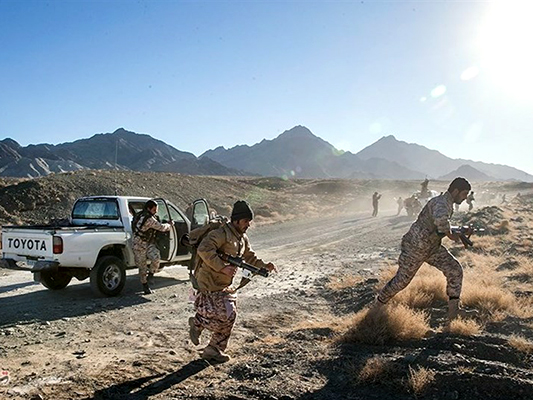
The IRGC’s ground troops smashed the group of armed bandits and terrorists in the border area of West Azarbaijan province, said commander of the IRGC Ground Force Brigadier General Mohammad Pakpour.

The anti-revolutionary terrorists were going to conduct acts of terror and sabotage in Iran, added the top commander.

The IRGC forces killed two of the armed terrorists in the shootout, he went on to say, according to a Farsi report by the IRIB News Agency.

“In this operation, four of the armed terrorists were wounded, and some ammunition as well as military equipment and hardware was also seized,” said General Pakpour.
