Monday, April 13, 2026
Home Blog Page 3947

Nature Schools; Different Environment to Nurture Students

The Shahrvand daily newspaper has filed a report on the Fasham Nature School, one of fifty “nature schools” operating in Iran, and expounded on their advantages over conventional schools. The highlights of the report follow:

In nature schools, students’ learning coefficient rises by 25%, and their hyperactivity drops by 40%, says an education official.

Students Free in Nature Schools
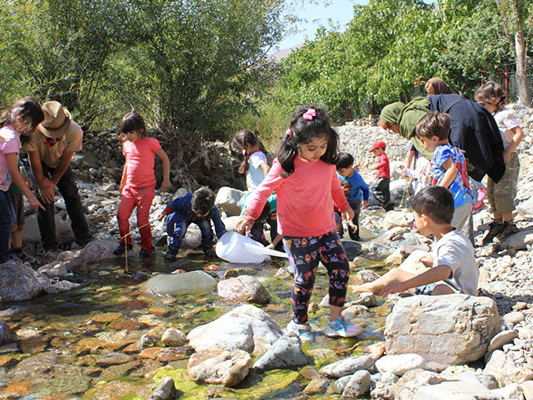
Nature Schools; Different Environment to Nurture StudentsThe principal of the Fasham Nature School says students in nature schools have none of the limitations they would face in ordinary schools.

Nature schools are not like conventional schools where little kids would sit at their benches, listen to their teachers and answer their questions. Students spend their time in another way in nature schools. They even wouldn’t force students to learn new methods of planting trees. In nature schools, the bottom line is to “set oneself free.” In such schools, students learn how to establish a relationship with nature, and that’s how they learn. This simple sentence is so difficult that not everyone can get along with it. For example, one of Iran’s 50 nature schools is located in Garmabdar in Fasham resort on the suburbs of the Iranian capital, Tehran. There, kids will not be told off if they run around trees, jump over pieces of rock and put their arms in soil elbow-deep. No one will tell them “Stop that!”

The school is located next to a river; here, a school means a yard full of trees, two plump rabbits, three dogs, a few lambs, hens, roosters and a field covered with stones, soil and grass. If interested, kids can take the eggs laid by the hens and fry them in a pan, or they can run after butterflies and watch mulberries on trees. In nature schools, the principle is to set oneself free.
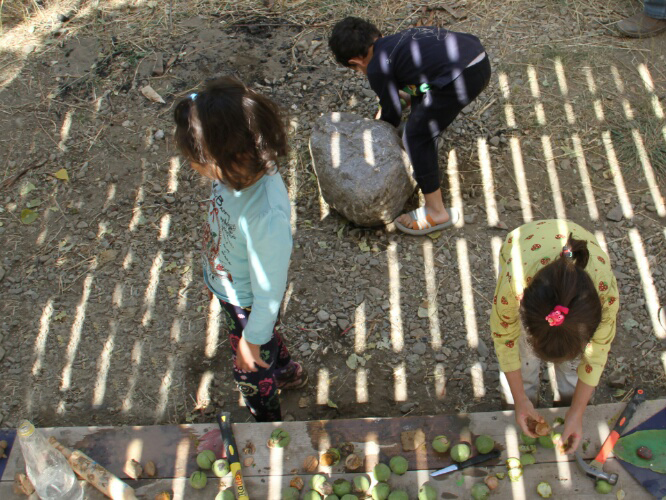
Nature Schools; Different Environment to Nurture StudentsArash Kermanshahi, the principal of the school, has been an environmental activist for more than 20 years now. With the cooperation of 20 facilitators, he is staying at the school and spends his time, day and night, with kids between 3 and 12 years of age. He believes children should play until they are 12 years old. He says kids’ relationship with nature shapes their characters, prompts them to protect the environment in the future and helps them use their skills in different fields.

Authorities at the school speak of Abdulhossein Vahabzadeh, the founding father of nature schools in Iran.

“3-to-12-year-old children do not need direct education. They will get the chance to get an education later on. Direct education stifles creativity and keeps creative skills in children from developing,” the school principal quotes Vahabzadeh as saying. Nature schools were first introduced in Europe. Then Vahabzadeh, a renowned environmental activist, brought the idea to Iran.

In summer 2014, the first nature school was inaugurated in Mashhad thanks to his initiative, and it was decided that more nature schools be established across Iran.

Iran is the first country in the Middle East to have started building nature schools. The Iranian Department of the Environment offers good loans to those who build nature schools.


Conventional Schools: No Trees & So Much Competition
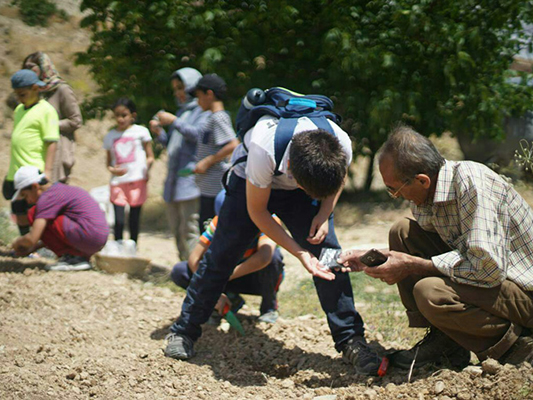
Nature Schools; Different Environment to Nurture StudentsLeila Parhizgar, a PhD candidate majoring in The Environment, has come to the school with her little daughter.

“There are not enough green spaces and trees in schools. The Education Ministry has only created a competitive atmosphere for children. The kids are always anxious, waiting to take part in competitions, and win prizes. That’s why they don’t enjoy their childhood. Nature schools are a way to establish a relationship with humans’ basic foundation, which is nature. Through violence and giving orders, one cannot expect children to become useful citizens in the future,” she says.


Ordinary Schools Similar to Barracks

What do children exactly do in nature schools? According to Kermanshahi, it is necessary that children be left alone and allowed to play until they are 12 years old, because their job is “playing” only.

“Taking kids to class and teaching them certain things will separate them from playing and creativity. This is wrong. This age period is a time when children are curious and get to know the environment around them, themselves, their capabilities and their small society. This comes as all these basic necessities are restricted in conventional schools.”

The principal of the nature school believes that these environment-friendly schools sound the death knell to all limitations which exist in conventional schools, limitations such as “peers must study together, you need to get permission before talking, if you act otherwise you will be punished.”

“This age period is the time when children get to know social relationships, but our schools have turned into barracks. One should know that not all children should be educated in the same way. It has been years that the world has come to this conclusion: Children should play to become creative and learn all social and individual skills.”
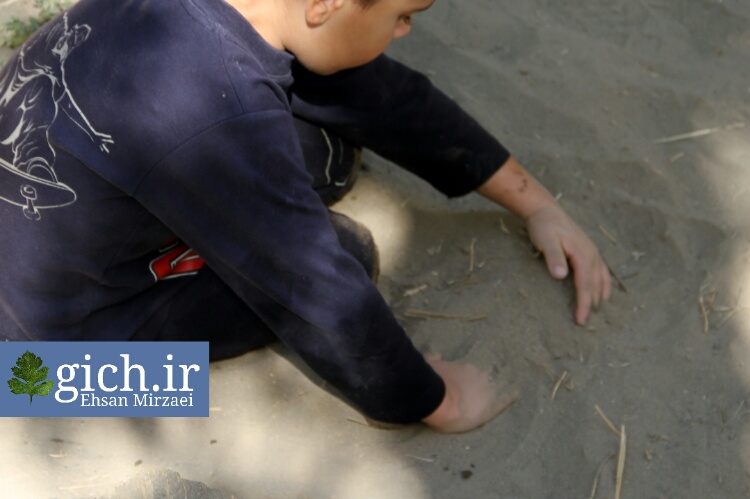
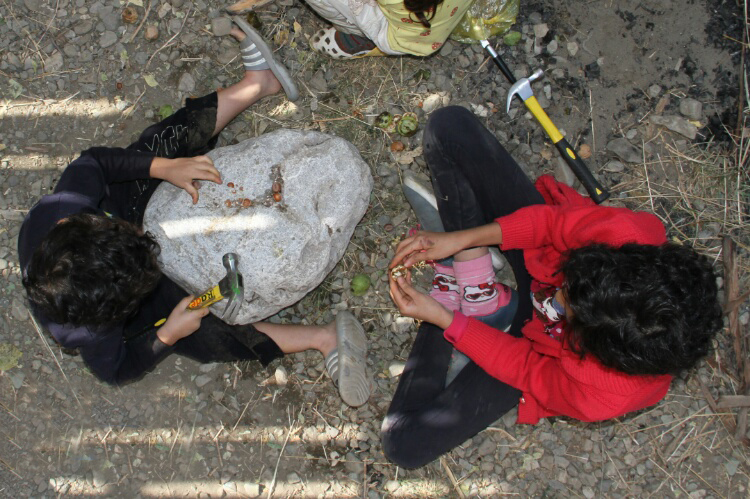
Nature Schools; Different Environment to Nurture StudentsNo special classes are held in nature schools. The only events might be get-togethers for cooking jam or touching the leaves of different plants. Children are free in this environment. Everything is free as long as the kids themselves or others are not facing serious harm. There is only one important law for children here: Don’t hurt yourself, others and nature.

Those working here let children be free. They have no role in children’s playing. They just help if the kids ask for it. For example they offer consultations if the children need a solution. We adults are among the key environmental factors here. The history of mankind indicates that our ancestors did the same. But now, we send kids as young as 3 to different classes to learn different things, e.g. to play the piano. However, these things can be learned after the age of 12 or throughout one’s life, too.
Nature Schools; Different Environment to Nurture StudentsEach nature school should have at least 5 facilitators, though a group of 20 experts are cooperating in this school. The school principal says the team comprises 30 people, but 20 of them include experts such as sociologists, biologists, etc., who are certified facilitators. The most important thing they learn is to not manage children’s games.

“They should be trained to feel comfortable with the concept that children should be left alone,” says Kermanshahi.

Six days are for kids and Fridays are for families. Of course, this law does not apply to nature schools because not all fathers and mothers can leave children alone the way facilitators expect them to. But this is the decision the principal has made for the school.

As the principal explains, a more advanced training course has been envisaged to learn how to keep track of the progress that children make after they enter nature schools.
Iran’s Judiciary Confirms Gas Deal with Total

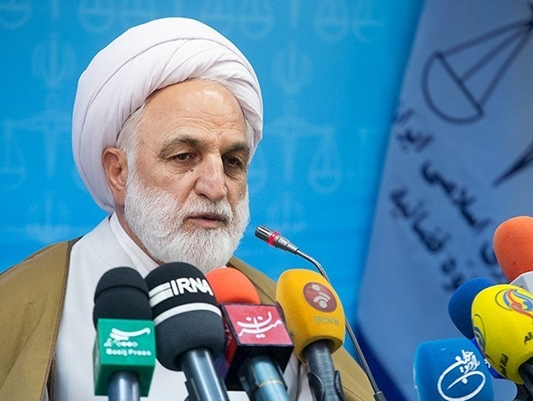
Ejei

Speaking to reporters in Tehran, Judiciary’s Deputy Chief and Spokesman Gholam Hossein Mohseni Ejei said a judicial committee tasked with vetting the Oil Ministry’s contracts and business negotiations has examined the contract with Total and has confirmed that there is no problem with the deal.

In July, the Oil Ministry signed a $5 billion contract with Total and China’s National Petroleum Company (CNPC) on development of the 11th phase of South Pars gas field.

Afterwards, some Iranian lawmakers voiced concern about the damages the gas deal would do to the country’s “national interests.”

The administration, however, played down criticism by opponents of the deal, saying the contract would serve the goals of national development, as emphasized by Leader of the Islamic Revolution Ayatollah Seyed Ali Khamenei.

Total has a 50.1 percent share in the 20-year deal. The state-owned China National Petroleum Corp. has a 30 percent stake and Iran’s Petropars has 19.9 percent.

The deal includes 30 wells and two production units.

The South Pars 11 project will have a production capacity of 1.8 billion cubic feet per day, or 370,000 barrels of oil equivalent per day.

Iran Dismisses Saudi Claims about Its Support for Taliban

Iran Dismisses Saudi Claims about Its Support for Taliban

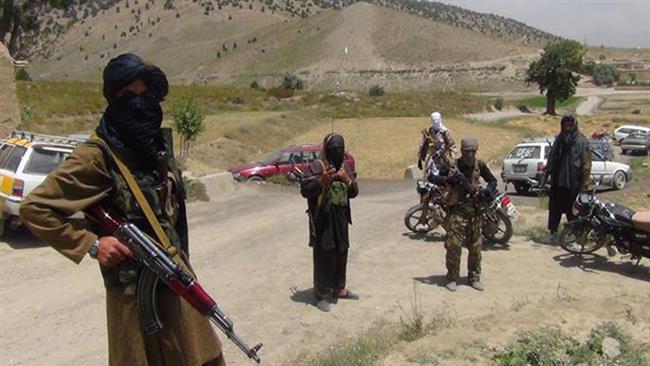
In a Tuesday statement, the embassy said it regarded as “baseless and groundless” the unprofessional and divisive remarks by the Saudi chargé d’affaires in Kabul, Mishari al-Harbi, and completely rejected them. The Saudi diplomat had recently accused Iran of supporting the Taliban militants in Afghanistan.

“The claim of the Islamic Republic of Iran’s support for armed groups inside Afghanistan made by a regime which had recognized the former Taliban government and still has broad links with various terrorist groups in the country and the entire region seems bizarre,” the statement added.

This is while the Iranian diplomats have themselves been victims to acts of violence and terror in Afghanistan, it said.

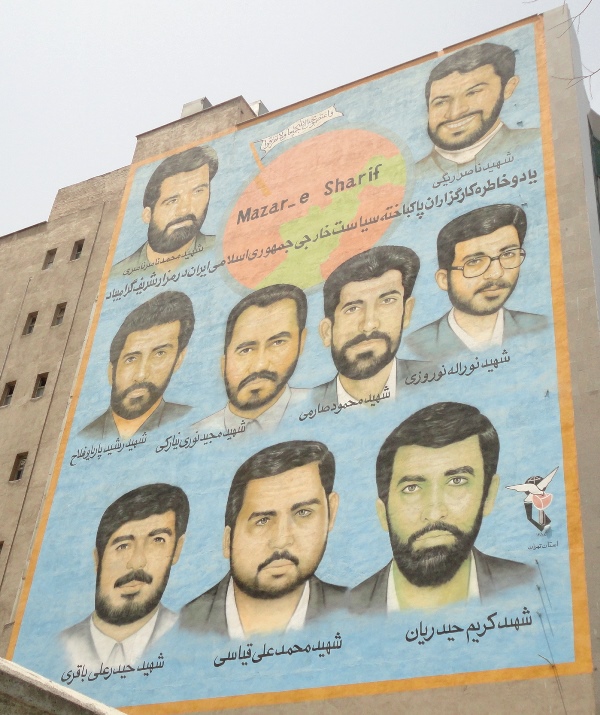
Taliban militants killed Mahmoud Saremi, the correspondent of the Islamic Republic News Agency (IRNA), along with eight Iranian diplomats, in the northern Afghan city of Mazar-i-Sharif in 1998.

The statement further said the root causes of the extremist and terrorist ideology in the region were clear to all and everyone is aware that the pursuit of such wrong policies by the sponsors of this ideology has led to numerous problems.

It added that the Islamic Republic once again reiterates its principal policy in supporting Afghanistan’s peace and stability and still believes that the war-ravaged country should turn into a place for constructive interaction among states.

The embassy also urged all countries to refrain from spreading their own issues and failures into Afghanistan.

Afghanistan is still grappling with violence well over a decade after the US and its allies invaded the country as part of the so-called war on terror. The invasion removed the Taliban from power, but has failed to stop the militancy.

Taking advantage of the chaos, the Daesh terror group, which is mainly based in the Middle East, has managed to establish a foothold in the eastern Province of Nangarhar.

A Look at Iranian Newspaper Front Pages on August 9

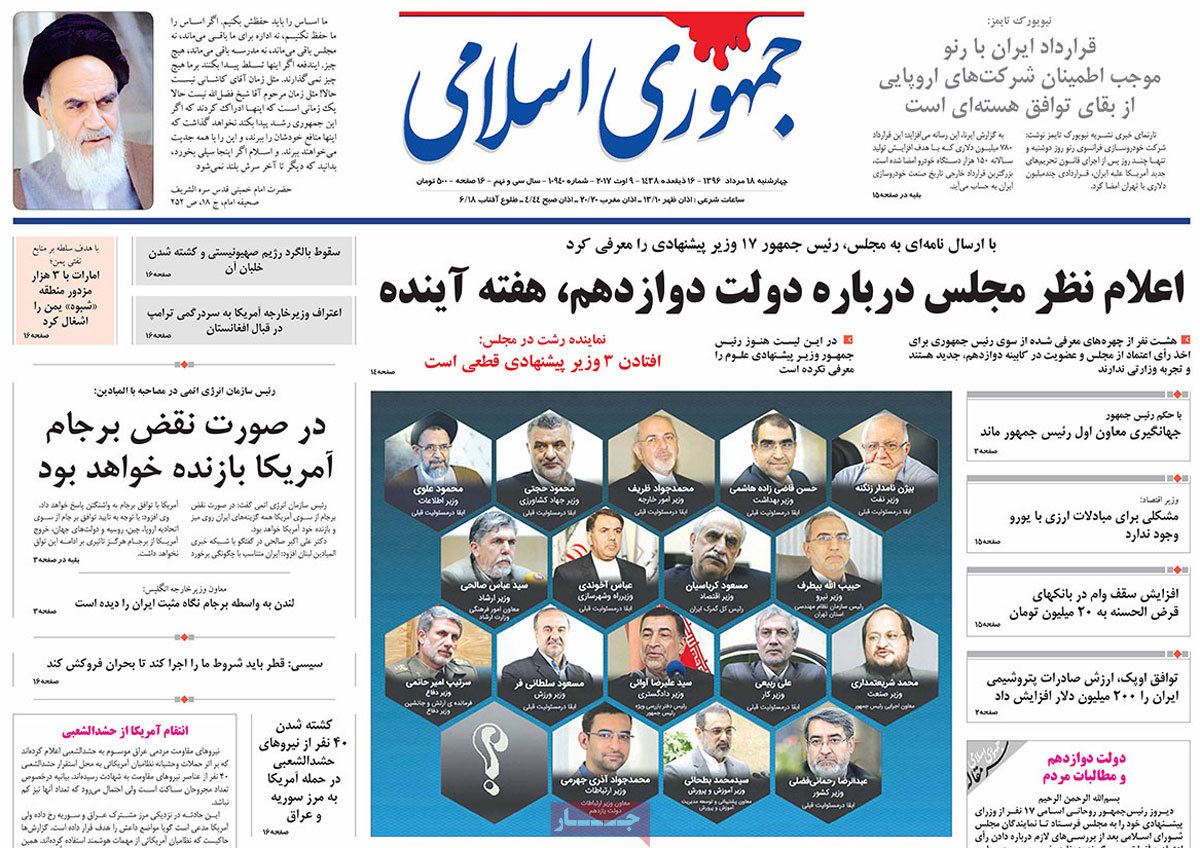
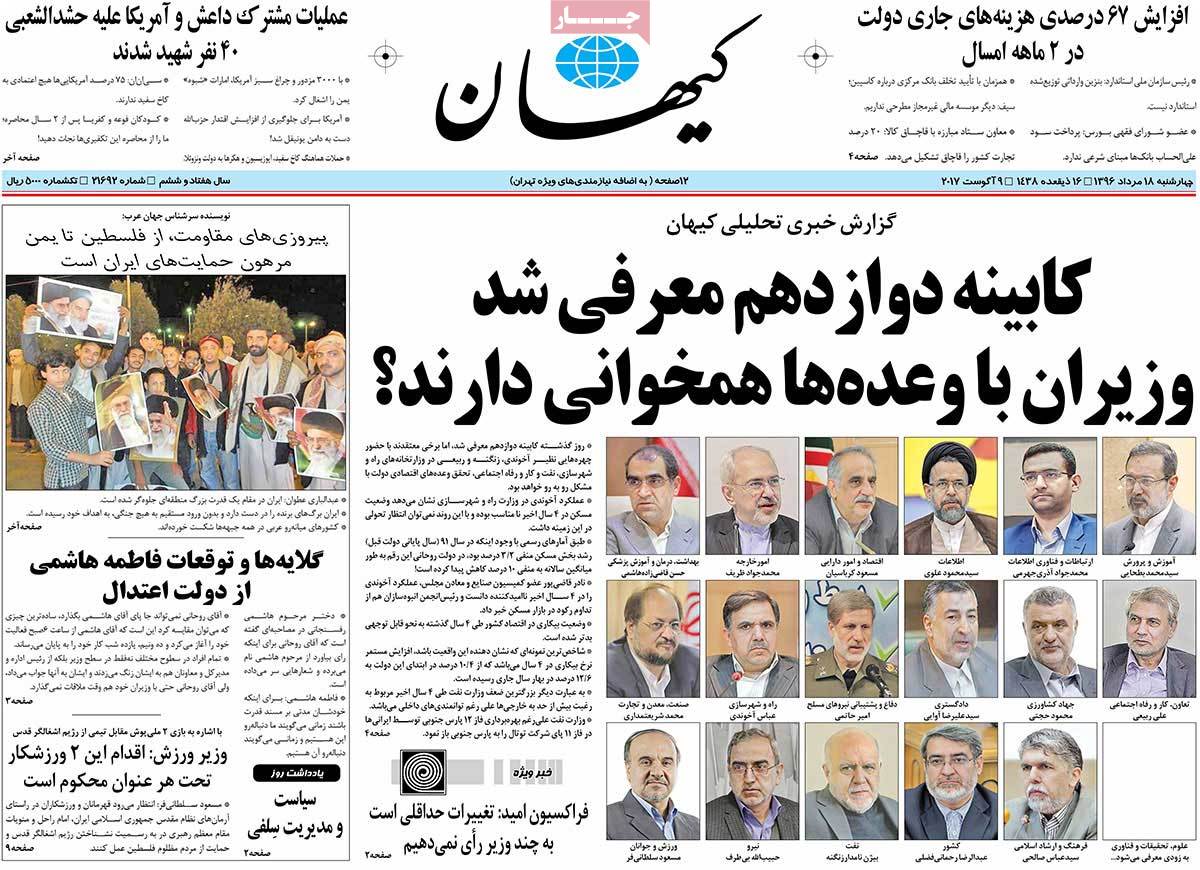
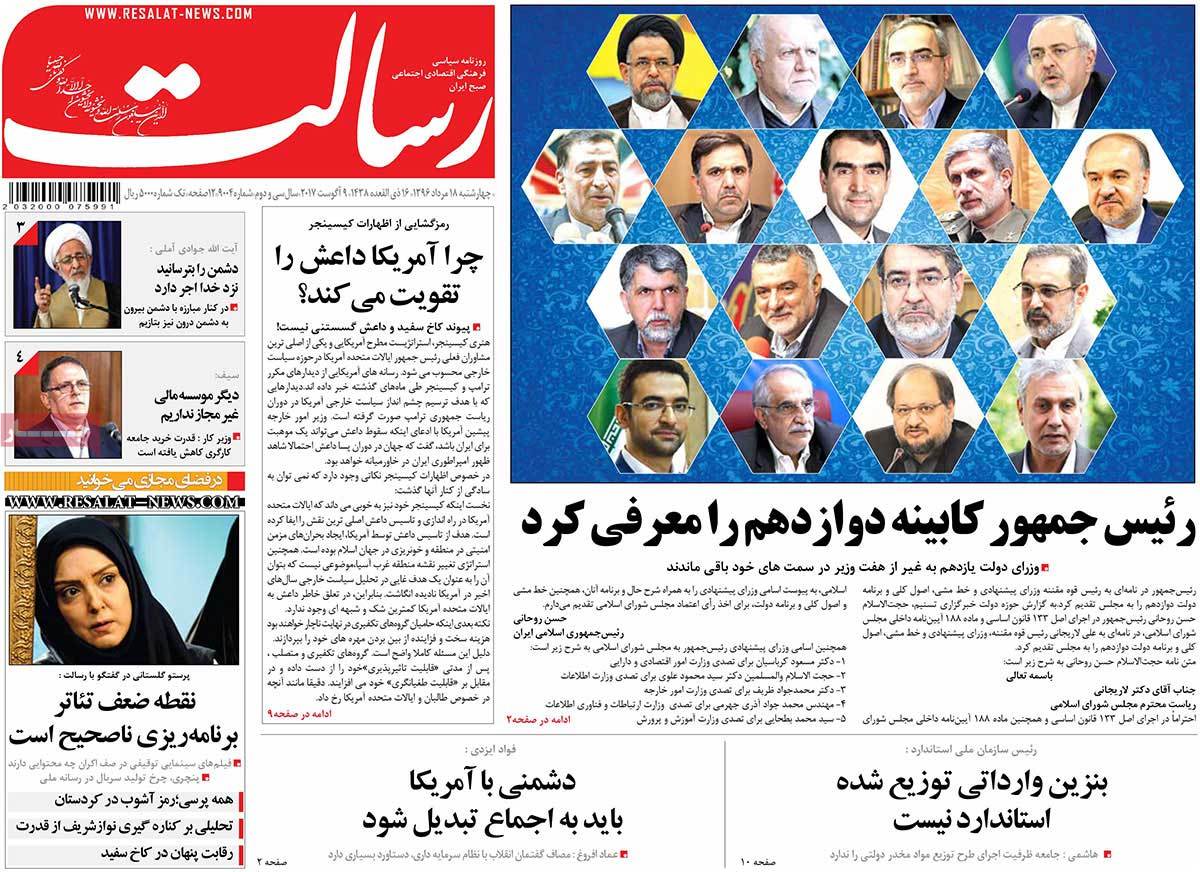
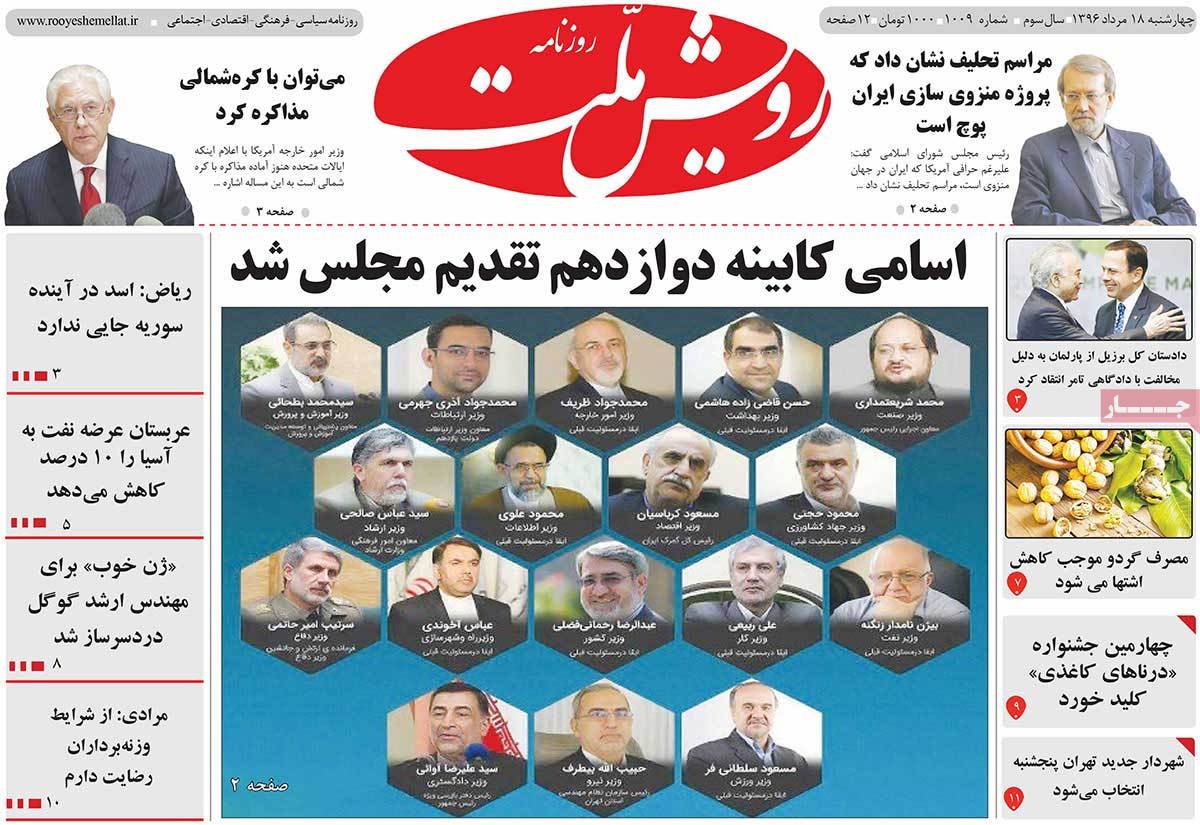
The top story today was the list of President Hassan Rouhani’s ministerial nominees, which was submitted to the Parliament for vote of confidence.

It seems that Rouhani’s list has not satisfied either his reformist supporters or his conservative opponents. His reformist supporters, particularly, believe that some of his ministers should have been replaced, and at least one female minister appointed.

The Iranian lawmakers’ controversial selfies with EU Foreign Policy Chief Federica Mogherini also remained a top story, with the Parliament condemning the fuss made about it in Iranian media, the IRIB in particular.

Another top story was the remarks made by Ali Akbar Salehi, the head of Atomic Energy Organisation of Iran (AEOI), in an interview with Lebanon’s Al Mayadeen TV about the US breach of nuclear deal and Iran’s possible reaction.

The above issues, as well as many more, are highlighted in the following headlines and top stories:


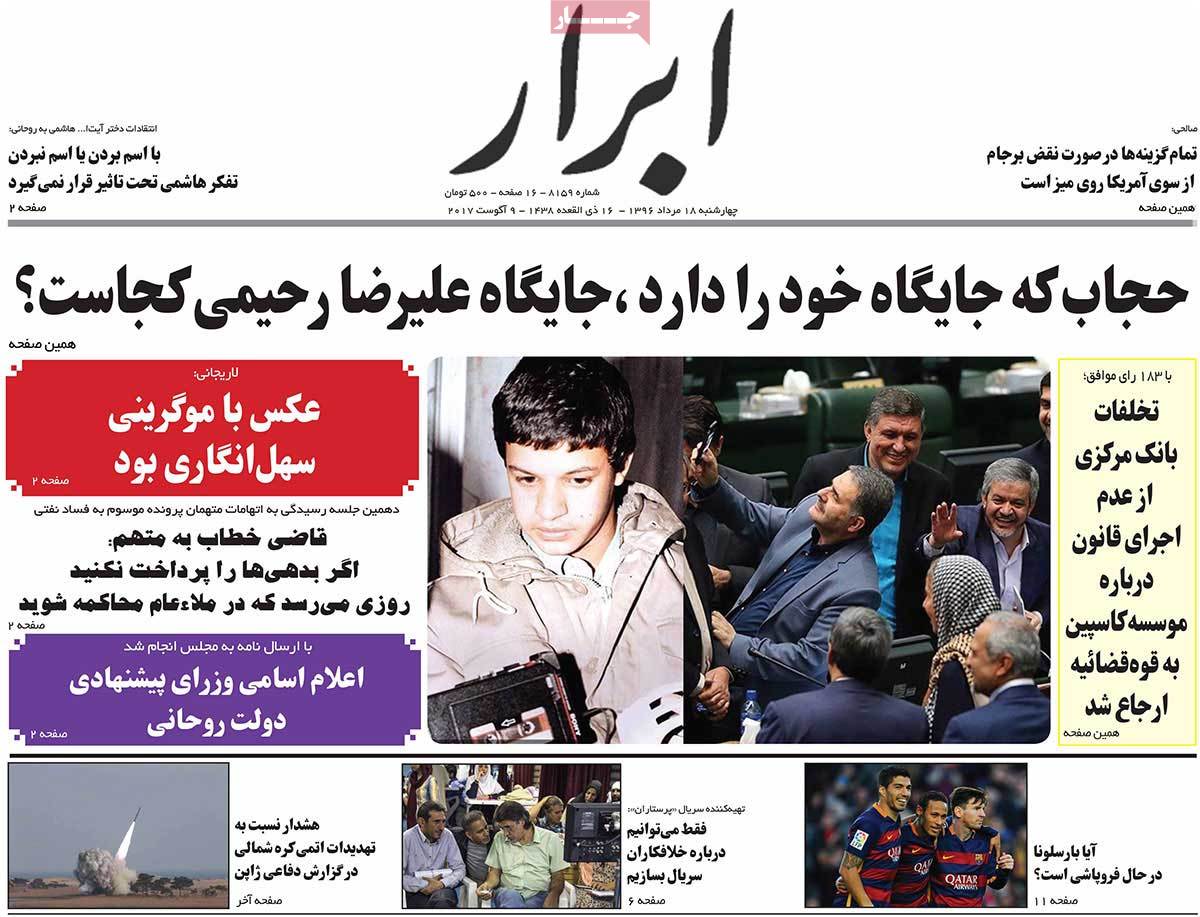
Abrar:

1- Larijani: Selfie with Mogherini Was Negligence

2- Judge to Oil Criminals: If You Don’t Pay Debts, You’ll Be Executed in Front of People’s Eyes

A Look at Iranian Newspaper Front Pages on August 9 - abrar


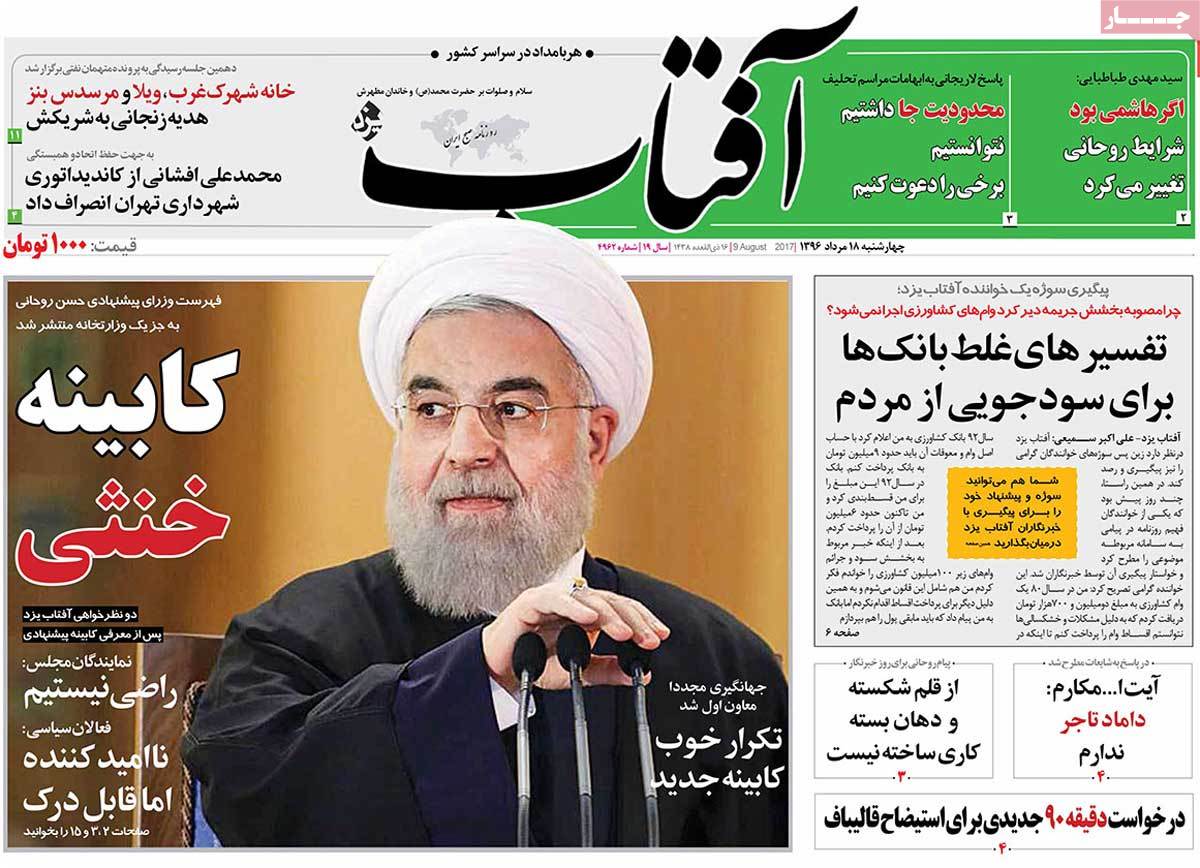
Aftab-e Yazd:

1- Neutral Cabinet: Rouhani Submits List of Proposed Ministers

2- Poll Shows MPs Not Satisfied with Rouhani’s List, Activists Disappointed, but Convinced

3- Larijani: Due to Space Limits, We Couldn’t Invite Some People to Inauguration Ceremony

A Look at Iranian Newspaper Front Pages on August 9 - aftab


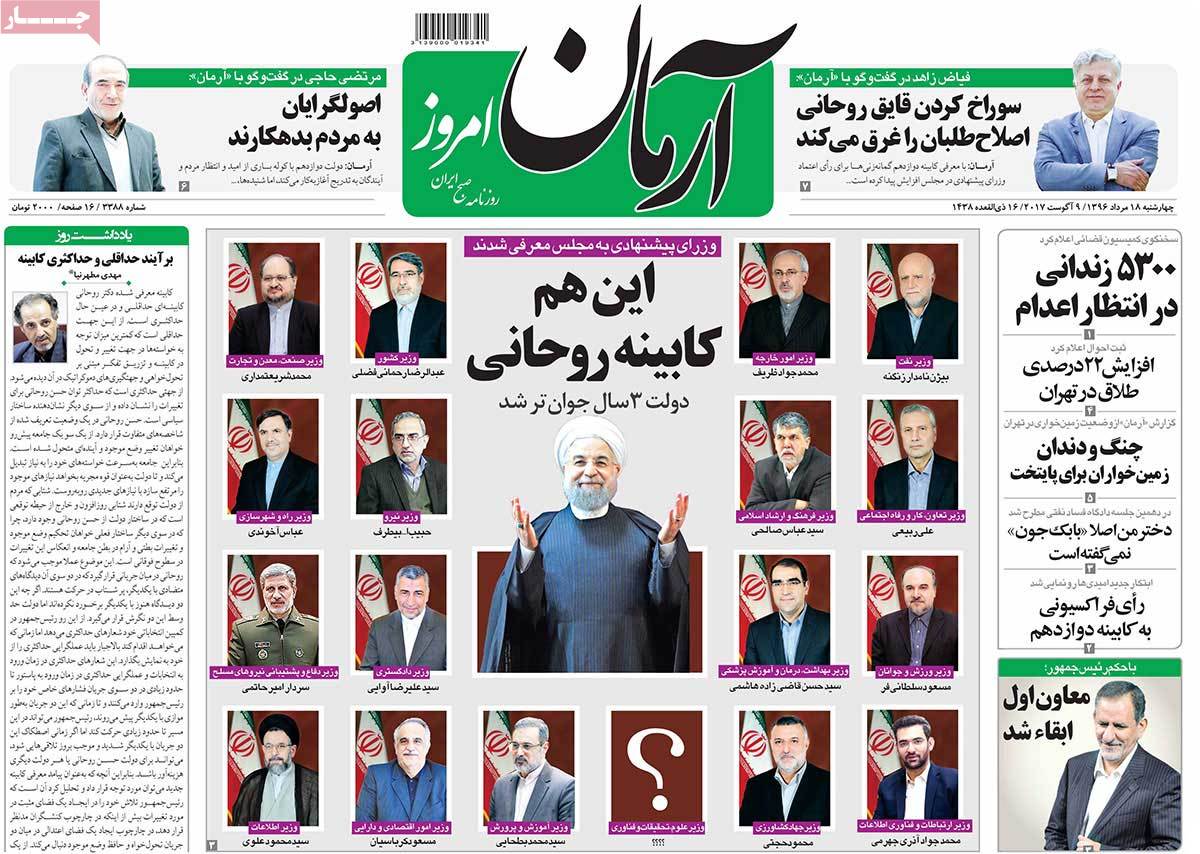
Arman-e Emrooz:

1- And Here’s Rouhani’s Cabinet: Government 3 Years Younger

2- 22% Increase in Number of Divorces in Tehran\

A Look at Iranian Newspaper Front Pages on August 9


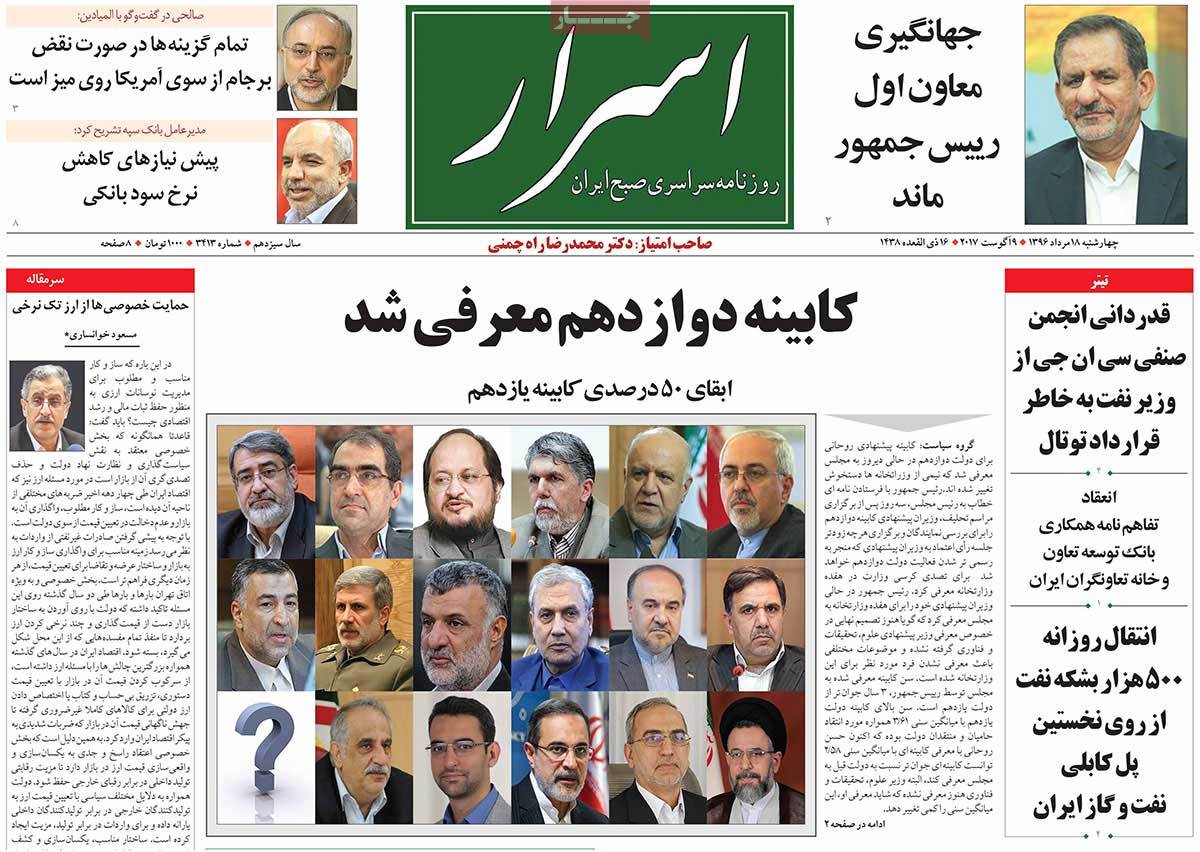
Asrar:

1- Jahangiri Remains Rouhani’s First VP

2- Iran Nuclear Chief: All Options on Table If US Breaches Nuclear Deal

3- CNG Syndicate Praises Oil Minister for Deal with Total

A Look at Iranian Newspaper Front Pages on August 9 - asrar


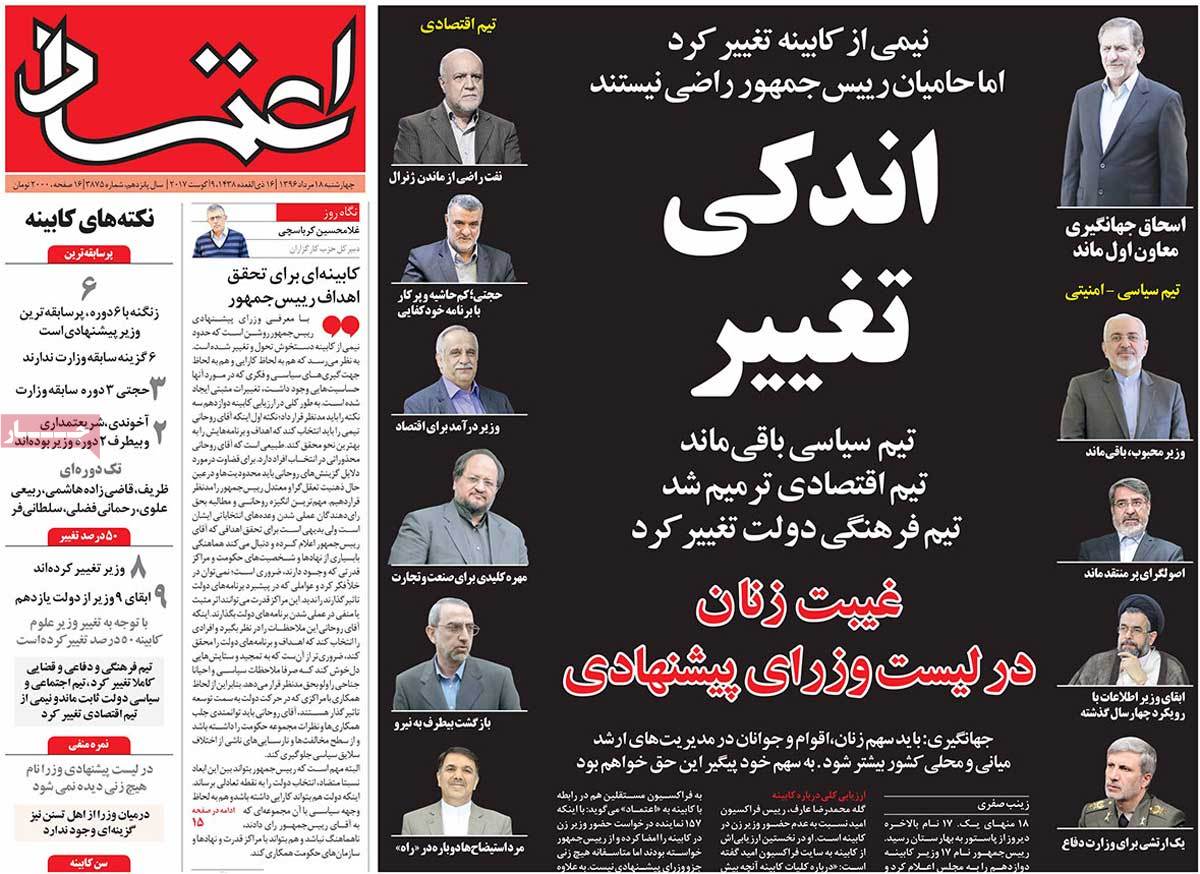
Etemad:

1- A Slight Change: Half of Rouhani’s Cabinet Changed, but Supporters Not Satisfied

2- Rouhani’s Political Team Remains Unchanged, Economic Team Modified, Cultural Team Changed

3- Women’s Absence from Rouhani’s List of Ministers

4- First VP: Number of Senior Female Managers to Be Increased

A Look at Iranian Newspaper Front Pages on August 9 -etemad


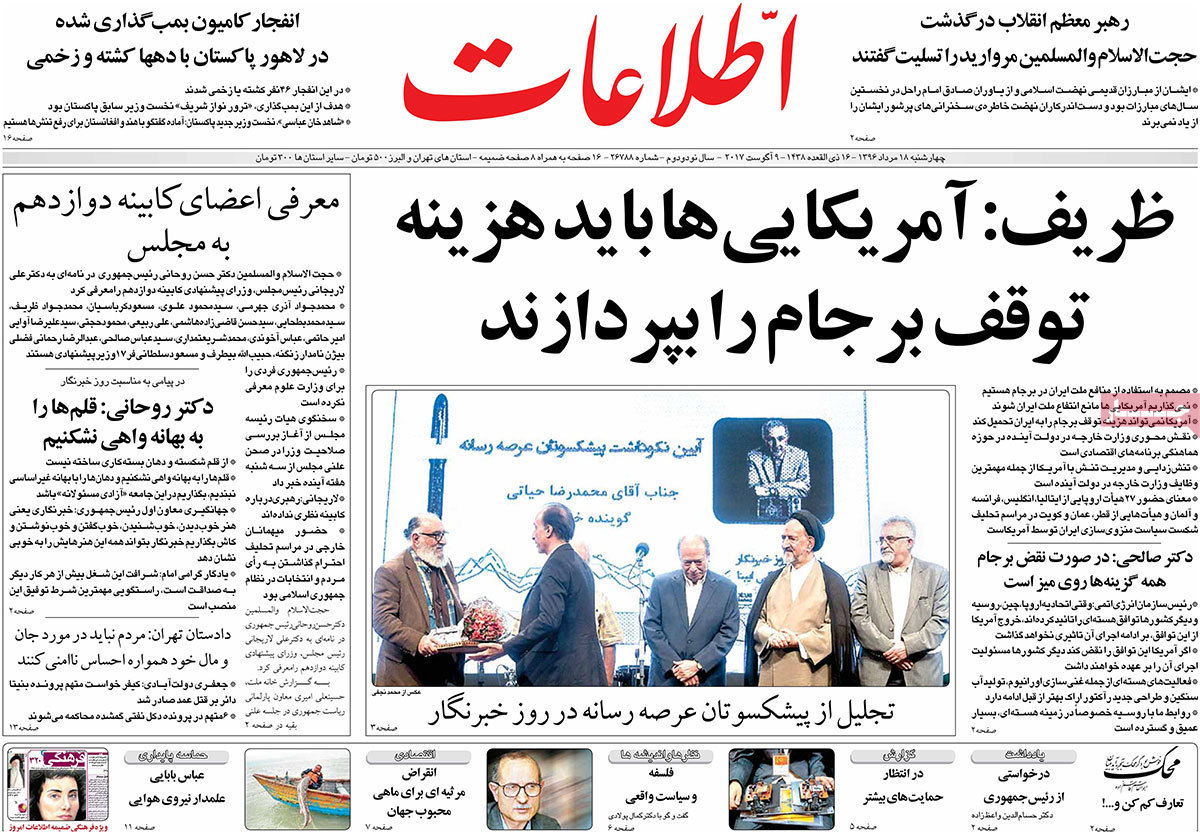
Ettela’at:

1- Zarif: Americans Should Pay Price for Scrapping Iran Deal

2- Rouhani: Let’s Avoid Breaking Pens on False Pretexts [on Journalists’ Day]

A Look at Iranian Newspaper Front Pages on August 9 - etelaat


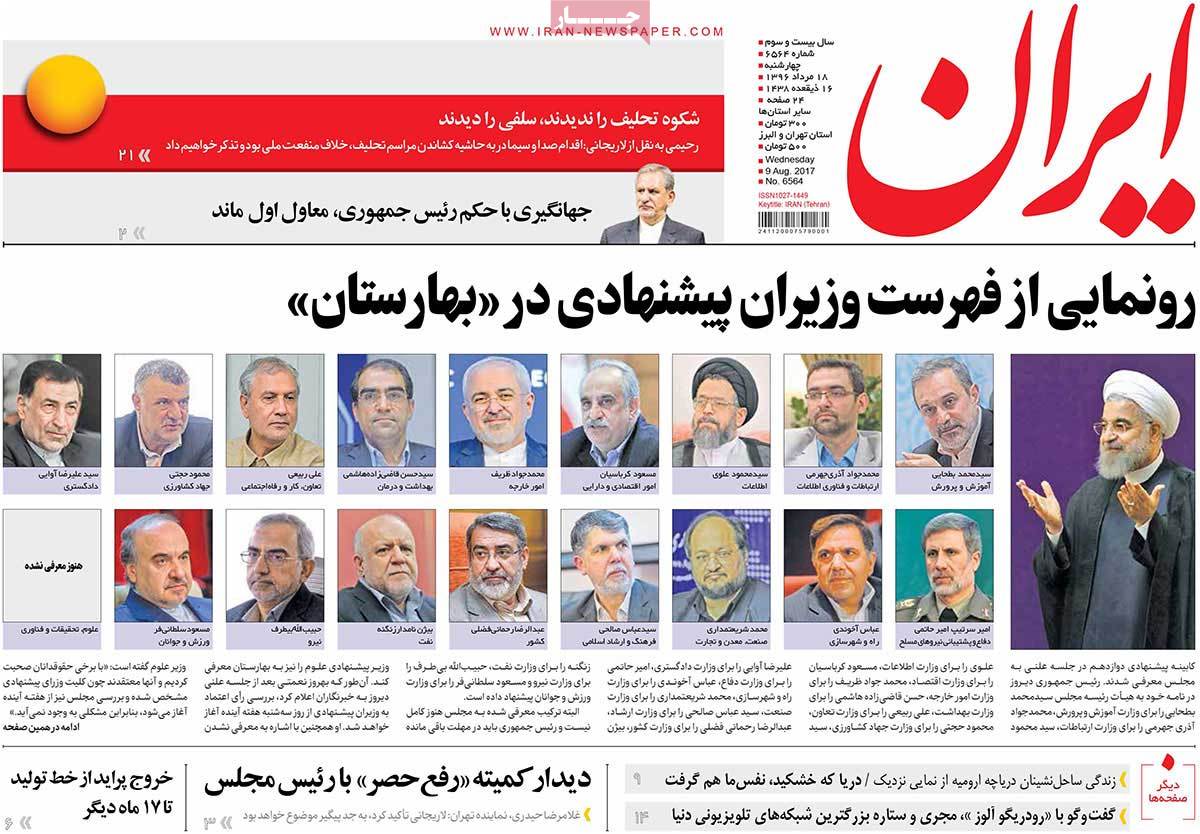
Iran:

1- They Didn’t See Glory of Inauguration, They Just Saw Selfie

2- IRIB’s Move to Marginalise Swearing-in Ceremony against National Interests: Larijani

3- Parliamentary Committee Formed to Pursue Ending House Arrest of Opposition Leaders

  • Larijani Has Vowed to Seriously Follow up on Issue: MP

A Look at Iranian Newspaper Front Pages on August 9 - iran


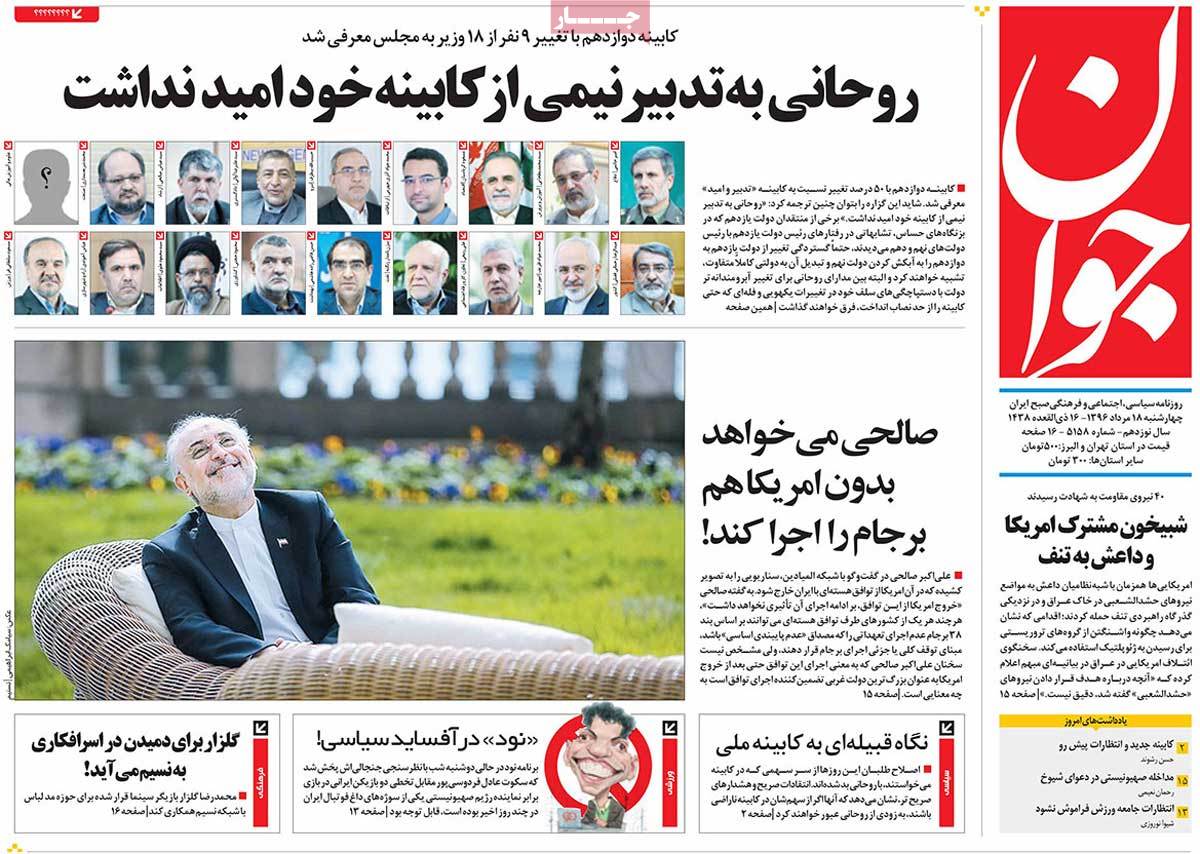
Javan:

1- 9 out of 18 Ministers Changed in Rouhani’s New Cabinet

  • Rouhani Didn’t Believe in Prudence of Half of His Cabinet Members

2- Iran Nuclear Chief Wants to Implement JCPOA Even without US!

A Look at Iranian Newspaper Front Pages on August 9 - javan


Jomhouri Eslami:

1- Iran-Renault Deal Assures European Firms of JCPOA’s Survival

2- AEOI Chief to Al Mayadeen: US to Lose If JCPOA Violated

3- British Official: London Has Noticed Iran’s Positive View Due to JCPOA

4- 40 Iraqi Popular Forces Killed by US Airstrike on Syria-Iraq Border

A Look at Iranian Newspaper Front Pages on August 9 - jomhori


Kayhan:

1- New Cabinet Introduced: Are Rouhani’s Ministers Compliant with His Promises?

2- Senior Arab Author: Resistance’s Victories, from Palestine to Yemen, Thanks to Iran Support

3- Sports Minister Condemns Two Iranian Football Players for Playing against Israeli Team

A Look at Iranian Newspaper Front Pages on August 9 - kayhan


Resalat:

1- Ayatollah Javadi Amoli: Intimidating Enemies to Be Rewarded by God

2- Standard Organization Chief: Imported Petrol Not Based on Standards

3- CBI Governor: We No Longer Have Illegal Financial Institutions

A Look at Iranian Newspaper Front Pages on August 9 - resalat


Rooyesh-e Mellat:

1- Larijani: Swearing-in Ceremony Proves Isolation of Iran Pointless

2- Saudi Arabia to Decrease Supplying Oil to Asia by 10%

A Look at Iranian Newspaper Front Pages on August 9 - royesh


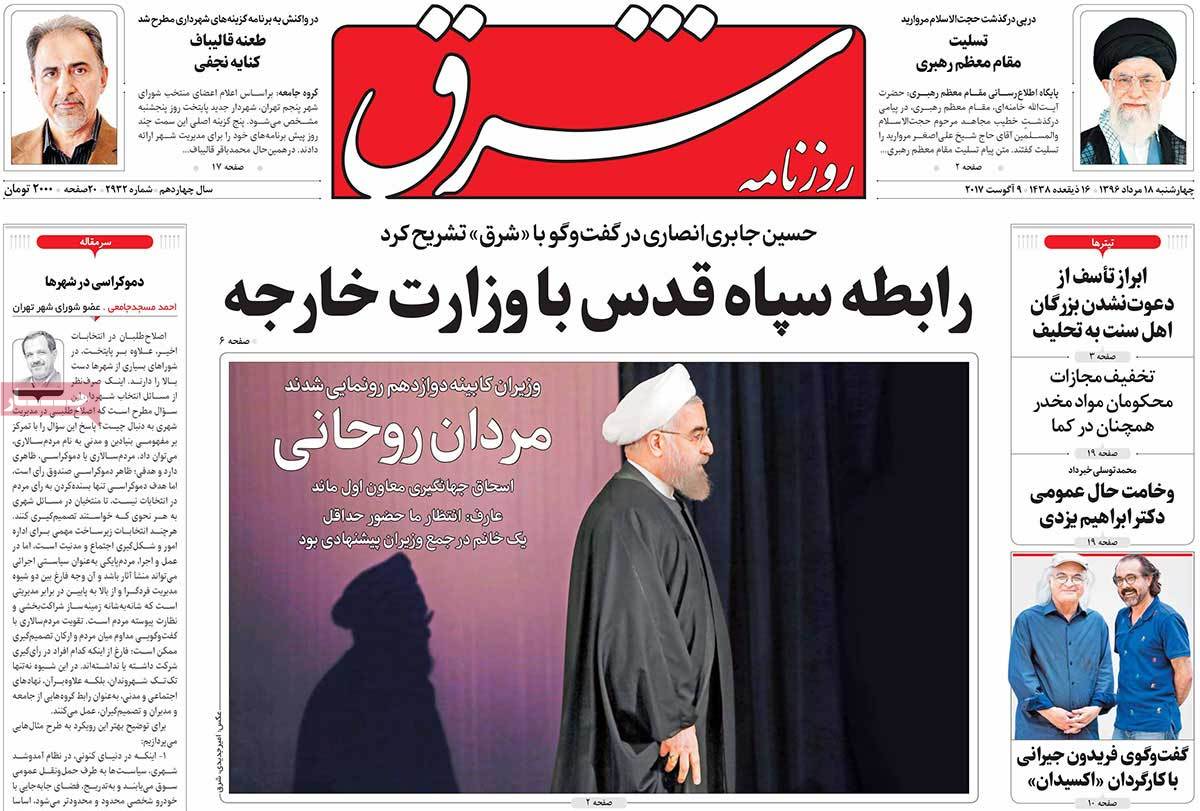
Shargh:

1- Rouhani’s Men: New Ministers Unveiled

2- Aref: We Expected to See at Least One Female Minister

3- Deputy FM Explains IRGC Quds Force’s Relation with Foreign Ministry

4- Parliament’s Failure to Invite Top Sunni Figures Regrettable

A Look at Iranian Newspaper Front Pages on August 9 - shargh


Iran Condemns Terrorist Attack in Afghaninstan’s Sar-e Pol

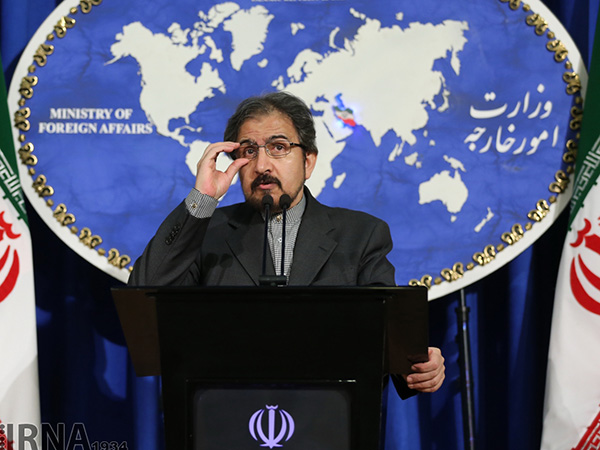
Bahram Qassemi

In a Wednesday statement, the ministry’s Spokesman Bahram Qassemi censured the Sunday night terrorist attack which led to the martyrdom of tens of people in the area.

He also offered sympathy to the Afghan people and government and condoled with the families of the victims of this brutal and inhumane crime.

Qassemi referred to the long-standing grudge and hostility of the enemies of the oppressed people of Afghanistan, and called on the Afghan government and people to be more alert.

He has also stressed the need for maintaining unity and showing more solidarity against such terrible humanitarian crimes and the divisive and sectarian measures by the terrorist groups.

Saudi Arabia, UAE Try to Revive Saddam’s Party: Iraq

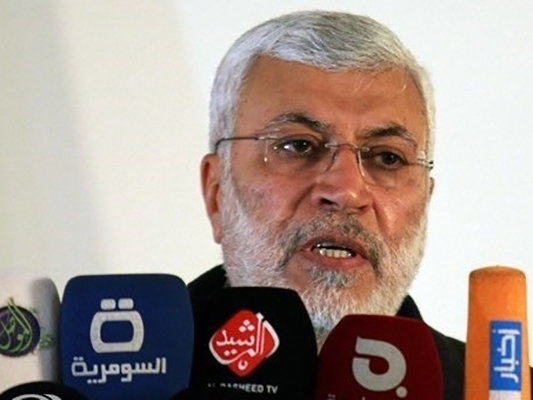
Abu Mahdi al-Muhandis

Deputy Commander of the Popular Mobilization Units (PMU), Abu Mahdi al-Muhandis, says the consulates of Saudi Arabia and the UAE in the Iraqi Kurdistan Region have sought to revive Iraq’s Baath party in the country.

He went on to say that there are comprehensive information about the subject.

Al-Muhandis also noted that Saudi Arabia was attempting to form a militia group in Iraq, adding, however, since the country’s plot failed, it concentrated its efforts on al-Qaeda and ISIS.

The Iraqi commander said if he feels the need, he can disclose the information he has about the issue, according to a Farsi report by the Al-Alam News Network,

“The truth is that we do not want to damage the international relations between Iraq and the regional countries.”

He also said Saudi Arabia is not honest in its fight against terrorism.

Al-Muhandis added that the actual role Riyadh is playing in Iraq has remained unchanged.

“Saudi Arabia is still targeting the Iraqi establishment and the PMU.”

Structural Changes in Iran Foreign Ministry; Speculations, Implications

When Rouhani’s first presidential term started in 2013, the case of the Islamic Republic’s nuclear activities was taken from the country’s Supreme National Security Council (SNSC) and instead the ministry of foreign affairs took over the responsibility to pursue this important international case.

It seems to be the first and the most important dual mission of the Iranian foreign ministry, since it is difficult to separate the political and economic dimensions of the nuclear case.

After the nuclear deal and signing the JCPOA, the ministry of foreign affairs had to shoulder the heavy responsibility of this case which was in fact a combination of economic and political issues. However, the traditional structure of the ministry was not ready to play this role.

The nuclear agreement could not be achieved and no one could take over the complicated process of maintaining the deal in the domestic and international arena without FM Mohammad Javad Zarif’s great talent and the capacities of the active team of negotiators.

Zarif and his colleagues, who also enjoyed the trust of Iran’s Leader Ayatollah Seyyed Ali Khamenei and the special trans-organizational permissions he gave the foreign minister, actually compensated for the heterogeneous and bureaucratic structure of Iran’s foreign ministry.

It should be acknowledged that, although US has not complied with its commitments under the deal, for several times the international organizations including the International Atomic Energy Agency (IAEA) have certified Iran’s compliance with the nuclear agreement which is  a success for the Iranian ministry of foreign affairs.

Now after having successfully completed the first “political-economic” mission in the international arena, the foreign ministry of the Islamic Republic of Iran seeks to reorganise its administrative structure and its bureaucratic system to continue the process that it has been working on in the past four years.

Following the reintroduction of Zarif as the foreign minister in the second administration of Hassan Rouhani on August 8, the Tasnim News Agency has, in a Farsi article, unveiled a structural reorganization plan at the ministry of foreign affairs, which shows that the plan is in its final stages.

If this plan is approved and implemented, the responsibility of the nuclear deal will be transferred from the legal deputy to the political deputy, which means a more significant role for politics in smoothing the course of nuclear deal implementation.


Changes in the Structure of Ministry of Foreign Affairs

There are media speculations about structural and fundamental changes in Iran’s ministry of foreign affairs. According to a Farsi report by Tasnim, the media and even the lawmakers insist that the ministry needs some drastic changes in its economic departments to become more agile.


Draft Bill Ready to Be Submitted in Near Future

Recently, Deputy Chairman of the Iranian Parliament’s National Security and Foreign Policy Commission, Abolfazl Hassan-Beigi, said that a new structure of economic diplomacy will be created in the foreign ministry. He also announced that qualified people and experts would be recruited for this purpose.

Hassan-Beigi also stated that changes in some structures of the foreign ministry require parliamentary authorization, and some others have to be approved by the government.

“Provisions have been provided and the foreign ministry is supposed to submit a draft bill to the government, and then the government will send the bill to the parliament,” Hassan-Beigi added.

Moreover, Foreign Ministry Spokesman Bahram Qassemi has recently defended the ministry’s performance in the economic sphere, saying they are considering some mechanisms to boost the economic structure of the foreign ministry.

Based on some media speculations, four new posts called “Neighbourhood Deputy,” “Political Deputy”, “Citizens’ and Iranians’ Rights Deputy”, and “Economic Deputy” will be added to the structure of the foreign ministry and the “Political Deputy” will follow up the nuclear deal case.

Prior to this, there were only economic attachés in four countries of the world, but with the establishment of the “Economic Deputy”, this issue would be followed up more seriously. No news has yet been released on the removing or merging of other departments of the ministry.

Tasnim has come up with some new findings on the structural changes in the ministry.

The following are the possible changes in the ministry’s structure which are currently being discussed there.


Political Deputy; Link between Minister and Director-Generals

In this regard, it has been decided to demote the minister’s field deputies – including Deputy for European and American Affairs, Deputy for Arab and African Affairs, and Deputy for Asia and Pacific Affairs – to Director-Generals.

All of these director-generals will be linked to the minister via a deputy called “Political Deputy”, and the affairs will be followed up through this deputy. This change is being sought for what is called the “Agility in Foreign Affairs Ministry”.


Political Deputy to Take Over Responsibility for JCPOA

In another change, the nuclear agreement case will be forwarded to the Political Deputy from the Legal and International Affairs Deputy.

The purpose of this change seems to be sending a message to the world, especially the United States, saying that the legal proceedings of the JCPOA are over for Iran and are not subject to revision.

It seems that these changes to the foreign ministry are inevitable since its structure has not undergone a fundamental change over the past few decades. On the other hand, the world has been rapidly transformed over the course of these decades. However, it seems that no final agreement has been reached on this issue yet.

Furthermore, given the global and regional developments, it is important to pay more attention to the issue of economic diplomacy in the foreign ministry’s structure.

Iran FM Commemorates 1998 Mazar-i-Sharif Martyrs

Foreign Minister Mohammad Javad Zarif has, in a message, honoured the memory of the Iranian diplomats and journalists killed by the Taliban during a siege of the Iranian consulate in Mazar-i-Sharif in Afghanistan back in 1998. The full text of the message follows:

Nineteen years have passed since a number of elite Iranian reporters and diplomats were martyred in Mazar-i-Sharif while on duty and offering sincere services abroad. The tragedy tore the hearts of Iranians as well as all Muslims and justice-seekers across the world.

The contravention of international laws and human principles as well as resorting to violence and terror to violate the immunity of the Iranian diplomats in Mazar-i-Sharif was among the darkest and most painful events in Iran’s history, which has had many ups and downs.

Now, nearly two decades on since the sorrowful and heinous crime was committed, those who serve at Iran’s diplomacy apparatus together with the country’s journalists still mourn the demise of their colleagues.

I commemorate those who lost their lives in the painful tragedy and renew allegiance to all martyrs who gave their lives for Islam and the 1979 Revolution. I ask God Almighty to bestow his blessings upon them and wish their families success, dignity and prosperity.

Iran Says All Options on Table If US Breaches Nuclear Deal

Ali Akbar Salehi, the head of the Atomic Energy Organization of Iran (AEOI), says all options are on the table in case the US violates the nuclear deal signed between Tehran and six world powers, also known as the Joint Comprehensive Plan of Action (JCPOA).

“Washington is unlikely to do this (violate the JCPOA) because such a move will be to its detriment,” he added in an interview with Al-Mayadeen TV, as cited in Farsi by the Fars News Agency.

“Iran’s response will be proportionate to the way the US deals with it (the nuclear deal),” he said.

The European Union, China, Russia and other countries have approved of the JCPOA, so Washington’s withdrawal from the deal will have no bearing on its implementation, said Salehi.

He said if the US contravenes the agreement, the responsibility for it will rest with Washington itself.

“It is not our responsibility. The [International Atomic Energy] Agency has announced almost seven times that Iran has remained committed to the JCPOA, and hence, there are no grounds for violating the deal,” he said.

He expressed the hope that a day will not come when Iran will have to return to the pre-JCPOA situation.

“At the beginning of the [nuclear] talks, the possibility of the deal being violated was put forward as well. So, several channels were envisaged to get back to the previous situation, even a situation better than before.”

Salehi described the JCPOA as a “history” whose impacts will be noticed more and more as time goes by. He also said he was pleased to have had a key role in the nuclear negotiations.

“Nuclear activities such as uranium enrichment, production of heavy water, the re-designing of the Arak reactor with China’s help in addition to exploitation of uranium quarries are underway better than before, and media reports of internal differences in Iran over the JCPOA are simply political dreams,” said Salehi.

He further noted that Iran and Russia are further expanding their relations.

Salehi touched upon joint ventures by Tehran and Moscow, including the construction of two new large power stations in Bushehr next to the current nuclear facility there.

“Iran has very deep and extensive ties with Russia in the nuclear field,” he noted.

‘Lebanon’s Golden Triangle: Army, Hezbollah, People’

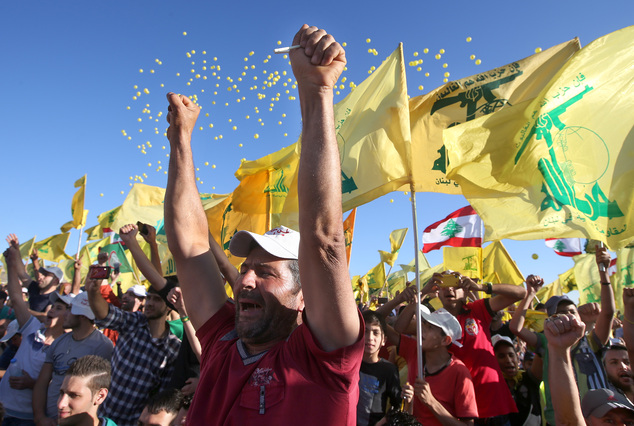
Hezbollah

The Persian-language Tasnim News Agency has, in a report, elaborated on the secret behind Lebanon’s success in countering the Zionist aggression. The full text of the report follows.

The Lebanese resistance movement Hezbollah, the Lebanese army, and people constitute a golden triangle which has protected Lebanon against relentless aggression. The three safeguard the country against acts of aggression by Zionists and Takfiri groups. Experience has proved that the defense strategy has been fruitful.

Walid Sukkarieh, an expert on Lebanon’s military affairs, has also supported the formation of the three-pronged front.

“Can we establish an army which could be superior to the Israeli army militarily? [Can we establish] an army with whose help we will be able to attack Israeli forces, secure military domination over them and free our homeland? Lebanon does not have what it takes to do this. It is only the help of the [Lebanese] resistance [movement Hezbollah] that protects our land against any aggression or occupation. And this resistance is the result of a resistant society,” he said.

“This is a military strategy for all weak countries in confronting powers which are militarily superior,” the expert added.

Hezbollah stood up to aggressors in 2006 when the Zionist regime of Israel launched aggression against Lebanon. The army defended the nation on the domestic front. The people, for their part, put up a stiff resistance. Therefore, they emerged victorious, exactly like in 2017 when a similar triumph was secured against terrorist groups.

“Both in the recent war and in the July conflict back in 2006, it was Hezbollah that stood up to the Israeli enemy in the first place. Of course, the army and people were also on the scene. In the recent conflict on Arsal heights, Hezbollah launched a combat operation, and the army served as a bulwark against terrorism. The army did not allow terrorism to spill over from borders to villages and other areas in Lebanon. Here, the army’s artillery backup was very important. Even now if it is necessary to put up resistance against ISIS once again, the army stands ready to do so,” the expert added.

The Golden Triangle has proved itself in practice. In the eyes of the Lebanese people, this three-pronged front proves its efficiency more and more every day, showing that it is the best option to support Lebanon against foreign threats posed by both Zionists and Takfiris.

Lebanese citizens have, in their interviews with Tasnim, stressed the efficiency and effectiveness of the triangle comprising the army, the people and Hezbollah, and confirm its key role in defending Lebanon against the Israeli regime’s aggression.

A Lebanese citizen said she does believe in the three-pronged front made up of the army, the people and Hezbollah, and that every patriotic person should believe in them.

“We are with the army, and we’re specifically with the Lebanese resistance [movement Hezbollah,] which managed to set us and Lebanon free,” says another citizen.

A Beirut resident says the Lebanese take pride in the army, the people and Hezbollah.

Another Lebanese lady says, “Our blood is for resistance.”

She says the Lebanese have given their lives for their country, saying, “We believe all others took action for our sake, and we will act for them, too.”

Despite different points of view, the army-people-Hezbollah triangle is an undeniable, deep-rooted fact and a national necessity for Lebanon to help protect the country’s frontiers and territorial integrity.