Sunday, April 19, 2026
Home Blog Page 3920

Iranian General Warns Iraqi Kurdistan against Independence Referendum

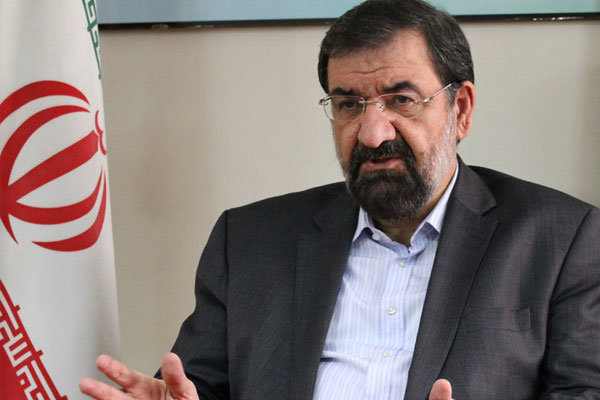
The warning by Mohsen Rezaei during a meeting with Iraqi journalists in Baghdad Sunday night came as the date drew nearer for the semi-autonomous Kurdistan region in northern Iraq to hold the plebiscite on September 25.

“Iraq is a well-known nation and a member of the United Nations with international borders, and its breakup is a very wrong thing, because the disintegration of the country would be the starting point for dangerous insecurities in the region,” he said.

It would have “dangerous” ramifications for the regional countries, said Rezai, who is currently the secretary of Iran’s top arbitration body, the Expediency Council, having served as the head of the Islamic Revolution Guards Corps (IRGC) all through the eight-year Iraqi war of the 1980s on Iran.

“If the disintegration of Iraq begins, it will be extended to Syria and Turkey, and a separatist war will break up in the region, which may plunge the region to 20 years of insecurity,” said Rezaei.

“That is why the Islamic Republic of Iran, Turkey, Syria and Iraq are strongly opposed to a geographical change in the region,” he said of the four ethnically diverse nations which have Kurdish populations.

The Iranian government has maintained generally positive relations with Kurdish political entities and it greatly values stability along its western border with Iraq. That mountainous region already enables some Kurdish groups to skirmish with Iranian forces.

With Turkey obsessive in opposing a Kurdish state, Rezaei warned of possible deployment of Turkish troops to northern Iraq if the Kurds secede.

The anti-Turkish PKK terrorist group dominates the armed groups operating in northern Syria. If a Kurdish state is forged from Iraq, the Turks will assume that it would appropriate Kurdish-occupied territory in Syria. That would formalize a major security threat along Turkey’s border.

The US has been supporting Kurdish militants in Syria for some time, shipping in massive volumes of heavy weapons to the region, which has sounded alarm bells in Turkey.

As a result of a secession, Rezaei said, new wars would start in the region between the central government of Iraq and Kurdistan, which would only harm the Kurdish nation.

“Unfortunately, the issue of the referendum on the Iraqi Kurdistan, more than being a popular demand, is a personal issue, and many Kurdish leaders are against it,” he said.

Masoud Barzani, president of the Iraqi Kurdistan region, has told various officials he would push for a referendum, but the UN and the Europeans have refused to support it, at least publicly.

Rezaei said, “Some Kurdish leaders want to make a name and a reputation through the referendum, while what Iraqi Kurdistan needs is security and progress.”

The Iranian official is in Iraq along with Expediency Council chairman Ayatollah Mahmoud Hashemi Shahroudi who met with Prime Minister Haider al-Abadi in Baghdad Sunday.

Iranian General Warns Iraqi Kurdistan against Independence Referendum

Rezaei said UN and European countries’ refusal to send delegations to observe the Kurdish referendum is “the biggest failure” for the process.

“If the Kurdish leaders of Iraq continue to insist on a referendum, that would have no more than two reasons: either personal motivation or behind-the-scenes hands,” he said, adding that the future would expose those hidden agendas.

Rezaei touched on the US policy in the region, stressing that the Americans do not want complete security to be established in Iraq and Syria, and oppose any action that leads to lasting security in these two countries.

Israel’s Prime Minister Benjamin Netanyahu has also expressed interest in partitioning Iraq and establishing an independent Kurdish state in the Arab country, the Jerusalem Post reported last month.

The Israeli premier expressed his “positive attitude” toward a Kurdish state in the northern areas of Iraq during a meeting with a delegation of 33 US Republican congressmen, the Israeli paper said.

A report published in the New Yorker magazine in 2004 said Israeli military and intelligence operatives were active in Kurdish areas and providing training for commando units.

According to the report, Israel has been expanding its presence in Kurdistan and encouraging Kurds, its allies in the region, to create an independent state.
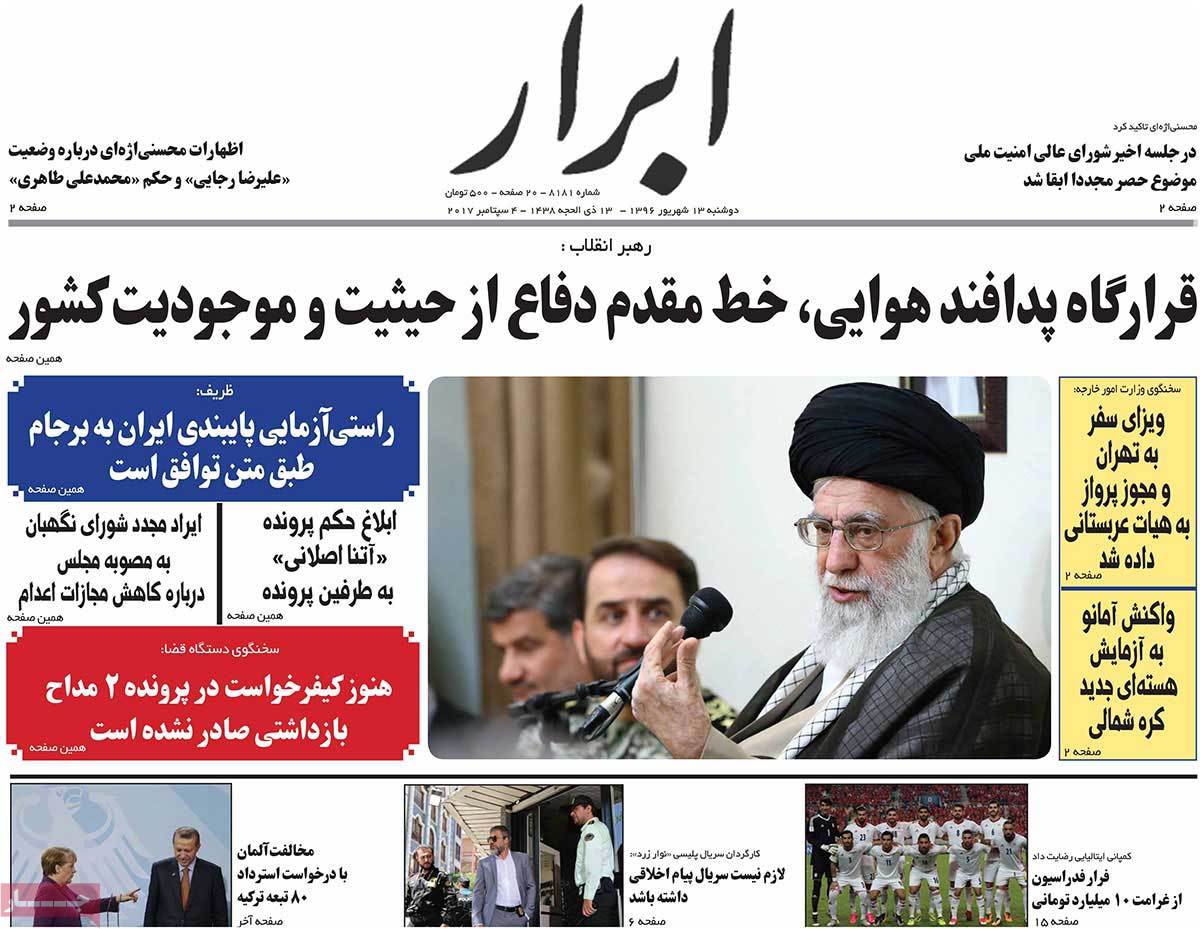
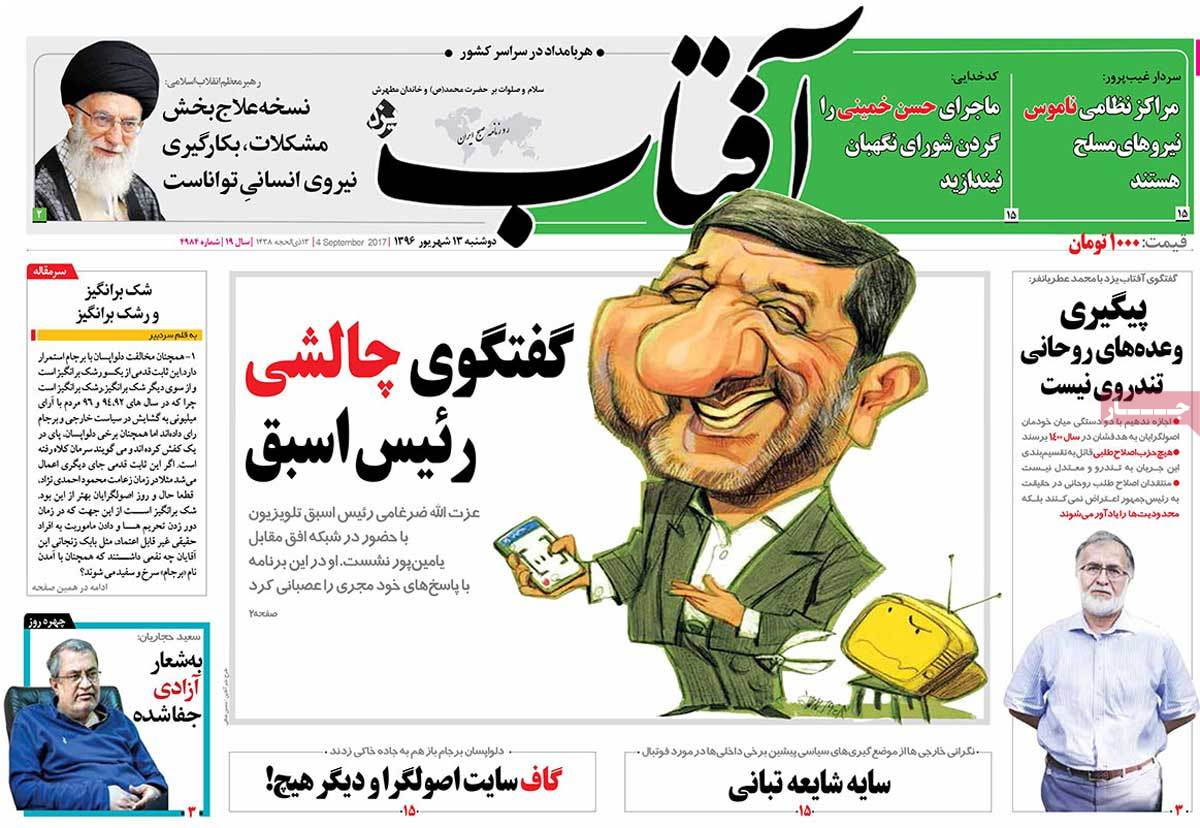
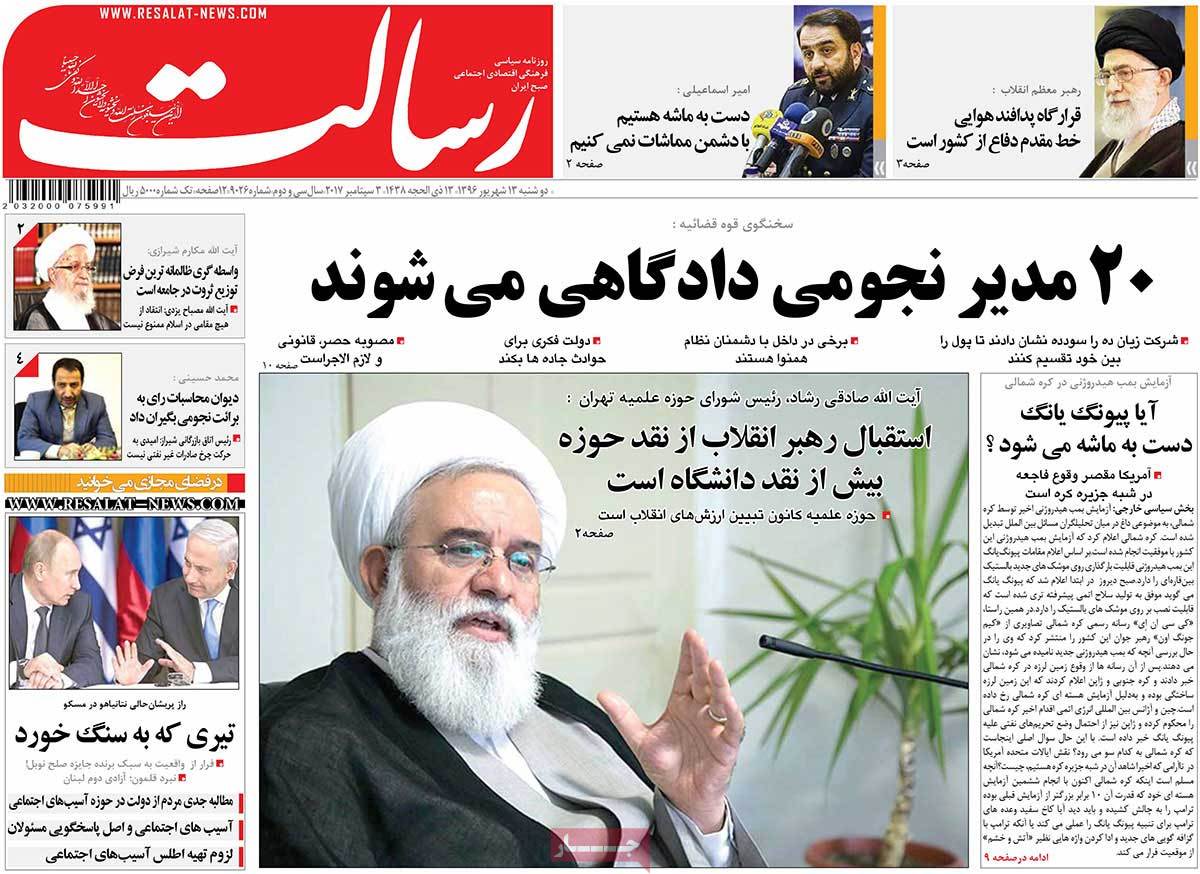
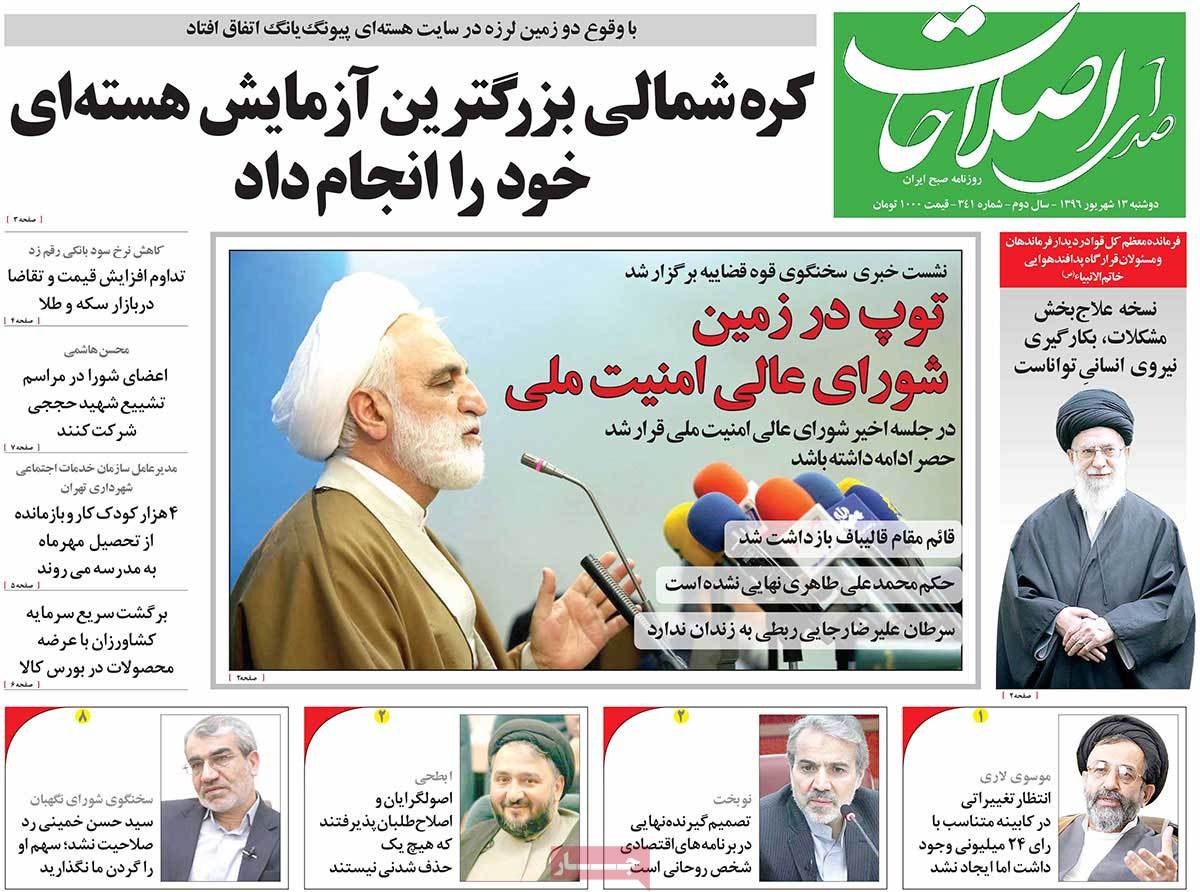
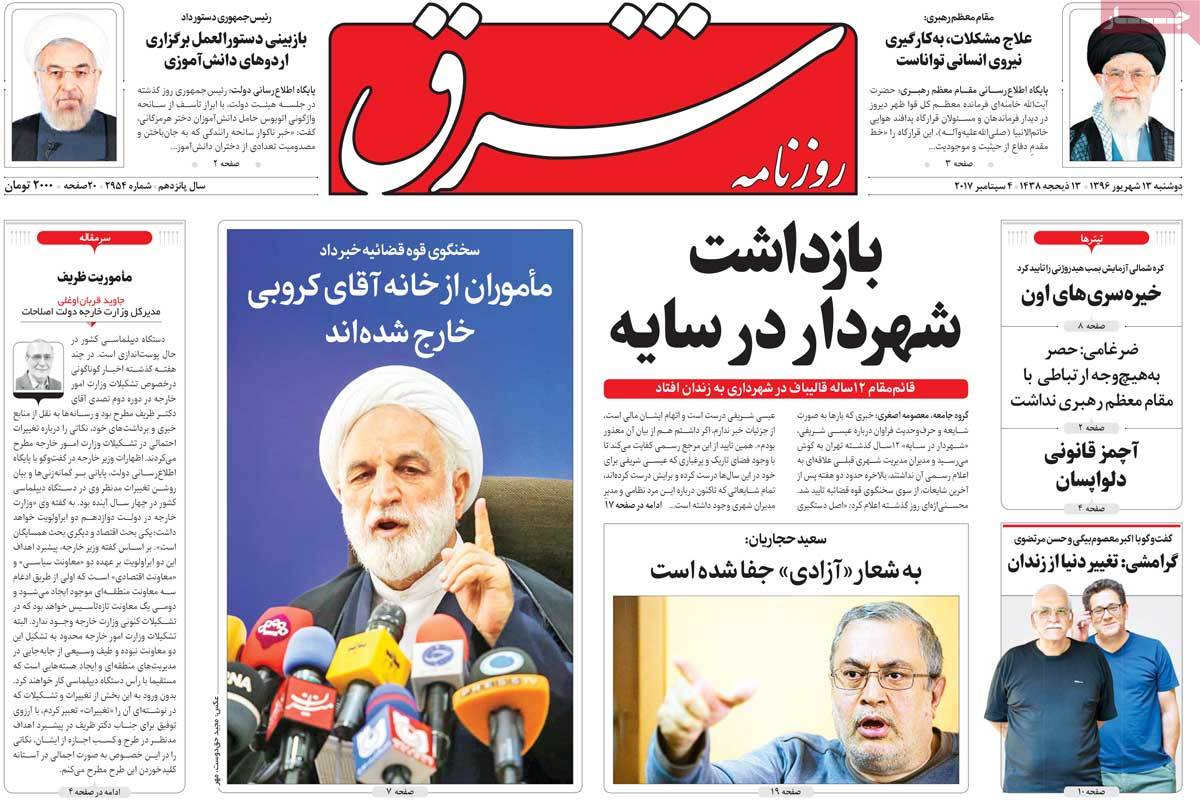
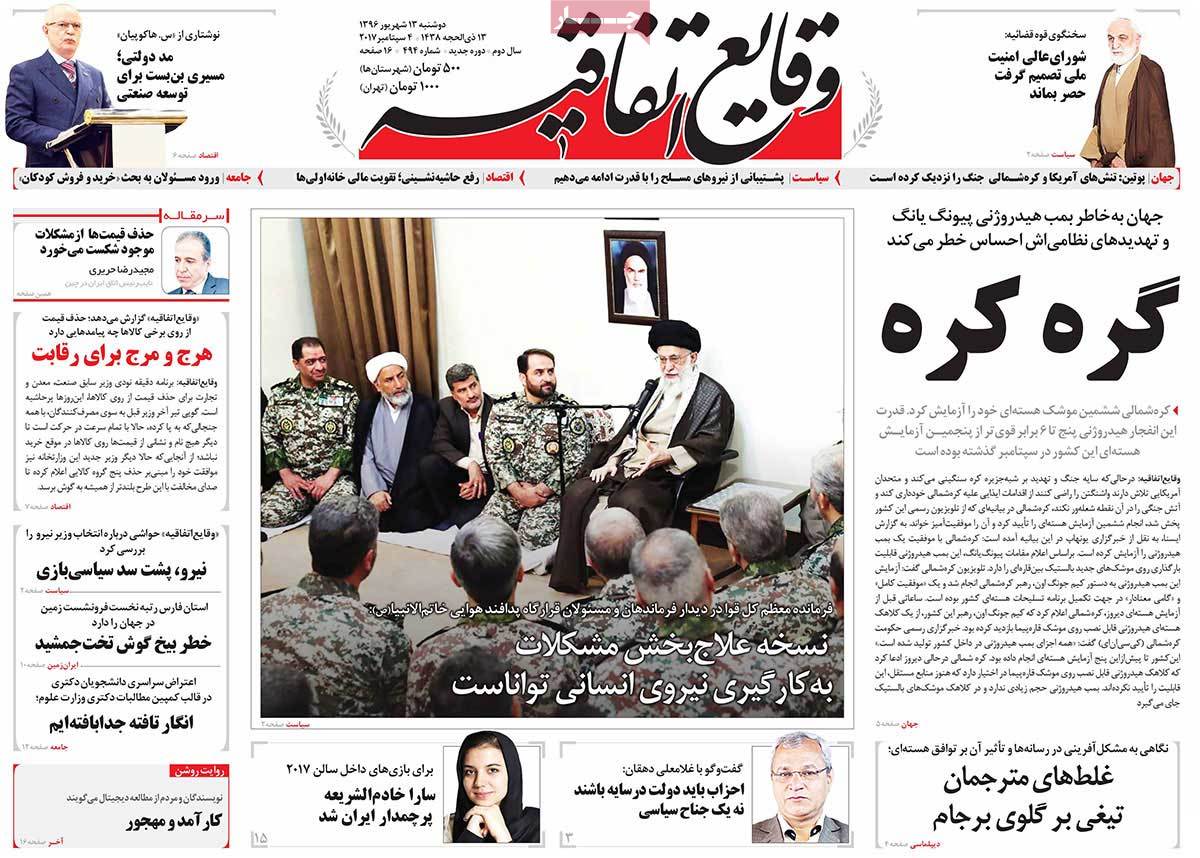
A Look at Iranian Newspaper Front Pages on September 4

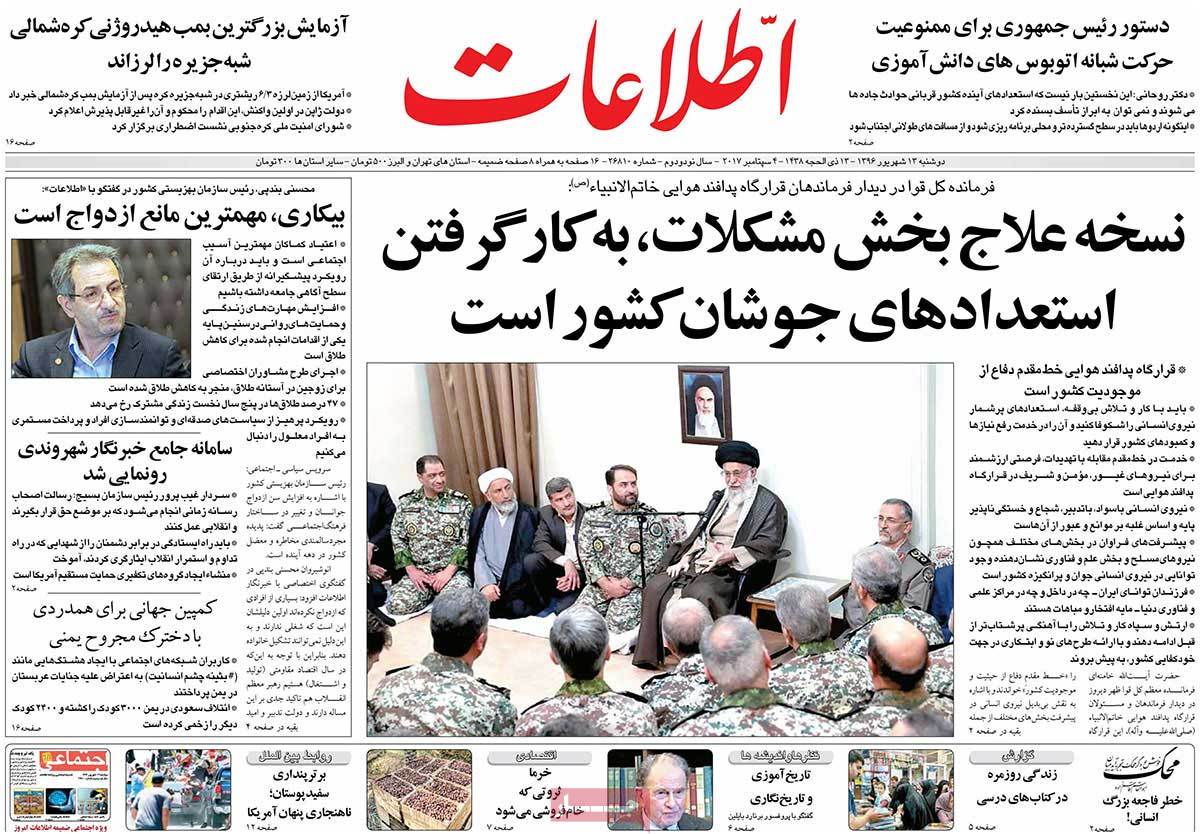
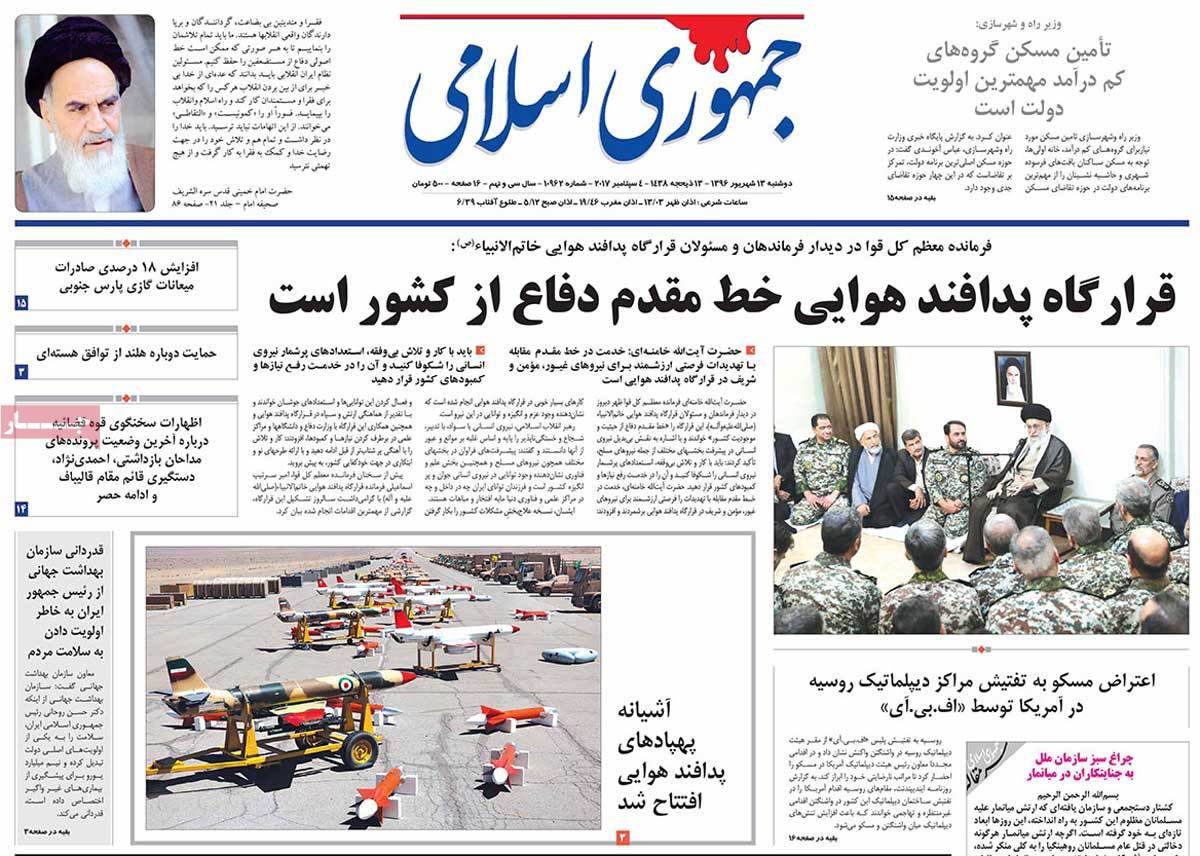
All newspapers today covered the remarks made by the Leader of Iran’s Islamic Revolution Ayatollah Seyyed Ali Khamenei in a meeting with the country’s air defence commanders and personnel.

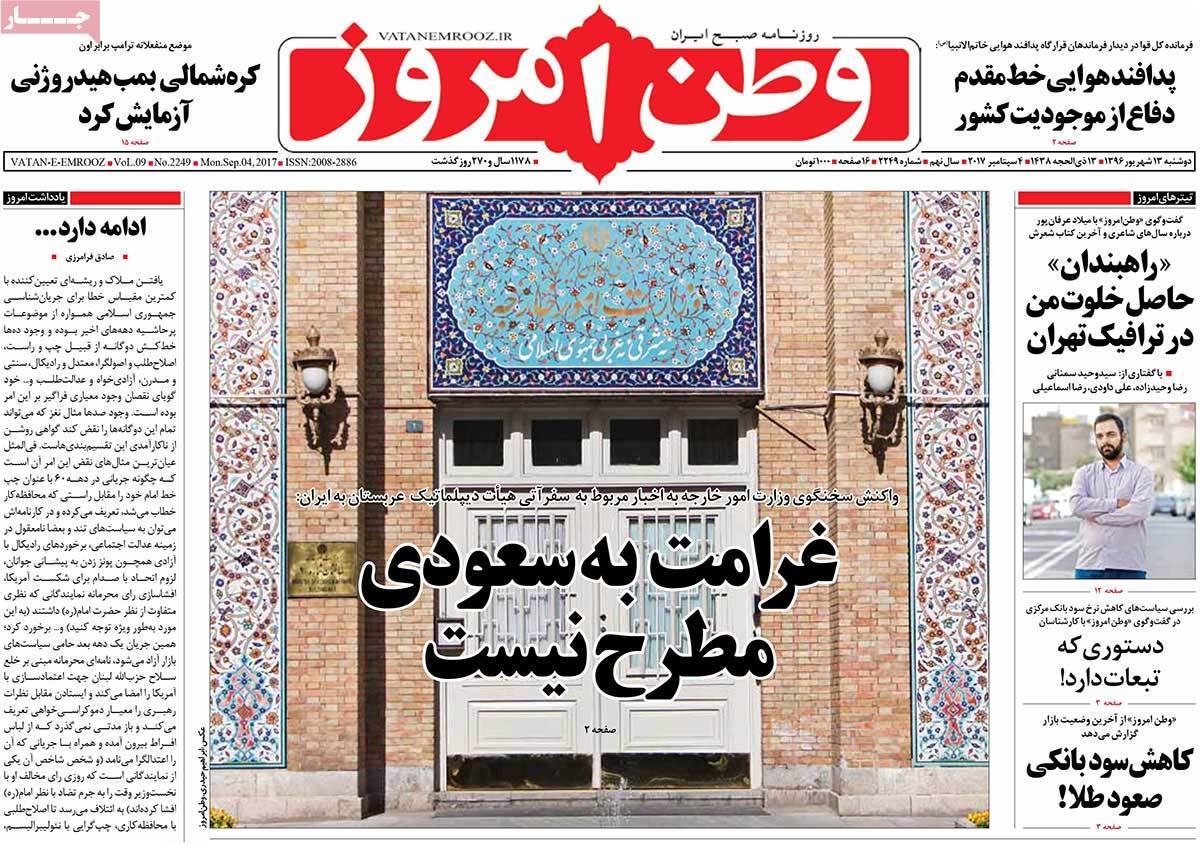
Foreign Ministry Spokesman Bahram Qassemi’s comments about a Saudi delegation’s visit to Tehran also received great coverage. Qassemi said their visas have been earlier issued, and they are going to check their diplomatic sites 20 months after the severance of bilateral ties.

Another top story was the weekly press conference of Judiciary Spokesman Gholam-Hossein Mohseni Ejei, and his remarks about various issues, including a decision by the Supreme National Security Council to keep the opposition figures Mir-Hossein Mousavi and Mahdi Karroubi under house arrest.

Mohseni Ejei also declared that one of the deputies of former Tehran Mayor Mohammad-Baqer Qalibaf has been arrested on financial charges.

The above issues, as well as many more, are highlighted in the following headlines and top stories:


Abrar:

1- Iran Leader: Air Defence Base, Frontline of Defending Iran’s Existence

2- Iran Foreign Ministry: Visas Issued for Saudi Delegation to Visit Tehran

3- Zarif: Verification of Iran’s Commitment to JCPOA Based on Text of Deal

A Look at Iranian Newspaper Front Pages on September 4


Aftab-e Yazd:

1- Iran Leader: Using Capable Human Resources Key to Problems

A Look at Iranian Newspaper Front Pages on September 4


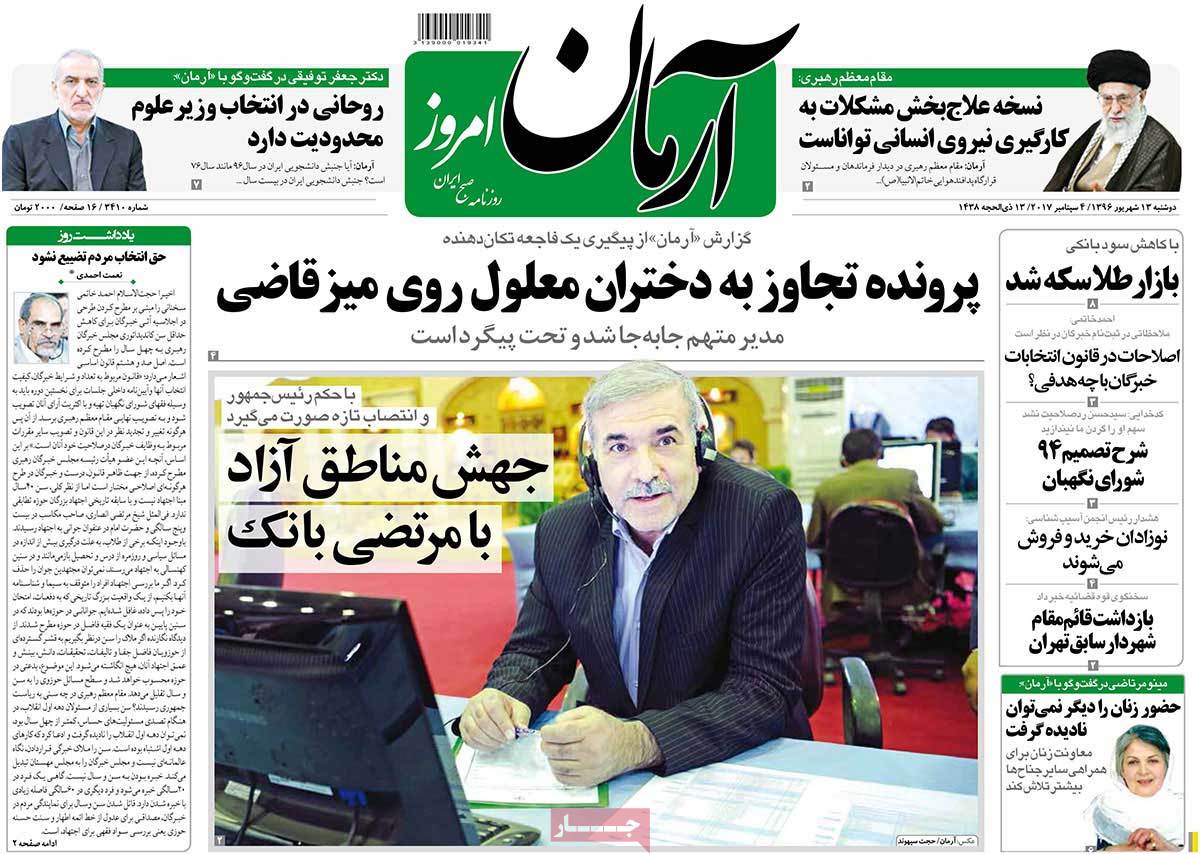
Arman-e Emrooz:

1- Man Who Raped Disabled Girls to Appear in Court

A Look at Iranian Newspaper Front Pages on September 4


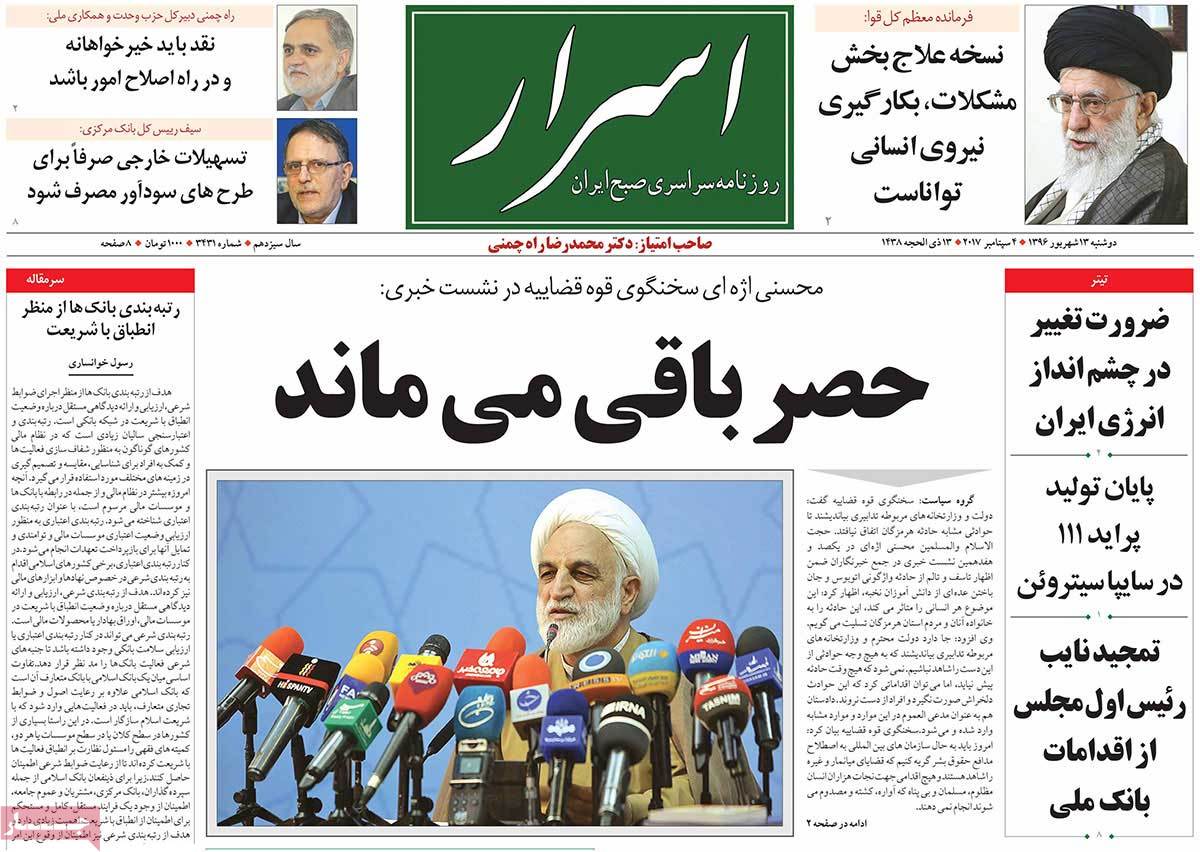
Asrar:

1- Judiciary Spokesman: Opposition Figures to Remain under House Arrest

A Look at Iranian Newspaper Front Pages on September 4


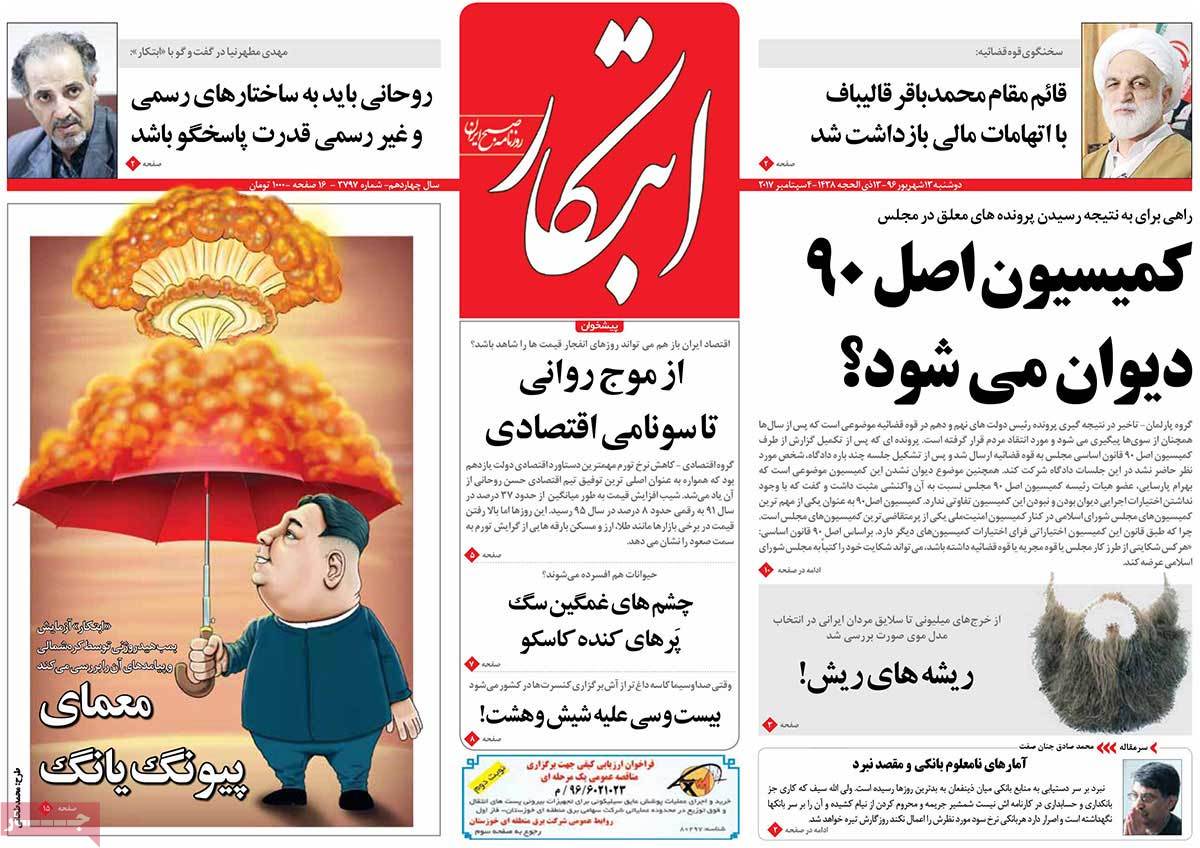
Ebtekar:

1- Secret of Pyongyang: A Report on North Korea’s Nuke Tests, Consequences

2- Judiciary Spokesman: Qalibaf’s Deputy Arrested on Charge of Financial Corruption

A Look at Iranian Newspaper Front Pages on September 4


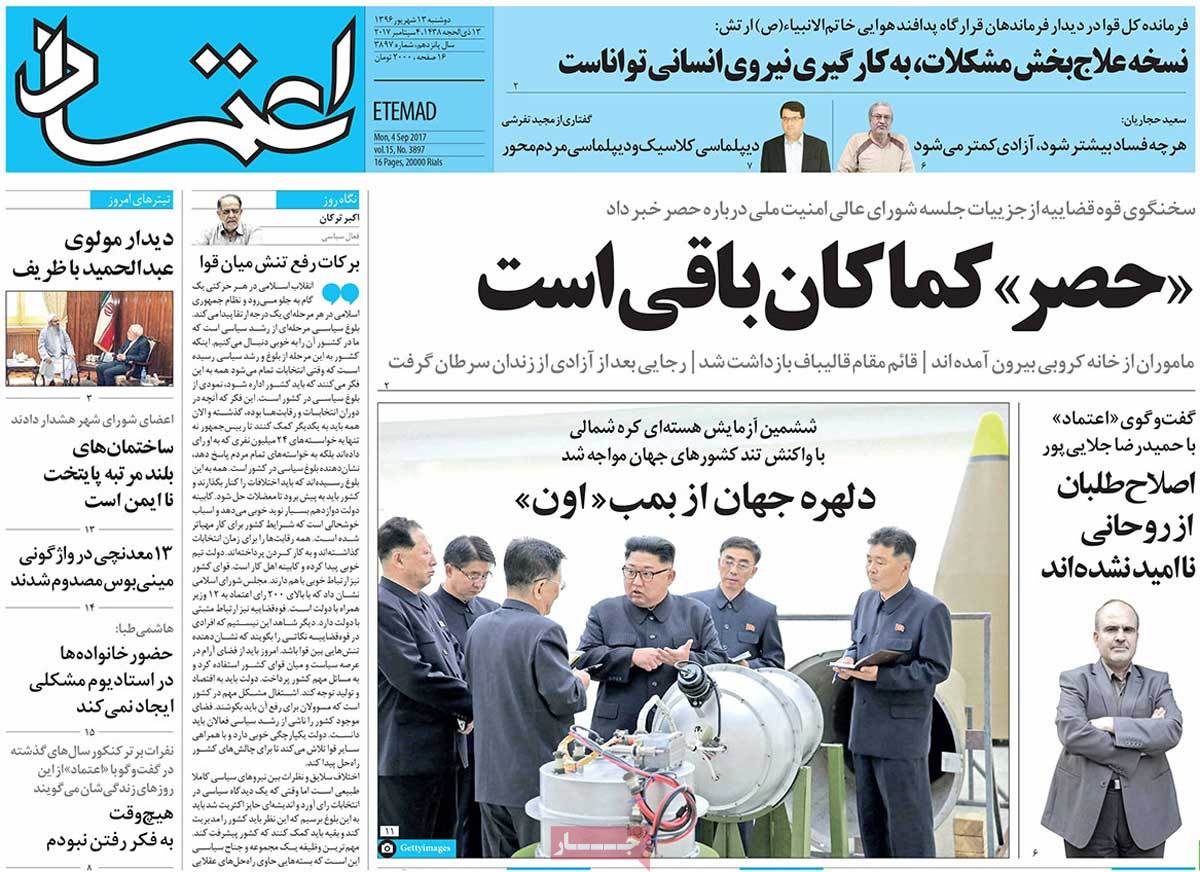
Etemad:

1- World Worried about Kim Jong-un’s Bomb

A Look at Iranian Newspaper Front Pages on September 4


Ettela’at:

1- Buses Carrying Students to Camps Banned from Starting Trips at Night: Rouhani

2- Korean Peninsula Trembles after Pyongyang’s Test of Biggest H-Bomb

3- Unemployment Most Important Barrier to Marriage in Iran: Official

A Look at Iranian Newspaper Front Pages on September 4


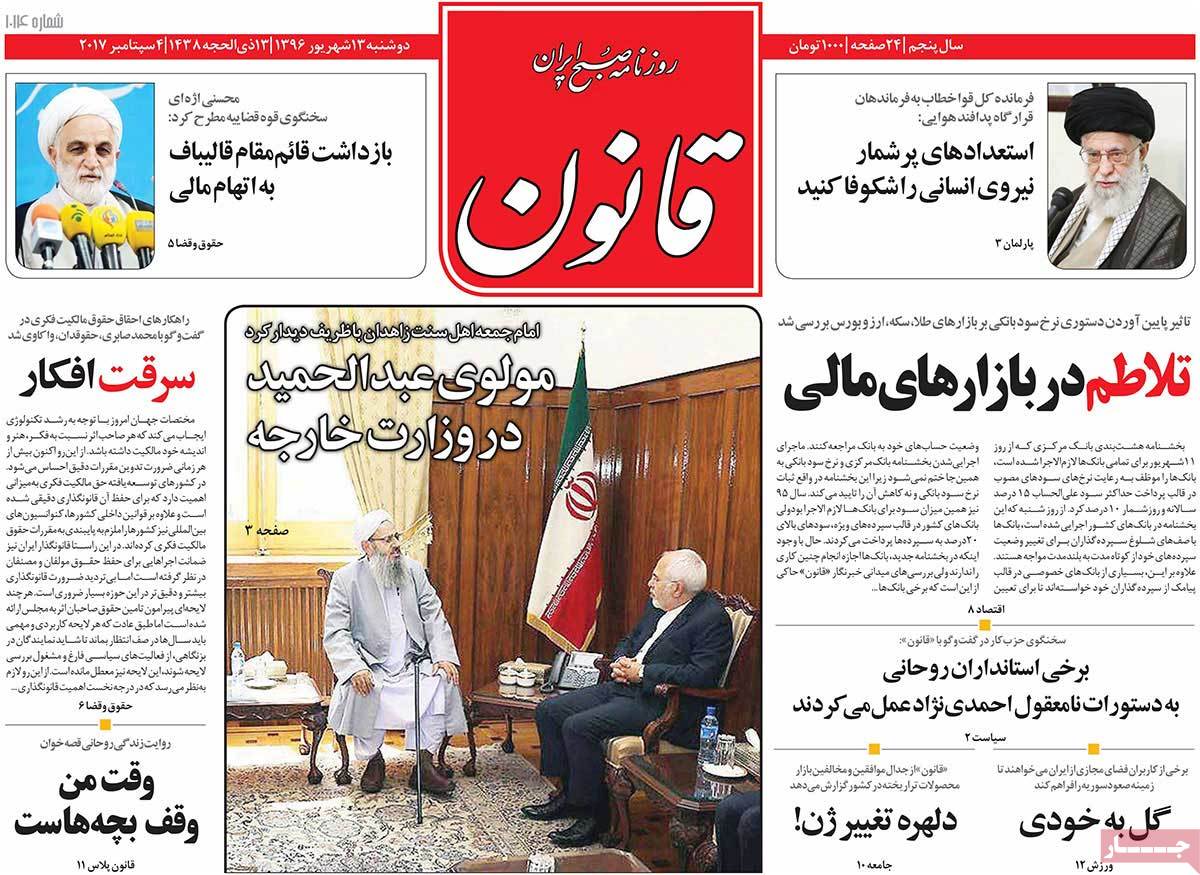
Ghanoon:

1- Iran’s Top Sunni Cleric Meets with FM Zarif at Foreign Ministry

A Look at Iranian Newspaper Front Pages on September 4


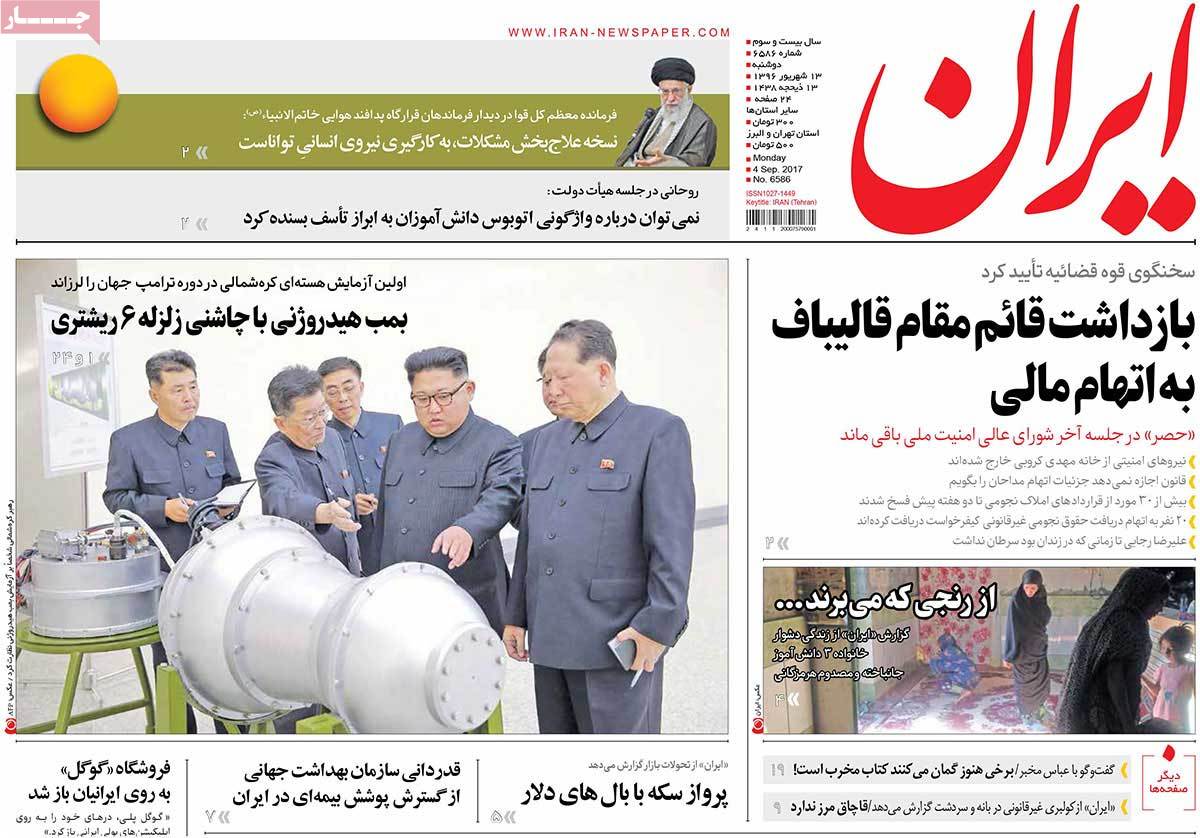
Iran:

1- Hydrogen Bomb Causes 6-Magnitude Earthquake

2- WHO Praises Expansion of Insurance Coverage in Iran

3- Google’s Play Store Open to Iranian Users

A Look at Iranian Newspaper Front Pages on September 4


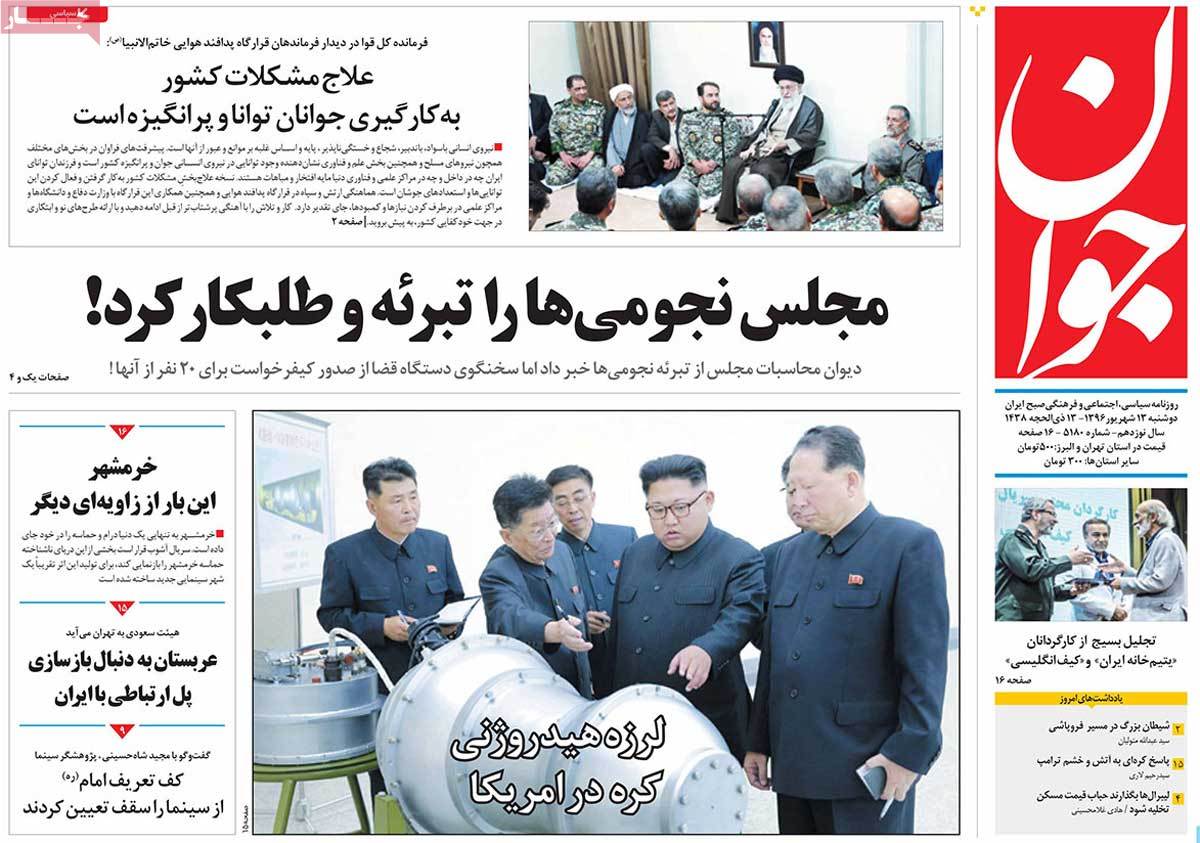
Javan:

1- Hydrogen Leads to Earthquake in US

A Look at Iranian Newspaper Front Pages on September 4


Jomhouri Eslami:

1- Moscow Protests against FBI’s Inspection of Russia’s Diplomatic Sites in US

A Look at Iranian Newspaper Front Pages on September 4


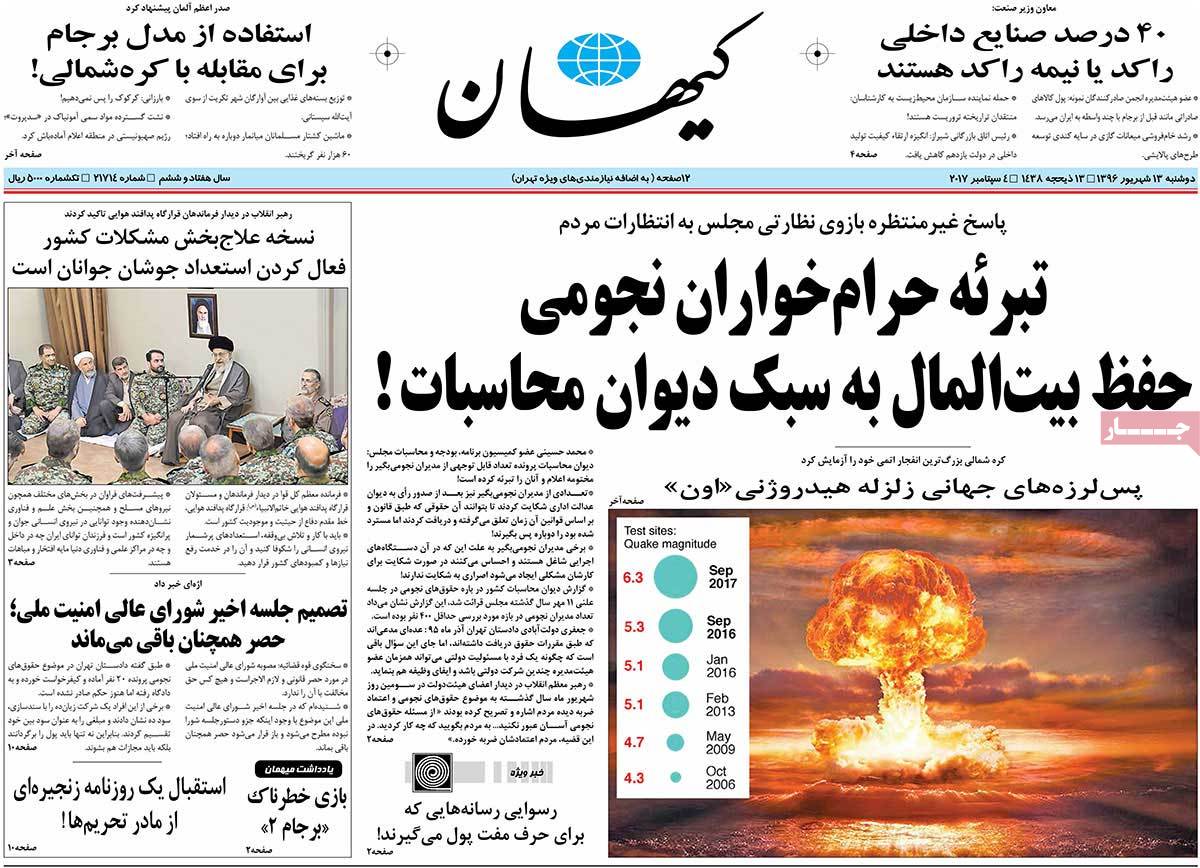
Kayhan:

1- German Chancellor Says JCPOA Can Be Used as Role Model to Counter N. Korea!

A Look at Iranian Newspaper Front Pages on September 4


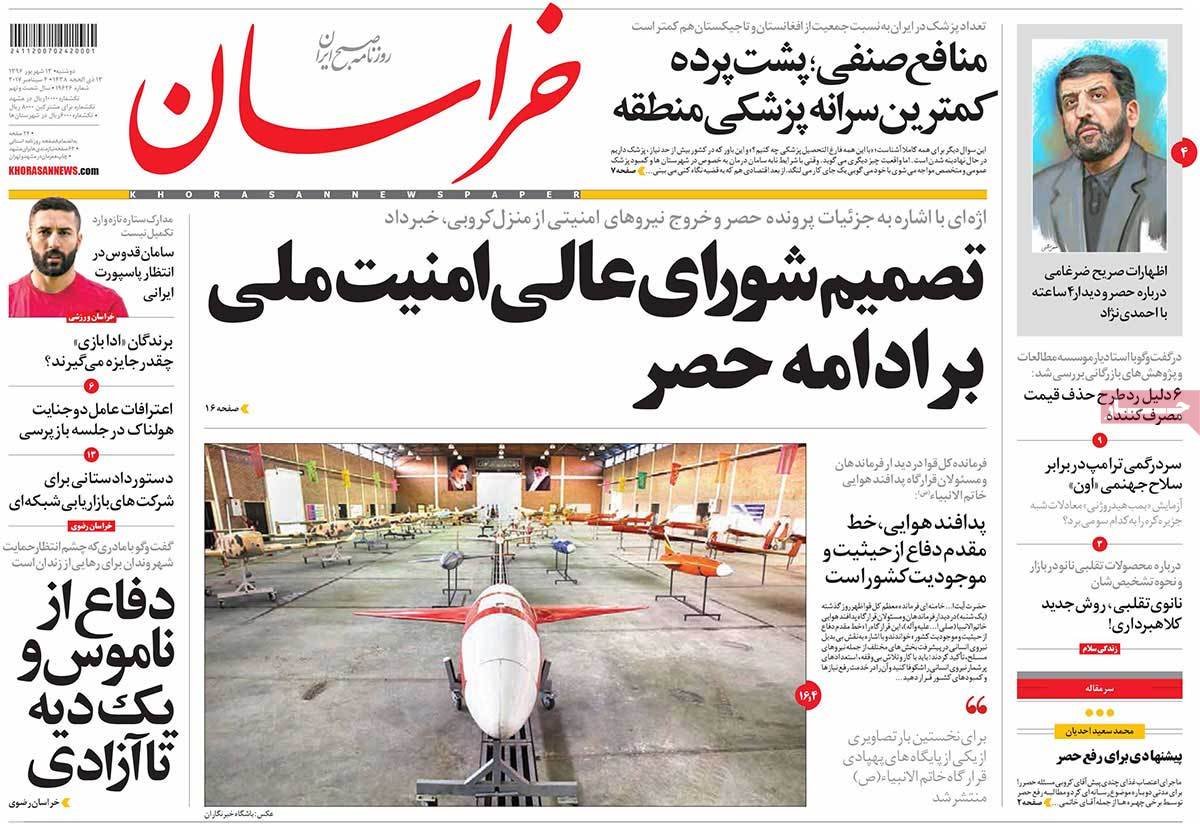
Khorasan:

1- Trump Confused by North Korean Leader’s Lethal Weapon

2- Pictures of Iran’s Drone Base Released for First Time

A Look at Iranian Newspaper Front Pages on September 4


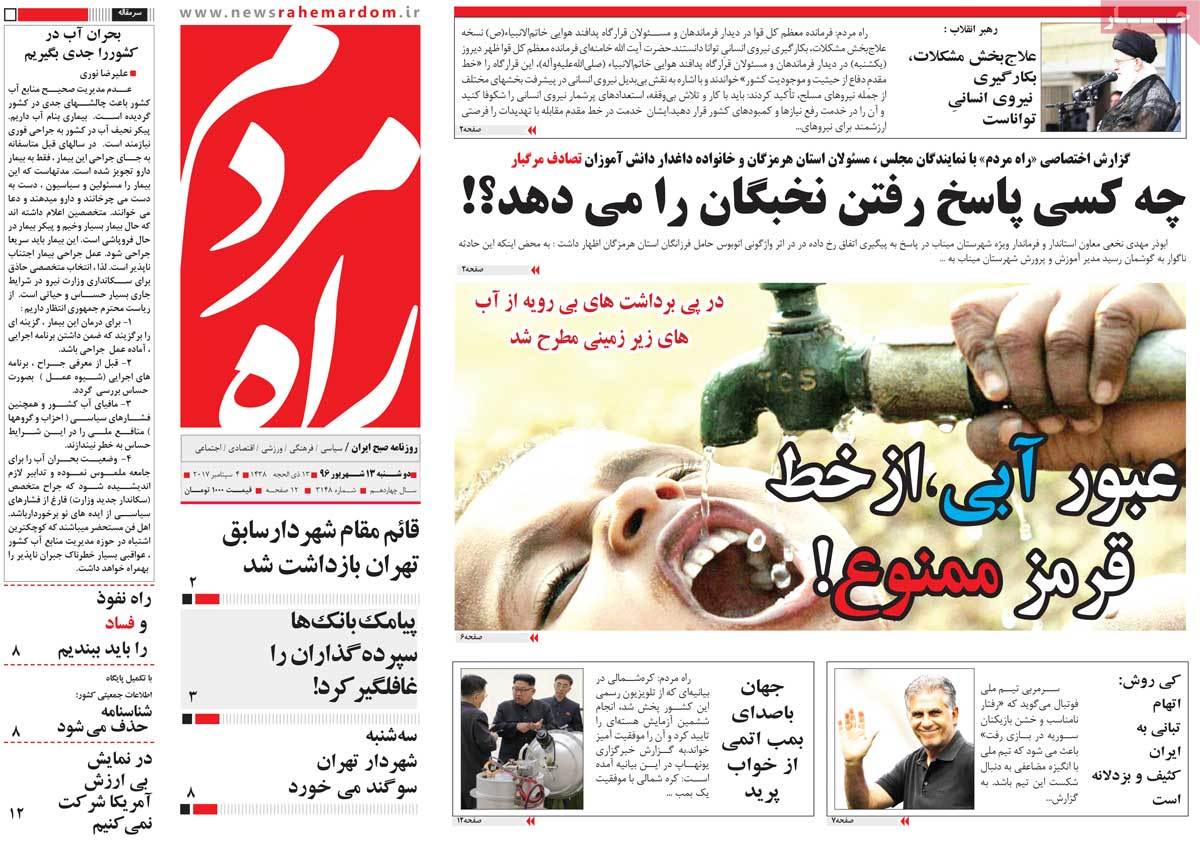
Rah-e Mardom:

1- Queiroz: Accusations of Iran’s Match Fixing (with Syria) Dirty, Cowardly

A Look at Iranian Newspaper Front Pages on September 4


Resalat:

1- Iran Ready to Pull Trigger, Won’t Appease Enemies: General

2- Judiciary Spokesman: 20 Executives Who Received Astronomical Salaries to Be Tried

A Look at Iranian Newspaper Front Pages on September 4


Seda-ye Eslahat:

1- 4,000 Child Labourers, Those Deprived of Education to Go to School Next Month

A Look at Iranian Newspaper Front Pages on September 4


Shargh:

1- Judiciary Spokesman: Security Forces Out of Opposition Figure Karroubi’s House

A Look at Iranian Newspaper Front Pages on September 4


Vaghaye Ettefaghieh:

1- A Look at Trouble-Making in Media, Its Impact on Nuclear Deal

  • Translation Mistakes, Blade on Throat of JCPOA

A Look at Iranian Newspaper Front Pages on September 4


Vatan-e Emrooz:

1- No Talks of Paying Compensation to Saudis: Iran Spokesman

A Look at Iranian Newspaper Front Pages on September 4


Iraqi PM Praises Tehran’s Support for Baghdad in Anti-Terror Fight

In a meeting with Chairman of Iran’s Expediency Council Ayatollah Mahmoud Hashemi Shahroudi in Baghdad on Sunday, Abadi thanked Iran for its unwavering support for the Iraqi government and nation in the fight against terrorism, Iraq’s al-Sumaria news website reported.

He added that the Iraqi government would continue its victories against Takfiri terrorists thanks to the unity among the Iraqi people that has played a major role in helping the country’s military forces defeat Daesh (ISIL or ISIS) militants.

Ayatollah Hashemi Shahroudi, for his part, praised Iraq for its victories against terrorism, saying, “Successive victories (by the Iraqi forces against Daesh) under the command of the prime minister as well as the unity of the Iraqi nation have astounded the world” and made enemies hopeless.

The senior Iranian cleric also reiterated the Islamic Republic’s support for Iraq in its battle against terrorists in a bid to help restore peace and security to the Arab nation.

In recent weeks, Iraq’s military forces have made significant progress in their fight against Daesh terrorists by liberating the northern city of Tal Afar.

The Daesh militants made swift advances in northern and western Iraq in summer 2014, after capturing territories in Syria.

However, a combination of concentrated attacks by the Iraqi military and the popular forces, who rushed to take arms after top Iraqi cleric Ayatollah Ali al-Sistani issued a fatwa calling for fight against the militants, blunted the edge of Daesh offensive and later forced the Takfiri terrorists out of much of the territory they had occupied.

Match Fixing in Iran-Syria FIFA World Cup Qualifier Not Probable: Report

Ahead of the Tuesday’s FIFA World Cup Asian qualifier in Group A between Iran and Syria, rumours of a game-fixing plot by the two teams are rife.

According to a Farsi report by the Jame Jam Online news website, close political relations between Iran and Syria and the fact that they are both Muslim states have fueled such rumours.

With 21 points from their previous nine matches, Iran sits on top of Group A’s table and have already qualified for the next year’s extravaganza in Russia.

Syria, on the other hand, have notched up 12 points from their earlier fixtures and only needs a win at Azadi Stadium in the Iranian capital of Tehran to keep alive their hopes of guaranteeing at least a play-off berth or, if luckier, securing a place at the next year’s World Cup.

Syria sits two points behind the second-placed Korea Republic and above the fourth-placed Uzbekistan on goal difference. The Koreans and the Uzbeks will be facing off in Tashkent in a simultaneous kick-off. This means that a win could even see Syrians claim second spot and a historic first-ever FIFA World Cup appearance.

A couple of days before the match between Iran and Syria, Germany’s shz.de news website has dismissed the likelihood that the match is going to be a fixed game, writing that despite the rumours of a probable match fixing conspiracy by the two squads, Iran’s head coach Carlos Queiroz has categorically denied such gossips, promising that his side will take on Syria with all their might and at full capacity.

In addition, after a goalless draw in the first leg of the match between the two teams in Malaysia in November 2016, Iran is highly motivated to defeat Syria in Tehran.

Meanwhile, the Iranian squad has not conceded even a single goal in their previous nine matches, setting a great world record. This is another factor guaranteeing that they have high motivation for bettering their record by putting in a convincing performance in Tehran.

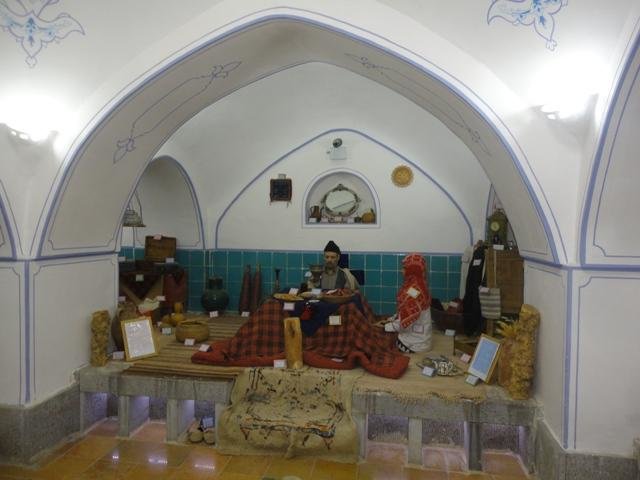
Old Bathhouse in Central Iran Turned into Anthropology Museum

Old Bathhouse in Central Iran Turned into Anthropology Museum

Since the very beginning, bathhouses were among the highly important urban spaces and structures. Following mosques and schools, they were almost the most important urban buildings, particularly in Iran.

According to a Farsi report by IMNA, in the past, a number of factors were taken into consideration when constructing different sections of a bathhouse and designing its spaces.

They included providing easy access to different parts of the bathhouse; making it possible to regulate the temperature of the building’s interior spaces; controling the humidity; and sending the wastewater produced in the building out through channels. It was also important to build bathhouses within an urban texture.

‘Meymeh Gordeh Bathhouse’ in Meymeh county in Isfahan Province, central Iran, is one of these old buildings which has dome-like roofs and tall pillars. Lime and brick are the two main materials used in the construction of the bathhouse. ‘Gordeh’ means big in local dialect.

Located in front of Meymeh’s main mosque, known as ‘Jame Mosque’, the bathhouse was converted into an anthropology museum by the Cultural Heritage, Handicrafts and Tourism Organization of Isfahan Province in 2007. The aim of the move has been to showcase the regional people’s indigenous culture, customs, traditions; as well as professions and occupations in the past.

Meymeh’s bathhouse has been constructed in an area spanning 500 square meters.

A total of 600 antique items and historical objects are kept at the museum that help put on display the native people’s life 400 years ago.

France Using Iranian Saffron to Produce Herbal Medicines

Iranian lawmaker, Farhad Falahati, has said processing saffron into value-added products is the missing link in raising the productivity of the red gold in Iran.

According to Farsi report by Health News Agency (TEBNA), he said in France saffron is being processed into herbal medicines and drugs, such as antidepressants, to create value-added products from the flower.

Commenting on the status quo of saffron production in Iran, Falahati said, “When we export the red gold to target markets without packaging and processing it in advance, obviously, the crop will be sent back to the country’s market in the form of value-added products, such as cosmetics. Such trade transactions are solely in the interest of the country that possesses developed processing industries.”

He added when it comes to processing saffron, Iranian producers have only spouted hollow slogans.

“We hold saffron festivals while such events fail to have any significant and favourable impact on developing the country’s saffron processing industries.”

No One to Blame

Falahati said no particular Iranian administration is to blame for the failure to approve a comprehensive national plan for processing saffron.

He regretted the fact that none of the Iranian governments have delivered a remarkable performance to this end.

“This comes as a fundamental transformation could be achieved in the field of cultivating saffron in Iran by approving such a plan.”

He stressed that Iran is required to replace traditional saffron production methods with modern ones to prevent the possibility of lagging behind a country such as Afghanistan, which has begun making investments in the field of cultivating the crop using scientific methods, in exporting the product to international markets in the future.

Iran has failed to register the brand of its saffron globally, the MP said, adding two main priorities in preserving and protecting Iran’s saffron are ensuring genetic protection for the bulbs of the saffron indigenous to the Islamic Republic and registering the brand of the Iranian saffron globally.

He noted that Afghanistan has managed to produce saffron bulbs in its greenhouses using modern irrigation systems and, thus, significantly increase the production level of the crop in the country.

Iran, South Africa Call for Expansion of Banking Ties

During the Sunday talks, Iranian Foreign Minister Mohammad Javad Zarif described South Africa as a friendly nation which came to Iran’s aid  in tough times, especially when Iran was under sanctions.

Zarif also called for promotion of mutual cooperation between Tehran and Pretoria on all fronts, especially in the banking field.

“Iran can be a good and reliable partner for South Africa in the region,” said the top Iranian diplomat.

For her part, Speaker of South Africa’s National Assembly Baleka Mbete welcomed efforts to further boost bilateral relations, especially in the banking sector.

She also said great potential exists in both countries for mutual cooperation, stressing the need to tap into that potential.

Holding a meeting of the Iran-South Africa Joint Cooperation Commission, an upcoming trip to South Africa by Iranian President Hassan Rouhani, the Iran nuclear deal, and regional developments, especially the issue of Palestine, were among other issues discussed by Zarif and Mbete.

US Siege on Civilians Aimed at Undermining Lebanon Victory: Iran

“The US siege on women and children is an illogical move given a history of cooperation between Washington and ISIS,” Foreign Ministry Spokesman Bahram Qassemi said in a Sunday statement.

“We believe this is an effort to negatively affect the victory of the Lebanese government and Resistance movement,” he said.

“The aerial siege against women and children in civilian buses and the killing of several pregnant women over the past two days could turn into a humanitarian disaster if continued,” Qassemi noted, warning that it could further fuel violence across the region.

He also welcomed and expressed support for humanitarian efforts made by the Lebanese resistance movement and Lebanon’s government to save innocent civilians, which turned Lebanon’s military triumph into an even bigger victory.

“Thanks to the resistance shown by the governments, armies, and resistance forces of Iraq, Syria, and Lebanon and by virtue of the cooperation and support of Iran and Russia, the ISIS terrorist group is on the verge of complete annihilation, and the campaign to fully eradicate terrorism in Syria and Iraq is going on with a vengeance,” he noted.

Therefore, Qassemi added, imposing a blockade on a number of women and children in a desert has no military value and will not diminish the power of ISIS; rather, it will stoke violence in the region.

“Fighting armed ISIS militants is different from killing ordinary and innocent people,” he added.

“Iran, as a country which is at the forefront of the campaign against terrorism, especially ISIS, is asking the UN to intervene and prevent the killing of innocent people,” Qassemi noted.

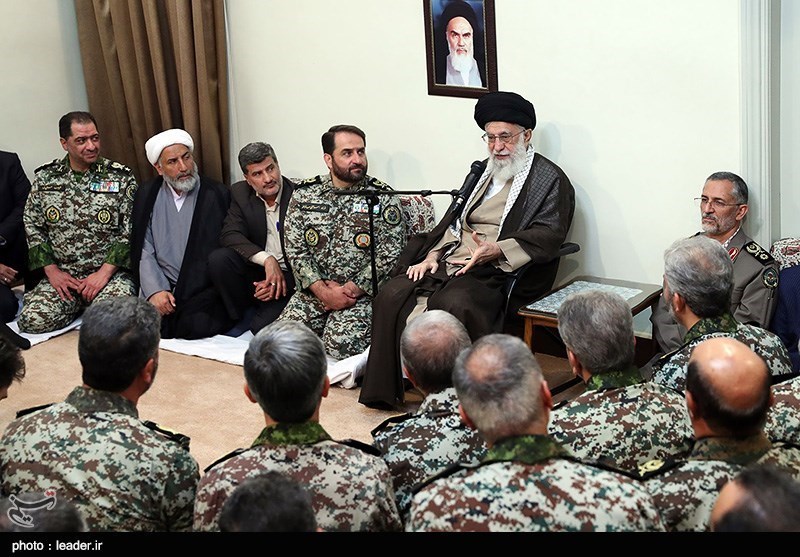
Leader Underlines Key Role of Air Defence in Iran’s Security

The Iranian Air Defense is at the forefront of protection of Iran’s dignity and existence, Ayatollah Khamenei said in a meeting with the Air Defense commanders and officials in Tehran on Sunday.

The Leader also admired the “very good jobs” that the Khatam al-Anbia Air Defense Base has done, describing them as a testimony to the “determination, motivation and capabilities” of local forces.

The key to removing the obstacles is the existence of “educated, prudent, courageous and tireless human resources” in the country, Imam Khamenei added, calling on the Air Defense to accelerate efforts and develop “new and innovative plans” to make Iran self-sufficient.

Leader Underlines Key Role of Air Defence in Iran's Security

Ayatollah Khamenei also praised the close coordination between the Army and the Islamic Revolution Guards Corps (IRGC) in the Air Defense Base, and hailed the Air Defense’s cooperation with the Defense Ministry and the country’s universities and scientific centers in order to remedy any deficiencies.

In comments on Saturday, Chief of Staff of the Iranian Armed Forces Major General Mohammad Hossein Baqeri described plans to boost the country’s air defense capabilities as the number one priority, saying the significant progress in that sphere has turned Iran’s airspace into one of the safest in the turbulent Middle East region.

Last week, Iran’s Air Defense unveiled four homegrown systems for civil and military applications.

The four systems, dubbed Sama, Samee’, Baseer, and Samet-1, are used for detecting aerial targets, controlling air traffic, and transferring data.

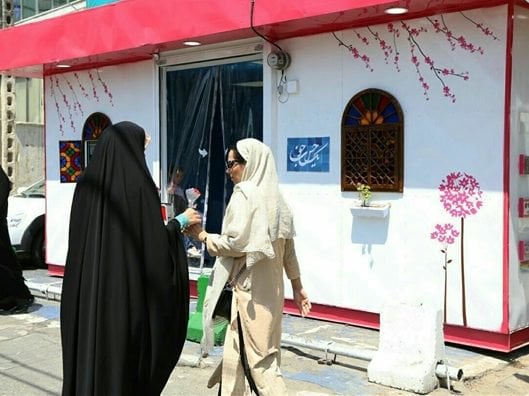
‘A Good Feeling’ Campaign, Different Way to Promote Hijab in Tehran

A number of nicely decorated pavilions called “A Good Feeling” are seen in some of the neighbourhoods in the Iranian capital, Tehran, in which women who have recently become Muslims or made a change in their lifestyles promote the culture wearing hijab in a new different way.

According to a Farsi report by the Young Journalists Club (YJC), the women in these portable cabins help other ladies who go to their pavilions to experience correct hijab and understand why it is necessary in Islam.

They also answer their visitors’ religious questions and help resolve their uncertainties about religious matters.

Visitors to the cabins are presented with gifts such as flowers, scrolls, brochures containing information about religious issues and children’s books.