Sunday, December 28, 2025
Home Blog Page 3899

Match Fixing in Iran-Syria FIFA World Cup Qualifier Not Probable: Report

Ahead of the Tuesday’s FIFA World Cup Asian qualifier in Group A between Iran and Syria, rumours of a game-fixing plot by the two teams are rife.

According to a Farsi report by the Jame Jam Online news website, close political relations between Iran and Syria and the fact that they are both Muslim states have fueled such rumours.

With 21 points from their previous nine matches, Iran sits on top of Group A’s table and have already qualified for the next year’s extravaganza in Russia.

Syria, on the other hand, have notched up 12 points from their earlier fixtures and only needs a win at Azadi Stadium in the Iranian capital of Tehran to keep alive their hopes of guaranteeing at least a play-off berth or, if luckier, securing a place at the next year’s World Cup.

Syria sits two points behind the second-placed Korea Republic and above the fourth-placed Uzbekistan on goal difference. The Koreans and the Uzbeks will be facing off in Tashkent in a simultaneous kick-off. This means that a win could even see Syrians claim second spot and a historic first-ever FIFA World Cup appearance.

A couple of days before the match between Iran and Syria, Germany’s shz.de news website has dismissed the likelihood that the match is going to be a fixed game, writing that despite the rumours of a probable match fixing conspiracy by the two squads, Iran’s head coach Carlos Queiroz has categorically denied such gossips, promising that his side will take on Syria with all their might and at full capacity.

In addition, after a goalless draw in the first leg of the match between the two teams in Malaysia in November 2016, Iran is highly motivated to defeat Syria in Tehran.

Meanwhile, the Iranian squad has not conceded even a single goal in their previous nine matches, setting a great world record. This is another factor guaranteeing that they have high motivation for bettering their record by putting in a convincing performance in Tehran.
Old Bathhouse in Central Iran Turned into Anthropology Museum

Old Bathhouse in Central Iran Turned into Anthropology Museum

Since the very beginning, bathhouses were among the highly important urban spaces and structures. Following mosques and schools, they were almost the most important urban buildings, particularly in Iran.

According to a Farsi report by IMNA, in the past, a number of factors were taken into consideration when constructing different sections of a bathhouse and designing its spaces.

They included providing easy access to different parts of the bathhouse; making it possible to regulate the temperature of the building’s interior spaces; controling the humidity; and sending the wastewater produced in the building out through channels. It was also important to build bathhouses within an urban texture.

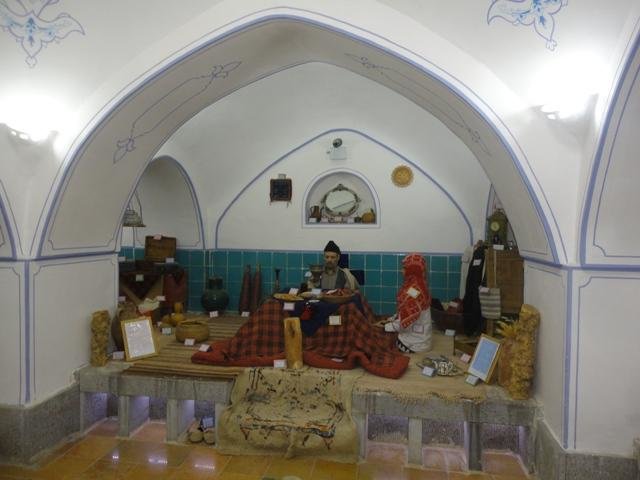
‘Meymeh Gordeh Bathhouse’ in Meymeh county in Isfahan Province, central Iran, is one of these old buildings which has dome-like roofs and tall pillars. Lime and brick are the two main materials used in the construction of the bathhouse. ‘Gordeh’ means big in local dialect.

Located in front of Meymeh’s main mosque, known as ‘Jame Mosque’, the bathhouse was converted into an anthropology museum by the Cultural Heritage, Handicrafts and Tourism Organization of Isfahan Province in 2007. The aim of the move has been to showcase the regional people’s indigenous culture, customs, traditions; as well as professions and occupations in the past.

Meymeh’s bathhouse has been constructed in an area spanning 500 square meters.

A total of 600 antique items and historical objects are kept at the museum that help put on display the native people’s life 400 years ago.

France Using Iranian Saffron to Produce Herbal Medicines

Iranian lawmaker, Farhad Falahati, has said processing saffron into value-added products is the missing link in raising the productivity of the red gold in Iran.

According to Farsi report by Health News Agency (TEBNA), he said in France saffron is being processed into herbal medicines and drugs, such as antidepressants, to create value-added products from the flower.

Commenting on the status quo of saffron production in Iran, Falahati said, “When we export the red gold to target markets without packaging and processing it in advance, obviously, the crop will be sent back to the country’s market in the form of value-added products, such as cosmetics. Such trade transactions are solely in the interest of the country that possesses developed processing industries.”

He added when it comes to processing saffron, Iranian producers have only spouted hollow slogans.

“We hold saffron festivals while such events fail to have any significant and favourable impact on developing the country’s saffron processing industries.”

No One to Blame

Falahati said no particular Iranian administration is to blame for the failure to approve a comprehensive national plan for processing saffron.

He regretted the fact that none of the Iranian governments have delivered a remarkable performance to this end.

“This comes as a fundamental transformation could be achieved in the field of cultivating saffron in Iran by approving such a plan.”

He stressed that Iran is required to replace traditional saffron production methods with modern ones to prevent the possibility of lagging behind a country such as Afghanistan, which has begun making investments in the field of cultivating the crop using scientific methods, in exporting the product to international markets in the future.

Iran has failed to register the brand of its saffron globally, the MP said, adding two main priorities in preserving and protecting Iran’s saffron are ensuring genetic protection for the bulbs of the saffron indigenous to the Islamic Republic and registering the brand of the Iranian saffron globally.

He noted that Afghanistan has managed to produce saffron bulbs in its greenhouses using modern irrigation systems and, thus, significantly increase the production level of the crop in the country.

Iran, South Africa Call for Expansion of Banking Ties

During the Sunday talks, Iranian Foreign Minister Mohammad Javad Zarif described South Africa as a friendly nation which came to Iran’s aid  in tough times, especially when Iran was under sanctions.

Zarif also called for promotion of mutual cooperation between Tehran and Pretoria on all fronts, especially in the banking field.

“Iran can be a good and reliable partner for South Africa in the region,” said the top Iranian diplomat.

For her part, Speaker of South Africa’s National Assembly Baleka Mbete welcomed efforts to further boost bilateral relations, especially in the banking sector.

She also said great potential exists in both countries for mutual cooperation, stressing the need to tap into that potential.

Holding a meeting of the Iran-South Africa Joint Cooperation Commission, an upcoming trip to South Africa by Iranian President Hassan Rouhani, the Iran nuclear deal, and regional developments, especially the issue of Palestine, were among other issues discussed by Zarif and Mbete.

US Siege on Civilians Aimed at Undermining Lebanon Victory: Iran

“The US siege on women and children is an illogical move given a history of cooperation between Washington and ISIS,” Foreign Ministry Spokesman Bahram Qassemi said in a Sunday statement.

“We believe this is an effort to negatively affect the victory of the Lebanese government and Resistance movement,” he said.

“The aerial siege against women and children in civilian buses and the killing of several pregnant women over the past two days could turn into a humanitarian disaster if continued,” Qassemi noted, warning that it could further fuel violence across the region.

He also welcomed and expressed support for humanitarian efforts made by the Lebanese resistance movement and Lebanon’s government to save innocent civilians, which turned Lebanon’s military triumph into an even bigger victory.

“Thanks to the resistance shown by the governments, armies, and resistance forces of Iraq, Syria, and Lebanon and by virtue of the cooperation and support of Iran and Russia, the ISIS terrorist group is on the verge of complete annihilation, and the campaign to fully eradicate terrorism in Syria and Iraq is going on with a vengeance,” he noted.

Therefore, Qassemi added, imposing a blockade on a number of women and children in a desert has no military value and will not diminish the power of ISIS; rather, it will stoke violence in the region.

“Fighting armed ISIS militants is different from killing ordinary and innocent people,” he added.

“Iran, as a country which is at the forefront of the campaign against terrorism, especially ISIS, is asking the UN to intervene and prevent the killing of innocent people,” Qassemi noted.

Leader Underlines Key Role of Air Defence in Iran’s Security

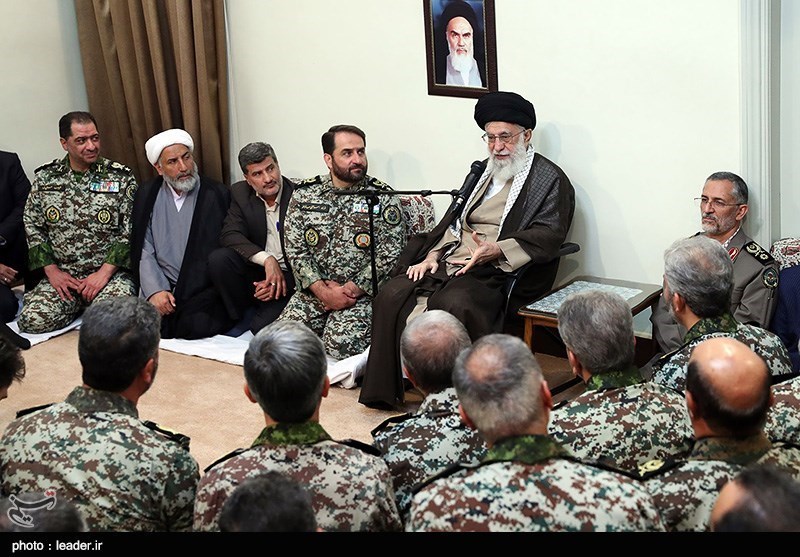
The Iranian Air Defense is at the forefront of protection of Iran’s dignity and existence, Ayatollah Khamenei said in a meeting with the Air Defense commanders and officials in Tehran on Sunday.

The Leader also admired the “very good jobs” that the Khatam al-Anbia Air Defense Base has done, describing them as a testimony to the “determination, motivation and capabilities” of local forces.

The key to removing the obstacles is the existence of “educated, prudent, courageous and tireless human resources” in the country, Imam Khamenei added, calling on the Air Defense to accelerate efforts and develop “new and innovative plans” to make Iran self-sufficient.

Leader Underlines Key Role of Air Defence in Iran's Security

Ayatollah Khamenei also praised the close coordination between the Army and the Islamic Revolution Guards Corps (IRGC) in the Air Defense Base, and hailed the Air Defense’s cooperation with the Defense Ministry and the country’s universities and scientific centers in order to remedy any deficiencies.

In comments on Saturday, Chief of Staff of the Iranian Armed Forces Major General Mohammad Hossein Baqeri described plans to boost the country’s air defense capabilities as the number one priority, saying the significant progress in that sphere has turned Iran’s airspace into one of the safest in the turbulent Middle East region.

Last week, Iran’s Air Defense unveiled four homegrown systems for civil and military applications.

The four systems, dubbed Sama, Samee’, Baseer, and Samet-1, are used for detecting aerial targets, controlling air traffic, and transferring data.

‘A Good Feeling’ Campaign, Different Way to Promote Hijab in Tehran

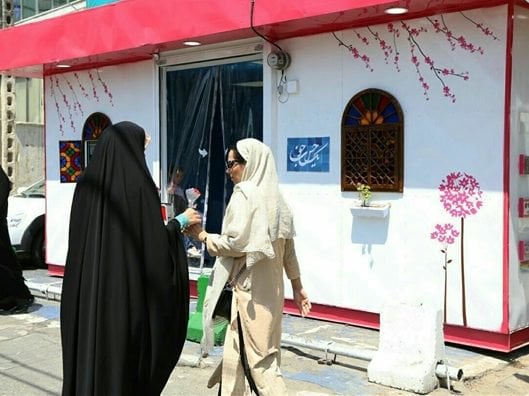
A number of nicely decorated pavilions called “A Good Feeling” are seen in some of the neighbourhoods in the Iranian capital, Tehran, in which women who have recently become Muslims or made a change in their lifestyles promote the culture wearing hijab in a new different way.

According to a Farsi report by the Young Journalists Club (YJC), the women in these portable cabins help other ladies who go to their pavilions to experience correct hijab and understand why it is necessary in Islam.

They also answer their visitors’ religious questions and help resolve their uncertainties about religious matters.

Visitors to the cabins are presented with gifts such as flowers, scrolls, brochures containing information about religious issues and children’s books.

Iran Not to Allow Others to Interfere in Its Defence Affairs

“The Trump administration’s hullabaloo about controlling or visiting the Islamic Republic of Iran’s military centers is worth nothing,” Brigadier General Massoud Jazayeri said on Sunday.

He also stressed that the US insistence on inspection of Iran’s military bases is both in contradiction to the terms of the Joint Comprehensive Plan of Action (JCPOA) and lacking in credibility when taking into account the country’s national security.

In August, US President Donald Trump dispatched his UN ambassador Nikki Haley to Vienna to press the UN nuclear chief on their reading of Iran’s compliance with the JCPOA, the nuclear agreement between Iran and the Group 5+1 (Russia, China, the US, Britain, France and Germany).

Thereafter, Iran’s mission to the IAEA issued a statement, saying the objectives and the results of Haley’s trip to Vienna “contradict” the JCPOA and Resolution 2231, which the UN Security Council adopted to endorse the nuclear agreement.

Iranians Are Saudi Arabia’s Brothers in Islam: Mecca Governor

In a press conference, the Emir of Mecca Khalid al-Faisal noted that “Iranians are our religious brothers and we warmly welcomed their entry to this holy land.”

He went on saying that the Iranian pilgrims did not face any serious problems during the Hajj season and performed their rituals easily and smoothly.

“I hope they would remember us in future with good impression and they would do the same with us,” he added.

Iranian pilgrims arrived in the holy city of Mecca to perform Hajj rituals this year after their last year’s absence. Iran boycotted Hajj after two tragic incidents in 2015 which left nearly 470 Iranian pilgrims dead.

Serious questions were raised about the competence of Saudi authorities in managing the Hajj rituals in the wake of the incidents.

The Islamic Republic had stressed that it would not resume the pilgrimage until its conditions are met. Giving guarantee for a safe and honourable pilgrimage was among the main conditions set by Iran which was accepted by Saudi Arabia.

Saudi Arabia also unilaterally severed its diplomatic ties with Iran in January 2016 after attacks on its diplomatic premises in Tehran and Mashhad by a group of protesters outraged by Riyadh’s execution of eminent Saudi Shiite cleric Sheikh Nimr al-Nimr.

Saudi Delegation to Visit Iran after Hajj Season: Spokesman

Foreign Ministry Spokesman Bahram Qassemi said the Saudi delegation’s visit to Iran is only aimed at visiting their diplomatic sites because they have remained empty since Saudi Arabian diplomats left Iran.

In an interview with IRNA, he noted that an Iranian delegation is also set to arrive in Saudi Arabia in future to visit Iran’s diplomatic mission in the Arab country.

According to Qassemi, the visits will be made as part of a bilateral agreement between Tehran and Riyadh.

“The Saudi delegation’s visas were issued a long time ago but they have yet to visit the Islamic Republic for any reason. Their visit has been probably postponed to a date after the Hajj season,” he added.

The spokesman also dismissed as baseless certain media reports on Riyadh’s decision to receive compensation for the damages made on its diplomatic mission in Iran and said so far, no demand has been raised by the Saudi side in this regard.

Tensions between Iran and Saudi Arabia escalated after Riyadh’s execution of a Shiite cleric in 2016. The move triggered angry protests in many countries, including Iran.

Outraged protesters in Iran attacked the Saudi embassy in Tehran and its consulate in Mashhad. Following the attacks, Riyadh cut its diplomatic ties with the Islamic Republic.

Saudi Delegation to Visit Iran after Hajj Season: Spokesman


Ties began to deteriorate following a human crush in Mina, near the Saudi holy city of Mecca, in September 2015, which killed thousands of pilgrims, including hundreds of Iranians. The incident cast doubt on the kingdom’s efficiency in hosting the rituals.

Iran is still pressing Saudi Arabia to clarify the circumstances of the incident and a separate crane crash earlier that month in which another number of Iranian pilgrims were killed.

Tensions between the two countries eased considerably recently during preparations for the pilgrimage this year when Iranian Hajj officials and diplomats met with Saudi officials to discuss arrangements for Iranian pilgrims.

According to Kuwaiti newspaper Al Jarida, the Iranian delegation is expected to visit Saudi Arabia following the mission by the Saudi assessment team amid hopes that the exchange of visits would mark the start of a new chapter in the relations between the two countries, particularly as bilateral contacts would be open and direct instead of via third parties.