Sunday, December 28, 2025
Home Blog Page 3898

Why Is Israel Worried about ISIS Defeats in Region?

Israeli officials are closely monitoring the latest developments in the region particularly the Syrian army and its regional allies’ recent victories over ISIS as well the advancements of the Lebanese army and Hezbollah in fight against al-Nusra Front.

According to a report by the Basirat news website, that is why they are now desperately trying to say that the recent developments have ended up in Iran’s interest and the country is seeking to increase its influence in Syria.

Therefore, even the recent visit of Israeli Prime Minister Benjamin Netanyahu to Moscow can be analyzed from this perspective; a visit which was not warmly welcomed by the Russians, especially Russian President Vladimir Putin.

And now the current aggressive stances of Israeli officials, including the Israeli military intelligence, completely reveal how worried they are about the defeats of the terrorist groups in Syria and the collapse of Tel Aviv’s plans in the region.

In a report, Israel’s Intelligence service has emphasized that the current strategic changes in the region means that Tehran-Beirut route passing through Baghdad and Damascus has become smooth for Iran as well as its allies and resistance groups.

In another word, the current development has created a huge challenge for the Zionists. Tackling the challenge is not possible for Israel without the US’ support. And during his visit to Russia, Netanyahu was seeking to convince Russian officials to keep Iran away from the occupied lands’ borders. This is exactly what he expects the US to take seriously.

As a researcher at a Herzliya-based centre has put it, Tel Aviv had adjusted its policy towards Syria based on the prediction that Syrian President Bashar al-Assad could not leave behind the current crisis and at the end he would fall and this in turn would undermine the axis of Iran-Hezbollah.

However, this prediction failed and today we see that Assad is more than ever hopeful to remain in power because he enjoys the full support of its regional allies in Iran and Lebanon. Meanwhile, some European countries have changed their policies towards the crisis out of fear of the threats of the terrorist groups like ISIS and Al-Nusra Front.

The final point is that the Zionists’ current stances towards Iran are the continuation of their old stances over the past years. But such statements against Iran by the Zionist regime amid the current developments in the region, particularly the Syria crisis, reveal that the Zionists are desperately trying to resort to any means to achieve their goals, even by giving concessions. Meanwhile, the predictions of the Zionists about the battles in Syria have ended up in failure and today they are trying to postpone any direct conflict with the resistance axis for as long as possible.
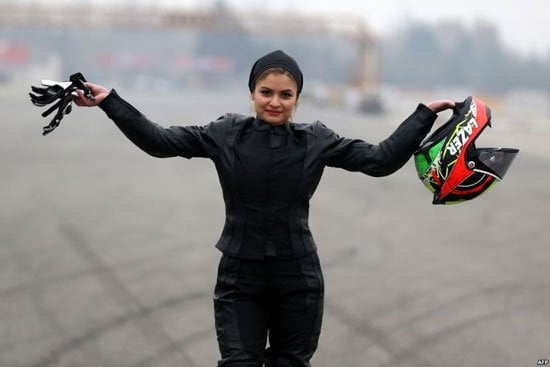

Female Iranian Motocross Racer Wants to Be World Champion

Shafiei works hard to encourage other women interested in motorcycling and she is proud of it. She has held a free class for 114 Iranian women interested in racing, and now nearly 20 of her students are working as semi-professional riders.

Here is the full text of the Shargh daily newspaper’s Farsi interview with this daring Iranian girl:

Q: You have been a fan of motorcycling since childhood. What makes a teenage girl pursue a strange career like racing?

A: Maybe a sense of obstinacy. I could not accept that someone could do something and I cannot. I started riding in 2004. I first rode on the streets; but I liked racing. Many people asked me if I can take part in motocross adventures. I was asking myself why not I should experience cross-country motorcycling. This prompted me to enter motocross riding.

Female Iranian Motocross Racer Wants to Be World ChampionQ: Can you tell me when you got famous?
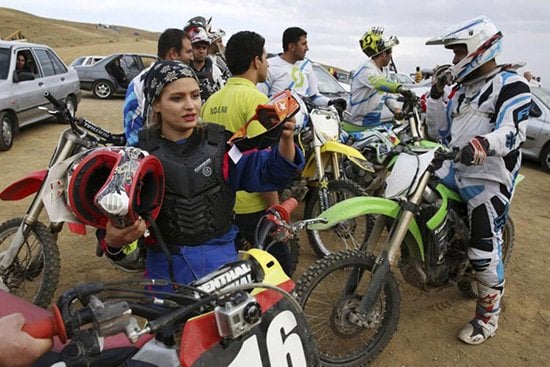
A: It was in 2015. At that time several major news agencies, including the Associated Press, filed a number of different reports about me. That’s because I was the first female motorcyclist who could get a license to enter the Azadi Stadium track. There, alongside some men, I went through a professional course in three days. After that, many people became aware of my activities in racing and I was introduced as a forerunner in women’s motorcycling.

At that time, I became the one who moves in the opposite direction; a person who had achieved some accomplishments in the field of women’s sports that nobody had access to.

Q: You said you did not want to surrender, and your goal was to get women into the world of motorcycling. Did you succeed?

A: You see, I always wanted to open a motorsport school for women. On the other hand, I wanted to break the barrier of women’s entry into Azadi Stadium track, which, at the end, I succeeded with the many follow-ups I did. The next barrier that had to be broken was the lack of racing events for women. This was eventually accomplished after my several follow-ups, and in 2016 the permit to hold such competitions was issued by the Ministry of Sports.

Of course, the media and their advertisement played a very important role and finally, motor racing became an official sport for women. I myself held the first motorcycling tournament, and became the first female racing champion in Iran. In this way, I have been struggling to remove the barriers that women face.

Female Iranian Motocross Racer Wants to Be World ChampionQ: What is the reaction of the Federation? Do they welcome women’s motorcycling?
A: The head of the Federation, Mr Sidanlou, supports us; his opinion is positive about women’s motorcycling.

Q: One of the things that happened recently was your trip to the United States to take part in various motorcycling rides, a trip that put you in the centre of media focus.

A: On my trip to the US I was seeking motorcycling certifications; I got both the motocross and motor race certificates.

Q: At that time you grabbed the attention of the National Geographic Network and they started to make a documentary on you.

A: The National Geographic Network wanted to come to Iran and make that documentary, but before that, there were a lot of TV channels and news agencies like BBC, CNN, Norway TV, AP, AFP and Germany’s ZDF, which all sent correspondents to Iran to file a report. However, on my trip to the United States, as the conditions were available, they came up with the report.

Q: Why is Behnaz Shafiei so important for the news outlets?

A: These media and networks do not come to me because I am a professional racer; that’s because I’m a person who fought for my own wishes and the Iranian female riders.

Q: Your trip to the US coincided with the days when Trump put Iran on the list of countries whose citizens were forbidden to enter that country. However, you attended the courses while holding Iran’s flag and then your picture went viral and had a lot of repercussions.

A: It is very simple. I want to officially eliminate the bad thoughts that exist around the world about Iran. I have now almost an international reputation, and whatever I do, would give a nice picture of Iran and Iranian women.

When I was in the US, I told the racer to come to Iran one day to see how we are racing. They told me if we came to Iran, they (the Iranians) would kill us! This is a false thinking that has been formed in the minds of many people. We can change these thoughts. It is necessary to send Iranian women to competitions abroad. I held the flag of Iran to tell them that their impressions of Iran and Iranian women are just a mistake. I made them understand that our people are intelligent and peaceful.

Q: What is Behnaz Shafiei’s only request at the current time?

A: I want to be the official representative of Iran in international competitions.

Iran FM Discusses Myanmar Plight with Turkey, Malaysia, Indonesia

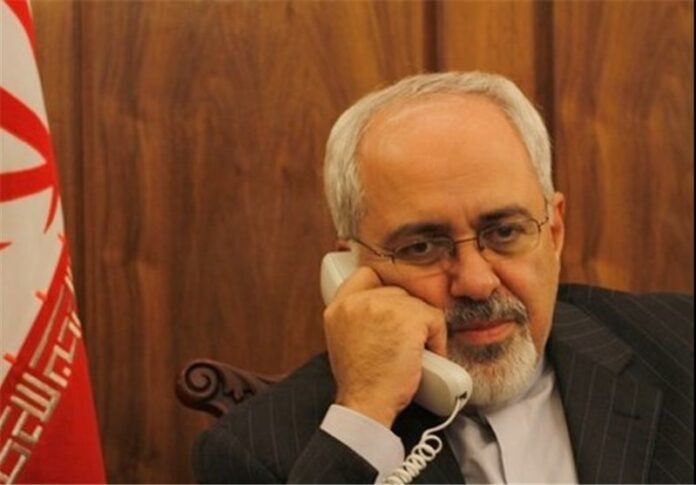
In separate phone calls with Turkey’s Mevlüt Çavuşoğlu, Malaysia’s Sri Anifah Aman, and Indonesia’s Retno Marsudi‎, Zarif voiced Tehran’s deep concern over the grievous situation of Muslim people in Myanmar.

The Iranian top diplomat also called on Muslim states to pay more attention and take practical measures to end the unfair and inhumane violence against Rohingya Muslims.

The Islamic Republic of Iran is prepared to provide any kind of help and contribute to collective measures by international bodies and Islamic countries, Zarif said during the Monday phone conversations.

‘Iran Condemns Test of Nuclear Weapons by Any Country’

‘Iran Condemns Test of Nuclear Weapons by Any Country’

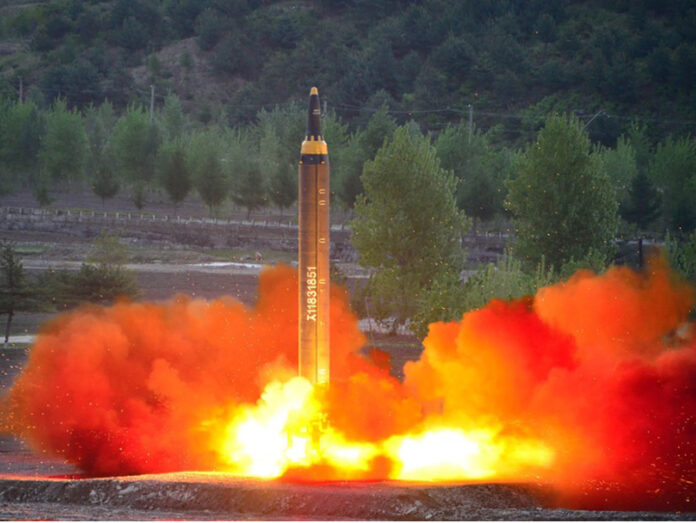
Iranian parliamentarian Morteza Saffari Natanzi says the Islamic Republic of Iran is principally against any test of nuclear weapons by any country in the world and thus it does not endorse North Korea’s nuclear tests.

“Based on a religions decree (Fatwa) by Iran’s Leader, Tehran is totally against any production of weapons of mass destruction,” he said In a Farsi interview with ICANA.

Iran is deeply concerned with the growing number of WMDs across the world, said Saffari Natanzi, who sits in the Parliament’s National Security and Foreign Policy Commission.

The Iranian lawmaker went on saying North Korea is hitting back at the US threats by conducting nuclear tests to create a secure margin for itself.

Saffari Natanzi added North Korea’s leader is trying to make it clear to the US President, Donald Trump, that Washington cannot do whatever it likes in the Far East and threaten North Korea with military attack.

“As we see, US missile systems in the Far East have not yet managed to detect North Korean missiles and this is a big defeat for Pentagon,” he said.

Saffari Natanzi said North Korea’s concerns about Trump’s aggressive policies are understandable and added the country will continue its nuclear tests as far as the US does not change its policies towards the Pyongyang.

He referred to the criticisms levelled by the European Union as well as the Democrat and Republican politicians in the US against Trump’s wired behaviours and said tensions in the Far East would finally lead to a new round of talks between Pyongyang and Washington mediated by Seoul, Tokyo and the UN Security Council but Trump’s behaviours only contribute to war.

The lawmaker also said the two sides have held talks and signed some agreements to tackle the problems in the past but the main issue is that the US has not remained committed to the agreements and “North Korea’s nuclear tests are just a defensive reaction to such behaviours.”

“The plight of insecurity and war in the Far East will engulf all the eastern Asian countries and the threat of war is imminent unless the two sides resume their political talks,” he added.

He concluded that security and safety will not be restored to the Far East unless the US puts an end to its threats against North Korea and sign a new nuclear deal with the country, in the same vein as the Joint Comprehensive Plan of Action (JCPOA) between Iran and the West.

Israel Resorts to UN to Calm Its Regional Fears

Israel Resorts to UN to Calm Its Regional Fears

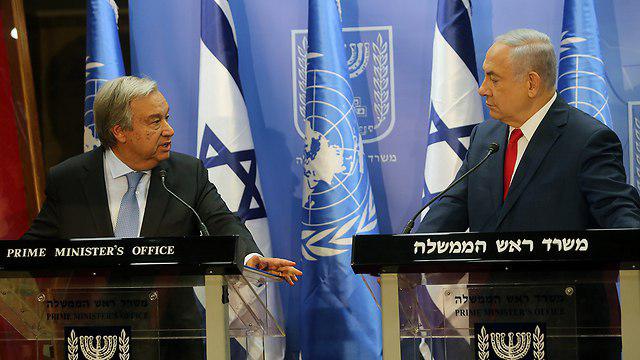
Last week, UN Secretary General António Guterres arrived in the occupied lands of Palestine for the first time during his term to hold talks with Israeli and Palestinian officials. The three-day visit came as the UN Security Council is working on a plan to renew the mission of its peacekeepers in Lebanon known as UNIFEL. The body is expected to vote on the plan on August 30.

According to a report by the Basirat news website, the US Ambassador to the UN Nikki Haley recently criticized UNIFEL for what she called closing its eyes on Hezbollah’s weapons in Lebanon.

However, the significance of the UN chief’s visit to the Palestinian territories lies in his several and concise meetings with the Zionist officials during which the Islamic Republic of Iran was blamed for its role in the region.

During his meeting with the UN head, Israeli Prime Minister Benjamin Netanyahu accused Iran of seeking to establish two centres in Lebanon and Syria to produce guided missiles. He blamed the UN for remaining silent towards the plan and stressed Israel cannot sit idle towards Iran’s growing influence in Syria and Lebanon. The Israeli official added the UN also closes its eye to the conspiracies hatched by Iran and Lebanon’s Hezbollah against Israel.

According to the Jerusalem Post, Netanyahu stressed that Israel preserves the right to defend itself and doesn’t allow Iran and Hezbollah to tighten their siege on Israel. He also noted that Hezbollah and Syria are the biggest challenges that Israel is facing today.

The statements come as earlier, during his joint visit with the UN chief to a museum called Holocaust museum, the Israeli official warned that Iran is trying to turn Syria into a military base.

Israeli Minister for Military Affairs, Avigdor Liberman, also echoed Netanyahu’s claims about Iran’s decision to set up missile centres in Syria and Lebanon and added Israel cannot put up with the idea.

He went on saying that Israel is prepared to hit back at any security threats and claimed, “Today we are in a dangerous situation because Iran is seeking to deploy its forces in Syria and change the strategic balance of the region to undermine Israel.”

Interestingly enough, the so-called “diplomatic” meetings were attended by Israel’s military intelligence Chief, Herzi Halevi. During one of these meetings, Helevi briefed the UN chief on the latest development in the region and said Hezbollah has expanded its domination over the government of Lebanon.

He said further measures must be adopted to prevent a new war from taking place in the future. The Zionist general stressed that “Iran’s efforts to produce sensitive weapons for Hezbollah within Syria and Lebanon is a dangerous move which Israel will not sit idle against it.”

The meeting was also attended by the UN’s envoy to the Middle East as well as Israel’s ambassador to the UN and a top manager of Israel’s foreign ministry for international organizations.

But the main issue is that the harsh stance of Israeli officials towards Iran taken under the pretext of Iran’s efforts to establish military bases in Syria and Lebanon reveal the deep worries of the Zionist regime about Iran. Meanwhile, they also show that Israel is seeking to change the current political and security balance in the region in its own interest.

So, this means that first of all, with the victories of Hezbollah over ISIS in Syria, Israel has been focused on changing the power balance in the region and beginning a new tactic in the region by accusing Iran and Hezbollah of sponsoring terrorism. This paves the way for more serious presence of the US and the West in the region. And, secondly, as part of a pre-emptive measure, the Israeli officials are planning to raise their security by preventing the axis of resistance from expanding in the region.

British Parliamentary Delegation to Visit Tehran

Rahimi said arrangements have been made for the visit and the British delegation will arrive in Tehran in the next months.

In a Farsi Interview with the Tasnim News Agency, he stressed that some of the Iranian members of Iran-UK Parliamentary Friendship Group visited the UK during the last parliamentary term. “And now it is the turn of the British parliamentary delegation to visit Iran,” he added.

The Iranian MP representing the people of Tehran said a delegation from the UK Foreign Secretary is also set to visit Tehran and added the visit is to be made with the aim of holding consular talks next month.

Iran, Syria Discuss Boosting Cooperation in Agriculture Sector

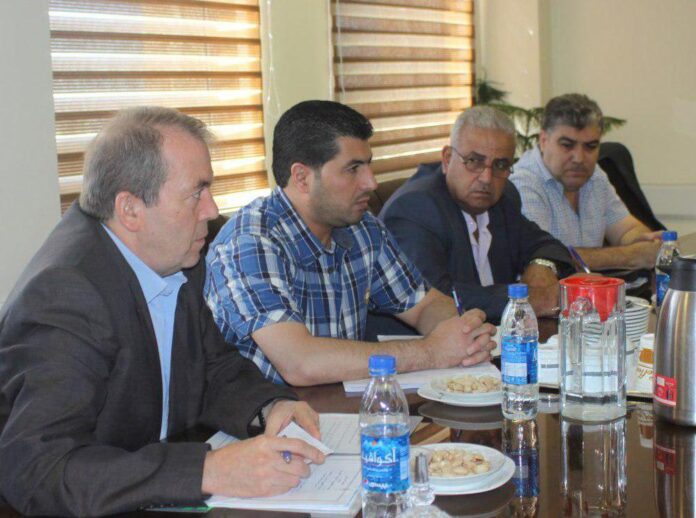
In a meeting in Tehran, senior agriculture research officials from Iran and Syria discussed enhancement of mutual cooperation in the fields of research, training and promotion of agricultural activities.

In the meeting, the Iranian side expressed content with the resumption of scientific relations between Tehran and Damascus.

According to a Farsi report by the Iranian Agriculture News Agency (IANA), the Iranian officials described Syria as a key regional country when it comes to agriculture and an “effective” partner for Iran as far as agricultural activities on the international stage are concerned.

The visiting Syrian officials, in turn, described their trip as a turning point in Tehran-Damascus scientific relations and promotion of cooperation in the agriculture sector. They said the civil strife in Syria has inflicted heavy losses on the country’s agriculture sector, and Syria needs Iran’s scientific-technical cooperation more than ever to solve the problems it is currently facing.

The Syrian delegation also presented a report on the country’s potentialities in the agriculture sector. They said Iran enjoys great potential in the agriculture domain, and called on Tehran to work with Damascus in building vaccine-producing factories and tackling pests.

They also welcomed collaboration with Iran in training and promotion of activities in the agriculture sector.

Among areas of cooperation agreed by both sides were procurement of fodder, aquaculture and holding short-term training programs.

Iranian General Warns Iraqi Kurdistan against Independence Referendum

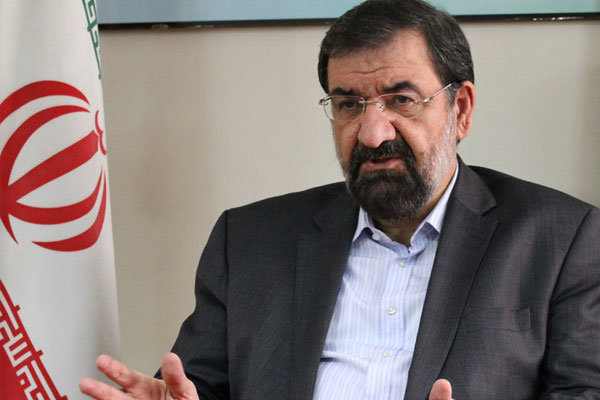
The warning by Mohsen Rezaei during a meeting with Iraqi journalists in Baghdad Sunday night came as the date drew nearer for the semi-autonomous Kurdistan region in northern Iraq to hold the plebiscite on September 25.

“Iraq is a well-known nation and a member of the United Nations with international borders, and its breakup is a very wrong thing, because the disintegration of the country would be the starting point for dangerous insecurities in the region,” he said.

It would have “dangerous” ramifications for the regional countries, said Rezai, who is currently the secretary of Iran’s top arbitration body, the Expediency Council, having served as the head of the Islamic Revolution Guards Corps (IRGC) all through the eight-year Iraqi war of the 1980s on Iran.

“If the disintegration of Iraq begins, it will be extended to Syria and Turkey, and a separatist war will break up in the region, which may plunge the region to 20 years of insecurity,” said Rezaei.

“That is why the Islamic Republic of Iran, Turkey, Syria and Iraq are strongly opposed to a geographical change in the region,” he said of the four ethnically diverse nations which have Kurdish populations.

The Iranian government has maintained generally positive relations with Kurdish political entities and it greatly values stability along its western border with Iraq. That mountainous region already enables some Kurdish groups to skirmish with Iranian forces.

With Turkey obsessive in opposing a Kurdish state, Rezaei warned of possible deployment of Turkish troops to northern Iraq if the Kurds secede.

The anti-Turkish PKK terrorist group dominates the armed groups operating in northern Syria. If a Kurdish state is forged from Iraq, the Turks will assume that it would appropriate Kurdish-occupied territory in Syria. That would formalize a major security threat along Turkey’s border.

The US has been supporting Kurdish militants in Syria for some time, shipping in massive volumes of heavy weapons to the region, which has sounded alarm bells in Turkey.

As a result of a secession, Rezaei said, new wars would start in the region between the central government of Iraq and Kurdistan, which would only harm the Kurdish nation.

“Unfortunately, the issue of the referendum on the Iraqi Kurdistan, more than being a popular demand, is a personal issue, and many Kurdish leaders are against it,” he said.

Masoud Barzani, president of the Iraqi Kurdistan region, has told various officials he would push for a referendum, but the UN and the Europeans have refused to support it, at least publicly.

Rezaei said, “Some Kurdish leaders want to make a name and a reputation through the referendum, while what Iraqi Kurdistan needs is security and progress.”

The Iranian official is in Iraq along with Expediency Council chairman Ayatollah Mahmoud Hashemi Shahroudi who met with Prime Minister Haider al-Abadi in Baghdad Sunday.

Iranian General Warns Iraqi Kurdistan against Independence Referendum

Rezaei said UN and European countries’ refusal to send delegations to observe the Kurdish referendum is “the biggest failure” for the process.

“If the Kurdish leaders of Iraq continue to insist on a referendum, that would have no more than two reasons: either personal motivation or behind-the-scenes hands,” he said, adding that the future would expose those hidden agendas.

Rezaei touched on the US policy in the region, stressing that the Americans do not want complete security to be established in Iraq and Syria, and oppose any action that leads to lasting security in these two countries.

Israel’s Prime Minister Benjamin Netanyahu has also expressed interest in partitioning Iraq and establishing an independent Kurdish state in the Arab country, the Jerusalem Post reported last month.

The Israeli premier expressed his “positive attitude” toward a Kurdish state in the northern areas of Iraq during a meeting with a delegation of 33 US Republican congressmen, the Israeli paper said.

A report published in the New Yorker magazine in 2004 said Israeli military and intelligence operatives were active in Kurdish areas and providing training for commando units.

According to the report, Israel has been expanding its presence in Kurdistan and encouraging Kurds, its allies in the region, to create an independent state.

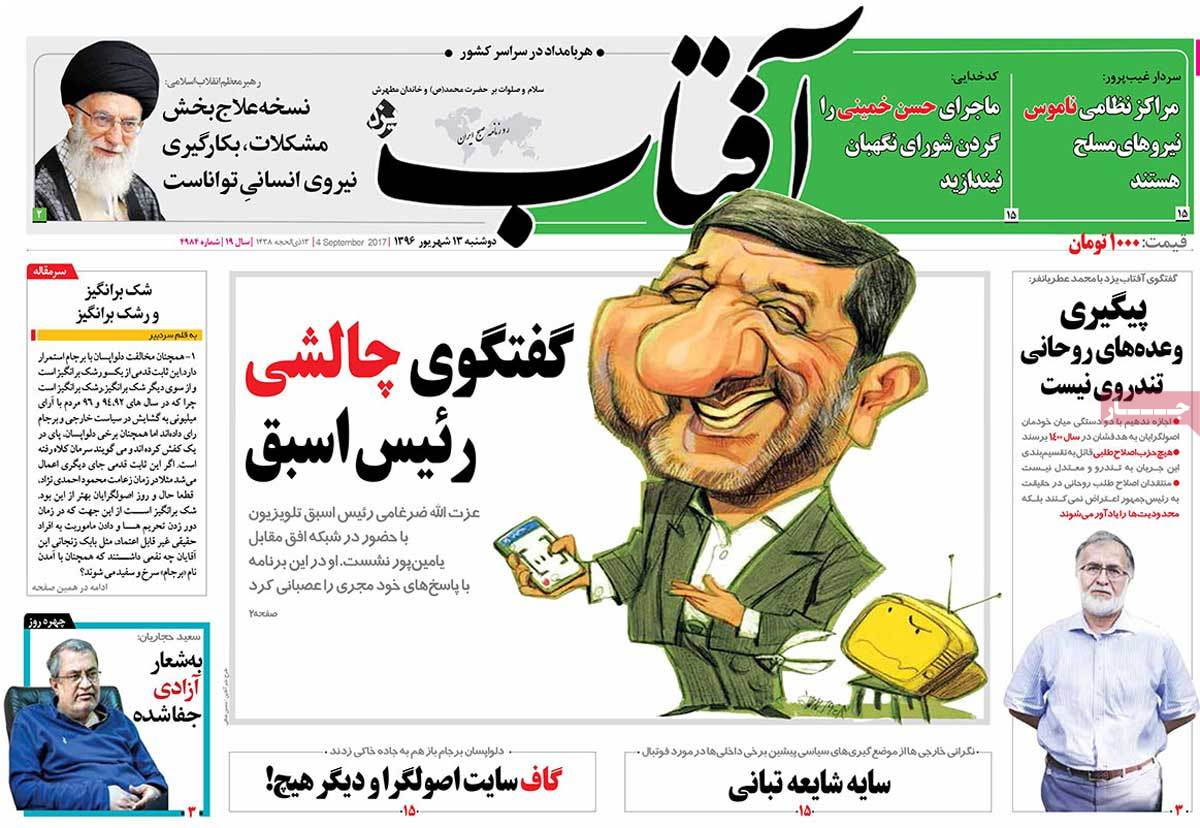
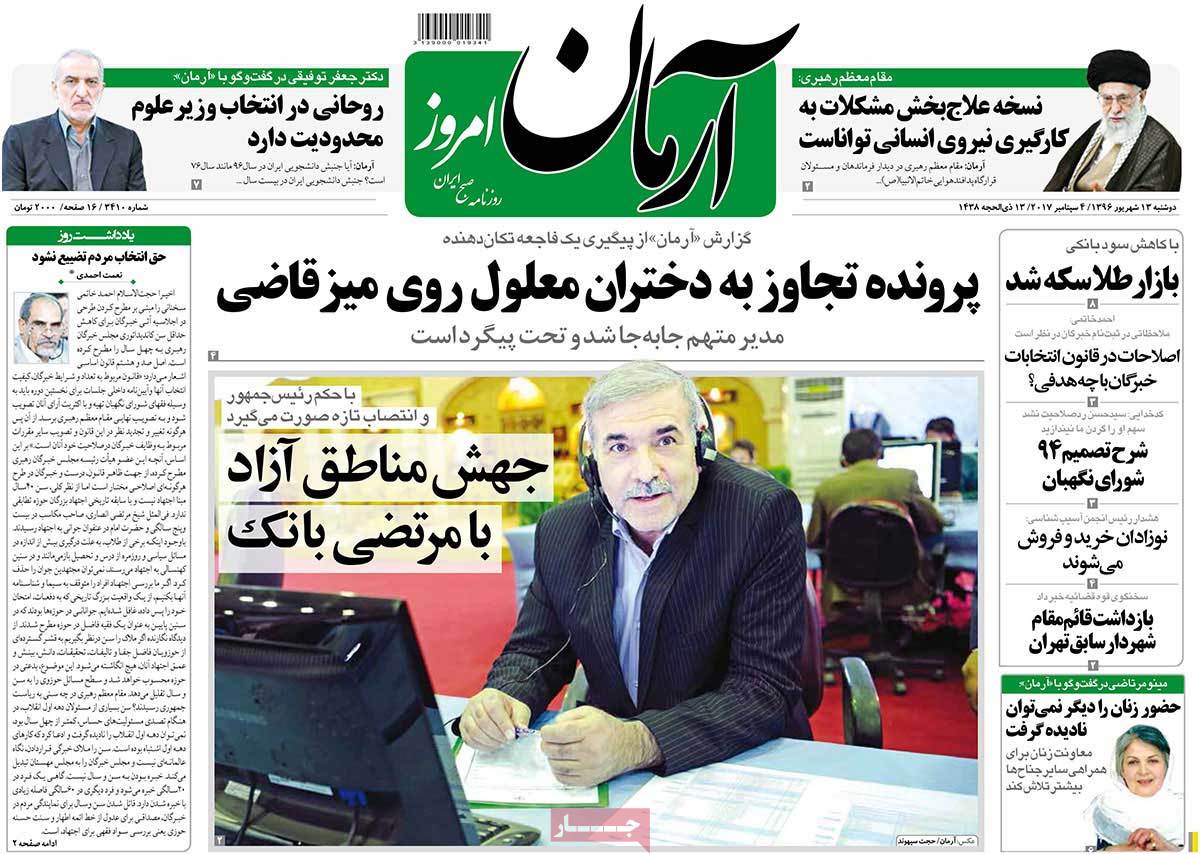
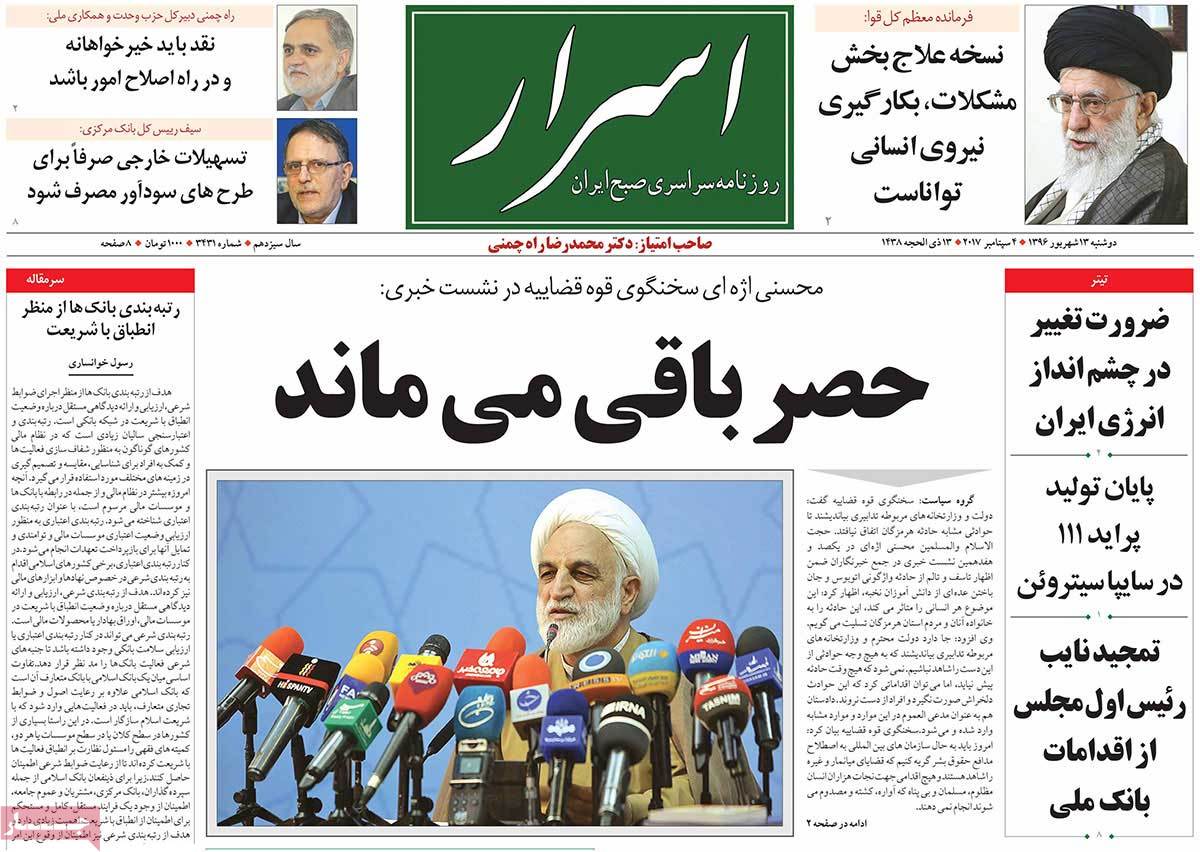
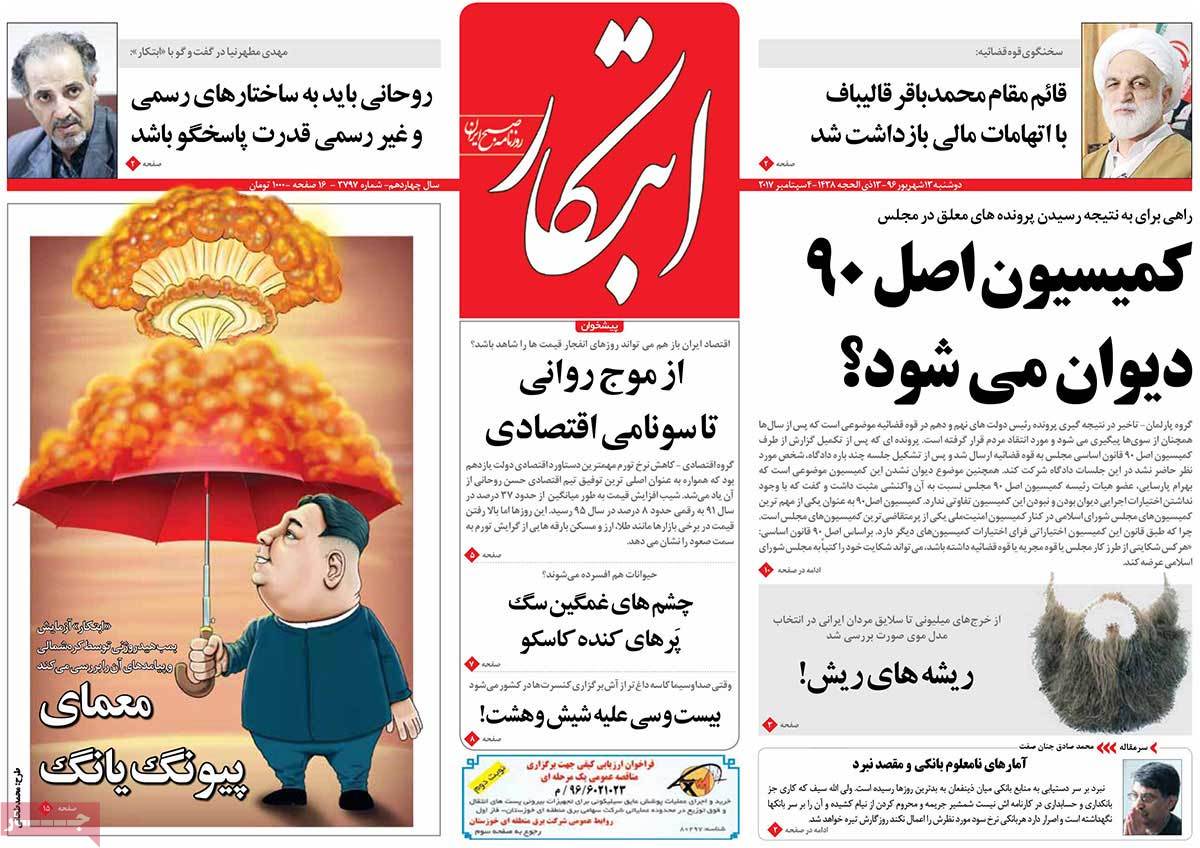
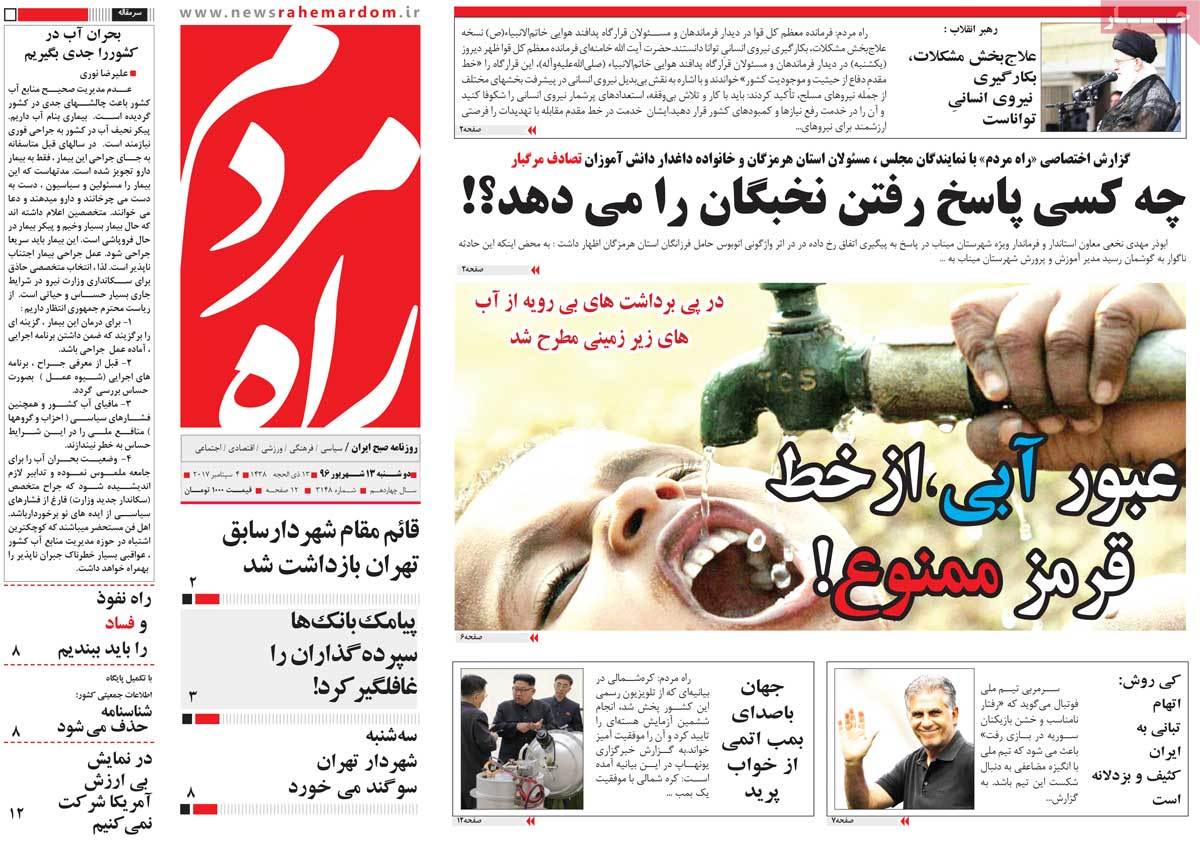
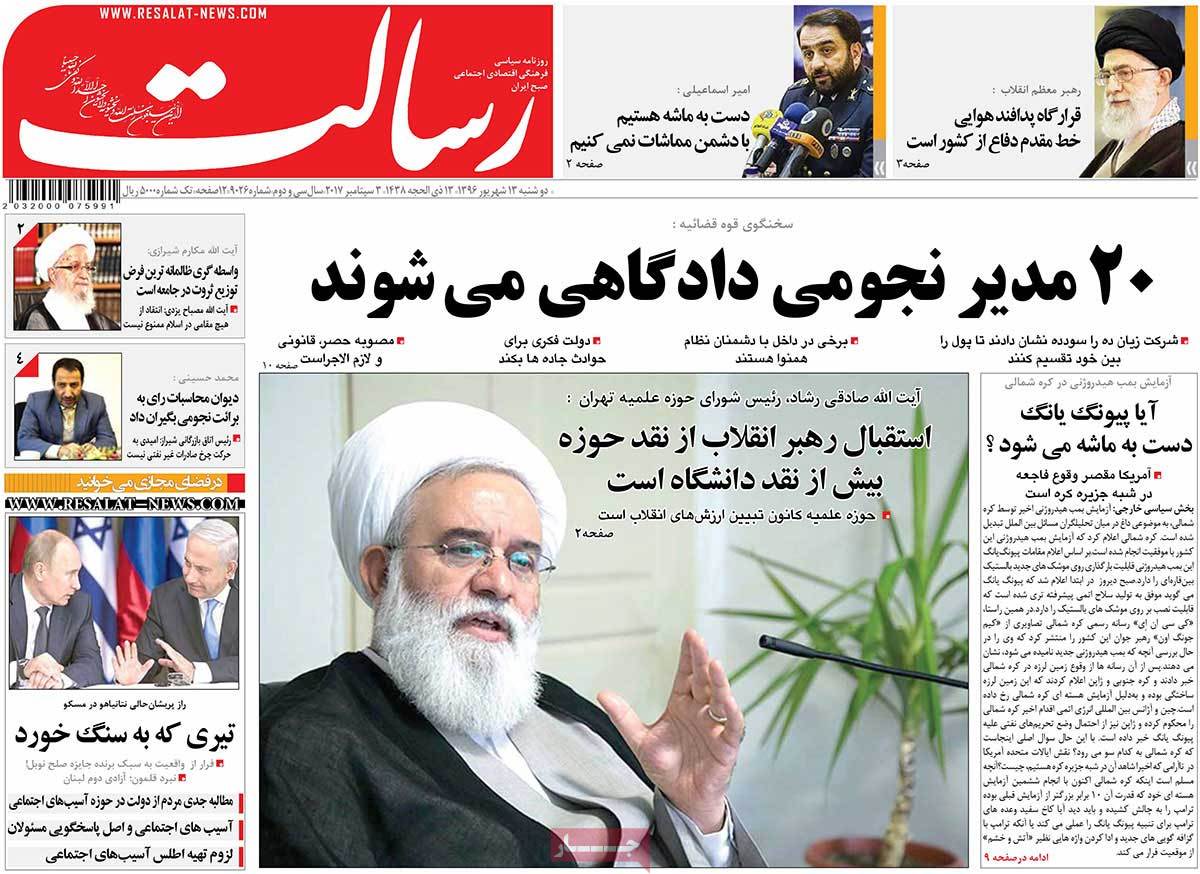
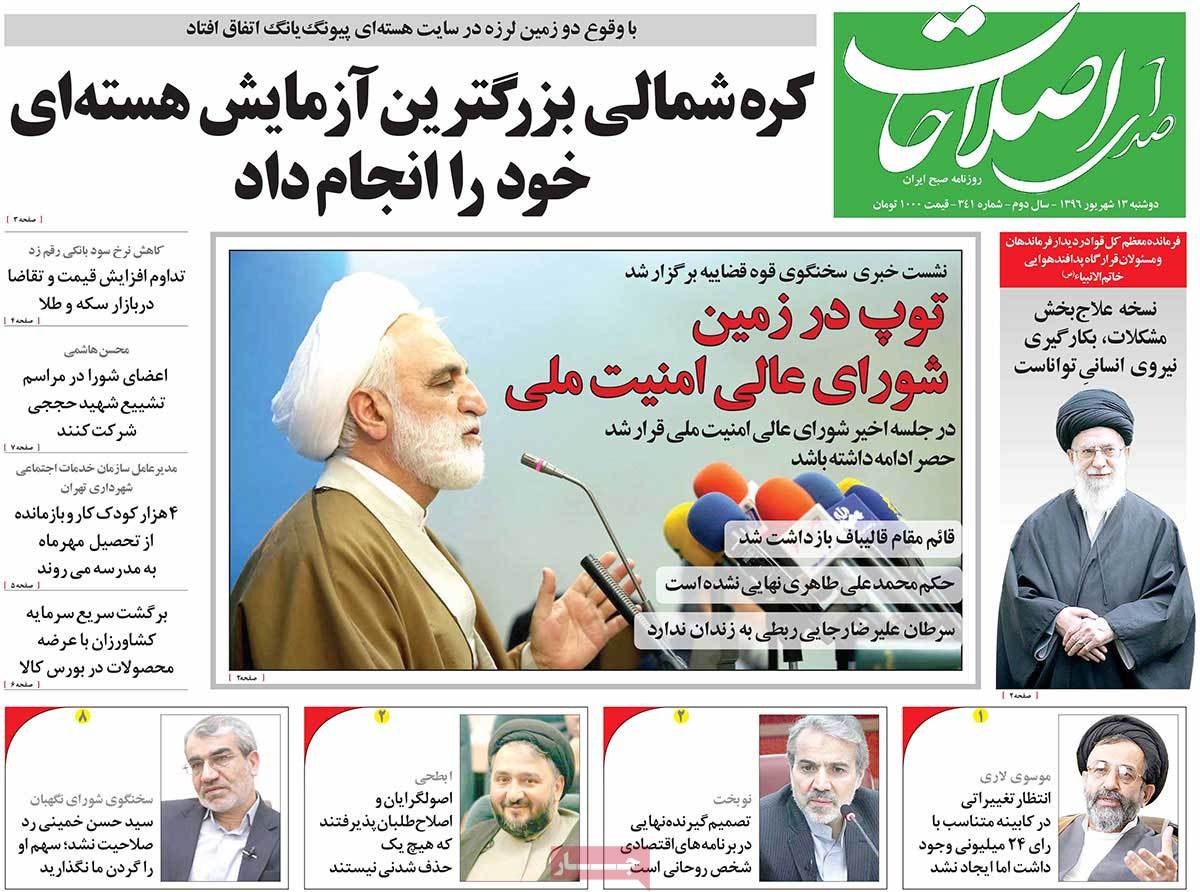
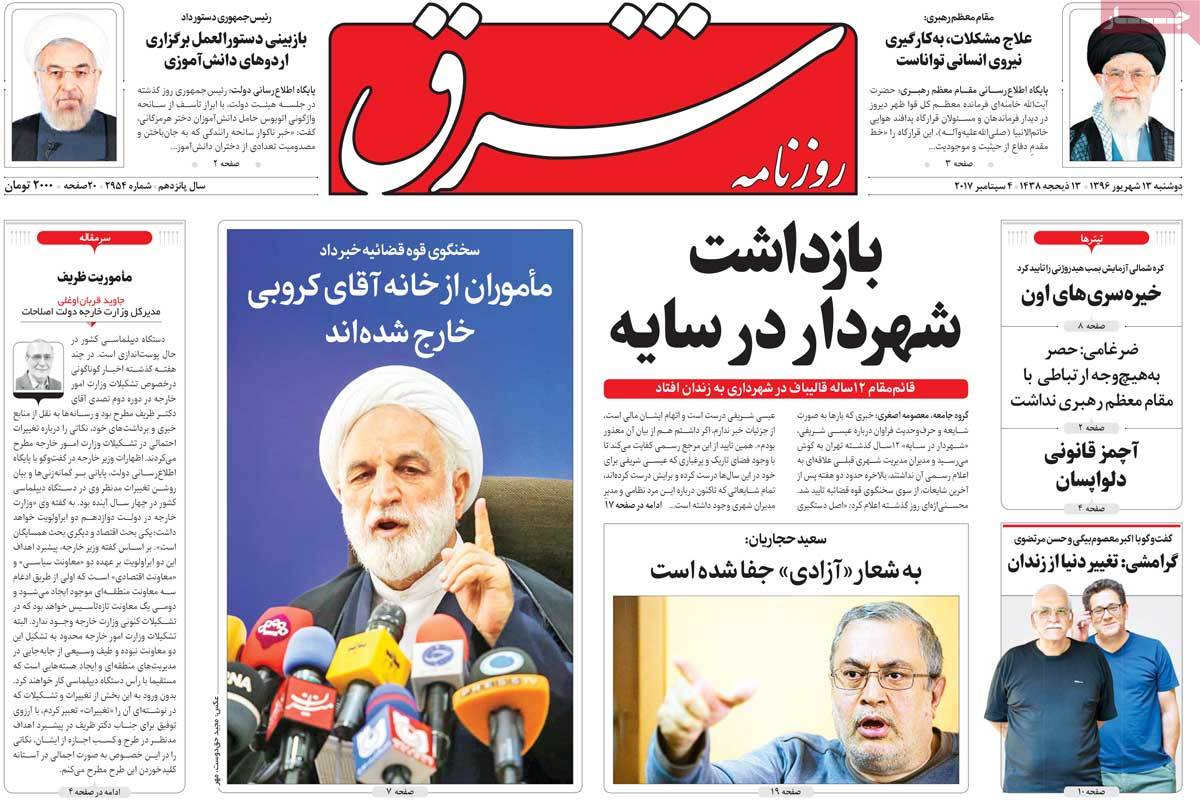
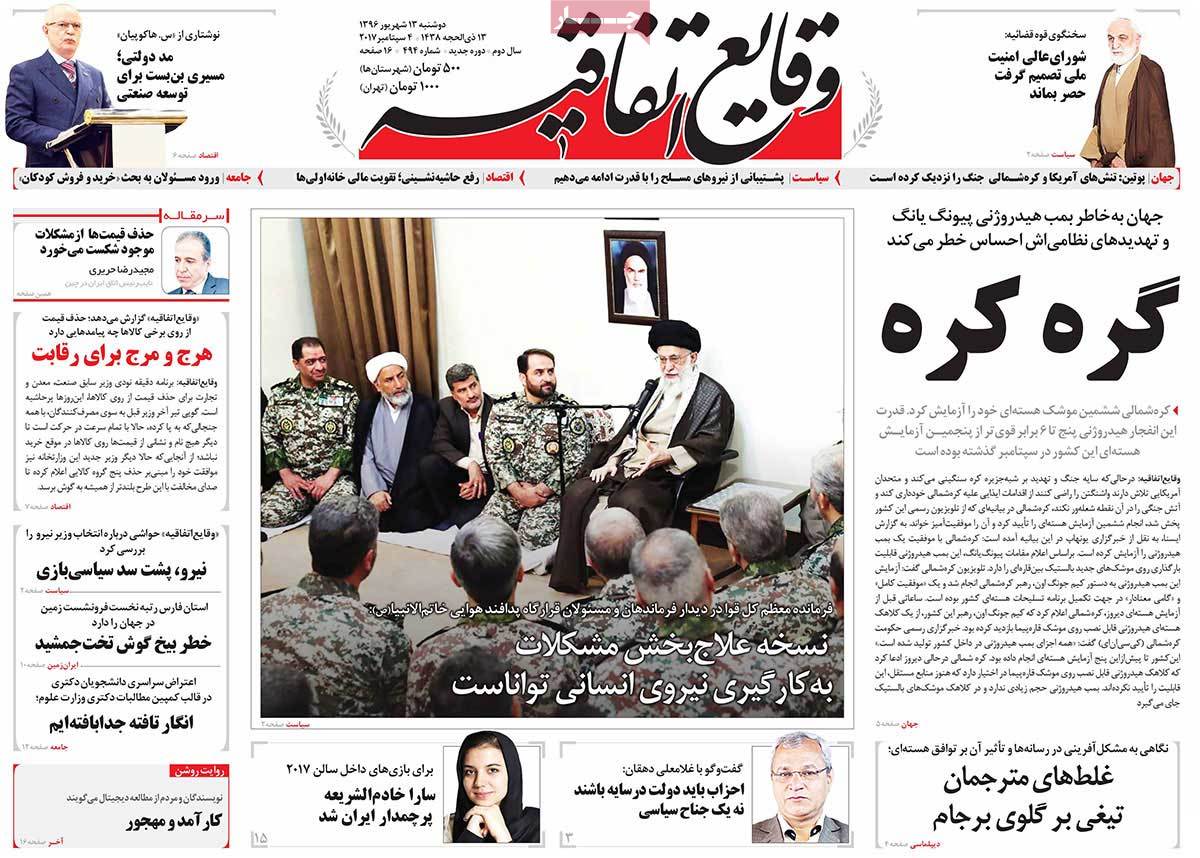
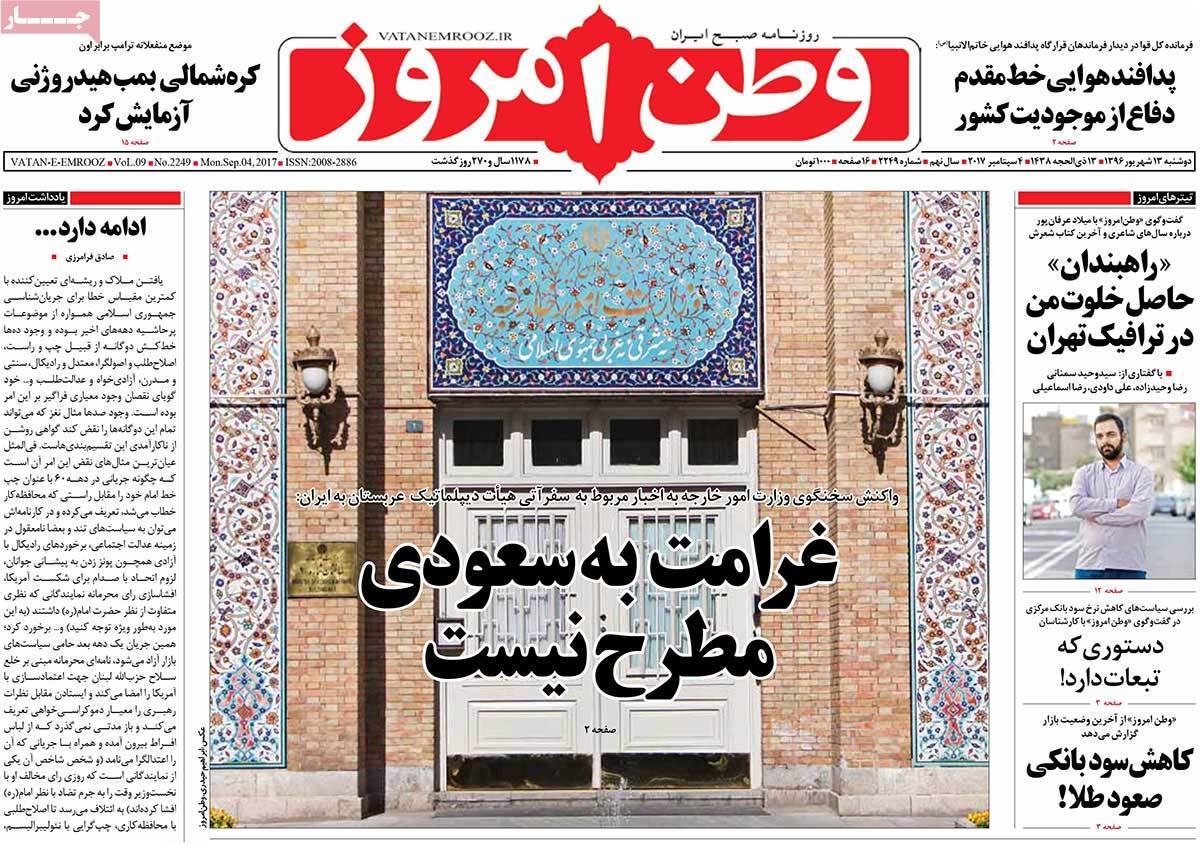
A Look at Iranian Newspaper Front Pages on September 4

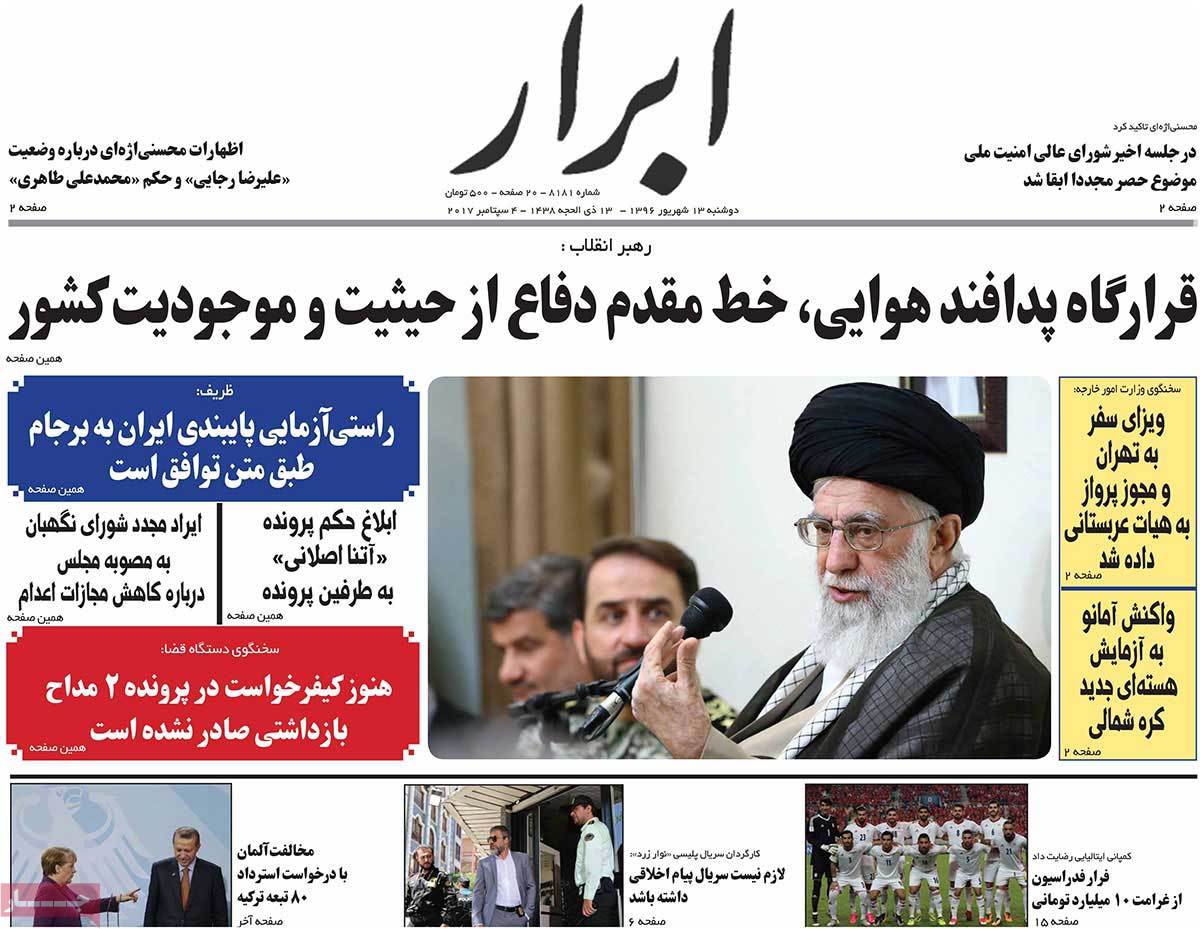
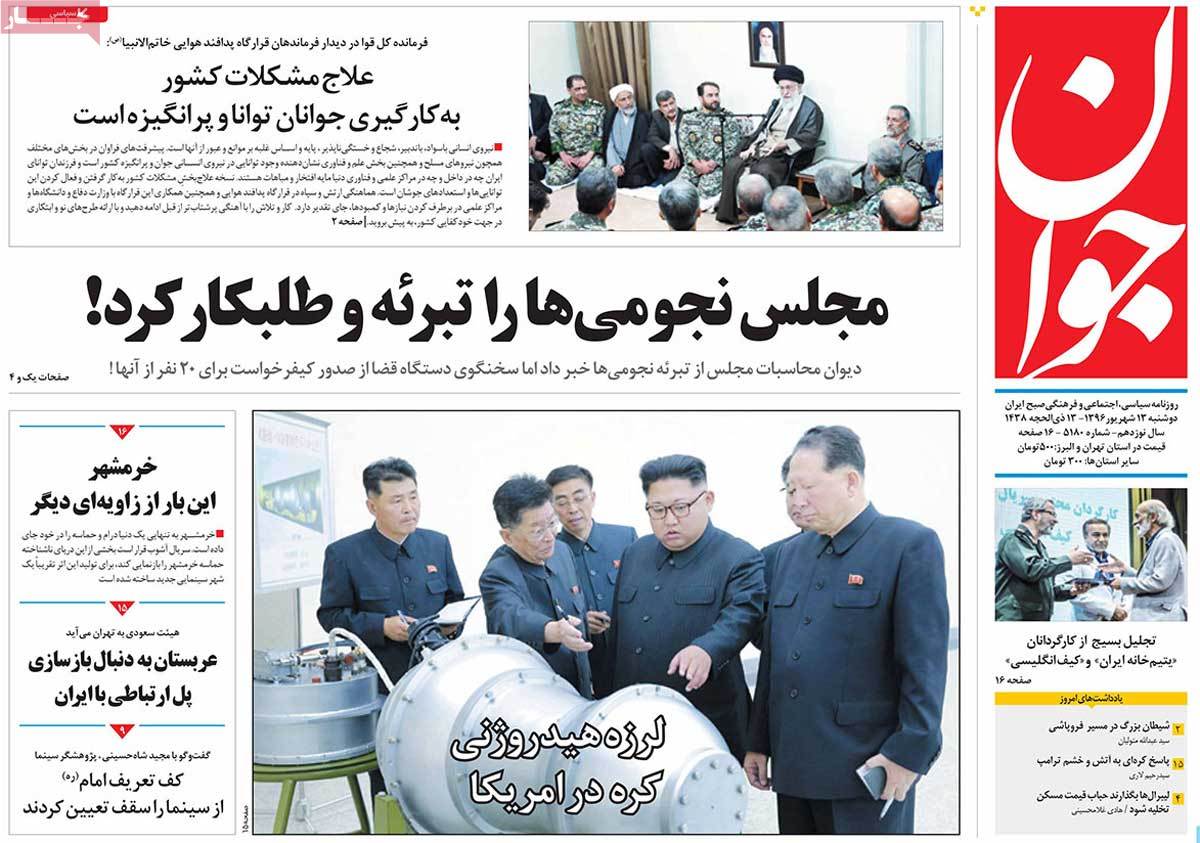
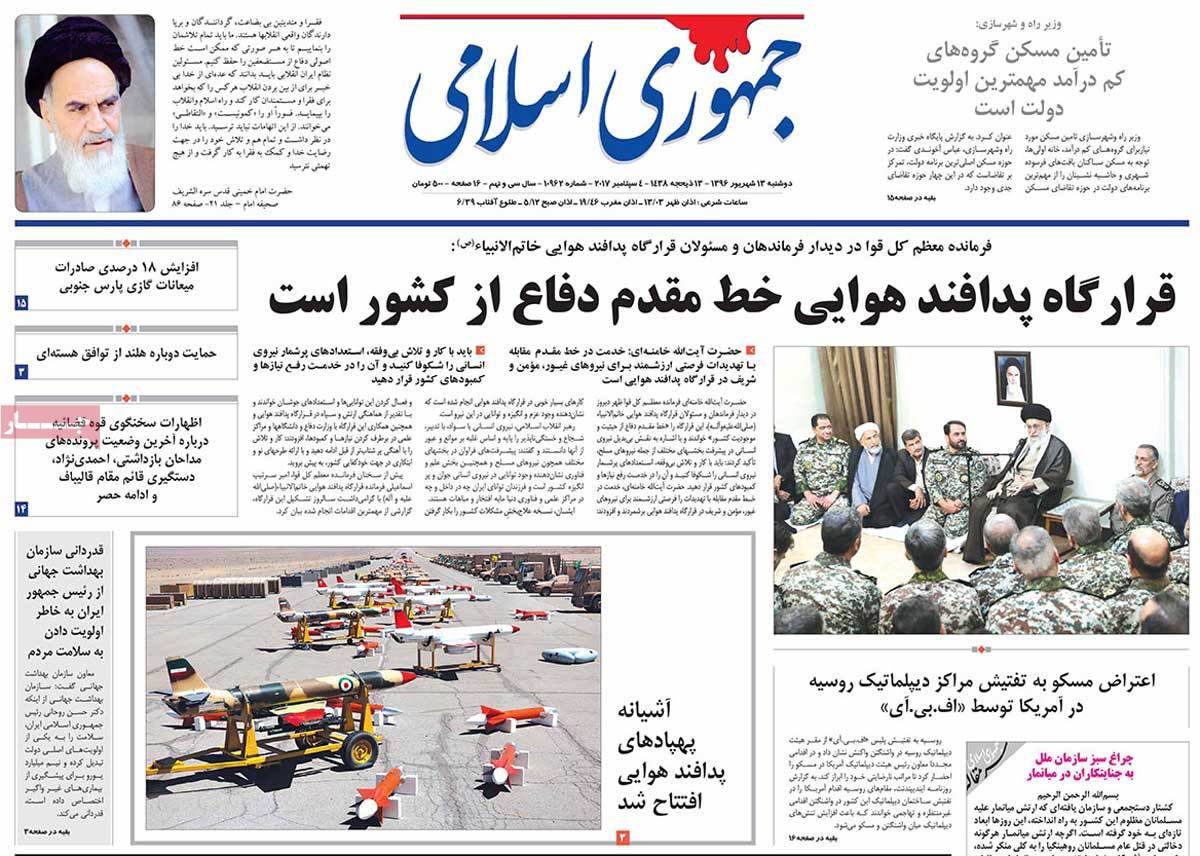
All newspapers today covered the remarks made by the Leader of Iran’s Islamic Revolution Ayatollah Seyyed Ali Khamenei in a meeting with the country’s air defence commanders and personnel.

Foreign Ministry Spokesman Bahram Qassemi’s comments about a Saudi delegation’s visit to Tehran also received great coverage. Qassemi said their visas have been earlier issued, and they are going to check their diplomatic sites 20 months after the severance of bilateral ties.

Another top story was the weekly press conference of Judiciary Spokesman Gholam-Hossein Mohseni Ejei, and his remarks about various issues, including a decision by the Supreme National Security Council to keep the opposition figures Mir-Hossein Mousavi and Mahdi Karroubi under house arrest.

Mohseni Ejei also declared that one of the deputies of former Tehran Mayor Mohammad-Baqer Qalibaf has been arrested on financial charges.

The above issues, as well as many more, are highlighted in the following headlines and top stories:


Abrar:

1- Iran Leader: Air Defence Base, Frontline of Defending Iran’s Existence

2- Iran Foreign Ministry: Visas Issued for Saudi Delegation to Visit Tehran

3- Zarif: Verification of Iran’s Commitment to JCPOA Based on Text of Deal

A Look at Iranian Newspaper Front Pages on September 4


Aftab-e Yazd:

1- Iran Leader: Using Capable Human Resources Key to Problems

A Look at Iranian Newspaper Front Pages on September 4


Arman-e Emrooz:

1- Man Who Raped Disabled Girls to Appear in Court

A Look at Iranian Newspaper Front Pages on September 4


Asrar:

1- Judiciary Spokesman: Opposition Figures to Remain under House Arrest

A Look at Iranian Newspaper Front Pages on September 4


Ebtekar:

1- Secret of Pyongyang: A Report on North Korea’s Nuke Tests, Consequences

2- Judiciary Spokesman: Qalibaf’s Deputy Arrested on Charge of Financial Corruption

A Look at Iranian Newspaper Front Pages on September 4


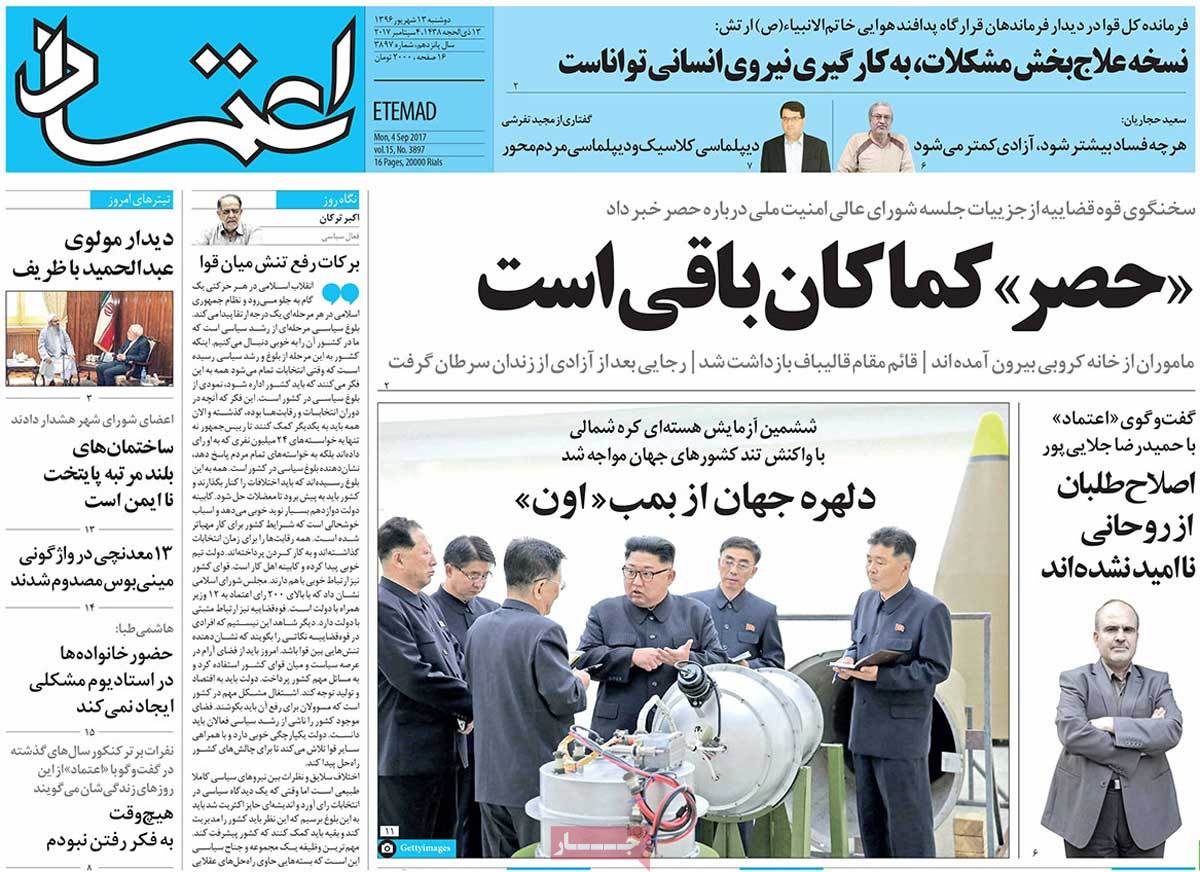
Etemad:

1- World Worried about Kim Jong-un’s Bomb

A Look at Iranian Newspaper Front Pages on September 4


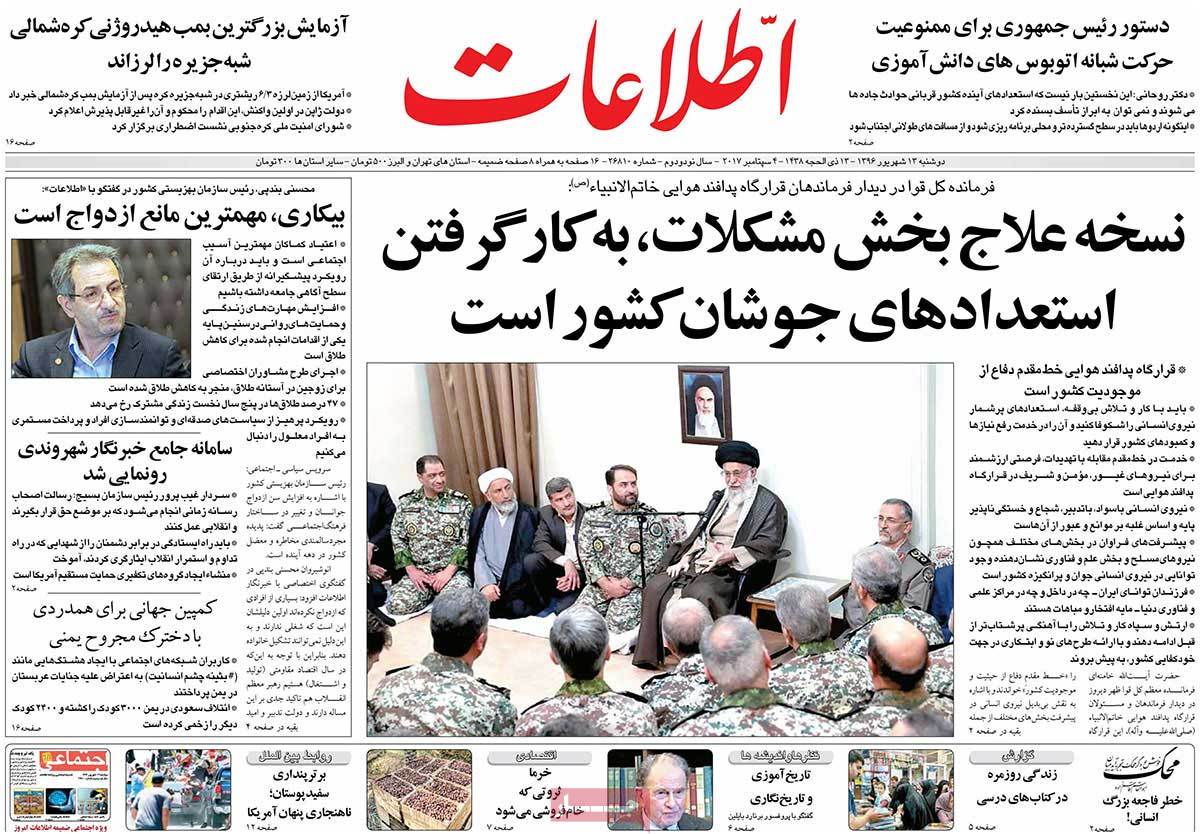
Ettela’at:

1- Buses Carrying Students to Camps Banned from Starting Trips at Night: Rouhani

2- Korean Peninsula Trembles after Pyongyang’s Test of Biggest H-Bomb

3- Unemployment Most Important Barrier to Marriage in Iran: Official

A Look at Iranian Newspaper Front Pages on September 4


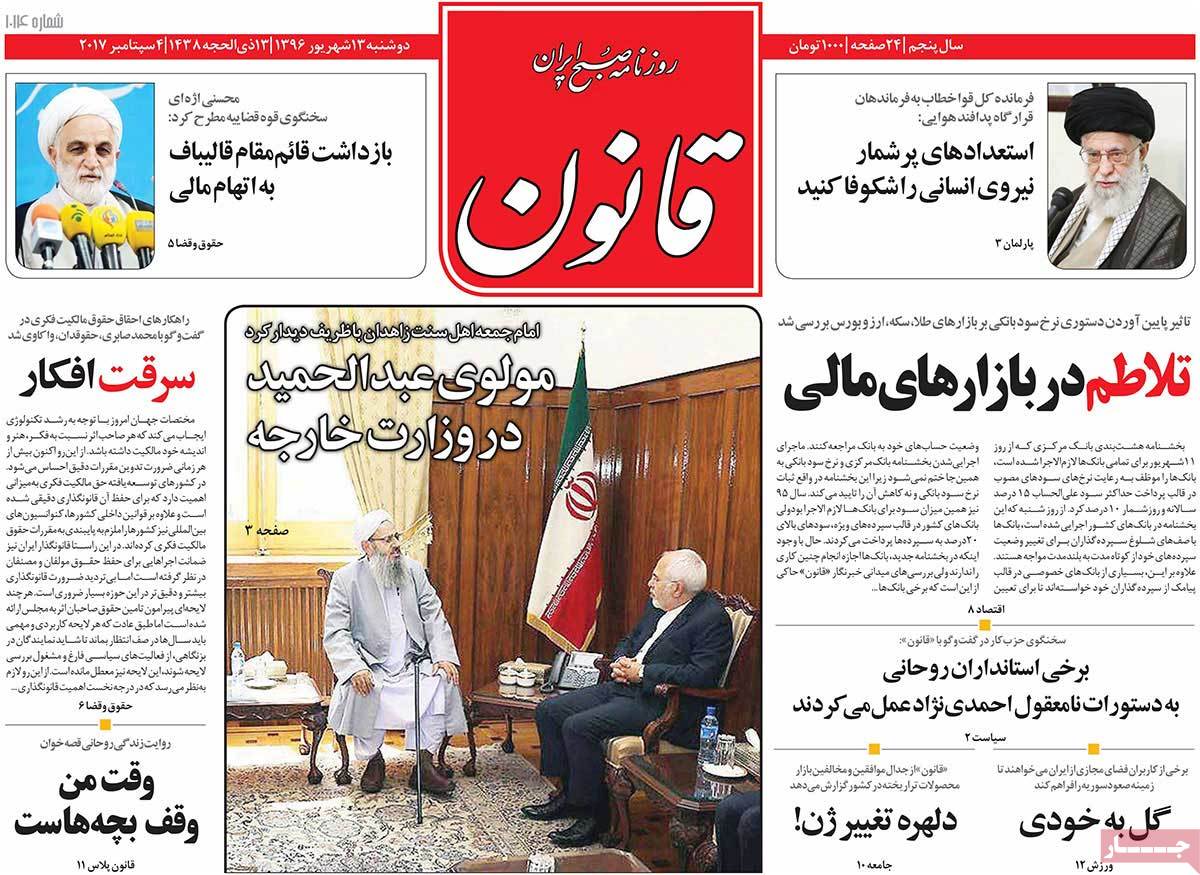
Ghanoon:

1- Iran’s Top Sunni Cleric Meets with FM Zarif at Foreign Ministry

A Look at Iranian Newspaper Front Pages on September 4


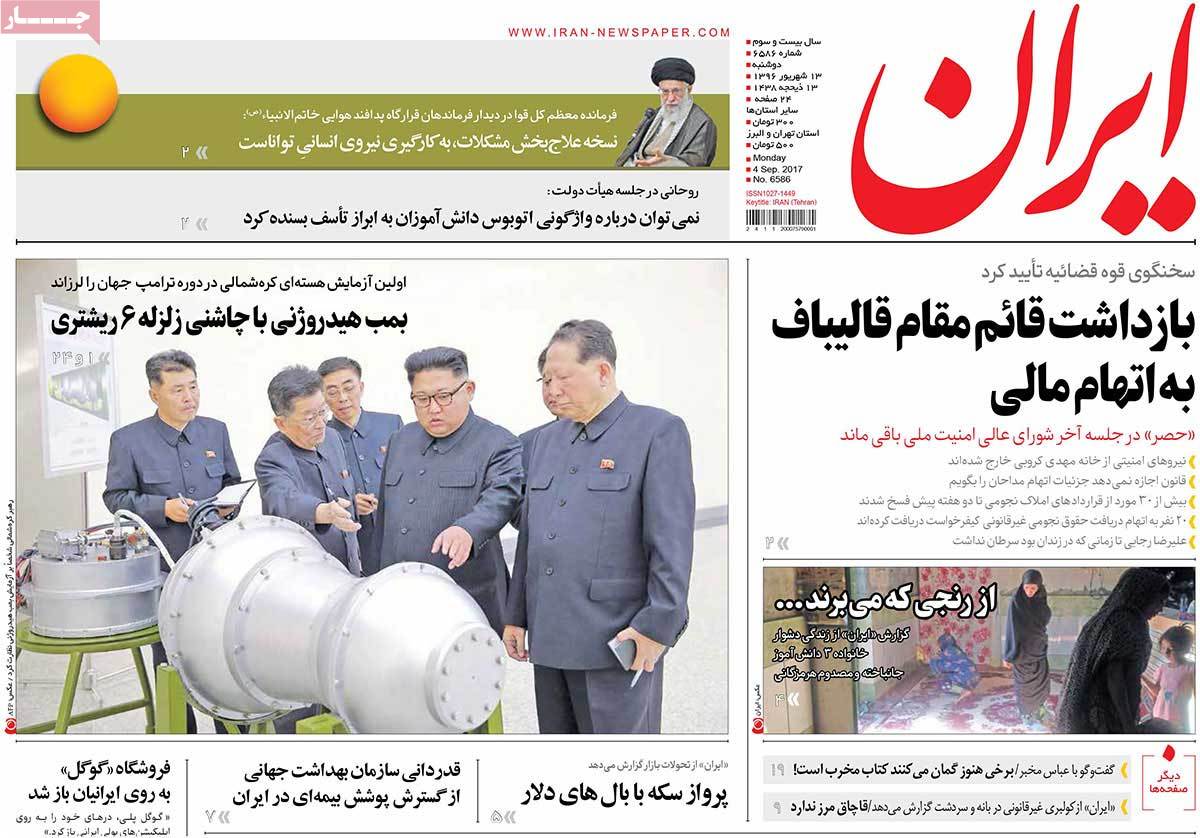
Iran:

1- Hydrogen Bomb Causes 6-Magnitude Earthquake

2- WHO Praises Expansion of Insurance Coverage in Iran

3- Google’s Play Store Open to Iranian Users

A Look at Iranian Newspaper Front Pages on September 4


Javan:

1- Hydrogen Leads to Earthquake in US

A Look at Iranian Newspaper Front Pages on September 4


Jomhouri Eslami:

1- Moscow Protests against FBI’s Inspection of Russia’s Diplomatic Sites in US

A Look at Iranian Newspaper Front Pages on September 4


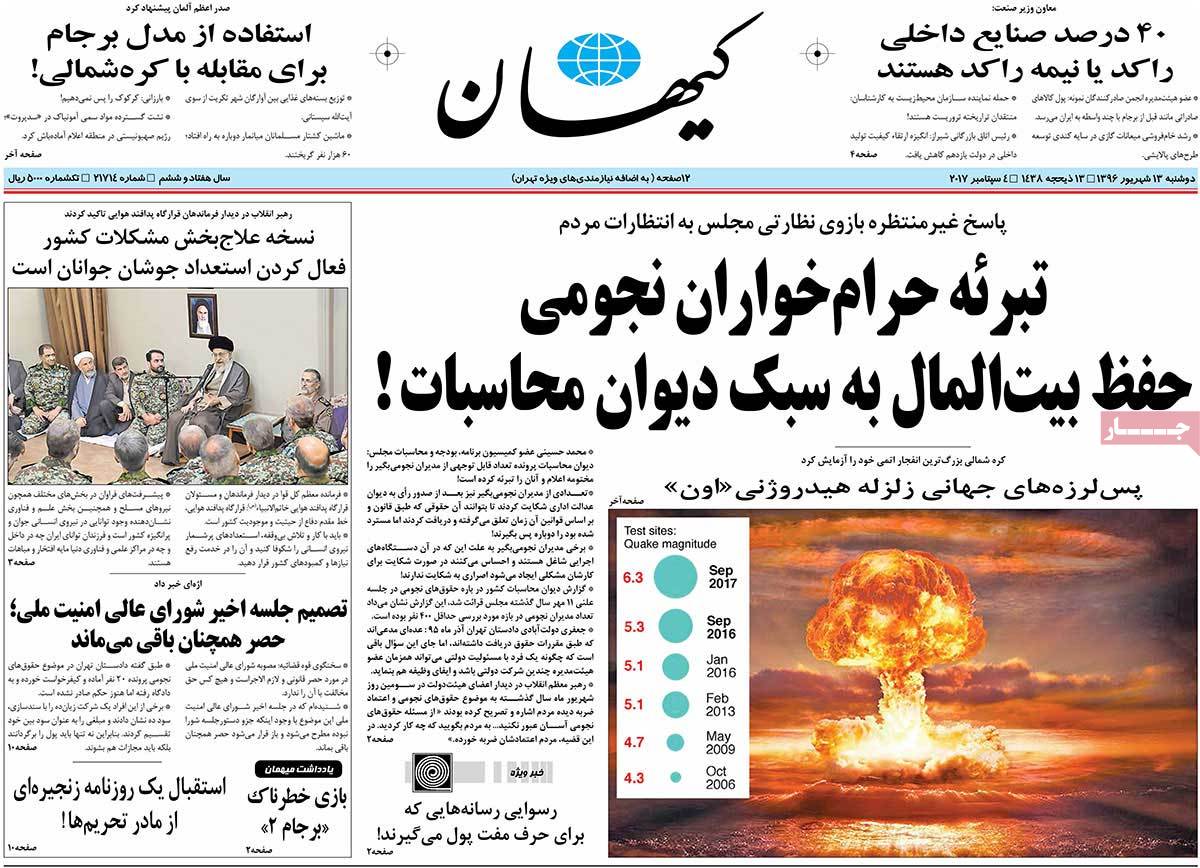
Kayhan:

1- German Chancellor Says JCPOA Can Be Used as Role Model to Counter N. Korea!

A Look at Iranian Newspaper Front Pages on September 4


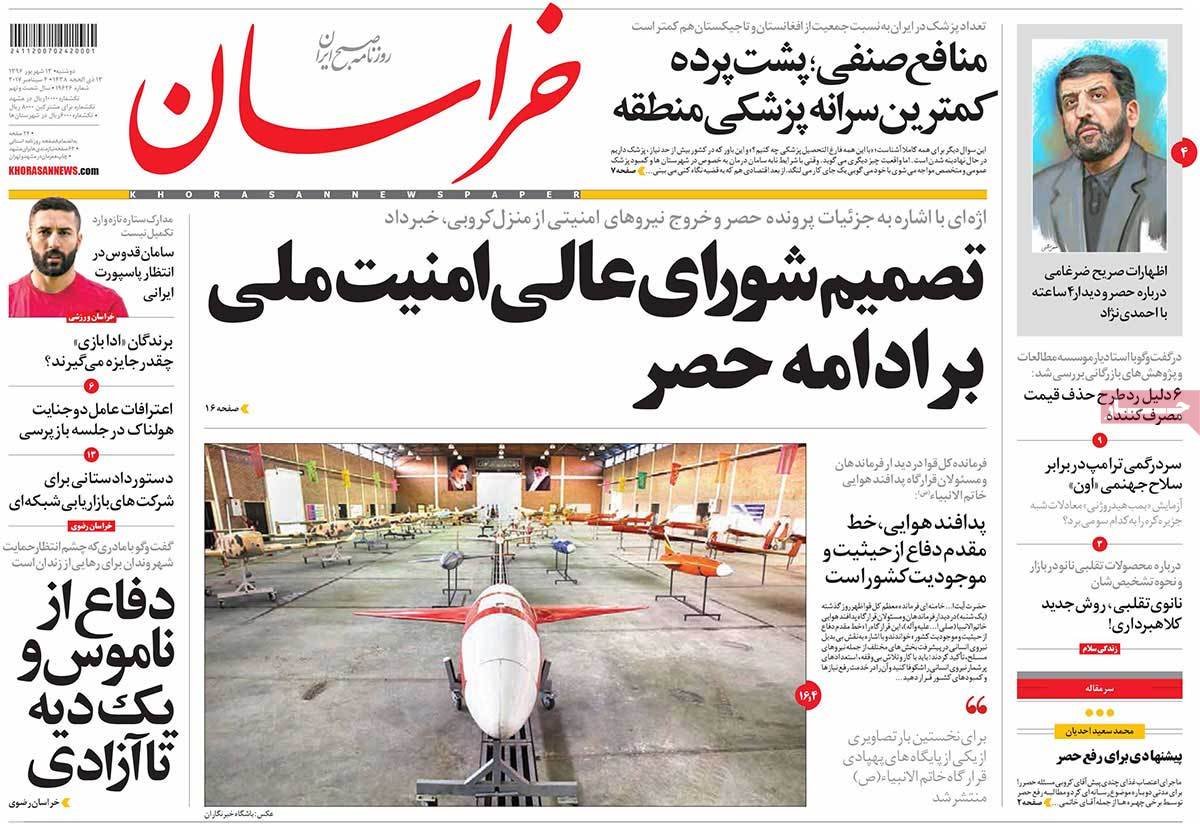
Khorasan:

1- Trump Confused by North Korean Leader’s Lethal Weapon

2- Pictures of Iran’s Drone Base Released for First Time

A Look at Iranian Newspaper Front Pages on September 4


Rah-e Mardom:

1- Queiroz: Accusations of Iran’s Match Fixing (with Syria) Dirty, Cowardly

A Look at Iranian Newspaper Front Pages on September 4


Resalat:

1- Iran Ready to Pull Trigger, Won’t Appease Enemies: General

2- Judiciary Spokesman: 20 Executives Who Received Astronomical Salaries to Be Tried

A Look at Iranian Newspaper Front Pages on September 4


Seda-ye Eslahat:

1- 4,000 Child Labourers, Those Deprived of Education to Go to School Next Month

A Look at Iranian Newspaper Front Pages on September 4


Shargh:

1- Judiciary Spokesman: Security Forces Out of Opposition Figure Karroubi’s House

A Look at Iranian Newspaper Front Pages on September 4


Vaghaye Ettefaghieh:

1- A Look at Trouble-Making in Media, Its Impact on Nuclear Deal

  • Translation Mistakes, Blade on Throat of JCPOA

A Look at Iranian Newspaper Front Pages on September 4


Vatan-e Emrooz:

1- No Talks of Paying Compensation to Saudis: Iran Spokesman

A Look at Iranian Newspaper Front Pages on September 4


Iraqi PM Praises Tehran’s Support for Baghdad in Anti-Terror Fight

In a meeting with Chairman of Iran’s Expediency Council Ayatollah Mahmoud Hashemi Shahroudi in Baghdad on Sunday, Abadi thanked Iran for its unwavering support for the Iraqi government and nation in the fight against terrorism, Iraq’s al-Sumaria news website reported.

He added that the Iraqi government would continue its victories against Takfiri terrorists thanks to the unity among the Iraqi people that has played a major role in helping the country’s military forces defeat Daesh (ISIL or ISIS) militants.

Ayatollah Hashemi Shahroudi, for his part, praised Iraq for its victories against terrorism, saying, “Successive victories (by the Iraqi forces against Daesh) under the command of the prime minister as well as the unity of the Iraqi nation have astounded the world” and made enemies hopeless.

The senior Iranian cleric also reiterated the Islamic Republic’s support for Iraq in its battle against terrorists in a bid to help restore peace and security to the Arab nation.

In recent weeks, Iraq’s military forces have made significant progress in their fight against Daesh terrorists by liberating the northern city of Tal Afar.

The Daesh militants made swift advances in northern and western Iraq in summer 2014, after capturing territories in Syria.

However, a combination of concentrated attacks by the Iraqi military and the popular forces, who rushed to take arms after top Iraqi cleric Ayatollah Ali al-Sistani issued a fatwa calling for fight against the militants, blunted the edge of Daesh offensive and later forced the Takfiri terrorists out of much of the territory they had occupied.