Saturday, January 17, 2026
Home Blog Page 3799

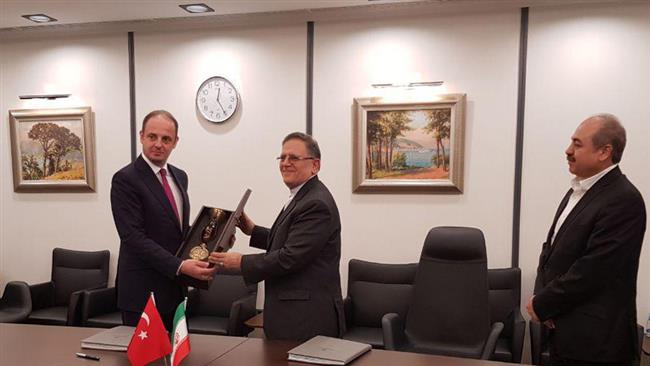
Iran, Turkey to Use National Currencies in Bilateral Trade

Iran, Turkey to Use National Currencies in Bilateral Trade

The agreement was signed during a visit to Ankara by Valiollah Seif, the governor of the Central Bank of Iran (CBI).

“The agreement is meant to help prepare the ground for the expansion of mutual economic relations between Iran and Turkey and also facilitate trade in mutual currencies of the two countries,” Seif was quoted as saying by Iran’s IRNA news agency.

“Based on it, Iran’s Rial and Turkey’s Lira can be easily converted into each other and merchants on both sides of the border can accordingly use those currencies for their trade activities.”

The official emphasized that this could help reduce the costs relating to the conversion as well as the transfer of currencies.

He added that the banks of the two countries can use the international payment tools to convert currencies into Rials and Liras.

Seif emphasized that the draft agreement would be finalized during the next meeting of the joint economic commissions between the two countries and would thus become effective immediately.

He emphasized that the initiative was in line with a mandate endorsed by the presidents of the two countries to boost their level of trade to as high as $30 billion per year.

“The potential to boost Iran-Turkey trade relations to $30 billion exists but the barriers to this need to be removed one by one,” Seif emphasized in his interview with IRNA.

“One important barrier was the limitations in banking channels of the two countries. The agreement to trade in local currencies can help remove it.”

‘Iran Should Adopt Independent Policy towards Kurdish Secession’

Senior political commentator Mohammad Masjed-Jamei has, in an interview with the Persian-language news agency Khabar Online, weighed in on the repercussions of the recent referendum on the secession of the Kurdistan region from Iraq.

He has reviewed the historical trends of secessionist moves, the future of the Middle East and tendencies toward disintegration. The highlights of the interview follow:

The referendum on the separation of the Iraqi Kurdistan region from Iraq was held at a time when its results could not be accepted under the current circumstances in the region, Europe and the world. After the collapse of the Soviet Bloc, several countries emerged from within the former Soviet Union and Yugoslavia and broke away from them. But the present situation in the Middle East is very much different from that in those years.

Back then, superpowers supported independence-seeking tendencies within the Soviet territory in order to help bring about the collapse of the Soviet Bloc, although the situation was different in Yugoslavia. Moreover, the proportion of the number of ethnic groups in those two countries to that of ethnic groups in Moscow and Belgrade at that time is not the same as the proportion of the number of Kurds in Iraq’s Kurdistan to that in Baghdad.

[On whether or not the referendum on the secession of the Iraqi Kurdistan region can be compared to the plebiscite on Catalonia’s independence, he said] there are practically two active independence-seeking currents in today’s Europe: Catalans and the Scottish. Although the European Union says it is committed to safeguarding the rights of minorities, the bloc is opposing any unilateral decision made without coordination with the capital of the country they are residing in. Despite the fact that Europeans lashed out at Spanish police for their acts of violence against pro-independence Catalans, they termed the referendum illegal as it had been held without the consent of the Spanish government. And the EU is now trying hard to find a way to keep Catalonia from separating from Spain, and blames itself for not having mediated between the two before the plebiscite was held.


Although the European Union says it is committed to safeguarding the rights of minorities, the bloc is opposing any unilateral decision made without coordination with the capital of the country they are residing in.


Furthermore, Europeans know well that they cannot tolerate and even calculate the consequences of such moves. The independence of Catalans would trigger independence-seeking moves in many parts of Europe, from northern Italy to Ireland located to the north of Britain, to Belgium, to ethnic Albanians in Kosovo, to Hungarians in Transylvania and residents from the Bask region both in Spain and France.

If these developments continue to unfold, that will seriously threaten their political and social stability and provoke ethnic, racial, lingual and local conflicts. In addition, the independence-seeking drive will stabilize the situation of Russians in Crimea because most of its people want to be reunited with Russia as an overwhelming majority of them voted “yes” to reunification in a referendum. Crimea was the main reason behind the straining of relations between the West and Russia. Therefore, the recognition of the current independence-seeking moves would amount to abrogation of their anti-Russia policies.

It is not Europe, only. Basically, calls for independence in big countries such as Russia, India, China and even Brazil and the United States and African countries will be problematic. Brazil’s Sao Paulo and the United States’ California have long been calling for independence due to economic reasons which are understandable. Tuaregs in Mali want their own country. They include the Tuaregs in Mali, Niger, Libya, Algeria and Chad. Berbers in North Africa have the same idea. Given Internet connections and the growing causes and effects, inattention to independence-seeking currents can result in numerous problems for our tense and chaotic world. Of course, it is not the only the issue of independence-seeking. This idea alone will lead to a rise in enmities and revive the negative memories in history. It might also trigger uncontrollable armed action, as has been the case on several occasions in the past.

[Regarding the prospects of the political landscape of Iraq’s Kurdistan, he said] If the organizers of the referendum had a more precise and more rational understanding of the situation in today’s world, they would not have done such a thing, at least for the time being. Provoking the sentiments of people and, directly or indirectly, adopting a carrot-and-stick policy vis-à-vis those who opposed the plebiscite, is not in the interest of anyone, even Iraqi Kurds themselves. They need security, welfare and progress on different fronts, not moves which run counter to all of these. After the fall of Saddam Hussein, their general situation has been much better than that of other Iraqis, and their proportionate share of oil revenues is much more than that of other Iraqis. The extent of the development in their territory is not comparable to that of other areas in Iraq.

Most probably, the flames triggered in Kurdistan will subside. The organizers of the plebiscite believed that others, especially countries from beyond the region, would back their initiative. However, such a thing did not happen, nor will it happen in the foreseeable future. The current situation is such that even Israel, which was first happy, backed down from its comments. Furthermore, since the time Kurdistan was established, they have been trying to identify and widen social, ethnic and religious rifts.


We need to adopt our own independent policy towards the Kurds. We can cooperate with others, including Turkey, within this policy, but the two countries cannot pursue the same policy towards the issue.


Zionists are following a two pronged-policy. First, they want to turn into the number-one power in the region. Second, they seek to disintegrate the region into small countries which would become Israel’s satellites. This point along with other issues has been described in an article about Israel’s strategy in the 1980s written by high-profile diplomat Oded Yinon. The article was published in a World Zionist Organization magazine.

We need to adopt our own independent policy towards the Kurds. We can cooperate with others, including Turkey, within this [independent] policy, but the two countries cannot pursue the same policy towards the issue.

Turkey is Iran’s major neighbour and cooperation with that country will benefit both sides as well as the whole region. This initiative will help boost regional cooperation, something needed by all in the region; nevertheless, one should not forget that the history and nature of the problems that Turkey has with Kurds are different form the problems that we have with the recent referendum. Moreover, we have different potentialities. Due to its industrial as well as economic and trade structures together with the features of its foreign policy, Turkey has high maneuverability power and uses it frequently. Currently, trade between Ankara and Iraq’s Kurdistan exceeds $12bn. This has somehow led to some kind of dependence, and Turkey can capitalize on this reality and benefit from it unilaterally to serve its own interests.

Iran-Turkey cooperation is a useful and necessary principle, which should be utilized in such a way that will not serve the interests of one side only. We witnessed a similar experience at the Economic Cooperation Organization (ECO). Iran tapped into its full potential to revive and expand the organization, but others benefited from the end result, at least in the economic arena, because they had more preparedness and capability.

Iranian, Malaysian Women Sign MoU to Promote Business Ties

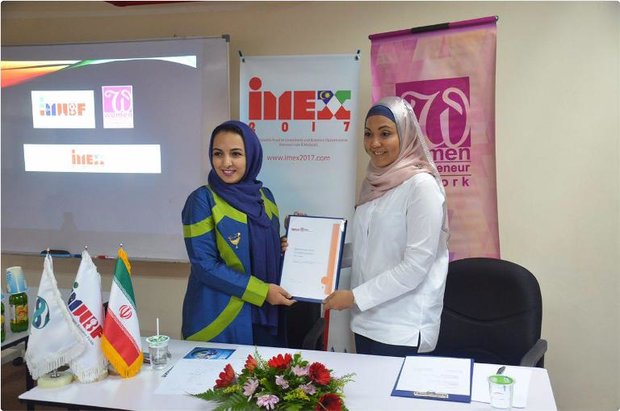
The cooperation agreement was endorsed on Monday evening in the Malaysian capital of Kuala Lumpur by IMWBF’s Secretary, Elham Amini and Ms. Nadira Yusoff, President of WENA president.

Ms. Amini underlined that participation of women is prerequisite to exploiting all capacities to increase amount of collaborations between the two Muslim countries.

The official further urged WENA members to visit Iran and stressed the need to foster friendly cooperation between businesswomen and entrepreneurs of the two sides.

Also the signing ceremony, Malaysia’s Yusoff voiced satisfaction over increasing trade transactions between Iranian and Malaysian women and attached great significance to cooperation and signing MoUs for making presence in Iran’s mega and outstanding market.

Tehran is expected to host a meeting on November 01-02 on investment opportunities in Iran and Malaysia for women.

Later at the session, Mohammad Hafez Hakami, who heads Iran-Malaysia Trade and Exhibition Opportunities, noted that there exited proper grounds for various activities that entrepreneur Muslim women from the two countries could use, and the cooperation between IMWBF and WENA could mark an emblem for women in other Muslim countries.

Iran Develops Thermal Night-Vision Goggles Using Nano-Powder

Researchers at Sairan Electro-Optical Industries, an Iranian knowledge-based company, have designed and produced thermal night-vision goggles using nanotechnology.

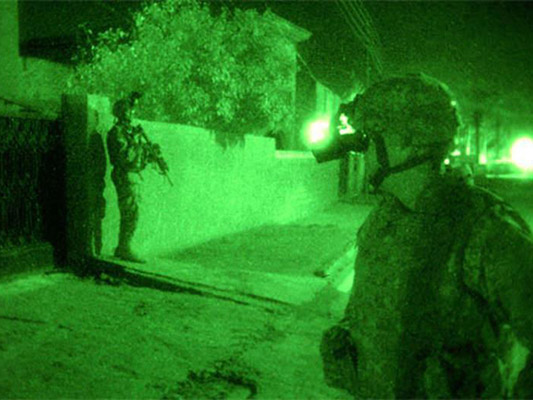
The device can track and detect the subject in the dark using IR and thermal waves, according to a Farsi report by Mehr News Agency.

The lens of the goggles must be designed very carefully in such a way that IR and thermal waves can pass through it. The lens is made of ceramic structures which need special powders. Iranian researchers have used nanotechnology to produce the powders, so that light will pass through them.

The nano-powders go through a special process turning into ceramic structures. Then they are coated and the lens is made. IR and thermal waves can pass through the lens. The heat is shown white on the screen. The body of each individual has a temperature which helps the goggles detect him/her.

The goggles have been produced in the country for years, and is now upgraded thanks to nanotechnology. The thermal night-vision goggles have both commercial and military applications.

Researchers from major Iranian universities have contributed to the project. The company developing the night-vision goggles, Sairan Eletro-Optical Industries, has been recognized as one of the top domestic firms working in the field of nanotechnology.

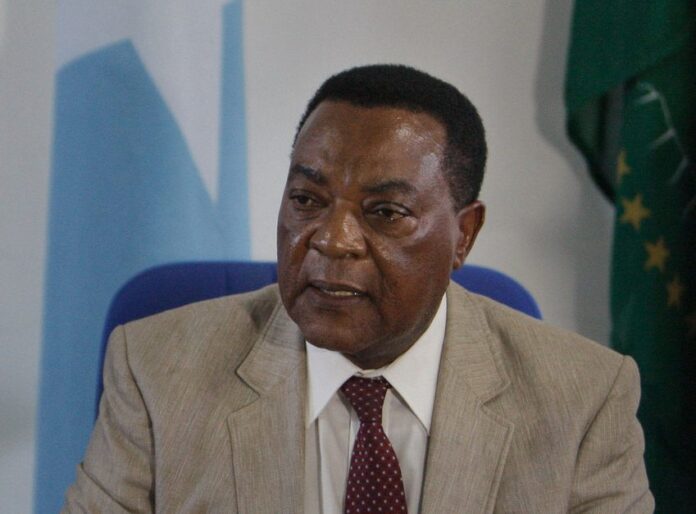
Tanzanian FM to Visit Iran on Wednesday

Tanzanian FM to Visit Iran on Wednesday

In a statement on Tuesday, Qassemi said the Tanzanian foreign minister and the delegation accompanying him will hold talks with high-ranking Iranian officials.

Mahiga plans to meet with his Iranian counterpart Mohammad Javad Zarif, President Hassan Rouhani, and a number of economic ministers to explore avenues for expanding bilateral ties between Tehran and Dodoma, Qassemi added.

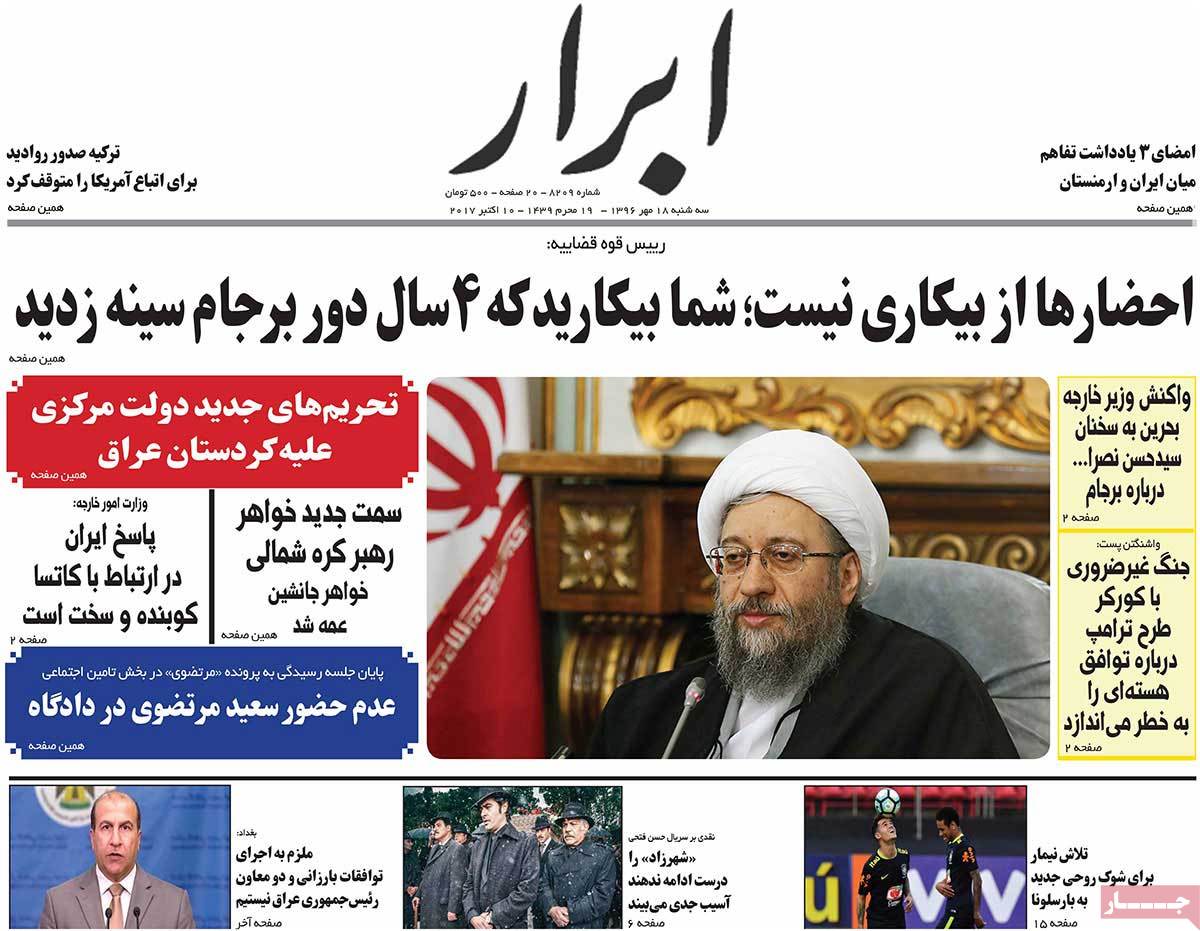
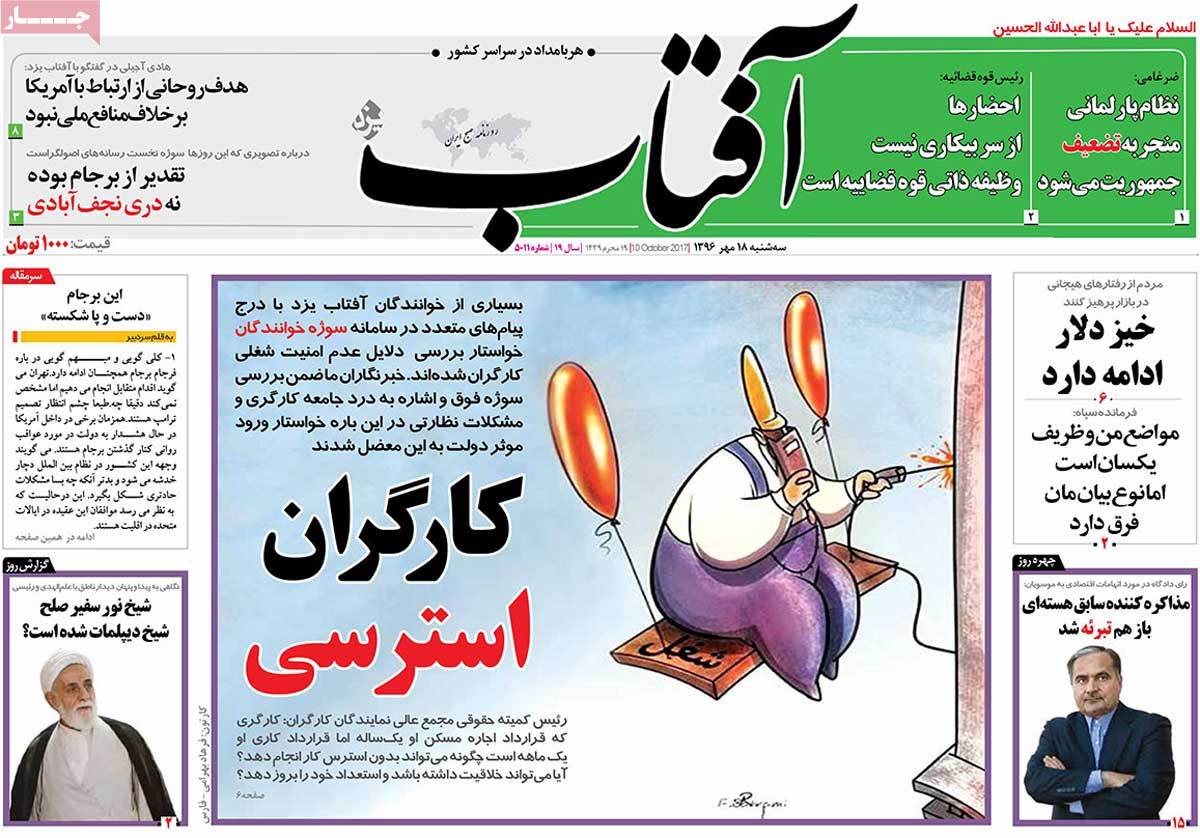
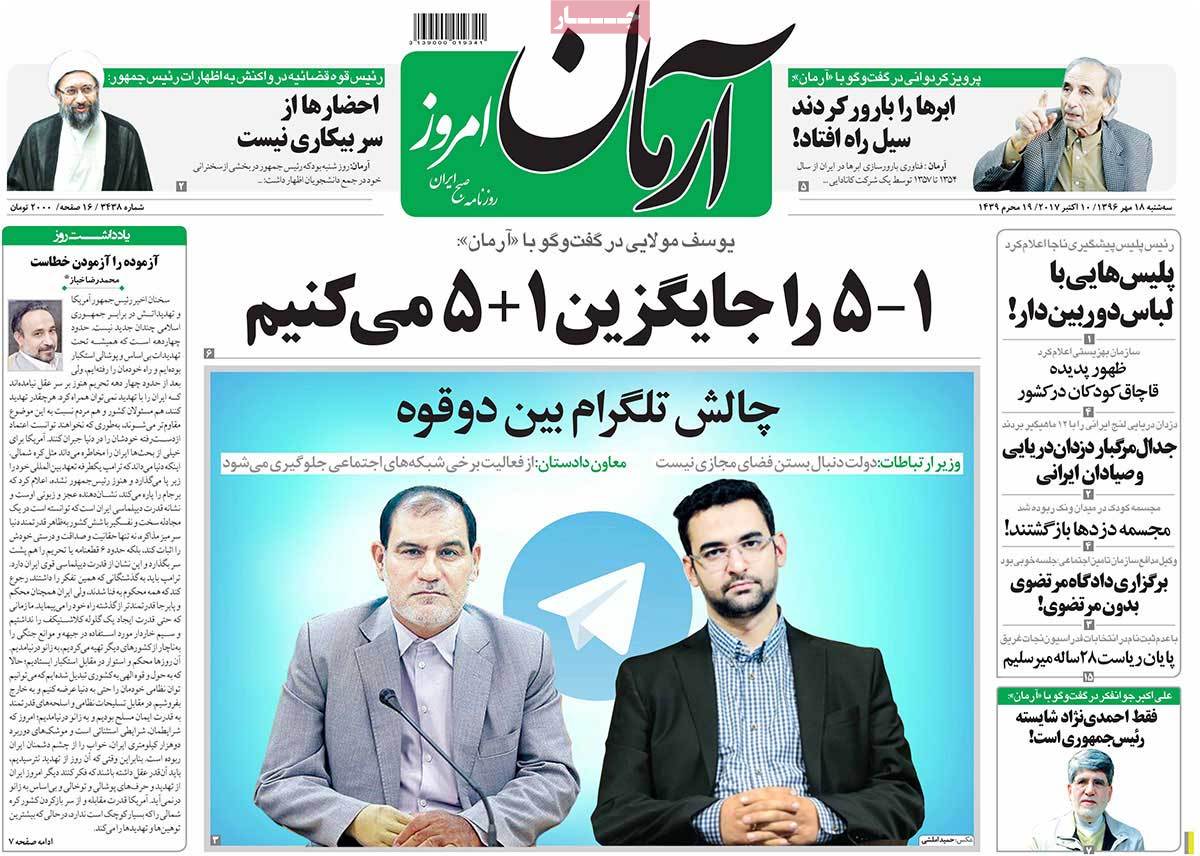
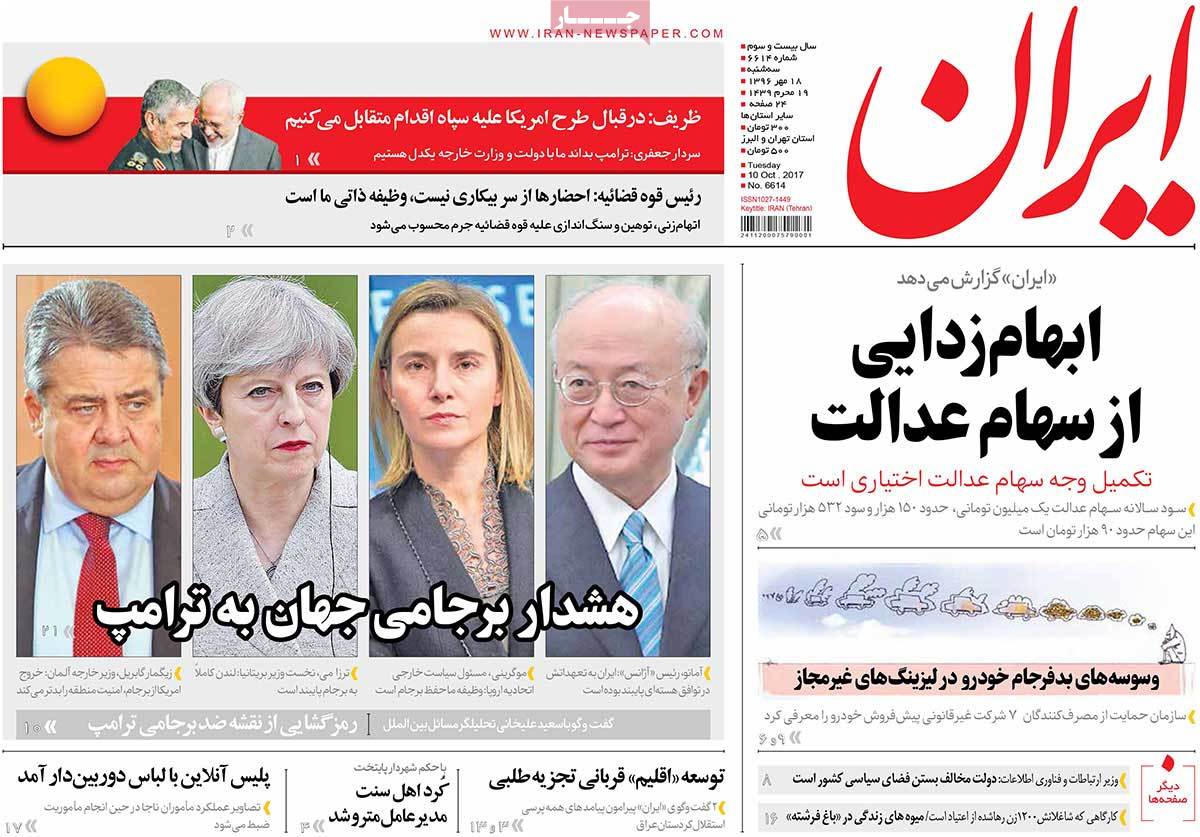
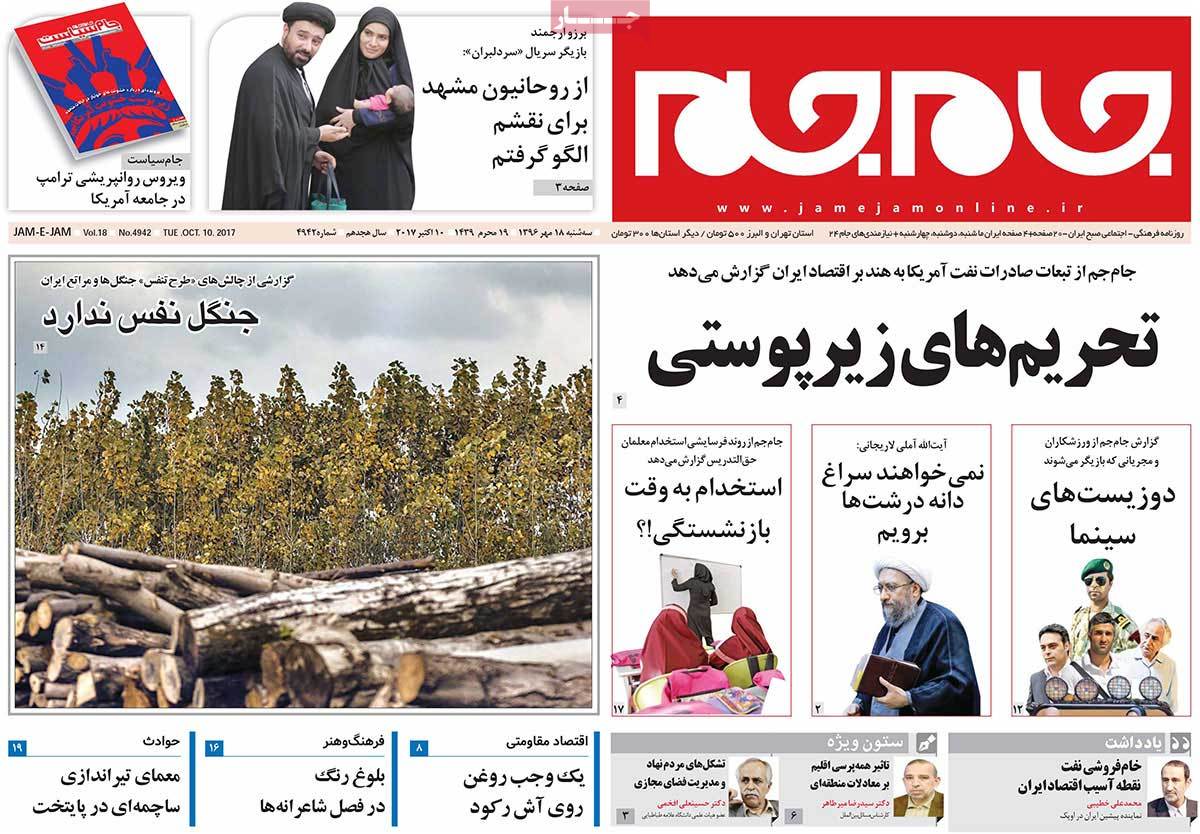
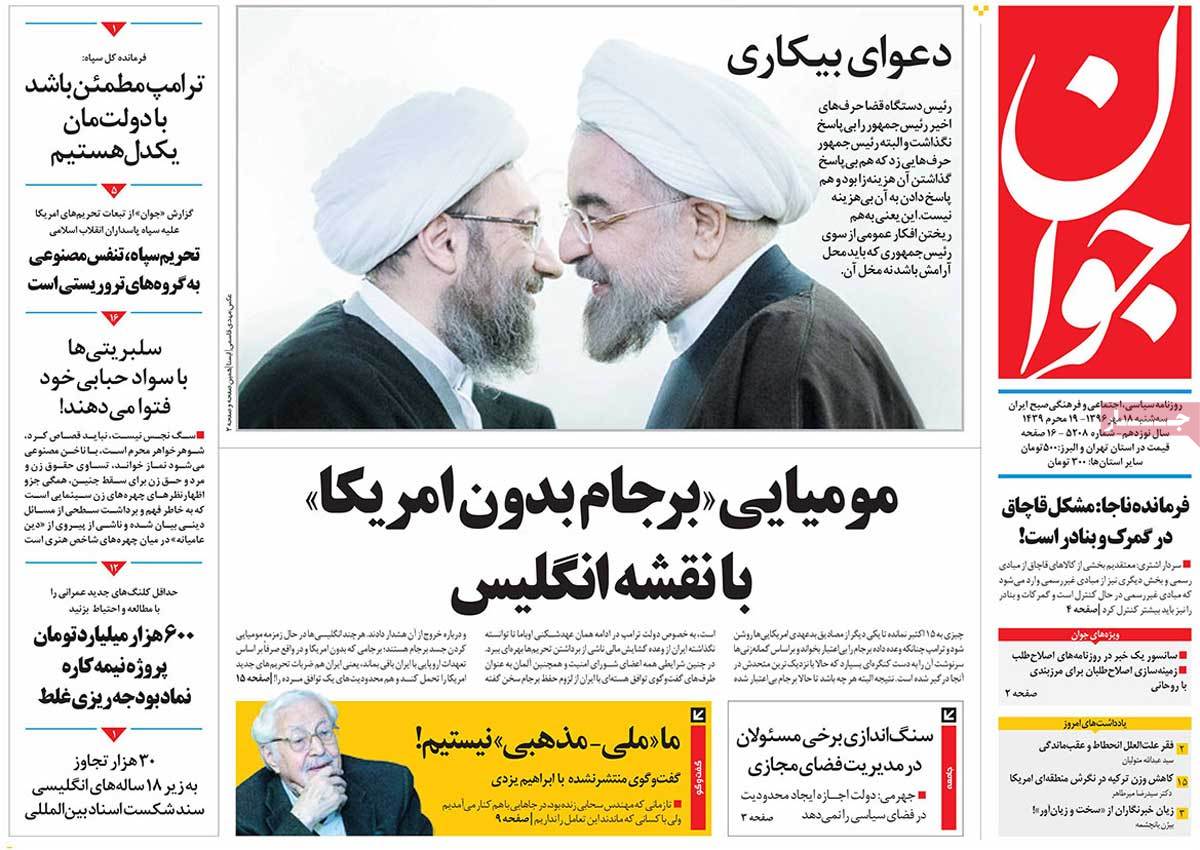
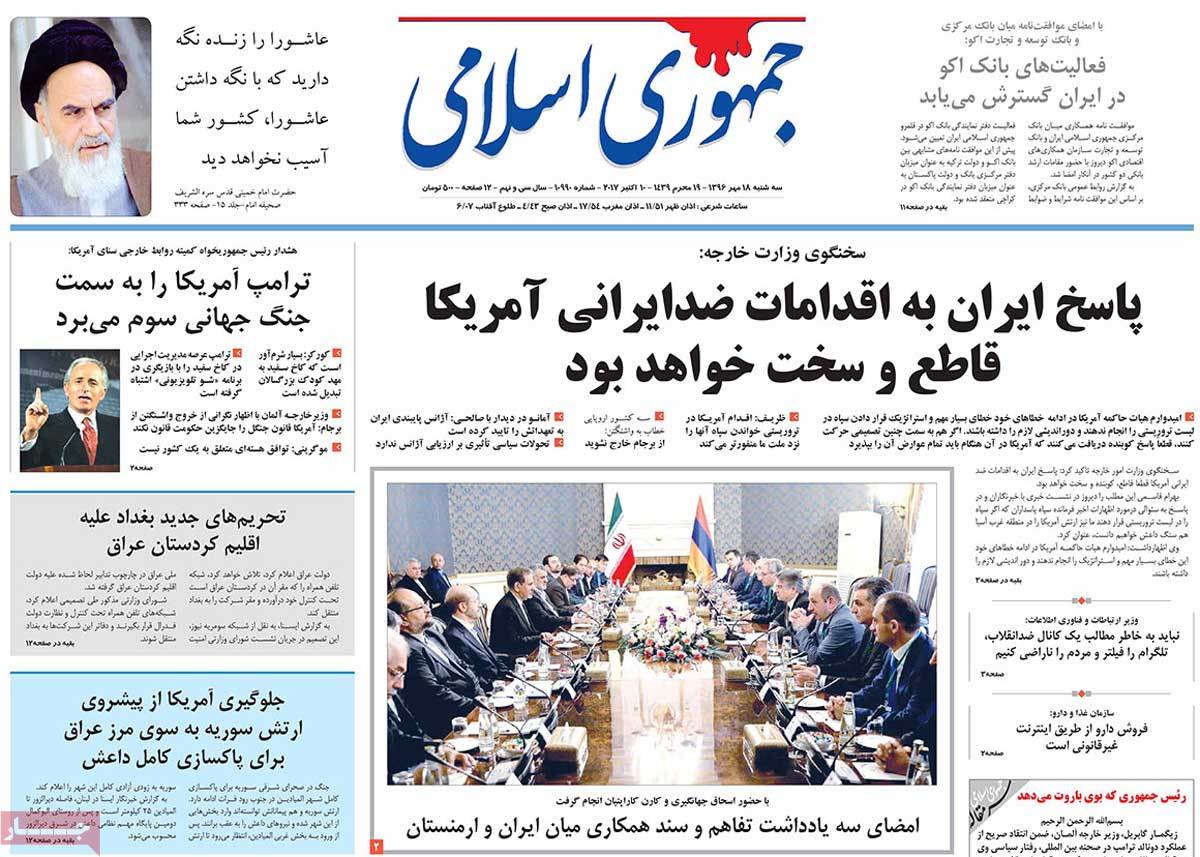
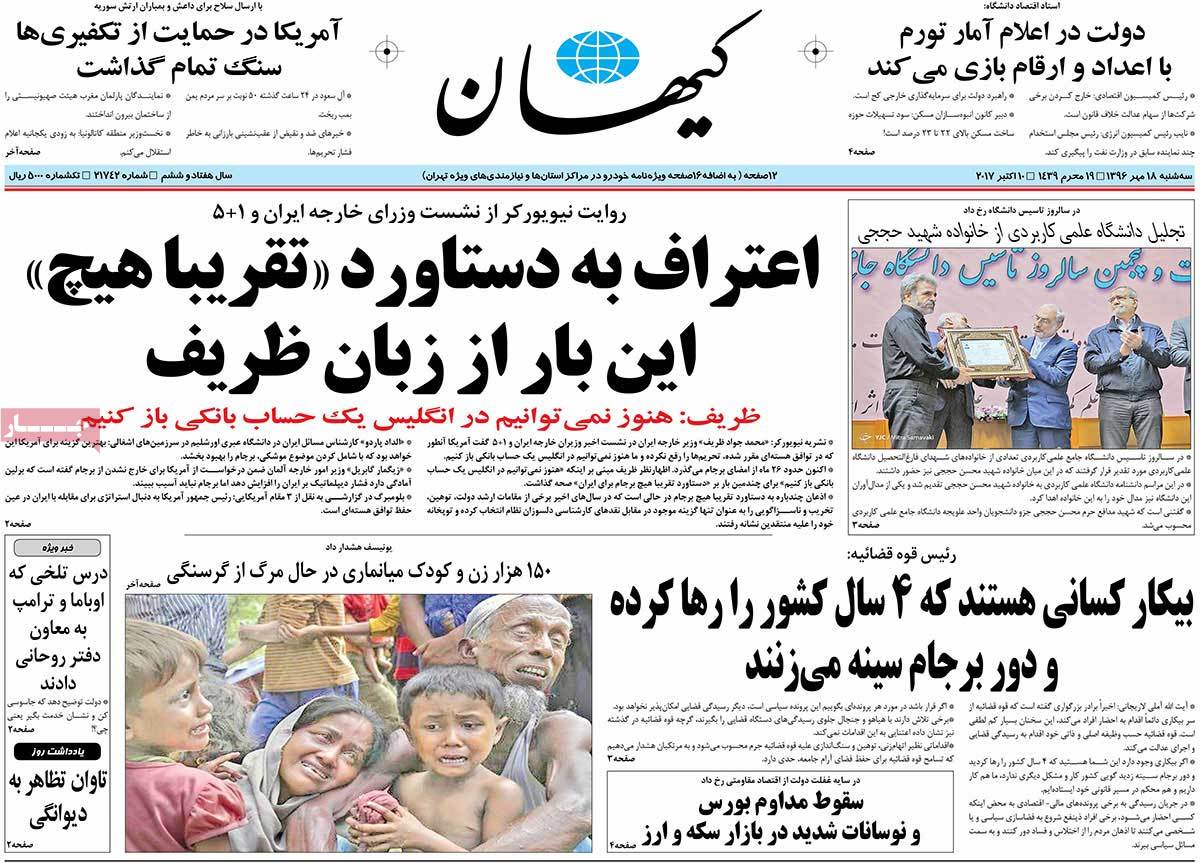
A Look at Iranian Newspaper Front Pages on October 10

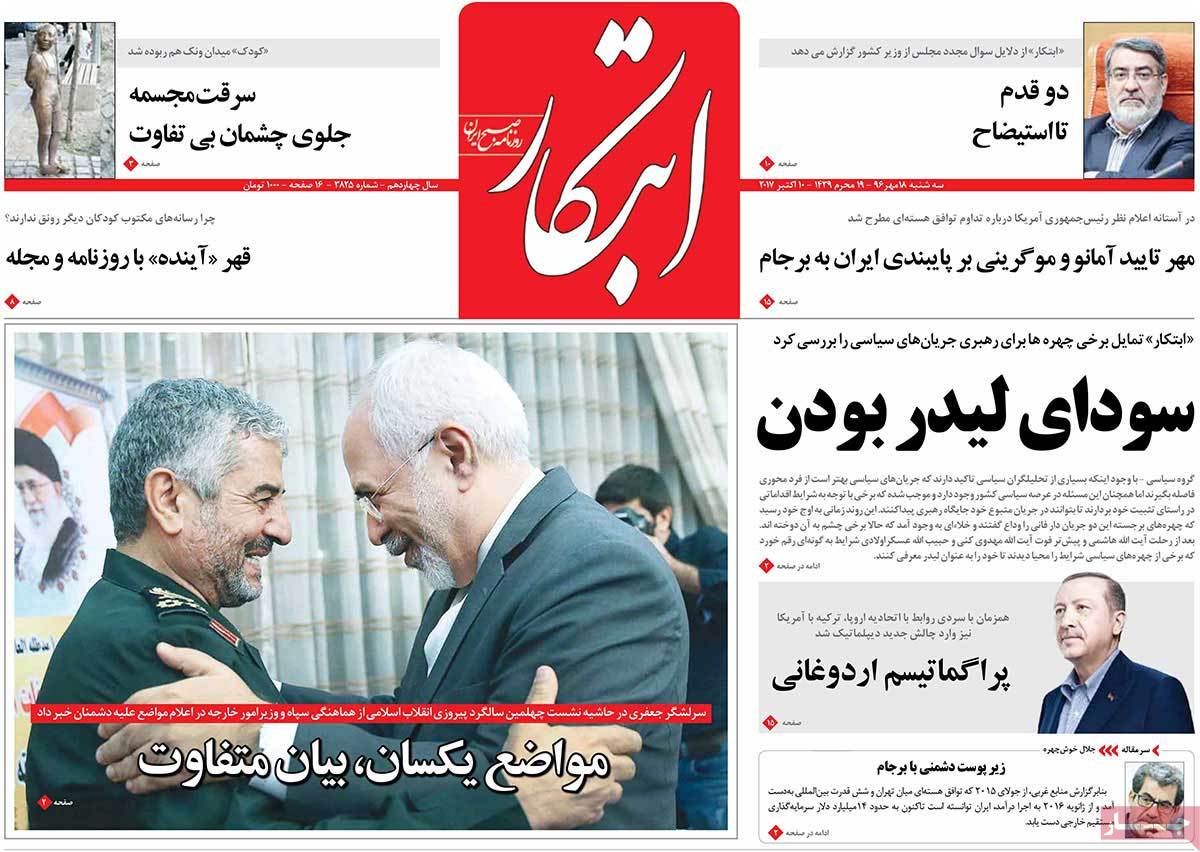
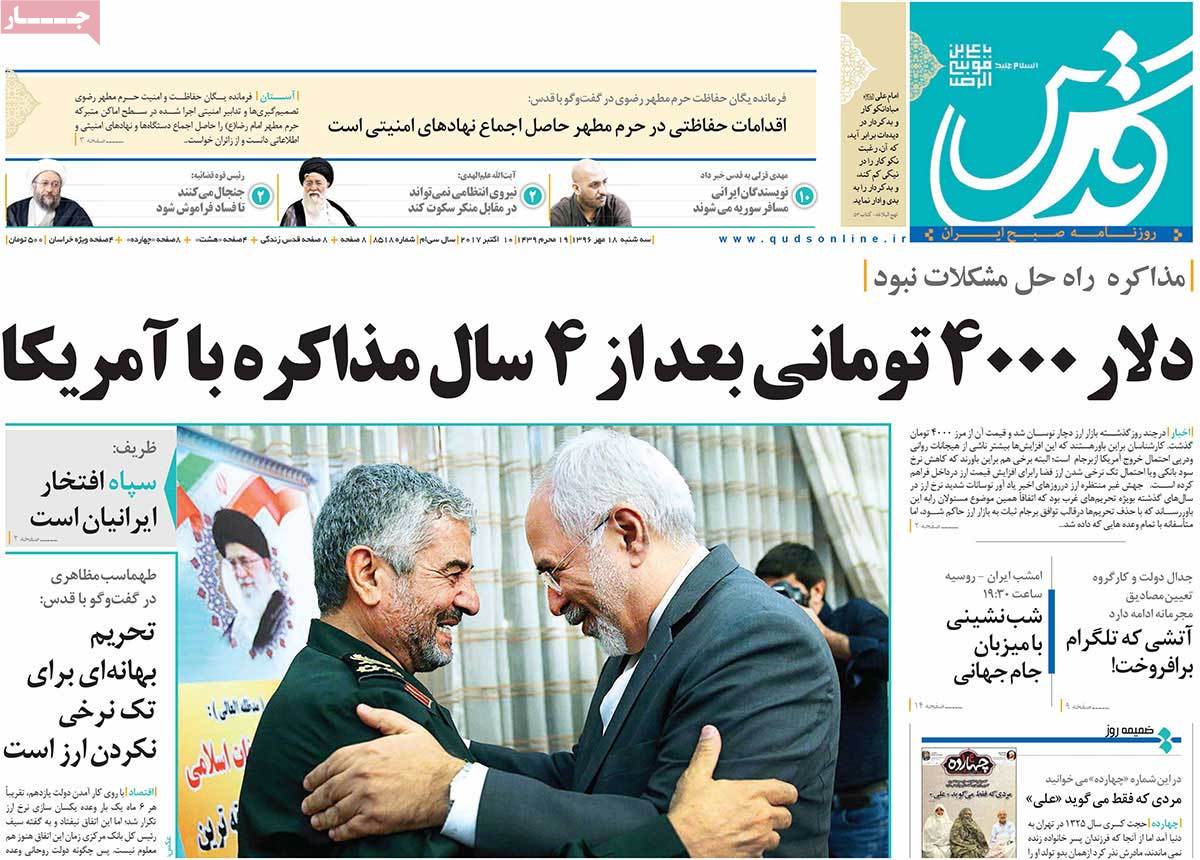
The top story in today’s newspapers was a meeting between Iranian Foreign Minister Mohammad Javad Zarif and IRGC Chief-Commander Major General Mohammad-Ali Jafari, where the two sides underlined the unity between IRGC and government in countering the enemies.

The meeting was mainly focused at showing Iran’s solidarity ahead of an expected decision by US President Donald Trump to blacklist the Islamic Revolution Guards Corps as a terrorist organization. Iranian papers today, and in recent days, widely covered Tehran’s reaction to the possible move.

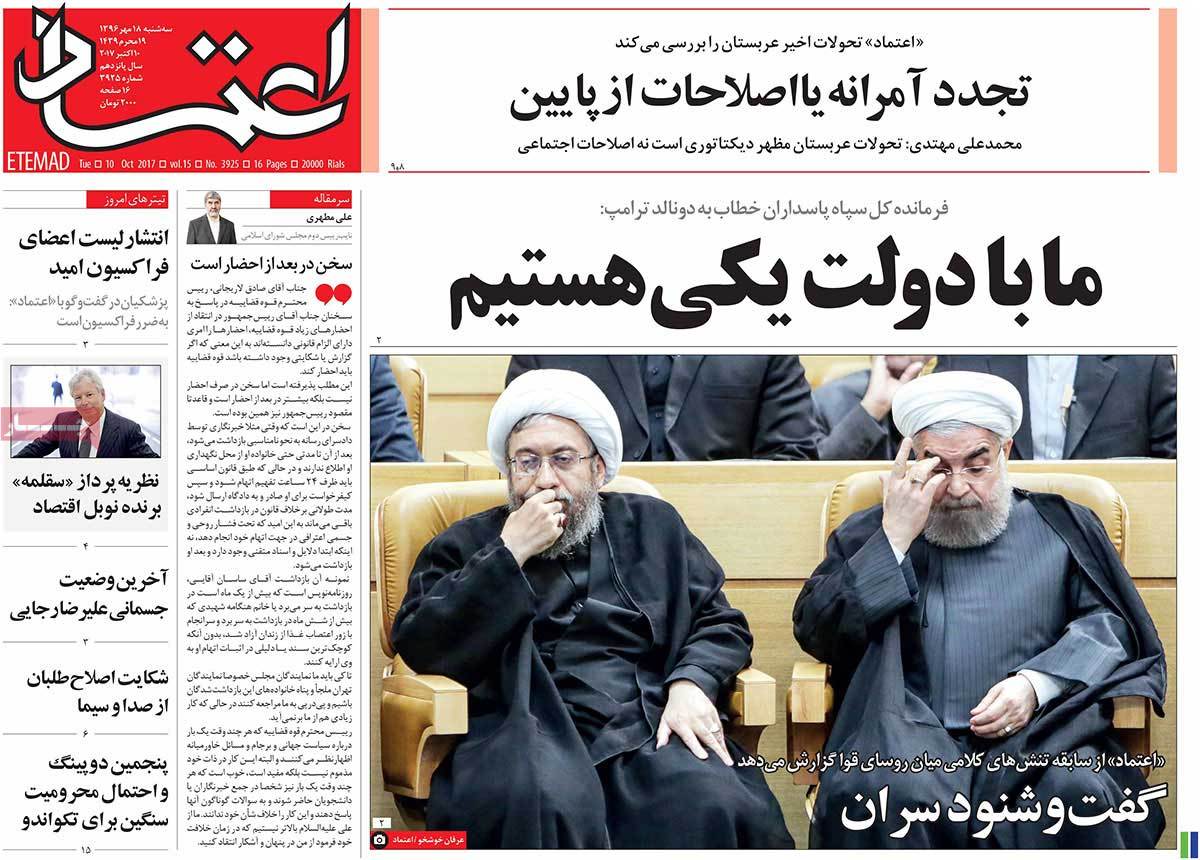
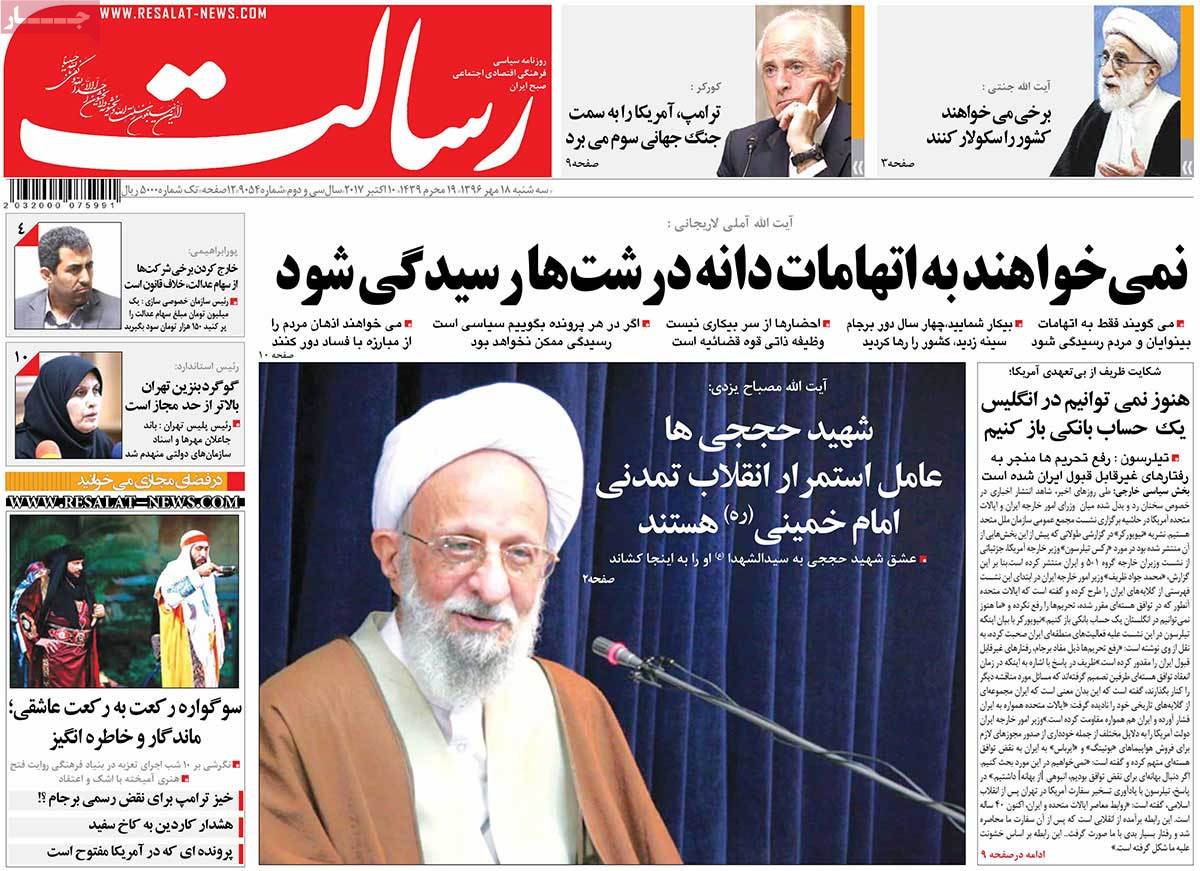
Newspapers also covered the remarks made by Judiciary Chief Ayatollah Sadeq Amoli Larijani in response to President Hassan Rouhani’s criticisms. Rouhani had lashed out at the Judiciary for arresting and summoning government officials and political activists, and Ayatollah Larijani stressed that the Judiciary is fulfilling its duty.

The above issues, as well as many more, are highlighted in the following headlines and top stories:


Abrar:

1- Iraqi Central Government’s New Sanctions against Iraqi Kurdistan

2- North Korean Leader’s Sister Replaces His Aunt

A Look at Iranian Newspaper Front Pages on October 10


Aftab-e Yazd:

1- Judiciary Chief Hits Back at Rouhani’s Criticisms

2- Conservative Figure Zarghami: Parliamentary System to Weaken Iran’s Republican Nature

3- IRGC Chief-Commander: Zarif and I Have Same Stances but Express It Differently

A Look at Iranian Newspaper Front Pages on October 10


Arman-e Emrooz:

1- We’ll Replace P5+1 with P5-1

2- Deadly Clash of Iranian Sailors, Pirates

A Look at Iranian Newspaper Front Pages on October 10


Ebtekar:

1- Chief-Commander Says IRGC, Foreign Ministry Coordinated against Enemies

  • Same Stances, Different Ways of Expressions

2- Amano, Mogherini Once Again Confirm Iran’s Compliance with JCPOA

A Look at Iranian Newspaper Front Pages on October 10


Etemad:

1- IRGC Chief-Commander to Trump: We Are Unanimous with Government

A Look at Iranian Newspaper Front Pages on October 10


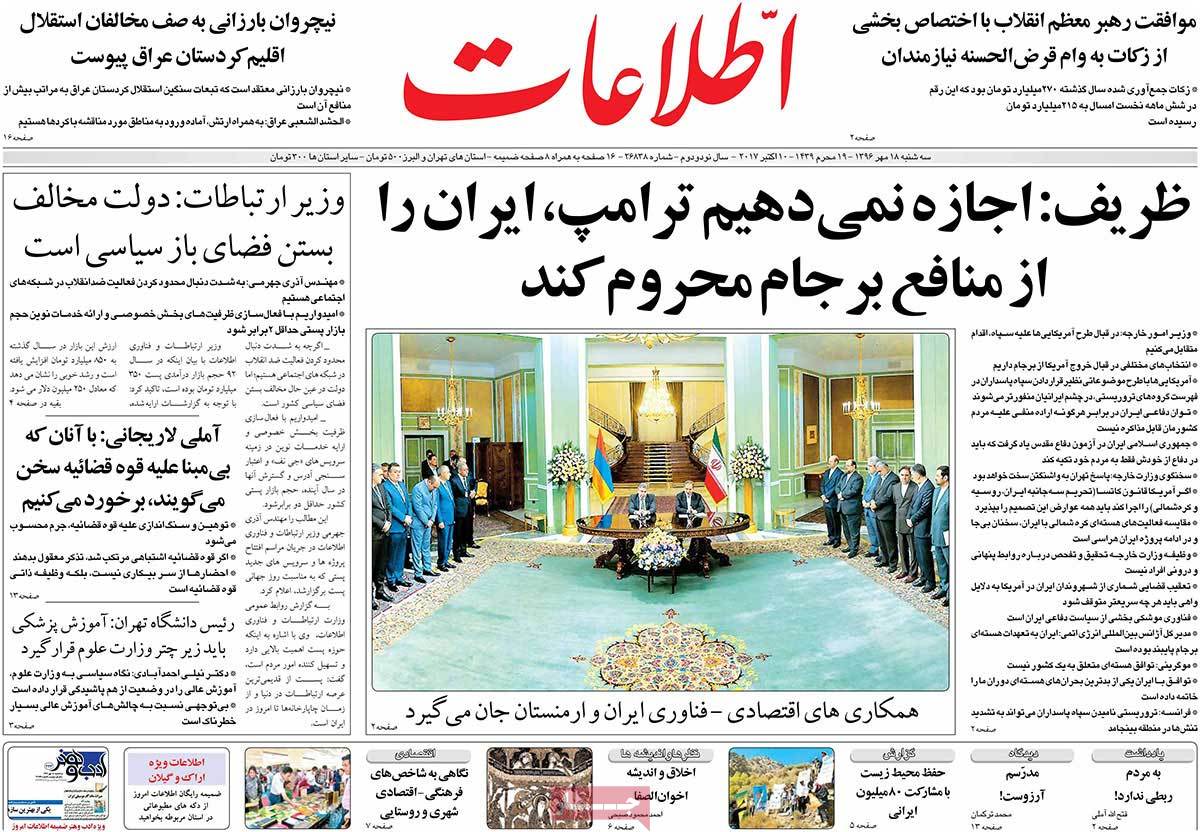
Ettela’at:

1- Zarif: We Won’t Let Trump Deprive Iran of JCPOA Benefits

2- Iraqi Kurdistan’s PM Joins Opponents of Kurdish Independence

3- Iran, Armenia to Expand Cooperation in Technology, Economic Field

4- ICT Minister: Government Opposed to Restricting Open Political Atmosphere

A Look at Iranian Newspaper Front Pages on October 10


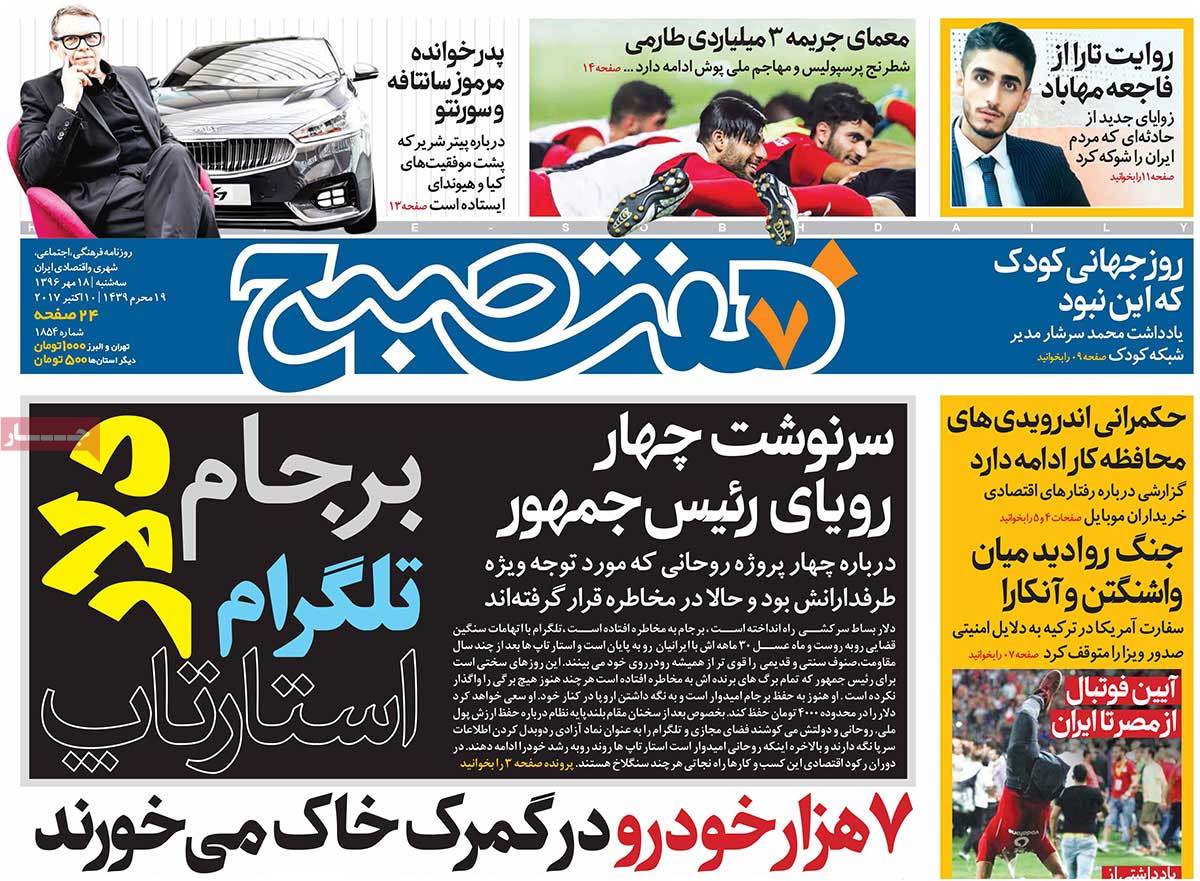
Haft-e Sobh:

1- Fate of Rouhani’s Four Dreams

  • A Report on Four of Rouhani’s Popular Projects Which Are Now at Risk

2- War of Visa between Washington, Ankara

  • US Embassy in Turkey Suspends Issuance of Visa for Security Reasons

A Look at Iranian Newspaper Front Pages on October 10


Iran:

1- World Warns Trump against Scrapping Iran Nuclear Deal

2- Zarif: Iran to Reciprocate US Possible Move against IRGC

A Look at Iranian Newspaper Front Pages on October 10


Jame Jam:

1- Indirect Sanctions:

  • A Report on Repercussions of US Oil Exports to India on Iran Economy

A Look at Iranian Newspaper Front Pages on October 10


Javan:

1- Mummifying Nuclear Deal without US with UK Plot

2- Blacklisting IRGC to Administer Artificial Respiration to Terror Groups

A Look at Iranian Newspaper Front Pages on October 10


Jomhouri Eslami:

1- Foreign Ministry Spokesman: Iran to Give Crushing Response to US Move against Tehran

2- ECO Bank to Expand Activities in Iran

3- Trump Taking US towards World War III: Republican Senator

A Look at Iranian Newspaper Front Pages on October 10


Kayhan:

1- Zarif Finally Admits Nuclear Deal Has Had Almost Nothing for Iran

2- US Does Its Best in Supporting Takfiri [Extremist] Terrorists

3- UNICEF Warns: 150,000 Myanmarese Kids, Women Dying of Hunger

A Look at Iranian Newspaper Front Pages on October 10


Quds:

1- Dollar Rate in Iran Hikes Up after 4 Years of Talks with US

2- Zarif: IRGC Is an Honour for Iranian People

A Look at Iranian Newspaper Front Pages on October 10


Resalat:

1- Judiciary Chief: They Don’t Want Us to Prosecute Criminals Linked with Gov’t

2- Ayatollah Jannati: Some Trying to Make the Country Secular

A Look at Iranian Newspaper Front Pages on October 10


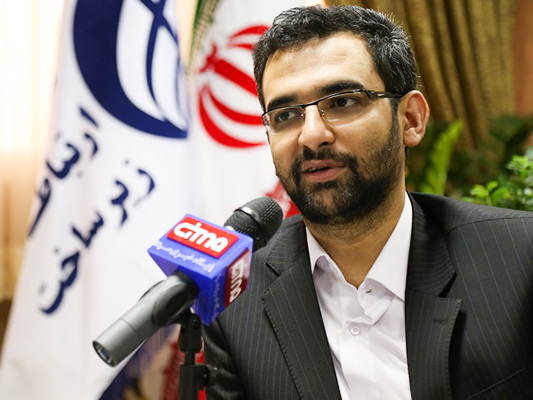
Rouhani’s Gov’t to Open Up Iran’s Political Atmosphere: ICT Minister

Mohammad Javad Azari Jahromi

Minister of communications and information technology, Mohammad-Javad Azari Jahromi, says all institutions of the Islamic establishment see eye to eye when it comes to countering counter-revolutionary elements operating in the virtual space.

However, he said, the necessity of tackling counter-revolutionary elements should not turn into a pretext to label political opposition as counter-revolutionaries and block the country’s political landscape. He said the government intends to open up the country’s political atmosphere.

Touching upon anti-revolutionaries’ activities in the cyberspace, he said, “Counter-revolutionary elements seek to create public discontent, and we shouldn’t further fuel that.”

The ICT minister then touched upon recent remarks by judicial officials regarding Telegram and counter-revolutionary channels.

“Comments by the country’s prosecutor general, who said he didn’t want to block the cyberspace, are promising. All constituents of the establishment have the same opinion on counter-revolutionaries’ activities in the cyberspace in the country, and they cannot afford to see this space be used for acting against people’s mental security and spreading hate and lies,” the minister noted.

“We all agree that anti-revolution channels which hatch plots and disrupt people’s mental security and their investments in the country mustn’t be allowed to work, and we are seriously working to limit their activities.”

He said we are also dealing with numerous cases where people have come to the ministry and asked it to tackle anti-revolution activities.

“The enemy should know that the administration (the executive branch) and the Judiciary do not have differences in this regard and have the same opinion.”

Azari Jahromi’s comments came after a channel in the Telegram messaging app started raising false allegations against the country’s top officials, particularly the Judiciary Chief Ayatollah Sadeq Amoli Larijani. The counter-revolutionary channel’s activities have sparked controversy in Iran over the need to restrict the activities of such online services.

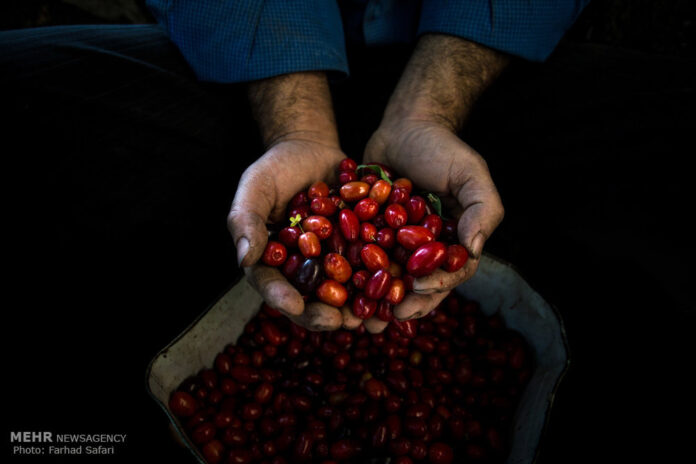
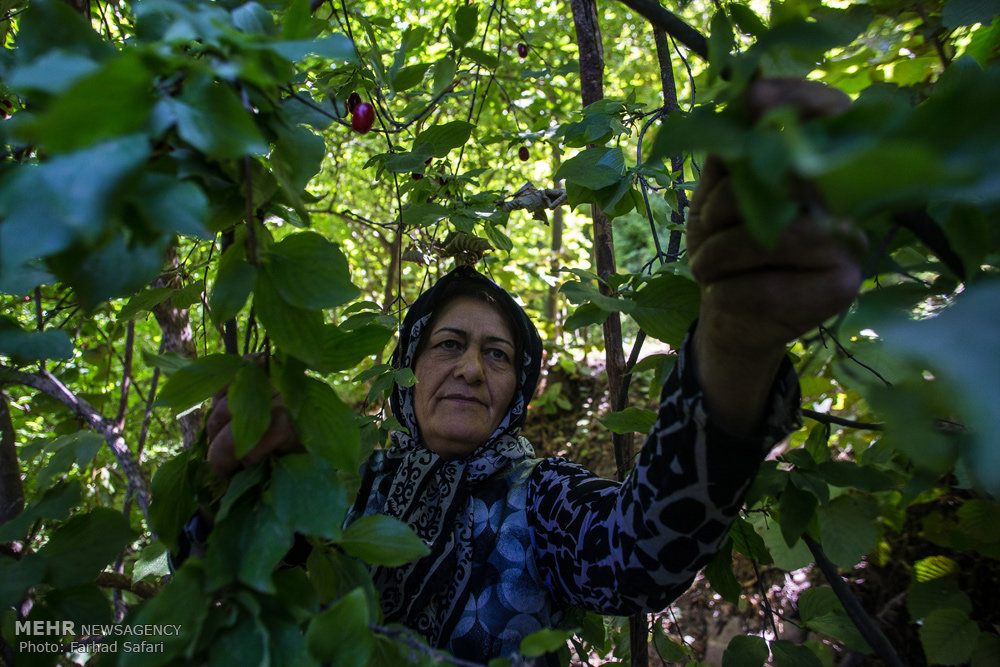
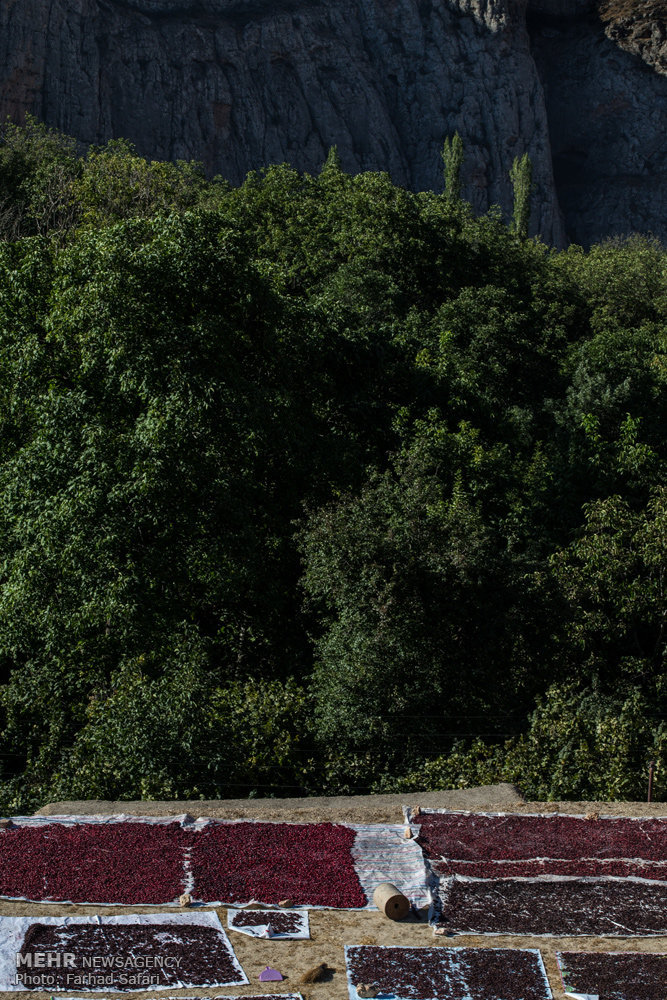
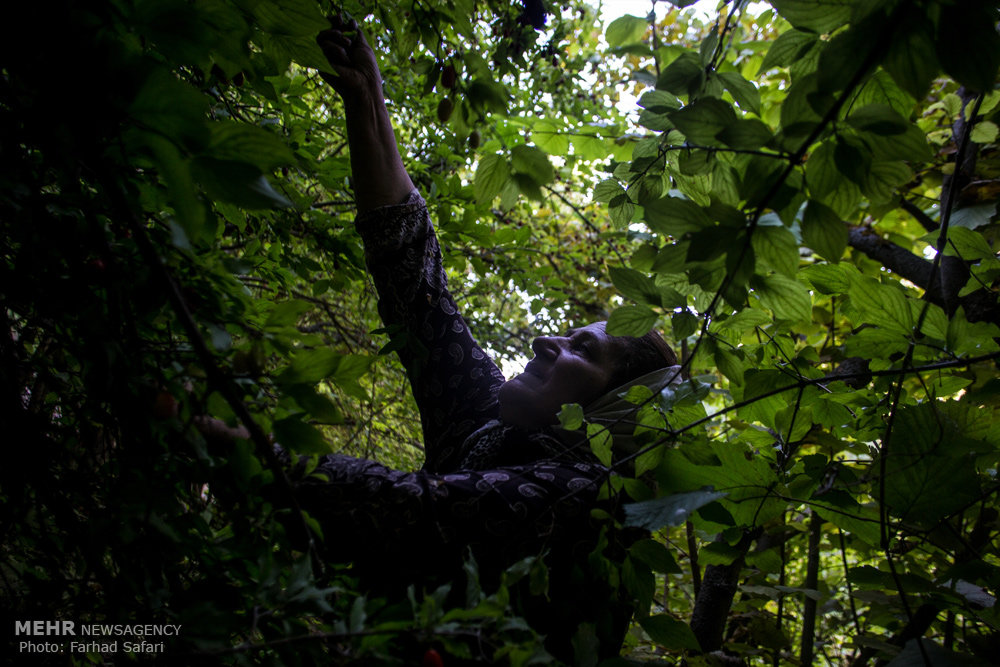
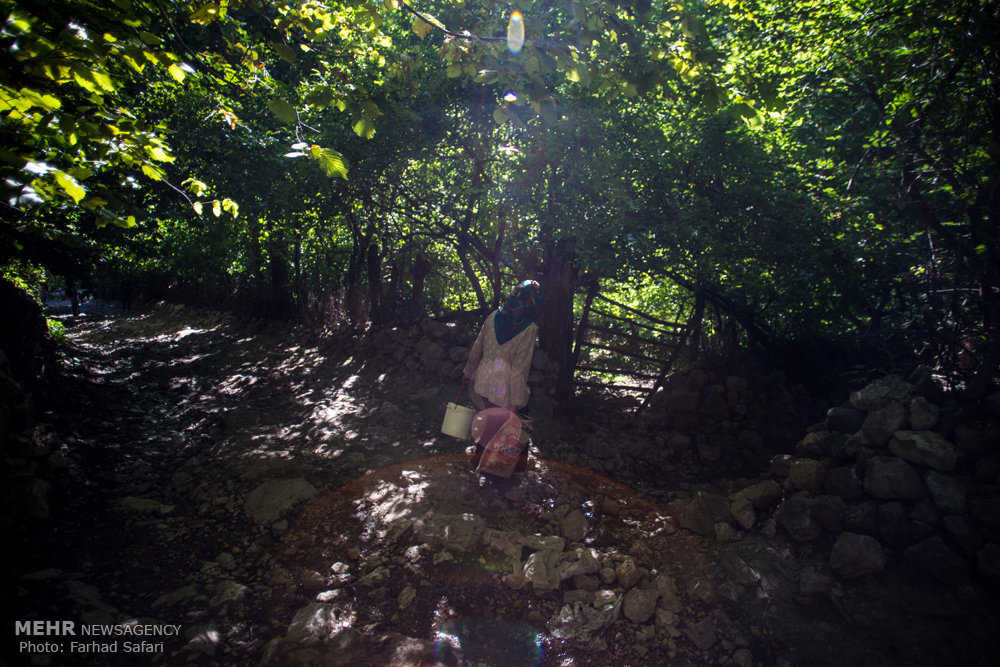
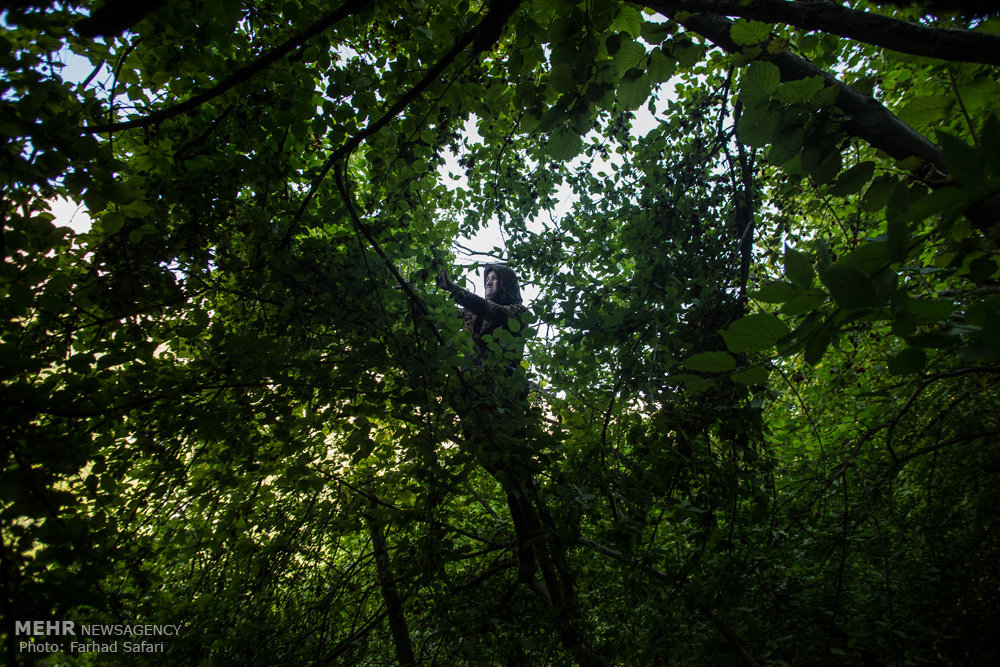
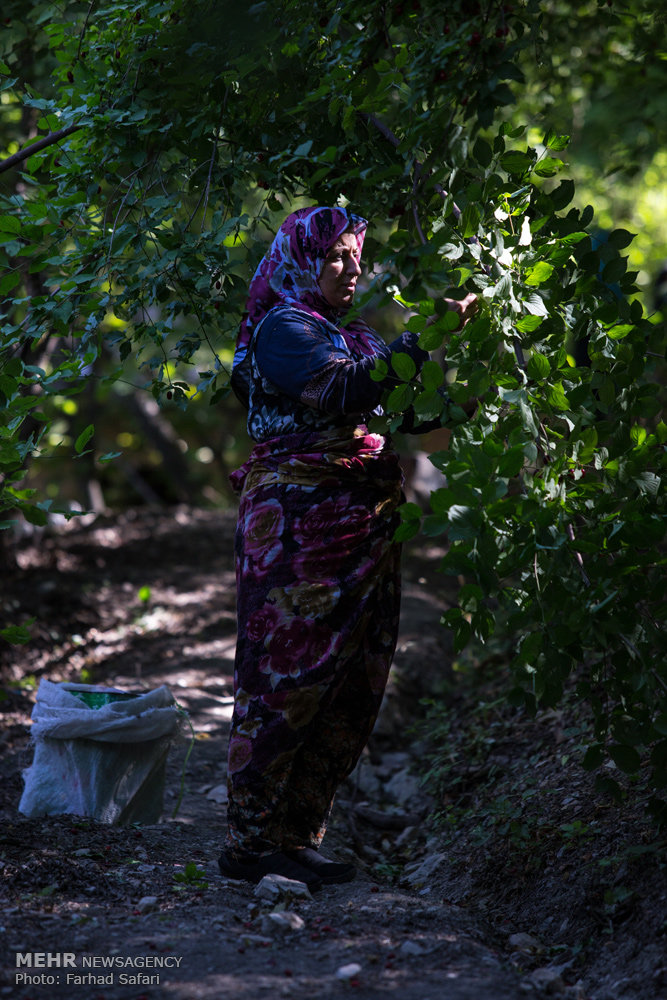
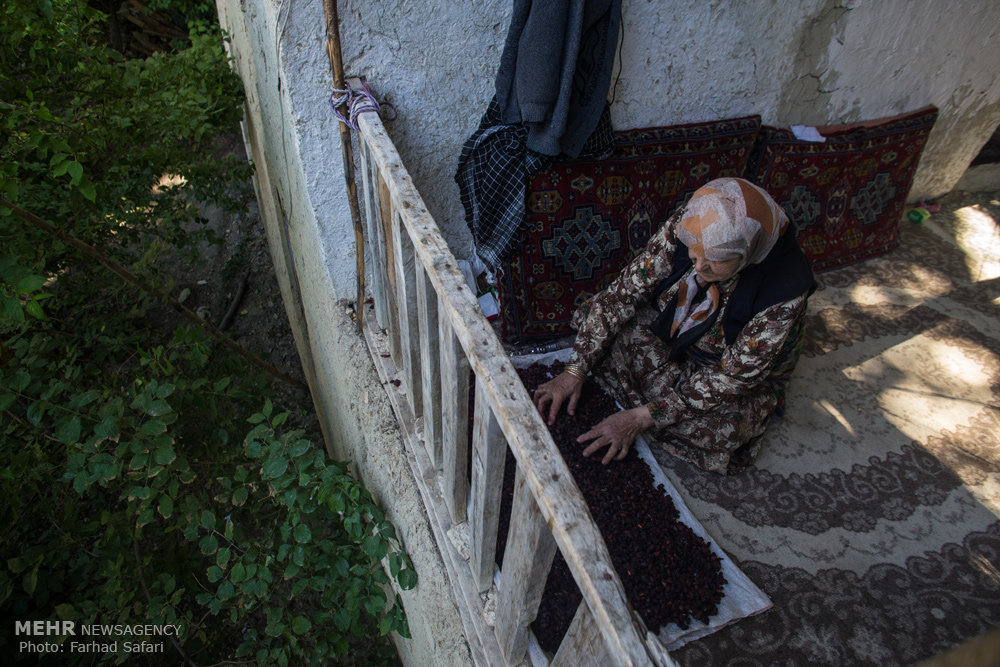
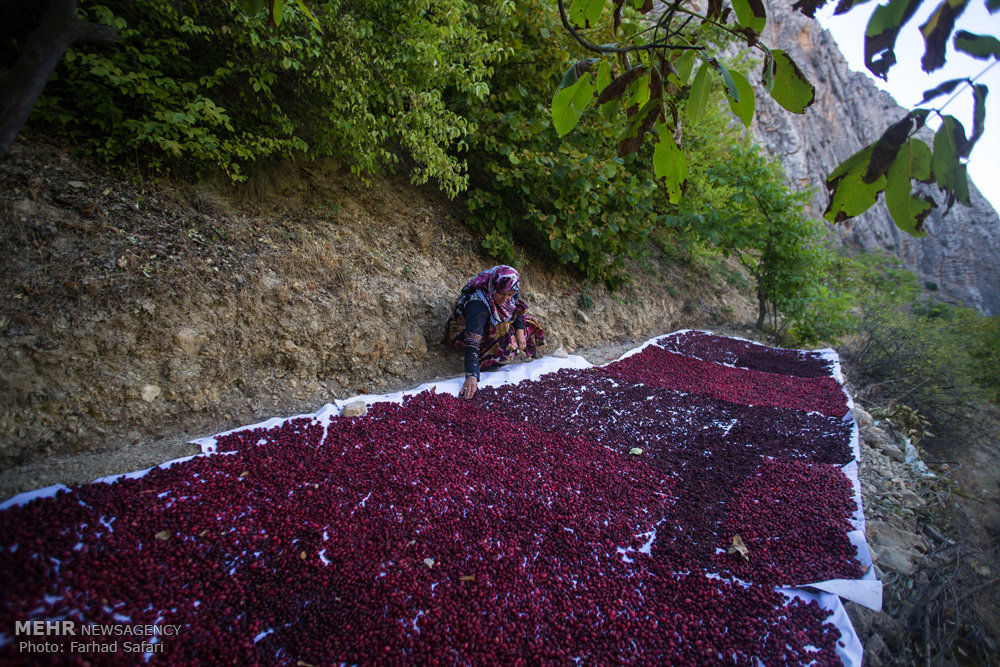
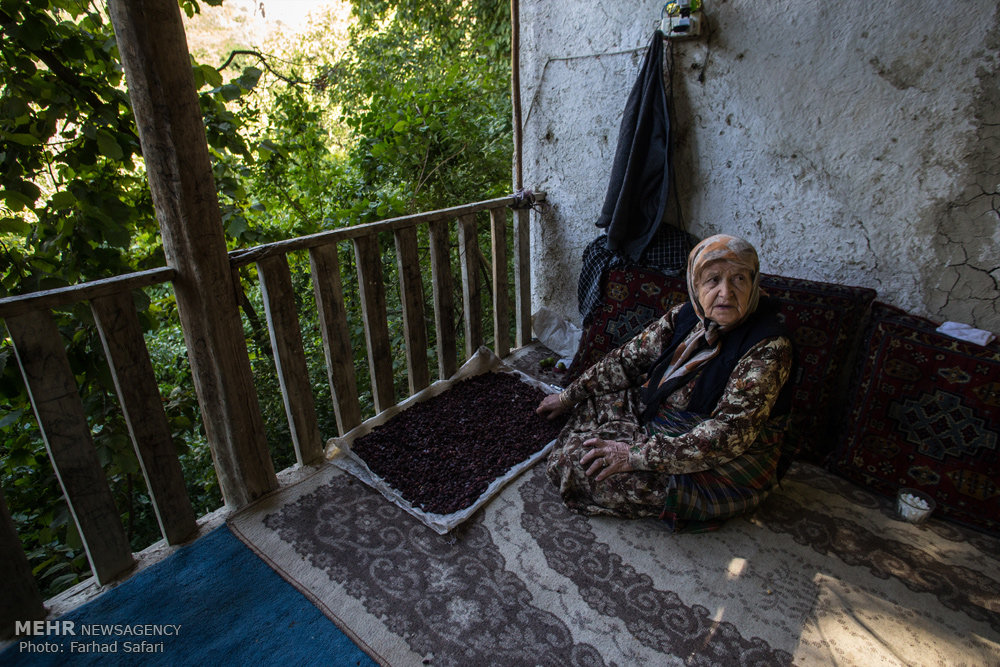
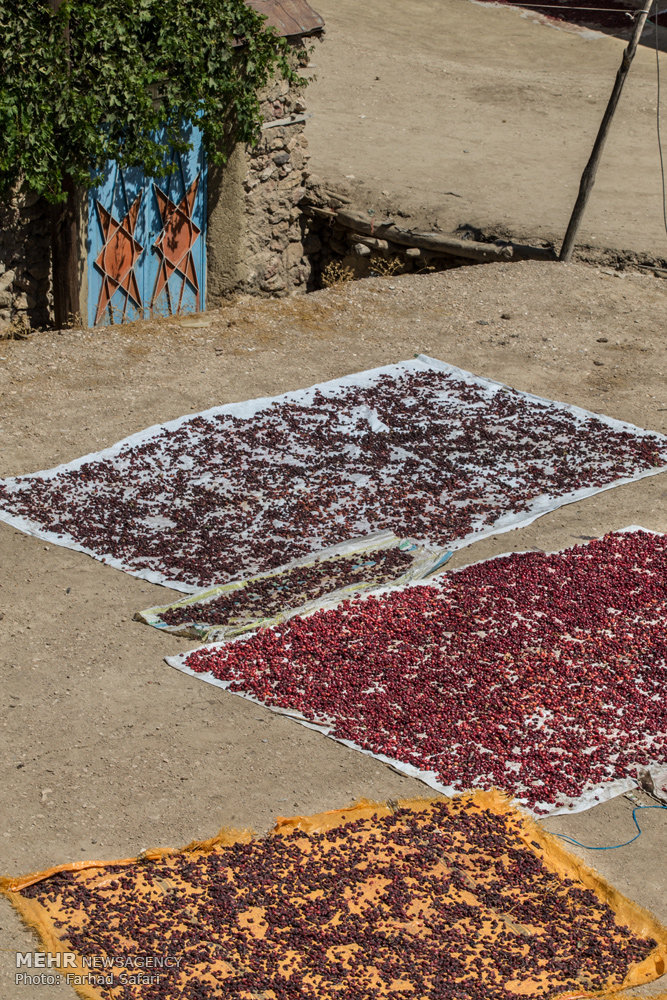
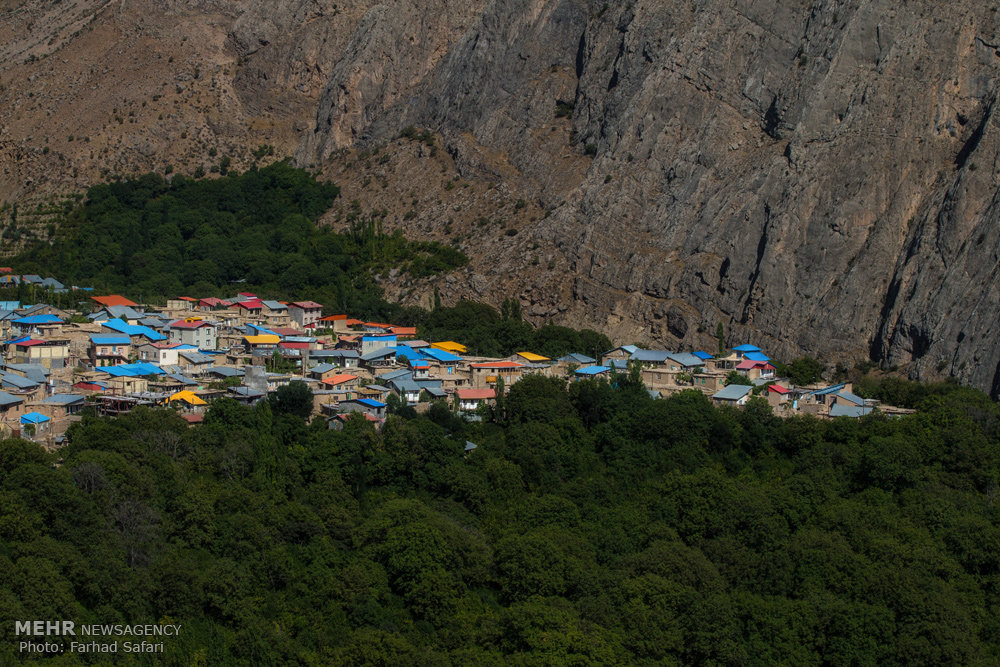
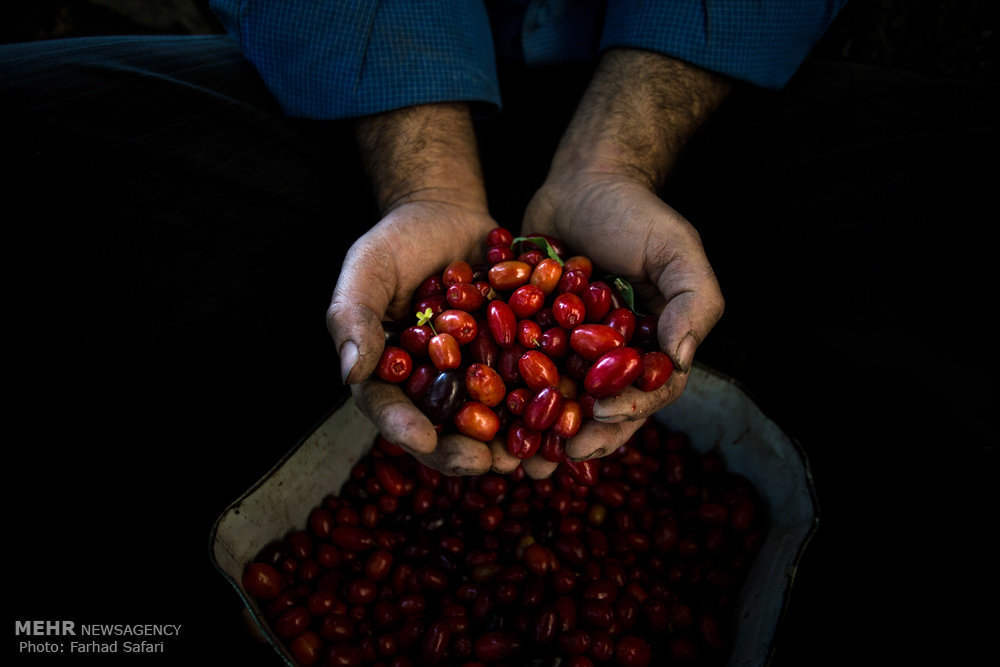
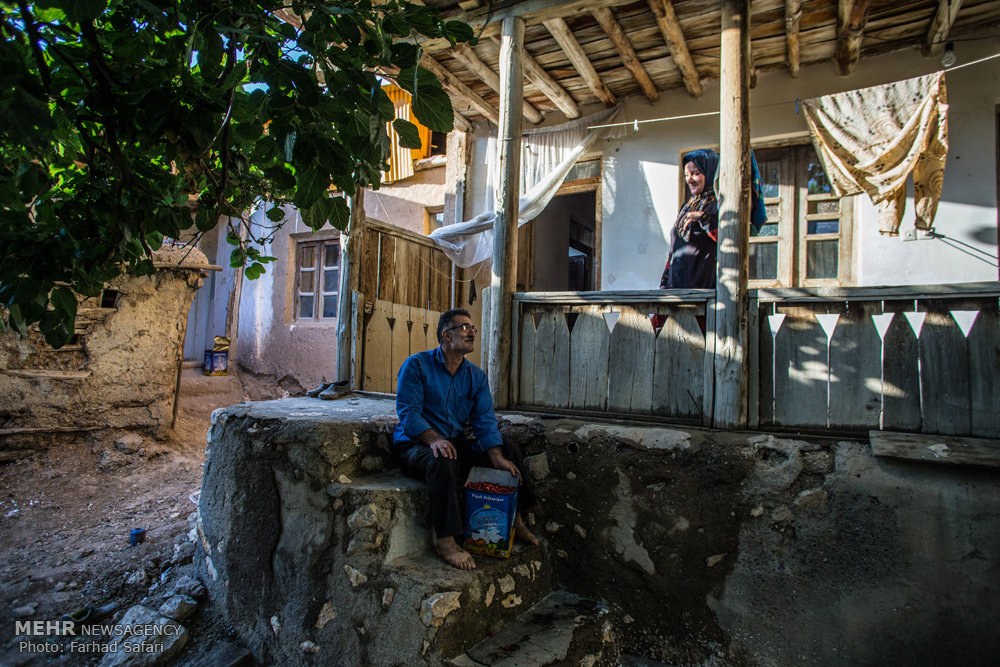
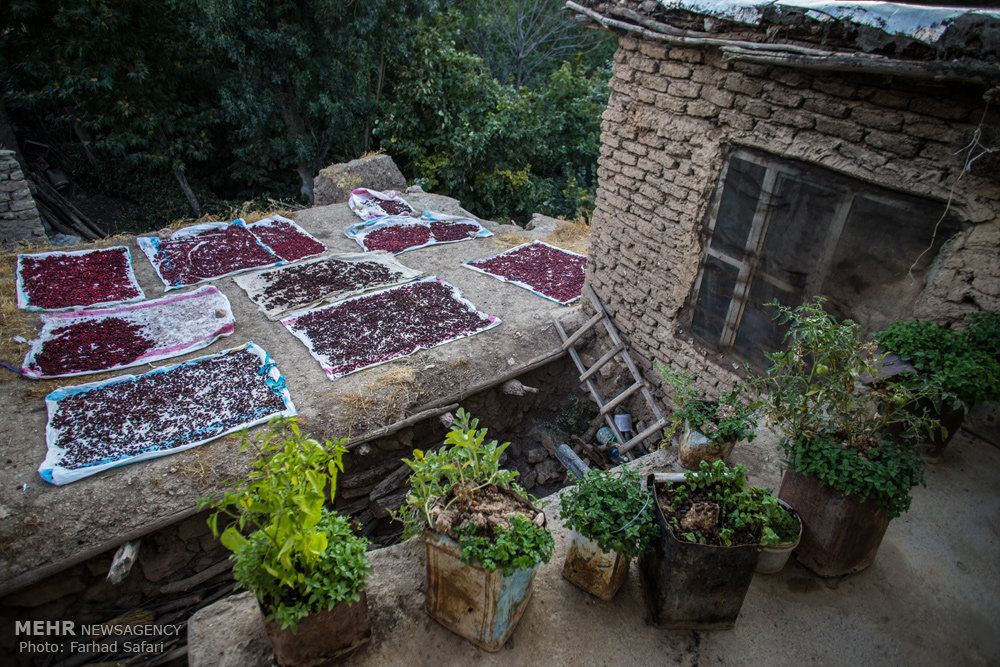
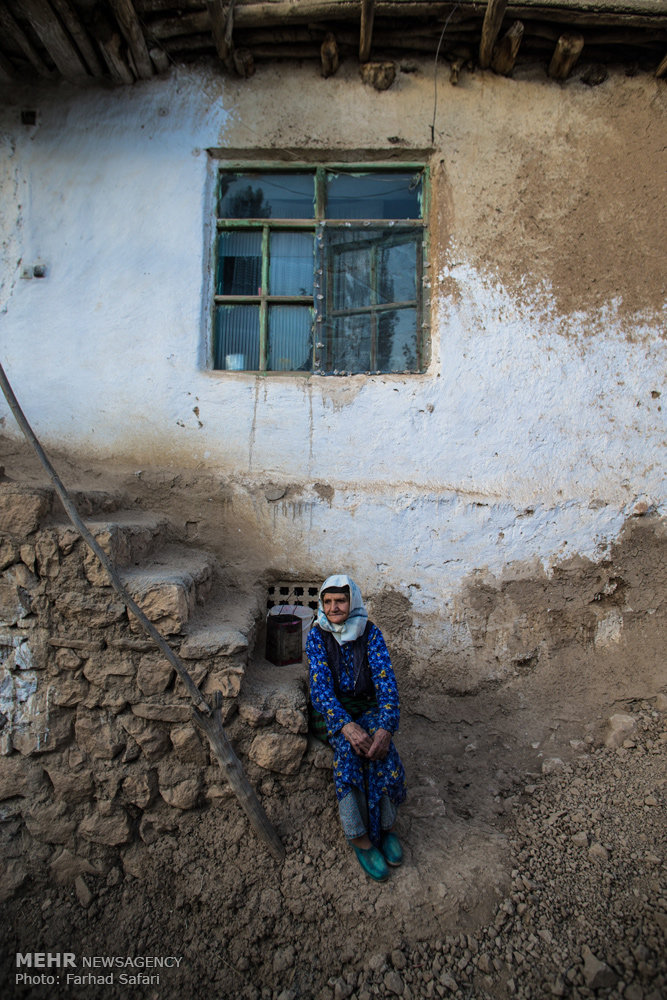
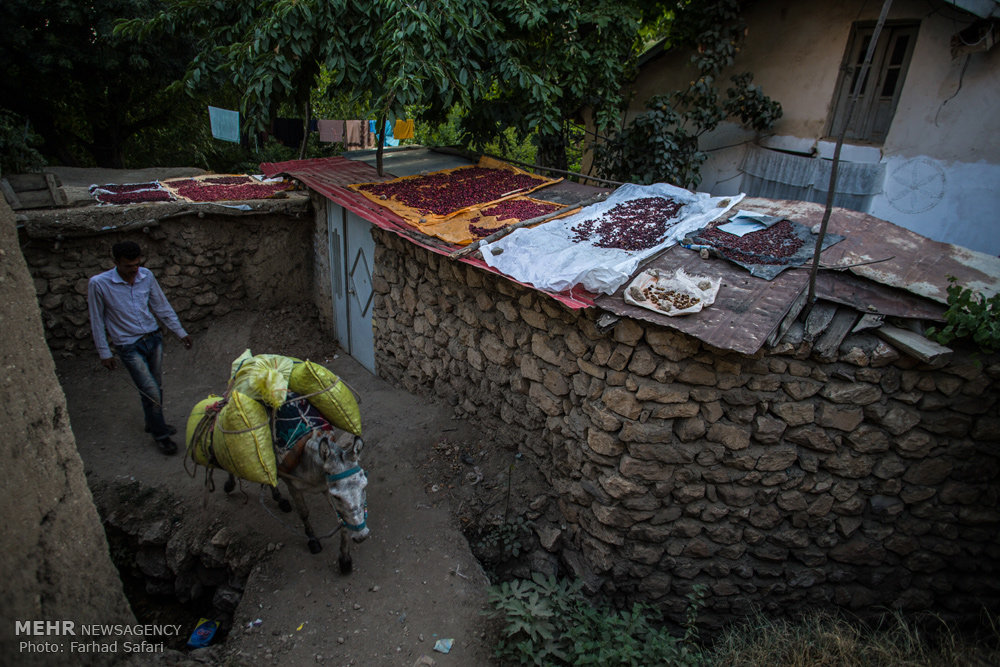
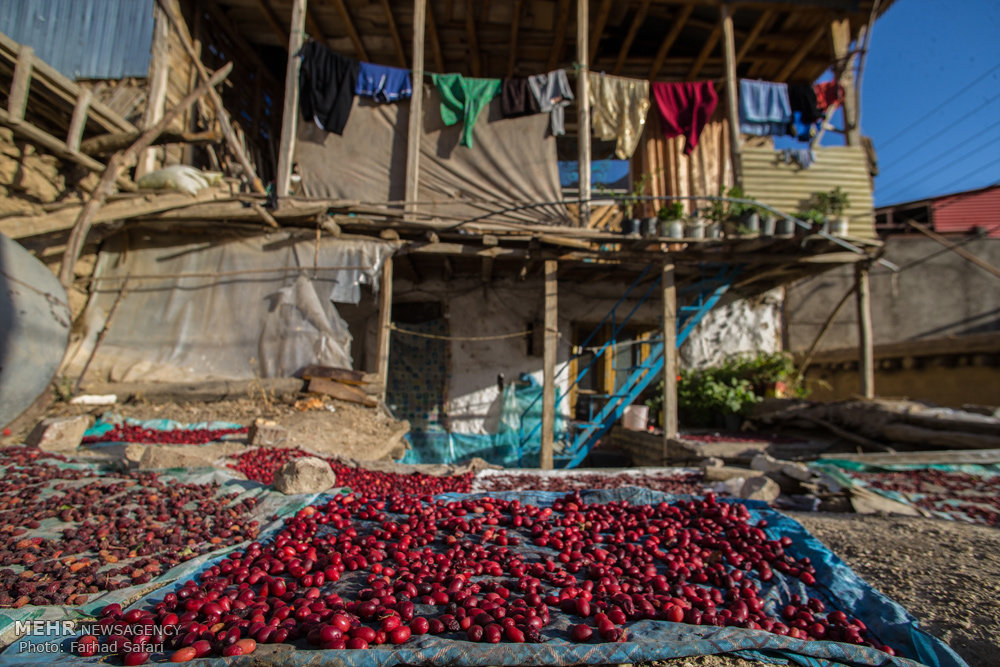
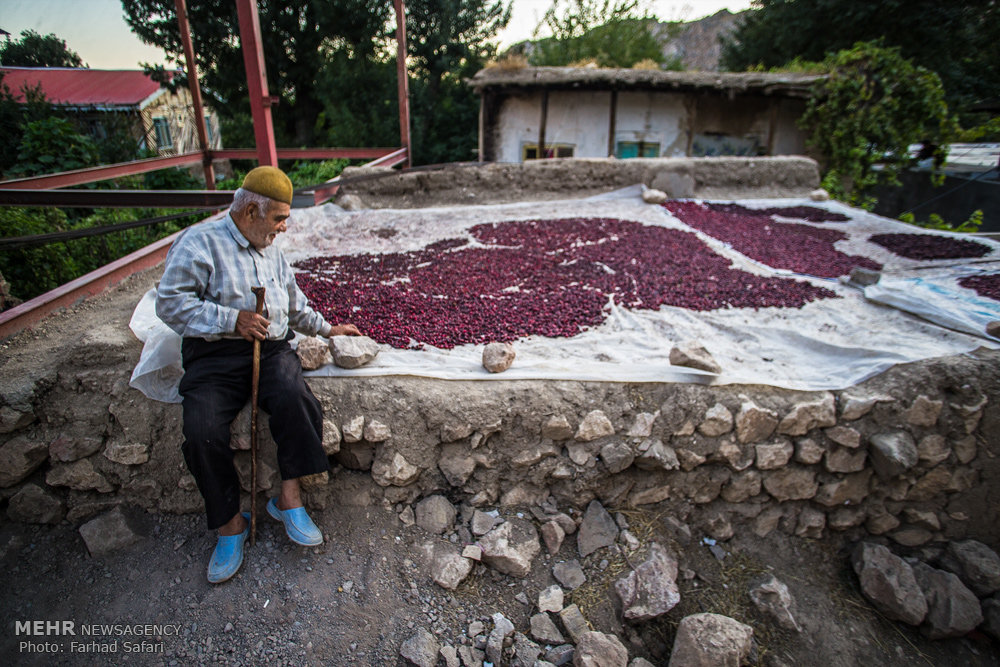
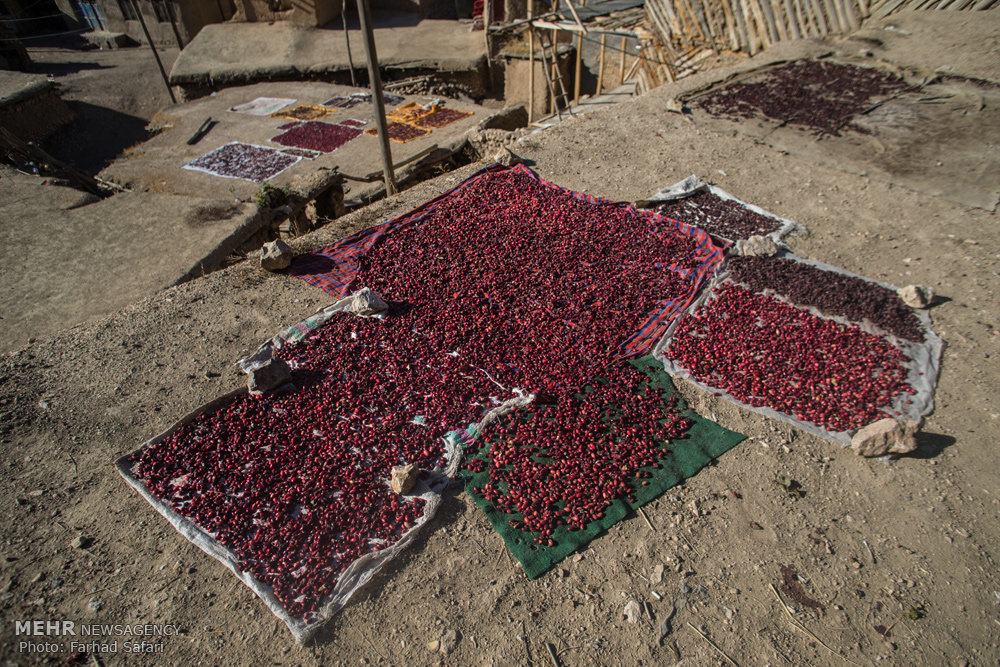
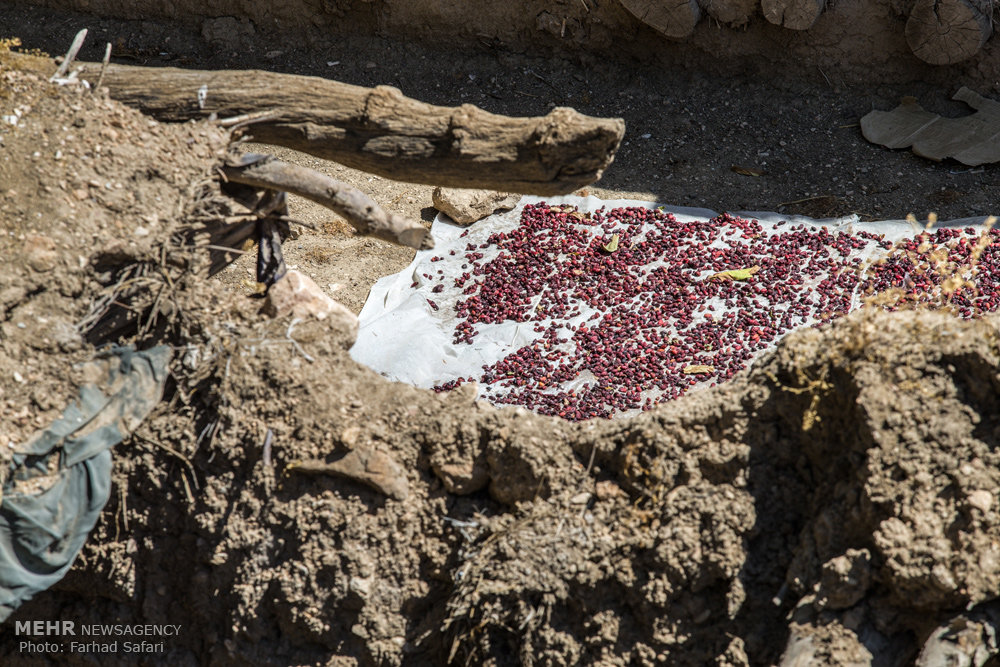
Village of Hir; Iranian Capital of Cornelian Cherry

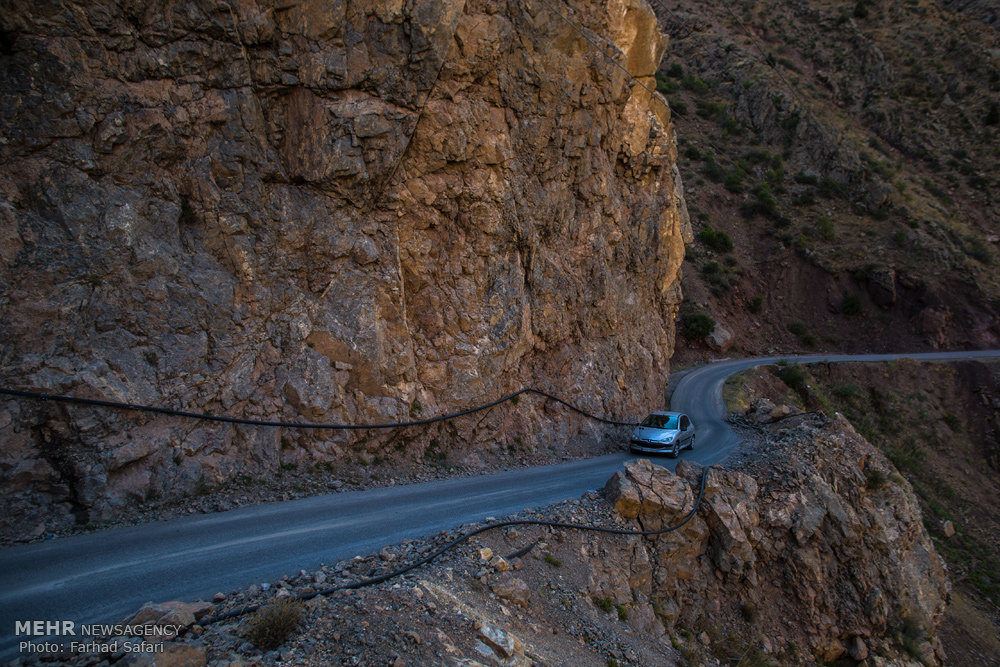
The village can be reached after passing through narrow roads, valleys and steep paths. After walking through this road, the sound of Nineh Roud river, along with the mass of cornelian cherry trees, beats your fatigue.

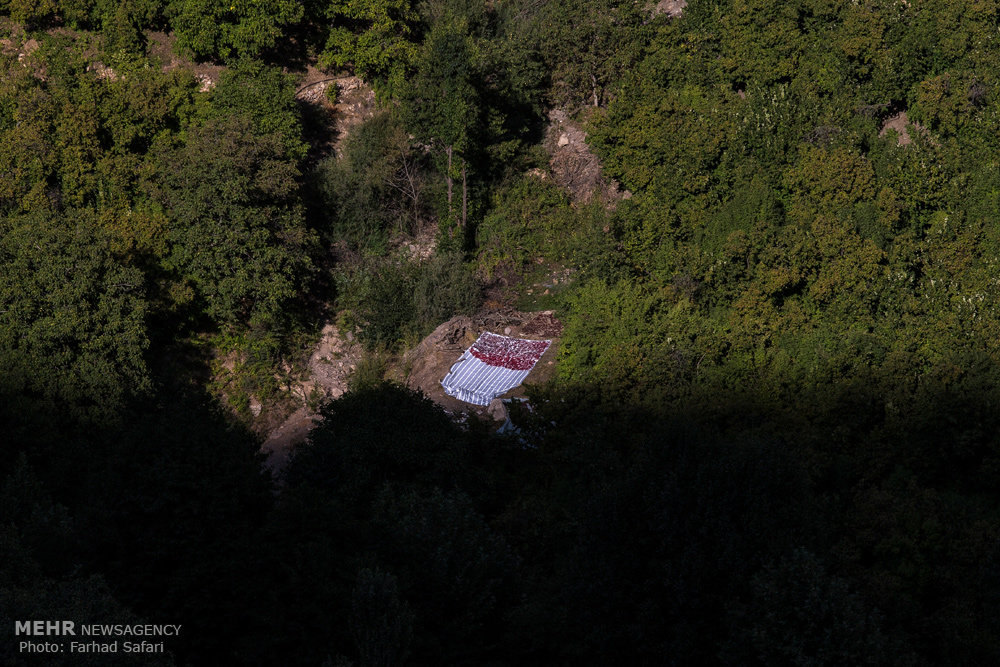
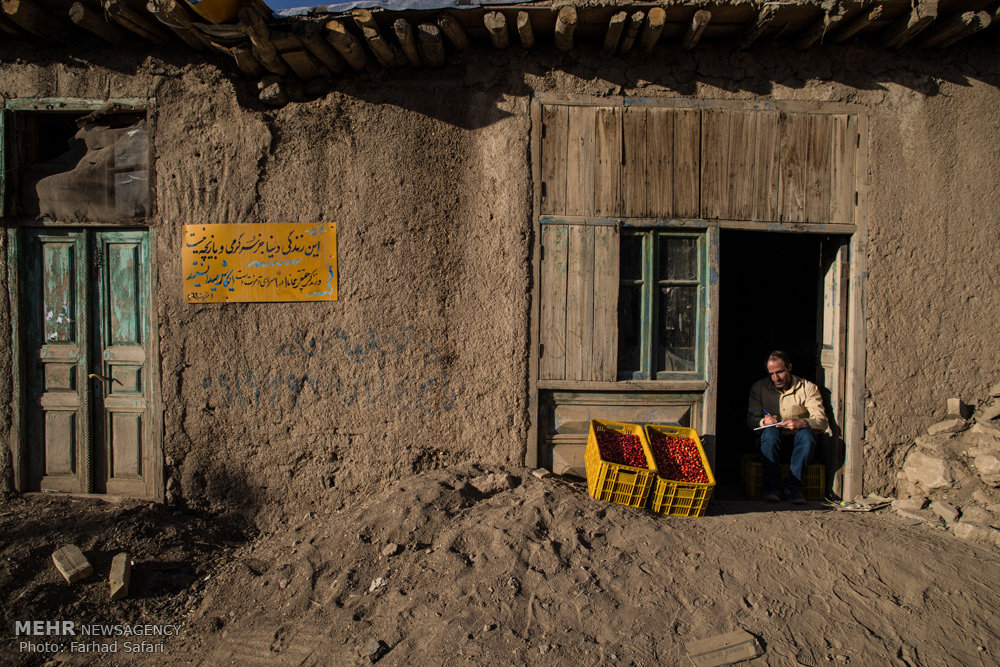
Hir is the capital of Iranian cornelian cherries, which has many fans in Iran. Hir produces about 90% of Iran’s cornelian cherry and is considered to be the capital of this fruit. In the harvest season, many people from this village and the city of Alamut pass through the narrow roads to have a share in the distribution of this fruit.

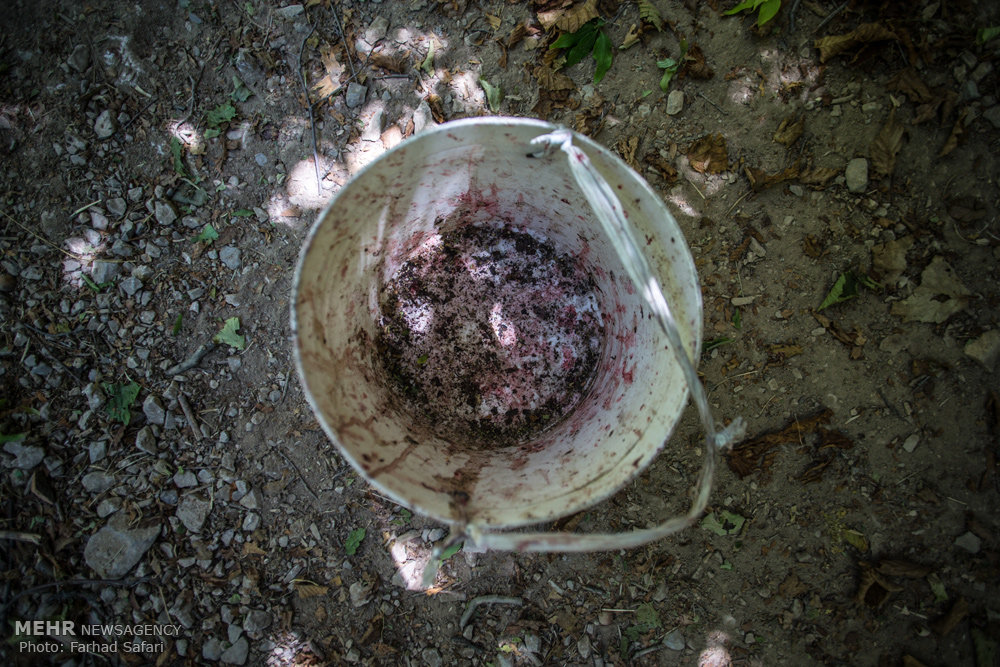
Here are Mehr New Agency’s photos of this beautiful village:

Iranian-Made Neuronavigation System Enters Service

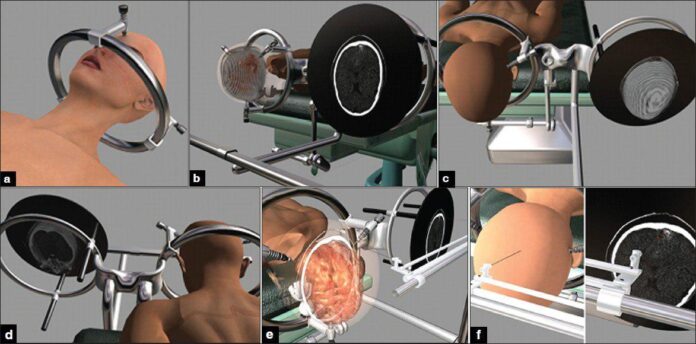
Iranian neurosurgeons can now use an indigenous neuronavigation system to perform their operations.

“The apparatus which plays a key role in removing brain tumours using new methods … has recently been installed at the neurosurgery room of the Qaem hospital in [the northeastern city of] Mashhad,” said Hamid Etamad Rezaei, the director of the neurosurgery team at Mashhad University of Medical Sciences.

According to a Farsi report by IRNA, he said the device made by Iranian experts around six years ago measures up to international standards.

Rezaei, a sub-specialist in neurosurgery, added the neuronavigation system is used to track the locations in question without surgeons having to break the skull open. The procedure will make it possible to remove brain and pituitary tumours, treat brain conditions and conduct sampling of tissues from deep parts of the brain, he added.

The neurosurgeon said the apparatus can also be used in operations on the spine.

Measures are underway to buy and install two other state-of-the-art apparatuses used in neurosurgery, including a modern microscope and a device used to control nerves in different parts of the patient’s body during the operation, he further said.

Iran Has Been Unfairly Maligned: FM Zarif

In his article released by The Atlantic on Monday, October 9, Zarif has also lashed out at world powers for their interference in the Middle East, stressing that such interventionist policies have wrought a fractured region.

What follows is the full text of the article title “Iranian Foreign Minister: Foreign Meddling Has Wrought a Fractured Middle East”:

Iranians live in a troubled and unstable region. We cannot change geography, but our neighbourhood was not always so stormy. Without delving too far back into history—although as an ancient peoples our memories are measured in millennia, not decades or even centuries—it’s safe to say that our region began to experience insecurity and instability when foreign, indeed completely alien powers, arrived and began interfering. The discovery of oil, a drug the West soon became addicted to, only strengthened colonial power projection into our region, and subsequently Cold War rivalry—both major factors in the US and U.K. decision to overthrow the legitimate and democratic government of Iran in 1953—provided the fodder for further meddling by foreign powers and superpowers.

Today, what that meddling has wrought is a fractured Middle East. Steadfast allies of the West, rather than considering the plight or aspirations of their own peoples, spend their wealth arming themselves, sending to the West the riches their natural resources provide. They spend billions more of that wealth spreading Wahhabism—a medieval ideology of hate and exclusion—from the Far East to the Americas. They support organized non-state actors who wreak havoc through terror and civil wars. In the case of Afghanistan, Saudi Arabia and the UAE went as far as officially recognizing the Taliban as the government—becoming two of only three countries in the world that did so. The US, meanwhile, turned a blind eye to the ideology and funding that led to the creation of al-Qaeda—and its more recent offshoots of ISIS, Nusrah, Ahrar al-Sham, Jaish-al-Islam, Boko Haram, al-Shabaab, and the list goes on—and to the worst terror attack on American soil since Pearl Harbor. The US military presence in the region now aims to counter not just threats to America’s own interests, but also supposed threats to the very same allies that have supported the kind of terror now being visited on the cities of Europe and the United States.

These allies of the West—throughout their brief history as nations hostile to my country—pounced on Iran in the aftermath of our Islamic Revolution, which freed us from a dictatorship not unlike theirs and allowed us to set our own course in history, independent and peaceful but allied to neither East nor West. While we voluntarily set aside a domineering role in the region, they funded, armed, and supported Saddam Hussein’s invasion of Iran. His eight-year war against us resulted in nothing but death and destruction, including the first battlefield use of chemical weapons since World War I—by Saddam against our soldiers, as well as against civilians—which was met with  deafening silence by the international community.

We Iranians, punished for having the gall to declare ourselves free of domestic tyranny and foreign dominance, were denied even the most basic defensive weapons, even while missiles rained down on our cities to the cheers of our Arab neighbours. One of those neighbours, Kuwait, a major funder of Iraq’s war on us and the facilitator of its oil sales, shortly afterward became the victim of Saddam’s ambitions itself. Yet in the interest of regional peace and stability, we chose to support Kuwait’s sovereignty in the face of Iraqi invasion, despite Saddam’s offer to share the spoils with us; he even sent his fighter jets to Iran, ostensibly for safe-keeping, but really in an attempt to lure us to his side. Our leadership firmly rejected this offer despite the hostility, both overt and covert, some Persian Gulf states had shown us since the revolution. We preferred for our Persian Gulf neighbours to remain stable, functioning, independent countries, rather than enjoying the certain but brief satisfaction of seeing them receive their just deserts.

Arab affairs are Iran’s business. And we are not shy in admitting that non-Arab affairs are their business. How can they not be?

Today, some of those states—especially Saudi Arabia, the UAE and, as a result of their expensive lobbying campaigns, the US—claim Iran is interfering in Arab affairs and spreading insecurity throughout the region. Ironically, though, it is they who have waged war on their fellow Arab nation of Yemen, invaded Bahrain, embargoed their kin in Qatar, funded and armed terror groups in the war in Syria, and supported a military coup against an elected government in Egypt, all the while denying the most basic freedoms to their own restless populations. Iran, meanwhile, being stronger and older as an independent state than any of its neighbours, has not attacked another country in nearly three centuries. Iran doesn’t and won’t interfere in the internal affairs of its neighbours.

Still, Arab affairs are Iran’s business. And we are not shy in admitting that non-Arab affairs are their business. How can they not be? We share borders, waters, and resources; we fly through each other’s airspace. We can’t not be interested in how our neighbours affect the part of the globe where we make our homes.

Our interest in our region’s affairs, though, is not malevolent. On the contrary, it is in the interest of stability. We do not desire the downfall of any regimes in the countries that surround us. Our desire—in principle and practice—is that all the nations of the region enjoy security, peace, and stability. Unfortunately, this is not the desire of some of some of our neighbours, whose untried leaders cherish the delusion of regime change in Iran, and support terrorist groups that seek to overthrow our government or create fear for the sake of wounding the nation. Our neighbours do this even while saying that Iran’s influence is spreading—especially since the conclusion of the nuclear agreement of 2015.

Iran’s influence, though, has spread not at the purposeful expense of others, but as a result of their and their Western allies’ actions, mistakes, and wrong choices. After the downfall of the Taliban in Afghanistan and Saddam Hussein in Iraq, it was inevitable that Iran, which had housed those countries’ refugees and provided asylum to their political figures, would have greater “influence” with the friends who took over than would those who supported and financed the atrocities of the Taliban and Saddam Hussein against their own people. It was not Iran that prevented a churlish Saudi Arabia from opening an embassy in Baghdad for a decade after the fall of Saddam, nor was it Iran that insisted on war with Yemen or an embargo of Qatar.

Qatar, a country that we differ with on a number of serious issues, is a neighbour we do not want to see unstable. Nor do we want to see its independence questioned while it suffers under the thumb of its bigger Saudi brother. Since we could not allow its besiegement and suffocation, we have provided it with much-needed ports and an air corridor. We similarly showed immediate support for the democratically elected government of Turkey, which also differs from us on some issues, when it suffered a coup attempt. We brought our influence to bear in Lebanon, a troubled land where a unity government was formed after two years of objections by Saudi Arabia, which seemingly preferred the instability of infighting and sectarian divisions in the Levant to a functioning, successful state.

In Syria, we came to assist the people when, in the guise of mass protest following the Arab Spring, terrorist groups—including some aligned to al-Qaeda and Daesh [ISIS] —took up arms to seize power and establish a monstrous terrorist state characterized by mass and bloody beheadings. Some of the terror groups have at some point been directly or indirectly funded and armed by some of our neighbours, and in some cases by the United States itself. The millions of Syrian refugees fleeing their homes are not fleeing a man, a sect, or a government; they are fleeing war and terror. But no country has done more than Iran in the fight against Daesh [ISIS] and in preventing the formation of an anti-Islamic caliphate from Damascus to Baghdad.

The millions of Syrian refugees fleeing their homes are not fleeing a man, a sect, or a government; they are fleeing war and terror.

Iran prioritized getting an agreement to solve the unnecessary nuclear crisis, precisely in order to prevent further instability in the region by eliminating one serious point of contention with Western powers. This, we hoped—and one would expect—would also benefit all our neighbours. Still, we did not neglect the other crises affecting the region, and on numerous occasions we offered plans, cease-fires, and negotiations to bring about an end to armed conflict. Almost all our offers fell on deaf ears—American and Arab alike. But just as we cannot and do not want to exclude major countries like Saudi Arabia from the regional stability equation, neither can we be excluded, for the instability of one nation affects the stability of all.

After the resolution of the nuclear crisis, our neighbours could have moved to increase trade and investment with us. They could have accepted our long-standing offer—repeated several times before and after the nuclear deal—to discuss a regional security arrangement. But they did the opposite: They doubled down on their hostility toward Iran and Iranians, and have done everything they can—from lobbying campaigns, to extreme flattery of the US president, to refusing to even engage with us—to perpetuate the fallacy that Iran is the root of all problems in the region and must be confronted (or to use the popular Washington term, be “pushed back” against), before it destabilizes the entire world.

It is in this atmosphere—and mindful of our 20th-century experience with a neighbour that waged an eight-year war against our people while virtually the entire world took the side of the aggressor—that we endeavour to have a working defensive capability. It is because of the hostility shown to us since the Islamic Revolution, from within our own region and from the West, and because of the West’s refusal to sell us any defensive weaponry that might deter a future Saddam, that we have developed an indigenous capability. It includes missiles, which require testing to ensure that they perform as designed, and which are now accurate to within seven meters. (This kind of accuracy, incidentally, would be entirely unnecessary for a nuclear payload, which can miss an intended target by tens or even a hundred kilometres and still rain death and destruction on a wide area. But accuracy is absolutely crucial in striking military targets or specific terrorist camps while avoiding civilian or non-combatant deaths.) We purposefully excluded our defensive military capability from negotiations for the Joint Comprehensive Plan of Action (JCPOA), as the nuclear deal is formally known, precisely because Iran will never abrogate its right to defend its citizens or delegate that right to an outside party. It is not intended as leverage or a bargaining chip in future negotiations. No party or country need fear our missiles, or indeed any Iranian military capability, unless it intends to attack our territory or foment trouble through terrorist attacks on our soil.

Saudi Arabia spends over $63 billion on defence annually, ranking 4th in the world behind only the US, China, and Russia. The UAE, a country with less than 1.5 million citizens, ranks 14th, with over $22 billion in annual defence spending. Iran doesn’t even make the list of the top 20 spenders: Its $12 billion puts it in 33rd place. It is hardly ramping up to be the new hegemonic bully in the neighbourhood. Our goal is not to have the biggest or best-equipped military, or to possess trillions of dollars’ worth of weapons, but to have the minimum materiel required to deter and to counter threats and armed attack. Our biggest asset for stability, security, and independence is our people, who—unlike the citizens of some US allies in the region—choose their government every four years.

Iranian “aggression” is a myth.


We patrol the waters of the Persian Gulf—so named by Westerners centuries ago given that its longest shore by far is Iran’s—because Iran’s right to defend its territory from sea attack or subterfuge cannot be questioned. (Presumably, likewise, the US Coast Guard and Navy have not stopped patrolling the Gulf of Mexico, or the Atlantic and Pacific seaboards.) If there are accusations warranted about “provocative behaviour” in the Persian Gulf, Iran is surely the party to make them. US warships and aircraft carriers the size of cities routinely bear down on Iranian naval vessels in waters that are only 10 kilometres wide in some parts. No one should expect us to ever forfeit our rights in this important waterway, which is central to our economic and national-security interests.

The Iran-phobia perpetuated by some of our neighbours—which in the age of rule by political neophytes has become a kind of hysteria—is now influencing the outlook of the US This is true of the nuclear agreement and is evident more generally in the kind of open hostility toward Iran President Trump expressed in his 2017 UN speech. But the evidence for “bad behaviour” by Iran is non-existent. Iranian “aggression” is a myth, easily perpetuated by those willing to spend their dollars on American military equipment and public-relations firms, and by those promising to protect American interests rather than those of their own people. In the end, they serve neither.

The successful implementation of the nuclear deal—by Iran, at least—is proof of Iran’s good will and peaceful intentions. If we had hegemonic ambitions, an agreement would never have been reached. The JCPOA can in fact be a model for the diplomatic resolution of crises, and for peaceful outcomes in regional disputes. Rather than look at its shortcomings—for in any deal or bargain, there are shortcomings from the perspective of either side—it would behove other countries beyond to look at its benefits. For there are also benefits for all sides, including for our immediate neighbours.
New leaders in Saudi Arabia and the UAE, exhibiting the impetuosity of inexperience—as well as the hubris bred through a supremely sheltered and privileged upbringing—have embraced an aggressive regional stance. Fearing shame or failure, they may find it difficult to back down. But insisting on the wrong course won’t make it right. Vietnam should have taught that to America, and Afghanistan to the former Soviet Union. Our regional trouble should be teaching that to our neighbours. The right approach is not difficult to uncover—it just requires open eyes, an open mind, respect for the opinions and positions of others, and a willingness to engage and search for a mutually acceptable solution to any problem. We Iranians pledged to do that with six countries when we restarted negotiations on the nuclear issue in 2013. Even if one or more of the parties abrogates the deal without reason, or refuses to fully implement its side, the approach itself was the right one. Any failure, in the end, will not come from an inherent defect of the agreement, but from a lack of good faith that will only globally discredit the defectors.

Iran will continue on its own path of dialogue, mutual respect, and understanding.

But in thinking about how to move past regional stalemates—especially with regard to the spread of terror—it might be useful for our neighbours and their Western backers to take another, more careful look at past Iranian initiatives. Iran proposed a “Dialogue Among Civilizations” in 1998, well before 9/11 and before any notion of a “clash of civilizations” took hold among the general public. In 2013, President Hassan Rouhani proposed a “World Against Violence and Extremism” (WAVE), before Daesh [ISIS] became a household name. Both initiatives accurately diagnosed the enabling social, cultural, and global conditions that have encouraged the formation and spread of extremist violence—conditions that are too often forgotten in otherwise laudatory pledges to eradicate the scourge.
While clearly such forces as Daesh [ISIS] and its offshoots need to be defeated and their false promises exposed, a meaningful restoration of peace and stability to the Persian Gulf region hinges on the promotion of mutual understanding and regional security cooperation, which some of our neighbours have so far rejected. But there’s no reason we can’t cooperate. The ancient Persian game of chess requires either a winner, a stalemate, or surrender by one opponent in the face of defeat. It is a magnificent game, but it is just a game. In the real world, other outcomes are possible—there can be a “win-win” solution that doesn’t result in defeat for any side. To achieve this outcome, we should be erecting a working regional mechanism rather than laying more bricks in the wall of division. We can start with a regional dialogue forum, something Iran has always been—publicly and privately—in favour of.

Such a forum should naturally be based on respect for the sovereignty, territorial integrity, and political independence of all states; the inviolability of international boundaries; non-interference in others’ internal affairs; the peaceful settlement of disputes; the impermissibility of threats or use of force; and the promotion of peace, stability, progress, and prosperity in the region. A forum based on these principles could eventually develop more formal nonaggression and security cooperation arrangements between all the parties, ensuring that the Persian Gulf does not remain a synonym for implacable troubles.

Iran will in the meantime continue on its own path of dialogue, mutual respect, and understanding. In that vein, in early October I held successful top-level meetings in Qatar and Oman, followed by a summit with Turkey in Tehran, addressing issues of paramount importance to the peace and stability of our neighbourhood. It should be everyone’s fervent hope that we can have similar interactions with our other neighbours.