Saturday, January 3, 2026
Home Blog Page 3749

Vank Cathedral to Be Registered as Iranian World Heritage

Vank Cathedral, Iran

Iran will add Vank Cathedral to the list of Armenian churches inscribed at the UNESCO World Heritage website; according to the Deputy Head of Iran’s Cultural Heritage, Handcrafts and Tourism Organisation (ICHTO), Mohammad Hossein Talebian.

Addressing the closing ceremony of the joint exhibition of Iran and Armenia held at the National Museum of Iran in Tehran, Talebian noted that Iran is doing its best to add other important Armenian churches, such as Vank in Isfahan, to this list.

A Cathedral in the Armenian District

According to a Farsi report by ISNA, Vank is one of the most famous cathedrals in Iran and the largest one in Isfahan province, central Iran. In terms of historical paintings and decorations, it is known as the most beautiful church in Isfahan.
It is a combination of Iranian and Armenian architecture, and this has made it a unique structure in the world.

The location of this church in the Jolfa district of Isfahan allows you to visit the most famous Iranian cafes there while looking at this magnificent work of art.

Anyone walking into the Jolfa district will be enchanted by its special atmosphere.

History of Churches

Isfahan hosted six churches until the end of the 17th century. Meanwhile, there were 24 churches in the Jolfa district. Today, there are only 13 of them left. Each of these churches has its own characteristics, but among them, the Vank is an exception.

The cathedral was established in 1606, dedicated to the hundreds of thousands of Armenian deportees that were resettled by Shah Abbas I during the Ottoman War of 1603-1618.

The construction is believed to have begun in 1606 by first arrivals of Armenians; and completed with major alterations to design between 1655 and 1664 under the supervision of Archbishop David. The cathedral consists of a domed sanctuary, much like an Iranian mosque; but with the significant addition of a semi-octagonal apse and raised chancel usually seen in western churches. The cathedral’s exteriors are in relatively modern brickwork and are exceptionally plain compared to its elaborately decorated interior.

A Centre of Gathering

The Vank as the most important church in Jolfa has been a centre for educating priests and has played the role of a Christian seminary. Many monks have grown there and reached the highest religious positions.

Today, the Vank is the centre of communication between the Armenians of Isfahan and the southern regions of Iran with the world. As a result, the cathedral is of great importance to the Armenians.

Here are photos of Vank cathedral retrieved from the Karnaval.ir website:


Iranian University to Open Branches in Syria on Assad’s Order

The Islamic Azad University UAE Branch, also shortly known as the Azad University of Dubai

Damascus has given the green light to Iran’s proposal to establish branches of the Islamic Azad University in Syria, said Ali-Akbar Velayati, the head of the Board of Founders and Board of Trustees of the IAU.

“In a letter to [Syrian President] Bashar Assad, I announced that the Islamic Azad University is prepared to establish branches [in Syria] and he issued an order to establish branches of the Islamic Azad University in all Syrian cities,” Velayati said, as quoted by the Persian-language E’temad Online website.

Velayati said Islamic Azad University branches have been successful in different countries.

“[Students at] Different universities in Western countries are witnessing Iran’s growing power, and, hence, are seeking to learn the Persian language and literature as well as the Shiite and Islamic culture,” he noted.

Velayati also touched upon his recent meeting with Sheikh Humam Hamoudi, the head of Iraq’s Islamic Supreme Council, saying the Iraqi official welcomed the idea of the Islamic Azad University opening branches in his country.

The Iranian official also said he expressed the university’s readiness to open branches in Lebanon in a meeting with Secretary General of the Lebanese Hezbollah Movement Seyyed Hassan Nasrallah.

Velayati said Iran not only helps neighbouring and Islamic countries maintain their security, but also denies them no assistance to help promote Islamic, native and regional culture and shares with them its accomplishments in the field of science and technology.

The Islamic Azad University is a private university system in Iran, and one of the largest comprehensive systems of universities, colleges, and community colleges in the world.

Last year, the total number of enrolment in IAU branches was 1,620,000, which makes it the world’s fifth biggest universities in terms of enrolment.

Iran Denies Romours about Missile Strike on Oil Tanker

Iranian Labour Minister Ali Rabiei, who was tasked by President Rouhani with following up the recent oil tanker accident, told a press conference in Tehran it is a very big lie that the tanker has been hit by a missile.

“If anyone is familiar with political issues and radar systems, s/he will understand this is not true. Moreover, the bill of lading was issued for South Korea, and the government officially confirmed it. This is not an issue that could be kept secret internationally,” the Khabar Online news agency quoted Rabiei as saying in a Farsi report.

In response to a question regarding the negligence of the Chinese, he said it was not possible to get service from the Japanese and the Koreans because the incident happened in the Chinese waters.

“Some were saying that the fate of our nationals may have not been important to the Chinese, but we did not find any evidence that the Chinese would not care for the seafarers’ lives,” he underlined.

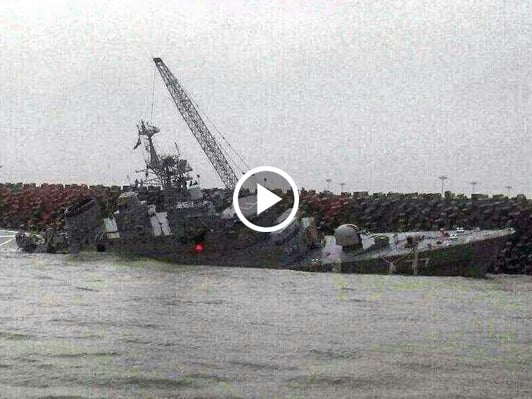
The entire crew members of Iran’s Panama-registered Sanchi oil tanker were killed after the vessel collided with a Chinese freighter in the East China Sea.

This oil tanker had 32 people inside, 30 Iranians and two other people from Bangladesh. Only the bodies of three were recovered.

The vessel sank on Sunday after a huge explosion while a team of Iranian commandos were getting prepared for a rescue operation.

Regional Conflicts Must Be Resolved through Dialogue: Iran

In a Tuesday meeting with Qatar’s parliament speaker in Tehran, Rouhani underlined that the Islamic Republic of Iran will always stand up for the Qatari government and nation.

“Today, there is a strong will on both sides to expand bilateral relations between Iran and Qatar,” Rouhani said, urging the officials of both states to spare no effort in deepening Tehran-Doha ties in all fields.

According to a Farsi report by the Iranian president’s official website, Rouhani stressed that Iran will never accept that the Muslim nation of Qatar comes under unfair pressure by the enemies.

“Iran and Qatar have had friendly and brotherly relations throughout history and have stayed with each other at harsh times,” Rouhani added.

For his part, Speaker of the Advisory Council of Qatar Ahmad bin Abdullah Al Mahmoud appreciated the Islamic Republic’s support for the Qatari nation and government particularly during the recent tension in the region.

“We are delighted to see that Iran and Qatar have established their bilateral relations based on friendship, brotherhood and neighbourhood,” he said, adding that the two sides should attempt to expand their current relations as far as possible.

The Qatari government maintains that any conflict in the region should be resolved through dialogue and mutual understanding, he added.

“Today, thanks to the support we receive from our friends especially Iran, we are standing against the malice and nasty plots of our enemies,” he added.

The Qatari official is in Tehran to attend the 13th Session of Parliamentary Union of the OIC Member States.

US Formation of Border Force Targeting Syria’s Territorial Integrity: Iran

The American plan to establish a so-called Border Security Force (BSF) in Syria’s border areas “runs counter to international regulations and is a plot against Syria’s territorial integrity and security and the region,” the president said in a meeting with speaker of the People’s Council of Syria Hammouda Youssef Sabbagh in Tehran on Tuesday.

It came after the US-led alliance purportedly formed to fight the Daesh (ISIL) terrorist group announced on Sunday that it was working with Arab and Kurdish fighters to establish the “Border Security Force”, which would be responsible for preventing a “resurgence” of Daesh in areas where the terrorists had been cleared by the Syrian Democratic Forces (SDF), a multi-ethnic alliance of predominantly Kurdish fighters.

Elsewhere in the meeting, Rouhani reaffirmed Iran’s commitment to helping the Syrian government and nation, urging efforts to help Syrian refugees return home and reconstruct their country.

The Syrian parliamentarian, for his part, said Damascus would never agree to the presence of US forces in the Arab country and has formally announced that Americans should leave.

Sabbagh also lauded Tehran’s unwavering support for the Syrian government and nation, calling for continued assistance in the process of reconstruction.

In September 2017, Iranian Foreign Minister Mohammad Javad Zarif said on the sidelines of the UN General Assembly that Iran will assist the Syrian nation in reconstructing their country after the war, in the same way that it contributed to the delivery of humanitarian aid to the Arab state amid the crisis.

Syria has been gripped by a civil war since March 2011, with militants from various terrorist groups, including Daesh, pouring into the Arab country.

On November 19, Daesh terrorists were flushed out of their last stronghold in Syria’s Al-Bukamal. The city’s liberation marked an end to the group’s self-proclaimed caliphate it had declared in 2014.

According to a report by the Syrian Center for Policy Research, the conflict has claimed the lives of over 470,000 people, injured 1.9 million others, and displaced nearly half of the country’s pre-war population of about 23 million within or beyond its borders.

Throughout these years, Iran has remained a close ally of Syria and supports its legitimate government in the face of foreign-backed militancy.

Saudi Arabia Betraying Muslim World: Iran Leader

US Presence in Region Causing Insecurity, Devastation: Iran Leader

In a Tuesday meeting with the participants of the 13th session of the Parliamentary Union of the OIC Member States, Ayatollah Khamenei said the Saudis are helping the US and Israel and it is a betrayal to the Muslim Ummah and the Muslim world.

The Leader further noted that the issue of Muslim unity is an important matter, adding, “We are ready to show brotherly behaviour even towards those who hitherto showed animosity towards us in the Muslim world.”

The Leader of the Islamic Revolution noted that the Muslim world, with its large population and facilities, can undoubtedly turn into a great and influential power in the world by maintaining its unity.

He also called on the Muslim world to stop conflicts saying that one of the aspirations of the enemies of Islam is to create differences, wage wars and cause bloodshed in the Muslim world to create a safe haven for the Zionists, and it must not be allowed.

“I believe that this fight against the Zionists will produce result, as today we see the resistance has progressed.”

Ayatollah Khamenei said once the Zionists’ slogan was From Nile to Euphrates, but today they are building a wall around themselves to be able to safeguard themselves on the occupied lands.

“Palestine is a collection; it is a country as well as a history, and its capital city is absolutely Jerusalem al-Quds.”

The Leader also referred to the attempts of the US to recognize Jerusalem al-Quds as the new capital of the Israeli regime saying that this is not something they could do.

The Leader of the Islamic Revolution also stated that there are important issues on the agenda of this session of the Parliamentary Union of the OIC Member States, but there are some issues that have been neglected.

He said the issue of Yemen and Bahrain are important ones that must be resolved.

“My advice to our brothers in the Muslim world is that we should be outspoken regarding the basic issues of the Muslim world to have an impact on public opinion.”

Elsewhere in his remarks, Ayatollah Khamenei said “do not let them ignore you and the major issues of the Muslim world through conspiracy of silence.”

Palestine is an important issue of the Muslim world that is largely ignored, said the Leader.

Iran President Blasts Trump’s Remarks about Africa

Speaking in a Tuesday meeting with Senegal’s Parliament Speaker Moustapha Niasse in Tehran, Rouhani said the Iranian government and nation have special respect for African people because they fought colonialism for years and are trying hard for further progress and development.

“The US president’s words about African people were very regrettable and wrong and must be condemned, and show that incumbent US statesmen still have not understood the status and grandeur of African people well,” said President Rouhani, according to a Farsi report by his website.

The president noted that Iran stands ready to further expand its relations with Senegal in all scientific, cultural, trade, economic and political fields.

“Promotion of cooperation and ties between Iran and Senegal can contribute to the enhancement of relations between the African continent with the sensitive West Asia region,” Rouhani underlined.

The president said Muslim countries as well as Middle East nations are facing numerous problems, namely terrorism.Iran President Blasts Trump’s Remarks about Africa

“The world of Islam needs more unity and brotherhood, so that it will be able to stand up to the enemies’ plots,” said Rouhani.

He expressed gratitude to the Senegalese government and nation for expressing sympathy over the tragic Sanchi oil tanker incident, adding, “Muslims sympathizing with one another in sad incidents is a sign of Islamic brotherhood.”

The top Senegalese parliamentarian, in turn, offered condolences to the Iranian people on behalf of the Senegalese government and nation over the oil tanker tragedy and hailed President Rouhani’s speech at the 13th Conference of the Parliamentary Union of the OIC Member States (PUIC) in Tehran.

He stressed the importance of solidarity among Muslims countries, urging Islamic nations to work towards further consolidating mutual relations and cooperation.

He also paid homage to the founding father of the Islamic Republic of Iran, Imam Khomeini, by narrating the memories of his meeting with the late Imam.

Iran Displays Tourism Capacities at Vienna Exhibition

The exhibition, attended by more than 800 companies from around 70 countries, put on display the latest tourism achievements and capacities of the participant countries.

Visiting the exhibition, Iran’s Ambassador to Vienna Ebadollah Molaee held talks with the Iranian participants of the exhibition, a Farsi report by IRNA said.

The representatives of Iranian companies in the exhibition also sat for talks with their Austrian counterparts on Friday at the Iranian embassy building in Vienna.

In an address to the meeting, Director for Tourism and Handicrafts Affairs at Iran Tourism and Auto Racing Centre Ebad-Reza Eslami said, “This is the third consecutive year that Iran is taking part in Vienna exhibition.”

“10 Iranian tourism companies take part in the exhibition,” he said, adding that compared with the previous year, the number of Iranian companies has increase by 75 percent this year.

Iranian companies are interested in introducing their country’s tourism capacities and achievements to the Europeans.

He also added that Austria is interesting for the Iranian tourism companies as a new market. “Iran and Austria have historical commonalities.”

According to Eslami, by establishing a direct flight route between Iran and Austria, Iran is interested in hosting more German-speaking tourists not only from Germany but also from Austria.

Collision of Chinese Ship with Iranian Oil Tanker Ambiguous: Expert

Mahmoud Khaqani says following the oil tanker’s recent collision in East China, which led to the deaths of all its 32 crew members, the Chinese and those who arrived in the area were very worried about the danger of water pollution.

“They did their utmost in controlling and shutting down the fire, but when realized that controlling the fire was not so simple, they preferred the tanker burn instead of polluting the area and the sea.”

Collision of Chinese Ship with Iranian Oil Tanker Ambiguous: Expert

In a Farsi interview with the Khabar Online news agency, Khaqani noted that Sanchi weighed 164 thousand tonnes carrying a cargo of 136,000 tonnes (960,000 barrels) of natural-gas condensate from Iran’s South Pars oil field.

The ship that collided with Sanchi, called CF Crystal, was a carrier of wheat from the United States to China and was insured. South Korean petrochemicals company Hanwha Total had purchased the natural-gas condensate.

“Reports say the insurer will pay damages to Hanwha for the lost cargo. In addition, this company has no responsibility for the damage caused to the environment of the accident site, the sunken tanker or the accident itself.”Collision of Chinese Ship with Iranian Oil Tanker Ambiguous: Expert

The expert went on to say that following the nuclear agreement, international insurance companies began to insure Iranian oil tankers carrying crude oil, petroleum products, gas condensate, etc., including oil tankers belonging to the National Iranian Tanker Company as of February 20, 2017.

“About half of the 65 oil tankers of the National Iranian Tanker Company are currently insured internationally. Indeed, insurance companies have defined a method that does not require the participation of US counterparts to cover Iranian oil and gas shipments and Iranian oil tankers,” said Khaqani.

He further mentioned that it should be investigated why the Chinese cargo ship suddenly hit Sanchi and stayed safe.

Collision of Chinese Ship with Iranian Oil Tanker Ambiguous: Expert

“If it was a deliberate move, they knew what the weakness of the tanker was. In the seas, everyone should think like a police, not like a judge. The parties that are currently worried and will take action are the insurance companies. 30 percent of the damages will be paid by two Iranian insurance companies, and 70 percent will be compensated by a foreign company. However, the legal aspects of the incident are very complicated as we do not know how its cargo was sold,” Khaqani added.

He also noted that if the cargo loaded at Asaluyeh port is FOB, then the seller (Iran) will not be responsible for it since the shipment belongs to the buyer. Therefore, the cargo is insured by the buyer and the vessel owner insures the tanker.

However, he added, if it is CIF, the seller will both insure the shipment and pay the shipping cost. When the cargo is delivered, the buyer becomes the owner. If that is the case, all the losses will be incurred on the seller.


Can Iran sue China?

Khaqani emphasized that everyone should wait as any comment can be used against Iran. He added that the Islamic Republic should wait for insurance companies to finalize their reviews and publish their reports.

“If the Chinese ship is blamed, the insurer must pay damages because the ships are insured like the cars. Its legal issues are very complicated as the incident occurred in China’s waters and the vessel sunk in the waters of Japan. Moreover, the ship was not carrying the flag of Iran and it was moving with the Panamanian flag.”Collision of Chinese Ship with Iranian Oil Tanker Ambiguous: Expert

He further stressed that while the ship’s ownership belonged to the National Oil Company of Iran, it was of Panamanian nationality. People in political positions had better not talk about the issue with inexpert commentaries, since any commentary at the time of the review of the case may end in loss or personal gain.


Why Panama?

Khaqani said, “There is a particular atmosphere in the international shipping domain and shipping world. For example, ships carrying the flag of Iran will be in trouble when entering certain ports. Of course, this is not only about Iran. Panama has provided economic conditions that do not levy tax on many companies. This procedure somehow generates revenue for Panama. So, the Panama flag was set on the tanker.”
This expert’s comments come in a situation that the commander of the Iranian Army’s Navy, Rear Admiral Hossein Khanzadi, said on Monday that the Iranian commandos who wanted to rescue the Iranian sailors received their visa to enter China two to three days later.

“My colleagues arrived at the scene on the seventh day, and on that day, as the ship was off the coast of China and was approaching the coast of Japan, the forces were dispatched quickly, but when they arrived to get into the oil tanker, a huge explosion occurred. Then, the whole deck was on fire and unfortunately, the vessel sank,” added the Iranian commander.

In a Farsi interview with Mizan News Agency, the Iranian army’s navy commander referred to the 6-hour time difference between Iran and China and appreciated the assistance of the Navy commander of China, who provided the opportunity to call and issue orders to the Iranian commandos, but in the end, he sadly talked about a horrific explosion that exactly at the beginning of the rescue operation, thwarted all efforts in the midst of water and fire.

Will the contents of the ship’s data recorder reveal the secret of the explosion?! Time will tell.

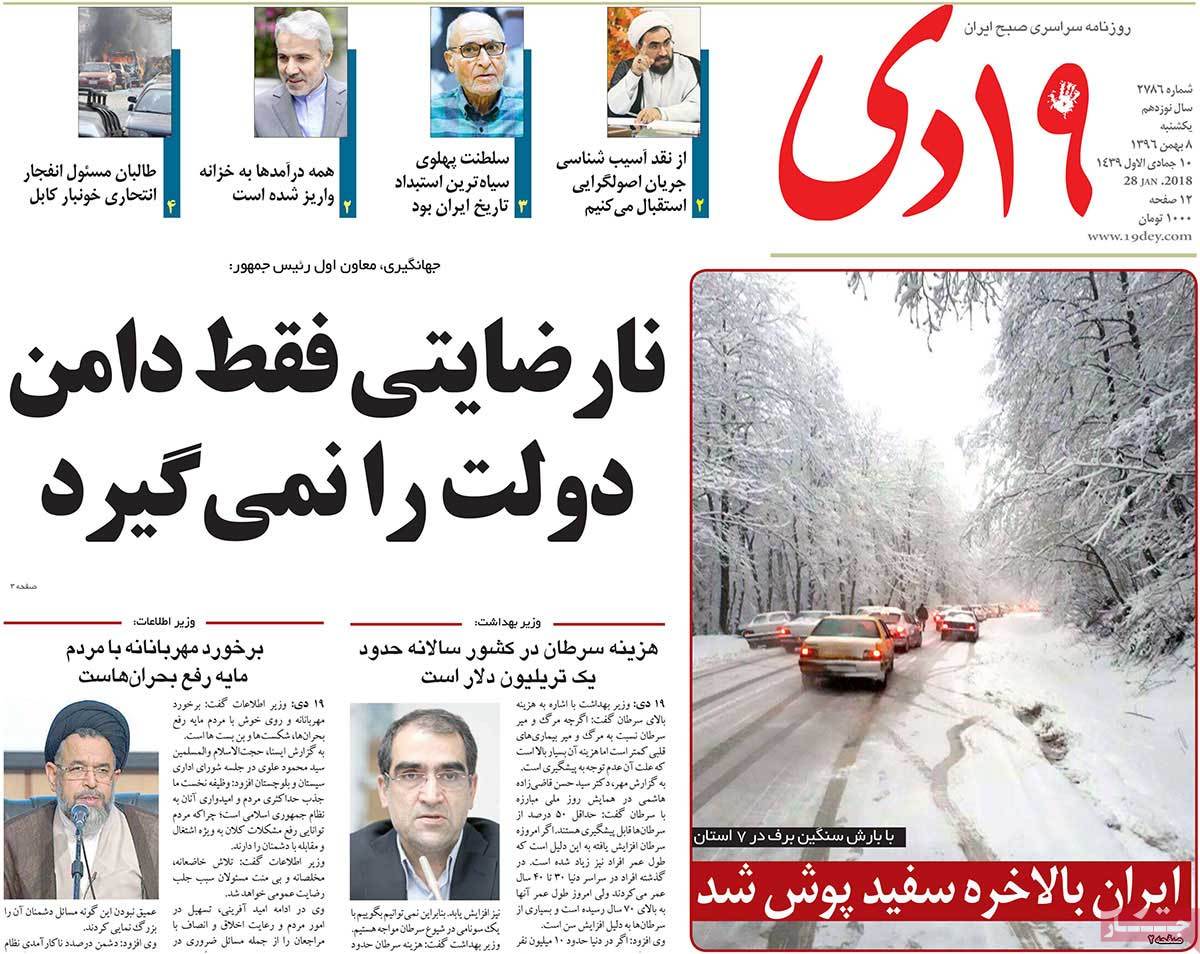
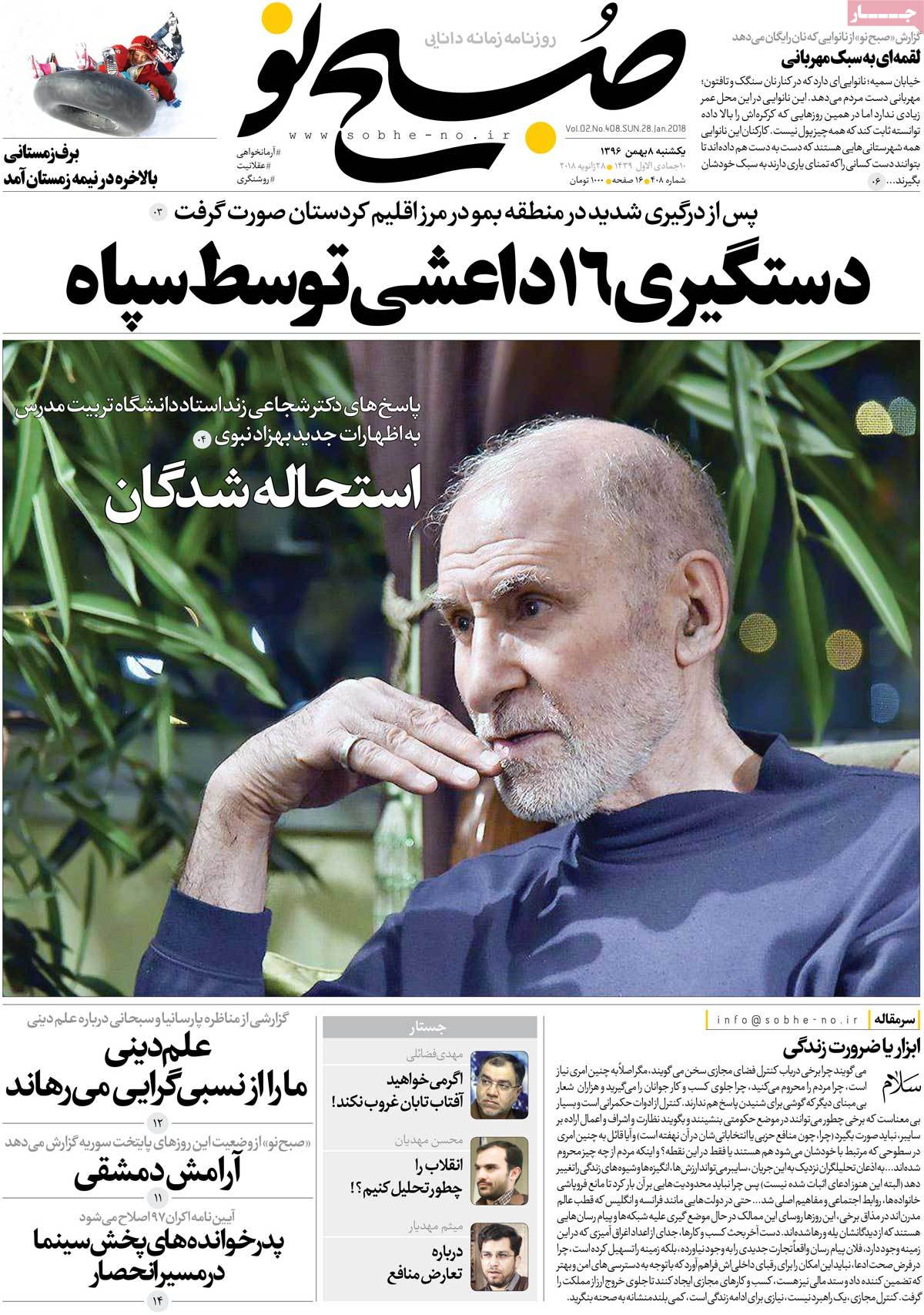
A Look at Iranian Newspaper Front Pages on January 16

A Look at Iranian Newspaper Front Pages on November 18

The oil tanker tragedy, in which 32 sailors lost their lives after their ship collided with a bulk freighter and sank in East China, remained the top story in all newspapers today.

Another top story these days is the extremely low precipitation in Iran and the dry year ahead of the country. Several papers covered a report about a group of people in Birjand, eastern Iran, who have started praying and offering sacrifice to ask God for rainfall.

The 13th conference of the Parliamentary Union of the Organization of Islamic Cooperation (OIC) Member States (PUIC), which got underway in Tehran on Tuesday morning, also received great coverage.

The above issues, as well as many more, are highlighted in the following headlines and top stories:


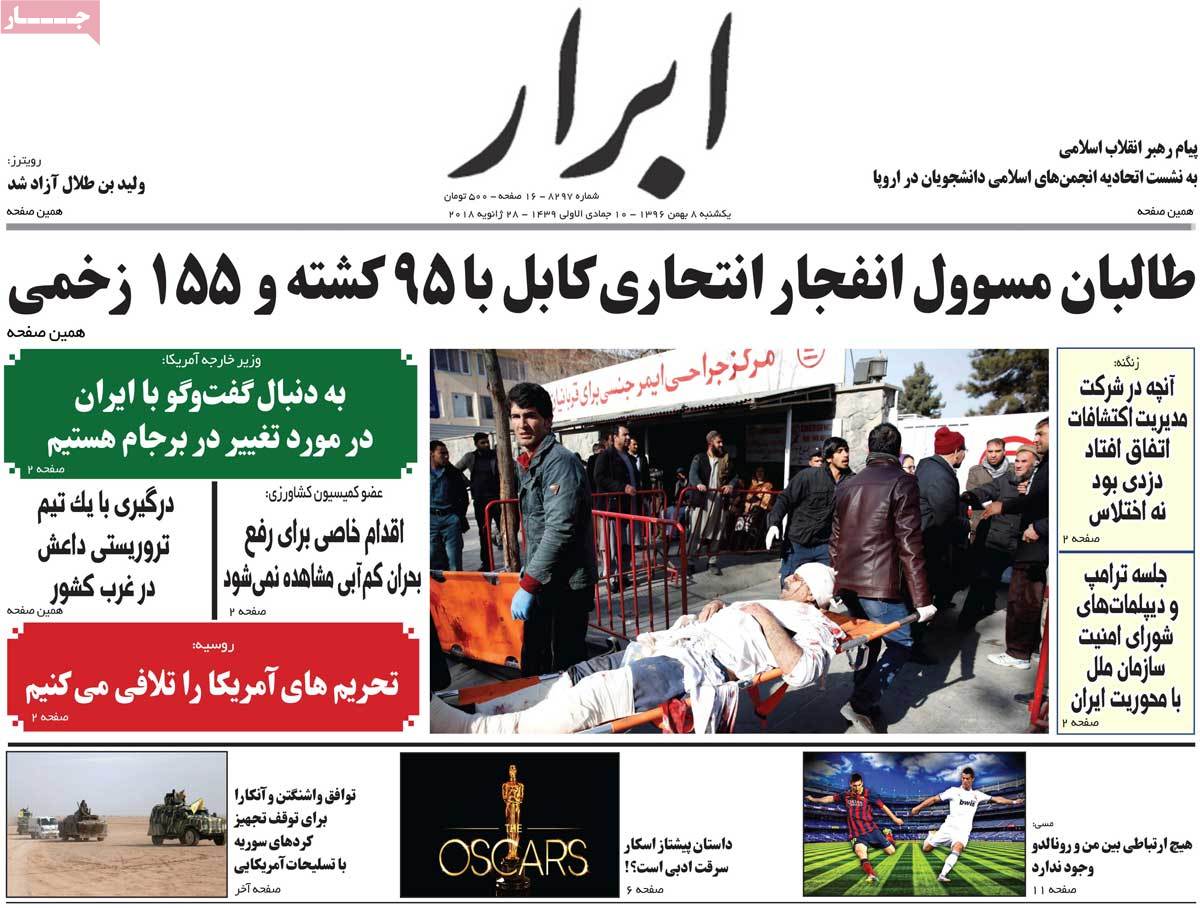
Abrar:

1- Iran Leader Offers Condolences over Death of Oil Tanker Workers

2- Herat Employee Arrested on Charge of Spying for Iran

3- Iran MP: China’s Performance in Sanchi Incident Ambiguous

A Look at Iranian Newspaper Front Pages on January 16


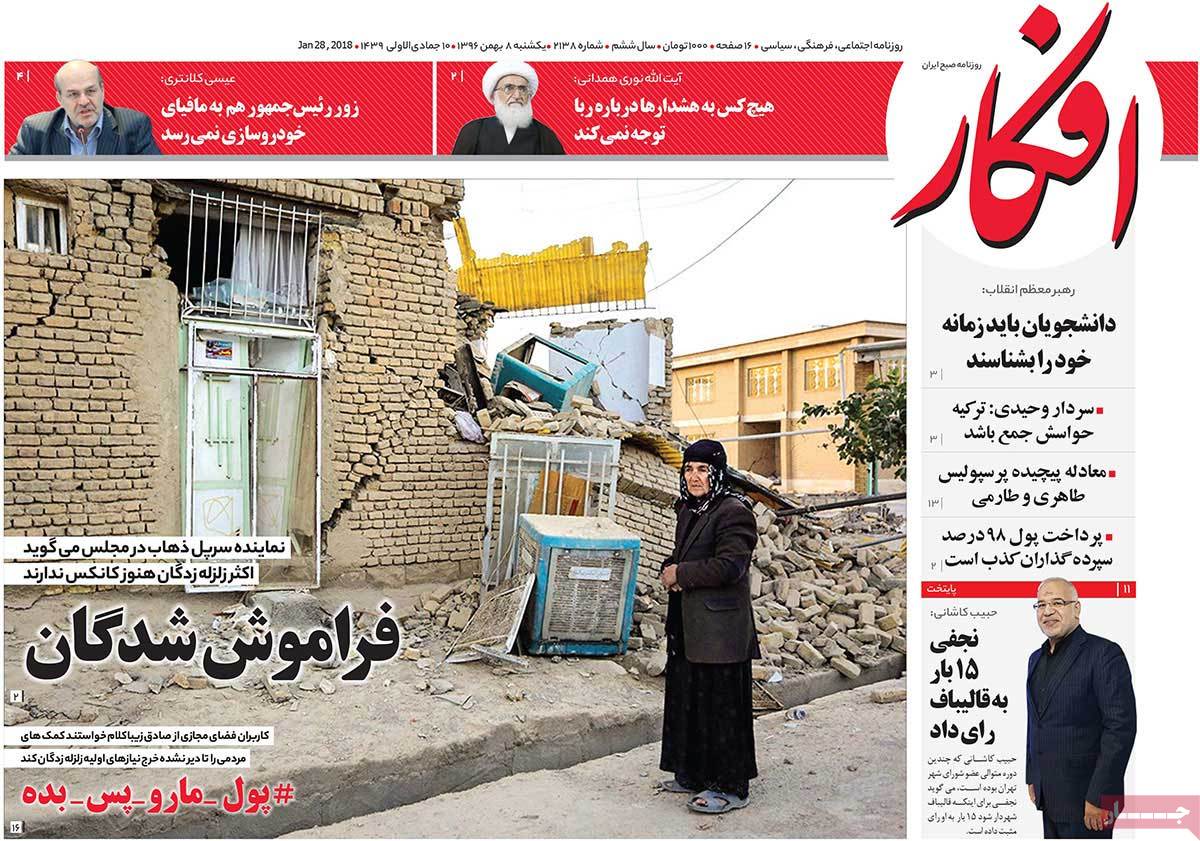
Afkar:

1- Weak Operation, Weaker Diplomacy

  • MPs Slam Foreign Ministry’s Negligence in Dealing with Oil Tanker Incident

A Look at Iranian Newspaper Front Pages on January 16


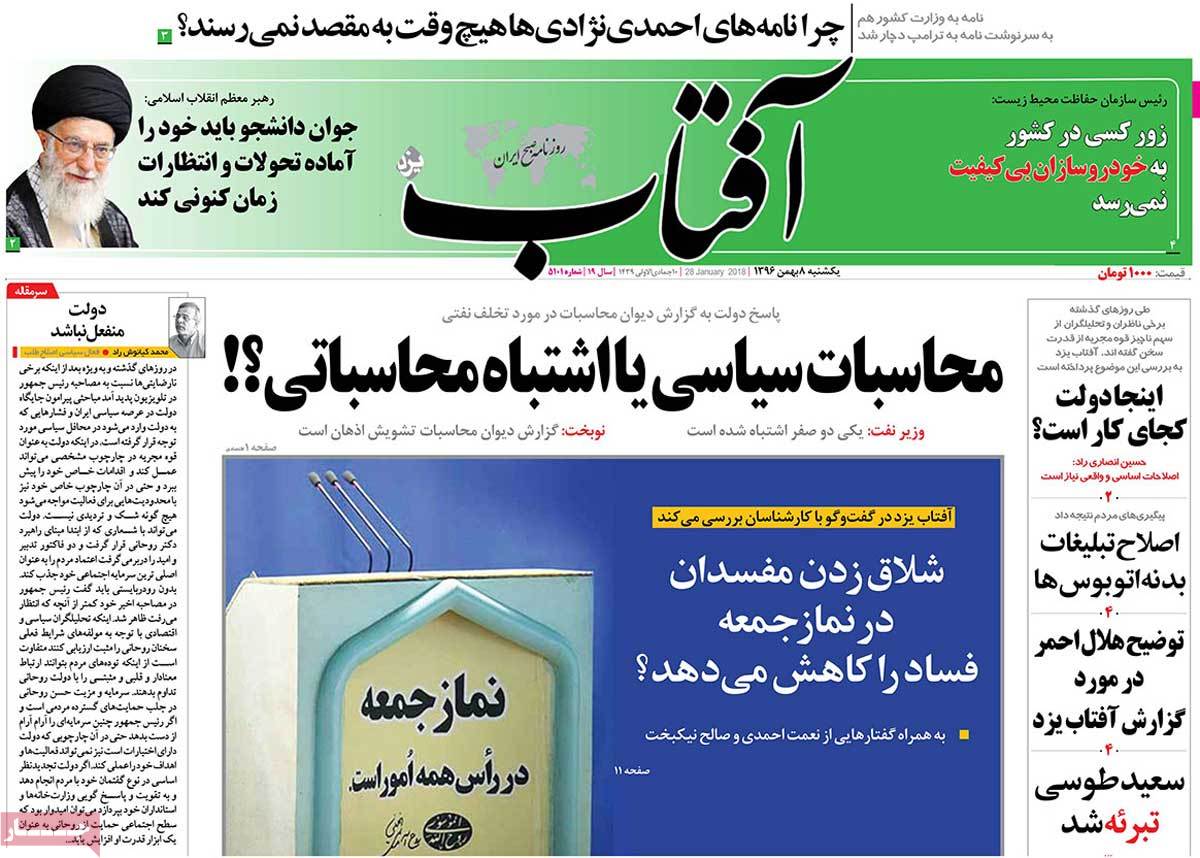
Aftab-e Yazd:

1- Sailors Were Alive after Incident: Experts

2- It’s Both Beautiful, Heartbreaking: People Pray for Rain in Birjand

A Look at Iranian Newspaper Front Pages on January 16


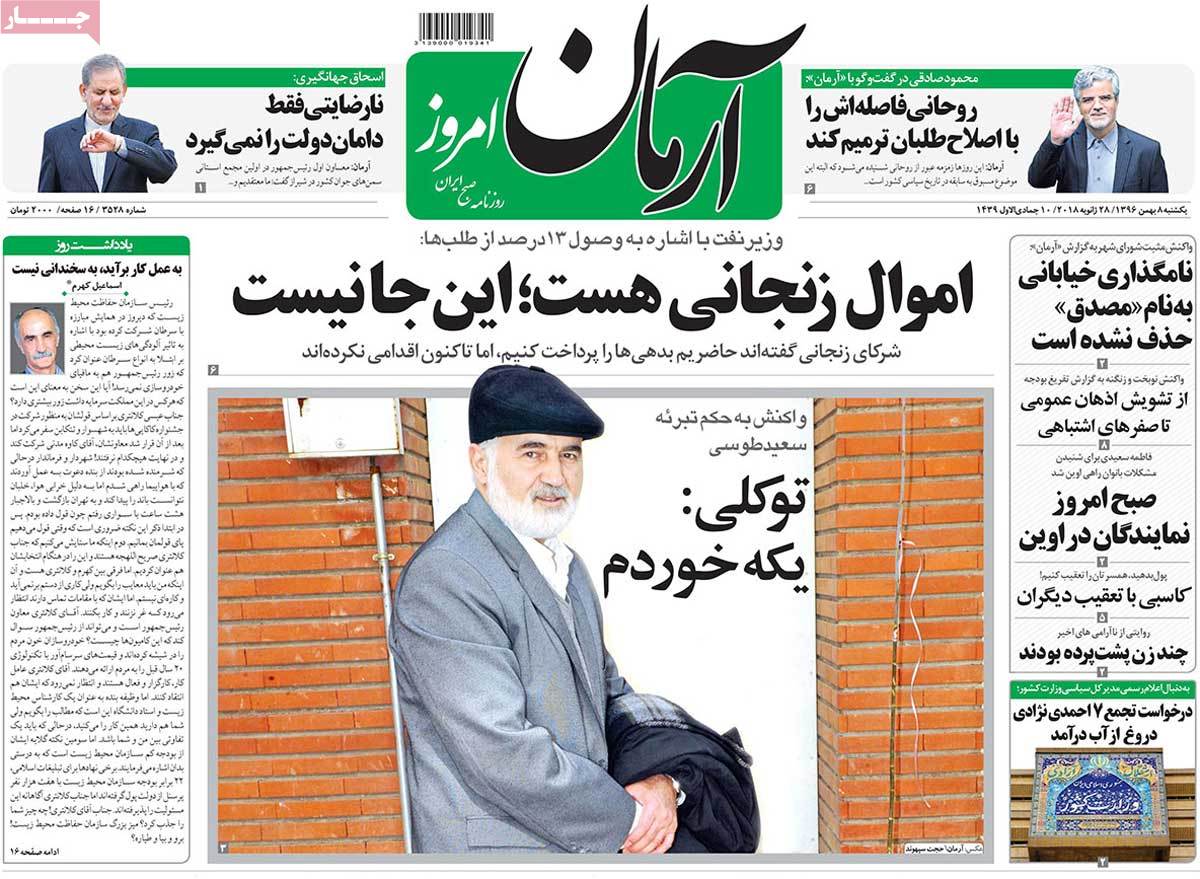
Arman-e Emrooz:

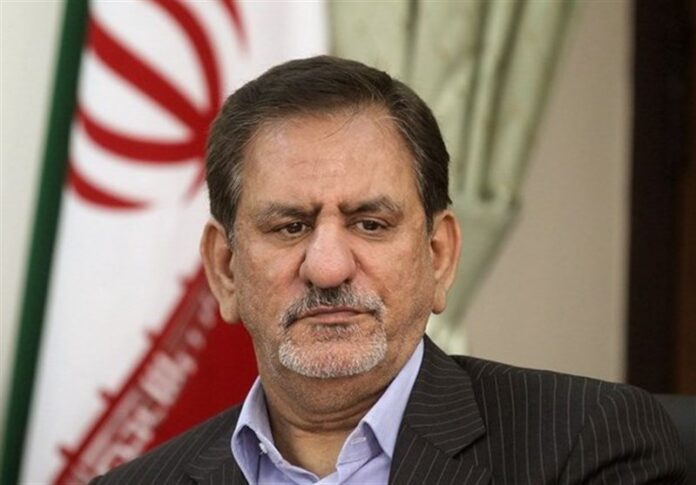
1- Iran First VP: National Dialogue Only Way to Overcome Problems

A Look at Iranian Newspaper Front Pages on January 16


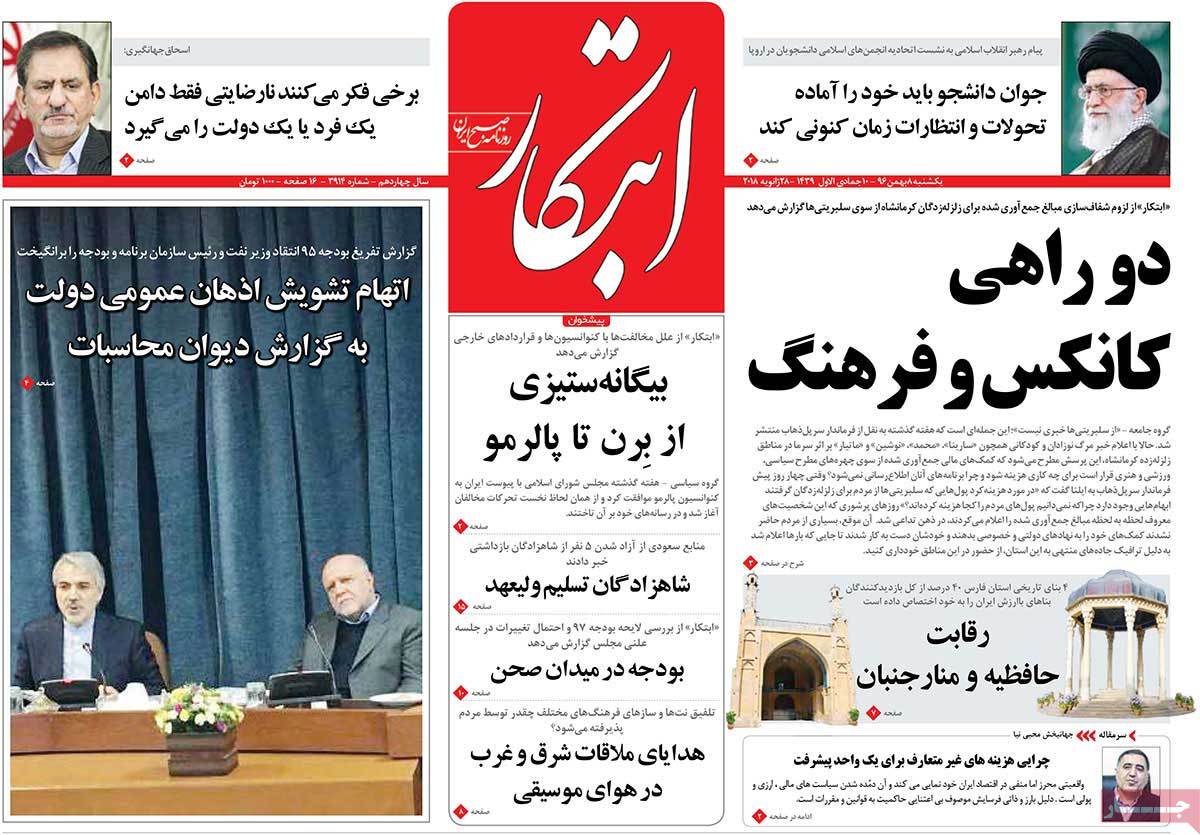
Ebtekar:

1- Border Clash between India, Pakistan: Repetition of Crisis in Subcontinent

2- Tears of Rain, Sorrow of Snow on Faces of Iranians

  • A Report on Impacts of Low Precipitation on People’s Souls

3- President Rouhani: Responsible or Critic? A Report on Rouhani’s Critical Stances

A Look at Iranian Newspaper Front Pages on January 16


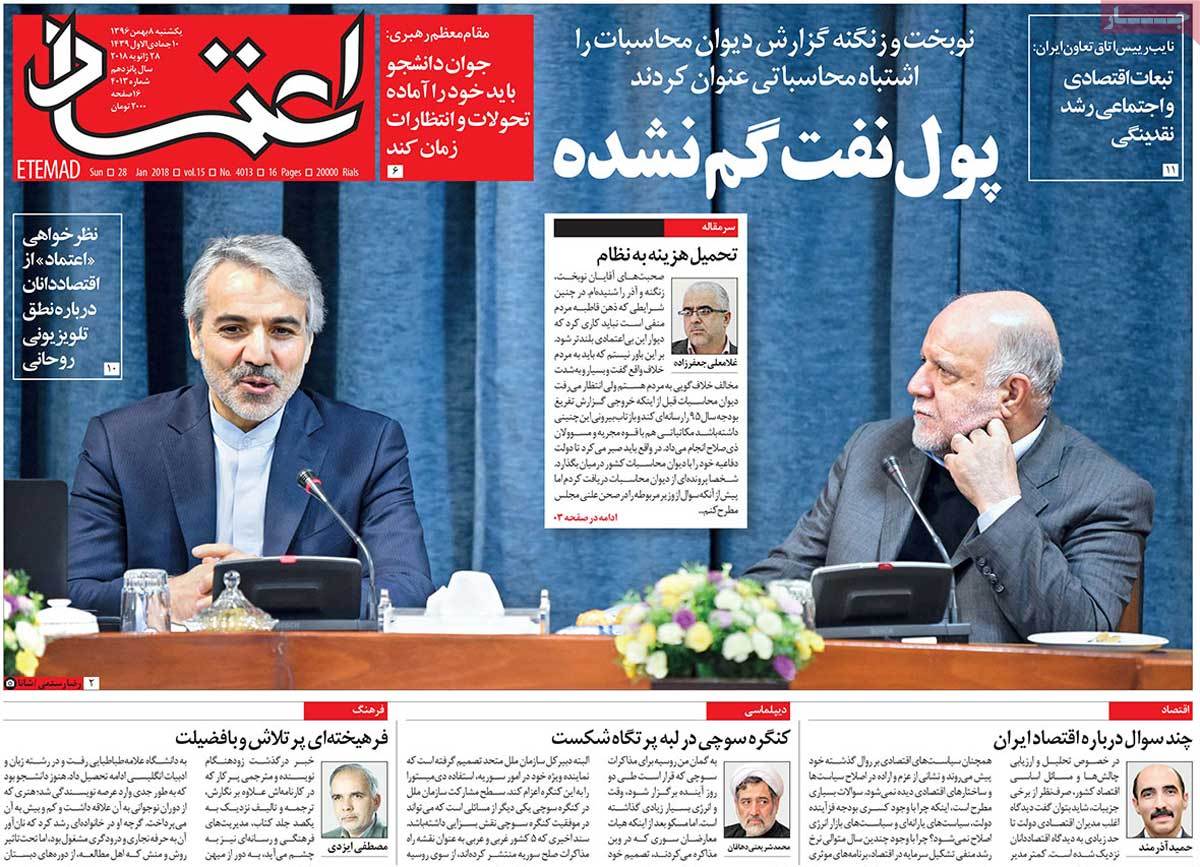
Etemad:

1- Iran Nuclear Deal, Leverage for Progress

  • Implementation of JCPOA Enters Third Year

A Look at Iranian Newspaper Front Pages on January 16


Ettela’at:

1- Lavrov: Iran Nuclear Program Not Negotiable

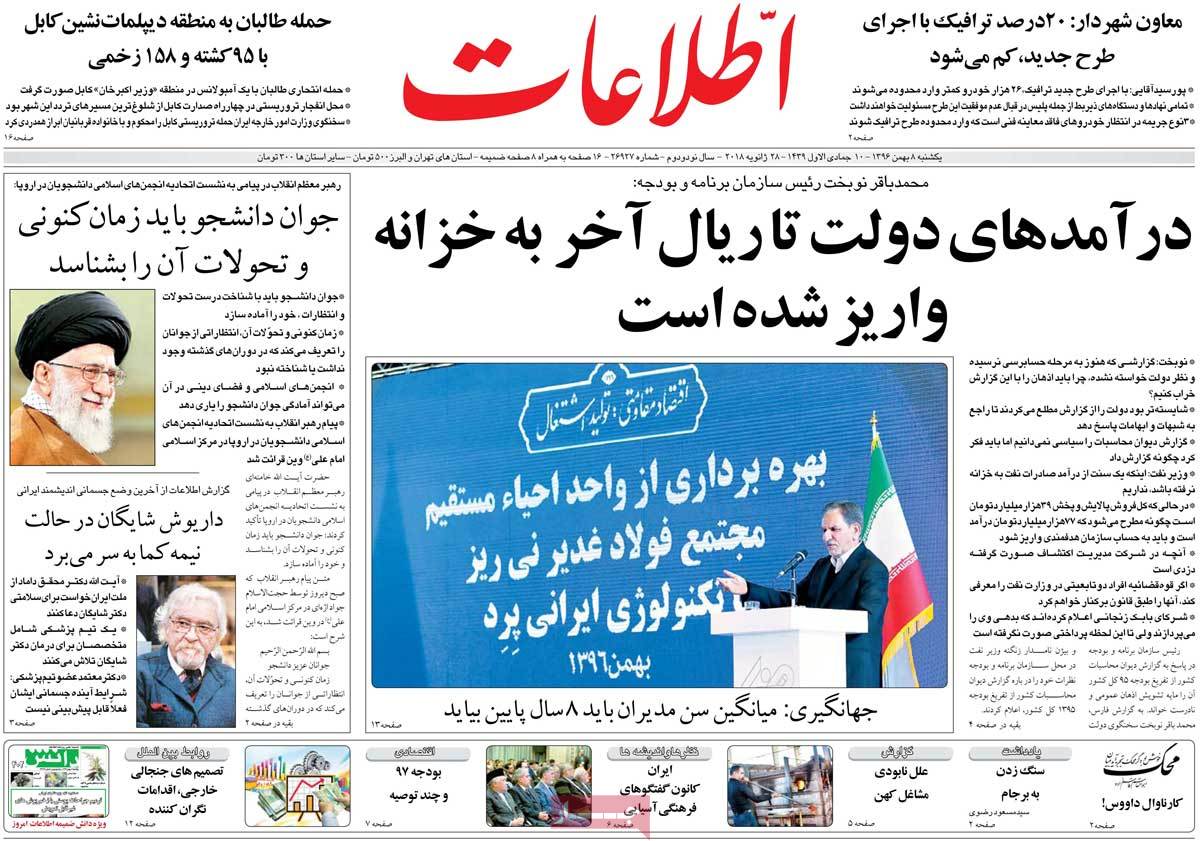
2- Larijani: We Should Let Entire World Hear Voice of Palestinian People

A Look at Iranian Newspaper Front Pages on January 16


Iran:

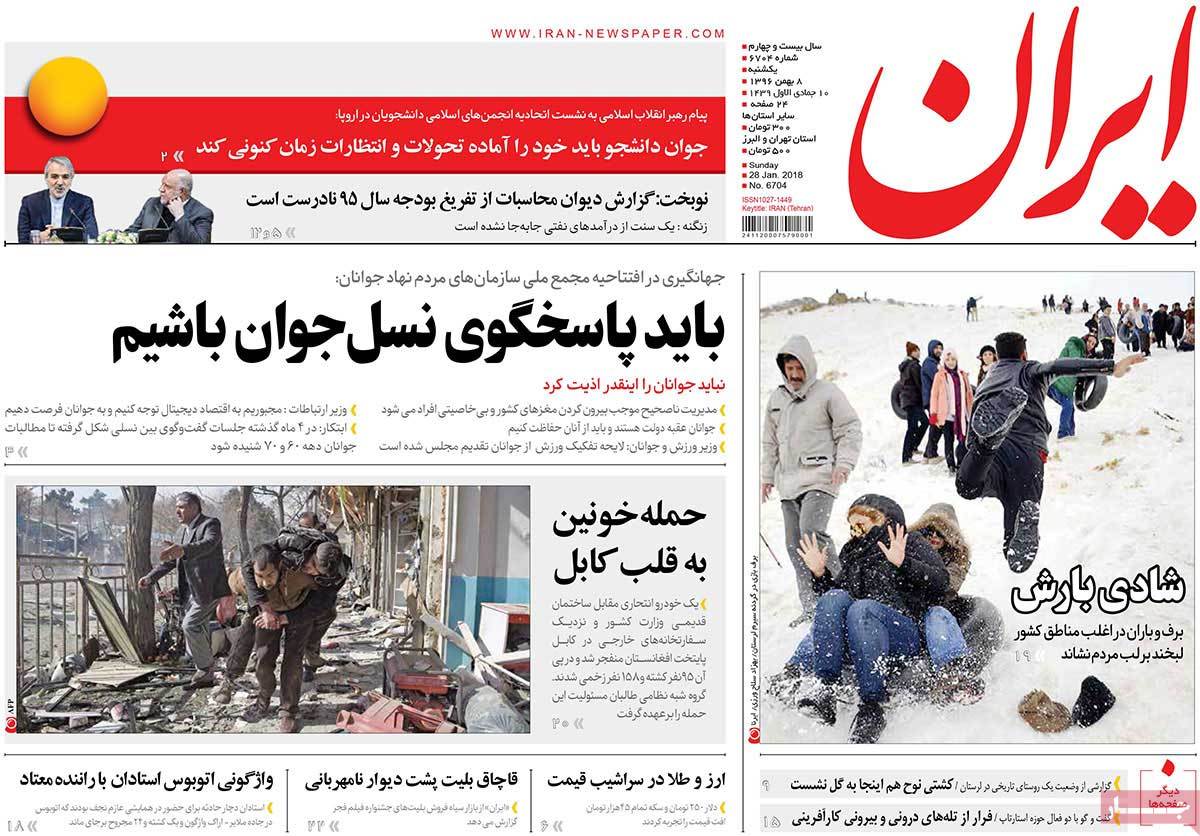
1- Everlasting Sorrow: People Mourn Deaths of Sanchi Sailors

A Look at Iranian Newspaper Front Pages on January 16


Javan:

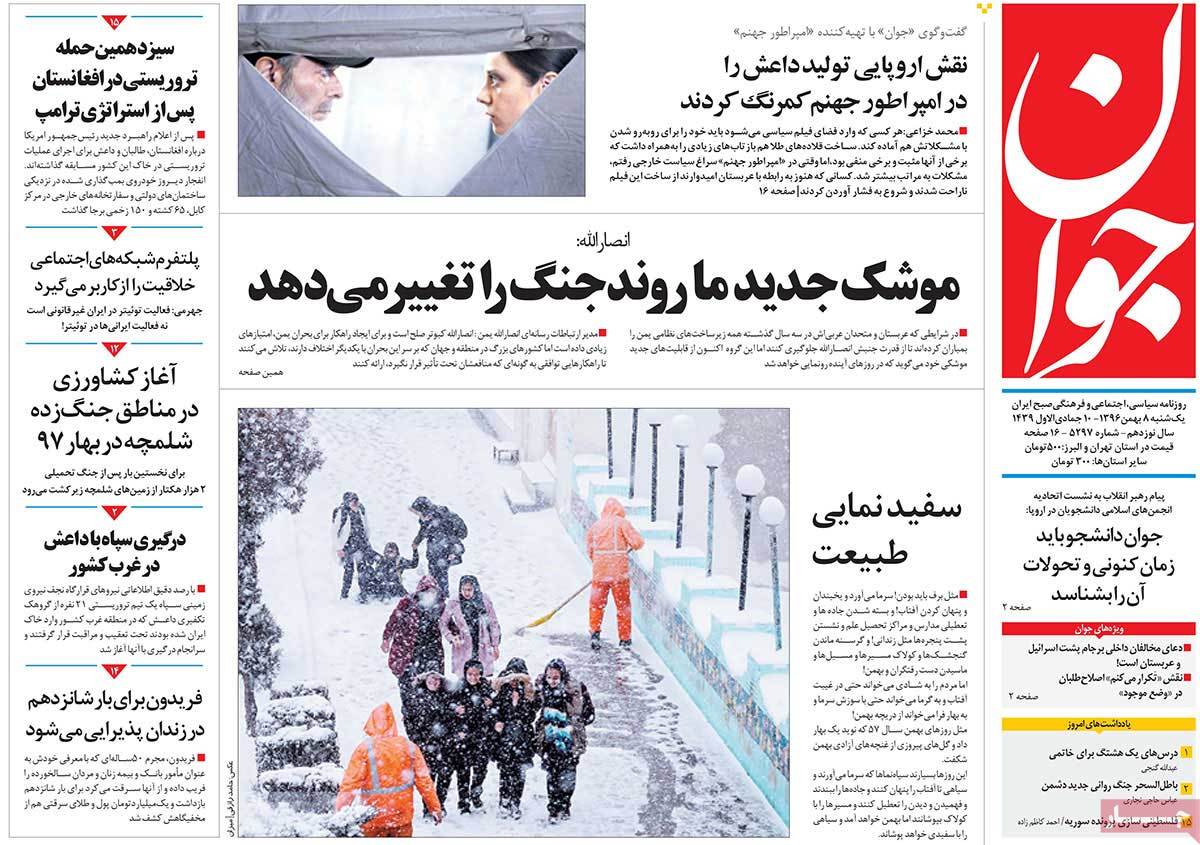
1- Europe Seems to Be Compromising with US over Iran Nuclear Deal

2- Decoding Oil Tanker’s Black Box Postponed to 3 Months Later

3- Food Prices Dropping in World, Rising in Iran

  • FAO: Price of Food Products Dropped

A Look at Iranian Newspaper Front Pages on January 16


Jomhouri Eslami:

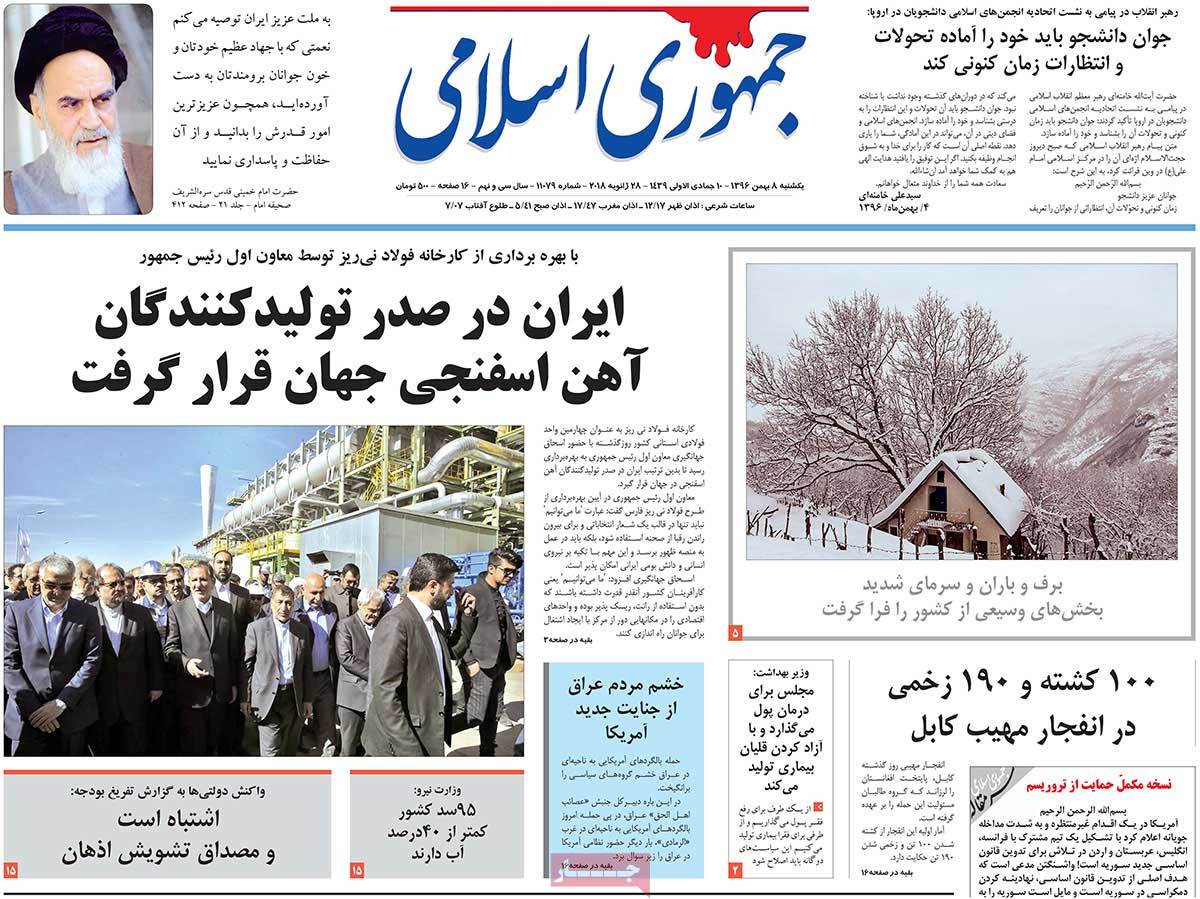
1- 13th Conference of OIC’s Parliament Speakers to Start in Tehran Today

A Look at Iranian Newspaper Front Pages on January 16


Ka’enat:

1- Preserving Iran Nuclear Deal to Be Moscow’s Top Priority in 2018: FM

A Look at Iranian Newspaper Front Pages on January 16


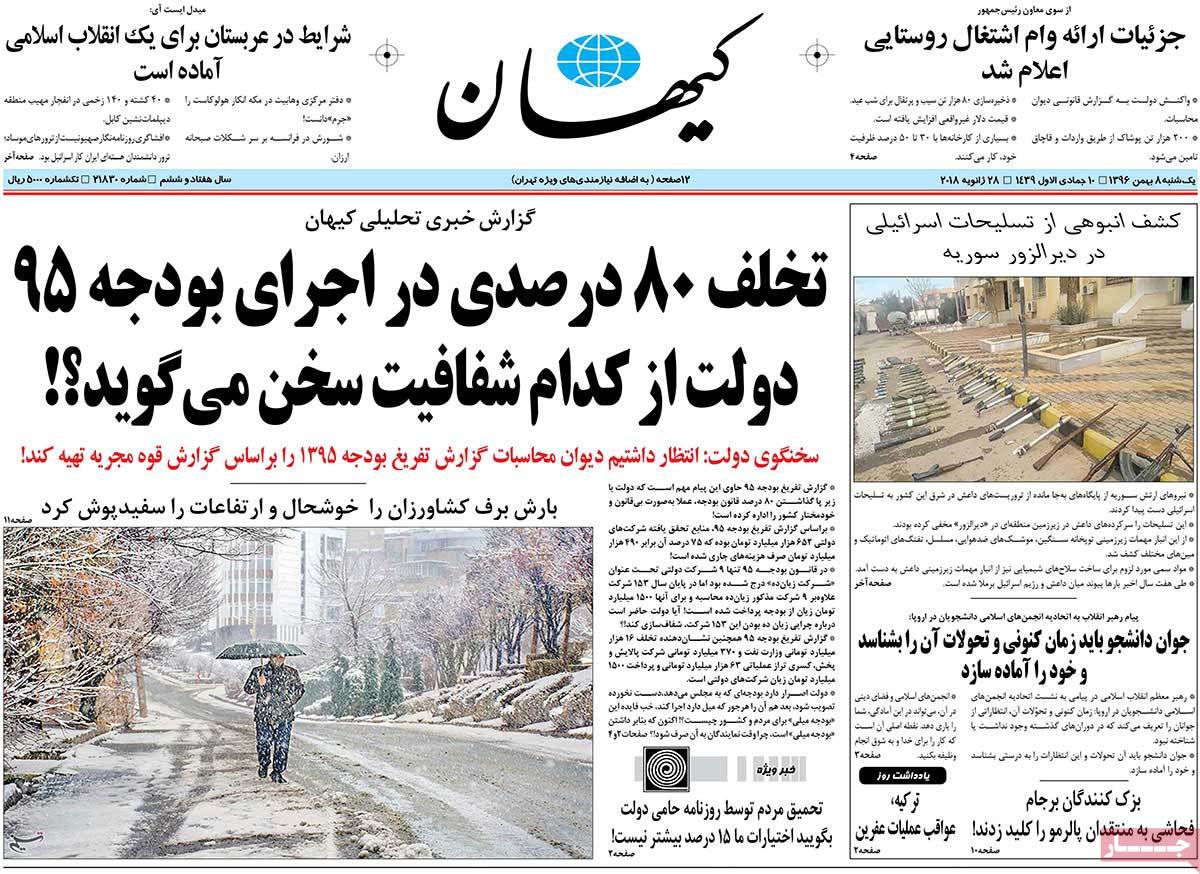
Kayhan:

1- From China to US: Social Media Not Fully Open in Any Country

2- Power Struggle in Saudi Dynasty

A Look at Iranian Newspaper Front Pages on January 16


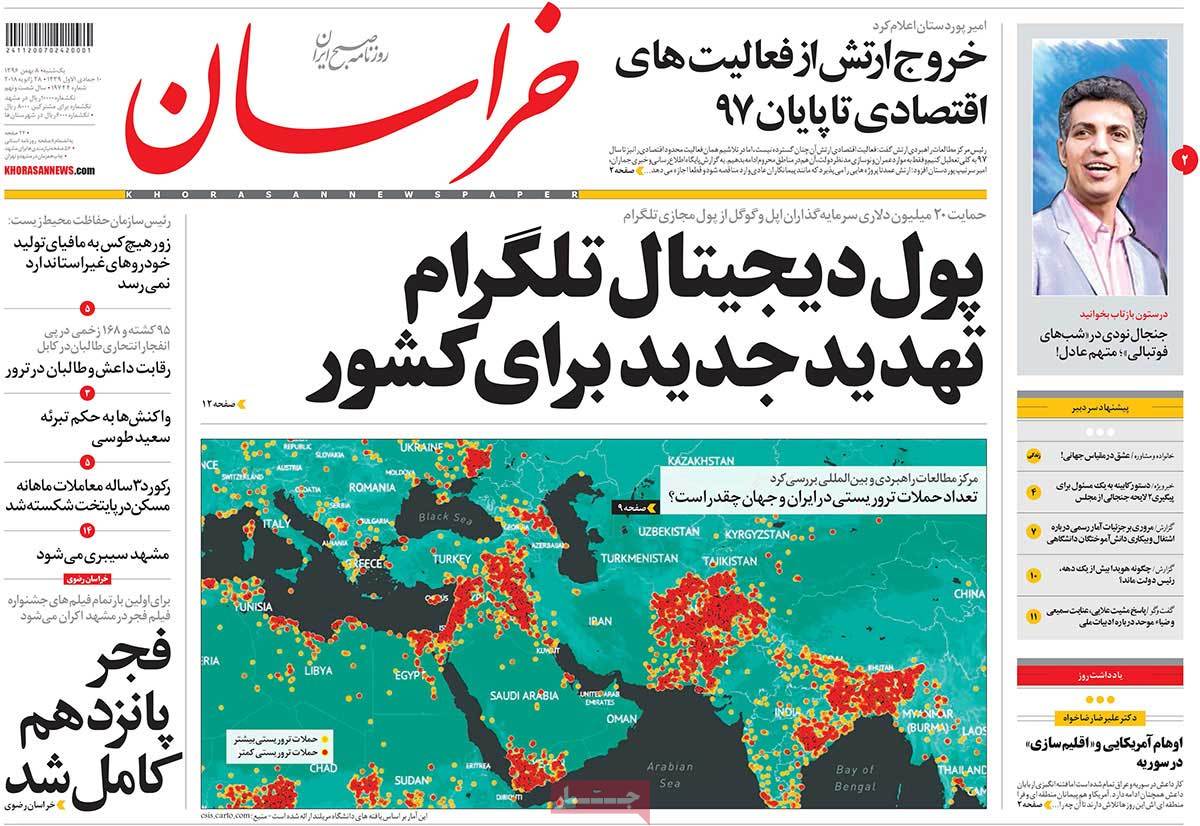
Khorasan:

1- Wave of Rumours about Sanchi Tragedy: Ambiguities in Bitter Incident

A Look at Iranian Newspaper Front Pages on January 16


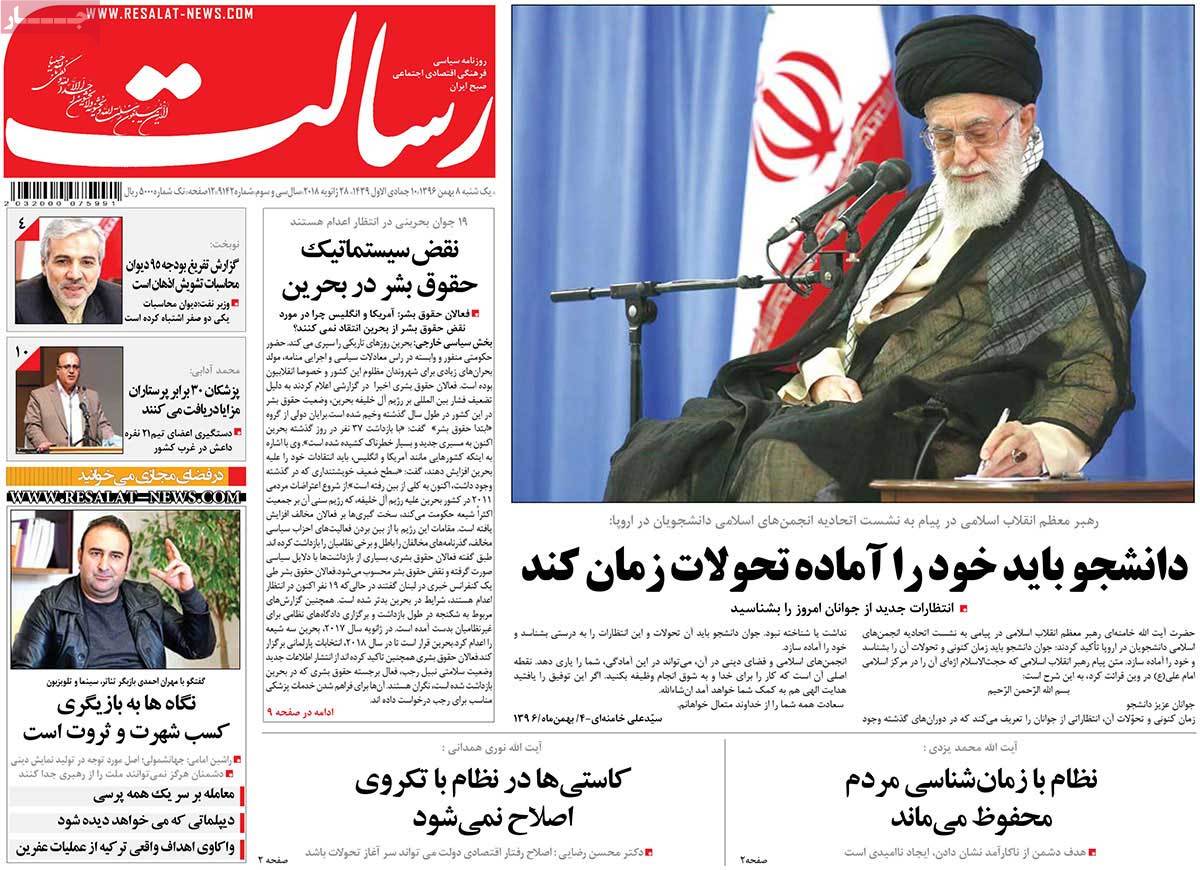
Resalat:

1- Judiciary Chief: Iran Not to Remain Silent towards US Sanctions

A Look at Iranian Newspaper Front Pages on January 16


Setareh Sobh:

1- Revolution against Revolution in Tunisia

2- German Green Party’s Lawsuit against Shahroudi Was General: Politician

A Look at Iranian Newspaper Front Pages on January 16


Shahrvand:

1- Mysterious Ship in China Waters

2- Humans Self-Flagellating by Destructing Their Own Environment in Extremely Fast Pace

A Look at Iranian Newspaper Front Pages on January 16


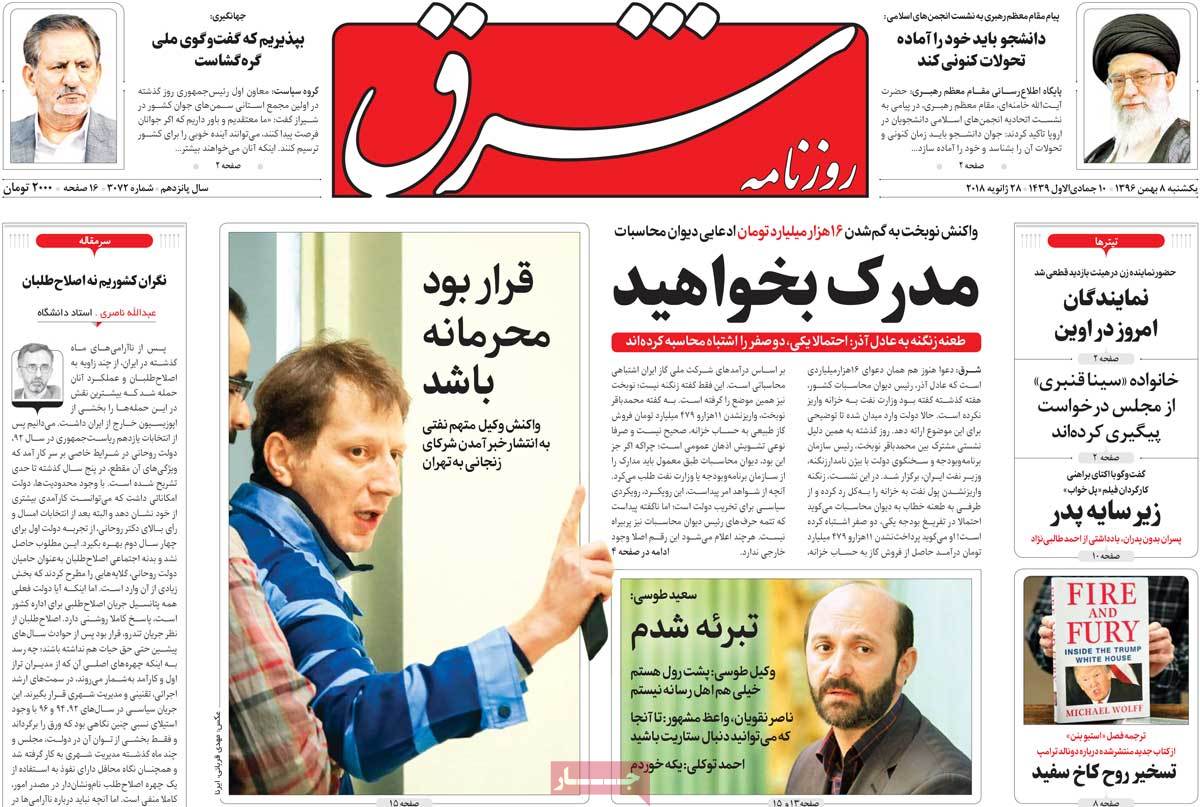
Shargh:

1- Merkel Stands by Macron to Counter Trump

A Look at Iranian Newspaper Front Pages on January 16