Sunday, December 21, 2025
Home Blog Page 3719

10 Iranian MPs to Visit Evin Prison Sunday

evin

The 10-member delegation includes lawmakers from the Judicial, Education, and National Security parliamentary commissions, a Farsi report by ISNA said.

Representatives from the parliamentary factions of conservatives (Followers of Velayat), reformists (Hope), and the Independents as well as the Parliament’s Presiding Board are among other members of the delegation.

Abdolkarim Hosseinzadeh, Mohammad Kazemi, Hassan Norouzi, Mohammad-Javad Fathi, Mohammad Dehqan, Mohammad-Ali Vakili, Allahyar Malekshahi, Fatemeh Saeidi, Valiollah Nanvakenari, and Mohammad Boroumandi are the MPs who will inspect the prison at 10 am, Sunday.

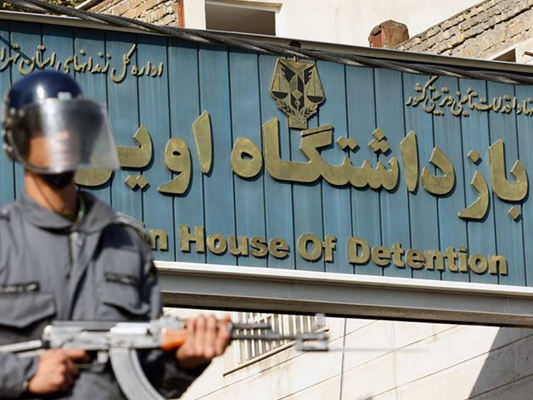
The Parliament started its talks with the Judiciary to make the arrangements for the visit a few days after the reported deaths of a couple of Evin detainees.

The Judiciary says the prisoners have committed suicide, but the lawmakers are going to visit the prison in person to inspect the situation.

Saudi Billionaire Released from Detention in Opulent Hotel

Waleed bin Talal

Reuters quoted a family source as saying on Saturday that the Saudi prince has arrived home.

His release came hours after Bin Talal, the highest profile detainee with stakes in companies such as Twitter and Citigroup, told Reuters in an exclusive interview at the opulent Ritz-Carlton hotel in Riyadh that he expected to be cleared of any wrongdoing and be released from custody within days.

Maintaining his innocence, he said he was finalising the “misunderstanding” through discussions with the government to clear his name and expected to resume normal life at the helm of his investment company, Kingdom Holding.

The release comes as Saudi Crown Prince Mohammed bin Salman’s purge winds down, with the gilded penal facility expected to reopen next month as a five-star hotel, FT reported.

The authorities have described the anti-graft drive as a strong message that corruption will not be tolerated as the crown prince seeks to diversify the economy away from its dependence on oil. The purge, also consolidating the prince’s power by sidelining potential rivals, has alarmed global investors who will be needed for his wide-ranging economic reform plans.

The authorities say they have recovered billions of dollars from detainees who have signed financial settlements in lieu of legal action on graft charges. Others have been released without charge. As many as 95 holdouts unwilling to settle charges could be transferred to prison to face trial, the authorities have said.

Iran’s Jaberi Ansari, Syrian President Meet in Damascus

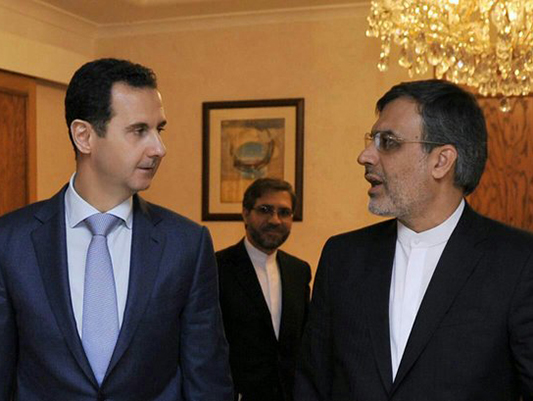
During the Saturday meeting, Assad and Jaberi Ansari discussed the most recent political and field developments of the Arab country, particularly the situation of Afrin in northern Syria, and mutual cooperation between the two countries.

The meeting was the latest round of Iran-Syria talks over the Arab country’s National Dialogue Congress which is to be held in Russia’s Sochi.

The Iranian diplomat is also expected to sit for talks with other senior Syrian officials over the latest developments in the war-stricken country, a Farsi report by the Fars News Agency said.

The talks are being held just days ahead of a “Syrian National Dialogue Congress” which is slated to be held in the Russian Black Sea resort of Sochi on January 29 and 30.

Jaberi Ansari, who also serves as the Iranian Foreign Minister’s Special Assistant in Political Affairs, took part in a preliminary meeting in Sochi on January 20.

During the meeting attended by the Russian president’s special envoy for Syria Alexander Lavrentiev as well as Turkish Deputy Foreign Minister Sedat Önal, the officials of Iran, Russia and Turkey also known as guarantor states made the final arrangements for holding Syrian National Dialogue Congress in Sochi.

Meanwhile, Syria’s foreign-backed main opposition group has refused to attend the Russia-brokered peace talks in Sochi.

Yahya al-Aridi, a spokesman for the opposition delegation at the Vienna talks on Syria, said Russia had not provided the necessary commitment and that the Sochi conference was aimed at undermining the UN-led efforts.

He noted that if the Russians want to bring peace to Syria they should put their efforts on Geneva talks. He also called on Moscow to exert pressure on Damascus to meet its commitments.

The 9th round of UN-mediated talks between Syria’s warring factions came to an end in Austria’s capital Vienna on Friday with no tangible progress. The main issues discussed included future governance, a new constitution and elections.

Persian Rugs of Sistan Globally Recognized at WIPO

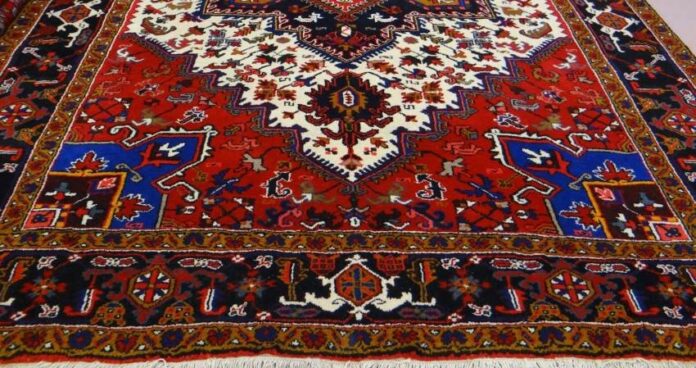
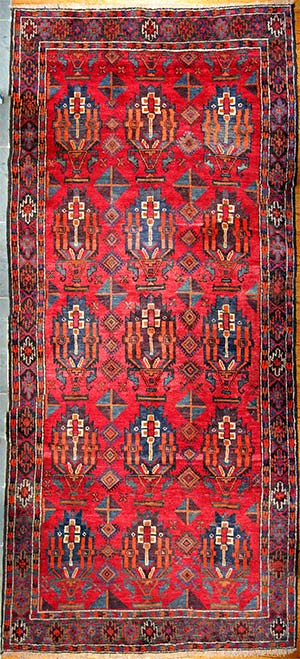
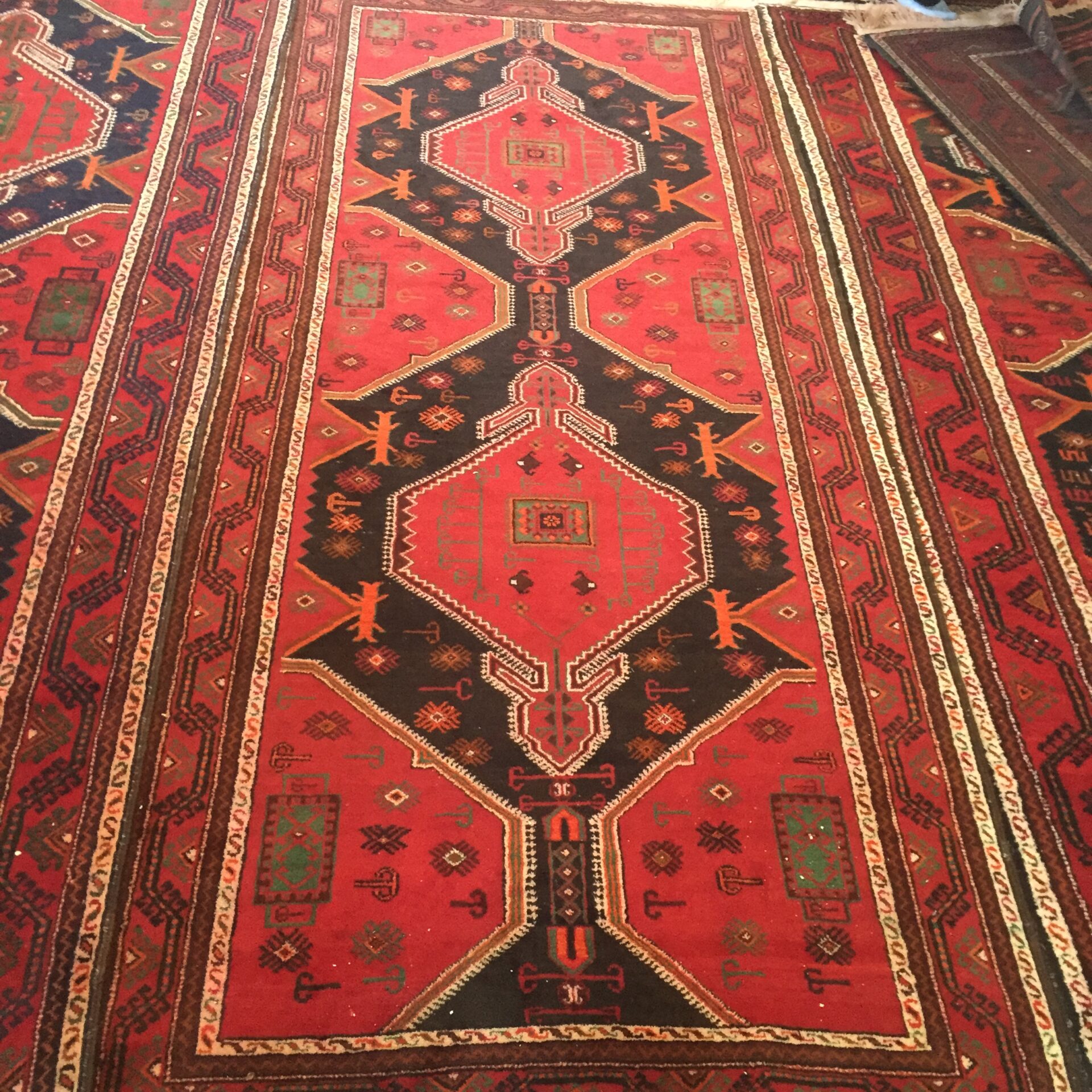
Persian Rugs of Sistan Globally Recognized at WIPOPresent at a recent ceremony to register the rug was Head of Iran’s National Carpet Centre Hamid Kargar who said hand-made carpets in 47 regions in Iran have been registered nationally and the carpets woven in 29 other regions have been registered internationally.

“The cases registered have been recognized at the World Intellectual Property Organization,” he said.

“Hand-woven carpets have always been known as one of our country’s key non-oil export items, and an important non-oil product, per se,” he said, according to a Farsi report by ISNA.

“Hand-made carpets remain a reliable source of forex revenues,” the official noted.

He said the hand-woven carpet sector plays a key role in creating jobs, too, and is a reliable source of income at times of drought in different parts of the country.

“In the distant past, carpet weaving was as source of income in addition to husbandry and agriculture, and these years when we are facing drought, it can help in creating jobs,” he underlined.

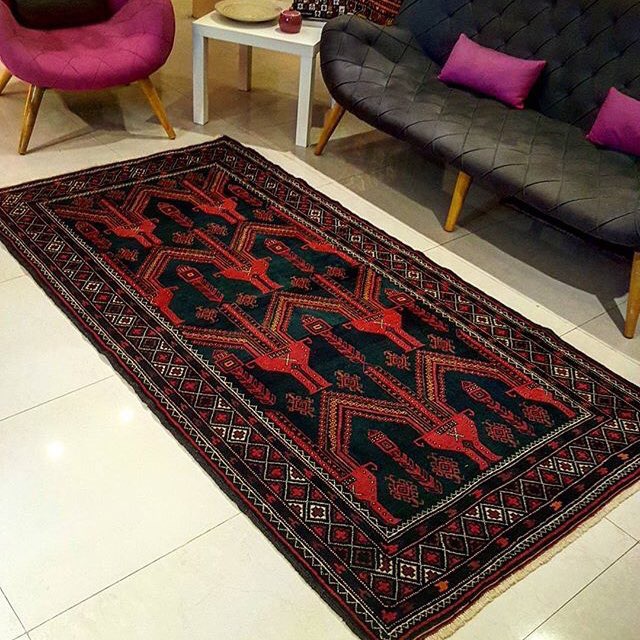
The official further said plans are set in motion to nationally register the hand-woven carpets produced by the Iranian Baluch ethnic group.

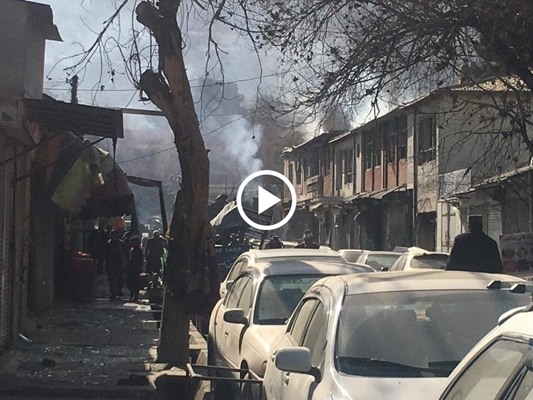
Dozens of People Dead, Wounded in Huge Kabul Blast (+Video)

The Afghan health ministry says that at least 63 dead and 151 wounded had been brought hospitals, and victims were still flowing in.

Afghanistan’s TOLO News reported that the explosion was felt and heard across the city.

The explosion was initially believed to have been a car bomb and happened outside the old ministry of interior building in the city.

Witnesses near the city centre said they heard at least three explosions, Al Jazeera reported.

A plume of grey smoke rose from the blast area in the city center and buildings hundreds of meters away were shaken by the force of the explosion.

The explosion comes a week after a deadly attack on the Intercontinental Hotel in the city.

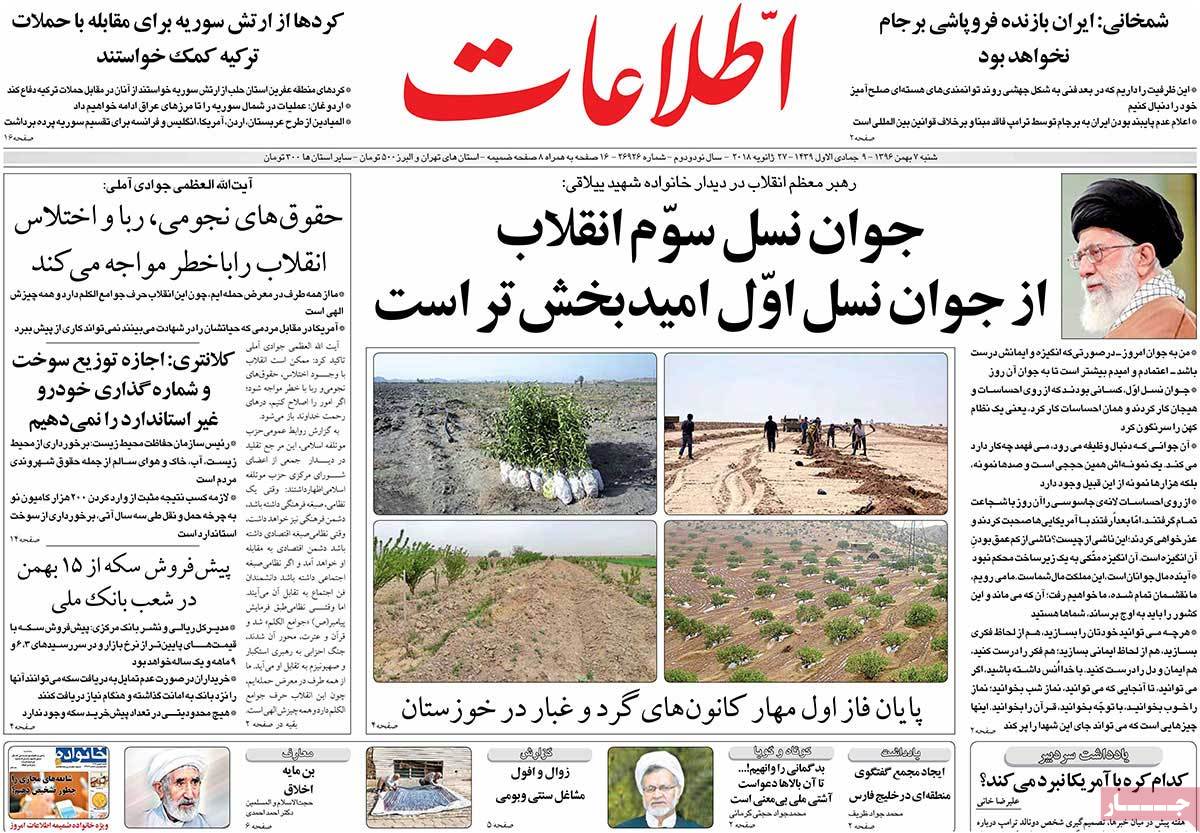
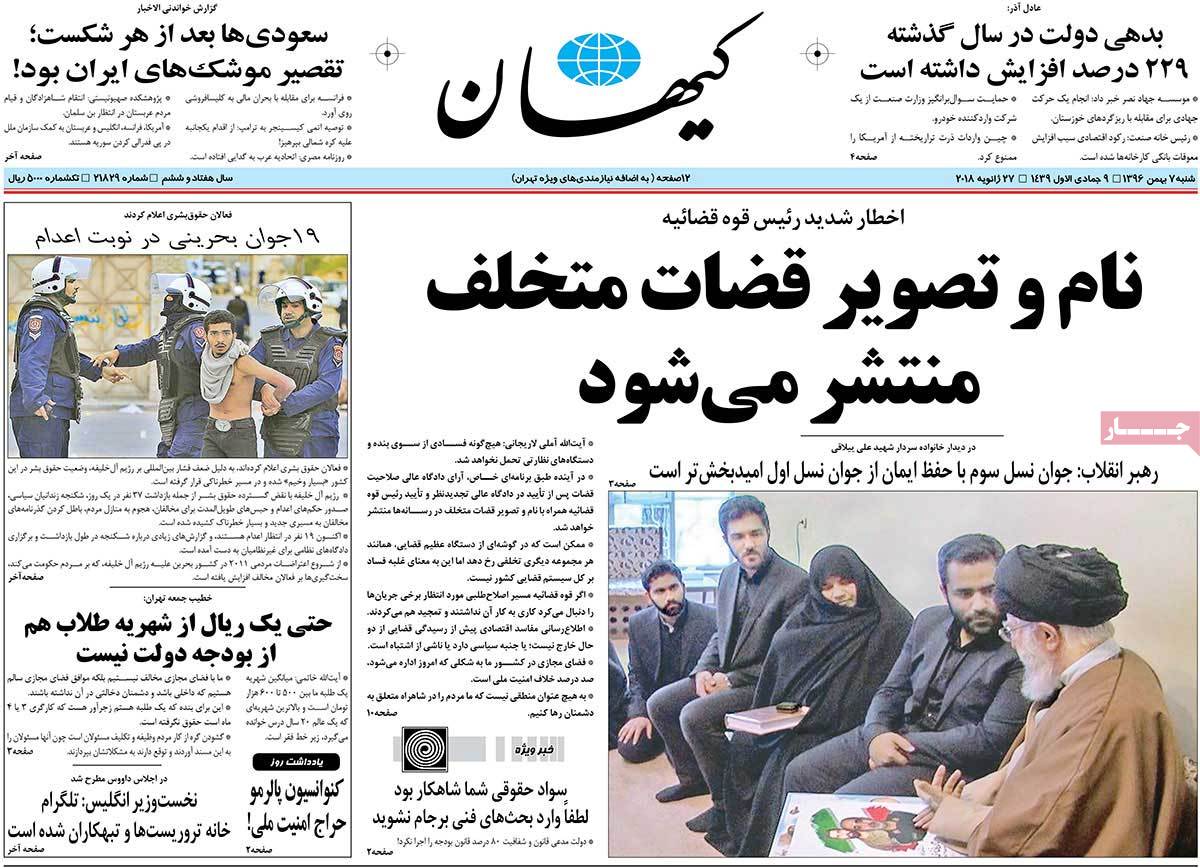
A Look at Iranian Newspaper Front Pages on January 27

A Look at Iranian Newspaper Front Pages on November 18

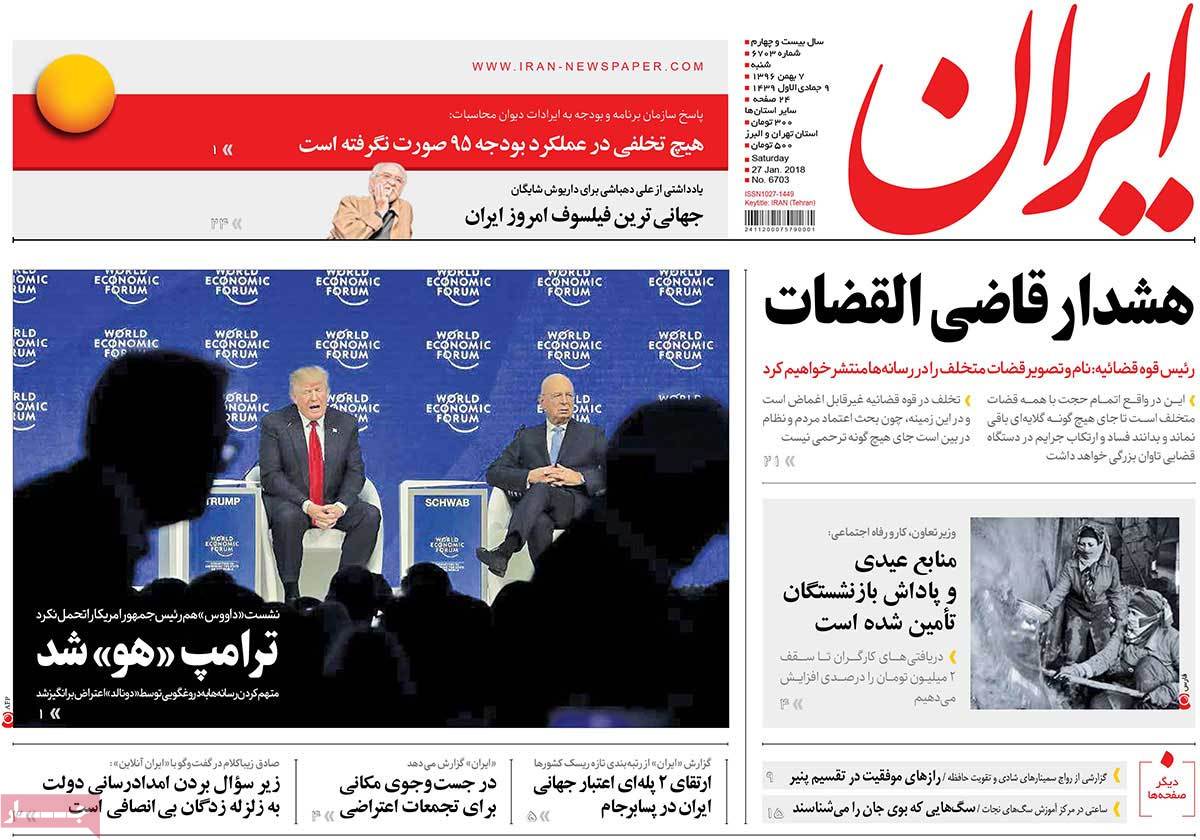
Several papers today covered the World Economic Forum held in the Swiss city of Davos, and criticized the Iranian foreign minister for not attending the important summit, where anti-JCPOA lobbies spoke out against Iran.

Also a top story was the Turkish operation in the Syrian city of Afrin, and the US warning about Ankara’s extension of the war to the SDF-controlled Manbij, near the Iraqi border.

A decision by the Organisation for Economic Cooperation and Development (OECD) to upgrade Iran’s risk rating to 5 also received great coverage.

The above issues, as well as many more, are highlighted in the following headlines and top stories:


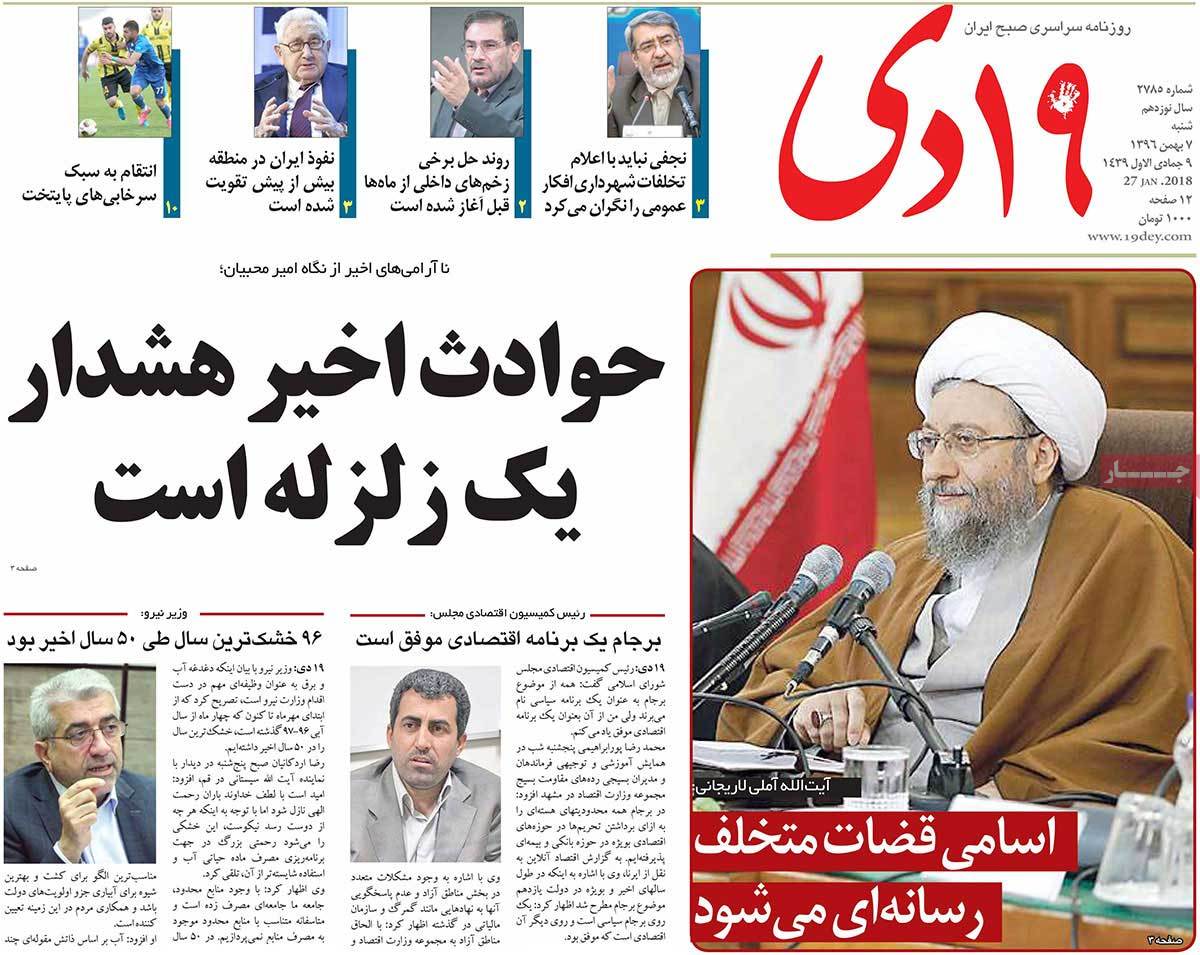
19 Dey:

1- Judiciary Chief: Names of Offending Judges to Be Released in Media

2- Power Minister: Current Iranian Calendar Year, Driest Year in Past 50 Years

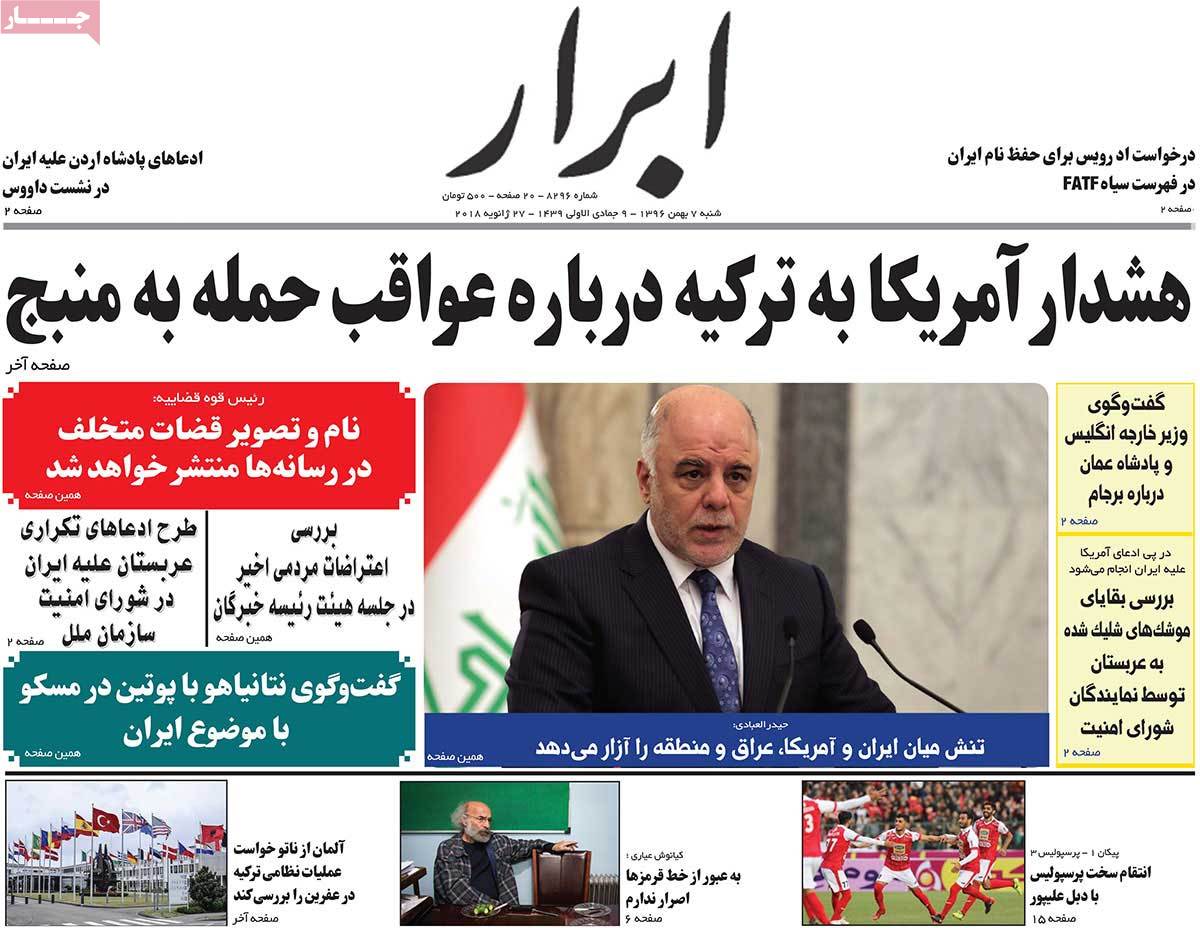
A Look at Iranian Newspaper Front Pages on January 27


Abrar:

1- US Warns Turkey of Consequences of Attacking Manbij

2- UNSC Representatives to Investigate Parts of Missile Fired at Saudi Arabia

3- Al-Abadi: Iran-US Tension Hurting Iraq, Region

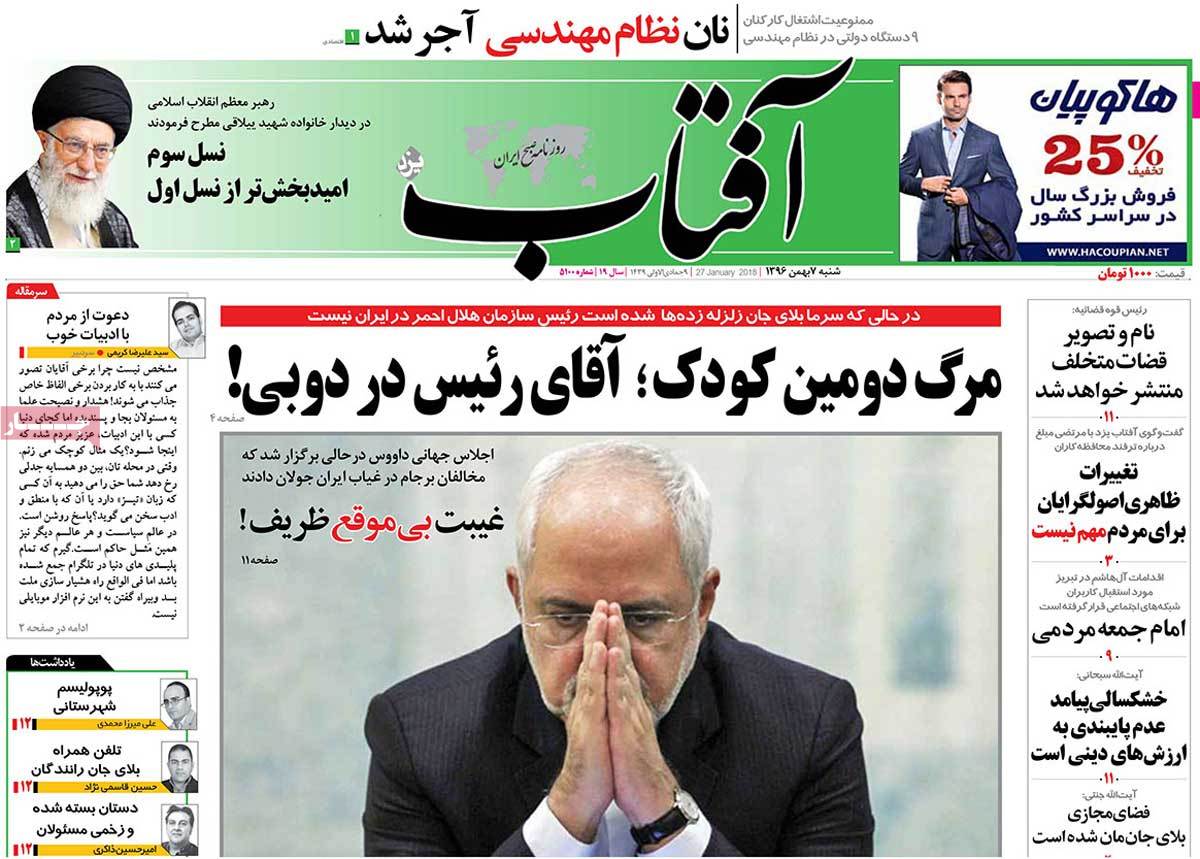
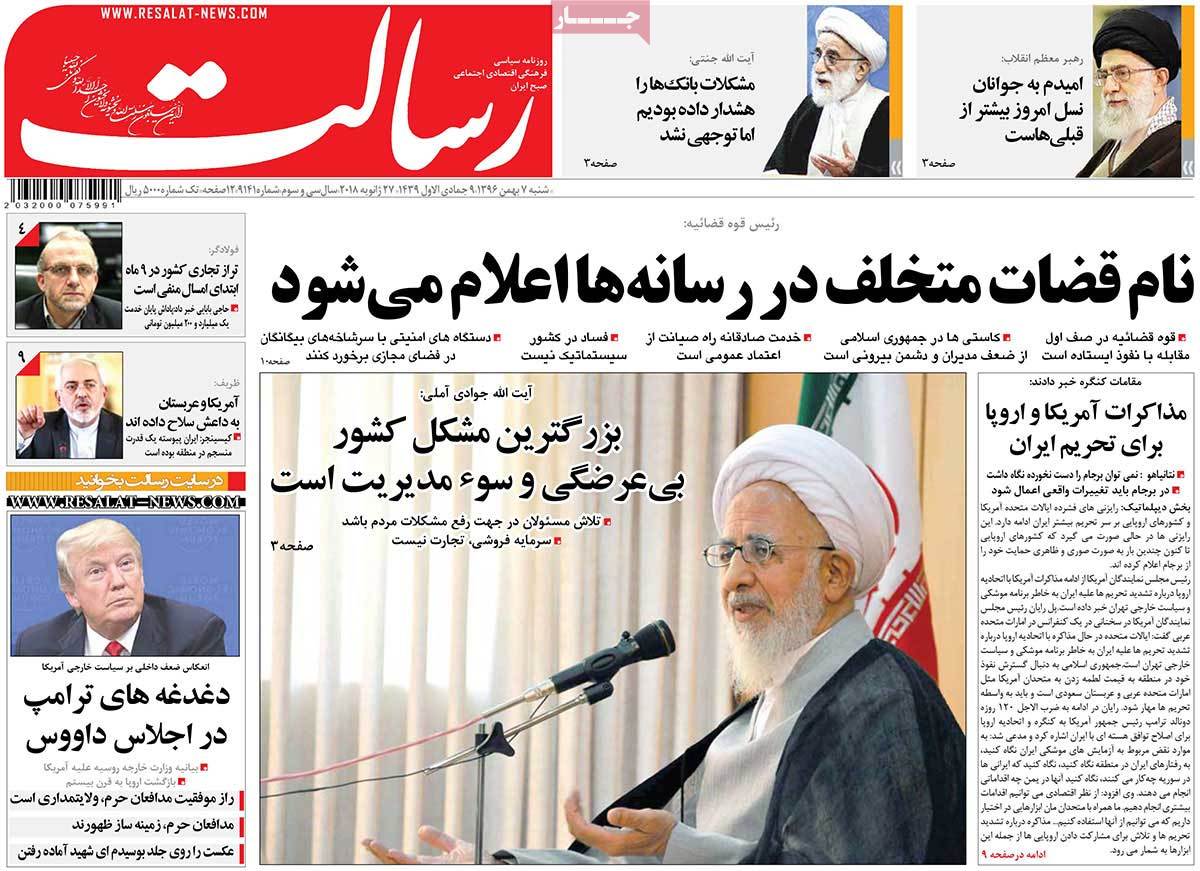
A Look at Iranian Newspaper Front Pages on January 27


Aftab-e Yazd:

1- Death of Second Child, Mr President!

  • While Quake-Hit People Are Dying of Cold, Red Crescent Chief Not in Iran!

2- Zarif’s Untimely Absence from WEF in Davos: Opponents of JCPOA Speak Out against Iran

3- Drought Result of Failure to Adhere to Religious Values: Cleric

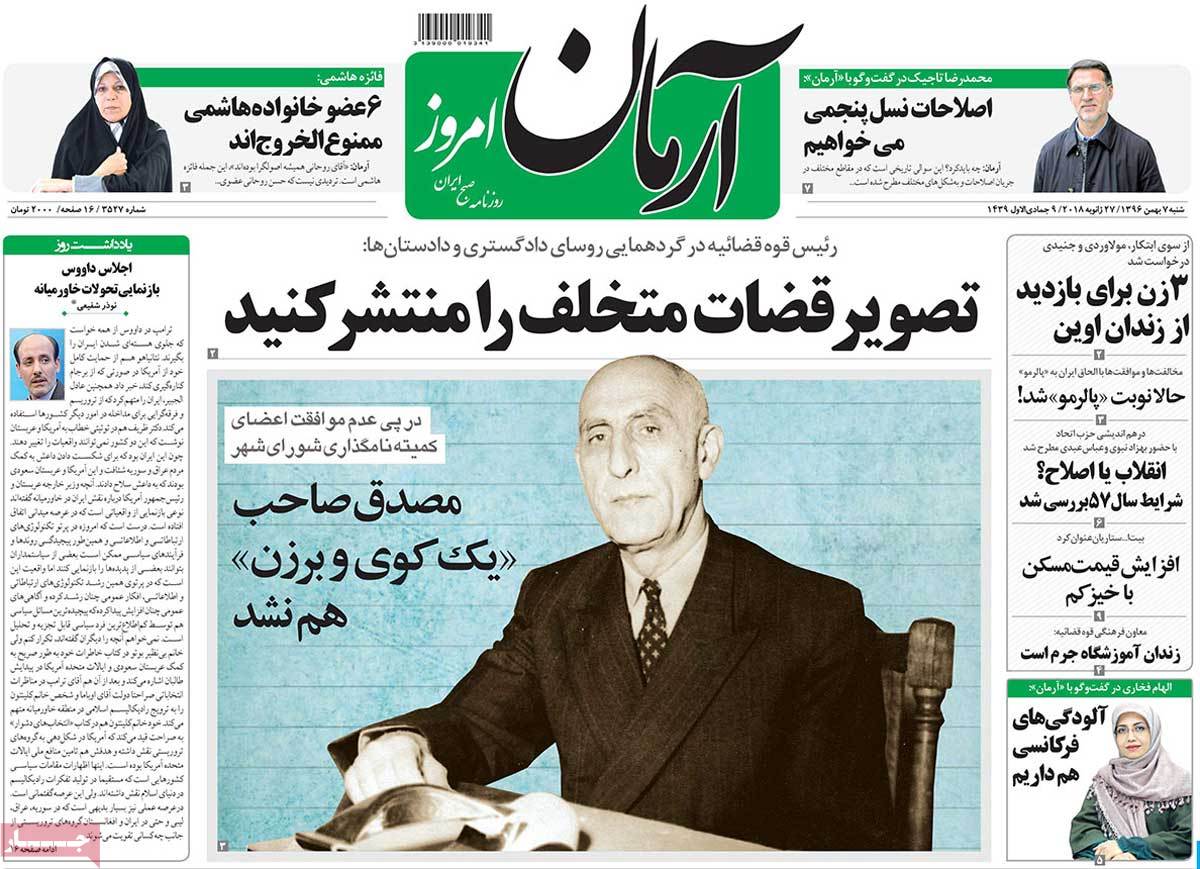
A Look at Iranian Newspaper Front Pages on January 27


Arman-e Emrooz:

1- Three Women Want to Visit Evin Prison

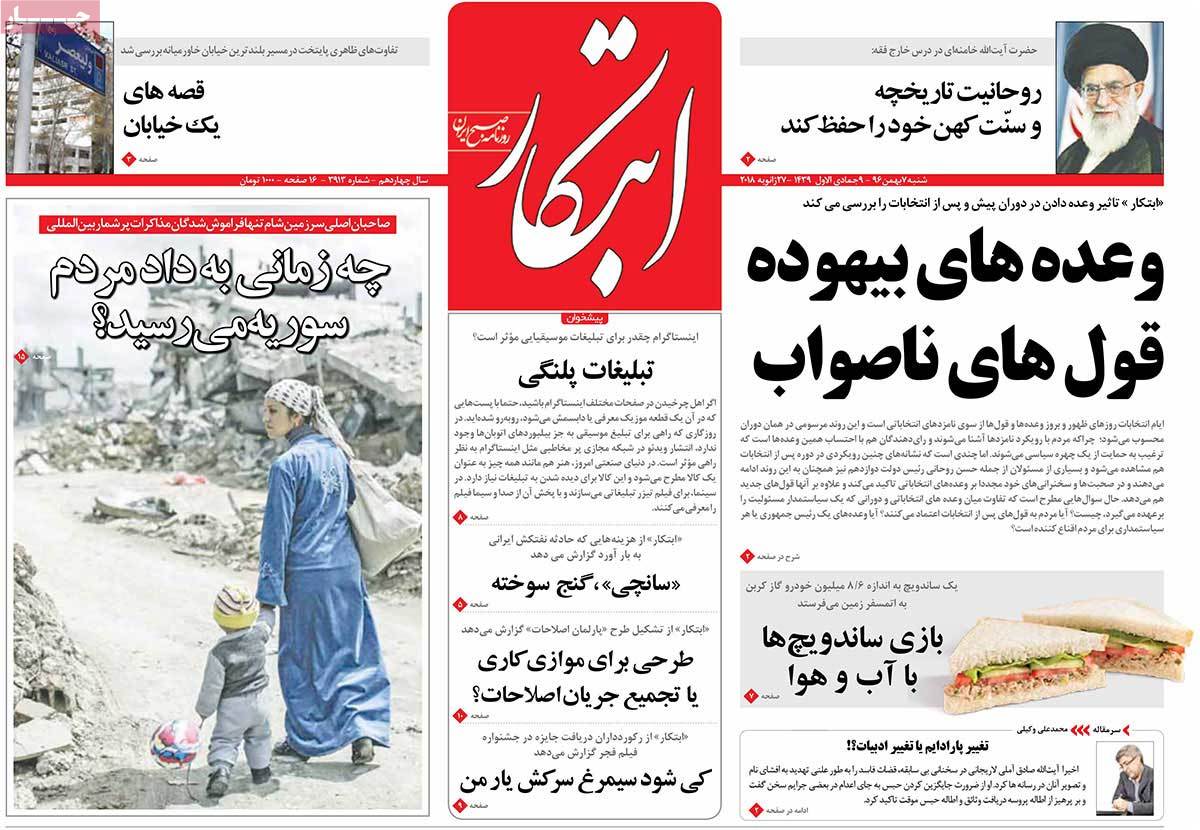
A Look at Iranian Newspaper Front Pages on January 27


Ebtekar:

1- Numerous Int’l Negotiations Totally Forgetting about Syrian People

A Look at Iranian Newspaper Front Pages on January 27


Ettela’at:

1- Shamkhani: Iran Not to Be Loser of JCPOA Annulment

2- End of First Phase of Tackling Khuzestan’s Dust Pollution

A Look at Iranian Newspaper Front Pages on January 27


Iran:

1- Trump Booed in Davos Summit

  • Controversy Sparked after Trump Accused Media of Telling Lies

2- Post-JCPOA OECD Ranking: Iran’s Risk Rating Upgraded to 5

A Look at Iranian Newspaper Front Pages on January 27


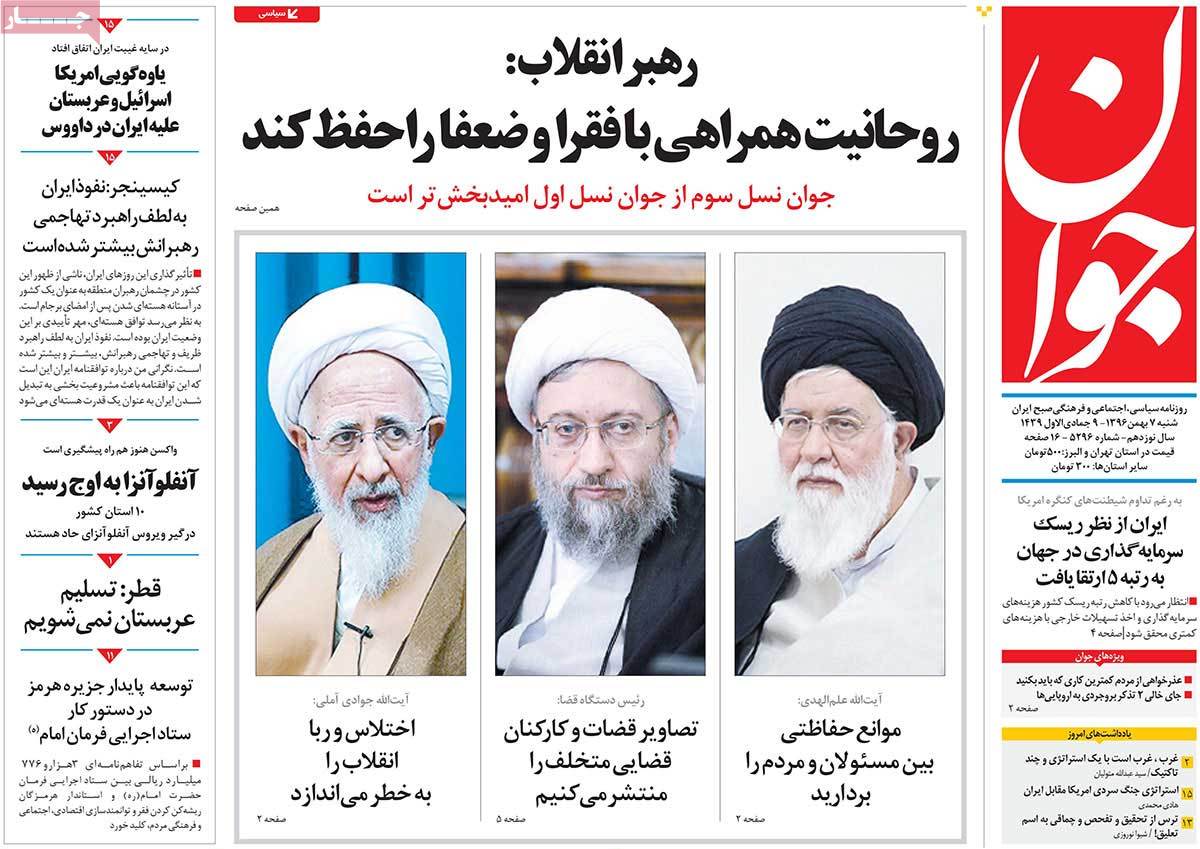
Javan:

1- Iran Leader Urges Clerics to Keep in Touch with Poor People

2- Cleric Calls for Removal of Security Barriers between People, Officials

3- Iran’s Risk Rating Improved despite US Congress’ Sabotage

4- Kissinger: Iran’s Influence Has Increased Thanks to Its Leaders’ Aggressive Strategy

A Look at Iranian Newspaper Front Pages on January 27


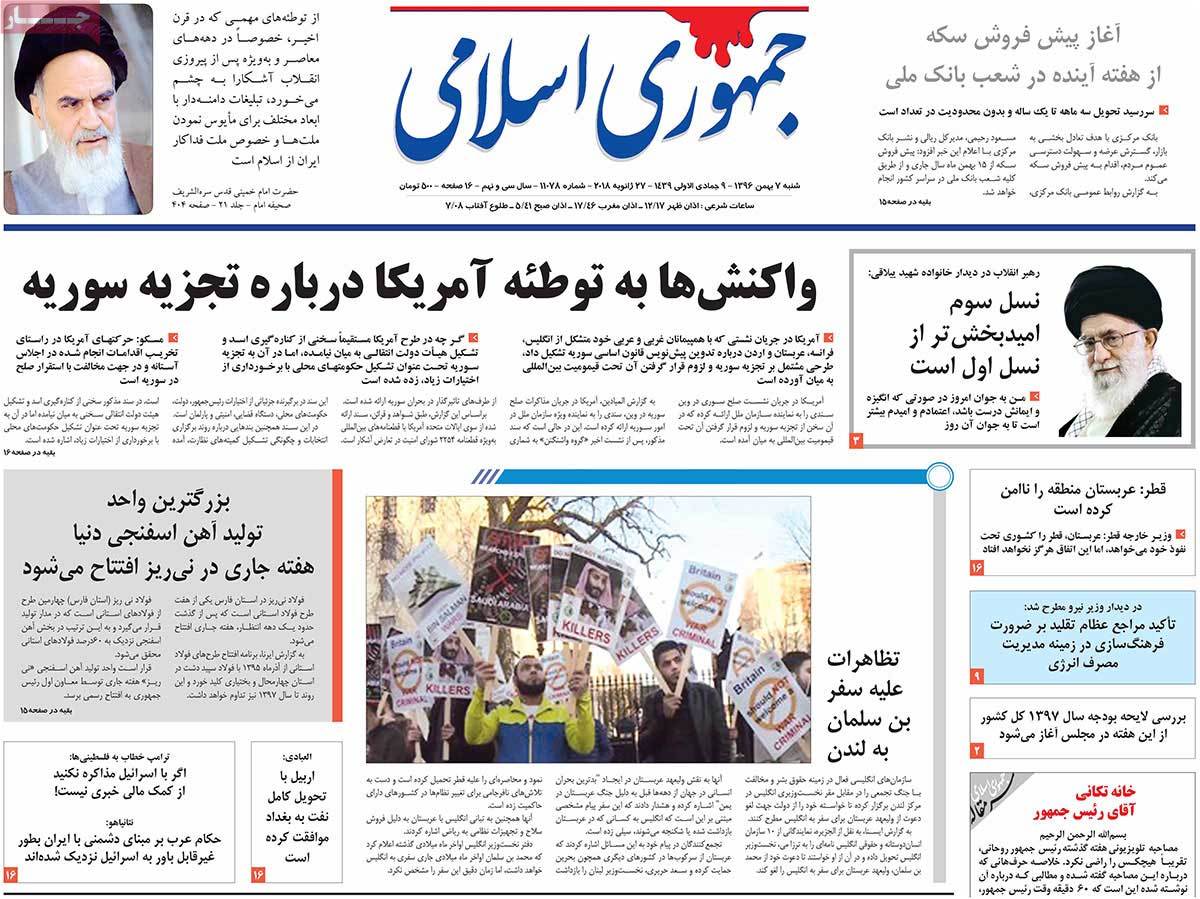
Jomhouri Eslami:

1- World’s Biggest Sponge Iron Factory to Be Launched in Iran Next Week

2- Qatar: Saudi Arabia Has Made Region Insecure

3- Top Clerics Call for Raising People’s Awareness about Optimized Energy Consumption

A Look at Iranian Newspaper Front Pages on January 27


Kayhan:

1- Cleric: Not a Single Penny of Seminary Students’ Tuition Comes from State Budget

2- British PM: Telegram Has Turned into House of Terrorists, Criminals

A Look at Iranian Newspaper Front Pages on January 27


Resalat:

1- Judiciary Chief: Names of Offending Judges to Be Publicized

2- Leader: I’m More Hopeful about Today’s Young Generation than I Was about Previous Ones

3- Zarif: US, Saudi Arabia Arm ISIS Terrorists

A Look at Iranian Newspaper Front Pages on January 27


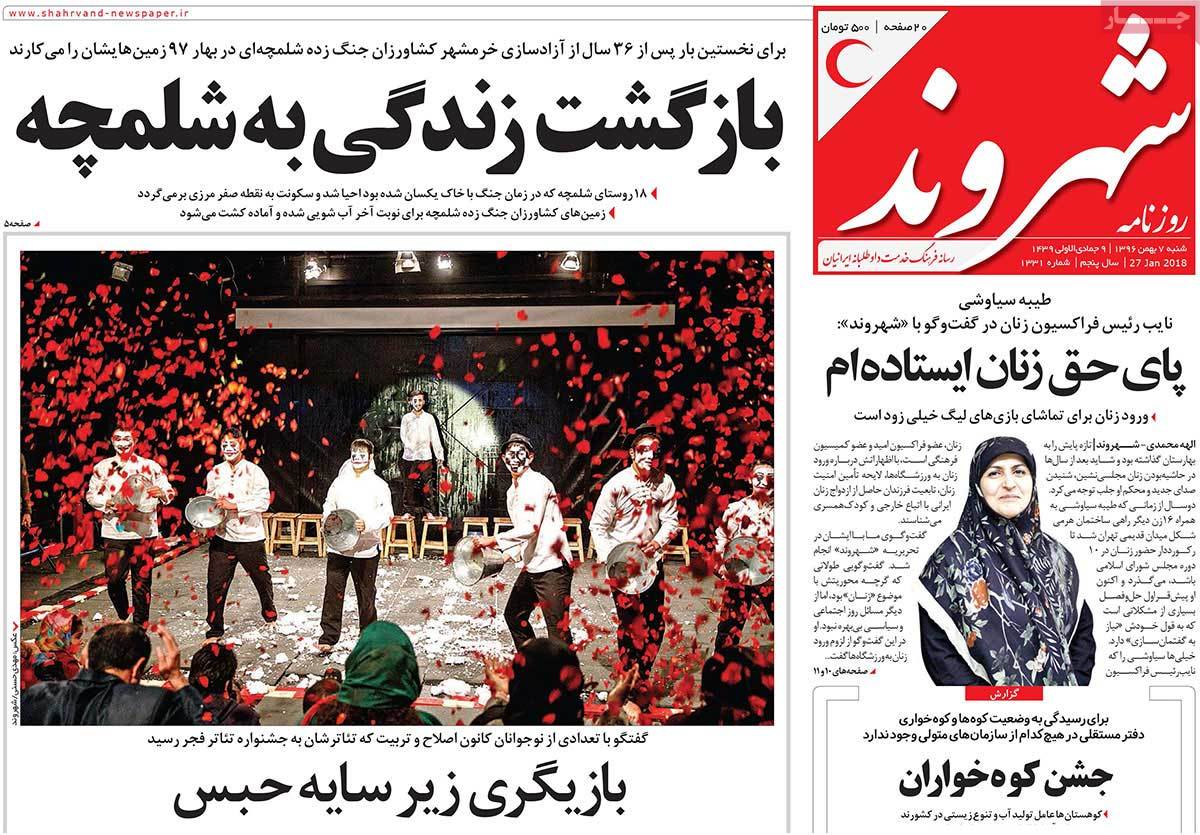
Shahrvand:

1- Return of Life to Shalamcheh

  • War-Torn Farmers of Shalamcheh to Plant Farms 36 Years after Khorramshahr Liberation

2- Performing Theatre While Serving Prison Term

  • Play Performed by Young Prisoners to Go on Stage in Fajr Festival

A Look at Iranian Newspaper Front Pages on January 27

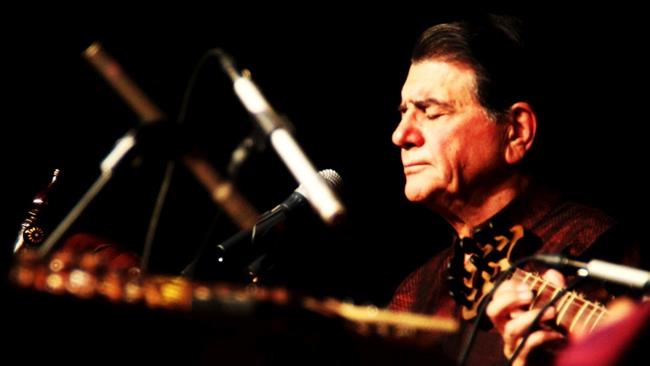
Shajarian, Greatest Living Maestro of Persian Singing

Shajarian, Greatest Living Maestro of Persian Singing

Born on September 23, 1940, in the northeastern city of Mashhad, Shajarian started recitation of the Holy Quran and singing at the age of five under the supervision of his father.

At the age of 12, he began studying Radif, the Iranian repertoire of classical melodic figures, with some of the prominent maestros of his time, including Ahmad Ebadi, Esmaeil Mehrtash, Abdollah Davami, and Nour-Ali Boroumand.

In 1959, Shajarian officially began his singing career at Radio Khorasan and rose to prominence across the country in the 1960s with his distinct style of singing.

Meanwhile, he continued learning different vocal styles from other virtuosos, including Reza Gholi Mirza Zelli, Fariborz Manouchehri, Ghamar Molouk Vaziri, Eghbal Azar, Taj Isfahani and Gholam Hossein Banan.

Shajarian has cited legendary Iranian tar musician Jalil Shahnaz as the most influential to his development, saying that Shahnaz’s playing style was what he most tried to mimic throughout his artistic life.

To better understand and perform the traditional repertoire, Shajarian also started playing the santour, a percussion-stringed Persian instrument, under the instruction of prominent virtuosos Jalal Akhbari and Faramarz Payvar.

The iconic vocalist continued his career in different spheres, including teaching at Tehran University’s Department of Fine Arts, working at National Radio and Television, conducting research on Iranian music, and creating a repertoire of recordings.

He has also collaborated with several other iconic Iranian musicians, including Pariviz Meshkatian, Mohammad Reza Lotfi, Hossein Alizadeh and Keyhan Kalhor, recording numerous historic albums and performing many famous concerts across the world, with the ensembles Aref, Sheyda, Ava and Shahnaz.

Collaboration with the ensembles Art and Culture, also known as Payvar, and Aref have been considered as some of the brightest episodes in Shajarian’s singing career.

Awards

Shajarian has received some of the world’s most prestigious awards for his legacy of art works, including UNESCO’s Golden Picasso Medal (1999), UNESCO’s Mozart Medal (2006), the French National Order of the Legion of Honour (2014), Iran’s National Radio and Television Golden Cup (1977), Iran’s Best Classical Vocalist (2000) and NPR’s 50 Great Voices (2010).

He was also nominated for Grammy Awards in Best World Music for his albums Without You in 2003 and Faryad in 2005.

Rabbana (Our Lord)

The inspiring works of Shajarian have put an unforgettable signature on the Iranian life and culture, becoming an inseparable part of the life of Iranians from different social strata.

For decades, Shajarian’s breathtaking performance of Rabbana prayer has been reminiscent of the holy month of Ramadan for Iranians.

He selected and combined four different Arabic verses of the Quran, each beginning with the phrase “Our Lord,” and sang it based on the Dastgah Segah, one of the seven musical modes in the Persian traditional music.

People listen to Rabbana during every Iftar ceremony when they want to break their fast. The prayer has been interwoven with every big family gathering and other religious festivals in Iran during the month of Ramadan.

Prominent Quran reciters, including the late iconic Egyptian reciter, Ragheb Mustafa Ghalwash, have praised the work as a unique masterpiece in the history of Quran recitation.

In May 2017, Iran’s Cultural Heritage Organization registered Shajarian’s Rabbana as part of the country’s national heritage.

Versatile artist

Apart from his enthusiasm for singing, Shajarian also devotes time to different other artistic activities, including composing music, playing various musical instruments, inventing new musical instruments, calligraphy and designing Japanese gardens.

He has done the calligraphy of the cover of several of his own albums. In November 2010, Shajarian displayed some of his calligraphy works at an exhibition in Tehran’s Vahdat Hall which showed the works of several contemporary Iranian calligraphy maestros.

Apart from composing music for some of his albums and playing several instruments, the maestro has invented several new musical instruments, including Sorahi, Shahr Ashoub, Saghar, Kereshmeh and Sabou.

In May 2011, Shajarian’s invented musical instruments were put on display at the Iranian Artists Forum in Tehran.

The iconic vocalist has also been campaigning to discover and train new talents in Persian singing, including in a 2007 nationwide program that aimed to take traditional Persian signing tests from numerous singers.

Shajarian’s son, Homayoun, and his daughter, Mojgan, are among the famous vocalists trained by the maestro.

The globally-renowned vocalist has also been engaged in several humanitarian activities, including the establishment of the Bam Garden of Art in the southern Iranian city of Bam, after the city was struck by a deadly earthquake in December 2003.

Battling cancer

In a Youtube message from Canada in March 2016, on the eve of Norouz – the Persian New Year – the artist hinted with a tinge of humor that he has been suffering from a disease, without elaborating on the details.

“I have been living with a guest that is my friend now for 15 years,” Shajarian said in the message, referring to his illness.

“I have stayed here (Canada) and cut my hair on his (my friend’s) order.”

“My friend and I need some more time to agree on some issues,” he added.

Later reports suggested that Shajarian has been fighting kidney cancer over the years, during which he had remained highly prolific.

Shajarian has continued his treatment in the US and Iran, with reports saying he is in the process of recovery.

Messenger for Iranian culture

Throughout his artistic career, Shajarian has mainly tried to distance himself from different established political viewpoints, stressing that he uses his voice to introduce the values of the Iranian culture to the world.

“My voice is part of the ancient culture of Iran, which seeks to remind the people of the world of the culture we have; the culture of humanity, the culture of love, peace and joy. We have no message other than friendship, love, life and happiness for the people,” he says in a documentary about his life.

Shajarian’s deep passion for the Persian poetry is one of the key elements in his artistic creations. In every single piece of his works, he meticulously selects poems from both classical and modern Persian poets based on the specific social conditions under which the song is created.

“Sometimes the richness of a poem takes me where I get intoxicated, until I realize I am singing for an audience,” he said in a 2015 speech in Tehran.

The maestro underlines the need for transcending beyond traditions in Persian music and at the same time maintaining the authenticity of the art, noting that art inevitably evolves according to the needs of its time.

Although Shajarian thinks that Iranian music has not been very well introduced to the global community, he has repeatedly expressed optimism over the future of the art and said that despite all the restrictions, the growing enthusiasm for music inside the Iranian society will eventually create major platforms for authentic Persian songs to be heard across the world.

OECD Upgrades Iran’s Risk Rating to 5

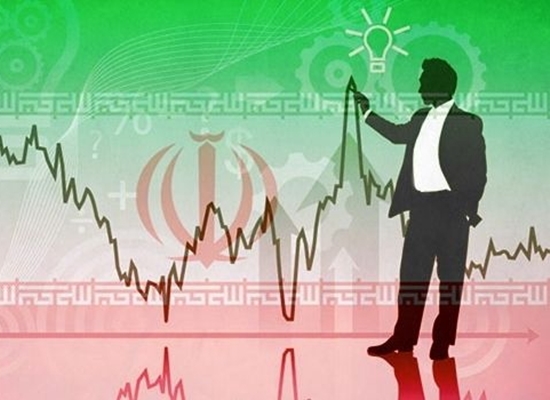
In a new report published in the wake of the OECD’s Country Risk Classification’s meeting on Friday, Iran managed to have its rating upgraded for a second consecutive year.
“Till two years ago, Iran’s rating in the country risk classifications stood at 7 which is the lowest in OECD’s ratings. But since 2016, with the efforts by the Organization for Investment Economic and Technical Assistance (OIETA) as well as Iran’s Foreign Ministry and Export Guarantee Fund of Iran (EGFI), the country managed to take long strides in economic progress upgrading its risk classifications from 7 to 6 in 2017,” a Farsi report by Khabar Online said.
The highest rating which Iran has recorded in the country risk classification is 4, which was made more than a decade ago.
Iran’s Minister of Industry, Mohammad Shariatmadari, said before the signing of the Joint Comprehensive Plan of Action (JCPOA) between Iran and the six powers in 2015 that Iran’s rating had declined to 7 which inflicted heavy blows on the country’s economic exchanges with the outside world.
The Iranian minister also noted that the rating moved up to 6 in 2017 following the implementation of the JCPOA. “Now with a further notch for the second consecutive year, our rating has reached 5 in 2018.”
The Organization for Economic Cooperation & Development Country Risk Classification measures the country’s credit risk and the likelihood that a country will service its external debt. The index uses a scale of eight risk categories to determine a country’s credit risk.
“Reports by the International Monetary Fund on the economic conditions of countries, their foreign exchange reserves, capabilities to pay off external debts and financial records are among the main factors with a bearing on the rating of a country in the OECD’s Country Risk Classification,” the Iranian minister says.
According to Shariatmadari, Iran’s new rating plays a significant role in attracting foreign investments and improving the country’s status and image at the financial and international arenas.
For his part, the Governor of Central Bank of Iran Valiollah Seif praised Iran’s new upgrade saying the upgrade is the results of hard efforts by the government, banking system and businesspeople.
In a message on his Twitter account, Seif called for further coordination between all related economic organizations in Iran adding that the country should prepare itself for further economic reforms in future.
Meanwhile, Deputy Head of Export Guarantee Fund of Iran, Arash Sharaini, described the upgrade “a positive signal from the Europeans and a further indication of their interest in continued engagement with Iran within the framework of the nuclear deal.”
In an interview with the English-language Financial Tribune Daily, he added the upgrade reduces the cost of attracting foreign finance, and “as a result helps us increase our foreign exchange reserves.”
He underlined that Iran deserves a higher classification namely 3, or even 2 due to its reserves and low external debt.
According to a report by the International Monetary Fund released in February 2017, Iran’s official reserves were projected at $123.5 billion in 2016-17. Meanwhile, “the country’s total debt to GDP stood at 2.2%, which is lower than any other country in the world. Iran also recorded the highest economic growth in the world according to the global lender’s 2016 report – 12.5%.
Since the implementation of JCPOA in 2016, Iran has clinched several foreign finance contracts including two agreements worth $25 billion with China Development Bank and CITIC Trust, a no-cap deal with Russia’s Exim Bank, a €5 billion deal with Italy’s Invitalia Global Investment, a €1 billion deal with Austria’s Oberbank, a €500 million deal with Denmark’s Danske Bank and two contracts worth €13 billion with South Korea’s Exim Bank and K-Sure.

Iran Expresses Regret Over South Korea Hospital Fire

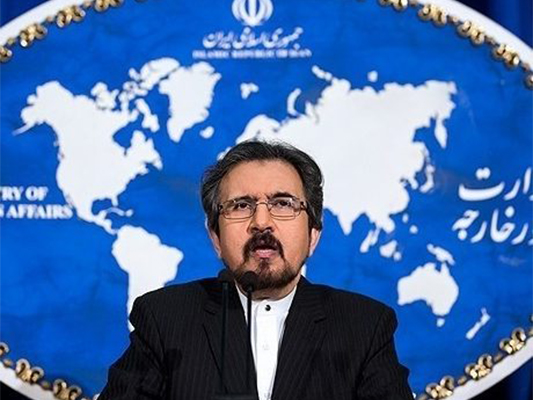
In a statement on Friday, Qassemi sympathized with the victims’ families and the Korean government and nation.

At least 37 people were killed and more than 140 injured after a hospital fire in the South Korean city of Miryang on Friday.

Initial reports show that around 200 patients were inside the building and the adjoining nursing home at the time of the fire, the cause of which remains unknown.

If the reports are true, the fire would be one of the deadliest South Korea has suffered in recent years, with the death toll still expected to rise.

Renegotiation of Iran Nuclear Deal Not Possible: Zarif

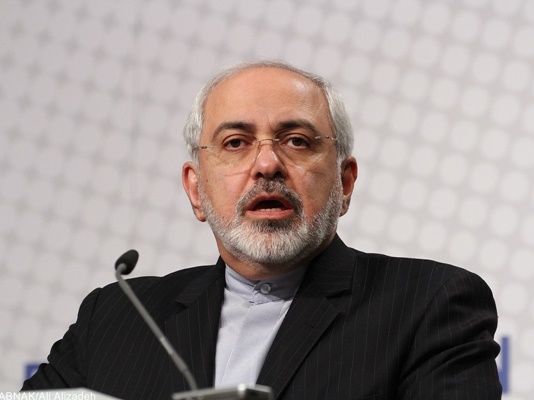
Mohammad Javad Zarif said in an interview with famous German Journalist Jürgen Todenhöfer that Europe cannot maintain the nuclear agreement by trying to violate the deal.

According to a Farsi report by Fars News Agency, the Iranian top diplomat called on Europe to support the nuclear deal because the international community is expecting the same as well. Iran’s Zarif said all parties must comply with the nuclear accord without making excuses.

In response to a question regarding the escalations in the region, Zarif stressed that to resolve the issues only a peaceful solution can work as many wars have been waged in the region and this situation cannot continue.

“From our point of view, the Persian Gulf issues require a dialogue that takes all aspects into consideration. It must be borne in mind that no one can dominate the region, and all sides must work together,” underlined Zarif.

Iran’s foreign minister further mentioned that it is needed to trust each other, and this has to be done through military inspections and signing non-aggression treaties with all countries in the region, including Saudi Arabia.

“Saudi Arabia is one of the most important countries in the Persian Gulf region; therefore, without Saudi Arabia we cannot reach a conclusion.”

Zarif also highlighted that Iran has not attacked any country in the past 300 years adding that “during the Iran-Iraq war, it was the Islamic Republic that was attacked, and after the war, we were a close friend of the Iraqi people and helped them in the fight against ISIS.”

About Iran’s missile program, Zarif noted that Iran spends the least on weapons in comparison with other regional countries.

“Saudi Arabia has missiles with higher range than ours. These missiles are capable of carrying nuclear warheads, while our missiles are not designed so. Saudi missiles are Chinese intercontinental ones with a range of 2500 kilometres. The main features of such missiles have a range of 12,000 kilometres.”

However, he added, Iran has missiles that are not capable of carrying nuclear warheads and their maximum range is 2,000 kilometres.

He also noted that “we will not use these missiles against any country, and we have announced we will only use them in case of being attacked.”

Zarif’s comments came after French Foreign Minister Jean-Yves Le Drian accused Iran on Monday of not respecting part of the UN Resolution 2231, which calls on Tehran to refrain from working on ballistic missiles.

Later, Secretary of Iran’s Supreme National Security Council, Ali Shamkhani, emphasized that Tehran’s missile program and defense capabilities would by no means be subject to negotiations.

Iranian Government Spokesman Mohammad Nobakht also said at his weekly conference on Tuesday that Tehran “will not negotiate with any party over its missile capabilities.”