Monday, December 22, 2025
Home Blog Page 3709

“Mistrust between Iran, US Grows after Nuclear Deal”

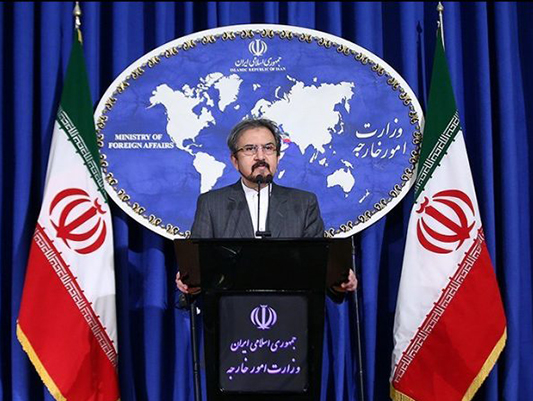
Speaking in a Farsi interview with the Jame Jam daily newspaper, Qassemi said the Islamic Republic’s trust in the US has been considerably lost because Washington has broken its promises.

Qassemi stated that recent experiences suggest some countries that claim to be a superpower are not reliable stressing that the wall of distrust between Tehran and Washington has become taller, especially after the JCPOA.

“The US withdrawal from the Paris Treaty, the NAFTA, and negotiations with Europe in the economic fields have led to the deepening of the differences in the West. Therefore, given the intensification of the hostile attitude of the United States towards our country, it is not reasonable to talk about negotiating with the US. We have to wait and see if Washington will take a wise approach.”

The Iranian Spokesperson also added that today, the United States only seeks to make money by selling arms to some countries in order to create gaps among the countries of the world, especially in the West Asia and Muslim countries.

“We are a country able to solve many problems. Although we believe in dialogue and engagement with other countries, the global conditions must be fair and respectful for all sides. However, this is not wise to assume that negotiating with the United States is a key to solve some of Iran’s problems,” noted Qassemi.

He said foreign policy has so far been the arena of a confrontation between Iran and the dominant powers of the East and the West, but recent experiences suggest some countries which claim to be a superpower are not reliable.

“The foreign policy of the Islamic Republic of Iran is one of the most important manifestations of the country’s political independence and national dignity,” added Qassemi.

He further mentioned that supporting the Palestinian cause against the Zionist regime is one of the other principles of the foreign policy of the Islamic Republic, which, despite many costs, Tehran has constantly insisted on.

“Today, the Islamic Republic of Iran is a pioneer in defending the oppressed nation of Palestine and confronting the aggression and bullying of the Israeli regime. The foreign policy of the Islamic Republic of Iran is based on the principles of protecting the oppressed and Muslims everywhere in the world. Therefore, we are recognized as the greatest supporter of the oppressed people in the world.”

He also noted that one of the most successful timespans in Iran’s foreign policy was at the time of war (against Iraq). Qassemi said a particular foreign policy had to be pursued during the war due to the difficult conditions, adding that despite all the problems, Iran’s foreign policy achieved many successes at that time.

He said that the UN Security Council Resolution 598 was an important achievement for the Islamic Republic of Iran at the very sensitive stages of the war.

“In the post-war period, we could reconstruct our foreign relations. We began our negotiations with the European Union and started economic, commercial, and industrial interactions with many countries to rebuild the country. Over $40 billion in foreign investment was absorbed, which could be effective in re-starting the Iranian economy, which was somewhat stopped by the war.”

Iran’s foreign ministry spokesman further pointed out that the nuclear deal, like Resolution 598, is seen as the beginning of a series of positive actions in foreign policy that have been approved by the Establishment.

“Despite the sanctions, we cleverly removed or reduced barriers,” underscored Qassemi.

Regarding the negotiations with the US, the Iranian senior diplomat said dialogue and interaction with the world, as emphasized by the Leader of the Islamic Revolution, is not a taboo. At the same time, conversation must have its own conditions. Iran is a powerful country having a good status in the region and in the world.

“We are in possession of good defensive capabilities, and we are not afraid of conducting negotiations with any country. We have to see whether others are really looking for dialogue or they only intend to use dialogue as a means to maintain their domination.”

A Look at Iranian Newspaper Front Pages on February 6

A Look at Iranian Newspaper Front Pages on November 18

Several papers today covered the beginning of President Hassan Rouhani’s project to renovate the country’s transportation system, and its impacts on the environment and growth of employment.

Also a top story was the water crisis in Iran and the remarks made by Issa Kalantari, the chief of Environment Department.

The withdrawal of US forces from Iraq and their relocation to Afghanistan was among other top stories today.

The above issues, as well as many more, are highlighted in the following headlines and top stories:


Aftab-e Yazd:

1- Rouhani Shouldn’t Be Scared of Giving Response to Lawmakers’ Questions

2- Qalibaf’s Aide: Conservatives Need to Revise Their Policies

3- Deputy Economy Minister: State Bodies Master of Unnecessary Paperwork, BureaucracyA Look at Iranian Newspaper Front Pages on February 6


Arman-e Emrooz:

1- Solutions to Issue of Water Crisis: Methods Successfully Tested in World

2- Details of Shooting in Iran Presidential Palace

  • Machete-Wielding Man Ignores Warnings of Security Forces

3- Reformists Have Asked for a Meeting with Iran LeaderA Look at Iranian Newspaper Front Pages on February 6


Ebtekar:

1- Europe’s Breath Held in Berlin: Decisive Talks in Germany to Get out of Deadlock

2- Environment Chief Makes Misleading Remarks about Water Crisis

3- These Uncontrollable Dollar, Euro RatesA Look at Iranian Newspaper Front Pages on February 6


Etemad:

1- Rouhani Tasks Three Ministries with Renovating Transportation System

2- Beginning of an End to 15-Year War: US Forces to Leave Iraq for AfghanistanA Look at Iranian Newspaper Front Pages on February 6


Ettela’at:

1- Minister Urges People to Be Obsessed about Water Consumption to Prevent Rationing

2- Rouhani: All Worn Cars Must Be Removed from Fleet

3- Saudi Arabia’s King Faisal Airbase Attacked by Yemeni Missile

4- Iran Starts Mass Production of New Drone Equipped with Precision-Guided Bomb

A Look at Iranian Newspaper Front Pages on February 6


Iran:

1- Biggest Renovation of Road Transportation System in Iran History

2- Culture Minister: Iranian Cinema to Be Destroyed If It Lacks Thought-Provoking Ideas

3- Tehran Plain Engulfed by Smoke: Capital on Verge of Alerting Level of Air PollutionA Look at Iranian Newspaper Front Pages on February 6


Javan:

1- Closing Special Schools for Gifted Students Will Only Benefit Private Schools

2- “Lottery” Returns Classic Heroes to Iranian Cinema

3- Moscow: US Can’t Chance JCPOA by Asking for Ransom

4- Tehran Prosecutor: 14 Bodies Guilty in Plasco IncidentA Look at Iranian Newspaper Front Pages on February 6


Jomhouri Eslami:

1- Russia: JCPOA Revision Impossible

2- Transport Minister: Public Buses Account for 30% of Tehran’s Air Pollution

3- 2,000 Special Beds Added to Capacity of Iran’s Hospitals

4- UN: Rohingya Crisis at Alarming Level for Regional SecurityA Look at Iranian Newspaper Front Pages on February 6


Kayhan:

1- Rouhani Defends National Security, [Reformists’] Chain Papers Censored His Remarks

2- Children in Gaza Hold Protest Rally, Chant “Save Us”

3- Deputy Agriculture Minister: Quality of Iranian Wheat Much Better than Imported Wheat

4- Iraq 2018 without ISIS, without US: Americans Leave IraqA Look at Iranian Newspaper Front Pages on February 6


Khorasan:

1- Parliament Approves Law against Special Concessions Given for Import of Cars

2- Guardian Council Spokesman: Presidential Candidates to Be Obliged to Introduce Their Team, PlansA Look at Iranian Newspaper Front Pages on February 6


Shargh:

1- Rouhani: They Thought Revolution Would End If They Kill Protesters

2- Foreign Ministry Spokesman Rejects EU’s Request for Missile TalksA Look at Iranian Newspaper Front Pages on February 6


Vatan-e Emrooz:

1- Great Job Bijan [Oil Minister Zanganeh]!

  • Iran Finally Stops Exporting Free Gas to Turkey after One Year

2- Returning to Cash! Central Bank Makes Decision that Undermines E-BankingA Look at Iranian Newspaper Front Pages on February 6

Iran, Russia Presidents Reject Presence of Foreign Troops in Syria

In a telephone conversation on Tuesday, the two sides discussed the results of the recent Syrian National Dialogue Congress held in the Russian city of Sochi, and expressed their preparedness to promote the formula of Astana Process in resolving the Syria crisis.

The two leaders then expressed their opposition to the imposing of any decision on Syrian people by foreign powers, saying it is the Syrian people who should decide about their future.

“Iran is against the presence of any foreign troops in Syria without the approval of the country’s government and nation,” Rouhani was quoted as saying in a Farsi report by the Iranian president’s official website.

He also noted the continuation of tension in northern Syria is not in the interest of any side and stressed that all regional states must respect the territorial integrity and sovereignty of Syria.

The Iranian president then highlighted the importance of trilateral cooperation underway among Tehran, Ankara and Moscow in fight against terrorism and restoring stability to Syria, and said this cooperation must continue till the final victory of Syrian people over terrorist groups.

Elsewhere in his remarks, Rouhani denounced certain states for their efforts to hamper the implementation of the Iran nuclear deal and said the Islamic Republic will remain committed to the deal as long the other sides do so.

He then dismissed as baseless the US officials’ claim that Iran is providing Yemen with missiles and said the allegations are part of the US administration’s effort to undermine the Iran nuclear deal.

For his part, the Russian president said his country is determined to expand its ties with Iran in all fields and added Russian companies are active in pressing ahead with joint projects signed between Iran and Russia.

Putin also called the upcoming meeting of Iran-Russia Joint Economic Commission a significant step in the strengthening of two sides’ cooperation.

The Russian president then praised JCPOA as an important achievement and said Moscow rejects any effort to undermine the deal as a dangerous move. “We have already clarified our stance on this issue for the other parties to the deal.”

He then said Iran and the Eurasia Economic Union have almost finalized talks over a temporary agreement to create a free trade zone and added with this agreement the two sides’ cooperation will enter a new phase.

The two presidents also expressed concern over the conditions of people in Yemen and underlined the necessity of expanding bilateral cooperation to restore peace to the war-torn country.

Animal-Lovers Feed Quadrupeds near Tehran Heights

There are two villages namely “Kond Olya” and “Kond Sofla” located in Shemiranat County, Tehran Province. In the vicinity of these villages there exists a protected area called Varjin in which you can watch different species of mountain animals.

In the winter, with the decline of plants in the Lavasanat Mountains, there is not enough forage to feed animals such as wild goats, goats and ewes.

Under these conditions, fodder purchased by animal-lovers is distributed on the downhill slope of the mountains so that these animals come from highlands to the hillsides to eat food. Therefore, it provides the opportunity to watch these animals at a very close distance.

ISNA’s photos of these animals are as follows:

Fire at Tehran’s Energy Ministry Building Leaves 9 Injured

Fire at Tehran’s Energy Ministry Building Leaves 9 InjuredThe fire broke out on Monday morning at the floor minus-four of the 8-storey building of Thermal Power Plants Company near Vali-e-Asr Square downtown Tehran.

The floor minus-four is where a great amount of documents and papers are archived and this has made the job more difficult for the firefighters.

An official with the company later announced that the fire was caused by the malfunction of a fire extinguisher, which automatically threw fire extinguishing powders on the papers and documents, and the ensuing heat started the blaze.

Deputy Energy Minister says all of the classified and important documents in this building are backed up and all servers are taken out of the building before the fire spreads out.

According to a report by Fars News Agency, Fire Department Spokesman, Jalal Maleki said the temperature is being constantly monitored and at present, the temperature has reduced. He added that the firefighters have reached the floor minus-three, but they have not been able to reach to the main location of the fire which is in the floor minus-four.

Tehran Mayor, Mohammad Ali Najafi, who arrived at the scene on Tuesday morning, said there is a possibility of the collapse of the whole building or part of it; therefore, the people from the nearby buildings have been evacuated since Monday night, reports Tasnim News Agency.

Fire at Tehran’s Energy Ministry Building Leaves 9 Injured

Reports say about 50 people, who had been trapped beneath the ground floor, were rescued soon after the fire broke out.

The Energy Ministry building has been built 54 years ago, and it is similar to the Plasco Building in many aspects. Both buildings have been built by the same constructor.

The Plasco Building was a 17-story high-rise landmark building in Tehran. The building collapsed on 19 January 2017 after a huge fire. Twenty firefighters were killed and at least 70 others were injured by the collapse, with 23 taken to local hospitals having suffered severe injuries.

Louvre Museum to Hold Exhibition of Its Works in Tehran

An Iranian cultural heritage official said the exhibition includes a collection of over 50 works from ancient civilizations in Western Asia, Europe and North Africa, including the Sumerians, Assyrians, Hittites, Ancient Egyptians, Ancient Greeks and Romans.

“A collection of paintings, designs and lithographs from the works of great European artists such as Eugene Delacroix and Camille Corot would be put on show,” said Jebrael Nokandeh, Director General of the National Museum of Iran.

“This collection has been selected from eight sections of the Louvre Museum and would be presented to the visitors in four main sections titled Birth of a Collection, Birth of a Museum, Dream of Globalization, and A Live Museum,” Tasnim quoted him as saying in a Farsi report.

Nokandeh added that many of the works have been selected from the main Louvre halls noting that one of the most prominent of these works is the statute of Sphinx.

The exhibition will be open to the public until June 8 at the National Museum of Iran.

Earlier, Tehran hosted an exhibition of ancient Armenian relics. South Korea also plans to hold an exhibition of its antiquities in Iran.

Iran Starts Mass Production of Drone Armed with Precision-Guided Bomb

Iran’s Defense Ministry on Monday unveiled Mohajer 6 drone equipped with Qaem precision-guided bomb during a ceremony attended by Defense Minister Brigadier General Amir Hatami on the occasion of the 40th anniversary of the victory of the Islamic Revolution.

Speaking to reporters, Hatami said Mohajer 6 has the capability to carry out surveillance, reconnaissance and combat missions within a wide operational radius and can help the Armed Forces identify and destroy pre-determined targets.

Iran Starts Mass Production of Drone Armed with Precision-Guided Bomb

He added that the drone could help conduct aerial surveillance for a long time and hit targets with high precision.

The minister noted that the new Iranian drone was capable of sending intelligence to control and command centers during day and night and could take off from and land on short runways.

During recent years, Iran has made major breakthroughs in its defense sector and attained self-sufficiency in producing important military equipment and systems.

In December 2016, the Iranian Army’s Ground Forces unveiled two domestically designed and manufactured drones on the final day of major military exercises code-named Mohammad Rasoulallah IV (Mohammad, the Messenger of God IV) in southeastern Iran.

One of the two aircraft, code-named Oqab (Eagle), is a combat drone capable of carrying air-to-surface missiles.

Iran Starts Mass Production of Drone Armed with Precision-Guided Bomb

The other, which is code-named Shahin (Falcon) and has been developed and manufactured under a project code-named Shahid Mohsen Ghotaslou, can collect information on the positions and movements of enemy forces through reconnaissance missions. It boasts a flight endurance of 24 hours.

Iran’s Islamic Revolution Guards Corps (IRGC) also in October 2016 unveiled the recently-manufactured combat drone called Saeqeh (Thunderbolt).

Iran Starts Mass Production of Drone Armed with Precision-Guided Bomb

The drone was put on show on Saturday at an expo showcasing the latest achievements by the IRGC’s Aerospace Division in the UAV industry.

Iran has also conducted military drills to enhance the defense capabilities of its armed forces and to test modern military tactics and state-of-the-art army equipment.

The Islamic Republic maintains that its military might poses no threat to other countries, stating that its defense doctrine is merely based on deterrence.

Every Single Word of JCPOA Based on Mutual Distrust: Iran FM

Speaking in a live interview with the state TV on Monday, Zarif pointed to the nuclear deal and its achievements, and noted it cannot be claimed that the JCPOA could not have been written in a better way. “However, I can claim the current deal is neither all we wanted, nor what the Americans wanted.”

“We insisted that all nuclear-related sanctions should be removed all at once. The US team had its own limitations and they had to refer to the Congress to lift sanctions. Under such circumstances, we were able to agree on a deal which was the only possible one in case of being ratified,” pointed out Zarif.

Iran did not expect the US to show good faith, and totally predicted what Trump is doing today, he noted, adding that every word of the deal has been written based on lack of trust, and this distrust is mutual.

The Iranian top diplomat further stated that Trump once said his first priority is to tear up the JCPOA, but around 390 days after making such a remark this has not yet happened because his advisors have reminded him if he makes such a decision, the US will be isolated in the world.


Missile Power

Regarding the country’s missile power, Zarif said, “We have a lot to say about the missiles, weapons, and the country’s defence capabilities. Our country has been attacked while the whole world supported the aggressor and tried not to let Iran have access to the most basic means of defence. No one is in the moral, legal or international position to tell Iran what facilities it must have.”


Presence in Iraq

Zarif also talked about elections in Iraq and the Saudis’ activities in this regard, noting that this policy, which seeks to buy security and influence, has continued for many years proving not to be a successful one.

“The Iraqi people are the ones who decide their fate. Our presence in Iraq has been based on respect for the Iraqi people’s choice and this has earned us respect. The Saudis’ mistake is that they have entered the region with a wrong command.”


Saudi Arabia and Its Wrong Policies

Addressing Saudi rulers, Zarif underscored that the result is clear when Riyadh imprisons the prime minister of a country to put pressure on it.

“It is crystal clear that by encouraging terrorism in a country and helping the Takfiri groups you will not be able to increase your influence. If you create insecurity by spending money, it does not provide security for that country, but instead backfires,” underlined Zarif.


Solution for Yemen

The Iranian foreign minister also talked about the Saudis’ aggression against Yemen saying that what Saudi Arabia has done in Yemen had no results but massacre of children.

“From the very first day of the Yemeni crisis, Iran insisted on a four-point plan calling for an immediate ceasefire and end of all foreign military attacks, humanitarian assistance, a resumption of broad national dialogue and establishment of an inclusive national unity government.”

Zarif said Tehran believes the same solution works for Yemen today. The conflict between different groups advances Yemen towards disintegration.

“We believe that as soon as possible, Saudi Arabia and the United Arab Emirates will come to the conclusion that the policy of their last three years had no result except hatred and massacres. There is no solution for Yemen except Iran’s four-point plan,” added Zarif.


Regional Security; Need for Dialogue

The Iranian Foreign Minister further noted that some of Iran’s neighbours are doing their best to pretend they are in danger because they are worried.

He said some regional states need to provide their security from the abroad; therefore, they are seeking to pretend the region is under threat.

Zarif added the Islamic Republic seeks to provide security from within, stressing that Tehran has always been seeking to use dialogue as a base for relations with other countries.


Ministry Structure Change

Elsewhere in his remarks Zarif referred to changes in the structure of Iran’s foreign ministry saying that this is perhaps the largest change of structure in the ministry since the Islamic revolution.

He went on to say that formerly the foreign ministry was working with the help of regional deputies, but these deputies have now been removed and there are just two political and economic deputies.

“Having eight regional ministerial assistants, which is a new experience, will enable our diplomacy to serve the goals of economic development and resistance economy.”

Iranian Tycoon to Build High-Rise Hotel near Trump Tower

Jazayeri was taken into custody in 2001 at the age of 24 for a long list of criminal activities involving bribery, illegal exports, forgery and massive embezzlement of state money and assets and spent the next 13 years in prison.

The well-known tycoon, who was finally released in 2014, has given an interview to ISNA saying that due to his special conditions, he does not intend to engage in economic activities inside Iran anymore, and wants to work with Iranians abroad.

In this interview, he claims he will soon launch the world’s largest bank.

He also says he has a plan to build a high-rise hotel next to Trump Tower in New York City.

“Building such a hotel may cost $1 billion. We pay 10 percent in cash which means $100 million. The rest ($900 million) would be provided through financing,” he added in this interview.

Here are excerpts of his remarks:
* Millions of Iranians are living overseas who are in possession of more than 1,300 to 1,400 billion dollars. One or two percent of this money could be ours.

* Meanwhile, I want to introduce a digital currency called “Shahram Coin”. This encrypted currency would be introduced to the world soon.

* As you know, the owner of Bitcoin has not yet identified himself or herself, but I will introduce my digital currency with credit and backing.

* The main job of my International Bank, is to provide the same initial cash [to build the hotel] that will be made available through network marketing and “Shahram Coin” encrypted digital currency.

* The building will be completed within the next 24 to 36 months.

* Panama, Hong Kong and Iceland have provided me with good offers.

* It’s been three years that I want to meet with the ministers who are involved in economic affairs, but they are not willing to talk to me at all.

* I have a good economic theory that will be a Nobel Prize nominee, but I do not know if it could win the prize.

US-EU Talks to Revise Iran Nuclear Deal Merely “US Dream”

Foreign Ministry spokesman Bahram Qassemi on Monday was reacting to US Secretary of State Rex Tillerson’s remarks that the alleged groups had already begun to meet, trying to determine how much Iran needed to be engaged in it.

“We have not received such remarks formally from the three European countries,” Qassemi told reporters during his weekly news briefing in Tehran, referring to the UK, Germany and France which are all parties to the 2015 nuclear deal.

“We think that the Americans, as per their wrongful and age-old habit, have again expressed their dreams through the mouth of others,” he added.

Tillerson, ending a week-long European trip in Warsaw Saturday, said he had secured support from the three countries to work on the deal that President Donald Trump has pledged to ditch unless changes are made.

“The working groups have already begun to meet on efforts to agree principles, what is the scope of what we attempt to address and also how much we engage Iran on discussions to address these issues,” he said.

Trump wants tighter restrictions on Iran’s ballistic missile program, vowing to stop waiving US nuclear sanctions on Iran unless the Europeans agreed to the changes he desires.

Qassemi said Iran had not received any official request from the EU for negotiation on its missile program.

“What is certain is that the Americans are dissatisfied with Iran’s ties with regional countries and also the European Union, and are trying to bring them in line with their interests through exerting pressure on them,” the spokesman said.

Qassemi said current relations between the Islamic Republic and the European bloc were strong enough and on a “logical track”.