Wednesday, December 24, 2025
Home Blog Page 3668

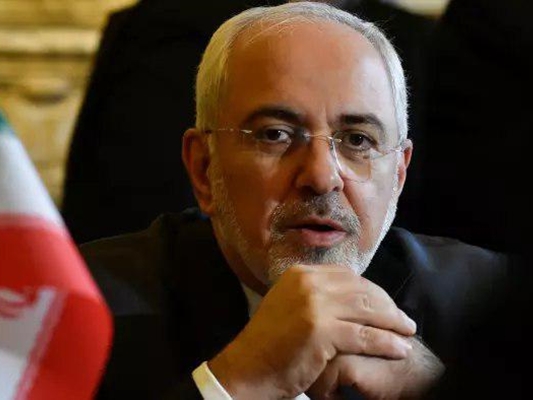
Iran FM Says Hopes Saudi Arabia Does Not Seek Nuclear Weapons

He underlined that all countries are entitled to have peaceful nuclear energy for peaceful purposes including uranium enrichment based on the Non-Proliferation of Nuclear Weapons (NPT).

“We don’t know yet the real intention of Saudi Arabia but based on the NPT, all states are entitled to have peaceful nuclear program including uranium enrichment,” he was quoted as saying in a Farsi interview with Etemad newspaper.

He said this is the principle policy of the Islamic Republic of Iran for today and future towards other countries’ right to have peaceful nuclear program.

“But we maintain that each country seeking to achieve nuclear weapons endangers its own and others’ security and we hope Saudi Arabia would not be after adopting such a wrong policy,” he said.

The Iranian foreign minister underlined that the US government is not in a position to deprive any state of the right to enrich uranium under the NPT.

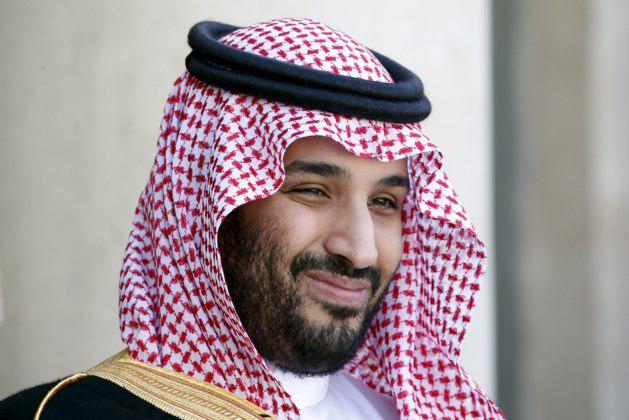
The remarks came in reaction to the earlier anti-Iran rhetoric by Saudi Arabia’s Crown Prince Mohammed Bin Salman who said his country does not want to acquire any nuclear bomb, “but without a doubt if Iran developed a nuclear bomb, we will follow suit as soon as possible.”

In a Thursday interview with CBS, the crown prince also downplayed Iran’s power, saying Iran was far from being a rival to Saudi Arabia.

The statements come as Iran has repeatedly announced that its nuclear program is totally peaceful and the country is not after nuclear weapons.

Iran insists that based on the International Atomic Energy Agency’s NPT, it is entitled to pursue its peaceful nuclear program.

The remarks by the Saudi crown prince were also rejected as baseless by Iranian Foreign Ministry’s Spokesman Bahram Qassemi who called Bin Salman a “delusional naïve person” whose remarks don’t deserve a response.
Iran Calls Saudi Crown Prince ‘Delusional, Naïve Person’


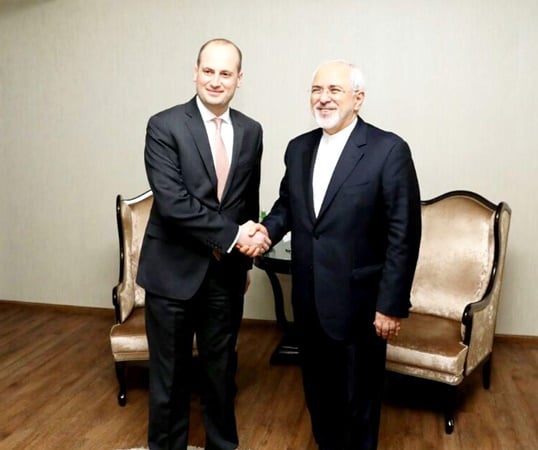
Iran, Georgia Resolved to Boost Trade Ties

Iranian and Georgian foreign ministers met in Baku on March 15, 2018 / Photo by the Iranian Foreign Ministry

During the meeting held on the sidelines of quadripartite talks between Iran, Turkey, Azerbaijan, and Georgia, Zarif called for taking advantage of the available capacities to enhance bilateral relations.

“We want to deepen our cooperation with Tbilisi to facilitate banking relations, finish the Iran-Georgia railway project, make operational a transit corridor from the Persian Gulf to the Black Sea and the Mediterranean and resume export of goods to Georgia.”

Zarif also described as highly significant the bilateral relations between Iran and Georgia at international arena and expressed hope the joint commission of two sides’ consulates would be held soon.

For his part, the Georgian foreign minister expressed his satisfaction with the growing ties between the two sides over the past year.

He also called for joint investments in technical and engineering projects and establishment of small, medium and even large-sized companies to expand economic and trade ties between the two sides.

Janelidze also called for the establishment of new branches of Iranian banks in Georgia with the aim of further developing their current economic ties.

Baku hosted top diplomats of Iran, Turkey, Azerbaijan and Georgia in the first-ever such quadripartite talks aimed at promoting regional peace and cooperation among the four nations.

Zarif arrived in Baku on Thursday to attend the quadrilateral meeting with his Turkish, Azeri and Georgian counterparts, namely Mevlut Cavusoglu, Elmar Mammadyarov and Mikheil Janelidze.

The talks focused on a range of issues, including regional developments, fight against drug trafficking and the enhancement of economic relations among the participating states.

Azerbaijan to Facilitate Visa Regime for Iranians

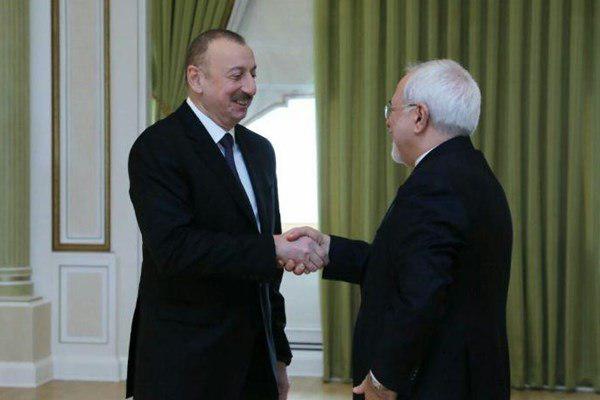
During his visit to the Azeri capital of Baku on Thursday, Zarif announced that the Azeri government will soon start issuing upon-arrival visas for Iranian nationals.

The issue was among the major topics discussed by Zarif in his meeting with Azeri President Ilham Aliyev.

During the meeting, Aliyev referred to the reciprocal visits made regularly by Iranian and Azerbaijani officials and expressed his delight at the upcoming visit of Iranian President Hassan Rouhani to Baku during Nowruz (Persian New Year) holidays.

“The relations between Iran and Azerbaijan have never been as good as today,” he said.

The Azeri president also described regional threats as “serious” and added Iran is a safe and stable country in the region.

He also called for closer cooperation between the two sides in different fields like transit and banking.

For his part, the Iranian foreign minister referred to the great capacities for expanding bilateral ties between Iran and Azerbaijan and added the Islamic Republic is satisfied with the current level of multilateral cooperation with the regional states.

“We believe multilateral cooperation is necessary for tackling security concerns resulting from terrorism particularly the remnant of ISIS in the region,” he noted.Azerbaijan to Facilitate Visa Regime for Iranians

Zarif also described as highly important the two sides’ roles in the region’s energy transmission line. The foreign minister pointed to the initiative for building a transit corridor from the Persian Gulf to the Black Sea and described it as a good project which needs to be facilitated.

Tackling banking problems and facilitating trade between the two sides via national currencies were among other issues discussed during the meeting.

Iran Calls Saudi Crown Prince ‘Delusional, Naïve Person’

In a Thursday statement, Qassemi described Bin Salman as a “delusional and naïve person” who never talks, but with lies and bitterness and has no idea of politics, but to use untimely strong words due to lack of foresight.

The spokesman said Iran respects its neighbours and other countries and nations across the world regardless of their area, military and economic power and even their national or international credit.

“Iran has always thought of a strong, safe and stable region. So, the Islamic Republic’s call for talks and tolerance towards the regional states, especially some ill-wishers and obstinate enemies, is based on dignity, wisdom and prudence which originates from our experience, knowledge, culture and historic civilisation,” he said.

Qassemi said the Islamic Republic of Iran’s foreign policy is based on considering the overall interests of the Islamic world and the regional and global peace, stability and security.

He said the remarks of the Saudi crown prince about Iran suffer from a lack of prudence and are dotted with undue biases.

“His remarks remind us of primitive era before the advent of Islam,” the Iranian spokesman noted, adding that his hollow brags belong to the primitive era

“If this is how the young crown prince thinks [that Iran has a weak army], then how come he keeps desperately talking about Iran’s threat with his masters but each time he is left empty-handed and milked by them?”

He underlined that it is better for Saudi Arabia not to boast of its economic power and military might because it has already come to its knees after waging a war and imposing a blockade on the innocent and defenceless people of Yemen over the past three years.

The spokesman said Saudi Arabia is frightened by the Yemenis’ resistance and added the Saudi regime spends its own people’s money to entertain itself by purchasing “beautiful weapons”.

“Saudi Arabia remains an importer of security and forgets to pay respect to a greater and stronger state like Iran. As wise men have said, it is better to remain silent than to make confusing statements,” he concluded.

Earlier on Thursday, the Saudi crown prince downplayed Iran’s power, saying that Iran was far from being a rival to Saudi Arabia.

In an interview with CBS, he added his country does not want to acquire any nuclear bomb, “but without a doubt if Iran developed a nuclear bomb, we will follow suit as soon as possible.”

He also noted that Iran’s army is not even among the five biggest ones in the Muslim world.

Western Media Hiding Truth about Iran Human Rights Situation

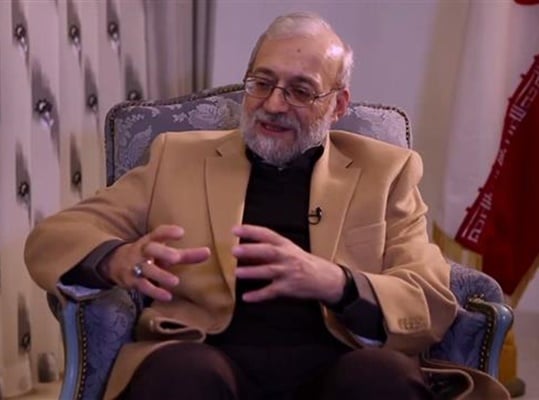
Mohammad Javad Larijani, who is in Geneva to attend the 37th Session of the UN Human Rights Council, told Press TV on Thursday that media reports about human rights issues in Iran, from capital punishment to handling of protests, have always been negative and seldom rooted in reality.

“Every day there are, I should say, hundreds of gatherings in Iran,” he said. “If it is within the institutions specially universities, mosques and other places, the regulation is simple: they should be given permission by the administration of those places.”

As for public protests, Larijani said, the government usually allows such protests to freely take place unless there is a chance that they would turn violent.

“There is plenty [of protests] that are not covered by the Western media but those which get violent… yes, it is the obligation of the government to fight violence,” he said, referring to sporadic illegal protests that took place in some Iranian towns last year.

The violent protests, that saw some individuals vandalize public properties and target security forces and public service workers, received widespread coverage in Western media and prompted direct support from US President Donald Trump and heads of a handful of other Western countries.

Iranian security forces let the protests continue for several days but eventually intervened once they get violent.

“Those who incite violence they should be pursued by the law,” Larijani said.

Larijani said the West only cares for protests that fit into its own agenda and does not, for example, cover protests by Iranian women against the way they are depicted in the Western media.

Asked about Iran’s practice of capital punishment and claims by the UN that the Islamic Republic issues death sentences for persons under 18, Larijani said the issue can be discussed in two levels.

First, he said, it was “philosophically unwarranted” to discuss a complete end to the death penalty and, instead, a rational approach would be to limit it to a certain number of “high crimes” that threatened the society.

“Ninety percent of the death penalties in Iran are stemming from narcotics-related crimes,” Larijani said.

He noted that his organization worked five years with the Iranian parliament and other government and judicial institutions to review the laws and make them more efficient in this regard.

On the issue of death penalty for juveniles, Larijani said the judicial system in Iran never gives people under 18 death penalties unless the judge determines that the suspect is “susceptible to carrying the responsibility of his action.”

UN Secretary General Antonio Guterres is scheduled to present a new report about Iran at the 37th session of the UN Human Rights Council, which began on February 26 and lasts until March 23.

Tehran has already blasted the report as “flawed both in nature and approach.”

Iran, Russia, Turkey Discuss Syria Peace in Astana

Top negotiators of Iran, Russia, and Turkey meeting in the Kazakh capital of Astana on March 15, 2018 / Photo retrieved from Jaberi Ansari's Telegram channel

Hossein Jaberi Ansari, a senior assistant to Iran’s foreign minister in special political affairs; Alexander Lavrentiev, the Russian president’s special envoy on Syria; and Sedat Onal, the Deputy Undersecretary of the Turkish Foreign Ministry, held preparatory talks for the Friday meeting among foreign ministers of their respected countries.

During the meeting held on Thursday, the three chief negotiators discussed arrangements for the Friday meeting and its schedule.

Foreign ministers of the three guarantors of the Astana talks will discuss the result of the eight previous rounds of Astana talks and priorities and future agenda of the talks.

On the sidelines of the trilateral meeting, Iranian Foreign Minister Mohammad Javad Zarif and his Russian and Turkish counterparts will meet with the host of Astana talks, Kazakh President Nursultan Nazarbayev.

Earlier on Thursday, Jaberi Ansari held a bilateral meeting with Lavrentiev, during which the two sides talked about the outcome of the Syrian National Dialogue Congress held in Sochi and arrangements for the creation of a committee for constitutional reform in Syria.

They also exchanged views on the agenda of the first meeting of the working group on the release of detainees/abductees and handover of the bodies as well as the identification of missing persons in the Syria conflict.

Charity Concert Held in Tehran to Raise Funds for Mothers in Prison

The musical performance was given by the all-female band “Sound of Naerika” at Tehran’s Eyvan Shams Hall on Thursday night.

All the money raised from the ticket sales will be allocated to the release of 250 mothers who are currently imprisoned for unintentional offences, according to Iranian Vice-President for Women and Family Affairs Massoumeh Ebtekar.

This is the second year the fundraising event is being held by the Vice-Presidency after a successful experience last year, Ebtekar said.

The revenue generated from the tickets sold on Thursday accounted for part of the $1.5 million needed to release the 250 female inmates, Ebtekar noted, adding that those who wanted to donate more money to the campaign were provided with the opportunity during the Thursday concert.

The event, which was open to the public, had been widely promoted by celebrities, particularly renowned female actresses and artists, on social networks.

According to the data released by Iran’s Blood Money Organization, $125,000 was raised during the same ceremony last year, which was enough to release 32 female prisoners.


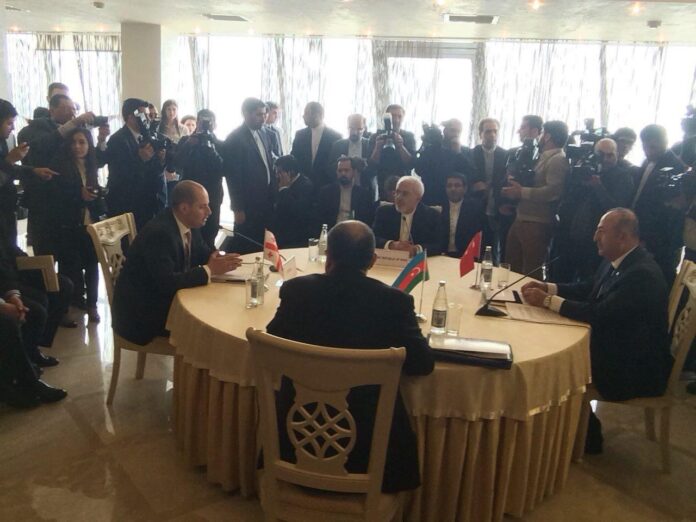
Iran, Georgia, Azerbaijan, Turkey Hold Quadrilateral Talks

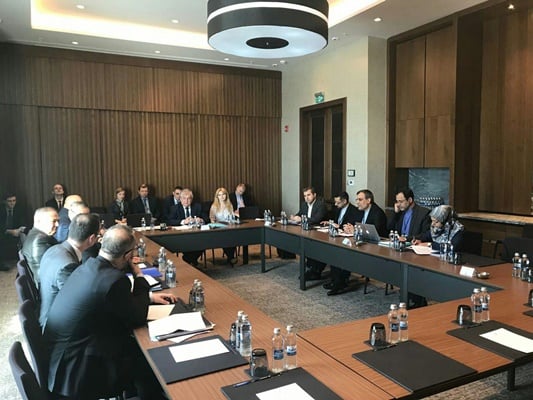
Foreign ministers of Iran, Turkey, Georgia, and Azerbaijan meeting in Baku on March 15, 2018 / Photo by Mizan News Agency

The Baku quadrilateral meeting focused on promotion of cooperation among the four countries to strengthen regional peace and develop economic, energy, transportation, cultural and tourism ties.

Speaking at the beginning of the meeting, Zarif called on regional countries to work for promoting stability and economic development in the region and engage in cooperation against terrorism and extremism.

The next meeting in the quadrilateral format will be held in Georgia.Iran, Georgia, Azerbaijan, Turkey Hold Quadrilateral Talks

On the sidelines of the meeting, Zarif also sat down for bilateral talks with his Georgian counterpart Mikheil Janelidze.

During the meeting held on Thursday, Zarif and Janelidze discussed bilateral ties and regional cooperation between two countries.

Earlier in the day, Zarif also held a meeting with Azeri President Ilham Aliyev.

The foreign minister departed Baku for the Kazakh capital Astana on Thursday to join a trilateral meeting with top Turkish and Russian diplomats Mevlut Cavusoglu and Sergei Lavrov.

The meeting is to be held within the Astana talks on Syria, aimed at putting an end to the seven-year conflict in the Arab country.

Iran Leader Says People’s Economic Woes Resolvable

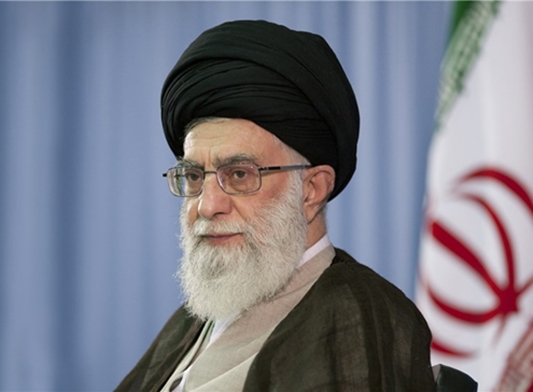
“We are aware of people’s livelihood problems and other issues, and we believe there are no unsolvable problems in the country … ,” said Ayatollah Seyyed Ali Khamenei.

According to a transcript of his words posted on Leader.ir, Ayatollah Khamenei said he will talk to people about the issue in coming days.

The Leader was speaking in a Thursday meeting in Tehran with members of the Assembly of Experts, a clerical body empowered to appoint and dismiss the Leader.

Iran in recent years has been struggling with an underperforming economy hit hard by years of international sanctions and mismanagement.

Since taking power in 2013, the government of Hassan Rouhani has sought to kickstart the economy, but many say progress has been slow.

The Leader has frequently advocated Resistance Economy as the solution to Iran’s economic woes.

Resistance Economy is a set of principles aimed at boosting the country’s income and making the economy immune to economic wars waged by foreign powers, through improving productivity and curbing the economy’s dependence on oil export revenues, among other measures.

It was first proposed by the Leader in 2011, amid the tightening of economic sanctions against Tehran by the US and its allies over unproven allegations that Tehran intends to build nuclear weapons.


Bright Future Awaits Iran

Ayatollah Khamenei further noted that Iran has been under a massive attack by arrogant powers, which has political, economic, cultural, social and physical dimensions.

The Leader said “enemies of the religion” have been pressurizing Iran to give up meeting its religious and moral duties, including to fight against the oppressor and support the oppressed.

However, thanks God, Iranian’s endurance and insight has enabled them to push back the adversaries, he said.

The Leader said he believes a bright future awaits the country, and God willing Iranians will manage to deal with their enemies.

“There is a youthful and lively movement in the country that, I believe, will create a better future for Iran,” he said.

“A big group of faithful and active youth … are firmly and wholeheartedly pursuing the goals of the revolution,” the Leader said.

Iran, Turkey Call for Closer Defence Cooperation

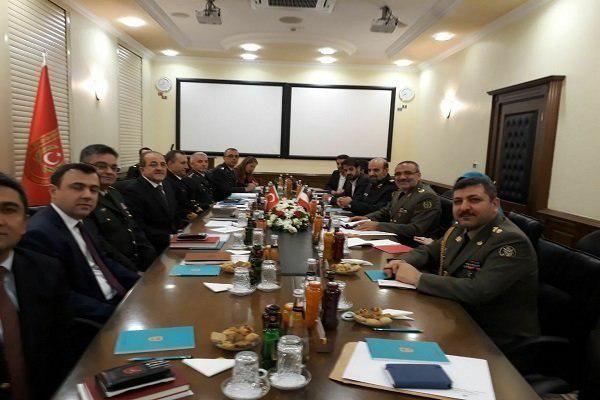
Iran’s Deputy Defence Minister Mohammad Ahadi and Turkey’s Deputy Chief of Staff Umit Dundar discussed issues of mutual interest in a meeting in Ankara on Thursday.

According to a Farsi report by Fars News Agency, the two officials said better defence relations will pave for a closer partnership between the two countries and promote peace and stability in the region.

Ahadi and Dundar also talked about regional developments, calling for greater respect for national sovereignty and territorial integrity of regional countries.

In the meeting, Ahadi extended an invitation from Iranian Defence Minister Amir Hatami to his Turkish counterpart Nurettin Canikli to pay a trip Tehran.

During his stay in Turkey, Ahadi, who headed a military delegation, visited several defence-oriented manufacturing factories.