Thursday, December 25, 2025
Home Blog Page 3620

US Inciting Saudi Arabia to Clash with Iran: Leader

Ayatollah Seyyed Ali Khamenei

Addressing a large num ber of workers in Tehran on Monday, Ayatollah Khamenei said inciting certain inconsiderate and reckless governments in our own region is among the enemy’s plots to counter the Islamic Republic of Iran.

“Americans provoke Saudis to create rift and clash in the region,, Why don’t they incite the Zionists? Because they want to trigger a war between Muslims,” the Leader noted.
Ayatollah Khamenei went on to say that the US plans to provoke regional states into waging war against the Islamic Republic of Iran.

“But if the states have wisdom, they won’t engage in any conflicts with Iran. Any state which decides to confront Iran will definitely suffer a crushing blow and a heavy defeat,” he noted.

The Leader underlined that the US officials are seeking not to pay any price for their confrontation with the Islamic Republic and the great nation of Iran.

“Creating insecurity is the main business of the US. Chaos and misery are the only legacy that the US leaves behind wherever it goes. That’s why, we need to have the US out of the West Asia,” he added.

He described the Persian Gulf and the West Asia as the home of Iran and added the state which should be kicked out of the region is the US, not Iran.

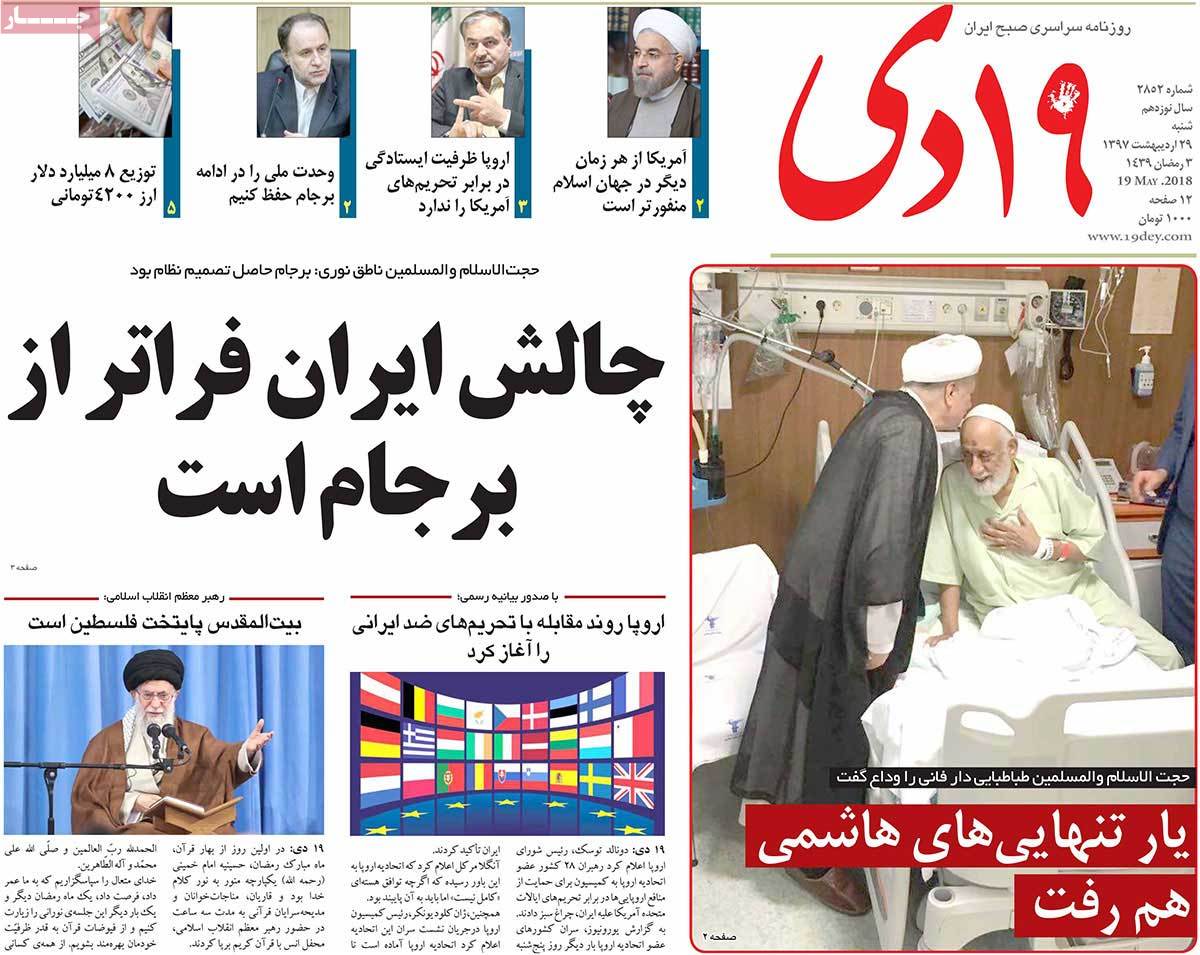
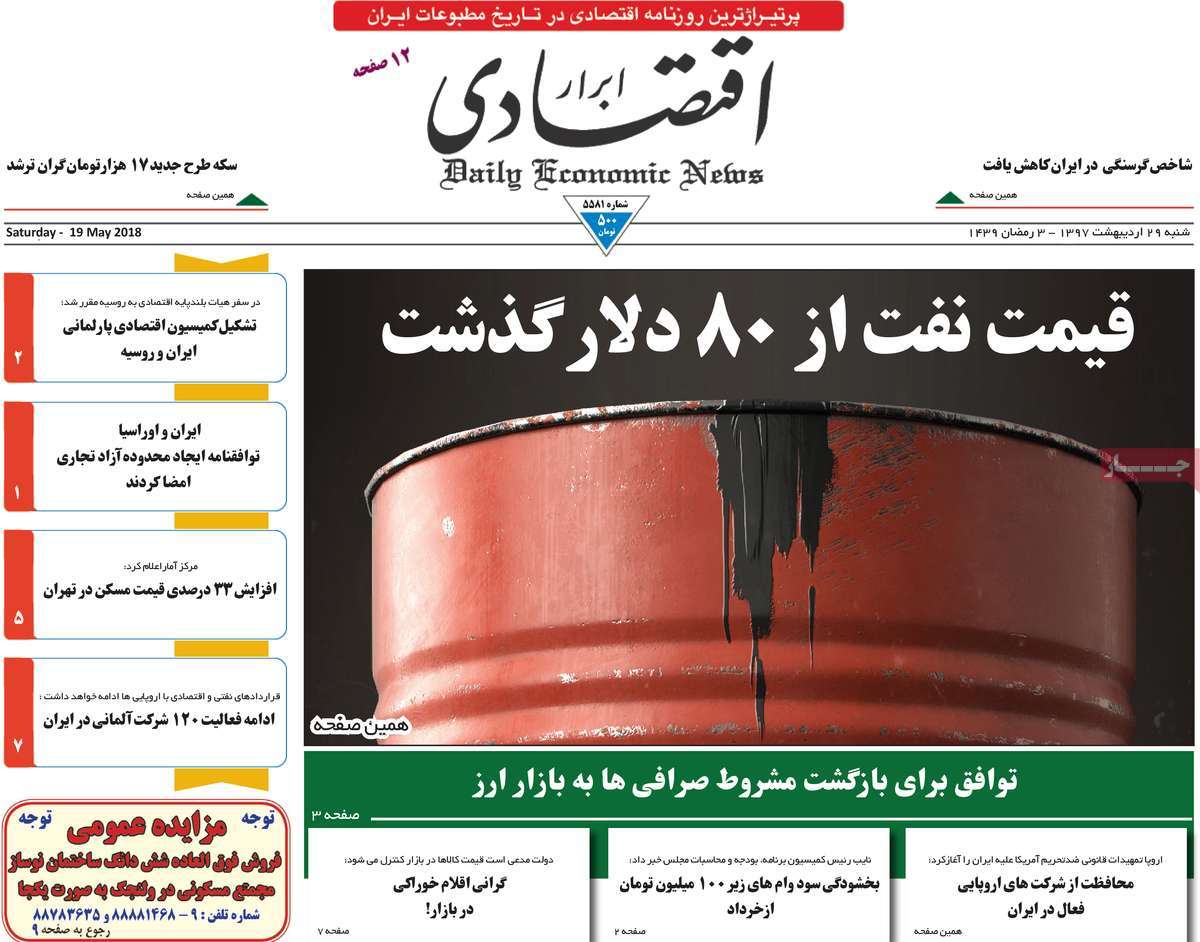
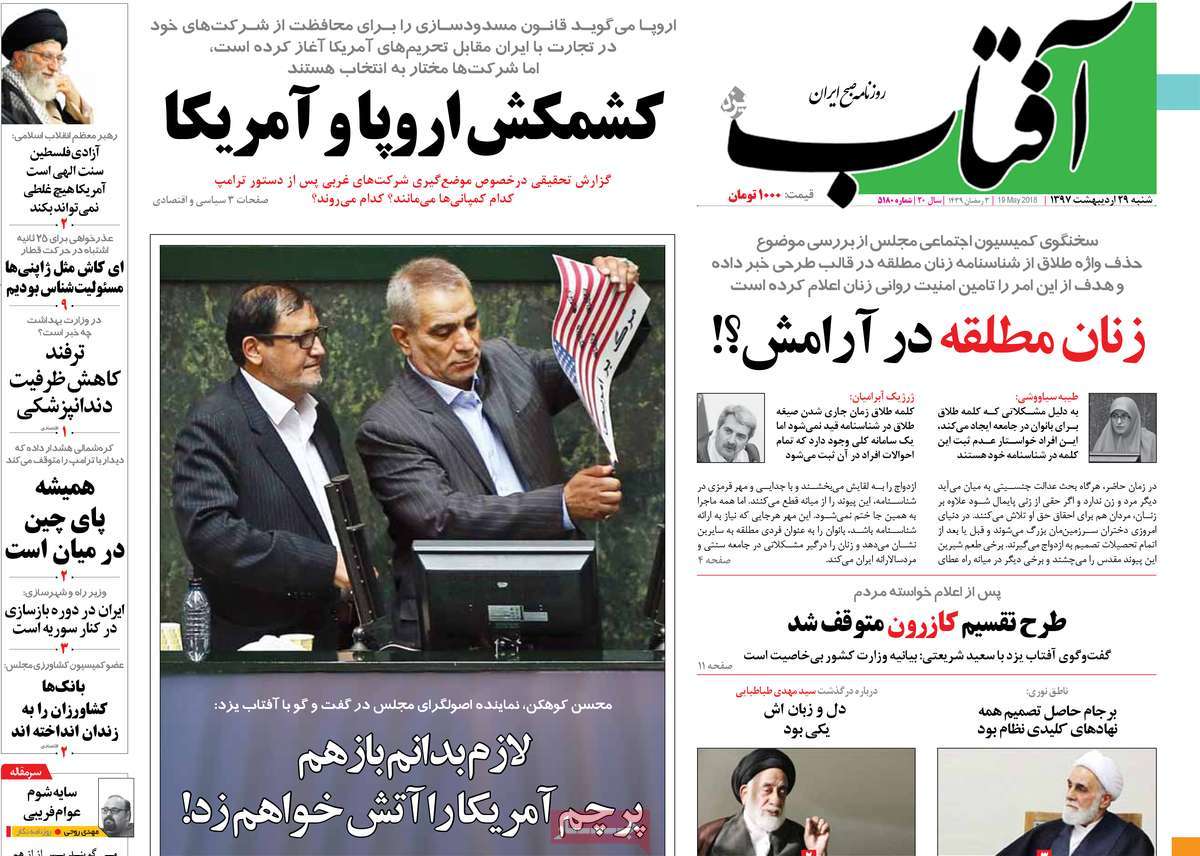
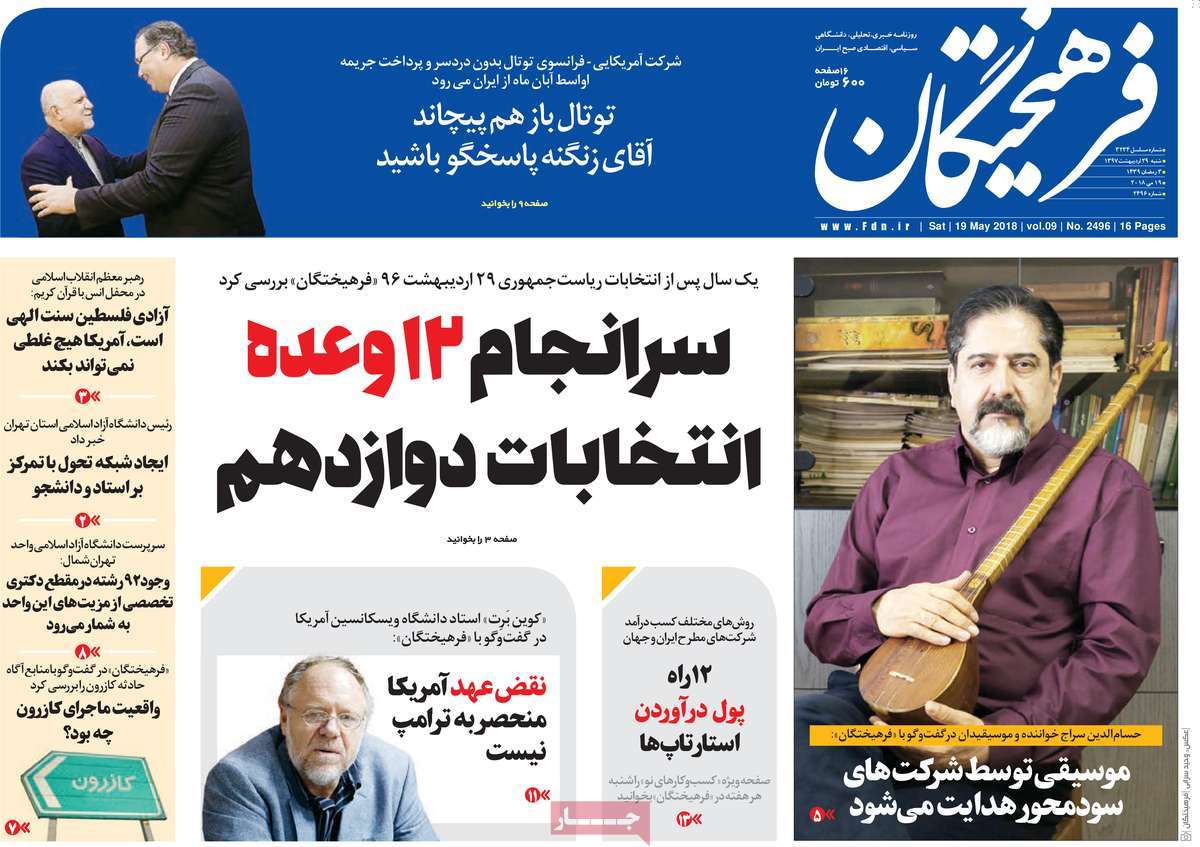
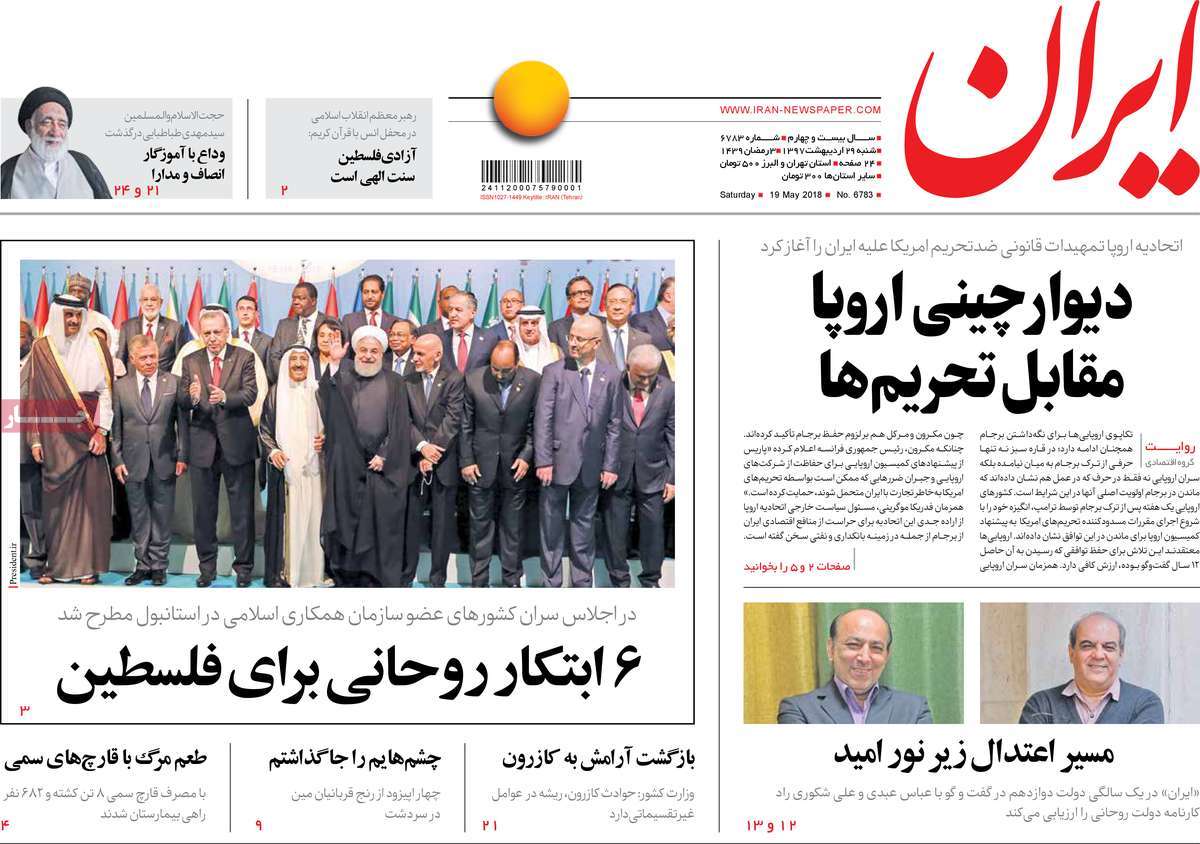
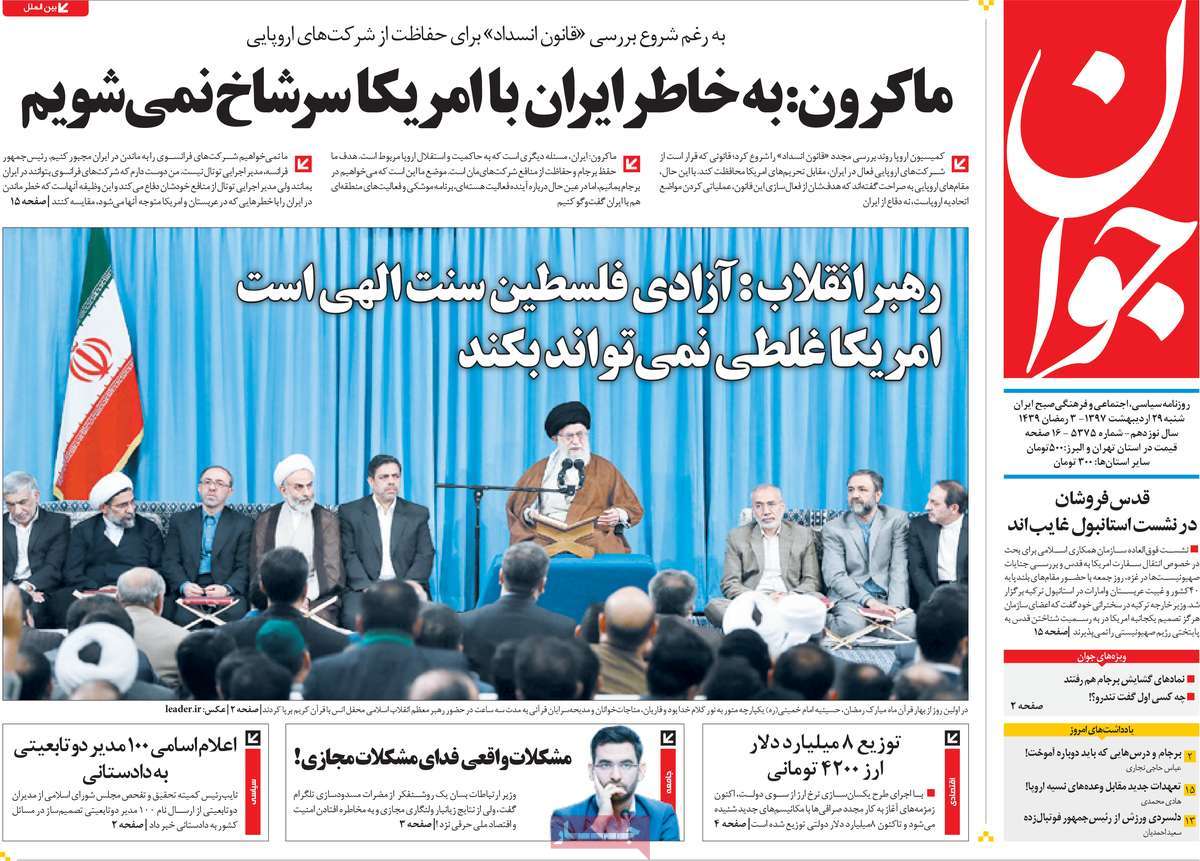
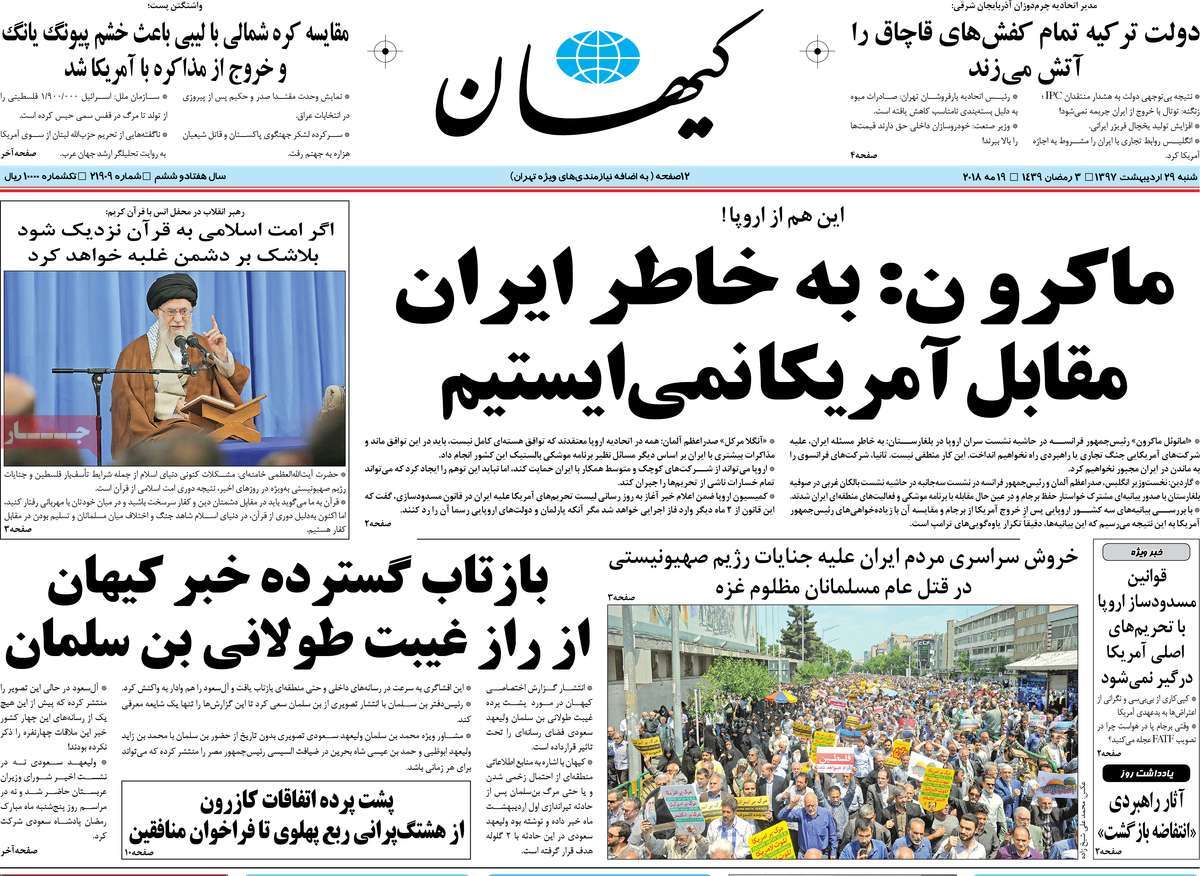
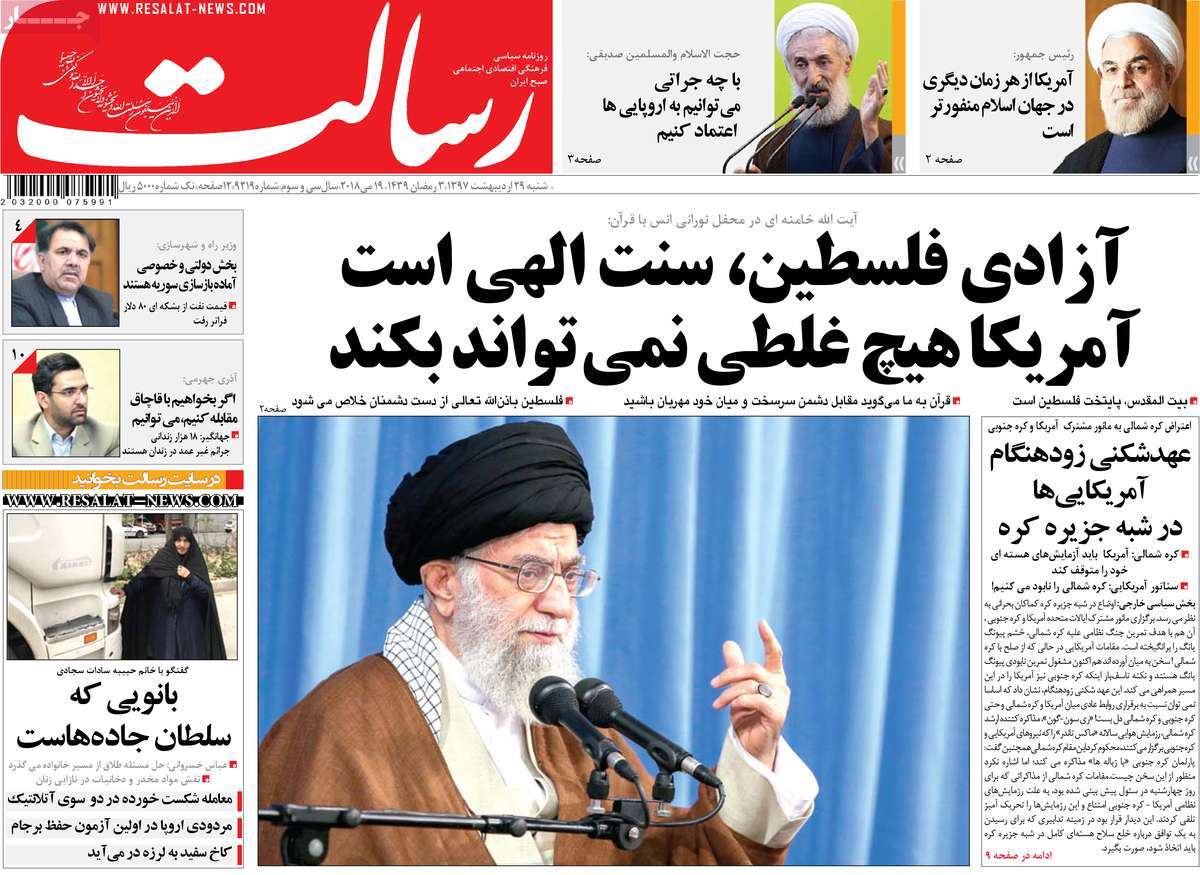
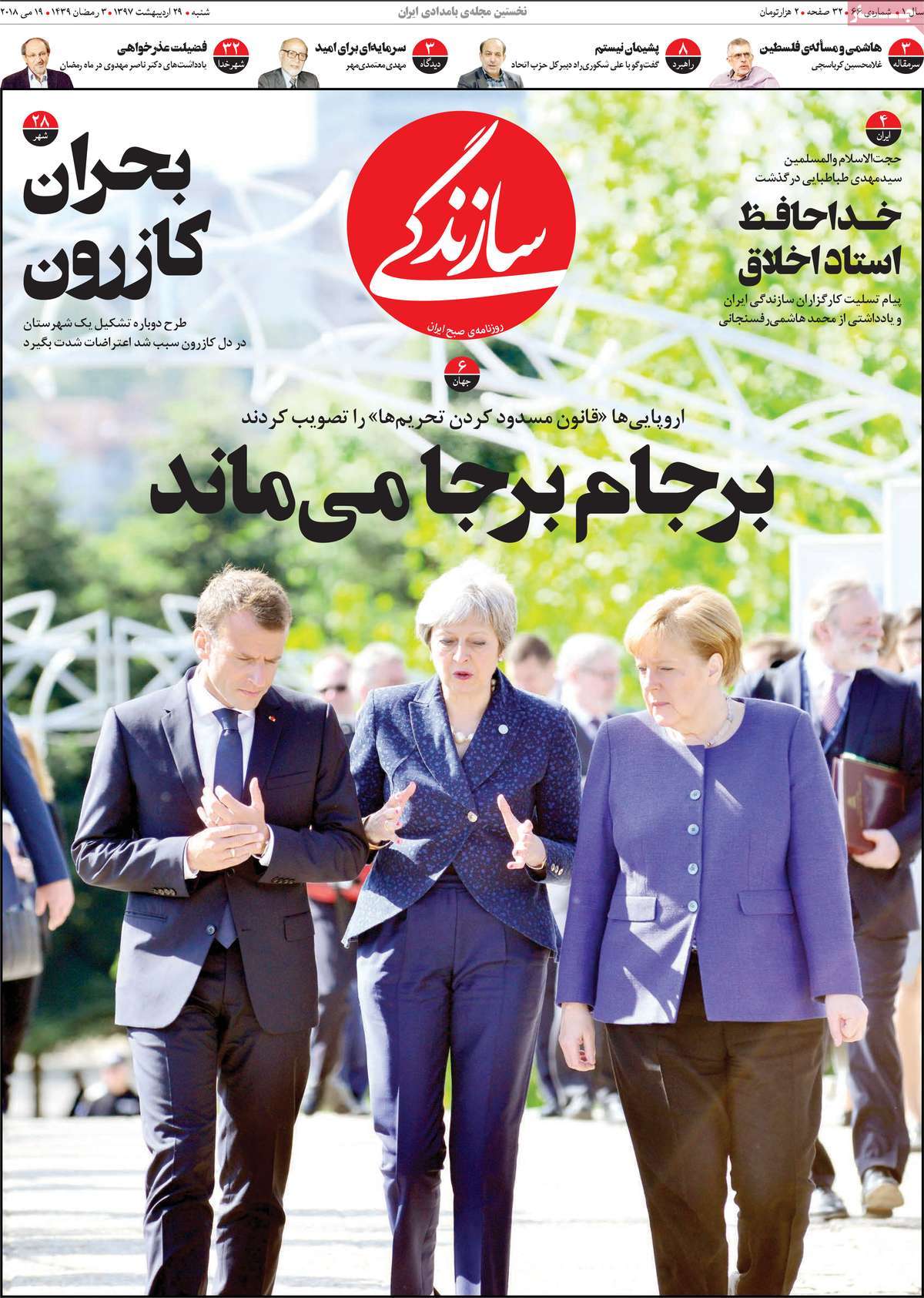
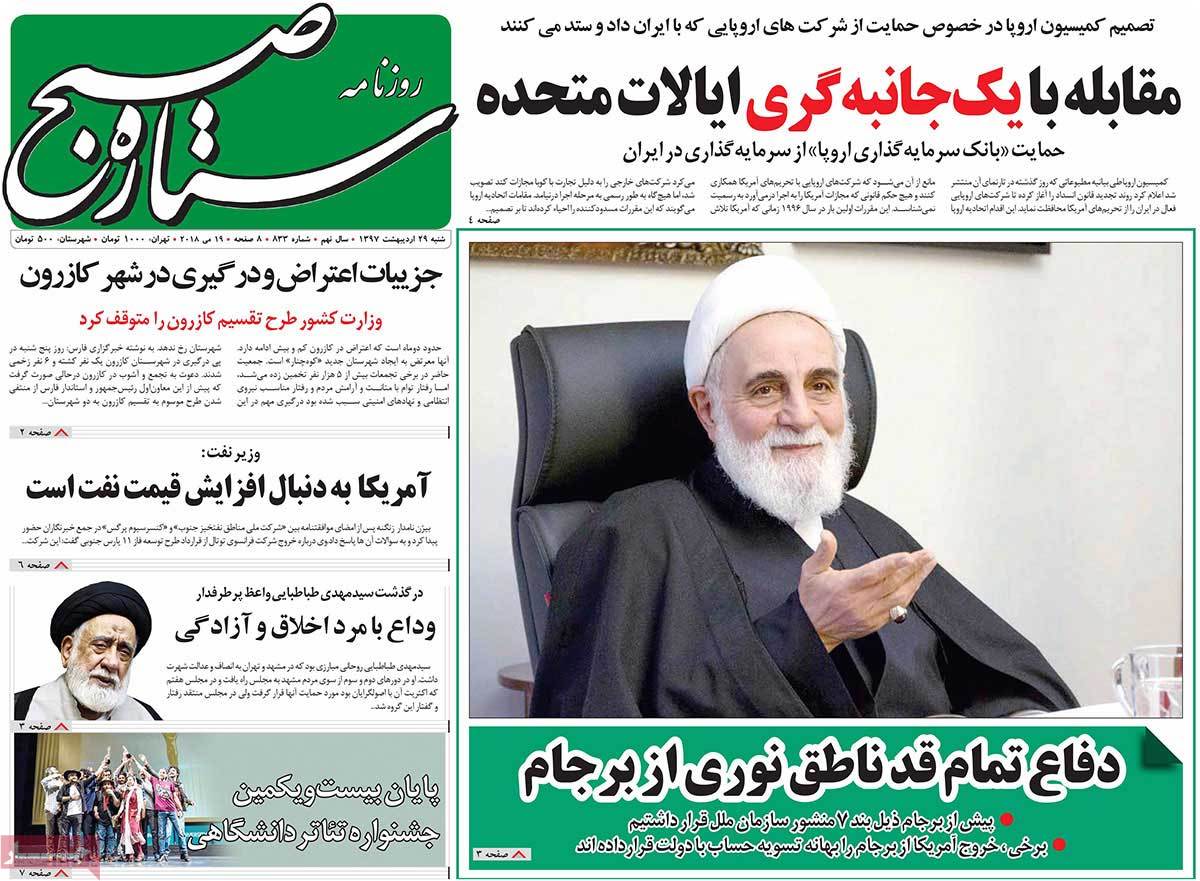
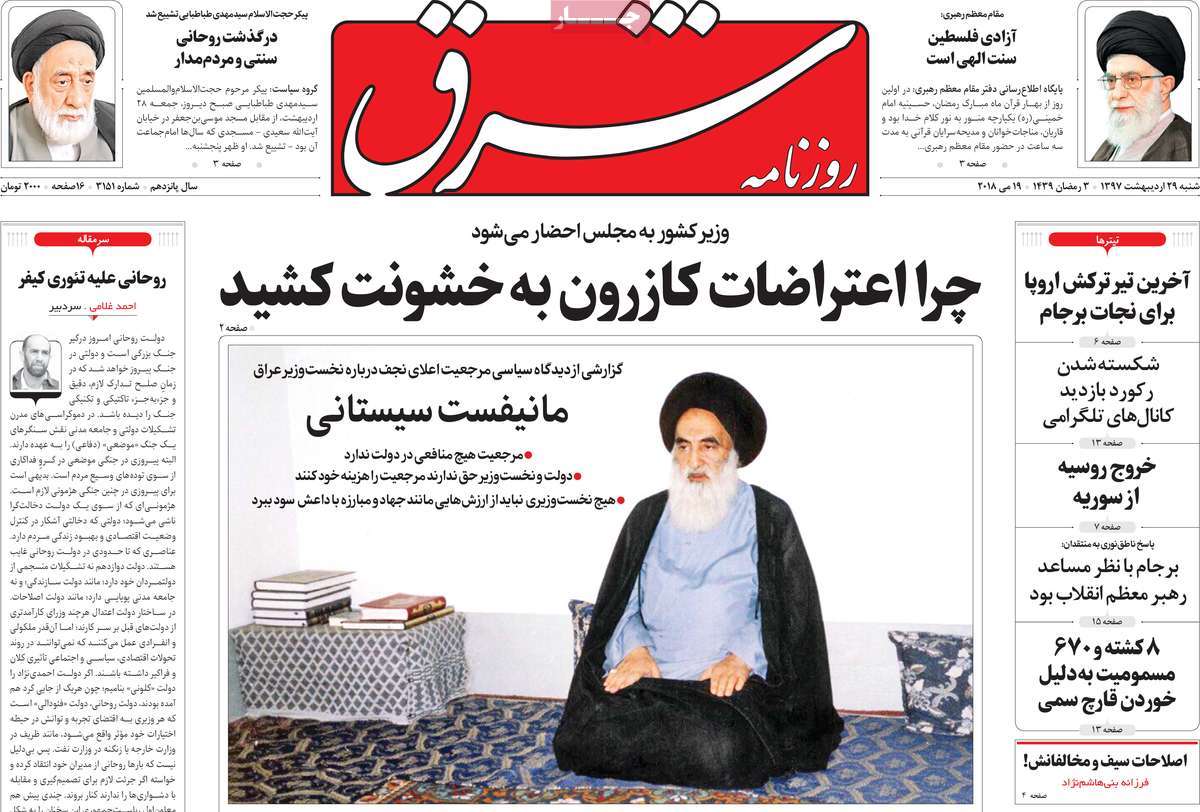
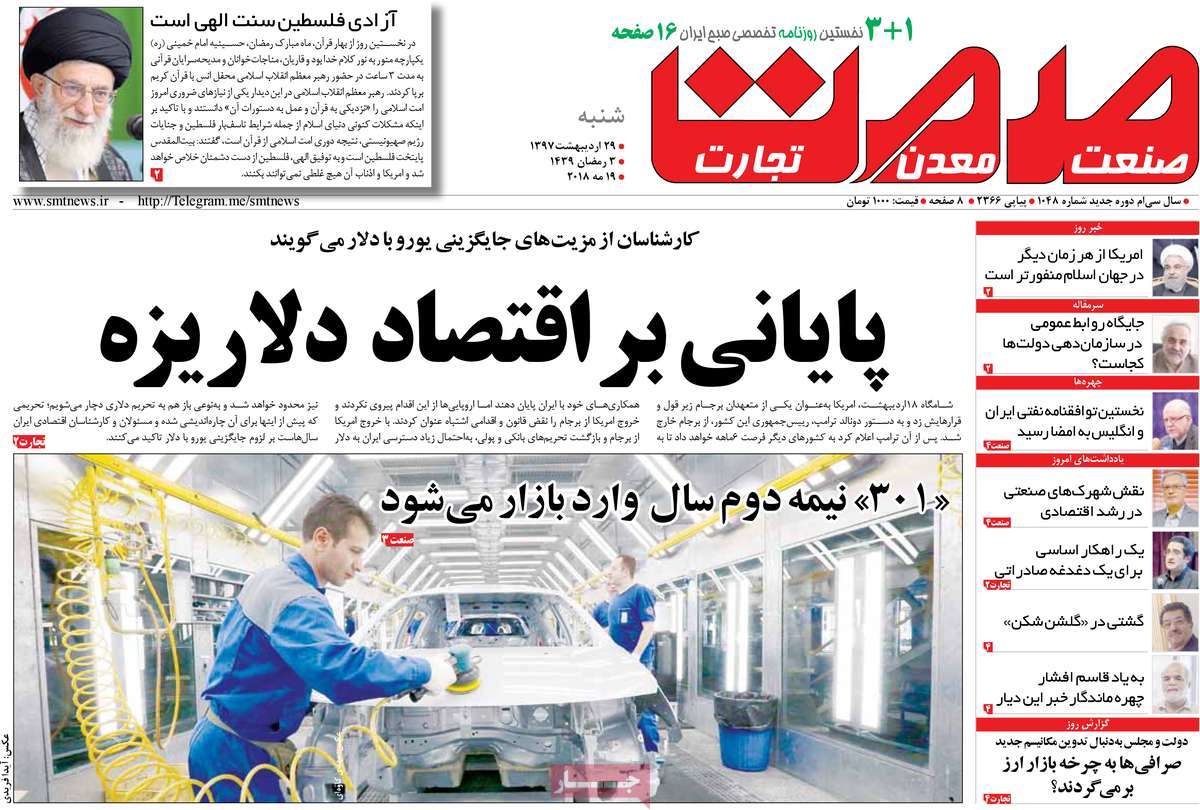
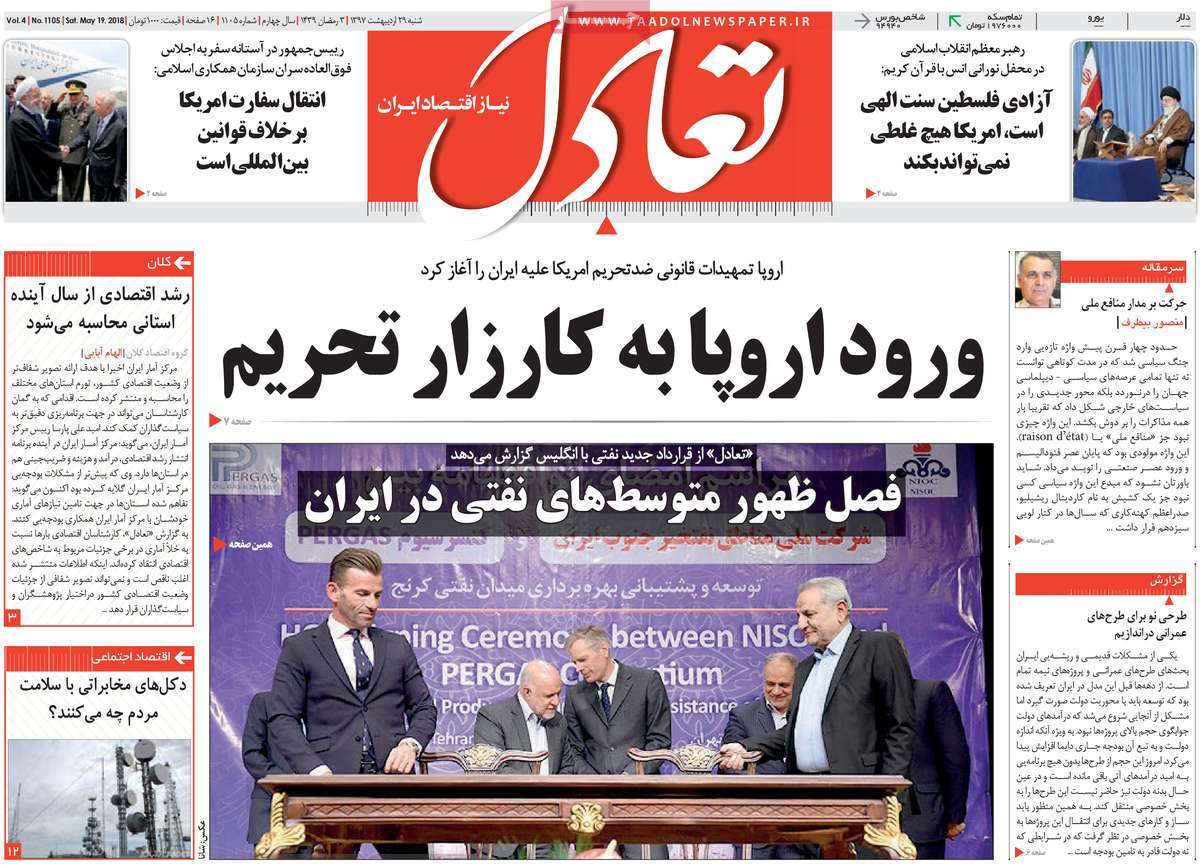
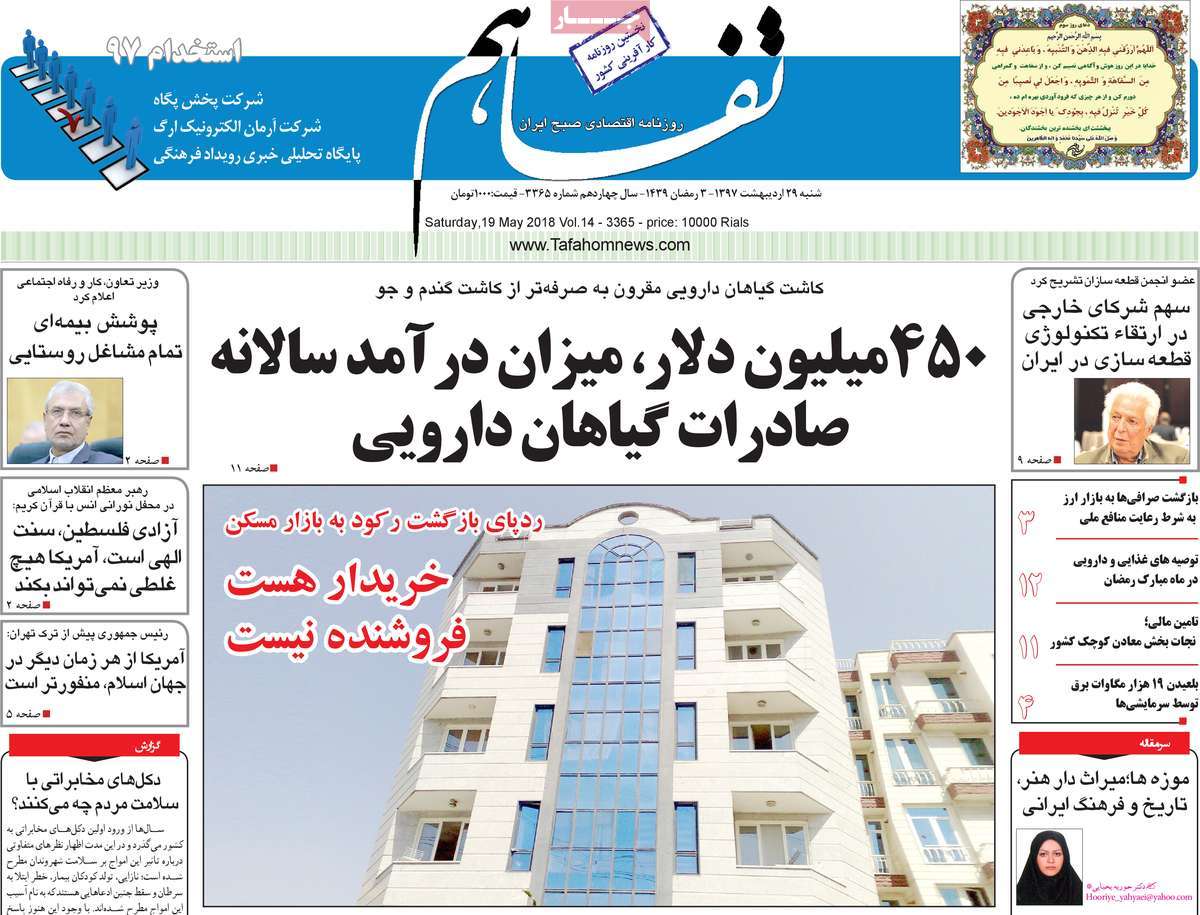
A Look at Iranian Newspaper Front Pages on April 30

A Look at Iranian Newspaper Front Pages on November 19

Almost all papers today covered the remarks made by Iranian President Hassan Rouhani in criticism of certain members of his own cabinet who, according to him, are disappointed about resolving the country’s problems.

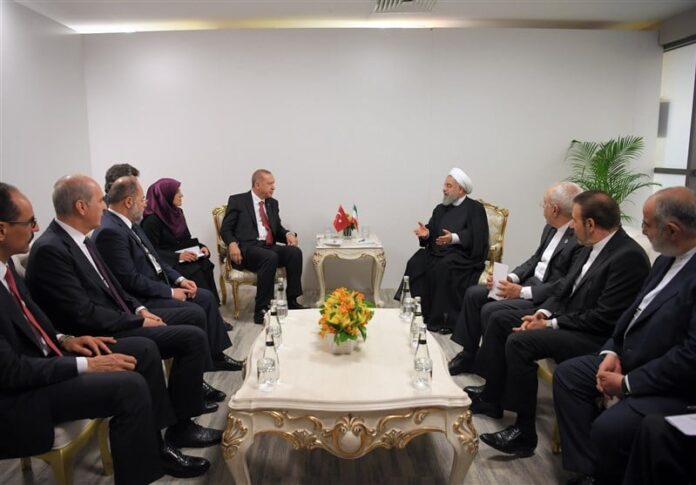
Also a top story was the imminent opening of the branches of three Iranian banks in Germany, and the talks between Tehran and Ankara over integration of bank cards.

Several papers also highlighted Europe’s commitment to the Iran nuclear deal, as expressed by a number of European leaders following their meetings with US President Donald Trump.

The above issues, as well as many more, are highlighted in the following headlines and top stories:


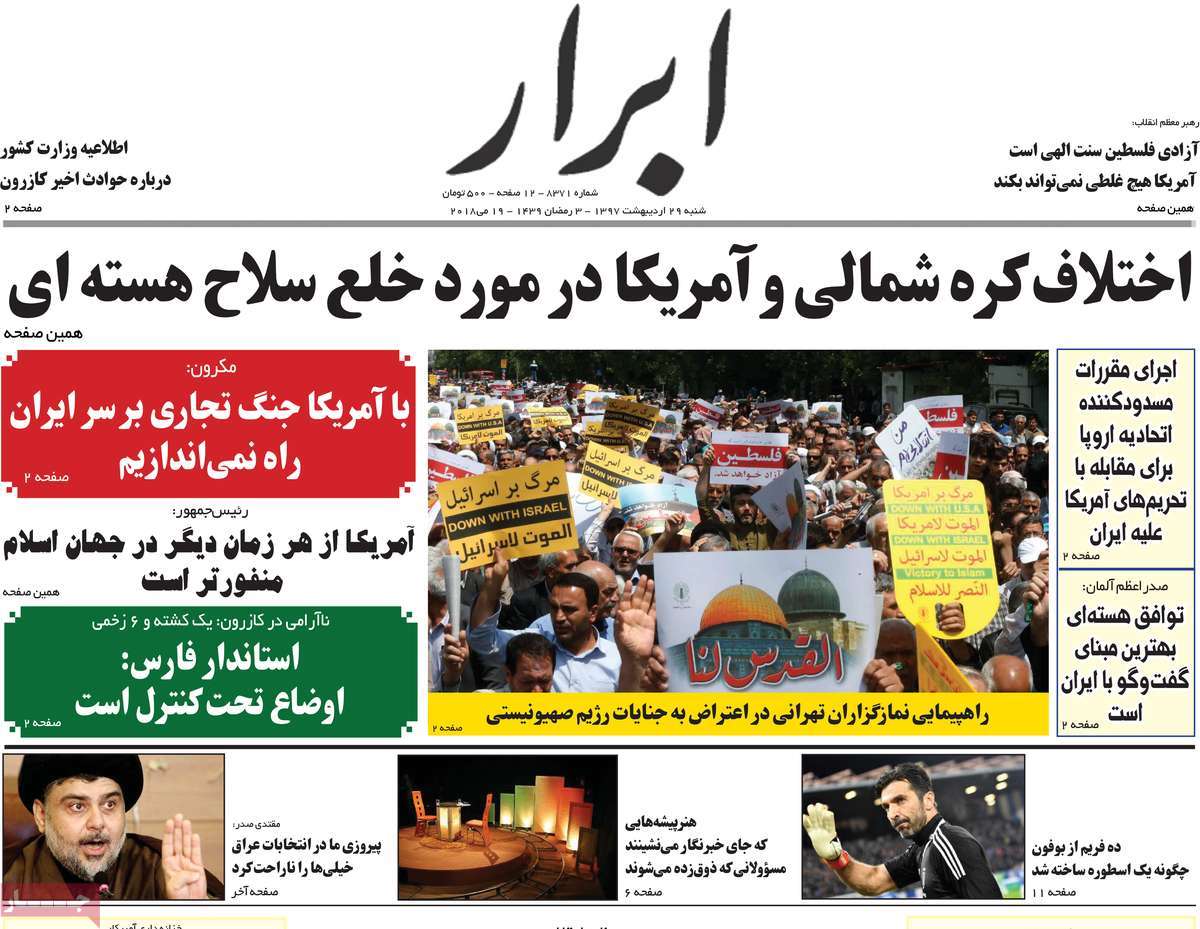
Abrar:

  • Iran Army, IRGC Hold Joint Parade, Display Air Defence Equipment
  • Trump: I’m Not John Kerry to Sign Bad Deal with Iran

A Look at Iranian Newspaper Front Pages on April 30


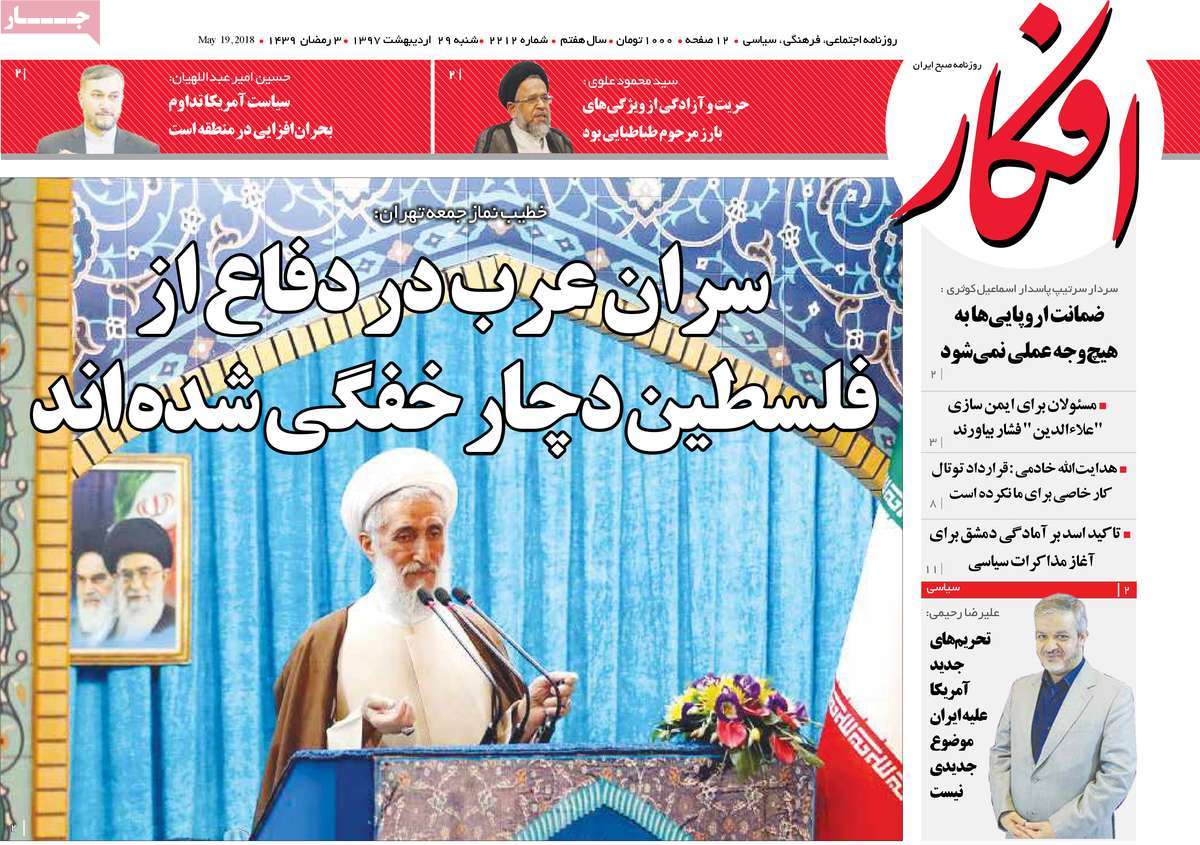
Afkar:

  • Velayati: Colonialists Will Never See Their Dream of Renaming Persian Gulf Realized

A Look at Iranian Newspaper Front Pages on April 30


Aftab-e Yazd:

  • Analyst: China and India to Blame for Iran’s Forex Problems

A Look at Iranian Newspaper Front Pages on April 30


Arman-e Emrooz:

  • Israelis Attacked Oliver Stone’s Email: Fajr Festival’s Secretary

A Look at Iranian Newspaper Front Pages on April 30


Asrar:

  • Rouhani: We Cannot Force Women to Stay Home

A Look at Iranian Newspaper Front Pages on April 30


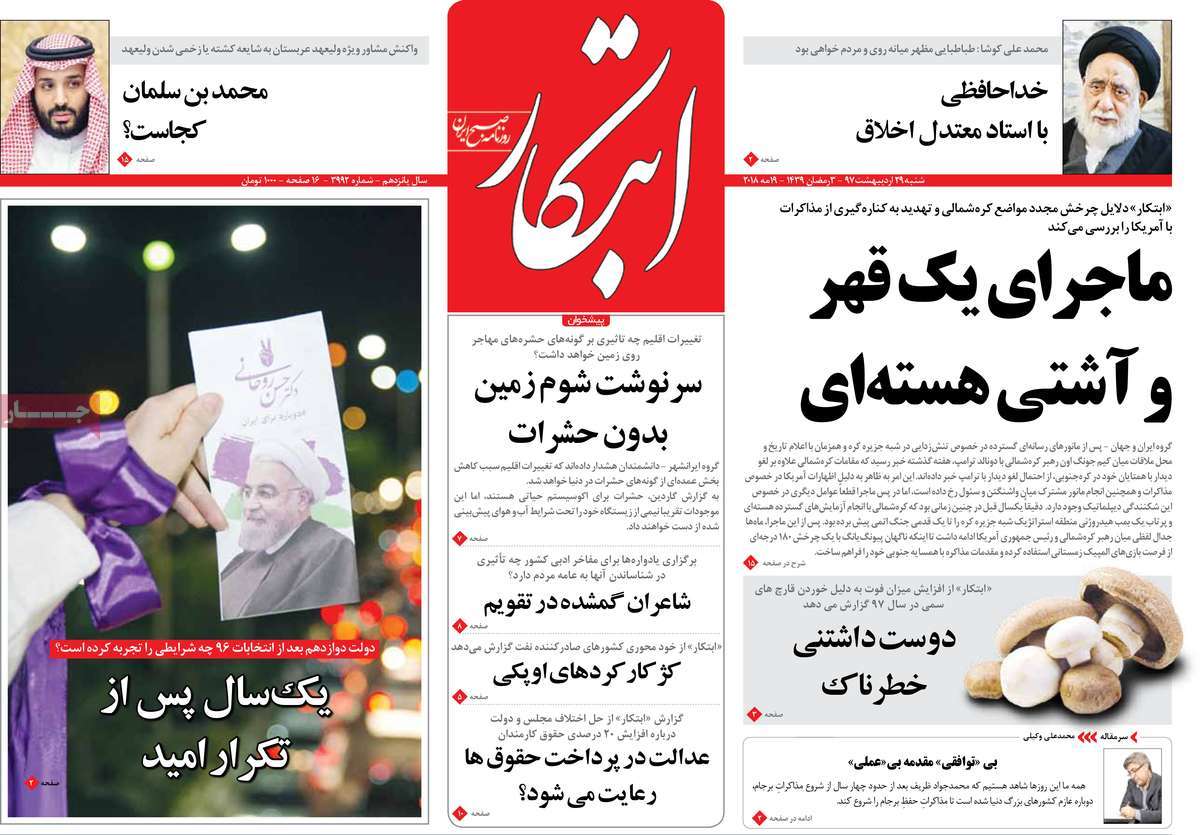
Ebtekar:

  • President of “Hope” Government Slams “Disappointed” Gov’t!
  • Rouhani: Making People Frustrated with Their Future among Enemy’s Plots

A Look at Iranian Newspaper Front Pages on April 30


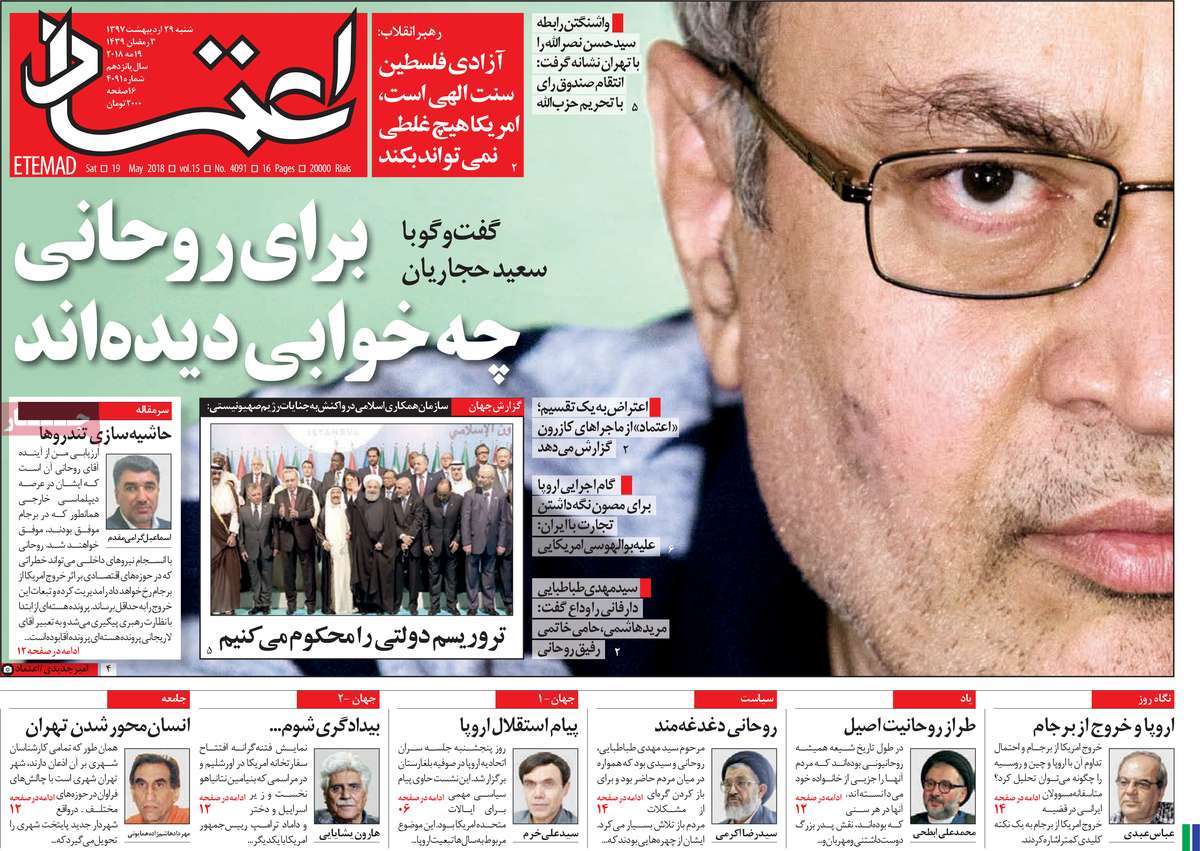
Etemad:

  • New Make-up Artists for Saudi Arabia’s New Face
  • Bin Salman to Use New Generations to Revive Saudi Lobby Groups in Washington

A Look at Iranian Newspaper Front Pages on April 30


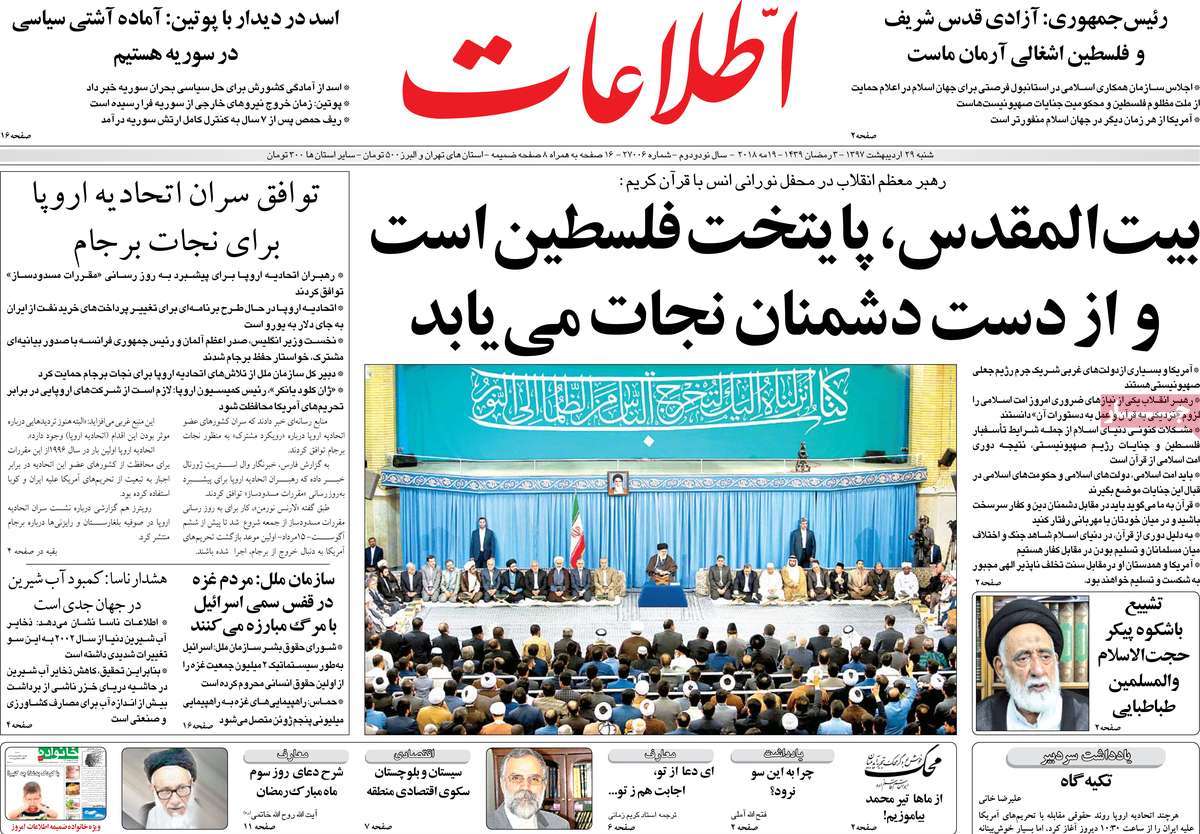
Ettela’at:

  • Iran First VP: We’ll Give Foreign Currencies to All Students Living Abroad
  • Rouhani: We Won’t Accept Any Commitment beyond Iran Nuclear Deal

A Look at Iranian Newspaper Front Pages on April 30


Haft-e Sobh:

  • Iranian Banks’ Initiative against Trump
  • Iranian Banks to Open Branches in Germany, Integrate Bank Cards with Turkey

A Look at Iranian Newspaper Front Pages on April 30


Hemayat:

  • Washington, Europe Dividing Labour to Achieve New Deal on Iran Missiles

A Look at Iranian Newspaper Front Pages on April 30


Iran:

  • 10 Hours without Telegram

A Look at Iranian Newspaper Front Pages on April 30


Javan:

  • Disappointment of Rouhani’s Ministers
  • Rouhani, for Second Time in Past Few Days, Complains to People about His Cabinet!
  • Kaveh Madani Allowed to Leave Iran Upon Intelligence Ministry’s Request: Judiciary

A Look at Iranian Newspaper Front Pages on April 30


Jomhouri Eslami:

  • French President: EU Will Definitely Stay in Iran Nuclear Deal
  • After JCPOA: Iran’s Exports to Europe Increased Tenfold, Imports Rises by 1.2 Times

A Look at Iranian Newspaper Front Pages on April 30


Kayhan:

  • They Once Claim Transfer US Dollars Using Sacks, Now Say Working with 250 European Banks!
  • Two Electromagnetic Nuclear Bombs Built by N. Korea Can Kill 90% of Americans

A Look at Iranian Newspaper Front Pages on April 30


Mardom Salari:

  • Al Saud’s Circus against Iran
  • WWE Contest in Saudi Arabia Sparks Controversy

A Look at Iranian Newspaper Front Pages on April 30


Sazandegi:

  • Rouhani: Why Disappointed?
  • President Divides His Ministers into Two Categories: Hopeful, Hopeless

A Look at Iranian Newspaper Front Pages on April 30


Sepid:

  • Health Minister: Khuzestan Must Be Turned into Medical Hub of Mideast

A Look at Iranian Newspaper Front Pages on April 30


Setareh Sobh:

  • New Era of Hostility against Iran
  • New US Secretary of State Visits Middle East

A Look at Iranian Newspaper Front Pages on April 30


Shahrvand:

  • Oliver Stone an Opportunist: Iranian Critic

A Look at Iranian Newspaper Front Pages on April 30


Shargh:

  • European Leaders: JCPOA Must Be Preserved

A Look at Iranian Newspaper Front Pages on April 30

“Telegram, Safe Haven for Criminal Groups”

These days, the messaging service has turned into a scene of criminal acts, from fraud, terrorism and rumour spreading to blackmailing and smuggling of drugs and goods.

Two-thirds of cybercrimes are carried out through Telegram. According to a report by the Persian-language Tasnim News Agency, in line with its media advertising to promote its brand, Telegram has ensured its users with complete privacy. This has led many experts to this conclusion that the mechanism of the messaging app is aimed at providing criminal groups with a safe haven in the cyberspace. The groups are as follows:

  • Swindlers

Swindling makes up for most of the crimes committed in the cyberspace. Internet swindling is rare in official websites. But messaging apps like Telegram prepare the ground for criminal acts like illegal sale and purchase. The swindlers pick up their victims out of those who are easily influenced by online advertising. Unfortunately, swindlers cannot be prosecuted by the judiciary officials easily. Imagine you have purchased a product through Telegram and paid the money in advance but when you receive the product, you find out that it is not the one you picked up and paid for. What can be done? Almost nothing!

Remaining anonymous in Telegram on the one hand and people’s trust in the messaging app on the other have paved the way for swindlers to do whatever they like in the messaging service.

Colonel Mortazavi, the head of cyber police department in Iran’s Isfahan province, said in an interview last year that the number of fraud cases in Telegram is much higher compared with similar messaging apps like Viber or WhatsApp.

  • Terrorists

Remaining anonymous in Telegram has made it an appropriate space for terrorist acts. Unlike other messaging apps which have adopted strict measures against acts of terrorism, Telegram takes the issue easily. That’s why Telegram was the last app which restricted the ISIS’ access to itself.

Investigations made into terrorist attacks in Russia and France over the past year revealed that the terrorists made their arrangements for the attacks mainly through Telegram. Therefore, Russia has called on Telegram’s management to relocate some of its servers into the country and provide them with the data of Russian users of Telegram. So far, Telegram has refused to cooperate with the Russian government.

Meanwhile, last year with the growing number of terrorist attacks in South Asia, Indonesia restricted its population’s access to the app. Iran went through a similar experience last year when certain Telegram channels began to fuel unrest in the country. Iranian officials finally decided to temporarily block public access to Telegram to control the chaos.


  • Gossipers

Since Telegram has not established any cooperation with any official entity in the world, there is no supervision on the current of news published on the messaging app. Therefore, there is no way to verify the authenticity of the news coming out of Telegram. This paves the way for spreading of rumours across the world. So, the users can be misinformed easily by the gossipers who usually operate under false identities. On the other hand, Telegram doesn’t contribute to any verifying process.


  • Blackmailers

One of the main crimes in Telegram is blackmailing. Since most people are not aware of the safety measures in the cyberspace, they easily share their personal data and photos with others. This provides the criminals with a good opportunity to press ahead with their projects. This is a common problem with all messaging apps. The only way to cope with it is raising public awareness about the importance of privacy in the cyberspace. They should avoid trusting others in the Internet.


  • Smugglers

Telegram is an ideal medium for selling contraband goods, inflicting a heavy blow to any country’s economy. But once again, since in Telegram there is no way to recognize the real identity of a user, the smugglers have managed to establish their own territory in the messaging app. They can sell illegal goods in the country through Telegram.


  • Drug Traffickers

In some Telegram channels, drug smugglers are easily conducting their business selling different types of drugs from marijuana to LSD and cocaine. Interestingly enough, these crimes are carried out without any problem. In the pictures below, you can find a number of Telegram channels which are active in selling drugs without being worried about legal crackdown.


Global Call for Coping with Telegram’s Law Aversion

In most developed states, messaging apps active in the cyberspace are held accountable for their activities within the geographical borders of each country. This means that they restrict the access of users who violate the country’s Constitution.

For example in the US, any one making an unlawful use of communication channels is fined $250,000 or given prison terms of up to two years. In Germany, the service providers are held responsible for the contents they provide their users with.

In the UK, former Prime Minister David Cameron pressurised large tech companies like Google and Microsoft into cooperating with the government to delete child pornography material from the Internet.

Meanwhile, Google has restricted its search domain in many countries at the request of their governments. For example, search results in Thailand for “Thailand King”, in Germany for “Nazi” and in Turkey for “YouTube” have been filtered.

This comes as Telegram refuses to cooperate with governments. The app has been blocked in several countries like Saudi Arabia, China and Oman, and restricted in Russia and Indonesia. In her address to the World Economic Forum last year, UK Prime Minister Theresa May called messaging apps a safe haven for criminals and terrorists.

In line with its policy to evade responsibility for its contents, Telegram is now seeking to block any filtering. This will further prompt criminals to resort to the messaging service to press ahead with their dirty projects.

“US-Saudi Partnership Stoking Instability, Insecurity in Region”

qassemi

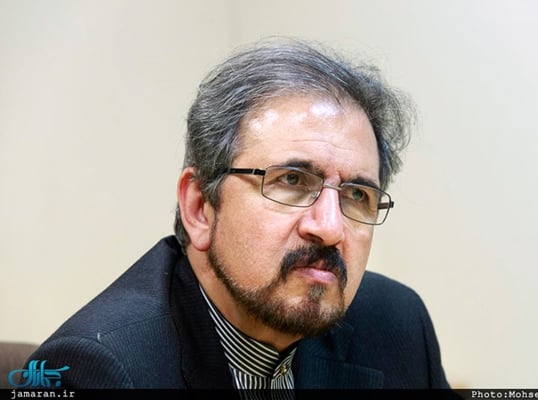
In a Monday statement, Bahram Qassemi rejected recent anti-Iran comments by US Secretary of State Mike Pompeo in a meeting with the Saudi foreign minister in Riyadh.

“What the US secretary of state describes as Washington’s partnership with Saudi Arabia is a partnership aimed at triggering instability and war as well as promoting arms races and extremism based on the adventurism of certain novice and bellicose Saudi politicians.”

“Such a move has, so far, had destructive consequences such as the perpetuation of violence, animosity and distrust among the regional countries as well as the creation of long-running crises, insecurity and instability in the region,” he said.

“As long as this unholy expansionist partnership exists, the regional nations will barely savour the taste of security and tranquility along with human and economic development.”

“The foreign ministers of the United States and Saudi Arabia will realize the meaning and outcome of their so-called partnership once they look at the deplorable humanitarian situation in Yemen and the extremism and terrorism in the region,” Qassemi added.

“What the US secretary of state has said about the Islamic Republic of Iran’s role and presence in some regional countries is just a rehash of baseless claims,” the spokesman said.

“The Islamic Republic of Iran’s advisory role in the two neighbouring countries comes at the request of their legitimate governments and is in line with fighting terrorism in the region, and this support will continue as long as the two governments need such help to combat terror,” Qassemi underlined.

He also touched upon the allegation that Iran is meddling in Yemen.

“The erroneous and false claim made again regarding Yemen is not true and is only aimed at deflecting the attention of the international public opinion from the crimes committed by Saudi Arabia in its aggression against Yemen. It is just a worthless claim geared to the perpetuation of Saudi Arabia’s warmongering, its aggression against Yemen, and the destructive and destabilising presence of foreign powers in the region.”

During his first tour of the Middle East as secretary of state, Pompeo rehashed false allegations against Iran and repeated Washington’s threat of quitting the Iran nuclear deal if the accord is not fixed.

Iran, Turkey to Integrate Bank Cards

This was announced during a meeting on Saturday between high-level representatives of Bank Melli Iran and Turkey’s Ziraat Bank, the official website of BMI reported.

“It has been decided that bank cards will be used between the two countries. Many Iranian and Turkish tourists travel between the two countries each year and using these cards can lead to the growth of tourism,” Mohammad Reza Hosseinzadeh, Bank Melli’s CEO, said.

Huseyin Aydin, CEO of Ziraat Bank who also heads Turkey’s association of state-owned banks, also put his support behind the scheme and said using integrated bank card systems can help the exchange of currencies and boost bilateral trade.”

According to a report published by the Hotel Association of Turkey, some 2.5 million Iranian tourists visited Turkey in 2017, making the country the top destination for Iranian holidaymakers. About 155,000 of the nearly 1.5 million foreigners who visited Turkey at the start of 2018 were Iranians.

The bank card integration scheme can prove immensely helpful, especially as Iran is still facing the repercussions of unifying its dual foreign exchange rates on April 10.

At present, foreign banknotes are scarce in Iran’s open market and travelers may legally get only up to €1,000 for foreign trips from authorized banks. Even that is uncertain as Central Bank of Iran Governor Valiollah Seif advised travelers to wait and postpone their trips until they can get their required hard currencies in the foreseeable future.

Turkey is not the only country being eyed for bank card integration. Iran’s similar scheme with Russia is undergoing trial and was supposed to be implemented by Dec. 10 after repeated promises, but it has been delayed again until further notice due to technical issues.

Iran is also negotiating bank card integration with Japan, Azerbaijan, Iraq, China and Oman.

During Saturday’s meeting, CEOs of Bank Melli and Ziraat Bank also discussed the currency swap deal that was formally agreed in October and designated their banks as agent banks. The first letter of credit using the national currencies of Iran and Turkey was opened on April 16 by BMI.

“Iranian and Turkish traders have welcomed the scheme,” Hosseinzadeh said.

Aydin announced that Turkey’s Economy Minister Nihat Zeybekci will travel to Iran in the near future and said that his bank is ready to fully cooperate with BMI as it has already formed technical committees in this regard.

Iran Not to Accept Anything beyond JCPOA, Rouhani Tells Macron

In a Sunday phone conversation with his French counterpart Emmanuel Macron, which lasted more than an hour, President Rouhani said the JCPOA has ensured regional security and cooperation.

Rouhani slammed the US for seeking to violate the JCPOA and said over the past few days, Iran has adopted highly significant economic decisions in banking and forex areas in response to the US possible pullout of the nuclear accord.

The Iranian president blasted the US stance towards the JCPOA over the past two years and said continuation of the stance is not acceptable for Iran anymore.

He reiterated that the JCPOA is non-negotiable and said Iran will not accept any further commitments beyond the nuclear deal.

Rouhani called the Iran nuclear deal a main basis for building trust between Iran and the west, and said, “Given high capacities for expansion of ties in various political, cultural, economic and regional areas, we are determined to strengthen our relations with France.”

The French president, for his part, called for further expansion of ties between Iran and France.

He then underlined that France and other European sides of the Iran nuclear deal support the JCPOA and added his country will remain in the deal resolutely.

Macron also called on the Iranian president to remain in the nuclear deal even if the US decides to pull out.

He then referred to the regional issues and said France has always been after a stable region and said the JCPOA can serve as a good model for resolving regional issues.

Iran State TV to Air Documentary on US-ISIS Cooperation

ISIS

Named Lord of War, the documentary provides its viewers with a new account of US support for terrorists in the region.

According to a report by the Persian-language news agency Young Journalist Club (YJC), the new documentary draws on rarely-seen videos to shed light on an undeniable fact about the US support for the ISIS terrorists.

The documentary is set to be broadcasted for the first time when the US begins to relocate its embassy from Tel Aviv to East Jerusalem Al-Quds.

Provided by the Resistance Front which has managed to penetrate into the US Command and Control in the region, the videos used in the documentary portray a vivid account of the fight against ISIS in Iraq and Syria.

The videos reveal how the US commanders provide ISIS with direct and indirect military and logistic support helping the terrorists to survive.

Lord of War is produced by Owj Arts and Media Organization which is a non-governmental media organization affiliated with the IRGC. It is active in launching propaganda campaigns, film production and distribution.

US has been accused repeatedly by Syria, Russia, Iran, Turkey and a number of other regional states of sponsoring terrorist groups in the region.

A study by Conflict Armament Research (CAR) said last year that sophisticated weapons the US and Saudi Arabia secretly provided for so-called moderate militants fighting the Syrian government quickly fell into the ISIS hands.

Iran Develops Its Own Digital Currency

Iran Develops Its Own Digital Currency

Iranian Minister of Communications and Information Technology Mohammad Javad Azari Jahromi says the Iranian cryptocurrency is being developed under a joint project involving the ministry’s ICT Research Institute, Central Bank of Iran’s Monetary and Banking Research Institute and the state-run Post Bank.

“Last week, in a joint meeting aimed at exploring the progress of the project, it was announced that the experimental model is ready,” he said, according to a report by the Persian-language Islamic Republic News Agency (IRNA).

The announcement came after the central bank last Sunday banned Iranian banks from dealing in foreign cryptocurrencies, including Bitcoin.

“Banks and credit institutions and currency exchanges should avoid any sale or purchase of these currencies or taking any action to promote them,” a central bank circular said, based on a ban on cryptocurrencies passed by Iran’s anti-money laundering body in December.

Cryptocurrencies’ underlying block-chain technology eliminates the need for a third party and allows for instant, irrevocable and secure transactions.

Iran joined the growing list of nations to crack down on cryptocurrencies, including India and Pakistan who made roughly similar moves in early April.

Azari Jahromi says the CBI ban does not cover home-grown digital currencies and it does not mean Iran will resist against cryptocurrencies, which could shape the future of finance world.

“The CBI ban on Bitcoin dealings was made out of concerns such as [it could lead to] foreign currency flight and that the [volatility in the crypto market] could lead people to lose their assets. But Bitcoin is not the one and only cryptocurrency,” the minister said.

Dozens of countries such as China, Russia, and Singapore have already developed their own digital currencies, as they address needs of consumer anonymity and transaction efficiency.


National Cryptocurrency Not in Conflict with Sharia

In a Farsi interview with banking news website IBENA on Friday, Azari Jahromi said the Iranian cryptocurrency will be backed by assets, so it will have no Sharia (Islamic rules) problems.

Iranian clerics have expressed concerns that doing business with virtual currencies could have problems, as Islamic Sharia believes money should hold real value or be backed by such assets.

The Iranian cryptocurrency will be backed by assets, just like the Malaysian cryptocurrency which is backed by gold and the Venezuelan one which is supported by oil, Azari Jahromi said.

Referring to reports by western media that Iran is developing cryptocurrencies as a means to circumvent financial sanctions by avoiding traditional financial avenues, the minister said, “All cryptocurrencies are capable of circumventing sanctions because they are not under supervision of the US financial regulatory body, and the national digital currencies are naturally capable of this.”

Both Venezuela and Iran are currently the targets of heavy sanctions imposed by the US.

Iran moved this month to formally unify its official and open market exchange rates and banned money changing outside of banks, after its currency rial plunged to an all-time low earlier this month.

Government officials described the sudden plunge as unnatural, suggesting it could be caused by an economic plot hatched by the US and its allies.

Sarbaz; The Little India Inside Iran

Sarbaz, one of the most beautiful cities in Sistan and Baluchestan, has a population of 186,165, the majority of whom live in rural areas along Sarbaz River.

When you enter the city, palm trees and grassy fields grab your attention as if a small paradise is built in the heart of the dry and underdeveloped province.

Sarbaz is very much similar to India when it comes to climate, food culture and clothing; therefore, it is widely known in Iran as the Little India and the City of 72 Nations.

The city’s weather in the coldest season of the year is quite like springtime, and you can rest in the shade of the palm trees.

The climate variability in Sarbaz provides conditions for planting and harvesting different fruits such as dates, tree melon, banana, jujube, mango, sapodilla, guava, and citrus types like lemon, orange, and mandarin.

The existence of green palm trees and rivers in Sarbaz make it a suitable habitat for breeding fish and crocodiles. The locals of Sarbaz call their dwarf crocodiles “Gando”.

The use of traditional agricultural tools next to arts like needlework and architecture reflect the preservation of traditional values by the people of this city.

If you wish to see beautiful houses, special decorations and varied shapes on the exterior of the houses, travel to Sarbaz and see different traditional designs on the exterior walls of this region.

What follows are photos of the city retrieved from various sources:

Iran Says West Trying to Distort Name of ‘Persian’ Gulf

Ali Akbar Velayati, an advisor to Leader of the Islamic Revolution Ayatollah Seyyed Ali Khamenei, says any change in the name of the Persian Gulf will be a prelude to false claims of ownership on Iran’s territory.

Velayati made the comment in a ceremony to unveil the “Persian Gulf” book, reported the Persian-language Iranian Students’ News Agency (ISNA).

“We haven’t done enough regarding the Persian Gulf and other parts of Iran,” the Leader’s advisor noted.

“The story of the Persian Gulf and the wicked talk of changing its name by certain entities are, in my view, a transient issue and what is right will finally rule the day,” he said.

“In the items left behind by the [ancient] Greek and the maps they had drawn in accordance with the circumstance of the time, the words used are synonymous with the Persian Gulf,” Velayati said.

He underscored that it was the UK that initiated the move to change the name of the Persian Gulf, not in a bid to change it to the “Arab Gulf,” but to eliminate the word “Persian,” and that is why British media use the misnomer “Gulf” to refer to the body of water.

Velayati, however, noted that even the UN has stressed that the right phrase is “The Persian Gulf.”

“The reason why there is so much emphasis on using the name ‘The Persian Gulf’ is that changing the name is the preamble to changing the identity and ownership of, and creating false claims on Iran’s territorial integrity. So, the reason they use the false phrase ‘The Arabian Gulf’ is that they want it to take on a legal connotation,” he said.

“This is while our shores in the Persian Gulf along with all our islands there cover an area more than all of the shores belonging to the six Persian Gulf littoral countries combined,” he said.

He then put emphasis on the strategic importance of the Persian Gulf.

“From the viewpoint of geopolitics experts, anyone who dominates the Persian Gulf has, in fact, dominated the Indian Ocean.”

He said countries such as Saudi Arabia are the mouthpieces of the US and Israeli regime and other global hegemons.

Velayati said, “God willing, the name of Persian Gulf will remain the same forever.”