Sunday, December 28, 2025
Home Blog Page 3556

A Look at Iranian Newspaper Front Pages on June 28

A Look at Iranian Newspaper Front Pages on November 19

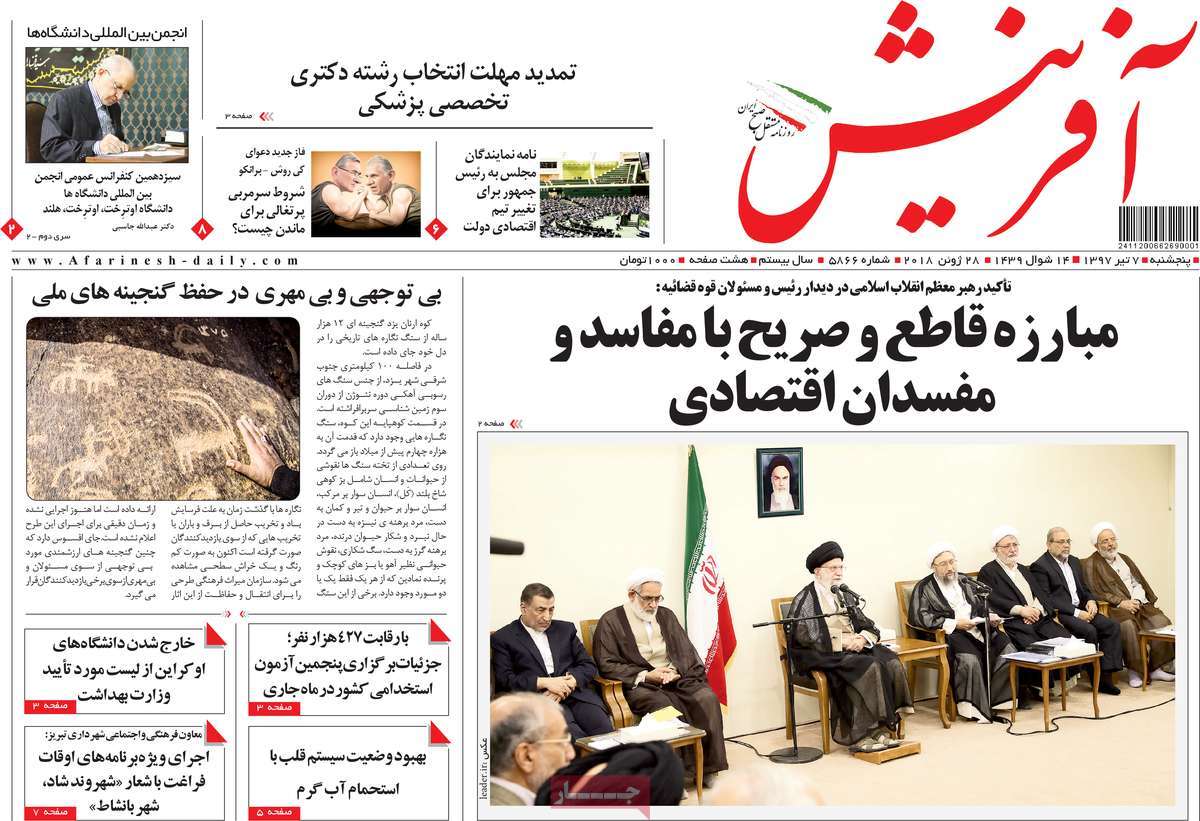
All newspapers today covered the remarks by the Leader of Iran’s Islamic Revolution Ayatollah Seyyed Ali Khamenei in a meeting with the country’s top judges and Judiciary officials. During the meeting, Ayatollah Khamenei urged the Judiciary to help the government tackle the ongoing economic problems in Iran.

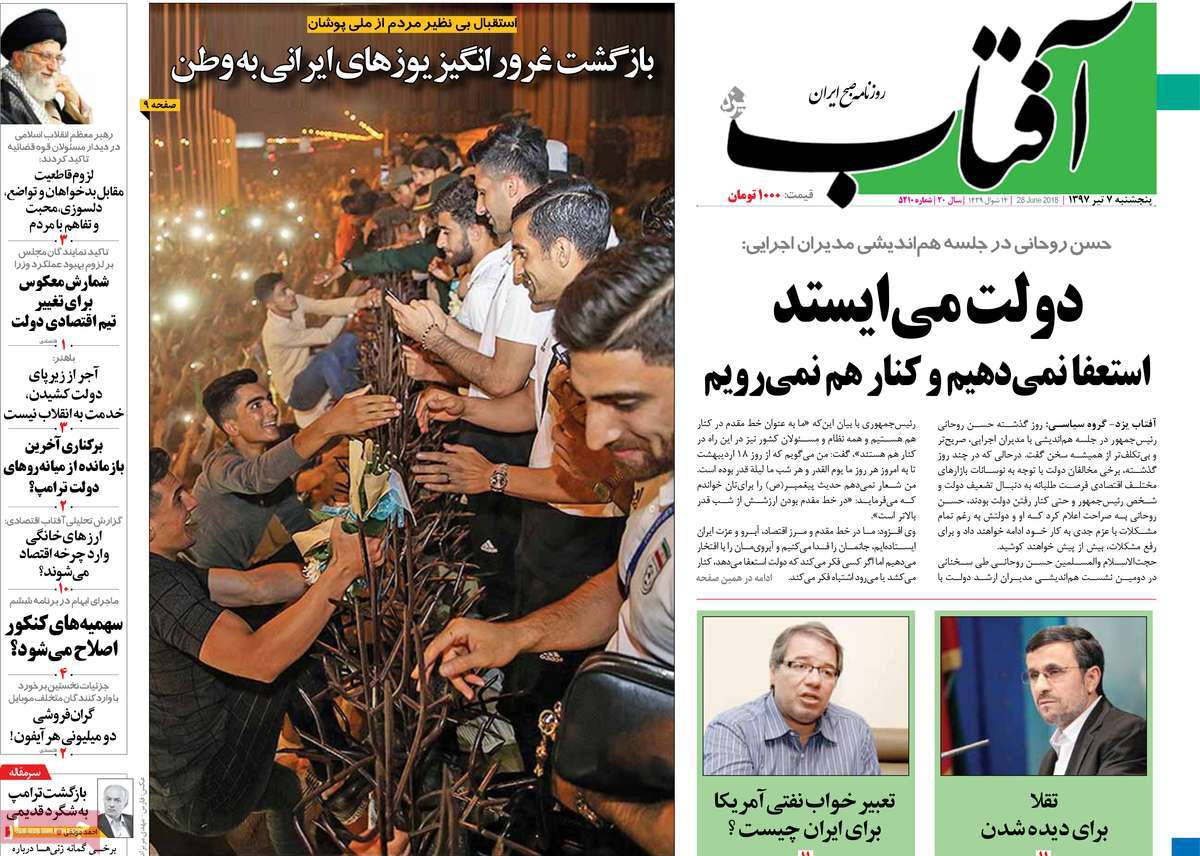
Also a top story was comments by President Hassan Rouhani who said he won’t resign and give up, and will stay to resist the US pressures and sanctions.

The above issues, as well as many more, are highlighted in the following headlines and top stories:


Afarinesh:

1- Leader Urges Decisive, Serious Fight against Corruption

2- Ukraine’s Medical Universities Not Recognized by Iran’s Health Ministry Anymore
A Look at Iranian Newspaper Front Pages on June 28


Aftab-e Yazd:

1- Rouhani: Government Is Standing Firmly

  • We Won’t Resign, We Won’t Give Up

2- Glorious Return of Iranian Cheetahs to Homeland
A Look at Iranian Newspaper Front Pages on June 28


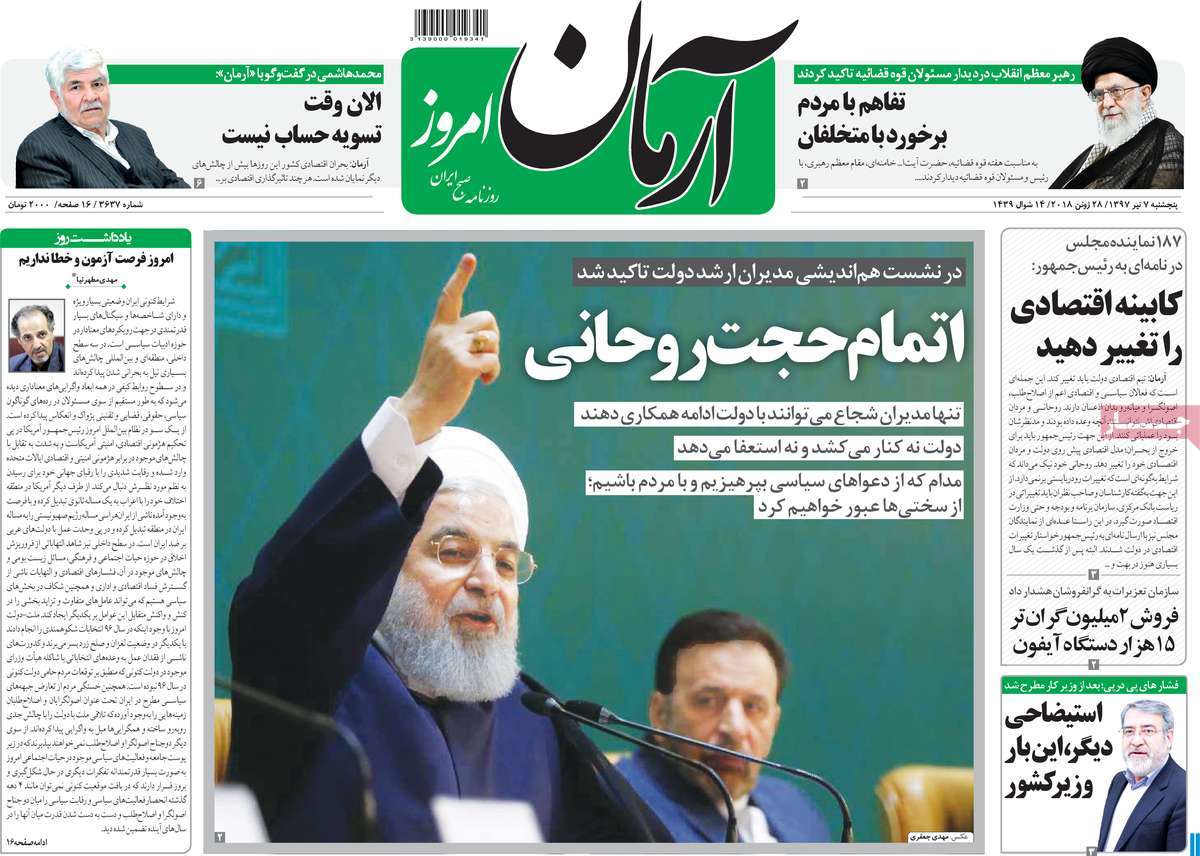
Arman-e Emrooz:

1- Rouhani Gives Ultimatum to Government Executives

  • Only Courageous Managers Can Continue Working for Gov’t
A Look at Iranian Newspaper Front Pages on June 28


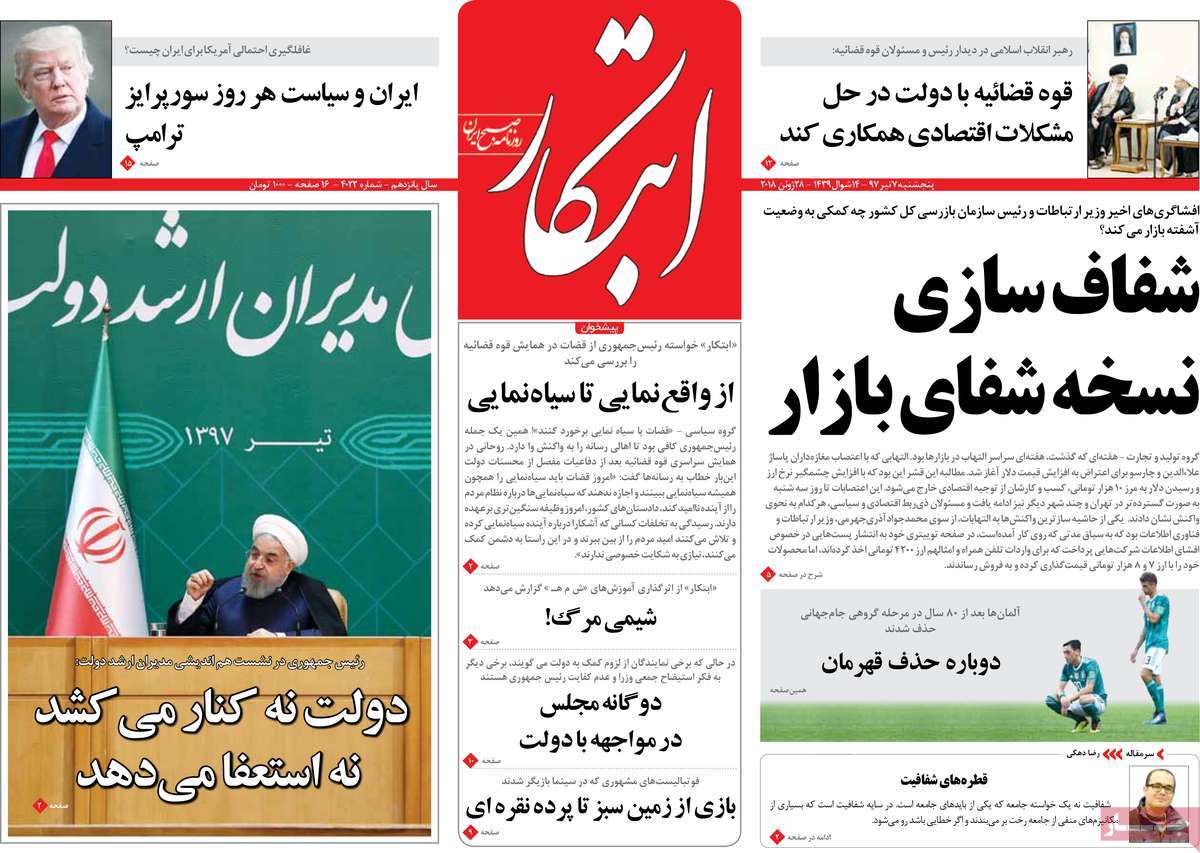
Ebtekar:

1- Leader Urges Judiciary to Cooperate with Gov’t in Resolving Economic Woes

2- Iran and Policy of Being Surprised by Trump Every Day

  • How Will US Surprise Iran?

A Look at Iranian Newspaper Front Pages on June 28


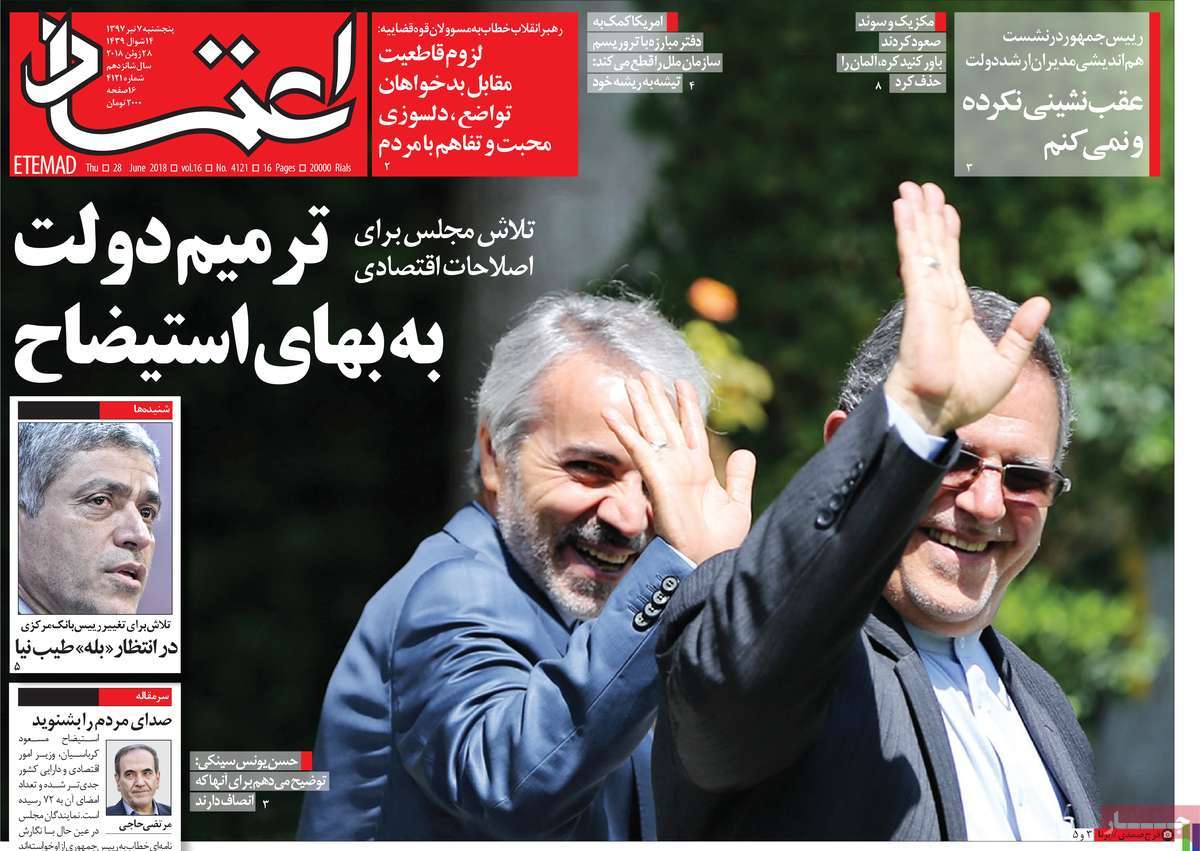
Etemad:

1- In Attempt to Make Economic Reforms, Parliament Calls for Cabinet Reshuffle

2- Efforts to Change Governor of Iran’s Central Bank
A Look at Iranian Newspaper Front Pages on June 28


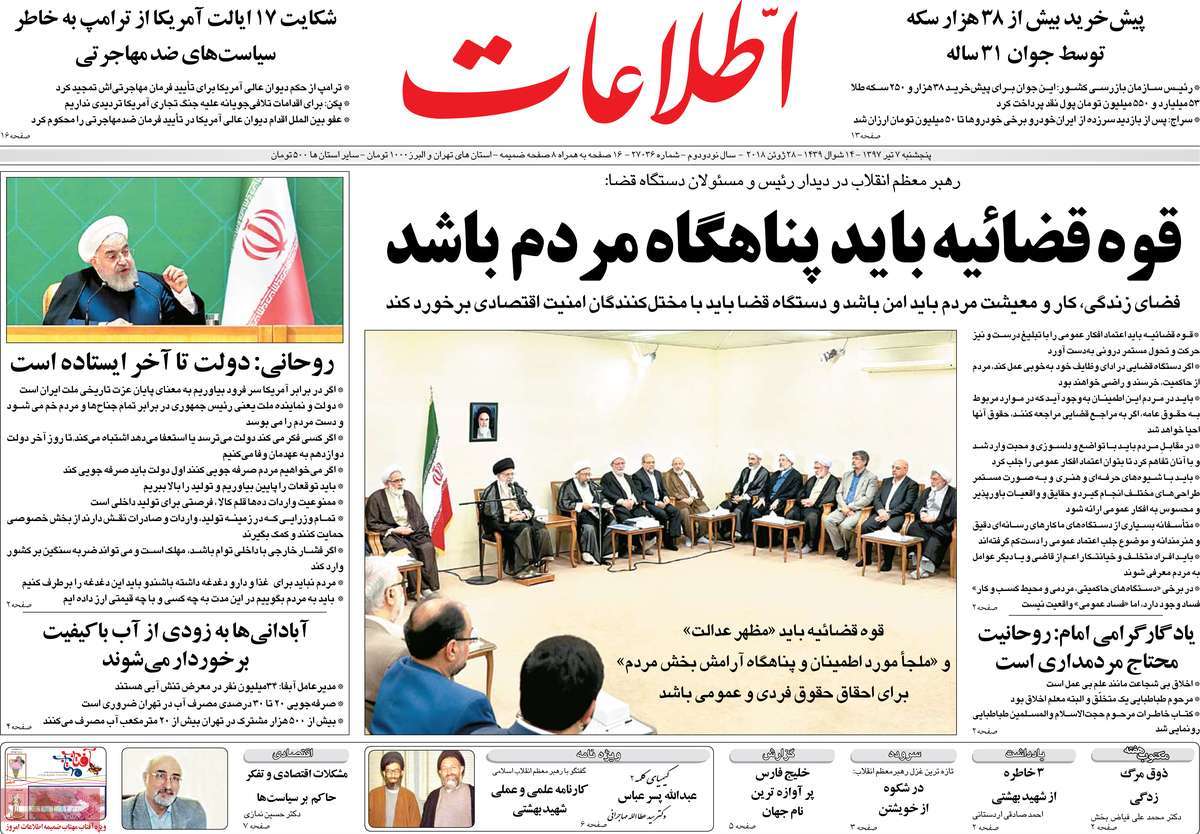
Ettela’at:

1- Judiciary Must Be People’s Shelter: Leader

2- 17 US States Sue Trump over His Anti-Immigration Policies

3- 31-Year-Old Man Pre-Purchases 38,000 Gold Coins

4- People of Abadan to Regain Access to Fresh Drinking Water Soon
A Look at Iranian Newspaper Front Pages on June 28


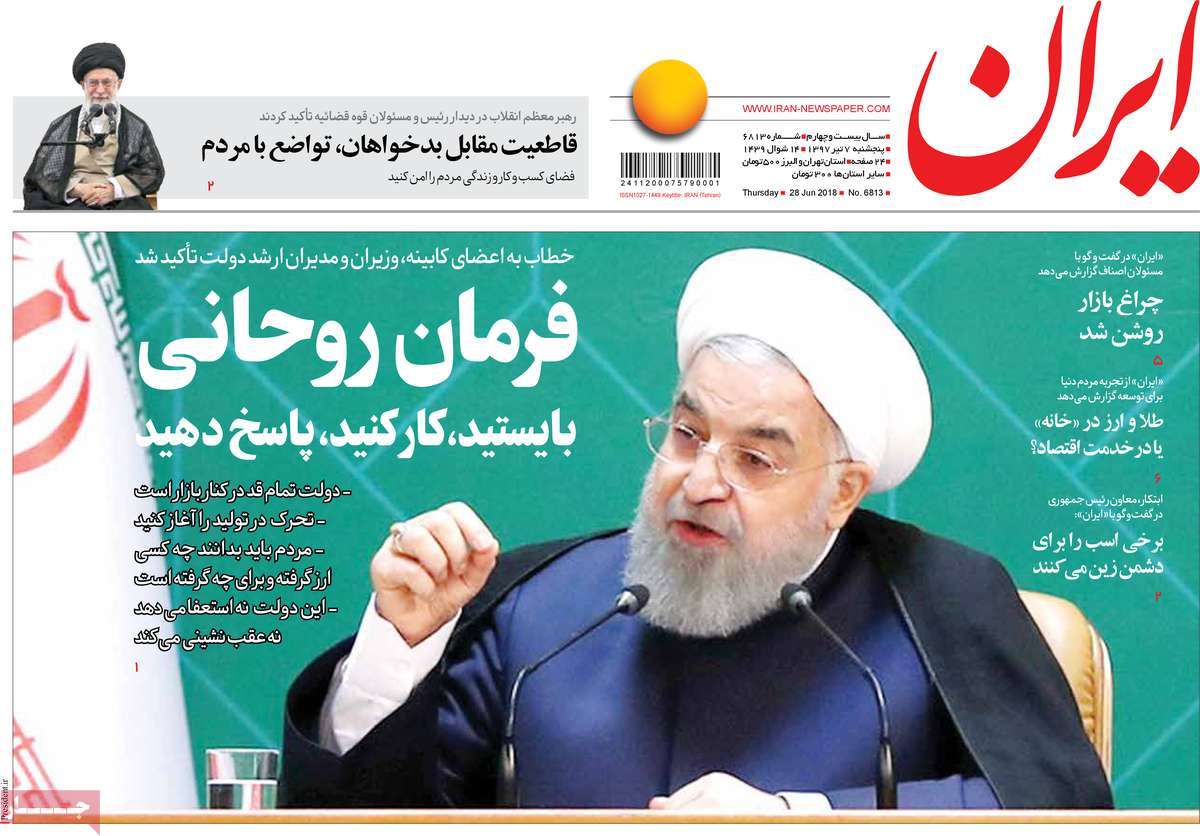
Iran:

1- Rouhani’s Order: Stand Firmly, Work Hard, Be Accountable

2- Shops in Tehran Bazaar Reopened
A Look at Iranian Newspaper Front Pages on June 28


Jame Jam:

1- Make People’s Business Environment Safe: Iran Leader

2- Netanyahu in Offside!

  • Why Israeli PM Likes to Talk to Iranians on Any Pretext These Days
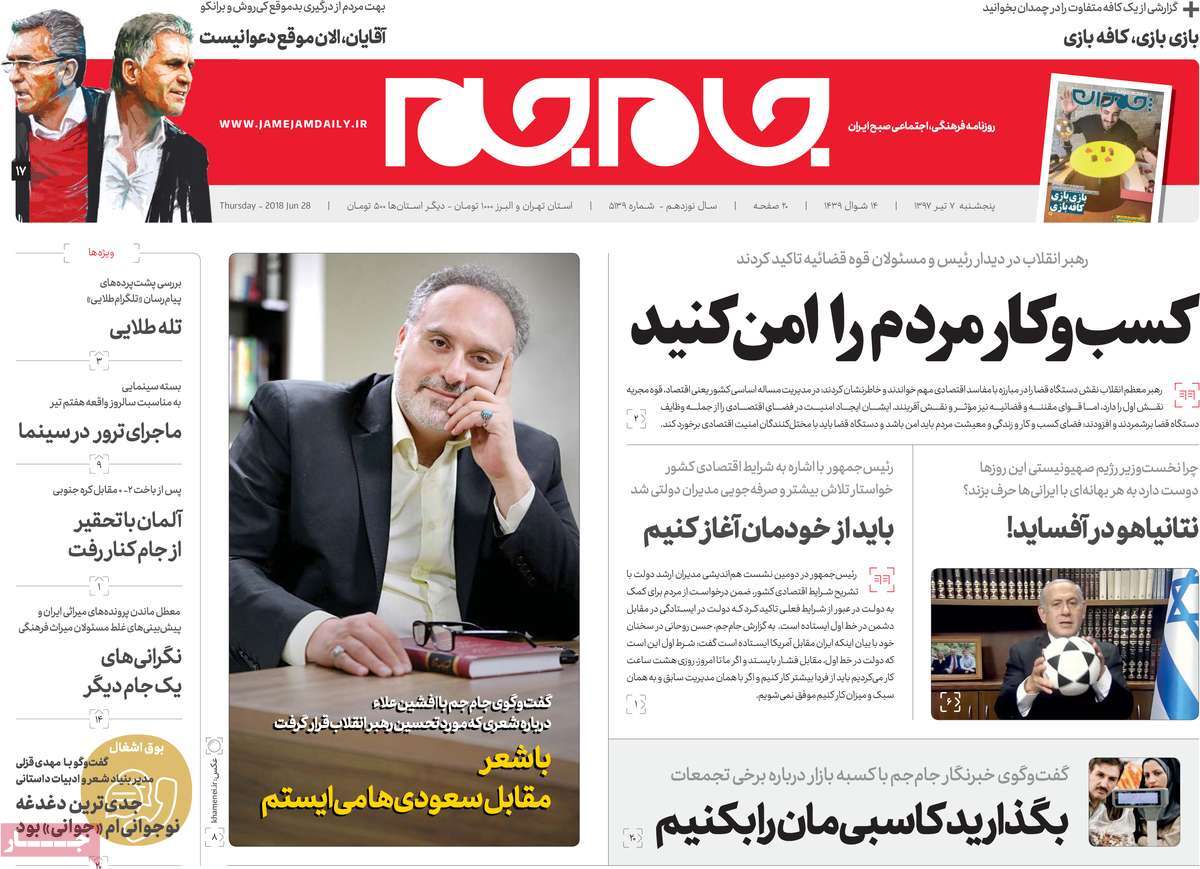
A Look at Iranian Newspaper Front Pages on June 28


Javan:

1- We’ll Bring US to Its Knees in War of Wills: Rouhani
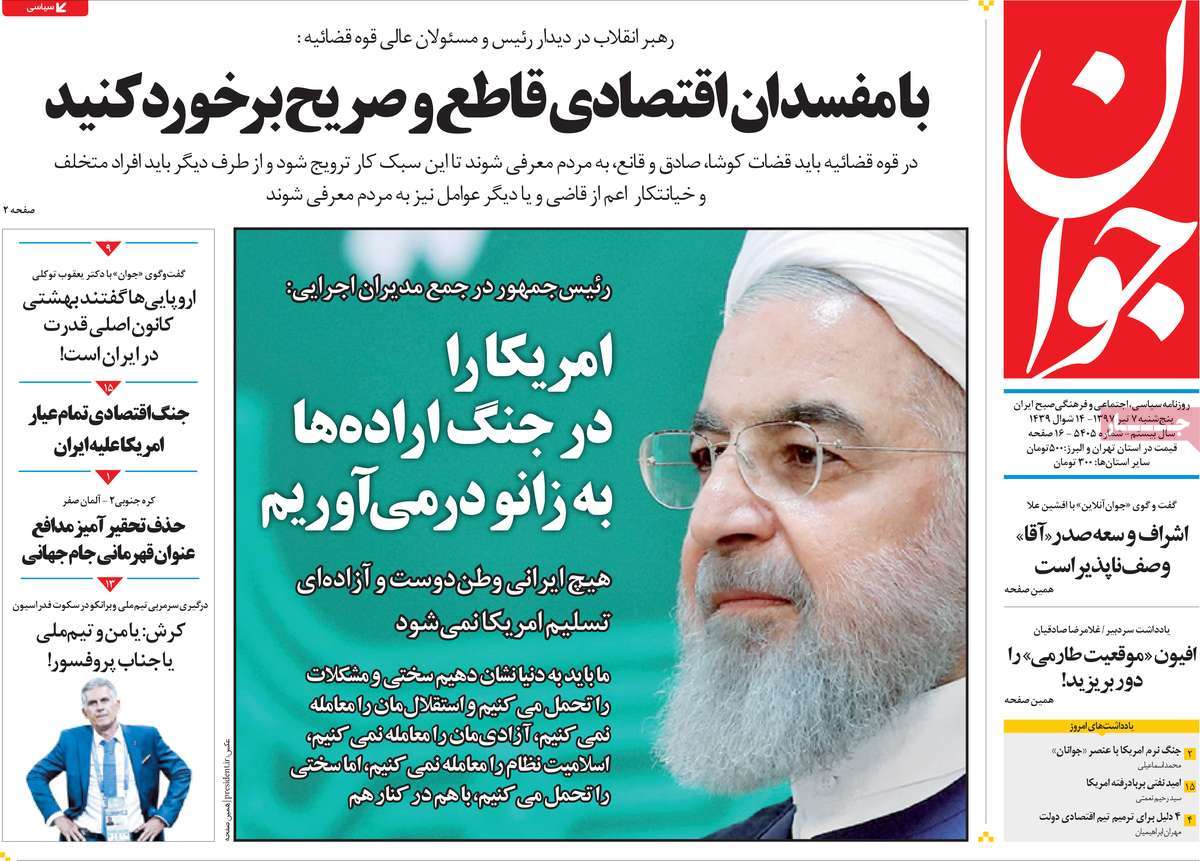
A Look at Iranian Newspaper Front Pages on June 28


Jomhouri Eslami:

1- Rouhani: We Maintain Our Historical Dignity and Defeat US
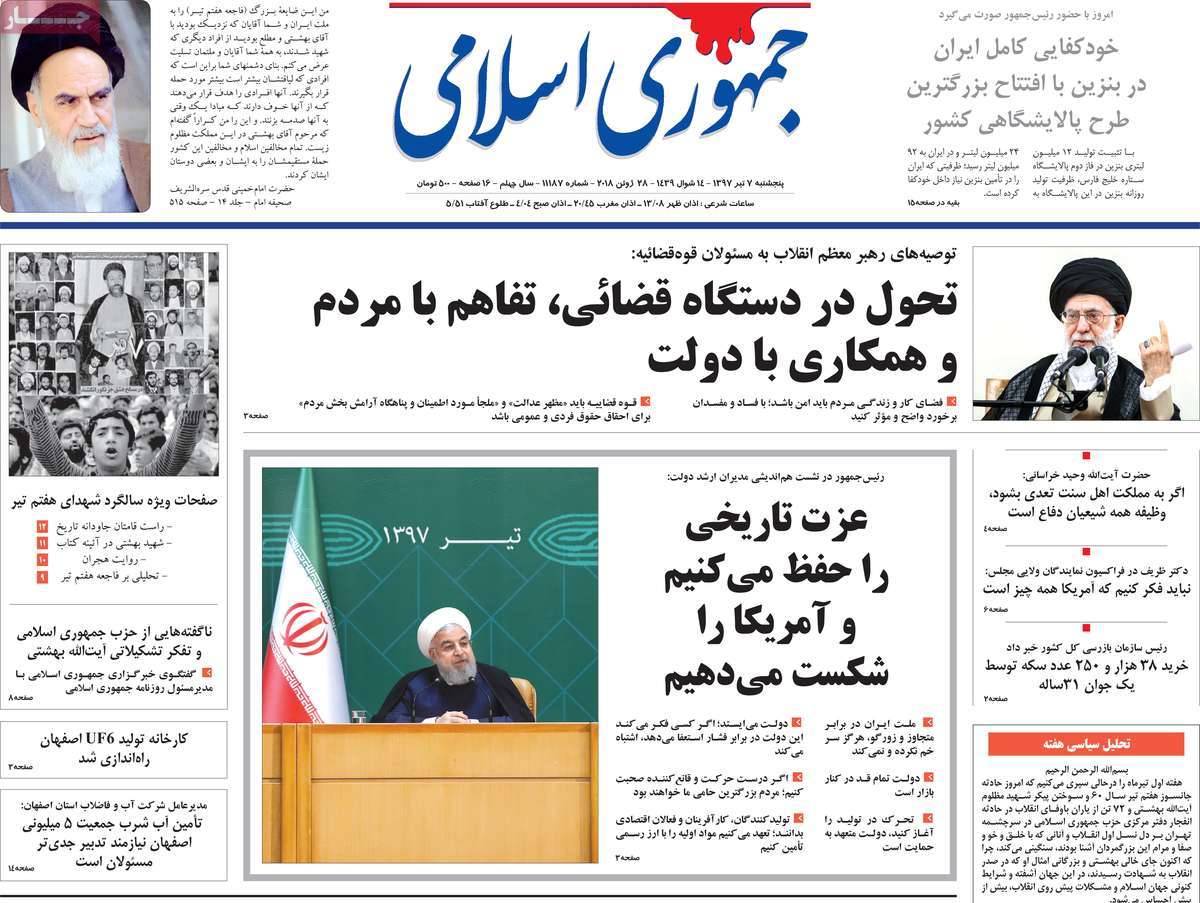
A Look at Iranian Newspaper Front Pages on June 28


Kayhan:

1- Tehran Bazaar Gives Crushing Response to Netanyahu
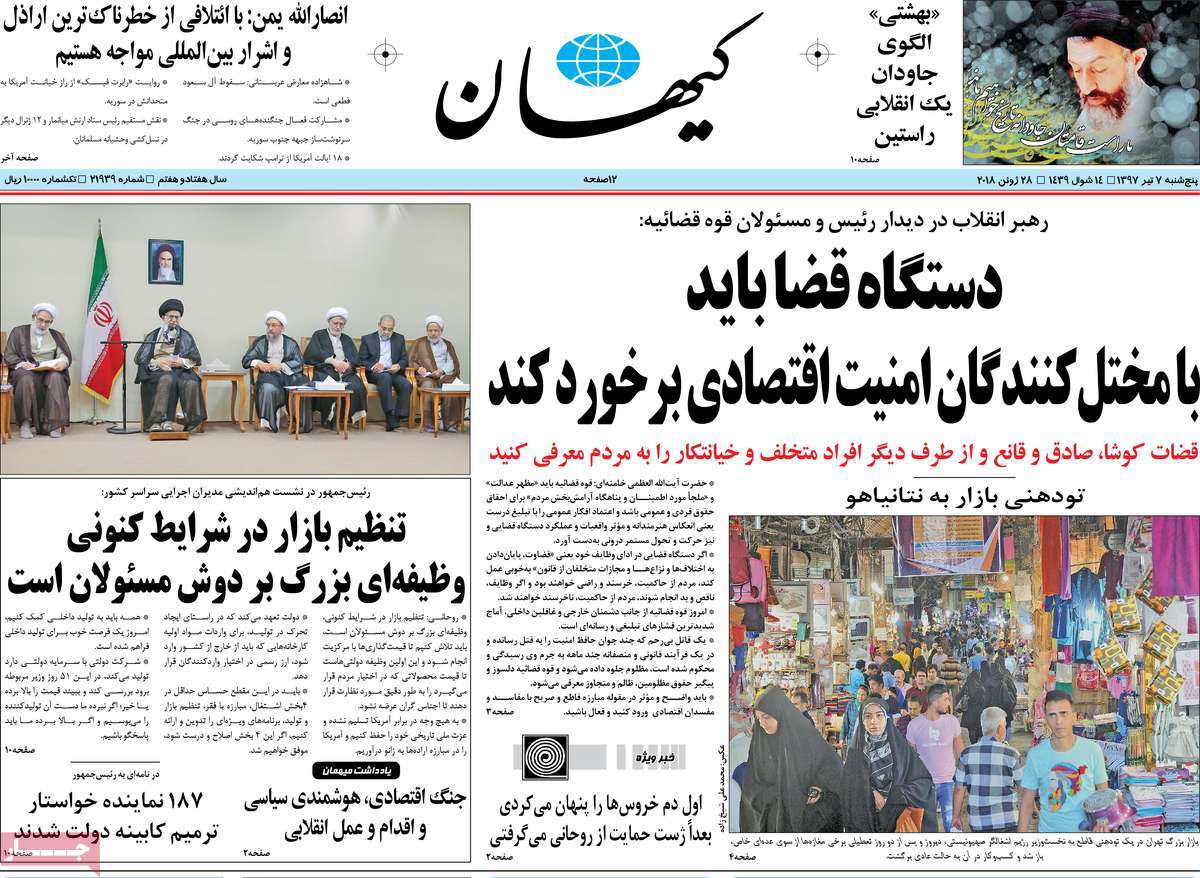
A Look at Iranian Newspaper Front Pages on June 28


Khorasan:

1- Rouhani’s Prescription for Overcoming Problems

  • Unity, Saving, Selling State-Owned Profitable Shares, Transparency, Efficiency

2- Iran’s Winning Cards against Oil Sanctions; Iran-Trump Oil Chess
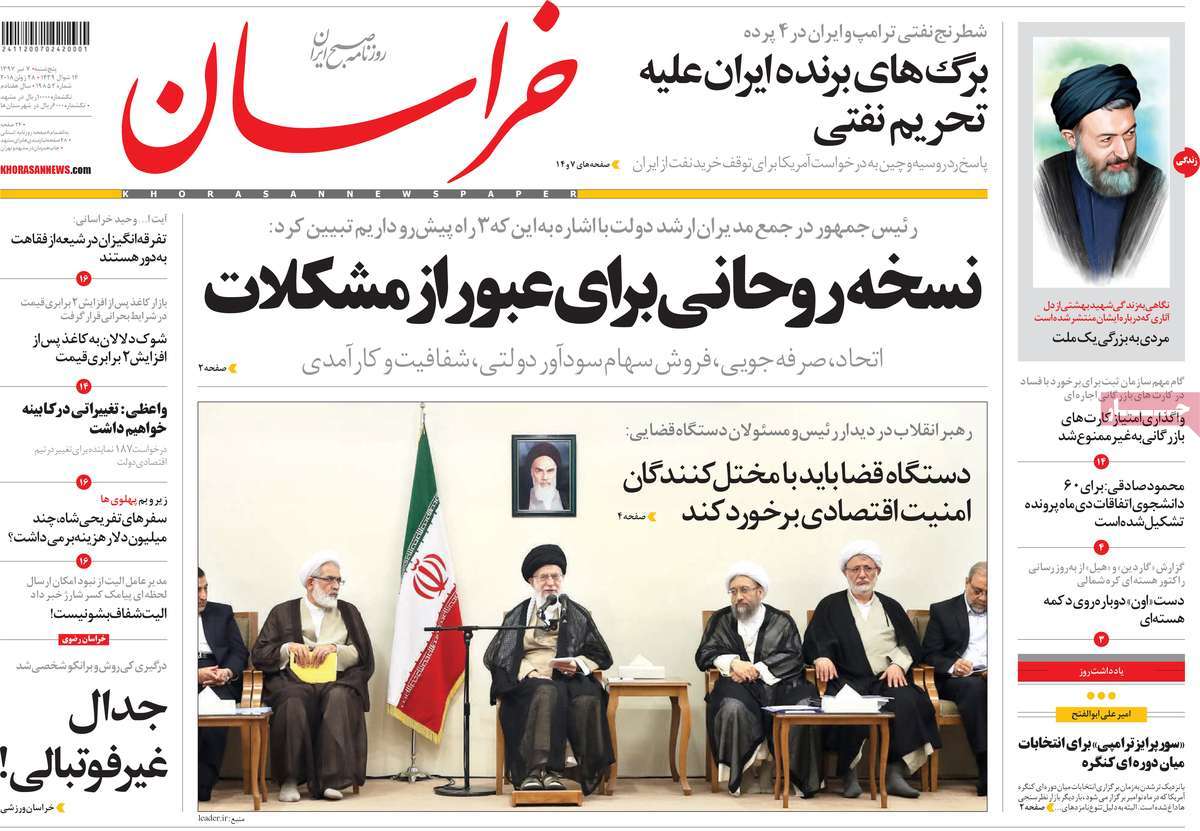
A Look at Iranian Newspaper Front Pages on June 28


Shargh:

1- Government under Parliament’s Pressure: 187 MPs Write to Rouhani

  • Change Your Economic Team

2- Government Won’t Resign, Won’t Give Up: Rouhani
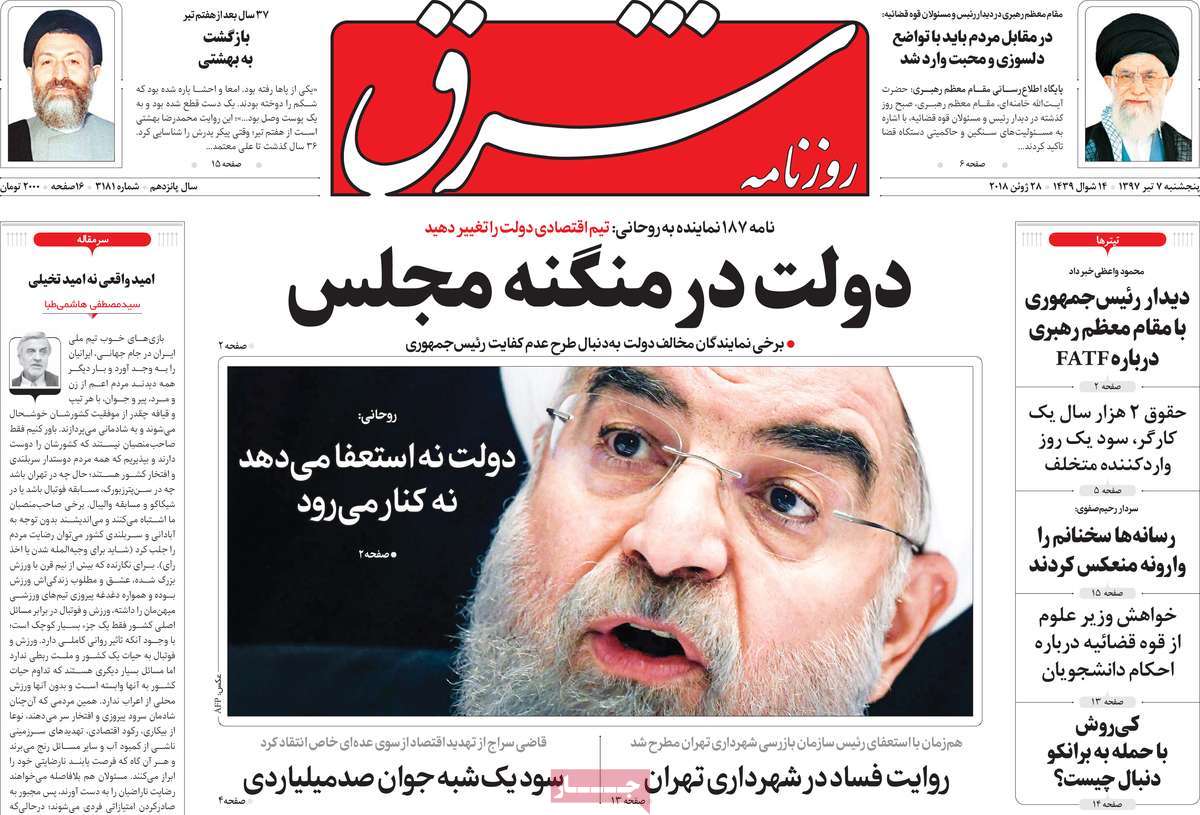
A Look at Iranian Newspaper Front Pages on June 28

Iran, Sweden Share Experiences in Gender Mainstreaming

During the Tuesday workshop held at Iran’s National Library, the Iranian and Swedish officials talked about ways to eliminate gender imbalance and inequality and promote women’s participation in the labour market.

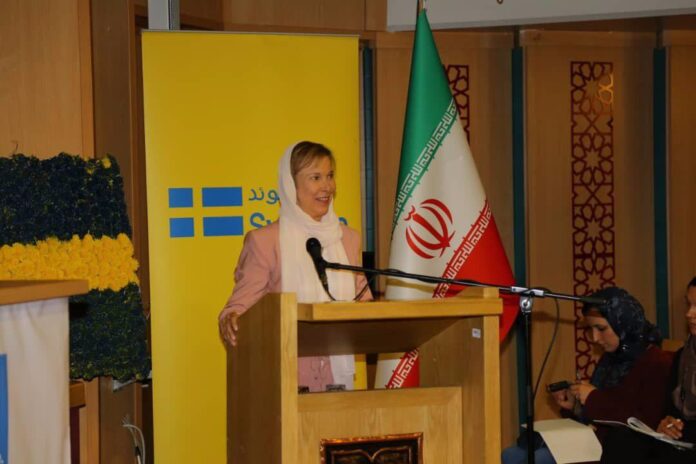
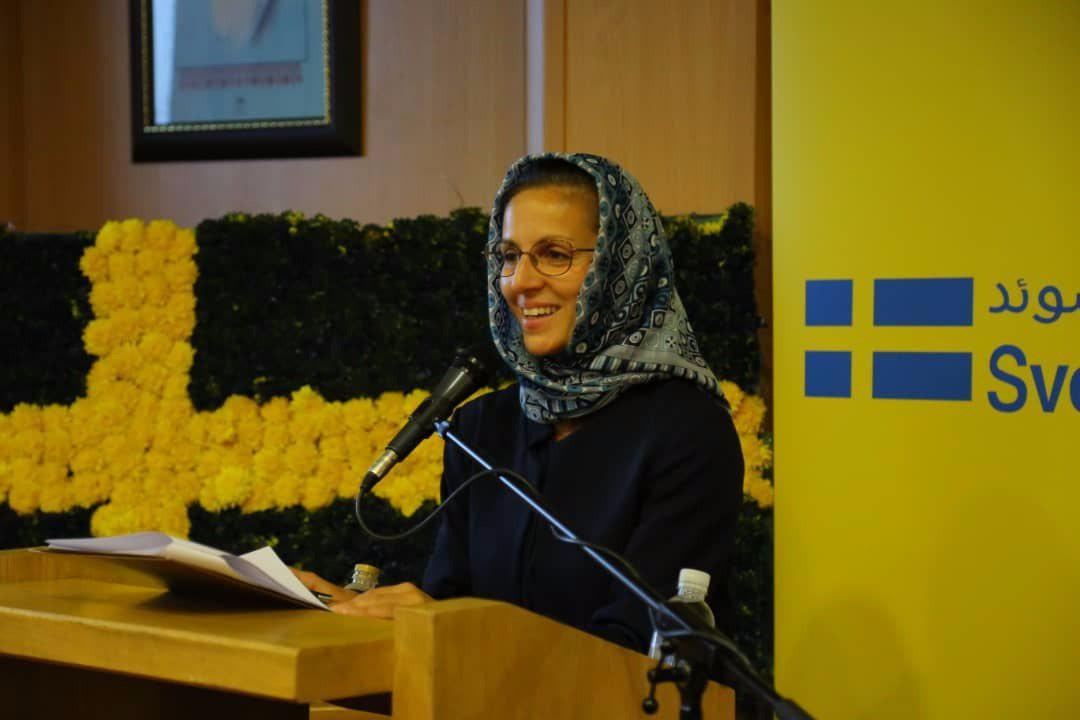
Addressing the gathering, Swedish Ambassador to Tehran Helena Sångeland referred to a Memorandum of Understanding (MoU) earlied signed between Iran and Sweden on women’s empowerment, and said her country is fully prepared to share its experiences with the Islamic Republic in this field.

Sångeland said Stockholm is committed to promoting women’s participation in the labour market and decision-making, and strongly believe that women must play a bigger role in the government and society at large.

She also expressed Sweden’s interest in share its experiences with Iran in the field of gender mainstreaming.

Promote women’s rights and facilitating their access to resources is the right and smart thing to do, the Swedish diplomat added.

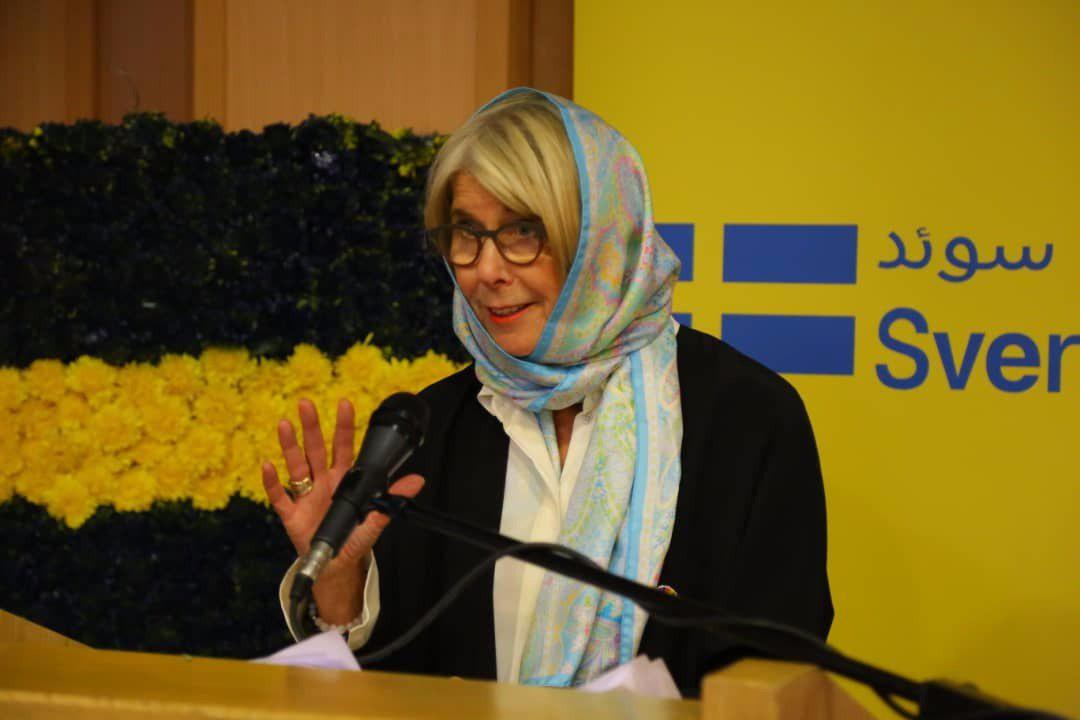
Director-General of the Swedish Institute Annika Rembe also told the gathering that the event is considered as one step further to implement the MoU earlier signed by the Swedish prime minister during his visit to Tehran.

She said Sweden’s main priority is to strengthen women throughout the world, but big challenges require further collaboration.

“This is an issue which poses challenge to all societies, including Iran, Sweden and others,” Rembe said, while highlighting the incredible potential existing in the Islamic Republic for empowerment of women.

In Sweden, women’s participation in the labour market was made possible thanks to its parental leave system, she noted.

Iran, Sweden Share Experiences in Gender MainstreamingRembe expressed the hope that her institute would be able to share its experiences in this regard with others. “Today I try to outline a broader perspective of Sweden’s gender equality.”
She also elaborated on the important reforms made by the Swedish government during the past decades to promote gender parity in the European state.

Rembe described reforms as a prerequisite to Sweden’s economic development, stressing that the Swedish society is based on inclusion and equality.

She said hopefully 43% of mayors and 40% of managers of public sector in Sweden are women.

However, she added, there are still areas in which Sweden needs to improve itself.

She expressed regret that only 16% of CEOs in private companies of Sweden are women, and emphasized that the figure needs to be improved.

26% of professors are women, and men enjoy more opportunities for funds and resources, she said, adding that these resources must be allocated gender-neutrally.

Iran, Sweden Share Experiences in Gender MainstreamingDuring the workshop, Katarina Fehir also took the podium to elaborate on the way the Swedish city of Malmo managed to implement gender mainstreaming policies and promote gender equality throughout the city.
Following the speeches delivered by the Swedish side, Zahra Shojaei, a former advisor to the Iranian president on women affairs, and Fatemeh Tondguyan, an advisor to the Iranian oil minister on women affairs, elaborated on Iran’s experiences in the field of promoting women’s rights after the 1979 Islamic Revolution.

The day-long International Workshop on Gender Mainstreaming was attended by several Iranian and Swedish officials, including Iranian Vice-President for Women and Family Affairs Massoumeh Ebtekar and President Hassan Rouhani’s Special Assistant for Citizens’ Rights Shahindokht Mowlaverdi.

Washtub; Ancient Musical Instrument Popular among Women in Northern Iran

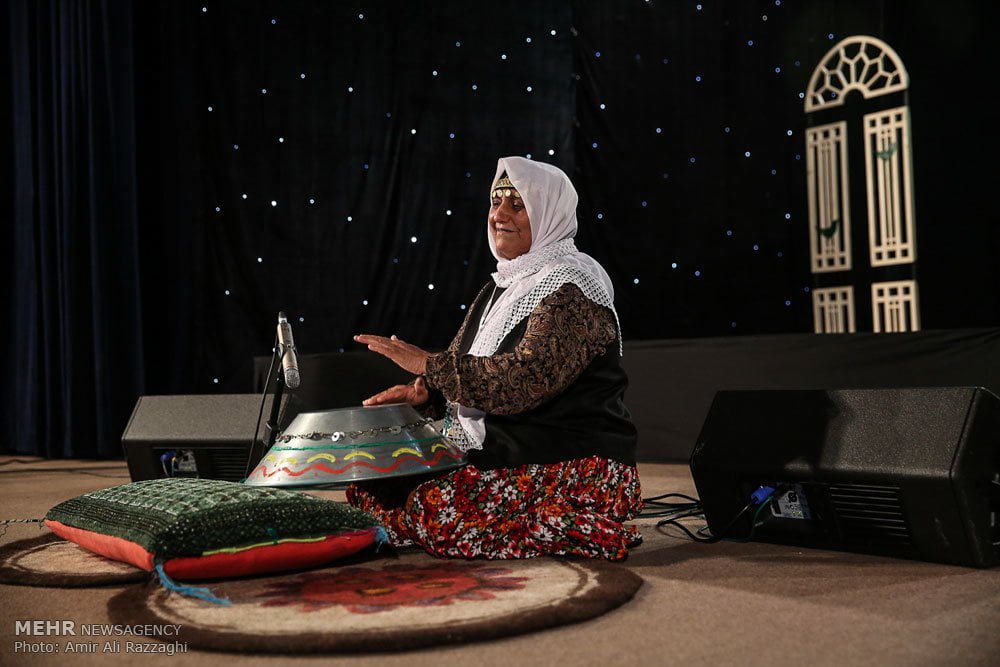
The ancient folk music of the indigenous people was made up of tools and accessories that people historically used to meet their needs. Using such stuff, they tried to express themselves and share their joy and grief.

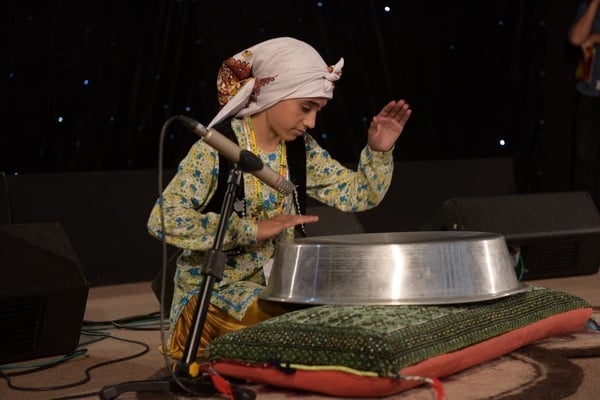
Washtub; Ancient Musical Instrument Popular among Women in Northern IranWashtub is among the most popular folklore musical instruments in Iran, particularly in northern provinces. When hitting on the washtub to make a sound, people used to give effects by placing a small bowl like a saucer on it.
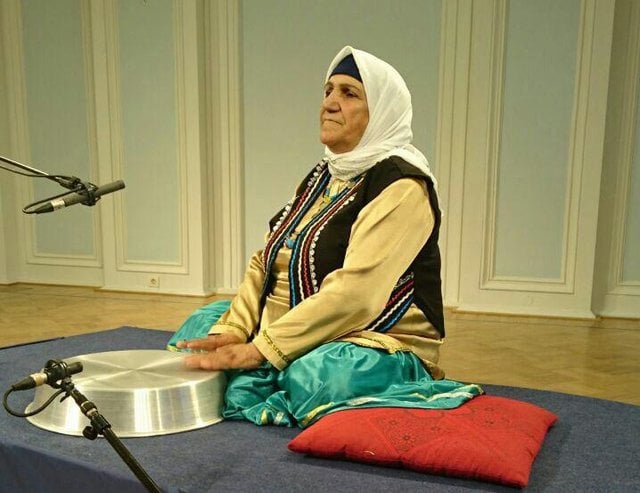
Ali Hassannejad, a researcher of folklore culture in Mazandaran, says washtub is one of the main means of native life in Mazandaran, which was also used as a musical instrument.

“The washtub is used as a device at various occasions as a percussion instrument, because the musicians must hit it with two hands.”

Washtub; Ancient Musical Instrument Popular among Women in Northern IranAccording to a report by Jamaran, the Third Festival of Folk Music of People Living Around Alborz Mountains will be held next month to provide an opportunity for the women of Mazandaran to play their washtubs.

The festival will be held from July 23 to 27 in Mazandaran province.

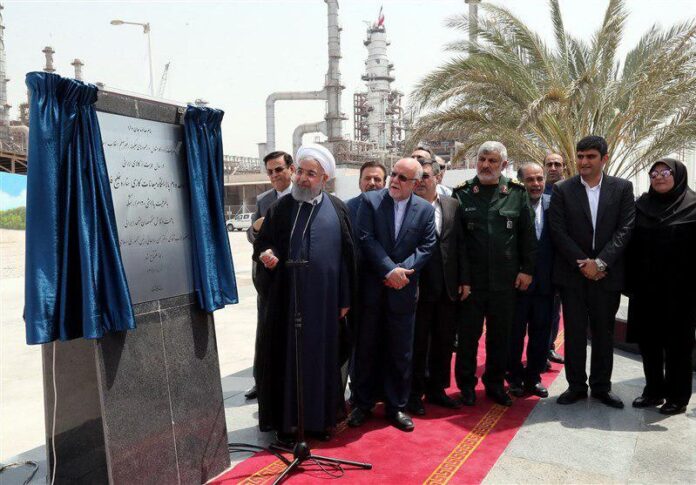
Iranian President Opens 2nd Phase of Persian Gulf Star Refinery

Once the new phase of the huge refinery starts its operation, the country’s daily production of Euro-V petroleum will increase from 12 million litres per day to 24 million.

Speaking upon his arrival in the province, Rouhani hailed the refinery as a “unique project in the region and the world”, Fars News Agency reported.

The refinery is expected to make Iran self-sufficient in the production of petroleum.

The first phase of the refinery was opened last year, when it started producing 12 million litres of Euro IV petroleum.

Iran currently produces almost 64 million litres of petroleum a day and imports 12 million liters to meet domestic demand.

The next two phases aim to raise total production of Euro IV and Euro V petroleum to 36 million litres a day, raising Iran’s total output to 100 million litres.

The construction of the refinery was started 11 years ago, but international sanctions imposed over Tehran’s nuclear work slowed down the project.

Iran Rejects Rumours of Exporting Water to Kuwait

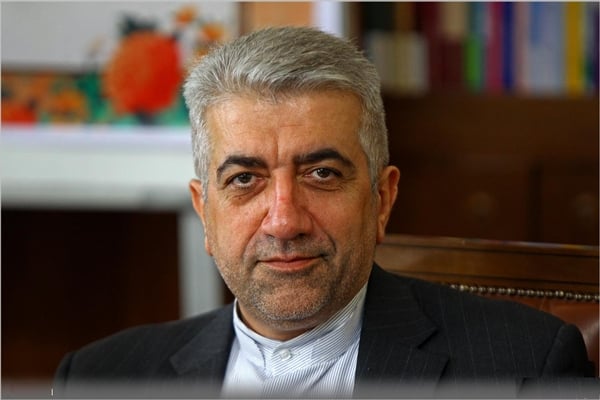
Reza Ardakanian underlined it was opportunists who spread the rumour that Tehran is going to transfer water to other countries including Kuwait.

“The [Iranian] Energy Ministry has no plans, decision or projects to transfer, sell and export even a single drop of this territory’s water to any country beyond the Iranian borders, and the issue of [Iran] transferring water to Kuwait was put forward in the early 1980s by those who benefitted from the implementation of a project to take the country’s water to Kuwait,” said the minister.

“At that time, the key opponent of the implementation of this project was the deputy energy minister for water affairs, who has now become Energy Minister, which is bad news for middlemen. With the authority that he has now, he will seriously prevent this from happening,” the minister noted, alluding to himself.

“These people will, every day, make new rumours in different areas related to water in order to secure their interests as they [falsely] claimed that the Ghadir water pipeline project was meant to transfer water abroad, provoking locals,” he said.

The minister’s remarks followed rumours that Iran was to export water to Kuwait. The rumour has been around for almost two decades now, and the rumour is denied every time it begins flying around.

This time, the rumour resurfaced when the people of Khuzestan province in southern Iran began complaining about the quality of the drinking water they used. Locals were dismayed at the bad quality of the tap water. Officials said the impurities were because of low water levels at the Karoon river, and promised to solve the problem in a matter of days. However, a wave of rumours hit social networking sites, suggesting that Iran is exporting water to Kuwait at a time when Khuzestan and Karoon are suffering from water shortage.

The rumour flying around by word of mouth over the phone and on social media says that “under a 30-year contract to transfer potable water from the Karoon river to Kuwait signed in 2003, Iran is obliged to export to Kuwait 900,000 cubic metres of water a day or 10,000 litres of water per second, which is one of the most important reasons behind low water levels and the low quality of water at Karoon river.”

This comes as water authorities have vehemently denied the rumour.

A senior water official at the Energy Ministry says talk of an agreement on the transfer of water to Kuwait came to the fore during one of the former Iranian administrations.

“As far as I know, the memorandum of understanding has never been implemented, and given that exporting water to neighbouring countries requires approval by Parliament, no such ratification exists at the moment,” said Hedayat Fahmi.

“If a person or organization has documents suggesting water has been transferred abroad, this is an illegal act and relevant authorities need to deal with the issue according to the law,” said Fahmi.

He said the Energy Ministry has no plans to transfer water to neighbouring countries.

“The Energy Ministry’s most important objective is to provide water for Iranian citizens, and will do whatever it takes to discharge this responsibility,” the official noted.

It is noteworthy that  an urgent project has got underway in Khuzestan province to construct a temporary embankment dam to provide potable water for residents until a project already underway to transfer drinking water is completed.

Based on reports, the quality of water in Khuzestan province has been deteriorating over the past two days, making it difficult for the people to quench their thirst in temperatures exceeding 50 degrees centigrade.

Iran Not to Succumb to US Pressures: President

rouhani

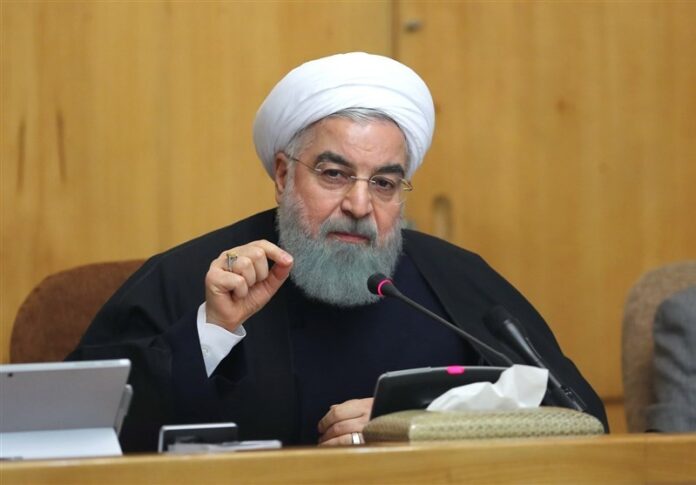
Rouhani made the comment in a meeting with executive managers from across the nation.

“We will not succumb to the US, will preserve our historical and national dignity, and will bring the US to its knees in this battle of wills,” said the president as quoted by Fars News Agency.

“The Iranian nation will be glorious as it always has been during history, and bullying powers will realize that they have chosen the wrong path,” he added.

President Rouhani then stressed the necessity of remaining united inside the country at this juncture.

“It is not possible to stand up to the US, and [at the same time] continue to have our internal differences. One would say the JCPOA was good, another one would say it was very bad, and another would say the JCPOA was nothing. …. Now it’s not the time for such words,” he noted.

He said internal divisions should be set aside as such rows will only affect the needy and low-income classes of the society, and the people will pay the heaviest price.

He said resistance against the US will be costly if internal divisions are not put aside.

“If we continue to stand against one another, our situation, our economy, our culture and our unity will become more unstable, our differences will grow and division within the nation will increase as well,” Rouhani said.

Iran Brings UF6 Production Plant Back into Operation

Iran Brings UF6 Production Plant Back into Operation

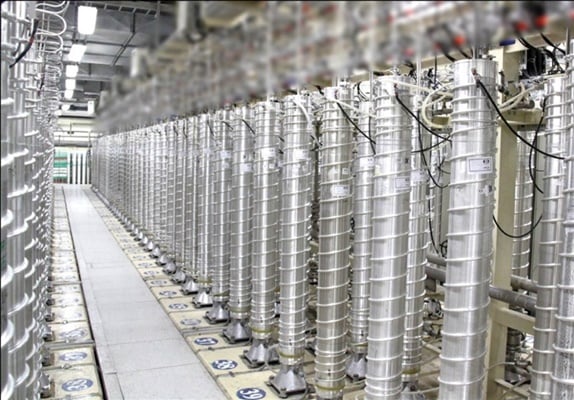
The plant is one of the important installations of the Uranium Conversion Facility (UFC) in central Isfahan province.

Moreover, the first barrel of yellow cake was unloaded at the plant’s feeding section for the first time in nine years.

The UF6 production plant at Isfahan’s UFC had remained out of service since 2009 due to a shortage of yellow cake in the country. After an agreement was signed between Tehran and six world powers on Iran’s nuclear program in 2015, a large amount of yellow cake was imported into the country and yellow cake production capacity increased in Iran, making it possible to put the plant into operation once again.

As officials at Isfahan’s UFC had already adopted the necessary measures and made the necessary predictions and kept different parts of the plant ready for operation, now they were able to make the necessary repair work and changes to put the plant into service again.

US Policy of Pressure, Sanctions to Increase Mutual Distrust: Iran

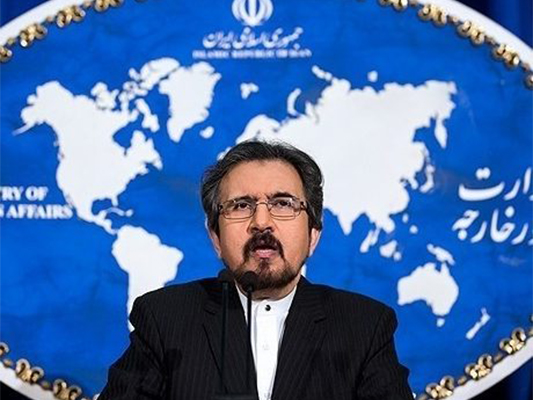
Qassemi made the comment in reaction to remarks by a senior American official regarding the termination of Iran’s oil sales.

“It seems like [US President Donald] Trump has forgotten that today’s world is not like what it was in the past thanks to technological advances as well as the presence of, and the role played by the world public opinion in political and international issues,” said the spokesman in an interview with the Islamic Republic News Agency (IRNA).

He further urged Washington not to continue its policies, saying, “The United States cannot and should not seek to press ahead with its failed and unilateral policies, which were also pursued by the country’s previous administrations and were always criticized during Trump’s election campaign speeches.”

“The US should accept that it has lost its previous status in the world,” Qassemi noted.

“The United States may cause problems for countries, but at the end of the day, the people of the world and countries will take their interests into consideration and regard the United States’ behaviour towards other countries as insulting and, finally, the world will not accept such behaviours in the future,” he said.

He said it is a medieval approach to impose the policies of an individual and a country on other states.

“Today, no country has the right to impose its will and demands on others, and other countries will not accept such a policy. Trump’s policies will finally push the US towards spending tens of trillions of dollars internationally once again on actions that are basically against wisdom and the realities of the world and will fail after some time,” he noted.

“Unfortunately, it seems that the US has not yet been able to get to understand the undeniable realities of the Iranian people’s culture and civilisation and independence-seeking spirit, and uses methods which are a complete failure and wrong,” the spokesman said.

Qassemi also underscored that Iran can stand up to such pressure.

“Although by illegally withdrawing from the JCPOA and adopting unilateral policies, Trump seeks to make the Islamic Republic of Iran take emotional and unwise actions, Tehran continues to pursue its peace-seeking policies and fight terrorism despite these pressures and will continue to work towards establishing stability and security in the region,” he said.

Qassemi said he was confident that today’s integrated world cannot afford to see a country dictating what it wants to others.

“The policy of pressure and sanctions will be futile in the future as it has always been so, and will only further increase the height of the wall of mistrust and animosity in Iran and the region against the US,” he said.

“We hope the United States of America would behave in a balanced and wise atmosphere and without any extremism by some short-tempered officials of the US’ ruling elite whose policies have led to instability and insecurity in the region and across the world,” he said.

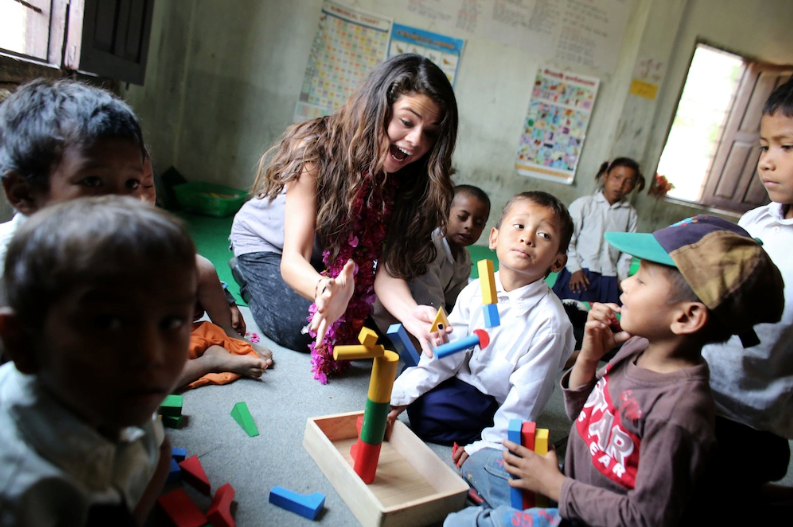
Has Selena Gomez Had Any Time for Going to School?

Most of you would probably agree that school days are the best. Especially when you get a little bit older and realize how much you loved to study together, waste time together and grow up together, just your “ordinary” life. However, everything is relative, and what is ordinary to one is extraordinary to another. What probably most of us hold for absolute truth is that Selena Gomez is living a great and extraordinary life of being the voice of the generation.

Just Do Your Best

Knowing that education is the most powerful tool to change the world, Selena Gomez finished high school after intense home-schooling and received a diploma in 2010, but without the official graduation, she is still missing not going to the prom. Nevertheless, at the age of seventeen, Selena Gomez became a young UNICEF goodwill ambassador and supporter to provide, among others, education to the children worldwide. With her great enthusiasm and commitment, she used her voice to draw attention to the vulnerable and to bring the necessary funds. Whether she has used an online essay writer or an academic assistant is still unknown. But it is quite clear how one could come in handy when your absolutely booked with work related events.

Has Selena Gomez Had Any Time for Going to School?Lack of Time

It could be rightfully said that Selena has a hard time with free time. It is no wonder for a solo artist that had six top-ten entries on the US Billboard Hot 100. Selena Gomez started as a child star and became a successful actress and accomplished singer. She has launched her clothing line for teenagers “Dream Out Loud”, as well as a self-titled fragrance. Being the most popular Instagram star with 137 million followers in 2018, Selena is active in regularly communicating with her fans and supporters. This is just to name a few things in a career of this dedicated worker. Does being the voice of generation leave you any time for school?

Maybe the more precise question would be exactly how to structure your day and go to school with such a busy schedule and career.

No Pressure

Starting her career at an early age, Selena Gomez was under the pressure to grow up just a little bit faster than her peers. A great talent and commitment have placed her at the centre of a public attention, and many unrealistic expectations started lurking from different sides. One of the expectations that can affect self-image is related to a perfect body. Even though trends in our society are slowly changing, and healthy diet and regular sport are becoming encouraged for the promotion of a healthy lifestyle itself, projecting of a perfect body image still remains. On the other hand, too much work and exhaustion leave detrimental consequences on the overall health. Selena had a period of personal struggles and managed to successfully recover and come back stronger and even more motivated. School of life is the most educational of all – having a friend to lean on, right information and self-confidence are enough to get prepared for what may come tomorrow. And from there the road is open to challenge the laws of chance.

On Education

In general, an implication of this article is that a proper formal education provided in schools definitely takes time and effort. School days are also the best ways because of the studying and growing up together, and the friendships that will remain. It is a more traditional setting used to acquire knowledge.  However, informal education is equally important – learning in a different setting, from the experience, and from the interactions while growing up and choosing a career path represents the school in itself. Either way, great expectations usually come hand in hand with great talent and commitment. Projecting of perfection in any form is potentially harmful to the overall health, and balance is the key to a successful living. It is sometimes good to know from the beginning what road you would like to take. Still, it is equally good to recognize opportunities along the way and embrace the challenge, take it as an adventure and make it count. Selena Gomez is living that great and extraordinary life of being the voice of a generation, taking a not that usual path of an international star. She explained that the idea of formal education is not abandoned, but is simply not the priority at this point in time. And she is balancing her priorities very well as far as we know.

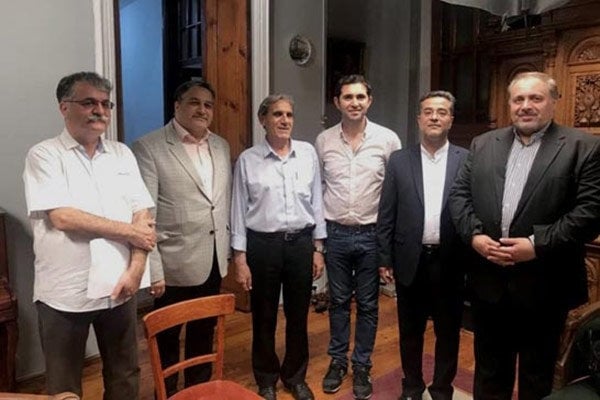
Joint Production of “High Voltage” to Boost Iran-Azerbaijan Cultural Ties

Tabesh, who has travelled to Baku along with Iranian Minister of Culture and Islamic Guidance Seyyed Abbas Salehi, visited the backstage of “High Voltage” feature film, which is being filmed in the historical city of Baku.

During the Tuesday visit, Tabesh referred to cinema as a bridge that can connect Iran to Azerbaijan, and said he is happy to see the “High Voltage” project has been kicked off.

“Today, with the beginning of the production of ‘High Voltage’ feature, relations between Iran and Azerbaijan entered a new chapter,” he added.

In turn, the film’s producer Amir-Shahab Razavian welcomed his guests and said, “This film will be shot in Baku and the Iranian Azeri-speaking cities of Meshkinshahr and Ardabil.”

“Our main goal is to make most of the film in Azeri-speaking cities, and then Tehran and other cities and towns of the country.”

“Considering the reasonable budget of the film, it is possible to return this amount and even make profit from it. In addition, we are aiming for the Turkish market, and have had talks with Turkish distributors.”