Friday, April 17, 2026
Home Blog Page 3500

Public Campaign Raising Awareness about Iran’s National Heroes

Public Campaign Raising Awareness about Iran’s National HeroesThe move comes to please martyrs’ mothers and safeguard the historic value of the martyrs’ section at Behestht-e-Zahra cemetery in southern Tehran.

Fatemeh Baqeri has written an article on this unique initiative. The full text of the article, published by the Mehr News Agency, follows.

Life never stops at martyrs’ section of the cemetery. The reason behind it is the affinity between sons and mothers, who come to visit their sons’ final resting places at the weekend.

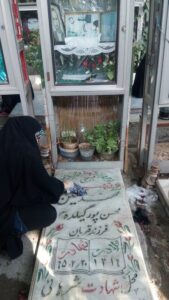
If you walk in the quite martyrs’ section of the cemetery, you may run into mothers who have wrapped their chadors around their waists and take their time to wash up and sweep the tombstones with shaky hands. When they are happy with how clean the gravestones are, they begin reciting verses from the holy Quran and keep waiting to entertain visitors to the martyrs with date and fruit.

But as the time passes by over the years, not everything remains as fresh and clean as mothers want. The tombstones tarnish and stain with the passage of time and go pale due to wind, rain, sunshine, etc., resulting in the inscriptions and lines on the gravestones wearing away.

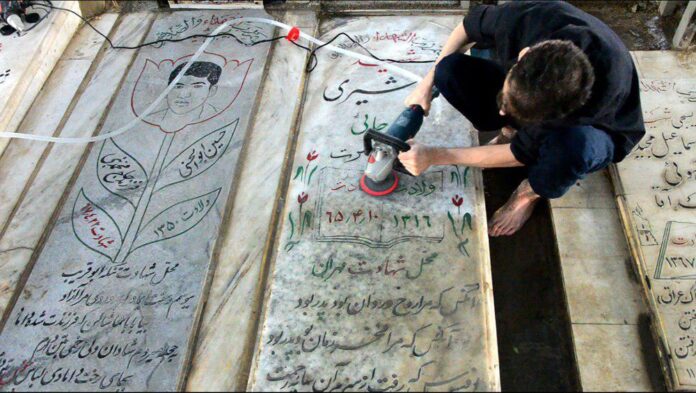
Now, a few young enthusiasts have launched the “For the Martyr” campaign on social media to restore the martyrs’ tombstones in cooperation with people.

They say they want to both make martyrs’ mothers happy and safeguard the country’s national heritage.

We talked to Mahdi Ayat, the manager of the group who, himself, is a researcher and documentarian. He said the many number of times that his friends have visited the cemetery over the past couple of years made them look at the martyrs’ section differently from those visiting the place once in a blue moon.
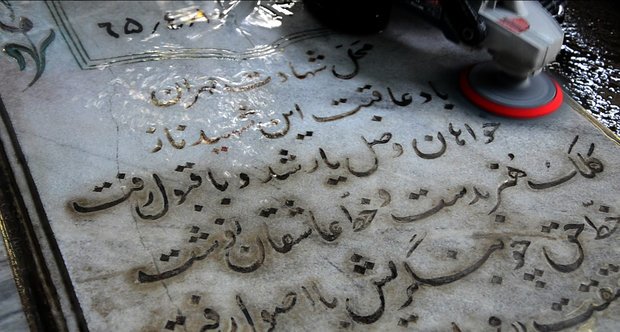
Public Campaign Raising Awareness about Iran’s National Heroes“Over this period, we saw a large number of the martyrs’ old tombstones had gone black. Moreover, we listened to the concerns of martyrs’ families. Maybe we don’t care about it that much, but the tarnish on the gravestones make a martyr’s mother sad and she tells herself what she’s supposed to do now. So, we decided to do something. My friends and I formed a group. One of them was a martyr’s child, one was a defender of holy shrines, another a war veteran and …,” said Ayat.

Members of the “For the Martyr” campaign seek to scrub the tombstones clean rather than having them replaced. Replacing martyrs’ gravestones is legally forbidden. Most of us are unaware of the law.

“By Replacing the tombstones, whether the Martyrs Foundation or even martyrs’ families are doing an illegal act,” said Ayat.

“On the strength of Article 564 of Book Five of the Islamic Penal Code (the section on deterrent punishment), anyone who repairs, destroys, restores or even expands whatever regarded as cultural heritage without permission from the Cultural Heritage Organization, he/she must not only compensate for the damage inflicted, but will be imprisoned for three months to two years,” he added.

“Apart from being located at a pilgrimage site, the martyrs’ section is four decades old and considered a popular arts museum of the country,” he said.

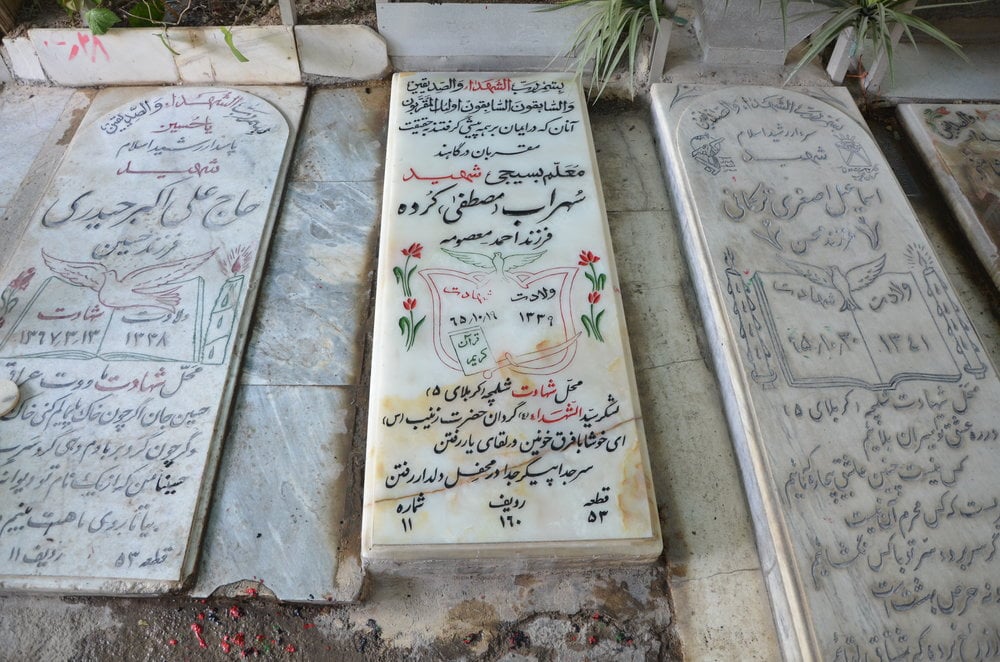
The fine and delicate designs together with the information on the tombstones also contribute to the historical value of the martyrs’ section.
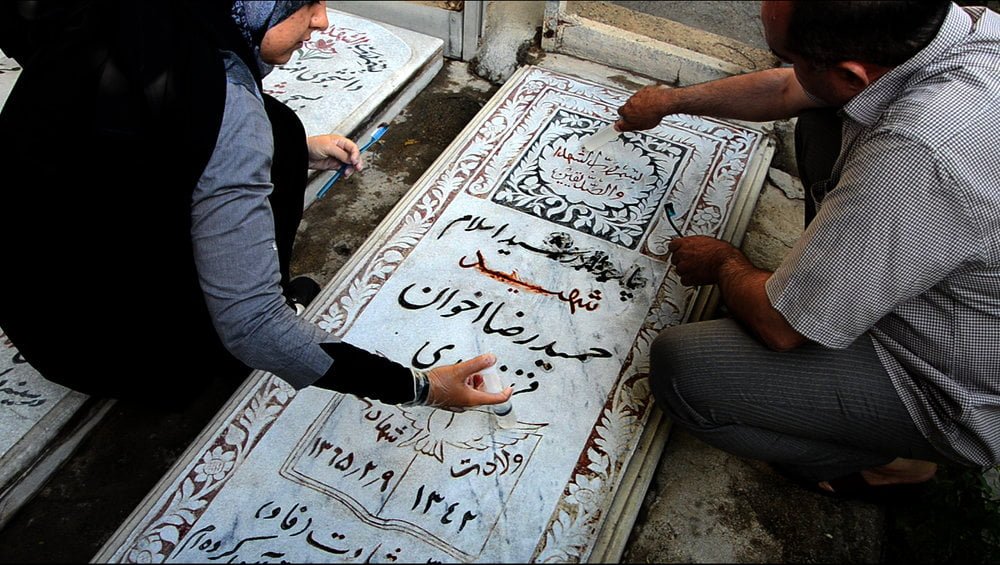
Public Campaign Raising Awareness about Iran’s National Heroes“Moreover, the martyrs’ section is like a document … There are a series of words and expressions on the tombstones whose omission will look as if part of history is omitted, things like bombardment of cities, chemical attacks, SAVAK (the intelligence service of the former Pahlavi regime of Iran), torture, movement, Imam, revolution, Saddam, enemy, hegemony and …,” he said.

They are to get together every Tuesday and Friday with the people who announce their readiness via cyberspace and do the scrubbing and painting on the gravestones. The procedures of their work are posted on social media.

“We have collected our money to pay for the equipment and have not received any budget from any institution. We deliberately refuse to get funding from other institutions because we want to tell people that we are responsible with regards to martyrs. There are 30,000 martyrs buried in Behesht-e-Zahra: 26,000 are known and 4,000 unknown. The parents of between 50 to 60 percent of those martyrs have passed away as well, and there are a considerable number of martyrs that have few or no visitors,” he said.

Ayat says they are just at the beginning of their work and have no idea how all martyrs’ mothers will react, but he says he has met one of those mothers and she was very pleased with all the work.
Public Campaign Raising Awareness about Iran’s National Heroes


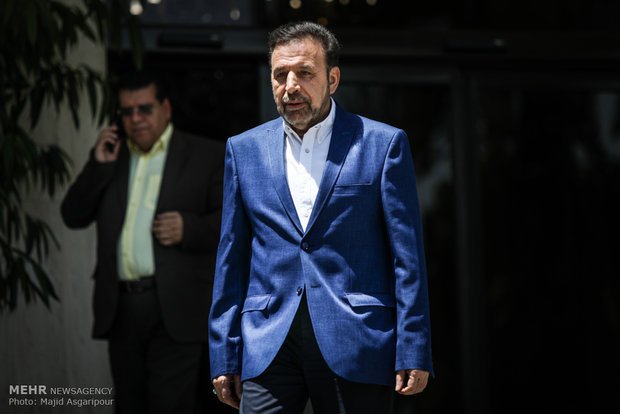
Rouhani’s Chief of Staff in Ashgabat for High-Level Talks

Vaezi arrived in Ashgabat on Wednesday at the head of a high-ranking political and economic delegation, and was welcomed by senior Turkmen officials and the Iranian ambassador to the central Asian country.

During his visit, Vaezi is accompanied by an entourage including officials from the Iranian ministries of Foreign Affairs, Oil, Economy, Roads and Urban Development, and Energy as well as the Central Bank of Iran (CBI), the official website of the Iranian government, dolat.ir, reported.

Vaezi is going to meet with Turkmen President Gurbanguly Berdimuhamedow, foreign minister and several other officials of the country on issues of mutual interest.

Iran, India, Afghanistan Agree to Boost Cooperation on Chabahar

Iran, India to Sign Preferential Trade Agreement Pact

The Tuesday meeting was chaired by Afghan Deputy Foreign Minister Hekmat Khalil Karzai and attended by Indian Foreign Secretary Vijay Gokhale and Iranian Deputy FM Abbas Araghchi.

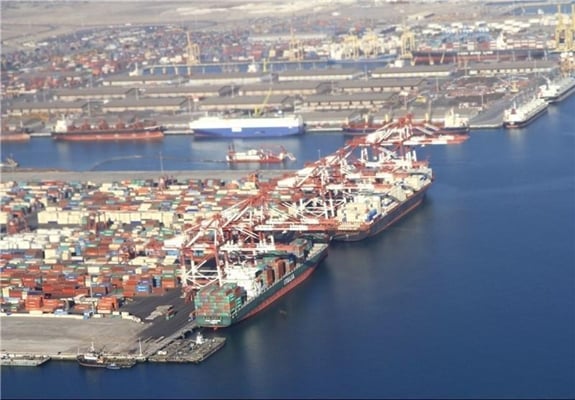
According to a statement released after the meeting, the trilateral talks focused on consolidating economic cooperation, particularly in the Iranian port city of Chabahar port.

Chabahar, a port city in Sistan and Baluchestan province in the south-eastern coasts of Iran, is easily accessible from India’s western coast, and is known as a promising rival for Pakistan’s Gwadar.

The port provides India with an easier land-sea route to Afghanistan. In November, the country sent its first cargo of wheat to Afghanistan through Chabahar.

A rail link between Chabahar and Zahedan and thereon to Afghanistan is a crucial part of India’s ambitious extra-regional connectivity plans over which Tehran, New Delhi and Kabul have signed a basic agreement.

In return for importing equipment and facilitating unloading and loading operations, Iran has handed over the right to operate the Chabahar port to India for a limited time.

Before the Kabul talks between Tehran and New Delhi, Iranian Minister of Roads and Urban Development Abbas Akhoundi paid an official visit to India to discuss the issue of Chabahar as well as India’s oil imports from Iran despite the US sanctions.

According to a report by the official website of the Iranian government, dolat.ir, Akhoundi held constructive talks with the Indian officials over those issues and a range of other topics, as a high-ranking US delegation was also visiting India to dissuade them from working with Tehran, particularly in the field of crude oil trade.

As a report by India’s Economic Times wrote, New Delhi’s talks with Akhoundi on the same day when Americans had arrived in the country were a clear indication of India’s resolve to boost its cooperation with Iran despite the US bans.

Tents Set Up across Iran to Mark Beginning of Muharram

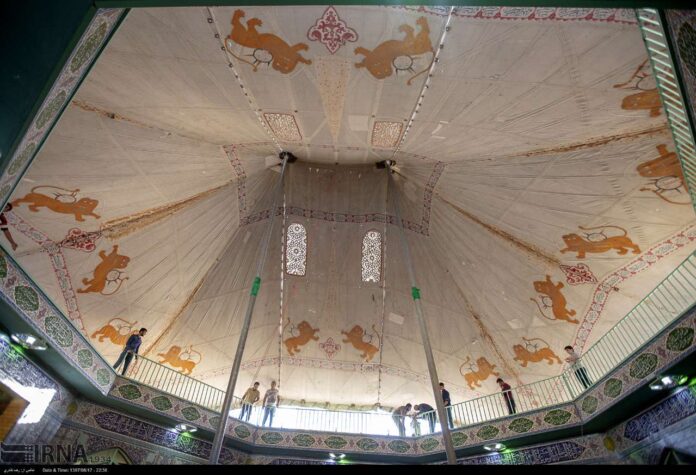
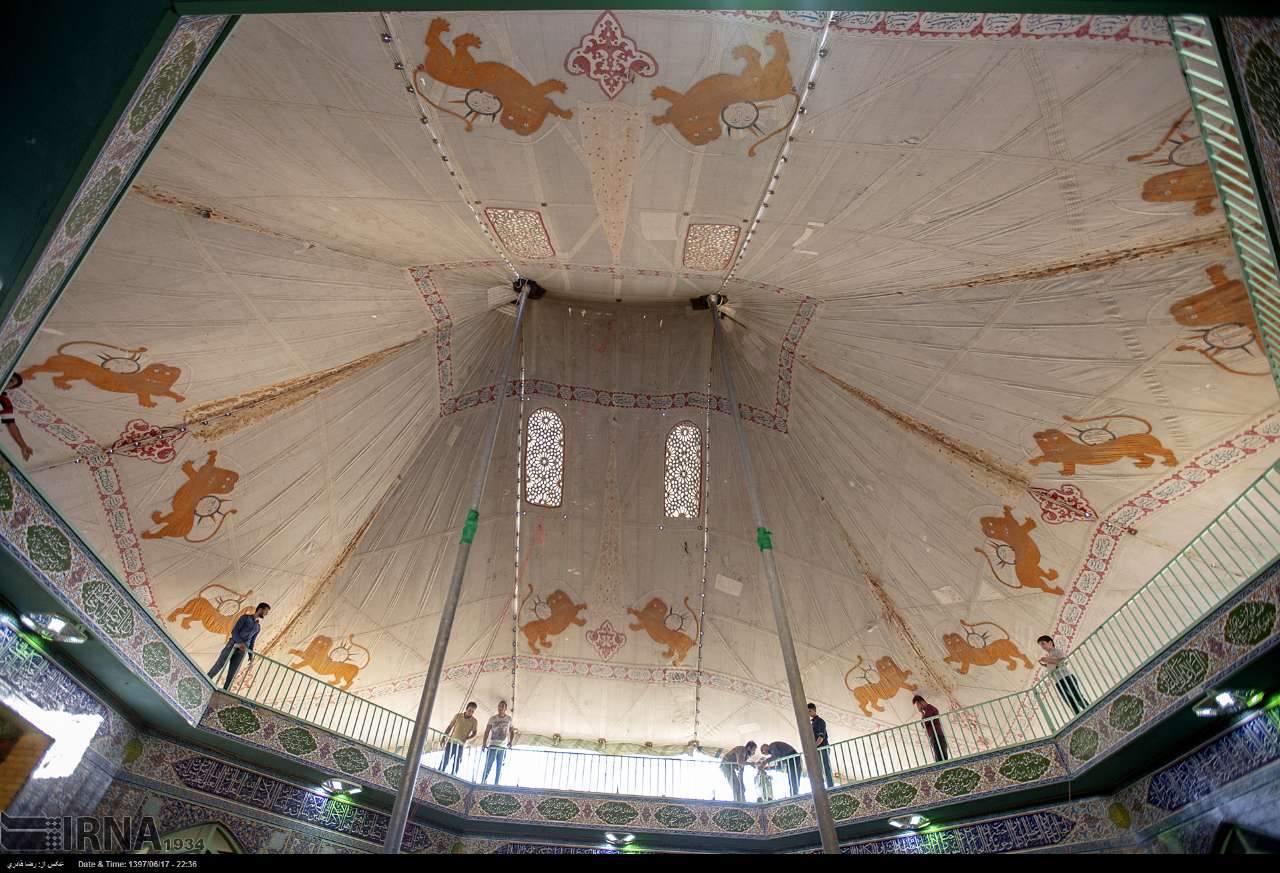
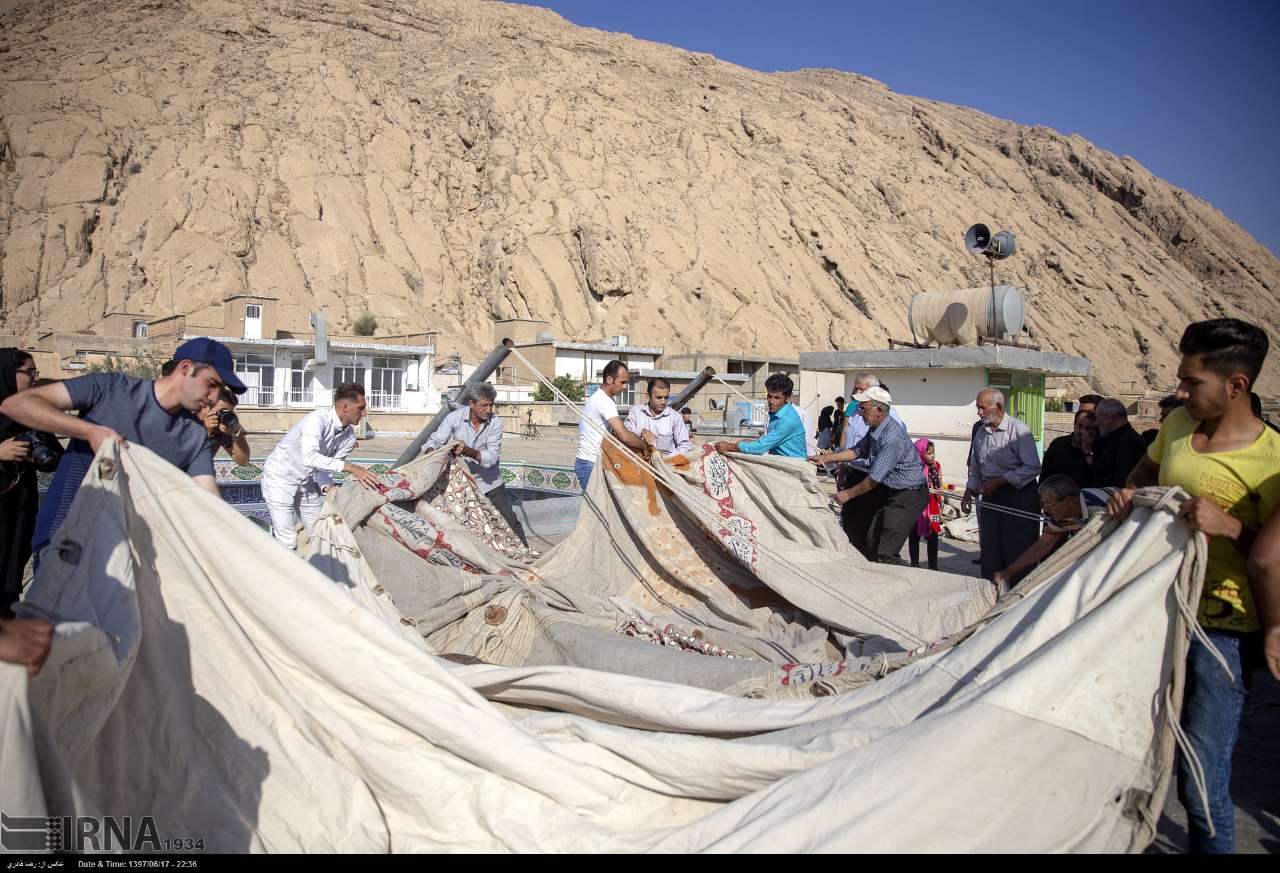
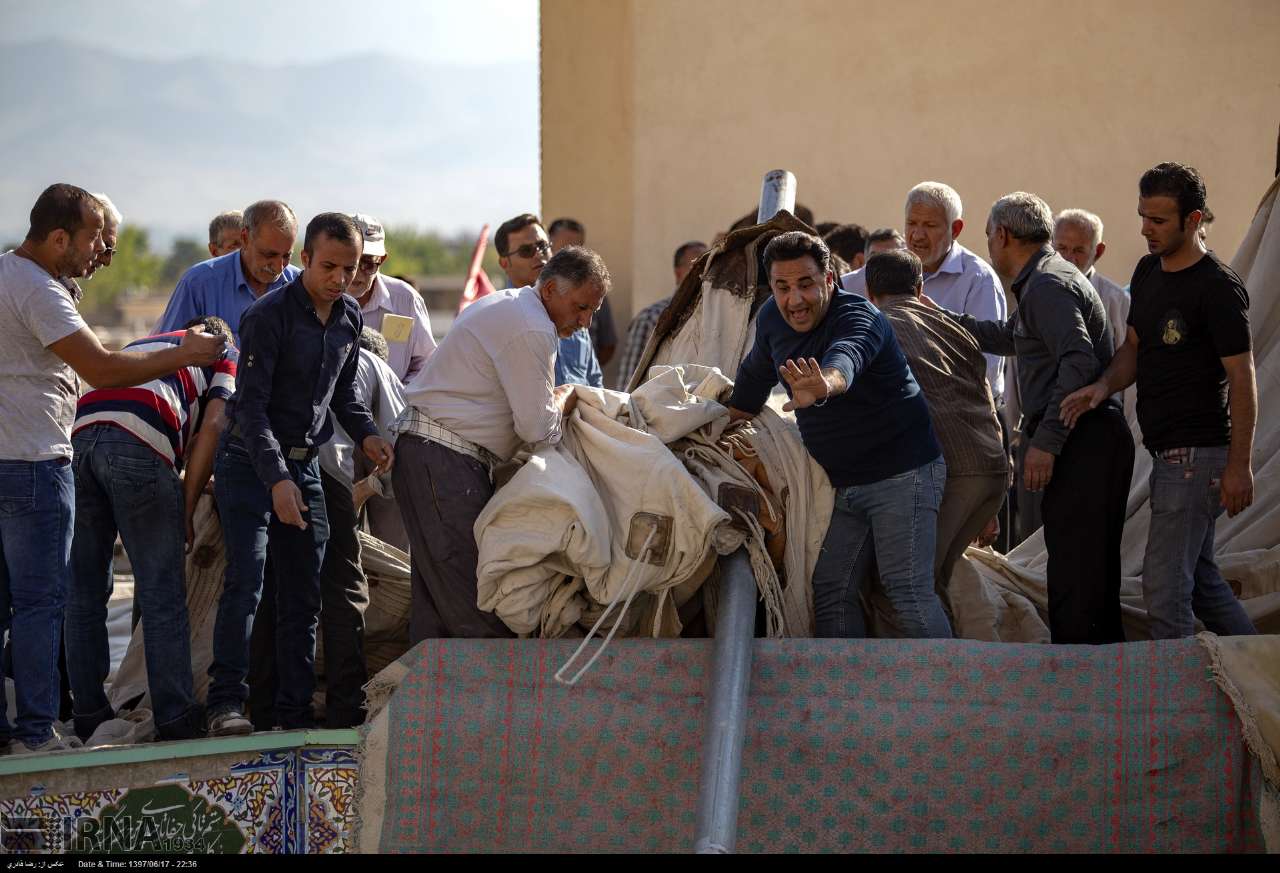
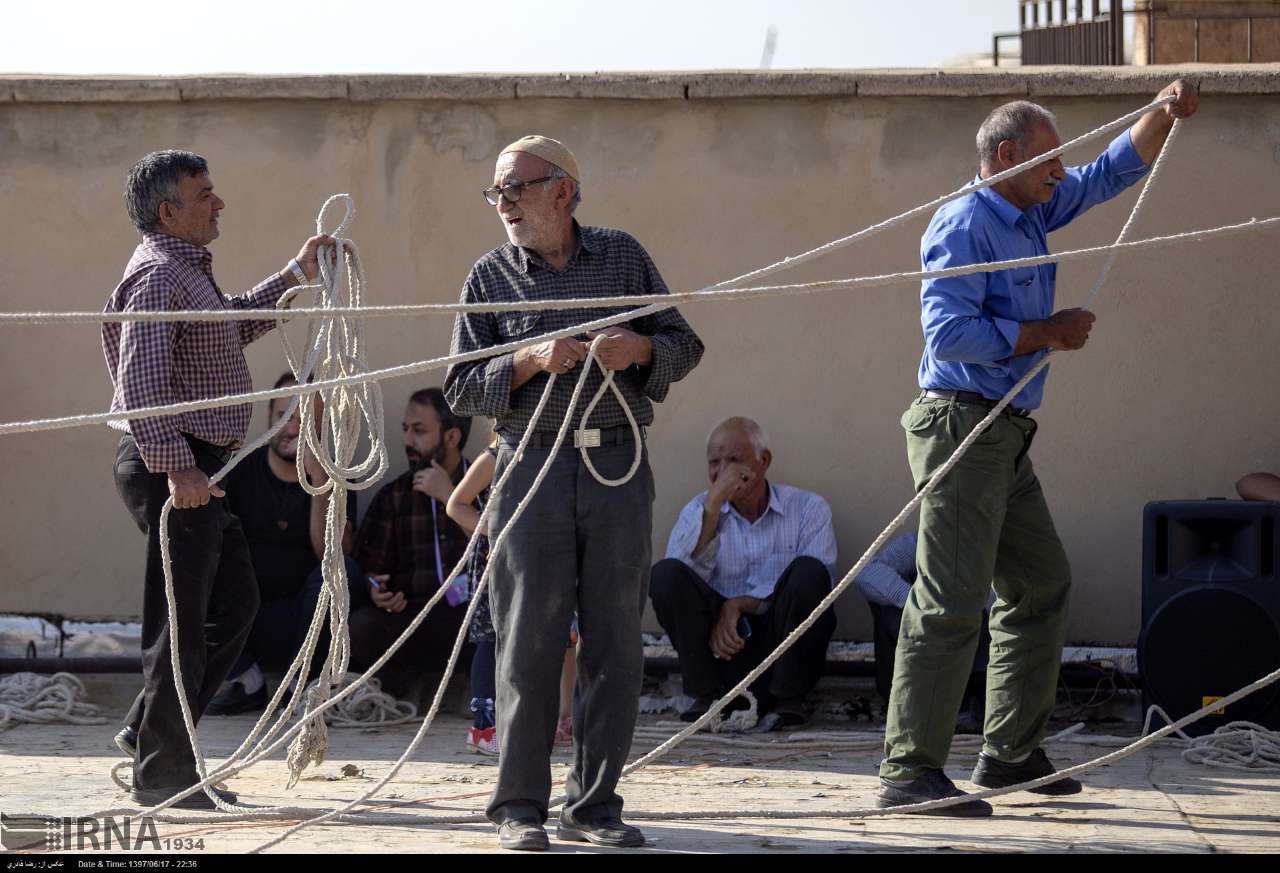
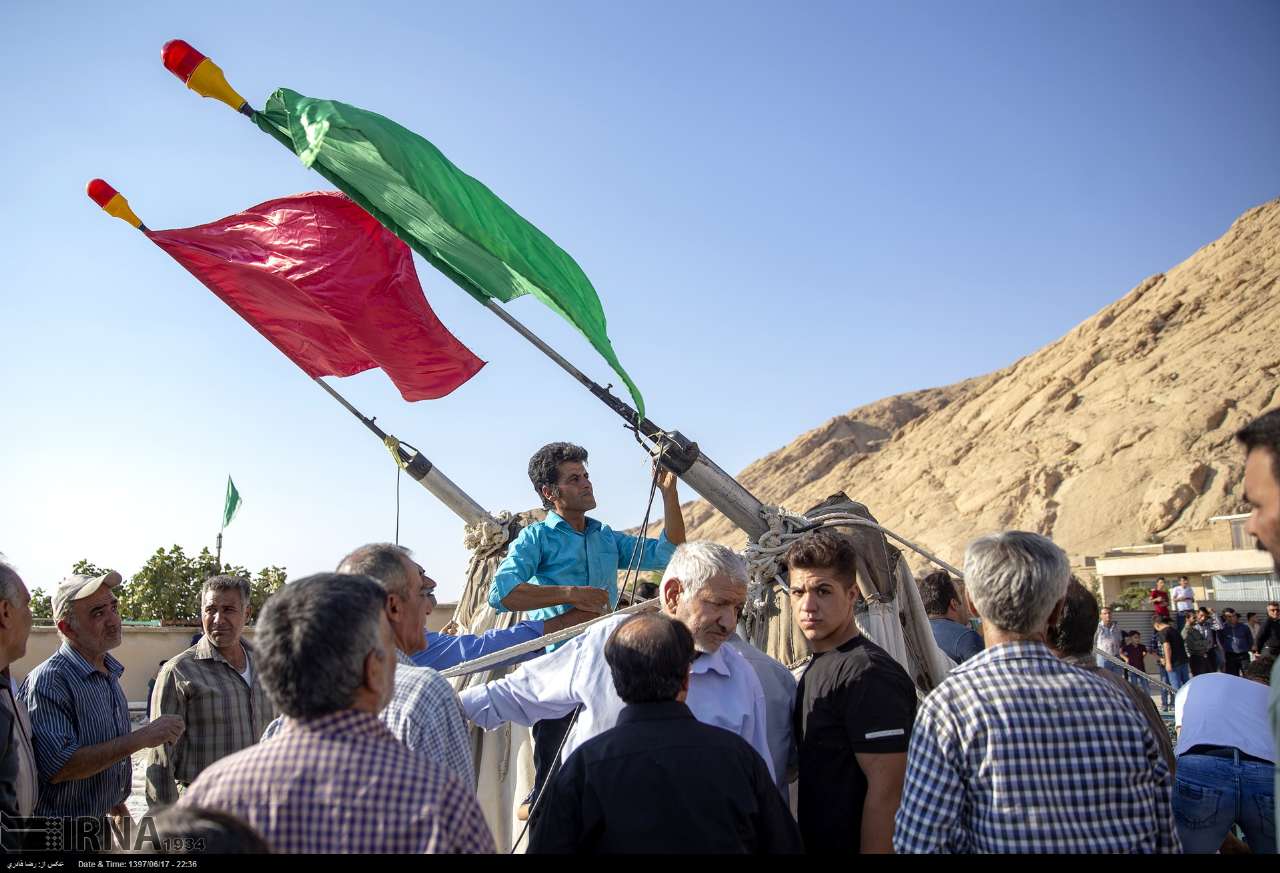
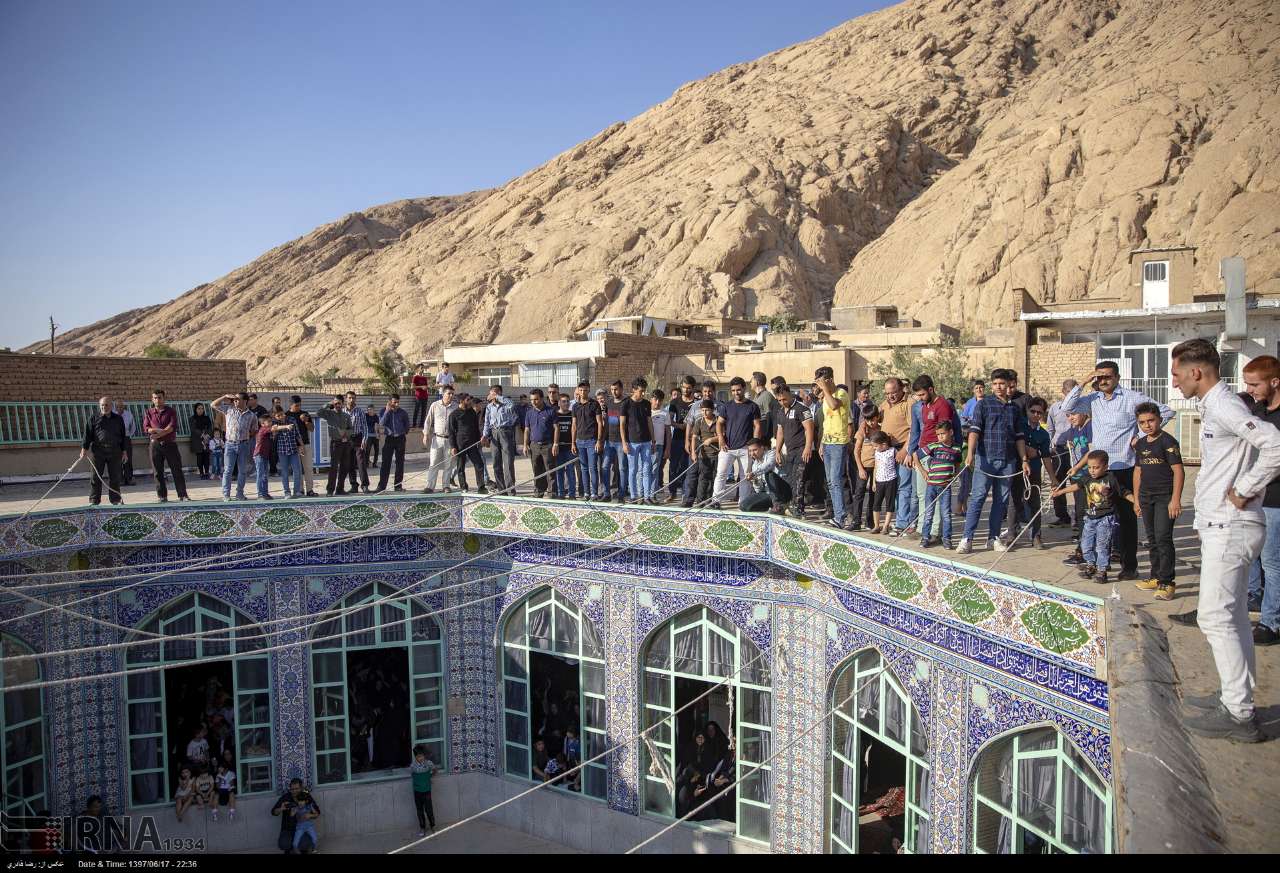
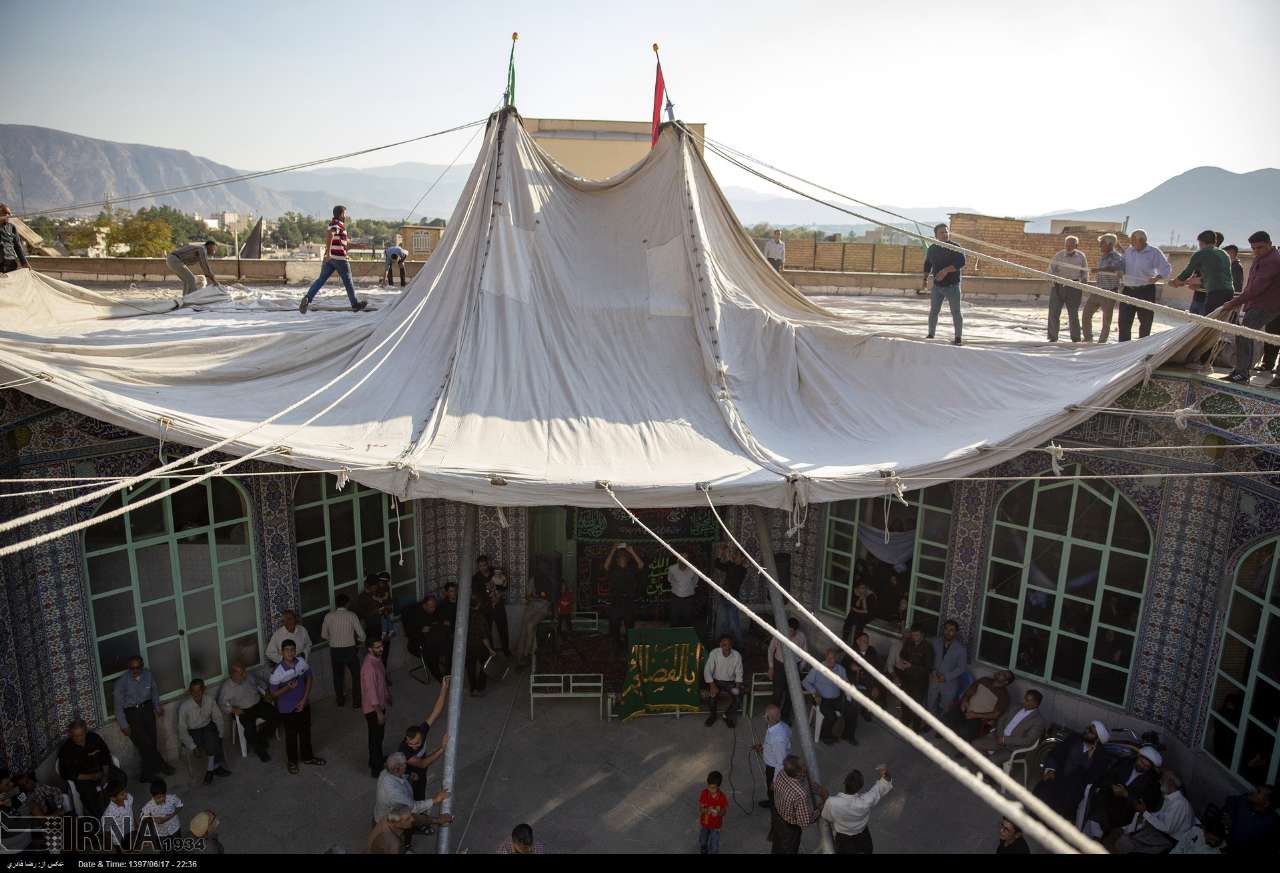
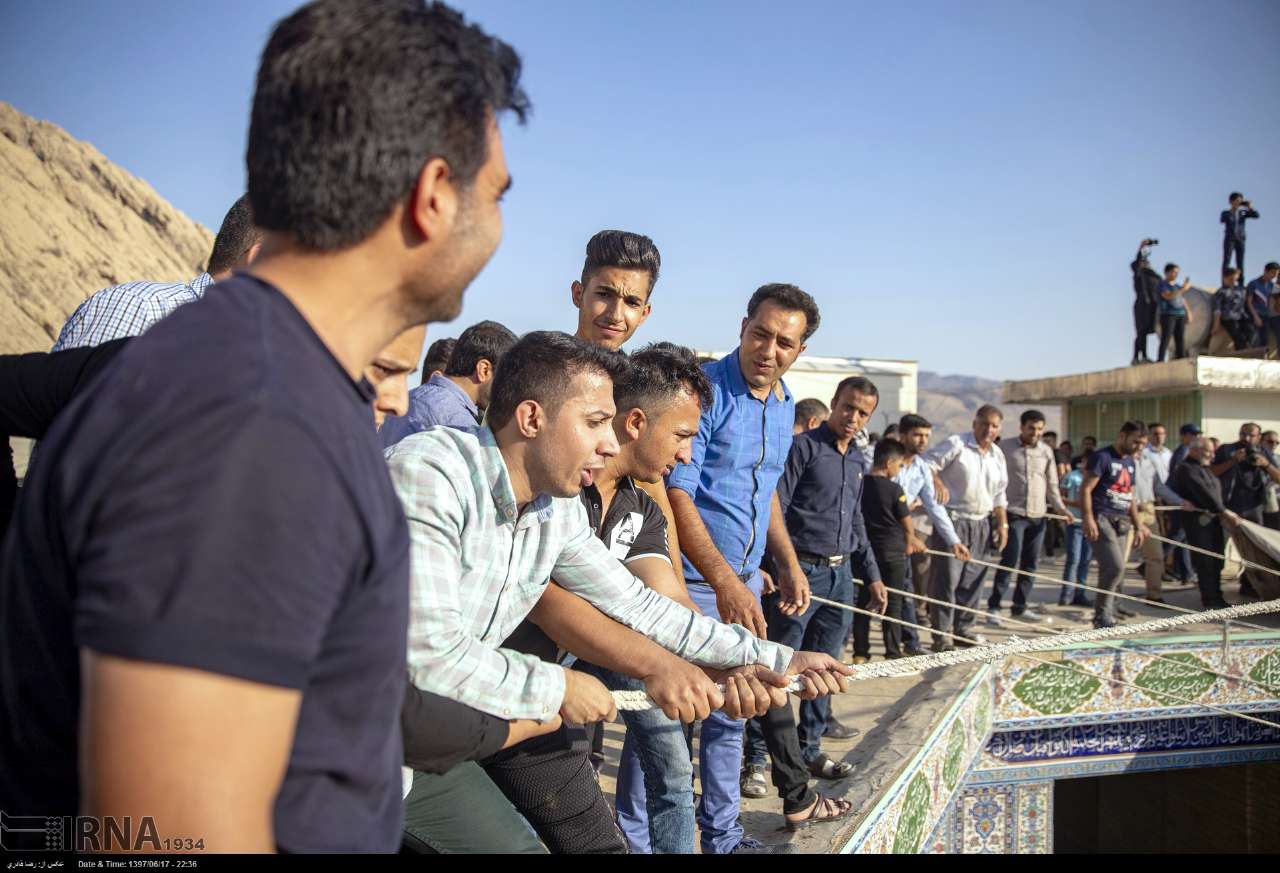
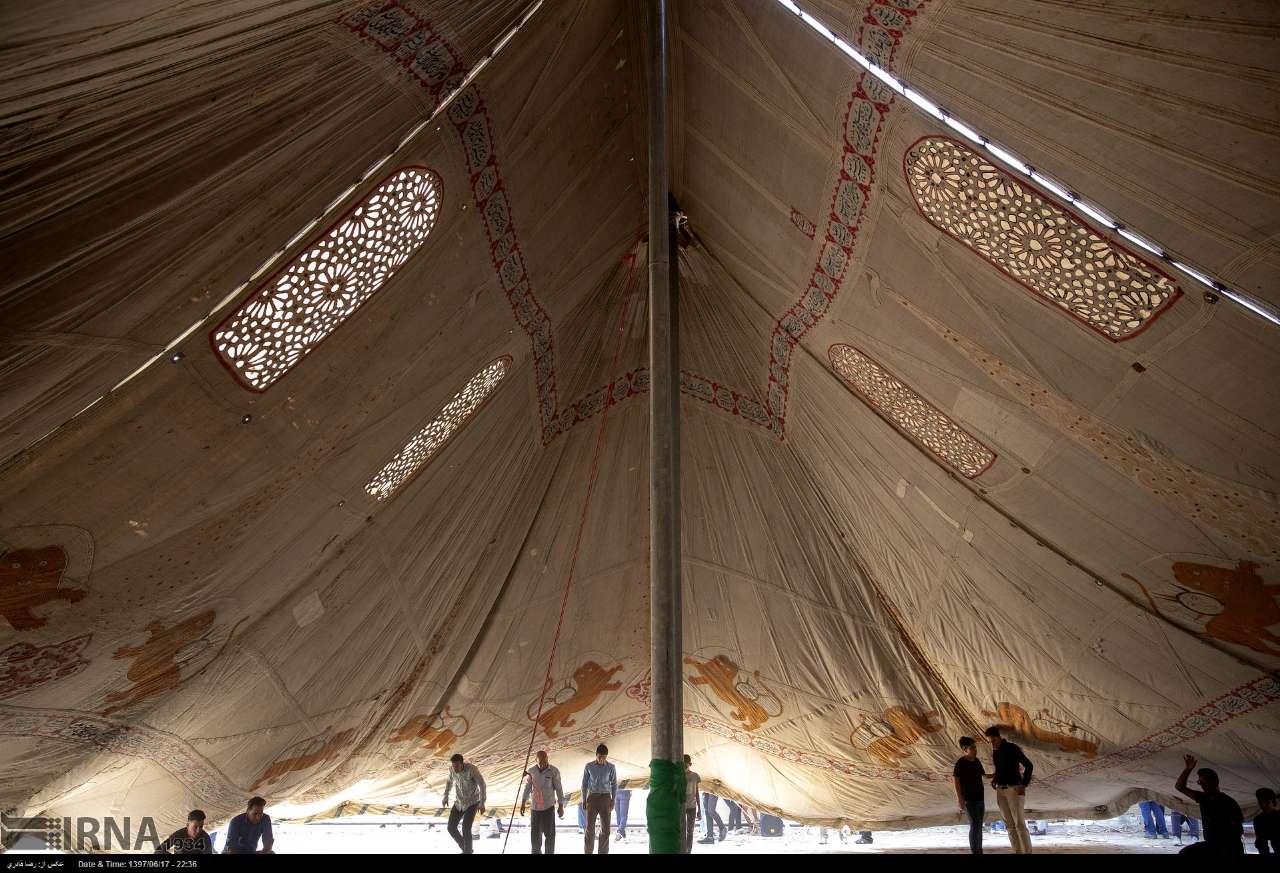
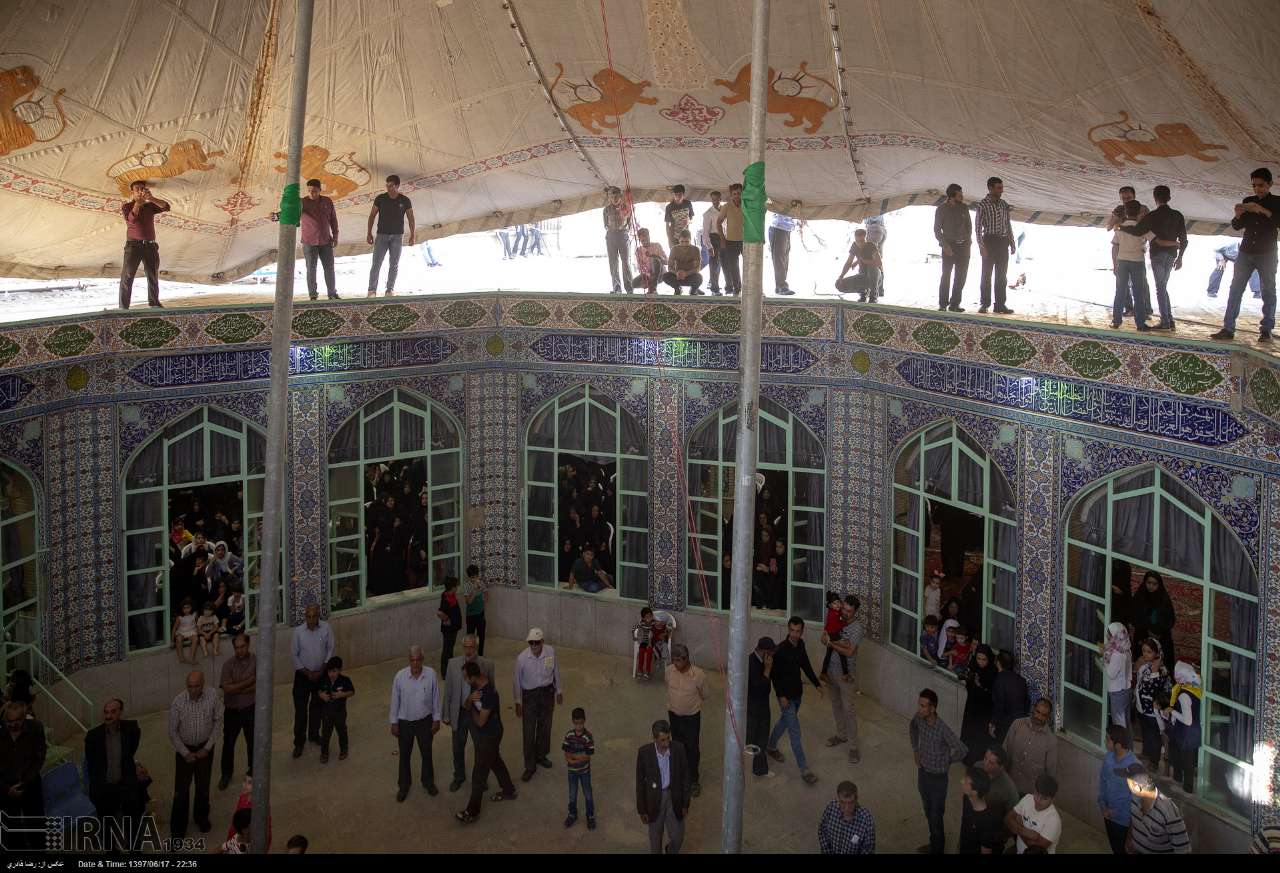
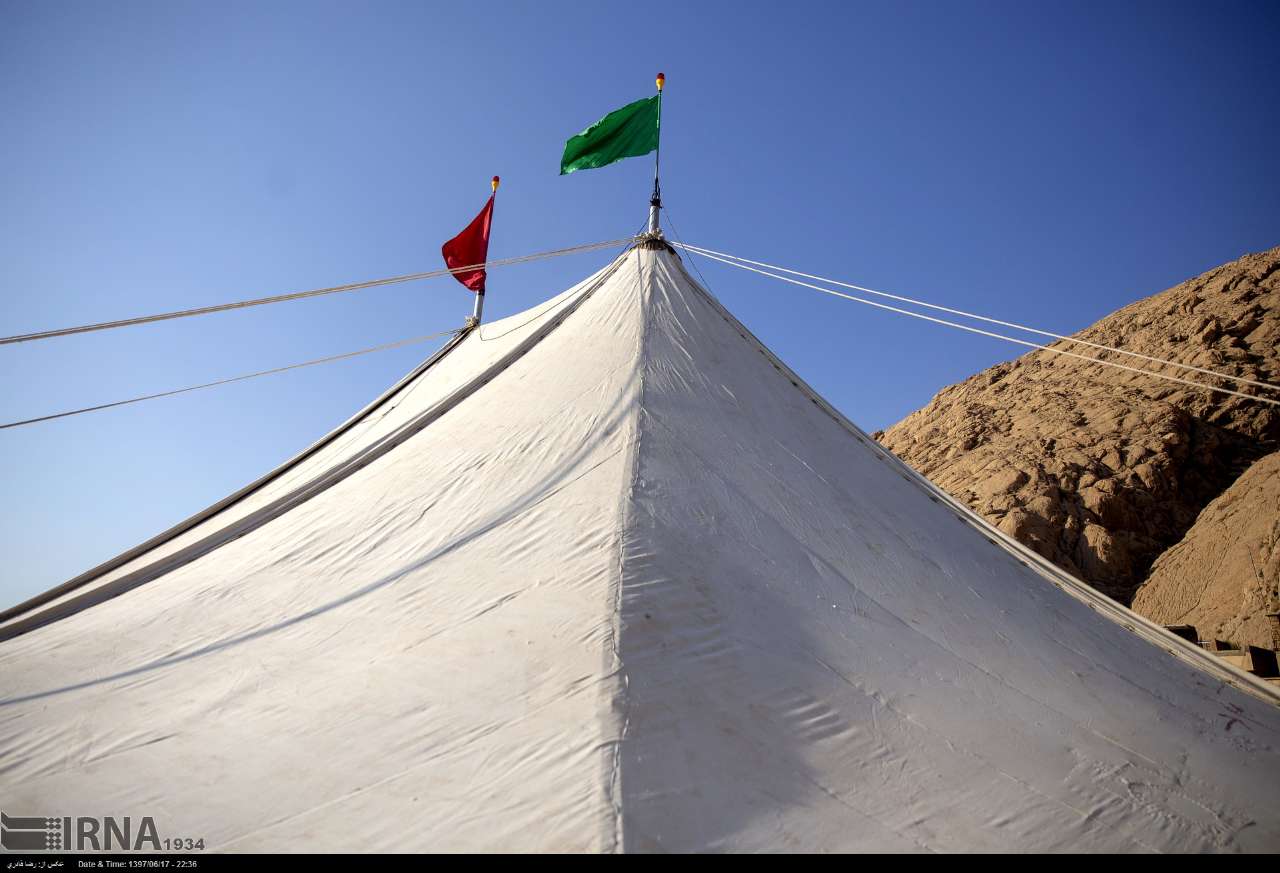
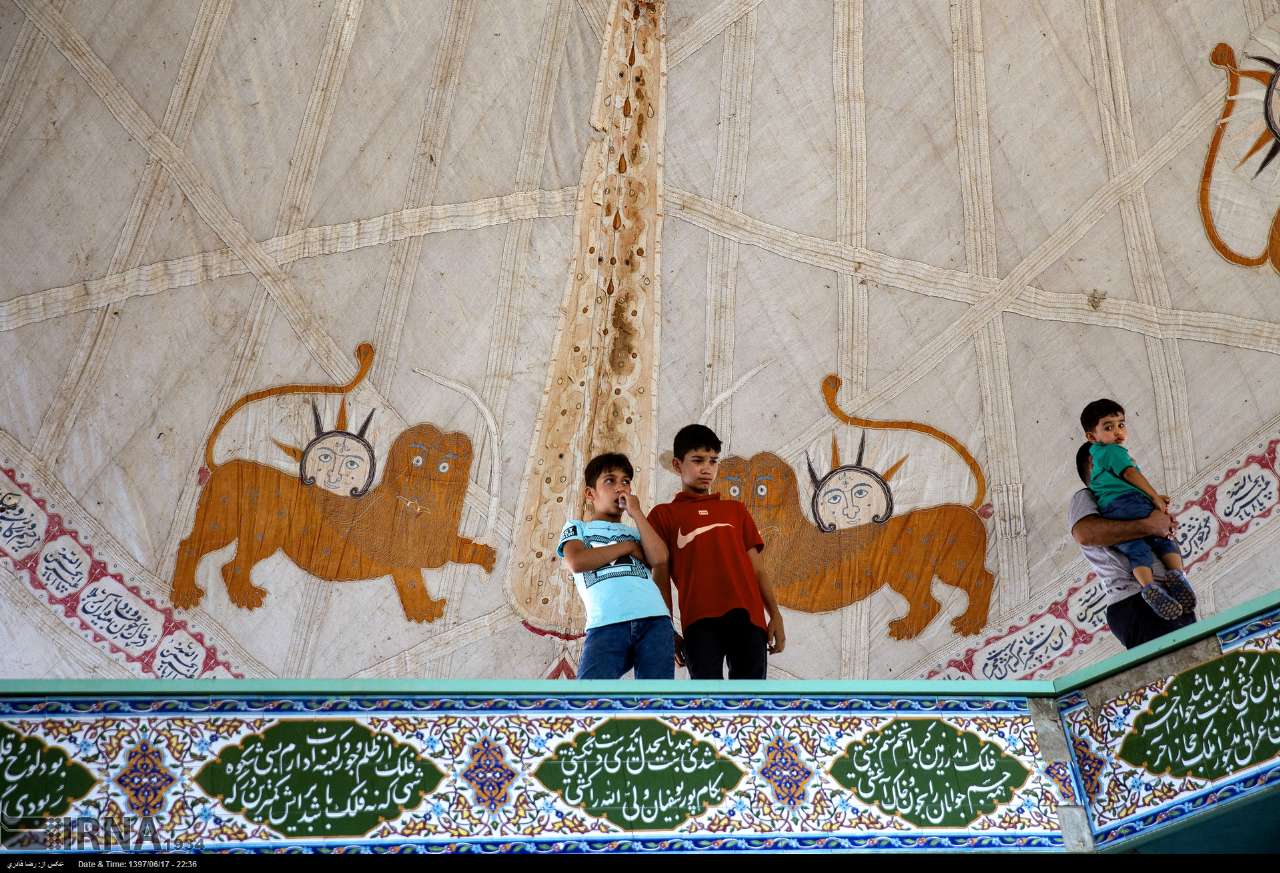
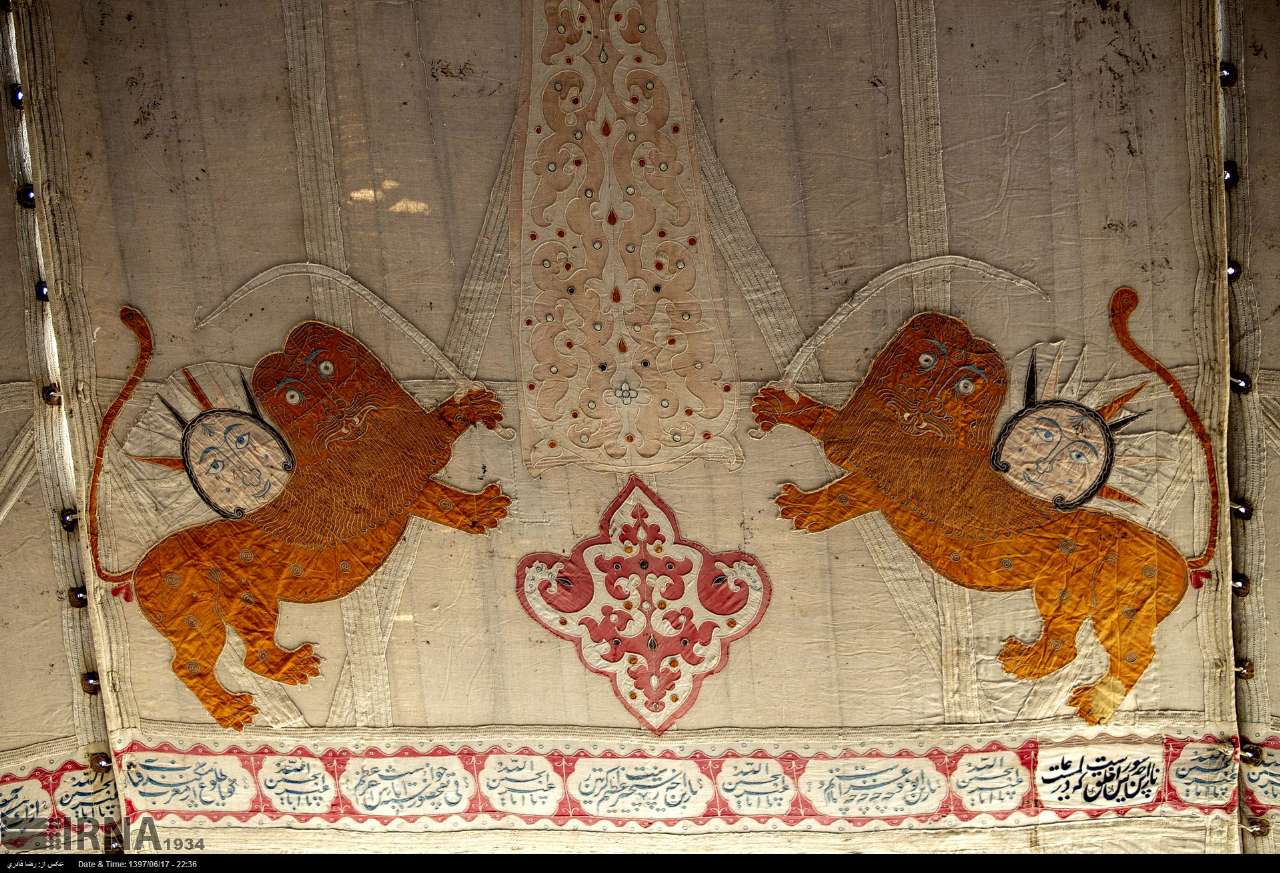
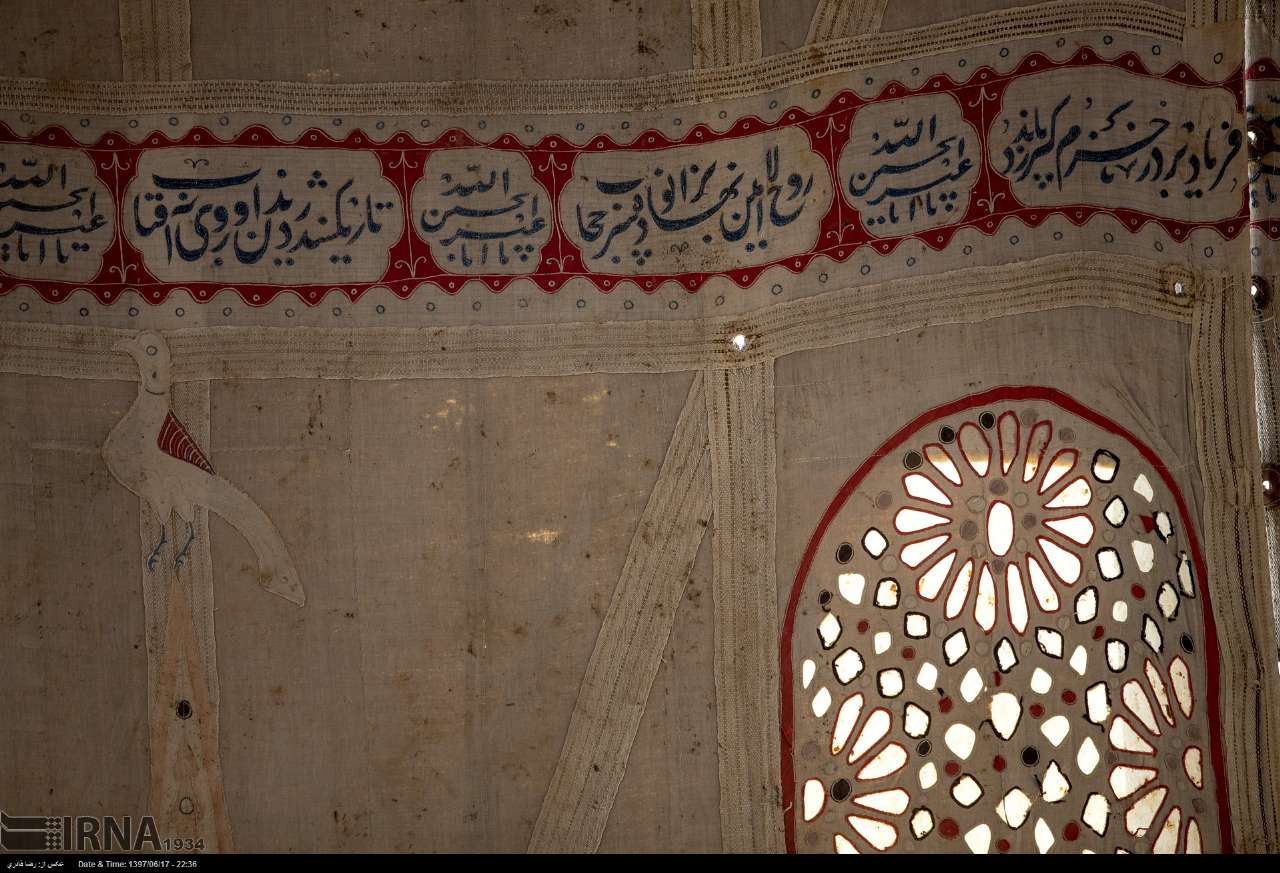
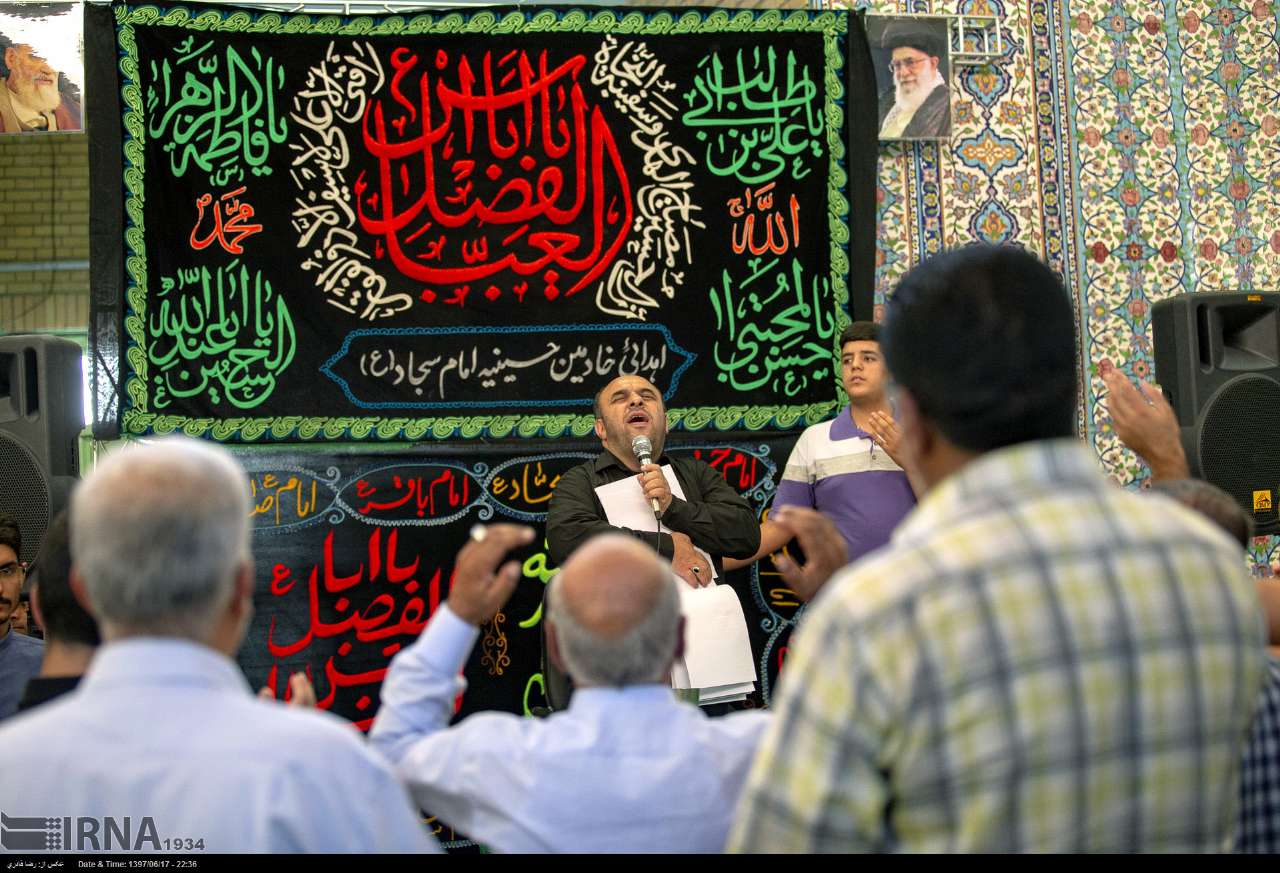
In accordance with a 400-year-old tradition, people in the town of Zarqan in Fars province set up tents on the threshold of Muharram to honour the upcoming anniversary of Ashura, the tenth day of the lunar month.

Ashura was the day when Imam Hussein, a grandson of Prophet Muhammad, and dozens of his faithful companions were martyred in an unequal battle with enemy troops in Karbala, modern day Iraq, in 680 AD.

What follows are IRNA’s photos of the tents set up in Zarqan:

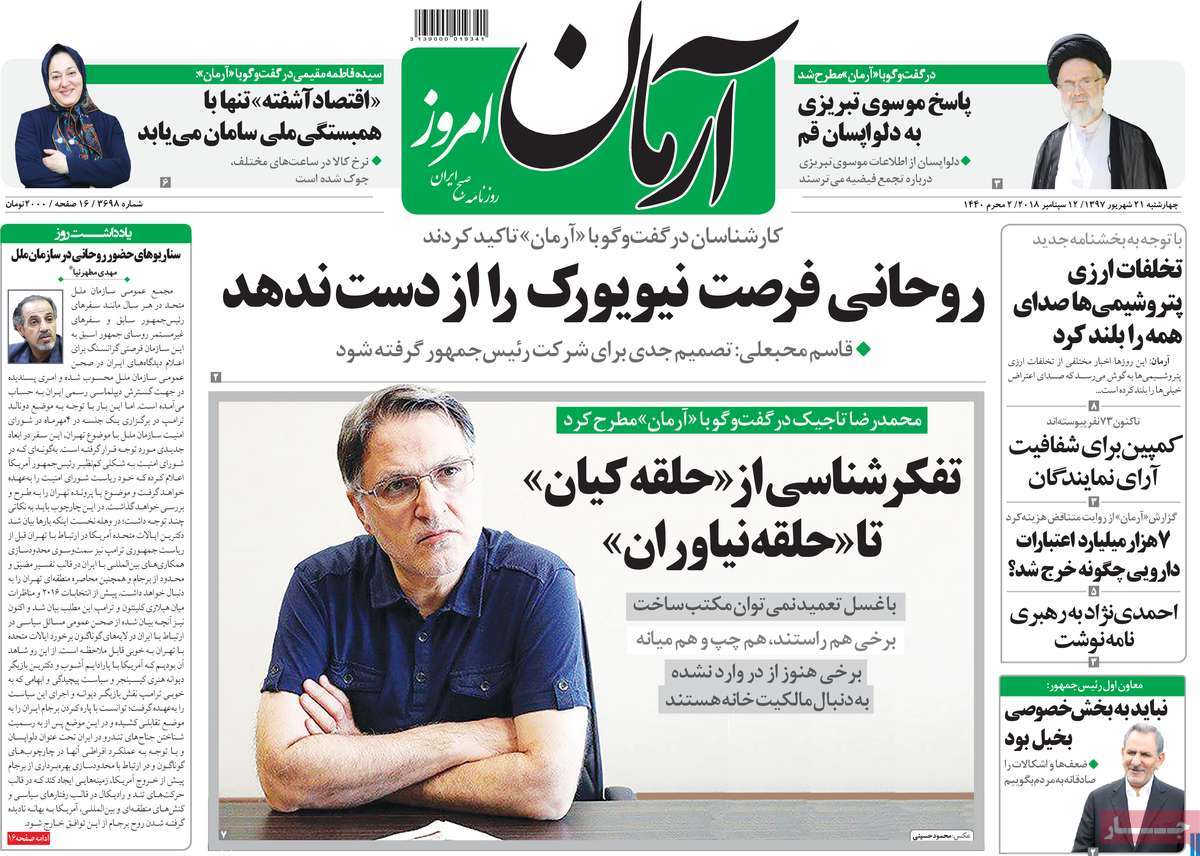
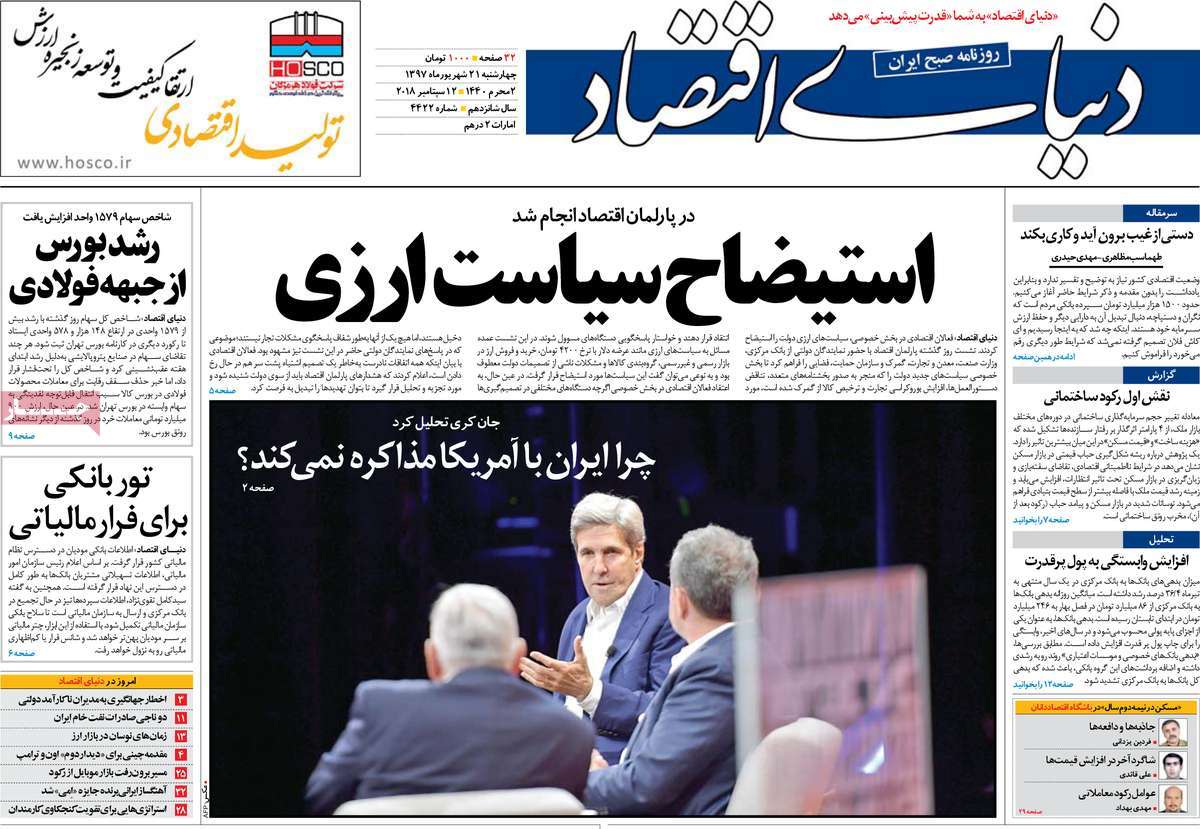
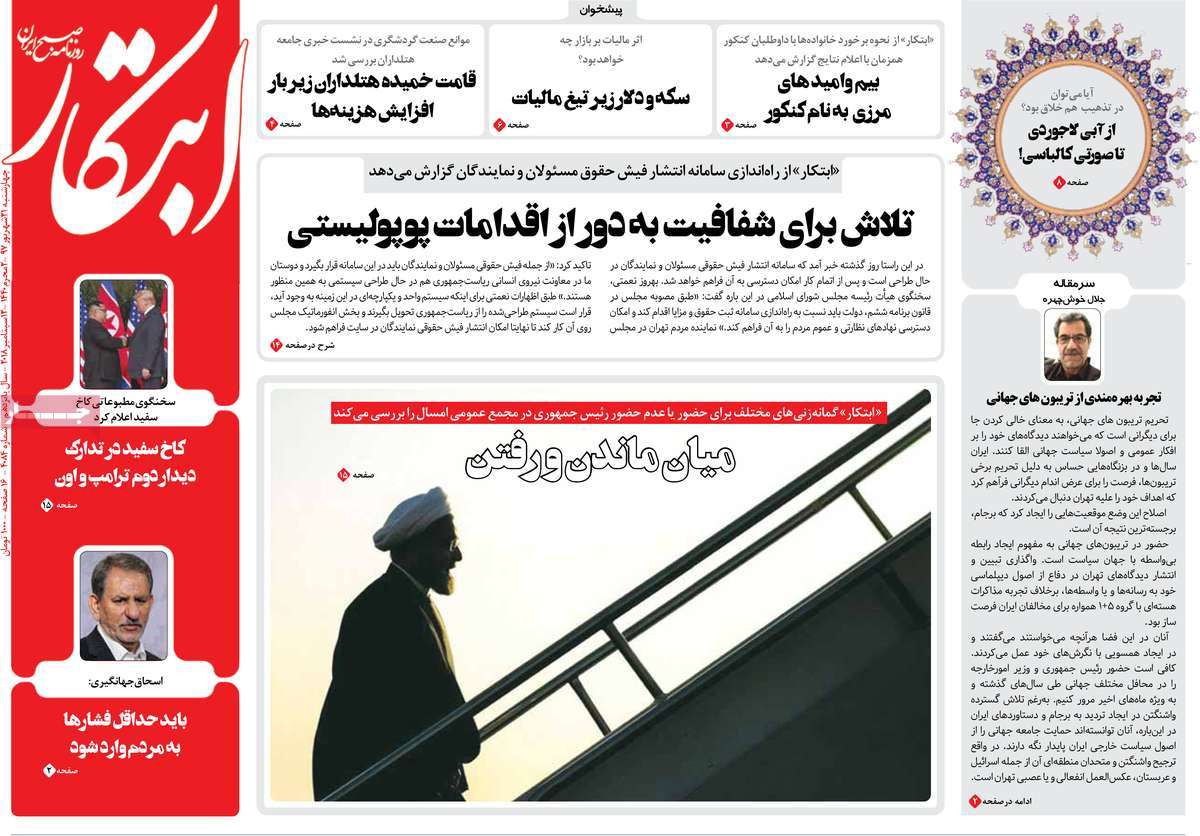
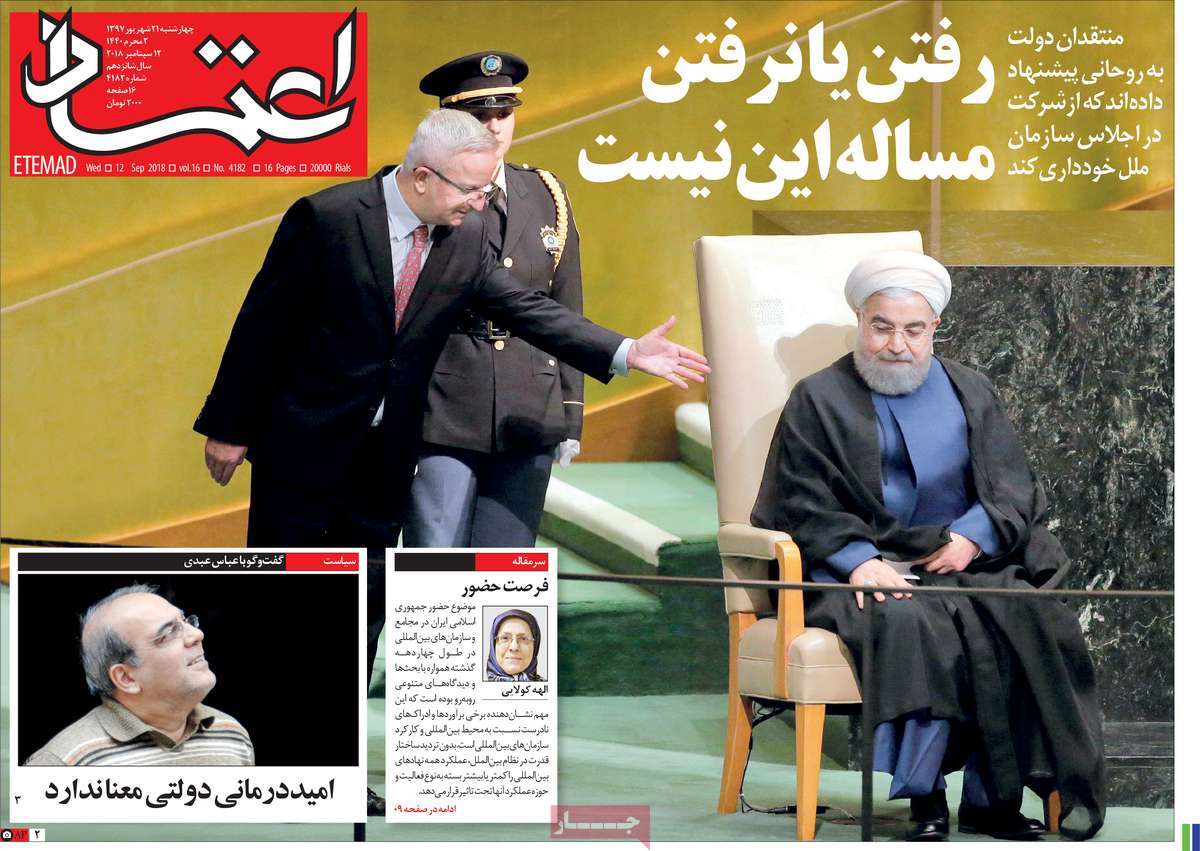
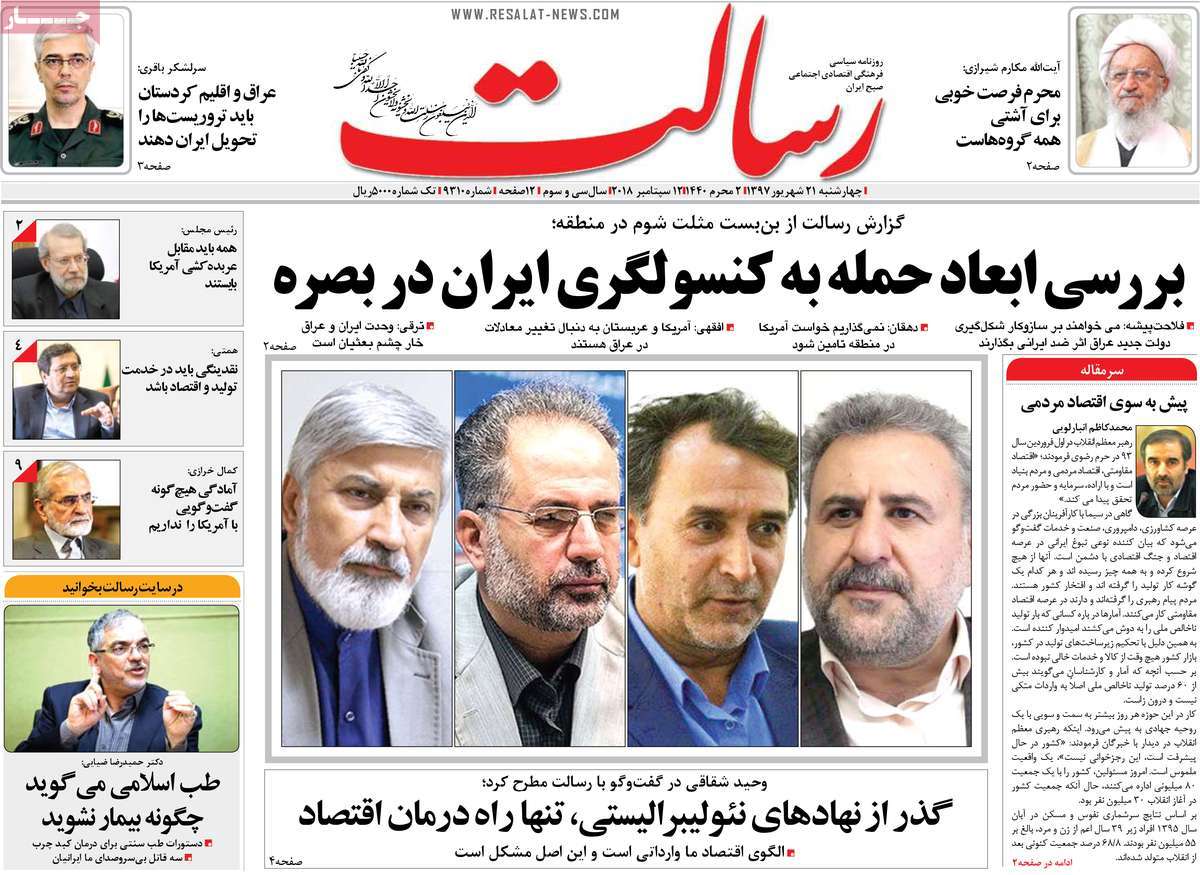
A Look at Iranian Newspaper Front Pages on September 12

A Look at Iranian Newspaper Front Pages on November 19

The top story today was speculations regarding President Hassan Rouhani’s possible decision to attend or boycott a UN Security Council meeting due to be chaired by US President Donald Trump.

Also a top story was remarks by Major General Mohammad Baqeri, the chief of staff of the Iranian Armed Forces, regarding the recent attack on terrorists’ positions in the Iraqi Kurdistan.


The above issues, as well as many more, are highlighted in the following headlines and top stories:


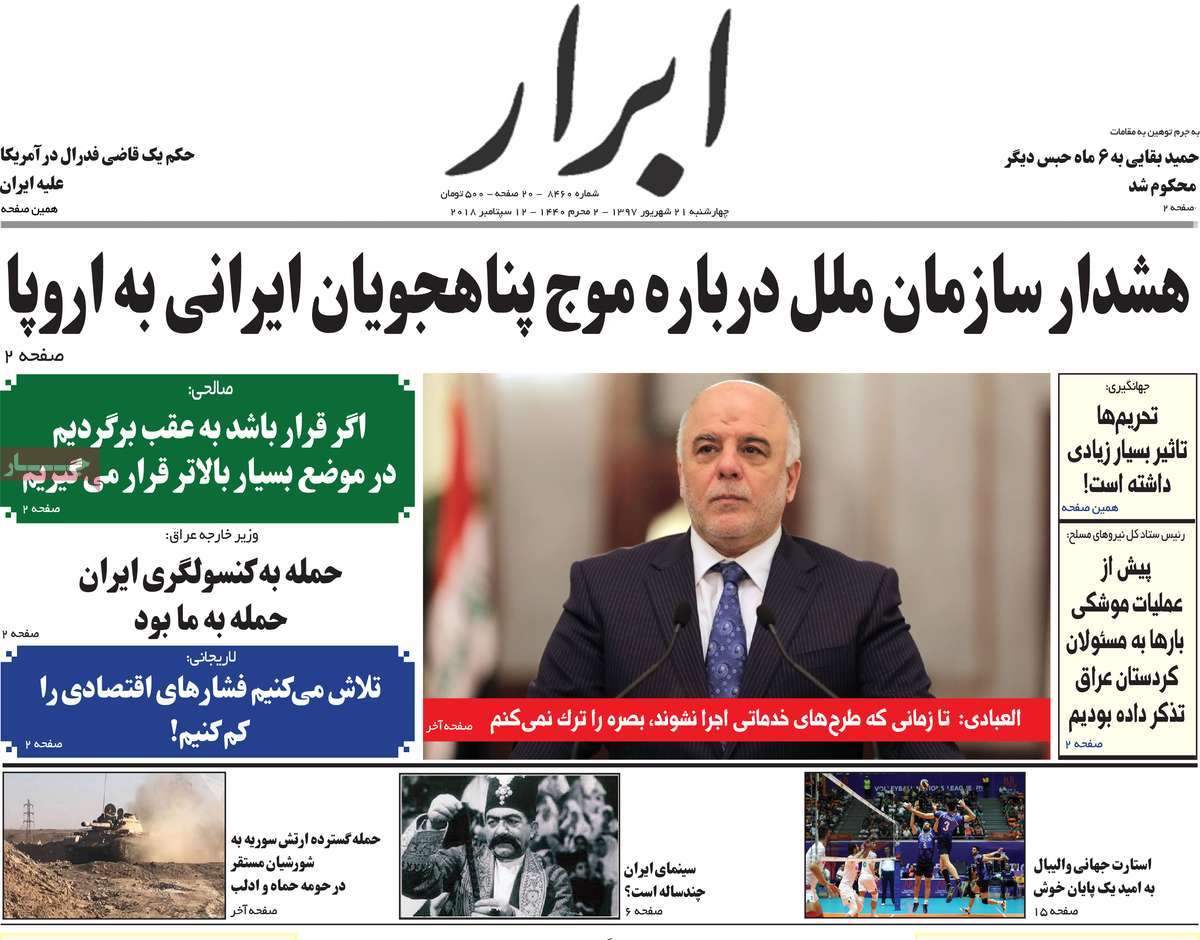
Abrar:

1- UN Warns about Flock of Iranian Refugees to Europe

2- Iraqi PM: I Won’t Leave Basra before Public Services Provided Properly

A Look at Iranian Newspaper Front Pages on September 12


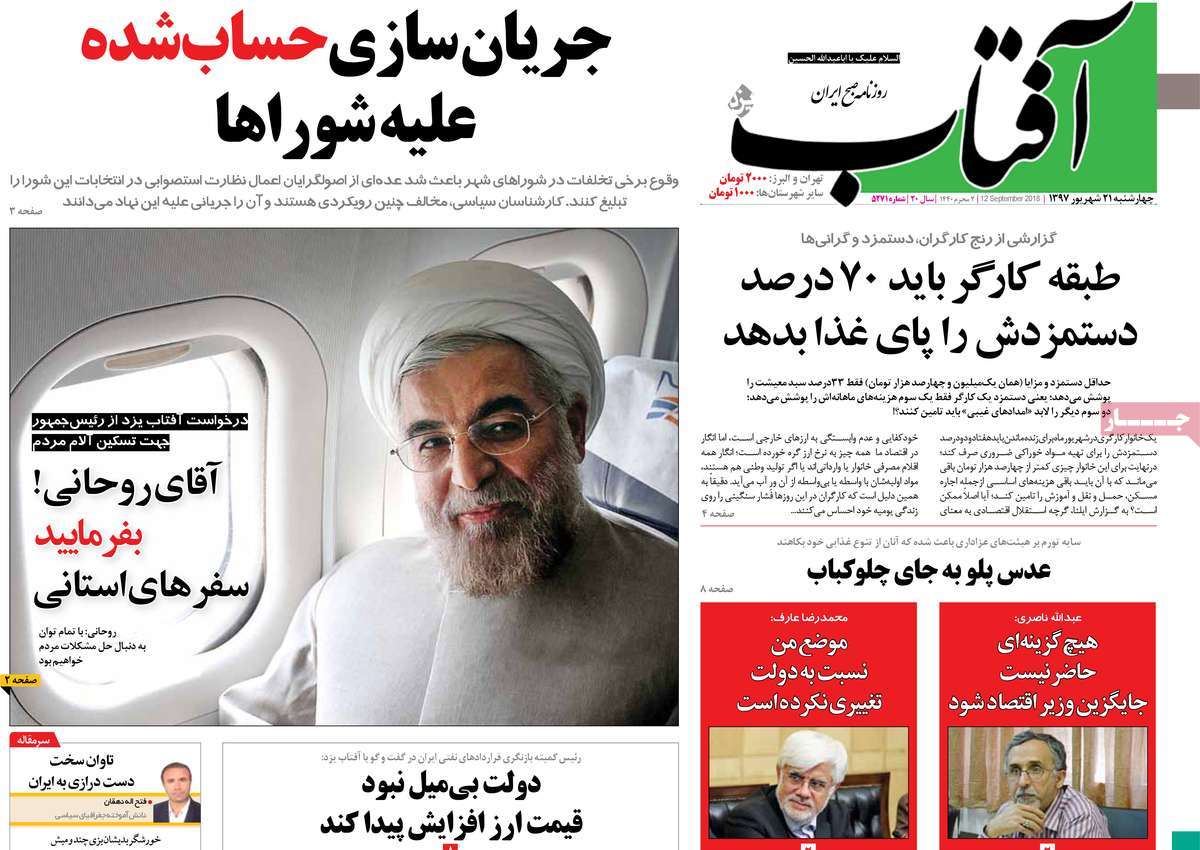
Aftab-e Yazd:

1- Analyst: No One Ready to Replace Economy Minister

2- Working Class Has to Spend 70% of Its Wages on Food

A Look at Iranian Newspaper Front Pages on September 12


Arman-e Emrooz:

1- Experts: Rouhani Shouldn’t Miss Chance of New York Visit

2- Scenario of Rouhani’s Presence at UN [Editorial]

A Look at Iranian Newspaper Front Pages on September 12


Donya-ye Eqtesad:

1- Kerry Explains Why Iran Doesn’t Fight against US

2- Government’s Forex Policy Questioned by Economic Parliament

A Look at Iranian Newspaper Front Pages on September 12


Ebtekar:

1- Dilemma of Staying or Going

  • Speculations Regarding Rouhani’s Participation in This Year’s UNGA

2- White House Preparing for Second Trump-Kim Meeting

A Look at Iranian Newspaper Front Pages on September 12


Etemad:

1- Rouhani’s Critics Asking Him to Boycott UN General Assembly

2- Reformist Figure: Government’s Efforts to Increase People’s Hope Meaningless

A Look at Iranian Newspaper Front Pages on September 12


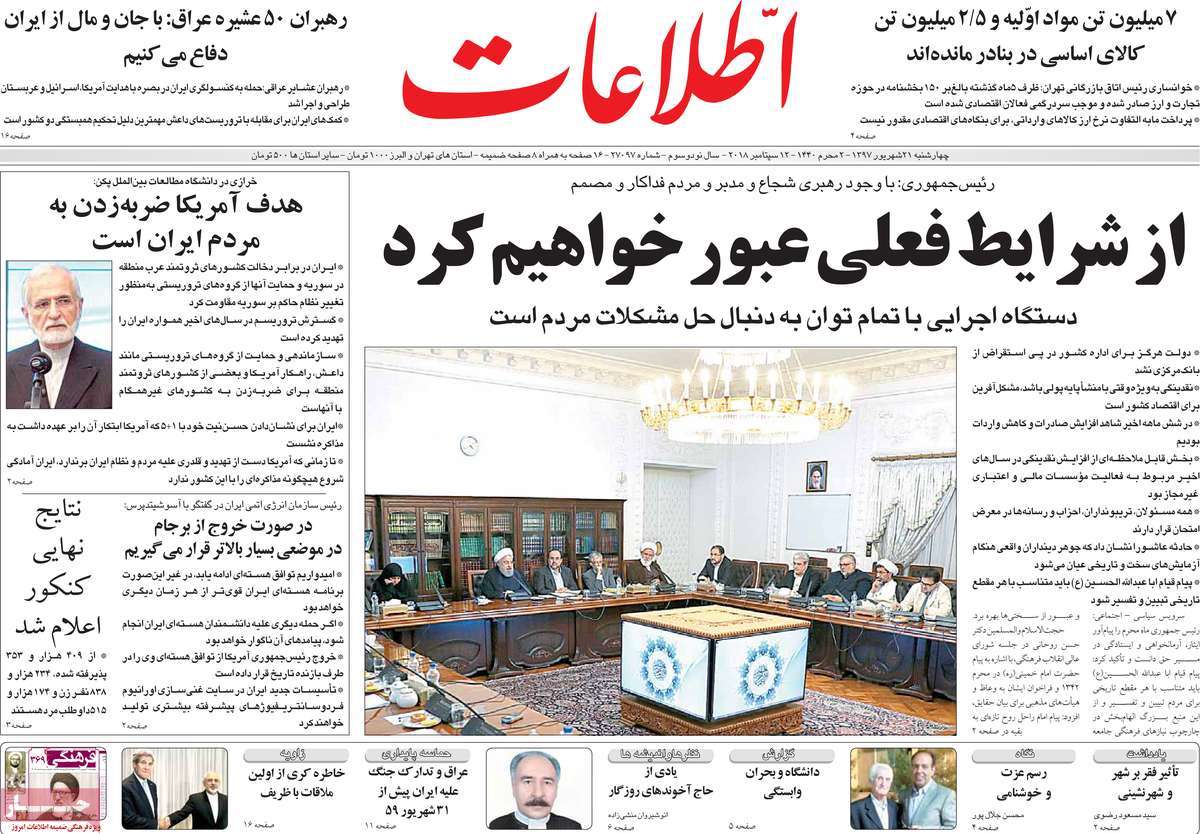
Ettela’at:

1- Rouhani: We’ll Overcome Current Situation Thanks to Our Brave Leader, Patient People

2- Iranian Diplomat in Beijing: US’ Aim Is to Harm Iranian Nation

3- Leaders of 50 Iraqi Tribes: We’ll Defend Iran Wholeheartedly

4- Iran’s Nuclear Chief to AP: We’ll Be in Much Higher Position If We Withdraw from JCPOA

A Look at Iranian Newspaper Front Pages on September 12


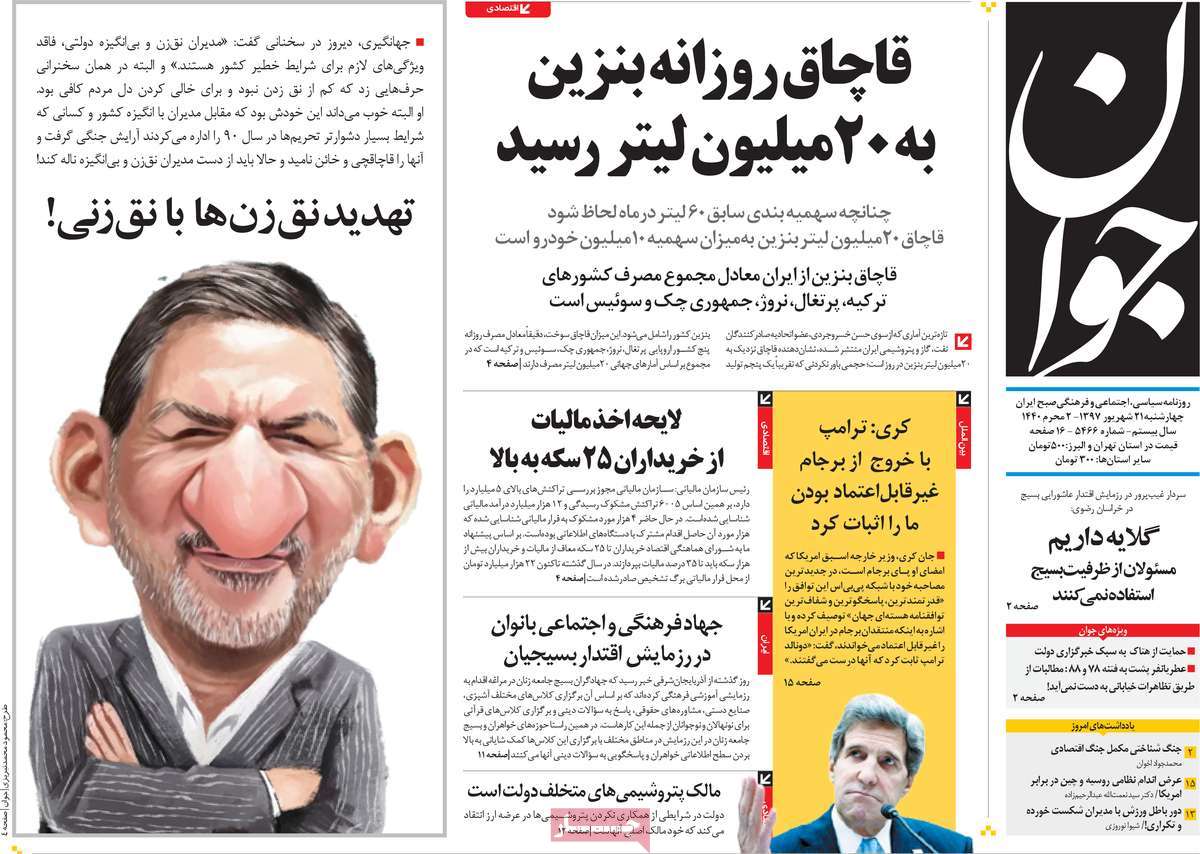
Javan:

1- 20 Million Litres of Petrol Smuggled Every Day

2- Kerry: Trump’s Withdrawal from JCPOA Proved US Untrustworthy

A Look at Iranian Newspaper Front Pages on September 12


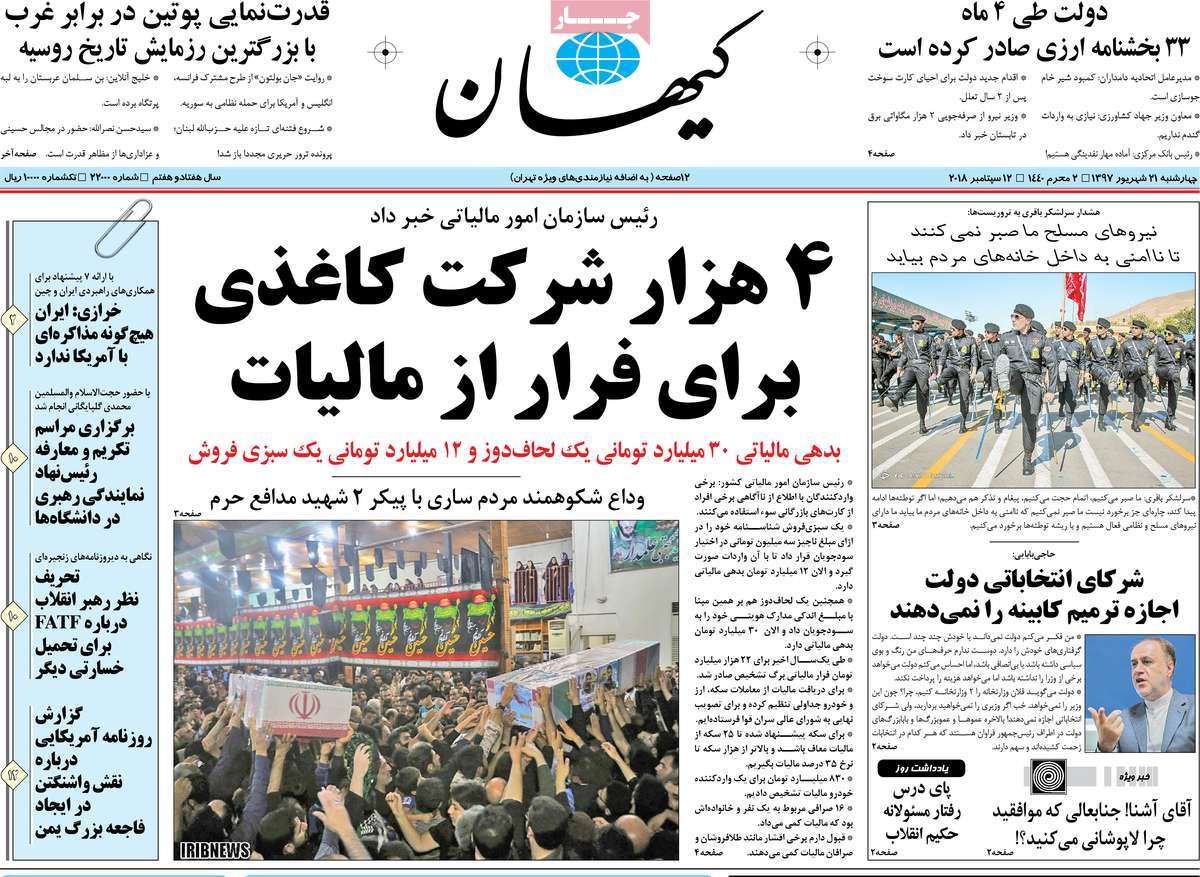
Kayhan:

1- Putin Shows Off His Power to West by Holding Russia’s Biggest-Ever Military Drill

2- Top General: Our Armed Forces Won’t Wait until Terrorists Bring Insecurity to Iran

A Look at Iranian Newspaper Front Pages on September 12


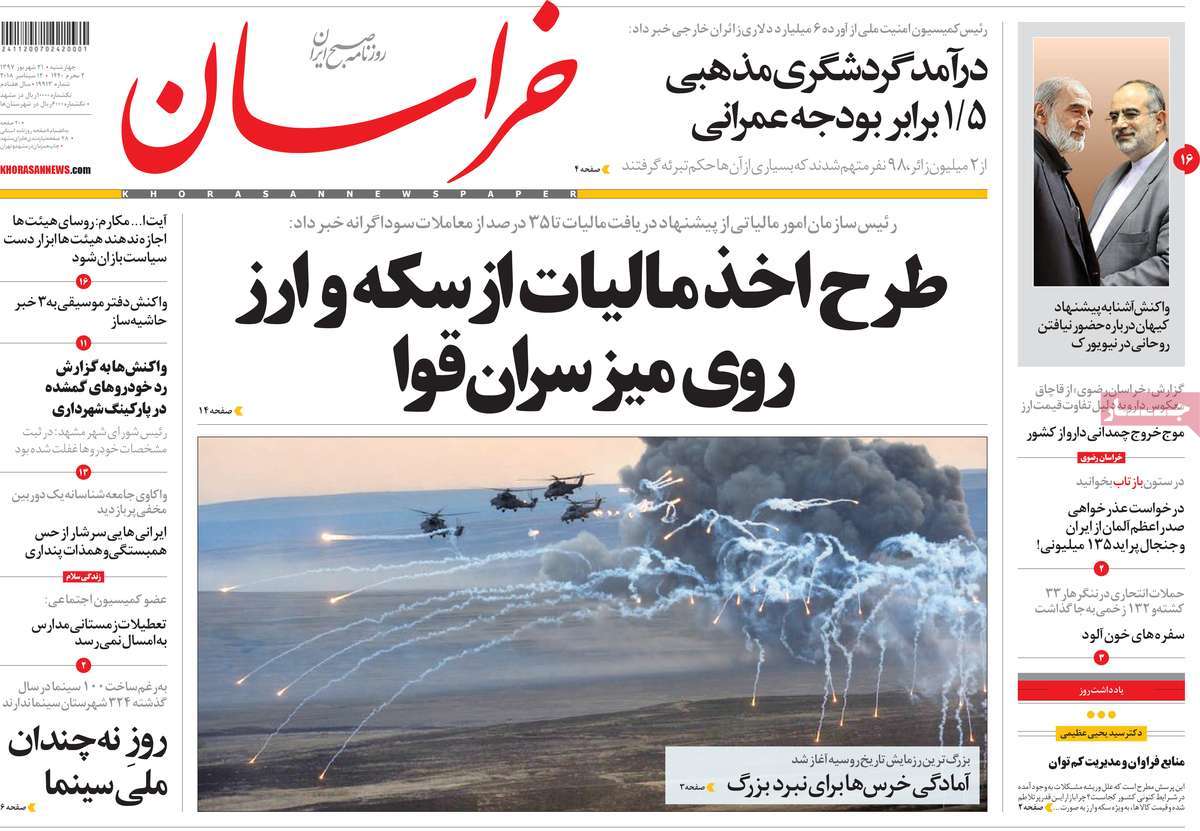
Khorasan:

1- Top Authorities Working on Plan to Receive Tax from Gold Coin, Forex Deals

2- Religious Tourism Income 1.5 Times Bigger than Construction Budget

A Look at Iranian Newspaper Front Pages on September 12


Resalat:

1- Review of Various Aspects of Attack on Iran’s Consulate in Basra

  • How Inauspicious Triangle of Mideast Failed

2- Leaving behind Neoliberal Bodies Only Way to Cure Iran’s Economy

3- Every One Must Stand against US’ Bullying: Parliament Speaker

A Look at Iranian Newspaper Front Pages on September 12


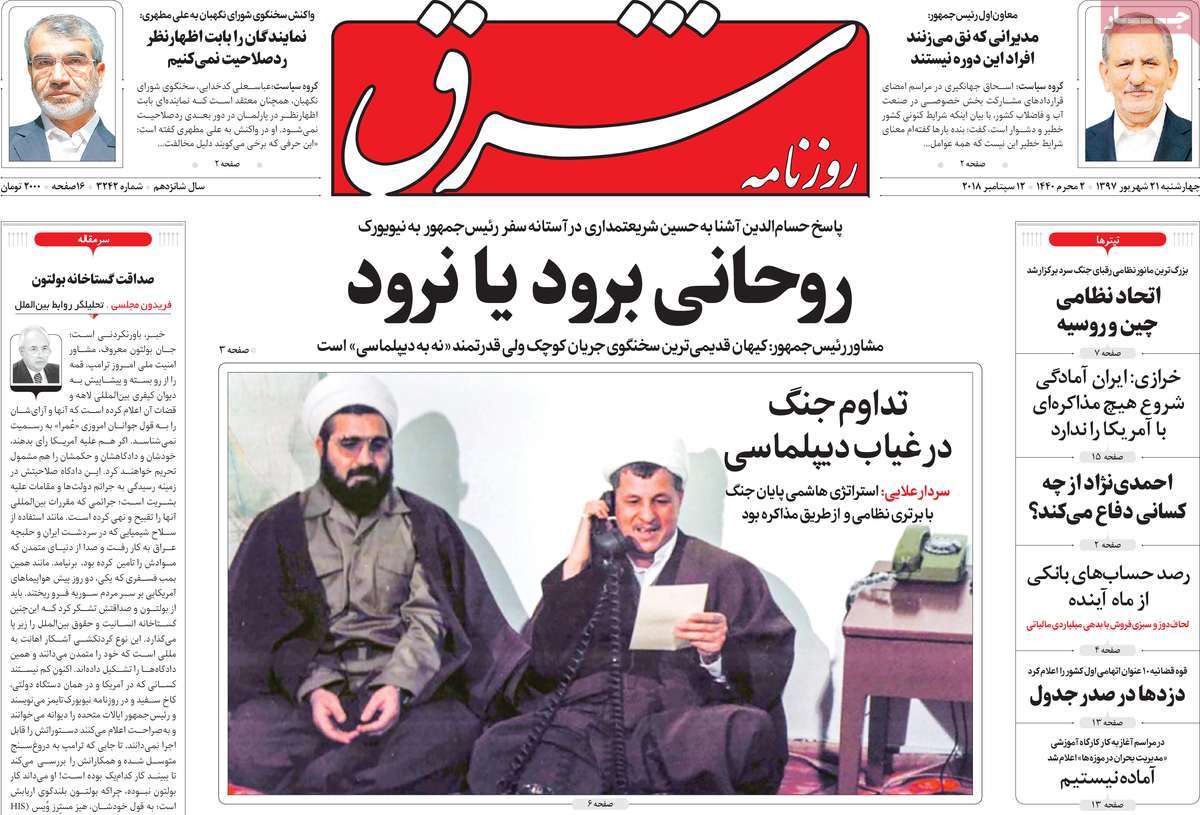
Shargh:

1- Military Alliance of China, Russia: Biggest War Games of Cold War Enemies Held in Russia

2- Bolton’s Impudent Honesty [Editorial]

A Look at Iranian Newspaper Front Pages on September 12


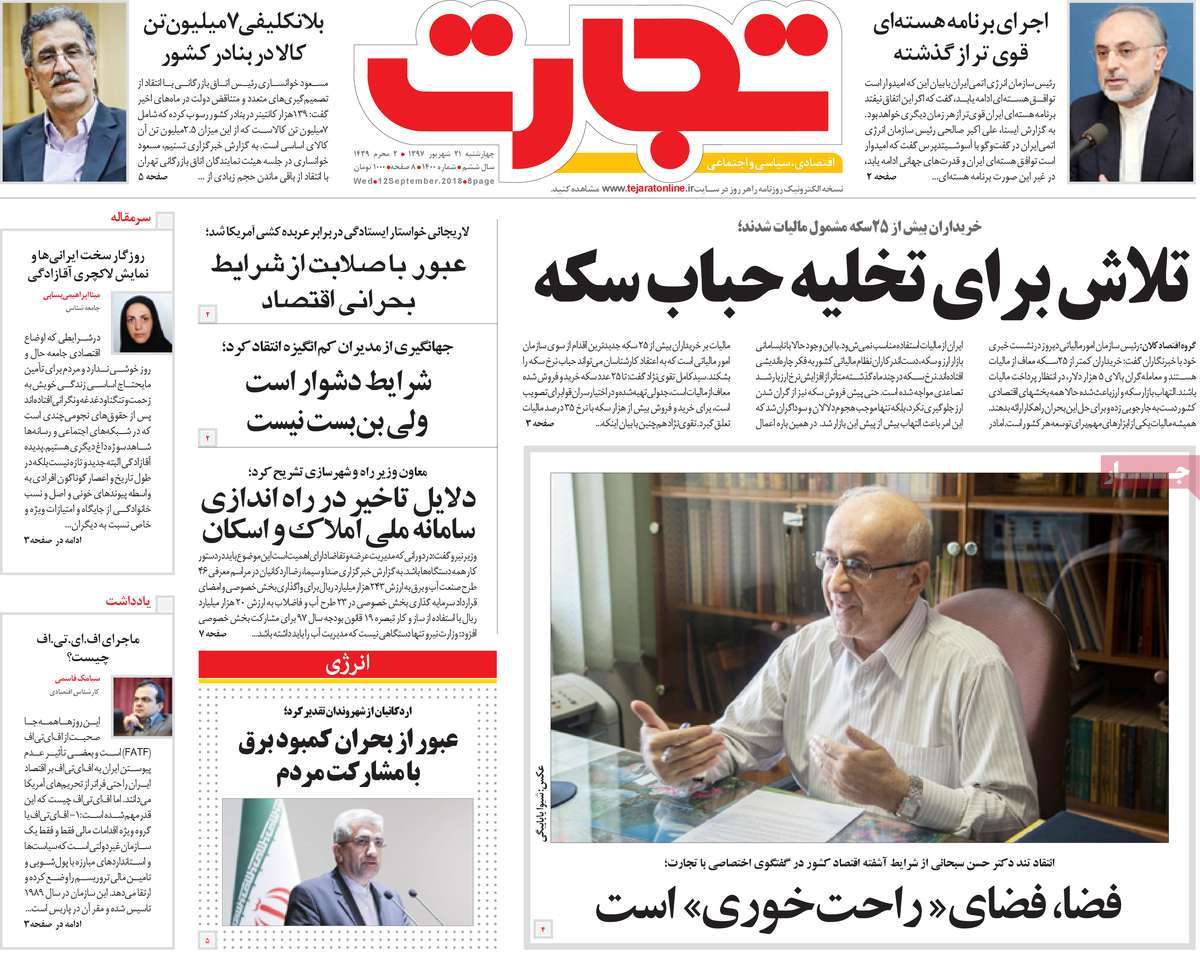
Tejarat:

1- Iran Nuclear Chief: Implementation of Nuclear Program Stronger than Before

2- Iran First VP: Conditions Difficult, but No Deadlock

A Look at Iranian Newspaper Front Pages on September 12


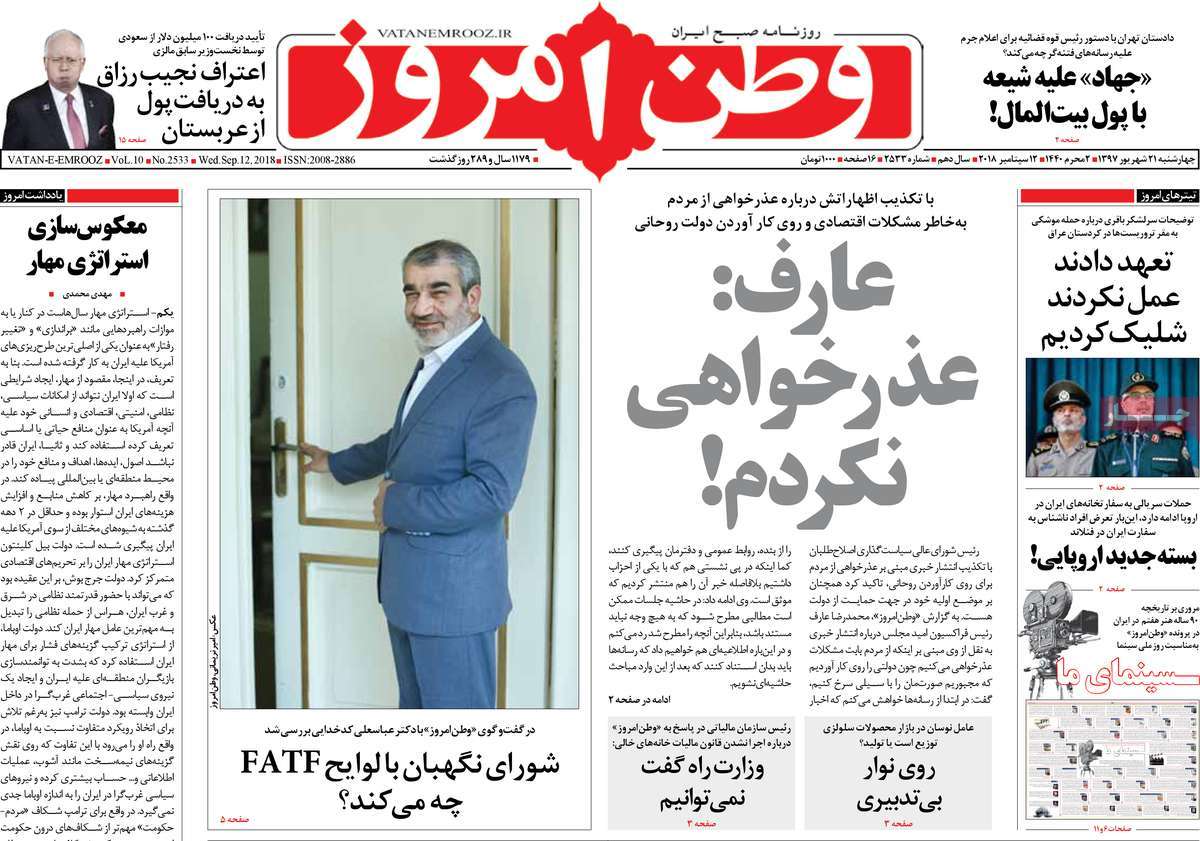
Vatan-e Emrooz:

1- Malaysia’s Ex-PM Najib Razak Admits He Has Received Money from Saudi Arabia

A Look at Iranian Newspaper Front Pages on September 12

Iran’s New Consulate in Iraq’s Basra Opens after Attack on Previous One

In a ceremony in Basra on Tuesday, Iran’s ambassador Iraj Masjedi inaugurated the new consulate’s building.

“I’m here to inaugurate the new premises of our Iranian consulate in Basra… because we don’t want lose a single day of services for the people of Basra,” AFP quoted Masjedi as saying.

The Iranian flag was also hoisted at the site of the new consulate in a ceremony attended by Iraqi officials and journalists.

On September 7, a mob of angry protestors stormed into the Iranian consulate in Basra, destroyed the diplomatic mission’s properties, took down the flag of Iran and torched the building.

The consulate’s building was not the first to be set on fire. The angry demonstrators had earlier set government buildings ablaze as well. The buildings included the headquarters of the local government, the ruling Dawa Party, the Supreme Islamic Council and the Badr Organization.

Suicide Attack on Afghan Demonstrators Kills 68, Wounds 165

Medical staff have struggled to treat people wounded by the powerful blast in Nangarhar province on September 12, 2018 / Photo by AFP

Scores of demonstrators had blocked the highway between the provincial capital Jalalabad and a key border crossing with Pakistan, when the bomber struck.
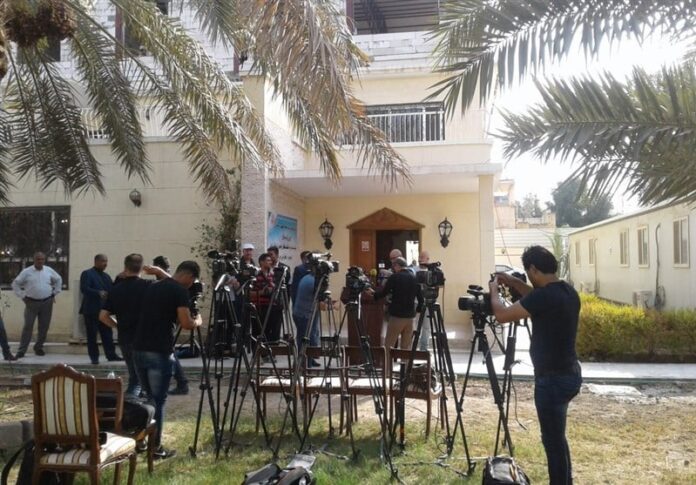
The protesters had come from Achin district to demand the removal of a local police commander.
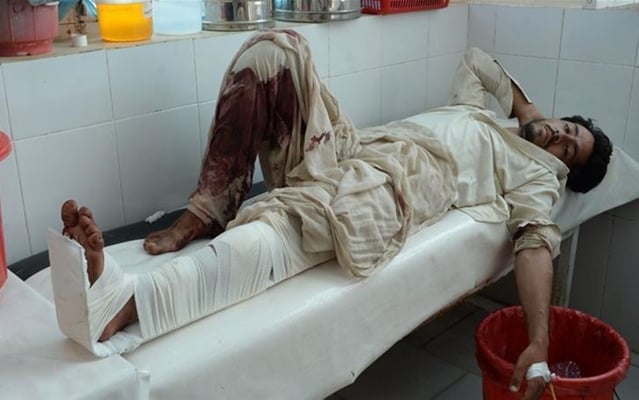
The attack was one of the worst in Afghanistan for months but security officials have warned that similar attacks are likely if crowds gather for campaign rallies ahead of parliamentary elections in October

“… the explosion happened and I found myself surrounded by blood and flesh,” Zar Khan, one of the injured, told AFP news agency.

The deadly suicide attack came hours after multiple bombings targeted schools in Jalalabad.

One blast went off at the entrance of Malika Omaira girls’ school in the morning, killing a 14-year-old boy and wounding four other people. It was followed by two explosions in Behsud district, also near two schools.

Afghan President Ashraf Ghani condemned the suicide attack, as well as the school bombings in Nangarhar.

In a statement he said that “attacks on civilian facilities, mosques, women, children, are all crimes against humanity”.

The Taliban denied any involvement in the attacks and no other group claimed responsibility for the violence.

Nangarhar has been a main stronghold of ISIS fighters since early 2015.

US’ Threats against ICC Reveal Its Double Standards on War Crime

Political analyst Ali Korram has, in an analytical piece published in Arman-e Emrooz daily newspaper, weighed in on the White House’s double-standard approach vis-à-vis the issue of war crimes. The Full text of the article follows.

The Hague-based International Court of Justice (ICC) is an age-old legal entity. When the United Nations was formed, it chose the ICC as its legal and statutory arm.

Since then, the rulings of the tribunal have always been respected and not been contested by any institution or country. In other words, the verdicts issued by the court should be so precise that cannot be criticized or faulted. Therefore, the ICC’s rulings have been used as a legal yardstick in international relations so far.

The only place where the tribunal’s verdicts may be thrown out is at the United Nations Security Council (UNSC) with the consensus and unanimous decision of the five permanent members of the council plus its non-permanent members only for one purpose: international peace and security. If an ICC ruling jeopardizes international peace and security for some reason, then the verdict can be suspended upon the UNSC’s order.

Therefore, as it can be seen, the tribunal’s rulings are so strong that are reviewed only in cases where international peace and security come into play. Only in such cases may the court’s verdict be temporarily suspended or set aside.

Now, the performance of US President Donald Trump and his radical associates such as John Bolton should be studied. In a recent speech, Bolton threatened to slap sanctions on the ICC and its 15 judges and block the tribunal’s access to its bank accounts in the United States and any transactions between the court and other banks taking place through the US if the ICC investigates the United States’ war crimes in Afghanistan. This is probably the first time in history that a country is interfering with the ICC’s independence of opinion.

Throughout the past 73 years since World War II and even during the era of the League of Nations and before the ICC came into existence, the importance of the tribunal has been due to its independent rulings. Accordingly, this is the first time a country lays claim on the court’s verdict, and that every country itself is unfortunately the custodian of the UN Charter.

That means the disaster that the United States is bringing about with regards to the court cannot be forgiven or condoned whatsoever. If America’s war crimes in Afghanistan are true, then Afghan people are entitled to having an independent international authority look into the crimes. Nevertheless, the US government, which has committed war crimes in Afghanistan, is officially blocking the ICC’s work and, even worse, has threatened the tribunal.

If the US’ war crimes in Afghanistan are not to be probed, then why is it that Washington is so sensitive and makes so much fuss about war crimes in Syria? International conscience says war crimes should be investigated, be it in Syria, Yemen, Myanmar or Afghanistan. It doesn’t matter which country has committed the crime. The perpetrator should be introduced as the guilty party.

Didn’t the US roll up its sleeves and prosecute and hold tribunals for leaders of former Yugoslavia for war crimes in Bosnia and Kosovo? Didn’t Washington call for them to be tried and face justice? Didn’t the US hold a tribunal in Nuremberg to prosecute Nazi Germany after the World War II? Didn’t the US try leaders of the Nazi Party at that court?

As you see, the United States has actively taken action to investigate war crimes over the past 73 years, but, shamefully enough, is threatening unbiased ICC judges with sanctions and questioning the ICC’s independence of opinion.

If it happens, the United States – at least the US under Donald Trump – has no right to express its opinion about war crimes in Syria or any other place and call for other countries’ leaders to stand trial.

Iran, Turkey, Russia Discuss Formation of Syria Constitutional Committee

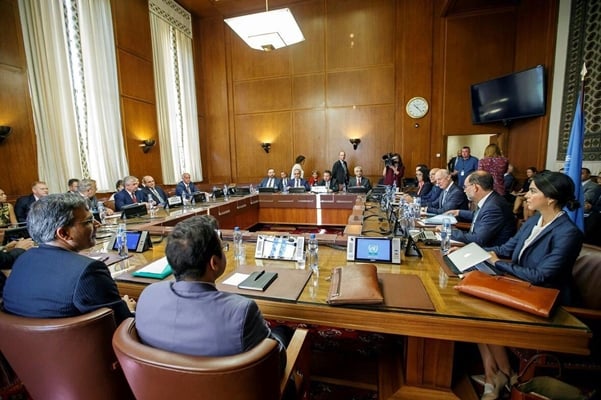
In the Tuesday meeting, Hossein Jaberi Ansari, Alexander Lavrentiev and Sedat Onal, the top negotiators of Iran, Russia and Turkey in the Syria peace process, and UN Special Envoy for Syria Staffan de Mistura discussed the constitutional committee.

The participants discussed progress in the political process to settle the Syrian conflict, particularly the formation of the constitutional committee and stressed the following points:

  1. The political process must be intra-Syrian and the integrated national sovereignty of Syria must be protected.
  2. The composition of the committee must be acceptable to various sides and should be based on the facts on the ground in Syria.
  3. All issues and details regarding the constitutional committee will be agreed upon as a single package.
  4. Considering the sensitivity of issues and the consequences of the multi-year crisis in the country, making arrangements for formation of such a constitutional committee is time-consuming. But all sides stressed on the need for paying attention to both the speed and quality of the process.

In the meeting, the representatives of the three guarantors of the peace process in Syria agreed to create a working group comprising their experts to prepare the ground for consultations with the UN to facilitate the creation of the constitutional committee. They also agreed to start the third round of consultations late October.

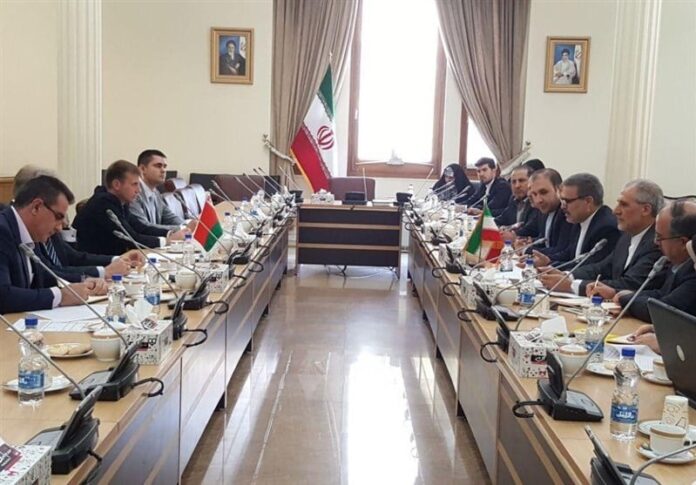
Tehran Hosts Fresh Round of Iran-Belarus Consular Talks

In the meeting held in Tehran on Monday, the Iranian and Belarusian delegations hailed the progress in visa facilitation, judicial cooperation, the transfer and extradition of convicts, the fight against illicit drugs and organized crimes.

They also stressed the need to completely implement previous agreements reached between Tehran and Minsk.

During the session, the two sides also discussed cooperation in establishing more facilities for legal, easy and safe travel for citizens of the two countries.

Back in June, Iranian President Hassan Rouhani met with Belarusian President Alexander Lukashenko on the sidelines of the Shanghai Cooperation Organization (SCO) summit in China.

“Belarus has always been a friendly country for Iran and Tehran is ready to strengthen economic and business relations (with the country), especially in scientific and modern technology fields,” Rouhani said at the meeting on June 9.

Iran wants closer ties with Belarus, he said, adding that cooperation between the Islamic Republic and Eurasia would enhance the Tehran-Minsk relations.

Lukashenko, for his part, said his country is resolved to develop relations with Iran in all political and economic areas, adding that Tehran is a key regional partner for Minsk.

He further described as “wise” Iran’s stance on a unilateral move by the US to withdraw from the 2015 nuclear deal known as the Joint Comprehensive Plan of Action (JCPOA) and said taking unilateral actions and violating international obligations undermine international law.

In a unilateral move on May 8, US President Donald Trump announced his country’s withdrawal from the nuclear agreement between Iran and the Group 5+1 (Russia, China, the US, Britain, France and Germany).

Following the controversial decision, Rouhani said Iran weighs plans to remain in the agreement with the other five parties, provided that they ensure full benefits for Iran.