Monday, December 22, 2025
Home Blog Page 3470

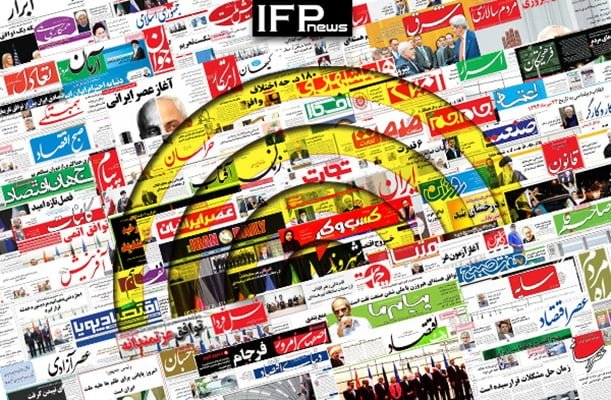
A Look at Iranian Newspaper Front Pages on September 12

A Look at Iranian Newspaper Front Pages on November 19

The top story today was speculations regarding President Hassan Rouhani’s possible decision to attend or boycott a UN Security Council meeting due to be chaired by US President Donald Trump.

Also a top story was remarks by Major General Mohammad Baqeri, the chief of staff of the Iranian Armed Forces, regarding the recent attack on terrorists’ positions in the Iraqi Kurdistan.


The above issues, as well as many more, are highlighted in the following headlines and top stories:


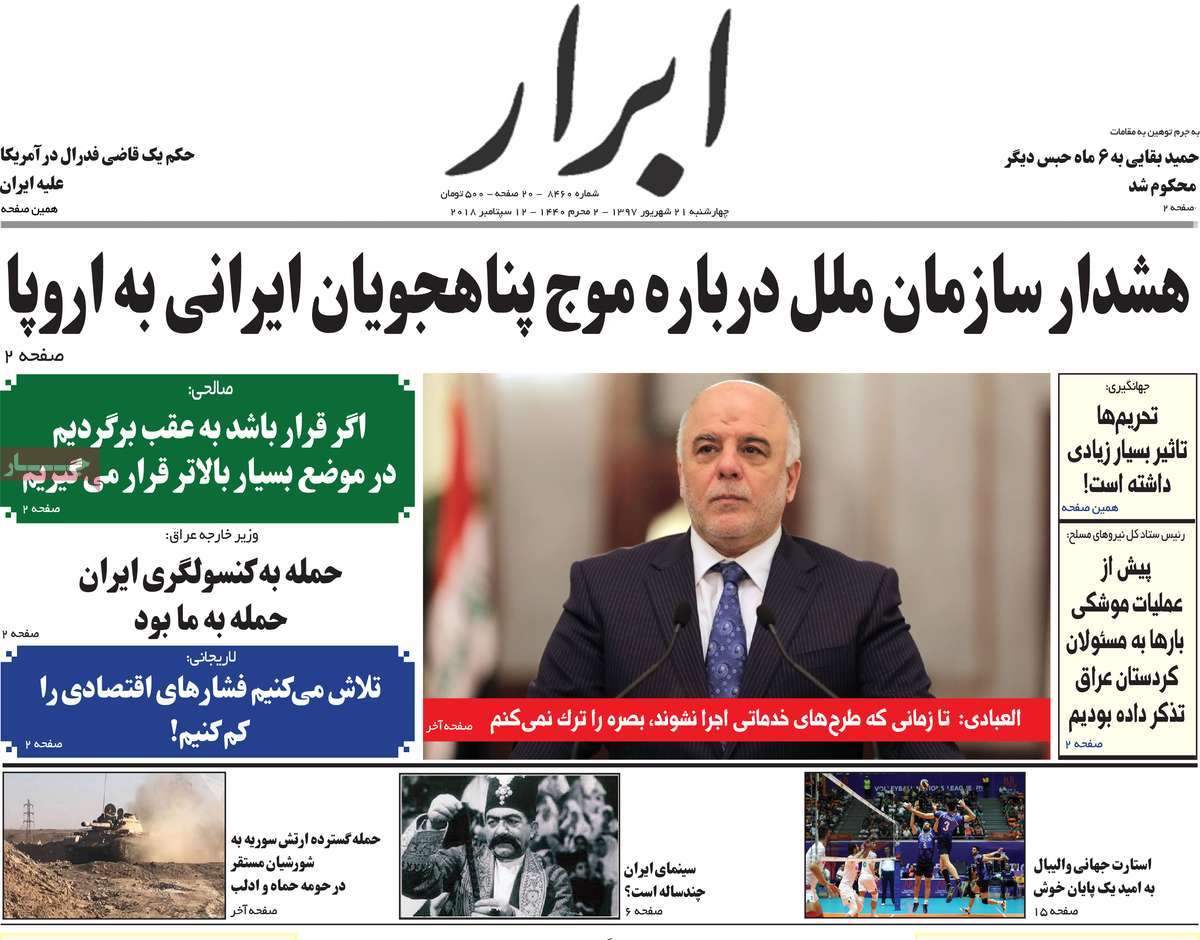
Abrar:

1- UN Warns about Flock of Iranian Refugees to Europe

2- Iraqi PM: I Won’t Leave Basra before Public Services Provided Properly
A Look at Iranian Newspaper Front Pages on September 12


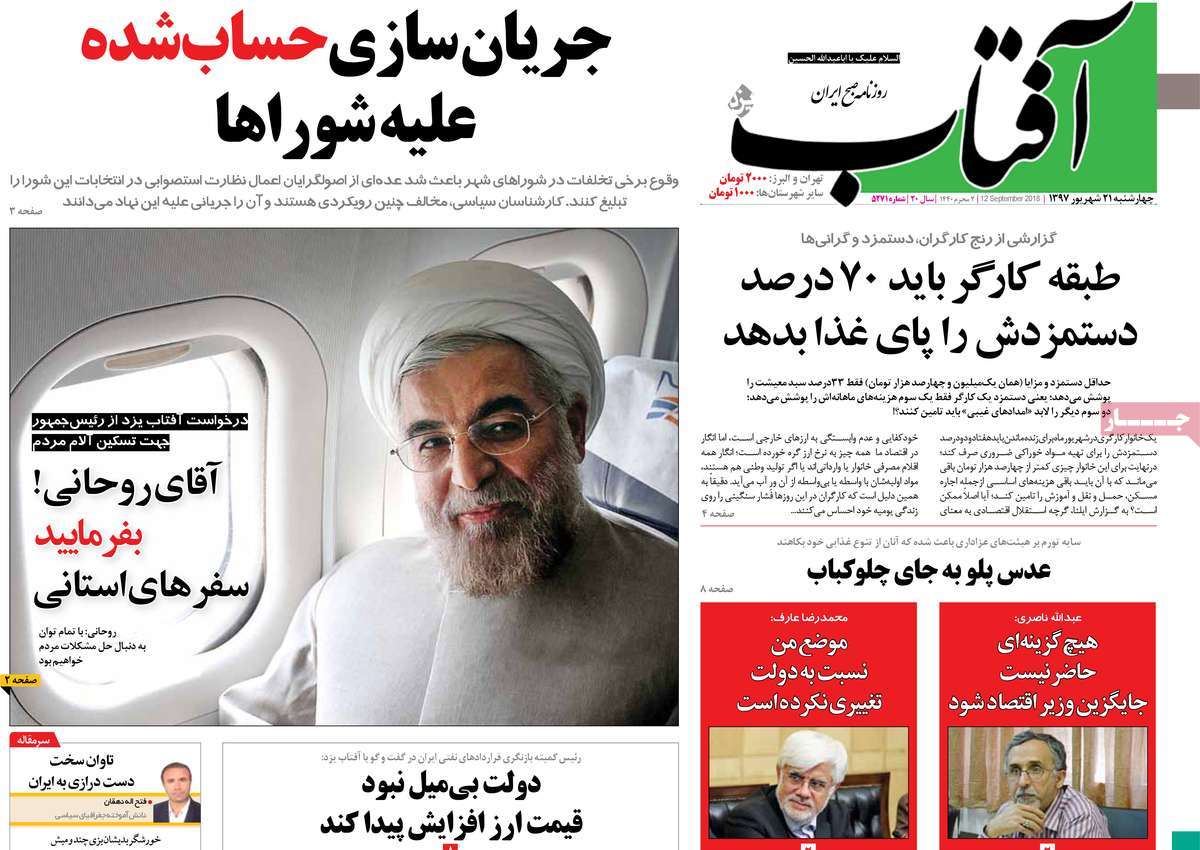
Aftab-e Yazd:

1- Analyst: No One Ready to Replace Economy Minister

2- Working Class Has to Spend 70% of Its Wages on Food
A Look at Iranian Newspaper Front Pages on September 12


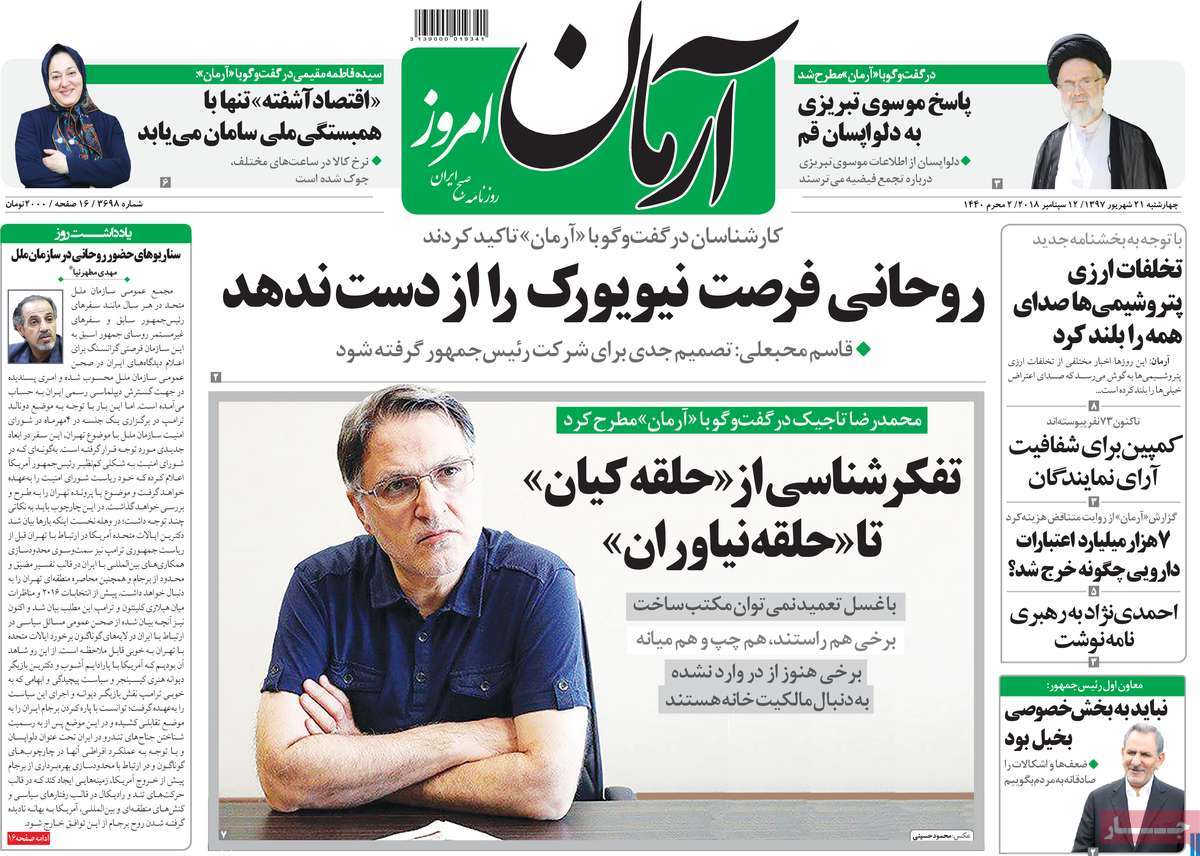
Arman-e Emrooz:

1- Experts: Rouhani Shouldn’t Miss Chance of New York Visit

2- Scenario of Rouhani’s Presence at UN [Editorial]
A Look at Iranian Newspaper Front Pages on September 12


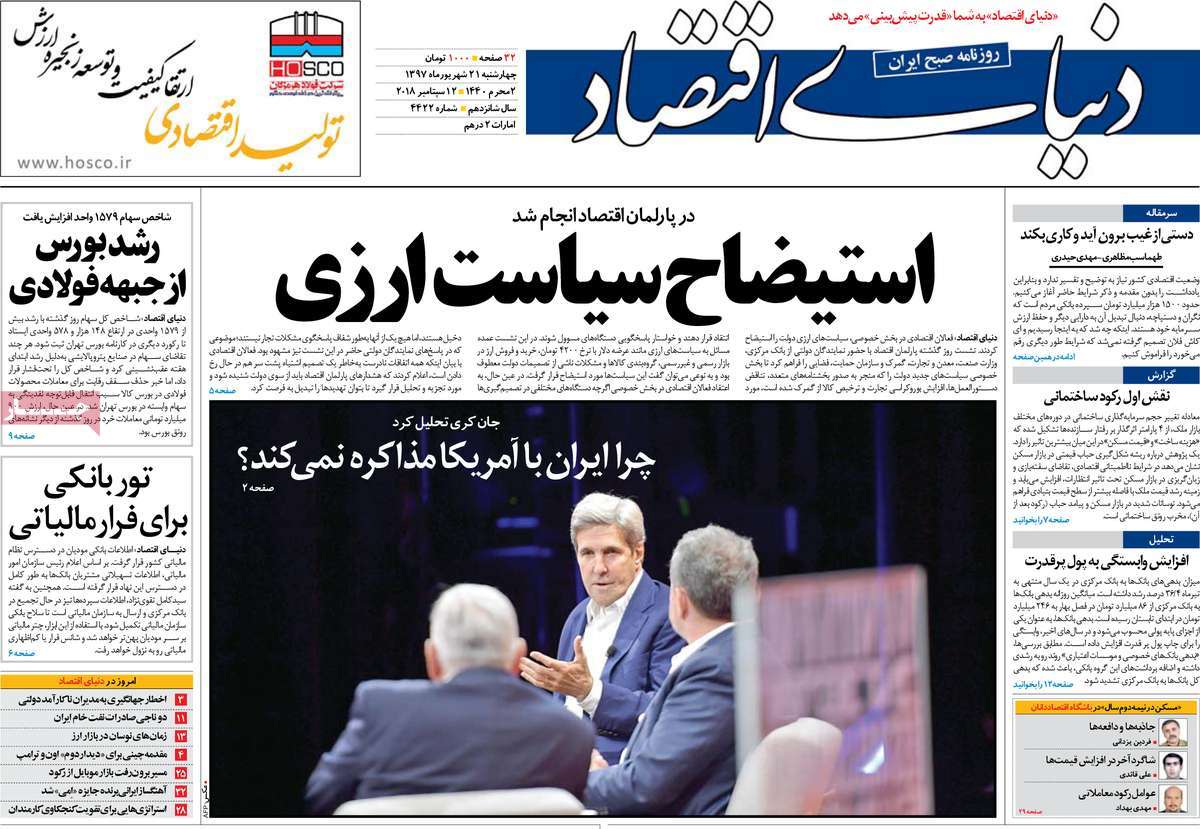
Donya-ye Eqtesad:

1- Kerry Explains Why Iran Doesn’t Fight against US

2- Government’s Forex Policy Questioned by Economic Parliament
A Look at Iranian Newspaper Front Pages on September 12


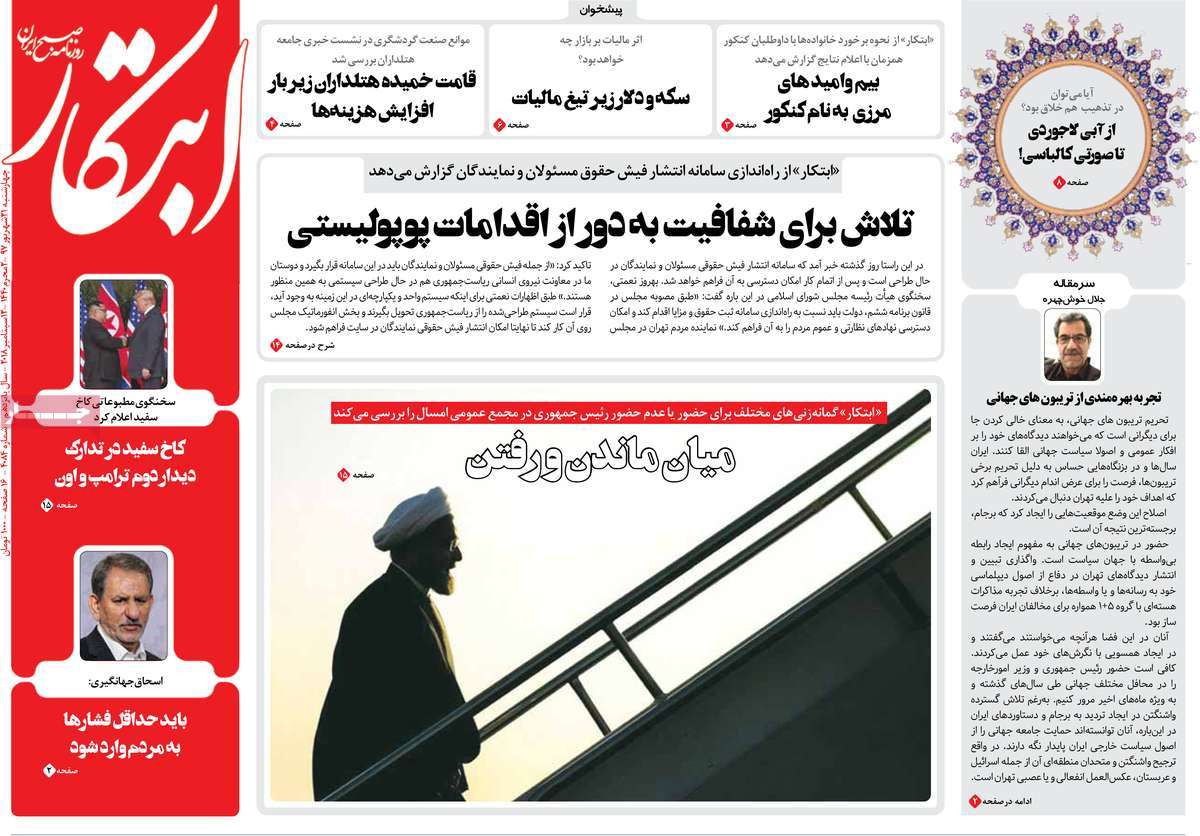
Ebtekar:

1- Dilemma of Staying or Going

  • Speculations Regarding Rouhani’s Participation in This Year’s UNGA

2- White House Preparing for Second Trump-Kim Meeting
A Look at Iranian Newspaper Front Pages on September 12


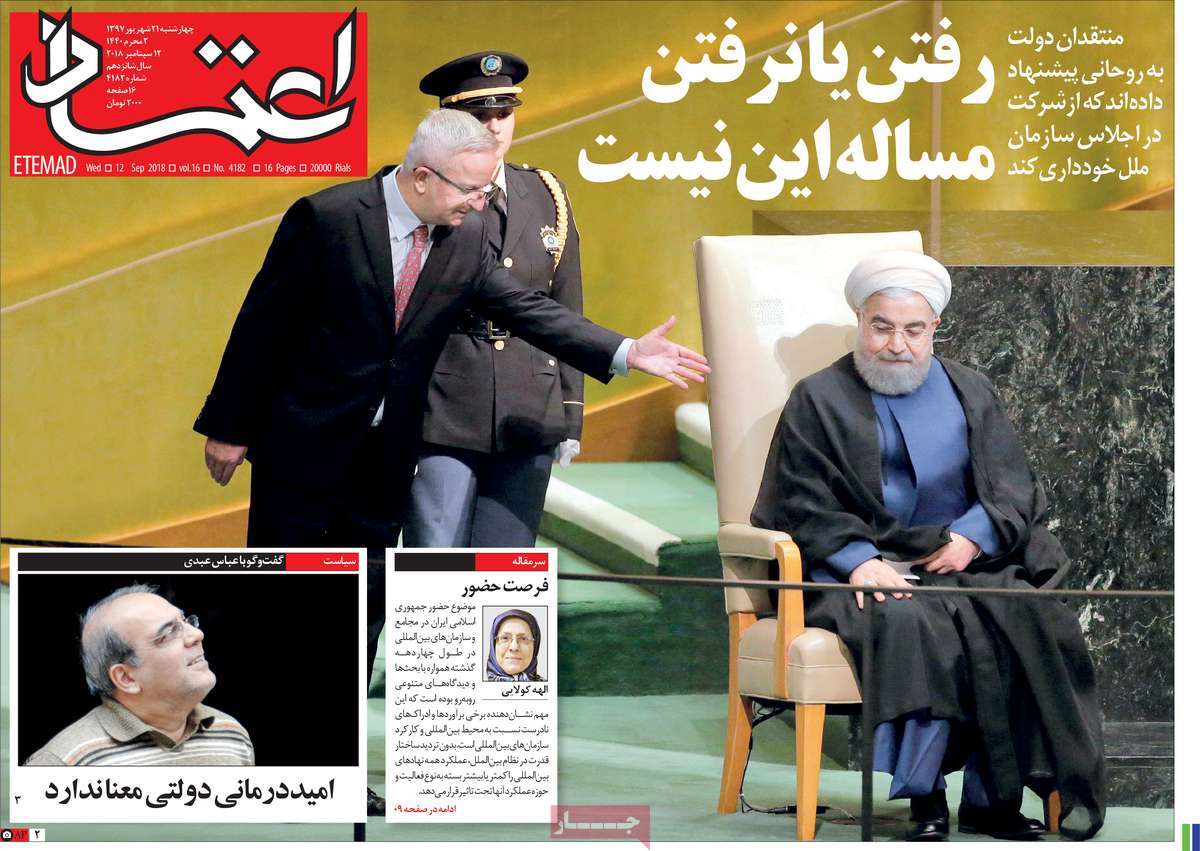
Etemad:

1- Rouhani’s Critics Asking Him to Boycott UN General Assembly

2- Reformist Figure: Government’s Efforts to Increase People’s Hope Meaningless
A Look at Iranian Newspaper Front Pages on September 12


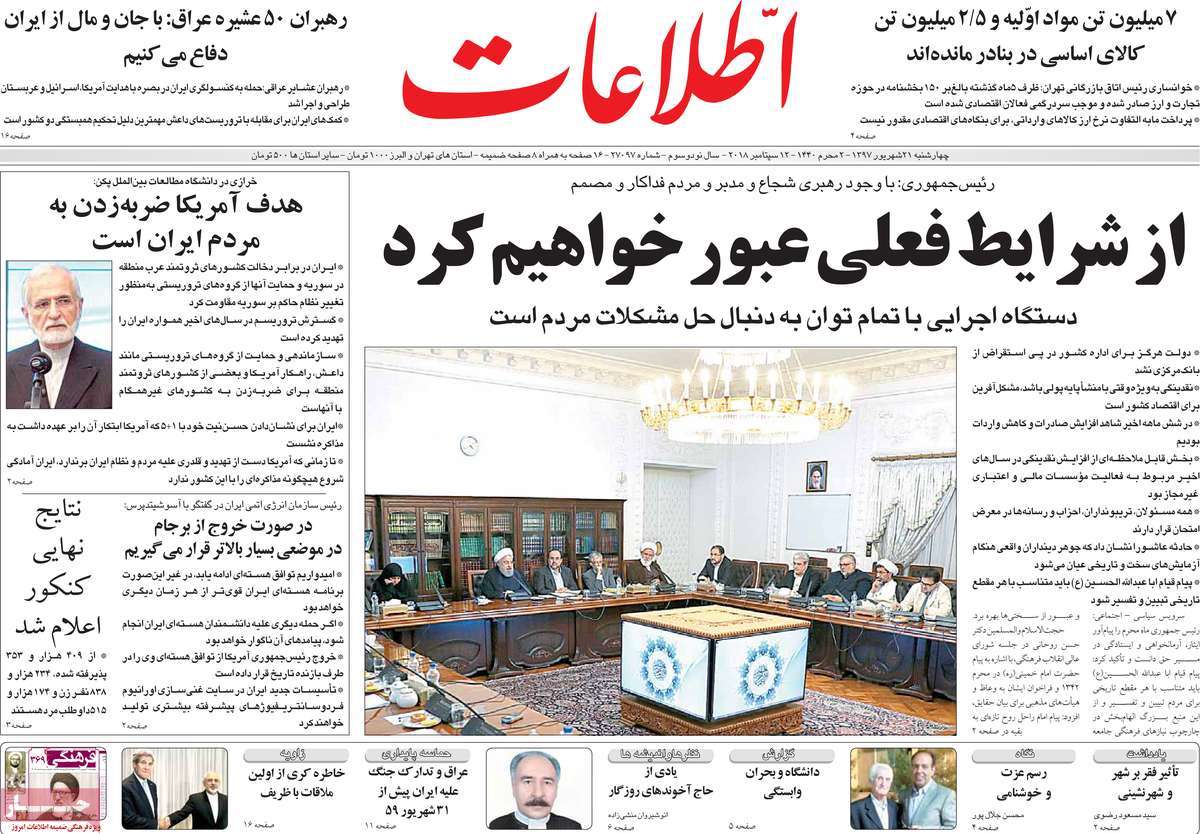
Ettela’at:

1- Rouhani: We’ll Overcome Current Situation Thanks to Our Brave Leader, Patient People

2- Iranian Diplomat in Beijing: US’ Aim Is to Harm Iranian Nation

3- Leaders of 50 Iraqi Tribes: We’ll Defend Iran Wholeheartedly

4- Iran’s Nuclear Chief to AP: We’ll Be in Much Higher Position If We Withdraw from JCPOA
A Look at Iranian Newspaper Front Pages on September 12


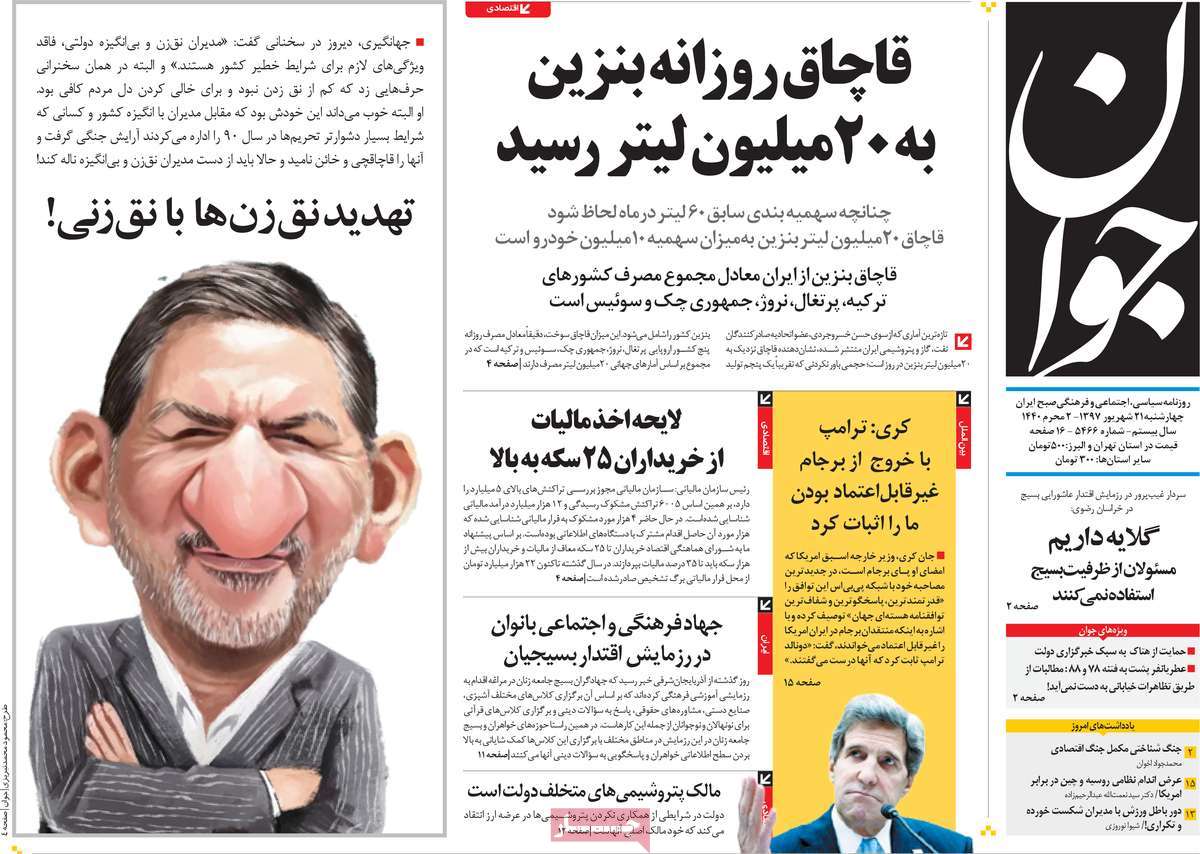
Javan:

1- 20 Million Litres of Petrol Smuggled Every Day

2- Kerry: Trump’s Withdrawal from JCPOA Proved US Untrustworthy
A Look at Iranian Newspaper Front Pages on September 12


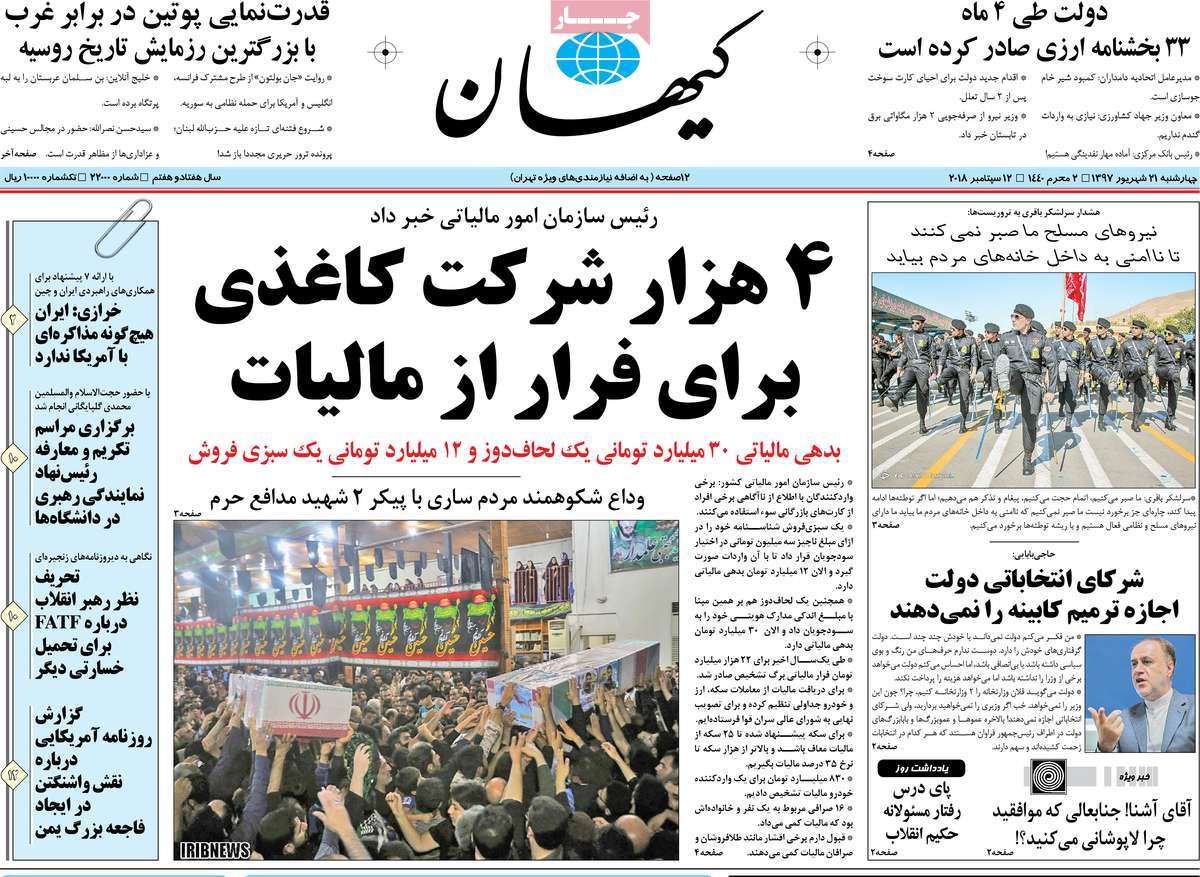
Kayhan:

1- Putin Shows Off His Power to West by Holding Russia’s Biggest-Ever Military Drill

2- Top General: Our Armed Forces Won’t Wait until Terrorists Bring Insecurity to Iran
A Look at Iranian Newspaper Front Pages on September 12


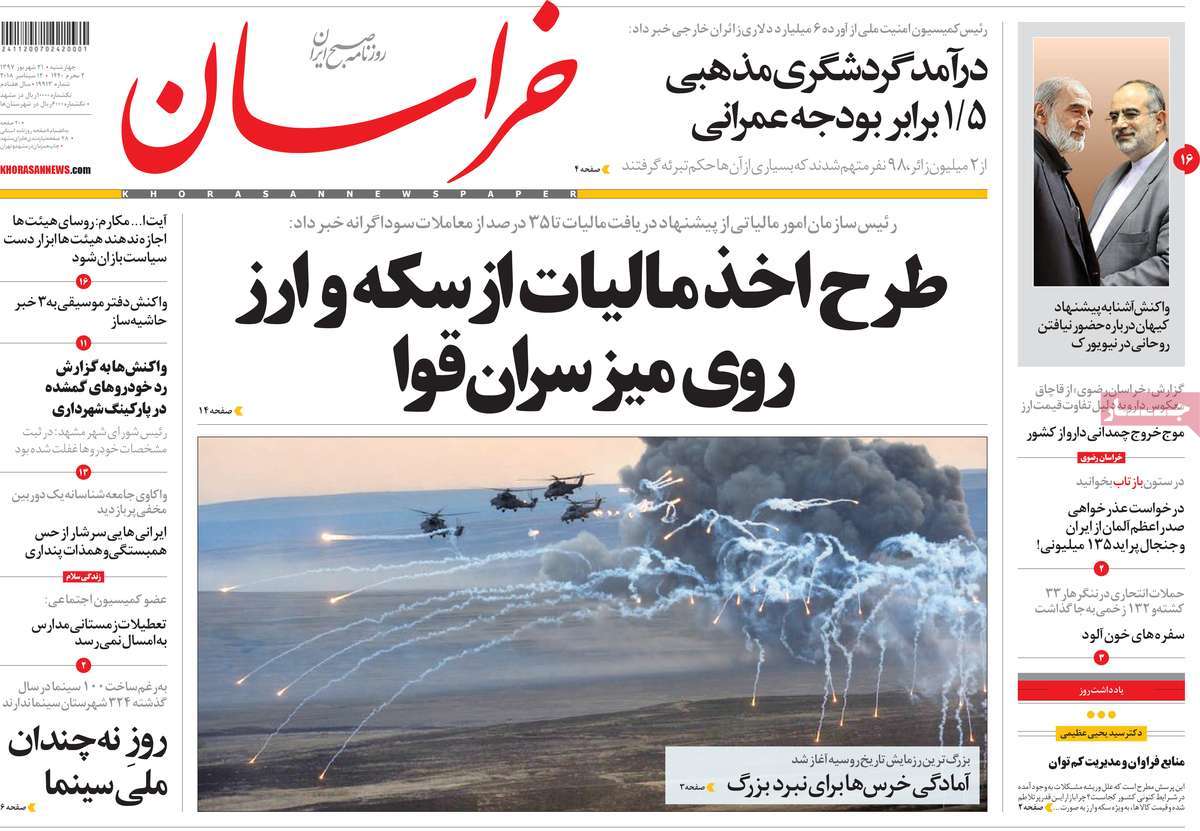
Khorasan:

1- Top Authorities Working on Plan to Receive Tax from Gold Coin, Forex Deals

2- Religious Tourism Income 1.5 Times Bigger than Construction Budget
A Look at Iranian Newspaper Front Pages on September 12


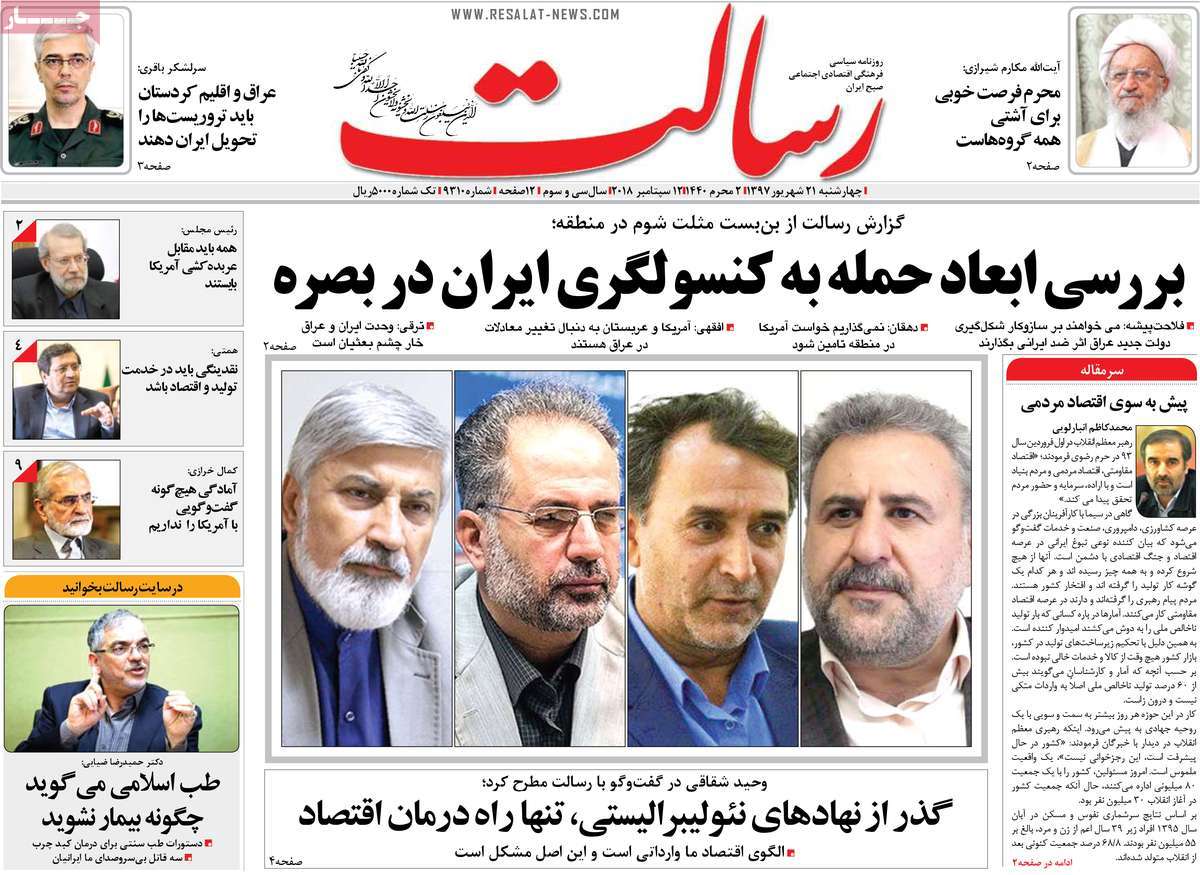
Resalat:

1- Review of Various Aspects of Attack on Iran’s Consulate in Basra

  • How Inauspicious Triangle of Mideast Failed

2- Leaving behind Neoliberal Bodies Only Way to Cure Iran’s Economy

3- Every One Must Stand against US’ Bullying: Parliament Speaker
A Look at Iranian Newspaper Front Pages on September 12


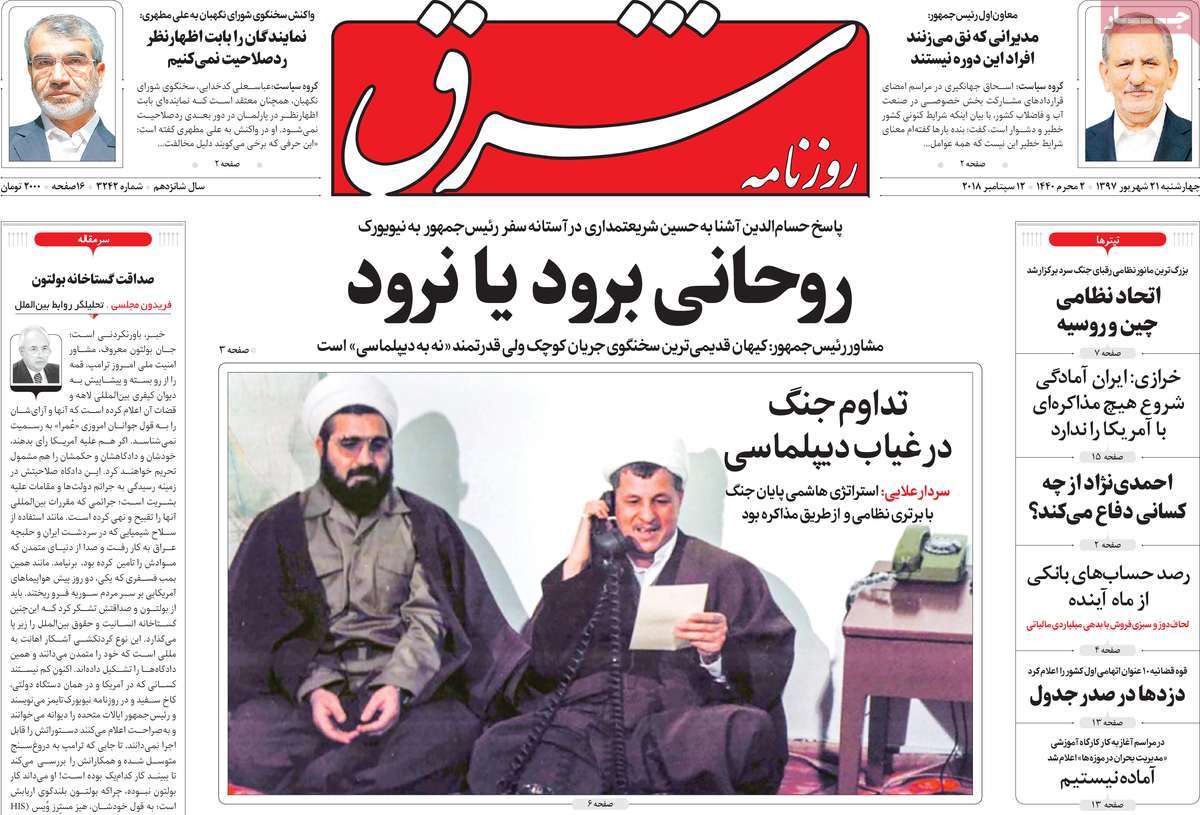
Shargh:

1- Military Alliance of China, Russia: Biggest War Games of Cold War Enemies Held in Russia

2- Bolton’s Impudent Honesty [Editorial]
A Look at Iranian Newspaper Front Pages on September 12


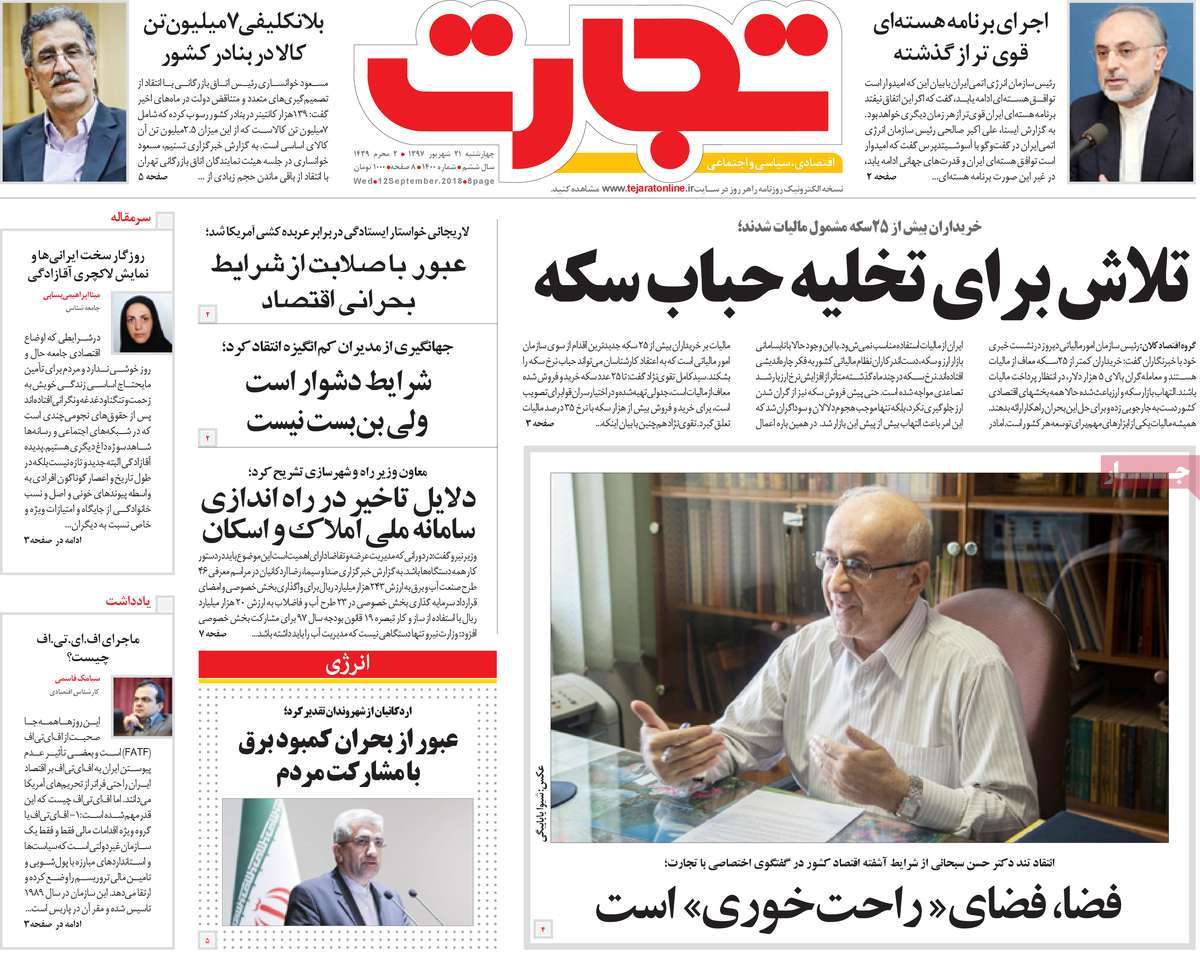
Tejarat:

1- Iran Nuclear Chief: Implementation of Nuclear Program Stronger than Before

2- Iran First VP: Conditions Difficult, but No Deadlock
A Look at Iranian Newspaper Front Pages on September 12


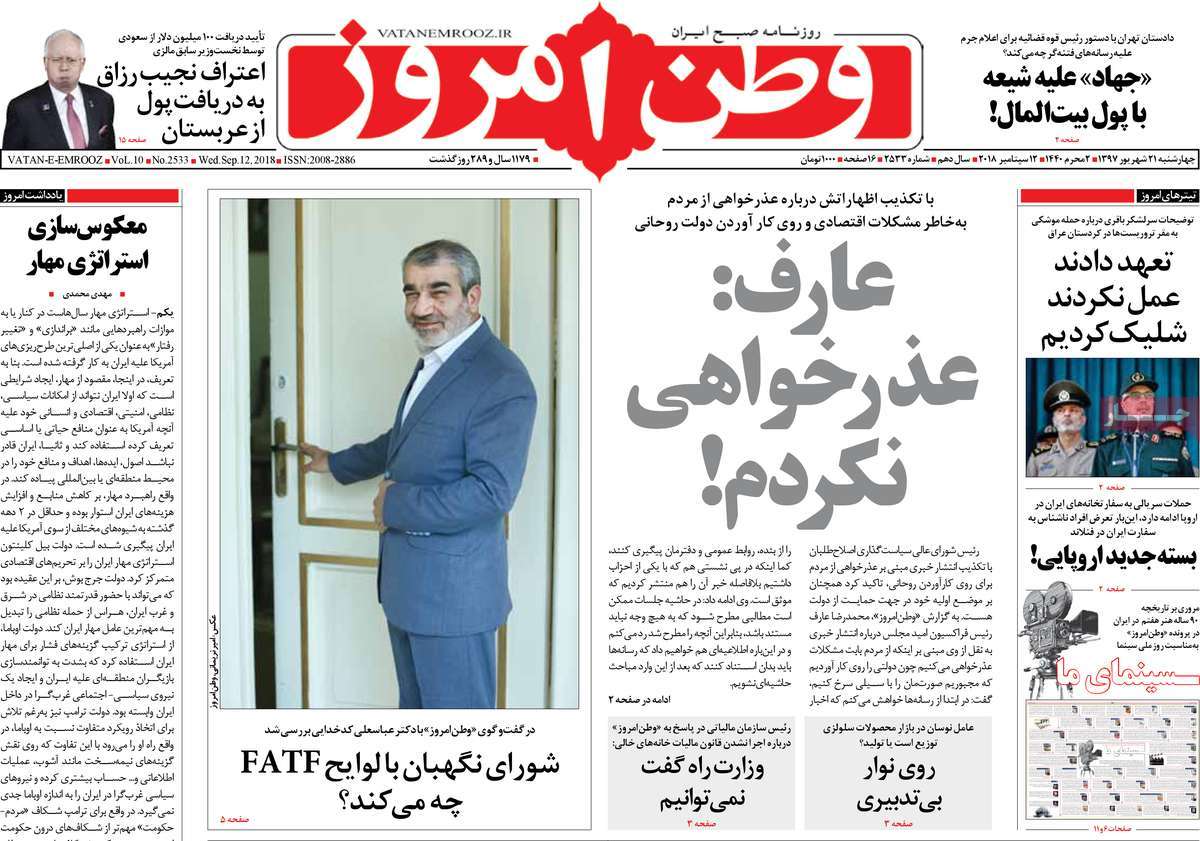
Vatan-e Emrooz:

1- Malaysia’s Ex-PM Najib Razak Admits He Has Received Money from Saudi Arabia
A Look at Iranian Newspaper Front Pages on September 12

Iran’s New Consulate in Iraq’s Basra Opens after Attack on Previous One

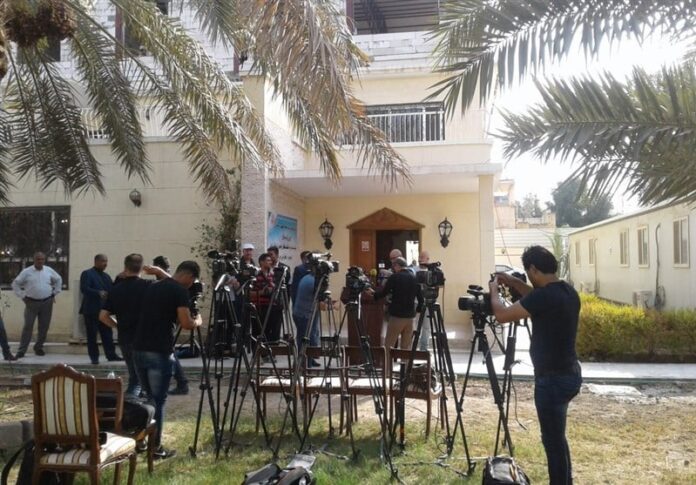
In a ceremony in Basra on Tuesday, Iran’s ambassador Iraj Masjedi inaugurated the new consulate’s building.

“I’m here to inaugurate the new premises of our Iranian consulate in Basra… because we don’t want lose a single day of services for the people of Basra,” AFP quoted Masjedi as saying.

The Iranian flag was also hoisted at the site of the new consulate in a ceremony attended by Iraqi officials and journalists.

On September 7, a mob of angry protestors stormed into the Iranian consulate in Basra, destroyed the diplomatic mission’s properties, took down the flag of Iran and torched the building.

The consulate’s building was not the first to be set on fire. The angry demonstrators had earlier set government buildings ablaze as well. The buildings included the headquarters of the local government, the ruling Dawa Party, the Supreme Islamic Council and the Badr Organization.

Suicide Attack on Afghan Demonstrators Kills 68, Wounds 165

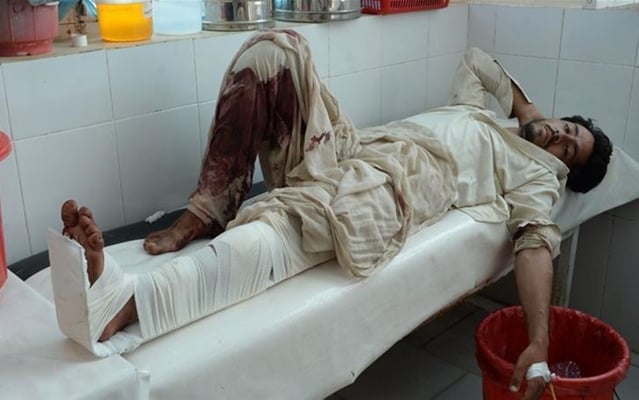
Medical staff have struggled to treat people wounded by the powerful blast in Nangarhar province on September 12, 2018 / Photo by AFP

Scores of demonstrators had blocked the highway between the provincial capital Jalalabad and a key border crossing with Pakistan, when the bomber struck.

The protesters had come from Achin district to demand the removal of a local police commander.

The attack was one of the worst in Afghanistan for months but security officials have warned that similar attacks are likely if crowds gather for campaign rallies ahead of parliamentary elections in October

“… the explosion happened and I found myself surrounded by blood and flesh,” Zar Khan, one of the injured, told AFP news agency.

The deadly suicide attack came hours after multiple bombings targeted schools in Jalalabad.

One blast went off at the entrance of Malika Omaira girls’ school in the morning, killing a 14-year-old boy and wounding four other people. It was followed by two explosions in Behsud district, also near two schools.

Afghan President Ashraf Ghani condemned the suicide attack, as well as the school bombings in Nangarhar.

In a statement he said that “attacks on civilian facilities, mosques, women, children, are all crimes against humanity”.

The Taliban denied any involvement in the attacks and no other group claimed responsibility for the violence.

Nangarhar has been a main stronghold of ISIS fighters since early 2015.

US’ Threats against ICC Reveal Its Double Standards on War Crime

Political analyst Ali Korram has, in an analytical piece published in Arman-e Emrooz daily newspaper, weighed in on the White House’s double-standard approach vis-à-vis the issue of war crimes. The Full text of the article follows.

The Hague-based International Court of Justice (ICC) is an age-old legal entity. When the United Nations was formed, it chose the ICC as its legal and statutory arm.

Since then, the rulings of the tribunal have always been respected and not been contested by any institution or country. In other words, the verdicts issued by the court should be so precise that cannot be criticized or faulted. Therefore, the ICC’s rulings have been used as a legal yardstick in international relations so far.

The only place where the tribunal’s verdicts may be thrown out is at the United Nations Security Council (UNSC) with the consensus and unanimous decision of the five permanent members of the council plus its non-permanent members only for one purpose: international peace and security. If an ICC ruling jeopardizes international peace and security for some reason, then the verdict can be suspended upon the UNSC’s order.

Therefore, as it can be seen, the tribunal’s rulings are so strong that are reviewed only in cases where international peace and security come into play. Only in such cases may the court’s verdict be temporarily suspended or set aside.

Now, the performance of US President Donald Trump and his radical associates such as John Bolton should be studied. In a recent speech, Bolton threatened to slap sanctions on the ICC and its 15 judges and block the tribunal’s access to its bank accounts in the United States and any transactions between the court and other banks taking place through the US if the ICC investigates the United States’ war crimes in Afghanistan. This is probably the first time in history that a country is interfering with the ICC’s independence of opinion.

Throughout the past 73 years since World War II and even during the era of the League of Nations and before the ICC came into existence, the importance of the tribunal has been due to its independent rulings. Accordingly, this is the first time a country lays claim on the court’s verdict, and that every country itself is unfortunately the custodian of the UN Charter.

That means the disaster that the United States is bringing about with regards to the court cannot be forgiven or condoned whatsoever. If America’s war crimes in Afghanistan are true, then Afghan people are entitled to having an independent international authority look into the crimes. Nevertheless, the US government, which has committed war crimes in Afghanistan, is officially blocking the ICC’s work and, even worse, has threatened the tribunal.

If the US’ war crimes in Afghanistan are not to be probed, then why is it that Washington is so sensitive and makes so much fuss about war crimes in Syria? International conscience says war crimes should be investigated, be it in Syria, Yemen, Myanmar or Afghanistan. It doesn’t matter which country has committed the crime. The perpetrator should be introduced as the guilty party.

Didn’t the US roll up its sleeves and prosecute and hold tribunals for leaders of former Yugoslavia for war crimes in Bosnia and Kosovo? Didn’t Washington call for them to be tried and face justice? Didn’t the US hold a tribunal in Nuremberg to prosecute Nazi Germany after the World War II? Didn’t the US try leaders of the Nazi Party at that court?

As you see, the United States has actively taken action to investigate war crimes over the past 73 years, but, shamefully enough, is threatening unbiased ICC judges with sanctions and questioning the ICC’s independence of opinion.

If it happens, the United States – at least the US under Donald Trump – has no right to express its opinion about war crimes in Syria or any other place and call for other countries’ leaders to stand trial.

Iran, Turkey, Russia Discuss Formation of Syria Constitutional Committee

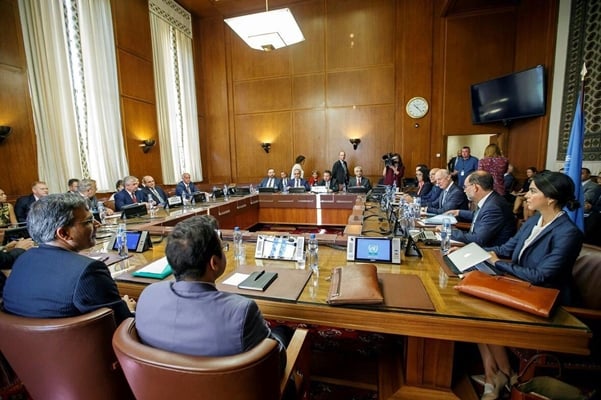
In the Tuesday meeting, Hossein Jaberi Ansari, Alexander Lavrentiev and Sedat Onal, the top negotiators of Iran, Russia and Turkey in the Syria peace process, and UN Special Envoy for Syria Staffan de Mistura discussed the constitutional committee.

The participants discussed progress in the political process to settle the Syrian conflict, particularly the formation of the constitutional committee and stressed the following points:

  1. The political process must be intra-Syrian and the integrated national sovereignty of Syria must be protected.
  2. The composition of the committee must be acceptable to various sides and should be based on the facts on the ground in Syria.
  3. All issues and details regarding the constitutional committee will be agreed upon as a single package.
  4. Considering the sensitivity of issues and the consequences of the multi-year crisis in the country, making arrangements for formation of such a constitutional committee is time-consuming. But all sides stressed on the need for paying attention to both the speed and quality of the process.

In the meeting, the representatives of the three guarantors of the peace process in Syria agreed to create a working group comprising their experts to prepare the ground for consultations with the UN to facilitate the creation of the constitutional committee. They also agreed to start the third round of consultations late October.

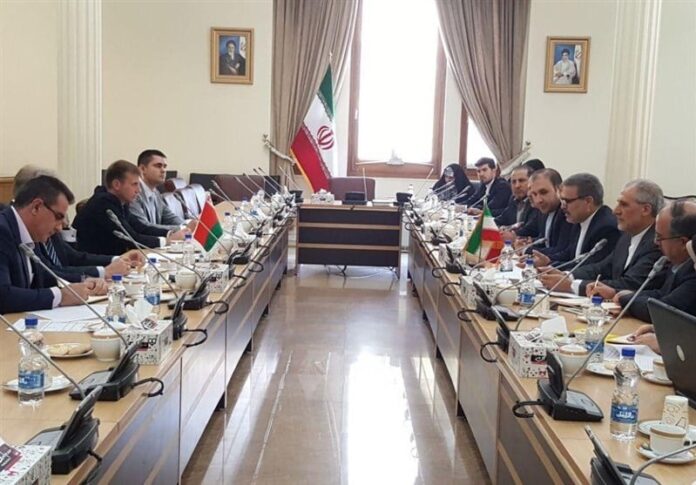
Tehran Hosts Fresh Round of Iran-Belarus Consular Talks

In the meeting held in Tehran on Monday, the Iranian and Belarusian delegations hailed the progress in visa facilitation, judicial cooperation, the transfer and extradition of convicts, the fight against illicit drugs and organized crimes.

They also stressed the need to completely implement previous agreements reached between Tehran and Minsk.

During the session, the two sides also discussed cooperation in establishing more facilities for legal, easy and safe travel for citizens of the two countries.

Back in June, Iranian President Hassan Rouhani met with Belarusian President Alexander Lukashenko on the sidelines of the Shanghai Cooperation Organization (SCO) summit in China.

“Belarus has always been a friendly country for Iran and Tehran is ready to strengthen economic and business relations (with the country), especially in scientific and modern technology fields,” Rouhani said at the meeting on June 9.

Iran wants closer ties with Belarus, he said, adding that cooperation between the Islamic Republic and Eurasia would enhance the Tehran-Minsk relations.

Lukashenko, for his part, said his country is resolved to develop relations with Iran in all political and economic areas, adding that Tehran is a key regional partner for Minsk.

He further described as “wise” Iran’s stance on a unilateral move by the US to withdraw from the 2015 nuclear deal known as the Joint Comprehensive Plan of Action (JCPOA) and said taking unilateral actions and violating international obligations undermine international law.

In a unilateral move on May 8, US President Donald Trump announced his country’s withdrawal from the nuclear agreement between Iran and the Group 5+1 (Russia, China, the US, Britain, France and Germany).

Following the controversial decision, Rouhani said Iran weighs plans to remain in the agreement with the other five parties, provided that they ensure full benefits for Iran.

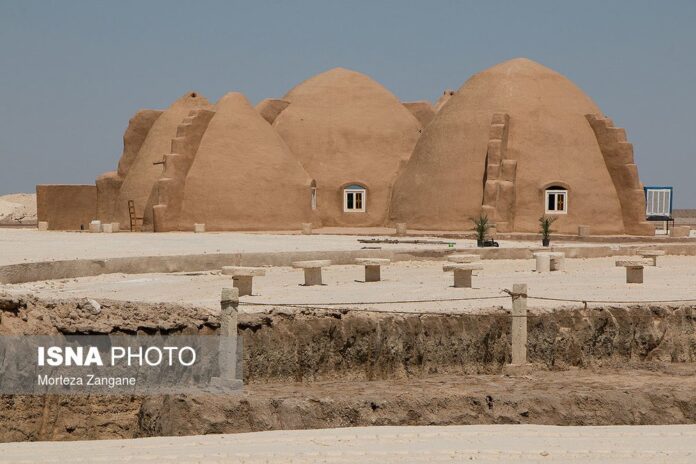
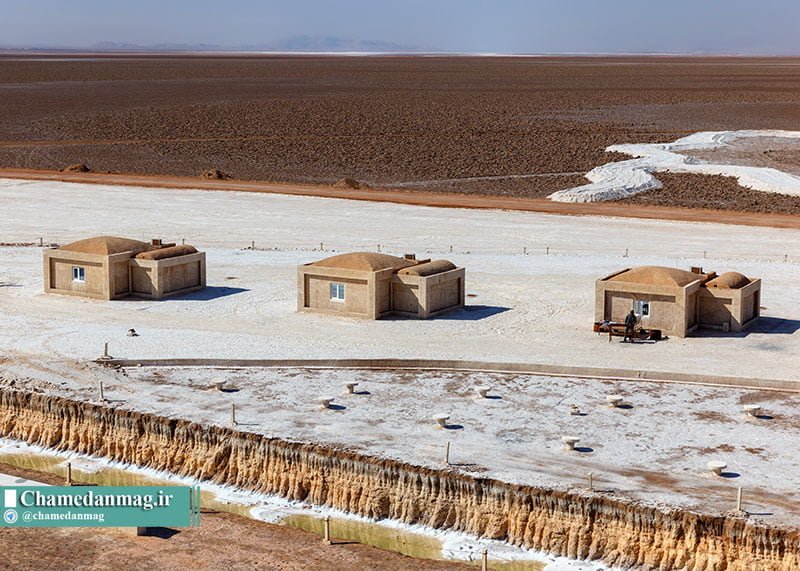
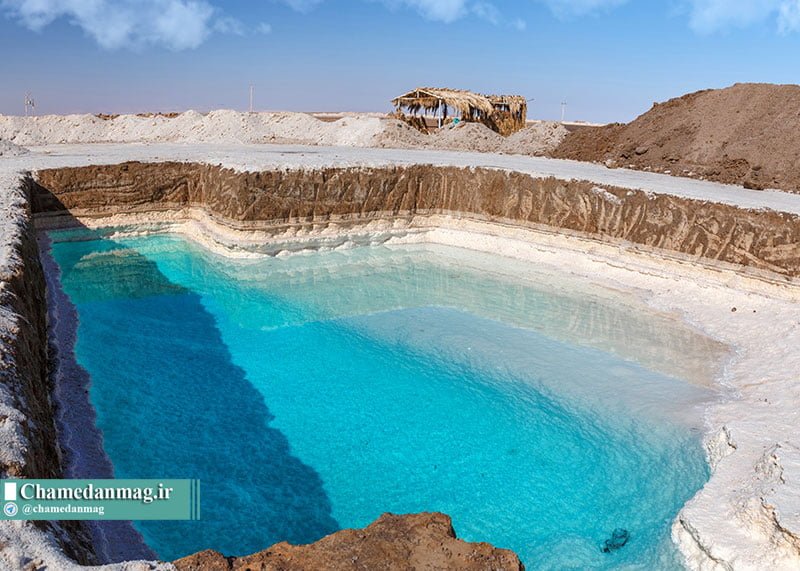
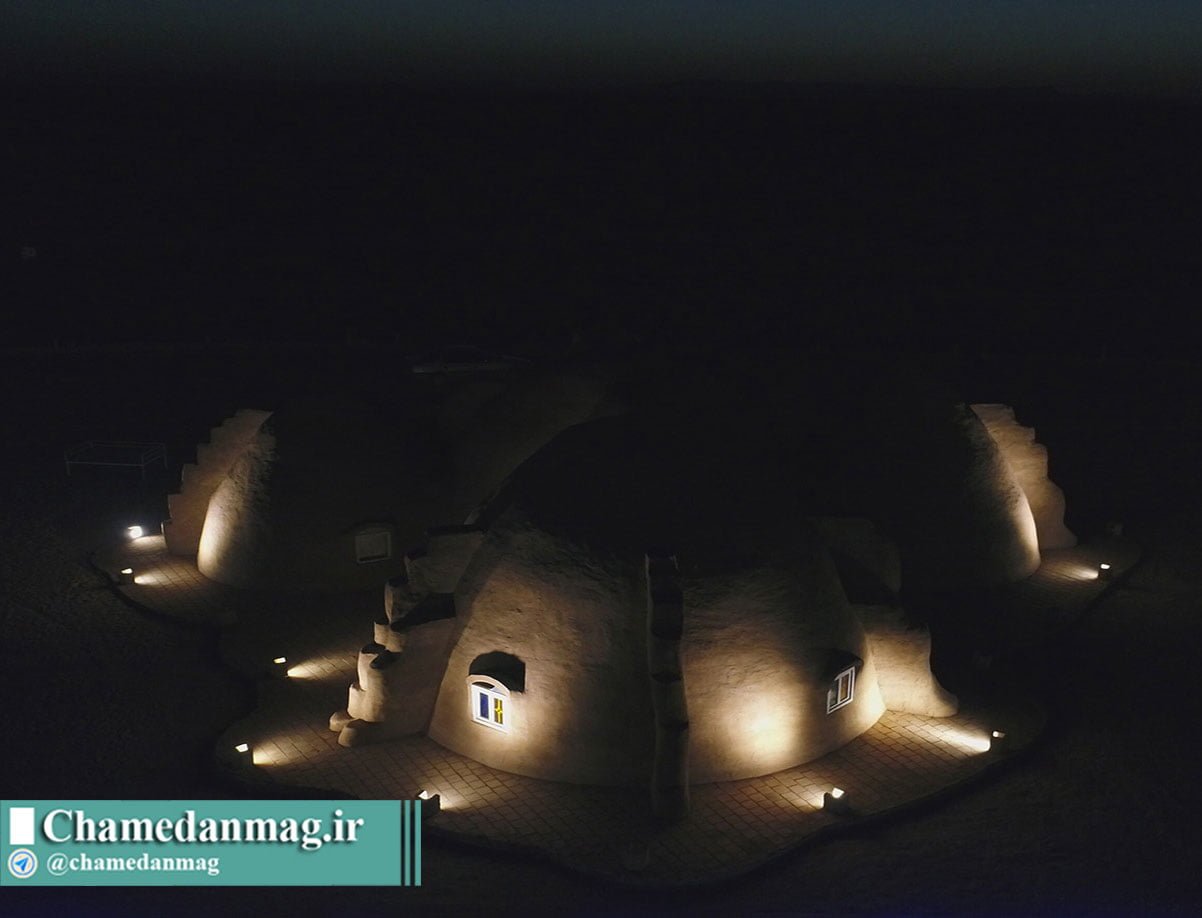
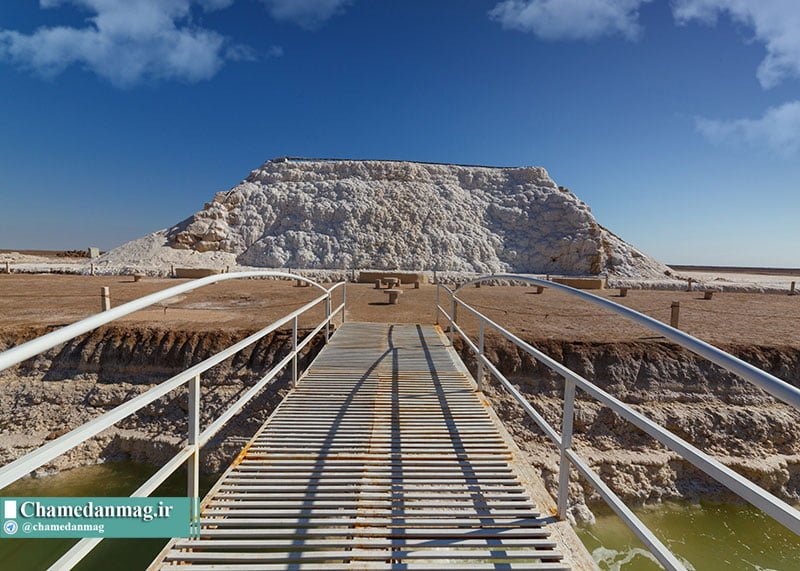
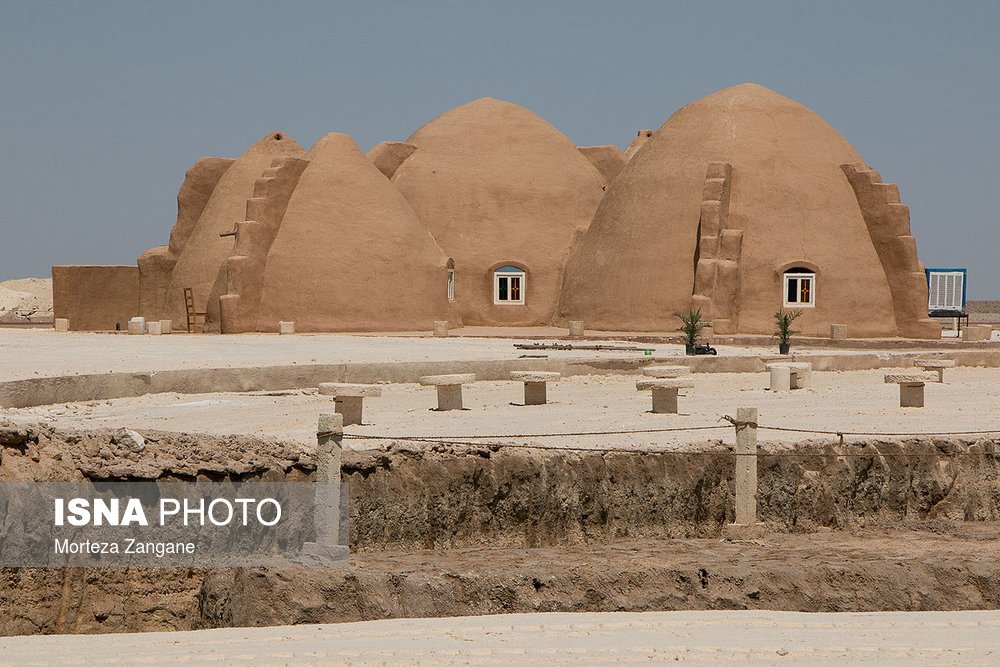
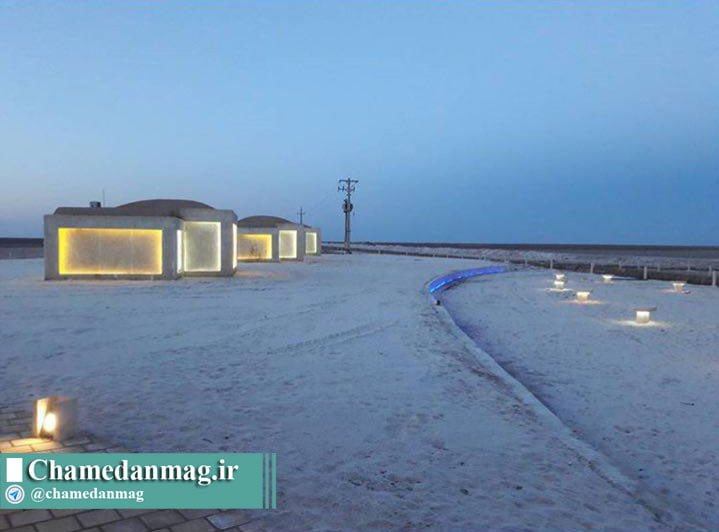
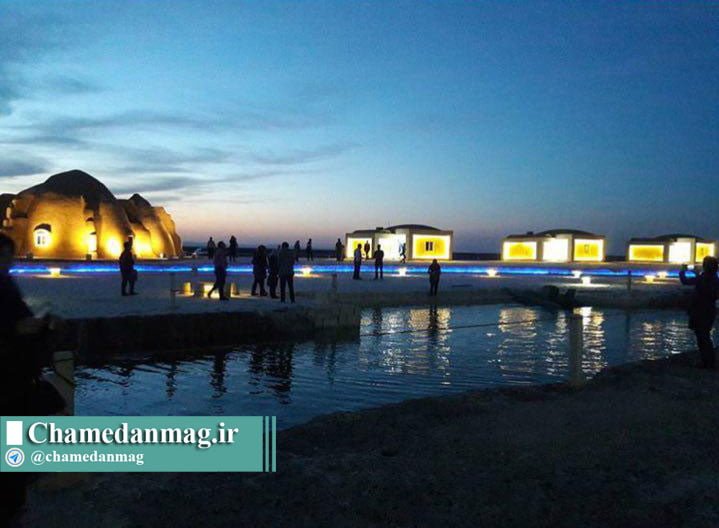
Potash Complex: Dreamy Residence in Heart of Iran Deserts

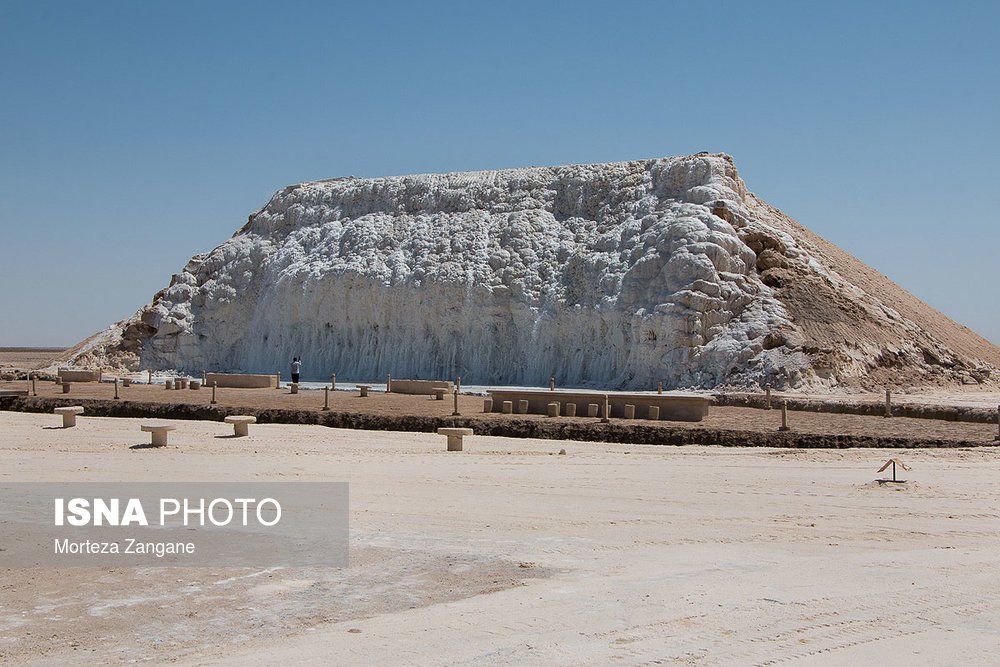
The complex has been established with the main goal of producing 50,000 tonnes of potassium chloride as fertilizer, 300,000 tonnes of sodium chloride for petrochemical, food and pharmaceutical uses and 30,000 tonnes of magnesium hydroxide.

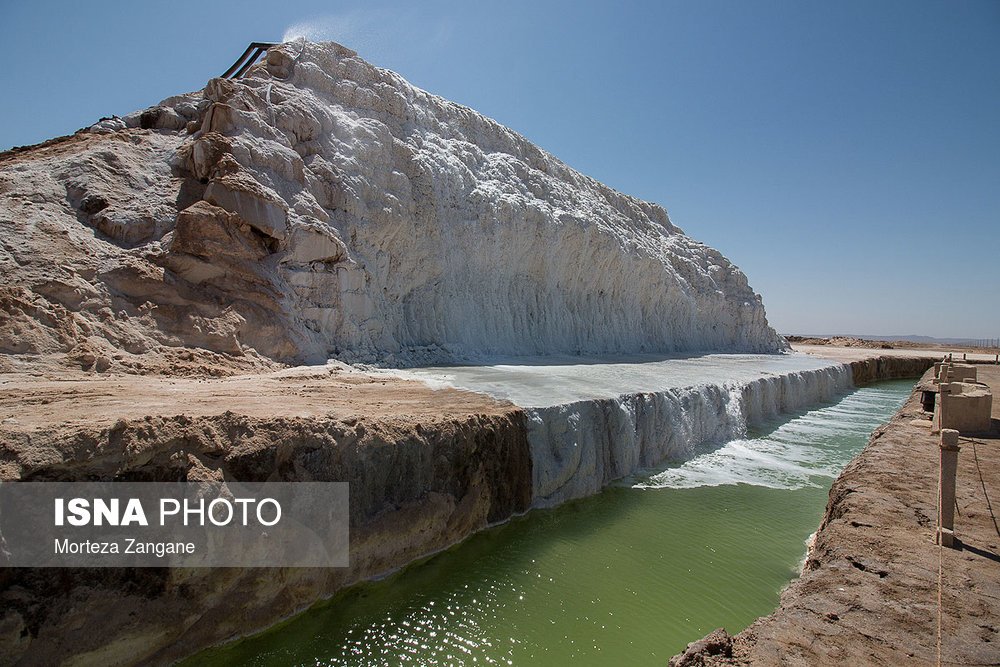
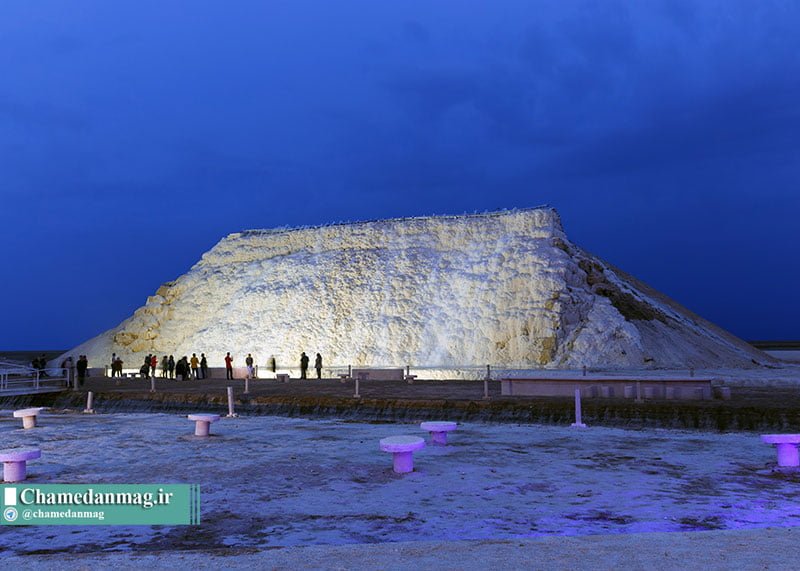
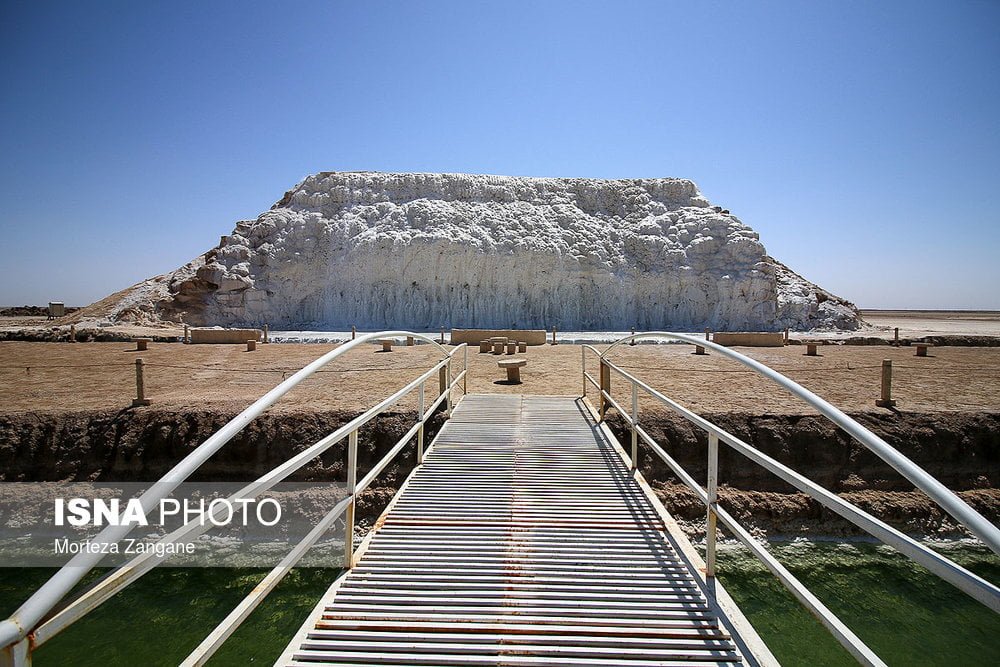
A large mine close to the complex is among the main tourist attractions for Iranian and foreign visitors. Just during the current Iranian New Year holidays, the complex attracted about 2,000 tourists to the region.

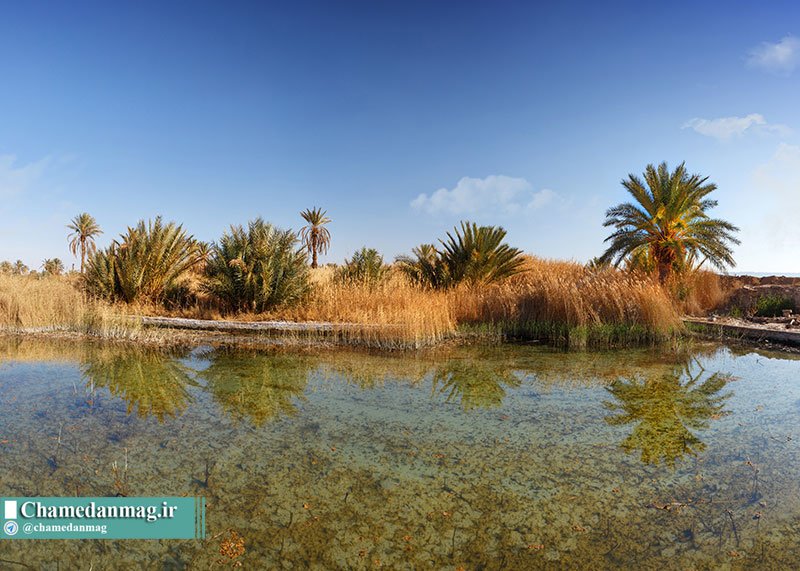
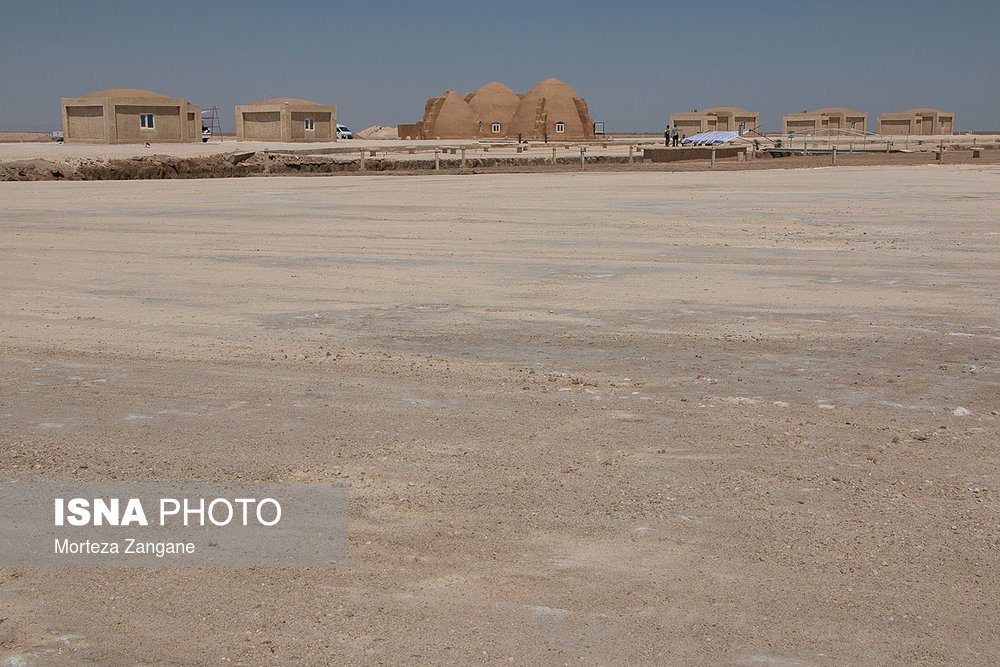
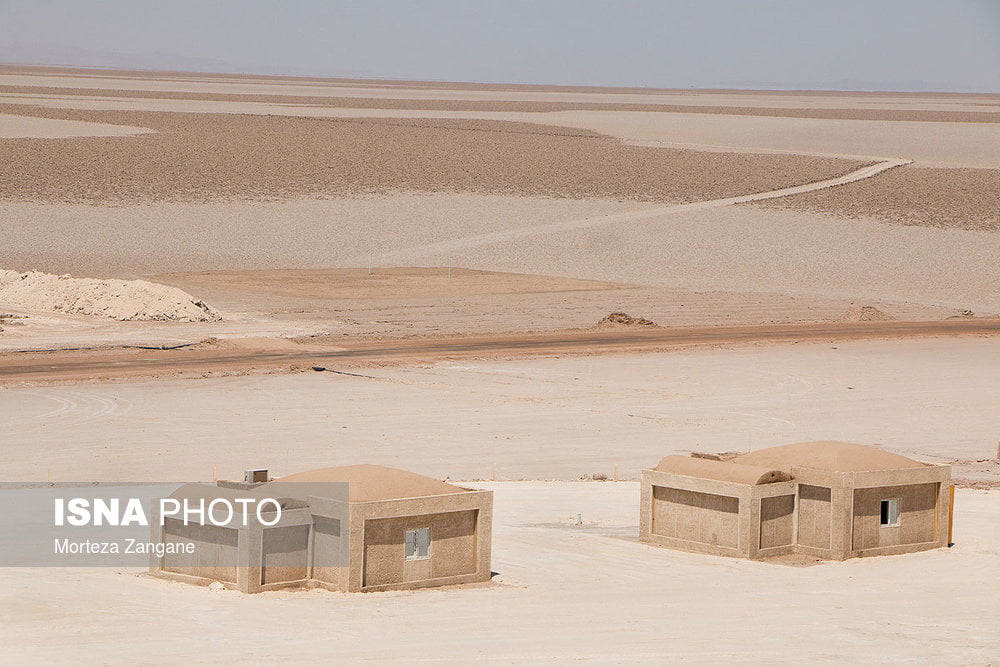
The complex is capable of contributing to mining and health tourism. It can also attract the interested visitors in the Dasht-e Kavir. It includes the Village of Salt, Potash Park and Kamal-Abad Farm.

Potash Complex: Dreamy Residence in Heart of Iran DesertsJoy of Drinking Coffee by Salt Ponds
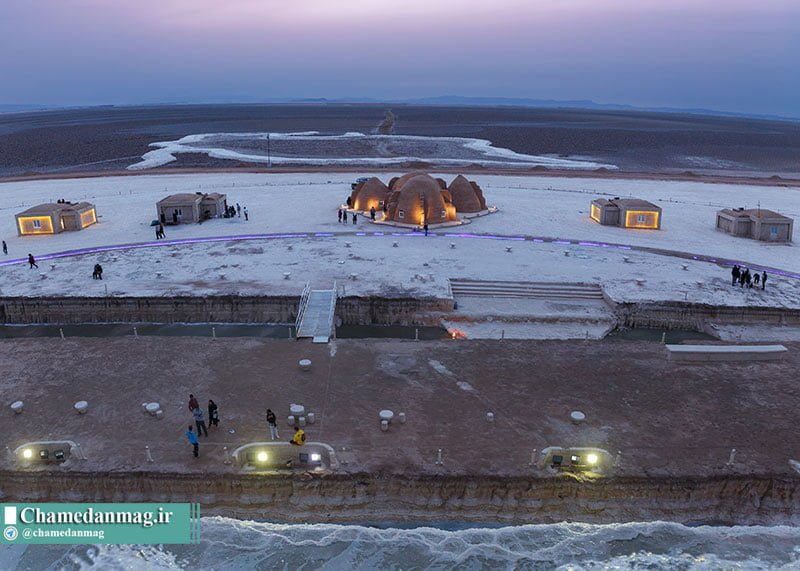
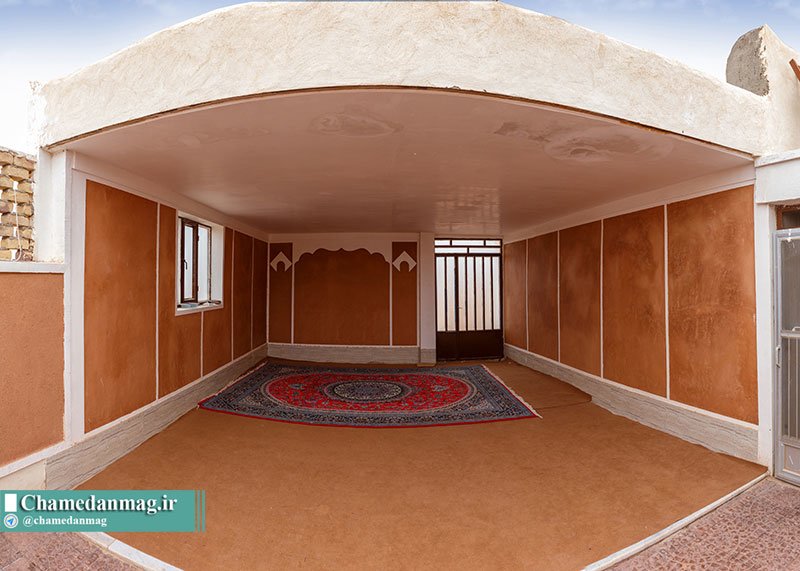
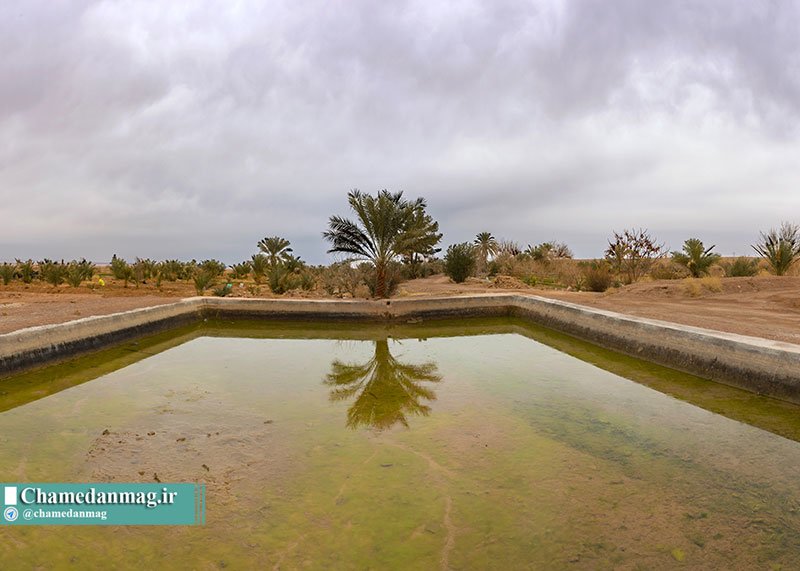
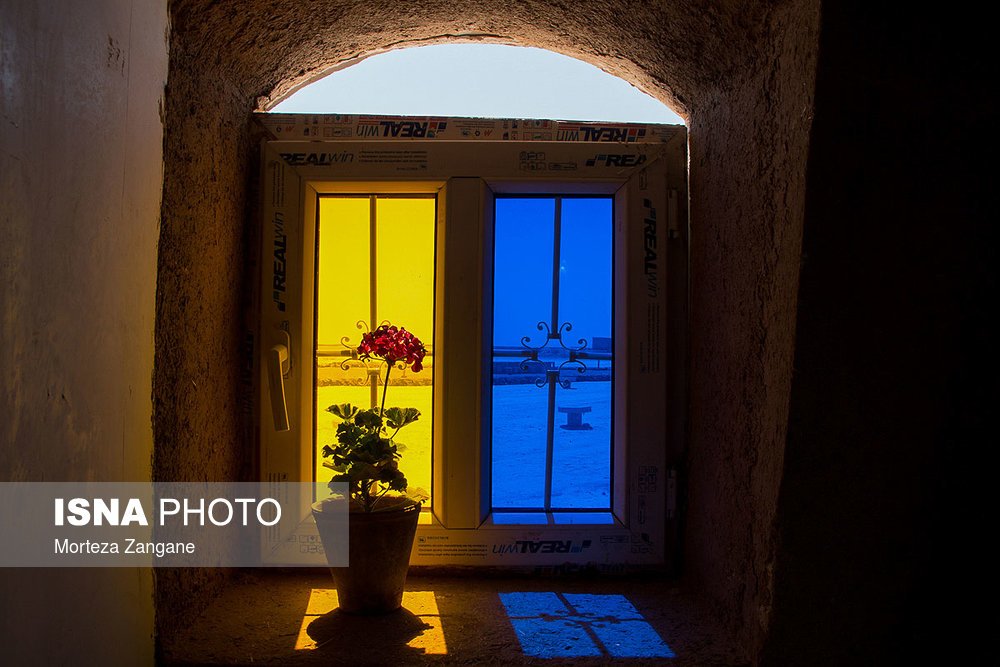
The complex, according to the organizers, seeks to promote mining tourism in the region. It is home to a salt cascade, which is 30 metres in height, and includes a handicrafts exhibition, an Ab Anbar (water reservoir), a number of recreational residential units and motels. Meanwhile, there are some farms, Nakhlestans (gardens of palm trees), a restaurant and a cafeteria, an observatory as well as a complex of pools, a track motorsports and an off-road track.

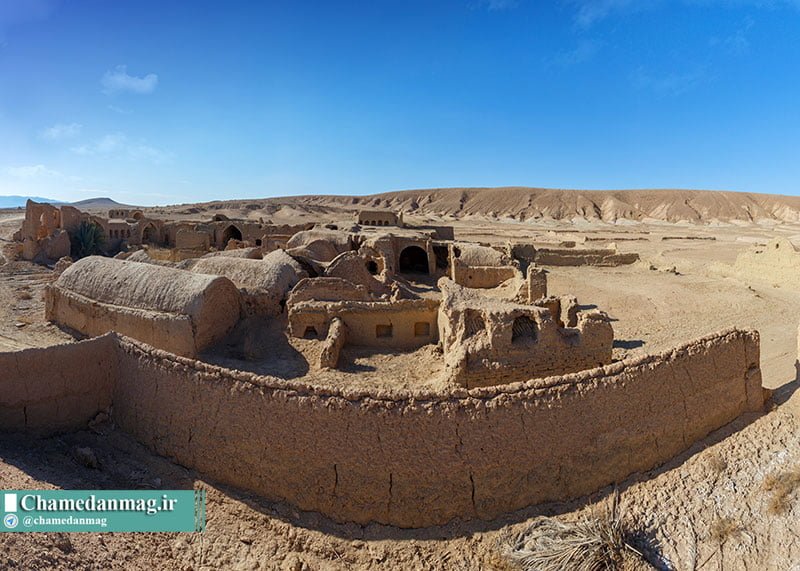
Kamal-Abad Farm with an area of 190 square metres includes 25 traditional homes as well as a number of farms and date gardens.

The complex is located 30 km away from Khur Biabanak, which has a population of about 20,000.

What follows are photos of the complex retrieved from various sources:

World Must Force US to Act Like Normal State: Iran FM

Iran Blasts Europe’s ‘Disastrous’ Subservience to US

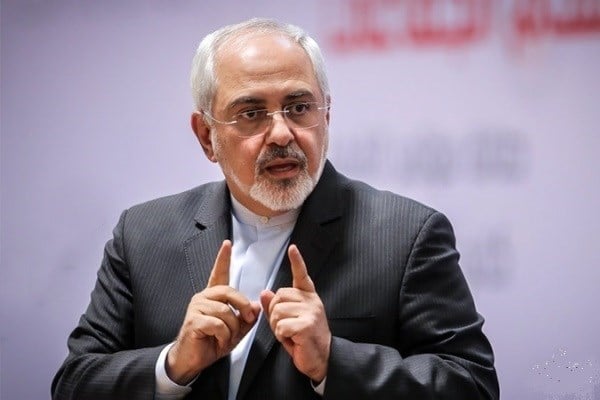
“The US threatens to impose sanctions on the ICC & even prosecute its judges in American courts. Where is the outrage?” Zarif said in a Tuesday tweet.

“The boorishness of this rogue US regime seems to know no bounds,” he added.

“When will the international community say enough is enough & force US to act like a normal state?” Zarif asked.

His comments came after White House National Security Adviser John Bolton threatened sanctions against International Criminal Court (ICC) judges who plan to probe alleged war crimes committed by Americans in Afghanistan, saying it constitutes an assault on US sovereignty.

Bolton on Monday branded the ICC in The Hague “outright dangerous” in an attempt to pressure the  court which is planning to investigate the alleged US war crimes.

“The United States will use any means necessary to protect our citizens and those of our allies from unjust prosecution by this illegitimate court,” Bolton told members of the conservative Federalist Society gathered at a Washington, DC, hotel.

He argued the court poses a threat to US sovereignty.

“In theory, the ICC holds perpetrators of the most egregious atrocities accountable for their crimes, provides justice to the victims, and deters future abuses,” Bolton said.

“In practice, however, the court has been ineffective, unaccountable, and indeed, outright dangerous,” he said.

The chief prosecutor of the ICC has called for a formal investigation into war crimes in Afghanistan following the US-led invasion of the country in 2001.

ATR to Replace Iran with Alternative Clients amid US Sanctions

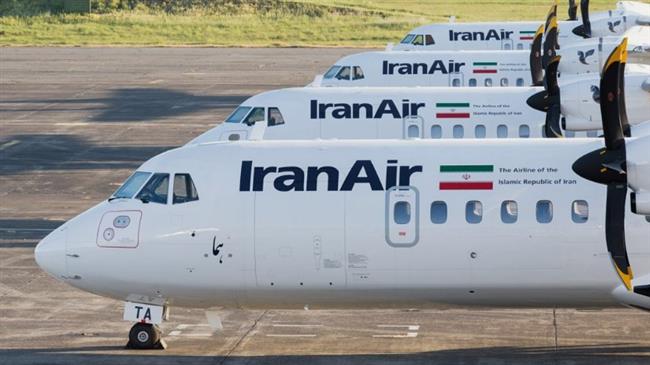
ATR has delivered 13 new generation ATR 72-600 aircraft ordered by Iran in 2016 but it has to secure licenses for further deliveries from the US which imposed new sanctions on the Islamic Republic last month.

The European airplane manufacturer delivered five more ATR turboprop aircraft early last month just before Washington installed the new sanctions on Aug. 6.

For more deliveries, however, the company appears to have given up on soliciting the United States, with Leonardo Chief Executive Officer Alessandro Profumo telling Bloomberg TV that ATR was seeking new customers for the aircraft.

“We are pretty confident that we will finalize the re-allocation to other countries by the end of this year,” he said.

The US decision on Iran has raised question marks over whether ATR can reach a target of stabilizing annual deliveries at 80 aircraft in 2018.

Profumo tried to play down the fallout, saying the company does not expect “any meaningful impact” from the US sanctions on Iran.

The planemaker had earlier said it would suffer financial damage if it were unable to deliver the aircraft it has already produced following earlier US approvals.

ATR’s co-owner Airbus has a deal with flag carrier IranAir for 100 commercial planes but it has delivered just three of them. Airbus said in July it would not attempt to deliver any more planes to Iran.

After the signing of a nuclear accord between Iran and other countries in 2015, IranAir ordered a total of 200 aircraft from Western planemakers. Boeing, which had sold 80 jets to IranAir, does not plan any deliveries.

The Europeans have been trying to portray the nuclear deal with Iran as a flagship achievement of their foreign policy and a symbol of their growing strength but their weakness in the face of US threats has undermined their bid.

Iranian officials have pressed the European Union to save the nuclear agreement through meaningful measures to guarantee Iran’s interests in the deal.

However, Leader of the Islamic Revolution Ayatollah Seyyed Ali Khamenei said last month that Iranian officials should stop pinning their hopes on Europe saving the international nuclear deal.

“There is no problem with continuing relations and negotiations with Europe, but hope should be abandoned regarding matters such as the nuclear deal,” he said in a meeting with President Hassan Rouhani and members of his cabinet.

Ayatollah Khamenei is the champion of a resistive economy which seeks to counter sanctions through increasing the country’s resilience to outside pressures by boosting domestic production.

Masghati & Cookie: Yummy Souvenirs of Shiraz

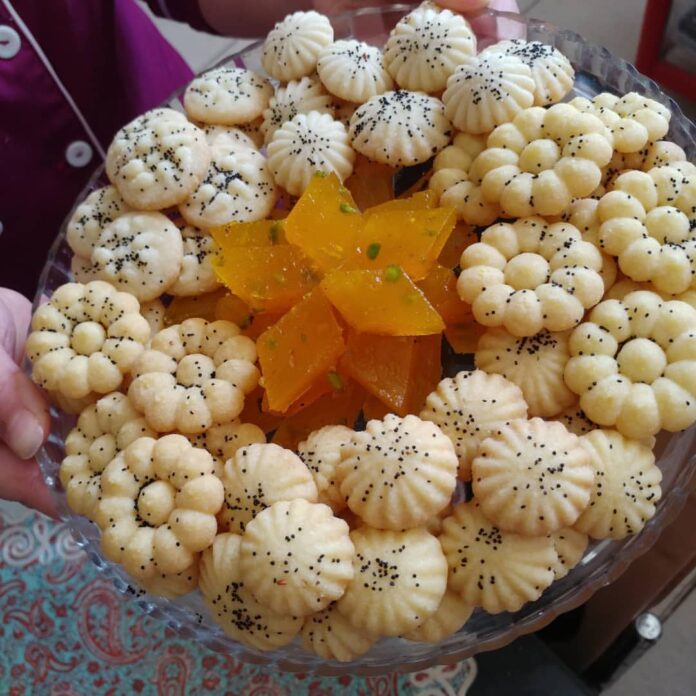
The “Art of Cooking Shirazi Masghati & Cookies” has recently been registered on the country’s List of Intangible Cultural Heritage.

Masghati is a delicious desert also used as confectionary. Masghati is the most famous souvenir of the provincial city of Larestan. So, it is also known as Shirazi or Lari Masghati.

With the ingredients mentioned below, you will be able to make Masghati for six people.

You may eat Masghati on its own or with cookies. In Fars province, it is usually eaten with cookies.

Ingredients for Cookies
Rice flour: 200gr
Solid cooking oil: 125gr
White flour: 50gr
Eggs: one egg
Rosewater: a quarter of a cupful
Powdered sugar: 80gr

Recipe
To make cookies, first mix rice flour, powdered sugar, white flour and eggs.

Then add solid oil and a little rosewater before mixing them well until you get a paste-shaped mixture. Pick a little of that and roll it into a ball-shaped piece before putting it on the tray. Then press it with a wooden stamp to get an embossed pattern. After that, put it in the oven and leave it there for 20 minutes at a temperature of 160 degrees.

Ingredients for Shirazi Masghati
Sugar: 300gr
Starch: 150gr
Butter: 125gr
Rosewater: half a glass
Cold water: 4 glasses
Lime Juice: 1 spoonful
Saffron: as much as necessary
Pistachio Slices: as much as necessary
Almond slices; as much as necessary

Recipe
First, mix starch with cold water until starch completely dissolves. You’d better sieve it to get a consistent mixture. Now, pour the mixture of water and starch into a casserole and put in on the flame. Use low temperature to keep Masghati from becoming too dry at the end. Now, add sugar and mix it with the water and starch in the casserole until it dissolves completely. At this point, brew some saffron and add it to the ingredients inside the casserole.

Keep beating the ingredients until the mixture becomes thick. After the starch becomes thick, add rosewater and butter and mix it well. Now, oil the inside walls of the mould which is to be used for Masghati. We need to oil the mould to make it easier for Masghati to come off after it gets cold. Then pour the mixture into the mould and put some pistachio and almond slices on it and put it in the refrigerator for one hour to become hard.

After Masghati becomes hard, we get it off the mould, cut it into small pieces (usually cut into rhombus-shaped pieces) and put it in the plate. Msghati can be used both as dessert and confection.

Masghati & Cookie: Yummy Souvenirs of Shiraz