Monday, December 22, 2025
Home Blog Page 3265

Iran to Avenge Terrorist Attack on IRGC Forces

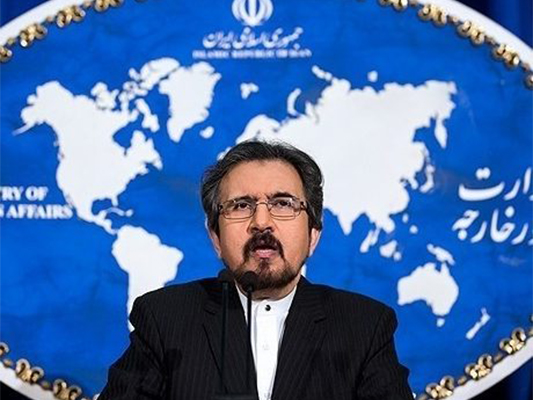
In a Wednesday statement, Qassemi offered sympathy to the families of the victims and those injured in the tragic incident.

He condemned the inhumane attack by the terrorist group that claimed responsibility for it, and said the group receives military, financial, and intellectual support from certain regional states.

Such inhumane attacks will just make the Iranian nation and government more determined to continue its fight against terrorism in the region, he noted.

Qassemi also vowed that Iranian intelligence and military forces will definitely take revenge for the blood of the incident’s martyrs.

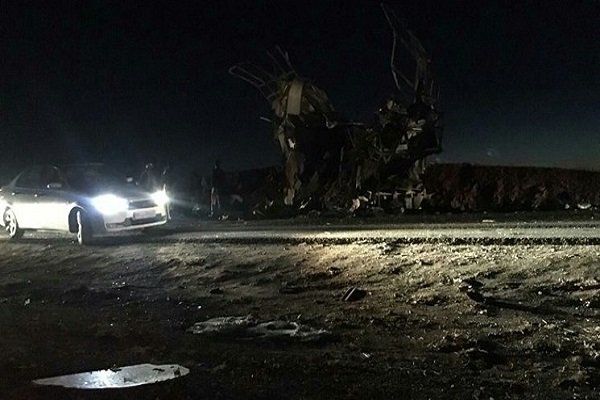
A suicide attack by Pakistan-based Takfiri elements on a bus carrying Iranian border guards in Iran’s Sistan and Baluchestan province has killed and wounded dozens of IRGC forces.

The attack, claimed by the so-called Jaish ul-Adl terrorist group, targeted the bus carrying IRGC border guards travelling between the cities of Zahedan and Khash in south-eastern Iran.

At least 27 have been killed and 13 other wounded in the blast.

The IRGC’s Quds Headquarters said in a statement that an explosive-laden car rammed into the bus, which was taking the personnel back to their homes.

Following the deadly attack, the governor-general of Sistan and Baluchestan declared three days of mourning.

Foreign Ministry Explains Why Iran Not Invited to FATF Meeting

Iran Appoints Female Ambassador to Denmark

“The Islamic Republic of Iran is not a member of the FATF council or an official member of the regional groups affiliated to it,” Qassemi told ISNA on Wednesday.

“That’s why the country has never been invited to attend the body’s regular official meetings,” he added.

He referred to the reports of Iranian delegations’ participation in the FATF’s previous meetings, and said expert delegations from Iran previously attended the body’s unofficial expert meetings and panels, which are usually held one month earlier, in order to technically review the situation of Iran’s accession within the framework of the FATF’s agenda.

“In the absence of the technical agenda, such a meeting has not been held,” Qassemi added.

27 Killed in Terrorist Attack on Iranian Border Guards’ Bus

The attack, claimed by the so-called Jaish ul-Adl terrorist group, targeted the bus carrying IRGC border guards travelling between the cities of Zahedan and Khash in south-eastern Iran.

At least 27 have been killed and 13 other wounded in the blast.

The IRGC’s Quds Headquarters said in a statement that an explosive-laden car rammed into the bus, which was taking the personnel back to their homes.

Following the deadly attack, the governor-general of Sistan and Baluchestan declared three days of mourning.

Iran Signs MoU with Russia, Kazakhstan for Free Trade

The document was signed in Moscow Tuesday, bringing the countries closer to the free trade zone between Iran and the Eurasian Economic Union, which Russia has established with its neighbors.

“The memorandum is an integral part of the free trade zone agreement signed between the Eurasian Economic Union member states and Iran last year,” Kazakhstan’s Deputy Minister of Agriculture Gulmira Issayeva said.

Under the deal, Iran will import wheat for its private millers who will produce flour for export, her Iranian counterpart Ali-Akbar Mehrfard said.

Iran, he said, has enough wheat harvested inside the country to cover its needs but it can export Russian and Kazakh grain to other countries. Iranian private millers are not allowed to use domestic wheat for flour exports.

“In Iran, there is suitable infrastructure in the flour industry, which is twice as much as domestic demand. In addition, Iran’s wheat silage is at a good level, and we now have 5 million tonnes of flour trade,” Mehrfard said.

Kazakhstan has welcomed using Iran’s transit and logistics network to deliver its agricultural goods to customers, he said, adding the two countries are also working on wheat swap arrangements.

No volume has yet been set, with Mehrfard saying the issue is up to the private sectors to decide. He also said the memorandum does not specify the currency to be used but the countries can trade in their national money.

Last year, an Iranian official said the country was negotiating importing around 100,000 tonnes of Russian wheat per month to increase flour exports to neighboring Iraq.

“We have a little financial problem to resolve but after it we will be able to go through with the deal,” secretary general of the Iran Federation of Food Industry Associations Kaveh Zargaran said.

A Russian official said at the time that the talks were part of broader negotiations about a free trade zone between Iran and Russia.

Iran is in advanced talks about creating a free trade zone with the union, known as the EAEU.

Iran’s Ambassador to Moscow Mehdi Sanaei said on Friday he expected the Iranian parliament to ratify the free trade agreement with the EAEU “in the near future.”

“The agreement is very important for Iran because it opens the gates to a big market for our country, and also opens the Iranian market to Russia and northern countries,” Mehr news agency quoted him as saying.

The union aims to ensure the free movement of goods, services, capital and workers between the member states.

The EAEU was established in 2015 by Russia, Kazakhstan and Belarus and later joined by Armenia and Kyrgyzstan. In 2016, Vietnam officially became the first non-regional country to join the bloc.

Russia’s First Deputy Minister of Industry Sergei Tsyb said last week that the EAEU would sign free trade agreements with Singapore, India and Egypt “in the near future.”

The bloc has also held negotiations with South Korea. According to Russia’s RT television, more than 40 countries and international organizations, including several South American states, have expressed interest in joining the EAEU.

Most world countries are currently a member of World Trade Organization (WTO) which is dominated by the United States.

Tsyb said WTO member states are currently using over 7,500 non-tariff measures such as quotas, licenses, restrictions and embargoes with respect to industrial goods.

Russia is coming under growing pressure from the West, including economic sanctions. Iran is also the target of the toughest sanctions announced by US President Donald Trump in May.

‘Jews Living in Peace, Harmony with Other Iranians’

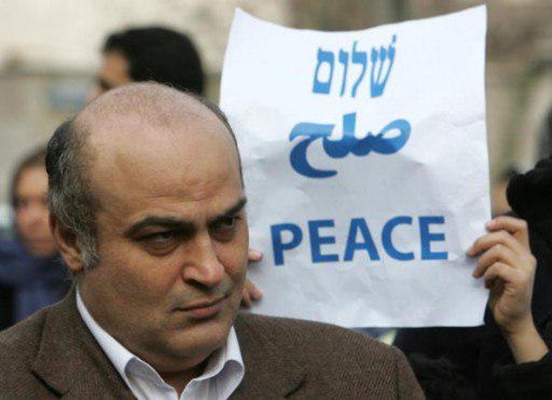
Undated photo of Siamak Morreh-Sedgh, the representative of the Jewish community at the Iranian Parliament, attending an anti-war demonstration of Iranian Jewish community.

Morreh-Sedgh was born in the city of Shiraz in 1955. He graduated in medicine, and worked in Kurdistan province from 1995 to 2001. Afterwards, he worked as a technical expert at a pharmacy. He is now serving for a third term as the representative of the Jewish community in the parliament.

The following are excerpts of his interview with ISNA where he has weighed in on the situation of the Jews in Iran, his memories of the days of the 1979 Islamic Revolution of Iran as well as the role of Jews in the revolution and in defending the country during the 8-year Iraqi imposed war on Iran in the 1980s.

In the interview, he has also touched upon the difference between Zionism and Judaism, the origins of the Jews’ culture in Iran and their concerns and positions on the enemies’ acts of sabotage.

Are there any differences between Jews in Iran and in other countries?

As far as Judaism is concerned, there are not many religious differences between Jews in different parts of the world. However, all Jews across the globe cannot be categorized into one group, as Muslims cannot either. This applies to all divine faiths.

Religiously speaking, Jews in Iran are followers of Judaism, and from a strategic perspective, they are Iranian citizens. Therefore, we fully abide by the laws and regulations of our country when it comes to politics and international relations. During the 8-year Iraqi imposed war on Iran in the 1980s, all Iranian people, including Jews, Muslims, and Zoroastrians, joined hands to defend our national values as well as Iran’s territory. It makes no difference to us whether our enemy is Saddam Hussein, Trump or Netanyahu. Whoever poses a threat to Iran’s national interests and values is an enemy of Jews, too.

How do you evaluate the coexistence between Iranian people and Jews?

Jews have been living alongside other Iranians for around 3,000 years now. In fact, Iran is one of the places where Jews have always had ease of mind as their homeland and have been able to have peaceful coexistence with Iranian people. Jewish Iranians have had an undeniable role in medicine and pharmacy as well as cultural issues such as music plus philosophy. Furthermore, several other things such as their costumes, eating habits and even ceremonies held on Jewish occasions have been inspired by the Iranian culture.

Iran is one of the places where Jews have always had ease of mind as their homeland and have been able to have peaceful coexistence with Iranian people.

What are the most important concerns of the Jewish community in Iran?

They share the same problems that other Iranians have. At the moment, the most important issue and concern of the Jewish community in Iran, especially the youth, is unemployment, which is a problem that all Iranians have.

How do you compare the situation of the Jewish community in Iran before and after the revolution?

Emigration is a natural phenomenon that takes place after every revolution. In Iran, too, many people, including Jews, emigrated after the revolution. Interestingly enough, Iranian Jews’ abidance by Judaism has become much stronger after the revolution because a more religious atmosphere has prevailed across the country following the revolution. This impacts all communities and ethnic groups. Moreover, the emergence of some social issues has influenced the Jewish community. For example, divorce was considered a taboo in the Jewish community until 20 years ago. However, the rising divorce rate in the country nowadays has had an impact on the Jewish community as well.

What is the Jewish community’s position on the current US economic war against Iran?

The Jewish community is not separate from other Iranians. Iranian Jews who have stayed in Iran have no intention of emigrating to other countries and have always defended Iran as their one and only homeland and have shown their loyalty. We have experienced economic problems more severe than what we are facing today. I don’t think the intensity of the current problems, even the initial sanctions, are comparable to the events that took place during the Iraqi imposed war on Iran.

How do you see the propaganda campaign launched by Western media against the rights of minorities, especially Jews, in Iran?

We have always emphasized that the general situation of religious minorities in Iran is improving. Of course, there are some problems, too. But the Islamic establishment seeks to settle those issues, and they have cooperated with us in this regard as much as possible. This reality should be promoted across the globe. If that happens, then no one outside Iran will speak for us. I have had interviews with foreign media several times. Once, I sat down with Ahmed Shaheed

in Geneva, and he finally confessed that the human rights situation in Iran is better than that in other Middle East countries, even by Western standards.

Minorities have spontaneously held different ceremonies all the time to safeguard the ideals of the revolution, but unfortunately, such events have not been properly covered.

When Leader of the Islamic Revolution Ayatollah Seyyed Ali Khamenei underwent surgery, prayers were held in all synagogues across Iran for the Leader’s health, but no report was filed in that regard. Another case in point is the Sepir hospital, which is the Middle East’s only charity hospital for Jews. It is also the only Jewish hospital in the world which admits all patients, Jewish and non-Jewish alike, based on charity regulations. More than 90 percent of its staff members and patients are Muslims. One of the Old Testament’s key statements is written on top of the gate of the hospital. It reads: “Love those of your kind the same way you love yourself.” It does not say “those of your religion” or “your brother.” Rather, it uses the phrase “your kind.” That means it would be enough to be a human. Well, has this been covered more frequently in Iranian or foreign media?

The world’s safest synagogues are located in Iran. Even in Europe, synagogues are protected by security guards.

Iran is the only country to have practically defended Christians in Iraq and Syria during the time when the ISIS terrorist group was at the peak of its activities. But where was this reported? At that time, I brought up the issue at the European Parliament. It is an honour for Iran that Christians in Iraq and Syria regard General Qassem Soleimani as a saviour. Asia’s oldest synagogue in Syria was targeted by ISIS, and Africa’s oldest synagogue in one of Tunisia’s islands was struck by the Taliban. This comes as the world’s safest synagogues are located in Iran. Even in Europe, synagogues are protected by security guards, including one from Mossad, who safeguards the building along with local security personnel and police. However, there is no need for the presence of police at synagogues in Iran. We only use police when we want to establish internal order at our synagogues. Where in the world can we see such security, and where have we covered this story?

It would be naive to think the US secretary of state would tell the truth about minorities in Iran. I have said time and again that it would be pointless to respond to such individuals because their words are so repetitive that they are not worth being responded to. The only solution is that we ourselves should have an integrated system to promote realities.

‘US Coup Attempt in Venezuela Aimed at Dominating Oil Resources’

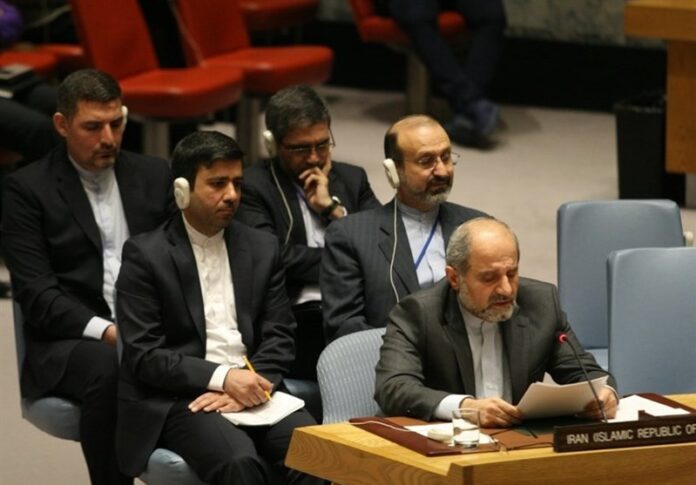
Addressing a Tuesday meeting of the Non-Aligned Movement (NAM) about Venezuela, held at the United Nations Trusteeship Council, Eshaq Al-e-Habib called for an end to the US’ hostile, illegal and provocative policies.

The Iranian envoy described the current developments in Venezuela as a domestic issue that does not threaten regional or international peace and security, MNA reported.

Al-e-Habib further emphasized that no foreign action can be taken without the explicit consent of the government and no one can instruct Venezuelans what to do or not do, which system to choose or what policies to adopt.

“Most importantly, no country or organization has the right to determine which of the national institutions of another country is democratic or legal. According to the Universal Declaration of Human Rights and the International Covenant on Civil and Political Rights, only the ‘will of the people’ will be the basis of legitimacy of the state,” he stated.

“It is an inherent right that shouldn’t be subject to a condition such as the recognition of a foreign country or organization and should be strongly respected by every UN member state,” the Iranian envoy said, adding, “Hence, all the hostile policies of the United States and its illegal and provocative actions must be stopped.”

On January 23, Venezuelan opposition leader Juan Guido announced himself as interim president with the support of the US and its allies. This act has been referred to as ‘the coup against the elected president, Nicholas Maduro.’

Many countries, including Iran, Russia, China, Cuba, Turkey, South Africa, and Uruguay, have condemned the US position, stressing the need to respect Venezuela’s sovereignty and territorial integrity.

‘Iranians Should Feel They’re at Economic, Psychological War’

rouhani

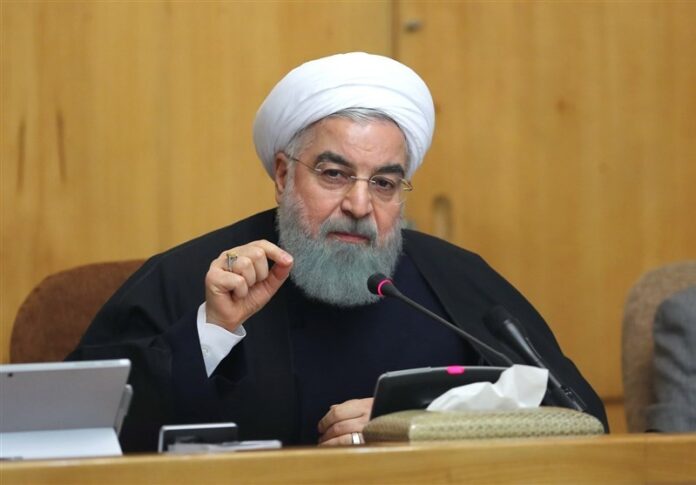
“We should all feel that we are in a war situation,” he said, expressing hope for greater unity among people and political groups.

Speaking in a cabinet session on Wednesday, Rouhani said the government is on the frontline of the battle and needs popular support to win the war.

Rouhani hailed people’s strong presence in celebrations on the 40th anniversary of the victory of the Islamic Revolution on Monday, saying it was a sign the nation is determined to foil adversaries’ plots.

“This nation will once again stand for its dignity, independence and prestige and it’s not ready to surrender itself to the enemy, as surrendering to the enemy has no end,” he said.

“If the Iranian nation gives in to the US … we should give up our dignity, independence and identity as well,” he said.

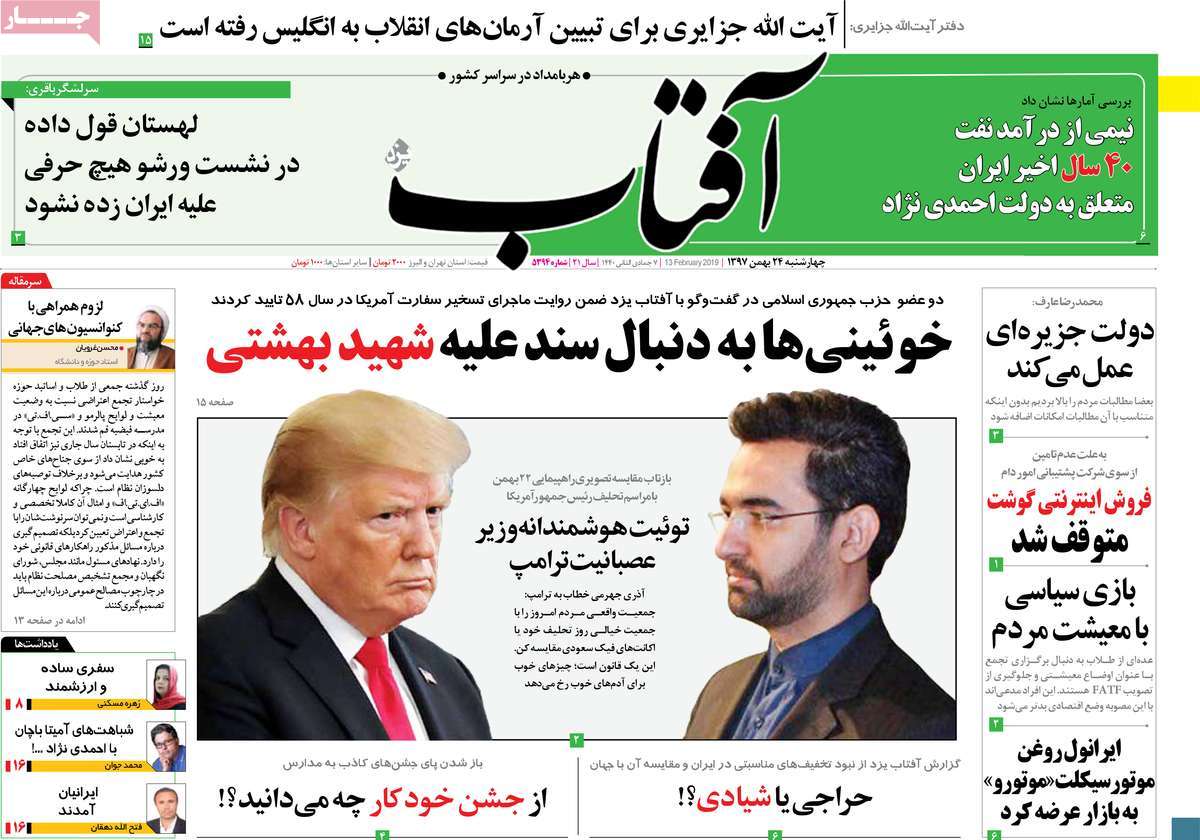
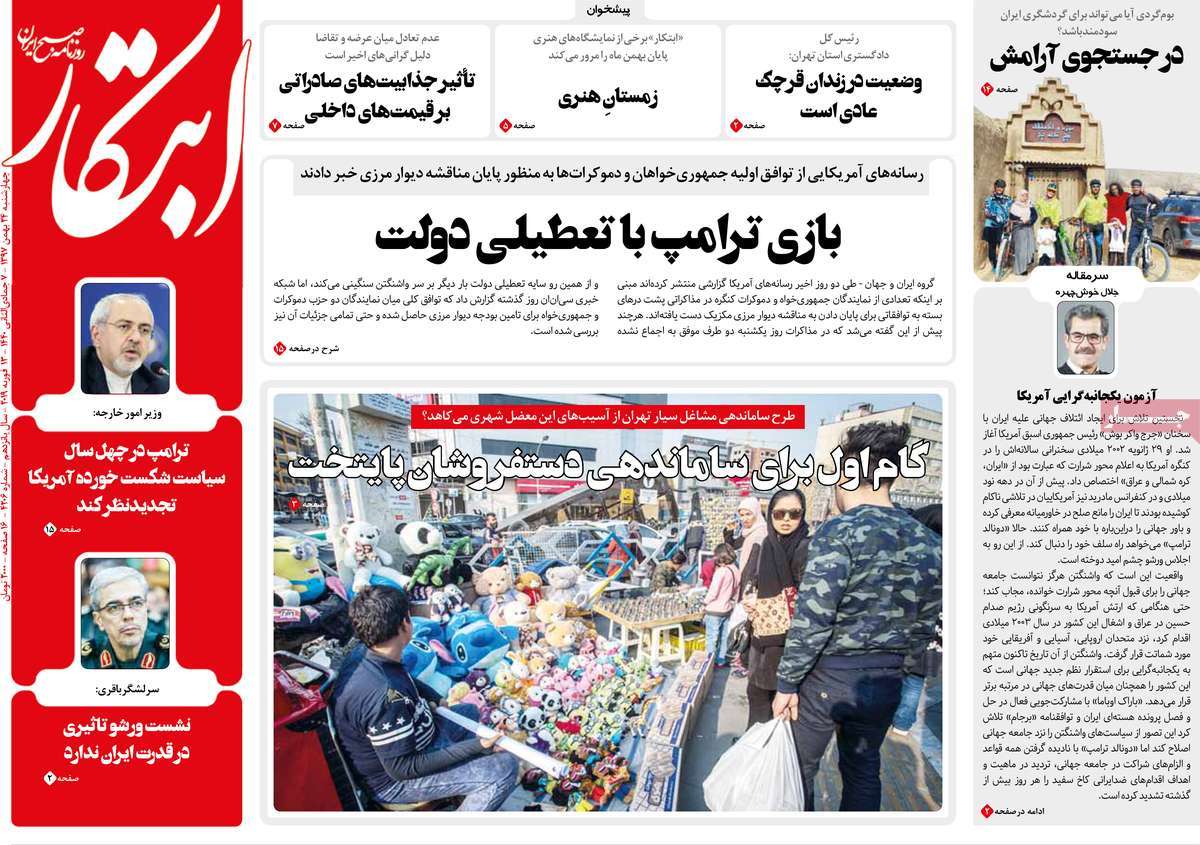
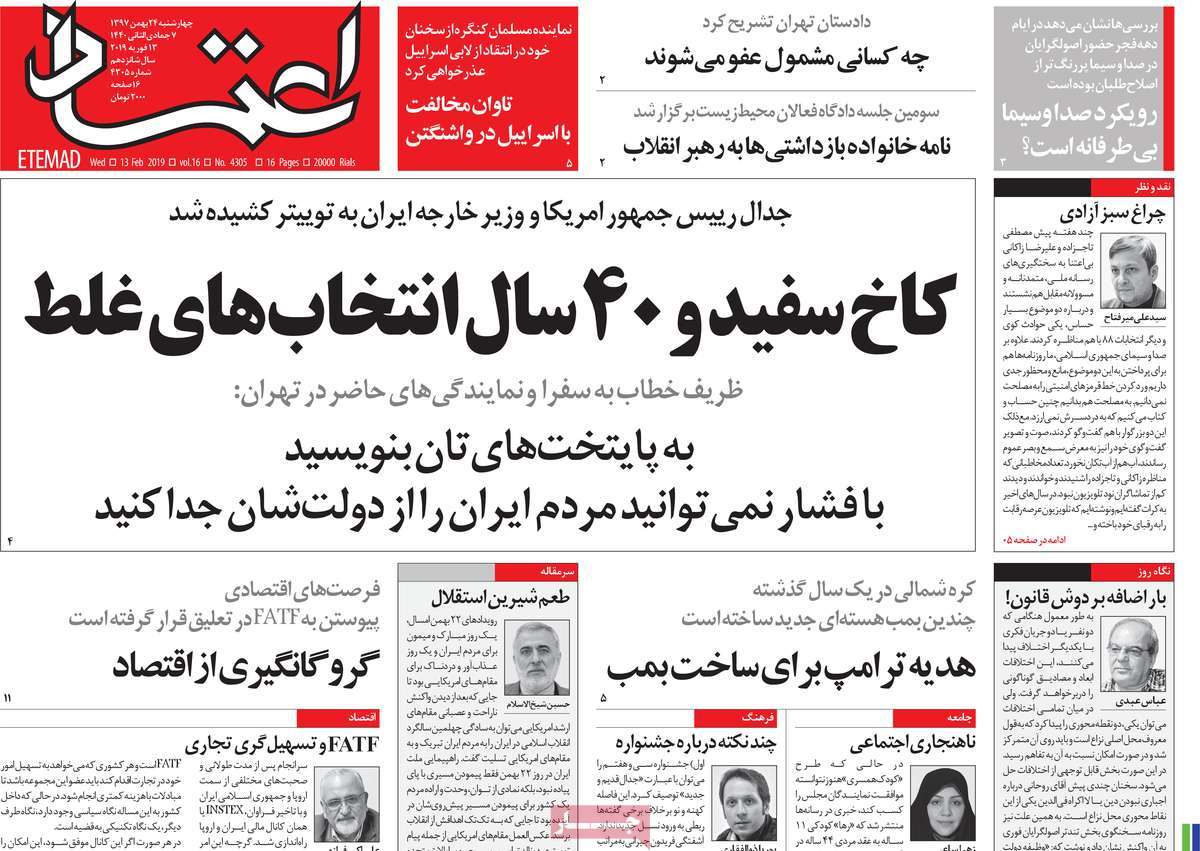
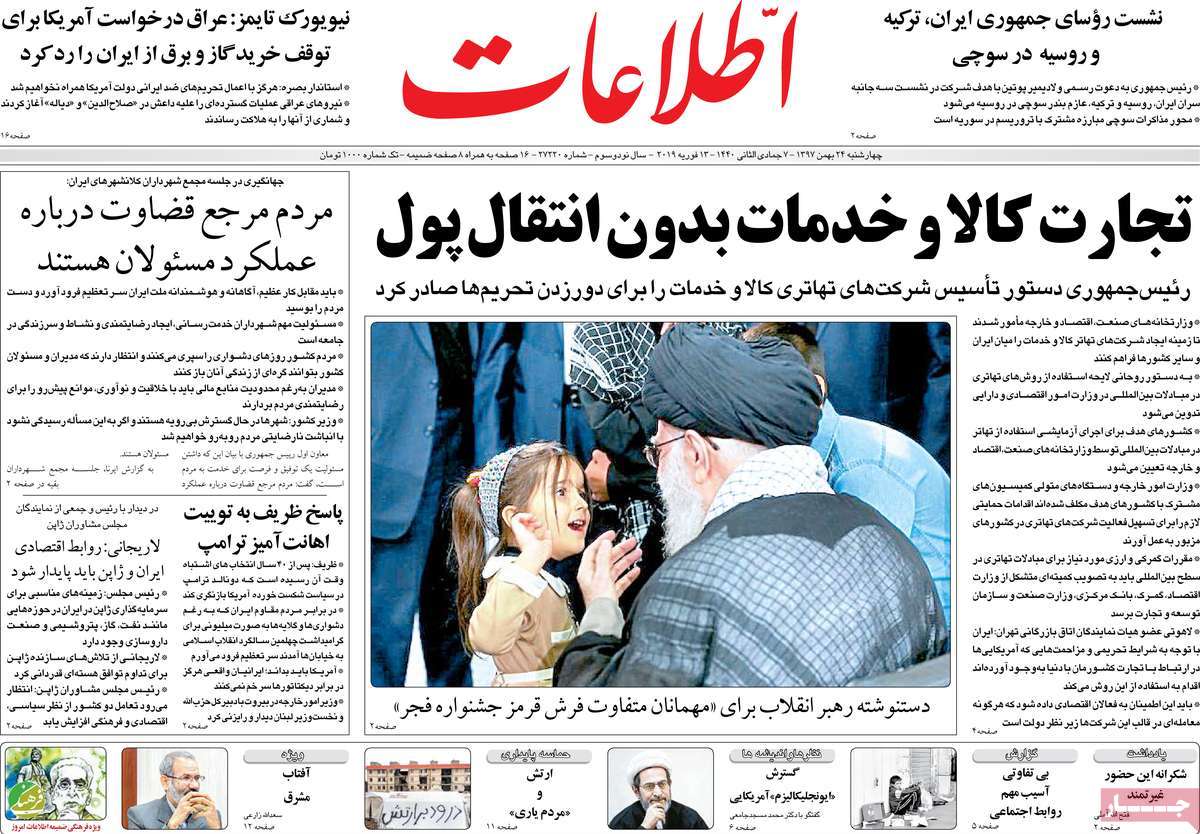
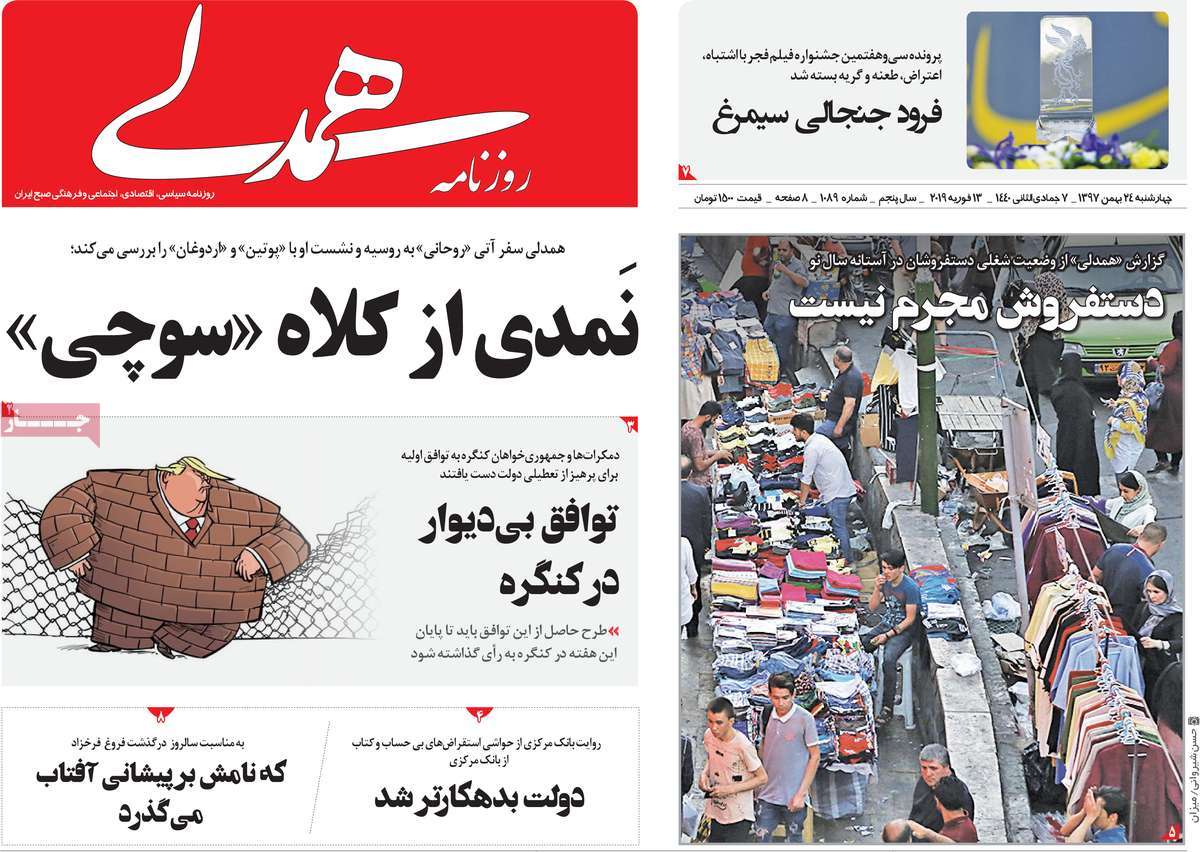
A Look at Iranian Newspaper Front Pages on February 13

A Look at Iranian Newspaper Front Pages on November 19

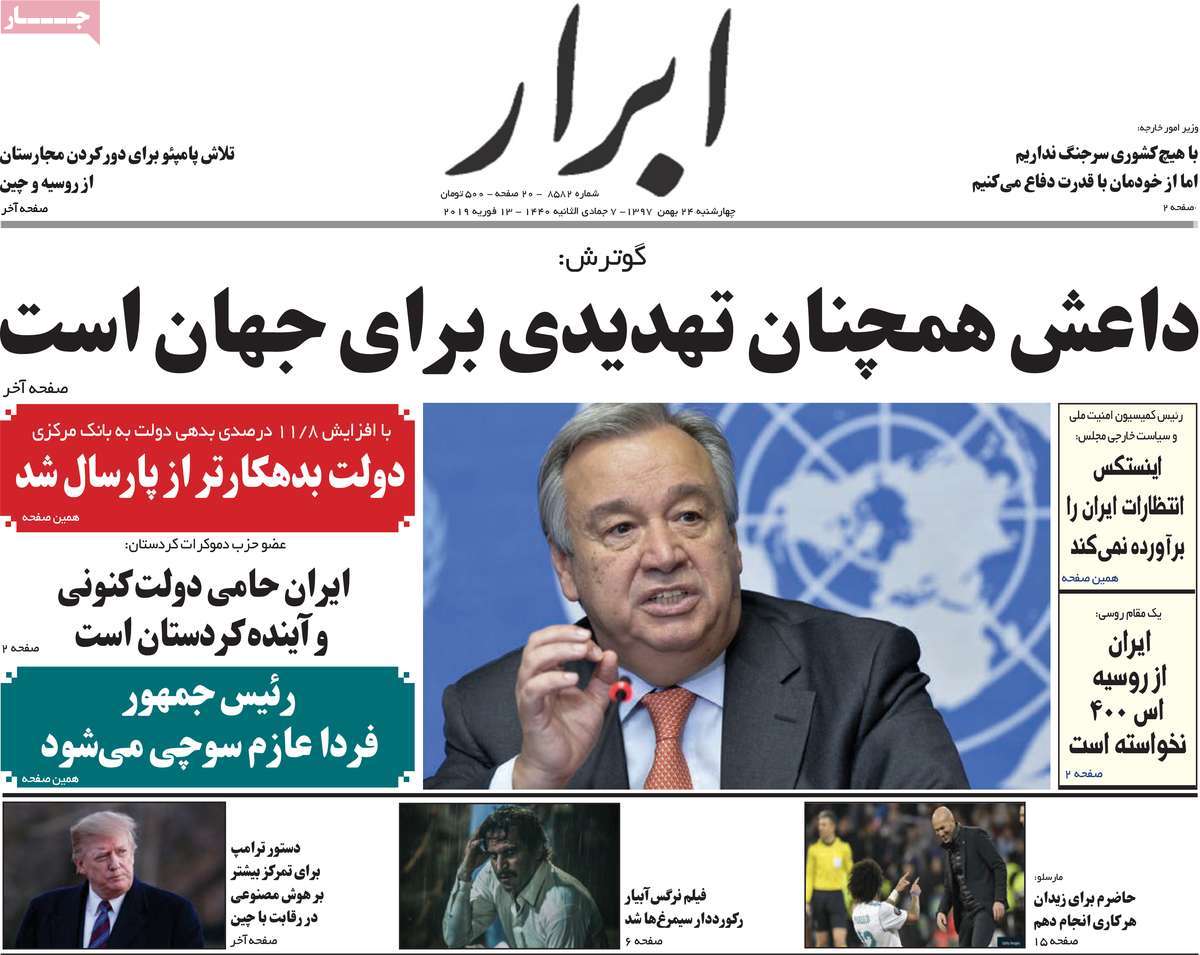
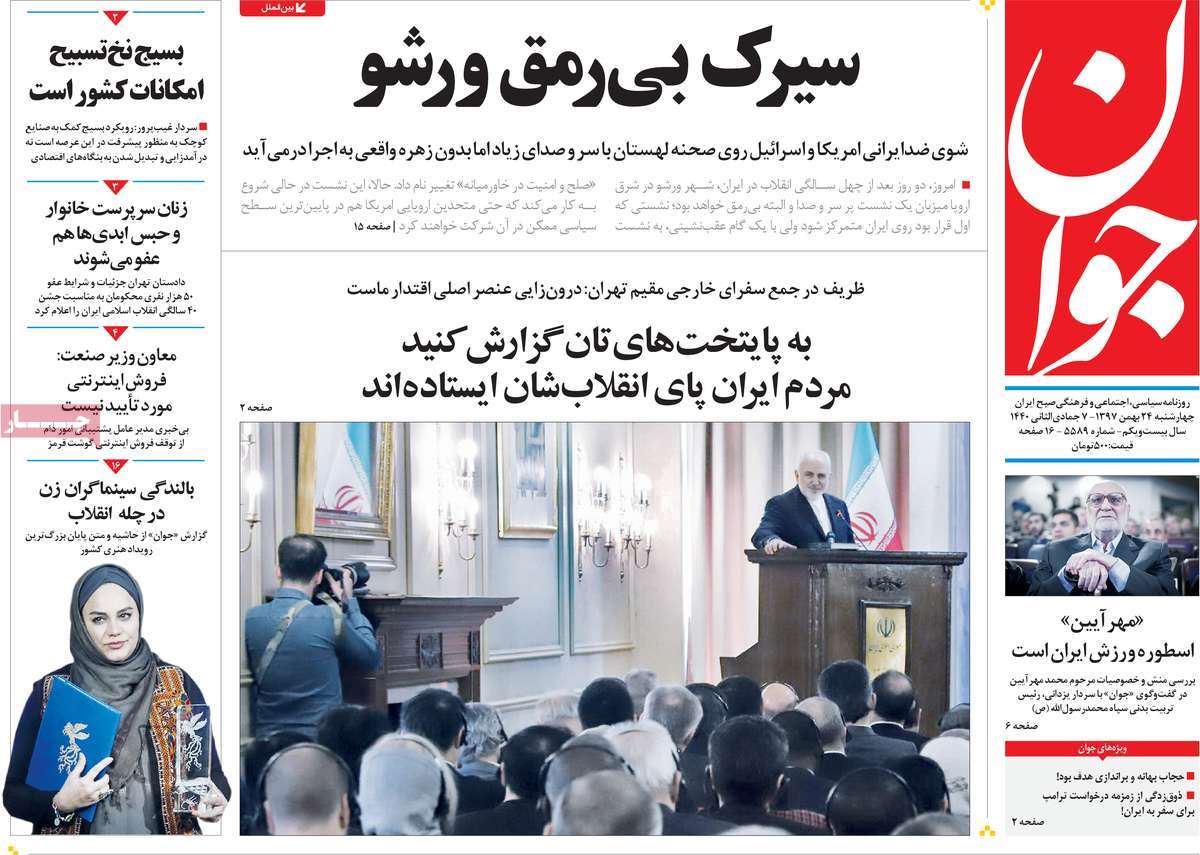
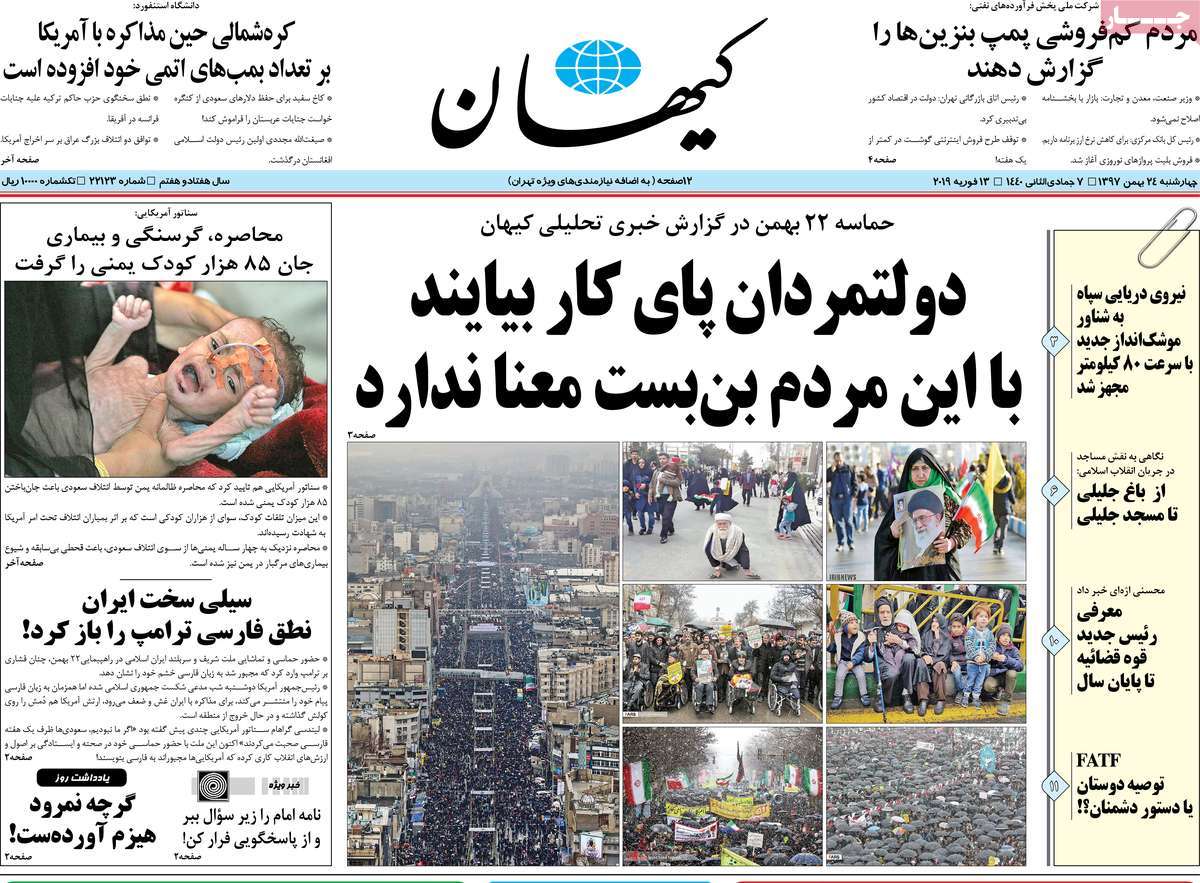
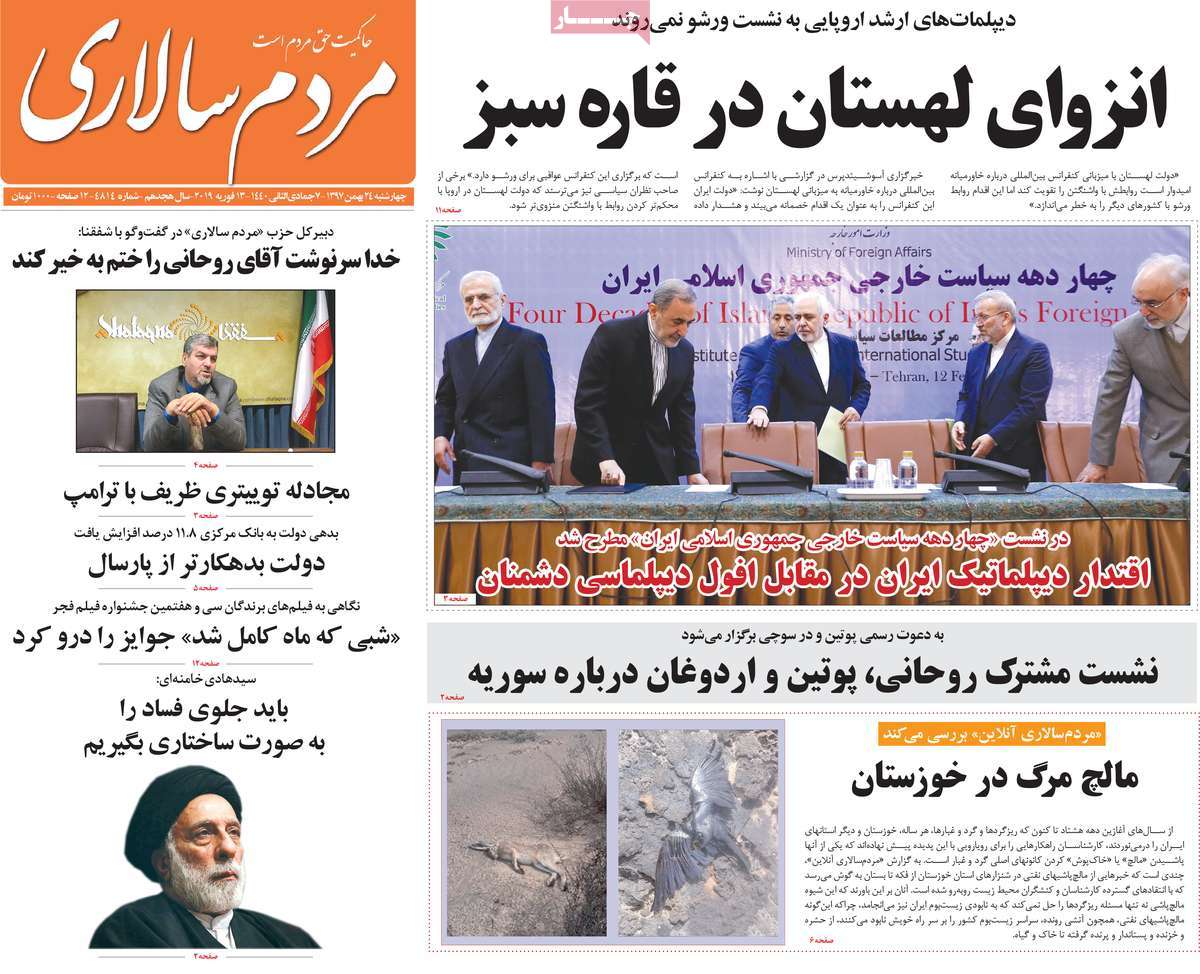
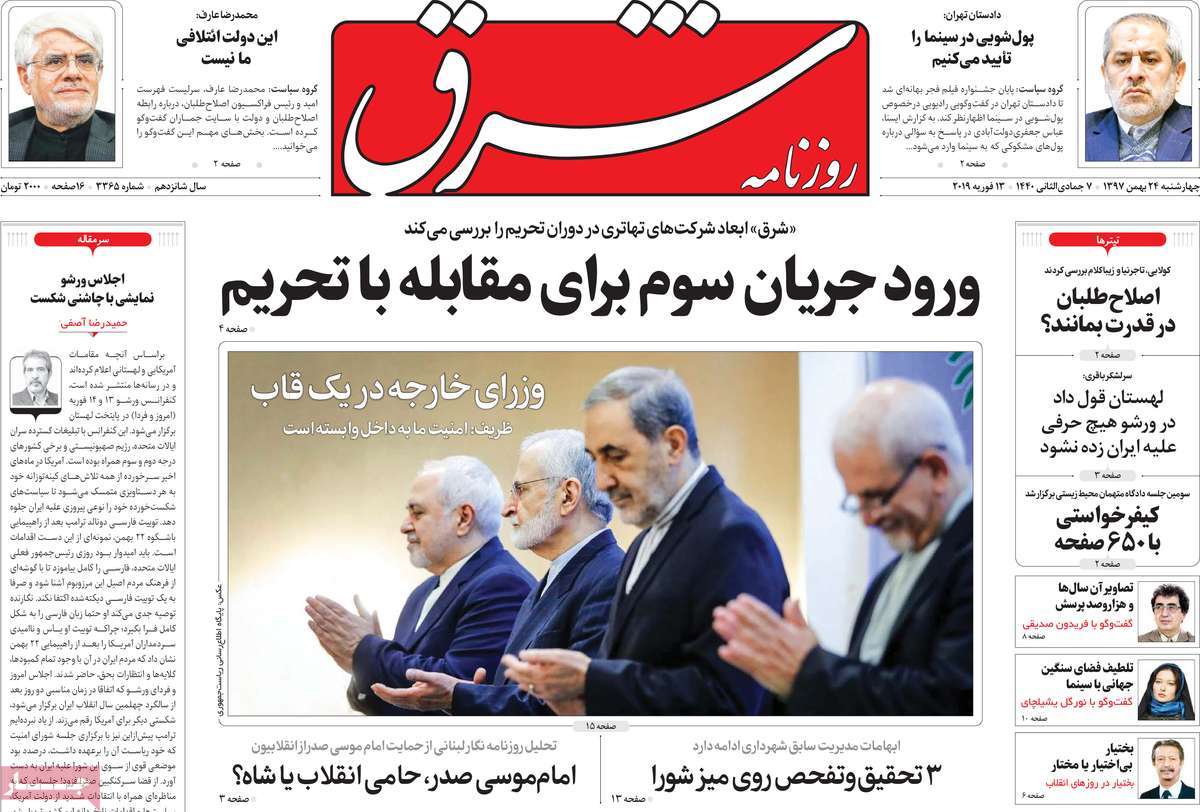
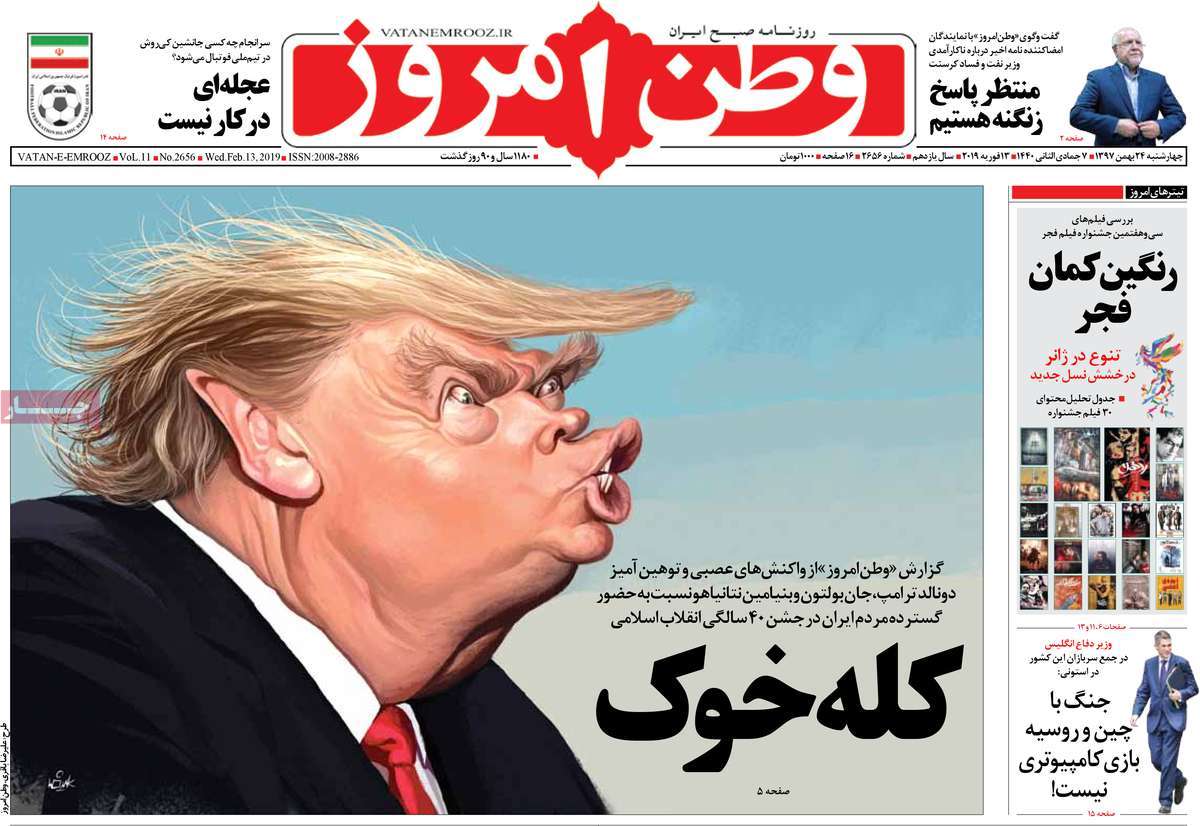
The top story in all papers today was the latest war of words between Iranian and American officials, particularly the tweet by US President Donald Trump and the response he received from Iranian Foreign Minister Mohammad Javad Zarif.

Also a top story was the upcoming Warsaw Summit, which is to be held by the US in the Polish capital and is expected to be an anti-Iran meeting of Western, Israeli, and Arab foreign countries, even though Poland has vowed it will have nothing to do with Iran.

The Thursday meeting between Iranian President Hassan Rouhani, his Russian counterpart Vladimir Putin, and the Turkish president, Recep Tayyip Erdogan, in the Black Sea resort city of Sochi also received great coverage. The issue of Syria and efforts by the three guarantor states to bring back peace to the country will be the focus of the trilateral meeting.

The above issues, as well as many more, are highlighted in the following headlines and top stories:


Afkar:

1- FM: We’re Not after War with Any Country, but Strongly Defend Ourselves

2- Pompeo’s Efforts to Keep Hungary Away from Russia, China

3- Guterres: ISIS Still Threat to World

4- Russian Official: Iran Has Never Asked Russia for S-400

5- Trump Calls for More Focus on Artificial Intelligence in Competition with China

6- INSTEX Not Fulfilling Iran’s Expectations: Lawmaker

A Look at Iranian Newspaper Front Pages on February 13


Aftab-e Yazd:

1- Ayatollah Jazayeri in UK to Elaborate on Causes of Iran’s Revolution

2- Poland Vowed No Anti-Iran Comments Be Made in Warsaw Summit

3- Half of Iran’s Oil Revenues in Past 40 Years Earned during Ahmadinejad’s Era

4- Iranian Minister’s Smart Tweet amid Trump’s Outrage

  • ICT Minister: Compare REAL Crowd Attending Iran Rallies with Your Fake Inauguration Day Crowd

A Look at Iranian Newspaper Front Pages on February 13


Ebtekar:

1- Iran FM: Trump Must Rethink 40 Years of Failed US Policy

2- Top General: Warsaw Summit Not to Impact Iran’s Power

3- Trump Playing with Government Shutdown

  • GOP, Dems Reach Initial Deal to End Border Wall Dispute

A Look at Iranian Newspaper Front Pages on February 13


Etemad:

1- Price of Opposing Israel in Washington

  • Muslim Congresswoman Apologizes for Remarks against Israeli Lobby Group

2- White House and 40 Years of Wrong Choices

  • US President, Iran FM Continue War of Words in Twitter

3- Trump’s Gift for Making Bomb: N. Korea Has Developed Several New Nukes in Past Year

A Look at Iranian Newspaper Front Pages on February 13


Ettela’at:

1- Iran, Russia, Turkey Presidents to Meet in Sochi

2- New York Times: Iraq Rejects US’ Request to Stop Gas, Electricity Imports from Iran

3- Zarif’s Response to Trump’s Insulting Tweet

4- Rouhani Urges Formation of Barter Companies to Bypass US Sanctions

A Look at Iranian Newspaper Front Pages on February 13


Hamdeli:

1- A Report on Rouhani’s Upcoming Trip to Russia, His Meeting with Putin, Erdogan

2- No-Wall Deal in Congress

  • Democrats, Republicans Reach Initial Deal to Avoid Gov’t Shutdown

A Look at Iranian Newspaper Front Pages on February 13


Javan:

1- Dull Circus of Warsaw

  • US, Israel’s Anti-Iran Show in Poland to Be Held in Noisy, but Impotent Way

2- Report to Your Capitals Iranians Have Stood behind Their Revolution: Zarif

A Look at Iranian Newspaper Front Pages on February 13


Kayhan:

1- North Korea Has Increased Its Nuclear Bombs While Holding Talks with US

2- 85,000 Yemeni Kids Killed by Hunger, Disease

3- IRGC Navy Equipped with New Catamaran Capable of Firing Cruise Missile

4- Trump Starts Talking after Being Slapped by Iran in Face

A Look at Iranian Newspaper Front Pages on February 13


Mardom Salari:

1- Poland’s Isolation in Europe: Top European Diplomats to Boycott Warsaw Summit

2- Rouhani, Putin, Erdogan to Hold Trilateral Meeting on Syria

A Look at Iranian Newspaper Front Pages on February 13


Shargh:

1- Third Move to Counter Sanctions: Barter Companies

2- Warsaw Summit: A Show Doomed to Failure [Editorial]

3- Poland Vowed There’ll Be No Anti-Iran Comment in Warsaw Meeting

A Look at Iranian Newspaper Front Pages on February 13


Vatan-e Emrooz:

1- War against China, Russia Not a Computer Game: UK Defence Secretary

A Look at Iranian Newspaper Front Pages on February 13

Iran Leader Releases ‘Strategic’ Statement on 40th Revolution Anniv.

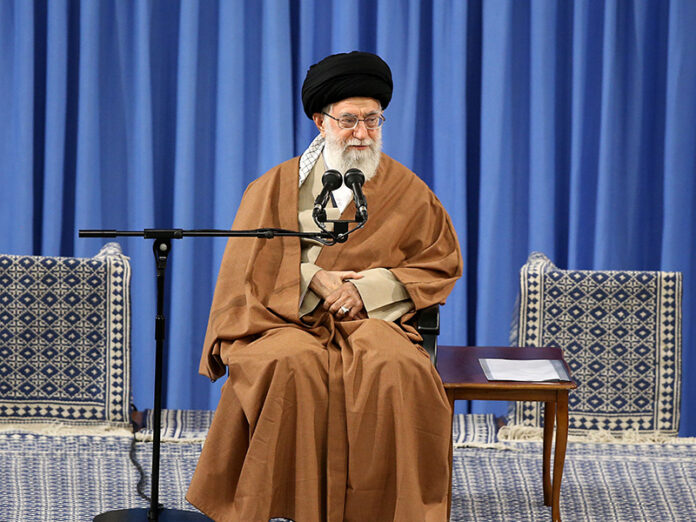
Ayatollah Seyyed Ali Khamenei

The statement, issued as a new chapter is opened in the Islamic Republic’s life, explains the path walked in the past forty years and the steps needed for further advances, the Leader’s official website said.

In the statement, the Leader has stressed the unique role Iranian youth could play to help the country take its “second stride” towards ideals, explaining requirements for Iran’s progress in seven sections.

The Leader has further admitted the Revolution’s failure to realize justice in the Islamic society by saying that “we’re far far away from where we should be”, and stressed that the Revolution is prepared to correct its mistakes.

Ayatollah Khamenei has also urged all Iranian officials to be “afraid” of deepening gap among social classes in the Iranian society.

The full text of the statement, entitled the “Second Phase of the Revolution”, is as follows:

In the Name of God, the Most Beneficent, the Most Merciful

All praise is due to Allah, the Lord of the Worlds, and peace and greetings be upon our Master and Prophet, Ab-al-Qassem Al-Mustafa Muhammad, upon his pure and immaculate household, upon his chosen companions and upon those who follow them in charity until the Day of Judgment

Among all the nations suffering from oppression, few make an effort to launch a revolution; and among those nations that have risen and launched a revolution, few have been witnessed to have pursued it to the end, or moved beyond merely changing the government and safeguarded their revolutionary values. However, the auspicious Revolution of the Iranian nation—which is the greatest and most popular revolution of the contemporary era—is the sole revolution that has persisted forty years of pride, saved from betrayal to its values, and it has preserved its dignity and original slogans against all the temptations which seemed irresistible; hence, entering the second phase of self-development, society-processing and civilization-building. Heartfelt salutations to this nation, the generation who initiated and continued [the movement] and the generation that currently steps into the magnificent and global phenomenon of the second forty years!

The day when the world was divided into the material West and East, and no one presumed a major religious movement would emerge, the Islamic revolution of Iran stepped into the scene gloriously and mightily; it broke the frameworks; it flaunted to the world the outdatedness of the clichés; it put the religion and the material world together, and declared the coming of a new era. It was much expected that the leaders of deviation and oppression would react—but in vain. Whatever the right and left modernity did— from pretending to ignore this emerging and unprecedented voice to extensive efforts for suffocating it— just brought them closer to their indispensable demise. Today, after forty annual celebrations of the victory of the Revolution and forty Fajr ten-days, one of the two centers of animosity has already perished, and the second one is struggling with predicaments that signal its death in the near future. Whereas, the Islamic Revolution is advancing while preserving and adhering to its mottos.

It is possible to assume an expiry date for anything, yet, the global mottos of this religious revolution are exceptional; they will never expire because they match human nature in all eras. Freedom, ethics, spirituality, justice, independence, dignity, rationality, brotherhood, are not limited to a single generation or society so that they would rise in a period and decline in the next. It is impossible to imagine a people who despise these values. The reported cases of reluctance to these values were due to the officials who had shrunken from these religious values; and not due to their adherence to them and endeavors for achieving them.

The Islamic revolution—like a living and unwavering phenomenon—is always flexible and ready to correct its mistakes, but it is not revisionary or passive. It is positively sensitive to criticisms; it regards them as a divine blessing as well as a warning to those who do not act upon their words; yet it, by no means, takes distance from its values, which are blended with the religious faith of the people, thanks be to God. Since the establishment of the system, the Islamic revolution has never suffered from, and will never suffer from stagnation and recession, and it does not see any conflict and contradiction between revolutionary dynamism and political and social order; rather, it eternally defends the theory of the revolutionary system.

The Islamic Republic is not reactionary and it does not lack perception and understanding in face of new phenomena and situations; however, it strongly adheres to its principles and it is highly sensitive to its frontiers in relation to its rivals and enemies. It never imprecisely regards its principle lines and considers it important as why and how it would persist. Undoubtedly, the gap between the musts and the realities has always tormented the idealist consciences; however, this gap is fillable, and in the past forty years it has been filled in many cases, and certainly in the future, with the presence of a young, faithful, wise and motivated generation, it will be filled more vigorously.

The Islamic Revolution of the Iranian nation has been mighty, but merciful; forgiving and even oppressed. It has not committed any of extremist and deviated acts that have marked many other uprisings and movements with stigma. In no conflicts—not even against the United States or Saddam Hussein—did it ever shoot the first bullet and, in all cases, it defended itself after the enemy’s attack; of course, it blow the defensive strike vigorously. Since its inception, this Revolution has never been merciless nor has it ever shed blood; it has neither been passive nor hesitant. Standing assertively and courageously against bullies and thugs, it has defended the oppressed. This revolutionary bravery and gallantry, this honesty, assertiveness, and sovereignty; this global and regional realm of action in support of the oppressed of the world represent a source of pride for Iran and the Iranians, and may it persist eternally!

Now, at the beginning of a new chapter in the life of the Islamic Republic, I would like to address my dear young people: the generation who steps up to start another part of the Great Jihad [selfless endeavor] for building a great Islamic Iran. The first section of my address concerns the past.

Dear ones! You cannot learn but from your own experience or listening to the experiences of others. Many of what we have seen and experimented, your generation has not experienced and seen yet. We have seen and you will see. The decades ahead are your decades, and it is you who should protect your revolution while you are qualified and full of motivation, and move it closer to its great ideal: that is, the emergence of a new Islamic civilization and the preparation for the rising of the great sun of wilayat (may our souls be sacrificed for him) [Imam Mahdi (a.s.)]. To take steady steps in the future, we need to develop a good knowledge of the past and learn from the experiences. If this strategy is neglected, lies will replace the truth, and the future will be menaced by unknown threats. The adversaries of the revolution are strongly motivated in their efforts to spread distortions and lies about the past and even the present, exploiting money and all the necessary tools for it. The bandits of thought, creed and awareness are ample; the truth cannot be heard from the enemy and its troops.

The Islamic Revolution and the establishment that rose from it started from scratch. Firstly, everything was against us: the corrupt regime of Taghut [Pahlavi tyranny]—which, in addition to its dependence and corruption, tyranny and being coup-based—was the first royal regime in Iran that was brought to power by the foreigners rather than by the force of sword; the government of the United States and some other Western governments; or the extremely chaotic situation inside Iran; and the shameful backwardness in science and technology, politics, spirituality, and any other virtue.

Secondly, there was no precedent experience before us and the path ahead of us had not been treaded. Obviously, Marxist uprisings and the like could not represent a role model for a revolution that emerged from the heart of Islamic faith and knowledge. Islamic revolutionaries began without an example and experience, and the combination of a republic and Islam and the means for the formation and progress of it were not achieved except through the divine guidance as well as the luminous heart and the great thought of Imam Khomeini. And this marked the first brilliance of the Revolution.

Then, the revolution of the Iranian nation transformed the bipolar world of that day into a three polar world, and then, with the fall and disappearance of the Soviet Union and its allies and the emergence of new poles of power, the new dichotomy of “Islam and the Arrogant Front” became a prominent phenomenon of the contemporary world and the focal point that is attracting the world’s attention. On the one hand, the aspirated look of the oppressed nations, freedom-seeking movements and some independence-seeking states of the world fixated on it; and on the other hand, it was screened by resentful and malicious eyes of the world’s bullying regimes and blackmailer thugs. Such, the world adopted a different orientation, and the seismic power of the Revolution shook the untroubled pharaohs. Hostilities began with all intensity; if it was not due to the magnificent power of the faith and the motivation of this nation and the heavenly and endorsed leadership of our imminent Imam, it was impossible to resist the hostility, conspiracy, and vice [directed at us].

In spite of all these onerous problems, the Islamic Republic took greater and stronger steps day after day. The past 40 years exhibited great jihads, brilliant achievements and amazing advances for the Islamic Iran. The magnitude of the progress made by the Iranian nation in the last forty years is well-recognized when compared to similar spans following other major revolutions such as the French Revolution, the October Revolution of the Soviet Union and the Indian Revolution. The jihadi management strategies inspired by Islamic faith and the belief in the principle of “we can do it”—that Imam Khomeini (r.a.) had taught us all—assisted Iran in its achievement of dignity and progress on various arenas.

The revolution put an end to a long historical decadence, and the country, which was severely humiliated and utterly retrograded during the Pahlavi and Qajar dynasties, started to progress rapidly. In its first step, the revolution turned the disgraceful regime of the tyrannical monarchy into a popular and democratic state, and employed the element of national determination—which is the essence of comprehensive and genuine progress—to the heart of the country’s governance; then, it turned the youth into the main forerunners of the developments and the key players in the management of the country. It conveyed the “we can do it” spirit and belief to everyone; thanks to the enemies’ sanctions, it taught everyone to rely on domestic capacities, and this unfolded a source of great blessings:

Firstly, it guaranteed the stability and security of the country; the territorial integrity and the protection of the borders—which were targeted by the enemy’s serious threats—and gave rise to the miracle of victory in the eight-year war, leading to the defeat of the Ba’athist regime, and its American, European and Eastern supporters.

The story is being updated …

6m Foreign Tourists Visit Iran in 9 Months: VP

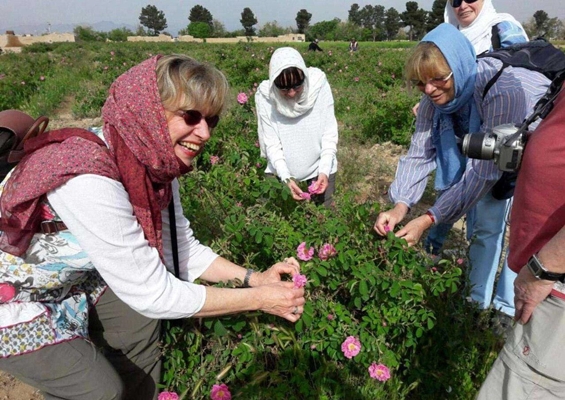
A group of foreign tourists picking rose flowers which will be turned into rosewater in the city of Kashan, in central Iranian province of Isfahan

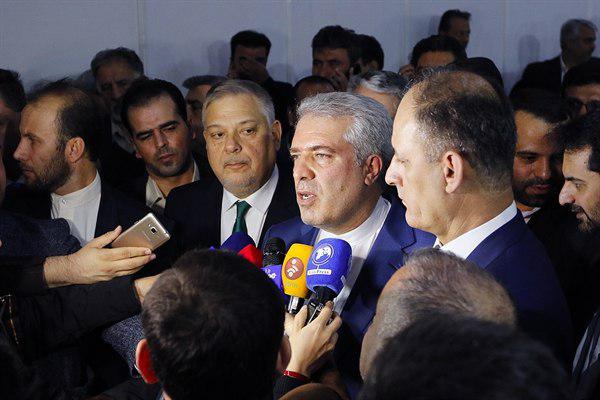
Speaking to reporters on the sidelines of the 12th Tehran International Tourism Exhibition on Tuesday, Mounesan predicted that by the end of the current Persian year (March 20), nearly seven million foreign tourists will visit Iran.

“Iran enjoys various tourist attractions along with its unique historical sites as well as warm hospitality of its people. Meanwhile, through holding various international tourism exhibitions, the Islamic Republic has managed to attract a growing number of tourists,” he was quoted as saying in a report by the Cultural Heritage and Tourism News (CHTN) website.

He went on to say that fortunately, the number of foreign tourists visiting Iran has increased significantly compared with the same period last year.

Tourism, in addition to economic functions, has other social and cultural functions which can lead to further cultural exchanges among the cultures, Mounesan said.

He also predicted a promising future for Iran’s tourism industry.

The Iranian vice-president said today a growing number of investors are expressing their interest in investing in Iran’s tourism industry.

6m Foreign Tourists Visit Iran in 9 Months: VP“So far, two thousand projects worth millions of dollars have been launched in Iran by private firms active in the tourism industry,” he said.

Mounesan cited the huge investments as a sign of a promising future for the industry in Iran.

During his visit to the Tehran International Tourism Exhibition, Mounesan was accompanied by Iraq’s Culture and Tourism minister.

The two officials made a tour of various sections of the exhibition and held talks with the delegates from private companies active in tourism industry.