Monday, December 22, 2025
Home Blog Page 3263

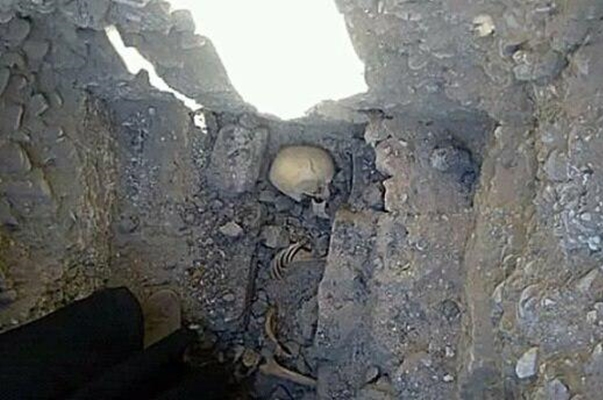
5,000-Year-Old Skeleton Unearthed in Northern Iran

The remains were dug out at a historical site in the city of Babol in Mazandaran province, said Mohammad Fazeli, the head of the archaeological team.

The skeleton belongs to a girl, around 13-14 years of age.

An awl was also discovered next to her. A necklace made of seashells, stone and tar was around her neck. Studies show the skeleton is between 3,000 and 5,000 years old.

According to Fazeli, historical sites in Babol are the target of raids and theft.

He said between 400 and 500 illegal excavations have been conducted in the area, highlighting the need to establish security there.

World Must Tell US We’re Not Living in Jungle: Iran

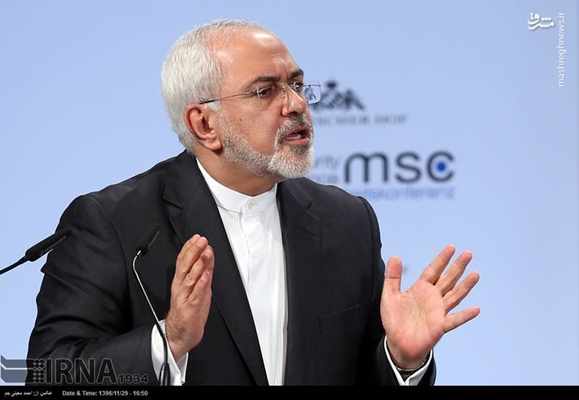
Zarif made the comments in a Q&A session following his speech at the 55th Munich Security Conference in Germany.

His comments came in response to a question about Iran’s attempt to launch a satellite last month that failed to reach orbit, Zarif said it was possible the failure was due to Washington’s sabotage campaign as suggested by a New York Times report this week.

He added that Iran had already been investigating these failures but was now “looking into the specifics” after the story in The Times.

“It’s quite possible. We don’t know yet. We need to look into it very carefully,” the Iranian foreign minister said.

The New York Times reported on Wednesday that the Trump administration had reportedly revived a secret plan to sabotage Iran’s ballistic missiles as part of its broader plan to weaken the Islamic Republic’s military might and harm its economy.

It cited current and former administration officials and reported that the clandestine operation has been ongoing for some time now but it was practically impossible to determine whether it has been successful and if yes, to what extent.

Iran launched a scientific satellite into space to collect environmental information to boost the country’s forecasting system. However, technical problems that occurred during the final stage of the launch prevented the spacecraft from reaching orbit.

Iran’s Minister of Information and Communications Technology Mohammad Javad Azari Jahromi tweeted on January 15, “The Payam (Message) satellite was successfully launched this morning aboard the satellite carrier. But the satellite unfortunately failed to be placed in orbit in the final stage.”

He, however, stressed that Iran was preparing to launch another satellite, named Doosti (friendship).

What follows is the full text of Zarif’s speech at the MSC 2019:


In the name of God, the Compassionate, the Merciful

Ladies and Gentlemen,

This past Monday, millions of Iranians gathered for mass rallies to mark the 40th anniversary of the Islamic revolution; an earthquake that collapsed a pillar of US domination in West Asia.

We’ve never been forgiven by the United States for having exercised our right to self-determination. As a result, we have long been the target of an unhealthy fixation—an obsession—which continues to this very day.

The demonization of my country has been a convenient cross for seven consecutive American presidents to bear—and a smokescreen for America’s regional clients to hide behind. It is long overdue for the United States to dismantle this malign institution, for it has today morphed into one of the greatest threats to even its own interests—and of course international peace and security.

In the past two years, the US has taken its animus towards Iran to a new extreme, as epitomized by its unlawful and unilateral abrogation of its commitments under the painstakingly-negotiated Joint Comprehensive Plan of Action, which was unanimously endorsed by the UN Security Council. To gain accomplices in its lawlessness, the US is now even labouring to force others to violate that Resolution, which explicitly calls for normalization of economic relations with Iran.

At the recent meeting of “the unwilling” and “the openly-coerced” in Warsaw, the US Vice President and the Secretary of State both blasted Europe for even attempting—albeit without much practical success—to abide by its obligations under the JCPOA and Security Council Resolution 2231. Yesterday – right here in Munich – Vice President Pence repeated this farce when he arrogantly demanded that Europe must join the US in breaking its commitments while undermining its own security. His hateful accusations against Iran—including his ignorant allegation of anti-Semitism against the heirs of a man described as ‘Messiah’ in the Torah for saving Jews – is both ridiculous and dangerous.

This malign obsession with Iran is imposing costs on others—and especially in our region, which has for 40 years suffered the consequences of US insistence on making wrong choices.

Driven by its pathological obsession with Iran, America has long encouraged reckless and destructive adventurism on the part of its clients: from arming Saddam Hussein in his attack against Iran to supporting the propagation of extremism; from aiding and abetting the ruining of Syria and bombing of innocents in Yemen to whitewashing the incarceration of a Prime Minister and dismemberment of a journalist. In parallel, the US has systematically shielded Israel’s constant aggression against Palestinians, while insulating its severe violations of the sovereignty of Lebanon and Syria.

And all in the name of “containing” Iran.

Ladies and Gentlemen,

The US claims—and some blindly parrot its accusation—that it is Iran which is interfering in the region. But has it ever been asked whose region? Just glimpse at a map. The US military has travelled 10,000 kilometres to dot all our borders with bases. Meanwhile, it has milked the region of its resources through vast arms sales. According to the most conservative estimate, the GCC’s military spending alone will reach a record high of $100 billion this year—almost seven times that of Iran.

So, who is really exporting insecurity to our region?

What is it that threatens the region more?

The unfathomable arsenals used to terrorize the people of Yemen? Or Iran’s defensive missiles, which have only ever been used against ISIS terror in self-defence?

Is it Iran that threatens the annihilation of others—or is it Mr Netanyahu—Israel’s wolf-crier-in-chief—who openly threatens my country’s obliteration while standing next to his nuclear bomb factory?

No theatrics here—including the show put on by Vice President Pence—can obscure these realities.

Indeed, more and more nations are becoming explicit about the fact that the United States is now the single biggest source of destabilization in our neighbourhood. As we speak, Iraqi lawmakers are demanding the withdrawal of US forces from their land. And after more than 17 years of failure in Afghanistan, the US is now negotiating with the Taliban to withdraw the American military.

In contrast, our standing with the peoples of Iraq and Syria to counter terrorism has put ISIS on the verge of extinction, with both countries enjoying levels of peace and stability not seen in years.

I arrived here in Munich from Sochi, where President Rouhani continued his dialogue with his Russian and Turkish counterparts on how to further promote peace in Syria. Prior to that, I visited Lebanon and Iraq for 7 days of discussions with government officials, as well as with political, community and business leaders on how to work together to strengthen stability and advance mutual economic opportunity in our region.

But the reckless US obsession with Iran is threatening these hard-won victories.

On another front, Iran’s continued full implementation of the JCPOA—despite the US’ abrogation—has played a major role in decreasing tension and promoting regional and global stability. But Iran cannot foot the entire bill for vital global security achievements – whether it is the nuclear accord, or the combatting of drug and human trafficking to Europe.  Europe needs to invest too. Many around the world—and particularly on this content—speak eloquently about multilateralism. But they also need to walk the walk. For instance, INSTEX falls short of the commitments by the E3 to “save” the JCPOA. Europe needs to be willing to get wet if it wants to swim against the dangerous tide of US unilateralism.

While we have shown our desire for engagement, we don’t depend on others for our security, stability, prosperity and progress. We solely depend on our own people. That is why 40 years of so-called “maximum pressure”—namely demonization, war, sanctions and terror—including the heinous foreign-sponsored terrorist bombing in my country on Wednesday—has failed to “bring Iran to its knees”; nor has it affected our people’s decision-making calculus.

Distinguished Friends,

Iran’s foreign policy is designed to further the goal of creating a strong region that precludes the emergence of hegemonic aspirations by any power – regional or global.

A strong region simply means more confidence, more trade and more interaction between and among the countries in the region, than with external powers.

It requires home-grown political and territorial stability; reliance on the populace as the source of legitimacy, security and prosperity; harmonization of national identities and regional citizenship; participation of all in ensuring peace; and the exercising of strategic self-restraint.

Ladies and Gentlemen

In spite of all the ignorant hate-speech by American officials, let me remind you that we Iranians are proud to be the inheritors of a great civilization. The entirety of humanity is today riding in the same boat and we either sail together; or sink together. Our renowned poet, Sa’adi, testified to this truth over 900 years ago:

All human beings are members of one frame

Since all, at first, from the same essence came.

When time afflicts one limb with pain

The other limbs cannot at rest remain.

I thank you for your attention.

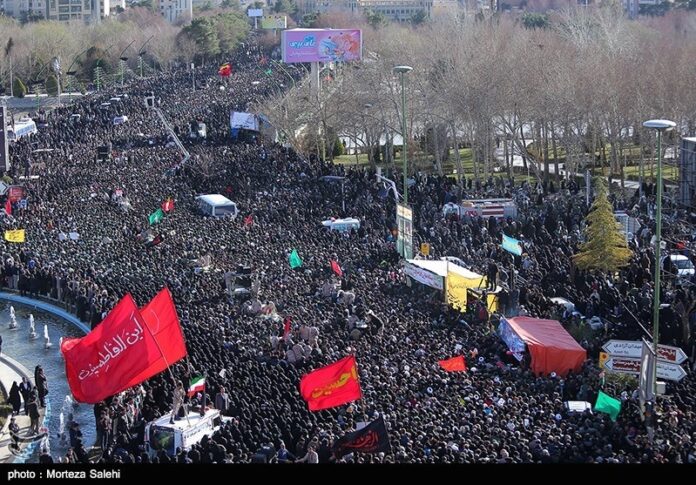
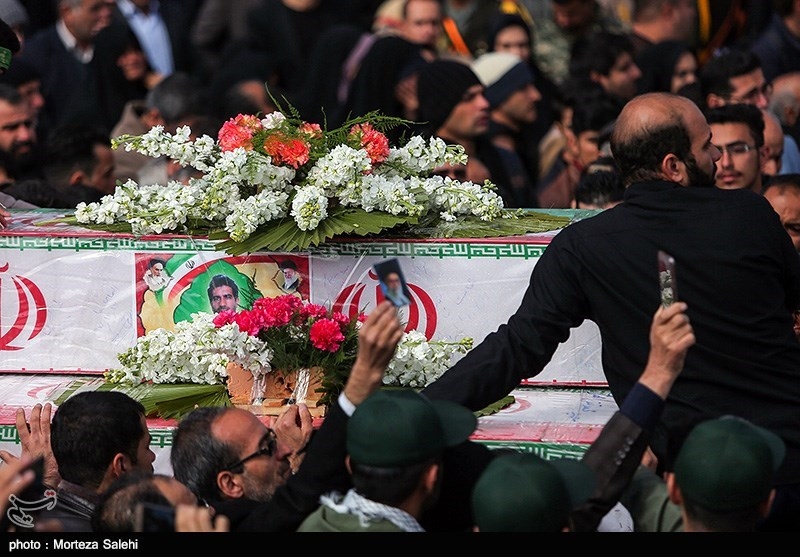
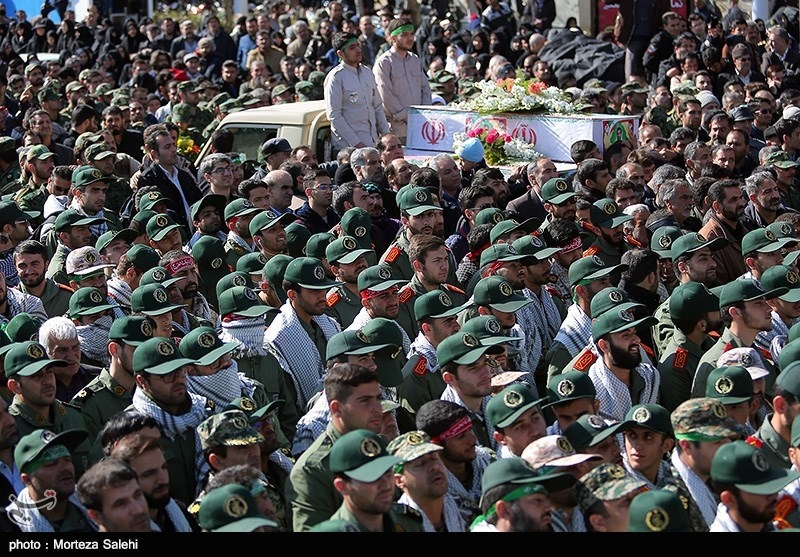
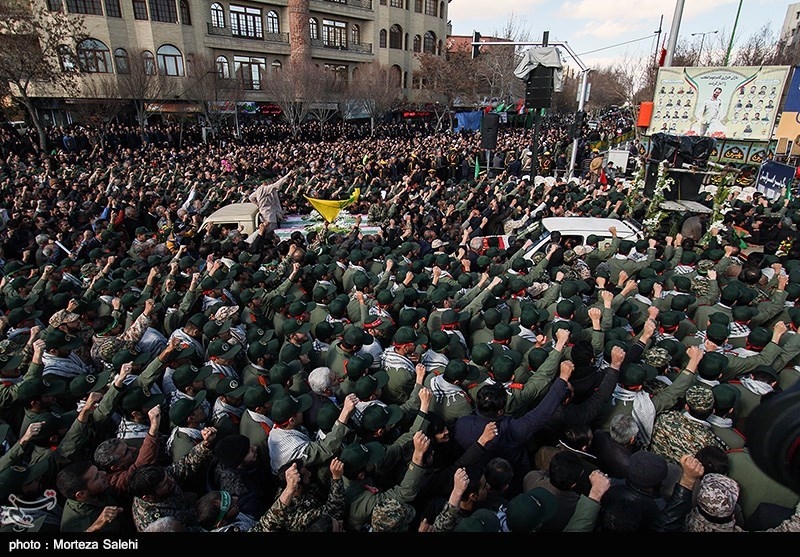
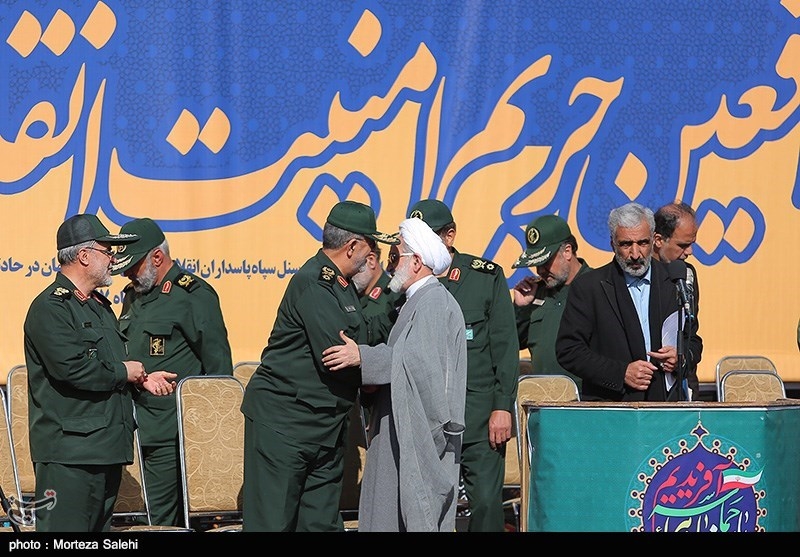
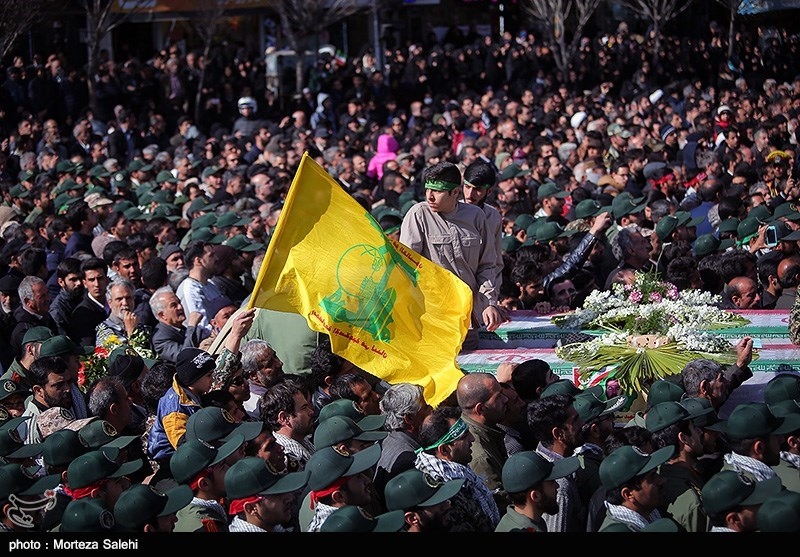
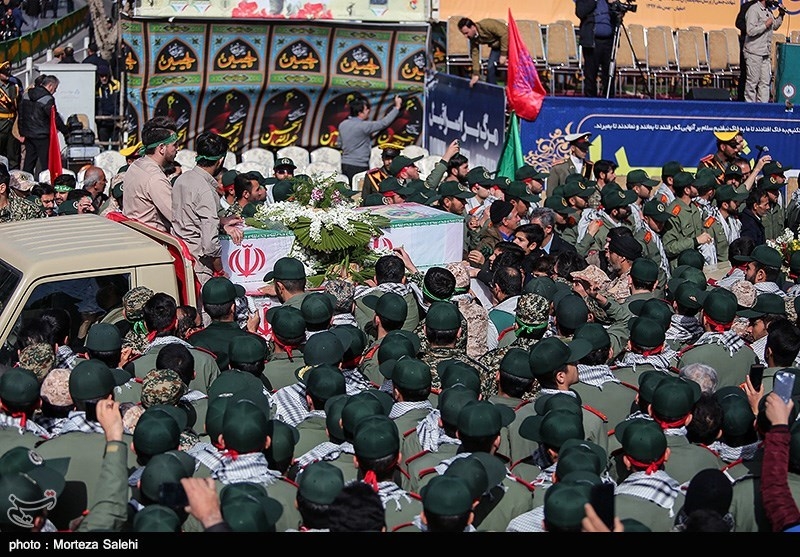
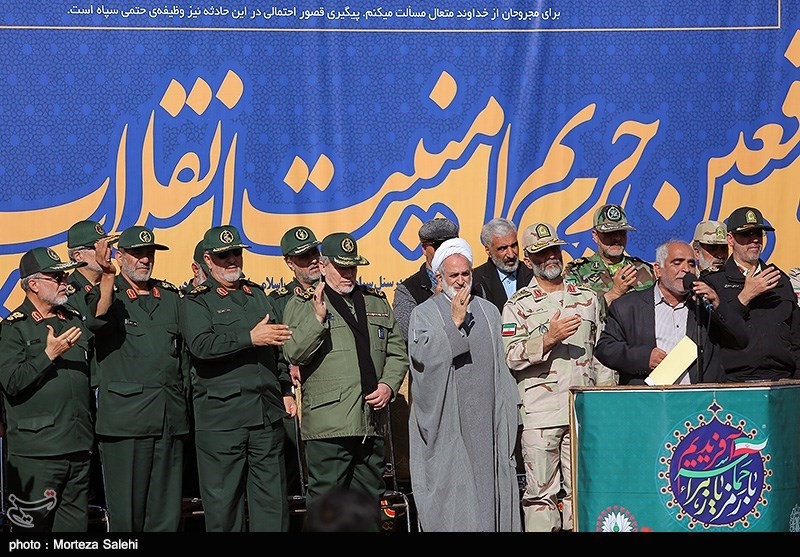
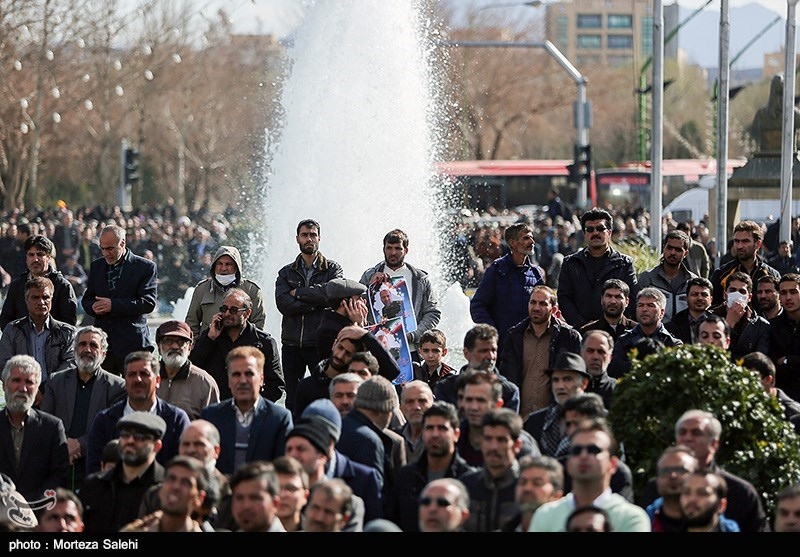
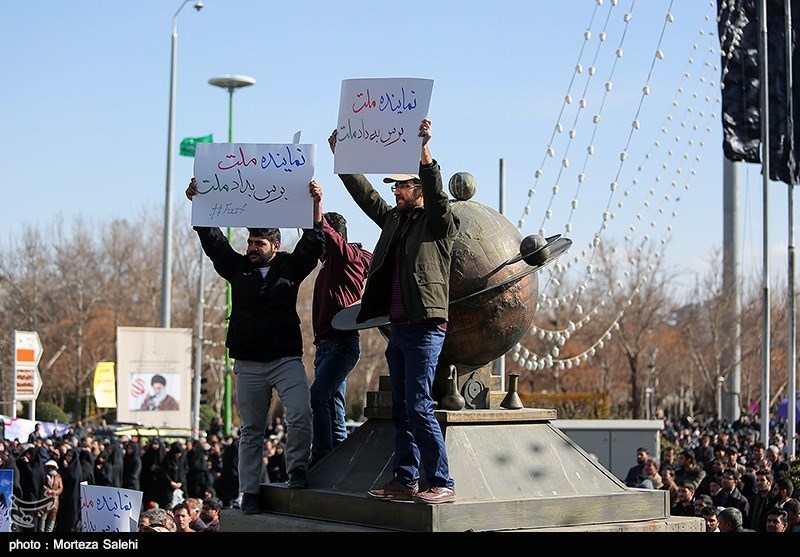
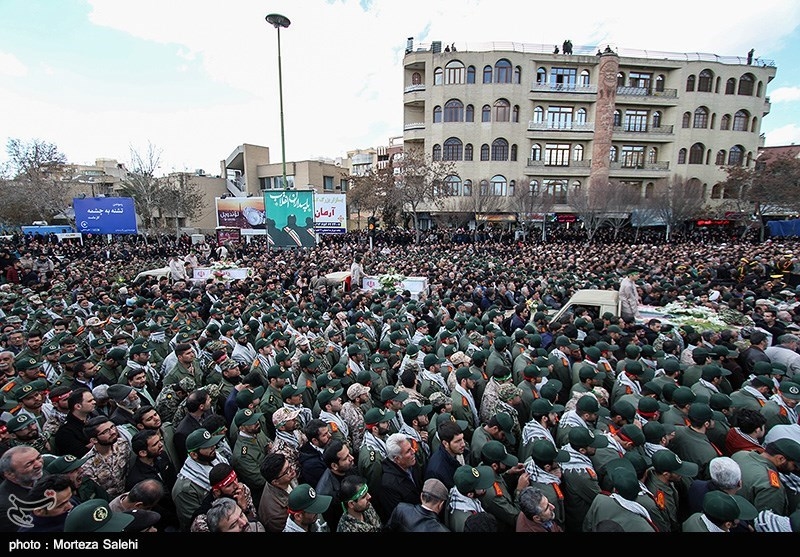
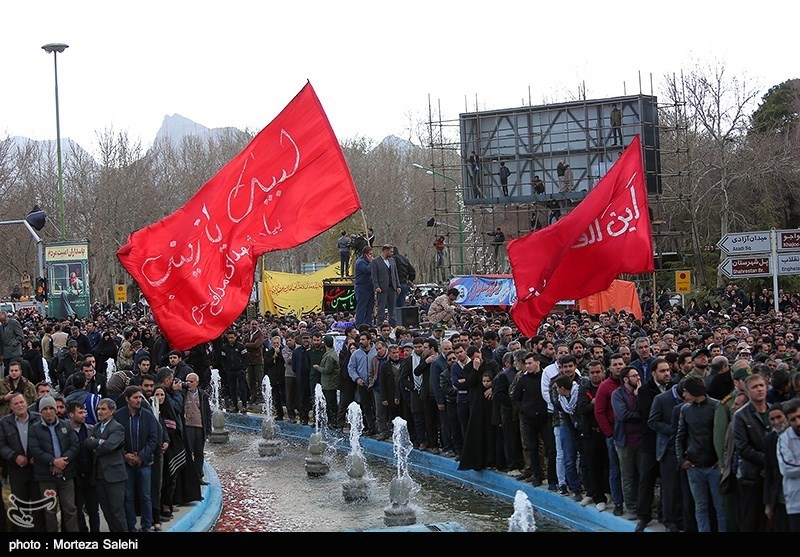
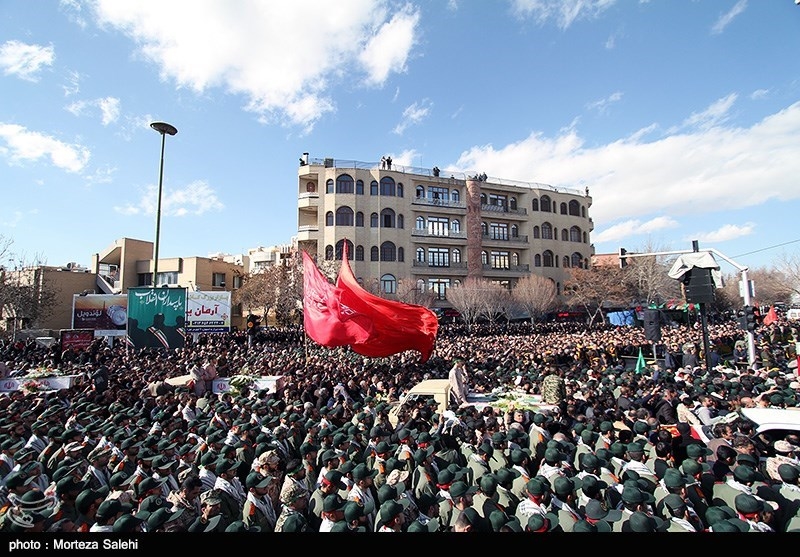
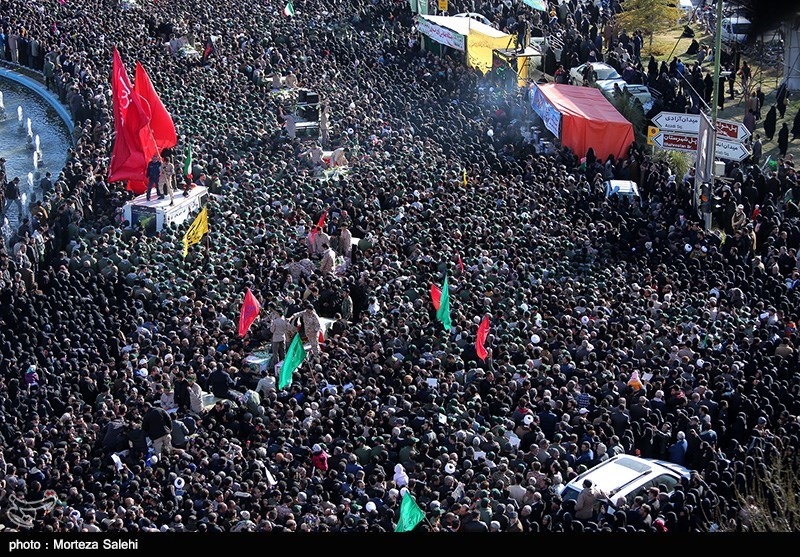
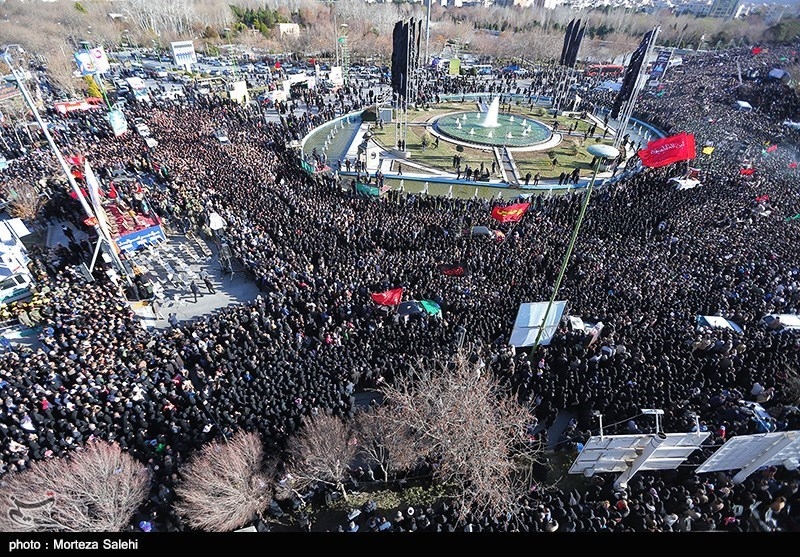
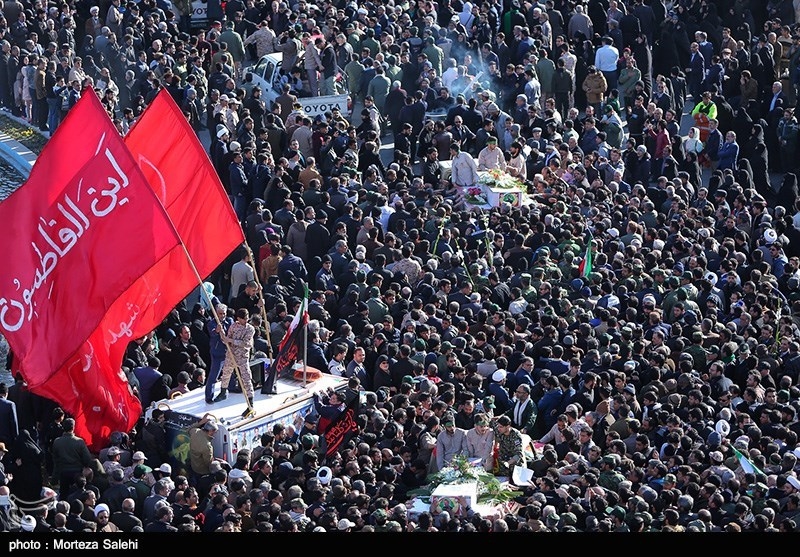
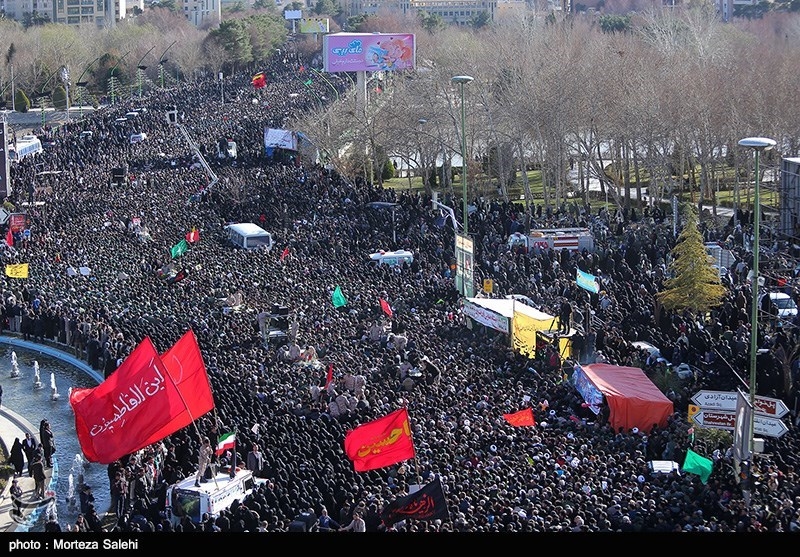
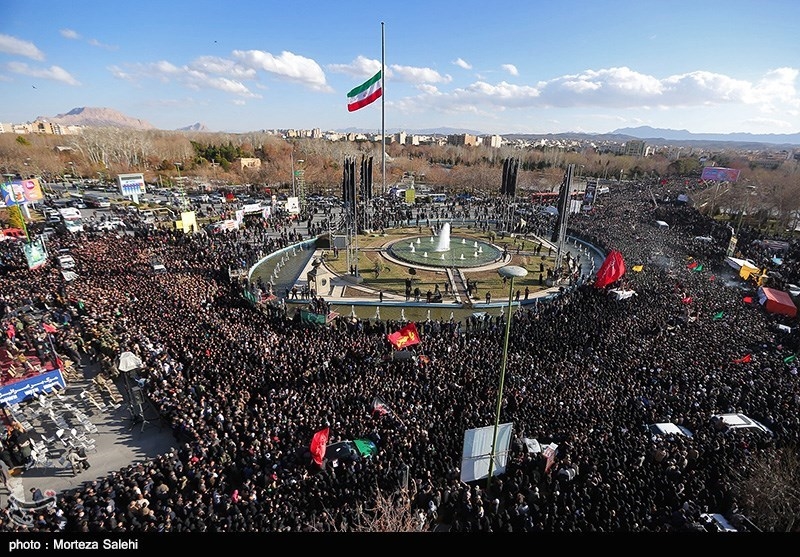
Thousands Attend Funeral of IRGC Forces in Isfahan

The terrorist attack, claimed by the Pakistan-based Jaish al-Adl terrorist group, claimed the lives of 27 and wounded 13 others on Wednesday night.

The majority of those killed in the attack were young soldiers from Isfahan province.

What follows are photos of the funeral retrieved from Tasnim News Agency:

FM Zarif Meets World Diplomats in Munich

Iranians Ready to Negotiate, but Not under Pressure: Omani FM

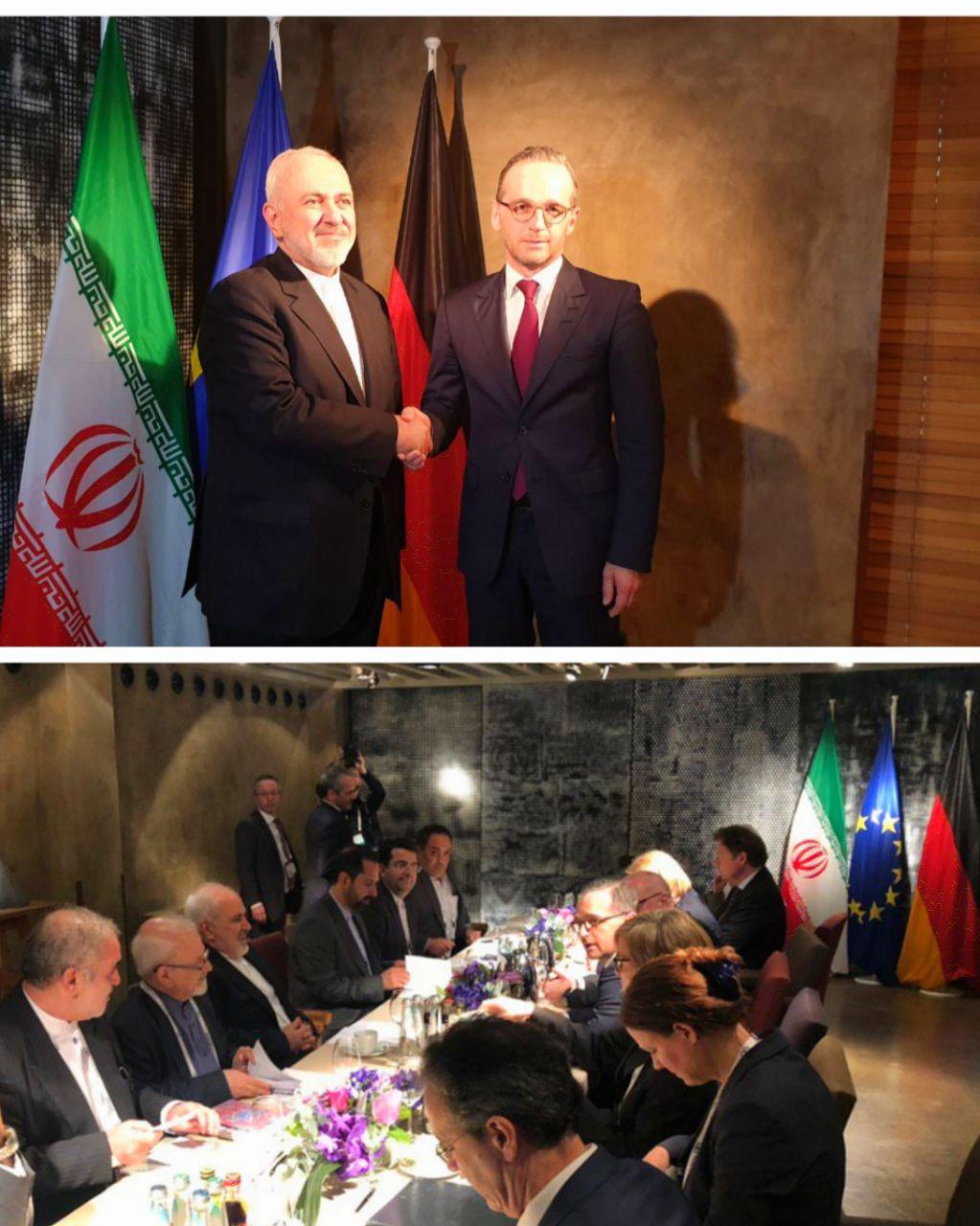
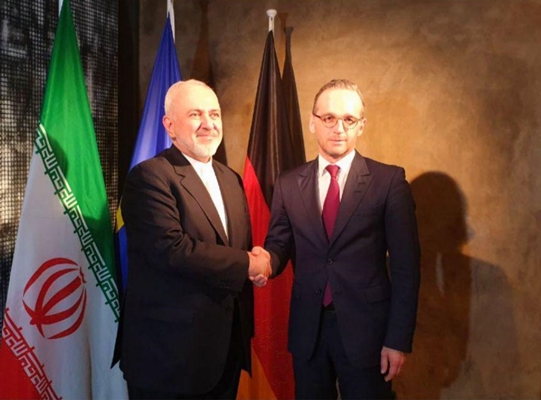
On Saturday, Zarif held a meeting with his German counterpart Heiko Maas, during which the two sides exchanged views on bilateral ties, the Iran nuclear deal, and the Instrument in Support of Trade Exchanges (INSTEX).

They also discussed the most important regional and international issues including Yemen, Syria, Afghanistan, among others.

Zarif further exchanged views with his Kyrgyz counterpart Chingiz Aidarbekov about bilateral relations in all fields, especially in economy and culture, and on international collaborations between Tehran and Bishkek.

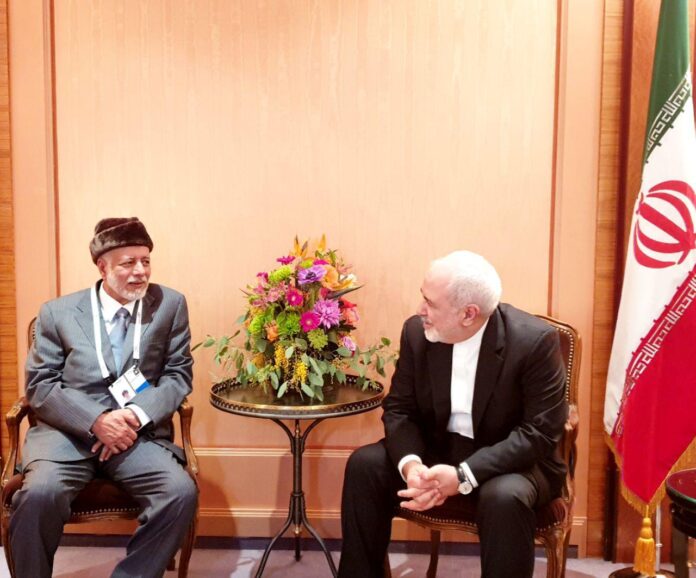
The Iranian top diplomat also held talks with his Omani counterpart Yusuf bin Alawi on the sidelines of the Munich Security Conference in Germany.

In the meeting, Zarif and bin Alawi discussed bilateral ties and regional issues.

Earlier, the Iranian top diplomat held talks with Rosemary DiCarlo, the UN Under-Secretary-General for Political Affairs. At the meeting, the two sides conferred on Iran-UN cooperation, the implementation of the UN Security Council Resolution 2231, the Iran nuclear deal (JCPOA), and the Instrument in Support of Trade Exchanges (INSTEX).

They also talked about various international and regional issues including the situation in Afghanistan, Yemen, Syria, and Lebanon.

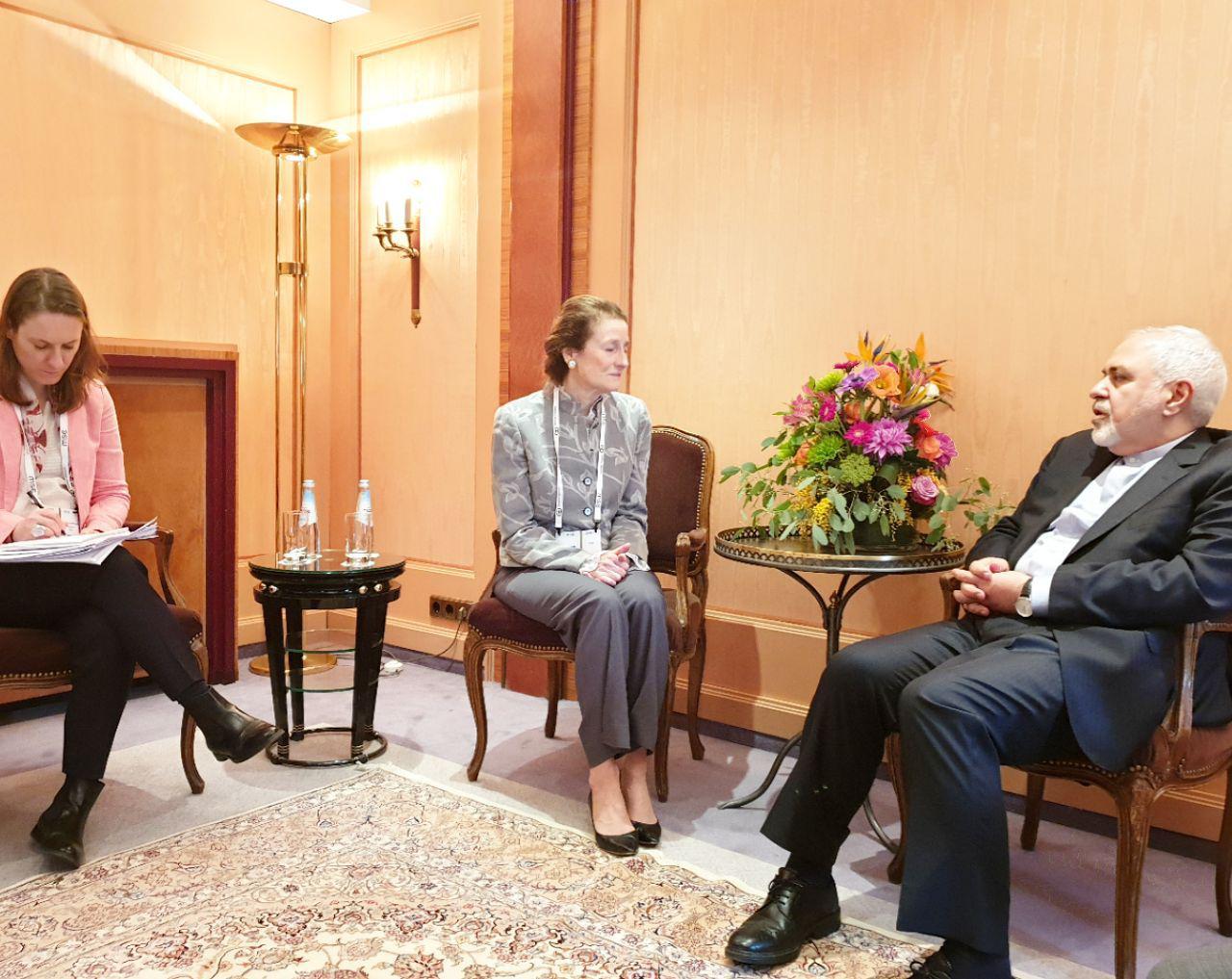
Zarif also discussed Tehran’s cooperation with the UNICEF in a meeting with Henrietta H. Fore, the executive director of the United Nations International Children’s Emergency Fund (UNICEF).

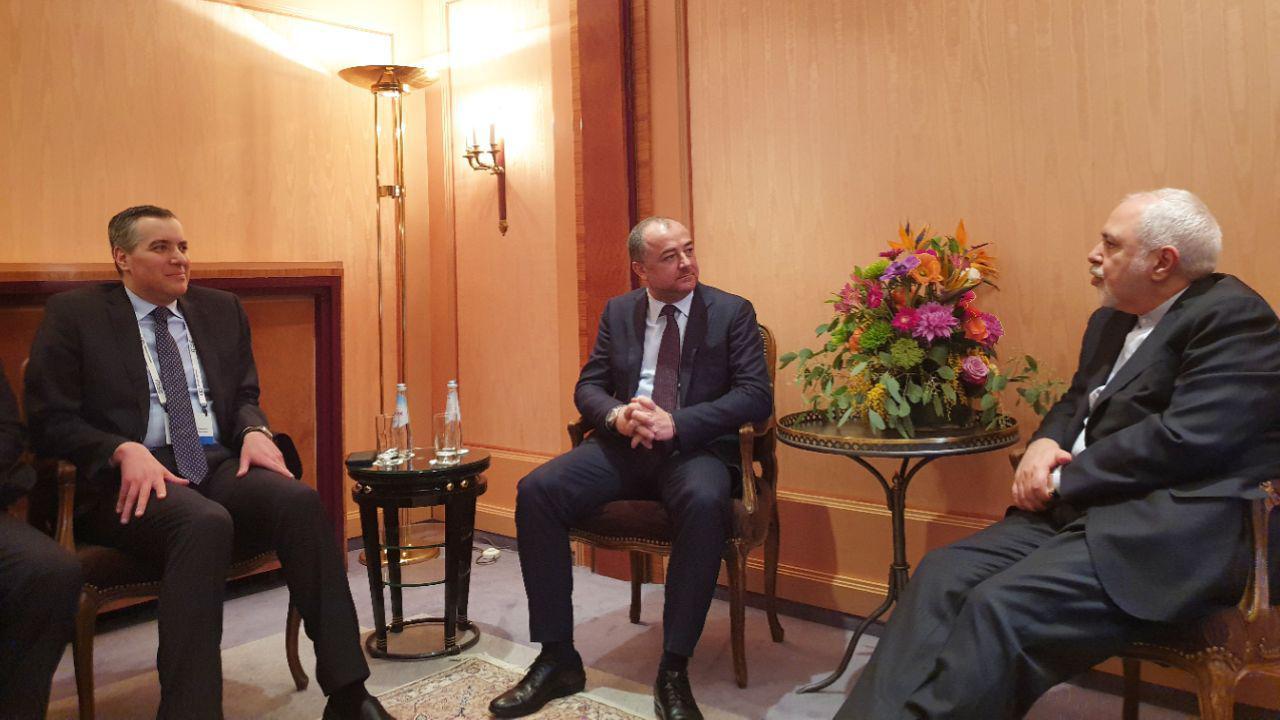
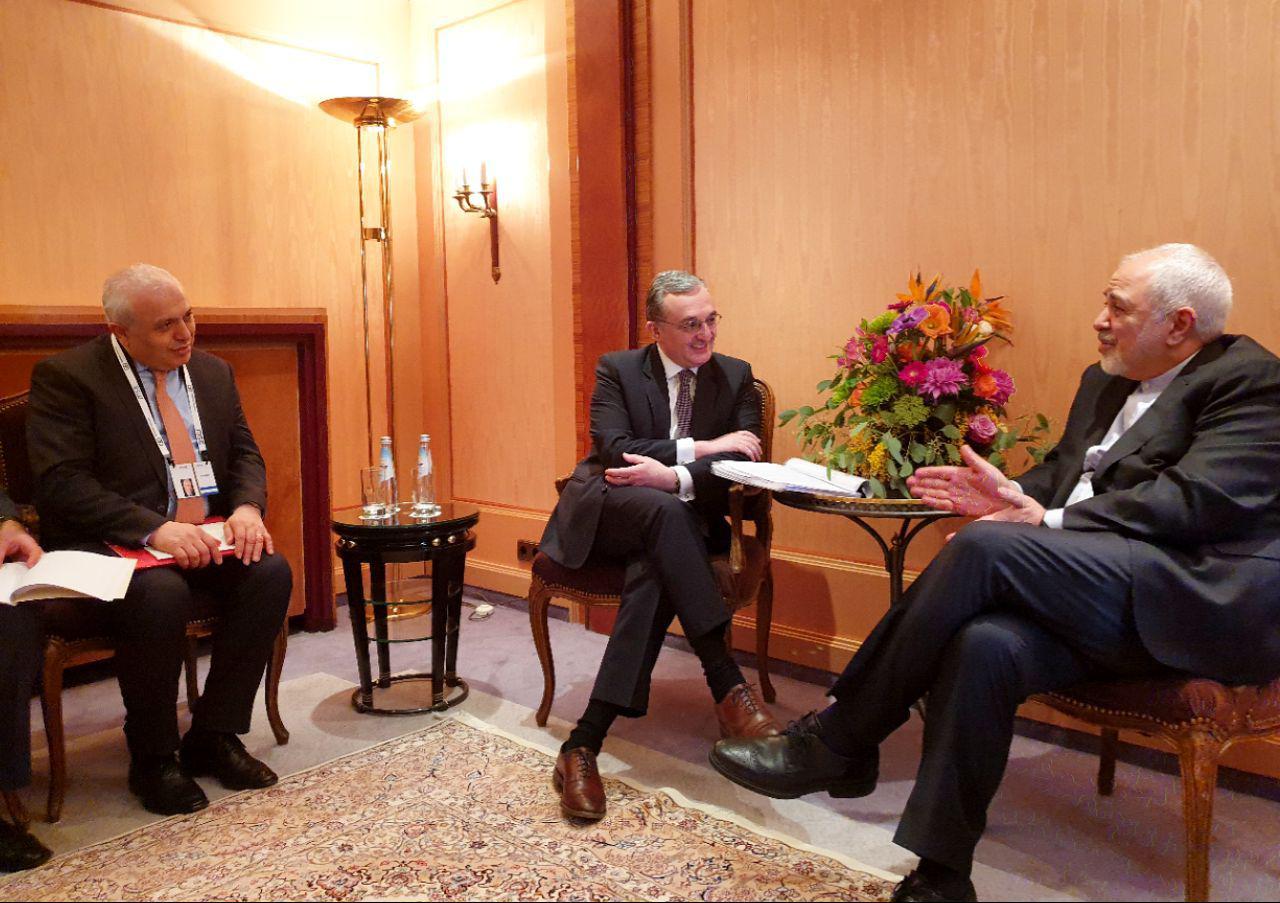
The Iranian top diplomat also held talks with Lebanese Minister of National Defence Elias Bou Saab, Armenian Foreign Minister Zohrab Mnatsakanyan, EU Foreign Policy Chief Federica Mogherini, and the Primate of the Syriac Orthodox Church, Patriarch Mor Ignatius Aphrem II.

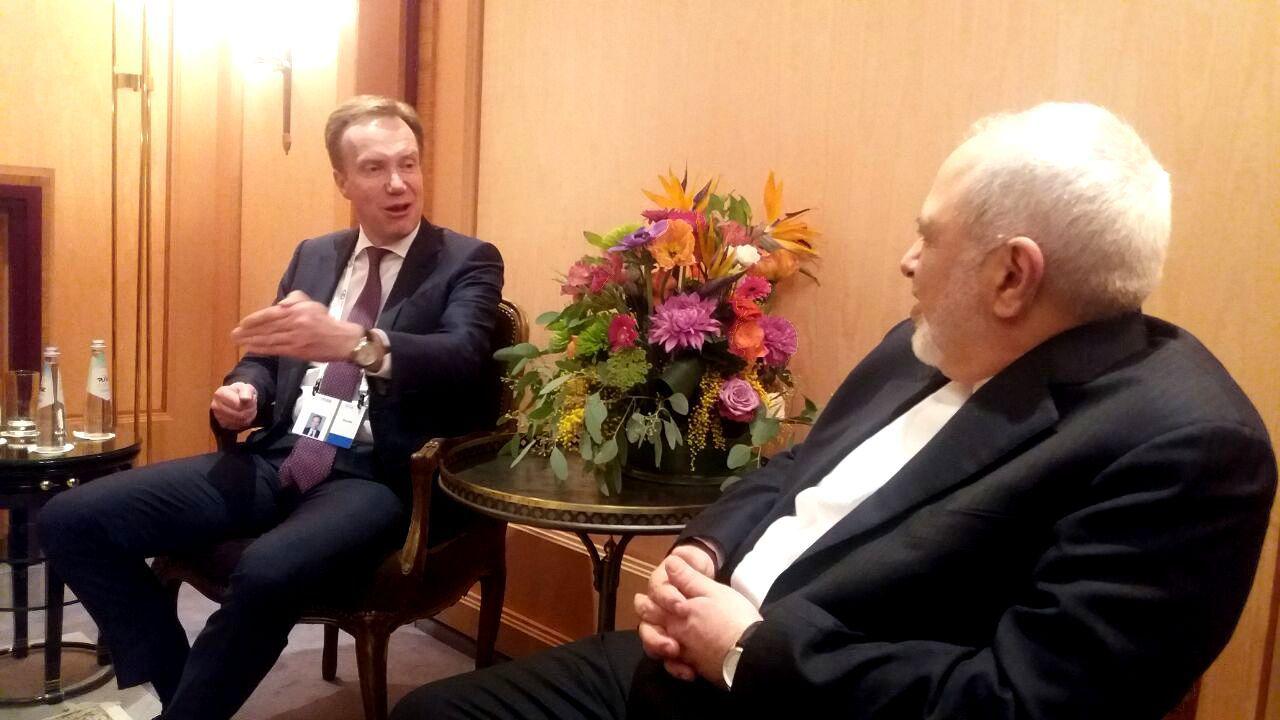
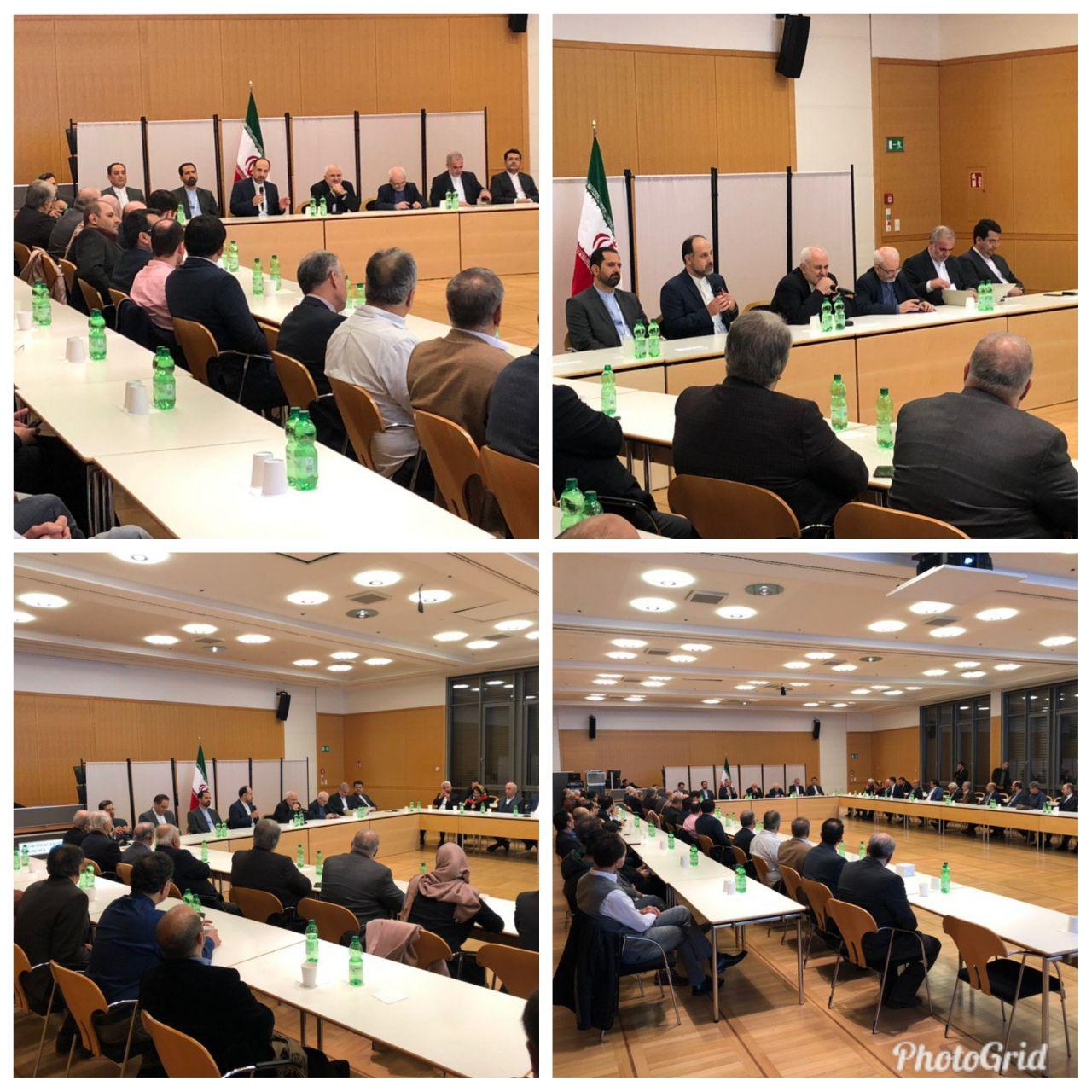
On the same day, Zarif also met with Børge Brende, the president of the World Economic Forum (WEF) and a former Norwegian foreign minister; Mary Robinson and Lakhdar Brahimi, two members of The Elders; and a group of Iranian expatriates living in southern Germany.

During the meeting, Zarif exchanged views with the participants on the common issues and concerns of Iranians inside and outside the country, particularly in cultural, economic, legal, and consular fields.

The Iranian top diplomat also responded to some of the questions raised by the participants.

India FM Stops over in Iran to Discuss Terror Attacks

During the short visit, the Indian foreign minister sat for talks with Iranian Deputy Foreign Minister for Political Affairs Seyyed Abbas Araqchi, as the Iranian top diplomat Mohammad Javad Zarif was in Germany to attend the Munich Security Conference.

The two officials condemned the recent terrorist attacks in Iran’s Sistan and Baluchestan and India’s Srinagar, and offered sympathy to each other.

They also underlined the necessity of establishing peace and calm in the region through dialogue.

Pakistan is facing accusations of harbouring terrorists from western neighbour Iran as well as eastern foe India after dozens of soldiers were killed in separate suicide attacks in the two countries.

Both India and Iran have warned of strong responses to the attacks, which they blame on militant networks based in Pakistan.

Forty-four members of India’s paramilitary police were killed in a suicide car bomb attack in the disputed region of Kashmir on Thursday.

The Pakistan-based militant group Jaish-e-Mohammad (JeM) claimed responsibility for the attack, which was carried out by a 22-year-old man who was born in Indian Kashmir.

India has long accused Pakistan of sponsoring terrorist attacks by Jaish-e-Mohammed and other militant groups, with Pakistan’s Inter-Services Intelligence (ISI) suspected with helping create the group.

On Saturday, Iran echoed India’s complaints, blaming Pakistan-based militants for the deaths of 27 IRGC border guards in a suicide bombing near the Iranian-Pakistani border earlier this week.

The Pakistan-based terrorist group Jaish al-Adl claimed responsibility for the attack.

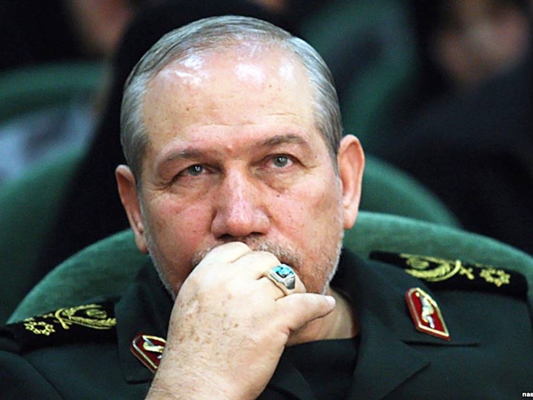
The perpetrators of the recent deadly terrorist attack in Iran had been trained in neighbouring Pakistan, said Major General Yahya Rahim Safavi on Saturday, adding that Pakistan’s Inter-Services Intelligence (ISI) should be held accountable for the deadly attack.

“These wicked criminals (the perpetrators of the terror attack) were [members of] one of the ethnic groups in Baluchestan province, who had received training in the neighbouring country to conduct suicide attacks,” said General Safavi, who is a senior advisor to Leader of the Islamic Revolution Ayatollah Seyyed Ali Khamenei.

“Our neighbouring country (Afghanistan) and the ISI should be answerable to the Iranian government and nation as well as the IRGC regarding how they (the terrorists) crossed the country’s border, and why this neighbouring country has turned into a safe haven and a place for training and dispatching these unfaithful terrorist groups,” said the top general.

Terrorists behind Attack on IRGC Trained in Pakistan: Iran

safavi

Major General Yahya Rahim Safavi said Pakistan’s Inter-Services Intelligence (ISI) should be held accountable for the deadly attack which killed 27 and wounded 13 others.

“These wicked criminals (the perpetrators of the terror attack) were [members of] one of the ethnic groups in Baluchestan province, who had received training in the neighbouring country to conduct suicide attacks,” said General Safavi, who is a senior advisor to Leader of the Islamic Revolution Ayatollah Seyyed Ali Khamenei.

“Our neighbouring country (Afghanistan) and the ISI should be answerable to the Iranian government and nation as well as the IRGC regarding how they (the terrorists) crossed the country’s border, and why this neighbouring country has turned into a safe haven and a place for training and dispatching these unfaithful terrorist groups,” said the top general.

He said the Iran-Pakistan common border has faced threats and security problems in the past, too, and used by terrorists as a safe haven, and “the Pakistani government should be answerable for that.”

He said evidence shows these terrorist groups are financially supported by certain Persian Gulf countries “whose crown prince is currently in Pakistan.”

“They were nursing other wicked and sinister thoughts for the ceremonies marking the anniversary of the victory of the Islamic Revolution, but their plots were foiled thanks to the vigilance of the IRGC and other security and intelligence institutions,” said the general.

General Safavi noted that Iran reserves the right to crack down on the perpetrators of such terrorist attacks.

He said that Iran would like to have cordial relations with neighbouring countries, adding, “insecurity in the region will benefit the Americans and Zionists who have gathered at Warsaw conference.”

The top general noted that the Iranian nation and military will, in due time, deal a crushing and proportionate response to those who provoked and masterminded the recent terrorist attack in Iran.

Iran Dismisses US VP’s ‘Nazi’ Comments

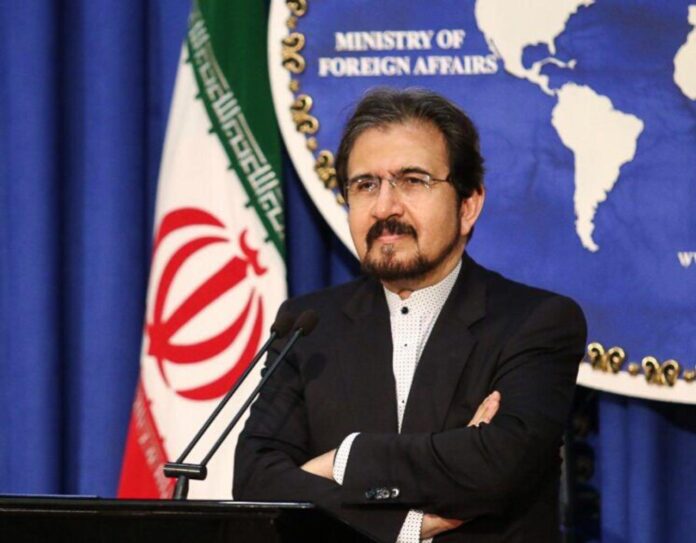
“Iran’s historical and cultural record in coexistence of and respect for divine religions, particularly the Jewish religion, has been registered in credible documents of various nations,” Bahram Qassemi told ISNA Saturday.

“The long-standing and several-thousand-year-old history and civilization of Iran shows the way Iranians thought of and viewed other cultures and religions and their peaceful coexistence and tolerance in such issues,” he noted.

“Those who have some understanding and knowledge of the world’s history and culture and are familiar with books and history and have a minimum level of fairness and justice in their words would not make such hollow and false words so recklessly,” he said.

Pence’s remarks were “empty and propagandistic” ones made out of grudge and hysteria, Qassemi said.

“Our criterion and yardstick in foreign policy is the aggressive and occupying nature of the fake and illegal Zionist regime and the killing machine of the Palestinian people which has cruelly imposed itself on the region, caused division and rift among regional countries and is a source of crises and long-term and costly tensions in the Middle East.”

“They should know that making these allegations and futile and irrelevant remarks won’t help resolve the main issue or remove the root causes of their anger and crisis,” the spokesman added.

“Be patient, read and learn as history is full of facts that no power can delete or change forever,” Qassemi said, addressing the American official and his allies.

On Friday, Pence accused Iran of Nazi-like anti-Semitism, following a visit to the memorial site of Auschwitz in Poland.

Pence said the visit to the Nazi camp had made him more determined to confront Tehran, which he claimed was “breathing out murderous threats with the same vile anti-Semitic hatred that animated the Nazis in Europe,” Radio Free Europe reported.

War with Iran to Be Suicidal for US, FM Zarif Warns

Zarif, who is in Germany to attend the 55th Munich Security Conference (MSC) 2019, made the remarks in a wide-ranging exclusive interviewwith NBC News on Friday when asked if there would be a war between Iran, the US and Israel.

He said the “same gang” behind the US invasion of Iraq in 2003 were “at it again” in pushing for war with Iran.

“I’m not saying [US] President [Donald] Trump’s administration, I’m saying people in President Trump’s administration are trying to create the same eventually and I believe they will fail,” the Iranian foreign minister said.

“But I think at the end of the day, some sense will prevail and people will find out that it’s suicidal to engage in a war with Iran.”

The United States, under former President George W. Bush invaded Iraq in 2003, claiming that the then-Iraqi regime possessed weapons of mass destruction. No such weapons were ever found. President Bush later called his decision to order the invasion of Iraq “an emotional one.”
Bush’s successor, former President Barack Obama, officially ended the occupation of the Arab country in 2011.

The top Iranian diplomat further said Washington has a “pathological obsession” with Tehran and added, “Iran is different from other countries. The United States is used to dealing with countries that rely on outside as their source of legitimacy [and] as their source of strength.”

However, he emphasized, Iran has survived for 40 years in spite of the US pressure and not with its support.

On Wednesday, hawkish Israeli Prime Minister Benjamin Netanyahu said in a short video recorded on the sidelines of an anti-Iran meeting in Warsaw, Poland, that the event “is an open meeting with representatives of leading Arab countries that are sitting down together with Israel in order to advance the common interest of war with Iran.”

Netanyahu’s office posted the Hebrew-language video on Facebook and Twitter, in which he could be heard using the Hebrew word “milchama,” which literally translates to “war.”

It also tweeted Netanyahu’s remarks on its English-language Twitter account.

The Israeli premier’s open call for war with Iran led to an uproar on social media and even startled the White House, which had earlier claimed the Warsaw forum was not meant to “demonize or attack Iran.”

The backlash prompted Netanyahu’s office to quietly delete the tweet and replace it with another one that changed the phrase “war with Iran” to “combating Iran,” without issuing a retraction or a correction of any kind.

Elsewhere in the interview, Zarif once again expressed Iran’s objection to the idea of renegotiating the landmark Iran nuclear deal, officially known as the Joint Comprehensive Plan of Action (JCPOA).

President Trump withdrew Washington in May from the Iran nuclear agreement, reached between Iran and the P5+1 group of countries in 2015, and decided to re-impose unilateral sanctions against Tehran.

Under the deal, Iran undertook to put limits on its nuclear program in exchange for the removal of nuclear-related sanctions.

Vice President Mike Pence on Thursday urged Washington’s European allies to withdraw from the JCPOA and accused them of trying to break US sanctions against Tehran.

“Sadly, some of our leading European partners have not been nearly as cooperative. In fact, they have led the effort to create mechanisms to break up our sanctions,” Pence said.

Pointing to Iran’s attempt to launch a satellite last month that failed to reach orbit, Zarif said it was possible the failure was due to Washington’s sabotage campaign as suggested by a New York Times report this week.

He added that Iran had already been investigating these failures but was now “looking into the specifics” after the story in The Times.

“It’s quite possible. We don’t know yet. We need to look into it very carefully,” the Iranian foreign minister said.

The New York Times reported on Wednesday that the Trump administration had reportedly revived a secret plan to sabotage Iran’s ballistic missiles as part of its broader plan to weaken the Islamic Republic’s military might and harm its economy.

It cited current and former administration officials and reported that the clandestine operation has been ongoing for some time now but it was practically impossible to determine whether it has been successful and if yes, to what extent.

Iran launched a scientific satellite into space to collect environmental information to boost the country’s forecasting system. However, technical problems that occurred during the final stage of the launch prevented the spacecraft from reaching orbit.

Iran’s Minister of Information and Communications Technology Mohammad Javad Azari Jahromi tweeted on January 15, “The Payam (Message) satellite was successfully launched this morning aboard the satellite carrier. But the satellite unfortunately failed to be placed in orbit in the final stage.”

He, however, stressed that Iran was preparing to launch another satellite, named Doosti (friendship).

Pakistan Backs Terrorists behind Zahedan Attack: IRGC Chief

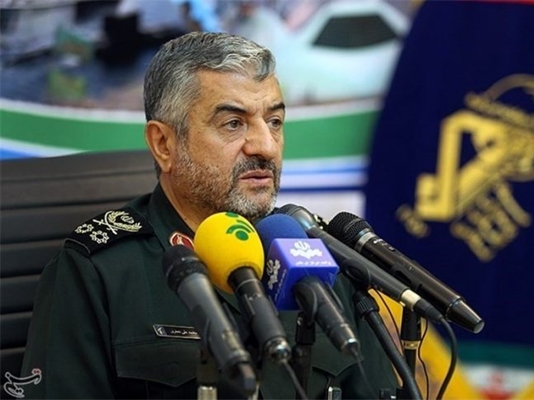
Major General Mohammad Ali Jafari said on Saturday the Pakistani government supports terrorists who committed the recent attack on IRGC forces, and its security service knows the whereabouts of these groups.

The Pakistani government must change its approach towards these groups, he said, adding that Iran reserves the right to directly respond to the attack if Pakistan does not move to fight terrorists.

Last Wednesday, a suicide attacker hit an explosive-laden vehicle into a military bus carrying IRGC personnel in the south-eastern Sistan and Baluchestan province.

The attack killed 27 and wounded 13 others.

The Jaish al-Adl group, an offshoot of Jundallah which has carried dozens of terror operations inside Iran in recent years, has claimed responsibility for the attack.


Iran’s Revenge Coming

General Jafari said the attacks had been carried out at the order of Saudi Arabia and the UAE, two Arab governments hostile towards Iran.

Iran will no longer show patience towards plots and reactionary governments in the region, particularly Saudi Arabia and the UAE, which take these measures at the order of the US and Zionist regime, and will certainly take compensatory measures from now on, he said.

The IRGC chief said such terror attacks would only strengthen Iran’s will to deal blows to enemies.

“The enemies must be assured that the comrades of these martyrs and all those responsible for protecting security of people will be more determined to defend and deal bigger blows to enemies,” he said.

A Look at Iranian Newspaper Front Pages on February 16

A Look at Iranian Newspaper Front Pages on November 19

The top story today was the remarks made by President Hassan Rouhani during his tripartite meeting with his Russian and Turkish counterparts in the city of Sochi. The withdrawal of US forces from Syria was among the topics highlighted by most papers.

Several papers also covered the Warsaw Summit and resembled it into a circus staged by Washington. Some dailies also said that the Sochi Summit could defeat attempts at Warsaw to give a bad picture of Iran.
Reactions to the Wednesday terrorist attack in Iran’s Sistan and Baluchestan province in which 27 border guards were killed was another topic highlighted by Iranian dailies.
The above issues, as well as many more, are highlighted in the following headlines and top stories:


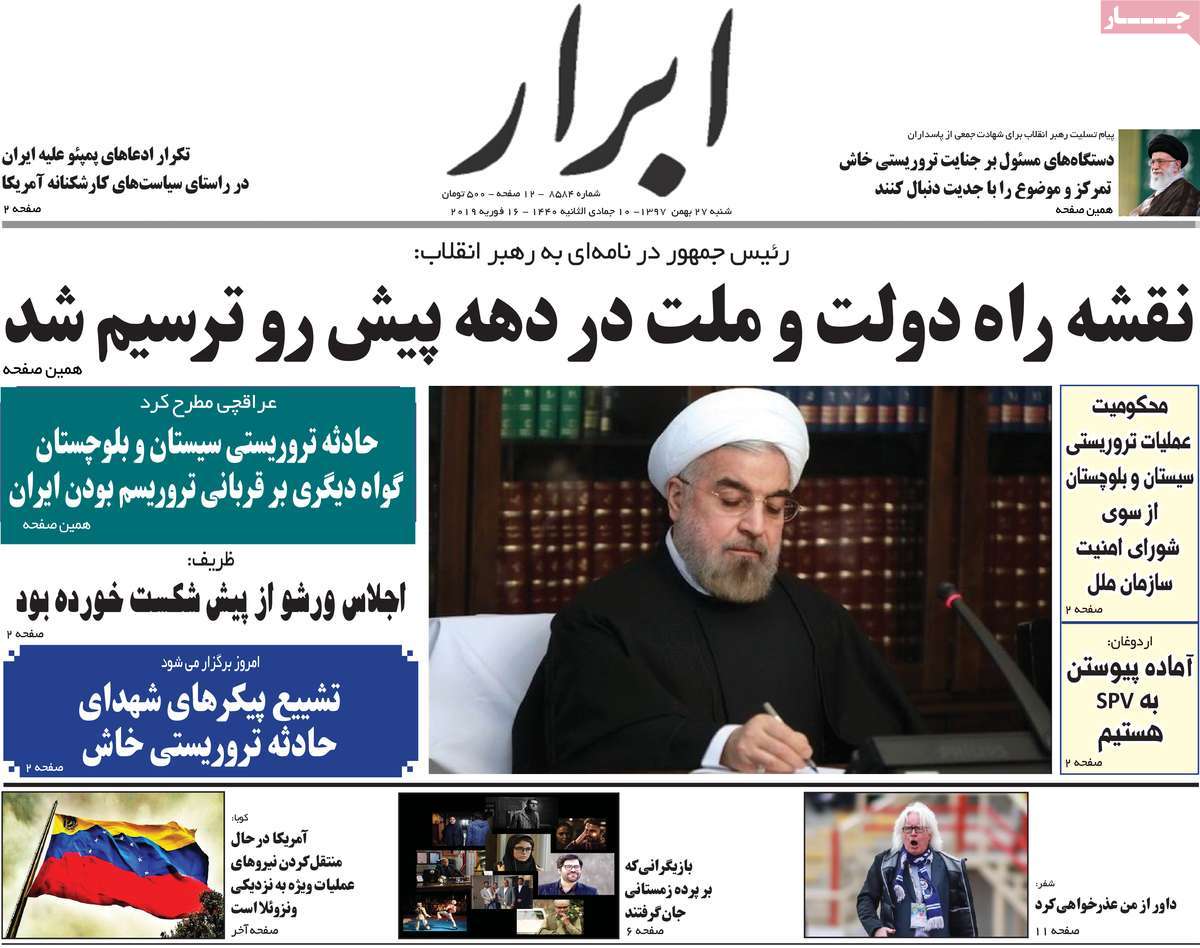
Abrar:

  • Pompeo Repeats Anti-Iran Claims in Line with US Disruptive Policies
  • UNSC Condemns Iran’s Sistan and Baluchestan Terrorist Attack
  • We Are Ready to Join SPV: Erdogan
  • US Moving Special Operations Forces Near Venezuela: Cuba

A Look at Iranian Newspaper Front Pages on February 16


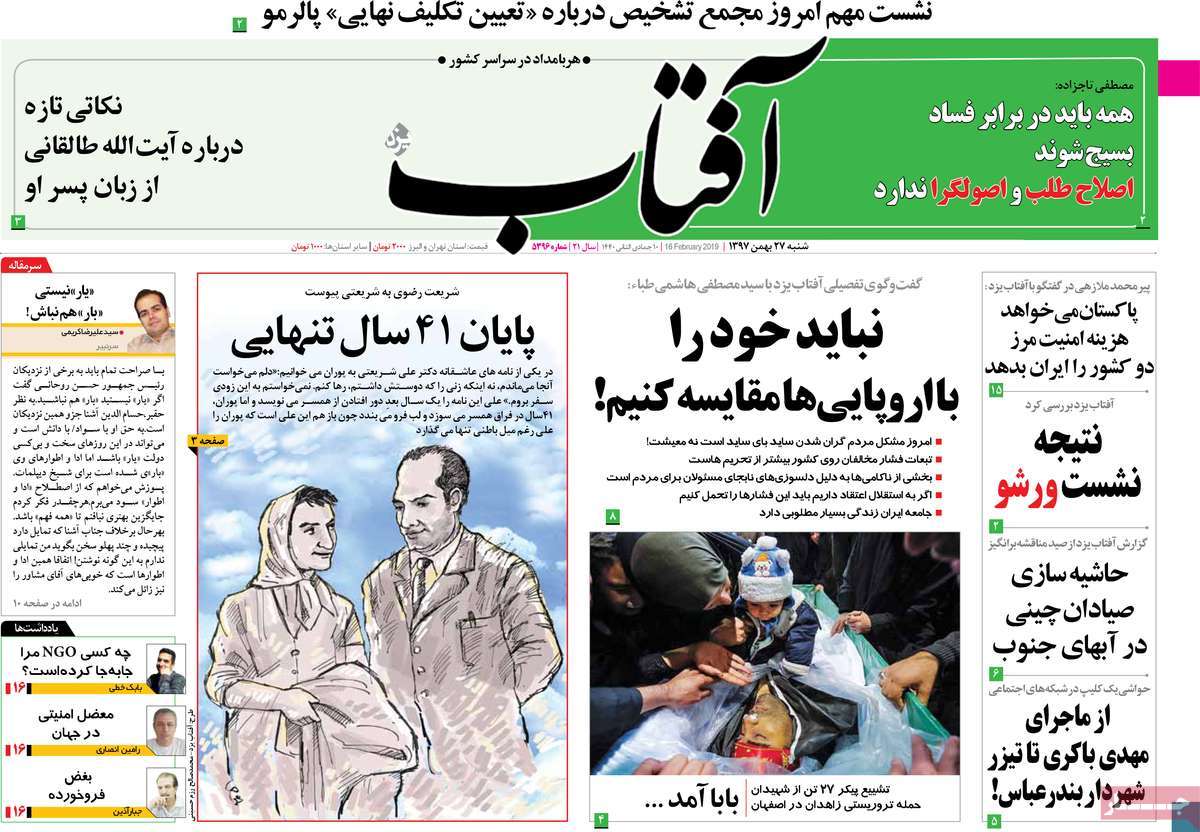
Aftab-e Yazd:

  • ‘Pakistan Wants Iran to Pay Border Security Costs’
  • Warsaw Summit Outcome
  • Disputes of Chinese Fishermen’s Fishing in Southern Waters

A Look at Iranian Newspaper Front Pages on February 16


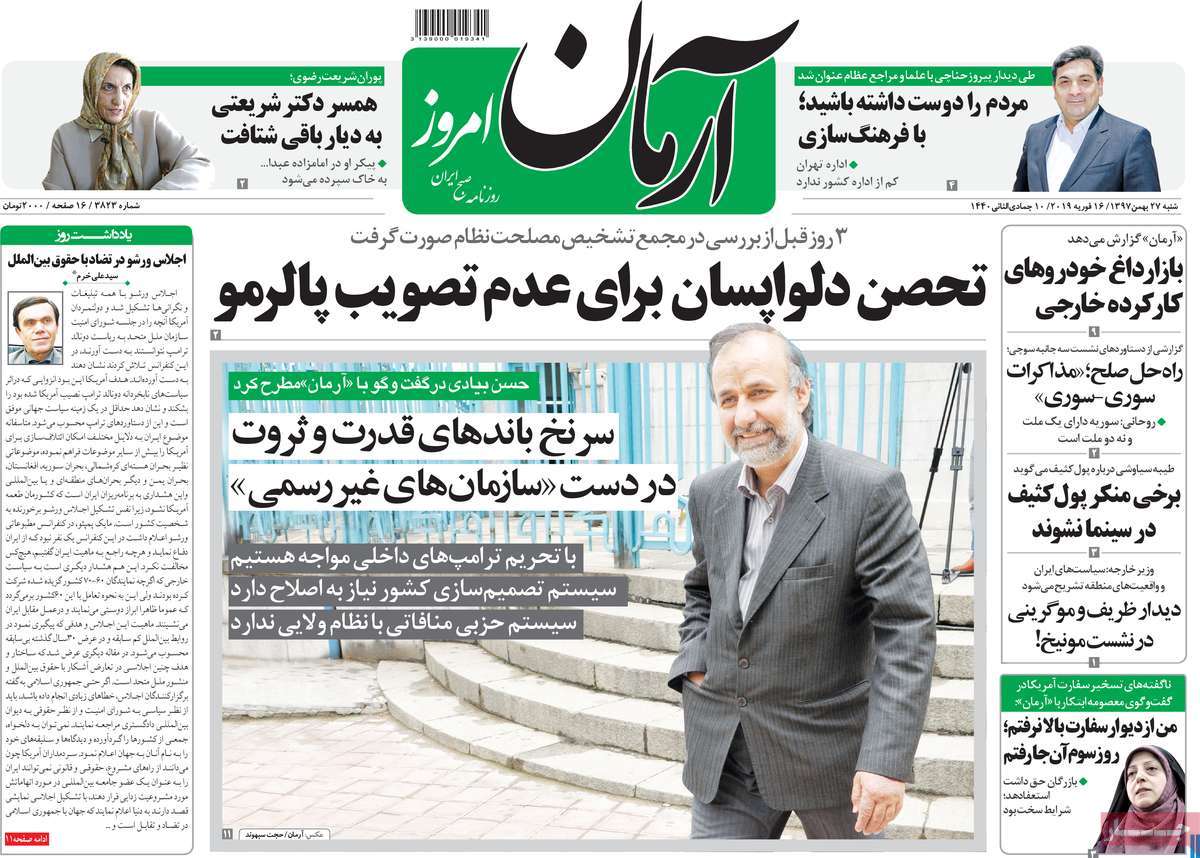
Arman-e Emrouz:

  • Syria Has One Nation Not Two: Rouhani
  • Peace Solution Only Through Syrian-Syrian Talks
  • Zarif, Mogherini Meet in Munich
  • Iran’s Policies, Regional Realities Described: Zarif

A Look at Iranian Newspaper Front Pages on February 16


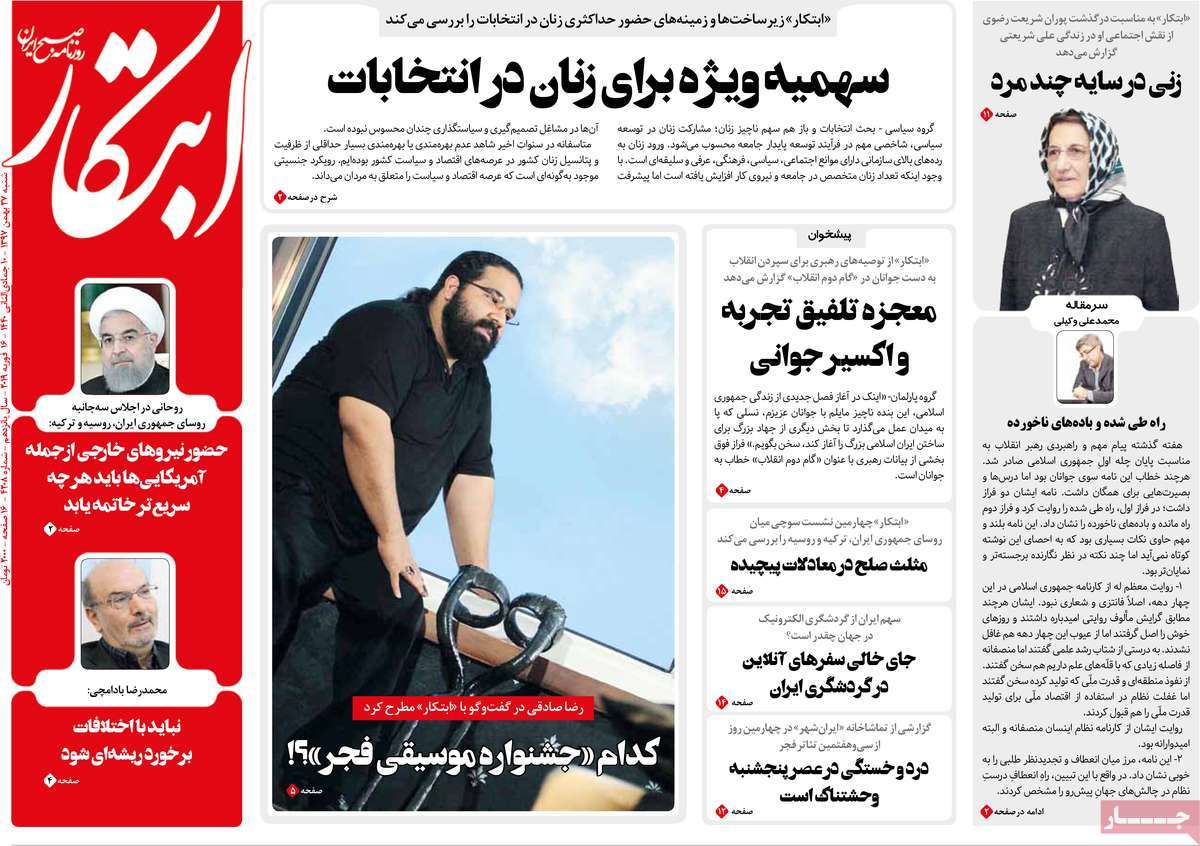
Ebtekar:

  • Presence of Foreign Forces, Especially US, Should End ASAP: Rouhani in Sochi
  • Equations of Peace Triangle
  • A Look at 4th Sochi Summit between Presidents of Iran, Turkey, Russia

A Look at Iranian Newspaper Front Pages on February 16


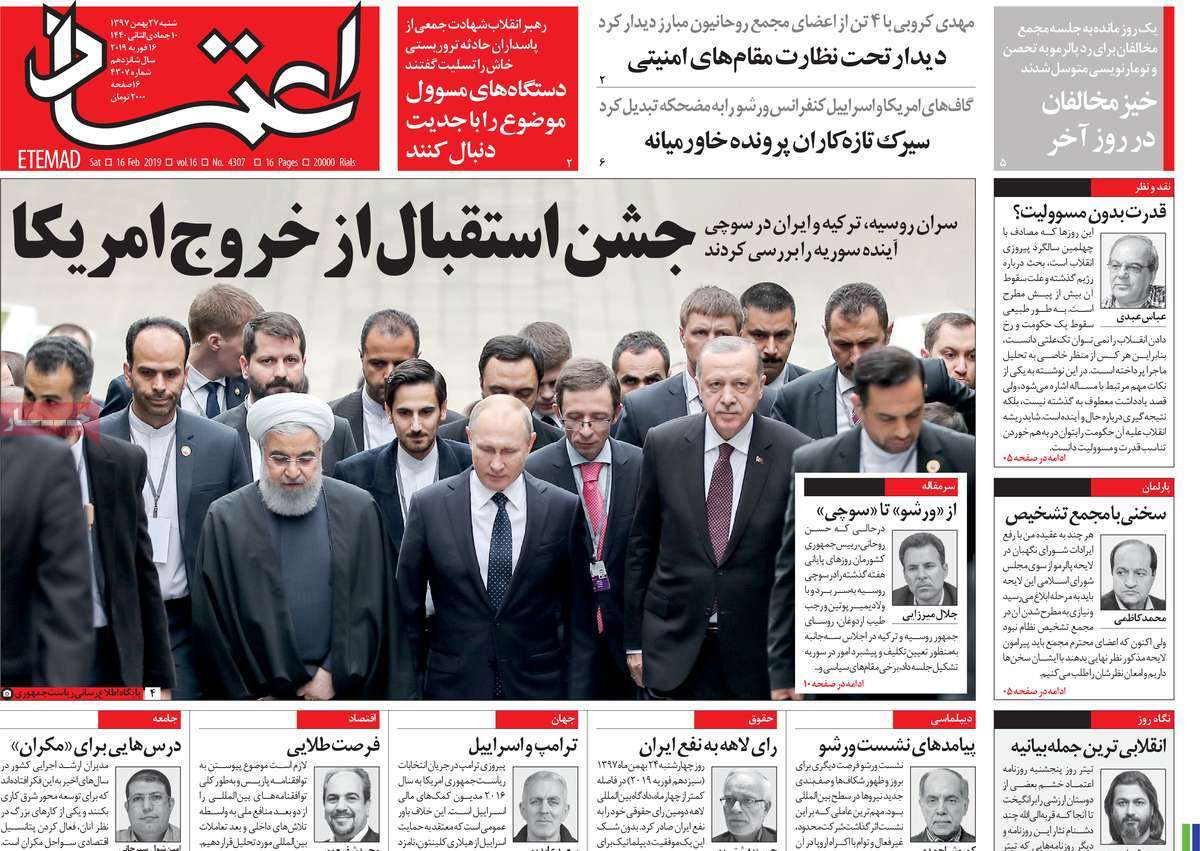
E’temad:

  • US, Israeli Gaffes Turn Warsaw Conference into Farce
  • Celebrating US Withdrawal
  • Turkish, Iranian, Russian Leaders Study Syria’s Future in Sochi

A Look at Iranian Newspaper Front Pages on February 16


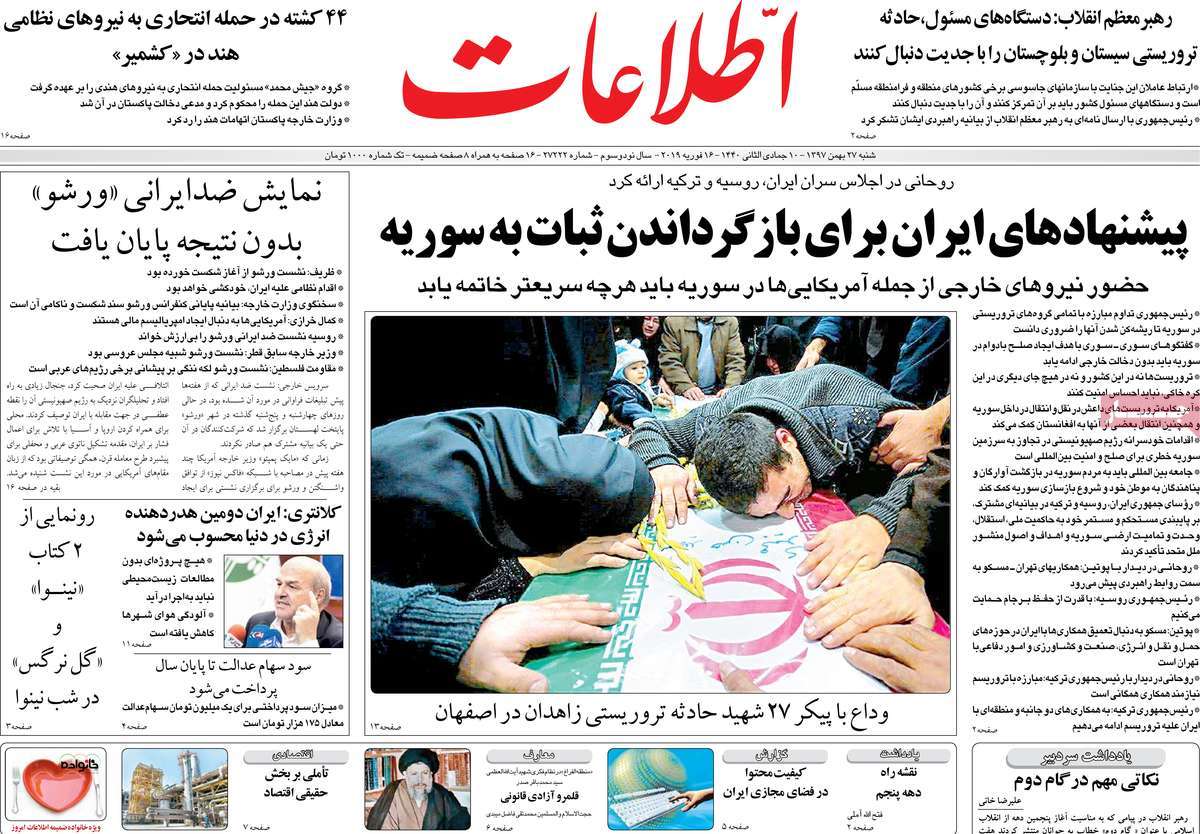
Ettela’at:

  • Responsible Organisation Must Look Seriously into Sistan & Baluchestan Terror Attack: Leader
  • 44 Killed in Suicide Attack on Indian Troops in Kashmir
  • Rouhani Sets Forth Proposals to Restore Stability to Syria

A Look at Iranian Newspaper Front Pages on February 16


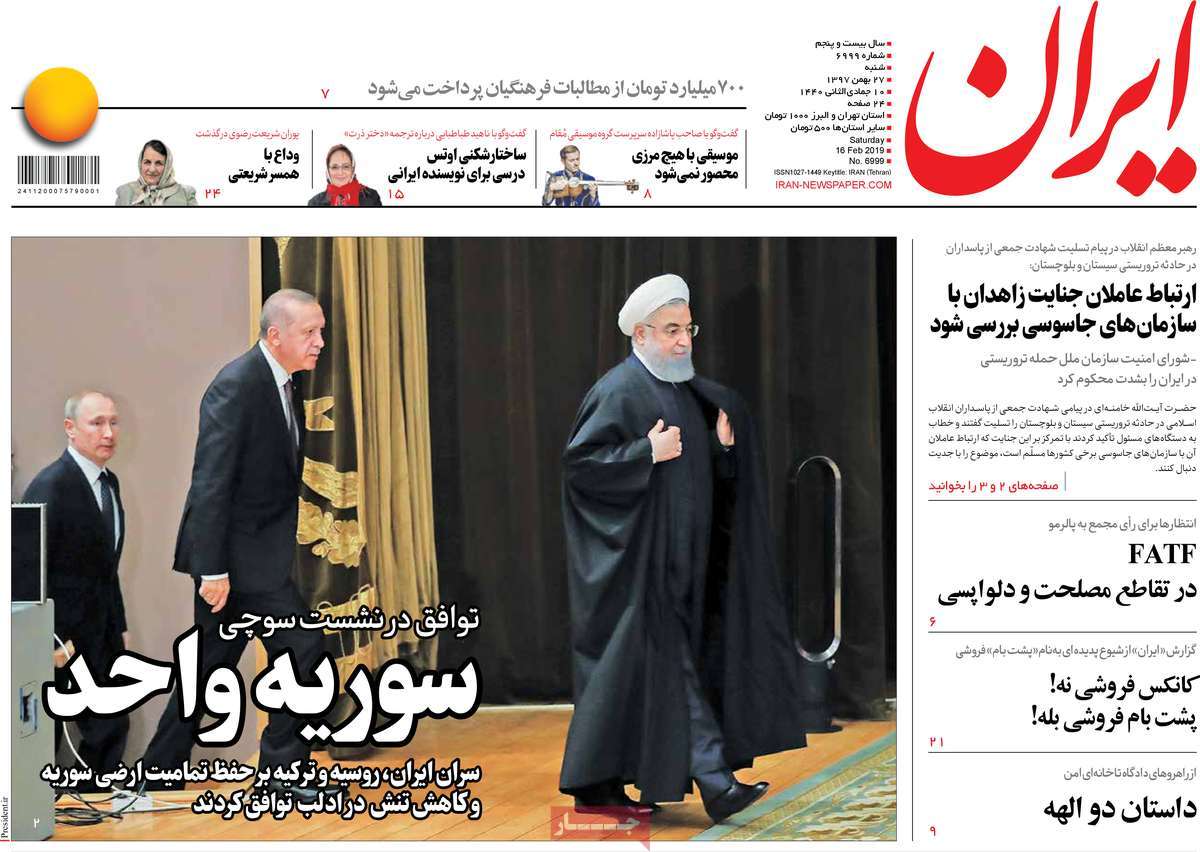
Iran:

  • Iran, Russia, Turkey Leaders Agree on Maintaining Syria’s Territorial Integrity, Reducing Tensions in Idlib

A Look at Iranian Newspaper Front Pages on February 16


Jomhouri Eslami:

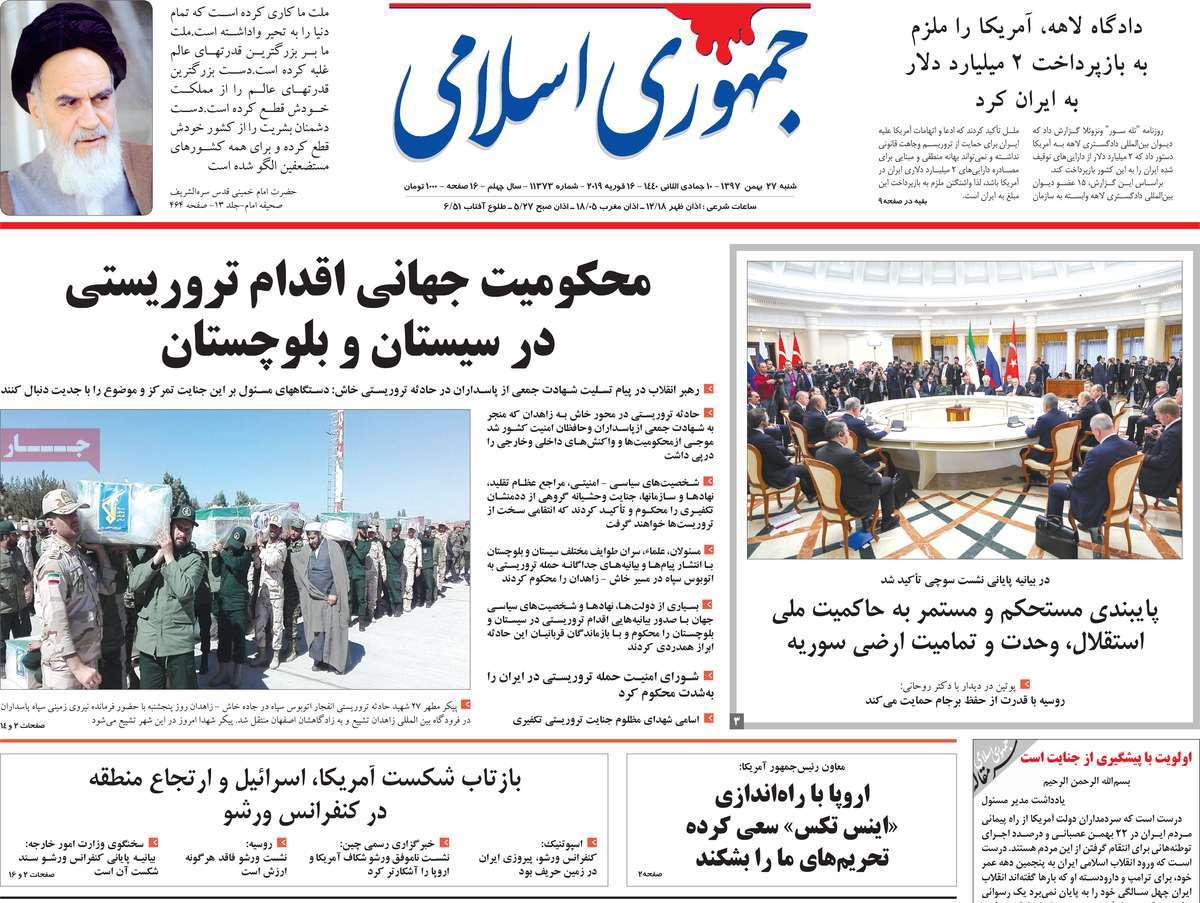
  • The Hague Orders United States to Pay $2 Billion to Iran
  • World Condemns Terror Attack in Iran’s Sistan & Baluchestan
  • EU Have Led INSTEX to Create Mechanisms to Break up Our Sanctions: Mike Pence

A Look at Iranian Newspaper Front Pages on February 16


Kayhan:

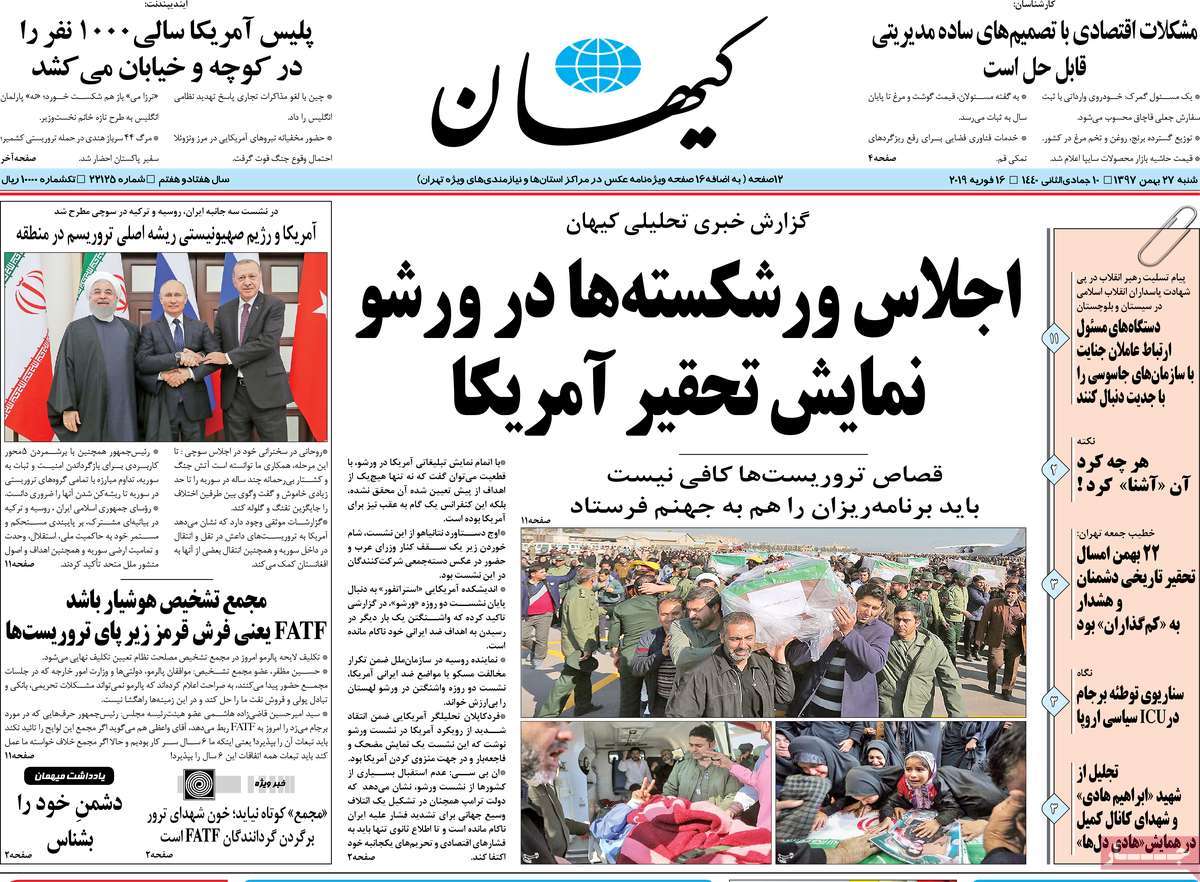
  • US Police Shoot Almost 1,000 Dead Every Year: Independent
  • US, Zionist Regime Cause of Terrorism in Region: Iran, Turkey, Russia Discuss in Sochi
  • Warsaw Summit Displays US Humiliation

A Look at Iranian Newspaper Front Pages on February 16


Sazandegi:

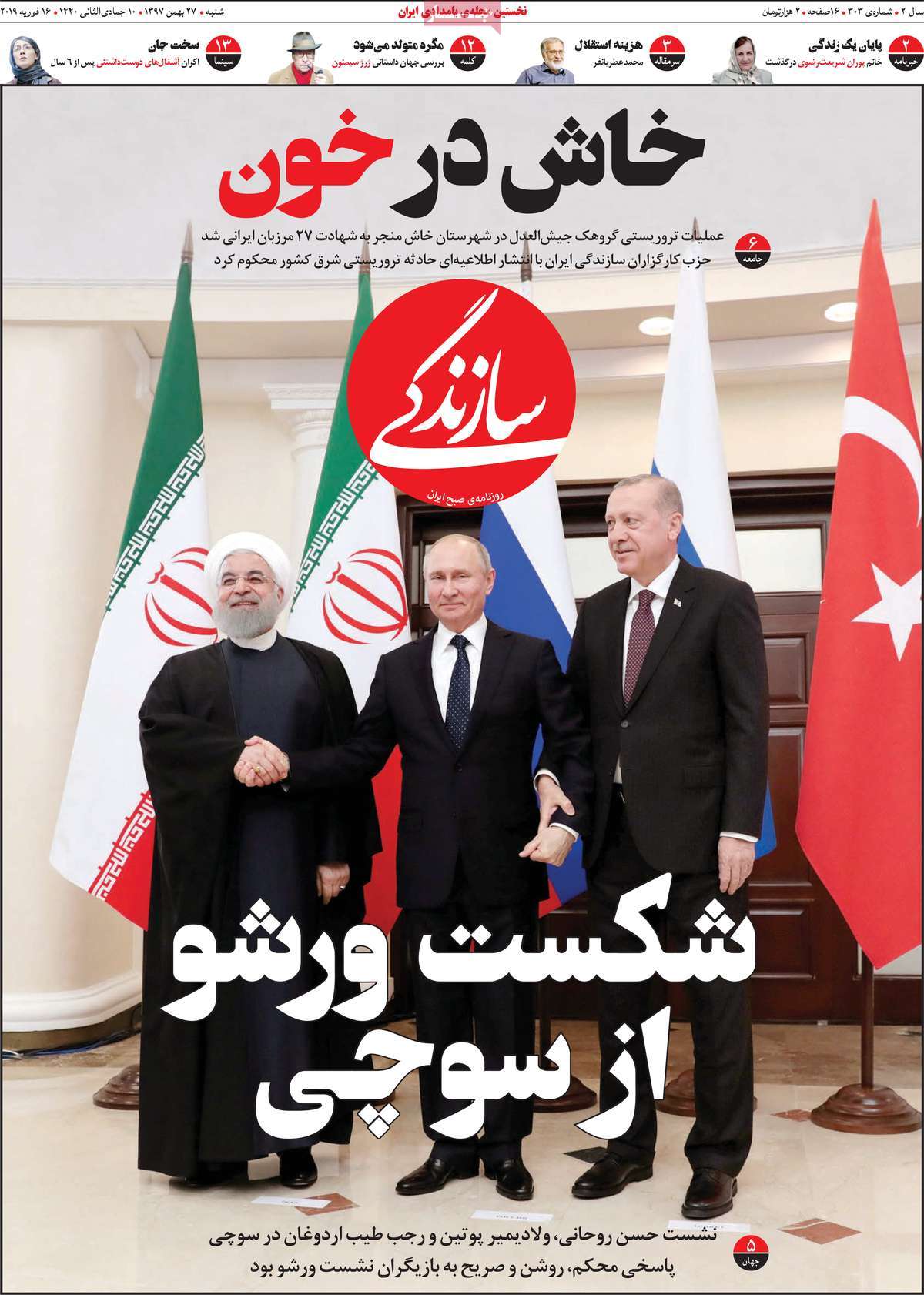
  • Khash in Blood
  • Terrorist Attack in Khash Kills 27 Iranian Border Guards
  • Warsaw Defeated by Sochi
  • Sochi Tripartite Summit Clear Response to Warsaw Players

A Look at Iranian Newspaper Front Pages on February 16


Setareh Sobh:

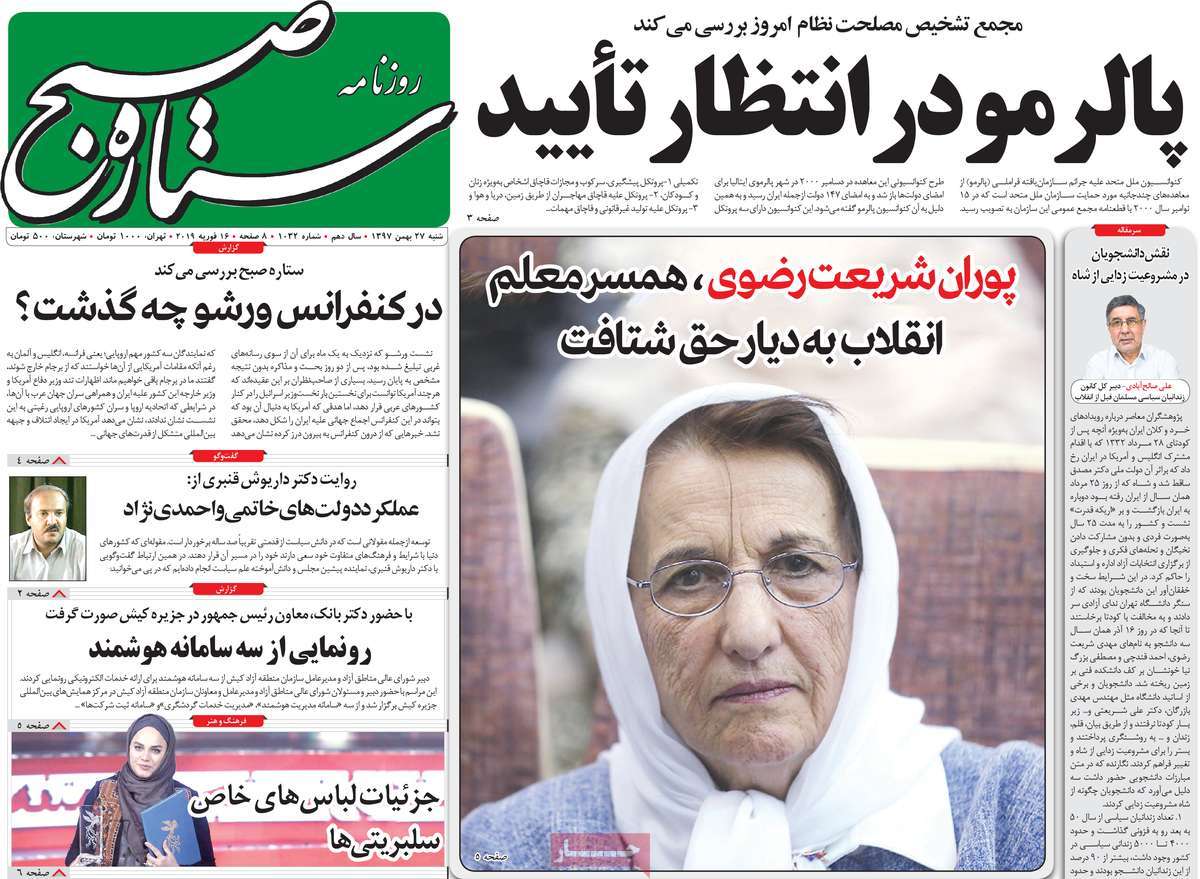
  • Palermo Convention Waiting to Be Approved
  • Iran Expediency Council Looks into Palermo Convention Approval
  • What Happened at Warsaw Conference?

A Look at Iranian Newspaper Front Pages on February 16


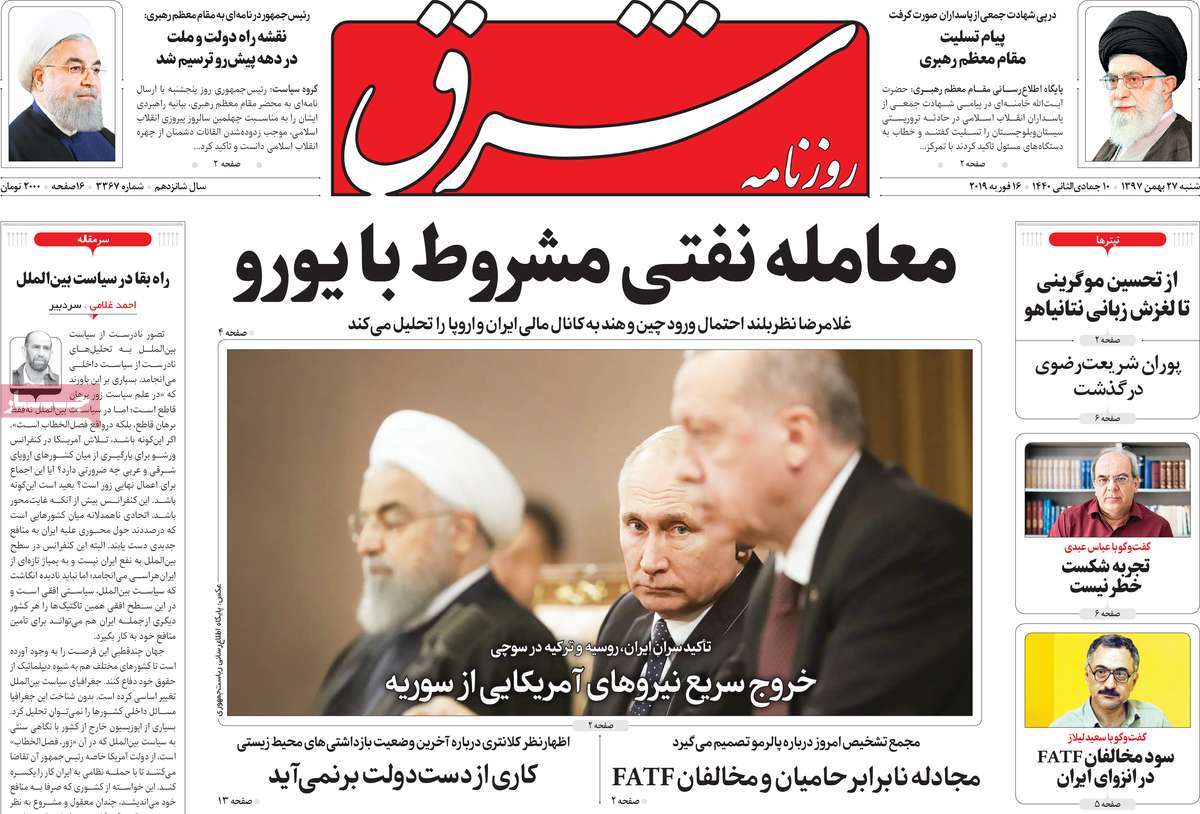
Shargh:

  • Oil Trade with Euro
  • Expert Analyses Likelihood of China-India Coop with Iran Through EU Channel
  • Rouhani Writes Letter to Leader on Roadmap of Coming Decade for Gov’t, Nation
  • Iran Leader Expresses Sympathy over Martyrdom of IRGC Forces
  • Iran, Russia, Turkey Leaders Confirm Withdrawal of US Forces from Syria

A Look at Iranian Newspaper Front Pages on February 16