Friday, December 26, 2025
Home Blog Page 3130

US Bans Will Never Cease Iran’s Progress: IRGC Chief

General Hossein Salami

“Past experiences have shown that enemies cannot infiltrate (into the country) and that currently, they are unable to pursue their goals,” Major General Salami told reporters in the northeastern holy city of Mashhad on Thursday.

“Sanctions cannot stop our progress,” he said, adding that however, they create space for Iran to focus its attention on its capacities.

If there were no sanctions, Iran would not return to its indigenous capabilities and would not achieve its economic and political independence, the commander went on to say.

The remarks come against the backdrop of increased tensions between Iran and the US with Washington imposing new sanctions against the Islamic Republic.

The US has ratcheted up pressure on Iran since last year after withdrawing from the 2015 nuclear deal, known as the Joint Comprehensive Plan of Action (JCPOA).

Since then, the administration of US President Donald Trump is trying to reduce Iran’s oil exports to “zero,” and has sent an aircraft carrier strike group, a bomber squad, an amphibious assault ship, and a Patriot missile battery to the Middle East to try to stack up pressure on Tehran.

Iranian officials, however, have dismissed such moves as psychological warfare, saying the country has its own ways of circumventing the American bans and selling crude oil.

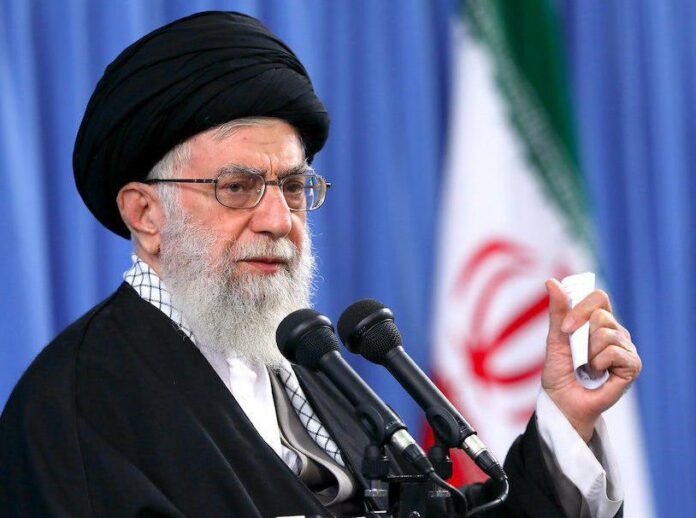
In comments on April 24, Leader of the Islamic Revolution Ayatollah Seyed Ali Khamenei said the US’ attempts to block the export of Iranian oil will get nowhere as Tehran will be exporting any amount of crude it needs and wants.

Zarif in Paris to Discuss Macron’s Offer ahead of G7 Summit

The two sides held talks on Friday noon, just one day before France chairs a three-day summit of leaders of Group of Seven (G7) countries, including US President Donald Trump, in the southern resort of Biarritz.

Later in the day, Zarif will also meet his French counterpart Jean-Yves Le Drian.

Zarif, who has been on a tour of Scandinavia, had earlier this week visited Finland, Sweden, and Norway.

Speaking in a Thursday press conference in Oslo, Zarif said Macron had made proposals to Iranian President Hassan Rouhani who had dispatched him to Paris “to see if we can finalize some of these ideas so each party can fulfill its obligations” under the nuclear deal.

“We already have some common grounds [with France], but they need to be increased,” he said in a joint presser with his Norwegian counterpart. 

Speaking at the Norwegian Institute of International Affairs, he said proposals were “on the table, both from the French and the Iranian side,” Reuters reported.

“It will be a chance to see if we can find ground for understanding. We already have points of agreement,” Zarif said.

The discussions between Zarif and Macron will come at a critical time for relations between Tehran and the West as Iran is reducing its commitments under the 2015 nuclear deal in response to Trump’s decision to pull out and re-impose anti-Iran sanctions.

Macron has insisted that diplomacy is the only way to solve the standoff and twice in the last months dispatched his diplomatic adviser Emmanuel Bonne to Tehran.

A presidency official, who asked not to be named, said the talks would continue this channel.

Macron admitted in comments Wednesday there were “true disagreements” within the G7 over Iran but said he would “try to propose things” in the talks, such as a softening of sanctions or a compensation mechanism to offset the debilitating restrictions.

The French foreign ministry said earlier this month that it “needs no permission” to talk to Iran after Trump accused Macron of sending “mixed signals” to the Islamic Republic.

This Is Why You Need a Truck Accident Attorney

You have the right to seek compensation from the individual or individuals responsible for the accident. If you try to go at it alone, your chances of success are limited. Trucking companies have teams of lawyers who are at the ready to protect the interests of the trucking company. Insurance companies have their own army of lawyers who are also looking to protect their clients and the insurance company’s finances.

The success of your case depends in great part on the truck accident attorney you pick to represent you or represent your loved one. You need a personal injury lawyer who has experience representing victims of truck accidents and who has been successful in court.

ust because an attorney has been practicing civil litigation for some time is not a guarantee that they will be able to help you. You need your attorney to be able to pursue all of the compensation that you deserve. If you try to pursue a legal case against a trucking company, a trucker, or their attorneys on your own, the odds are stacked against you.

Lawyers Can Discover All Liable Parties

An accident involving a truck is different than an accident involving a pedestrian vehicle. In addition to the size difference of the vehicles involved and the potential damages that happen, there are potentially more parties who can be held liable in a truck accident as opposed to one with a pedestrian vehicle.

If you work with competent West Coast trial lawyers, they will be able to discover if other parties could be held liable for the crash. These parties could include:

• The owner of the trailer
• The repair shop that works on the trucks
• The truck manufacturer
• The owner of the cab
• The company that leases the truck
• Freight forwarding companies
• Governmental companies

When you are working with an experienced Los Angeles truck accident attorney, they will know how to get the most out of the discovery process. They will do their due diligence and work with law enforcement, eyewitnesses, and expert witnesses to collect important evidence and make sure that all of the liable parties are held accountable for the part that they played in the accident.

Negotiating with Insurance Companies

Insurance companies are notorious for their desire to low ball the people who have a claim against them. They will use every trick at their disposal in an attempt to get the person who is bringing a claim against them to accept the lowest amount of compensation possible.

Insurance companies operate from a position of power. They have money. They have time. And they have all the resources they need. They realize that when a person has been severely injured in a truck accident, they may not be working. As a result, they have no income. The bills keep coming, and there are medical bills added on.

Insurance companies hope that they can wait a person out. They wait until an accident victim’s financial situation becomes so desperate that they feel like they have no other financial option but to accept the low offer that the insurance company makes.

A personal injury lawyer will not be so easily pressured by insurance companies. These attorneys are experienced in negotiating with the attorneys who represent large insurance companies and large corporations. They understand the tricks that insurance companies try to use to either reduce the value of your claim or to deny it entirely.

You have a better chance of recovering the maximum compensation if your attorney has experience in negotiating with insurance companies. They know how much certain injuries are worth, and they know what it takes to get their clients the money they deserve.

Attorneys Who Understand Trucking Laws and Trucking Regulations

Truckers and trucking companies must follow laws laid out by the government as well as guidelines laid out by the trucking industry. For example, truck drivers should not be working more than they are allowed to by law. They should be monitored to guarantee that they are getting a sufficient amount of sleep each night. Truck drivers need to receive a specific number of hours of training prior to operating commercial trucks on their own.

The FMCSA states that commercial trucks need to have systematic inspections, they need to be repaired following set guidelines, and they must receive regular maintenance. All of this is done to keep trucks safe. It is also a requirement that the motor carrier has a record of their inspections.

Experienced West Coast trial lawyers have detailed knowledge about trucking laws. They are able to identify violations of the law and show how these may have contributed to the accident. Even if an attorney does not know every single law that applies to a particular case, they have the experience and resources that allow them to find the laws and then interpret their application. Most people who are involved in an accident lack the experience, the time, the resources, and the energy to dig into trucking laws like this.

Providing You with Guidance through the Legal Process

The legal process is complicated. If you are not familiar with it, it is easy to feel overwhelmed. Having a Los Angeles truck accident attorney can help minimize the stress you feel and guarantee that your best interests are being looked after along the way.

The compensation for accidents involving trucks can be considerable. For this reason, trucking companies fight hard to protect themselves. Insurance companies, their lawyers, and any corporate lawyers involved are fighting to protect the best interests of their clients. But you have to remember that what is in the best interests of their clients is rarely in your best interests.

It is recommended that a person contacts a lawyer as soon as they possibly can after their accident. A truck accident attorney will interact with the truck company representatives and insurance companies on behalf of their clients. This is important because usually in the days following an accident, trucking companies and their insurance agents will try to get in contact with the accident victim, attempting to offer a settlement, to get a statement, or to gather other information.

When you have an attorney working with you and for you, they can help you gather the evidence that you will need to make your claims stronger. This may include photographs of what happened at the accident, medical records, the name of the trucking company, etc.

Over the road trucks are large. Truck drivers, manufacturers, trucking companies, and repair companies have the responsibility to see to it that these vehicles are operated in the safest way possible. When large trucks collide with small passenger vehicles, the results are disastrous. Personal injury attorneys who focus on truck accidents can help victims get the compensation that they need with the goal of helping the victim get back to living a high quality of life.

Trump Will Leave Office While Islamic Republic Still in Power: Rouhani

President Hassan Rouhani made the remarks in an address to a Thursday ceremony to unveil the homegrown “Bavar-373” missile defence system, which is a more advanced version of the Russian S-300.

Rouhani referred to a meeting he held last year with the head of a European country on the sidelines of the UN General Assembly in New York, and said, “In that meeting, the European official quoted the US president as saying that if Europeans cooperate with Trump and stop working with Iran, the Islamic Republic would not exist in three months’ time.”

“I told that European official that the man who made such a claim will leave office himself, and his party will also lose power, but the Islamic Republic will remain in power more strongly for hundreds of years more,” Rouhani said.

He said it’s been a year since the deadline given by Trump to that European official, but Iran is still strong despite the US efforts to weaken the country.

“A superpower has mobilized all its facilities – from the CIA to the Treasury, the State Department, its security forces, and all its spies across the world to see which vessels approach Iranian ports or leave them.”

“The US has never been weaker, alienated and isolated than now, and I cannot recall such a weak position for the US in history,” Rouhani said.

“Just two days ago, the US Secretary of State expressed his next year’s grief about Iran and said if the Iran nuclear deal remains in place, the anti-Iran arms embargoes will be lifted, and the country will be able to buy weapons,” he said.

However, he added, no one shared his concern. “The US had never been so much humiliated and looked so much desperate in history.”

Also last year the US president personally attended a UN Security Council meeting, but all the 14 members of the UNSC opposed him, he said.

“Trump was also mocked by all members of the UN General Assembly, and this is unprecedented in the history of the US that its president is mocked at the UN.”

“The US has been defeated, and we are the winners of this battle.”

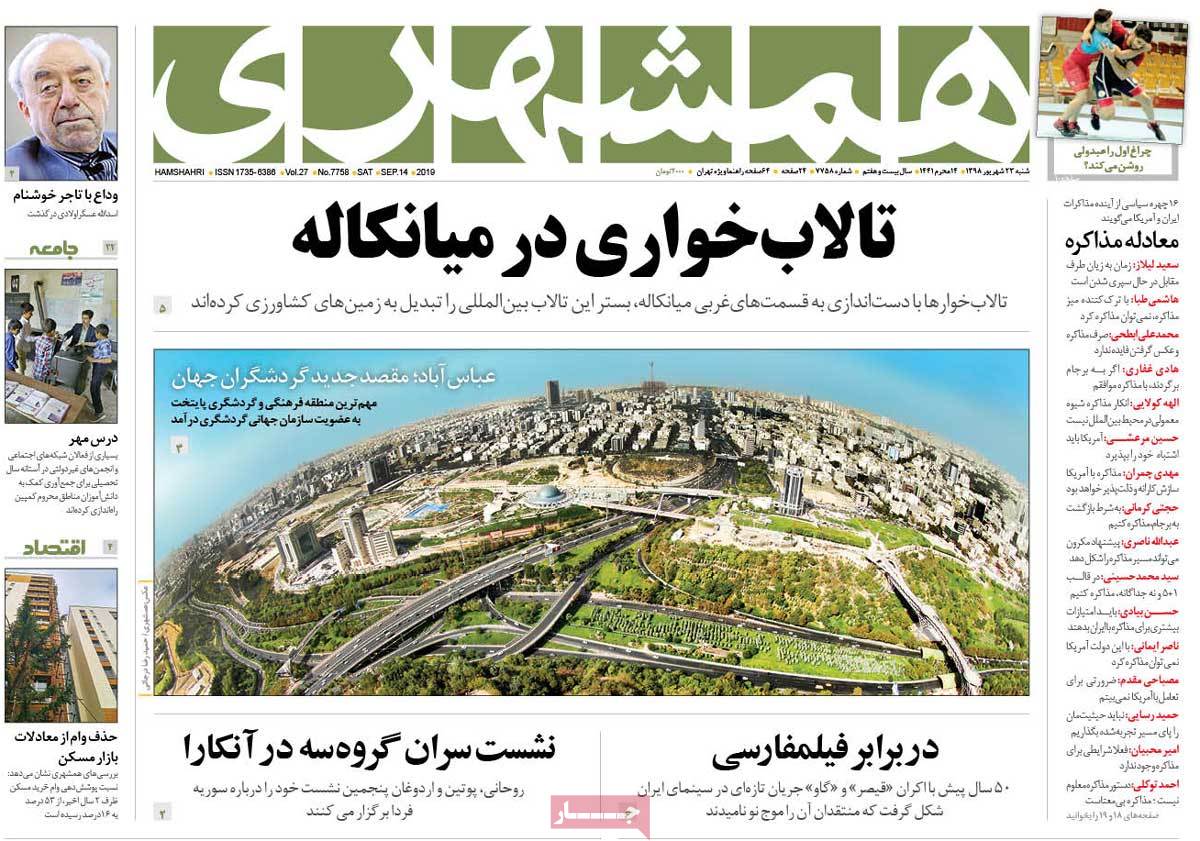
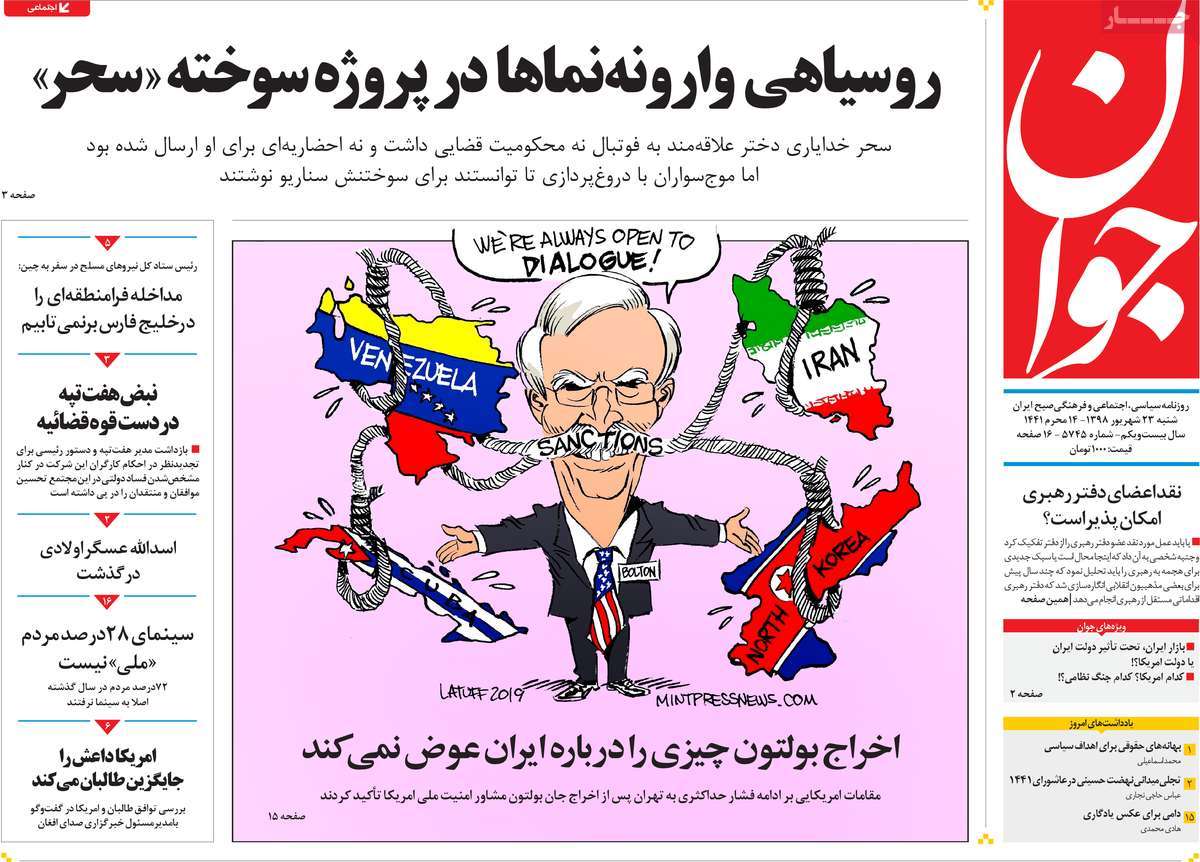
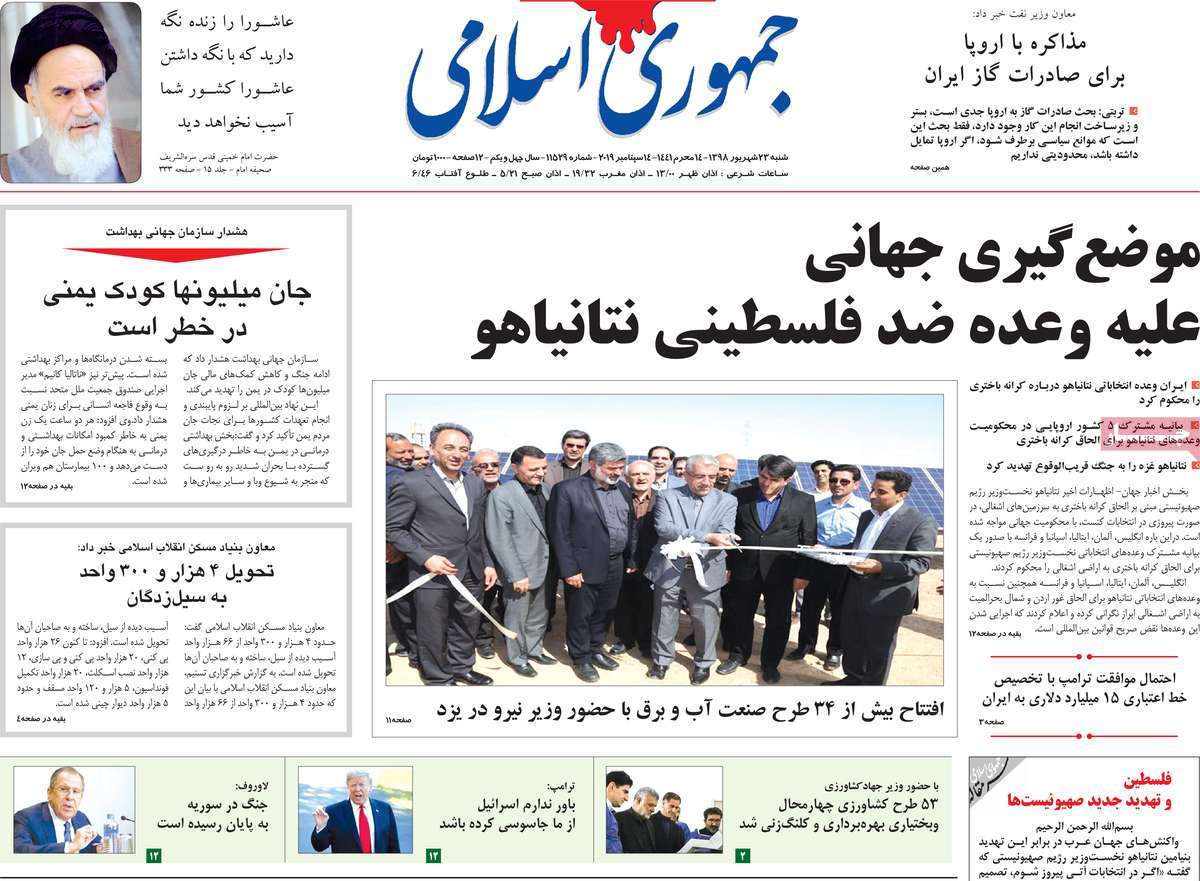
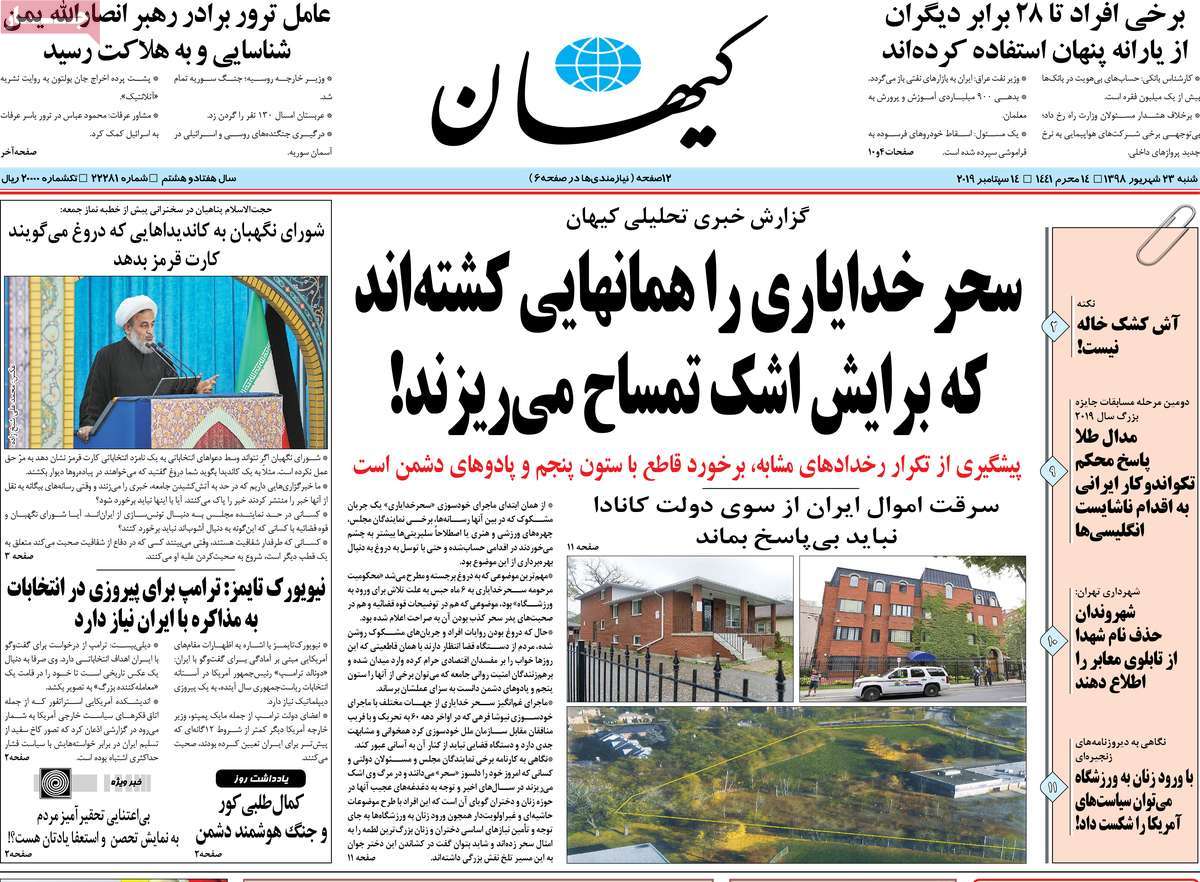
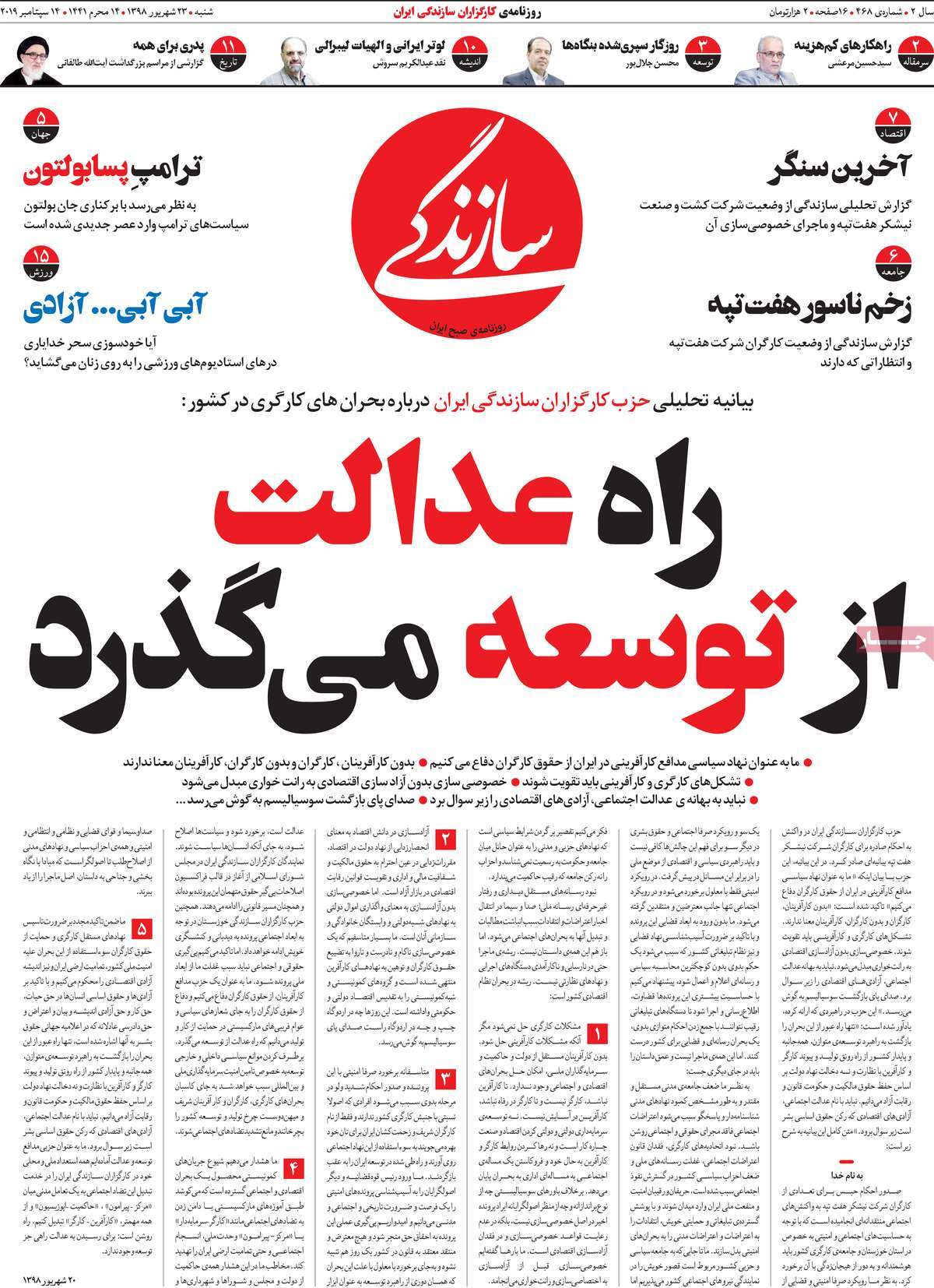
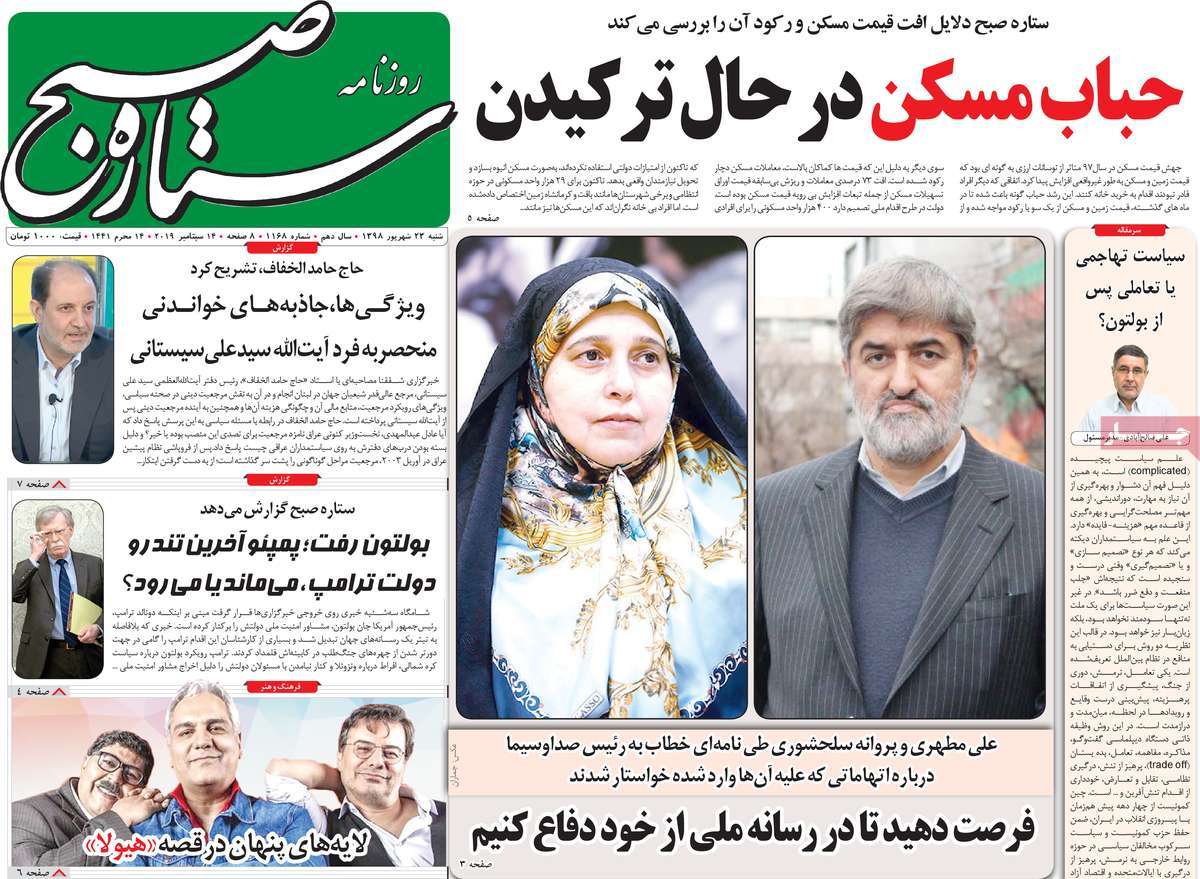
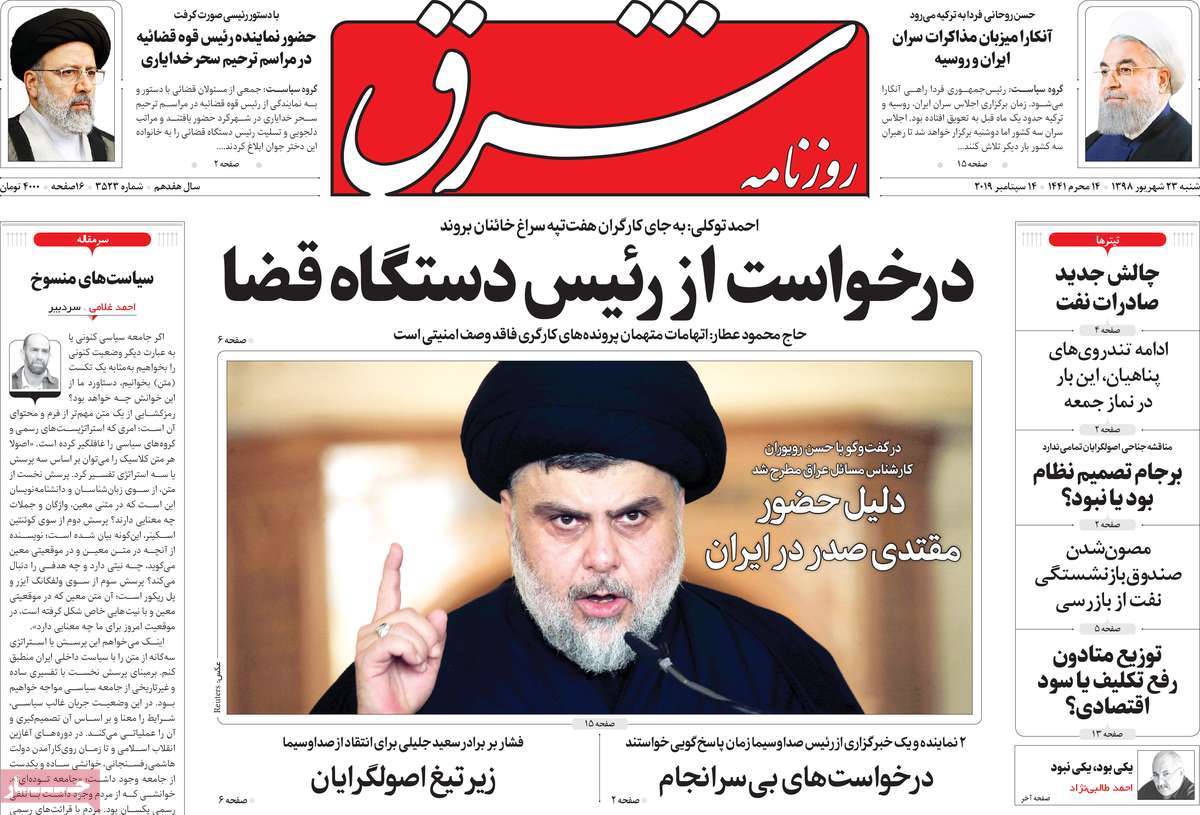
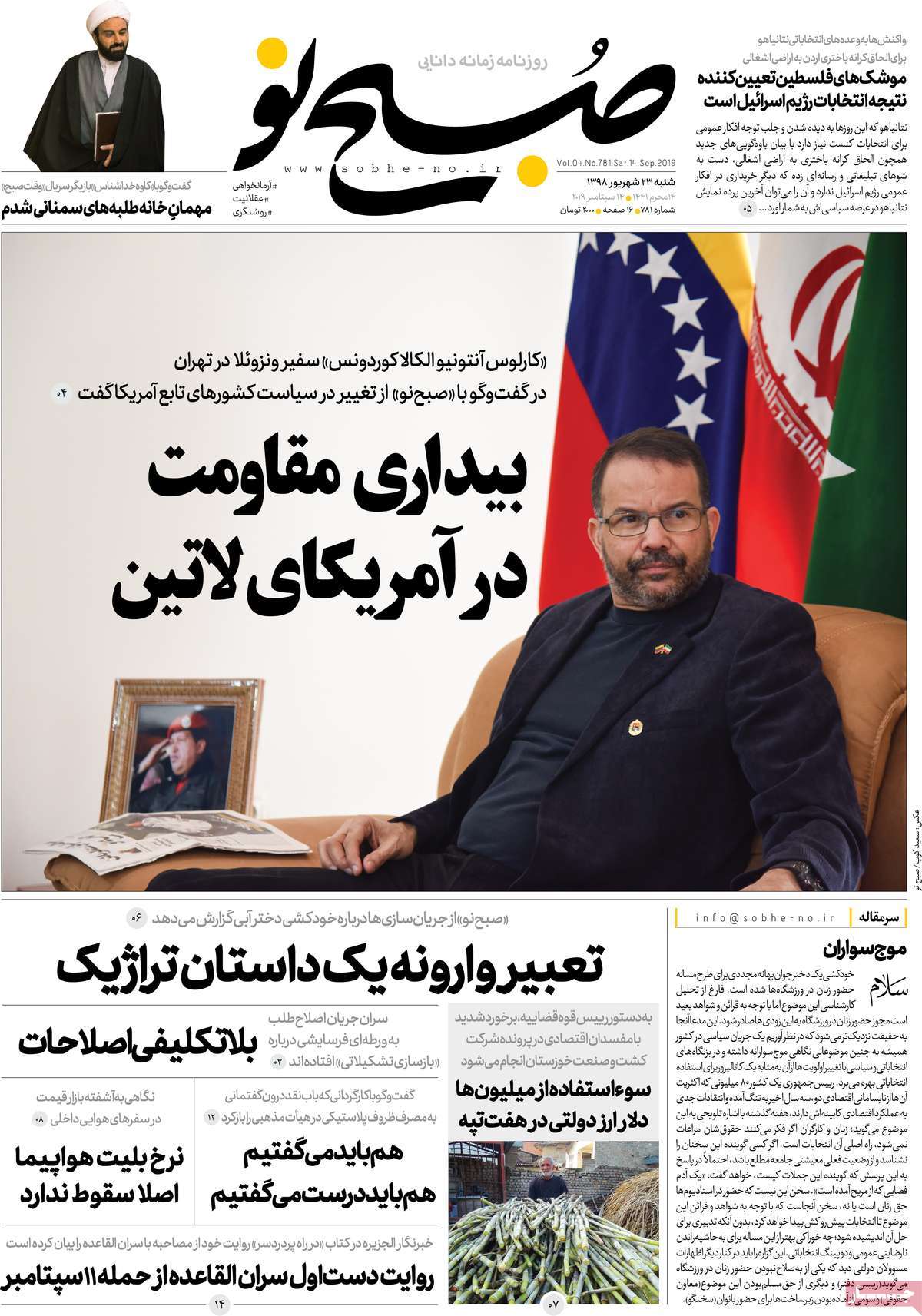
A Look at Iranian Newspaper Front Pages on August 22

A Look at Iranian Newspaper Front Pages on November 19

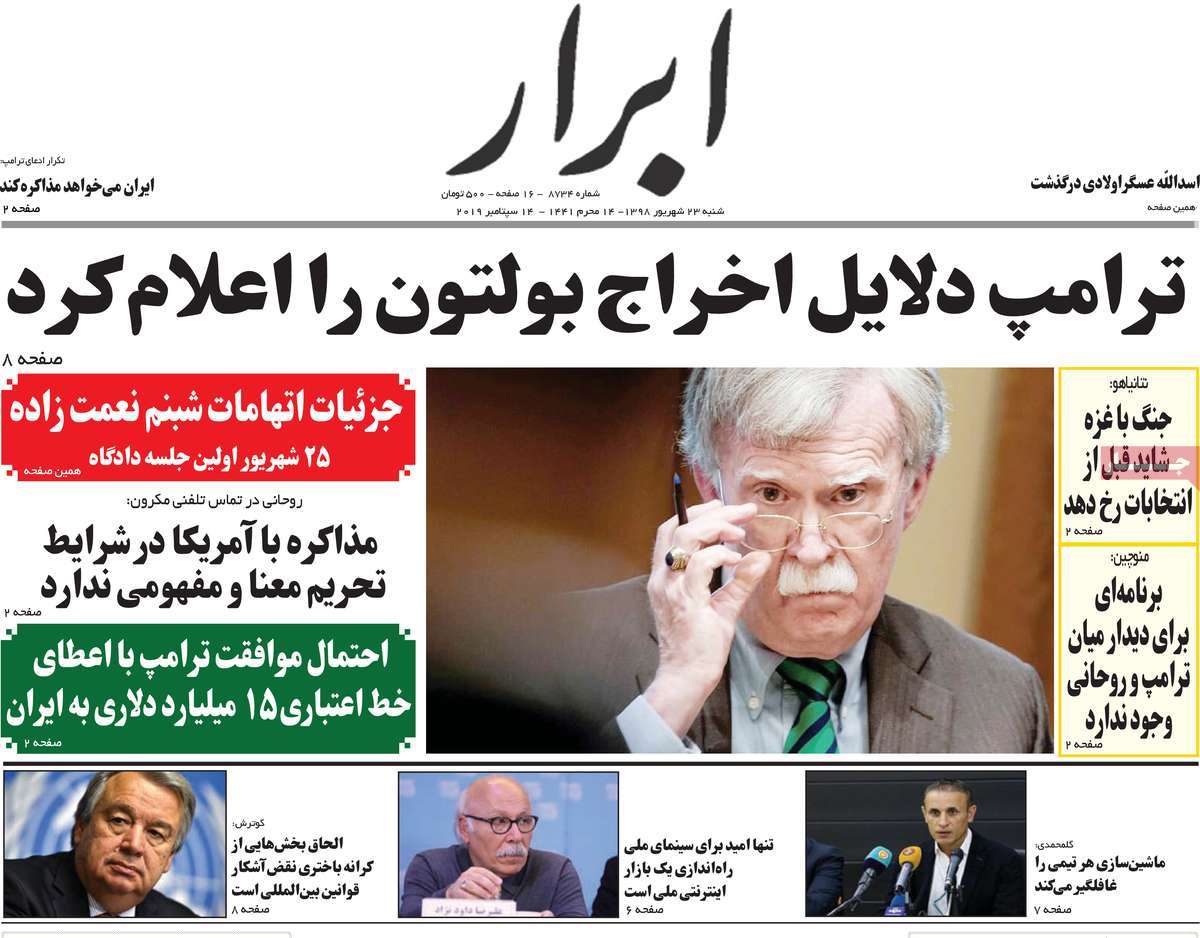
Abrar:

1- Saudi Envoy to UN Explains Reasons for Iran-Saudi Row

2- Rouhani: We’ve Chosen Right Path on Reducing Commitments

3- Zarif: We’ll Continue Trade with Any Country We Want

4- Australia to Join US’ Mission in Persian Gulf

5- Pompeo: North Korea’s Missile Tests Worrying; ISIS Still a Threat

A Look at Iranian Newspaper Front Pages on August 22


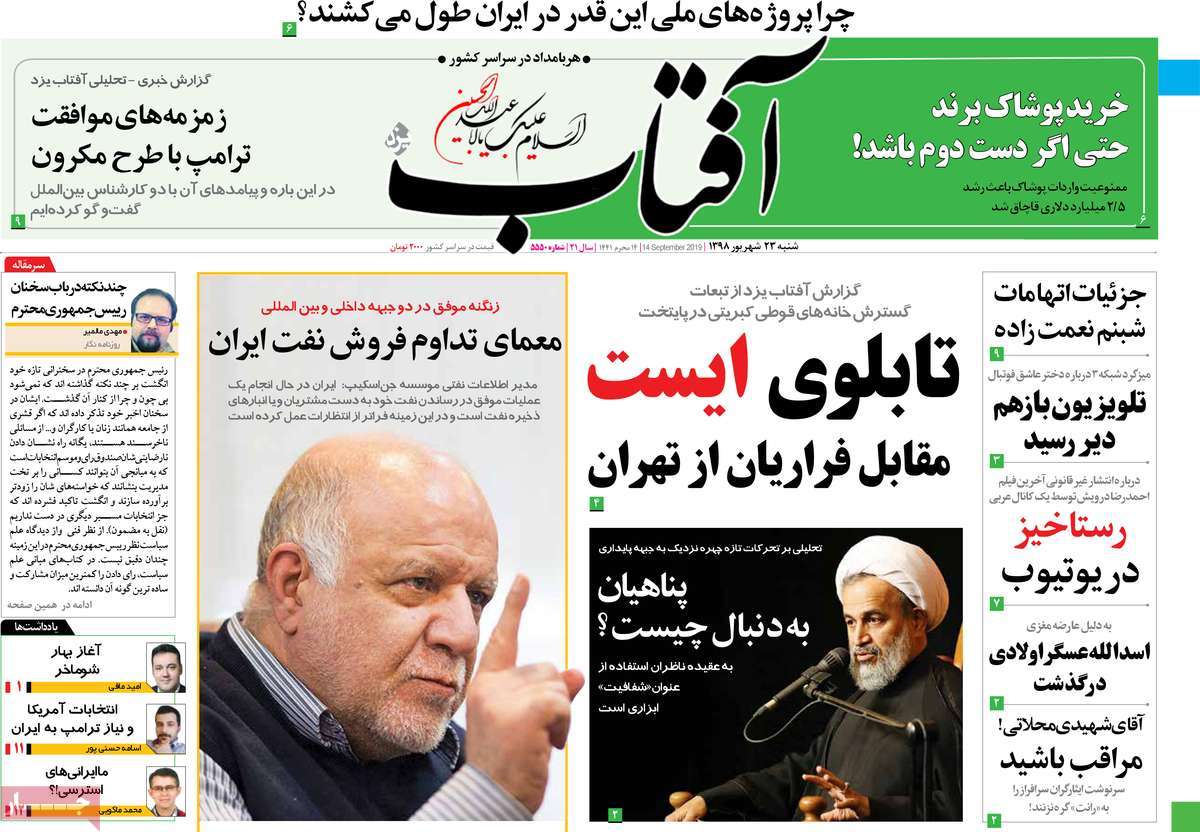
Aftab-e Yazd:

1- Iran Leader: Enemies Can’t Do a Damn Thing; Next 40 Years to Be Better

2- Iran Should First Receive Compensation for Seized Oil Tanker, Then Release UK Oil Tanker

3- Why Does Iran Want Compensation? [Editorial]

A Look at Iranian Newspaper Front Pages on August 22


Besharat-e Now:

1- Rouhani: We’ve Chosen Right Path on JCPOA

2- Iran Leader: Domestic Production Key to Resolving Problems

3- Zarif in SIPRI: We’ve Shard with Europe Options for Third Nuclear Step

A Look at Iranian Newspaper Front Pages on August 22


Etemad:

1- Crisis in Rome: Will Italian Parties Prevent Salvini from Rising to Power?

2- Iran Leader: Next 40 Years to Be Better for Us, Worse for Enemies

A Look at Iranian Newspaper Front Pages on August 22


Ettela’at:

1- Yemen’s Ansarullah Downs Advanced US Drone with Its Missile Defence System

2- Iran Leader Says Cultural Atmosphere Shouldn’t Be Restricted

3- Rouhani: We’ll Bring US to Its Knees If All Bodies Cooperate

4- Zarif: Europe Must Implement Its Commitments in Trade with Iran

A Look at Iranian Newspaper Front Pages on August 22


Jomhouri Eslami:

1- US Drone Hunted in Yemen Airspace

2- Bloomberg: Iran Successful in Maintaining Value of Its Currency

3- Trump Cancels Visit to Denmark after Copenhagen Refused to Sell US Greenland

4- Russia Calls for End of US Sanctions Policy against Iran

A Look at Iranian Newspaper Front Pages on August 22


Kayhan:

1- First Priority of Country Is Economy, Culture: Iran Leader

A Look at Iranian Newspaper Front Pages on August 22


Mardom Salari:

1- Saudi Making Effort to Create Channel for Dialogue with Iran: Al-Akhbar

2- Expansion of Ties between Iranian, Turkish Parties Can Help Develop Tehran-Ankara Regional Economic, Political Ties

A Look at Iranian Newspaper Front Pages on August 22

Why Did US Media Disclose UAE-Israel Secret Meetings?

From Past to Present

The anti-Iranian activities by certain states in south of the Persian Gulf, namely Saudi Arabia and the United Arab Emirates, is not anything new. Such measures had started at the time of “Barack Obama”. Since the outbreak of crisis in Syria, the Saudis and Emiratis tried everything they could. Not much time has elapsed since Riyadh rejected the UN Security Council seat in 2013. The reason for the Saudi withdrawal at that time was said to be the Russian veto of a UN Security Council resolution against Syria. But later in April 2016, when then US president Obama received a cold welcome from the Saudi leaders, it became clear that they only resented the negotiations that resulted in the JCPOA.

Months later, a number of international and local news media revealed that the Saudi and Emirati leaders had proposed that Obama should launch military attack on Iran, pledging to cover the whole costs. However, Obama had asked them to settle their problems at the negotiating table with Iranians, a response that further fueled the Persian Gulf rulers’ anger at Washington.

Such approach and policy-making in Riyadh and Abu Dhabi went on even more fanatically after Obama, when “Donald Trump” took the office at the White House. But only half a term in office for Trump was enough to prove that the Saudi and Emirati hopes were vain.

Right Time to Reconsider

The current situation in the Persian Gulf and West Asia is more dangerous than ever. The regional governments who did not believe that Iranians could resist the strongest unilateral and cruel US sanctions and who did not even imagine how the Iranian Armed Force would project power, have now gained a better understanding of the costs of a full-fledged war in the region.

On the other hand, the Saudi plans in Syria, Iraq, and the direct and full-blown war on Yemen have failed. The Houthis can now easily target oil facilities and air bases at the heart of Saudi Arabia, and have expanded the war into Saudi Arabia. In addition, the major and vital targets inside the United Arab Emirates are not also out or reach of the Houthi forces.

The need to get out of a futile and costly war in Yemen on the one hand, and the threats of a possible confrontation between Iran and the US facing those countries on the other hand, have provided enough reasons and logic for a retreat from and revision of the aggressive policies of the regional countries, in a way that the first signals came from the other side of the Persian Gulf.

The Facts Facing Regional Nations

Although the recent developments, particularly the security crisis in the Persian Gulf, created tough conditions for the people of Iran under the cruel sanctions, they laid bare the nature of the American arrogant policies and the Zionist objectives and intentions before the eyes of the regional nations.

It has now become clear why Americans have been creating and escalating tensions in the region and how the tensions would benefit the US and Israel.

Disclosure of secret meetings among the UAE, Saudi Arabia, the US and Israel was not surprising for Iranians, because their hostility towards Iran is clear to everyone, as they have formed an anti-Iranian club in recent years. The foreign minister of Iran has perfectly described this warmongering gang as the “B-Team.”

The main point of the US’ strange decision to divulge the secret meetings is that the US proved that it basically opposes any de-escalation of tensions in the region. Those who have relished the petrodollars of Arab states are sending the Arabs the bills for the arms sales and for the costs of deployment of American forces.

In the meantime, the diplomatic activities in the region, particularly the dispatch of an Emirati delegation to Iran and the positive signals from Saudi Arabia, concerned those parties and galvanized the American and Zionist warmongering and hard-line trend. In late last week, they began to release reports of Emirati and Saudi contacts with Iran, and then there was a disclosure by the Wall Street Journal on August 15, which said the continued cooperation and secret meetings between Israel and the United Arab Emirates were an outcome of the “Warsaw security conference” held in February.

The Americans’ hasty move to disclose the secret anti-Iran meetings has also another message: The B-Team mentioned by Mohammad Javad Zarif has practically fallen apart, and the American revelation also signifies that Washington is trying to obstruct the de-escalation of tensions in the region at any price, even by threats or a scandal for the Arab governments.

Diplomat Reveals Reason for Shift in Emirati, Saudi Policy on Iran

UAE de facto leader Mohammed bin Zayed (left) and Saudi Crown Prince Mohammed bin Salman

While Iranian President Hassan Rouhani’s administration has always advocated dialogue with the neighbours, Saudi Arabia has taken a tough line on interaction with Iran, at least until lately.

In a speech in Sweden during his tour of Scandinavia, Iranian Foreign Minister Mohammad Javad Zarif reiterated on Tuesday that Tehran was ready to pay a price for friendly ties with the neighbours.

Relations between Tehran and Riyadh have strained over the past years after their conflicting views on regional developments, particularly on Yemen and Syria, became more noticeable.

The relations further deteriorated after a crush of pilgrims in Mina, near Saudi Arabia’s Mecca, in September 2015, which killed over 7,000 Hajj pilgrims, including 465 Iranians.

Tehran has blamed the deaths on the Al Saud’s mismanagement of the Hajj pilgrimage and criticized Riyadh for “lack of cooperation” on restoring the rights of families of the victims.

The row between Iran and Saudi Arabia escalated further in January 2016, following Riyadh’s execution of prominent Shiite cleric Sheikh Nimr al-Nimr, and a subsequent attack by outraged Iranian protesters on the Saudi embassy in Tehran, which resulted in the Arab country’s decision to sever its ties with the Islamic Republic.

However, there have been signs of a thaw in Iran’s ties with Saudi Arabia’s close ally, the United Arab Emirates, in recent weeks.

In late July, an Emirati military delegation visited Iran and signed a memorandum of understanding to promote cooperation on common border security with Iran.

Many believe that the shift in the Abu Dhabi’s policy on Iran reflects a change in the policies of its close ally, Saudi Arabia.

Moreover, Saudis have given the Iranian Hajj pilgrims a warm welcome in this year’s pilgrimage.

In interview with Fararu news website, Nosratollah Tajik, a Middle East expert and Iran’s former ambassador to Jordan, has explained how a shift in the regional situation has made Saudi Arabia and the United Arab Emirates – known as Iran’s regional rivals in the Arab world – decide to improve ties with Iran.

“Different hardware and software factors have led to such relative thaw or shift in the Saudi and Emirati policies towards Iran. The instances in the hardware arena are the issue of oil tankers in the Persian Gulf and the downing of the US drone. These have disappointed Saudi Arabia and the UAE’s hopes for a hundred percent American support for their policies against Iran, forcing them to resolve the disputes with Iran politically, not militarily,” the former Foreign Ministry advisor said.

“The other part relates to the prolonged war on Yemen. Saudi Arabia and the UAE are under pressure of the international public opinion for the crimes that Saudi Arabia has committed in Yemen, among other things,” Tajik added.

“In the software arena, I believe that we should mainly monitor the political developments in the region. The UAE’s internal disputes, Saudi Arabia’s difference with the UAE, and all of these factors force them to address their issues with Iran politically, instead of entering the military phase,” he added.

“In the UAE, the internal rifts between Sheikh Mohammed bin Zayed, the influential Emirati crown prince, and the other six emirs over Yemen and Iran have led them to the conclusion that they should prevent further damages and settle the disputes with Iran. Another reason behind the UAE’s new policy was the outflow of capital of the Iranian residents, and the UAE’s vulnerability to the outflow of capital because of its heavy dependence on foreign investment. The UAE is more susceptible to the Persian Gulf security developments than Saudi Arabia, so it is natural for it to shift its policy towards Iran more rapidly than Saudi Arabia,” he added.

“As regards the Saudi stance, there is a part relating to the Yemen war and another part is that Saudis are willing to hold the next year’s G-20 summit in Riyadh. As a result, Saudis would naturally adopt the ‘zero tension policy’ in order to portray a good image of them and demonstrate a safe picture from Saudi Arabia as the world will be watching the G-20 leaders there,” Tajik added.

The former ambassador to Jordan also commented on the future prospect of relations between Iran and Saudi Arabia and the ways to improve the ties, as cited by Zarif, saying, “We have a lot of differences. Sadly, we live in an undeveloped region; nonetheless, no country could choose its neighbour. We need to be realistic and try to achieve a mechanism on the basis of commonalities. I believe that the traditional patterns of collective security are not working anymore. We must move towards modern patterns, and preferably towards establishment of peace through economic interaction.”

“The governments are in charge of the traditional patterns of security, and since the governments in this region are suspicious about each other and have doubts and fears, we’d better exercise economic interaction and make the private sectors of countries involved in the economic interests, with which the security will be also ensured,” Tajik concluded.

Iran Unveils Homegrown ‘Bavar-373’ Missile Defence System

The system was unveiled in a Thursday ceremony held on the occasion of National Day of Defence Industry.

A distinguishing feature of Bavar-373 is its vertical launching system with square launchers, mostly used for air defence on warships.

Bavar-373 uses a long-range, phased array fire-control radar, dubbed Me’raj-4.

The air defence system employs three different types of missiles to hit targets at various altitudes.

Iranian military technicians have in recent years made great headways in manufacturing a broad range of indigenous equipment, making the armed forces self-sufficient in the arms sphere.

Tehran has always assured other nations that its military might poses no threat to regional countries, saying that the Islamic Republic’s defence doctrine is entirely based on deterrence.

US Main Source of Insecurity in West Asia: Iran FM

Speaking at the Stockholm International Peace Research Institute (SIPRI) during a visit to Sweden, Iranian Foreign Minister Mohammad Javad Zarif made the comments Wednesday amid the US military presence in the Persian Gulf.

He added that Iran has already fulfilled all of its commitments under the Joint Comprehensive Plan of Action (JCPOA) and the United Nations Security Council Resolution 2231, which enshrines it.

“This is an agreement, this was not a diktat,” he said. “We did not dictate it to the other side obviously, but the other side did not obviously dictate it to us to some people’s chagrin.”

“Iran according to 15 reports of the IAEA (the International Atomic Energy Agency) … has complied with the Resolution 2231 and with the JCPOA,” he said. “Even five IAEA reports came after US withdrawal, it still showed that we don’t violate [the deal].”

Washington abandoned the landmark deal in May 2018, when President Donald Trump said he was going to use sanctions and other measures in his power to force Iran into renegotiating another deal that addresses the country’s missile program and its growing role in the Middle East region.

Zarif noted that the US, under Trump, is unpredictable and does not comply to the international law.

He said Iran behaves in a predictable manner and expects predictable behavior in response.

“Mutual unpredictability will lead to chaos. Because President Trump cannot expect to be unpredictable and expect other people to be predictable. Unpredictability will lead to mutual unpredictability and unpredictability is chaotic,” Zarif said.

Since Trump’s exit, Iran has ruled out the possibility of revising the current JCPOA or negotiating a new one. It has also warned the other signatories — the UK, France, China, Russia and Germany — to either salvage the deal by meeting their commitments or watch the Islamic Republic also stop implementing the JCPOA.

While China and Russia have signaled that they would continue trade with Iran at highest possible levels, the UK, France and Germany have been struggling to come up with a response to US pressure.

They had promised Iran that they would continue trade as usual using a special payment channel called the Instrument in Support of Trade Exchanges (INSTEX) but have yet to make it operational months after its much-delayed official launch in January 2019.

Zarif said the European “failed” to deliver their commitments and needed to take action if they wanted to save the deal.

In a display of impatience with the Europeans, Tehran has on two occasions reduced its commitments under the JCPOA in accord with mechanisms that the agreement provides for dealing with non-compliance, including increasing its enriched uranium stockpiles beyond the 300-kg limit and enriching uranium to purity levels beyond the 3.67 percent agreed in the deal.

Zarif defended Iran’s response to the non-compliance at the SIPRI and said the third stage would bring about bigger changes.

“If the other side violates the deal we have a right at a remedy to reduce our commitments to the deal,” he argued. “This is written in the deal.”

Zarif also decried the US military presence in the region, asserting that it would increase insecurity.

“No amount of foreign military presence (in the Persian Gulf) can prevent insecurity in this region. Security is a common global commodity. We have to accept either security for everybody or insecurity for everybody,” said the top Iranian diplomat. “You cannot have an island of security by your fleet in the Persian Gulf when the United States is waging an economic war against Iran. When the United States is forcing countries to seize our ships in Gibraltar, in the Suez Canal, in Singapore. That’s insecurity. Global security is intertwined.”

Tehran, Stockholm Discuss Parliamentary Cooperation

In the Wednesday meeting, the two sides discussed various issues in bilateral relations, especially collaborations and parliamentary visits between Iran and Sweden.

They also conferred on the Iran nuclear deal (JCPOA) and the latest regional and international developments.

Tehran, Stockholm Discuss Parliamentary Cooperation