Saturday, December 27, 2025
Home Blog Page 3115

Iran, Slovenia Hold Political Consultations in Ljubljana

The senior Iranian diplomat first held the third round of political consultations between Tehran and Ljubljana with his Slovenian counterpart Simona Leskovar.

In the Wednesday talks, the two sides discussed the latest developments pertaining to bilateral political, economic and cultural relations, regional and international issues, including the JCPOA, and developments in the West Asia region and the Persian Gulf.

Given the numerous opportunities and potentialities, both sides stressed the necessity of enhancing mutual cooperation and relations in various areas, including agriculture, food industry, pharmaceuticals, and tourism.

They also exchanged views on the negative consequences and challenges resulting from unilateralism, especially with regards to the aggravation of crises in the region and across the world, and expressed support for multilateralism.

In a separate meeting, Araqchi also sat down with Slovenian Deputy Prime Minister and Foreign Minister Miro Cerar.

Iran, Slovenia Hold Political Consultations in Ljubljana

In the meeting, the Slovenian official touched upon political visits to both countries by officials of the two sides as well as the exchange of trade delegation in recent years, describing Tehran-Ljubljana relations as cordial.

He said his country’s stances are in line with those of the European Union and aimed at preserving the JCPOA. He said Slovenia would like to join the Instrument in Support of Trade Exchanges (INSTEX), a European special-purpose vehicle (SPV) established in January 2019 to facilitate trade with Tehran under the US sanctions.

Araqchi, in turn, expressed gratitude to the Slovenian government for inviting him to attend the 14th Meeting of the Bled Strategic Forum. He also thanked Slovenia for supporting the JCPOA and its request to join INSTEX.

Araqchi elaborated on efforts by France to reach agreement on the lifting of sanctions, and expressed hope the European Union and the three European countries which are parties to the talks with Iran will live up to their commitments under the JCPOA.

The top Iranian official also met with Slovenian Minister of Economic Development and Technology Zdravko Počivalšek.

Iran, Slovenia Hold Political Consultations in LjubljanaIn the meeting, the two sides reviewed the current situation as well as the prospects of mutual economic and trade relations. They also highlighted the existence of numerous potentialities and opportunities for bilateral trade and economic cooperation, especially in the domain of tourism, and stressed the importance of making such cooperation materialize. They further stressed the need to exchange trade and economic delegations between the two countries in the near future. Počivalšek, in turn, said his country is keen to work with Iran at the highest levels.

US sanctions also came up for discussion during the talks. Araqchi touched upon the problems caused by Washington’s sanctions on Iran.

“Despite these sanctions, there are still opportunities, areas and paths for boosting trade and economic cooperation between the two countries, and there are also channels for removing or cushioning the effects of challenges,” he said.

Iran, UN Discuss Formation of Syria Constitutional Committee

The two sides discussed the latest developments in Syria and the grounds for cooperation between Iran and the United Nations for the settlement of Syria crisis in the meeting.

In the talks, the Iranian diplomat touched upon the political developments in Syria, including the fight against terrorism and the necessity for the expansion of the Syrian government’s sovereignty over the entire Syrian territory, the formation of the Constitutional Committee, the return of the displaced, the exchange of detainees and abductees, the reconstruction of Syria, and a number of other issues.

He also expressed Iran’s readiness, like before, to work in cooperation with the UN to help resolve the Syria crisis.

In turn, the UN Secretary-General’s Special Envoy pointed to his previous meetings with the Iranian officials and to his upcoming visits to a number of countries in order to finalize the line-up and agenda of Syria’s Constitutional Committee. He also conferred with Khaji on the outstanding and unresolved issues surrounding the committee.

Pedersen also expressed gratitude to Iran for its efforts in this regard, stressing the need for the continuation of consultations.

Iran President Orders Suspension of R&D Limits in 3rd JCPOA Step

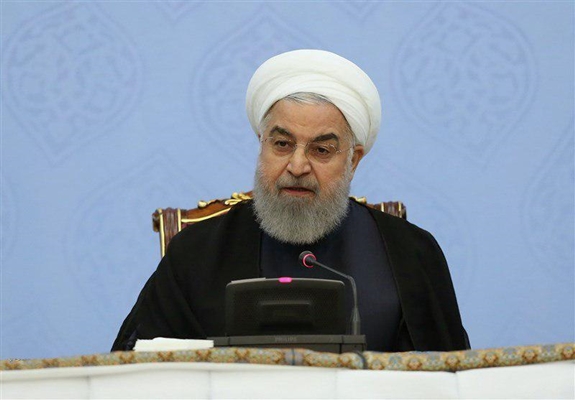
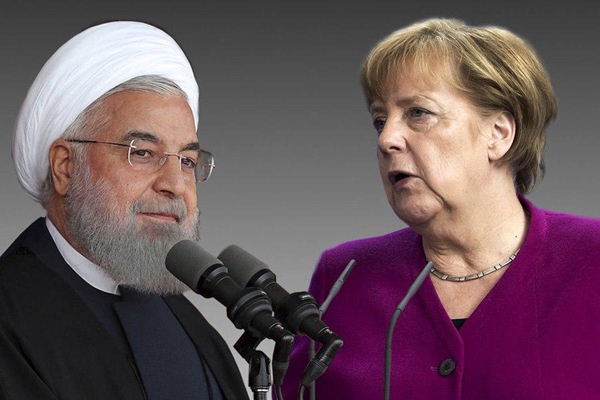
In comments after a meeting with the Parliament speaker and the Judiciary chief on Wednesday evening, President Rouhani announced that Iran’s third step in a phased reduction of commitments to the JCPOA will begin on Friday.

“For the third step, the Atomic Energy Organization (of Iran) must immediately start whatever the country needs technically in the (nuclear) research and development field, and must abandon all commitments under the JCPOA in the field of research and development,” the president said.

He noted that the AEOI is ordered to rapidly expand the research and development regarding various types of centrifuge machines and whatever is necessary for uranium enrichment.

The president explained that lifting such a limit will be a “big stride”, because a major part of negotiations with the P5+1 before reaching the JCPOA revolved around a timetable for R&D throughout the years to come.

“The whole timings of research and development that we had been committed to under the JCPOA will be totally lifted as of Friday, and we will be taking whatever is required in technical terms and in terms of progress in the nuclear technology, under the (International Atomic Energy) Agency’s supervision and within the framework of a peaceful approach,” the president added.

The remaining parties to the JCPOA will have another two months to come to an agreement with Iran, the president added, saying in that case, Tehran may resume honouring the JCPOA.

Iran has already rowed back on its nuclear commitments twice in compliance with articles 26 and 36 of the 2015 deal, after the US scrapped the agreement in May 2018 and the European parties (UK, France, and Germany) failed to ensure Iran’s economic interests.

Iran maintains that all the measures are reversible, provided that the other parties fulfill their commitments.

Iran Strongly Condemns Brian Hook’s Comments

Iran Once Again Denies Torturing Afghan Migrants at Border

“The intensification of hostile comments and desperate measures, the most ridiculous one of which was putting up reward for treason and espionage, are measures out of desperation and disappointment for targeting the Iranian nation,” Mousavi said in a statement.

“However, such measures will get nowhere as usual, and will add dark points to the record of their deceptive treatment of Iranians, while they will definitely have to be accountable for their measures someday,” the spokesman added.

The comments came after the US Department of State and its special Iran representative Brian Hook, announced a reward of up to $15 million for information leading to the disruption of what it called “the financial mechanisms of Iran’s Islamic Revolution Guards Corps (IRGC) and its branches, including the IRGC-Qods Force (IRGC-QF)”.

“This includes seeking information on the IRGC’s illicit oil sales, including via oil tankers like the Adrian Darya,” the State Dept. added.

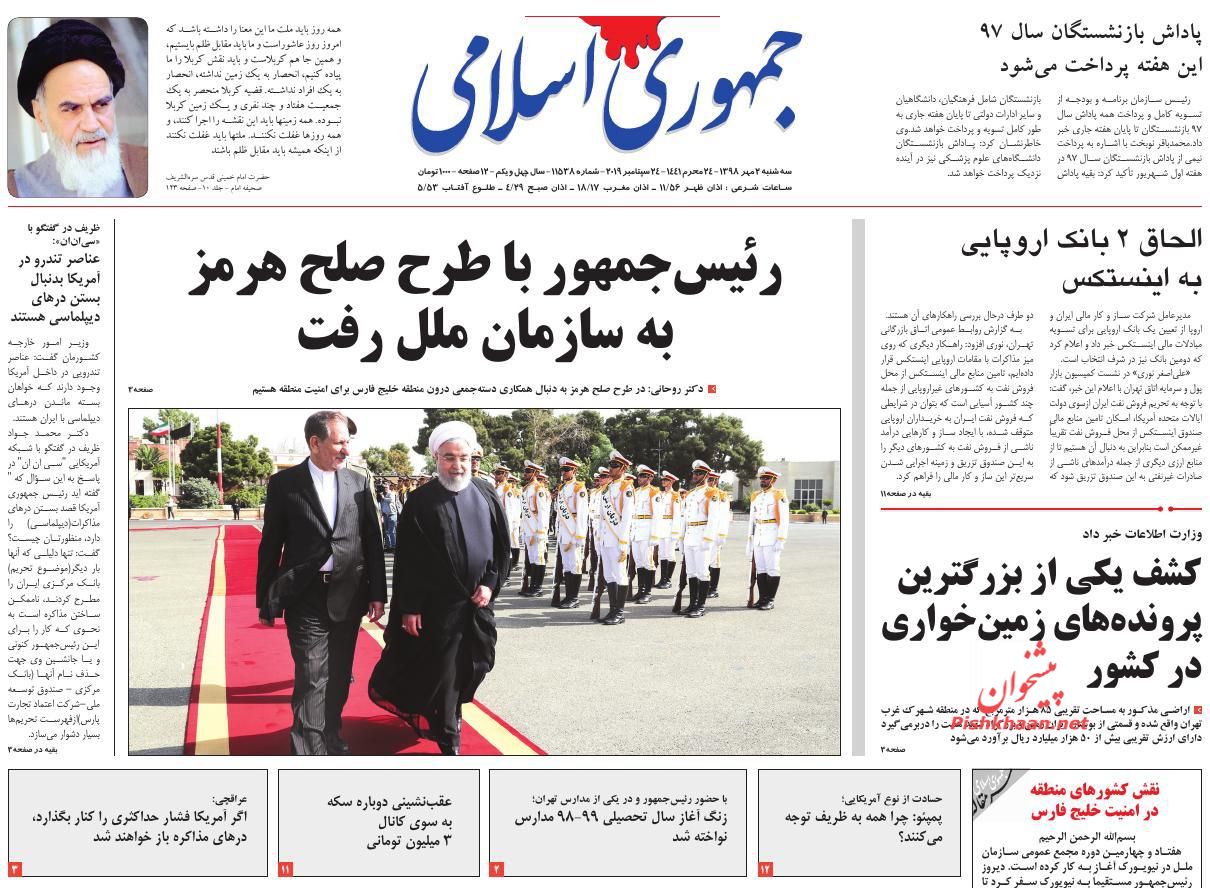
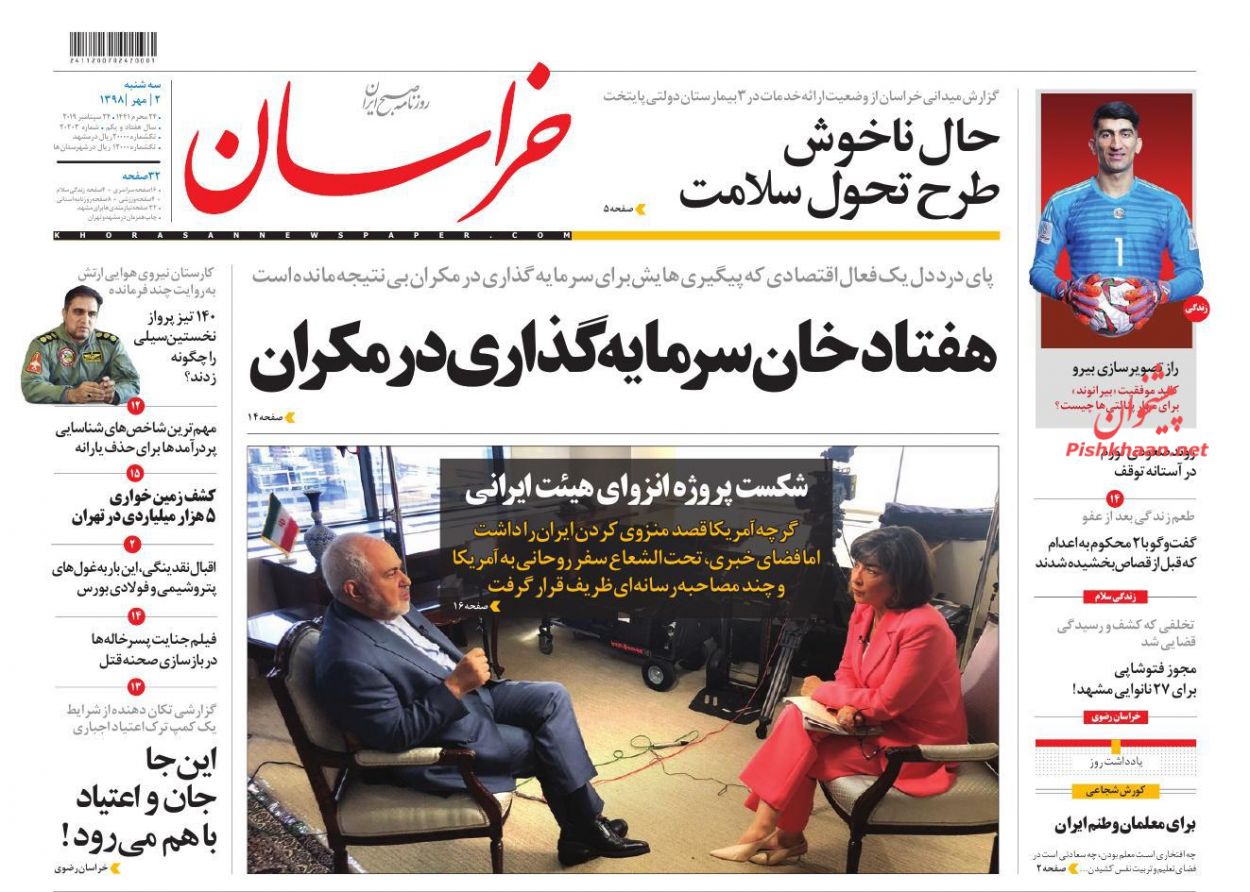
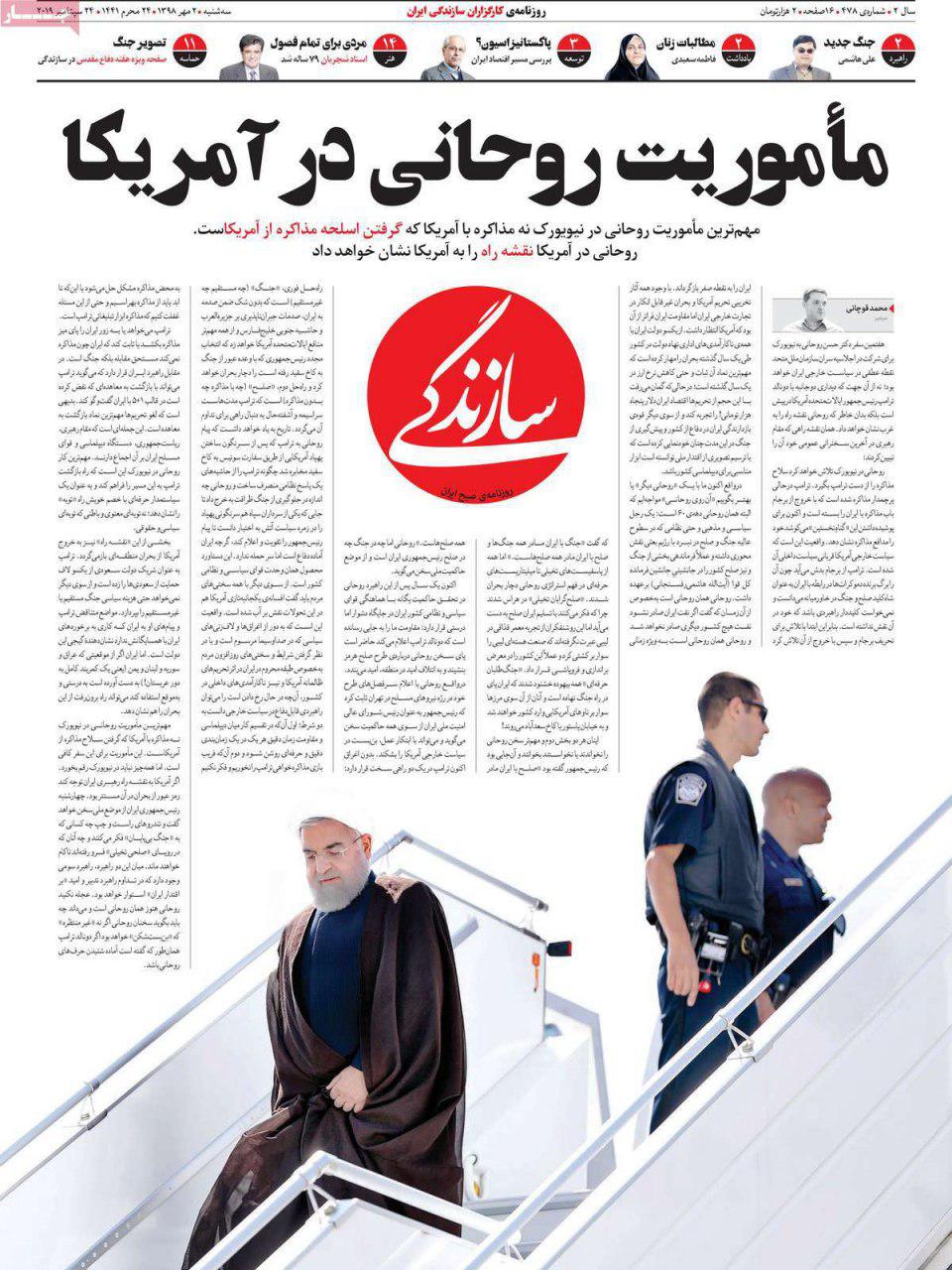
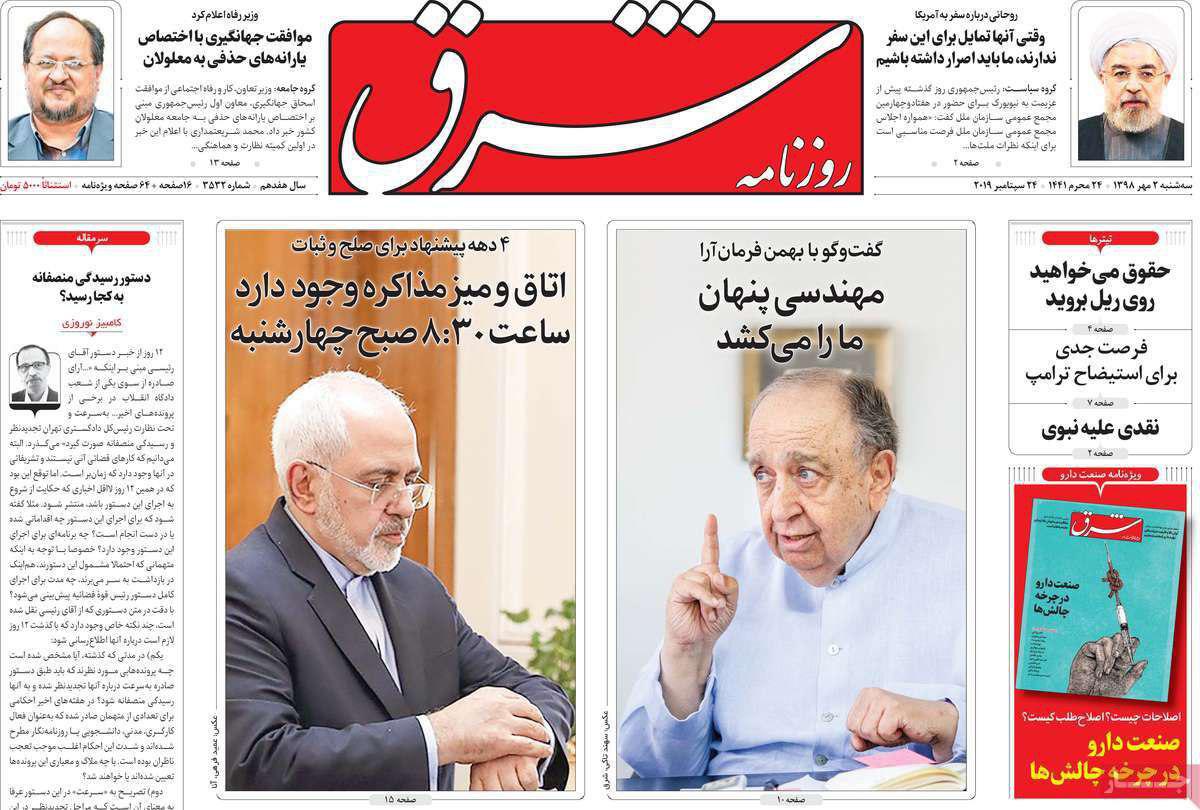
A Look at Iranian Newspaper Front Pages on September 4

A Look at Iranian Newspaper Front Pages on November 19

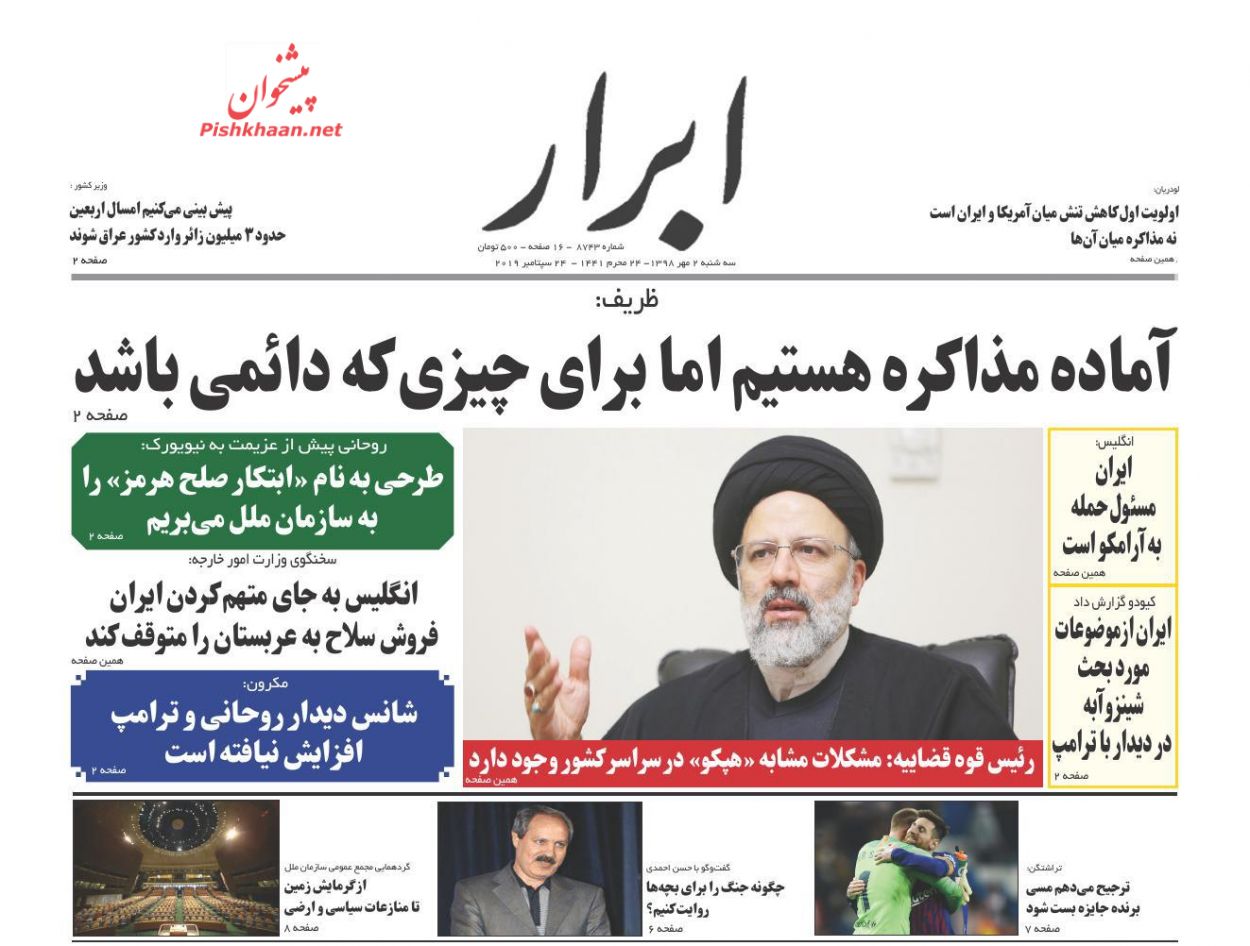
Abrar:
1- Australia FM in Bangladesh to Meet FM Zarif
2- UN Special Envoy for Syria Meets Zarif
3- Russia Takes Syria’s Phosphate Industry as Spoils of War
4- Iran’s 4.5%-Enriched Uranium Stockpiles Exceed 25kg
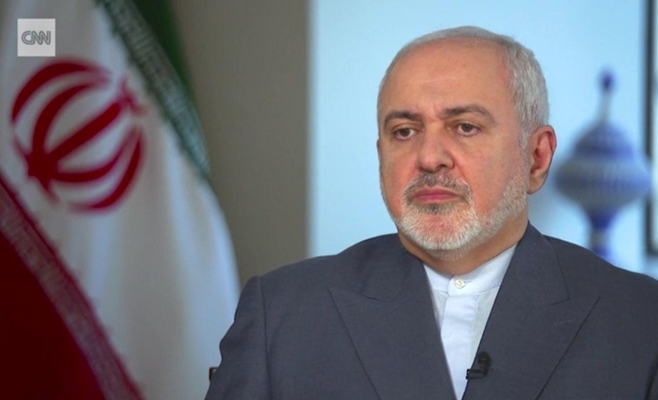
5- Zarif: Europe Not Ready to Take Risk for Saving JCPOA

A Look at Iranian Newspaper Front Pages on September 4


Abrar Eqtesadi:
1- Iran to Receive $15 Billion Line of Credit
* French Finance Minister to Share Proposal with US in Washington

A Look at Iranian Newspaper Front Pages on September 4


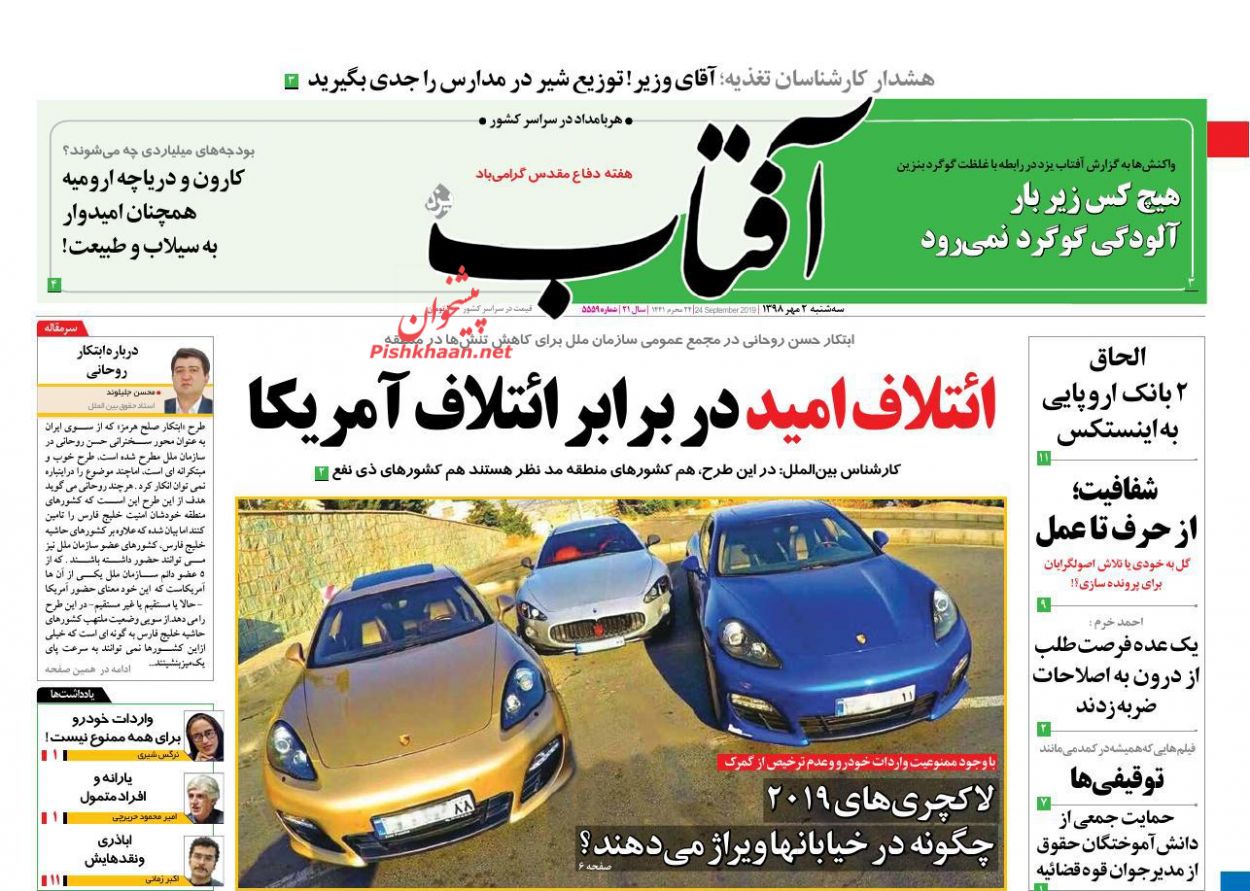
Aftab-e Yazd:
1- Zarif: Europeans Failed to Spend Money on the Place They Talk about
2- Appropriate Business Opportunity of Syria [Editorial]

A Look at Iranian Newspaper Front Pages on September 4


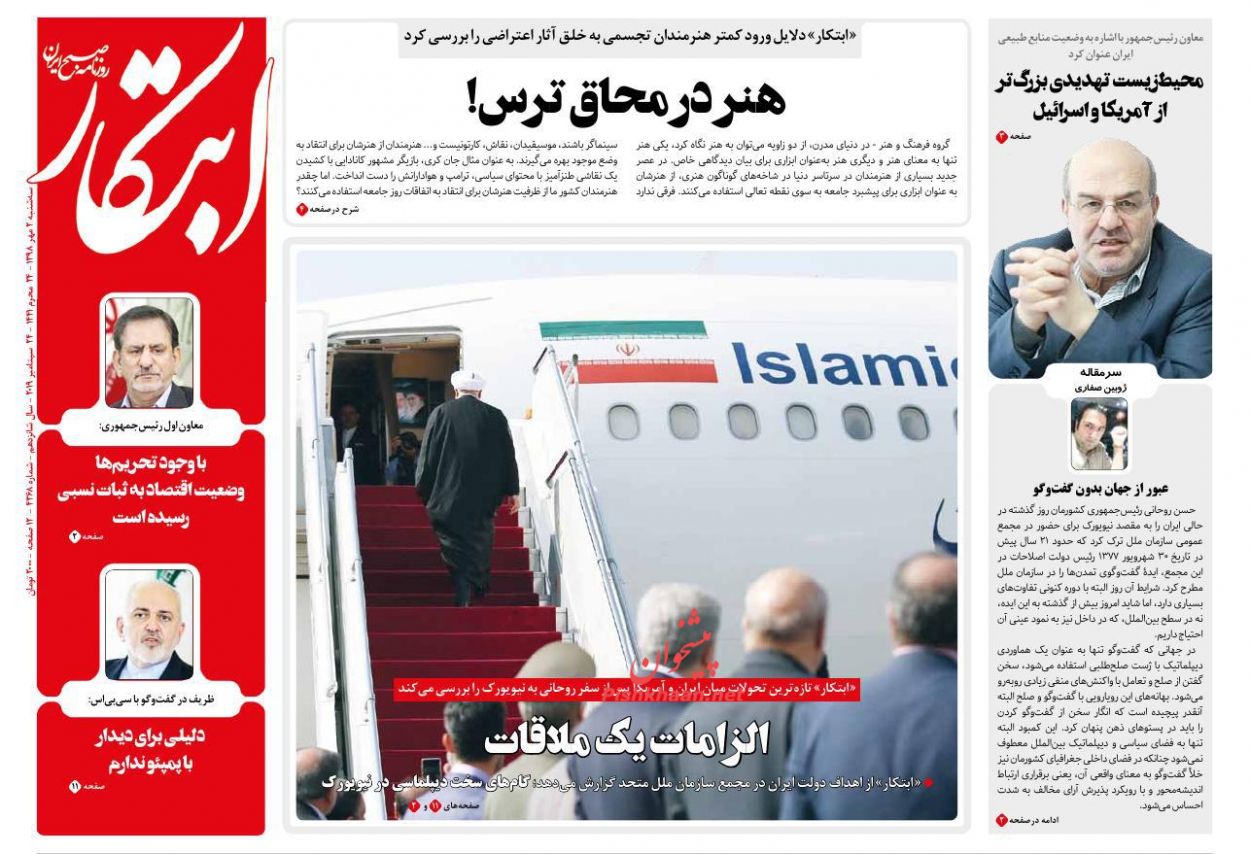
Ebtekar:
1- 48 Decisive Hours in London: Johnson Gov’t Loses Majority of Parliament
2- Rouhani: Some Lend Their Voice to Enemy
3- Steps Forward for JCPOA after Araqchi’s 10-Hour Talks in Paris

A Look at Iranian Newspaper Front Pages on September 4


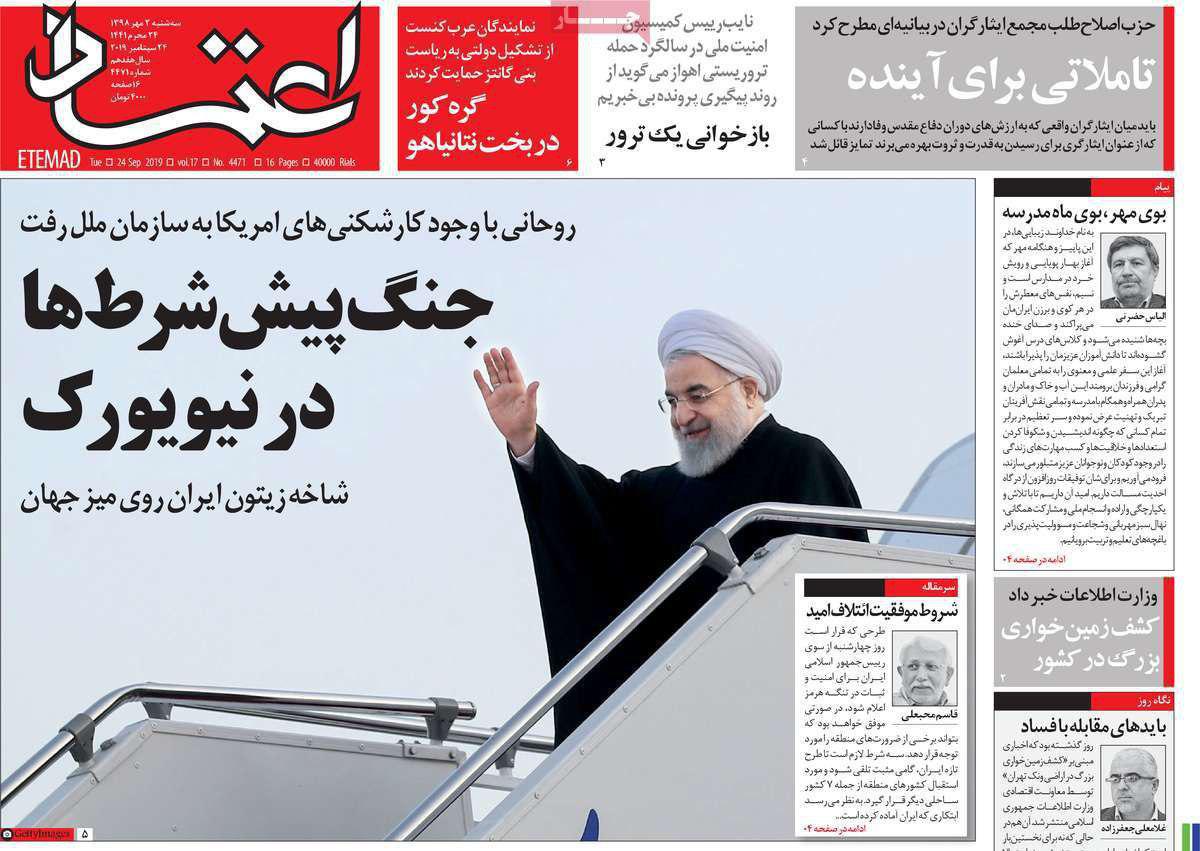
Etemad:
1- First Lifting Sanctions, Then Return to P5+1: Rouhani Sets Conditions for US
2- Suspicious Explosion in Northwestern Russia Raises Concerns about Future of Atomic Weapons

A Look at Iranian Newspaper Front Pages on September 4


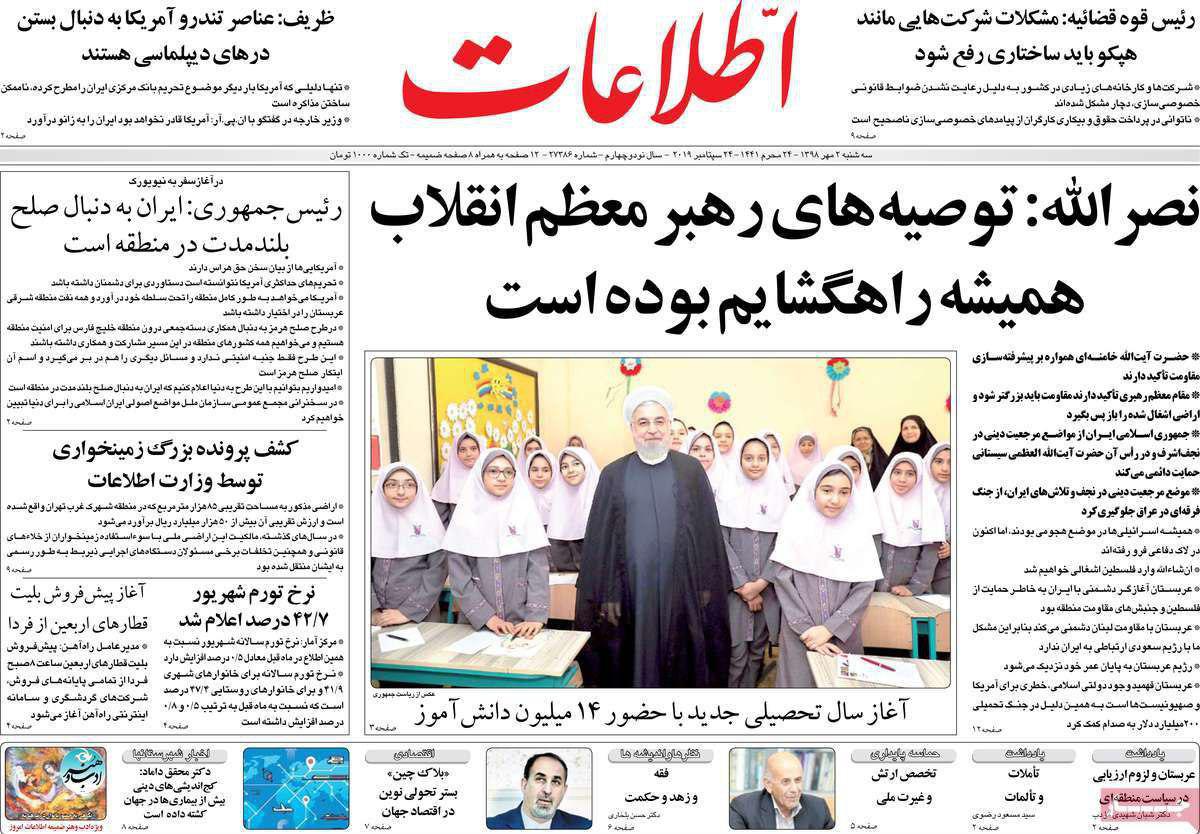
Ettela’at:
1- Rouhani: We’ll Never Close Gates of Diplomacy; No Decision for Bilateral Talks with US
2- Iraq Resistance Groups: We’re Ready to Stand by Lebanon Hezbollah in Fight against Israel
3- Le Drian: Creating LC for Iran Oil Hinges on US Renewing Waivers
4- Japan Refuses to Join US’ Anti-Iran Coalition

A Look at Iranian Newspaper Front Pages on September 4


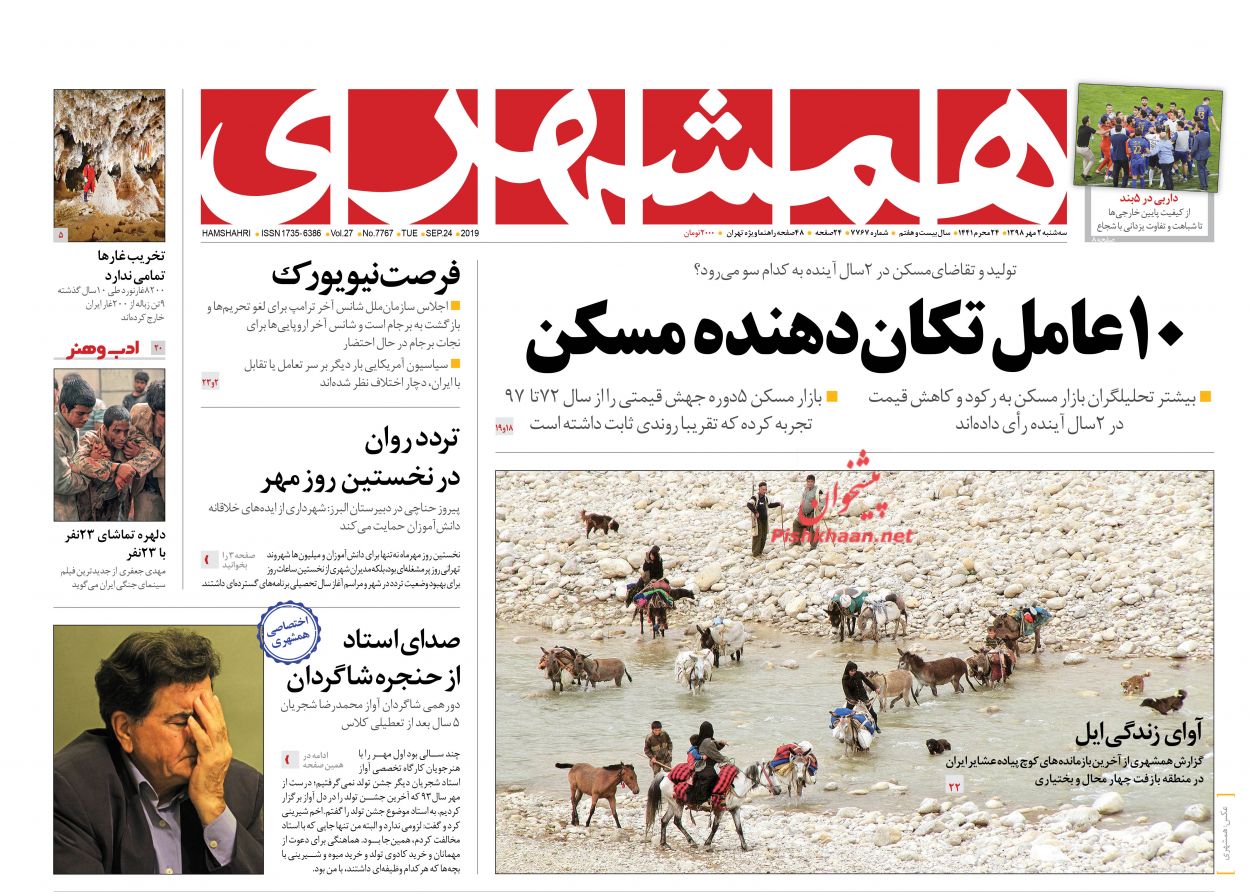
Hamshahri:
1- Tehran Mayor Delivers Speech at Vienna Conference
2- Iran Parliament Gives Vote of Confidence to Two Ministerial Picks

A Look at Iranian Newspaper Front Pages on September 4


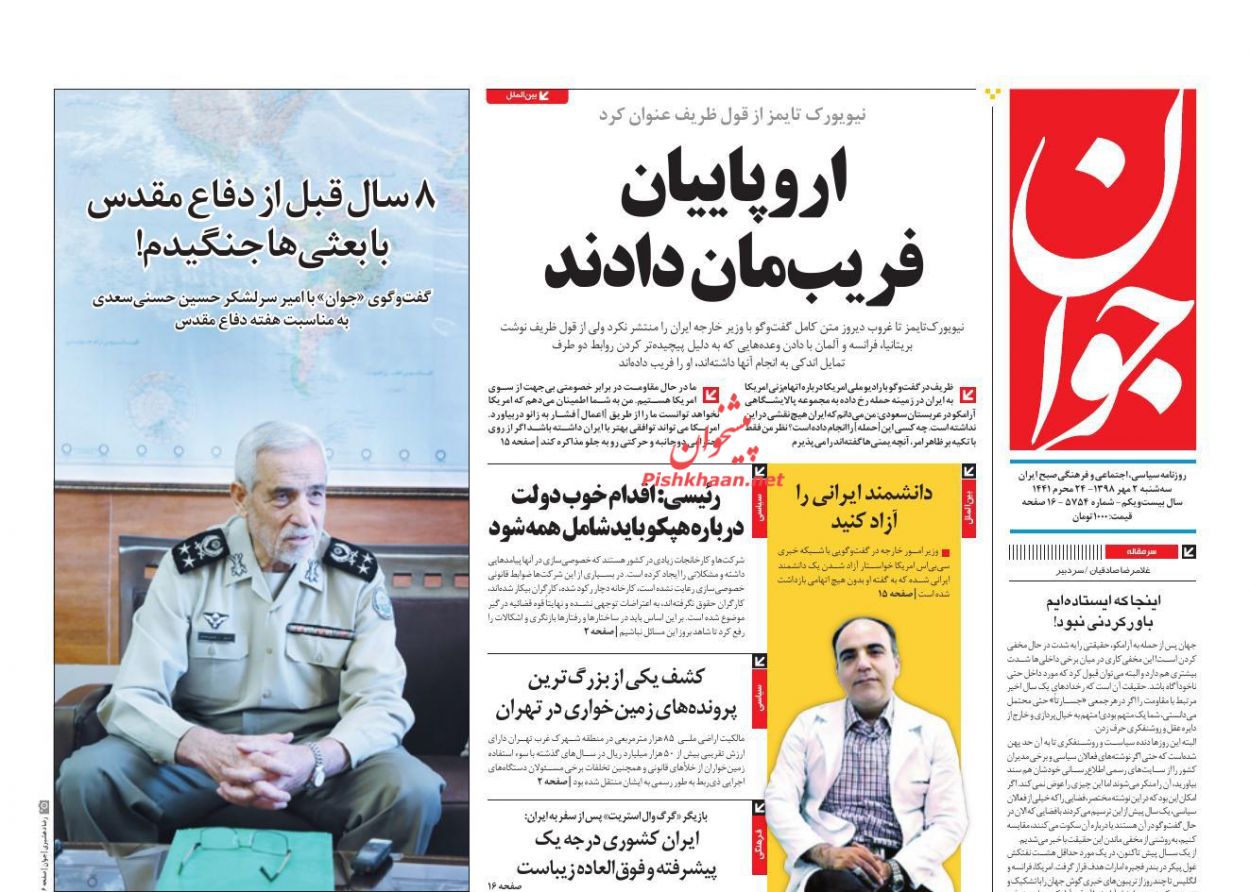
Javan:
1- French FM: Talks with Iran Fragile
* EU Line of Credit Depends on Iran’s Return to JCPOA, Guaranteed Security in Persian Gulf, Talks on Nuclear Issue after 2025; All of Them Depends on US’ Renewal of Waivers
2- Zarif: Too Soon to Talk of JCPOA Death

A Look at Iranian Newspaper Front Pages on September 4


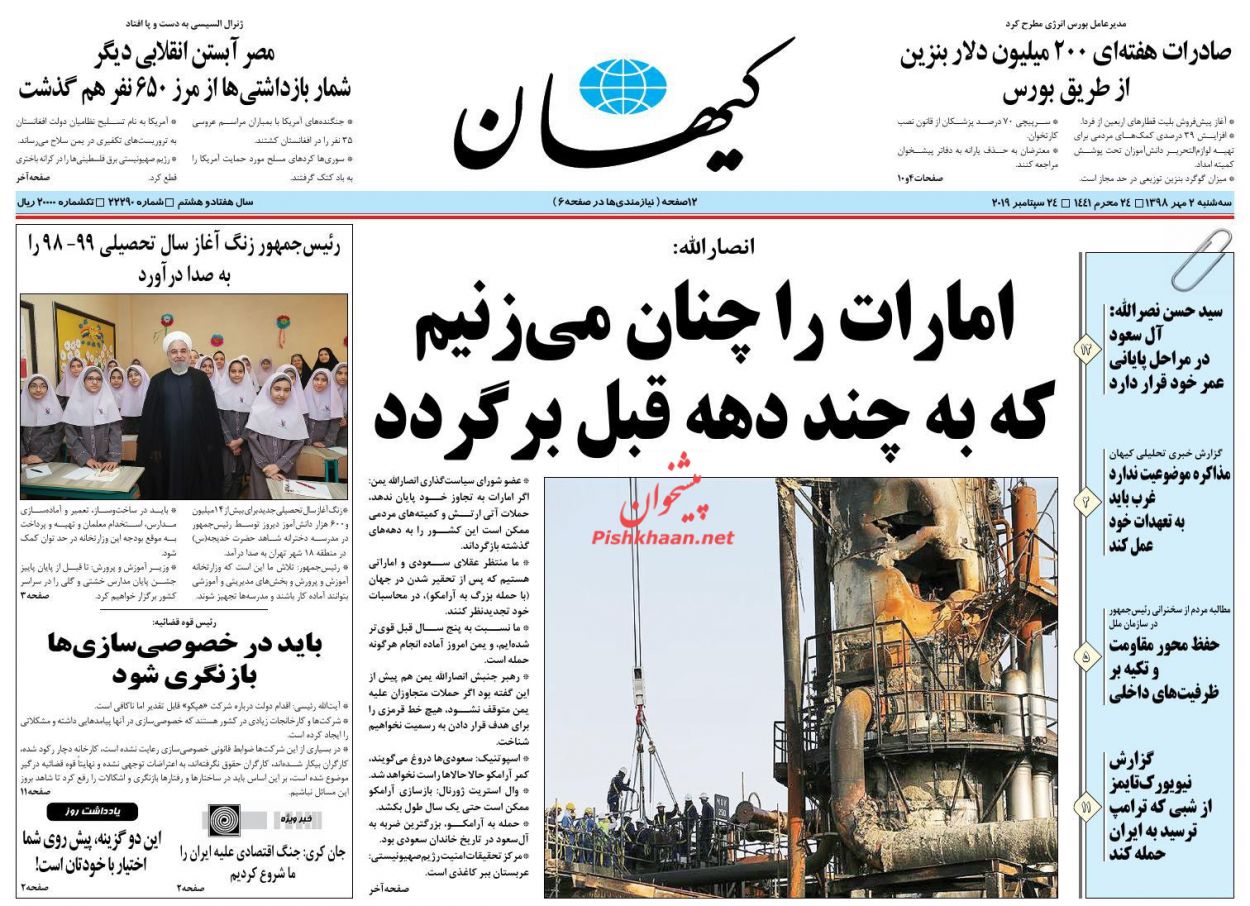
Kayhan:
1- Europe’s False Promises to Keep JCPOA: A Report on US-Europe Joint Deceit
2- US Presidential Candidate: They Lied to Us; Invasion of Iraq Targeted Its Oil

A Look at Iranian Newspaper Front Pages on September 4


Mardom Salari:
1- French Finance Minister in US to Discuss Macron’s JCPOA Offer with US

A Look at Iranian Newspaper Front Pages on September 4

Iran Ready to Promote Parliamentary Ties with Bangladesh

During the Wednesday meeting, the two sides conferred on enhancement of parliamentary relations, expansion of people-to-people communications, and support for development of business and trade cooperation.

They further discussed diversification of collaborations, implementation of joint projects in various fields including modern technologies, use of national currencies in bilateral trade, and support for cooperation between the two countries’ chambers of commerce.

Also on the agenda of talks was enhancement of joint efforts in the Muslim world and international bodies, particularly in the Parliamentary Union of the Member States of the Organization of Islamic Cooperation (OIC).

The Iranian top diplomat is in Dhaka to attend a ministerial meeting of the Indian-Ocean Rim Association (IORA).

He will later leave Bangladesh for Indonesia, where he is to hold talks with top officials of the country.

Dagchain versus Hyperledger: Comparison 2019

From that point forward, cryptocurrency dependent on blockchain advancements, as Bitcoin and Litecoin, have multiplied broadly.

Such a large number of digital currencies have jumped up over the previous decade that the entire subject can feel overpowering. In this article, we’ll demystify the ideas of digital money and the innovation that it’s based on and talk about the contrasts among Dagchain and Hyperledger.

Hyperledger

The Hyperledger venture is a communitarian exertion propelled by the Linux Foundation in 2016. Its expressed point is to unite individuals from various ventures so as to investigate the uses of blockchain innovation. The Hyperledger task does not have its own cryptocurrency. It plans to progress blockchain innovation and think of new uses for it.

Hyperledger’s individuals incorporate pioneers from the banking, figuring, and aeronautics ventures. Its individuals incorporate Airbus, American Express, Cisco, and Deutsche Bank, to give some examples.

Hyperledger records a scope of various activities on its site, all including better approaches to utilize blockchain innovation. For instance, the project known as Burrow is gone for improving the manner in which keen contracts work, and the Hyperledger Quilt is intended to make installments and exchanges simpler crosswise over various records.

Issues with Hyperledger

The Hyperledger venture has created a few advancements in the field of blockchain innovation, yet the project works in an unbending top-down design. The general population and gatherings that remain to profit the most from it are as of now in the worldwide one percent. The Hyperledger project needs clear and quick advantage for the vast majority of the world’s residents, particularly for those in developing countries.

Dagchain

Dagchain is the innovation that backs the cryptocurrency known as Dagcoin. It was made because of the deficiencies in blockchain innovation, which we’ll get into later in this content piece.

Dagcoin

Dagcoin is the money sponsored by Dagchain. It was considered with the objective of making a decentralized digital currency for use in developing nations. The thought was to enable common individuals to adapt to a general sense uncalled for framework and to help individuals manage the issues brought about by money depreciation.

The Dagcoin cryptographic money is planned to be much the same as a normal cash, just better. Rather than simply one more item to trade, Dagcoin will likely be the most usable currency ever.

Dagcoin expects to be a stage up from normal cash also. This implies improving the speed of exchanges while diminishing the cost, offering access to cash to more individuals with lesser confinements and impediments, giving more opportunity to execute.

How Is Dagchain Different from Hyperledger?

Dagchain does not work on a blockchain arrangement. It’s anything but a progression of blocks; rather, each different exchange frames its own block. The blocks are then connected to past exchanges so as to shape what’s known as a coordinated non-cyclic chart, or DAG.

The Dagchain was intended to be brisk moving and solid enough to back a typical currency. It was intended to democratize cryptocurrency and increment its versatility. While industry pioneers and huge business are free to utilize Dagcoin, the innovation was initially intended for use in the developing scene. It was planned to keep running as easily as could be expected under the circumstances and to be available to individuals who might not have foundations in innovation.

In contrast to different digital forms of money, it doesn’t depend on miners/diggers to affirm exchanges. Dagchain has each new individual from the system affirm in any event one past exchange. This implies there is no two-level framework, as there is in different cryptocurrencies, in which miners/diggers are advantaged over different clients. It likewise implies that there is a motivating force to keep Dagchain working rapidly, since each new client needs to affirm past exchanges before including their own exchange.

The Breakdown:

Dagchain is new innovation that looks to cure issues that emerged with blockchain innovation. It makes digital currency available to individuals around the globe. It Speeds up the affirmation procedure for exchanges and wipes out the two-level framework in many cryptographic forms of money.

Hyperledger runs on blockchain innovation, backs blockchain undertakings bolstered by figuring, aeronautics, and banking pioneers. It does not host a cryptographic money

Concluding Thoughts

Dagchain and Hyperledger differ in the way they work just as in their planned uses. Albeit both have their underlying foundations in blockchain’s “distributed ledger” framework, Hyperledger means to investigate new uses for blockchain, while Dagchain stays away from it altogether with an end goal to expand exchange speeds while diminishing or wiping out expenses.

They were additionally made considering entirely various uses; Hyperledger expects to streamline installments and exchanges for enormous banks, while Dagcoin was imagined with an end goal to make a steady, decentralized cash to help clients in creating nations. On its way of becoming the cryptocurrency of the future, Dagcoin also educates the masses through marketing by providing knowledge about the benefits of digital currencies.

Iran Leader Allocates Funds for Key Railroad Project

Mohammad Eslami said on Tuesday that the government had proposed drawing up from the fund to finance the Chabahar-Zahedan railway, a key link connecting Iran’s coastal areas on the Sea of Oman to the border with Afghanistan.

“We proposed tapping the National Development Fund to earmark credit to the Chabahar-Zahedan railway project which was approved by the Leader,” said Eslami, insisting that the project was a “national dream” as it could boost trade and economic activity in the relatively-deprived areas southeast of Iran.

The minister said last month that Iran had accelerated construction at its part of the Chabahar-Zahedan railway, a project where Indian companies are also contributing.

He had said that Iran’s value of investment in the project, which is expected to end by 2021, would amount to over $330 million.

India is a major partner in development plans for Chabahar as it seeks easier access to the markets in Afghanistan and Central Asian countries.

Iran also views the project a key element in its plans to complete a north-south corridor of railways which could have a huge impact on accommodation of trade from the India Ocean to Central Asia and Europe.

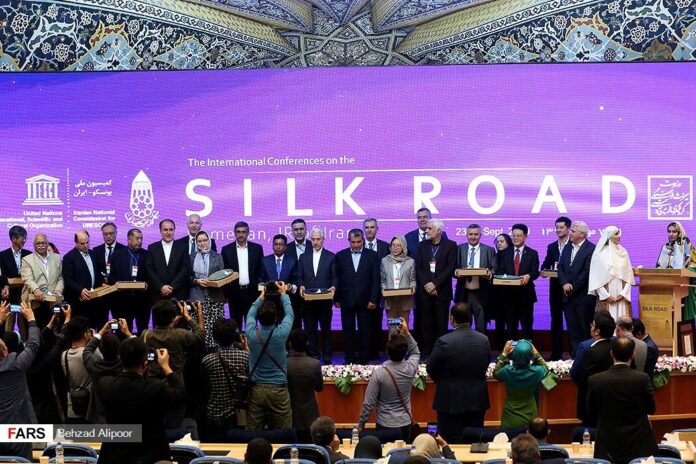
Iran needs to finish construction for a missing rail line between Rasht and Astara, located north of the country, to fully complete the corridor which is seen by many as the new Silk Road.

“Some countries want to build a replica of the Silk Road but they will never succeed,” said Eslami, while making a clear reference to China and its plans to open new trade routes to Europe and Central Asia through Pakistan and Kazakhstan.

“Iran is the main country on the Silk Road and we should use this potential,” he said.

Dates Harvesting Season Begins in Iran

Date Palm is a flowering plant species in the palm family with edible, hard-core fruit, thin skin and a sweet taste. It has large cluster of hanging branches and leaves, and the tree reaches 2 to 5 metres or more in height.

Dates are rich in energy with 160 calories in 100 grams. They are also considered a good treatment to relieve chronic fatigue and anemia.

Dates are high in fibres and a nutrient source of potassium. This fruit is known to promote health and to protect the nervous system. It also prevents night blindness and promotes health.

The unripe fruit or dates are called “Kharak” and in Arabic they are called “Hababouk”. Rotab is the next stage after kharak before the dates are fully ripe with more moisture and less sugar.

Bam dates, which are harvested from gardens and palm trees in southern Kerman, especially in the city of Bam, are popular across the country and the world in a variety of forms.

Harvesting in Bam begins in four stages from late August to mid October. The gardeners, together with their families and relatives, shake the palm trees and collect the dates.

What follows are photos of the date harvest retrieved from Young Journalists’ Club (YJC):

‘US Stopped Short of Striking Iran Fearing Serious Repercussion’

Iran Will Definitely Change Approach to UAE: Top General

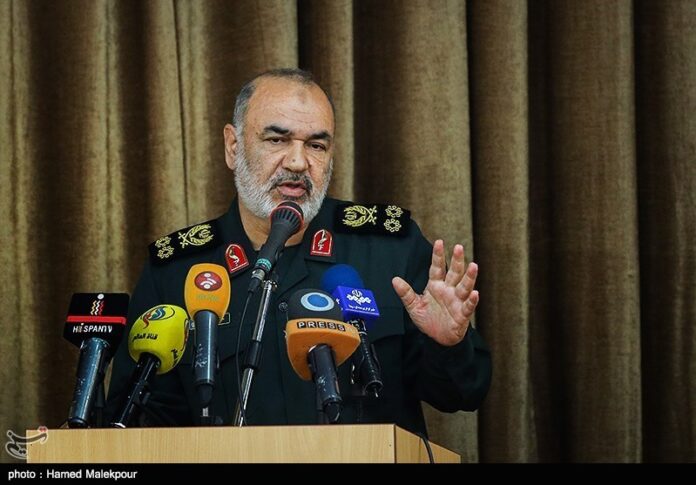
Major General Mohammad Baqeri said on Wednesday Donald Trump was the on the verge of implementing his decision following Iran’s downing of a US spy drone in the Iranian airspace last month.

“The day the drone was shot down, the US president just stopped short of implementing the decision, and this decision was the result of the US military’s intelligence and the briefing given to the US president,” said General Baqeri, the chairman of General Staff of the Iranian Armed Forces.

However, said the top commander, Trump told a lie when he said the US had decided not to attack in order to save the lives of people.

“Rather, [the US sopped short of attacking Iran because] Trump was briefed on what would happen in Iran’s missile sector, in the Persian Gulf and Strait of Hormuz, and in regional countries where Iran has arms,” he said.

“In two sessions, each 2-3 hours long, Trump was briefed and told that he would not be able to attack Iran,” said the top commander.

He underlined Iran is facing numerous military threats, but it is not attacked because of its deterrence power.