Wednesday, December 24, 2025
Home Blog Page 3092

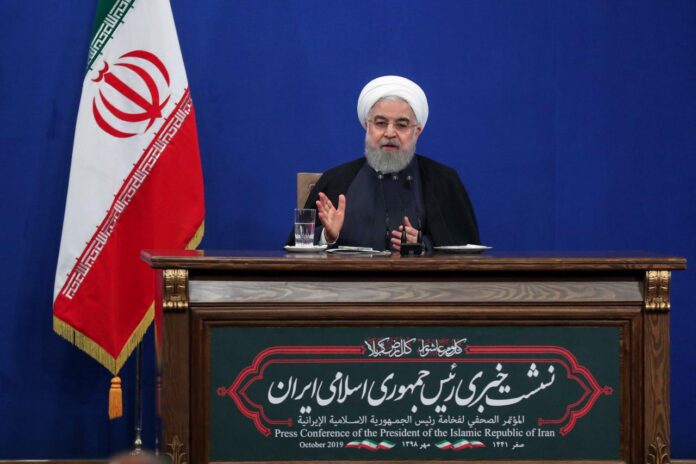
Enemy Won’t Dare Attack Iran: President Rouhani

Hassan Rouhani further said Iran will not succumb to the enemy, will defend itself and will not allow others to encroach upon its frontiers.

“The United States and the Israeli regime want to see discord among peoples in the Middle East region,” said the president at a parade of Armed Forces in the Iranian Capital, Tehran, marking the anniversary of the start of the Iran-Iraq war in the 1980s.

“Hegemonic powers led by the United States have always pursued the objective of creating insecurity, misery and problems, and looting the interests of the regional countries,” he said.

He said Iran attaches great significance to security in the Persian Gulf and the Strait of Hormuz.

“We announce to the world that the presence of foreign forces is problematic for international waterways as well as shipping, oil and energy security,” he said.

“However, he noted, the Islamic Republic of Iran’s path is one of unity and coordination with regional countries,” said President Rouhani.

“We extend a hand of friendship to all our neighbours and forgive their past mistakes,” President Rouhani said.

He noted enemies made numerous efforts in the years following the 1979 Islamic Revolution of Iran to create insecurity, hatch plots to disintegrate the country, and assassinate top Iranian officials.

“Enemies of the Revolution and the Iranian nation even didn’t settle for these acts, and conspired to undermine our security and defence foundations,” he added.

“The enemies’ first plot was to dissolve the Army, which was promoted by … mercenaries,” he said.

He then touched upon the 8-year Iraqi imposed war on Iran in the 1980s, which, he said, had Washington’s green light. He said the Iranian nation and military stood up to aggressors through unity and solidarity.

He further touched upon accusations levelled by the enemies against Iran.

“[The lies of] Those who want to attribute regional incidents to the Islamic Republic of Iran will be unmasked like all of their other lies which were exposed,” he said.

“If they are really after peace and security, they should not send so much dangerous weapons to the region and not turn our region into an arms depot and [a place for] an arms race, and if they really want security for this region they should distance themselves from the region because the presence of all of them has amounted to hardship and disaster for the region,” said the president.

Tehran Hosting Exhibition of Intrusive Drones Caught by Iran

The exhibition, entitled “Hunting the Vultures”, was opened on Saturday, Sep. 21, 2019, in a ceremony attended by IRGC Chief-Commander Major General Hossein Salami.

The exhibition will be open to visitors every day from 10 am to 6 pm until October 7 at Tehran’s Sacred Defence Garden-Museum.

Among the intrusive drones on display are the American drones RQ-170 Sentinel, RQ-11A Raven, and Desert Hawk I/III, an Israeli Hermes 200, and a British Phoenix drone, which was unveiled for the first time.

The most important drone captured by the IRGC is a US-made RQ-4 Global Hawk, which was shot down on June 20 over the territorial waters off the coastal province of Hormozgan.

The indigenous ‘3rd of Khordad’ air defence system which was used to down the drone is also on display at the exhibition, photos of which follows:

Iranian Firms to Attend GITEX 2019

The knowledge-based companies from Iran will be among exhibitors from around the world to attend this year’s GITEX at the Dubai World Trade Centre.

The 39th edition of the annual computer and electronics trade show, exhibition, and conference in United Arab Emirates will be held on October 6-9.

The Iranian exhibitors will be sponsored by the office of Iran’s Vice President for Science and Technology, the Iranian National Innovation Fund, and the Trade Promotion Organization of Iran.

Known as the biggest tech show in the Middle East, North Africa and South Asia, GITEX attracts many start-ups, technology enterprises and think-tanks from around the world.

More than 4,800 global exhibitors and 97 countries are going to showcase and offer their products, solutions and technologies across 26 show sectors. Moreover, 250 pioneers and practitioners are scheduled to go on stage at GITEX.

According to the event’s website, the 26 exhibiting zones would feature the latest innovations, from the world’s first autonomous flying taxi to as yet unreleased AI (artificial intelligence) software.

A section of the show, known as GITEX Future Stars, will displays the new strides in technology as start-ups from 75 countries are going to present their revolutionary ideas and innovation.

Furthermore, the innovators, technology experts and business leaders will be sharing the upcoming technologies in the Tech Talks program.

For a brief review of Iran’s achievements in various fields of science and technology, check the book “Science and Technology in Iran: A Brief Review – 2019

The technology week will also include X-Labs for live demos and discussions, the 3rd edition of Africa Investment Forum, and GITEX Trailblazer Awards that will honor the world’s technology first-movers and successful adopters that have set new benchmarks within their industry.

GITEX 2019 will be hosting businesses and entrepreneurs working on a broad range of technologies, such as artificial intelligence, block chain, 3D printing, drones, robotics, mobility, smart home, computer and mobile, digital imaging, cyber security, infrastructure network, cloud, big data, global smart cities, future transportation, and 5G.

Iran President Congratulates Armenia on National Day

Iran Congratulates Armenia on National Day

In his Saturday letters that were addressed to President Armen Sarkissian and Prime Minister Nikol Pashinyan, President Rouhani expressed hope that relations between the two countries will further deepen in all fields of mutual interest.

President Rouhani also wished health and success for them and prosperity and felicity for the people of the Republic of Armenia.

On August 23, 1990, Supreme Council adopted the Declaration of State Sovereignty of Armenia proclaiming the Armenian SSR abolished and the establishment of the Republic of Armenia.

On September 21, 1991, the people of Armenia voted in a referendum to proclaim independence from the Soviet Union.

Levon Ter-Petrosyan was elected the first president of Armenia in November 1991. On December 21, 1991, Armenia joined the Commonwealth of Independent States (CIS). Armenia gained independence formally on December 26 in connection with the dissolution of the USSR.

FM Zarif Sends Message to World Peace Day Event

What follows is the full text of the message:

In the Name of God, the Most Gracious, the Most Merciful;

Dear friends;

I’d like to pay tribute to the martyrs and veterans on the occasion of the Sacred Defense Week. I’m afraid that I could not join you because of taking part in the United Nations General Assembly meeting in New York.

I express gratitude to Secretary-General of the Iranian National Commission for UNESCO Mr. Ayoubi, Director of the Museum of Islamic Revolution and Holy Defense Mr. Jafari, and all others for convening this valued event.

Honoring and respecting the concept of peace is a valuable and important measure in materialization of this concept in the global arena. Peace and security have been among the human being’s main wishes and requests throughout history, regardless of the time period, the location, or the type of society. The need for peace and calm derives from the pure nature of humans. The Almighty God has created human as a peace-loving being. There is no doubt that peace is a sacred term which has been always sought by the humanity and is considered as a common global cause. The truth is that the purpose of peace is not only the lack of wars, but it is aimed at the sense of justice, equality and security. In this concept, peace is regarded as a virtue. The obstacle to the materialization of peace and calmness is the estrangement of humans from the divine teachings, including fraternity, equality, peaceful co-existence, sincerity, justice-seeking, fairness and patience. The divine religions and monotheistic faiths have referred to peace and justice as an essential part of the criteria for human life, as the divine prophets have called on humans to pursue them. The human being’s instinct and innate wisdom prefers and favors the goodness, norms and values. “And Allah invites to the Home of Peace and guides whom He wills to a straight path,” God says in Quran.

Many wars throughout human history have broken out because of excessive demands and expansionist ideas, although they have been usually alleged to ensure peace and security or to protect the interests of one of the warring sides. In fact, a number of sides have been seeking their security by creating insecurity for the other side or parties. Based on this notion, we saw the formation of various political and military blocks in the international arena in the past, which has emerged as unilateralism today.

Along with the social and political developments in the human life, particularly the formation of nation states, the international community’s main concern has been the formation of collective mechanisms to maintain peace and security, to prevent the outbreak of wars, and to resolve the conflicts peacefully. The bitter experiences and heavy costs of the First World War made the world leaders to establish the League of Nations to achieve peace. After that arrangement proved ineffective and following the outbreak of World War II, the United Nations was founded, one of whose main goals is to protect international peace and security. The UN Charter has also set out regulations to that end.

The main responsibility to ensure this lies with the Security Council. In addition to the Security Council, the other UN bodies and affiliated specialized agencies have been seriously concerned about this issue as well. The UNESCO has also a significant role in the fortification and promotion of culture of peace. Despite the United Nations’ considerable efforts and activities and a series of achievements in this regard, we have sadly witnessed many internecine wars and unresolved conflicts. This has various reasons, such as the instrumental use of the UN mechanisms, particularly the UN Security Council, by a number of countries, the lack of commitment from certain powers and the UN member states to the contents of the UN Charter, and the lack of serious action on a reform of the UN structure. On the other hand, the bitter truth is that the culture of peace and rule of law has not been institutionalized within the international community.

Still, a series of countries believe they have a right to impose their own ideas and political views because they have power. Their meddlesome, monopolist, and unilateralist policy in the international relations is the root cause of the bulk of past wars and conflicts as well as the existing challenges.

The Islamic Republic of Iran has been a target of such hostile and unilateralist policy for around four decades. The Security Council’s negative performance during the Iraqi imposed war against Iran and after the Saddam regime’s crimes against people of Iran — such as the use of chemical weapons — was a blatant example of the Security Council’s poor performance in relation to international peace and security.

Another example of the abuse of the Security Council against the Islamic Republic of Iran was the council’s imposition of sanctions on Iran on baseless nuclear allegations.

Such situation was a result of the political approach of some of the Security Council’s permanent members to the subjects on the agenda. The US’ withdrawal from the JCPOA in spite of its commitments, including under the Security Council Resolution 2231, was another example of the political treatment of the Security Council. The US’ lack of commitment to the international treaties and the bilateral agreements with the other countries as well as the adoption of policy of unilateralism are among the major factors threatening the international peace and security.

The unresolved issue of Palestine after more than seven decades of occupation, killing and depriving a nation of its basic rights, displacing the people, and the current dire conditions in Yemen are glaring examples of brazen injustice in the international arena.

Based on its religious and national teachings, the Islamic Republic of Iran has always tried to strengthen regional and international peace and security.

The verification of Iran’s compliance with the JCPOA commitments confirms the reality. Iran’s key and leading role in the fight against terrorism, particularly in the war against ISIS in Syria and Iraq, are the other instances of the measures we have taken to combat the threats against peace and security. The Islamic Republic of Iran has always tried to fulfill the UN Charter’s goals, and has worked in active and constructive cooperation and interaction with the UN member states and various bodies to that end. By realizing the threats that extremism and violence pose to the international peace and security, the president of Iran proposed the idea of World Against Violence and Extremism at the UN General Assembly in 2013, which received a welcome from the UN members.

We believe that the most effectual way to restore and preserve peace and calm is for the humans to return to their pure nature and regulate their relations on the basis of genuine human and religious values and criteria. Promotion of the thoughts and first-hand views of the elites, the intelligentsia, and the clerics would have a great role in strengthening the culture of peace and friendship among the nations and countries.

The concept of peace has always had a special place in the Persian literature. Renowned Iranian poet Rumi has paid a great deal of attention of to the concept of peace. “The wars of mankind are like children’s fights; all meaningless, pithless, and contemptible,” says Rumi in the first book of the Masnavi.

Let’s hope for a world full of peace, calmness, and materialization of justice and rapport among the whole nations and countries.
Thank you.

Iran Strongly Rejects Saudi Claims about Aramco Attacks

Iran Says What IAEA Wants to Access “Not A Site”

“It is a source of regret that the Saudi government, under the delusion that Iran is its enemy, escapes from the existing realities and facts, and always raises Iran’s name in a bid to pin the blame on others for its own failures,” Seyyed Abbas Mousavi said Saturday.

He advised the Saudi government to stop levelling groundless accusations against others, and immediately end the devastating war on Yemen, which has resulted in nothing but the slaughter of innocent people and the destruction of the country.

Yemen’s Houthi Ansarullah movement and their allies in the Yemeni army deployed as many as 10 drones to bomb Abqaiq and Khurais oil facilities run by the Saudi state-owned oil company before dawn last Saturday.

The unprecedented attack knocked out more than half of Saudi crude output, or 5% of global supply, prompting Saudi and US officials to claim without any evidence that it probably originated from Iraq or Iran.

The US was quick to blame Iran for the brazen attacks, claiming there was no evidence the drones had originated from Yemen.

Iranian, Omani FMs Meet in New York

During the Saturday meeting, the two sides conferred on the latest developments in bilateral ties as well as the most important regional and international issues.

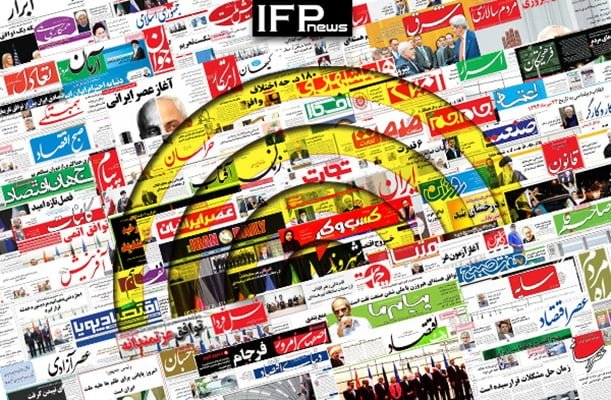
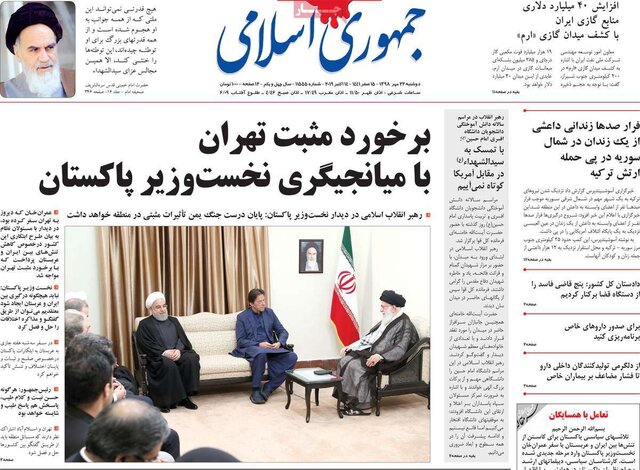
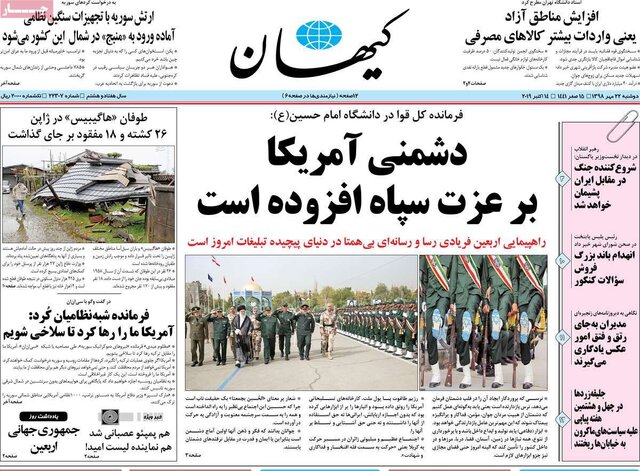
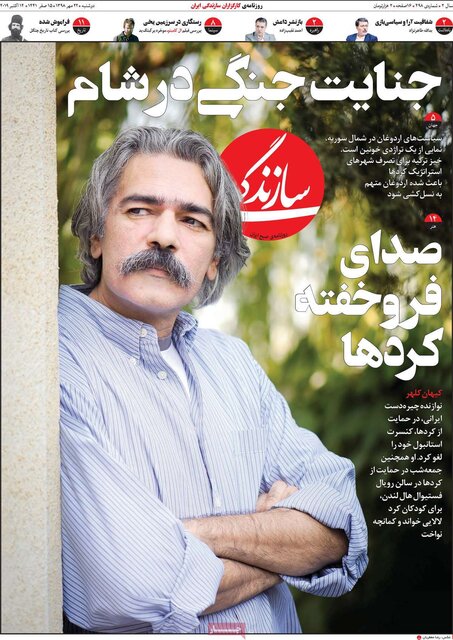
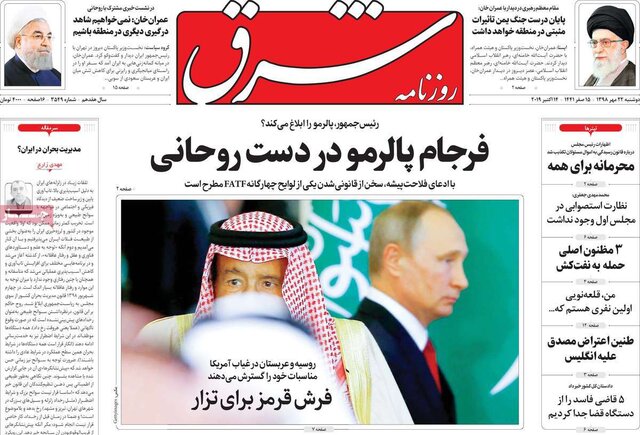
A Look at Iranian Newspaper Front Pages on September 21

A Look at Iranian Newspaper Front Pages on November 19

Abrar:
1- Air Force Commander: Iran Stronger than Before in Electronic Warfare
2- Le Drian Urges Iran to Fully Comply with JCPOA
3- Zarif Departs for New York

A Look at Iranian Newspaper Front Pages on September 21


Aftab-e Yazd:
1- Visa Issued for Rouhani in Last Minute: President to Visit New York

A Look at Iranian Newspaper Front Pages on September 21


Asrar:
1- Zarif: Military Action against Iran Will Lead to ‘All-Out War’
2- Oil Minister: US Using Oil as Weapon

A Look at Iranian Newspaper Front Pages on September 21


Donya-ye Eqtesad:
1- Last Blow to Arabs’ Dream: US Won’t Support Arab Rulers

A Look at Iranian Newspaper Front Pages on September 21


Ebtekar:
1- End of Tunisian Dictator in Saudi Arabia
* Ousted Tunisian President Bin Ali Dies
2- IRGC General: Trump’s Dream of Making Iran Give Up Will Never Come True
3- Iran’s Volleyball Team Advances to Final at Asian Championship

A Look at Iranian Newspaper Front Pages on September 21


Etemad:
1- No to Violence against Women
* Government Submits Bill on Women Security to Parliament
2- Bankrupt Crown Prince: Aramco Fire Didn’t Realize Bin Salman’s Dream of War
3- Long Steps of Iran, Yerevan
* Iran, Armenia Accelerate Efforts to Improve Ties

A Look at Iranian Newspaper Front Pages on September 21


Ettela’at:
1- Zarif: To America, Arabs’ Oil More Important than People’s Lives
2- Oil Minister: Current Economic Conditions Much More Difficult than 1980 War Time
3- UNSC Opposed to US’ Anti-Iran Plan on Aramco
4- People in Five Continents Hold Rallies in Support for Environment

A Look at Iranian Newspaper Front Pages on September 21


Hamshahri:
1- Duel in New York
* Zarif Responds to Pompeo in Several Tweets
* I’ll Defend My People, Country as Always

A Look at Iranian Newspaper Front Pages on September 21


Javan:
1- US Sells Old Iran Sanctions to Saudis Once Again
2- Nasrallah: Saudi, UAE Counting on Trump, but He’s Already a Loser
3- Zarif: Saudi, Zionism Want to Fight until Last American Soldier!
4- IRGC General: There’ll Be No Tomorrow for US, Saudi in Case of Move against Iran

A Look at Iranian Newspaper Front Pages on September 21


Jomhouri Eslami:
1- US’ Latest Anti-Iran Plot Fails in UNSC
2- Former US Top Diplomat: Netanyahu Deceiving Trump

A Look at Iranian Newspaper Front Pages on September 21


Kayhan:
1- Arab Media’s Confession: Nasrallah’s Destructive Blow Showed US Can’t Be Trusted
2- Suspicious Moves in Afghanistan and Calm before Storm

A Look at Iranian Newspaper Front Pages on September 21


Setareh Sobh:
1- Zarif in New York: Trump in Chamber of War

A Look at Iranian Newspaper Front Pages on September 21


Shargh:
1- Zarif’s Difficult Days in Manhattan

A Look at Iranian Newspaper Front Pages on September 21


Sobh-e Now:
1- Nasrallah: Trump Begging to Meet Rouhani

A Look at Iranian Newspaper Front Pages on September 21

Iran Denies Reports of Cyber-Attack on Its Oil Facilities

Reuters had earlier claimed that a number of Iranian servers and websites – including those of some petrochemical firms – were under a cyber-attack.

Iranian Oil Minister Bijan Namdar Zanganeh on Friday inspected several petrochemical plants and the 350,000-barrels per day Persian Gulf Star refinery, which helped Iran declare self-sufficiency in gasoline after the inauguration of its third phase in February.

During the visit, he discussed cyber security and production bottlenecks. “Investigating the refinery’s civil defence situation and related topics is among the goals … of the oil minister’s one-day trip to Bandar Abbas,” IRNA reported.

It was earlier reported that the country has declared condition orange in a number of its oil and petchem facilities in the south of the country.

A source said Friday nothing was threatening the facilities, and the condition orange had been declared as part of regular passive defence drills.

Even Saudis Didn’t Believe Iran Was Behind Aramco Attacks: Zarif

Saudi Arabia said Friday it had launched a military operation against Hudaydah because the port city was being used by Yemeni fighters to launch ballistic missiles and drones.

In a post on his Twitter account, Zarif said it was “curious” that the Saudis, who had blamed Iran for last Saturday’s air raids on two major Saudi oil facilities, had retaliated against Hudaydah in violation of a UN-brokered ceasefire agreement signed in Stockholm in December 2018.

US Secretary of State Mike Pompeo, without evidence, was also quick to blame Iran for the brazen attack. The claim drew ridicule from many social media users who compared Pompeo’s rushed conclusion to Washington’s indecision about the murder of prominent journalist Jamal Khashoggi at the Saudi consulate in Istanbul in October 2018.

On Saturday, Pompeo said Washington and its allies were seeking a “peaceful resolution” with Iran, marking a significant cooling of rhetoric after Donald Trump had warned the US was “locked and loaded”.

Tehran has vehemently rejected accusations of involvement in the raids as “lies” and warned of “an all-out war” in the event of military strikes against the country.

Houthi spokesman Mohammed Abdul-Salam on Thursday warned that Saudi Arabia’s offensive in Hudaydah was “a serious escalation that could torpedo the Sweden agreement.”

“The coalition will be responsible for the consequences of this escalation and we’ll be watching the UN stance on this situation closely,” he said.

On Friday, Ansarullah’s president of the Supreme Political Council Mahdi al-Mashat said Yemeni fighters were calling a halt on drone and missile attacks, hoping “the gesture would be answered” by the Saudis.

Al-Mashat said the peace plan was aimed at ending the conflict “through serious negotiations to achieve a comprehensive national reconciliation which does not exclude anyone”.

The official, however, warned that the Yemenis “would not hesitate to launch a period of great pain” if their call for peace was ignored.

Saudi Arabia and its allies launched the war on Yemen in March 2015 in an attempt to reinstall a Riyadh-backed former regime and eliminate the Houthi movement, which has been defending the country along with the armed forces.

The Western-backed offensive, coupled with a naval blockade, has destroyed the country’s infrastructure, and led to a massive humanitarian crisis.