Monday, December 22, 2025
Home Blog Page 3035

Karbala Tribe Chiefs Apologize to Iran over Consulate Attack

The tribal leaders met with Iran’s Consul General in Karbala Mir-Masoud Hosseinian on Wednesday and offered their apology for Sunday’s raid by a group of assailants on the Iranian diplomatic mission.

They said the attackers could not disrupt brotherly and strong relations between the Iranians and the people of Karbala, adding that Tehran has stood with the Iraqis during difficult times.

Hosseinian, for his part, stressed that the incident would not affect Baghdad-Tehran ties and expressed hope that the Iraq unrest would end soon.

Late on Sunday, a group of so-called protesters scaled the concrete barriers surrounding Iran’s Karbala consulate and spray-painted scurrilous writings on its perimeter walls.

Some other demonstrators also threw stones and burned tires around the Iranian consulate building, prompting Iraqi security forces to fire in the air to disperse the crowd.

Local sources said an Iraqi element affiliated to the Ba’ath Party has been arrested over the attack, but there has been no confirmation from Iraqi officials.

‘Port blockage cost Iraq $6’

In another development on Wednesday, a spokesman for Iraqi Prime Minister Adil Abdul-Mahdi said the blocking of Iraq’s major Um Qasr port by anti-government protesters has cost the Arab country over $6 billion so far.

“Iraq has lost more than 6$ billion due to closure of Umm Qasr port, after protesters blocked all the roads that leads to the port,” Major General Abdul Karim Khalaf said at a press conference. “Blocking the roads and bridges will only harm the Iraqi economy.”

He further warned that Iraqi security forces will “immediately arrest any protester or individual who blocks the roads and bridges from now on, as we will also make sure not to let anyone to get close to the ports and the oil fields.”

Khalaf also said that security forces had been ordered not to use live fire on demonstrators.

“To avoid any confusion, clear and strict instructions have been handed down that no live ammunition be used. Orders have also been given not allow any live ammunition on the scene [of protests],” he said.

At the start of October, street protests erupted in several Iraqi cities over unemployment and a lack of basic services.

The rallies resumed on October 25 after a pause of about two weeks, but took a violent turn. Over 150 people lost their lives in the first round, according to official figures.

The United Nations estimates that as of November 4 at least 254 people were killed and thousands more wounded during Iraq protests.

‘Wind’ Painting Exhibition Underway in Tehran

In the painting, Iranian high school girls can be seen wearing uniforms on the streets of Tehran, but their face or behaviour is not recognisable.

The special attribute of this collection is the presence of a natural element that is not clearly evident, but plays an important role. The wind, without being seen in the picture, could be felt as it disrupts the order of the elements in the works.

The scarves on the students’ head, not deliberately, have concealed their faces. Here, without seeing faces, one can visualise the laughter or anger and see their different reactions.

In the works of Shohreh Mehran, most of the subjects have no visible face. The audience either can see their backs or the subjects have covered their faces with their hands when tidying their scarves. But this time an external element such as the wind has covered their faces.

Removing women’s faces and putting them under cover gives them an identical identity that enhances their homogeneity in their uniforms.

The painting exhibition will run through November 19 at E’temad Gallery.

What follows are Honar Online’s photos of the exhibition:

A Look at Iranian Newspaper Front Pages on November 7

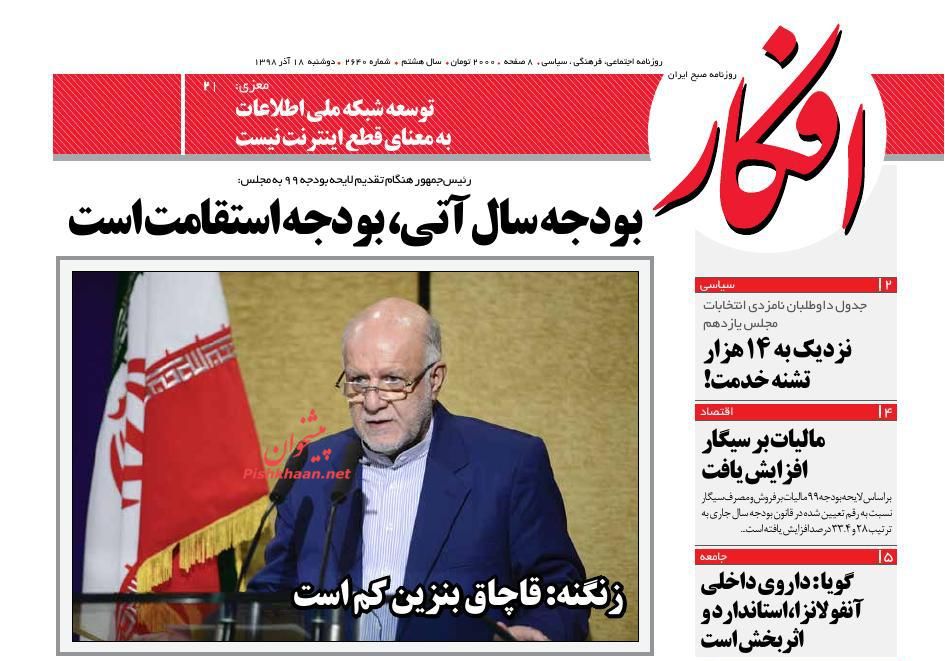
A Look at Iranian Newspaper Front Pages on November 19

Aftab-e Eghtesadi:

1- US’ Role in Closure of Bank Accounts of Iranians Living in Malaysia

2- Chinese Firms to Replace Other Foreign Companies: Industry Minister

Iran Aftabe Eghtesadi newspaper November 7


Asr-e Azadi:

1- Zarif to Europe: Remain Committed to Your Commitments

2- Kuwait Deputy FM: We Conveyed Iran’s Message to Saudi, Bahrain

Iran Asre Azadi newspaper November 7


Etemad:

1- Fordow Last Step Before End of JCPOA?

2- Rouhani: We Have to Take Fourth Step, But There Are Still 2 Months Left for Talks

3- Obligatory Peace in Southern Yemen: Resigned Gov’t, Separatists Reach Agreement

4- Iran’s Fourth Step Equal to Three Steps: Analyst

Iran Etemad newspaper November 7


Iran:

1- Enrichment in Fordow in Fourth Cut to Iran’s Commitments

Iran newspaper November 7


Jomhouri Eslami:

1- Beginning of 4.5-Percent Enrichment in Fordow

2- Even Johnson Falls Victim to Brexit

3- France Determined to Expel MKO: French Official

4- Riyadh Deal Introduction to Yemen Disintegration: Southern Yemen Groups

Iran Jomhouri Eslami newspaper November 7


Kayhan:

1- Pentagon: 20 US Soldiers Commit Suicide Everyday

2- Paris, Washington Dividing Labour: Is France Complicit with US?

3- Fourth Step a Trivial One: JCPOA Withdrawal Only Response to West’s Violation of Commitments

4- Syrian Military Enters Northern Areas, Warmly Welcomed by People

5- Iran Leader’s Aide: Our Experience Shows US, E3 Not Going to Fulfill Their Commitments

Iran Kayhan newspaper November 7


Rooyesh-e Mellat:

1- Iran’s Letter on Plan to Inject Gas into Fordow Facilities Delivered to IAEA

2- 2,000 Kilograms of UF6 Gas in Fordow as Part of Fourth Step

3- Zarif: We Will Return to Our Commitments If Europe Complies with Its Obligations

Iran Rooyesh Mellat newspaper November 7

Erdogan Says Turkey Has Captured al-Baghdadi’s Wife

Abubak Al baghdadi

Al-Baghdadi was known to have four wives, the maximum number one can have under Islamic law at one time, Al Jazeera reported.
“The United States said Baghdadi killed himself in a tunnel. They started a communication campaign about this,” said President Erdogan.

“But I am announcing it here for the first time: We captured his wife and didn’t make a fuss like them. Similarly, we also captured his sister and brother-in-law in Syria,” he said in a speech at Ankara University. He gave no other details.

A senior Turkish official said earlier this week that Turkey had captured al-Baghdadi’s sister, her husband and daughter-in-law, and hoped to gain intelligence from them about ISIS, although Ankara has not said what knowledge they may have had about the group’s operations.

A Turkish official said the 65-year-old sister is suspected of being affiliated with ISIS and called her capture an intelligence “gold mine”.

Fahrettin Altun, Turkey’s communications director, said on Twitter. “The arrest of al-Baghdadi’s sister is yet another example of the success of our counter-terrorism operations.”

China, US Agree to Roll Back Tariffs on Each Other’s Goods

America and China trade

The amount of tariff relief that would come in the first phase, set to be signed in the coming weeks, would depend on the content of that agreement, spokesman Gao Feng said Thursday without giving further details. The two sides had “constructive talks” in the past two weeks, he said.

If confirmed by the US, such an understanding could provide a road-map to a deal to end the trade war that’s cast a shadow over the world economy.

China’s key demand since the start of negotiations has been the removal of punitive tariffs imposed by President Donald Trump, which by now apply to the majority of its exports to the US

Stocks rallied, with Hong Kong’s Hang Seng Index climbing 0.7% and futures on the S&P 500 adding 0.5%. The yuan strengthened.

The two sides continue to negotiate over where and when a “Phase One” deal would be signed. Gao said he had no further information on the location or timing.

Iran Officially Starts Enrichment at Fordow Nuclear Plant

Iran-Nuclear

In a statement on Wednesday, the AEOI said the gas injection started at 00:00 (local time) Thursday upon the order of President Hassan Rouhani, who is also the head of the Supreme National Security Council.

The gas injection, which was completed under the full supervision of the International Atomic Energy Agency (IAEA), started after the transfer of a cylinder containing 2,000 kilograms of UF6 from Shahid Ahmadi Roshan nuclear facility of Natanz to Fordow nuclear plant, located near the city of Qom.

The underground facility in Fordow has 1,044 IR-1 centrifuges. The uranium hexafluoride gas is being injected into 696 centrifuges, and the remaining machines (348) are used for producing and enriching stable isotopes.

Spokesman for the AEOI Behrouz Kamalvandi says after the completion of the process, enrichment will resume at Fordow plant at the level of 4.5 percent by Saturday, when the inspectors will come back to check the process again.

The fourth step in Iran’s commitment reductions was initially announced by President Hassan Rouhani on Tuesday.

Rouhani confirmed in a tweet on Wednesday that the gas injection would begin later in the day.

The Islamic Republic says the suspension of its commitments is not a violation of the JCPOA but is based on Articles 26 and 36 of the agreement itself. The country has repeatedly said the moves are reversible in case other parties to the JCPOA live up to their commitments.

The fate of the Iran deal has been in doubt since May 2018, when the US abruptly abandoned the deal and reinstated the anti-Iran sanctions that it had lifted as part of the JCPOA.

Tehran says the European cosignatories — Britain, Germany and France — have so far failed to uphold their commitments. They have expressed vocal support for the deal, but failed to provide meaningful economic incentives as required under the nuclear agreement.

Iron Age Findings on Show in Western Iran 

Iron Age Findings, Iran 

The purpose of this exhibition is to present the archeological findings of the Iron Age in western regions of Iran.

Kurdistan province is one of the main cultural hubs of the era; especially the origins of the Mana culture which has been underestimated.

The exhibition includes 289 works from the Sanandaj Museum and National Museum of Iran. They have been recovered from different archaeological sites. 

The exhibition of Iron Age findings will be open to the public at the Sanandaj Museum until December 3.

What follows are photos of this event: 

Iran to Inject Gas into Fordow Nuclear Plant at Midnight

A 2,800-kilogram cylinder containing 2,000 kilograms of UF6 (uranium hexafluoride) has been transferred from Natanz nuclear facility to Fordow – near the city of Qom, where 1,044 centrifuges are installed.

The deal allowed the first-generation IR-1 centrifuges at Fordow to spin without uranium gas.

The process is taking place under the supervision of inspectors from the International Atomic Energy Agency (IAEA). The UN nuclear watchdog is tasked with monitoring the technical aspects in the implementation of the Joint Comprehensive Plan of Action (JCPOA).

An IAEA spokesman confirmed that UN inspectors are on the ground in Iran and will report back on relevant activities,.

“We are aware of the media reports today related to Fordow. Agency inspectors are on the ground in Iran and they will report any relevant activities to IAEA headquarters in Vienna,” the spokesman said in a statement.

Speaking on Wednesday, Behrouz Kamalvandi, the spokesman for the Atomic Energy Organization of Iran (AEOI), explained that the first step for enriching uranium is transferring the material to the site before connecting them to the feeding lines.

The injection process will practically begin at midnight, said Kamalvandi, adding that the process will take a few hours to stabilize and by Saturday, when IAEA inspectors will again visit the site, a uranium enrichment level of 4.5 percent will have been achieved.

The fourth step in Iran’s commitment reductions was initially announced by President Hassan Rouhani on Tuesday.

The Islamic Republic says the suspension of its commitments is not a violation of the JCPOA but is based on Articles 26 and 36 of the agreement itself.

The fate of the Iran deal has been in doubt since May 2018, when the US abruptly abandoned the deal and reinstated the anti-Iran sanctions that it had lifted as part of the JCPOA.

Tehran says the European cosignatories — Britain, Germany and France — have so far failed to uphold their commitments.They have expressed vocal support for the deal, but failed to provide meaningful economic incentives as required under the nuclear agreement.

Iran Raps Deal between Yemen’s Former Government, Separatists

Mousavi

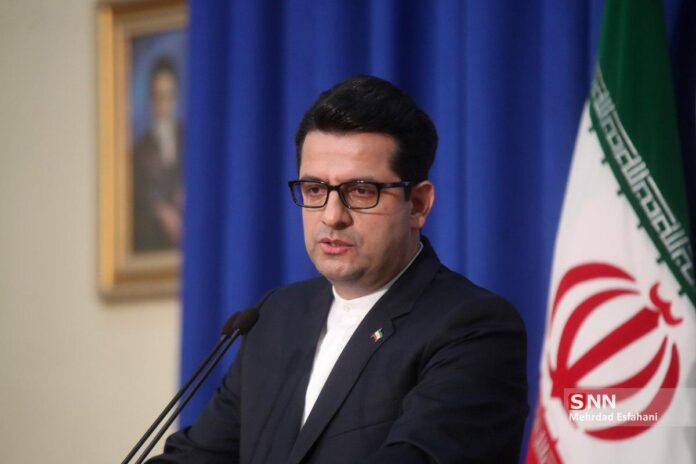
In a statement on Wednesday, Foreign Ministry Spokesman Seyyed Abbas Mousavi denounced a “defective” agreement that has been signed in Riyadh between a number of Yemen’s southern groups and Abd-Rabbu Mansour Hadi, the former president of Yemen who resigned and fled to Saudi Arabia in 2015.

“Signing such documents will by no means help settle the problems of Yemen, and it will contribute to stabilization of occupation of southern Yemen by Saudi Arabia and its allies, directly or through their proxy forces,” he noted.

Mousavi also highlighted the Islamic Republic of Iran’s stance on the formation of a united and inclusive Yemeni government on the basis of Yemeni-Yemeni talks, and emphasized the necessity of protecting Yemen’s unity and territorial integrity.

“The vigilant people of Yemen, who have always fought against the occupiers, will not allow their enemies and ill-wishers to bring south of that country under the control and occupation of the foreign forces,” the spokesman added. 

He further recommended that if Saudi Arabia is serious about its claims to be seeking to resolve the problem of Yemen, it should give a positive response to the initiative put forward by President of Yemen’s Supreme Political Council “Mahdi al-Mashat” for a cessation of attacks on the two countries instead of deciding for the groups that lack any authority.

“As emphasized several times, the Islamic Republic of Iran believes that the first step in resolving the Yemeni crisis would be a halt to the war and bloodshed and the lifting of the cruel blockade on Yemen and its people, and that the next step is holding Yemeni-Yemeni talks for reaching an agreement on that country’s political future,” Mousavi concluded.

His comments came after Yemen’s resigned government and the UAE-backed separatists signed a power-sharing deal in Riyadh.

Saudi Crown Prince Mohammed bin Salman has described the so-called “Riyadh Agreement” as a crucial step towards a political solution to end Yemen’s war, triggered by Saudi Arabia itself.

Turkey Walking on Tightrope Held by US and Russia

Seyyed Ali Qaem-Maqami says Russia and the US do not want to lose Turkey or move the country completely towards another trail.  

Qaem-Maqami has stated in an interview with Khabar Online that the clashes in northeast Syria have been decreased in recent days due to the fact that Syrian Kurdish forces have withdrawn from the region under the agreement between Russia and Turkey. 

“However, they are still looking for help from the Americans. They do not know what Washington agreed upon with Erdoğan behind closed doors. The US, as it seems, has preferred the Syrian oil to supporting the Kurds. Putin, meanwhile, has taken his share from Erdoğan. Meanwhile, the central government still is not allowed to enter these areas!”

Qaem-Maqami believes that in the current situation, Syria has actually disintegrated.

Q: Turkish officials have not announced whether they intend to strike again after the ceasefire. The latest news comes from the Turkish ambassador to Syria, who said that Ankara has no plans to launch a new offensive in northeast Syria. What does Erdoğan want in Syria in general, and what would be the result?

A: Turkish President Recep Tayyip Erdoğan has backed terrorist groups since the beginning of the terrorists’ war against the Ba’athist government in Syria. The Salafi Takfiri terrorist groups have now been renamed to “Syrian National Army” under the command of the Turkish army and intelligence. The Istanbul-based “National Coalition for Syrian Revolution and Opposition Forces” has announced Abdurrahman Mustafa as the Prime Minister of interim government of Syria. The Syrian National Army or Jaish al-Watani is also considered as the interim government’s army.

Erdoğan considers Syrian President Bashar al-Assad and the Syrian Armed Forces illegitimate. He is trying to occupy all the areas of northern Syria and leave their control to Jaish al-Watani to prevent the Syrian Armed Forces from entering these areas. He would then relocate about two million Syrian refugees residing in Turkey to the region. 

Erdoğan has even threatened to confront the Syrian Armed Forces if they enter northern Syria, including the east of Euphrates, especially Afrin, Idlib and Jarabulus. Erdoğan also said that Manbij and Ayn al-Arab should be under the control of the Turkish army and Jaish al-Watani.

Based on the 13-point agreement with the US, Turkey launched Operation Peace Spring and entered the area between Tal Abyad and Ras al-Ain at a depth of 32 kilometres and a length of 120 kilometres. Turkey fought with the Syrian Democratic Forces and the People’s Defense Units affiliated with the “Kurdistan Communities Union under Abdullah Ocalan” using US intelligence, military and weapons supports.

About 800 people from the Syrian Democratic Forces and the People’s Defense Units are said to be killed. According to Erdoğan, more than thirty civilians and Turkish nationals and 130 Syrian nationals of Jaish al-Watani were killed in Operation Peace Spring. According to the agreement between Turkey and the US, the Syrian Democratic Forces were supposed to withdraw from the M-4 highway near the Operation Springs area.

Meanwhile, the United States has announced that the forces have withdrawn from the M-4 highway. However, the Turkish Foreign and Defense Ministry insisted that the claim must be confirmed by the Turkish military and intelligence, and if the forces of the People’s Defense Units are seen beyond the highways, the Turkish army will destroy them. One of the sections of the US-Turkey agreement was that the US must not announce new sanctions against Turkey during the ceasefire in the area of Operation Peace Spring, and remove the previous sanctions after the withdrawal of Turkish forces and ending the operation. However, the US Congress approved two bills of recognising “Armenian genocide” and “new sanctions against Turkey.”

Q: What was the agreement between Erdoğan and Putin? Has the president of Turkey been able to keep Putin agreed with the continuation of the operation?

A: Turkish President Recep Tayyip Erdoğan and his Russian counterpart Vladimir Putin signed a 10-point agreement in Sochi. According to the agreement, the Syrian Democratic Forces and People’s Defense Units based in the areas between Tal Abyad and Jarabulus in the west of the Operational Area of Peace Spring must withdraw. They must also withdraw from Ras al-Ain to the Iraqi borders in the east of the Operational Area of Peace Spring in a depth of 32 kilometres. Russia also announced that 34,000 troops of the People’s Defense Units with three thousand heavy weapons had withdrawn below the safe zone line.

Erdoğan has said that Turkey should control 444 km of eastern Euphrates, but the United States and Russia are blocking the Turkish army and Jaish al-Watani militia from entering the area.

The withdrawal of the Syrian Democratic Forces and People’s Defense Units below the 32-km depth line has brought the eastern Syrian areas under the control of the Syrian Democratic Forces that are affiliated with the US army.

The areas of the eastern Euphrates have rich sources of mines, oil and gas, water and dams, agriculture and animal husbandry. The United States and Turkey are working together to deprive the Syrian government and army of these economic and energy resources.

Erdoğan claims he is not eyeing Syrian lands, but his practical policy proves the contrary. Erdoğan and Mevlüt Çavuşoğlu claim the Turkish military has the right to enter Syria on the basis of the Adana Agreement on Combating Terrorism, and is entitled to defend itself and preserve the survival of the Turkish government. However, he has also threatened to back Jaish al-Watani’s battle with the Syrian Armed Forces under Bashar al-Assad’s command.

However, we see that despite Erdoğan’s threats, a new Syrian constitution committee was formed. The committee brought together representatives of Syrian opposition groups under the protection of Turkey, representatives of Bashar al-Assad’s government under the auspices of the Islamic Republic of Iran and Russia, as well as representatives of the Syrian people groups sponsored by the United Nations.

Q: Considering the Putin-Erdoğan agreement, what is going on between the US and Russia? And what is the danger for Iran in particular?

A: The United States directly and Russia indirectly have protected Syrian Democratic Forces and People’s Defense Units. The 10-point agreement between Turkey and Russia has allowed part of the Syrian Arab Armed Forces under the command of Bashar al-Assad to enter the areas of Manbij, Ayn al-Arab, Hasakah, Qamishli, Cizre and Kamaliyah. As a result, Erdoğan’s plan to occupy northeast Euphrates has failed.

The US will remain in Syria to maintain the security and illegitimate aggressive interests of the racist Israeli regime. The US goal is to disrupt or threaten the process of establishing and expanding Iran-Iraq relations with Syria. The United States will occupy areas of western Iraq and eastern Syria. As Donald Trump, Centcom and the Pentagon claim, they will prevent the killing of Kurds and will not allow the security of Syria and Iraq’s oil and energy resources to be compromised. 

Recep Tayyip Erdoğan is pursuing a policy of balancing power between the United States and Russia in Syria and moving on a path that is controlled by Washington and Moscow. This political expert also believes that Russia and the US do not want to lose Turkey or move the country completely towards another path.  In the current situation, Syria has actually disintegrated.

Q: In your opinion, why does Erdoğan pursue this policy? Has he become politically motivated at home or has the coup time removals had a negative impact on his image?

A: Recep Tayyip Erdoğan has removed all the leadership and founders of the AKP. There is intense conflict within the party. A number of AKP leaders and MPs have been ousted or forced to resign at the behest of Erdoğan.

Dissatisfaction with the presidential system has increased. The AKP’s internal opposition insists that individual dominion has been created and that the AKP has distanced from its principles. The rent and nepotism is established in the Turkish parties and government. At least half of Turkey’s political and social community wants a return to a democratic parliamentary government. Erdogan’s presidency has packed down and disenfranchised parliament and the judiciary.

According to opposition parties, particularly the National Salvation Party run by the late Necmettin Erbakan, Erdogan’s policy towards Syria has resulted in the destruction and killing of the Syrian people and has served the interests of Zionist. Erdoğan sees his position is being weakened in domestic politics. Therefore, he is trying to silence and control all dissidents through outbound operations and incite a sense of nationalism and militarism. This as the opposition parties in Turkish parliament have been forced to extend Turkish military overseas operations license in Iraq and Syria for another year on October 31. Otherwise, Erdoğan would accuse them of being traitor and supporters of terrorism.

Recep Tayyip Erdoğan claims he is fighting infidels in Syria, but the US and NATO are Turkey’s strategic allies in this fight. 

Q: Given Erdoğan’s position inside Turkey, is it in his interest to continue this role? What role does Turkey exactly play in the Middle East?

A: Erdoğan considers Syrian President Bashar al-Assad and the Syrian Armed Forces under Assad illegitimate. Following the US occupation of Iraq in 2003, new political and strategic developments in the Middle East began, and the regional countries of the two blocs got involved in fierce confrontation and intense competition. On one hand, there was an anti-Zionist resistance front consisted of Iran, Syria, Lebanon’s Hezbollah, the Palestinian people, Hamas and the Palestinian Islamic Jihad movement. On the other hand, the Zionist anti-resistance front consisted of the United States, Britain, Israel and the reactionary regimes of the Persian Gulf was organised and got united.

Syria has signed a strategic partnership agreement with Iran and Russia to save itself from isolation. Iran turned into Syria’s biggest political and economic patron. That’s because Iran, Syria, Palestine and Hamas were and are still facing dangerous enemies and occupiers such as the US and Israel. The United States has tried to divide the Muslim and Arab world into two blocks, the “Shiite Crescent” and the “Sunni Axis”, and to portray the so-called Iranian-led Shiite Crescent as a threat to the Sunni and Arab world.

The United States and the Israeli regime mobilised the regimes of Al Saud, the United Arab Emirates, Qatar, Turkey and Egypt. One of the goals of the imperialist and Zionist axis was to occupy, destroy, and dismantle Syria as the link between the anti-Zionist resistance movements. This role was assigned to the AKP led by Recep Tayyip Erdoğan. 

Turkish government must cooperate sincerely with anti-Zionist resistance and assist the front to expel the US from Syria. It must cooperate with the government of Bashar al-Assad and the Syrian Armed Forces, and withdraw from Syria and hand over the entire Syrian state to the Syrian government and army. Otherwise, the claim to support the territorial integrity and political and national unity of Syria is meaningless.