Monday, December 22, 2025
Home Blog Page 3001

Qalamkari; Traditional Art of Making Hand-Painted Textile

Qalamkari; Traditional Art of Making Hand-Painted Textile (7)

People in small workshops, especially in Khorzuq city, weave the cotton textile of Qalamkari. The artists print patterns on the fabrics using stamps made of pear or hawthorn wood smeared with natural, herbal colours.

The Qalamkari textile is then washed and dried before being sent to the shops.

What follows are IRNA’s photos of Qalamkari works and the shops selling them:

Pastak & Shawl Weaving; Ancient Art of Iran’s Kurdistan

Pastak & Shawl Weaving; Ancient Art of Iran’s Kurdistan (2)

This old industry now exists only in the two villages of the city as a lasting and authentic art.

Pastak and shawls are among the very old men’s clothing that have been worn in the Kurdish regions in the past due to the climatic conditions and authentic culture. They were woven by the old and rural men and women. Because of the special beauty, this garment still has a lot of fans.

Amenah Salehi is one of the women who works in shawl and Pastak weaving industry. This art has provided direct employment for a number of men and women in the village. In addition, her daughters are also assisting her in her small workshop.

“I learned it from my mother when I was very young,” this entrepreneur told IRNA.

“Then, I learned how to weave Pastak, which was a tough job, but after a while I grew an interest in it. Pastak is woven in a number of steps and part of the job is carried out by men. I do the main knitting process with a special tool, and other women do the sewing. Each Pastak sells for about $30 to $35.”

Head of the Cultural Heritage, Tourism and Handicrafts Department of Baneh says Kani Guyz village near Baneh is the birthplace of this art. The people of this village have been involved in the handicraft industry for a long time.

Weaving Pastak has many steps and the artists weave it in several steps. Each person specialises in a different field.

Pastak is one of the most ancient clothing and symbols of Kurdish people that has been in demand very much for the last two years and is exported to some neighbouring countries.

No artifacts have been found to date, but evidence suggests that Pastak-weaving has a long historical background in terms of texture, old workshops, and geographical location.

Iran Ready for Cooperation with Uzbekistan on New Technologies: Official

Chairman of the International Interaction Centre of the Iranian Vice-Presidency for Science and Technology Mahdi Qalenoei addresses the Iran-Uzbekistan Business Forum in Tashkent, Uzbekistan, on December 12, 2019

In an address to a Thursday meeting of Uzbek and Iranian businesspeople and officials, held in Tashkent, Chairman of the International Interaction Centre of the Iranian Vice-Presidency for Science and Technology Mahdi Qalenoei hailed Uzbekistan as a friendly country and a major economic center near Iran.

Highlighting Iran’s efforts to boost trade ties with Uzbekistan in recent years, Qalenoei said Tehran and Tashkent can promote cooperation in the sphere of new technologies, considering the global technological advances, the regional and international environmental problems, the need for innovation in science, the necessity of optimizing energy use, the need for application of cognitive sciences, and the importance of increasing productivity and economic competitiveness.

He also expressed hope that academic cooperation between the two nations would accelerate the progress in new technologies such as nanotechnology, biotechnology, aerospace science, cognitive sciences, and new energies.

“Today, more than 4,400 Iranian knowledge-based companies are offering technologies that sell in the domestic market and could also enter the international markets in case of joint investment in mass-production,” he added.

Iran Ready for Cooperation with Uzbekistan on New Technologies: Official
The Iran-Uzbekistan Business Forum held in Tashkent on December 12, 2019

According to the presidential official, the Iranian biopharmaceuticals are being exported to Russia, Turkey and other regional countries for the treatment of cancer and inflammatory diseases.

Qalenoei said Iranian pharmaceutical company “CinnaGen” has fulfilled the domestic need for biotech medicines, and is also capable of designing, constructing, equipping and launching pharmaceutical factories in the other countries.

The technologies developed by CinnaGen have been exported to Turkey, Syria, Southeast Asia, and Latin America, he added, unveiling plans for cooperation with the European countries.

The official then highlighted the advances made by “Cell Tech Pharmed”, saying the Iranian company has succeeded in curing four terminal illnesses with the use of stem cells and regenerative medicine.

The Iranian knowledge-based companies have also the technical know-how to manufacture advanced equipment such as surgical robots, linear particle accelerators, dosimetry apparatus, radio frequency systems, and cyclotrons used for medical diagnosis, he added.

Qalenoei also highlighted the Iranian knowledge-based companies’ progress in the production of livestock and poultry vaccines, antibiotics, hormones, and supplementary medicines.
Iran Ready for Cooperation with Uzbekistan on New Technologies: Official
Iranian and Uzbek businesspeople attending the Iran-Uzbekistan Business Forum in Tashkent on December 12, 2019

Moreover, he added, the Iranian knowledge-based enterprises working on herbal medicine have developed a cure for chronic migraines, and have also invented herbal ointments for the treatment of bedsore, burns and diabetic ulcers.

There are more than 260 knowledge-based companies in Iran in the field of medical research and production of new pharmaceuticals, while around 200 other firms are engaged in innovative and research activities to develop medical equipment, said chairman of the International Interaction Centre of the Iranian Vice Presidency for Science and Technology.

10 Reasons Why You Need to Get a British Business Degree in 2020

Source: Unsplash.com

Its universities are regularly ranked high on the global lists of best educational institutions and their graduates frequently occupy top governmental posts or make successful careers in many developed and developing countries. Below you will find the 10 reasons why you may choose this country for getting a business degree in 2020.

  1. Global Recognition

According to world university rankings, UK universities occupy 4 positions on the top 10 list for 2020. They also hold the highest scores in terms of employer reputation and academic reputation. This means that an investment in your UK degree can give you global recognition in both practitioner and academic circles improving your career perspectives. A small step in this sphere can go a long way in securing your future professional success.

  1. Education Quality

UK educational institutions are closely monitored by the country government within the scope of multiple regulated qualifications. This ensures the highest teaching standards as well as good accessibility of the most advanced learning instruments for your progress. The country is highly interested in foreign students and makes all necessary provisions to provide the ultimate educational experience for your money.

  1. Professional Practice Opportunities

Best global entrepreneurs including Elon Musk started their first business projects or got practical industry experience while studying at the university. With the UK being one of the global business centres, you get outstanding internship opportunities that will assist you in your future endeavours. There is nothing more effective than instantly applying your academic knowledge to practical tasks while also being able to ask your university for help with remedying your skill deficiencies.

  1. Extensive Student Support

As opposed to the US and other countries offering maximal academic freedom, the UK system involves close cooperation with university advisors, counsellors, and tutors. While this may not be suitable for all students, this strategy ensures that you will always get help with any problem ranging from essay writing to finding optimal student accommodation.

  1. Scholarship and Governmental Support

In many situations, you may be eligible for various scholarship programmes offered by the UK government or various local organisations. Additionally, international students receive free medical services from the NHS. These provisions may also be extended to your dependable family members in some cases.

  1. Unique Internship Opportunities

Most major financial institutions offer finance graduate schemes as an internship option. This way, you can get 1-2 years of experience at such companies as HSBC, Barclays or the Lloyds Banking Group, which will be a valuable addition to your CV. Moreover, many graduates also get job offers if the managers of these organisations recognise their potential value for the employer.

  1. Work Permit Options

The UK authorities may grant you a post-study work permit if you find a job with an annual salary exceeding 20,800 pounds. Many students with a business degree who underwent internship and were offered a position by their employers find this goal realistic. This may be the best way to succeed as a business professional in one of the key global financial centres if you consider the UK as the optimal country for your future career.

  1. Shorter Educational Courses

On average, undergraduate and postgraduate PhD courses take a shorter time to complete in the UK as compared to the US and other countries. This may be highly beneficial for practice-oriented students seeking to apply their newly attained business degree to practical tasks as soon as possible. You can also combine your internship or part-time work with study activities more effectively due to these provisions.

  1. Cultural Diversity

The UK is a unique mix of different cultures and its institutions have been accepting international students for many years. Whatever your background is, you will instantly feel yourself at home and will be able to fully concentrate on your business studies without having to accommodate to the local environment.

  1. Online Application Systems

The Universities and Colleges Admissions Service (UCAS) allows foreign students to easily apply to multiple universities, establish contact with their staff members, learn admission essay topics,and resolve any other admission-related problems. This system is highly convenient for maximising your chances of entering a respectable UK institution and minimising the amount of administrative or regulatory complexity in the process.

A British business degree is more than a mere academic qualification. It is a unique chance of immersing in a culture focused on educational achievements and the opportunity to engage in state-of-the-art research projects. It also opens many doors for your future professional career in any country you choose for continuing your development as a specialist. With the next application phase starting in spring 2020, you still have plenty of time to prepare. If you feel that your admission essay can be improved, you can also look for a quality essay writing service and ask professional essay editors for constructive criticisms.

Iran Condemns German FM’s Meddlesome Comments

Iran Vows to Take Action If UN Arms Embargo Not Lifted

In a statement on Thursday, Mousavi said such irresponsible and meddlesome remarks cannot remedy the negligence of certain European countries in fulfilling their commitments under the JCPOA and their passive stance towards the US economic terrorism against Iran.

“The world public opinion has not yet forgotten the country that armed former Iraqi dictator Saddam Hussein with chemical warfare, which was used against Iranians and their Iraqi neighbours during the war imposed (1980–88) on Iran,” he added.

Mousavi said the world still remembers how German riot police suppressed protesters on the eve of the two-day G20 summit in Hamburg back in July 2017, and how weapons are being funneled by some European states to the Middle East, where they have brought about nothing other than war crimes, destruction and massacre of women and innocent children as seen in Yemen.

“Berlin is expected to put honouring the fundamental principles of human rights on its agenda discreetly, comprehensively and neutrally, instead of taking unprofessional and biased positions,” he added.

Mousavi further underlined the Iranian government’s resolve to hear the different views and opinions of its people, and said, “The Islamic Republic of Iran sharply distinguishes enemies, those behind the murder of innocent people and their foreign sponsors from protesters during the recent unrest and riots in the country.”

“Based on the results of its probes and investigations, the country will make the necessary decisions in a bid to respect the Iranian people’s rights and ensure sustainable security,” he added.

Earlier in the day, Maas claimed that hundreds of people had been killed during the recent riots in Iran, and condemned security forces over use of force against rioters and anarchists.

The German foreign minister made the remarks in reaction to a question asked by a parliamentarian.

In mid-November, the Iranian government raised gasoline prices in order to moderate the national consumption rate, which stands at 110 million liters per day, 40 million liters above the maximum daily domestic requirement.

The move prompted protests in a number of cities that went largely peaceful but turned violent when armed riotous individuals took advantage of the situation to vandalize public and state property, and attack civilians and security forces alike.

No official death toll has so far been released, but the victims reportedly include both security forces and civilians.

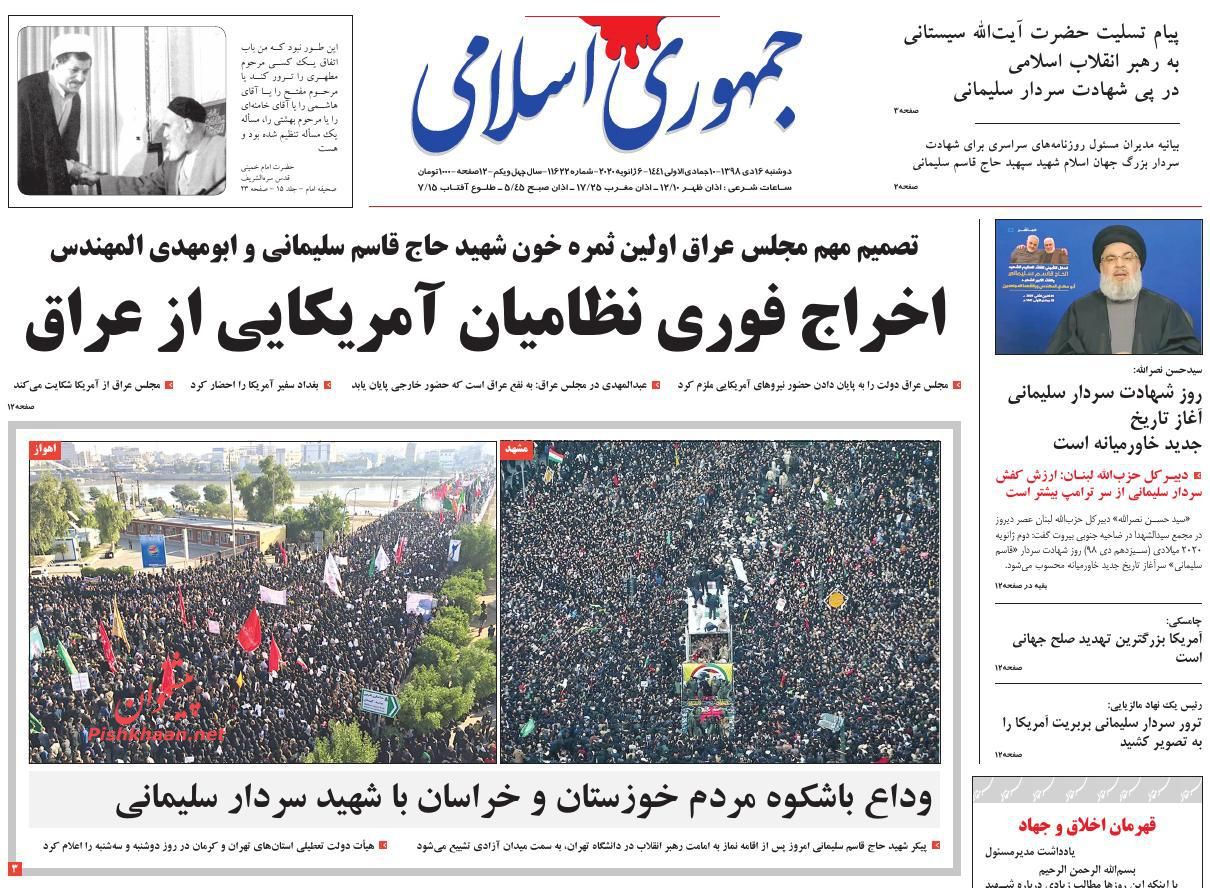
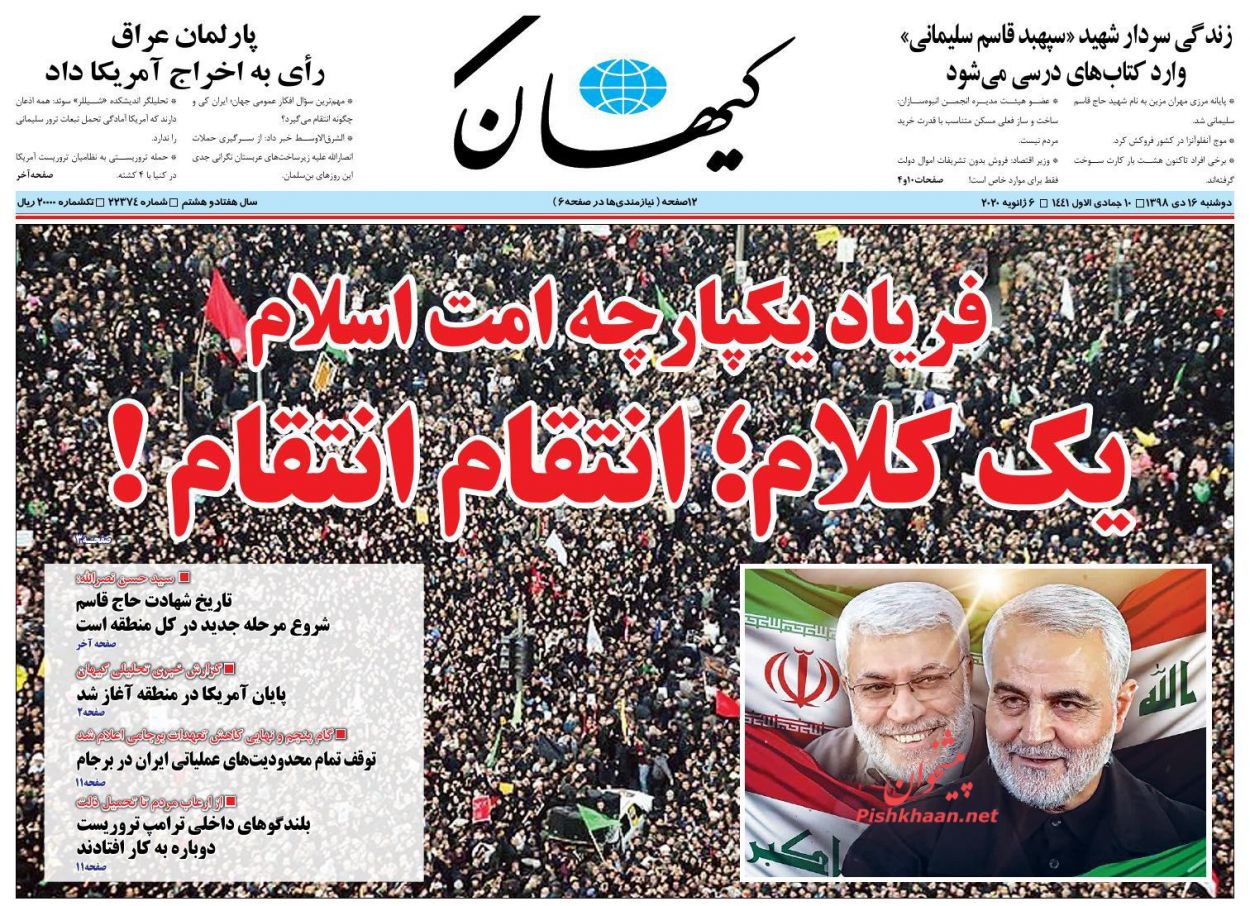
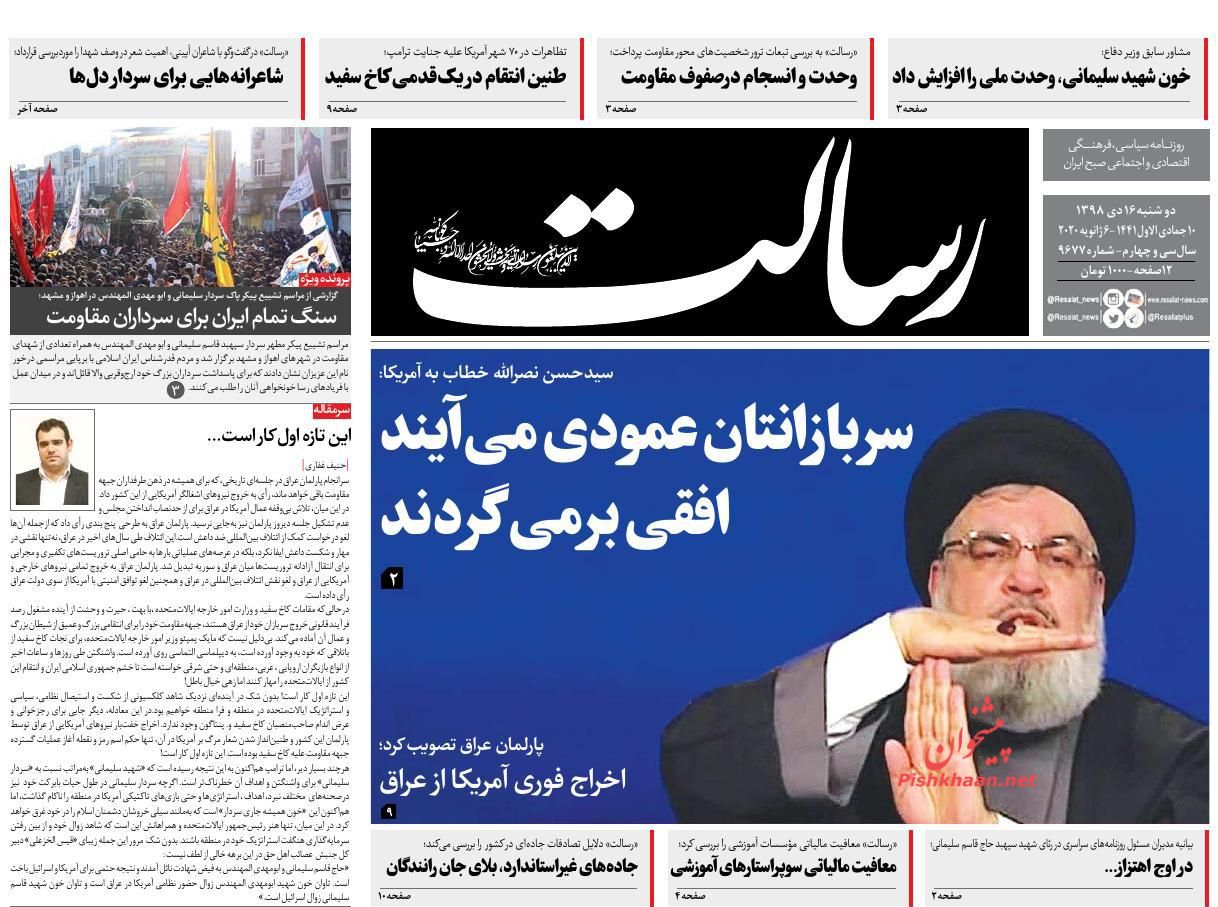
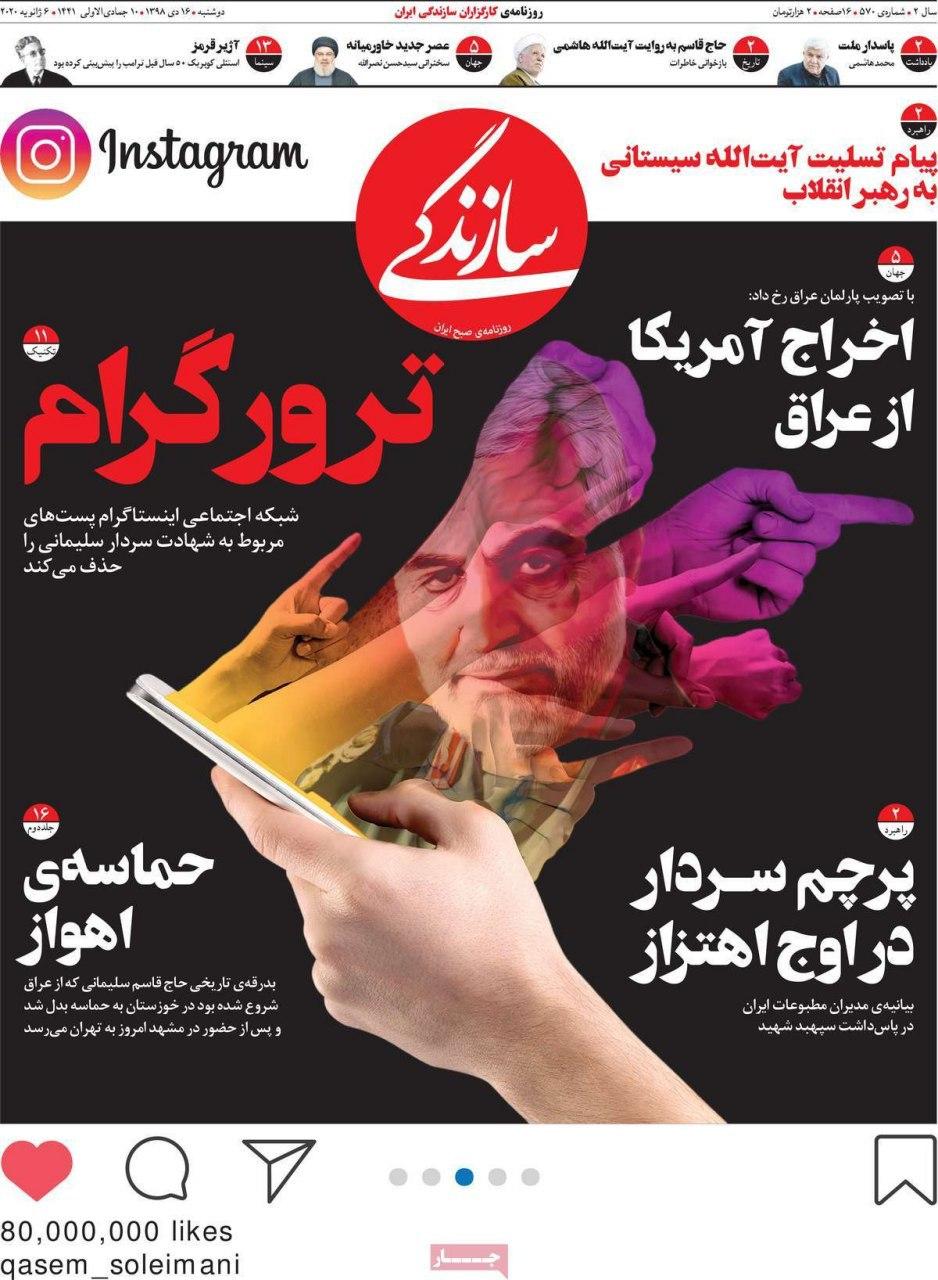
A Look at Iranian Newspaper Front Pages on December 12

Newspaper Headlines

Abrar:

1- Tens of Thousands of Iraqis Hold Rally in Baghdad

2- Saudi FM: Iran Must Change Its Behaviour Before Offering Peace

3- IRGC Says General’s Comments about Targeting Tel Aviv from Lebanon Were Distorted

4- Trump Calls for Moscow’s Support for His Policies against Iran

5- Rouhani: Reinforcing National Information Network Doesn’t Mean Cutting Off Access to Global Internet

A Look at Iranian Newspaper Front Pages on December 12


Aftab-e Yazd:

1- Rouhani: People Must Be Made Aware of Severity of Sanctions

2- Hook Calls for Consular Dialogue with Iran

A Look at Iranian Newspaper Front Pages on December 12


Afkar:

1- Nothing Should Be Kept Secret from People: Rouhani

2- IRGC Chief: We’ve Blocked Many Elements of Enemy’s Infiltration, Interference

A Look at Iranian Newspaper Front Pages on December 12


Ebtekar:

1- Anti-Cooperation Council: A Review of 40th GCC Summit

2- Rouhani: People Must Be Made Aware of Everything

A Look at Iranian Newspaper Front Pages on December 12


Etemad:

1- End of 3 Months of Lies: UN Finds No Evidence to Show Iran Behind Aramco Attacks

A Look at Iranian Newspaper Front Pages on December 12


Jomhouri Eslami:

1- Stability to Return to Forex Market Soon: Chief Banker

2- UN: There’s No Evidence to Show Iran’s Role in Aramco Attacks

3- Europe Has Not Considered Any Offer to Sanction Iran: Borrell

4- Supporting US Economic Terrorism in Contradiction to Good Neighbourliness: Iran

A Look at Iranian Newspaper Front Pages on December 12


Kayhan:

1- 880,000 Angry Labourers in France Pour into Streets against Macron

2- Chain Attacks on US Bases in Iraq, Syria, Afghanistan

3- We Should Convince Iran to Stop Decreasing JCPOA Commitments: Borrell

4- US Treasury Imposes Fresh Sanctions against Iran

A Look at Iranian Newspaper Front Pages on December 12


Mardom Salari:

1- Trump’s Anti-Iran Bargaining with Lavrov; Russian FM in Washington

2- Iran’s Harsh Reaction to GCC’s Hostile Statement

A Look at Iranian Newspaper Front Pages on December 12


Setareh Sobh:

1- We’ll Negotiate but Observe Islamic Establishment’s Red Lines: Rouhani

2- Positive Signals for Talks Ahead of Rouhani’s Trip to Japan [Editorial]

A Look at Iranian Newspaper Front Pages on December 12

Iran Rejects Macron’s Call for Release of French Inmates

Iran Rejects Macron’s Call for Release of French Inmates

“The French should not forget that Iran is a sovereign state. Neither our government nor the judiciary will take any advice from anyone,” Mousavi said on Wednesday in a tweet posted both in Persian and French.

“Any interference in Iran’s domestic matters is unacceptable to us,” he added.

On Tuesday, Macron said the imprisonment of two French nationals in Iran was unbearable and demanded their immediate release.

“On Human Rights Day, my thoughts go to Fariba Adelkhah and Roland Marchal, our compatriots held in Iran, and their families,” Macron said on Twitter.

“Their imprisonment is intolerable. They must be freed without delay. I told President Rouhani, I repeat it here,” he wrote.

Adelkhah, a 60-year-old anthropologist and researcher at Sciences Po’s Center for International Studies (CERI) in Paris, and her colleague Marchal were arrested in Iran in June on espionage charge.

In October, Mousavi said that Iran’s national law does not recognize the dual citizenship of Iranian citizens, and thus Adelkhah is regarded as an Iranian national.

Macron’s appeal followed a prisoner swap at the weekend between Iran and the United States.

Iranian-Made Flu Medicine Now Available in Market

Iranian-Made Flu Medicine Now Available in Market

Kianoush Jahanpour said that thousands of homegrown Oseltamivir capsules have been introduced into the country’s drug distribution chain.

In an interview with ISNA, he said more than 1,300,000 foreign Oseltamivir capsules had earlier been imported urgently, and distributed over the past few weeks to the nation’s health network and selected pharmacies.

“However, with the introduction of the Iranian-made product, this strategic drug has been stored sufficiently until early May,” he underlined.

The spokesman said the priority of the Ministry of Health as well as Food and Drug Administration is the well-being of the citizens and the provision of the supplies.

“As long as adequate domestic production is available in a timely and efficient manner, imports will not be allowed, and there will be good coordination between the health system, executive agencies and regulatory bodies,” concluded Jahanpour.

Tapestries of Iranian Artist on Show in Tehran

The gallery has put on show multiple texture patterns with different materials and fibres and a range of conceptual ideas that encompass geometric and abstract works.

Shahrzad Gharavi is a modern Iranian artist who has been able to combine the native experiences of the country with modern knowledge in her professional work in a bid to show a combination of local ideas with an international approach.

Born in Abadan in 1952, she studied graphic design at the Faculty of Decorative Arts at Tehran University of Art, but then moved to Belgium and spent two years freelancing at St Lucas University in Brussels in the field of tapestry and silk printing.

In the years later, Gharavi’s professional activity continued by holding numerous individual and group exhibitions in domestic and international galleries.

The artist, who is active in a variety of artistic fields, has just put on show a collection of her tapestries that she has created since 1976.

Tapestry may be the simplest definition of textile and fibre art in which the artist uses a variety of tools and materials to express her ideas.

Tapestry might be limited to stereotypical materials at first glance, but Gharavi has added new textures to this art by adding unusual materials such as metal filaments.

Following you can find photos of the exhibition of her tapestry works retrieved from Honar Online:

Iranian Couple Hold Exhibition to Show Women Woes, Achievements

An Iranian artist couple have run an exhibition called "Leili and Shirin" to put on show in two different ways some works about the society’s view of the women

The paintings by Mahsa Najafi and Sadeq Farhadian are displayed at this event but with two different styles. The exhibition features 20 works by Najafi and 30 works by Farhadian.

“My wife and I each worked on our own collections, and planned to hold two different solo exhibitions,” Farhadian told Honar Online.

We didn’t think of a joint exhibit during the work, but when we got closer to the final stage, we decided to hold one joint exhibition as there were many similarities and commonalities, he said.

“The subject matter of both portraitures are women, but there are two completely opposite views. Each of us had in mind a community of women whose lives and positions were quite different. My works have a sadness that engages the audience, but Mahsa’s works are like a glimpse of hope in this atmosphere.”

Farhadian added that in his work, he dealt with one of the lower classes of society, and the dark atmosphere reflects their pain and sorrow. Whereas Mahsa’s collection of works is elitist and deals with a group of women who, despite all the hardships they endured, they have finally gained a certain status and credibility.

“In my view, what matters is the issue of choice and the social impact that separates the two. I worked on Plexiglas and fielded them with sand,” he said about his technique.

“My hometown is located in desert, and I use desert materials in my works. My work is layered and can finally be recognised as painting.”

However, Mahsa Najafi first draws the subjects she chooses on cardboard with pencil or charcoal and then modifies and prints the portraits of the people she wishes to use with Photoshop filters.

Then, according to the scheme originally drawn, the portraits will be cropped to make the final image look like a lace fabric. This lace paper rests on the scheme so that the design be completely in line with the photo cuts.

What follows are Honar Online’s photos of the exhibition: