Friday, January 2, 2026
Home Blog Page 2911

Iran Can Rein in COVID-19 If People Cooperate: Expert

“Given that the virus is a newly-emerged one, we do not know the treatment, the symptoms, and the behaviour of the virus in different climates,” said Ali Akbar Haqdoust, the head of the Epidemiology Committee of the National Coronavirus Headquarters.

He added such diseases as COVID-19 are highly dependent on individual behaviour, and if individual behaviour is not corrected, it is not possible to predict when the outbreak’s peak will be.

Based on the calculations and behaviour of the virus in other countries and some of our cities, it seems with the help of the people and the efforts of the authorities, we can cross the peak of the disease in the near future, he noted.

The most important treatment for patients is rest, calm and adequate sleep, he reiterated.

Haqdoust said the ways in which people deal with corona disease differ from one country to another in terms of economic, demographic, climatic and lifestyle issues.

“Each country should deal with the disease based on its culture and position, but the principles of combating the disease are the same.”

He pointed out the risk is real and serious, adding “It does not know age and gender. Anyone who is concerned about his/her health and respects others should follow health guidelines.”

“Amid sanctions and heavy economic pressure, we were able to resist well and we owe it to the people. However, decisions were made regarding commuting to the provinces that were considered red zone, and hotels and resorts do not check in travellers.”

He underscored that “according to our calculations, the risk of death from the disease is not higher than other parts of the world, and the World Health Organisation has confirmed this.”

Tips for People with Obsession amid Coronavirus Pandemic

Tips for People with Obsession amid Coronavirus Pandemic

The fast outbreak of the coronavirus is changing people’s work and daily lives. For those who own businesses, the stress and financial uncertainty is even greater. When we don’t know what the future will hold, or are working in isolation, what can we do?

With the spread of the new coronavirus, most people experience anxiety, and this is not just for those with obsessive-compulsive disorder. However, these people may experience a more severe reaction or anxiety.

Here are how we can cope with uncertainty by taking on a new mindset.

If you are also in the same situation, know that you are not alone. It is natural for all to have anxiety. Tell yourself, “I may have a lot of anxiety, but it’s normal in this situation,” or you can tell yourself “it’s really tough for all of us.”

Notice what’s forcing you to start cleaning and washing? Do you do a wash to follow preventive advice? Or to get rid of annoying thoughts and anxiety?

Do the recommended things, no more! Try not to pay attention to obsessive thoughts. When you follow the recommendations, say “that’s enough”.

If you have ideas like, “Did I do it right?”, “Was my handwash enough?” try to put them aside.

Keep track of news from a reliable source only once a day. Avoid checking the news frequently and reading about the virus repeatedly.

Don’t overestimate the risk. It is true that Covid-19 is worrying, but many people just show mild to moderate symptoms.

Try to focus less on the Corona and its worries. Instead, try to entertain yourself with other things.

Focus on the “now” and “here”. Say everything is right for me now and here. Do not always think what will happen in the future.

Try to accept the uncertainty. Anxiety is rooted in ambiguity. You don’t see the virus and you can’t be 100% sure everything is safe. However, we cannot control everything.

If symptoms persist and if you cannot live your normal daily life despite self-care techniques, consult a physician, psychologist, or psychiatrist.

Kuwait Donates $10 Million to Coronavirus Relief in Iran

Minister of Foreign Affairs of the State of Kuwait Sheikh Ahmad Nasser Al-Mohammad Al-Sabah held a telephone conversation with Minister of Foreign Affairs of the Islamic Republic of Iran Mohammad Javad Zarif on Tuesday morning.

In the conversation, the Kuwaiti minister expressed solidarity with the Iranian government and nation in the battle with the coronavirus epidemic, and unveiled plans for a donation of $10 million from Kuwait to Iran for the fight against COVID-19.

For his part, Foreign Minister Zarif expressed gratitude to the Kuwaiti government and nation, and described the war on coronavirus as a global issue that requires regional and international cooperation.

Foreign Minister Zarif also denounced the unilateral and illegal sanctions the US has imposed on the Iranian nation, and called on Kuwait to participate actively in the global campaign for ending and defying those inhumane sanctions.

US Lies that Iran’s Medical Sector Not Sanctioned: Expert

US Lies that Iran’s Medical Sector Not Sanctioned: Expert

Foreign policy and international law expert Reza Nasri says in line with the anti-Iran boycott, the US government has also set up a public relations apparatus and – with the help of some “Persian-speaking” people- has organised a system to justify its actions.

In an interview with Khabar Online, Nasri said “United Against Nuclear Iran” is one of the most influential pressure groups in the United States which is close to the Trump administration’s hardliners. The group has been providing and defaming lists of foreign companies working with Iran for many years to discourage them in various ways to work with Iran.

The group is made up of former US, European military, and security officials, who often intimidate and threaten the company’s executives and decision-makers in order to avoid working with Iran by sending delegates and representatives to these companies.

“Naturally, when the director of a European company sees a delegation consisting of several former CIA chiefs, a former chief of German intelligence (BND), several US national security advisers, a former British military / security official, a Canadian attorney general with several lawyers has come to threaten him, he never takes risks and probably prefers to reconsider cooperation with Iran!”

Now, the group, which has always worked as the “unofficial” arm of the US government against Iran, is targeting licensed pharmaceutical companies to make Iran vulnerable in these difficult times.

That is to say, on the one hand, the US government is publicly announcing the elimination of barriers to the supply of medicine and medical equipment to Iran, and on the other hand, it is blocking Iran’s access without accepting responsibility.

In fact, the US government and the boycott propagandists have a “well-prepared” package of justifications. When they are publicly criticised, they publish these justifications widely on social media.

“For example, if you show in numbers that sanctions are harming the health of ordinary people, they will immediately launch a campaign to satisfy public opinion by displaying several State Department documents claiming that medicines are not sanctioned. They try to say that it is because of the Iranian government’s mismanagement. If you prove that the financial pressure and freezing Iran’s assets has caused put the government in trouble in controlling coronavirus, they immediately run a campaign to induce that Iran’s money is spend for missiles, Syria and Iraq.”

But the interesting thing is that when boycotters and propagandists face the hardliner English-speaking media or their lobbyists and sponsors their rhetoric is completely different!

At these times, they suddenly say they have decreased Iran’s economic growth from positive to negative. They even report that several factories and industries have gone bankrupt. They also recklessly refer to the sanctions as “crippling!”

Brian Hook – who tries to show himself a supporter of the Iranian people- is proud to report that the US has inflicted some $50 billion worth of financial damages to the Iranian government in one year. On the other hand, US Secretary of State Mike Pompeo – who tries to pretend a supporter of Iranian people on Twitter – says “If Iran wants its people to eat, it must fulfil our conditions”!

UNICEF, UAE, Uzbekistan Send Aid to Iran amid Coronavirus Outbreak

UNICEF, UAE, Uzbekistan Send Aid to Iran amid Coronavirus Outbreak

Iran’s foreign ministry said it has received Uzbekistan’s humanitarian aid on Monday morning which included medical supplies.

An Uzbek plane brought the batch to Iran on March 16.

The United Arab Emirates also sent two aid planes carrying critical medical supplies to Iran to support Tehran’s efforts to combat the COVID-19 disease.

Abu Dhabi says the two aid aircraft contained over 32 metric tonnes of supplies, including boxes filled with thousands of pairs of gloves, surgical masks, and protective equipment.

On March 3, the UAE had contributed to a coronavirus aid mission to the Islamic Republic in collaboration with the World Health Organisation, WHO, by dispatching a UAE aircraft carrying 7.5 tonnes of medical supplies and five WHO experts.

Meanwhile, UNICEF’s third batch of supplies to fight COVID-19 outbreak arrived in Iran, on March 16, to protect the country’s healthcare providers.

According to Iran’s foreign ministry, in addition to medical supplies, UNICEF’s assistance includes Persian guidelines for protecting children against corona and creating a safe environment for children at home amid the outbreak in the society.

The second batch of UNICEF which arrived in Iran on March 3 weighed more than 3 metric tonnes. It contained two types of high-filtered respiratory surgical masks, surgical gowns as well as surgical goggles.

UNICEF shipped the first batch of Personal Protective Equipment (PPE) for health personnel, weighing more than 1 metric tonne late February.

Iran’s Leader Urges People to Follow Corona Instructions

Iran’s Leader Urges People to Follow Corona Instructions

In a letter on Monday, the Leader once again praised the efforts made by the country’s health minister and his colleagues to contain the new coronavirus pandemic in the country.

He emphasised that National Mobilization Plan has scientific backing, along with religious, humanitarian motives.

“It is a useful plan that will turn disaster into a blessing and a threat into an opportunity, God willing,” reads the letter.

Iran has been trying to contain the rapid spread of coronavirus which so far has infected some 14,000 people and killed 853 until Monday.

14 Million Iranians Screened for Coronavirus: Minister

Iran Starts Phase Two of National Campaign against COVID-19

Out of 14 million people screened for COVID-19, some 73,434 people have been diagnosed with the COVID-19 symptoms, Namaki said.

The minister said those who may carry and spread the virus will be strongly isolated and put under treatment.

Earlier, Deputy Health Minister Alireza Raisi had noted that the National Plan to Fight against Coronavirus been officially launched nationwide since Saturday. He said 6.5 million people have been screened through health centres and the rest have been screened through the salamat.gov.ir self-reporting portal.

He went on to say that 70,000 workers in health centres across the country have contacted people and followed up their health condition.

“Healthcare workers are contacting people with symptoms to make them feel comfortable,” he said.

Iran has been trying to contain the rapid spread of coronavirus which so far has infected some 14,000 people and killed 853 until Monday.

For most people, the virus causes only mild or moderate symptoms, such as fever and cough. For some, especially older adults and people with existing health problems, it can cause more severe illness, including pneumonia. Most people recover in a matter of weeks.

The virus has infected more than 150,000 people worldwide and killed more than 5,800. More than 70,000 people worldwide have recovered after being infected.

Iranian, Croatian FMs Discuss Corona Crisis

Iranian, Croatian FMs Discuss Corona Crisis

In a telephone conversation on Monday, the two top diplomats discussed the latest developments related to the outbreak of coronavirus in Iran and the world.

The Croatian foreign minister expressed solidarity with the Iranian government and nation in their fight against the epidemic, and offered his condolences to the families of the victims.

In turn, Zarif appreciated the support, but emphasised that the EU must not abide by the US unilateral and unlawful sanctions.

He said the EU should do this not only as a JCPOA obligation, but also to prevent the deaths of innocent Iranians due to the cruel US sanctions.

Croatia is the rotatory President of the EU at present.

Iran Asks UK to Defy US Sanctions

US Claim That Iran Sanctions Reinstated 'Baseless': FM Zarif

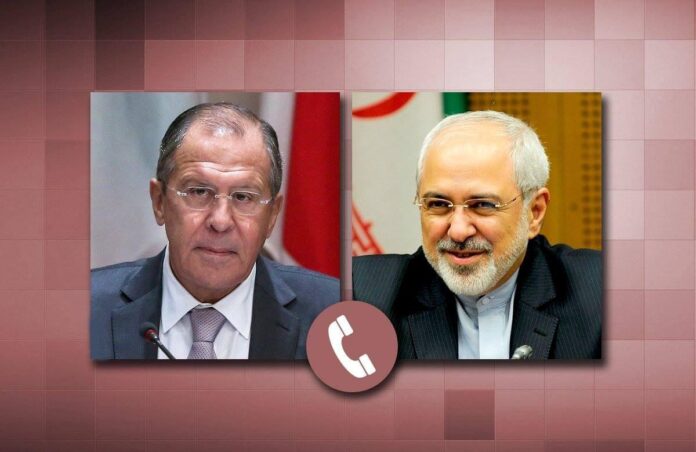
Iranian Foreign Minister Zarif and Secretary of State for Foreign and Commonwealth Affairs of the UK Dominic Raab held a telephone conversation on Monday evening.

In their talks, the two top diplomats discussed a range of issues, including the latest developments surrounding the outbreak of coronavirus in Iran and the world, the unilateral sanctions imposed by the US, the JCPOA, the consular affairs between Tehran and London, and the regional developments.

In the telephone conversation, Foreign Minister Zarif commended the European Union and the three EU members of the JCPOA –the UK, France and Germany- for sending aid to Iran for the fight against coronavirus, slammed the US’ illegal and unilateral sanctions as an obstacle to the battle with the global pandemic, and called on the UK to defy the US’ cruel sanctions against the Iranian nation under such circumstance, both on the basis of its (Britain’s) JCPOA commitments and the human considerations.

Two Quakes Hit Iran as Fight against COVID-19 Goes On

Two Quakes Hit Iran as Fight against COVID-19 Goes On

On Monday at 01: 34 a.m. an earthquake measuring 5.4 on the Richter scale hit Roydar, Hormozgan Province in southern Iran at a depth of 16 km, says Iranian Seismological Centre.

According to the latest reports, although ensued by a landslide, the quake has only brought on minor financial damages. The quake was felt in Bandar Abbas, Minab and Qeshm Island.

Earlier on Sunday at 00:11:20 local time, an earthquake of magnitude 4 at a depth of 10 km struck the city of Qom which ISNA says in some areas was felt with “a horrendous noise.”

The quake caused public hesitation whether to stay at home for fear of coronavirus, or to camp outside in case the tremor is followed by a major quake, the report adds.