Sunday, December 21, 2025
Home Blog Page 2408

North Korea calls US war in Afghanistan ‘human rights crime’

In a statement posted on its website on Sunday, North Korea’s Foreign Ministry called for US forces to be brought to justice for the mass atrocities in Afghanistan.

“At this moment in time, the world is raising the voices demanding that the US troops be brought to justice at all costs for US atrocities of mass destruction committed against innocent people in this country and that a stern judgment be made on the criminals,” it said.

The ministry cited reports by international bodies and countries showing the severity and magnitude of the atrocities and destruction caused by the soldiers fighting the US-led war.

“The above facts corroborate that all the places trampled upon by the US troops were reduced to the barren land of human rights,” the North Korean ministry stated, adding that the United States has engaged in such crimes in different parts of the world behind the veil of being the “judge of human rights”.

The United States and a number of its allies invaded Afghanistan and toppled a Taliban regime there in late 2001 under the pretext of the so-called “war on terror”. The invasion and the ensuing war gravely worsened the security situation in the country.

The militant group has come to power again following an ill-planned and hasty withdrawal of US-led forces from the war-torn country.

Source: Yonhap news agency

Iranian president to visit Tajikistan for SCO summit

The trip will mark Raisi’s first foreign visit since he took office in early August.

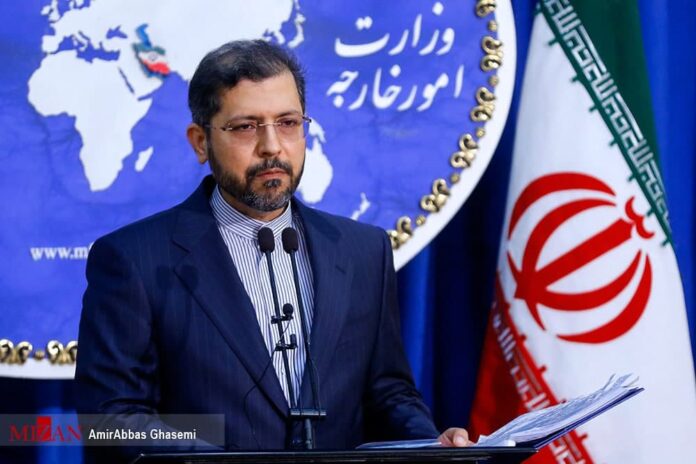
Khatibzadeh said Iran’s request for full SCO membership will be considered during the upcoming summit and expressed hope for a desirable outcome.

Tajikistan’s capital Dushanbe will be hosting the Shanghai Cooperation Organization summit on September 16-17.

The SCO is a Eurasian political, economic and security alliance founded by China, Kazakhstan, Kyrgyzstan, Russia, Tajikistan, and Uzbekistan.

The Islamic Republic has had an observer status at the SCO since 2005.

Western countries drop plans for anti-Iran resolution at IAEA meeting

Western countries on Monday scrapped plans for a resolution criticising Iran at the UN atomic watchdog after Tehran agreed to prolong monitoring of some nuclear activities.

The decision by the United States, France, Britain and Germany not to push for a resolution at this week’s meeting of the IAEA’s 35-nation Board of Governors avoids an escalation with Iran that could have killed hopes of resuming wider talks on reviving the Iran nuclear deal.

During a last-minute visit to Tehran this weekend by IAEA chief Rafael Grossi, Tehran agreed to grant his agency overdue access to its equipment in Iran that monitors some sensitive areas of its nuclear programme. Inspectors will swap out memory cards more than two weeks after they were due to be replaced.

Grossi said on Sunday that the agreement solved “the most urgent issue” between the IAEA and Iran. He made clear on Monday, however, that on another source of concern – Iran’s failure to explain uranium traces found at several old but undeclared sites – he had obtained no firm commitments.

“I did not receive any promise,” Grossi told a news conference when asked about the uranium traces, the first of which were found more than two years ago at a site in Tehran that Iran has described as a carpet-cleaning facility.

“What I said there … is that I need to have a clear conversation with the new government about this,” he added.

A joint statement by the IAEA and Iran on Sunday said Grossi would meet Iran’s nuclear chief Mohammad Eslami in Vienna next week and then Grossi would “visit Tehran in the near future to hold high level consultations with the (Iranian) government”.

Grossi declined to say more specifically whom he would meet in Tehran or when.

The aim of the weekend agreement was to buy time for wider diplomatic efforts aimed at bringing the United States and Iran fully back into the 2015 nuclear deal, which imposed restrictions on Iran’s nuclear activities in return for the lifting of international sanctions against Tehran.

Then-President Donald Trump pulled the United States out of the nuclear deal in 2018, re-imposing punishing economic sanctions on Iran. Tehran responded as of a year later by breaching many of the deal’s restrictions and later enriching uranium to purity levels much closer to weapons-grade.

Indirect talks between Iran and the United States stopped in June, days after Ebrahim Raisi was elected President of Iran. Western powers have called on Iran to return to negotiations, saying time is running out, while Raisi has noted Iran is willing to, but without Western “pressure”.

“Iran played its cards well,” one Vienna-based diplomat said of the weekend agreement.

“The promise to continue high-level discussions on the outstanding issues managed to deflate the pressure for a resolution, even if what Grossi brought back from Tehran was pitifully little,” the diplomat added.

Source: Reuters

First foreign commercial flight since Taliban return lands in Kabu

The Pakistani state airline flight from Islamabad carrying a handful of passengers landed at the Kabul airport, which was severely damaged during a chaotic evacuation of more than 120,000 people ahead of the August 31 deadline for US withdrawal from Afghanistan.

There was hardly anyone on the plane, around 10 people… maybe more staff than passengers, according to reports.

Hours later, the plane made a return flight back to the Pakistani capital with around 70 people on board, according to airport ground staff.

The passengers on the flight to Islamabad were mostly Afghans, including relatives of staffers with international organisations such as the World Bank.

The resumption of commercial flights will be a key test for the Taliban, who have repeatedly promised to allow Afghans with the right documents to leave the country freely.

Many NATO nations admitted that they had run out of time to evacuate thousands of at-risk Afghans before the August 31 deadline, which was agreed between the US and the Taliban.

A PIA spokesman stated over the weekend that the airline was keen to resume regular commercial services, but it was too soon to say how frequently flights between the two capitals would operate.

Qatar Airways operated several charter flights out of Kabul last week, carrying mostly foreigners and Afghans who missed the evacuation.

An Afghan airline resumed domestic services on September 3.

“This is a big moment. We are very excited,” said one airport employee, dressed in a blue shalwar kameez and orange high-visibility vest, adding, “It’s a hopeful day. Maybe other airlines will see this and decide to come back.”

A bus painted with a “Welcome to Afghanistan” was waiting to ferry the passengers from the plane to the terminal, but in the end the new arrivals walked.

Passenger halls, airbridges and technical infrastructure were badly damaged in the days after the Taliban rolled into Kabul on August 15, when thousands of people stormed the airport in the hope of fleeing.

Tens of thousands of Afghans fear reprisals for helping foreign powers during the 20-year US-led occupation, but the Taliban insist they have granted a general amnesty to everyone – including the security forces they fought against.

While the Taliban have promised a milder form of rule this time, the hardline group has moved swiftly to crush dissent, including firing in the air to disperse recent protests by women calling for the right to education and work.

Sunday, the Taliban Higher Education Minister, Abdul Baqi Haqqani, laid out the new policies at a news conference, several days after Afghanistan’s new rulers formed an all-male government.

Restrictions on female university students include compulsory hijabs although Haqqani did not specify if this meant compulsory headscarves or also compulsory face coverings.

Gender segregation will also be enforced, he noted.

“We will not allow boys and girls to study together,” he said, adding, “We will not allow co-education.”

Haqqani stated the subjects being taught would also be reviewed. While he did not elaborate, he said he wanted graduates of Afghanistan’s universities to be competitive with university graduates in the region and the rest of the world.

In an interview on Afghanistan’s leading Tolo News, Taliban Spokesman Syed Zekrullah Hashmi stated last week that women should give birth and raise children. While the Taliban have not ruled out the eventual participation of women in government, the spokesman added “it’s not necessary that women be in the cabinet”.

Sources: FRANCE 24, AFP and The AP

Iran FM to UK counterpart: Tehran sanctions illegal

Hossein Ambir Abdollahian referred to the Vienna talks to revive the Iran nuclear deal and said the Islamic Republic welcomes negotiations which would produce tangible results and help achieve the rights of the Iranian people.

He called on Britain to take confidence building measures to resolve some problems in bilateral ties.

He also urged London to repay a decades-old debt of over 527 million dollars to Iran regarding the sales of British tanks and other vehicles to Iran.

Tehran had paid up for the items but most were never delivered because of sanctions imposed on Tehran after the Islamic Revolution.

Referring to the situation in Afghanistan, he expressed regret over the wrong policies of the United States and some other Western countries towards the country. He said achieving security and stability in this country depends on establishing an inclusive government with the participation of all ethnic groups and on efforts to practically confront terrorism there.

British Foreign Secretary Dominique Raab also expressed hope that following the establishment of the new government in Iran, relations and interactions between the two countries will expand in various fields based on mutual understanding.

‘World’s largest underground city’, located in Iran’s Tafresh

It covers an area of 150 hectares. Exploring the underground city started in 1998. Given the 150-hectare area, we can safely say this is the biggest underground city of Iran and even the Middle East.

So far, two spaces of about 400 square meters have been explored in two stages. During the excavation, a number of pottery, bones, stone mortars and artifacts were discovered, and up to this stage of excavation, it’s obvious that the city dates back to the Seljuk period.

Down the wooden door to the underground city, there are about 15 steps in a curved way down, which leads to the first floor via a winding path, which is about 13 meters underground.

The other two floors, each, after passing through the corridors, leads to the next floor via a staircase. The underground city has proper ventilation, adequate oxygen and it’s very pleasant and cool inside.

According to the head of the excavation team, this is the biggest underground city of the world. Seyyed Mehdi Mousvainia said, “Even in Turkey, where it is said that 500 sites of handicrafts have been discovered and identified, there is no underground city of this size”.

Mousavinia added that full excavation of the underground city in Tafresh is impossible during “our lifetime”.

Japan protests Russia over alleged airspace violation

Tokyo has issued a protest with Moscow through diplomatic channels over a Russian aircraft allegedly entering Japan’s aerospace without authorization, Chief Cabinet Secretary Katsunobu Kato said on Monday.

“Yesterday, at 9:37 a.m. [local time, 00:37 GMT] and at 9:58, a Russian plane violated the airspace of our country near Cape Shiretoko on the Hokkaido island. In this regard, the defense ministry scrambled fighters of the Air Self-Defense Force, and the Ministry of Foreign Affairs lodged a strong protest with the Russian government through diplomatic channels,” Kato told reporters.

The foreign ministry also demanded that measures be taken to prevent such incidents in the future, the official added.

The Japanese Ministry of Defense announced on Sunday that a Russian An-26 aircraft illegally entered Japan’s airspace in the area of the Shiretoko Peninsula on the Hokkaido island twice within 30 minutes. Japanese media reported that this appeared to be a civilian airplane.

Source: RIA Novosti

Third trial phase of Iranian vaccine kicks off

The third phase started on Monday in the presence of Iran’s Health Minister Bahram Einollahi and Defense Minister Mohammad Reza Ashtiani . 

The first volunteer to get the shot was General Dr. Reza Allah Veran, the head of the Defense Ministry’s Health and Treatment Department.  

Officials say, at the third phase of Fakhra’s clinical trial, 40 thousand volunteer get the shot in three months and the final product will be delivered to the Health Ministry. 

The first phase saw the vaccination of 135 volunteers and the in second phase, 500 people got the jab.  

Iran has stepped up its vaccination campaign using foreign and Iranian vaccines and says the entire population will be fully inoculated in a few months.

Iraqi PM visits Imam Reza shrine before leaving Iran

Kazimi was greeted by Khorasan Razavi’s governor. Kazimi’s plane touched down at Mashhad’s Shahid Hashemi Nejad Airport at 3 am on Monday and he immediately went to visit the shrine of the 8th Shia Imam after landing. 

The Iraqi prime minister arrived in Iran on Saturday for talks with Iranian officials on regional issues and bilateral ties.  

The two sides agreed to expand relations in all fields including trade. During his visit, Kazimi also thanked Iran’s government and people for standing by Iraq in the fight against terrorist group including Daesh.

Iran sets new coronavirus vaccination record

The daily number of vaccinations has once again set a new record as the country is trying hard to reach a target of over two million doses per day.

The number of new fatalities and infections, however, remain high as Iran is slowly moving past the peak of its fifth wave of the outbreak.

Iran’s Health Ministry reported Monday 448 new deaths and over 22,000 new infection cases.

Based on official figures, so far over 114,700 Iranians have lost their lives to the deadly respiratory disease.

Over the past months the Iranian government was widely criticized for the slow pace of inoculations.

Iran is importing tens of millions of coronavirus vaccine doses and is domestically producing several types of shots to combat the outbreak.