Sunday, December 21, 2025
Home Blog Page 2393

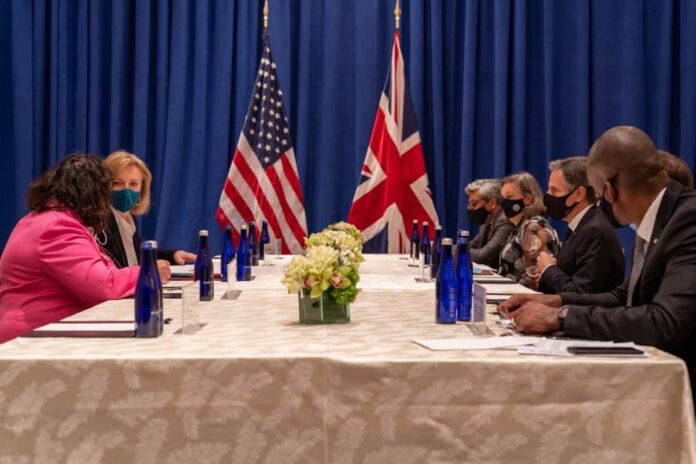
Top US, UK diplomats discuss Iran, Afghanistan

Blinken and Truss discussed a range of issues, including the situation in Afghanistan, tackling the climate crisis, Iran, a free and open Indo-Pacific, and deepening economic ties.

The US secretary of state also wrote on Twitter he had a great first in-person meeting with the UK foreign secretary to discuss shared priorities, “from Iran and Afghanistan to a free and open Indo-Pacific”.

Britain’s foreign office also announced Truss met Blinken during the U.N. General Assembly in New York and held discussions on Iran, Afghanistan and the trilateral security partnership between the U.S., Australia and the UK.

The UK Foreign Office added Britain and the United States agreed on the need for Iran to return to negotiations in Vienna on the Joint Comprehensive Plan of Action (JCPOA).

Source: Reuters

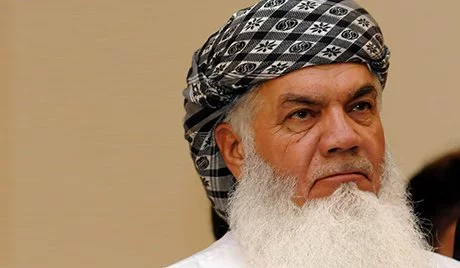
Ismail Khan: Iran can pressure Taliban into forming inclusive government

Q: Khalilzad wrote in his memoir that you wanted the Ministry of Interior.

A: They told me to go to the Ministry of Interior. When I said I would come to Kabul, they made a promise and took me to the Ministry of Energy.

Q: Do you think that Khalilzad wanted to remove you because of American influence and confrontation with Iran, or that he was a Taliban man from the beginning? I mean did he have a lot of ties with the Taliban and wanted to weaken the Afghan government by removing you?

A: Well, Khalilzad and one of the goals of the Americans themselves was to remove the jihadi leaders from power altogether, and all of Khalilzad’s effort was to remove jihadiswho were governors in Afghanistan, in Kandahar, Jalalabad, Herat, etc.

Q: What was your opinion about the Shia and Sunni fabric of Herat during your rule? After all, you were always influential in Heart. Did you mind at all if the Shia population of Herat increased during this period or did it not matter to you? For example, did you have a demographic cultural policy about the debate between Shia and Sunni? After all, this might be the case anywhere, for example, the fact that Hazaras ostly moved to Heart and bought houses there … Did you ever care about stuff like this?

A: In Herat, the Shia and Sunni issue was resolved in such a way that if you go to Herat now, you will see that Shias and Sunnis live in the same alley. They do not have specific neighborhoods. But the Hazaras eventually settled in the region due to the difficult conditions in Bamyan and other central mountainous provinces, but the Shia areas came into being in Herat after they came together to marry and live together in a village. This is almost completely solved in Herat. Religious conflicts did not harm anyone in houses in the city and they do not happen.

Q: What is your view on the cultural commonalities between Iran and Afghanistan and our bonds? I mean our common civilization, our common past, our common language. Thats because I’m talking to some Iranian friends and some of them say these are slogans, feelings, and it does not matter much. In practice, for example, politics is something else. Do you think that our common assets can really be useful in the field of action, in politics, in the economy, in society? We now have the same language, our own script and our own calendar. We are the only two countries that have Persian language and script. Tajikistan is different from us in this respect. Only you and we have the Hijri Shamsi calendar. Now if the Taliban do not change it. How do you think these cultural assets can be used?

A: Well, from the distant past, Afghanistan and Iran were like a family. They have very close similarities in different aspects of life. These have caused them to always make good use of each other’s civilization and culture and to have good mutual acceptance. I can say that Afghans in particular have always considered Iran as their second home. They never view Iran as a foreign country or treat Iran as they do other countries. Thats because we have very special commonalities, as you said, especially our common language, which have caused us to always make good use of this area of civilization and to have mutual acceptance.

Q: You are a jihadi figure; you are a prominent Islamic figure; and at the same time, you are you interested in, for example, Ferdowsi’s Shahnameh, myths …because I always saw you mention ancient Heart. Do you have love stuff like this? Do you?

A: Naturally. Those who have more armed struggles, especially freedom struggles, and they chant freedom-seeking slogans, these are my favorite.

Q: So do you like mythical figures like Rostam and Siavash and the like?

A: It is very interesting that this might not be found in Iran, but in Afghanistan, I used to go to many villages where old men holding a big cane would read the story of Shahnameh by memory and at the same time perform the same acts.

Q: Some say we should not celebrate Nowruz as Eid?

A: This is what an ignorant person would say out of prejudice. Nowruz is definitely celebrated in Afghanistan, especially in

that you were mobilizing the forces well. You resisted for about 20 days and we followed the news daily Herat.

Q: Did Herat fall because they stabbed you in the back? I saw that said you were liberating the districts, and there was good resistance in Herat. But suddenly in one or two days, things were upside down. Were you betrayed? Did the Afghan government betray you and pull the rug from under your feet?

A: In general, something of a coup took place in Afghanistan. President Ghani really committed a great national betrayal. I mean, we also told you that on many occasions politicians always had meetings with Ashraf Ghani. They were 5 or 10 or 15 people. We always met him. Things went on that way until recently when Afghanistan collapsed. I think Ashraf Ghani was an agent who would do that anyway, and lately you may have heard him say we handed over Afghanistan to its main heirs, the Pashtuns”. That was a national treason on the part of Ashraf himself. Afghanistan would have never fallen with all the great assets at its disposal, but Ashraf Ghani could not tolerate the Mujahideen taking over this government. He did not want the resistance to take power. He could not stand it, because he was not from this family. This was what caused him to remain indifferent to the fall of the first governorates until the last one that fell. No matter how hard we tried and said lets take over the provinces and lead the war”, he didnt let us do that. We finally had to, when we saw the war approaching the city, we finally took action. But unfortunately it was too late. Although we fought for two months, the last twenty days were very noisy, because the war was around the city, but we started the war two months ago, when there was a war in the governorates. At the end of the day, when the Taliban could not enter the city on the front we had, Ashraf Ghani ordered the army to surrender. We fought on but they surrendered. It caused the Taliban to enter the city from two prongs, which were the headquarters of the Herat army, and the headquarters of the police of Heart. These units stopped resisting and the Taliban entered the city.

Q: What exactly happened on July 21?

A: On that day, the Taliban retreated from the two strongholds, which was the army corps and the police command. When the Taliban entered the city, we stayed out. And finally, when we saw that they had taken the city and we were out, we also went to the army corps. When we arrived there, the army corps had surrendered. In appearance, we thought they were on our side, but in fact, they had already made a commitment to each other. We stayed there that night and the next morning the Taliban arrived inside the army corps.

Q: You mean their commander was on the Talibans side?

An: yes.

Q: How about Hearts governor?

A: Hearts governor and his men were in cahoots with the Talibans side.

Q: So, the governor himself betrayed you, because I saw them come to your house on the twenty first day, and the governor was offering you condolences. So all this was a show?

A: Well, the commander of the army and the security officer who was sent from Kabul to coordinate the war and the deputy security chief, they had already made a commitment. When the governor saw that they were together, he joined them. But they could not say anything openly.

Q: Did the Taliban put pressure on you when they started talking to you?

A: No. If you saw the interview, I did not mention the Taliban nor did I congratulate their victory or say any of these things.

Q: They wanted to force you to tell others to surrender.

A: They asked many questions and speak to the crowd for them to do this and that.

Q: At the same time, you emphasized social justice, which was a great thing. What do you think will happen to Afghanistan now?

A: I think this government will not last. You see the cabinet that was announced. If anyone wanted to stay in Afghanistan or hope for Afghanistans future, the Taliban showed with the cabinet that these are a special group and only one party, one group of people who want to rule a country, which is not possible.

Q: How do you think this situation is going to change, now that the Taliban are in power and have taken over all of Afghanistan? The world is almost behind them.

A: No, that is not the case, because in Afghanistan it was first shown that no government has been able to maintain its rule by force. You saw that the communists themselves first staged a coup by Davud Khan. The government did not last. When the communists staged a coup, it did not last more than six months. It lasted three months. For example, Amin did a coup that lasted one year. The Mujahideen could not use force and at the same time the Taliban failed the first time. No government can survive in Afghanistan by force.

Q: How do you evaluate this resistance in Panjshir, AmrollahSaleh and Ahmad Massoud? Can they do something or not?

A: Well, these are not alone. Everything starts from the beginning in a corner, and at least the rest of the provinces of Afghanistan will announce their cooperation.

Q: Is Saleh a reliable person given he worked with Ghani?

A: Well, the leader of the Panjshir resistance is Ahmad Massoud. Saleh doesnt call the shots.

Q: Do you consider Ahmad Massoud a reliable person?

A: Naturally, this is the case, given the experiences that he has from his father, and him having by his side these Mujahideenwho are experienced and were his father’s friends. We hope that, God willing, they will remain prudent.

Q: What do you think Iran could do and what can it do now?

A: Iran did all it could in this regard. During this period, there was no talks with the Taliban over the formation of a government. The Taliban should have come up with a plan to form a government with the participation of all groups. But unfortunately they didnt do so. Iran, as a big country and neighbor, plays a big role in political matters and it can pressure the Taliban into forming an inclusive government and avoid a war given Iran has friends in the region and with the help of other neighbors.

Q: Can Iran, through political, diplomatic and moral support, be effective without political interference to prevent a unilateral Taliban rule?

A: Well, our effort and wish is that all our friendly and brotherly and neighboring countries make every effort not to solve the issue of Afghanistan by war, but to resolve it through consensus and dialogue.

Q: You mean Iran wields sufficient spiritual influence to bring them into line?

A: Certainly, yes.

Q: Was Karzai also involved in Ghanis betrayal, especially in Kabuls surrender?

A: No, Karzai was not involved in that.

Q: Do you consider the role of Karzai and Abdullah positive?

A: Yes.

Ismail Khan: Recent events in Afghanistan coup, Ghani committed treason

 

Iran FM to Focus on Economic Diplomacy on UNGA Sidelines

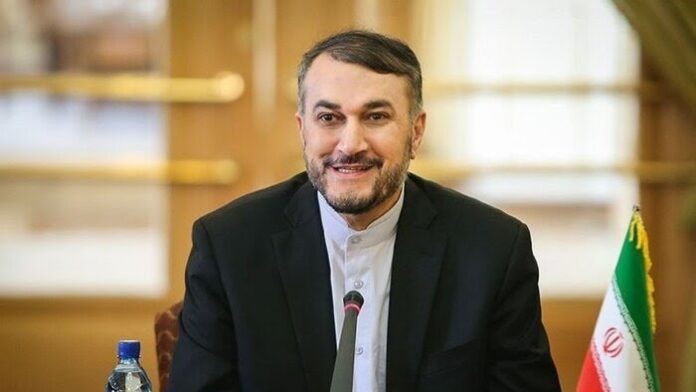
“I hope we can use this opportunity in line with a balanced foreign policy and active, dynamic and smart diplomacy of the 13th administration [current Iranian government] to adjust and develop our foreign relations with all regions of the world and target countries, and to hold talks and consultations with counterparts,” Hossein Amirabdollahian, who heads Iran’s delegation, said after arrival in New York.

“One of the topics, which has been on our agenda, is focus on Asia and neighboring countries as a priority, along with a balanced foreign policy and interaction with all countries in the world.”

The foreign minister added that he will also follow up on the problems of Iranian expatriates during a meeting planned in New York. That, he said, is one of the dozens of bilateral and multi-lateral meetings scheduled during his visit.

Amirabdollahian also expressed hope that the current Iranian government can help ease the problems expatriates face and offer them a strong support.

UN General Assembly Session Opportunity for Intl. Convergence: Analyst

“This session n is an opportunity for diplomacy chiefs of different countries to meet and hold consultations with their counterparts as well as other participating dignitaries as a large number of authorities of various countries come together under one roof at a certain point in time which they can use to boost their alliances and coalitions and also air their grievances,” said Amirali Abolfat’h, an expert on international affairs.

He also touched upon Iranian Foreign Minister Hossein Amirabdollahian’s plan to attend the UN General Assembly session as well as the meetings he is scheduled to have on the sidelines of the event.

“This session is a good opportunity for officials and foreign ministers of different countries to learn about the viewpoints of the new Iranian administration and foreign minister,” he explained.

Asked how Iran can use the UN session as an opportunity to present the points of view of the thirteenth administration, the expert replied, “Traditionally, foreign ministers of different countries take part in the annual session of the UN General Assembly, and sit down with their opposite numbers on the fringes of the event.”

“Generally, on the sidelines of this session, friends and rivals meet each other and share views on the latest bilateral, regional and international developments and try to bridge their differences,” he added.

He said Amirabdollahian’s trip to New York as Iran’s foreign minister to attend the UN General Assembly meeting is a routine visit.

“Moreover, the Iranian foreign minister and president have changed after eight years, and this session will serve as an opportunity for representatives from different countries, including rivals, allies and partners, to get familiar with the viewpoints of the new Iranian administration and the country’s foreign minister, and this is an opportunity which Iran should also seize to elaborate on its positions and views in line with securing the Iranian nation’s interests,” he said.

However, he said, the UN is playing a key role in leading efforts to provide humanitarian aid to Afghans, and called on the international community to engage with the Taliban due to the unclear situation in the country.

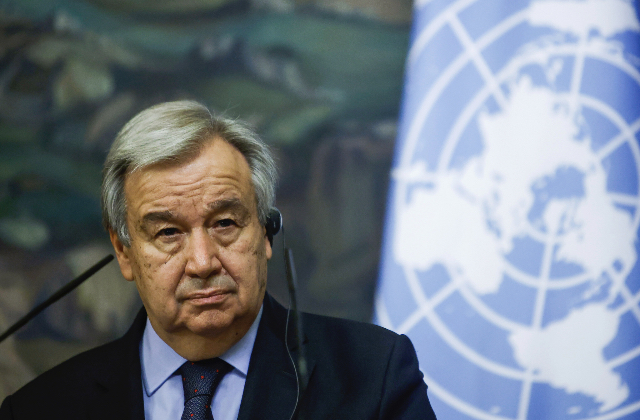
Guterres further added US President Joe Biden’s commitment to global action on climate, including rejoining the 2015 Paris Climate Agreement that former president Donald Trump withdrew from, is probably “the most important” action he could take.

He also expressed regret over the failure of countries to work together to tackle global warming and ensure that people in every country are vaccinated.

He once again urged the world’s 20 major economic powers in the G20, who failed to take united action against COVID-19 in early 2020, to create the conditions for a global vaccination plan.

Guterres also said the divide between developed countries in the north and developing countries in the south “is very dangerous for global security”, adding that “it’s very dangerous for the capacity to bring the world together to fight climate change”.

EU accuses US of disloyalty to allies

The extraordinary rebuke of the new American president, whose election was celebrated across Europe as an opportunity to rejuvenate ties after the four years of belligerence and combativeness of Donald Trump, raised the prospect of a grave and prolonged breach among Western powers.

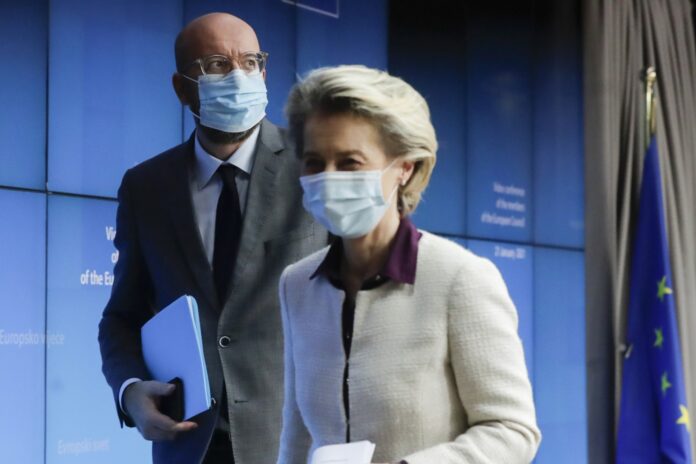
“With the new Joe Biden administration, America is back,” European Council President Charles Michel told reporters in New York, as world leaders convened for the high-level debate of the U.N. General Assembly. 

“What does it mean America is back? Is America back in America or somewhere else? We don’t know,” he added.

By failing to consult EU nations about the new Indo-Pacific strategy, under which Australia canceled a blockbuster contract to buy French submarines, Michel stated Biden had discarded an agreement reached by leaders after many hours of talks at the G7 summit in Britain in June to remain united in confronting authoritarian regimes, particularly China. 

“The elementary principles for an alliance are loyalty and transparency,” Michel said, adding, “We are observing a clear lack of transparency and loyalty.” 

European Commission President Ursula von der Leyen voiced her own dismay during an interview with CNN, in which she called the treatment of France  “unacceptable” and demanded Biden provide an explanation. 

“There are a lot of open questions that have to be answered,” von der Leyen said, adding, “One of our member states has been treated in a way that is not acceptable, so we want to know what happened and why. And therefore you first clarify that before you keep going with business as usual.” 

Michel noted that the 27 EU heads of state and government would discuss the rift with the U.S. over dinner on October 5 in Slovenia, ahead of a summit focused on the Western Balkans.

And von der Leyen’s comment signaled potential disruption of the planned first meeting of a new EU-U.S. Trade and Technology Council in Pittsburgh next week — an event that was supposed to showcase the renewed policy partnerships between Brussels and Washington.

But despite the irate rhetoric, it was unclear what, if anything, EU leaders could say or do about the matter, which some EU diplomats and officials suggested was more of a commercial dispute between Paris and Canberra, and a matter of wounded French pride, than a genuine cause for rupturing relations with the U.S. and sowing divisions that could weaken NATO.

By coming in so squarely behind French President Emmanuel Macron — who still has said nothing publicly and is not attending the U.N. meetings — Michel and von der Leyen seemed to elevate the risk of a prolonged dispute that could be exploited by China, Russia and other rivals, and to increase the difficulty in finding a face-saving exit for the Western allies. 

Michel insisted the feud should not be viewed narrowly as a matter of French economic interests, but rather as part of a pattern of disregard for European allies and their interests by four U.S. presidents, beginning when George W. Bush decided to wage war in Iraq and Afghanistan. 

“[Barack] Obama with charisma, very polished, took important decisions in Syria with negative consequences for Europe, and we could observe also a lack of coordination, of consultation between the United States and European governments,” Michel stated, adding, “At least with Donald Trump it was very, very clear that he was not in favor of the European integration, that for him Europe doesn’t matter, but it was clear.” 

Biden, on the other hand, talked a big game about renewing transatlantic ties, according to Michel, but then railroaded European allies with his decision about following through on Trump’s plan to withdraw from Afghanistan, “and”, he added, “a few days ago with this strange announcement”.

“When the transatlantic alliance is less robust and less solid, this is not good for the security in Europe and everywhere in the world,” Michel said, adding that “this is more than a bilateral trade or industrial topic. It’s more than that”.

Arriving in New York City on Monday, French Foreign Minister Jean-Yves Le Drian said all EU countries should be worried about the disregard the U.S. had shown its allies. 

“Europeans shouldn’t be the rejects of the strategy chosen by the United States,” Le Drian continued, adding, “We are in this new state of mind, which means the Europeans need to identify their own strategic issues and to have a discussion with the United States on this topic.” 

Le Drian noted that conversation was likely to occur in the context of the development of a new “strategic concept” at NATO, a tacit acknowledgment that addressing the affront by the Americans would take quite a bit of time, and some convincing of EU countries heavily reliant on the U.S. for security guarantees. 

While Macron has remained silent, France has moved swiftly to retaliate by recalling ambassadors and also vowing to scuttle a proposed free-trade agreement between the EU and Australia. 

Source: POLITICO

IAEA worried about North Korea’s nuclear program

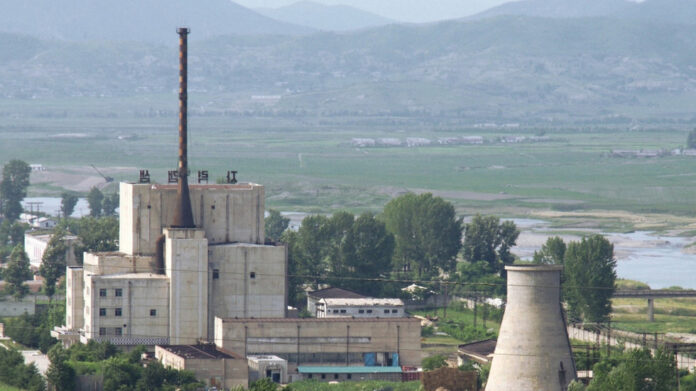
During an annual meeting of International Atomic Energy Agency (IAEA) member states on Monday, the agency’s Director-General Rafael Grossi stated that the country had resumed “work on plutonium separation, uranium enrichment, and other activities”.

Based on satellite imagery, the IAEA stated in its annual report in August that a five-megawatt reactor at the country’s Yongbyon nuclear complex had been put back into operation sometime in early July, after apparently being idle since December 2018.

The agency had observed discharges of cooling water “consistent with the operation of the reactor”, but it could not “confirm either the operational status” of the facilities listed in the report or the “nature and purpose of activities conducted therein”.

Since Pyongyang expelled IAEA inspectors in 2009, the nuclear watchdog has been primarily reliant on satellite imagery and so-called “open-source information” in its reporting on North Korea (DPRK). Noting that the nuclear activities were “cause for serious concern,” the agency reported a number of “deeply troubling” indicators.

According to the report, a steam plant serving the radiochemical laboratory at the complex had been operational for some five months earlier in the year. Although it stopped working in early July, the agency suggested the time frame was sufficient for reprocessing work to separate plutonium from spent reactor fuel, as well as uranium mining activity, to have occurred.

In recent weeks, a number of media outlets have reported on continuing construction at the Yongbyon Nuclear Scientific Research Center – with the work attributed to the apparent expansion of a uranium enrichment plant within the facility.

The Yongbyon complex, situated 100 kilometers (62 miles) north of the capital Pyongyang, is the country’s largest and best-known nuclear facility, said to be responsible for producing the fissile material used in six nuclear tests, according to the South Korean JoongAng Daily newspaper.

The paper reported that the complex’s reactors had been largely inactive for years, with periodic activity observed at the uranium plant. Citing a study released last week by the US-based Middlebury Institute of International Studies, the paper noted that satellite images showed a walled space had been created out of a previously forested area next to the uranium enrichment plant.

The new construction was deemed sufficient to “house 1,000 additional centrifuges”, according to the report, which calculated that the increased capacity would enable the plant to raise its production of “highly enriched uranium by 25 percent”.

In a report to the IAEA’s board of directors last week, Grossi noted the agency had monitored activity at the Yongbyon nuclear complex from mid-February to early July. While the centrifuge enrichment facility appeared not to be operational at the time of the agency’s August report, Grossi reportedly said cooling units from the facility had since been removed.

In addition to Yongbyon, the IAEA also apparently observed signs of ongoing construction activities at a light water reactor being built at the Kangson nuclear complex outside Pyongyang.

While North Korea has yet to comment on the new reports, last year it labelled the IAEA “a marionette dancing to the tune of the hostile forces against the DPRK”, and dismissed a previous report as being “completely pervaded with guesswork and fabrication”.

Earlier this month, the reclusive country carried out tests of a new long-range cruise missile and reportedly fired two unidentified projectiles – thought to be ballistic missiles – into the Sea of Japan. Pyongyang had repeatedly threatened to resume testing of its long-range missiles after denuclearization talks with the US stalled.

Source: RT

Several killed in Russian university shooting

Ðîññèÿ. Ïåðìü. Íà òåððèòîðèè Ïåðìñêîãî ãîñóäàðñòâåííîãî íàöèîíàëüíîãî èññëåäîâàòåëüñêîãî óíèâåðñèòåòà íà óëèöå Ãåíêåëÿ, ãäå íåèçâåñòíûé óñòðîèë ñòðåëüáó â îäíîì èç êîðïóñîâ. Ìàêñèìàëüíî âîçìîæíîå êà÷åñòâî. Ñíèìîê ñ âèäåî/Ñòðèíãåð/ÒÀÑÑ

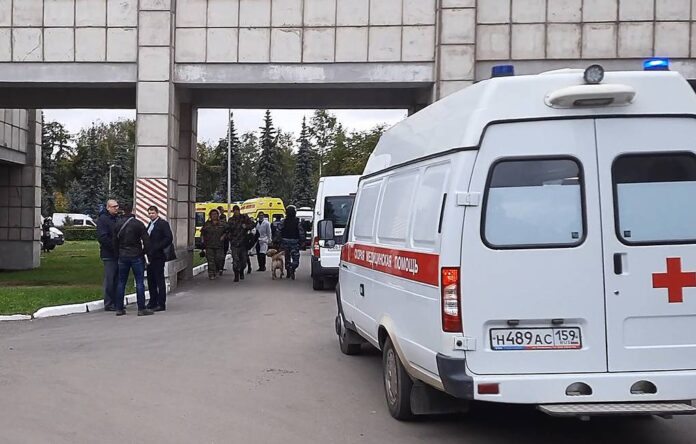
The incident happened on Monday morning at Perm State University, one of the oldest universities in the Urals region, close to where Europe and Asia meet. The school’s social media alerted everyone who was on campus to leave if possible, or lock themselves inside a room.

19 of the injured have received gunshot wounds, according to the Russian Ministry of Health.

Images published online, apparently taken at the scene, showed a rush to escape through the windows. A video taken from inside the building appears to show an armed person dressed in black and wearing a helmet slowly walking across the campus as horrified onlookers express their shock.

The crisis ended with the perpetrator apprehended, the university and the police reported. According to some media, he was injured by the police.

Law enforcement officials said the shooter is a student at the university where the attacks happened. Earlier unconfirmed reports identified him as an 18-year-old lone-wolf attacker named Timur Bekmansurov, who allegedly left a note describing his motives on social media.


Source: RT

Biden goes on vacation amid several national crises

“Mr. President, what will you tell Emmanuel Macron?” a reporter asked as Biden sped by.

“When are you going to call Macron?” another reporter asked.

Biden is set to call French President Emmanuel Macron to resolve a diplomatic crisis that developed last week. France recalled its ambassadors to the United States and Australia in response to a joint agreement between the U.S., Australia, and the United Kingdom to provide nuclear submarines to Australia, scrapping a previous agreement to send French-made submarines Down Under.

“At the request of President Macron, I have decided to immediately recall our ambassadors to the United States and Australia to Paris for consultations,” French Minister for Europe and Foreign Affairs Jean-Yves Le Drian said in a statement Friday.

“The abandonment of the ocean-class submarine project that Australia and France had been working on since 2016 and the announcement of a new partnership with the United States aimed at studying the possibility of future cooperation on nuclear-powered submarines constitute unacceptable behavior among allies and partners; their consequences affect the very concept we have of our alliances, our partnerships, and the importance of the Indo-Pacific for Europe,” the statement added.

Earlier in the week, Le Drian told a French radio station that the agreement, perceived as a challenge to China’s presence in the region, was a “stab in the back.” He also compared President Biden to former President Donald Trump.

“This brutal, unilateral and unpredictable decision reminds me a lot of what Mr. Trump used to do,” Le Drian stated, noting, “I am angry and bitter. This isn’t done between allies.”

White House Press Secretary Jen Psaki claimed that France had been notified of the deal before the agreement.

Biden also faces national crises at the southern border and in Afghanistan.
Hundreds of migrants crossed the border into Texas on Saturday, with many of them originally coming from Haiti.

Customs and Border Protection (CBP) announced Wednesday that authorities encountered 208,887 migrants in August, a slight decline from the 212,000 encounters in July and the second month in a row where the number of encounters breached the 200,000 mark.

The 208,887 number for August represents a 317% increase over August 2020, which saw 50,014 encounters — and a 233% increase over August 2019, where there were 62,707 amid that year’s border crisis.

Meanwhile, the head of U.S. Central Command, Gen. Kenneth F. McKenzie Jr., announced on Friday that it is unlikely any Daesh members died in a Kabul drone strike on August 29, which led to multiple civilian casualties.

An untold number of Americans and U.S. allies remain trapped in Afghanistan after President Biden ordered the full withdrawal of U.S. troops on August 31, leaving the country in the hands of the Taliban. Retired military leaders have called for the mass resignation of Biden’s diplomatic and military leaders in the wake of the fiasco.

Meantime, Gen. Mark Milley, chairman of the Joint Chiefs of Staff, faces serious accusations after Bob Woodward’s upcoming book, “Peril”, revealed that Milley gave assurances to China that America would not strike the country amid his worries that Trump’s actions might spark a war.

Source: FOX News

IRGC launches fresh strikes against terror groups on border with Iraq

“We had warned that if these hostile groups make the slightest error, they will receive a harsh response,” Brigadier General Majid Arjmandfar, the second in command of the Hamzeh Seyyed Shohadda Headquarters in West Azarbaijan Province said.

He said the Islamic Revolution Guards Corps struck the positions of the anti-revolutionary cells on the border and destroyed four of their bases.

“Anti-revolutionary groups have been set up in Iraq’s north by the intelligence agencies of foreign hostile countries and even some Arab states to be used to advance their interests and place obstacle in the way of the Islamic Republic,” Arjmandfar explained.

The general warned that the Iranian armed forces will deem any area, where these groups are present, as enemy territory and have a duty to mount operations against them.

The latest Iranian anti-terror strikes comes as Chief of Staff of the Iranian Armed Forces Major-General Mohammad Baqeri warned of more operations against terrorist cells in Iraq’s northern Kurdistan region.

The top Iranian commander stressed that Iran has a right to confront them under the Charter of the United Nations.

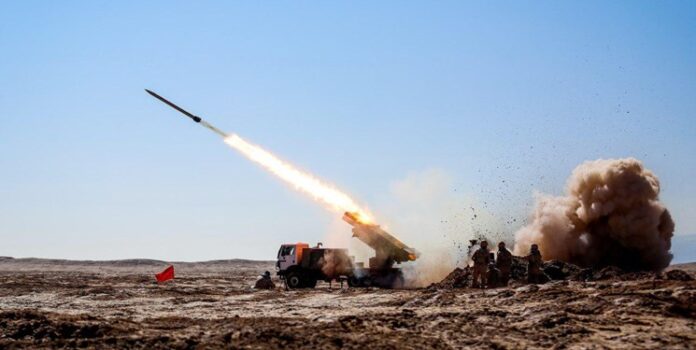
Earlier in September, Iran’s Islamic Revolution Guards Corps pounded the positions of these groups in northern Iraq with several missiles.

Iran has been critical of officials in Baghdad and Iraq’s semi-autonomous Kurdistan region for failing to act on anti-Iran terror groups increasingly active in border areas.

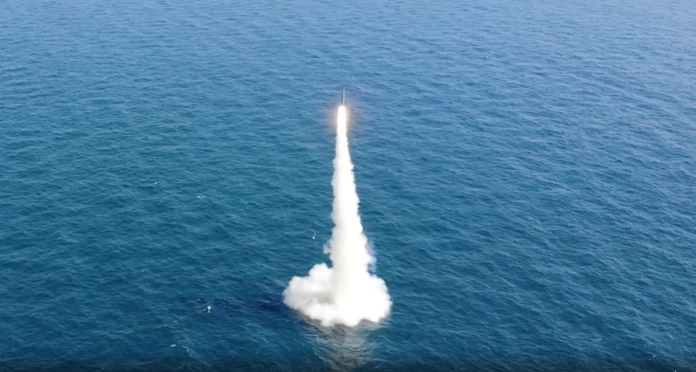
N. Korea calls South’s submarine-missile test ’clumsy’

On Monday, Jang Chang Ha, chief of North Korea’s Academy of the National Defence Science, criticized South Korea’s submarine-launched ballistic missile (SLBM) test as being “clumsy”, and cast doubts on its logistics, stating that it did not even bear a resemblance to the weapon it claimed to be.

Instead, according to Jang, the armament looked like a South Korean short-range ground-to-ground “Hyunmoo-serial” missile, while the warhead was an imitation of India’s K-15 SLBM.

“Whatever the purpose, the hasty revelation of the picture which would definitely arouse doubt of all the military experts indicates that South Korea must have been pressed to hastily get around the world the news about its possession of SLBM with its own efforts,” the military chief explained.

The military research chief suggested that Seoul’s missile is just for “bragging” and “self-comforting”.

“If what South Korea opened to [the] public and trumpeted so much is [an] SLBM, it is just in the stage of [an] elementary step”, Jang went on, claiming it has insufficient “strategic and tactical significance” to threaten its northern neighbor.

Seoul’s “ambitious efforts” to beef up its submarine-launched weaponry, however, are “a clear omen for the military tension that will be certainly aggravated on the Korean peninsula”, Jang warned.

South Korea hailed the success of the trial conducted last week, with the office of President Moon Jae-in stating that the armament was going to play a key role in the country’s ability to defend itself.

The test came just hours after North Korea fired two projectiles suspected of being ballistic missiles into the sea outside of Japan’s exclusive economic zone. Pyongyang had also tested a new long-range cruise missile that traveled some 1,500km (930 miles) a few days prior, which the Pentagon said showed that the isolated nation is a threat to “its neighbors and the international community”.

Pyongyang has also condemned Washington for undermining regional stability and global power balance – and vowed retaliation if its divisive nuclear-powered submarine deal with Australia threatens its national security.

“This is a very controversial and dangerous move which undermines the strategic balance in the Asia-Pacific region and can trigger a nuclear arms race,” the North Korean Foreign Ministry said.

The ministry claimed that while the United States routinely demonstrates double standards, the new administration is more “unpredictable,” and now even Washington’s allies are wary of getting “stabbed in the back”.

Pyongyang added it fully understands Beijing’s concerns that such an irresponsible military pact will undermine “regional peace and stability, the international nuclear non-proliferation system, and intensify the arms race”.
The so-called AUKUS deal, announced by the US, UK and Australian leaders last week, caused an unprecedented diplomatic row and heated tensions with NATO ally France, which as a result lost a lucrative shipbuilding contract with Canberra. The move has also triggered a strong backlash from Beijing, as most observers agree the controversial pact is aimed at countering and containing China.

Days before the AUKUS announcement, North Korea caused uproar in Seoul, Tokyo and Washington, after it test-launched two different types of weapons – a railway-borne missile system and a long-range cruise missile. Several days later, Seoul conducted a submarine-launched missile test of its own, while on Friday the US Navy fired two strategic Trident II SLBMs, insisting the test was “not conducted in response to any ongoing world events, nor as a demonstration of power”.

However, the latest developments, Pyongyang claimed, fully validate the isolated state’s drive to bolster its national security and means of deterrence.

“We are closely analyzing the repercussions of the US decision, and will surely take appropriate measures if it has any negative impact on our national security,” it announced.

Source: KCNA