Wednesday, December 31, 2025
Home Blog Page 2315

Turkey and Russia negotiating to clear Kurds from Kobani

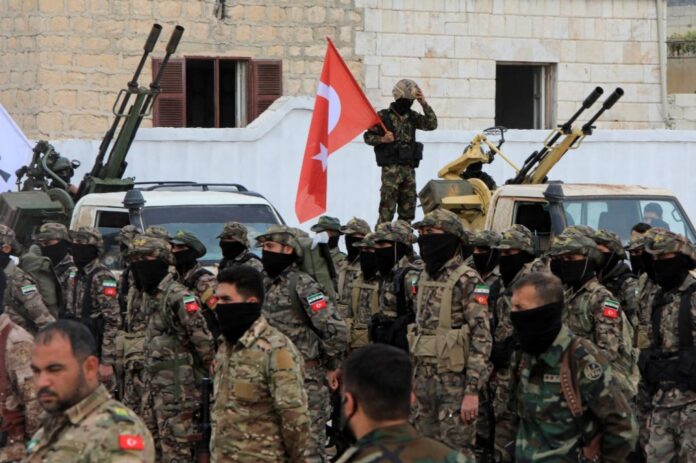
Turkish President Recep Tayyip Erdogan said last month that Ankara had lost patience due to sporadic attacks by the YPG, also known as the People’s Protection Units, against the Turkish forces and Ankara-controlled areas in northern Syria.

“We are determined to eliminate the threats emanating from Syria with our own means,” he stated in televised comments, adding, “We will take the necessary steps in Syria as soon as possible.”

Since then, Turkish and Russian officials have been negotiating a deal to address Turkish concerns with regards to the YPG, which Ankara considers a terrorist group due to its direct links with the PKK, a designated terrorist group according to Turkey, the US and EU.

Ankara and Moscow signed a previous deal in 2019, where Russia committed to pull YPG forces from the border area, a promise yet to be upheld by Moscow, according to Turkish officials.

Turkey aims to close the western part of the border by seizing Kobane and linking Turkish-controlled areas Jarablus and Tal Abyad.

Kobane was the site of a major battle between the YPG and Islamic State forces, in which the Kurdish group backed by US air strikes repelled a siege by IS militants in late 2014 and early 2015.

Kobane has been held by the YPG since 2012, while Syrian and Russian troops entered the border town during an earlier Turkish incursion in 2019.

According to a draft deal, sources told MEE that Russia would maintain its presence in Kobane, also known as Ayn al-Arab, while Ankara would capture the surrounding areas towards the strategic M4 highway.

Turkey wouldn’t deploy its allied Syrian National Army forces to the city and there would be joint Turkish-Russian control on the M4. Turkey would also maintain the security of the Russian base in Sarrin by not placing the Syrian forces in the vicinity. In return, Russia would make sure that YPG fighters would withdraw southwards.

However, according to the same sources, Russia has tied the Kobane operation to some concessions on Idlib, where Moscow eyes Arihah, the Syrian town that sits on the M4 highway. It isn’t clear whether Ankara is willing to cede territory in Idlib where millions of Syrians are stuck in a comparatively smaller area, dense with military installations and militant groups.

Turkish officials, speaking to Bloomberg last week, announced that Turkey was considering leaving some small parts of Idlib to Russians to get support for an operation in northern Syria.

Sources told MEE that the negotiations with Russia were still underway and Erdogan would need to sanction any deal before launching a military operation.

“It is a political decision at the end of the day,” one of the sources added.

Separate Turkish security sources, on the other hand, told MEE that the military had nearly completed its preparations for an initial incursion in northern Syria.

“We also nearly finalised our deployments in Idlib as well to protect the area against Syrian regime and Russian attacks,” one of the sources said, noting, “Our experiences in the past suggest we should be militarily ready in Idlib even if we have a deal with Moscow because of our past experiences with Russia.”

Security sources said the military could progress with any possible operation in northern Syria within the same day. However, more time might be needed to complete the deployments.

Russia meanwhile continues to play hardball with Turkey. Last weekend, Russian jets continued to hit Turkish-backed Syrian National Army headquarters in the Afrin region, which was only a couple of kilometres away from the Turkish border.

Russians also deployed four Su-35s to Qamishli airport last Thursday, indicating that it is against any possible Turkish operation in this area.

A Turkish defense ministry source, in a meeting with Turkish media, said that only one Russian warplane landed in Qamishli and left the same day.

“It wasn’t a permanent deployment,” the source added.

Turkish security sources indicated that Ankara was also interested in the Tell Rifaat pocket controlled by YPG in northern Aleppo, where occasional rocket fires and attacks killed or injured a number of Turkish and Syrian National Army forces. However the Russians, concerned by the security of Aleppo, were against Turkey’s wishes.

“What Russia is offering is joint patrols in the area,” one of the sources continued.

Two Turkish police officers were killed and two others were wounded after an attack reportedly carried out by the YPG in Azaz, where Turkish forces control Syrian territory, the Turkish interior ministry said last month.

Turkey launched its first military campaign into Syria in 2016 as an attempt to create a buffer zone between its territory and land held by the US-backed Kurdish forces.

Ankara then carried out two other operations against the YPG, one of which targeted the Afrin region in 2018.

Tensions have risen recently as Turkey has stepped up its military campaign against Kurdish forces in both Syria and Iraq.
Panjshir official: Ahmad Masoud seeking support against Taliban

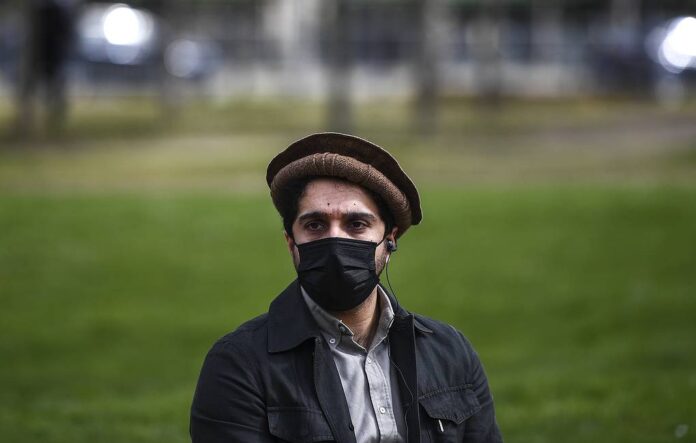
epa09101005 Ahmad Massoud, son of late Afghan commander Ahmad Shah Massoud, looks on during a ceremony to unveil a commemorative plaque in honour of late Afghan anti-Taliban commander Massoud in an alley along the Champs-Elysees Avenue in Paris, France, 27 March 2021. EPA-EFE/CHRISTOPHE ARCHAMBAULT / POOL MAXPPP OUT

“Ahmad Massoud is currently in Tajikistan, but sometimes he visits Afghanistan to meet with resistance units in the country’s regions,” Kabir Wasik told TASS on Monday.

According to the spokesman, the resistance front’s leader is trying to seek the support of various states in countering the Taliban.

“Massoud strives to convince the region’s countries and the entire global community to fight the Taliban. He travels to different states in order to draw attention [to the National Resistance Front] and gain support,” the spokesman for the Afghan resistance front said.

Deputy Governor of Panjshir pointed out that the national resistance maintained good relations with Tajikistan, which “had been providing substantial assistance to the Afghan people in the fight against the Taliban.”

On September 23, Tajik President Emomali Rahmon, speaking at the 76th session of the UN General Assembly, called for elections in Afghanistan, as well as for the establishment of the new government, including the representatives of all ethnic groups, in particular, Afghan Tajiks. According to the president, declaring any government without considering the Afghan citizens’ interests can result in disastrous consequences. Rahmon also warned about the growing threat of international terrorism in the country.

The Taliban embarked on a large-scale operation to take control of Afghanistan after the US had announced its intention to withdraw its forces in the spring. On August 15, Taliban fighters swept into Kabul without encountering any resistance, with Afghanistan’s then President Ashraf Ghani subsequently fleeing the country. On September 6, the Taliban gained full control over Afghanistan, and on September 7, the radicals announced the new interim government, which has not been recognized by any country yet.

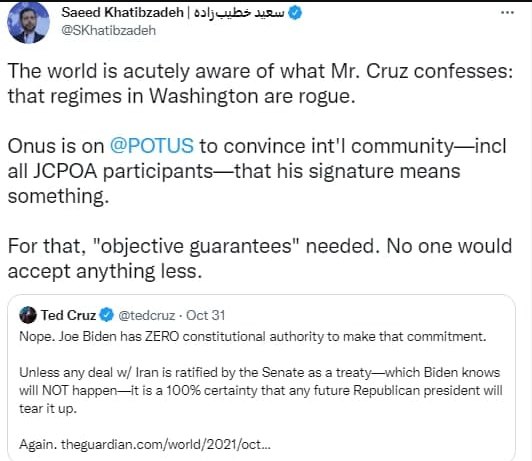
Iran: Rogue regimes at the helm in Washington, nuclear commitment a must

“The onus is on US President [Joe Biden] to convince the international community – including all JCPOA participants – that his signature means something,” said Iranian Foreign Ministry Spokesman Saeid Khatibzadeh in a tweet.

“So, objective guarantees are needed. No one would accept anything less,” he added.

Khatibzadeh made the comments in reaction to recent remarks by US Senator Ted Cruz.

“Joe Biden has ZERO constitutional authority to make that commitment. Unless any deal with Iran is ratified by the Senate as a treaty—which Biden knows will NOT happen—it is a 100% certainty that any future Republican president will tear it up,” said Cruz on Twitter.

Khatibzadeh also said the world is no stranger to what Cruz has confessed .“ The world is acutely aware of what Mr. Cruz confessed: that regimes in Washington are rogue,” said the spokesman.

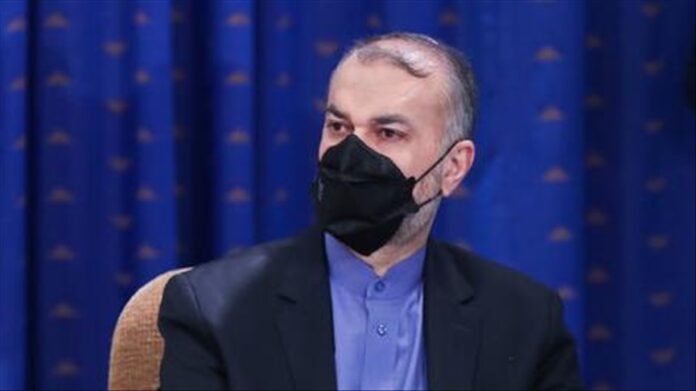
Iranian FM tests positive for Covid

Amir Abdollahian is at home in quarantine.

Meanwhile, the Iranian Foreign Ministry spokesman confirmed the top diplomat has contracted the virus.

Saeed Khatibzadeh however described Amir Abdollahian’s general condition as good.

He said the foreign minister is performing his work-related duties from home.

Khatibzadeh also said Amir Abdollahian’s physician prescribed that he change his work schedule.

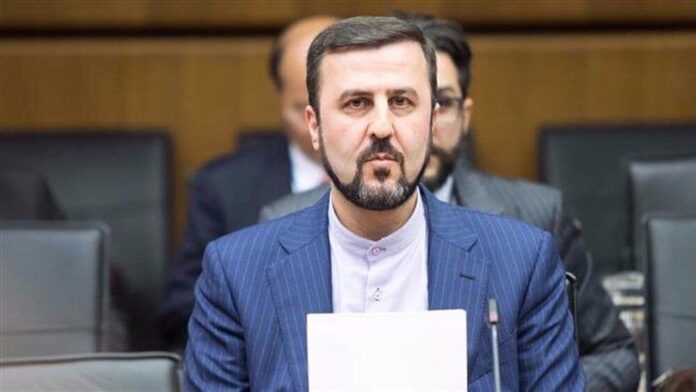
Iranian rights council chief slams Israel for tearing UNHRC report

Ghariabadi said in a tweet that the silence has emboldened the regime to make a mockery of the UN Human Rights Council by tearing a repirt by the head of the body to the UN General Assembly. Gharibabadi said the report reflects the findings of the UN Human Rights Council’s Commission of Inquiry, which mostly condemn or criticize the Zionist regime.

He added that Israel ‘s ambassador once tore the UN general Assembly’s resolution in 1975 that described Zionism as a form of racism.

Gharibabadi said this second move by the Zionist regime proves that the Commission of Inquiry must continue its investigations into Tel Aviv’s rights violations.

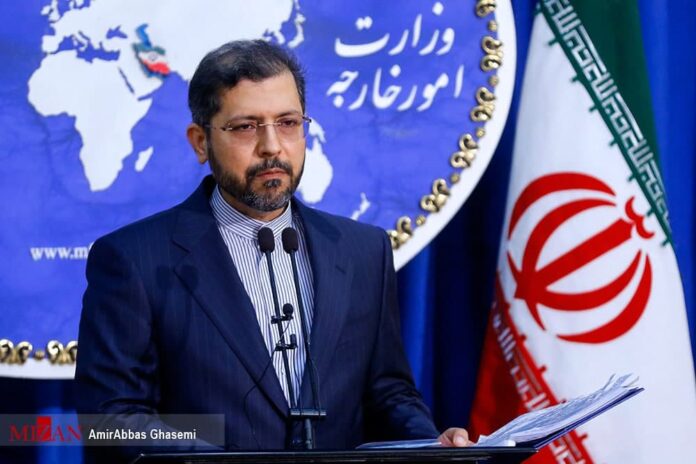
Khatibzadeh: Nukes have no place in Iran’s defense doctrine

khatibzadeh-Iran

He said the Islamic Republic of Iran has always emphasized at its highest levels that in accordance with the fatwa issued by the Leader of the Islamic Revolution Ayatollah Seyyed Ali Khamenei banning the production and use of nuclear weapons, it will not seek to build nuclear weapons and that these weapons have no place in the country’s defense doctrine.

The Islamic Republic of Iran, as a responsible member of the Non-Proliferation Treaty and a member of the International Atomic Energy Agency, has always cooperated properly with this technical and specialized body within the framework of the Safeguards Agreement and has fully adhered to its obligations, and showed goodwill until one year after the illegal and irresponsible withdrawal of the United States from the JCPOA, he added.

Khatibzadeh stated that Iran welcomes the intention of the other parties to fully return to fulfilling their obligations, adding that the criterion for Iran is the action of the other party.

Contrary to its stated policy, the new U.S. administration continues to pursue a policy of maximum pressure that led to new sanctions or the re-imposition of previously lifted sanctions, he stated.

The Foreign Ministry spokesman further emphasized that after the necessary time for the formation of the new Iranian administration and conducting necessary reviews, and after consulting with partners and consultations with the coordinator of the JCPOA Joint Commission, it was announced that negotiations to remove sanctions will begin before the end of November.

Regarding what was announced in the statement of the leaders of the four countries about the production of enriched uranium metal and high-enriched uranium, Khatibzadeh clarified that contrary to the statement, production of uranium metal and high-enriched uranium, as previously stated, was for peaceful purposes and had civilian uses, including medical use and refueling of Tehran’s research reactor.

It should be noted that such positions that do not correspond with reality will not have constructive results, he said.

The foreign ministry spokesman said the so-called nuclear crisis, which is exaggerated in this statement, is no more than a fabricated and propaganda crisis.

Khatibzadeh stressed that the current situation is the result of irresponsibility and non-compliance with commitments by the governments issuing this statement, and the illegal withdrawal and violation of UN Security Council Resolution 2231 of 2015 by the U.S. government and inaction of the European parties in fulfilling their obligations.

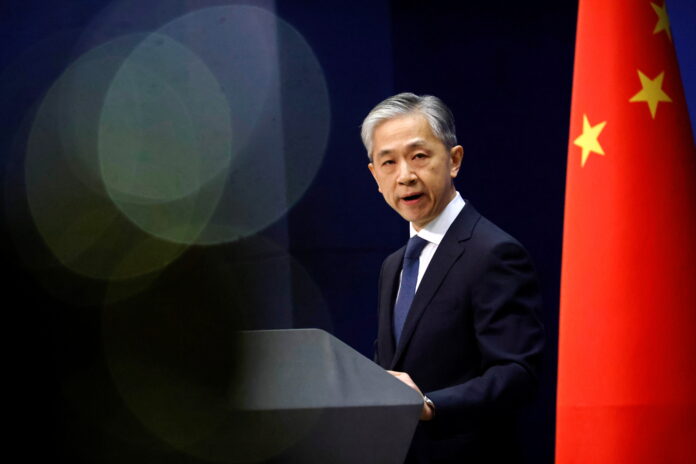
China: US should correct policy of maximum pressure

Wang Wenbin

“Effective implementation of the JCPOA (Joint Comprehensive Plan of Action) is the only correct way to resolve the Iranian nuclear issue,” China’s Foreign Ministry Spokesperson Wang Wenbin stated during the regular press conference on Monday.

“China firmly supports efforts to bring the agreement back onto the right track at an early date,” he added.

“On this basis, Iran should resume full compliance. Other parties should all play a constructive role to this end,” he said.

“The six rounds of negotiation on resumption of compliance held during the first half of this year have made important headway. All parties should resume negotiation at an early date and look for flexible and pragmatic solutions to outstanding issues and work for new breakthroughs,” the spokesperson noted.

“China will continue its close communication with relevant parties and participate constructively in the negotiation. At the same time, we will also firmly safeguard our legitimate and lawful rights and interests,” Wenbin continued.

Iran, China: Unilateral U.S. sanctions illegal

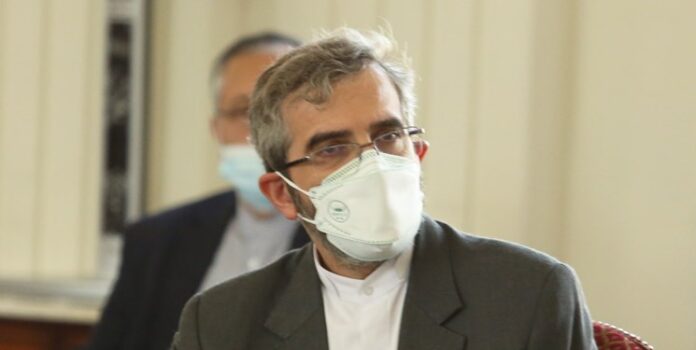
Iranian Deputy Foreign Minister Ali Bagheri Kani said in a twitter post on Monday that he and his Chinese counterpart Ma Zhaoxu stressed during a phone conversation that sanctions against Iranian individuals, entities and third parties should be removed, and that guarantees must be provided so that such illegal measures will not be repeated.

The Iranian and Chinese deputy foreign ministers emphasized the importance of the rule of law in international relations.

The phone conversation comes days after Bagheri Kani, who is Iran’s top negotiator, traveled to Brussels and Moscow, where he met with the European Union Deputy Foreign Policy Chief Enrique Mora and Russian Deputy Foreign Minister Sergei Ryabkov.

Bagheri and Mora agreed that talks between Iran and the P4+1 group in the Austrian capital Vienna will resume before the end of November on a possible return of the United States to the 2015 nuclear deal.

Former U.S. president Donald Trump withdrew America from the JCPOA and re-imposed unilateral sanctions against Iranians to force them to negotiate a new deal. Iran rejected this and rolled back some of its nuclear commitments in response. Trump’s successor Joe Biden says he wants to return to the deal, but has so far enforced Trump’s sanctions and failed to take concrete measures to build confidence.

Just days ago, in a move that was condemned by Iran, the US Treasury imposed new sanctions on real and legal Iranian individuals linked to the country’s unmanned aerial vehicle program.

South Korea ‘face mask donation’ triggers public backlash in Iran

The donation has outraged many Iranians, with some taking to twitter to express their anger.

Some social media users have responded to the move on the South Korean Embassy’s twitter page calling on Seoul to release Iranian funds immediately.

“Iranians are not in need of the small number of masks you have bothered to donate. And just for your information, Iran is now an exporter of masks,” a social media user wrote on the embassy’s page. “Release the Iranian nation’s funds if you are so determined to look civilized.”

Another user wrote that “Atieh Hospital should not have accepted such humiliation.”

Some others said the South Korean Embassy has insulted the Iranians rather than sending a friendly signal.

The angry reactions poured in after the Korean embassy in Tehran announced in a Twitter post that ambassador Yun Kanghyeon donated the face masks to Atieh Hospital on October 26 to “help the Iranian people overcome Covid-19.”

Iran has repeatedly called on Seoul to unfreeze nearly eight billion dollars in payment for crude imports seized because of American sanctions.

Before the re-imposition of US sanctions in 2018, the Islamic Republic was South Korea’s third-largest trade partner in West Asia.

Erdogan: US should not support terror groups

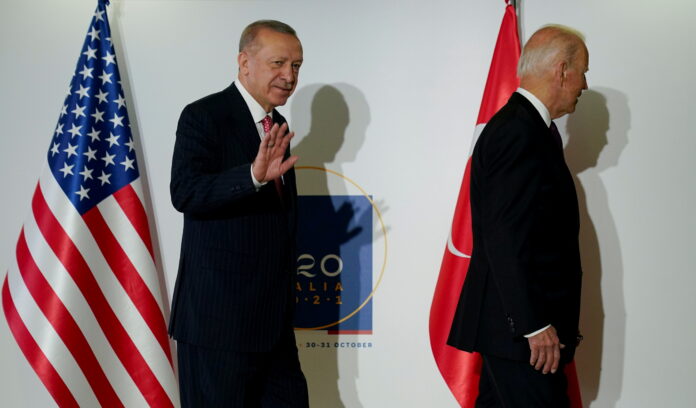
Turkey's President Tayyip Erdogan waves as he attends a bilateral meeting with U.S. President Joe Biden, on the sidelines of the G20 leaders' summit in Rome, Italy October 31, 2021. REUTERS/Kevin Lamarque

Turkey will conduct anti-terror cross-border operations ‘whenever necessary”, Erdogan stated.

“There is no stepping back from it,” he said in response to a question on a return flight from the G20 Leaders’ Summit held in Rome, Italy.
He called on NATO ally US that it “should not support terrorist organizations.”

On his meeting with US counterpart Joe Biden on the sidelines of the G20, Erdogan noted they discussed the procurement of F-16 fighter jets.

“I didn’t witness any negative approach,” he said of the meeting held on Sunday, adding that he hopes to conclude the “sensitive issue.”

He stated Turkey and the US agreed to focus “more intensely” on the economic ties, and discussed cooperation in Afghanistan, Syria, Libya, and the Eastern Mediterranean.

Erdogan added that he told the US and French presidents how establishment of a base in Alexandroupoli, Greece near Turkish border “seriously disturbs” Turkey.

Earlier, the Turkish president announced the US proposed the sale of F-16 fighter jets as compensation for Turkey’s payment for the F-35s.

In 2019, Washington announced that it was taking Turkey out of the F-35 stealth fighter jet program over Ankara’s purchase of the S-400, a Russian defense system it bought after its efforts to buy US Patriot missiles were rebuffed.

The US claimed the Russian system posed a safety risk. Turkey, however, stressed the S-400s would not be integrated into NATO systems, and thus pose no threat to the alliance or its armaments.

Ankara also repeatedly proposed setting up a commission to clarify the issue.