Wednesday, December 24, 2025
Home Blog Page 2272

Armenia, Azerbaijan agree ceasefire after deadly border clash

“Under the mediation of the Russian side, an agreement was reached to cease fire at Armenia’s eastern border from 18:30 (14:30 GMT). The situation has relatively stabilized,” the Armenian Defense Ministry announced in a statement.

The Azerbaijan government did not immediately confirm the ceasefire.

Armenia on Tuesday asked Russia to help defend it against Azerbaijan after a border clash in which it claimed 15 of its soldiers had been killed, 12 captured, and two combat positions had been lost.

The Azerbaijani and Armenian defense ministers have taken measures to stabilize the situation at the border after their telephone talks with their Russian counterpart, Sergey Shoigu. The situation near Mount Kilisali has normalized, the Russian Defense Ministry reported on Tuesday.

“Following telephone talks with the Azerbaijani and Armenian defense ministers conducted at the initiative of Russian Defense Minister Sergey Shoigu, the Azerbaijani and Armenian sides took measures to stabilize the situation. Hostilities near Mount Kilisali have been stopped, the situation has normalized and is under control,” it said.

According to earlier reports, Shoigu spoke over the phone with his Armenian and Azerbaijani counterparts and called on them to stop actions that might further escalate the situation.

The United Nations calls on Azerbaijan and Armenia to demonstrate restraint and use peaceful means to settle problems between themselves, Deputy Spokesperson for the Secretary-General Farhan Haq noted on Tuesday.

“We are following with concern the reports of this latest violence. And we’ll need to verify those reports. And at this point we urge all sides to exercise restraint, to act in accordance with the ninth of November and 11th of January trilateral statements and address any related concerns peacefully through dialogue. We want to avoid any return to the sort of escalation we had earlier,” he added.

The situation in Nagorno-Karabakh and the adjacent Syunik region in Armenia deteriorated dramatically in November. The sides regularly report armed incidents, including those entailing human casualties. On November 13, Yerevan and Baku exchanged accusations of shelling each other’s army positions. Apart from that, the situation is tense at the sections of the highway linking Armenia and Iran that came over under Baku’s control under the November 9, 2020, statement by the leaders of Armenia, Azerbaijani and Russia and where a post of Russian border guards was set up to ensure the free movement of people and motor vehicles.

On Tuesday, intensive hostilities sparked in border districts of Armenia’s Syunik Province. Yerevan stated that the Azerbaijani Armed Forces commenced an advance deeper into the republic’s territory, threatening the highway connecting the capital with Armenia’s southern regions and Iran. Baku blamed Yerevan, accusing the Armenian Armed Forces of a provocation. According to the Ministry of Defense of Azerbaijan, Armenian servicemen attacked Azerbaijani outposts.

Migrant swans land in Mazandaran wetlands


The wetlands of Sorkhrood in Mahmood Abad and Azbaran in Fereydoonkenar are hosing the migratory birds.  

IRIB quoted the head of Wildlife Supervision Office of Mazandaran’s Department General of Environmental Protection as saying each year, with the beginning of the cold season in the northern Caspian Sea and parts of Siberia, migrant swans begin flocking to the lower latitudes in the form of a small population in mid-November.

Kouros Rabiei said the arrival of migrant birds into the wetlands of Mazandaran Province depends on weather conditions. 

Rabiei added that the population of swans includes such species as the screamers (Faryadkesh) and the small ones (Kouchak) while most of the screamers land in the wetlands of Sarkhroodd in Mahmood Abad and Azbaran in Fereydoonkenar. 

He went on to say that most of the swans have entered the wetlands of the province since mid-December and with the gradual increase of temperature from the end of February, after three months of the winter, they will start migrating back to Siberia. 

Rabiei also said increased migration by birds and food shortages force the swans to move to other dams where they risk getting hunted.

WHO: Over 16mn Yemenis engulfed in food insecurity

The WHO has warned that 75 percent of Yemeni children suffer from acute malnutrition.

In a post on its Twitter account on Monday, the UN agency responsible for international public health warned that three out of four children in Yemen are “chronically malnourished.”

It also estimated that 16.2 million Yemenis – more than half of the country’s population of 30 million – are food insecure.

Acute malnutrition is responsible for almost one-third of all deaths in children under five years of age. It damages a child’s physical development and causes intellectual or cognitive impairment among those who survive. Malnutrition is largely irreversible, perpetuating illness, poverty, and inequality.

Back in February, four UN agencies, including the WHO, warned that acute malnutrition and severe acute malnutrition have increased by 16 and 22 percent, respectively, among Yemeni children under five years of age from 2020.

The figures are among the highest levels of malnutrition recorded in the country since the Saudi war began in 2015, they added.

“The increasing number of children going hungry in Yemen should shock us all into action,” said UNICEF Executive Director Henrietta Fore at the time.

“More children will die with every day that passes without action. Humanitarian organizations need urgent predictable resources and unhindered access to communities on the ground to be able to save lives,” Fore had noted.

Today, Yemen is one of the most dangerous places in the world for children to grow up, with high rates of communicable diseases, limited access to health services, and inadequate sanitation and hygiene systems.

Last month, the UN Security Council voiced “grave concern for the dire humanitarian situation [in Yemen], including prolonged starvation and the growing risk of large-scale famine, which is compounded by the dire economic situation.”

Saudi Arabia, supported by its regional and Western allies, launched the devastating military aggression against its southern neighbor in March 2015 in collaboration with a number of its allied states and with arms and logistics support from the US and several Western states.

The aim was to return to power the former Riyadh-backed regime and crush the popular Ansarullah movement which has been running state affairs in the absence of an effective government in Yemen.

The war has stopped well shy of all of its goals, despite killing tens of thousands of Yemenis and turning entire Yemen into the scene of the world’s worst humanitarian crisis.

Meanwhile, Yemeni forces have in recent months gone from strength to strength against the Saudi-led invaders and left Riyadh and its allies bogged down in Yemen.

Throughout the course of the war, the United States has supported and armed Saudi Arabia. The Ansarullah movement, which runs the Sana’a government, frequently refers to the war as the “US-Saudi aggression” to underscore Washington’s leading role in the war.

Despite his February promise to end “all American support for offensive operations in the war in Yemen, including relevant arms sales,” US President Joe Biden has recently approved $650 million worth of weapons purchases to Saudi Arabia.

Iran special envoy holds ‘constructive’ talks with Taliban officials

“We had positive and constructive talks with Afghan officials in different fields, including the economic sphere,” Hassan Kazemi Qomi said on Tuesday after discussions with Afghanistan’s Acting Minister of Foreign Affairs Amir Khan Muttaqi in Kabul.

Noting that Afghanistan is currently under foreign sanctions, the Iranian envoy said during the meeting, the Iranian and Afghan delegations agreed to pursue cooperation in the fields of agriculture, trade and fuel.

Kazemi Qomi said security issues were one of the important topics of discussion, noting that “Afghanistan is currently under pressure from the proxy terrorist groups of the occupiers who fled the country themselves but have continued the war through their proxy groups.”

He added that if stability and security is fully restored in Afghanistan, it will pave the way for construction and will lead to Afghanistan’s increasing regional and global interactions.

Kazemi Qomi said strengthening regional and international cooperation as well as the formation of an inclusive government in Afghanistan were also discussed in Kabul.

The acting Afghan foreign minister said for his part that Afghanistan wants good relations with Iran.

Iranian and Afghan delegations held good talks on different political and economic issues as well as refugee affairs and bilateral ties, he added.

“We hope that with the improvement of Afghanistan’s economic situation, bilateral relations will deepen,” the acting Afghan foreign minister stated.

The Iranian envoy arrived in Kabul on Monday at the head of a delegation for a 3-day visit.

Pakistani FM: We are bound to preserve ties with Iran

He said Pakistan is determined and bound to preserve its traditional partnership and excellent ties with Iran. Qureshi made those comments on Tuesday during a speech to officials, professors and students of the National Defense University affiliated to the Pakistani Army in Islamabad.

He was explaining Pakistan’s position on regional developments and foreign policy, especially relations with neighbors, including Iran.

Qureshi said Pakistan has always maintained its relations with Iran despite pressures. He added, “We have deepened the scope of our traditional partnership with influential countries in the Islamic world, especially Iran”. On the unity of the Islamic ummah, the Pakistani foreign minister said Islamabad has steadily tried to act as a bridge for détente and promotion of dialogue, even when the specter of war looms over the Middle East.

Qureshi described the issue of Afghanistan and helping peace in the country as a collective responsibility. He said Pakistan has played its role in promoting dialogue and reconciliation in Afghanistan despite the challenge of terrorism, the influx of refugees or false narratives. Qureshi also maintained that his country believes there is no military solution to the conflict in Afghanistan and a peaceful and prosperous Afghanistan is in the interest of Pakistan and the whole region.

Report: Israel bugs telephones in WB and Gaza

The Israeli military has reportedly bugged all mobiles and phones imported into Gaza and actively monitors the mobile networks operating in the occupied territories to find “pressure points” used to blackmail Palestinians.

At any given time, hundreds of Israel Defense Forces (IDF) troops are listening in on phone conversations in the West Bank and Gaza, a former member of the IDF’s ‘Unit 8200’ signals intelligence corps told the Middle East Eye news outlet.

The unidentified corpsman claimed that all mobiles and phones imported into Gaza through the southern Kerem Shalom crossing are implanted with an Israeli bug. Similarly, anyone making use of the occupied areas’ only two operational mobile networks – Jawwal and Wataniya – is apparently under surveillance.

Besides monitoring politically active Palestinians and potential security threats, Israel’s Shin Bet internal security service reportedly conducts an additional level of audio monitoring to identify adulterers and homosexuals who can be “pressured” to join its network of informants.

“This is an entire world in which the Shin Bet can acquire power over Palestinians that ultimately forces them to collaborate or reveal things about other people, and it is all part of the system of control,” he noted.

The IDF veteran said the “grunt work” behind this mass surveillance system is being carried out by soldiers who learned Arabic as part of their military service – and apparently are told by “the people around them” that “this is proper” and “there is no reason” to “think that what they are doing is not okay.”

These troops are reportedly monitored by Druze soldiers or soldiers of Syrian descent who are native Arabic speakers. The transcribed conversations are translated and sent to the IDF’s intelligence divisions and to the Shin Bet, stated the ex-soldier, who added that there were no limits to both Israel’s capabilities to invade Palestinian privacy and on what the soldiers can do with the “intimate conversations” they intercepted.

“People who are soldiers in the army would laugh when they heard sex talk. Soldiers save the conversations and send them to their friends. This is a very harsh invasion of the privacy of every Palestinian living there,” he declared.

Last week, reports emerged about the IDF using invasive facial recognition tech as part of a surveillance dragnet in the West Bank.

Iran concerned over new clashes between Armenia, Azerbaijan Republic

Khatibzadeh called on the two countries to exercise restraint and refrain from expanding and escalating the conflict.

He also stressed the need for countries to respect internationally recognized borders and called on the two sides to resolve their differences through dialog and peaceful means.

The Foreign Ministry spokesman described the current tensions as dangerous for the gradual process of achieving peace and progress in the region.

He stated that the Islamic Republic of Iran, as in the past, is ready to help the two sides resolve their disputes and establish stability and security in the region.

Yerevan says 15 Armenian troops were killed in fresh Azeri artillery fire and 12 soldiers were captured. It also added they have lost two combat posts near the border region.

Iran thrash Syria, edging closer to world cup

The first goal of the game that was held in Syria was scored by Sardar Azmoun in the 33rd minute as he latched on to a perfect through-ball by Vahid Amiri.

Haj Safi netted a second goal for Iran from the penalty spot in the 42nd minute. That was a VAR penalty awarded by the referee.

Iran’s 3rd goal came in a stunning style with a minute left on the clock, as Ali Gholizadeh displayed a combination of dribbling skills and persistence to remove a number of defenders, before scoring the goal.

Both halves saw plenty of opportunities open to Iran.

The win means Iran remain at the Top of Group A with 16 points, two clear of South Korea, after 6 rounds.

With this victory, Iran’s Team Melli broke its previous record for the number of consecutive wins.

Raisi: Iran very serious in Vienna talks

President Raisi reiterated Iran is equally serious about the realization of the rights of the Iranian people and removal of all anti-Tehran sanctions.

Iran says in the Vienna talks with Russia, China, Britain, France and Germany will focus on the lifting of the US sanctions and the full return of all parties to the JCPOA to their commitments under the deal. The Vienna talks are to resume by the end of November.

Raisi went on to appreciate Russia for defending Iran’s nuclear rights and pushing for the removal of all anti-Iran sanctions.

Raisi said Iran is determined to expand trade relations with Russia, adding “We are ready to finalize the comprehensive document of long-term cooperation between the two countries so that the process of further enhancing bilateral relations and cooperation can be implemented quickly”.

The Iranian president added opposing unilateralism and strengthening multilateralism are among shared views of Tehran and Moscow.

Raisi stressed the need for joint cooperation between the two countries in regional issues and said, “We consider the continued presence of foreigners in Syria as being against the will of the Syrian people and government and illegal because it threatens the stability and security of the country.”

He also said Iran believes that the presence of Daesh terrorists in Afghanistan is dangerous for the country and the wider region, and all regional nations must be aware of the dangers of this conspiracy.

Raisi added that the Islamic Republic of Iran wants an inclusive government in Afghanistan which would represent all ethnic groups and political factions.

He said, “We believe that the formation of such a government can guarantee Afghanistan’s security”.

Raisi also welcomed Russia’s initiative for stability and calm in the Caucasus region.

During the phone conversation, the two presidents also stressed that Iran and Russia will not accept any change in the geopolitics and the borders of regional countries. Raise also thanked the president and the government of Russia for their assistance in Iran’s membership in the Shanghai Cooperation Organization and for supplying Iran with Covid vaccine.

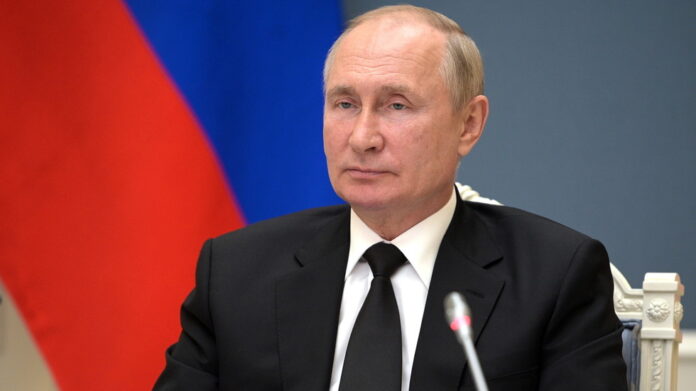
Putin for his part said Russia supports Iran’s proposal to draft a new document on long-term cooperation between the two countries, and that “we are determined to finalize the document as soon as possible”.

Putin said Russia views improving the level of economic relations and finalizing joint investment programs with Iran as highly important, adding, “We are witnessing positive willingness to increase the level of bilateral, regional and international cooperation between the two countries”.

Putin said Russia and Iran succeeded in preserving Syria’s independence and destroying terrorist hideouts there through their joint efforts.

The Russian president also supported the rights of the Iranian people regarding the nuclear issue. He expressed hope that in the upcoming negotiations, the parties will have sufficient political will to get out of the current situation.

The Russian president further expressed concern over the situation in the Nagorno-Karabakh region. Putin said, “We intend to launch a 3+3 advisory mechanism to increase the level of trust and cooperation in the region and we hope that the Islamic Republic of Iran will support this.”

The Russian president also said Moscow is determined to continue cooperating with Iran in its fight against the Covid pandemic and to sending vaccine shipments to the Islamic Republic for this purpose.

Covid-19 vaccine doses approaching 100mn mark in Iran

The Health Ministry said on Tuesday that over 585,000 shots had been administered over the past twenty four hours across the country bringing the total number to over 99,628,000.

The ministry also announced that nearly 56 million people in Iran have been fully vaccinated so far.

According the Health Ministry’s latest figures on Tuesday, 134 more people lost their lives to the respiratory disease over the past twenty four hours bringing the total number of fatalities to over 128,400.

Iran also reported over 6,000 new infection cases.

The country has been hit hard by five waves of the disease so far and has accelerated its vaccination campaign to prevent a sixth wave.

Health officials have declared 26 cities as red zones (high risk), 87 orange (medium risk) and 222 yellow (low risk). 113 cities are currently blue.