Thursday, December 25, 2025
Home Blog Page 2263

Iran wrestlers runners-up at world military championship

Iran won 4 gold, 4 silver, and two bronze medals and gained 210 points to finish runner-up in the 35th World Military Wrestling Championship.

The 35th World Military Wrestling Championship wrapped up Monday in the 12,000-seat hall of Tehran’s Azadi Stadium.

Iran team by Morteza Ghiyasi (65 kg), Bahman Teymouri (79 kg), Mohammad Hossein Mohammadian (97 kg), and Yadollah Mohebbi (125 kg) won gold medals.

Ahmad Mohammadnejad Javad (57 kg), Mohammad Baqer Yakhkashi (61 kg), Fariborz Babaei (74 kg), and Mohammad Hossein Mirbaghban (92 kg) won silver medals.

Mohammad Mehdi Yeganeh Jafari in the weight of 70 kg and Hadi Vafaeipour in the weight of 86 kg won bronze medals.

At the end of these competitions, the Russian team won first place with 215 points, the Iranian team became the runner-up with 210 points, and Armenia came in third with 140 points.

Iran: Illicit trade in small arms fuels terrorism

“We share the concerns about humanitarian, socio-economic and security consequences of the illicit trade in small arms and light weapons and their diversion to unauthorized recipients,” Majid Takht Ravanchi said in a Monday address to the High-Level Meeting of the General Assembly for the Appraisal of the United Nations Global Plan of Action against Trafficking in Persons.

He added that the “Program of Action to Prevent, Combat and Eradicate the Illicit Trade in Small Arms and Light Weapons in All Its Aspects” (PoA) is the only universal framework to address these multifaceted challenges.

“As a victim of foreign-backed terrorists, and faced with the threat of organized crime and trafficking in drugs linked to the illicit trade in small arms and light weapons, the Islamic Republic of Iran highly values the Program of Action and calls for ensuring its balanced, effective and full implementation including through identifying and addressing its implementation challenges,” Takht Ravanchi continued.

Iran’s ambassador to the UN stated that according to the Program of Action, “the illicit trade in small arms and light weapons in all its aspects sustains conflicts, exacerbates violence, contributes to the displacement of civilians, undermines respect for international humanitarian law, impedes the provision of humanitarian assistance to victims of armed conflict and fuels crime and terrorism”.

Takht Ravanchi, however, warned that in all efforts to combat the illicit trade in small arms and light weapons, the right of each country to manufacture, export, import and retain such weapons must be fully respected.

“Additionally, the scope of such efforts by the [Security] Council must be limited to those aspects that are related to serious adverse impacts of diversion of, and illicit trade in, small arms and light weapons on the conflict concerned,” he noted.

The US, Britain and some other Western governments have for years been involved in the provision of arms and weaponry to conflict zones across the world, and in particular, West Asia.

Earlier in the month, the US State Department approved the sale of $650 million worth of air-to-air missiles to Saudi Arabia to help Riyadh press ahead with its protracted military aggression against Yemen.

The package would include 280 AIM-120C-7/C-8 Advanced Medium Range Air-to-Air Missiles (AMRAAM), 596 LAU-128 Missile Rail Launchers (MRL) as well as support equipment and spare parts.

IAEA chief arrives in Tehran for talks

Rafael Grossi will hold negotiations with Foreign Minister Hossein Amir Abdollahian and Iran’s nuclear chief Mohammad Eslami.

Ahead of his trip, Grossi said he will discuss outstanding questions with Iranian officials and expressed hope for the establishment of “a cooperative channel of direct dialog so the IAEA can resume essential verification activities”.

Grossi’s visit is taking place just before a meeting of the IAEA’s 35-nation Board of Governors in the coming days.

On Monday, Iranian officials stepped up their calls on the international agency to resist political pressure.

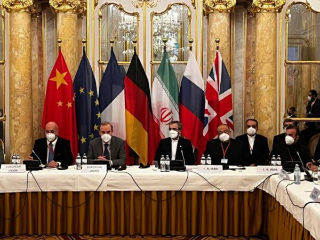
Grossi’s trip comes as negotiators from Iran and the remaining parties to the Joint Comprehensive Plan of Action prepare to convene in Vienna for their seventh round of talks this year, with Tehran insisting that the process must lead to the removal of unilateral U.S. sanctions.

People in Iran’s Shahrekord hold protest over water problems

The protesters marched to the office of the governor general on Monday urging officials to fulfill their promises regarding provincial water issues including an uncompleted water transfer project.

They also chanted slogans expressing opposition to the transfer of the province’s water to other parts of the country.

Chaharmahal and Bakhtiari Province is among many of Iran’s provinces that have experienced lower rainfall in recent years.

Authorities have been using tankers to deliver water to two hundred cities and villages in this western province.

Monday’s protest comes days after thousands of people in the central city of Isfahan staged a demonstration against projects resulting in a major river drying up there.

The people in Isfahan are critical of the development of water-intensive industries in central Iran and want the re-distribution of the Zayandeh Rud River’s water to other cities to stop.

Iran is ranked among the world’s arid countries with its annual precipitation levels at about one-third of the global average. Hundreds of Iranian cities and villages, mostly in the central and southern parts of the country, are water-stressed with significantly lower rainfall in recent years.

Iran embassy urges Intl. community help with refugee influx

The embassy posted a video on its Twitter account with a message that says some 300 thousand Afghan refugees have entered Iran since the Taliban takeover of Afghanistan in August.

The tweet also said hundreds of thousands of other Afghans could enter Iran in the coming months and the global community should provide the Afghans with tangible support.

Earlier, Iran’s ambassador to Brussels underlined the necessity of Western governments assuming their responsibility in this regard, saying the Islamic Republic has done all it could for the displaced Afghans.

The Iranian diplomat was speaking at a conference on the ramifications of the Afghanistan situation for the Silk Road area. He noted that what is necessary for the time being is to set up makeshift hospitals along the border because hospitals inside Iran are already facing serious shortages and an outbreak of infectious diseases is a possibility given the huge crowds in the border areas.

The Iranian ambassador to Brussels said only 35 thousand out of the 4 million Afghans in Iran have been settled in camps and the rest of them are in urban areas. He added that no one in Iran forces a migrant to leave the country against their will.

The Iranian envoy however urged other countries to follow suit and avoid deporting refugees. He said those who expect regional countries to take in migrants and refugees should treat them well.

Top Iran negotiator calls on IAEA to resist political pressure

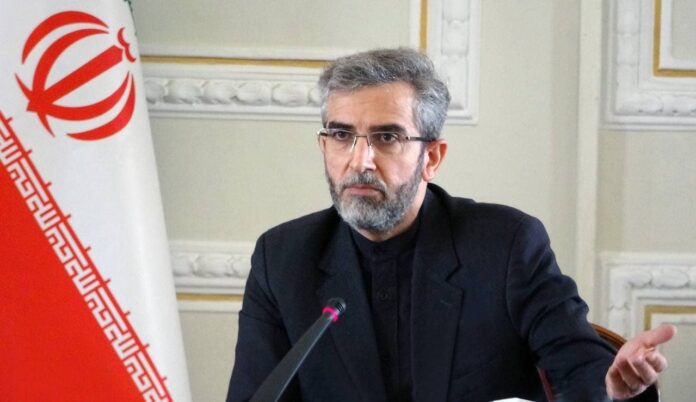
Bagheri Kani made the remarks in an interview with Al Jazeera TV Channel on Monday ahead of a visit by IAEA Chief Rafael Grossi to Tehran as Iran and world powers prepare for talks later this month in Vienna.

The deputy foreign minister said there is no reason for Iran to back down from its nuclear policy if the other side fails to adhere to its commitments, adding that “the United States has no choice but to accept the new reality regarding the nuclear deal”.

He stressed that the focus should now be on the seriousness of the Vienna talks and that Tehran wants the lifting of oppressive sanctions.

“We want guarantees that sanctions will be lifted, and Washington must provide them in the Vienna talks,” the top Iranian negotiator added.

He also warned that the window of opportunity provided by the nuclear deal will not remain open forever.

IAEA chief expresses hope for constructive Iran visit

afael Grossi
Director General of the International Atomic Energy Agency, IAEA, Rafael Mariano Grossi from Argentina, addresses the media during a news conference behind plexiglass shields regarding the agency's monitoring of Iran's nuclear energy program at the International Center in Vienna, Austria, Monday, June 7, 2021. (AP Photo/Lisa Leutner)

“I’m travelling to Tehran today for meetings with Iranian officials to address outstanding questions in Iran,” Grossi wrote on Twitter on Monday.

“I hope to establish a fruitful and cooperative channel of direct dialogue so the IAEA can resume essential verification activities in the country,” the head of the UN’s atomic agency added.

Tehran has expressed hope Grossi’s visit would be “constructive”.

Grossi was expected to meet Foreign Minister Hossein Amir Abdollahian and Mohammad Eslami, the chief of Iran’s Atomic Energy Organization (AEOI).

Iran has stopped observing some conditions of the Joint Comprehensive Plan Of Action (JCPOA) in 2019, after the United States withdrew from the plan in 2018 under then President Donald Trump and began imposing sanctions on Tehran.

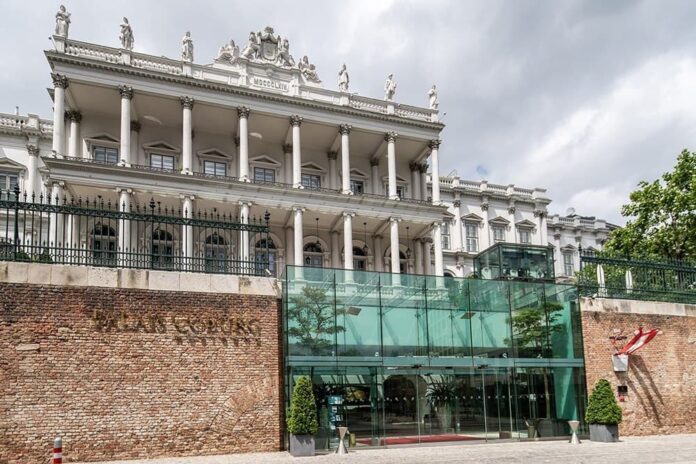
Representatives of Tehran and the other signatories of its 2015 nuclear deal will be in Austria starting November 29 to try to restore the Iran nuclear deal.

Report: US warns Israel against attacking Iran nuclear sites

According to the report published by the American daily newspaper New York Times on Sunday, Americans have praised the Tel Aviv regime for the attack against Iran’s nuclear facilities in the central city of Natanz and the assassination of Iran’s top nuclear scientist Mohsen Fakhrizadeh last year and described the criminal acts as “tactically satisfying”, but stated they are “ultimately counterproductive”.

However, officials familiar with the behind-the-scenes discussion between Washington and Tel Aviv said that Israeli officials have dismissed the warnings in return.

The report added that the matter was among many disagreements between the United States and Israel on how to stop Tehran’s civilian nuclear program.

Further complicating the issues was the fact that Iran has apparently managed to improve its defenses, particularly in the cyberspace, the NYT report said, meaning that launching cyber-attacks like the one by the malicious Stuxnet computer virus that was created jointly by the United States and Israel to damage Iran’s peaceful nuclear facilities, was no longer as effective.

As a consequence, cyber-attacks against Iran’s nuclear program have become “much harder now to pull off”, the report added.

With the “fading chance of Washington’s return to the 2015 nuclear deal” – officially known as the Joint Comprehensive Plan of Action (JCPOA), the United States was examining the possibility of hammering out an interim deal with Iran, the report said.

“Inside the White House, there has been a scramble in recent days to explore whether some kind of interim deal might be possible to freeze Iran’s production of more enriched uranium and its conversion of that fuel to metallic form,” according to The Times.

It added, “In return, the United States might ease a limited number of sanctions. That would not solve the problem. But it might buy time for negotiations, while holding off Israeli threats to bomb Iranian facilities.”

Iran has on occasions warned the Tel Aviv regime against any adventurism toward the Islamic Republic amid renewed Israeli threats of “nuclear terrorism”.

Back in October, Iran’s security chief brushed aside reports about Israel’s budget for a potential attack on Iranian nuclear facilities, saying the regime must consider the colossal cost of repair after Tehran’s “shocking” response.

The Times of Israel, citing a report published by Channel 12, reported earlier that Israeli officials had approved a budget of five billion shekels ($1.5 billion) to purchase high-powered weapons and equipment in preparation for a possible attack against Iranian nuclear facilities.

Around $600 million will be added to the previous $900 million budget for acquiring aircraft, intelligence-gathering drones, and weapons that can destroy heavily fortified underground sites, according to the report.

“Instead of allocating 1.5 billion dollars budget for atrocities against #Iran, the Zionist regime should focus on providing tens of thousands of billion dollars funding to repair the damage that is going to be caused by Iran’s shocking response,” Secretary of Iran’s Supreme National Security Council Ali Shamkhani stated in tweets he posted in Persian, Arabic, English, and Hebrew.

Envoys from Iran and the P4+1 group of countries — Britain, France, Russia, and China plus Germany — are expected to hold the seventh round of discussions in the Austrian capital city of Vienna in late November.

Former US President Donald Trump left the JCPOA in May 2018 and reimposed the anti-Iran sanctions that the deal had lifted. He also placed additional sanctions on Iran under other pretexts not related to the nuclear case as part of his “maximum pressure” campaign.

Following a year of strategic patience, Iran resorted to its legal rights under the JCPOA, which grants a party the right to suspend its contractual commitments in case of non-compliance by other signatories and let go of some of the restrictions imposed on its nuclear energy program.

The US administration of Joe Biden has announced it is willing to compensate for Trump’s mistake and rejoin the deal, but it has shown an overriding propensity for maintaining the sanctions as a tool of pressure.

Tehran insists that all sanctions must first be removed in a verifiable manner before the Islamic Republic reverses its “remedial measures”.

Russia: IAEA chief’s Iran visit “good opportunity” for cooperation

“On November 22-23 the IAEA Director General will pay a visit to Tehran,” Mikhail Ulyanov, Russia’s ambassador to international organizations in Vienna, wrote in a tweet on Sunday.

The visit “will be a good opportunity for the Agency and the new authorities in Iran to establish closer contacts and cooperation on issues of common interest”, he stated, adding, “We wish the two sides to have productive discussions!”

During his visit to Tehran, Grossi is scheduled to hold talks with Iran’s Foreign Minister Hossein Amir Abdollahian and the head of the country’s atomic energy organization, Mohammad Eslami.

Grossi’s trip comes ahead of the meeting of the 35-nation Board of Governors as well as the much-anticipated talks in the Austrian capital, Vienna, on the removal of US sanctions on Iran.

Earlier this month, the IAEA chief complained that he had “no contact” with the new Iranian administration of President Ebrahim Raeisi.

Tehran dismissed the claim, stressing that on the contrary, he had had close consultations with both the Atomic Energy Organization of Iran (AEOI) and the Iranian embassy in Vienna.

“An invitation has been extended to him and a date for his trip has been proposed as well,” Iranian Foreign Ministry spokesman Saeed Khatibzadeh announced at a press conference last week, adding that Iran was awaiting a response.

The Islamic Republic has invariably welcomed cooperation with the IAEA’s officials, but at the same time, it has warned the body against falling under the influence of third parties as it calibrates its relations with Tehran.

UN warns Afghanistan banking system at risk of collapse

In a three-page report on Afghanistan’s banking and financial system seen by Reuters, the UN Development Programme (UNDP) said the economic cost of a banking system collapse – and consequent negative social impact – “would be colossal.”

An abrupt withdrawal of most foreign development support after the Taliban seized power on Aug. 15 from Afghanistan’s Western-backed government has sent the economy into freefall, putting a severe strain on the banking system which set weekly withdrawal limits to stop a run on deposits.

“Afghanistan’s financial and bank payment systems are in disarray. The bank-run problem must be resolved quickly to improve Afghanistan’s limited production capacity and prevent the banking system from collapsing,” the UNDP report added.

Finding a way to avert a collapse is complicated by international and unilateral sanctions on Taliban leaders.

“We need to find a way to make sure that if we support the banking sector, we are not supporting Taliban,” Abdallah al Dardari, head of UNDP in Afghanistan, told Reuters.

“We are in such a dire situation that we need to think of all possible options and we have to think outside the box,” he continued, adding, “What used to be three months ago unthinkable has to become thinkable now.”

Afghanistan’s banking system was already vulnerable before the Taliban came to power. But since then development aid has dried up, billions of dollars in Afghan assets have been frozen abroad, and the United Nations and aid groups are now struggling to get enough cash into the country.

The UNDP’s proposals to save the banking system include a deposit insurance scheme, measures to ensure adequate liquidity for short- and medium-term needs, as well as credit guarantees and loan repayment delay options.

“Coordination with the International Financial Institutions, with their extensive experience of the Afghan financial system, would be critical to this process,” UNDP said in its report, referring to the World Bank and International Monetary Fund.

The United Nations has repeatedly warned since the Taliban took over that Afghanistan’s economy is on the brink of a collapse that would likely further fuel a refugee crisis.

UNDP said that if the banking system fails, it could take decades to rebuild.

The UNDP report added that with current trends and withdrawal restrictions, about 40% of Afghanistan’s deposit base will be lost by the end of the year. It said banks have stopped extending new credit, and that non-performing loans had almost doubled to 57% in September from the end of 2020.

“If this rate continues of non-performing loans, the banks may not have a chance to survive in the next six months. And I am being optimistic,” al Dardari stated.

Liquidity has also been a problem. Afghan banks heavily relied on physical shipments of US dollars, which have stopped. When it comes to the local afghani currency, al Dardari said that while there is about $4 billion worth of afghanis in the economy, only about $500,000 worth is in circulation.

“The rest is sitting under the mattress or under the pillow because people are afraid,” he added.

As the United Nations seeks to avert famine in Afghanistan, al Dardari also warned about the consequences of a banking collapse for trade finance.

“Afghanistan last year imported about $7 billion worth of goods and products and services, mostly foodstuff … If there is no trade finance the interruption is huge,” he said, adding, “Without the banking system, none of this can happen.”