Friday, January 16, 2026
Home Blog Page 1466

Muharrem Ince withdraws from Turkey presidential race, boosting Erdogan’s main challenger

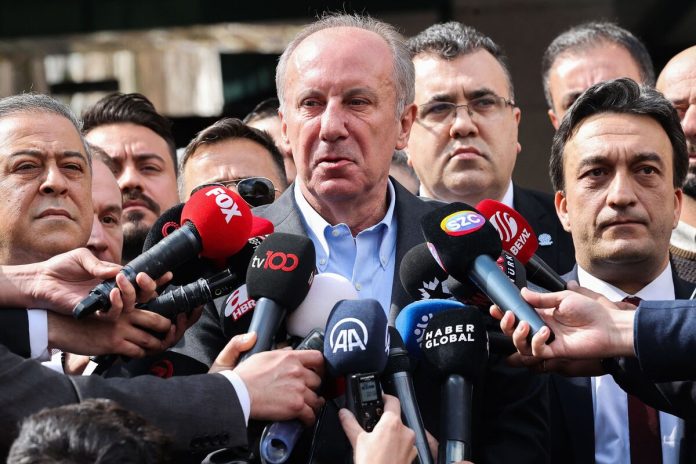
Muharrem Ince

“I’m withdrawing my candidacy,” Ince told reporters, adding, “I am doing this for my country.”

Before his withdrawal on Thursday, Ince was one of four candidates in the vote, alongside Erdogan, his main opponent Kemal Kilicdaroglu and Sinan Ogan. A survey earlier showed Erdogan lagging Kilicdaroglu by more than five percentage points ahead of the election.

In a statement, Ince blamed an apparent smear campaign against him as the reason behind his decision to pull out from the race.

“Turkey could not protect my reputation. A presidential candidate’s reputation is important,” said Ince.

He called on voters to support his Homeland Party, stating, “The Homeland Party is important for Turkey’s future. It must be in the parliament. I want votes for the Homeland Party from every household.”

Ince also hit out at the opposition, saying: “When they [the opposition] lose the election they will put the blame on us. They shouldn’t have any excuses left.”

The 59-year-old was was the only contender without an alliance backing him. He branded the Homeland Party and his movement as the “third way”.

Ince was a former deputy of centre-left Republican People’s Party (CHP) and candidate for the 2018 election, where he came second. He later split from the party, which he is critical of.

Ince added Turkish social democrats and secular nationalists should unite against “Islamist” political parties.

His confrontational manner has led to scraps with journalists, and Kilicdaroglu supporters believed he was taking away support from their candidate and helping Erdogan.

Ince came under ferocious criticism from the opposition for entering the campaign.

Most saw him as a spoiler candidate who could only help Erdogan secure a third decade of rule.

Ince countered that he offered voters a more vibrant alternative to the 74-year-old Kilicdaroglu – a bookish former civil servant, who lost a string of national elections against Erdogan.

Ahead of his withdrawal, Ince had promised to send refugees back to their home countries and “restore” secularism in Turkey if he captured the presidency.

The last opinion polls showed Kilicdaroglu leading Erdogan by a few percentage points and falling just short of breaking the 50-percent threshold needed for a first-round win.

Ince’s popularity has been ebbing away after touching nearly 15 percent.

The latest surveys showed him picking up between two and four percent of the vote.

But that might be enough to put Kilicdaroglu over the top.

The Metropoll survey showed 30.5 percent of Ince’s support falling to Kilicdaroglu and 23.4 percent going to Erdogan.

Ince notably did not endorse any candidate after dropping out.

His name will also still appear on the presidential ballot.

A fourth minor candidate – nationalist Ogan – is believed to be mostly drawing votes away from Erdogan.

“Another crazy day in Turkish politics,” emerging markets economist Timothy Ash remarked.

“Ince withdraws, with the assumption that most of his votes now go to Kilicdaroglu, making it possible/more likely of a (Kilicdaroglu) first round win.”

Kilicdaroglu has been appealing for days for Ince to formally back his candidacy.

Erdogan, meanwhile, has been staging daily rallies at which he announced incentives and bonuses to voters aimed at spurring support.

The 69-year-old Turkish leader pledged on Thursday to double the size of a previously promised wage hike for public workers.

Iran Covid cases become double-digit after weeks

COVID in Iran

“A sum of 76 new patients infected with COVID-19 have been identified in the country based on confirmed diagnosis criteria during the past 24 hours,” the Iranian Health Ministry’s Public Relations Center said on Thursday, and added, “49 patients have been hospitalized during the same time span.”

It further announced that the total number of COVID-19 patients has increased to 7,610,544.

“Unfortunately, five patients have lost their lives in the past 24 hours, increasing the number of the dead to 146,198,” the ministry noted.

It expressed satisfaction that 7,363,099 coronavirus patients have recovered or been discharged from hospitals so far.

The center went on to say that 431 cases infected with COVID-19 are in critical conditions.

It added that 56,507,766 coronavirus diagnosis tests have so far been carried out across the country.

The health ministry public relations warned that 11 cities are orange, 146 cities are yellow, and 291 cities are blue.

Azerbaijan and Armenia accuse each other of border shelling

Armenian Soldier

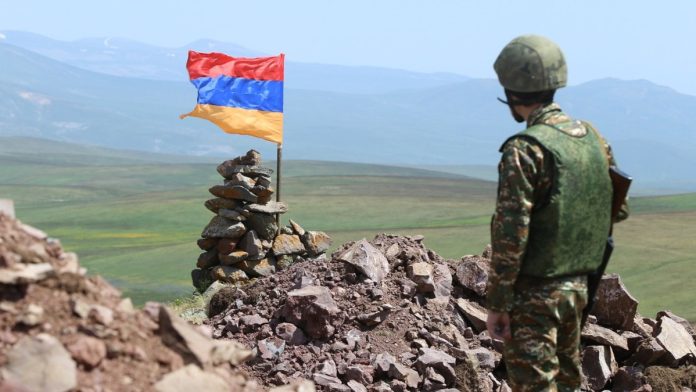
Armenia claimed that Azerbaijani military launched an artillery and mortar attack on its servicemen near the village of Sotk around 6:00am local time (2:00am GMT).

The shelling continued for several hours and wounded at least three Armenian troops, the country’s defense ministry said, adding that it would report on their condition later. It also accused Azerbaijan of targeting an ambulance as it was evacuating one of the injured soldiers.

“The units of the Armenian Armed Forces are taking appropriate preventive and defense measures” in response to the actions by the neighboring country, the ministry said.

The situation in other areas along the border between the two former Soviet republics remains “stable,” it added.

Azerbaijan’s Defense Ministry has rejected as misinformation Armenian reports about an attack by Azerbaijani army units on an ambulance vehicle carrying an Armenian serviceman.

Baku has insisted that it was responding to an attack by Armenian forces late on Wednesday. Yerevan has rejected this claim.

Mortar and artillery fire continued from the other side of the border on Thursday morning, Azerbaijan’s Defense Ministry said, adding that it was performing “the needed countermeasures.”

Armenia has carried out “a deliberate provocation” and has “once again violated the ceasefire,” the ministry insisted.

Despite the flareup, Armenian Prime Minister Nikol Pashinyan said he still intends to travel to Brussels on Sunday for talks with Azerbaijani President Ilham Aliyev. However, he made it clear that the possibility of a peace deal being signed during the meeting was “very low” as the draft treaty still needs work.

Armenia and Azerbaijan are engaged in a decades-old dispute over Nagorno-Karabakh, a part of Azerbaijan with a predominantly ethnic Armenian population, which declared independence from Baku in the early 1990s. In 2020, the two neighbors fought a 44-day war for control of the area, which concluded in a truce brokered and monitored by Russia.

However, tensions have still remained high between Yerevan and Baku, resulting in sporadic border incidents. The most intense flare-up occurred last September, when clashes led to dozens of casualties on both sides.

Local police chief killed while chasing drug smugglers in southern Iran

Crime Scene

Major Mohammad-Reza Assadollahi, chief of Charak Police Station, was involved in a pursuit of vehicles carrying narcotics when one of the cars being chased hit the police vehicle, causing it to overturn.

Major Assadollahi was in that vehicle and died in the incident.

Police had surveilled the smugglers and set up a checkpoint along a road where the smugglers were believed to use.

Two vehicles were warned to stop but refused and sped on.

Police forces, including Major Assadollahi, then launched the pursuit.

The vehicles were ultimately stopped and one of the smugglers was arrested. Some 150 kilograms of narcotics were discovered.

Police is looking for the rest of the suspects.

Over the last four decades, thousands of Iranian forces have been killed in the country’s all-out war on drug traffickers.

Iranian Minister of Economy in Saudi Arabia on official visit

Ehsan Khandouzi

The visit will feature bilateral talks with Saudi Arabian officials and participation at a meeting of the Islamic Development Bank, where he will deliver a speech.

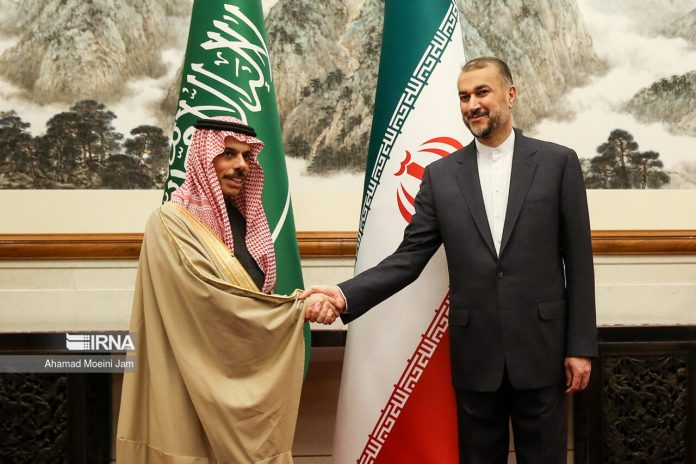
This marks the first visit by an Iranian official to Saudi Arabia since the two countries reached a China-brokered reconciliation agreement.

Iranian Foreign Minister, Hossein Amirabdollahian said on Wednesday that Tehran will soon appoint its ambassador to Riyadh.

Iran says to “soon” appoint envoy to Saudi Arabia

Hossein Amirabdollahian and Prince Faisal bin Farhan Al Saud

The top diplomat made the remarks in an interview with ICANA, a news agency affiliated with the Iranian Parliament, that was published on Wednesday.

He noted the details of the reopening of the Saudi embassy in Tehran will soon be announced.

The restoration of ties between Iran and Saudi Arabia provides a “great capacity” that could serve the interests of the two countries, the region, and the Muslim world, Amirabdollahian added.

The remarks come as the foreign ministers of the two states held their first meeting in seven years in Beijing on April 6, stressing the need to implement the reconciliation agreement signed on March 10.

Speaking on Monday in his weekly press conference, Iranian Foreign Ministry spokesman Nasser Kanaani said that “good progress” has been made in the reopening of diplomatic missions.

“Based on the agreement and the practical determination, we have had good progress in the process of making diplomatic missions ready,” he continued, adding that “more time” is needed because the buildings have not been used for years.

“We are in the final stages of preparing the missions,” said the diplomat, hoping that they would be officially reopened in the “shortest time” possible.

“Political relations between Iran and Saudi Arabia are practically in place,” Kanaani noted, adding that Tehran is “optimistic” about the continuation of this reconciliation based on both sides’ determination and goodwill.

Technical delegations from Tehran and Riyadh have already visited the diplomatic missions in the past weeks to make the necessary arrangement and preparations for reopening.

Iran and Saudi Arabia agreed to restore their diplomatic ties and reopen their embassies after several days of intense talks hosted by China on March 10.

In a joint statement after the agreement, Tehran and Riyadh stressed the importance of respecting each others’ national sovereignty and avoiding interference in each other’s internal affairs.

They also agreed to implement a security cooperation agreement from April 2001 and another accord from May 1998 to enhance their cooperation in various fields, such as economy, trade, investment, technology, science, culture, sports, and youth affairs.

The détente can reduce tensions in a region that has been plagued by instability for decades.

Saudi Arabia severed diplomatic relations with Iran in January 2016 after Iranian protesters, enraged by the execution of prominent Shia cleric Sheikh Nimr Baqir al-Nimr by the Saudi government, stormed its embassy in Tehran.

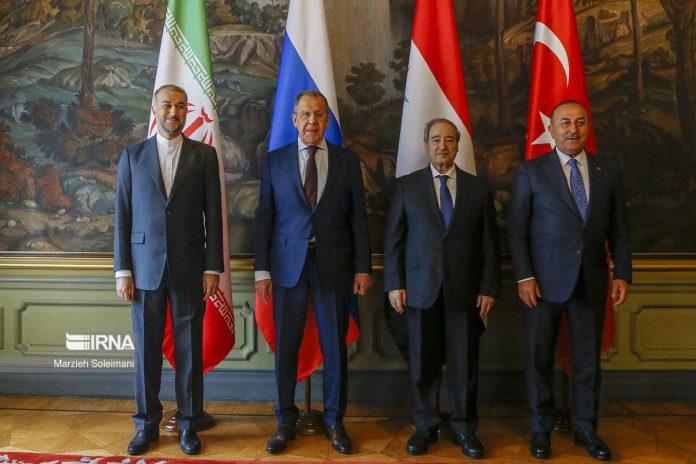
Russia quartet meeting: Senior diplomats call for respect for Syria’s sovereignty, territorial integrity

FMs Iran Russia Turkey Syria

Top diplomats from Iran, Turkey, Russia and Syria have wrapped up their landmark summit on the Syrian conflict in Moscow, underscoring the Arab country’s sovereignty and territorial integrity, and setting up a roadmap to improve strained ties between Damascus and Ankara.

The foreign ministers made the remarks in a final communiqué at the end of the four-party meeting aimed at reconciliation and resumption of ties between Damascus and Ankara in various dimensions on Wednesday.

“Pursuant to UN Security Council Resolution 2254 and official statements in the Astana process, the participants emphasized their commitment to the territorial integrity of Syria, non-interference in its internal affairs and fighting all forms of terrorism, separatism and extremism in the country,” the final communiqué said.

Endorsed in 2015, Resolution 2254 supports a Syrian-led political process facilitated by the United Nations.

“They also emphasized the importance of increasing international humanitarian aid to Syria with the aim of facilitating the voluntary, safe and dignified return of Syrians to their homeland and post-war reconstruction,” it added.

According to the final communiqué, the participants agreed that deputy foreign ministers of the four countries should undertake the task of preparing a roadmap for advancing relations between Turkey and Syria in coordination with their defense ministries and intelligence chiefs.

There had been a “positive and constructive atmosphere” in the exchange of views, the communiqué said, and the ministers agreed that high-level technical contacts and discussions will continue in the same four-party format in the future.

The agreement comes a week after Syria and Arab governments meeting in Jordan agreed to set up a roadmap of their own to resolve the Syrian conflict and improve ties.

Syria has been returning to the Arab fold and restoring relations with its neighbors in a slow but steady process that culminated with a decision Sunday by the Arab League to reinstate Syria’s membership after 12 years.

Turkey severed its relations with Syria in March 2012, a year after the Arab country found itself in the grip of rampant and deadly violence waged by foreign-backed militants, including those supported by Ankara.

Since 2016, Turkey has launched several military incursions in northwest Syria and captured an important enclave previously held by US-backed Kurdish forces fighting the Assad government.

Russia and Iran, on the other hand, entered Syria at the request of Damascus, and played a key role in defeating the terrorists and reclaiming much of the country back.

Syria and Turkey are currently taking steps toward reconciliation after 11 years.

In the last bid to mend ties between Ankara and Damascus, the defense ministers and intelligence chiefs of Russia, Syria, Turkey, and Iran met in Moscow late last month and discussed the withdrawal of Turkish troops from Syria.

The process of normalizing ties between Ankara and Damascus kicked off on December 28, 2022, when the Russian, Syrian and Turkish defense ministers met in Moscow, in what was the highest-level meeting between the two sides since the outbreak of the Syrian conflict.

Syrian President Bashar al-Assad stated in January that a rapprochement with Turkey would depend on Turkey ending its occupation of northern Syria and its support for militant groups fighting against the Damascus government.

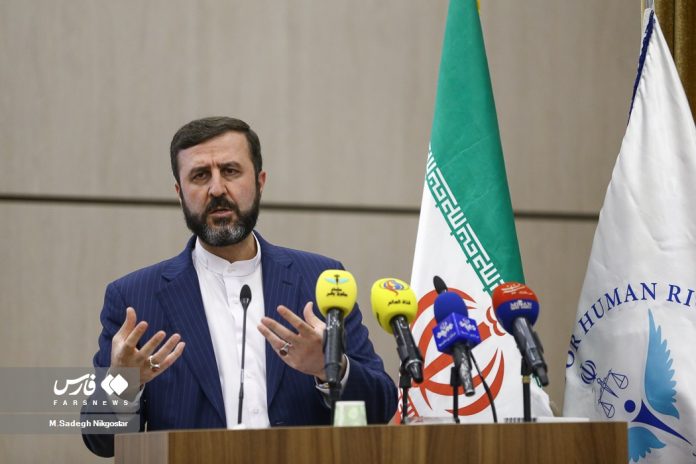
Iran’s rights chief: All terror grouplets enjoy safe haven in Sweden

Kazem Gharibabadi

Kazem Gharibabadi, secretary of Iran’s High Council for Human Rights and the Judiciary chief’s deputy for international affairs, dismissed the condemnation of Tehran by Sweden and other Western countries over the execution of the ringleader of the notorious Harakat al-Nidal terrorist group, Habib Farajollah Cha’ab.

Cha’ab, an Iranian-Swedish national, had been found guilty of spreading “corruption on earth,” a capital offense under Iranian law, through forming and leading a criminal group for the purpose of carrying out terrorist attacks in Iran’s Khuzestan Province, which the outfit seeks to separate from Iran.

In one case, he was the mastermind of a terror attack on a military parade in the city of Ahvaz in 2018, which killed dozens of people, including civilians.

Sweden summoned Iran’s envoy over the execution.

Gharibabadi denounced Sweden for providing “all types of intelligence and security support” to Cha’ab.

Although Iran had received an Interpol red notice for Cha’ab and he was identified and arrested in one of the Eastern European countries, Sweden immediately intervened and took him back to the country on a special plane, he explained.

“We did not see even a single statement from the Western countries and Sweden condemning the terrorist acts of this person,” he said.

“The fact that they condemn the Islamic Republic of Iran after the execution of the verdict is of no value to us.”

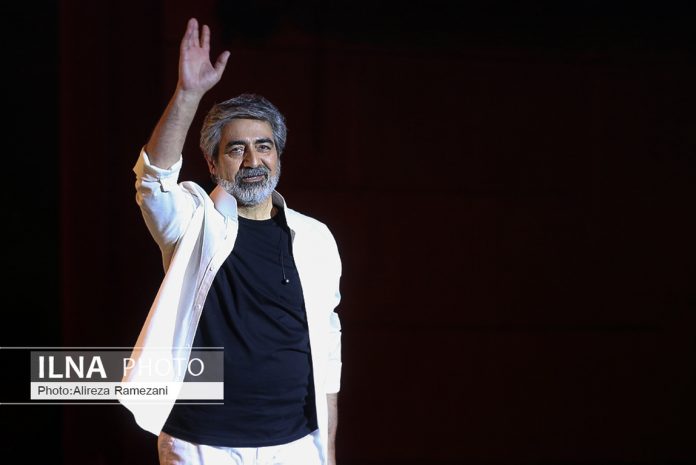
Iranian pop singer Hossein Zaman dies of cancer at 63

Hossein Zaman

His son, Abouzar, announced the sad news on his Instagram page on Thursday, months after Zaman was hospitalized due to cancer-related complications.

“My dad is gone. My dad is gone forever,” he wrote.

He was a popular singer in the 1990s. Zaman stood away from his profession for some 18 years and released only a handful of tracks over those years.

He returned to stage for a last concert in 2018.

Fourth Palestinian military commander killed in Israeli raid on Gaza as ceasefire falters

Israel Gaza

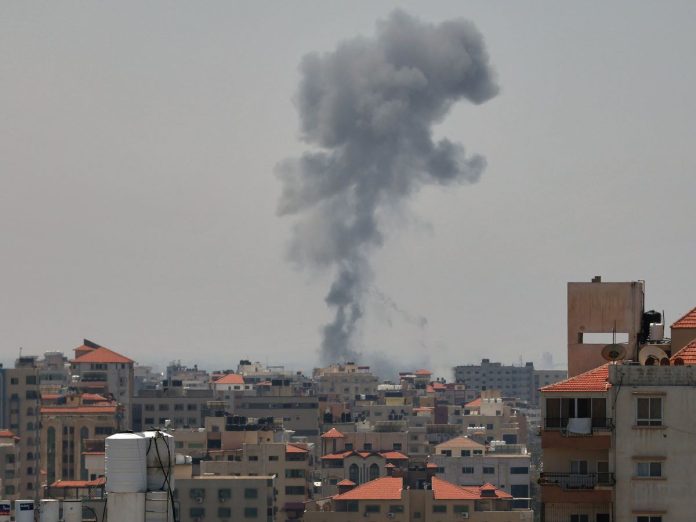
The strikes targeted a building in Hamad Residential City, near Khan Younis in southern Gaza strip early on Thursday.

“Ali Ghali… commander of the rocket launch unit… was assassinated in the south of the Gaza Strip along with other martyrs,” said a statement from the al-Quds Brigades, the resistance group’s armed wing.

Israel has been staging back-to-back aerial assaults against the blockaded Palestinian enclave since Tuesday.

At least 24 Palestinians have been killed and dozens of others injured as a result of the incessant aggression. The fatalities include three other senior commanders of the Islamic Jihad as well as their wives and children.

On Wednesday, Palestinian resistance groups in Gaza fired a new batch of retaliatory rockets towards Israeli cities, including Tel Aviv, in response to the regime’s deadly air raids.

Gaza’s joint command of Palestinian resistance groups said in a statement that it had fired “hundreds” of rockets towards the occupied Palestinian territories in an operation codenamed “revenge of the free.”

“The resistance will remain in all fronts of the homeland as one unit, a sword and a shield for our people, our land and our holy sites,” the statement read.

“The resistance is ready for all options, and if the occupation persists in its aggression and arrogance, black days await it,” it added.

Tel Aviv has admitted that the at least 400 rockets were fired towards the territories from the besieged Gaza Strip.

A state-run Egyptian TV station announced that Egypt, a frequent mediator between the sides, had brokered a ceasefire on Wednesday. Israeli officials confirmed that Egypt was trying to facilitate a ceasefire.

But truce efforts appeared to falter as fighting intensified late in the day, with neither side showing any sign of backing down.

In a prime-time TV address, Israeli Prime Minister Benjamin Netanyahu claimed that Israel dealt a harsh blow to the fighters.

“This round is not over,” he said, adding, “We say to the terrorists and those who send them: ‘We see you everywhere. You can’t hide, and we choose the place and time to strike you.’”

On Wednesday, the United Nations Secretary-General Antonio Guterres condemned the Israeli regime’s massacre of civilians in the besieged Gaza Strip as “unacceptable”.

The UN chief urged the occupying regime to “immediately” stop the bloodshed, said Farhan Haq, deputy UN spokesperson.

“Israel must abide by its obligations under international humanitarian law, including the proportional use of force and taking all feasible precautions to spare civilians and civilian objects in the conduct of military operations,” Haq added.

Tor Wennesland, the UN’s Middle East Special Coordinator for the Middle East Peace Process, has said the deaths of “civilians” from Israeli air attack was “unacceptable”.

“I condemn the deaths of civilians in the Israeli airstrikes. This is unacceptable,” he wrote in a statement.

“I urge all concerned to exercise maximum restraint and avoid an escalation,” he added.

Also on Wednesday, the Arab League regional grouping’s Council condemned the “barbaric Israeli raids on the Gaza Strip, which targeted civilians, children, and women in residential neighborhoods while they were sleeping safely in their homes.”