Russian forces captures Bakhmut: Wagner Group head
Head of Wagner Group Yevgeny Prigozhin said on Saturday that Russian forces had fully gained control of Bakhmut (Artemovsk).
“On May 20, 2023, today, at noon, Artemovsk was entirety taken,” Prigozhin announced in a video posted on Telegram.
Artemovsk is north of the large city of Gorlovka. The city is an important transport hub with many crossroads for Donbass and served as a vital center for supplying Ukrainian troops stationed in the region at the beginning of the military operation launched by Russia in Ukraine over a year ago.
G7 members express continued support for Ukraine
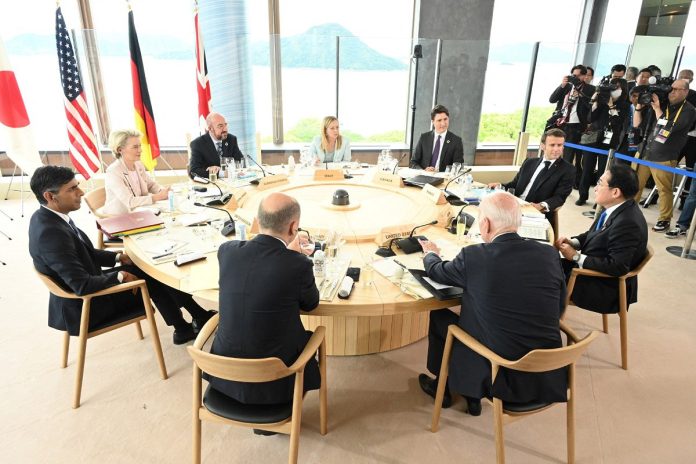
There have been plenty of photos and statements appearing on the social media accounts of the G7 and EU leaders that convey their continued support for Ukraine.
In the G7’s final communique, it stated, “We reaffirm our unwavering support for Ukraine for as long as it takes to bring a comprehensive, just and lasting peace.”
Zelensky invites Modi to join Ukrainian peace formula
Indian Prime Minister Narendra Modi has assured his country will do “everything we can” to find a resolution to the war in Ukraine during his meeting with Ukrainian President Volodymyr Zelensky.
The pair met on the sidelines of the Hiroshima’s G7 summit Saturday, for the the first time since Russia’s invasion of Ukraine last year.
“The war in Ukraine is a big issue for the whole world. It has also had many effects on the whole world. But I don’t consider it to be just an issue of economy or politics. For me, it is an issue of humanity,” Modi said.
“I will assure you that India and I, personally, will do everything we can to resolve it,” he added.
Zelensky briefed Modi “in detail on the Ukrainian Peace Formula and invited India to join the implementation of this initiative,” a Ukrainian readout of the meeting said.
India has strong ties to Russia dating back to the Cold War, and remains heavily dependent on Moscow for its military equipment. More recently, the country ramped up purchases of Russian energy.
Although New Delhi has sent humanitarian aid to Ukraine throughout the course of the war, it has abstained from UN resolutions calling for its withdrawal and condemning its invasion.
Last year, Modi spoke to Putin of the need to “move onto a path of peace” during a face-to-face with the Russian leader on the sidelines of the Shanghai Cooperation Organization summit in Uzbekistan in September.
Russia hits Kyiv with its 11th air strike this month
Russia launched another “massive drone attack” at Kyiv during the early hours of the morning, marking their eleventh air strike this month, the city’s military administration announced Saturday.
“The enemy is doing its utmost to strike key targets in Kyiv city and simultaneously deplete our air defense resources,” the local military said in a statement.
“In this way, Russians are aiming at putting the civilian population under deep psychological stress. That is why they attack Kyiv from the air almost daily,” the statement added.
The air raid alarm in the Ukrainian capital has only been silent for four days in May due to the regular attacks in the region.
Tuesday morning similarly saw an aerial attack on the city, which Russia claims to have destroyed a US-made Patriot air defense system, despite the Ukrainians saying all 18 Russian missiles launched that day, were intercepted and destroyed.
Russia used “20 Shahed drones, as well as a Merlin reconnaissance UAV,” all of which were identified and destroyed by the Central Command of the Air Force, according to the statement. There have been no casualties or destruction to major infrastructure.
Russia says supplying F-16 jets to Ukraine would carry ‘colossal’ risks for West
Western countries will be running “colossal risks” if they supply Ukraine with F-16 fighter jets, TASS news agency quoted Russian Deputy Foreign Minister Alexander Grushko as saying on Saturday.
Grushko was responding to a question about the implications of providing the jets, which Ukraine has been requesting from NATO countries.
It has not yet won commitments to deliver the planes, but US President Joe Biden told G7 leaders on Friday that Washington supports joint allied training programs for Ukrainian pilots on F-16s, senior US officials stated.
G7 leaders unveil plan to counter security risks
Leaders of the G7 nations have decided a plan to counter risks such as Russia’s “weaponization of energy,” according to a joint statement Saturday.
G7 members are meeting in Hiroshima, Japan, where Ukrainian President Volodymyr Zelensky is a surprise attendee.
“We will work together to ensure that attempts to weaponize economic dependencies by forcing G7 members and our partners, including small economies, to comply and conform will fail and face the consequences,” the statement said.
“Drawing lessons from recent incidents of weaponizing energy and other economic dependencies, we stand firmly against such behavior,” it added.
Russia has long been accused of “weaponizing” energy, manipulating prices and supply as a means to gain political leverage.
Europe in particular has sought to wean itself off Russian energy since the Ukraine war began.
Deputy Chairman of Russia’s Security Council Dmitry Medvedev sees no point in conducting negotiations on the situation in Ukraine and around it at the moment, because talks should be conducted only with the Kiev government’s ‘masters’ in Washington and only about post-conflict world order.
Commenting on European Commission President Ursula von der Leyen’s latest remarks against equal negotiations between Russia and Ukraine, Medvedev wrote on his Telegram channel on Friday that he would “find it difficult to disagree” with her in this regard.
“This is certainly so. How can you engage in equal talks with a half-decayed neo-Nazi country, which is under external governance? Talks are possible only with its masters, namely with Washington. There is no one else to talk to,” Medvedev wrote.
In his opinion, negotiations are possible only on the subject of “post-conflict world order.”
“However, it is too early to speak about it,” the Russian official continued, adding, “That is why there is no need at all for any negotiations.”
Von der Leyen said on the sidelines of the G7 summit in Hiroshima on Friday that equal negotiations between Russia and Ukraine must be rejected. In her words, G7 member states must support Ukrainian President Vladimir Zelensky’s so-called peace plan.
Zelensky arrives in Japan
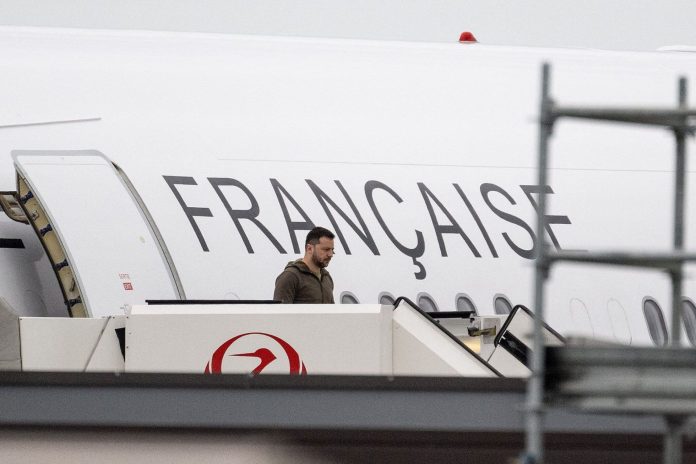
Ukrainian President Volodymyr Zelensky has arrived in Hiroshima, Japan, to attend the G7 summit.
Live footage broadcast by multiple media outlets showed Zelenskyy disembarking from a French government aircraft.
Zelensky tweeted on arrival: “Important meetings with partners and friends of Ukraine. Security and enhanced cooperation for our victory. Peace will become closer today.”
White House lays out Biden’s reversal on providing Ukraine F16 fighter jets
President Joe Biden reversed his previous objections to providing Ukraine with F16 fighter jets because he believes in equipping the country for a long-term fight against Russia, national security adviser Jake Sullivan told reporters Saturday in Japan.
Sullivan confirmed Biden told his Group of Seven counterparts that the US would support a joint effort to train Ukrainian pilots on the fighter jets, suggesting the decision came at a turning point in the conflict and was meant as a “long term commitment to Ukrainian self defense.”
“Now that we have delivered everything we said we were going to deliver so we can put the Ukrainians in a position to make progress on the battlefield, we’ve reached a moment where it’s time to look down the road and to say what is Ukraine going to need as part of a future force to be able to deter and defend against Russian aggression. F16 fourth generation fighter aircraft are part of that,” Sullivan said.
He added the aircraft weren’t currently what Ukraine needs in its battle against Russia, but that they would play a role later.
“Our view is that where the F16 fits into the fight is not right now,” he continued.
He affirmed the longstanding US position that military equipment provided to Ukraine isn’t meant to launch attacks in Russian territory.
“All of the capabilities that the United States has provided to Ukraine come with the basic proposition that the United States is not enabling or supporting attacks on Russian territory,” he stated.
Sullivan declined to provide a timetable for how long the training would take place.
Biden will meet with Zelensky in Hiroshima: White House
National security adviser Jake Sullivan confirmed the in-person attendance of Ukrainian President Volodymyr Zelensky at the G7 Summit in Hiroshima, Japan, and indicated that President Joe Biden will meet with him.
“I think it’s a safe bet that President Biden will meet with him,” Sullivan told reporters in Hiroshima Saturday morning local time.
He added that he did not have a formal announcement on a meeting to share at this time, but that Biden “looks forward to the opportunity to be able to sit down face-to-face” with Zelensky.
Sullivan did not provide details on Zelensky’s travel to Japan, but said the US was “not the party – the country – that flew him here.”
Japan’s Prime Minister Fumio Kishida also confirmed Zelensky’s attendance.
Kishida said in a Ministry of Foreign Affairs statement that Japan’s government has decided to hold a session on Ukraine with G7 leaders on Sunday, which is the last day of the summit.
“The decision was made to hold a session on Ukraine with the G7 leaders, with face-to-face participation by President Zelensky,” the statement read, adding, “President Zelensky will also participate as a guest in the session on peace and stability with the G7 Heads of State and Government and the leaders of the invited countries.”
The statement confirmed that Kishida and Zelensky also plan to hold a bilateral meeting on Sunday.
Kishida reiterated that “the situation in Ukraine” is one of the main agenda items of the G7 Hiroshima Summit and that it “is important to reflect the voice of Ukraine.”
Zelensky’s in-person participation seemed more in flux Saturday morning in Japan, leaving open the possibility he could ultimately join only virtually. The sensitive nature of his security arrangements meant officials were wary of saying exactly how he would participate in the meeting.
Ukrainian officials claim explosions in Mariupol hit a Russian base
An adviser to the mayor of Mariupol in southeastern Ukraine claims explosions heard in the Russian-occupied city Friday night took place at a base for Moscow’s forces.
Petro Andriushchenko, who is not in Mariupol himself, said on Telegram it was a base that houses some 150 Russian troops and is used primarily for air defense support.
The Mariupol City Council, which is also currently based outside the occupied territory, echoed Andriushchenko’s claim.
“Three powerful explosions were heard by Mariupol residents,” the Ukrainian council said on Telegram. Preliminary reports indicate the blast hit a Russian base at the city’s airport, the council continued, sharing a short video of smoke and fire rising in the distance.
“Judging by the video, if the information is confirmed, the enemy should have suffered significant losses,” the council added.
A local group identifying itself as “Mariupol Resistance” said the explosion rocked an area on the outskirts of the city. On its Telegram channel, it also showed what appeared to be video taken by residents of air defenses in action.
Mariupol has become an important staging point for Russian forces in southern Ukraine, and Russian military convoys frequently pass through the area.
Moscow bans “500 Americans” from entry into Russia
Russia is banning “500 Americans,” including many prominent figures of US executive power, from entering the country “in a response to the regularly anti-Russian sanctions imposed by the Joe Biden administration,” according to a statement from Russia’s Ministry of Foreign Affairs on Friday.
The list includes former President Barack Obama, former US Ambassador John Huntsman, several US senators and the next expected chairman of the joint chiefs of staff, Charles Q. Brown Jr.
The rambling, indiscriminate list of names also includes late-night television hosts Jimmy Kimmel, Stephen Colbert and Seth Meyers.
“The attached ‘list-500’ also includes those in government and law enforcement agencies who are directly involved in the persecution of dissidents in the wake of the so-called Storming the Capitol,” the statement said.
The Ministry of Foreign Affairs justified the publication of the list in a statement on its website, saying, “It is high time for Washington to learn that not a single hostile attack against Russia will go without a strong reaction.”
Russia’s MFA did not specify complaints against each individual or explain what the sanctions would mean beyond a ban from entering the county.
In addition, the MFA announced it is continuing to deny a US embassy request for consular access to US journalist Evan Gershkovich “due to the failure to issue visas to Russian journalists from the Lavrov pool,” referencing the visit to the United Nations last month by Foreign Minister Sergey Lavrov.
The Joe Biden administration on Friday unveiled new sanctions targeting Russia for its war in Ukraine.
US to announce new security aid
President Joe Biden plans to announce a new military aid package worth hundreds of millions of dollars during this weekend’s G7 summit in Japan, officials familiar with the matter said.
Biden was expected to unveil the $375 million package after world leaders heard from Ukrainian President Volodymyr Zelensky, who officials had earlier said would travel to the summit in person.
Zelensky’s in-person participation seemed more in flux Saturday morning in Japan, leaving open the possibility he could ultimately join only virtually.
While a top Ukrainian official said Friday on national television that Zelensky’s in-person participation was “extremely important,” the sensitive nature of his security arrangements meant officials were wary of saying exactly how he would participate in the meeting.
Officials who earlier stated Zelensky would join in-person declined to say Saturday whether those plans remained intact.
However he decides to address the leaders, Zelensky was likely to continue his appeals for more advanced weapons and tougher sanctions on Russia.
The new American aid package was likely to include new artillery, ammunition and rocket launchers, officials added.
Ukraine says it still controls parts of the city of Bakhmut as troops battle for surrounding suburbs
Russian troops tried to recover recently lost ground around the eastern city of Bakhmut Thursday and Friday, but they were pushed back by Kyiv’s forces, a Ukrainian defense official said Friday.
Ukrainian forces are still fighting in the city itself, with many of the clashes taking place in southwestern Bakhmut, Ukrainian Deputy Defense Minister Hanna Maliar said on national television.
Ukrainian forces have claimed advancements in several areas surrounding the embattled city in recent days, despite coming under heavy fire from Russian troops. But Maliar acknowledged that Russian forces had made advances within the city limits.
The deputy defense minister stated that Ukraine continues pushing forward in the northern and southern suburbs of the city.
But, she added, “We need to understand the cost of this advance. It is extremely difficult to carry out combat missions there because the enemy has concentrated a huge amount of its efforts.”
Maliar noted troops are waging similar battles in the ruins of two other eastern towns that have been on the front lines since the invasion began: Marinka and Avdiivka, located south of Bakhmut.
Turkish president says he’s still not ready to support Sweden’s NATO membership
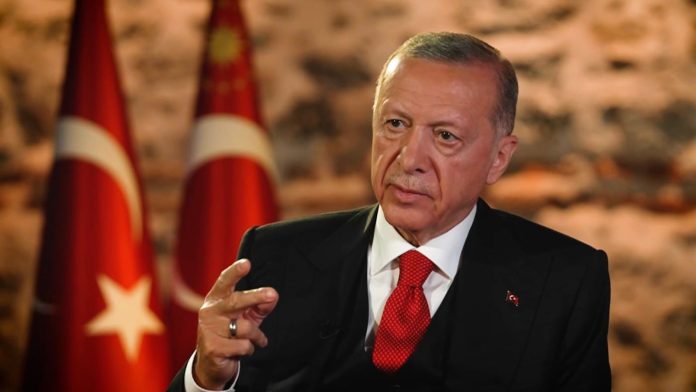
Turkish President Recep Tayyip Erdogan tells CNN he is still not prepared support Sweden’s NATO membership, repeating his claim that Stockholm has allowed terrorist organizations to harbor in the country.
Erdogan can’t look favorably on Sweden’s membership bid, “as long as Sweden continues to allow the offshoots of terror groups in Turkey to roam free on the streets of Stockholm,” he said in an exclusive interview with CNN’s Becky Anderson.
Erdogan has long accused Sweden of harboring militants from the banned Kurdistan Workers Party, a designated terror group in Turkey, Sweden, the United States and Europe.
Erdogan says he would like these individuals extradited, but Stockholm has made clear this won’t happen. The stalemate has blocked Sweden’s accession to NATO even as fellow Nordic country Finland moved ahead in the process and officially joined the alliance last month.
Some Western officials and Middle East observers have suggested the terrorism claims provide cover for Erdogan not to engage with the NATO question and potentially anger Russian President Vladimir Putin at a politically inconvenient time.
Russia provided an economic lifeline to Turkey after other nations imposed sanctions on Ankara, and Putin remains an attractive partner in the country’s post-earthquake rebuilding efforts, Gonul Tol, an academic with the Middle East Institute’s Turkey program, told CNN in March.
What it means for the war in Ukraine: Finland’s acceptance into the US-led security alliance dealt a blow to Putin, who has long sought to undermine NATO. Before invading Ukraine, he demanded the bloc refrain from further expansion.
The invasion instead drove non-aligned Finland and Sweden to abandon their neutrality and seek protection within NATO.
If Sweden eventually succeeds in joining the alliance, it will vastly change the security landscape in northeastern Europe, adding significantly to NATO’s frontier with Russia.
Rundown of sanctions imposed on Russia by US, UK, Canada
The US, Canada and the UK have issued new sanctions on Russia. Here are the main ones announced during the G7 summit in Japan:
US Department of the Treasury
Twenty-two people and 104 entities with touchpoints in more than 20 countries or jurisdictions.
US Department of State
Almost 200 individuals, entities, vessels and aircraft targeted and sanctions imposed on Polyus and the Russian business of its peer, Polymetal – the largest gold producers in Russia; 18 entities involved in expanding Russia’s future energy production and export capacity; subsidiaries of Russia’s state-owned nuclear energy company Rosatom.
US Department of Commerce
Seventy-one companies added to a Department of Commerce list that bars suppliers from selling them US technology without a hard-to-obtain licence.
UK
Eighty-six individuals and entities as part of a new crackdown on what it called “shady individuals and entities” connected to the theft and resale of Ukrainian grain.
Also targets companies connected to Rosatom, and the owner of Russian Copper Company, Igor Altushkin.
Canada
Seventeen individuals and 18 entities linked to Russian companies that provide military technology and know-how to Russia’s armed forces, family members of listed persons, and members of the Kremlin elite; and sanctions on 30 individuals and eight entities involved in Russia’s continuing human rights violations, including the transfer and custody of Ukrainian children in Russia.