Monday, December 22, 2025
Home Blog Page 1394

US says drone plant Russia building with Iran help could be fully operational by 2024

Russia Ukraine War

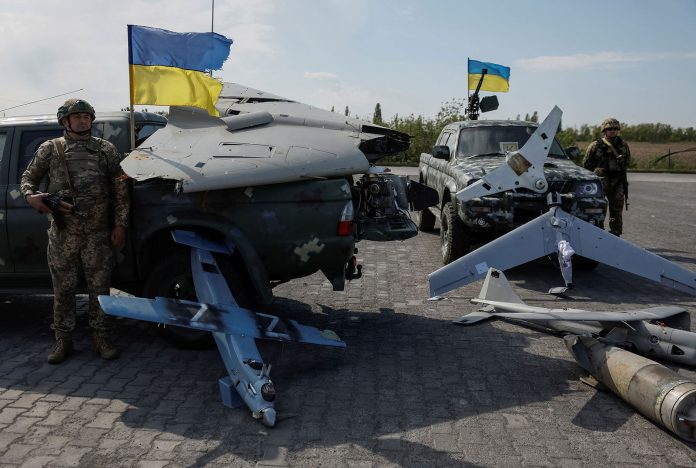
Iran is shipping equipment for the plant, as well as fully-built drones, to Russia via the Caspian Sea, US officials believe.

Kirby, the NSC’s coordinator for strategic communications, confirmed previous CNN reporting that Iran is using the Caspian Sea route to move drones, bullets and mortar shells to Russia, often using vessels that are “dark,” or have turned off their tracking data to disguise their movements.

The US released a map on Friday showing the route Iran appears to be using to ship the equipment from Amirabad, Iran to Makhachkala, Russia.

“Russia has been using Iranian UAVs (unmanned aerial vehicles) in recent weeks to strike Kyiv and terrorize the Ukrainian population, and the Russia-Iran military partnership appears to be deepening,” Kirby said in a statement on Friday.

“The support is flowing both ways: from Iran to Russia, and from Russia to Iran,” Kirby added.

Both Iran and Russia have repeatedly denied claims that Tehran has provided Moscow with drones to be used in the Ukraine war.

Iranian Foreign Minister Hossein Amirabdollahian in November dismissed media controversy over Iran’s alleged support for Russia in the Ukraine war, adding, however, that Tehran had provided Moscow with a limited number of drones months before the war in Ukraine.

He also assured that Iran will not be indifferent if it is proven that Russia has used Iranian drones in the conflict.

Iran, US held indirect talks in Oman: Report

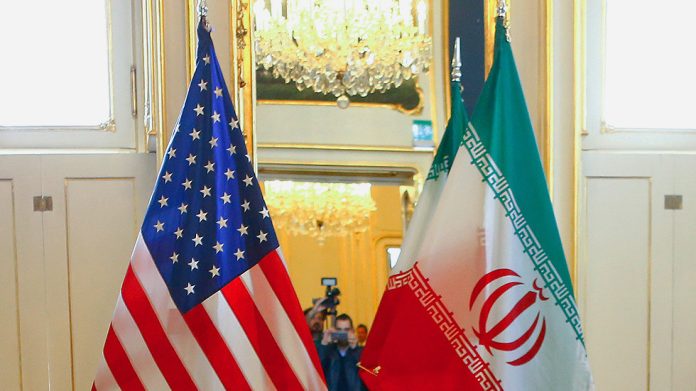
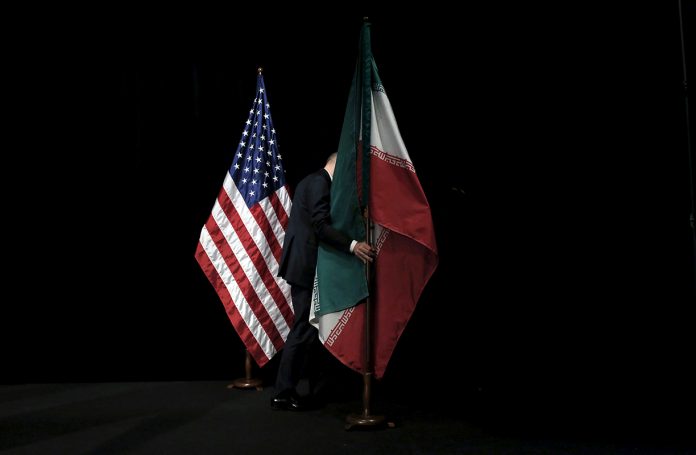
Iran US Flags

The “proximity talks,” which haven’t been previously reported, represent the first known indirect engagement between the US and Iran in this way in several months. They took place amid growing concerns in the White House about Iran’s nuclear advances.

White House Middle East coordinator Brett McGurk traveled to Oman secretly on May 8 for talks with Omani officials on possible diplomatic outreach to Iran regarding its nuclear program, as Axios reported last week.

According to the three sources briefed on the issue, an Iranian delegation also arrived in Oman at the same time. Iran’s top nuclear negotiator Ali Bagheri Kani was part of the delegation, one of the sources said.

McGurk and the Iranian officials didn’t meet, according to the sources. The two sides were in separate locations with Omani officials going between them and passing messages.

According to the sources, one of the main messages from the US focused on deterrence.

The sources added that the US made it clear that Iran will pay a heavy price if it moves forward with 90% uranium enrichment — the level needed to produce a nuclear weapon.

Tehran has repeatedly stated that it has no intention of developing nuclear weapons, with Iranian supreme leader Ayatollah Ali Khamenei even issuing religious edicts against the atom bomb and other weapons of mass destruction.

The aim of the indirect exchange of messages between the administration of President Joe Biden and Iran was to reach an “understanding” about ways to “de-escalate the Iranian nuclear program, Iran’s behavior in the region and its involvement in the war in Ukraine”, the sources stated.

Such an understanding and de-escalation in the region could be used later as a basis for future talks on a new nuclear agreement between the parties.

Iran and the United States have denied a media report that they were nearing an interim agreement under which Tehran would curb its nuclear program in return for sanctions relief.

Iran has cautioned the United States that the window of opportunity for an agreement on reviving the nuclear deal will not remain open forever, urging Washington to adopt a constructive approach to salvage the accord.

Iran showed to the world the peaceful nature of its nuclear program by signing the Joint Comprehensive Plan of Action (JCPOA) with six world states — namely the US, Germany, France, Britain, Russia and China. But, Washington’s unilateral withdrawal in May 2018 and its subsequent re-imposition of sanctions against Tehran left the future of the deal in limbo.

Negotiations between the parties to the landmark agreement kicked off in Vienna in April 2021, with the intention of bringing the US back into the deal and putting an end to its “maximum pressure” campaign against Iran.

The discussions, however, have been at a standstill since August 2022 due to Washington’s insistence on not lifting all of the anti-Iran sanctions and offering the necessary guarantees that it will not exit the agreement again.

Live Update: Russia’s “Special Operation” in Ukraine; Day 472

Russia Ukraine War
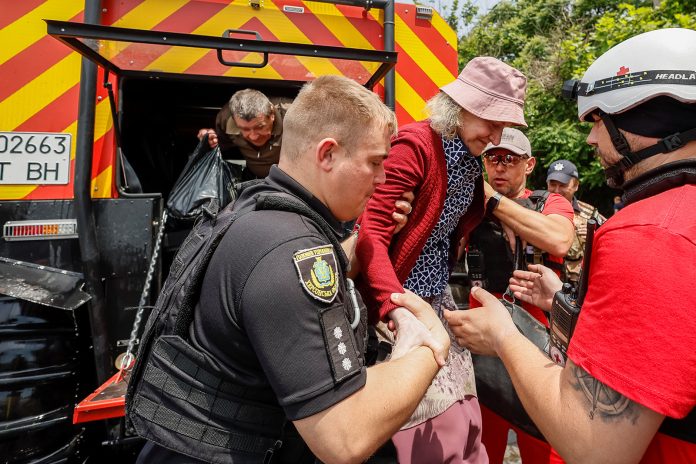
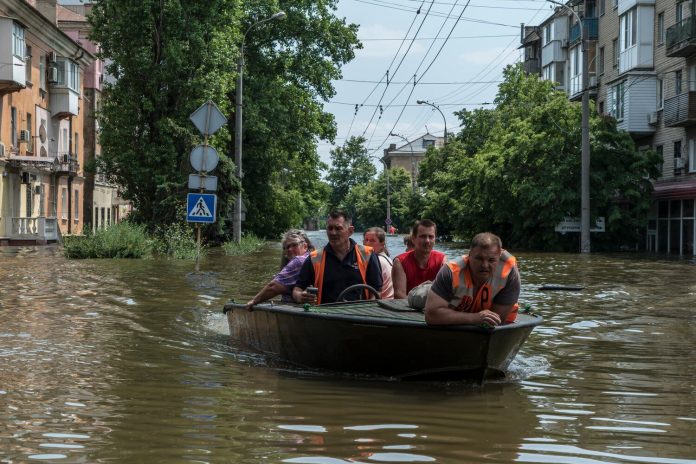
Rescuers and police evacuate local residents from a flooded area after the Nova Kakhovka dam breached, amid Russia's attack on Ukraine, in Kherson, Ukraine.

Xi briefed on African peace mission to Ukraine, Russia

South African President Cyril Ramaphosa has briefed Chinese counterpart Xi Jinping about an upcoming mission by African leaders to Russia and Ukraine to try and broker peace, Pretoria has said.

Ramaphosa announced last month that Vladimir Putin and Volodymyr Zelensky had agreed to receive a six-member African delegation, expected to visit this month.

Ramaphosa “has briefed” Xi, the South African presidency said in a statement. The delegation will group the presidents of the Republic of Congo, Egypt, Senegal, South Africa, Uganda and Zambia.

His office did not specify when he spoke to Xi but said the Chinese leader “commended the initiative by the African continent and acknowledged the impact the conflict has had on human lives and on food security in Africa”.


5 dead and over 2,600 rescued from flooding in Ukrainian-controlled areas of Kherson: Officials

Five people have died and more than 2,600 people — including 160 children — have been evacuated from Ukrainian-controlled flooded areas after the collapse of the Nova Kakhovka dam, according to Ukraine’s Internal Affairs Ministry.

“We are trying to continue evacuation activities, but the enemy is mercilessly shelling,” Internal Affairs Minister Ihor Klymenko said on Saturday.

In the hardest-hit southern Kherson region, a total of 2,588 people have been rescued from Ukrainian-controlled areas, head of Kherson region military administration Oleksandr Prokudin stated earlier on Saturday.

Water levels are receding, dropping 31 centimeters (12.2 inches) since Friday evening, according to Prokudin.

In the Kherson region, 47 settlements were flooded, while in the Mykolaiv region, 31 settlements were flooded, the minister noted. In the Dnipropetrovsk region, more than 89,000 customers in 26 settlements have no drinking water supply, Klymenko added.

The water level at the Nova Kakhovka reservoir “continues to decline,” Ukrainian Minister of Environmental Protection and Natural Resources Ruslan Strilets said on Saturday.

“As of the morning of June 10, 62% of its volume, or 12.24 cubic kilometers of water, has leaked out of the Kakhovka reservoir,” he continued, adding the water level in Kherson region’s national parks is “critical” and that 30% of the nature reserve and wildlife sanctuaries in the region is “under the threat of extinction.”

Ukraine’s main hydropower generating company Ukrhydroenergo announced in a statement Saturday that the water level dropped by 24 centimeters (more than 9 inches) in four hours.

The water level in Ukraine’s Zaporizhzhia Nuclear Power Plant’s cooling pool is “stable,” Ukraine’s state-owned nuclear power company Energoatom noted on Saturday.

The plant sits in Russian-occupied territory along the Dnipro River.


Counteroffensive and defensive actions taking place in Ukraine: Zelensky

President Volodymyr Zelenskiy stated on Saturday that counteroffensive and defensive operations were taking place in Ukraine, but told reporters that he would not say what stage they were at.

Zelensky shrugged and raised his eyebrows dismissively at a press conference in Kyiv when asked to respond after Russian president Vladimir Putin said on Friday that Kyiv forces had certainly begun their much-vaunted counteroffensive.


Canada to be part of multinational effort to train Ukrainian fighter pilots: Trudeau

Canada will be part of a multinational effort to train Ukrainian fighter pilots, President Justin Trudeau has said.

Trudeau is on a visit to Ukraine during which he also announced £$500m in new funding for military assistance for Ukraine.


Trudeau meets with Zelensky in unannounced visit to Kyiv

Canadian Prime Minister Justin Trudeau met with Ukraine’s President Volodymyr Zelensky during an unannounced visit to Kyiv on Saturday.

“I welcome Canadian Prime Minister Justin Trudeau and representatives of his team to Ukraine,” Zelensky said in a post on Telegram.

The two leaders issued a joint declaration after the meeting, which said, “The people of Ukraine can count on Canada to continue its political, financial, humanitarian and military support for as long as it takes – individually and through international cooperation within the G7, NATO, the United Nations and any other forum where Canada can bring its weight to bear.”

Since February 2022, Canada has committed over $8 billion in “wide-ranging” assistance to Ukraine, it added.

“Canada is providing unprecedented military support, including tanks, air-defence systems and artillery, and continues to develop new assistance measures based on Ukraine’s needs,” according to the joint declaration.


Ukrainian forces have made advances on parts of frontline near Bakhmut: Official

Counterattacking Ukrainian forces have advanced up to 1,400 metres at a number of sections of the front line near the eastern city of Bakhmut in the past day, a military spokesperson stated on Saturday.

The advance is the latest in a series of similar gains reported this week by Kyiv near Bakhmut, which Russia said it had fully captured last month after the bloodiest and longest battle since it began its full-scale invasion in February 2022.

“We’re trying…to conduct strikes on the enemy, we’re counterattacking. We’ve managed to advance up to 1,400 metres on various sections of the front,” the spokesperson for the eastern military command said when asked about fighting near Bakhmut.

Serhiy Cherevaty stressed in televised comments that Russian forces were trying to counterattack but that they had not been successful.

Ukrainian forces, he added, had inflicted heavy Russian troop casualties and destroyed military hardware in the area.


Canada’s PM visits Kyiv in show of support

Canadian Prime Minister Justin Trudeau visited Kyiv on Saturday in a gesture of support as Ukraine braces for a major counter-offensive against Russian forces and grapples with regular air strikes.

Trudeau paid his respects at a memorial site in central Kyiv to Ukrainian soldiers who have been killed fighting pro-Russian forces since 2014.

NATO member Canada, which has one of the world’s largest Ukrainian diasporas, has supplied military and financial assistance to Ukraine during the full-scale invasion launched by Russia in February 2022.


Russian strikes kill three and injure 26 in Odesa: Ukrainian officials

Russia attacked the Odesa region in southern Ukraine in the early hours of Saturday with missiles and drones, according to the Odesa region military administration.

“At night, the enemy attacked Odesa region with Shahed-136/131 attack UAVs (unmanned aerial vehicles). Air defense forces destroyed all the UAVs. The wreckage of one of the drones hit a 9-storey apartment, causing a fire,” the Odesa region military administration said.

Three people were killed and 26 others, including three children, were injured, according to the Odesa region military administration, adding that three remain in serious condition.

In addition, the coast of the Odesa region was hit by a missile attack in the early hours of Saturday, the Southern Command’s spokesperson Natalia Humeniuk said, speaking on national TV Saturday.

“Two missiles were destroyed, and one hit (the target). As a result of the flying fragments and blast wave, residential buildings were damaged, and 3 people were injured,” Humeniuk stated.

Russia also attacked the Poltava region with drones and ballistic and cruise missiles, causing “damage to the airfield infrastructure and equipment” at the Myrhorod military airfield, said Dmytro Lunin, head of Poltava region military administration.


Western allies are unlikely to invite Ukraine to join NATO during the war but are still negotiating language to signal their long-term commitment to Kyiv, the US ambassador to the alliance told POLITICO.

Ukrainian President Volodymyr Zelensky has been imploring NATO leaders in recent weeks to put Ukraine on a concrete path to accession, threatening not to attend the alliance’s annual summit in Vilnius next month if they can’t deliver.

But in an interview with POLITICO at the alliance’s headquarters, US Ambassador Julianne Smith conceded that allies can’t invite Kyiv to join NATO at the moment.

“I think the allies now are in agreement that a proper invitation is unlikely while they’re engaged in a full-scale war,” she said.

But she insisted NATO still wants Ukraine to get the message that it is with the war-torn country for the long haul — and is trying to find a way to show that in Vilnius.

“We want to signal to President Zelensky — if he comes in person — we care deeply about having a longer-term relationship with Ukraine and looking for ways to acknowledge, you know, all they’ve accomplished and that our support isn’t going to fade away or that we’re not going to get distracted,” she added.


Zelensky says “a lot of problems” persist as rescue operation continues after dam collapse

Ukrainian President Volodymyr Zelensky stated that “there are a lot of problems” as rescue operations in the Kherson and Mykolaiv regions continue following the Nova Kakhovka dam collapse.

“But we are working to overcome them at all possible levels,” Zelensky said in his nightly address. He did not elaborate on the issues.

Amid reports of intensified fighting in the south of the country, Zelensky noted, “For our soldiers, for all those who are in particularly tough battles these days. We see your heroism, and we are grateful to you for every minute of your life.”

The president also thanked the United States for a new security assistance package of support worth more than $2 billion. He added the package will ensure “missiles for the Patriots and other air defense systems, strengthening our defense on the ground, strengthening the strength of all our soldiers.”


UN delegation visits areas of Ukrainian-controlled Kherson region to provide flood assistance

A United Nations convoy met with Ukrainian authorities in Kherson to discuss the provision of further humanitarian assistance, officials said Friday, as the southern region reels from devastating floods caused by the collapse of the Nova Kakhovka dam earlier this week.

“Drinking water, food packages, materials for housing repairs and medicines are being sent to the Bilozerka community and Kherson city,” the Kherson region military administration posted on Telegram.

“The delegation met with Oleksandr Prokudin, Head of the Kherson Regional Military Administration, and representatives of the military administration,” the post continued, adding, “They discussed the needs of the region and the next aid deliveries.”

Speaking in Bilozerka, on the Ukrainian-controlled west bank of the Dnipro River and one of the worst-affected areas, UN Humanitarian Coordinator for Ukraine Denise Brown warned the number of people suffering will continue to rise past the initial estimates of 17,000 in Ukrainian-controlled areas alone, according to a UN news release.

“The disaster has also impacted people in areas under Russian control, but the UN currently has no access to this part of the country,” the release noted.


Ukrainians are relying on water handouts in flooded areas

Ukrainians living in areas flooded by the collapse of the Nova Kakhovka dam are “completely reliant” on handouts for clean drinking water, the nongovernmental organization World Central Kitchen told CNN on Friday.

“Roads and bridges have been flooded out and so food cannot move (into the area),” World Central Kitchen coordinator Yuliya Konovalova said, adding, “Water is offline and so people are now completely reliant on water provided by us and others.”

The collapse of the Nova Kakhovka dam in southern Ukraine has flooded entire villages, destroyed homes, and left tens of thousands of people without power or clean water.

Humanitarian organization Action Against Hunger’s field coordinator in the region, Phil Oldham, told CNN that the lack of clean drinking water in the area could mean that even those people whose homes have not been directly impacted by the flood will have to leave.

“We can see the possibility that there will be a much larger displacement as a result of the lack of drinking water,” Oldham said, adding, “Now even some of the wells in the area above the (area flooded by the) dam are running dry. … That could create additional displacements far beyond the level we’re seeing now directly from the flood zone.”

Oldham stated that those who’ve been displaced will likely be out of their homes for months, even as the water recedes.

Others in the area will try to stay in their homes no matter what, Konovalova told CNN.

“Many have resisted evacuation because they do not want to leave their homes in a war for the uncertainty of evacuation sites and relocation,” she said.

Christian Aid’s Ukraine Response Director Iryna Dobrohorska told CNN that the possibility of water-borne illnesses exists as well.

“Water contamination from dead animals and sewage is likely to have an impact on the rise of health dangers, (with) cholera being one of key risks in the affected areas,” Dobrohorska added.

For those who have chosen to stay, Dobrohorska said urgent medical help is needed – and not just physical help.

“The affected populations are equally in need of immediate psychosocial support,” she said, adding, “… Coupled with stress and shock from flooding, the people require close medical attention.”

“The people we are seeing are the elderly and the poor — that is the horror of the front line,” Konovalova said, adding, “People are scared, people have lost everything, people are clinging to the little they have left.”


Pentagon announces new $2.1 billion security assistance package for Ukraine

The Pentagon on Friday announced a new $2.1 billion security assistance package for Ukraine that it said includes “critical air defense and ammunition capabilities,” according to a press release.

“This USAI (Ukraine Security Assistance Initiative) package illustrates the continued commitment to both Ukraine’s critical near-term capabilities as well as the enduring capacity of Ukraine’s Armed Forces to defend its territory and deter Russian aggression over the long term,” the statement said.

According to the Pentagon, the package includes:

  • Additional munitions for Patriot air defense systems
  • HAWK air defense systems and missiles
  • 105mm and 203mm artillery rounds
  • Puma unmanned aerial systems
  • Laser-guided rocket system munitions
  • Support for training, maintenance and sustainment activities

With the new package announcement, the US has committed more than $40.4 billion in security assistance to Ukraine since the beginning of the Biden administration, including more than $39.7 billion since the beginning of the war in February 2022.


Putin claims Ukrainian counteroffensive has begun, but without success

Russian President Vladimir Putin claimed on Friday that the Ukrainian counteroffensive had begun, but it has not been successful.

“It can be stated with absolute certainty that the counteroffensive has begun,” Putin said on the sidelines of a conference in Sochi on Friday, claiming it is “evidenced by the use of strategic reserves.”

“It can be stated that all counteroffensive attempts made so far have failed. But the offensive potential of the Kyiv troops regime still remains,” Putin stated in video shared on Telegram from Russian state media.

Putin said “the Ukrainian troops have not achieved the tasks assigned to them in any of the main sectors. This is an absolutely obvious thing,” adding that the last two days have been “very intense.”

Ukrainian forces appear to have stepped up activities along the front line to the southeast of the city of Zaporizhzhia. But it is still too early to get a true picture of what is unfolding and the extent that Ukraine really is attempting a major push forward. Kyiv has been largely mum on a potential counteroffensive, but officials have previously said that it would not be announced.

The Russian leader’s comments are the latest in a series of upbeat Russian characterizations of events along the front line between the Zaporizhzhia and Donetsk regions.

Russian Defense Minister Sergei Shoigu said Thursday Ukraine’s 47th Mechanized Brigade had suffered heavy losses of personnel and arms in four separate attempts to break through Russian lines. All attempts had failed, he said.

Ukrainian officials remain tight-lipped about how fighting is progressing. In his address Thursday evening, President Volodymyr Zelensky described “very tough battles.”

“There is a result, and I am grateful to everyone who ensures the result,” he added, though it is quite possible he was referring to fighting around the eastern city of Bakhmut, which is along a very different part of the front line and where Ukrainian forces have made limited gains recently.

Information emerging from the battlefields of the Zaporizhzhia region is not all sunny for the Russians. On Friday morning, Russian pro-Kremlin blogger Semyon Pegov, who blogs under the alias WarGonzo reported that Ukraine’s armed forces had made gains south of Orikhiv toward the town of Tokmak in Russian-held territory. The situation facing Russian forces was very serious, he said.

But a local Ukrainian commander leading troops along the same front line rejected the suggestion Ukraine had begun its big attempt to recapture territory. Instead, the commander characterized the pushes as “reconnaissance in force” – operations designed to probe the enemy’s defenses for weak spots and to test its combat readiness.


UN nuclear watchdog launches assistance program to Ukraine in response to dam flooding

The International Atomic Energy Agency, the United Nations’ nuclear watchdog, on Friday launched a program to assist Ukrainians after the Nova Kakhovka dam collapsed earlier in the week, according to IAEA Director General Rafael Grossi.

Grossi will lead an assistance mission to Ukraine “in the coming days,” he said, where he will present the plan to Ukrainian President Volodymyr Zelensky. The measures come in response to Kyiv’s recent pleas for international assistance for flood-affected areas, acknowledged by Grossi in a video message on Twitter.

The IAEA chief will also pay another visit to the Zaporizhzhia nuclear power plant, he said, which receives cooling water – which is critical for safety – from a nearby thermal plant that is fed upstream from the reservoir adjacent to the breached dam.

“Through the use of nuclear technologies, we will determine the effects on potable water, human health and soil and water management, and assess the integrity of critical infrastructure,” Grossi said in the short video clip.

UN says Israel ‘silencing civil society’ by criminalizing Palestinian rights groups

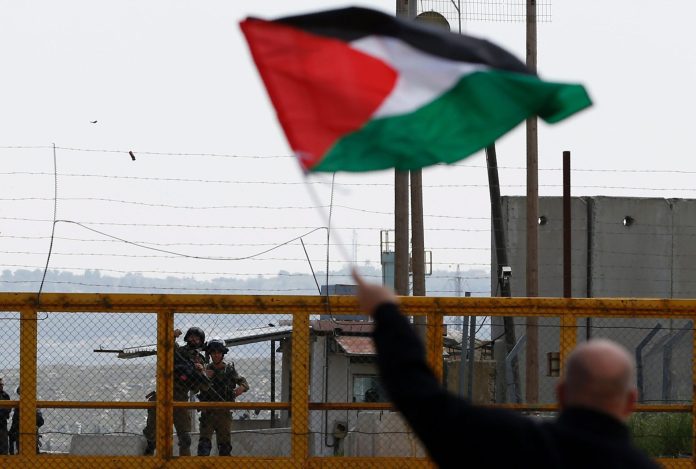
Palestine Israel

The findings were released in an annual report on Thursday by the Human Rights Council’s “Commission of Inquiry,” which was established after Israel’s 11-day aggression against the besieged Gaza Strip in May 2021.

The report, which examined attacks, restrictions and harassment of civil society actors, found that Palestinian journalists were particularly targeted and subjected to frequent harassment and punitive measures by Tel Aviv, seemingly as part of an effort to deter them from continuing their work.

Navi Pillay, a former UN human rights chief leading the commission, censured the Israeli violation of Palestinian rights and said the Israeli authorities were “limiting the rights to freedom of expression and peaceful association.”

“We were particularly alarmed by the situation of Palestinian human rights defenders, who are routinely subject to a range of punitive measures as part of the occupation regime,” Pillay said.

The former UN human rights chief added that most of the violations were committed as part of Tel Aviv’s campaign aimed at “ensuring and enshrining its permanent occupation at the expense of the rights of the Palestinian people.”

The report underlined that the Israeli crackdown on the Palestinian rights groups was “unjustified and violated fundamental human rights, including the rights to freedom of association, expression, opinion, peaceful assembly, privacy and the right to a fair trial.”

Women human rights defenders were also reported to face significant and distinct risks due to their visibility and role in fighting for societal and political change.

“We assigned significant importance to understanding the impact of the shrinking civic space on specific groups of activists, some of whom are more vulnerable to attacks and have suffered substantial personal harm as a result of being targeted,” said Commissioner Miloon Kothari.

“Women human rights advocates and protesters have been subjected to distinct gender-based stigmatization and isolation compared to their male counterparts, including sexual and gender-based violence during protests and online harassment and smear campaigns with the sole intent to discredit them and deter them from activism in public places,” Kothari added.

The report concluded that Israeli measures against civil society organizations amount to violations of international human rights and humanitarian law and may constitute crimes under international law.

Over the past year, the Israeli regime forces have stormed, searched, and sealed the headquarters of seven human rights organizations in the occupied West Bank, marking a major escalation against the advocacy groups.

The organizations raided by the occupation forces include Al-Haq, Addameer, the Bisan Center for Research & Development, Defense for Children International Palestine, the Union of Agricultural Work Committees, the Union of Health Work Committees, and the Union of Palestinian Women.

At least six of the organizations had been labeled as “terrorist” groups by the illegal entity for their alleged links to the Popular Front for the Liberation of Palestine (PFLP) umbrella group.

The NGOs have all denied any association with the PFLP. Nor have the Israeli officials provided any evidence of the alleged links.

Document reveals MbS threatened to damage US economy

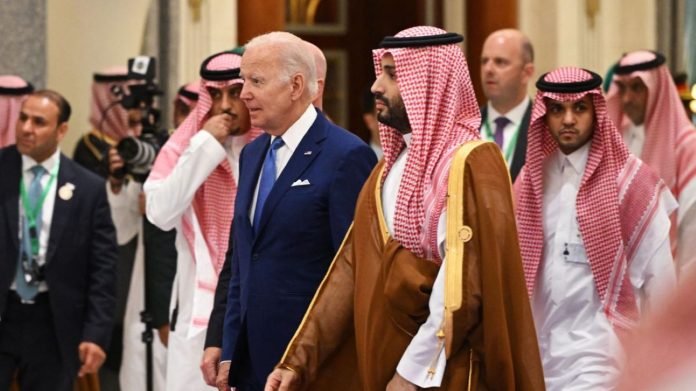
Biden and bin Salman

Even though the Saudi government publicly defended its actions politely via diplomatic statements, the 37-year-old de facto ruler of the country threatened in private to re-evaluate the Arab nation’s relationship with the White House and impose significant economic costs on the United States if it retaliated against the oil cuts.

According to the document, the crown prince claimed “he will not deal with the US administration anymore,” and promised “major economic consequences for Washington,” The Washington Post reported.

The US intelligence document was circulated on the Discord messaging platform as part of an extensive leak of highly sensitive national security materials.

“We are not aware of such threats by Saudi Arabia,” a spokesperson with the US National Security Council said.

“In general, such documents often represent only one snapshot of a moment in time and cannot possibly offer the full picture,” the official, speaking on the condition of anonymity, added.

“The United States continues to collaborate with Saudi Arabia, an important partner in the region, to advance our mutual interests and a common vision for a more secure, stable, and prosperous region, interconnected with the world,” the official continued.

Eight months after Biden vowed “consequences” for Saudi Arabia after oil output cuts, the US president has yet to take any measures against the Arab country and MbS has continued to engage with top US officials, as he did with Secretary of State Antony Blinken in the seaside Saudi city of Jeddah earlier this week.

Biden, who had pledged to make Saudi Arabia a “pariah” as a presidential candidate, now scarcely communicates with the crown prince but the president’s top aides have gradually rebuilt ties with him hoping the two nations can work together on pressing issues, including normalization with Israel, Saudi Arabia’s growing relationship with China, a long-sought peace deal in Yemen and continued disagreements over the supply of oil.

A second leaked US intelligence document from December last year also warned that Saudi Arabia plans to expand its “transactional relationship” with China by procuring drones, ballistic missiles, cruise missiles and mass surveillance systems from Beijing.

During a news conference alongside Blinken in the Saudi capital Riyadh on Thursday, Saudi Foreign Minister Prince Faisal bin Farhan Al Saud highlighted that China and Saudi Arabia are close and strategic allies and have been increasing cooperation in the energy and financial sectors, and that “cooperation is likely to grow.”

He said Saudi Arabia’s ties with the United States and China were not a “zero-sum game.”

“I don’t ascribe to this zero-sum game,” Prince Faisal stated, adding, “We are all capable of having multiple partnerships and multiple engagements and the US does the same in many instances.

“So I’m not caught up in this really negative view of this. I think we can actually build a partnership that crosses these borders,” the top Saudi diplomat continued.

Riyadh’s strengthening of its commercial and security ties with Beijing comes as US influence wanes in the Middle East region.

Iran, US deny reports of nearing temporary nuclear deal

Iran US Flags

Tehran has roundly rejected reports that Iran and the United States are reaching an “interim deal” that foresees some sanction relief for the Islamic Republic in exchange for changes in the country’s peaceful nuclear energy program.

Iran’s UN mission made the remarks on Thursday after the London-based Middle East Eye (MEE) news and analysis website claimed that the countries were close to clinching such a deal amid the stagnation of talks on the revival of the Joint Comprehensive Plan of Action (JCPOA).

The JCPOA was reached in 2015 between Iran and world countries, including the United States. It enabled limited sanction relief for the Islamic Republic, which, in turn, volunteered to change some aspects of its nuclear work.

The US, however, left the agreement in 2018 under former President Donald Trump, returning all the sanctions that the deal had lifted.

Negotiations to revive the agreement started in April 2021. The talks have, however, stalled amid Washington’s refusal to offer guarantees that it would not ditch the deal again.

“There is no interim deal [meant] to replace the JCPOA,” said the Iranian mission to the United Nations, adding that no such agreement is on the agenda.

Also on Thursday, a White House National Security Council spokesman similarly rejected the MEE report, calling it false and misleading.

Trump’s successor Joe Biden has alleged an interest in returning the US to the JCPOA. Biden’s administration has, however, not only stopped short of taking any measures that could lift the talks out of its current impasse but has also imposed many rounds of its own sanctions against the Islamic Republic.

MEE cited two unnamed sources as saying Iran and the United States had “reached an agreement on a temporary deal” to take to their superiors.

It claimed Iran would cease enriching uranium to purity of 60% or above and continue cooperation with the UN nuclear watchdog in return for exporting up to 1 million barrels of oil per day and access to “income and other frozen funds abroad.”

The website added the talks were led by US special envoy for Iran Rob Malley and Iran’s ambassador to the UN Amir Saeid Iravani in an apparent reversal of Iran’s refusal to deal directly with US officials.

A State Department spokesperson declined to comment on any such talks, saying only that it had ways to pass messages to Iran but would not detail their content or how they were delivered.

Two Iranian officials told Reuters there had been progress but no agreement was imminent. A third claimed Malley and Irvani met at least three times in the past weeks but gave no details.

Saudi Arabia rebuffs US push on normalization with Israel

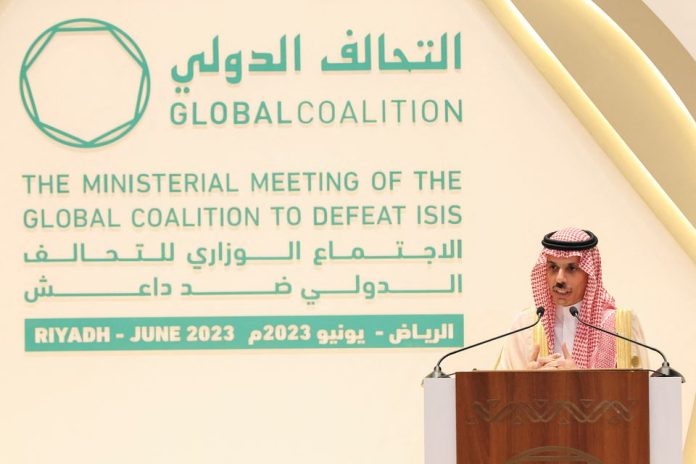
Saudi Foreign Minister Prince Faisal bin Farhan Al Saud

Speaking in a news conference alongside Saudi Foreign Minister Prince Faisal bin Farhan Al Saud in Riyadh on Thursday, Blinken reiterated that Washington will continue to play an integral role in expanding normalization between Tel Aviv and Riyadh.

Blinken, who was in the kingdom as part of a US push to defuse rows that have touched on oil prices, and Riyadh’s opening to Iran, further insisted that normalizing relations between Israel and its neighbors was a priority for Washington.

The Saudi foreign minister, however, rebuffed his American counterpart, saying that the kingdom believes “normalization of ties with Israel will have limited benefit without a pathway to peace for the Palestinians.”

“The Palestinian issue was and remains the central issue for Arab countries, and it is at the top of the kingdom’s priorities,” Saudi Crown Prince Mohammed bin Salman had also stressed during the Arab League summit in Jeddah in mid-May.

“We will not delay in providing assistance to the Palestinian people in recovering their lands, restoring their legitimate rights and establishing an independent state on the 1967 borders with East al-Quds as its capital,” he further noted at the time.

Blinken also reiterated on Thursday that Washington will not normalize relations with Syria and does not support other nation’s normalization of ties with the government of President Bashar al-Assad.

For his part, Prince Faisal defended the landmark decision to lift Syria’s Arab League suspension, which came shortly after the start of the country’s foreign-sponsored conflict 12 years ago.

“Syria made very clear commitments to address concerns of the international community,” the chief Saudi diplomat stated.

“We have differences of opinion but we’re working on finding a mechanism for us to be able to work together,” the Saudi foreign minister also pointed out during the press conference with the US secretary of state.

The Saudi foreign minister also highlighted that China and Saudi Arabia are close and strategic allies and have been increasing cooperation in the energy and financial sectors, and that “cooperation is likely to grow.”

He added Saudi Arabia’s ties with the United States and China were not a “zero-sum game.”

“I don’t ascribe to this zero-sum game,” Prince Faisal continued, noting, “We are all capable of having multiple partnerships and multiple engagements and the US does the same in many instances.

“So I’m not caught up in this really negative view of this. I think we can actually build a partnership that crosses these borders,” the top Saudi diplomat said.

Riyadh’s strengthening its commercial and security ties with Beijing comes as US influence wanes in the Middle East region.

Blinken was the second top US official to visit Saudi Arabia in less than a month, following a May trip by White House national security adviser Jake Sullivan.

However, Blinken’s meetings with bin Salman and Persian Gulf Cooperation Council (GCC) foreign ministers were relegated to the inside pages of Al-Watan and Okaz, the two major newspapers in Saudi Arabia.

Blinken and the crown prince had “open, candid” talks for an hour and 40 minutes, a US official said, covering topics including the conflict in neighboring Yemen, the war in Sudan, Israel, and human rights.

Riyadh has also leveraged its growing relationships with Russia and China as the Biden administration has pushed back against some Saudi demands including lifting restrictions on arms sales and help with sensitive high-tech industries.

Riyadh has clashed repeatedly with US President Joe Biden on its supply of crude oil to global markets, its willingness to partner with Russia in OPEC+ and its decision to restore full diplomatic relations with Iran in a deal brokered by China.

Iran, Azerbaijan FMs talk on phone, call for keeping up interactions

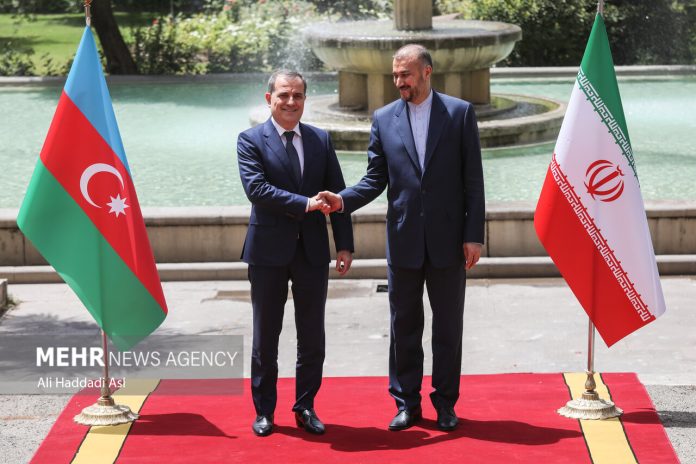
Iran and Azeri FMs Hossein Amirabdollahian and Jeyhun Bayramov

Iranian Foreign Minister Hossein Amirabdollahian held phone talks with his counterpart from Azerbaijan Republic, Jeyhun Bayramov, over the situation of bilateral ties.

During the lengthy talks, held on Thursday evening, the two sides stressed the necessity of keeping up interactions and exchanges of technical and expert teams in various fields with the goal of overcoming problems and achieving results.

They reviewed the latest issues between the two countries, emphasizing the need to get rid of misunderstandings and restore the relations between the two countries to a natural path that would serve the mutual interests of the two countries based on good neighborliness.

Ties between Iran and Azerbaijan have been tense over the past few months.

In late January, a man stormed the Azerbaijani embassy in Tehran, killing its head of security and wounding others.

Investigations in Iran found the attacker had personal motives, but Baku blamed the Iranian government and later expelled a number of Iranian diplomats in April.

In a tit-for-tat move, Iran expelled four Azerbaijani diplomats last month.

Baku’s close ties with Israel have also been a bone of contention. Iran has repeatedly warned of Israeli plots to gain a foothold in the region. In his recent visit to the Republic of Azerbaijan, Israel’s President Isaac Herzog described Baku as Israel’s close friend.

Live Update: Russia’s “Special Operation” in Ukraine; Day 471

Russia Ukraine War

‘Everything indicates’ Russia behind dam blast: EU

EU foreign policy chief Josep Borrel says “everything indicates” to Russia as being behind the Kakhovka dam breach.

“The dam was not bombed. It was destroyed by explosives installed in the areas where the turbines are located. This area is under Russian control,” Borrell told Spanish public television.

“I wasn’t there to find out who did it. But everything seems to indicate that if it took place in an area under Russian control, it is difficult to believe it could have been someone else,” he added.

At least five people died, and 13 are missing in flooding after the breach, Ukraine’s Interior Minister Igor Klymenko said earlier on Friday.


Russia to begin deploying tactical nuclear weapons to Belarus in July

Russia will begin deploying tactical nuclear weapons in Belarus after the facilities are ready on July 7-8, President Vladimir Putin told his Belarusian counterpart, Alexander Lukashenko, in a meeting in Sochi.

“So everything is according to plan, everything is stable,” Putin said, according to a readout from the Kremlin.


Russian governor enacts state of emergency after drone attack

The Russian governor of Voronezh has imposed a state of emergency after a drone hit an apartment building.

Three people were hurt by broken glass but did not need hospital treatment, Alexander Gusev said.

Russia’s state Investigative Committee opened a criminal case against “persons acting in the interests of the military-political leadership of Ukraine”.

There was no official reaction from Kyiv.

Drone strikes inside Russia have become a frequent occurrence in areas close to the Ukrainian border.


Iceland to suspend Russia’s embassy operations from August 1

Iceland will suspend its embassy operations in Moscow from August 1 and has asked Russia to scale back its diplomatic activities in Reykjavik, the foreign ministry said in a statement.

Iceland’s embassy operations are being suspended due to an ‘all-time low’ level of commercial, cultural and political relations between the two countries, the ministry said.

“The current situation simply does not make it viable for the small foreign service of Iceland to operate an embassy in Russia,” Foreign Minister Thordis Gylfadottir stated.

But diplomatic relations between the two nations have not been severed, the ministry said, adding that the embassy will be reopened once relations normalise.

Ukrainian Foreign Minister, Dmytro Kuleba, thanked Iceland’s foreign minister for the decision and said, “Russia must see that barbarism leads to complete isolation.”


‘Situation is tense in all areas of front’: Ukraine

Ukrainian deputy defence minister Hanna Maliar stated that the situation on the frontline was tense and heavy fighting was concentrated in the Donetsk region.

“The situation is tense in all areas of the front. The enemy continues to focus its main efforts on the Lyman, Bakhmut, Avdiiv and Marin directions, heavy fighting continues,” Maliar said on Telegram.

“In the Bakhmut direction, the enemy is withdrawing reserves and trying to hold the occupied positions. Makes attempts to attack but fails. Now our defenders are conducting active combat operations in several areas of the Bakhmut direction,” she added.


Ukraine says intercepted phone call proves Russia was behind dam blast

Ukraine’s security service says it has intercepted a telephone call proving a Russian sabotage group blew up the Kakhovka dam.

The Security Service of Ukraine (SBU) posted a short audio clip on its Telegram channel of the alleged conversation, which featured two men discussing the dam.

“They [the Ukrainians] didn’t strike it. That was our sabotage group,” said one of the men, who the SBU described as a Russian soldier.

“They wanted to, like, scare [people] with that dam,” the soldier continued, adding, “It didn’t go according to plan, and [they did] more than what they planned for.”

The SBU did not offer any further details of the conversation.


Kremlin accuses Ukraine of ‘barbaric shelling’ in Kherson

The Kremlin accuses Ukrainian forces of killing citizens affected by the dam flood in repeated shelling attacks.

Kremlin spokesman Dmitry Peskov called the attacks “barbaric.”

Peskov said Russian rescue workers were doing their best to help people in flooded areas but were being constantly shelled by Ukrainian forces.

“All the work is taking place under the shelling of the Ukrainian armed forces. This shelling does not stop. This is more than barbaric shelling,” Peskov told reporters.

“As a result of this shelling there are dead among the flood victims, there was even a pregnant woman,” he added.

On Thursday, Ukraine accused Russian forces of shelling civilians in the flooded territory it controls.


Sweden to allow NATO to station troops in country

The Swedish prime minister and defence minister say NATO troops will be allowed to be based in the country despite not having been approved to join the military alliance.

“The government has decided that the Swedish Armed Forces may undertake preparations with NATO and NATO countries to enable future joint operations,” Prime Minister Ulf Kristersson and Defence Minister Pal Jonson said in an opinion piece in the  Dagens Nyheter newspaper.

“The preparations may consist of temporary basing of foreign equipment and personnel on Swedish territory. The decision sends a clear signal to Russia and strengthens Sweden’s defence,” they added.

Sweden and Finland applied last year to join NATO after Russia’s invasion of Ukraine.

But while Finland joined the bloc in April, Sweden’s membership is being held up by Turkey and Hungary. All member states must agree before a country joins the military alliance.


Ukraine counteroffensive against Russia under way: Think tank

Kyiv’s counteroffensive against Russian forces has started, a Washington, DC-based think tank monitoring the war in Ukraine has said, though Ukrainian officials continue to deny or decline confirmation that their long-awaited campaign to retake territory occupied by Russian forces is under way.

“The Ukrainian counteroffensive has begun. Activity throughout Ukraine is consistent with a variety of indicators that Ukrainian counteroffensive operations are under way across the theater,” the Institute for the Study of War (ISW) said in a series of tweets late on Thursday.


Russia reports heavy fighting in Zaporizhia region of Ukraine

Russia has reported heavy fighting in the Zaporizhia region of southern Ukraine after saying it repelled repeated attempts by the Ukrainian army this week to smash through the front line and drive a wedge through Russian forces.

Russia’s top military brass briefed President Vladimir Putin on Thursday that Russia had successfully repelled the attacks, which Moscow says are part of an attempted major counteroffensive by Ukraine since Sunday.

A spokesman for Russia’s Vostok group of forces said 13 Ukrainian tanks were destroyed in battles in the Zaporizhia region and eight in the Donetsk region. It reported artillery, drone and infantry battles.


“Disaster is Putin”: Zelensky says while addressing catastrophic dam collapse

Ukrainian President Volodymyr Zelensky said that the collapse of the Nova Kakhovka dam in the Kherson region was not a natural disaster or evidence of climate change.

Instead, he stated, “The disaster is [Vladimir] Putin,” referring to the Russian president.

“Russian troops do not stop artillery strikes at the very territory where people are being evacuated. Unfortunately, there are wounded from these terrorist attacks. People who are rescuing and evacuating from the Russian ecocide are also forced to flee from Russian fire,” he continued.

The collapse of the Nova Kakhovka dam in southern Ukraine is one of the biggest industrial and ecological disasters in Europe for decades. The catastrophe has destroyed entire villages, flooded farmland, deprived tens of thousands of people of power and clean water, and caused massive environmental damage.

In the Russian-occupied part of the territory, where about a dozen settlements are flooded, “no evacuation is carried out at all,” Zelensky claimed in a video address to representatives of the world environmental protection community. People have been stuck on rooftops, “trapped in water” for days without drinking water, food, or medical care, he said.

“We do not know the number of dead and injured yet,” he continued, adding, “In more than 30 settlements, life is ruined. For hundreds of thousands of people in many towns and villages, access to drinking water has been greatly impeded.”

Both Russia and Ukraine are accusing each other of shelling during the evacuations. Also, Kyiv and Moscow have accused each other of causing the breach in the first place, although it is unclear whether the dam was deliberately attacked, or whether the collapse was the result of structural failure


Satellite images show Kherson province flooding

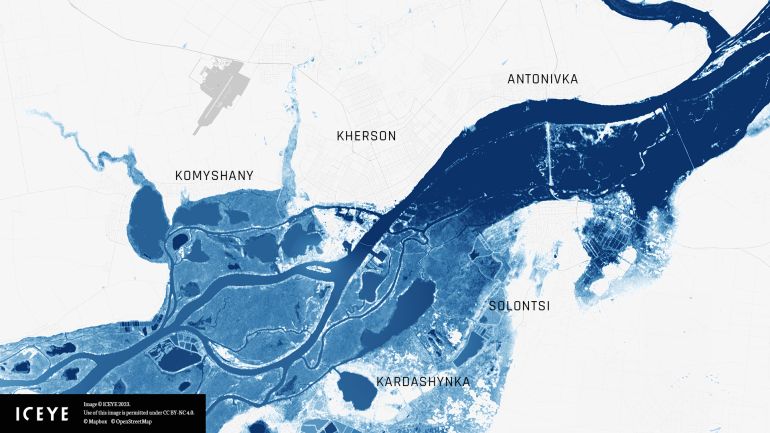
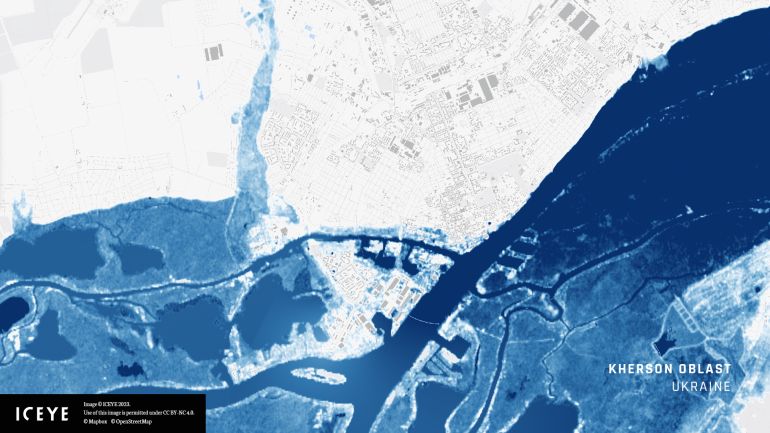
ICEYE’s flood data analysis details the flood extent and depth and shows that several towns and villages along the Dnipro river (Nova Kakhovka, Antonivka, Oleshky, Solontsi, and other areas) have been either partially or completely flooded.

ICEYE owns and operates the largest constellation of synthetic aperture radar (SAR) satellites. By combining satellite imagery with auxiliary ground-level information, the company delivers accurate insight into the extent and depth of major flood events around the world, in near real time.

Live Update: Russia’s “Special Operation” in Ukraine; Day 471 Live Update: Russia’s “Special Operation” in Ukraine; Day 471 Live Update: Russia’s “Special Operation” in Ukraine; Day 471 Live Update: Russia’s “Special Operation” in Ukraine; Day 471


Ukraine needs deadlier weapons: US lawmakers

Members of Congress have urged US President Joe Biden to provide even more advanced weaponry to Ukraine, including longer-range missiles that the White House previously warned could trigger World War III.

Kiev must be given Army Tactical Missile Systems (ATACMS) to strike distant targets in Russia’s supply lines, nine lawmakers said in a letter to Biden on Thursday. The bipartisan group, led by Colorado Democrat Jason Crow, dismissed concerns that such weapons could escalate the conflict or leave US missile supplies too depleted.

“We also understand the administration’s stated desire to maintain US stockpiles for future fights, but Ukraine is currently on the front lines in a fight for freedom in a war with immediate and long-term US national security implications,” the lawmakers said.

“The fight for global peace and security is playing out in Ukraine, and we believe this merits a drawdown from our existing stocks of this important capability,” they added.

“Helping Ukraine fight and win is a US national security imperative and signals to the world that thee US will stand by our fellow democracies,” the nine lawmakers continued.

They called on Biden to do everything in his power, including using his authority under the Defense Production Act to accelerate weapons output, to give Ukrainian troops everything they need to mount a counteroffensive.


Ukraine sees “stiff resistance” and losses in attempt to breach Russian lines: US officials

Ukrainian forces have suffered losses in heavy equipment and soldiers as they met greater-than-expected resistance from Russian forces in their first attempt to breach Russian lines in the east of the country in recent days, two senior US officials tell CNN.

One US official described the losses — which include US-supplied MRAP armored personnel vehicles — as “significant.”

Ukrainian forces managed to overrun some Russian forces in the east around Bakhmut.

However, Russian forces, armed with anti-tank missiles, grenades and mortars, have put up “stiff resistance,” with their forces dug into defensive lines that are several layers deep in some areas and marked by minefields that have taken a heavy toll on Ukrainian armored vehicles.

US and Western officials have been bracing for an expected counteroffensive for months, moving to shore up Ukraine’s defenses ahead of its start. This week, Ukraine’s Deputy Defense Minister Hanna Maliar said an offensive was “taking place in several directions.”

Both US officials say the losses are not expected to impact the larger planned Ukrainian counteroffensive. US and Western officials long expected the counteroffensive to take time and put Ukrainian personnel and equipment, including Western-supplied systems, at high risk.


NATO chief urges speedy Ukraine aid after dam breach

NATO Secretary General Jens Stoltenberg has urged members of the military alliance to speed up humanitarian assistance to Ukraine after the destruction of a major dam.

Ukrainian Foreign Minister Dmytro Kuleba briefed NATO ambassadors via video link on the devastation caused by the destruction of the Nova Kakhovka dam.

Stoltenberg told the meeting that “the consequences for thousands of people and for the environment are dramatic, and he urged Allies to provide support expeditiously,” NATO said in a statement.

“Allies expressed strong solidarity with Ukraine, and many are already providing critical aid, including water filters, pumps, generators, and shelter equipment,” it added.


US preparing another $2 billion in arms for Ukraine: Report

The Pentagon is set to unveil another $2 billion in military aid for Ukraine, hoping to bolster the country’s air defenses as it launched its much-touted counteroffensive against Russian forces, Bloomberg News reported.

The announcement is likely to come later this week, the outlet said, citing unnamed US officials. The arms will be provided under the Ukraine Security Assistance Initiative (USAI), which has furnished billions of dollars in American weapons to Kiev since fighting erupted with Moscow last year.

The new aid package will include two types of Patriot missiles: the Patriot Advanced Capability Missile-3 (PAC-3) and the Guidance Enhanced Missile. Produced by Raytheon, the latter munitions are said to provide “improved ability to defeat tactical ballistic missiles, cruise missiles or enemy aircraft in complement to the PAC-3 missile,” according to the US weapons-maker.

Washington will also reportedly send MIM-23 Hawk surface-to-air missile launchers, an aging system whose first variant entered service in 1960. Officials initially said the platform would be provided last November, but noted they would require refurbishing and repairs using funds from the USAI project.


WHO rushes emergency supplies to Ukraine

The World Health Organisation (WHO) has rushed emergency supplies to Ukraine after the breach of the Kakhovka dam, which led to widespread flooding.

“The impact of the region’s water supply sanitation systems and public health services cannot be underestimated,” WHO Director General Tedros Adhanom Ghebreyesus told a press briefing.

“The WHO has rushed in to support the authorities and healthcare workers in preventive measures against waterborne diseases and to improve disease surveillance,” he added.

Asked specifically about cholera, WHO technical officer Teresa Zakaria said the risk of an outbreak was present because the pathogen exists in the environment, adding that the WHO was working with Ukraine’s health ministry to ensure that vaccines can be imported if needed.


No Western troops will enter Ukraine: Kiev

Kiev has refuted suggestions by former NATO Secretary-General Anders Rasmussen that Poland could lead a “coalition of the willing” and send troops into Ukraine. The Ukrainian government has never asked for such a step, its top diplomat claimed.

“Until the armed conflict on Ukrainian territory is over, foreign nations will not send their troops into our nation. Moreover, we are not requesting that. We say: ‘give us weapons,’” Foreign Minister Dmitry Kuleba said in an interview on Thursday, commenting on Rasmussen’s remarks.

The former NATO chief suggested that an intervention scenario could materialize, should the US-led military bloc fail to offer formal security guarantees to Ukraine during a summit in Vilnius, Lithuania next month. Ukrainian President Vladimir Zelensky has reportedly threatened to boycott the event unless his nation is given a concrete roadmap to membership.

Kuleba expressed certainty that Ukraine will become part of NATO, insisting that Kiev would then deploy military units to other allies to defend them. The aspiration to join the bloc is enshrined in the Ukrainian constitution.


Flooding in Kherson has forced Russians to retreat: Ukraine

Flooding due to the Kakhovka dam breach has forced Russian troops to retreat by 5 to 15km (3 to 9 miles) in the Kherson region, Ukraine’s military announced.

A spokeswoman for its southern command, Natalia Humeniuk, told Ukrainian television the redeployment had “practically halved” Russian shelling in the region.


Russian lawmakers address world over Ukrainian ‘terrorism’

The upper chamber of the Russian parliament, the State Duma, placed the blame for the destruction of the Kakhovka dam on Ukraine and its Western backers and called on legislatures in other countries to give their assessment of the incident

In an open letter to the “parliaments and peoples of the World” published on Thursday, the Russian senators condemned what they described as a “terrorist act by the Kiev regime.”

The lawmakers pointed out that the rupture of the dam has led to a “major ecological catastrophe” along the path of the Dnieper River.

According to the document, Moscow warned the UN last October that the Ukrainian leadership might carry out “such a terrorist act.”

Officials cited as proof the repeated shelling of the Kakhovka hydroelectric power plant by Ukrainian forces in 2022. They went on to claim that the Ukrainian authorities had deliberately opened the floodgates at a similar facility upstream, thereby filling the Kakhovka reservoir to the brim.

The alleged Ukrainian act of sabotage was aided and abetted by Kiev’s Western backers, making the latter complicit, the letter insisted.

The Russian senators went on to accuse the West of launching a “disinformation campaign” aimed at shifting the blame for the dam’s destruction to Moscow.

The letter called on parliaments of other countries to respond to “yet another crime of the Kiev regime” and do everything within their power to prevent further similar “acts of international terrorism.”


Ukraine rejects Turkey’s Kakhovka dam proposal

Ukrainian Minister of Foreign Affairs Dmitry Kuleba has vehemently dismissed Turkey’s proposal for an international investigation into the destruction of the Kakhovka hydroelectric dam, calling the initiative a “game to indulge the Russians.”

This comes after Turkish President Recep Tayyip Erdogan held phone conversations with his Russian and Ukrainian counterparts on Wednesday, offering to organize an international commission to investigate the attack on the dam, which would include experts from all three countries, as well as the UN.

Speaking on the Ukrainian 1+1 news channel, Kuleba stated that was sick and tired of the UN and others who were proposing to investigate the explosion and accused them of playing a “game of quasi-justice.”

“It’s absolutely clear who’s who,” Kuleba said, dismissing any suggestions that Ukraine could have been responsible for blowing anything up.

“Take it easy, gentlemen,” he continued, adding, “We’ve already been there. It’s all just a game to indulge the Russians.”

Later in the interview, the minister admitted that some sort of investigation into the dam’s destruction would take place eventually, but that it would not be anytime soon.


West has done everything for Ukraine: Biden

Washington and its allies have exhausted their efforts to arm and prepare Ukraine for its counteroffensive against Russian forces, US President Joe Biden has claimed after meeting with UK Prime Minister Rishi Sunak at the White House.

“We’ve done everything we could, collectively but individually in the United States, to make them ready, to support ..,” Biden told reporters on Thursday in a joint press briefing with Sunak in Washington.

He called Kiev’s faltering attempts to mount an attack “an evolving situation where we’re very optimistic.”

Asked whether he expected to get new funding approvals from the Republican-controlled Congress to continue providing aid to Ukraine, Biden vowed “unwavering support” for Kiev.

Lawmakers have approved $113 billion in Ukraine aid since February 2022. NATO members plan to discuss long-term security commitments for Kiev at a summit next month in Vilnius.

“Long-term security to deter future aggression after this war ends is the goal, and we’re advancing this goal by providing the support Ukraine needs now on the battlefield and helping them strengthen their military over the long term,” Biden said, adding, “I believe we’ll have the funding necessary to support Ukraine as long as it takes.”

He argued that while some lawmakers have begun to question whether the US should continue to provide aid to Ukraine, he sees broad agreement on the consequences of failing to do so.


Sunak: We must show Putin that Ukraine support won’t wane

Rishi Sunak says Ukraine’s supporters needed to send a strong signal to President Vladimir Putin that their backing for Kyiv will not weaken as the war goes on.

“The more we can put in place support for Ukraine, not just in the here and now, that support that will last for a time and for years to come, I think it sends a strong signal to [Putin] that there is no point in trying to wait us out,” the UK prime minister said at a joint press conference with President Joe Biden.

“We’re not going anywhere. We will be here for as long as it takes. And hopefully that will speed up the calculation in his mind that he should withdraw his forces,” he added.


Rescuers in Kherson face shortage of equipment amid Russian shelling: Official

Rescuers are facing resource challenges while carrying out evacuations in Ukraine-controlled Kherson due to the scale of the flooding caused by the dam collapse, an emergency services officer told CNN.

There is a shortage of resources as Russians continue shelling the western bank of the Dnipro river, stated Maksym Trykur, an officer at Ukraine’s State Special Transport Service.

The catastrophe is “unprecedented and the challenge is it’s impossible to accumulate all the resources in such a short time,” Trykur told CNN.

The State Special Transport Service has been working along with the State Emergency Service of Ukraine in evacuating civilians.

“There’s a great shortage of the equipment. To put it simply — we need everything: boats, motor pumps, radio walkie-talkies, lights — all the equipment that comes in handy when a humanitarian catastrophe such as this occurs,” he said.

“People there are not in a position to stay. The place is unlivable, the houses are flooded, lots of cattle have been killed, the public transport doesn’t work obviously,” he added.

Trykur said most territories are flooded with 5 meters of water, or about 16 feet, and that “it’s impossible to predict the time frame that will allow people to come back to their homes.”

He added his colleagues on the ground have not encountered any humanitarian aid offices or assistance provided by any international organizations, such as the United Nations or the International Committee of the Red Cross

Activist: Iran risks losing position in global pistachio market to US

Pistachio

Mehdi Tayyebzadeh, a member of the Iranian Chamber of Commerce, told ISNA that Kerman Province, as the main producer of pistachios and dates in the country, has been active in the field of exports, apart from supplying the domestic needs.

The average income from the export of these two products has brought about $1 billion to the province in profit, he said.

Tayyebzadeh highlighted the problems facing the planting of pistachios, including water shortage, calling for authorities to address the issues before Iran loses it position to the US and other rivals, who have been greatly investing in the sector.

“Over the past years, America has invested significantly in this field and has become very active in the European markets and even the Chinese market,” he said. “Therefore, in order not to lose our market, we must prepare important plans.”

Cultivation of pistachios in Iran dates back to the ancient times, when the country remained the world’s unrivaled producer of pistachios for a long time, with Kerman being the hub of production for so-called green gold.

Over the past decade, however, climate change has caused severe drought in Iran, leading to 85 percent of the country being classified as arid or semi-arid and taking a heavy toll on the agriculture sector.