Zelensky says ‘war’ coming to Russia after Moscow drone attack
Ukraine’s President Zelensky has warned that “war” is coming to Russia after three Ukrainian drones were downed over Moscow.
“Gradually, the war is returning to the territory of Russia – to its symbolic centres and military bases, and this is an inevitable, natural and absolutely fair process,” Zelensky said on a visit to the western city of Ivano-Frankivsk.
“Ukraine is getting stronger,” he added.
Zelensky expects Russia to resume attacks on Ukraine’s power grid
Ukraine’s President Volodymyr Zelensky has said he expects Russia to resume its attacks on Ukraine’s energy system once cold weather returns later this year.
“It is obvious that this autumn and … in the winter the enemy will try to repeat the terror against the Ukrainian energy industry. We should be ready for this in any case,” Zelensky told senior government, security, and regional officials.
“At the government and security level, we will do everything possible,” he added.
Nearly 40 percent of the Ukrainian energy system was damaged in Russian missile and drone attacks over the past winter, which plunged Ukrainian cities into darkness and cold in what Kyiv called a deliberate strategy to harm civilians. Moscow says it launched the attacks to reduce Ukraine’s ability to fight.
‘We would be forced to use a nuclear weapon” if Ukrainian offensive a success: Russia
Former Russian President Dmitry Medvedev has stated that Moscow would have to use a nuclear weapon if Kyiv’s ongoing counter-offensive succeeded.
Medvedev, who is deputy chairman of Russia’s Security Council, a body chaired by President Vladimir Putin, said in a message on his official social media accounts that Russia would be forced to fall back on its own nuclear doctrine in such a scenario.
“Imagine if the.. offensive, which is backed by NATO, was a success and they tore off a part of our land then we would be forced to use a nuclear weapon according to the rules of a decree from the president of Russia,” he continued.
“There would simply be no other option. So our enemies should pray for our warriors’ (success). They are making sure that a global nuclear fire is not ignited,” he added.
Medvedev appeared to be referring to part of Russia’s nuclear doctrine, which sets out that nuclear weapons can be used in response to aggression against Russia carried out using conventional weapons, which threatens the existence of the Russian state.
Pope Francis calls on Russia to restore Black Sea grain deal
Pope Francis has called on Russia to revive the Black Sea grain deal, through which Moscow had allowed Ukraine to export grain from its seaports despite the war.
During his Angelus message on Sunday, he stated, “I appeal to my brothers, the authorities of the Russian Federation, so that the Black Sea initiative may be resumed and grain may be transported safely.”
Energy minister says confident Ukraine will keep lights on this winter
Ukrainians should be able to power their homes this winter after the widespread blackouts last year caused by Russian attacks.
Asked in a televised interview whether the country would be able to meet its goal of providing 1.7 gigawatts of generation capacity by the heating season, Ukraine’s energy minister German Galushchenko said, “We will manage to do it.”
He stated he could not give details now but that the country was adding power in ways it had never done before.
“I am very confident that the symbiosis of all actions will lead to the fact that we will be able to reliably ensure supplies during the heating season,” the minister added.
Missile and drone attacks on energy infrastructure following Russia’s full-scale invasion last year caused sweeping blackouts and water outages for millions of Ukrainians during the winter.
General Staff: Russia has lost 245,700 troops in Ukraine
According to the report, as of 9am (EET) on 30 July, Russia has also lost 4,205 tanks, 8,178 armored fighting vehicles, 7,275 vehicles and fuel tanks, 4,795 artillery systems, 698 multiple launch rocket systems, 459 air defence systems, 315 airplanes, 311 helicopters, 4,011 drones, and 18 boats.
The Kyiv Independent has pulled together the figures:
These are the indicative estimates of Russia’s combat losses as of July 30, according to the Armed Forces of Ukraine. pic.twitter.com/FPOMQmQiqZ
— The Kyiv Independent (@KyivIndependent) July 30, 2023
Putin says Russian navy will get 30 new ships this year
President Vladimir Putin said the Russian navy will get 30 new ships this year, Reuters reported on Sunday.
Putin made the announcement at a ceremony in St Petersburg to mark Russia’s annual Navy Day after reviewing a parade of warships on the Neva river.
He praised Russia’s navy in an address at the annual warship parade, which he attended accompanied by several African leaders.
Without mentioning Ukraine in his speech, Putin hailed “the brave crews of ships and submarines”.
He added: “In the name of Russia, our sailors give all their strength, show true heroism and fight valiantly, like our great ancestors.”
“Today, Russia is confidently implementing major elements of its national maritime policy and is consistently building up the power of its navy,” he continued.
Forty-five ships, boats and submarines took part in the parade along with around 3,000 servicemen, the Kremlin announced.
Ukrainian drones attack Moscow’s financial district: Mayor
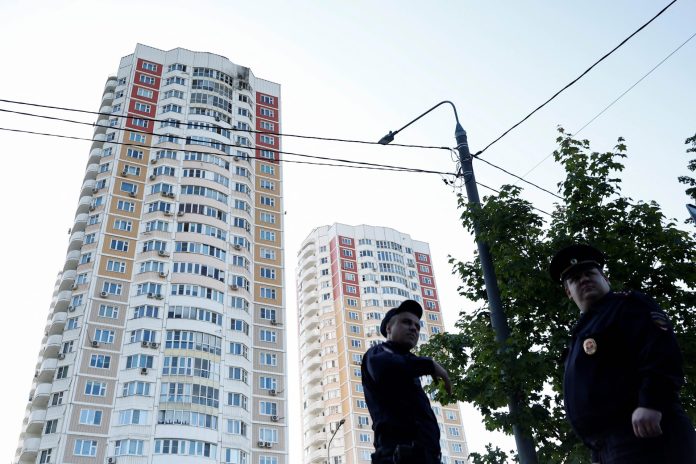
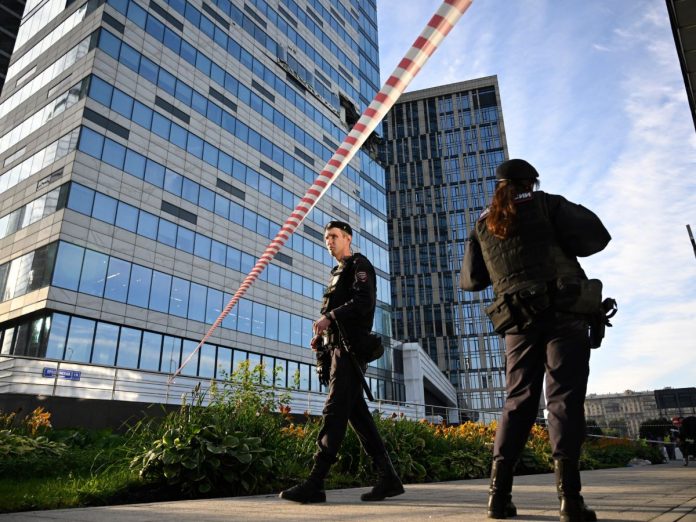
Ukrainian drones have attacked Moscow City, the Russian capital’s financial and business district, where some of Europe’s tallest skyscrapers are located, Mayor Sergey Sobyanin said in the early hours of Sunday.
“The facades of two of [Moscow] City’s office towers sustained minor damage. There are no casualties or injuries,” Sobyanin wrote in a short post on his Telegram channel.
The Russian Defense Ministry later released a statement, saying that a total of three drones were involved in the raid. According to the MOD, one was destroyed mid-air outside Moscow, while two others were disabled by air defenses, veering off course and crashing “on the territory of a non-residential complex in Moscow City.”
News agency TASS cited emergency services as saying there was “an explosion” between the fifth and the sixth floors of a 50-story building in the ‘IQ Quarter’ complex, which has three high-rise buildings. Local media reported that residents heard a loud blast. The IQ Quarter contains the offices of seven ministries and government agencies, including the ministries of trade, economy, and telecommunications.
A second “explosion” occurred at the OKO II building, which contains offices and shops, officials said. Emergency services told TASS news agency that windows were shattered between the first and fourth floors. They also said that a security guard was injured.
The damaged buildings have been evacuated, officials said. Evacuations from other Moscow City buildings are underway.
Ukrainian ‘terrorist attack’ on Crimea foiled: Russia
Russian forces have intercepted a Ukrainian attack on the Crimean peninsula involving 25 drones, the Defense Ministry in Moscow has said, adding that the raid caused no casualties or destruction.
In a statement early on Sunday, the ministry announced Moscow had repelled “an attempt by the Kiev regime to carry out a terrorist attack with 25 aircraft-type unmanned aerial vehicles” on facilities in Crimea.
It noted 16 Ukrainian drones were shot down by Russian air defenses while another nine were suppressed by electronic warfare, and crashed in the water near Cape Tarkhankut in the western part of the peninsula.
Crimea, which serves as the key base for the Russian Black Sea Fleet, has come under recurring Ukrainian missile and drone attacks in recent months.
On Monday, the Russian Defense Ministry reported a similar raid involving 17 drones, claiming all of them were downed. However, Sergey Aksyonov, the region’s leader, stated the strike hit a local ammunition depot.
Earlier this month a Ukrainian UAV raid on the Crimean Bridge damaged a section of the roadway and claimed the lives of a Russian married couple, while injuring their teenage daughter. Moscow responded by intensifying missile strikes on Ukrainian military facilities in the port city of Odessa.
In an interview with CNN on Monday, Ukrainian Defense Minister Aleksey Reznikov vowed further attacks on Crimea, describing the strikes as “normal tactics to ruin the logistic lines of your enemy to stop the options to get more ammunition, to get more fuel, to get more food, etc.”
Saudi Arabia to host Ukraine-Russia peace talks in coming weeks: Report
Saudi Arabia is set to host talks in August about Ukraine, inviting Western states, Ukraine and major developing countries including India and Brazil, according to a Wall Street Journal report.
The meeting would bring senior officials from up to 30 countries, including Indonesia, Egypt, Mexico, Chile and Zambia, to Jeddah on 5 and 6 August, the report said, citing diplomats involved in the discussion.
Ukraine and Western officials hope that the talks, which exclude Russia, can lead to international backing for peace terms favoring Ukraine, it added.
The Kremlin, which claims to have annexed around a sixth of Ukraine, has announced it views peace talks with Ukraine as possible only if Kyiv accepts “new realities”, a reference to its territorial claims. Kyiv says negotiations with Russia would be possible only after Moscow withdraws its troops.
Among the invited countries, it is not yet clear how many will attend, although countries that took part in a similar round of talks in Copenhagen in June are expected to do so again, according to the report.
Britain, South Africa, Poland and the EU are among those who have confirmed attendance and the US national security adviser Jake Sullivan is expected to attend, it added.
Kyiv’s forces are consolidating positions in southeastern Ukraine: Military
Fighting is raging across the southern and eastern fronts of the war in Ukraine this week, with Kyiv claiming modest gains in areas where it has recently ramped up its counteroffensive.
In southern Ukraine: Kyiv’s troops remain on offense in areas surrounding the cities of Melitopol and Berdiansk in the country’s south, military leaders said in a statement Saturday.
Russia is responding with missiles, rockets and air strikes targeting Ukraine’s troops and populated areas of southern Ukraine, according to the General Staff of the Ukrainian Armed Forces.
“Unfortunately, there were civilian casualties, and residential buildings were destroyed,” it said in an update.
A Ukrainian fighter with a mechanized infantry brigade stated that it has made successful gains on the outskirts of Robotyno, north of Melitopol in the Zaporizhzhia region. The brigade has also seen progress on the outskirts of the village of Verbove nearby.
“Robotyno is now basically just houses that have been completely destroyed and it is under our full fire control. The enemy has withdrawn all its headquarters from there and all it can do now is to throw in small groups of infantry. It is no longer under Russian control,” he added.
Ukraine’s military also reported Russian air strikes near Orikhiv in the Zaporizhzhia region, and in the Kherson region’s Antonivka. In those areas, the General Staff said, “the enemy is focusing its main efforts on preventing further advance of our troops.”
Russian forces in both regions have also been focused on holding the land corridor to Crimea, according to Ukraine’s Military Media Center.
In eastern Ukraine: In the Bakhmut area, the Ukrainian military has pushed Russian forces back almost to the village of Klishchiivka, Ukrainian serviceman Yevhen Kozhyrnov said on national television Saturday.
Kozhyrnov said the Ukrainian armed forces are moving on two flanks — north and south of Bakhmut. Over the past three days, a mechanized infantry brigade has advanced a little less than half a mile on the city’s outskirts, pushing back the enemy and reaching an advantageous height to control access to Bakhmut, Klishchiivka and access roads to the village, he added.
“Practically the whole of Klishchiivka is under fire, and this dictates a certain nature of the enemy’s actions,” Kozhyrnov stated.
“Our infantry is advancing heroically, very beautifully and very persistently, meter by meter, fighting for landings, for half landings, for every bush, there is progress,” he continued.
Kozhyrnov acknowledged “the advance is not fast,” adding that Russian forces are “still fighting back.”
Putin blames Ukrainian counteroffensive for lack of ceasefire
As Russia’s war against Ukraine rages on, and Kyiv escalates its counteroffensive, Russian President Vladimir Putin says a ceasefire is hard to implement.
He made the claim at a carefully orchestrated press event attended by a small group of Russian media in St. Petersburg.
Putin stated that Moscow has never rejected peace negotiations with Ukraine. In order to start the process to end the war, an agreement is needed from both sides, but it’s difficult to reach one while Ukraine’s army is on offense, the Russian leader said.
Putin also claimed Saturday that Ukrainian forces have lost hundreds of tanks and over 1,000 armored vehicles since June 4, a majority of them Western-made.
South African President Cyril Ramaphosa and several other African leaders have presented a 10-step peace initiative to both Putin and Ukrainian President Volodymyr Zelensky.
At his Russia-Africa summit this week, Putin has said the Kremlin is “carefully” considering the African leaders’ proposal, and blamed Kyiv for not coming to the table.
But Zelensky has ruled out any peace negotiations with Russia until Moscow’s troops withdraw from his country’s territory.
He stated allowing any negotiations while another nation’s military is occupying Ukraine would only “freeze” the war, pain and suffering caused by Putin’s invasion.
2 people killed and 1 wounded by Russian strikes in Zaporizhzhia
Russian strikes left two people dead and another person wounded in the southern city of Zaporizhzhia, a city official said Saturday.
“An enemy missile hit an open area. Unfortunately, a man and a woman died. Another woman was injured,” secretary of the Zaporizhzhia City Council, Anatolii Kurtev, said on Telegram.
“The blast wave knocked out windows in high-rise buildings and damaged the building of an educational institution and a supermarket,” he added.
On Friday, a Ukrainian commander on the southern front announced that his forces are “having some success” in driving back Russian forces, but intense combat continues.
Ukrainian forces this week for the first time reached Russia’s critical “dragon’s teeth” fortification, part of Moscow’s main line of defense. Satellite imagery had previously shown that Russia installed the “dragon’s teeth” lines — concrete and rebar pyramids designed to block the advance of armored vehicles — across the territory it controls in Ukraine.
Official: Russia received about 30 peace initiatives on Ukraine through various channels
Russia received about 30 peace initiatives for a settlement in Ukraine through official and unofficial channels, Russian Foreign Ministry Spokeswoman Maria Zakharova said on the sidelines of the second Russia-Africa summit.
“We are grateful to everyone. There were many such initiatives. It seems to me that a month ago there were already about 30 [initiatives] that were made by public figures through state channels or even in some private way,” the diplomat noted.
Zakharova stressed that Russia never refused negotiations on the Ukrainian conflict settlement.
“Even when we understood that they [negotiations] were unlikely to bring any added value, but we always gave such a chance to partners or the situation in general,” the Foreign Ministry Spokeswoman explained.
However, as Zakharova pointed out, in April 2022, “the Kiev regime withdrew from the negotiations, it asked for.”
“Several rounds took place, and then they stopped responding to the documents and materials that we sent at their request. <…> And in September, they themselves were legally banned from negotiating with our country,” she added.
Speaking about the African Peace Initiative on Ukraine, Zakharova pointed to the sincerity of African countries’ attempts to help resolve the crisis.
“We are extremely grateful to our African friends for the fact that they really – not in words, but in deeds – value peace and want to do everything in their power, even without being in any way participants in all this long-term drama, but, indeed, having open hearts and understanding what this can globally lead to and is already leading to. [We are grateful] for their attempt to do everything in their power or to somehow provide intermediary services, efforts to stabilize the situation. Once again, we never get tired of repeating the words gratitude,” the diplomat concluded.
Russia is ready for confrontation with NATO: Putin
Russia is “always ready for any scenario,” President Vladimir Putin told journalists on Saturday, commenting on a potential direct confrontation between the Russian and NATO militaries. The president was answering a question about recent near-collisions involving Russian and American aircraft in Syria.
“No one wants that,” the president added, pointing to the existing conflict-prevention lines that allow Russian and US officers to talk directly about “any crisis situation.” That fact that these lines still work shows that no side is interested in a conflict, he continued.
“If someone wants it – and that’s not us – then we’re ready,” Putin stated.
The Russian military has reported a total of 23 dangerous incidents involving Russian aircraft and those of the US-led coalition since early 2023, said Admiral Oleg Gurinov, the head of the Russian Reconciliation Center for Syria. Most incidents took place in July, he added.
In 11 cases the Russian pilots recorded being targeted with Western aircraft-targeting systems. Such actions on the part of the US-led coalition led to the automatic engagement of onboard defense systems, which saw Russian aircraft releasing decoy flares, the admiral told journalists.
Moscow has also repeatedly warned Washington and its allies about the risks of a potential direct conflict between Russia and NATO, particularly amid the ongoing conflict in Ukraine. Continued Western arms supplies to Kiev only extend the hostilities and make its Western backers engage in the conflict even deeper, Russia said.