
Trump stated that a draft agreement to end the war was nearly “95% done”.
“I really think we are closer than ever with both sides,” he said, adding that the Russian president, Vladimir Putin, also wants to “see it happen”.
The US president acknowledged there were “one or two tough” outstanding issues, over territory and how the war might end and expressed sympathy with Russia not wanting a ceasefire.
“You have to understand the other side,” he continued.
He also offered to travel to Kyiv to address Ukraine’s parliament ahead of a possible vote on a peace plan, saying he thought this would probably not be necessary.
“You are welcome always,” Zelensky interjected.
Zelensky repeatedly thanked Trump and paid tribute to his US team, including the president’s envoy Steve Witkoff and son-in-law Jared Kushner.
Despite the positive optics, there were few signs that a genuine agreement was imminent. When asked about the status of the Zaporizhzhia nuclear power station – occupied since the start of Russia’s 2022 full-scale invasion – Trump gave a confused answer and said Putin was no longer bombing it.
The meeting took place just hours after Trump held a lengthy phone call with Russia’s president.
“The two leaders want it to end,” Trump said, adding: “I think we can move pretty rapidly. Otherwise it’s going to go on for a very long time.” Trump praised Zelensky, saying: “This gentleman has worked very hard, and is very brave, and his people are very brave.”
He noted: “I do think we have the makings of a deal. We have two willing countries. We are in the final stages of talking.”
Speaking to reporters, the two leaders discussed the latest iteration of a 20-point peace plan and the unresolved question of the future of Ukraine’s eastern Donbas region. Standing next to Trump, Zelensky said US and Ukrainian negotiators had made good progress in recent weeks with “90%” of the draft agreed.
Writing on Truth Social before the meeting, Trump described his one-hour-15-minute call with Putin as “good and very productive”. Asked if Putin was serious about peace, Trump replied: “I think he is.”
There were no signs, however, that Russia was willing to drop any of its maximalist demands. According to Kremlin adviser Yuri Ushakov, Trump “listened carefully” on Sunday to Russia’s assessment of the conflict. Both sides agreed that a ceasefire proposed by Ukraine and Europe would only prolong the fighting “and is fraught with renewed hostilities”, Ushakov added.
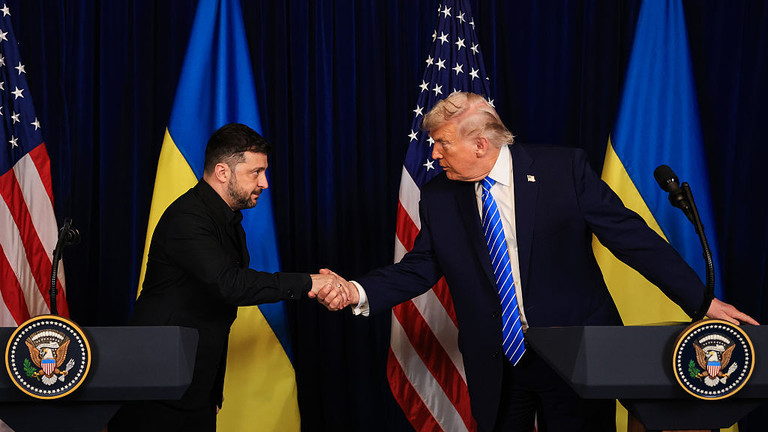
Trump greeted Zelensky on the steps of his residence and offered him a businesslike handshake. There was no hug. US officials did not meet Zelensky when he arrived at Palm Beach international airport, in contrast to the red carpet reception given to Putin by an applauding Trump at their summit in August in Alaska.
One former Ukrainian diplomat, Maria Drutska, stated that Putin was trying to “sabotage things” by ringing Trump before he saw Zelensky. During their previous meeting in October in the White House, Trump rowed back on the delivery of long-range Tomahawk missiles to Ukraine after a similar call to Moscow.
Putin wants Ukraine to hand over territory in the north of Donetsk oblast that his forces have been unable to capture. Zelensky’s counter-proposal envisages a demilitarised zone, with both sides withdrawing from the line of contact. The plan could be put to a referendum, providing Moscow first agrees to a ceasefire lasting from 60 to 90 days.
But fundamental problems remain, including the issue of security guarantees to prevent Russia from attacking again. Trump has made no military commitment to defend Ukraine. The original 28-point US plan was presented in November after talks with Russia and in effect demanded Ukraine’s capitulation.
Speaking alongside Canada’s prime minister, Mark Carney, on Saturday in the wake of another large-scale air attack on Kyiv by Russia, Zelensky described the onslaught as “Russia’s answer to our peace efforts”.
The Ukrainian president said to Carney: “We need two things, pressure on Russia and sufficient strong support for Ukraine.”
Ukraine’s capital was hit by more than 500 drones and ballistic missiles across Friday night and Saturday. The 12-hour attack killed four people and left half a million without power. Carney called the bombardment “barbaric”. A “willing Russia” was necessary to create conditions for a just and lasting peace, he added.
Trump declined to condemn the latest strikes on Kyiv and did not acknowledge that Russia – unlike, in his view, Ukraine – had deliberately targeted civilians.
“I believe Ukraine has made some very strong attacks also. I don’t say that negatively. You probably have to,” he stated, speaking outside his estate.
Sunday’s Mar-a-Lago talks were a moment of high risk for Zelensky. In a recent interview with the Guardian, Ukraine’s leader said he “wasn’t afraid” of the mercurial US president because both of them had a democratic mandate.
In February, Trump and the US vice-president, JD Vance, berated Zelensky in a bruising session at the White House. Subsequent meetings have gone better, including at the Vatican in April, and at the White House in October, when Zelensky was flanked by European leaders including Keir Starmer.
Ukrainian officials have worked hard to repair relations with a Russia-leaning White House, while coordinating closely with European allies.
Zelensky added he called Starmer on Sunday, informing him about the frontline situation and the consequences of Russian strikes. Trump said European leaders would join Sunday’s talks through a video conference link from Mar-a-Lago.
The Ukrainian delegation included Rustem Umerov, the head of Ukraine’s national security and defence council, the first deputy foreign minister, Sergiy Kyslytsya, and Ukraine’s new ambassador to Washington, Olha Stefanishyna. Witkoff and Kushner joined from the US side, as well as the US secretary of state, Marco Rubio, defence secretary, Pete Hegseth, Susie Wiles, the president’s chief of staff, and Gen Dan Caine, the chair of the joint chiefs of staff.
Zelensky described the meeting with Trump as a bilateral mostly focused on US-Ukraine issues. Key topics include security guarantees from the US and Europe, the military situation and the sequence for implementing agreements.
