Thursday, December 25, 2025
Home Blog Page 906

Americans concerned US campus protests will lead to violence: Poll

Protest US Universities

The survey, released Wednesday by USA Today and Suffolk University, found that nearly 32 percent of Americans said they are “very concerned” the protests will end up in violence, while just more than 35 percent said they are “somewhat concerned”.

Nearly 15 percent of respondents said they are “not very concerned”, and 14 percent said they are “not at all concerned”. About 3 percent were undecided, per the poll.

Protests calling for a cease-fire in the ongoing Israel-Hamas war in Gaza have roiled college campuses across the nation for nearly three weeks as demonstrators call on universities and the U.S. to sever ties with Israel. More than 2,500 people — students, faculty and others — have been arrested since the first major encampment began at Columbia University about three weeks ago.

While many of the protests have been reported to be peaceful, tensions have recently escalated between protesters, law enforcement and counterprotesters. A series of colleges have called in law enforcement to disassemble encampments or building takeovers, arguing they are a disruption to college campus activities.

Last week, protesters seized control of Hamilton Hall on Columbia University’s campus, prompting New York police officers to enter the building through a window, carrying riot shields and zip ties. Several people were arrested.

The violence escalated last Wednesday at the University of California, Los Angeles (UCLA) after counterprotesters assaulted a pro-Palestinian encampment for hours without police intervention. The counterprotesters threw fireworks and tried to take away the metal fencing and plywood from the encampment, resulting in a series of overnight skirmishes. Police later fired rubber bullets at the protesters while making arrests.

More than 200 UCLA students were arrested last week, California Highway Patrol announced.

President Joe Biden criticized the vandalism and trespassing occurring at some of the demonstrations earlier this month, while defending the right to peacefully protest.

“In moments like this, there are always those who rush in to score political points. But this isn’t a moment for politics,” Biden said in prepared remarks from the White House last week.

“It’s a moment for clarity. So let me be clear … Violent protest is not protected. Peaceful protest is.”

“Destroying property is not a peaceful protest, it’s against the law,” he continued, adding, “Vandalism, trespassing, breaking windows, shutting down campuses, forcing the cancellation of classes and graduation. None of this is a peaceful protest, threatening people, intimidating people.”

Concerns have been raised over the proliferation of antisemitic rhetoric and the safety of Jewish students, though several protest groups have pushed back against these characterizations.

Republicans and Democrats differed significantly when it came to how they view the protesters’ motives and beliefs, USA Today reported. About 64 percent of Republicans said the demonstrations reflect antisemitism, while only 22 percent of Democrats said the same, per the survey.

About 57 percent of Democrats and 26 percent of Republicans said the protesters’ motives do not reflect antisemitism, the poll found.

The USA Today/Suffolk University survey was conducted April 30 to May 3, among 1,000 registered voters. It has a margin of error of plus or minus 3.1 percentage points.
Southern Gaza hospitals running out of fuel: WHO

Gaza War

Israel on Tuesday sent ground troops and tanks into the city of Rafah and seized the nearby crossing into Egypt that is the main conduit for aid into the besieged Palestinian territory.

WHO Director-General Tedros Adhanom Ghebreyesus said fuel that the United Nations health agency had expected to be allowed in on Wednesday had been blocked.

Israeli authorities control the flow of humanitarian aid into Gaza.

“The closure of the border crossing continues to prevent the UN from bringing fuel. Without fuel all humanitarian operations will stop. Border closures are also impeding delivery of humanitarian aid into Gaza,” Tedros wrote on X, formerly Twitter.

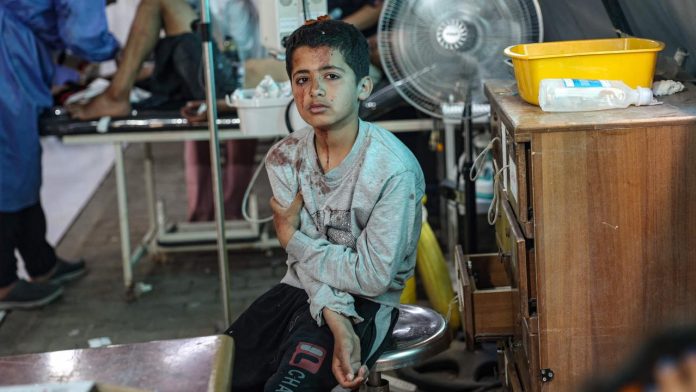
“Hospitals in the south of Gaza only have three days of fuel left, which means services may soon come to a halt.”

Israel has threatened a major assault on Rafah to defeat thousands of Hamas fighters it says are holed up there. But the city is also a refuge for more than 1.4 million Palestinians who have fled combat farther north in the coastal enclave under Israel’s previous evacuation orders.

They have crammed into tent camps and makeshift shelters and have suffered from shortages of food, water and medicine. Rafah’s main maternity hospital, where nearly half of Gaza’s births take place, has stopped admitting patients, the UN Population Fund (UNFPA) told the news agency Reuters.

The UNFPA announced the hospital, Al-Helal Al-Emairati Maternity Hospital, had been handling about 85 of the 180 births in Gaza each day before Israel’s incursion into the city.

Medical Aid for Palestine (MAP) stated it had received an update from Marwan Homs, head of Abu Youssef al-Najjar Hospital in Rafah, who said the facility is no longer functioning because all staff have been ordered to evacuate.

“This was Rafah’s largest hospital,” MAP noted.

“This means Rafah’s already overstretched and underresourced health system is now left with only Kuwaiti Hospital, which is an NGO hospital with around [a] 16-bed capacity; Marwani field hospital, which is only a trauma stabilisation point; and Al-Emairati Hospital, which is only a maternity hospital,” it added.

The dire warnings come as Palestinian officials in Gaza accused Israel of deliberately halting the entry of aid into Gaza and targeting medical facilities.

Israeli forces are “purposefully worsening the humanitarian situation by halting the entry of aid supplies from the Rafah and Karem Abu Salem border crossings, and by targeting hospitals and schools in eastern Rafah”, Salama Marouf, Gaza’s Government Media Office spokesman, told reporters, referring to the latter crossing by its Arabic name. It is also known as Kerem Shalom in Hebrew.

Israel claims it does not restrict aid supplies into Gaza.

Hamas announced its fighters were battling Israeli forces in the east of Rafah. The Israeli military claimed it troops had discovered Hamas infrastructure in several places in eastern Rafah and were conducting targeted raids on the Gaza side of the Rafah crossing and airstrikes across the Gaza Strip.

Israel has ordered tens of thousands of civilians, many of whom have been uprooted several times already, to go to an “expanded humanitarian zone” in al-Mawasi, some 20 km (12 miles) away. Rafah’s mayor Ahmed Al-Sofi said said the coastal area lacked all “the necessities of life”.

Residential neighbourhoods, hospitals and schools where tens of thousands of people have sought shelter “are being targeted” by Israeli forces in Rafah, Maarouf said.

“The reality in eastern Rafah governorate indicates a real humanitarian catastrophe,” he added.

More than 35 Palestinians have been killed in the latest 24-hour reporting period, according to health officials in the enclave.

Speaking alongside Maarouf, Khalil al-Daghran, an official with Gaza’s Ministry of Health, said the closure of the Rafah crossing has prevented dozens of wounded and ill Palestinians from leaving to seek treatment abroad and those who were cleared by Egypt to leave Gaza on Tuesday have been prevented from doing so.

The situation of Gaza’s sick and wounded is “very difficult” and has been this way since the start of the Israeli assault due to a severe lack of medical supplies, al-Daghran added.

He called on the international community and United States President Joe Biden’s administration to pressure Israel to end its assault and reopen the border crossings immediately.

About 50,000 people had left Rafah since Monday when the Israeli incursion began, an official with the UN Relief and Works Agency for Palestine Refugees (UNRWA) reported.

UNRWA announced an average of 200 people are leaving Rafah every hour – mainly to Deir el-Balah in central Gaza and to the widely destroyed southern city of Khan Younis.

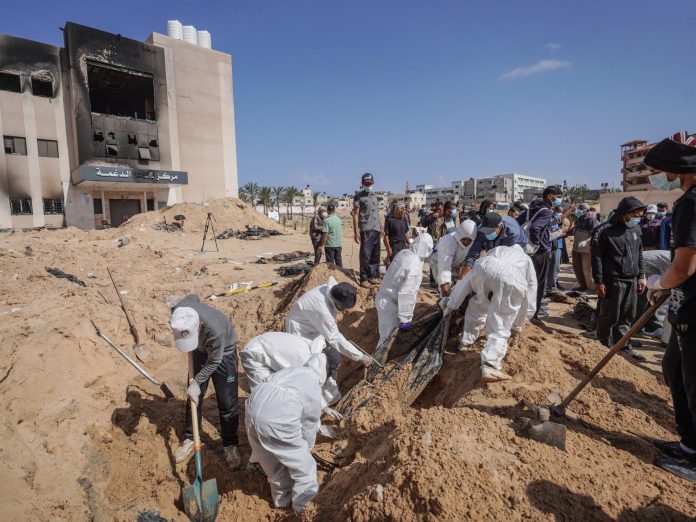
Third mass grave found at Gaza hospital

Gaza War

“Some 49 dead bodies have so far been exhumed from the mass grave and efforts are still underway to search for more,” it said in a statement.

At least seven mass graves have been found in the Gaza Strip as Israel continued its brutal offensive on the enclave that has left more than 34,800 people dead and injured over 78,400 others since Oct. 7, 2023.

Three mass graves were found at Al-Shifa Hospital, three at Nasser Hospital in the southern city of Khan Younis, and one inside Kamel Adwan Hospital in northern Gaza, the media office noted.

“At least 520 bodies of dead people have been exhumed from the seven mass graves,” it added.

Over seven months into the Israeli war, vast swathes of Gaza lay in ruins, pushing 85% of the enclave’s population into internal displacement amid a crippling blockade of food, clean water, and medicine, according to the UN.

Israel stands accused of genocide at the International Court of Justice. An interim ruling in January said it is “plausible” that Israel is committing genocide in Gaza and ordered Tel Aviv to stop such acts and take measures to guarantee that humanitarian assistance is provided to civilians in Gaza.

Twin rainbow forms over Tehran

Iran rainbow

A photo posted online captured the breathtaking view of this complete double rainbow with some buildings below.

Double or twin rainbows are a rare occurrence. Meantime, rainbows only require two things to form: the sun and a little bit of rain.

Recent downpours in Iran have been heavy though. Among other cities, Tehran saw heavy showers last evening.

The same thing has happened in many other cities such as the northwestern city of Ardabil, hit by hail.

EU reveals profits from blocked Russian assets

Ruble

The EU is expected to make a decision granting Kiev €2-3 billion in revenue generated by the Russian assets “in the coming weeks”, Urbain said in an interview with the Belgian news outlet L’Echo. Brussels previously suggested seizing the profits to buy weapons for Ukraine rather than using the funds for reconstruction, as had been initially planned.

Euroclear, a key intermediary on EU financial markets, has over €200 billion in Russian securities blocked in its accounts, according to company data. Over the past year those accounts have accrued nearly €4.4 billion in interest. The windfall tax on the profits is expected to be between 87% and 89%, according to Urbain.

The seizure of the interest income would raise a “question of legal certainty” and have a “very negative impact” not only on Euroclear, but on financial markets worldwide, she warned.

“If our clients feel that the law is no longer respected and that their assets may be confiscated, this opens a Pandora’s box,” Urbain told L’Echo.

“This could lead large international investors to turn away from Europe.”

Euroclear, one of world’s largest providers of cross-border settlements, which holds some €37 trillion in assets, has long opposed Brussels’ plans to tap frozen Russian funds, and its shareholders support that position, Urbain noted. The income linked to Russian activity “must be retained and must not be distributed”, she insisted.

The US had been pushing for the outright seizure of the underlying assets in order to fund Ukraine’s government, but has shifted towards taking only the interest amid resistance from France, Germany and the ECB, who worry that the euro could be affected if countries such as China start repatriating their massive foreign reserves as a precaution against their possible confiscation in the future.

Officials from G7 states privately said that full confiscation is no longer on the agenda despite Ukrainian demands, Financial Times reported last week.

Russia has stressed that any action taken against its assets would amount to theft and violate international law.

Teacher saves kids amid flood in Iran

Iran Flood

The self-sacrificing teacher has been identified as Farid Mahmoudi.

Kouhrang is a city in Chahar Mahal and Bakhtiari Province where downpours have been huge over the past months.

US says paused shipment of bombs to Israel amid concerns over Rafah offensive

Gaza War

The shipment, which was held back last week, includes 1,800 bombs weighing 2,000 pounds and 1,700 bombs weighing 500 pounds.

“We are especially focused on the end-use of the 2,000-pound bombs and the impact they could have in dense urban settings as we have seen in other parts of Gaza,” the official said.

Israeli leaders have warned for weeks that an invasion of the southern Gaza city of Rafah will occur at some point in the future, even as the US and others have publicly stated that such a ground operation should not occur. The Joe Biden administration has called for a comprehensive plan to protect more than a million civilians sheltering in Rafah and avoid an expansion of the humanitarian catastrophe unfolding in the coastal enclave.

On Monday, Israel carried out what the US described as a “limited” operation in Rafah, taking over the border crossing with Egypt that is a vital lifeline for humanitarian aid.

“This appears to be a limited operation, but of course, much of that depends on what comes next,” stated State Department spokesman Matt Miller on Tuesday.

“They have said, I think quite clearly, it’s no secret that they want to conduct a major military operation there. We have made clear that we oppose such an operation.”

The US and Israel have been in regular communication about the Israeli military’s plans to conduct a major ground operation in the southern part of Gaza, but the administration has been clear that the plans are far from ready.

“We’ve seen kind of the concepts, but nothing detailed at this point,” Pentagon press secretary Maj. Gen. Pat Ryder said at a press briefing Monday.

Still, Prime Minister Benjamin Netanyahu has repeatedly stated that a ground operation in Rafah is necessary to keep the pressure on Hamas to release the remaining hostages and to achieve victory. As Israel’s leadership came closer to a final decision, the US began to review proposed transfers of particular weapons to Israel that might be used in Rafah, the US official added. The process of carrying out the review began in April and led to the pause in shipments of the two types of bombs.

“We have not made a final determination on how to proceed with this shipment,” the official continued.

Among the largest conventional weapons in the US arsenal, 2,000 pound bombs can have a devastating impact, especially on a densely populated area such as Gaza. The heavy munitions leave a massive crater and can send deadly shrapnel hundreds of feet from the impact site.

The US is also reviewing the potential sale or transfer of other munitions, including Joint Direct Attack Munition (JDAM) kits to Israel, the official said. But these transfers are not imminent and would occur in the future, the official stated.

The Pentagon would not comment when asked about pauses in shipments, but insisted that none of this changes the US’s commitment to the defense of Israel.

“Our commitment to Israel’s security remains ironclad,” Pentagon deputy press secretary Sabrina Singh said at a briefing Tuesday, adding, “You’ve seen that since October 7. You’ve seen us surge security assistance to Israel. So while I’m not going to comment any further I can tell you that our commitments to Israel’s security remains the same.”

EU proposes new choice to tap Russian money amid war: Report

Russian Central Bank

The proposal comes as the bloc seeks ways to unlock funding for Kiev, Politico has reported, citing EU diplomats.

Earlier this year, Brussels suggested seizing the interest earned from the assets to acquire weapons for Ukraine rather than using the funds for reconstruction, as had been initially planned.

The proposed measure has faced resistance from some EU member states that are not part of NATO, including Austria, Ireland, Malta, and Cyprus. They have demanded an exemption from buying arms for Kiev, according to the article. Other vocal critics of the EU plan include Hungary and Slovakia, the outlet reported.

Under the EU’s latest attempt to win over member states, countries which oppose the plan can limit themselves to providing humanitarian aid to Ukraine, the outlet said, citing an EU document.

Brussels is now pressing ahead with the idea of creating two different tracks, according to officials – one in which the profits would be used for non-military aid, and a second aimed at buying weapons, from which neutral countries can opt out.

The West has frozen roughly $300 billion in Russian sovereign funds since the start of the Ukraine conflict. Brussels-based clearinghouse Euroclear holds around €191 billion ($205 billion) of the funds and has accrued nearly €4.4 billion in interest over the past year.

In March, EU foreign policy chief Josep Borrell proposed taking 90% of the revenues from Russian assets frozen in the bloc and transferring them to an EU-run fund that finances weapons for Ukraine.

The EU is aiming to give Kiev €2-3 billion in revenue generated by the assets this year. A first tranche of the money could be disbursed as early as July if Brussels can secure the approval of all member states.

The opt-out, however, may not appease Germany, France, and Italy, which are the least enthusiastic about the proposal due to the legal and financial risks, an EU diplomat told the outlet.

Russia has announced that any actions taken against its assets would amount to theft, stressing that seizing the funds or any similar move would violate international law and undermine Western currencies, the global financial system, and the world economy.

Lithuania says ready to send soldiers to Ukraine

Lithuania army

French President Emmanuel Macron floated the idea of having NATO boots on the ground in Ukraine in February, arguing that nothing should be excluded to prevent a Russian victory in the conflict. The Lithuanian government has similarly stated that there should be no red lines in efforts to aid Kiev.

Speaking to the British newspaper, Simonyte said she has parliamentary permission to deploy soldiers in Ukraine, but has not received a request from Kiev. Ukrainian Prime Minister Denis Shmigal told Canadian media last week that his nation would be “glad” to see Western intervention “if the time comes”.

Lithuania is among the Western nations that regularly resort to rhetoric Russia regards as belligerent. Last month, one of its ambassadors published a post on social media which implied that the strategic Crimean Bridge would soon be destroyed – one of Kiev’s key goals. The comment followed US approval of $61 billion in Ukraine-related spending and the revelation that it had supplied more mid-range ATACMS missiles to the country.

This week, the Russian military announced a surprise drill to test its ability to deploy non-strategic nuclear weapons. Moscow said it was a response to “threats” from Western officials, including Macron and British Foreign Secretary David Cameron, who told the media last week that Ukraine “has the right” to use arms donated by the UK to strike targets deep inside Russia.

In her interview, Simonyte stated she was not concerned about Moscow’s reaction to the possible Lithuanian deployment.

“Every second week you hear that somebody will be nuked,” she remarked.

The prime minister reiterated that Vilnius was “keen to help Ukraine, to ensure that it has the potential to renew its armed forces”. She denied that her government was considering deportations of Ukrainian citizens, since forcing them to go home to fight Russia “would not be legal”.

Ukrainian mobilization efforts have been undermined by draft avoidance and public resistance to the heavy-handed approach shown by conscription officers, as shown in multiple video clips circulating online. This week, the military recruitment center in Khmelnytsky Region in western Ukraine threatened prison terms of up to eight years for filming its officers at work.

Iran Leader meets Futsal National Team

Iran Leader meets Futsal National Team

The Futsal National Team beat down Thailand 4-1 in the final match in Bangkok, securing Iran’s 13th AFC Asian Cup title.

Related pictures: