









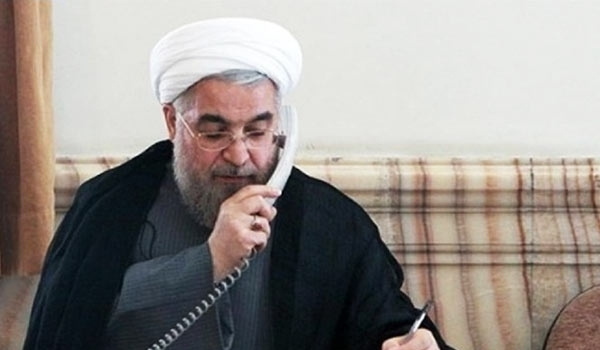
“Silence against Gaza catastrophe is not wise and people of Gaza will not tolerate repetition of former tyrannical conditions and continuation of several years of siege,” Rouhani said during the telephone conversation on Tuesday.
He noted that regional conditions necessitate closer cooperation and consultation between Iran and Qatar.
The Iranian president said that all Muslims are in a big historical test, adding, “Unity and cooperation is needed among Muslims to change living condition of the people of Gaza and attain sustainable ceasefire.
The Qatari emir, for his part, underlined the need for cooperation among Muslim states to break the siege of Gaza, and said, “Palestinian resistance movement defends it own pride and no one can prohibit it from it.”
He also welcomed the meeting of the Palestinian Committee of the Non-Aligned Movement (NAM) due to be held at the ministerial level in Tehran later this week.
The foreign ministers of the Non-Aligned Movement are slated to take part in an emergency meeting of the block’s Palestine Committee in Tehran to discuss the aggravating conditions in the Gaza Strip, Iranian Foreign Ministry Spokeswoman Marziyeh Afkham announced on Sunday.
“The one-day meeting of NAM’s Palestine Committee will be hosted by Iranian Foreign Minister (Mohammad Javad Zarif) in Tehran,” Afkham said.
She noted that the ambassadors of the member-states of NAM’s Palestine Committee, in a meeting held in New York earlier this month at Iran’s initiative and presided by Iran’s Ambassador to the UN Hossein Dehqani, selected Tehran for hosting the day-long emergency meeting.
“Subsequent to the outbreak of the recent crisis in Gaza and the order of President Hassan Rouhani and within the framework of the intensive diplomatic efforts made by Iran as rotating head of the NAM, several emergency and intensive meetings have been held in New York in the past 10 days as a result of the prompt action of the Iranian mission at the UN following a relevant order by Dr. Zarif to the mission,” Afkham said.
“Ways of utilizing the political capacities of the NAM member-states and relevant attempts and actions have been discussed and the (emergency) meeting of the NAM’s Palestine Committee will be held within the same framework,” she added.
Earlier this month, President Rouhani, as the Head of the NAM, in a declaration seriously condemned the recent massive attacks by the Israeli forces against the innocent people of Gaza Strip, and called on international bodies and world states to force Tel Aviv to stop its blind raids on civilians.
“Siege of Gaza Strip must be fully and immediately lifted and humanitarian aids must be forwarded to the Palestinians in need of them there,” said President Rouhani in the NAM declaration.
“The intensive air strikes against the residential areas of Gaza that have killed dozens of Palestinians so far and wounded so many others, including many women and children, once again echoed the sad tragedy of the Palestinian nation, and the obvious breaching of the entire international law by the Zionists before the open eyes of the world nations” the NAM declaration said.
“The recent aggressive acts have led to the creation of a catastrophic condition that has put at stake both the regional and the international peace and security,” it added.
“Military invasion against Gaza Strip takes place under such conditions that the region is still due to the lingering siege of Gaza throughout the past many years suffering from a dilemma due to the heavy shortage of medical and health facilities and the Palestinians face numerous hardships even for curing their wounded victims of the recent attacks,” the declaration went on to say.
“The occurrence of a great human catastrophe is feared under the current conditions and while expressing deep concern about its occurrence in Gaza Strip, I emphasize the need for offering humanitarian aids to the people of that region, immediately,” the Iranian President underlined.
“I, as the president of the Islamic Republic of Iran, and the rotating head of NAM, seriously condemn the systematic, illegal, and inhumane crimes against the Palestinians, and call on the entire concerned regional and international bodies to heed their legal responsibilities immediately, in line with full lifting of the Gaza siege and in forwarding of humanitarian aids for the Palestinian people, as well as blocking the path for more aggressive acts and the greater massacre of the oppressed Palestinian people through adoption of an effective legal and international mechanism to pursue and put to trail the criminal Zionists,” President Rouhani stressed.
The NAM declaration ended with deep pessimism on the impotence of the UN Security Council for adopting immediate measures to stop the ongoing aggressions and asked the UNSC members to immediately heed their responsibilities for putting an end to those unjust aggressions.
Israel has been pounding the blockaded Gaza for 23 consecutive days, killing at least 1,260 people and injuring more than 7,000 others.
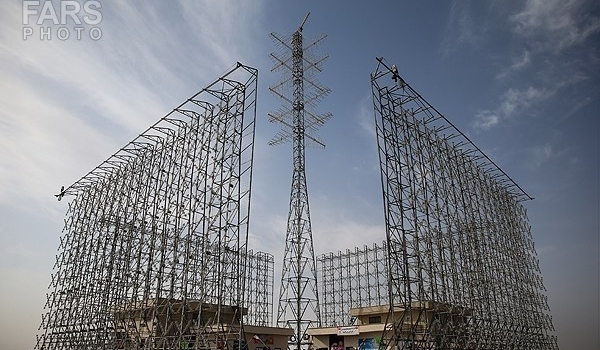
“On September 22 (parades), a number of missile and radar systems will be unveiled in Iran and we have spread these systems and radars in different parts of the country,” Esmayeeli told FNA.
The annual September 22 parades mark the start of the Week of Sacred Defense, commemorating Iranians’ sacrifices during the 8 years of Iraqi imposed war on Iran in 1980s.
During the parades last year, the Iranian armed forces displayed different weapons and military tools and equipment, including different kinds of fighters, choppers, drones, ground-to-ground missiles, air-to-ground missiles, surface-to-surface missiles, tactical and armed vehicles, surface and underwater vessels, electronic and telecommunication equipment, light and mid-light weapons, different kinds of artillery and mortar-launchers, air defense systems and engineering and logistic equipment.
The Iranian armed forces also displayed the tactical troposcatter system which is an advanced home-made communications system unveiled by Farzad Esmayeeli in September.
Also, Nebo tactical radar system, Kasta surveillance radars, Matla’ al-Fajr local radar system, national radar, a model of Shahab (Meteor) cosmic radar, a model of Samen radar, optimized Sky Guard radar system, high-altitude S-200 missile system, home-made Mersad missile system armed with indigenous Shahin (Eagle) missiles, mobilized Hag missile system, home-made mid-altitude Ya Zahra 3 missile system, and the low-altitude Rapier missile system were among the other weapons and military equipment on display.
The Iranian Armed Forces also displayed Saafaat electro-optic tracking system, mobile 35 and 23 mm cannons, mobile tactical communications vehicle, vehicle equipped with chemical decontamination system, DZ vehicle and communication system, Kheybar tactical vehicle, Same’ van built by the air defense base and central communication shelter manufactured by Khatam ol-Anbia Air Defense Base in the parades.
The Iranian Armed Forces have recently test-fired different types of newly-developed missiles and torpedoes and tested a large number of home-made weapons, tools and equipments, including submarines, military ships, artillery, choppers, aircraft, UAVs and air defense and electronic systems, during massive military drills.
Defense analysts and military observers say that Iran’s wargames and its advancements in weapons production have proved as a deterrent factor.
The Iranian officials have always stressed that the country’s military and arms programs serve defensive purposes and should not be perceived as a threat to any other country.
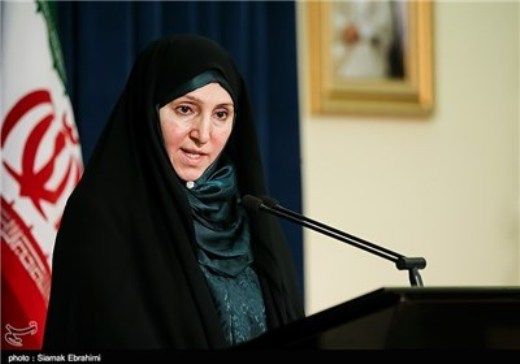
Dozens of civilians were killed or injured in a terrorist attack on Monday morning in Shache County, northwest China’s Xinjiang Uygur Autonomous Region.
A gang armed with knives and axes attacked a police station and government offices, while some moved on to the nearby Huangdi Township, attacking civilians and smashing vehicles as they passed. Dozens of Uygur and Han civilians were killed or injured.
“Police officers at the scene shot dead dozens of members of the mob,” reported the Chinese official news agency, Xinhua.

The condemnation comes after Israeli forces shelled the UN-run school in Jabalia refugee camp on Wednesday. Initial reports say at least 19 Palestinians were killed and about 90 injured in the deadly attack.
The United Nations Relief and Works Agency for Palestine Refugees in the Near East (UNRWA) said there is solid evidence that Israel was behind the attack. The UNRWA added that it had already announced the locations of its shelters to Israel.
“We have visited the site and gathered evidence. We have analyzed fragments, examined craters and other damage. Our initial assessment is that it was Israeli artillery that hit our school, in which 3,300 people had sought refuge,” Pierre Krahenbuhl, Commissioner General of the UNRWA, said in a statement.
The senior official also condemned “in the strongest possible terms this serious violation of international law by Israeli forces,” adding that Israel’s inhumane acts of violence were bringing shame to the world.
“Last night, children were killed as they slept next to their parents on the floor of a classroom in a UN-designated shelter in Gaza. Children [were] killed in their sleep; this is an affront to all of us, a source of universal shame. Today the world stands disgraced.” the statement read.
The UNRWA says it is the sixth time that one of the schools housing the fleeing Gazans has been struck by Israeli forces.
UN Humanitarian Chief Valerie Amos has also said that she is shocked by Israeli attacks on the world body’s shelters in Gaza.
Amos noted that civilians, among them children, are the main victims of Israeli attacks on the UN schools which are used as shelters by Palestinians.
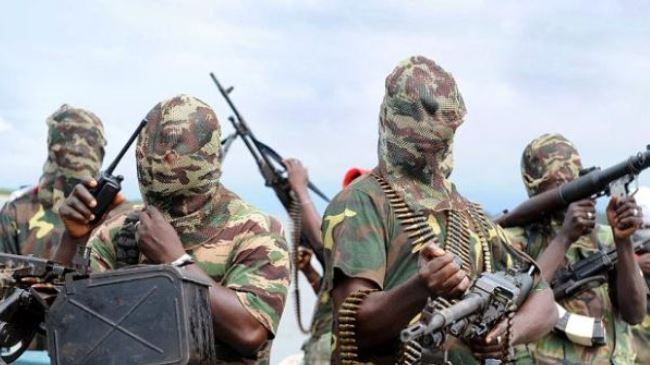
The two mosques in the town of Potiskum in Nigeria’s Yobe State were targeted by bombers late Tuesday. Eyewitnesses blamed the Takfiri Boko Haram terrorists for the deadly attacks.
The first blast rocked an open-air mosque belonging to Shia followers of Islam in the Dogo Tebo area of Potiskum at about 7:55 p.m. (1855 GMT), leaving four people dead, AFP reported.
The second explosion reportedly went off five minutes later at a mosque in the town’s Anguwar Bolawa area, in the compound of the chief imam, killing at least two worshippers.
Witness Balarabe Dahiru was cited in the report as saying that a bomber “we believe was from Boko Haram blew himself up at the open air mosque used by Shias which they name Saqafa shortly after saying their evening prayers there.”
“We took four dismembered bodies of the victims to the hospital along with five others who were injured,” said Dahiru, who was sitting outside his house when the blast took place.
Another local resident, identified as Awwal Maikusa, also offered a similar account, adding that a second blast occurred five minutes later.
“They are obviously the handiwork of Boko Haram,” Maikusa said of the two bombings.
The Takfiri militants have carried out many attacks on Christians and Muslims in northeastern Nigeria. Boko Haram militants also kidnapped over 200 schoolgirls in April.
Potiskum, Yobe state’s commercial hub, has been the scene of repeated deadly Boko Haram attacks in the past four years although they became fewer over the recent months.
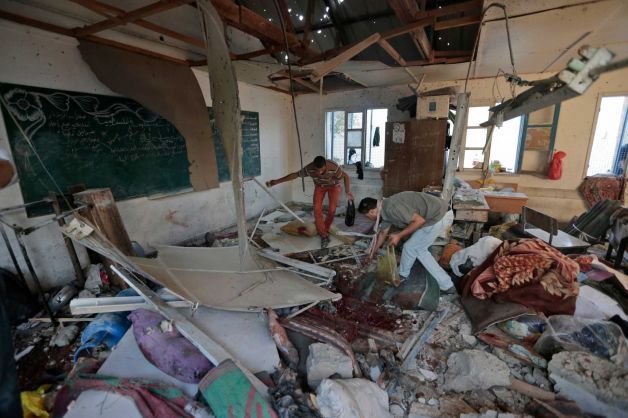
According to reports, the Israeli shelling hit Abu Hussein School in Jabalia, located 4 kilometers North of Gaza City early on Wednesday, press tv reported.
Scores of people also suffered injuries in the deadly attack on the UN-run school, which was used as a shelter by Palestinian families against the Israeli offensive.
This is the second time in less than a week that the Israeli army is targeting a UN-run school. On July 24, Israeli tank shells slammed into a school in Beit Hanoun in the Northern Gaza Strip. Sixteen people were killed and hundreds of people were also wounded in the attack. The school was also used as a shelter for Palestinian families forced to leave their homes due to Israel’s deadly offensive in the enclave.
Twelve more Palestinians were also killed in separate Israeli attacks on Wednesday.
Reports say that three mosques were also destroyed in overnight Israeli strikes on the blockaded enclave.
Since July 8, Israel has been targeting the Gaza Strip with military attacks. The air, sea and land strikes by Israel have so far killed more than 1,260 people and injured thousands of others in the coastal sliver.
The Ezzedine al-Qassam Brigades, the military wing of the Palestinian resistance movement Hamas, has been launching retaliatory attacks against Israel. Tel Aviv confirms 53 Israeli soldiers have been killed in Gaza war, but Hamas puts the number at around 100.

“We hope that international pressure will help warring parties to come to agreement, primarily over a ceasefire and then to attain firm peace which is still unfortunately seen in a very far future,” Chilean Foreign Minister Heraldo Munoz said.
He noted that the decision to recall the ambassador in Israel had been thought out in detail, Itar Tass reported.
El Salvador Ambassador in Israel Susana Edith Gun was also recalled for “urgent consultations” on Tuesday.
The Foreign Ministry of the Central American country said that El Salvador President Sanchez Ceren gave these instructions “over serious escalation of violence and Israel’s bombings in the northern part of the Gaza Strip.”
Ecuador, Brazil and Peru have already recalled their ambassadors from Israel.
The death toll of Palestinians from the start of an Israeli military operation in the Gaza Strip exceeded 1.1 thousand people and more than 6.5 thousand were wounded.
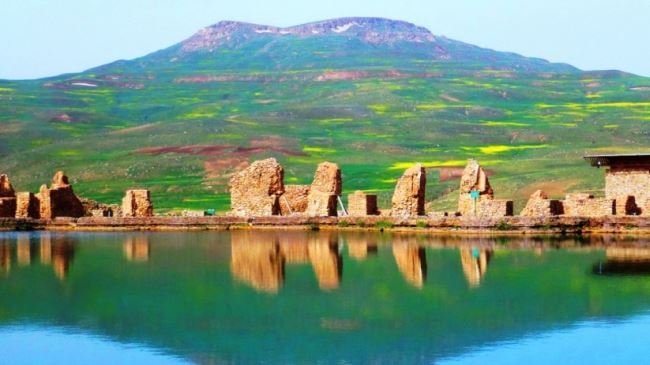
Takht-e Soleymān means ‘Throne of Solomon’ . It is located in north-western Iran, in a broad and remote mountain valley between cities of Zanjan and Tekab. The site consists of an oval platform around 350 by 550 square meters.
In earlier ancient period the area was known as ‘Shiz’ or ‘Adur Gushnasp’; which literally means the ‘Fire of the Warrior Kings’. The area’s name changed to”Throne of Solomon” after the Arab conquest.
Built during the Sassanid era, the ruins introduce the principal Zoroastrian sanctuary and a Sassanid temple dedicated to Anahita, the goddess of water and fertility in ancient Persian mythology.
Fire and water have been among the fundamental elements for the Iranian peoples since ancient times. Zoroastrian people believe that fire conceives a divine messenger between the visible world and the invisible (the one of gods); and consider water as the source of life.
Takht-e Soleymān includes a lake with floor springs, surrounded by massive stone walls and 38 towers.
There is also a volcanic conical core mount near the area; which is known as Solomon’s Prison (Zendan-e Soleyman).
The 107-meter tall mount has a giant hole on top, with 65meter span and nearly 80 meter depth.
Centuries ago, floor springs fed the hole and made it full of water. However the hole dried up after an earth quake.
The structures partly restored in the Mongol period (Ilkhanid) in 13th century. The designs of the fire temple, the palace and the general layout have strongly influenced the development of Islamic architecture.
Archaeological excavations have unveiled traces of an occupation during the Achaemenid period, as well as later Parthian settlements in the citadel.
Persia was a conquering empire, but also one of the more glorious and benevolent civilizations of antiquity.
As an outstanding ensemble of royal architecture, Takht-e Soleyman (Throne of Solomon) was inscribed on UNESCO’s World Heritage list on July 3, 2003.

“At present, we are self-sufficient in the production of diesel fuel and we have no need to import it,”Bijan Namdar Zanganeh said on Saturday.
Referring to the development of Iran’s giant South Pars gas field in the Persian Gulf, Zanganeh described the project as an unprecedented and the largest project in the country’s natural gas industry.
He expressed hope that Iran will add 100 million cubic meters of natural gas to its national network by the end of the current Persian calendar year (ending March 20, 2015).
Iran has been trying to enhance its gas production by attracting foreign and domestic investment, especially in its South Pars gas field.
South Pars is part of a larger field that is shared with Qatar. The larger field covers an area of 9,700 square kilometers, 3,700 square kilometers of which lie in Iran’s territorial waters (South Pars) in the Persian Gulf. The remaining 6,000 square kilometers, referred to as the North Dome, are located in Qatar’s territorial waters.
The Iranian oil and gas field contains 14 trillion cubic meters of natural gas, about eight percent of the world’s reserves.
© All Content by IFP News ( Iran Front Page ) is licensed under a Creative Commons Attribution 4.0 International License.
