Tuesday, December 23, 2025
Home Blog Page 5086

National Cinema Day to return to official calendar

Iran National Cinema Day
Tehran Pardis Cinema

In line with changes that usually come in the wake of the rise to power of a new government, Chairman of Iran Cinema Organization Hojatollah Ayubi has sent a letter to the secretary of the Public Culture Council which reads: “In light of the fact that the Supreme Leader has designated this year [which started on March 21, 2014] as the year of economy and culture, Iran Cinema Organization is appealing for the reinstatement of National Cinema Day on the country’s official calendar.” September 12th used to be called National Cinema Day on the official calendar, but two years ago the Public Culture Council removed it from the calendar and instead put it on an index, citing the fact that there are “too many occasions” on the official calendar of the country.


Panjereh-199-cover
Panjereh-199-cover

Khuzestan Province, Land of Oil and More

Khuzestan Province, Land of Oil and More

“Hunting and Nature” is a bimonthly that covers a variety of issues such as the environment, natural geography, hunting, game-keeping, conservation, and wildlife. Its 135th issue (April-June 2014) conducted an interview with Ahmad-Reza Lahijanzadeh, the director general of Provincial Environment Protection Department in Khuzestan, a southwestern Iranian province on the Persian Gulf; which has played a key role in the social, political, and economic life of the Iranians over the years.

We have picked part of the interviewwhere the environment chief talks about the climatic conditions of this mysterious expanse of land. Why mysterious? Because over the past century, it has been under the spotlight for two major reasons.

The first was the conflict that pitted the Iranian government against Western colonial powers, specifically Great Britain, over black gold – oil. It then resulted in the nationalization of the oil industry; and saw Mohammad Mosadegh’s government rise to power only to be toppled by the 1953 US-orchestrated coup – aka the 28 Mordad coup.

The second was the 8-year war between Saddam Hussein’s regime and Iran; which broke out following the 1980 invasion of Khuzestan and subsequent renaming of it by invaders. Khuzestan was finally taken back thanks to acts of bravery by the Iranian youth and selfless sacrifices of hundreds of thousands of soldiers; many of whom lost their lives or limbs to the war. What Khuzestan is like is one of the questions Lahijanzadeh has answered in the interview.

The human and natural environment of Khuzestan Province has some properties which are unknown to lots of people, particularly those who come from other parts of the country. On the surface, Khuzestan is an oil-rich region with a hot climate and barren deserts whose only considerable potential is oil, in reality though, our province enjoys special and at times unique features.

The province has a mountainous, plain-like and marine ecosystem

Khuzestan Province is about 64,000 square kilometers in area. One of its exclusive properties is that its northern and northeastern parts, which lie to the south of Central Zagros, are similar to the Zagros Mountains as far as ecosystem goes. The mountainous area abuts the Khuzestan Plain – a flat and fertile piece of land that stretches all the way to the sea.

That means the province has a mountainous, plain-like and marine ecosystem. The central ecosystem, the Khuzestan Plain, is irrigated by five large and permanent rivers, including the Karkheh River in the west of the province, the Dez River, the Karun River at the center, the Marun River, which is also known as Jarahi, and the Zohreh or Hendijan River in the east.

These five rivers have created their own alluvial ecosystems along their path in the region. Also, they have formed special deltas at their confluence with the Persian Gulf which in turn creates a habitat that can be seen only from the air.

Dense forests lying on the banks of the Karun and Dez rivers have now been designated as National Park

During a 150-minute tour by helicopter of the region, Masoumeh Ebtekar, the head of Iran’s Environment Protection Organization, and I only managed to inspect part of the area. The vastness of the Shadegan and Hoor al-Azim Lagoons and their remarkable biodiversity make for some other unique climatic properties of Khuzestan Province.

Dense forests lying on the banks of the Karun and Dez rivers have now been designated as National Park. We are seeking to protect the forests around the Karun River, because in terms of habitat, they are really precious. For instance, the forests of Karkheh and Dez are the native habitat of yellow Asian deer. Their habitat used to stretch from Syria and Lebanon to Mesopotamia in the east and on to Karkheh and Dez.

However all those forests and deer in the neighboring countries vanished over past two centuries; to the point that the yellow Asian deer was declared extinct about five decades ago. Nevertheless, some confirmed sightings of the deer by locals were reported later in the region of Karkheh; which prompted a team of experts, including some environmentalists along with a number of German researchers to visit the region.

After extensive efforts, they managed to catch six deer alive and took them to Germany for reproduction; before releasing them in Naz Plain of Sari – a city in northern Iran. Therefore the deer was saved from extinction. A number of these animals were brought back to their native habitat, Karkheh, about seven years ago.

Bring it on

Iranian female Ninjas

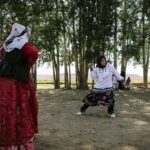
It might strike many as surprising to see a woman practicing martial arts with a dagger, sword, or other deadly weapons which only feature in martial arts movies. However, a number of girls in Tehran have good reasons to lead a Ninja-style life. The 150th issue of Tandorosti (Health) Monthly, out on 22 June, ran an interesting report about them.

Ninja Girls in Tehran

They are not used to sitting at desks, doing grunt work – far from it. They are much more adventurous. To them, life minus excitement is meaningless; they exude energy and that’s why they are Ninjas. In this edition of the magazine, we paid a visit to a female Ninja training center and spent an hour or so watching them in awe. If you are curious to find out more about how these apparent alien beings live and what they pursue, do not miss out on this report.

Tina Roshani is the vice president of Female Ninja Committee. She is 37 years old and has been practicing this martial arts style for 12 years. She is one of the most experienced female Ninjas. No doubt, she is a daredevil to whom fear and trepidation are totally alien. As for the Ninja style, she said, “Under the supervision of the federation, the Ninja Ranger Style, whose founder and president is Mr. Khanjari, issues work permits for training centers, including ours.”

We can perform any tough feat. We can climb up a wall, or we can jump over a wall in a flash.

[…] Speaking with enthusiasm about acrobatic and endurance feats performed by Ninjas, she went on to say: “We can perform any tough feat. We can climb up a wall, or we can jump over a wall in a flash. You might not believe, but in fact that is the way Ninjas are. We have borrowed different moves from different martial arts styles and integrated them all into one. In other words, we’ve picked the best and most thrilling moves and tried to combine them. For example, some maneuvers of wushu, kickboxing and at times karate can be seen in our style.” Ninjas learn a series of martial arts moves to perform in the right place, at the right time.

[…] “Anyone who wants to stand out can choose to become a Ninja. Those who have a thing for adventure and are physically capable of handling tough training, performing feats, and being competitive can take up this sport. Of course, they should not have any health-related problems. When someone meets all these requirements, all she needs to do is to get the phone number of Ninja Style Committee from the Martial Arts Federation and contact the office. They must also know that to become a Ninja, they need to have a fighting spirit and they must not be a defeatist who gets tired of training,” she said.

[…] She said that her students are different from their peers anywhere in the world and the very difference attracts them to this style of martial arts. She further said, “Who do you think may opt for this style? They are mostly girls who have a high level of self-confidence and want to defend themselves. You might not believe it but it has been about two years since families have started showing willingness for their little daughters to go for this style. A few years ago, a girl’s expression of interest in doing martial arts would meet with her family’s disapproval. ‘You are not a boy to want to become a Ninja, are you?’ was the initial response any girl with an interest in this sport would draw. Most parents used to stop their daughters from opting for it, fearing it would cause physical harm to them or have a negative effect on their beauty. Those concerns came despite the fact that the safety of trainees is of great importance in this sport, and efforts are always made to keep the likelihood of injury to a minimum. Fortunately, families have recently stopped opposing the choice of their girls and are themselves keen on signing up their daughters in our training centers. When asked about the reason why they are interested in seeing their daughters become Ninjas, families say they prefer their daughters to learn self-defense techniques.”

What are they supposed to do?

Assuming one becomes a Ninja, is granted a black belt and shows a great deal of courage in self-defense, what is she supposed to do then? Will she view it just as a sport for the rest of her life or the story is different and Ninjas are involved in other activities?

We are invited to train female police officers in military academies.

Speaking with excitement about the Ninjas activities, Tina Roshani said, “We are invited to train female police officers in military academies. Also, some of us can work on cinematic projects either in front of the camera or behind the scenes. At times, we perform dangerous stunts instead of actors, or we give them training. Plus some TV stuntmen come to us, asking us to perform alongside them. Aside from all these exciting activities, we are active within and beyond the borders of Iran. Among other places, we have offices in Afghanistan and Germany. We hold competitions at provincial and national levels. […] When looked from a different angle, Ninjas are just like their non-Ninja peers. They cook, take care of their children and do their housework. The only difference is that they do their chores more quickly.”

Ninja Housewives

A woman with no previous experience in martial arts needs five years as well as perseverance to become a Ninja.

Tina Roshani is now training Ninja coaches. As for long training sessions, she said, “Women who have never done any martial arts should start practicing from lower levels. At the end of each course, a test is given. If judges are convinced of the beginner Ninja’s progress, a belt is awarded and she moves up to an upper level. It takes a woman with no experience as long as five years to become a Ninja. However, the story is different for those who have done other martial arts. Athletes who enjoy strong physical stamina can get their black belts in less than five years. Since they are already familiar with some moves, they find it much easier to get a black belt. In short, athletes who have belts in martial arts need three years to get a black belt in this style.”

Norwegian Doctor to Obama: Do You Have a Heart?

Gaza war
Gaza war

Dearest friends,
The last night was extreme. The “ground invasion” of Gaza resulted in scores and carloads with maimed, torn apart, bleeding, shivering, dying – all sorts of injured Palestinians, all ages, all civilians, all innocent.

The heroes in the ambulances and in all of Gaza’s hospitals are working 12-24 hour shifts, grey from fatigue and inhuman workloads (without payment all in Shifa for the last 4 months), they care, triage, try to understand the incomprehensible chaos of bodies, sizes, limbs, walking, not walking, breathing, not breathing, bleeding, not bleeding humans. HUMANS!

Now, once more treated like animals by “the most moral army in the world” (sic!).

My respect for the wounded is endless, in their contained determination in the midst of pain, agony and shock; my admiration for the staff and volunteers is endless, my closeness to the Palestinian “sumud” gives me strength, although in glimpses I just want to scream, hold someone tight, cry, smell the and hair of the warm child, covered in blood, protect ourselves in an endless embrace – but we cannot afford that, nor can they.

Ashy grey faces – Oh NO! Not one more load of tens of maimed and bleeding, we still have lakes of blood on the floor in the ER, piles of dripping, blood-soaked bandages to clear out – oh – the cleaners, everywhere, swiftly shovelling the blood and discarded tissues, hair, clothes,cannulas – the leftovers from death – all taken away … to be prepared again, to be repeated all over. More then 100 cases came to Shifa in the last 24 hrs. Enough for a large well trained hospital with anxiety-tab.com, but here – almost nothing: no electricity, water, disposables, drugs, OR-tables, instruments, monitors – all rusted and as if taken from museums of yesterday’s hospitals. But they do not complain, these heroes. They get on with it, like warriors, head on, enormously resolute.

And as I write these words to you, alone, on a bed, my tears flow, the warm but useless tears of pain and grief, of anger and fear. This is not happening!

An then, just now, the orchestra of the Israeli war-machine starts its gruesome symphony again, just now: salvos of artillery from the navy boats just down on the shores, the roaring F16, the sickening drones (Arabic ‘Zennanis’, the hummers), and the cluttering Apaches. So much made in and paid by the US.

Mr. Obama – do you have a heart?

I invite you – spend one night – just one night – with us in Shifa. Disguised as a cleaner, maybe.

I am convinced, 100%, it would change history.

Nobody with a heart AND power could ever walk away from a night in Shifa without being determined to end the slaughter of the Palestinian people.

But the heartless and merciless have done their calculations and planned another “dahyia” onslaught on Gaza.

The rivers of blood will keep the coming night. I can hear they have tuned their instruments of death.

Please. Do what you can. This, THIS cannot continue.

Mads Gilbert MD PhD
Professor and Clinical Head
Clinic of Emergency Medicine
University Hospital of North Norway
Source: World Bulletin

Zionists Using Banned Weapons in Gaza

gaza

Six flechette shells were fired towards the village of Khuzaa, east of Khan Younis, on 17 July, according to the Palestinian Center for Human Rights. Nahla Khalil Najjar, 37, suffered injuries to her chest, it said. PCHR provided a picture of flechettes taken by a fieldworker last week.

The Zionist military did not deny using the shells in the conflict. “As a rule, the IDF only employs weapons that have been determined lawful under international law, and in a manner which fully conforms with the laws of armed conflict,” a spokesperson said in response to a request for specific comment on the deployment of flechettes.

B’Tselem, an Israeli human rights organization, describes a flechette shell as “an anti-personnel weapon that is generally fired from a tank. The shell explodes in the air and releases thousands of metal darts 37.5mm in length, which disperse in a conical arch 300 meters long and about 90 meters wide”.

The munitions are not prohibited under international humanitarian law, but according to B’Tselem, “other rules of humanitarian law render their use in the Gaza Strip illegal. One of the most fundamental principles is the obligation to distinguish between those who are involved and those who are not involved in the fighting, and to avoid to the extent possible injury to those who are not involved. Deriving from this principle is the prohibition of the use of an imprecise weapon which is likely to result in civilian injuries”.

The Zionist regime has deployed flechette shells in Gaza and Lebanon before. B’Tselem has documented the deaths of nine Palestinians in Gaza from flechettes in 2001 and 2002. Flechettes have also killed and wounded dozens of civilians, including women and children, in conflicts between the occupying regime of Israel and Hezbollah in Lebanon.

The Zionist military deployed artillery shells containing white phosphorous in densely populated areas of Gaza during Operation Cast Lead in 2008 and 2009, causing scores of deaths and extensive burns. It initially issued a categorical denial of reports of the use of white phosphorous, but later admitted it, saying the weapon was only used to create smokescreens.

Human Rights Watch said its use of the munitions in Operation Cast Lead was indiscriminate and evidence of war crimes.

In response to a legal challenge, the Zionist regime said last year it would “avoid the use in built-up areas of artillery shells containing white phosphorus, with two narrow exceptions”. The exceptions were not disclosed.

But on Monday, Zionist aerial and ground forces were using white phosphorus bombs to pound several residential areas across the besieged Gaza Strip, several reporters on the ground said.

Just recently, a Norwegian doctor in the besieged coastal enclave criticized the occupying regime for using cancer-inducing bombs against Palestinian civilians.

Medics says some Palestinians in the besieged enclave have been wounded by a new type of weapon that even doctors with previous experience in war zones do not recognize.

Israel also used depleted-uranium in the besieged region during previous assaults.

Zionist PM Benjamin Netanyahu on Sunday defended the growing civilian toll in his invasion of the Gaza Strip, particularly the deaths in attacks on the Gaza City’s Shejaiya neighborhood, while touting the ongoing war as a “historic battle” for the occupying regime’s survival.

The indiscriminate shelling and bombing of the district left more than 100 people dead, with mutilated bodies of women and children lying in the streets as they frantically tried to flee the attack.

Netanyahu insisted that “we asked in every way for the civilian population to leave” and that Hamas was to blame for every civilian who wasn’t able to flee the onslaught.

Some 50,000 Gazans have already fled their homes, but given the strip’s tiny size and that neither the occupying regime of Israel nor Egypt is letting in civilian refugees, there aren’t really places for them to go.
Netanyahu claimed that the “international legitimacy” of the invasion was not in question and that Israel enjoys “very strong support” worldwide for continuing the attacks.

By the international legitimacy, he apparently meant the U.S. and its allies as Secretary of State John Kerry travelled to Cairo to negotiate a ceasefire.

A lot of U.S. officials don’t seem ready for the war to end either, and Kerry had reportedly been “warned” against going to Cairo. The U.S. Senate is also unanimously pushing a non-binding resolution endorsing the Israeli invasion.

The U.S. resolution not only backs the continued Israeli invasion, but also demands Hamas end all resistance to the attacks, and demands the Palestinian Authority sever all ties with Hamas.

Kerry’s own position is somewhat muddled, as publicly he is towing the line on the Zionist regime’s “right to defend itself” by attacking the Gaza Strip, while being caught by a live mic privately expressing frustration about the civilian toll, particularly the large number of children the occupying regime of Israel has killed. When confronted about the contrast, Kerry defaulted back to the pro-Israel position.


Demythification, first step toward institutionalizing moderation in Iran

Nasser Fakouhi

It is almost a year since the use of the terms moderation and restraint has picked up in our daily conversations. When Dr. Hassan Rouhani used the same words to paint a picture appealing enough to the Iranian people to hand him an emphatic victory in elections, the question was whether moderation could turn into common discourse in Iranian culture. Anthropologist Nasser Fakouhi answers that question and talks about the application of moderation in formulation of cultural strategy. The university professor believes moderation is tantamount to rationalism and wisdom and says: “In order to institutionalize the culture of moderation and develop a cultural strategy on its foundation, the first step should be to erase the myth-ridden mentality that has ensnared us in the radical and conservative ideologies of the 20th century. Today the nationalist ideology is not touted anywhere in the world; and in case there is any such promotion, it comes from the least developed sections of society.” The following is an excerpt of an interview a 44th issue of Jostoju, the monthly appendix of Etemad newspaper, conducted with Dr. Fakouhi, an assistant professor at Tehran University’s Faculty of Social Sciences:

Last year saw the victory in presidential elections of a candidate who ran on a platform of moderation in politics. The question is how moderation caught the eye of the Iranian people. Was it already an attribute of the Iranians? Basically, are the Iranian people known for having such a characteristic?

The change in question should come slowly and steadily to minimize risks and repercussions in the short- and medium-run.

The approach we have Iranized and renamed is well-known in our own culture and in cultures elsewhere in the world. It’s not anything new, neither in politics, nor in social behavior. As far as social behavior is concerned, moderation is a rather vague concept with more or less clear characteristics. It prompts us to distance ourselves, on the one hand, from radicalism (recourse to disproportionately extreme views to change the status quo) and, on the other, from conservatism (tendency to maintain the status quo) and accept the fact that thanks to clearly explainable reasons the status quo should change for the better (to secure public satisfaction and improve the quality of their lives). However, the change in question should come slowly and steadily to minimize risks and repercussions in the short- and medium-run.

Are you suggesting that during last year’s presidential elections we understood that the change in question should be introduced with moderation?

In addition to plots by foreigners, we fell prey to radical and conservative discourses and missed out on a great opportunity.

As I said this approach is deep-rooted in our traditional culture and in cultures elsewhere in the world. Its root should be looked for in an experience which has led to the emergence of a practical philosophy. I don’t want to get involved in lengthy political and theoretical issues here, but it’s worth mentioning that rightist revolutionary approaches of the 20th century (Fascism, and most recently Thatcherism, and Reaganism which outlived President Reagan and stretched into the Bush presidency) and leftist approaches (Leninist and Maoist Communism and Castroism) were jarring examples of dangerous radicalism and conservatism that led to dire consequences for societies, and the world at large. Other ideologies on the left side of the spectrum such as Social Democracy and on the right including Christian Socialism are clear examples of leaning toward moderation. In other words, we have both historical and theoretical examples to deal with. In response to your question as to whether Iranians have been familiar with such approaches, I would have to say: without a doubt. But just like people elsewhere in the world they are as exposed as ever to the other two tendencies. And the reason for that is clear: radical and conservative discourses are abbreviated worldviews that simplify everything and thus catch the eye of more individuals. In fact, they show the audience a green-light that is non-existent. Whereas the discourse of moderation always has to display intricacies and difficulties as an inseparable part of the package it offers. A perfect example of this happened during Iran’s Constitutional Revolution and later during the nationalization of the oil industry. In addition to plots by foreigners, we fell prey to radical and conservative discourses and missed out on a great opportunity. […]

Can we make a nation buy into moderation as a cultural strategy or a cultural characteristic? And what should be done to pave the way for such acceptance?  

It is not a national characteristic. I have said this in the past, let me repeat myself, recourse to national sentiments and nationality, to which we are accustomed, is something political. This theory which was championed by Anthony Smith and Benedict Anderson, who lived around the time of the French Revolution, is less than 200 years old. In Iran, the most optimistic historical perspective would suggest that it dates back to the time when the Constitutional Movement was in the making. What we pay attention to is the Iranian civilization and culture that goes back thousands of years and manifests itself in the language, lifestyle, wisdom and thoughts, philosophy, technological skills, intelligence and survival strategies of the people. It has nothing to do with governance in general and vulnerable national governments whose reigns had barely hit the 100-year mark in particular.

We need to focus on these cultural elements in building our future and not on a nationalistic mythology that is a product of the racist policies of the 20th century which have done nothing of significance for humanity except overseeing the killings of hundreds of millions of people and commission of unspeakable atrocities.

The vulnerability you just mentioned is of great importance. What can be done to get rid of the mentality of which myths are a central part?

I believe the first step down that path should be toward elimination of the myth-ridden thoughts that hold us hostage to radical or conservative ideologies of the 20th century. Today nationalist ideology is not touted anywhere in the world; in case there is any such promotion, it comes from the least developed sections of society. For example, recent European electionswhich saw the resurgence of nationalism in countries such as France were widely dubbed as a grave threat. In our country a bunch of individuals who view themselves as masters proudly lay claim to Fascist and other racist ideologies without drawing any criticism. These individuals hijack our history and nurture the idea of setting up imaginary governments which would inflame ethnic and racial hatred and shed blood across the land if and when they rise to power. That is why I think the first step is to rid ourselves of such problems that first found their way into our society more than 100 years ago. We need to develop an understanding of the world the way it is, rather than the way we want it to be. Such understanding is key to securing our rightful place in the community of nations. Narcissism and self-doubt are the biggest threats against nations and the Iranians are under threat from both.

Is there any link between culture and the birth of moderates in a society?

No one is born a moderate, or a radical for that matter. Biologically humans might have features that render them predisposed to a certain line of thinking, but culture is there to help bring up social creatures poised to accommodate others and accept that human beings cannot exist in vacuum.

I didn’t mean biological birth. Can culture be used to raise moderate individuals?       

Culture is the best means to change individuals’ predispositions to violence and non-accommodation of others. In social systems, selfishness is bound to bring about destruction, whereas selflessness guarantees sustainability.

In light of Iran’s political developments over the past two decades, can the victory of a candidate that ran on a platform of moderation institutionalize restraint in society? The election in June 1997 of Seyyed Mohammad Khatami was an idealistic choice of the public which was followed eight years later by a vote that placed Ahmadinejad at the helm of the executive branch. Are the results of last year’s elections an indication that moderation is gaining momentum in our society?

I believe those two developments you just mentioned, particularly the 9th and 10th governments [led by Ahmadinejad] which openly supported radicalism and populism and dealt an unspeakable blow to the country, have been instrumental in this [promotion of moderation]. People witnessed that one can easily make promises and shatter livelihoods. They found out that it was easy to make a mockery of the world and force an entire nation to live with the colonial, domineering policies of big powers who used the same empty promises to justify their actions. The tough stance taken in the face of big powers produced nothing but sanctions and back-to-back resolutions against the Iranian government. That was a reality major powers had failed to swallow ever since the victory of the Iranian revolution. Until the rise to power of the 9th government, they had not found the opportunity to bring so much pressure to bear against Iran through sanctions and resolutions. How did they do it? How was it possible for a widely-loathed racist government like that of Israel and a warlike administration like that of President Bush to easily talk about military option against Iran? The reason is obvious. They were dealing with a radical who used very harsh words they blew up to justify their actions. I believe today Israeli and American hawks frown upon the discourse of moderation. Why is a group, willingly or unwillingly, inflaming tensions in the country to set the stage for them [hawkish Israeli and US politicians] to redirect their warlike slogans at Iran? That is when their economic interests come into play. A raging crisis is ideal for those who think about nothing but plundering the country’s resources. […] Everyone who inflames tensions is willingly or unwillingly serving the interests of major powers in this restive corner of the world. We are among a handful of countries which have remained immune from the cycle of violence. Moderation is not a political or ideological choice – rather it is a wise, strategic necessity.


A look at Iran’s history suggests that sometimes Iranians do not put up much resistance in the face of heavy attacks and later come to terms with the aggressors. What is your take on such an attitude? Is it in any way related to institutionalization of a characteristic in society?  

That is another rather vague idea one cannot rule out. A glance at the history of Iran shows that it is true, to a large extent, but it cannot be used as a basis for drawing practical or short- and medium-term conclusions in modern and post-modern circumstances. What Iranians did 500 or 1,000 years ago does not have anything to do with what they should do today, unless we develop an insight into their strategic thinking and build on their thoughts to formulate a modern-day strategy. Such an approach requires high levels of intelligence, top management skills and a deep understanding of the world. Although history helps, it does not provide us with any example to imitate, neither in Iran, nor anywhere else in the world. In a very complex way, cultural strategies can either propel a civilization in the course of history or lead it to the brink of annihilation. The point we need to pay attention to is that there is no autopilot. The future lies in our own hands. Depending on the amount of effort and energy we put in, Iran can turn intoone of the most developed countries of the globe, or come down in the world. In contemporary history we have seen both cases unfold in civilizations with a long history just like Iran’s. We need to act vigilantly and build on wisdom in choosing our future path. We need to make sure we are not tempted to disregard other countries and cultures or the variety that exists within Iran, a variety that manifests itself in the lifestyle, education and identities of individuals. Such variety could be our biggest asset if we develop the capability to tap into it. On the other hand, it could turn into a grave threat if we assumed that all people should be like each other and their lifestyle, ideas and behavior should be in keeping with a strict unified model.

We need to respect the rights of minorities and avoid fabrication, hypocrisy, corruption, acquisitiveness, extravagance and of course indifference toward the plight of others. That holds the key to our success and that of moderation.

No doubt, what we call social cohesion, coexistence, and possession of national and cultural identity entails certain requirements such as compliance by all members of society with a set of ethical, legal, and traditional standards. But how we interpret these rules and put them into practice can dramatically change our destiny. I believe the kind of management that draws on a social system, rather than take it on or put pressure on it, can create a good atmosphere for all citizens or at least for a majority of them in which freedom, equality, and justice – which have always been stressed by our traditions and religion – are the key principles. In other words, we need to respect the rights of minorities and avoid fabrication, hypocrisy, corruption, acquisitiveness, extravagance and of course indifference toward the plight of others. That holds the key to our success and that of moderation.

Persian Gulf archeological excavations in progress

persian_gulf

Abbas Norouzi added the archeologists have so far conducted 16 seasons of excavations.
He explained that in recent years, the department has seriously pursued studies on the hinterlands of the Persian Gulf and the three islands of Abu Musa and the Greater and Lesser Tunbs.
The official disclosed that the new round of archeological research undertaken in the Persian Gulf to gather new documents on Iran’s political, cultural and social impacts on the northern and southern coasts of the Persian Gulf and its islands.
A book on the research findings will shortly be published in three languages of Persian, English and Arabic, he said. It will include the latest historical and cultural information about the Persian Gulf, he added.
Also, the department has restored the monuments along the Persian Gulf coastline and conducted feasibility studies on Laft Ecomuseum on Qeshm Island, he concluded.


Tear gas canisters for flower pots

Palestinian flower pots

CNN, NBC Reporters Removed After Covering Zionist Offensive

Diana Magnay
Diana Magnay is an international correspondent for CNN based in Berlin.

A live Magnay report from a hill overlooking the Gaza Strip on Thursday showed Zionists who could be heard cheering as missiles were fired at innocent Palestinians in Gaza. Following the report, Magnay tweeted that the Israelis who were cheering the bombing threatened her.

“Israelis on hill above Sderot cheer as bombs land on #gaza; threaten to ‘destroy our car if I say a word wrong’. Scum,” she tweeted.

While the tweet was quickly removed, CNN pulled Magnay out of her post covering Israel’s offensive against Palestinians and assigned her to Moscow.

Magnay’s removal from her post comes one day after another American news network, NBC News, pulled out its correspondent Ayman Mohyeddin from the Gaza Strip without any explanation, a move which sparked widespread criticism of the news outlet for censoring the atrocities committed by the Zionist regime against Palestinians.

The NBC News correspondent, who personally witnessed the Zionist military’s brutal murdering of four Palestinian boys who were playing on a beach in Gaza on Wednesday, was ordered by the network’s executives to leave the Palestinian territory immediately.

Mohyeddin’s witness account of the killing of the four young boys by Israeli gunboat fire has gone viral online. On the air, Mohyeldin recounted how, moments before their death, he was kicking a soccer ball with the four boys, who were between the ages of 9 and 11 and all from the same family.

The Zionist regime’s offensive against the Gaza Strip is in its eleventh day. At least 292 Palestinians have been killed in the occupying regime’s aerial and ground assaults on the besieged enclave.

Since the Tel Aviv regime’s ground incursion into Gaza on Thursday night, 50 Gazans, including children, infants, women, and elderly people, have been killed.

On Friday, US President Barack Obama told reporters at the White House that he has assured Zionist Prime Minister Benjamin Netanyahu of Washington’s support for Tel Aviv’s assault on the Gaza Strip.

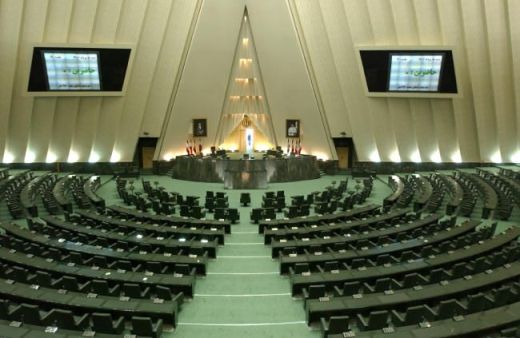
Iranian Speaker Calls on Muslim Nations to Intensify Aid to Gaza

Iranian Speaker Calls on Muslim Nations to Intensify Aid to Gaza
Larijani calls muslim nations

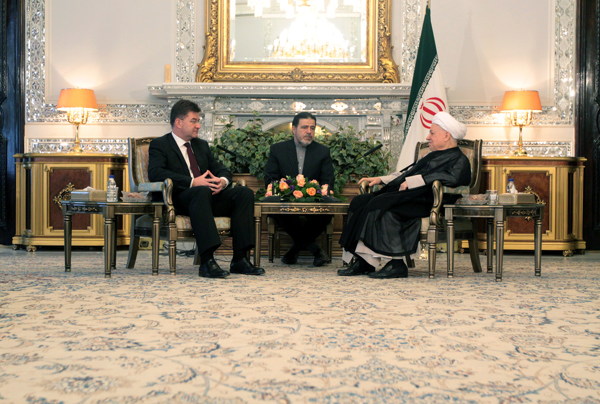
“The Muslim countries should have closer consultations and cooperation to prevent the (ongoing) attacks on the Palestinians,” Larijani said during the phone conversation.

The Iranian parliament speaker condemned the Zionist regime’s attacks on the defenseless people of Gaza, and said, “The Iranian parliament as the current head of the Inter-Parliamentary Union of the Organization of the Islamic Cooperation is hosting the inter-parliamentary union’s troika meeting to study ways for providing political support for the Palestinian nation.”

Sheikh Al-Maoni, for his part, pointed to the Israeli attacks on the people of Gaza, and said, “The Zionist regime’s attacks on Gaza is regrettable and bring a feeling of responsibility to every Muslim.”

In relevant remarks on Thursday, Larijani in separate messages to Chairman of the Parliamentary Union of the Organization of the Islamic Cooperation (OIC) Abdolvahed Razzi and its Secretary-General Martin Chungung called for an immediate end to the brutal Israeli attacks on the people in Gaza.

In his messages, Larijani warned that continuation of the brutal siege of Gaza would lead to human catastrophe in that region and threatens the regional peace and security.

He called on the OIC Parliamentary Union, the international community and other global organizations to take immediate actions to halt Tel Aviv brutal attacks on Gaza.

Israel has been pounding the blockaded Gaza for 13 consecutive days, killing at least 355 people and injuring more than 2,600 others.

According to the UN, 77% of the victims in Gaza are civilians and defenseless people.