Thursday, December 25, 2025
Home Blog Page 5056

US call for disconnecting Iran’s centrifuges is ridiculous

Hossein Sheikholeslam

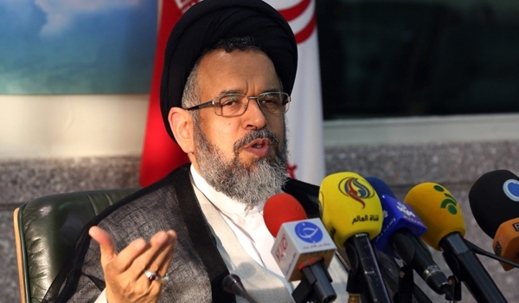
Hossein Sheikholeslam, an advisor to Iran’s parliament speaker, has dismissed as ridiculous a US appeal to Iran to disconnect its centrifuges [from feeds of uranium].

The advisor told Fars News Agency on Monday that the offer which has been given extensive coverage by Western media has yet to be officially floated.

If that happens, it would reveal that Washington takes a childish view of the ongoing nuclear talks, or that the Americans are treating Iranians as idiots, he said.

Sheikholeslam went on to say that by so doing the White House intends to imply that although it has put forth yet another constructive proposal to advance the talks, Tehran has rejected the offer.

He also said that such an offer translates to an insult to the Iranian nation and its dignity.

His comments came after Washington called for disconnecting Iran’s centrifuge cascades instead of reducing their numbers, trying to play up the offer as a confidence-building measure.

Challenges of nuclear talks

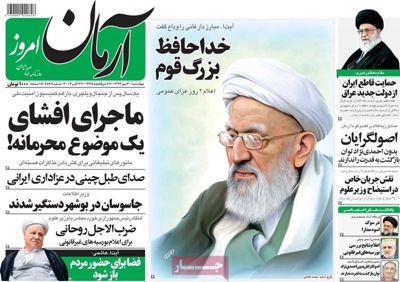
Arman newspaper
Arman newspaper
Javid Ghorban Oghli
Javid Ghorban Oghli

Former Director General of the Africa Department at the Iranian Foreign Ministry Javid Ghorban Oghli in an opinion piece in Arman-e Emrooz newspaper on September 22 highlighted “a change in Russia’s behavior” as far as Iran’s nuclear dossier is concerned.

In “The challenges of nuclear talks” piece, he wrote given the present conditions – Western sanctions against Russia in the aftermath of the Ukraine crisis – Moscow is not willing to let its ties and economic cooperation with Tehran undergo any change. What comes below is the translation of part of his opinion piece:

It should not be forgotten that nuclear talks are facing some challenges, one of which is the position of either side on the amount of uranium enrichment and the number of centrifuges.

Unfortunately, such matters are pitched across the country as an indication of [Western] greed and acquisitiveness. Everyone knows that Iran is determined to carry on with the talks until they produce results.

Such determination on the part of the Iranian side can be noticed by the Western negotiators more than anyone else. Now, Western nations know well that despite the pressures exerted on the Iranian negotiating team at home, Iran has stepped in the direction of a deal which could transform the political future of the region and the international community at large. Iran is in quest of a good agreement or in other words a solution.

Another challenge in the way of the talks is the Russian behavior. As things are, Russia is not willing to see its trade relations with Iran change. If Moscow’s behavior undergoes any change, it seems necessary that Iran’s negotiators mention it.

The final challenge has nothing to do with the technical aspect of the talks. Rather, it’s the pressure that Iran’s negotiating team is under at home. For the time being, Iranian negotiators are dealing with such challenges in New York and everyone hopes that both sides will overcome them.

Iran has always backed unity and stability in Yemen

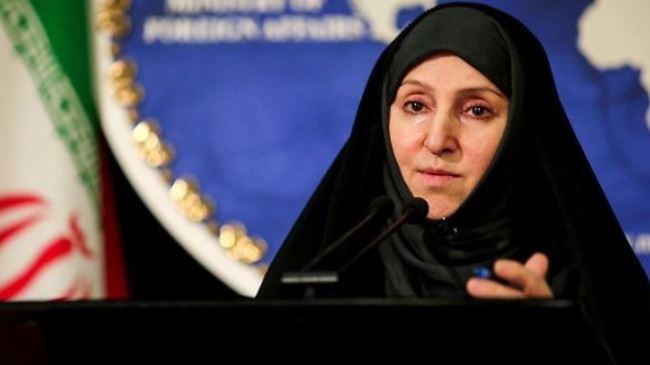
Iranian Foreign Ministry Spokeswoman Marziyeh Afkham

Tehran has welcomed a peace agreement signed between the Yemeni government and the revolutionaries saying that Iran has always lent support to unity, stability and calm in Yemen.

Foreign Ministry Spokeswoman Marziyeh Afkham praised the [UN-brokered] peace deal between the Yemeni rivals, saying this has come around thanks to the vigilance and restraint practiced by the Yemeni people, political parties and social groups during the recent protests in the Arab country, IRNA reported on Monday.

She went on to say that participation of all political and social parties as well as the elite in the country’s political process could contribute to the full implementation of the agreement and help security and stability make a comeback to the violence-wracked country.

The [bloody] protests over the last few days and the takeover of government buildings by protesters forced the Yemeni government to answer people’s calls to resign and initiate economic reforms.

This came after United Nations envoy to Yemen, Jamal Benomar, on Saturday announced a political agreement between the government and the [Huthi] militants, but his announcement did little to calm the tensions gripping the Arab country.

On Sunday, the revolutionary forces took over government buildings in the capital, including some military facilities.

UK’s Cameron likely to meet Rouhani in NYC

Rouhani-Cameron
Rouhani-Cameron

British Prime Minister David Cameron will reportedly meet with Iran’s President Hassan Rouhani on the sidelines of the 69th session of the UN General Assembly in New York.

It would be the first bilateral talks between a UK prime minister and an Iranian president since Iran’s Islamic Revolution in 1979.

Rouhani and Cameron are likely to discuss the threat posed by ISIL militants in Iraq and Syria, British media reported on Tuesday. Iranian officials have so far made no comments about the likely meeting.

A majority of Iranians back the country’s nuclear program

Iranian people
Iranian people

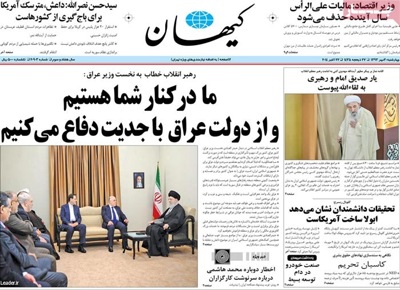
Approximately 94 percent of Iranians say their country needs a nuclear energy program. On Monday (September 22), Kayhan newspaper put the results of an opinion poll reported by Agence France Presse (AFP) in its special news column.

The poll conducted by the University of Tehran Center for Public Opinion Research and the Center for International and Security Studies at Maryland interviewed 1,037 Iranians by telephone between July 11 and 17.

Based on the survey’s results, while 79 percent of those interviewed said they would back a deal which even included Iranian assurances never to produce an atomic bomb, a large majority admitted demands such as dismantling half of Iran’s centrifuges and limiting nuclear research would be unacceptable.

The poll showed that three-quarters of those asked said they believe America would find some other excuses to impose sanctions, fearing the United States dominate or block its development.

And finally the results show that Iranians are divided about the likelihood of success in the negotiations over Iran’s nuclear program. A large majority say they would not blame Iranian officials if the talks fail.

Iranian, Pakistani FMs call for finalizing IP gas pipeline

iran pakistan gas pipeline

Iranian Foreign Minister Mohammad Javad Zarif and his Pakistani counterpart Hanna Rabbani in a meeting in New York underlined the need for finalizing Iran-Pakistan gas pipeline and security of borders.

During the meeting in New York Monday, the two sides discussed the latest developments of West Asia, Afghanistan and Iran-G5+1 talks as well as mutual cooperation between the two countries.

The Iranian and Pakistani foreign ministers also underlined the need for increasing the volume of bilateral trade and enhancing cooperation between the two countries’ interior ministries to increase the security of borders to prevent drug trafficking, illegal trespassing and activities of terrorist groups.

Zarif is in New York to take part in the new round of negotiations between Iran and 5+1.

Iranian President Hassan Rohani is also in New York to attend the annual meeting of the UN General Assembly.

Iran oil reserves to last 60 years: Oil Ministry official

Iran Oil Reserve
Iran Oil Reserve

Iran will be capable of exploiting its oil reservoir for the next six decades as the country has raised its estimated crude reserves to 157 billion barrels, an Iranian energy official said.

“Based on estimates, Iran will have oil for 60 years and gas for the next 200 years,” said Deputy Director of National Iranian Oil Company (NIOC) for Exploration Bahman Soleimani in an interview on Monday.

In the 1980s, Iran’s oil reserves were estimated to be enough for 20 years, but after extensive exploration, particularly over the past decade, many new crude reserves have been discovered, Soleimani pointed out.

The official added that exploration is conducted all over the country but most of the operations are focused on the Persian Gulf, Sea of Oman and the Zagros Mountain range.

In August, the Oil Ministry said Iran’s oil production increased by 11 percent in the first four months of the current Iranian year (started March 21) and predicted that the country will raise its oil production by 700,000 barrels per day (bpd) within the next three years.

In May, Mohsen Qamsari, NIOC’s director for international affairs, said Iran’s oil production capacity would reach four million barrels per day by the end of the current Persian calendar year in March 2015.

Commander: Iran will Give Crushing Response to ISIL If Threatened

Iran Commander
Iran Commander

Iranian Army’s Ground Forces Commander Brigadier General Ahmad Reza Pourdastan stressed full security at the country’s borders, and said his forces are monitoring all moves along the borders and would give a crushing and rigid response to ISIL if the terrorist group ever dares to pose a threat to Iran.

“Thank God, the Ground Forces enjoy a satisfactory level of preparedness to defend the country’s borders today,” General Pourdastan told reporters on the sidelines of the annual military parades in Tehran on Monday.

[…]

General Pourdastan underlined that ISIL is not considered a threat to Iran, and added, “But Iran has no problem confronting this terrorist group.”

Earlier Iran’s Chief of Staff Major General Hassan Firouzabadi described ISIL as a Frankenstein monster created through a media hype by the Zionists in a psychological operation to frighten Muslim states and advance their goals, stressing that Iraq alone will be enough to annihilate the terrorist group.

[…]

Iran FM calls for collective efforts to counter terror

Iran-UAE-FMs
Iran-UAE-FMs

Iran’s foreign minister has voiced alarm about the dangers of terrorism and extremism in the Middle East, calling for cooperation among Muslim states to counter such threats.

Mohammad Javad Zarif made the comments in a Monday meeting with his Emirati counterpart Abdullah bin Zayed Al Nahyan on the sidelines of the 69th session of the United Nations General Assembly in New York.

During the meeting, the two top diplomats discussed the crimes perpetrated by ISIL terrorists in Iraq and warned about the spread of such terror operations to other Middle Eastern states.

“This threat is against all countries in the region, and that is why broad cooperation is needed among all regional states to take serious action against it,” Zarif noted.

The Iranian foreign minister further called for comprehensive measures to prevent the derailment of the fight against terrorism and extremism.

ISIL extremists, who have seized large swaths of territory in Iraq and Syria, have terrorized various communities, including Shias, Sunnis, Kurds, Christians and Izadi Kurds, in their advances.

The two senior diplomats also discussed further expansion of relations between Iran and the United Arab Emirates, emphasizing the need for the implementation of previously concluded bilateral agreements.

Hand-woven Persian carpet motifs to be registered globally

Iranian Carpets
Iranian Carpets

Head of Iran’s National Carpet Center Hamid Kargar says Persian carpet motifs will be registered globally in line with supporting carpet producers and developing export of hand-woven Persian carpets.

He told IRNA that the hand-woven carpet is a cultural, economic and social product that helps bring in hard currency and that Iran’s National Carpet Center as the guardian of this major industry in the country should take all aspects into consideration.

Kargar further said one of the main programs of the center is propagation and dissemination of information on hand-woven Persian carpets which will cover foreign markets in addition to domestic ones. […]

He pointed to the provision of banking loans, insurance for all carpet weavers and education for all those involved in this industry as some of the measures which have been taken so far for the development of carpet industry.

Kargar said one of the important measures of the center which has been launched to support hand-woven Persian carpet is registration of carpet pattern and motifs in the name of their creators, adding that the National Library of Iran and the Ministry of Culture and Islamic Guidance have cooperated with the center in this respect.