Friday, December 26, 2025
Home Blog Page 5034

Cut financial aid to terrorists, Iran president tells West

Iran-Iraq-Rouhani
Iran-Iraq-Rouhani

“Those who claim to be fighting terrorism and those who have formed a coalition [against terrorism] should in the first step make efforts to have financial aid to terrorist groups cut,” President Rouhani said in a meeting with Iraqi Prime Minister Haider al-Abadi in Tehran on Tuesday.

Noting that terrorism has grown into a major problem for all countries in the Middle East, the president warned that the US-led anti-ISIL coalition’s airstrikes against the terrorists’ positions will only benefit the Takfiri group in the long run.

The US-led coalition has conducted several airstrikes on ISIL positions across Iraq, but the air raids have so far failed to dislodge the terrorists.

The Iraqi army, backed by volunteer forces, has been fighting the terrorist group for nearly six months now.

“Iran believes that the main responsibility in the fight against terrorist groups should be shouldered by Iraqi government and popular forces. The more united the Iraqi nation…the more successful they will be,” the Iranian president pointed out.
He emphasized that Iran has been supporting the Iraqi nation and army in their fight against terrorist groups from the very first day and would proceed with this policy until the end.

Rouhani vowed that Iran would spare no effort in helping the Iraqi government and called on regional governments to counter terrorism in a “coordinated and integrated” way to uproot this phenomenon.

The Iraqi premier, for his part, said terrorism poses a threat to all regional countries, adding that Iraq is assured of Iran’s assistance for the Arab country until the eradication of terrorism.


Senior cleric passes away in hospital

Mahdavi kani
Mahdavi kani

Senior Iranian cleric Ayatollah Mohammadreza Mahdavi Kani passed away in a Tehran hospital on Tuesday.
Ayatollah Kani was the chairman of the Assembly of Experts since March 8, 2011.

He was hospitalized on June 4 for heart problems. The 83-year-old cleric had since been in a coma.
Leader extols deceased cleric for revolutionary track record

Leader-Ali-Khamenei
Leader-Ali-Khamenei

“This great and pious man appeared always and everywhere in the position of a religious scholar and an honest politician and a candid revolutionary,” Ayatollah Khamenei said in a message of condolences following Ayatollah Mahdavi Kani’s demise on Tuesday.

The Leader said Ayatollah Kani was an influential figure in the Islamic Republic and a true companion of the late founder of the Islamic Republic, Imam Khomeini.

Ayatollah Khamenei said Ayatollah Mahdavi Kani played his role “bravely” during the years following the 1979 Islamic Revolution and spared no efforts in defending the revolution and the Islamic establishment.

Meanwhile, Iran’s President Hassan Rouhani also offered his condolences on the demise of Mahdavi Kani and declared two days of national mourning on the sad occasion.

In his message, the president said the Islamic establishment has witnessed the influential and brave role of Mahdavi Kani at sensitive junctures.

Ayatollah Mahdavi Kani, 83, passed away in Tehran on Tuesday after he fell into a coma on June 4 due to a major heart attack.

The 83-year-old veteran politician was elected chairman of the Assembly of Experts in March 2011. The high-ranking body of experts elects and oversees the activities of the Leader of the Islamic Revolution.

The senior Iranian official was also a founder and the leader of the Combatant Clergy Association, a prominent religious, cultural and political foundation formed with the objective of protecting the achievements of Iran’s Islamic Revolution.

P5+1 political directors may meet in early November: Russia

Russian-Ryabkov
Russian-Ryabkov

“There is no clarity. I think it will take place in the first decade of November, but so far it is just ideas and nothing more than preliminary estimates,” Russian Deputy Foreign Minister Sergei Ryabkov said on Monday.

Meanwhile, representatives of Iran’s nuclear negotiating team, headed by Director General for Political and International Affairs at Iran’s Foreign Ministry Hamid Ba’eedinejad, left for Vienna on Tuesday to attend the expert-level meetings scheduled to be held on Wednesday and Thursday.

The six world powers’ technical delegation is headed by Stephen Clement, an aide to the European Union Foreign Policy Chief Catherine Ashton.

The two sides will discuss the level of uranium enrichment in Iran, the process of the total removal of sanctions and the duration of a final nuclear agreement.

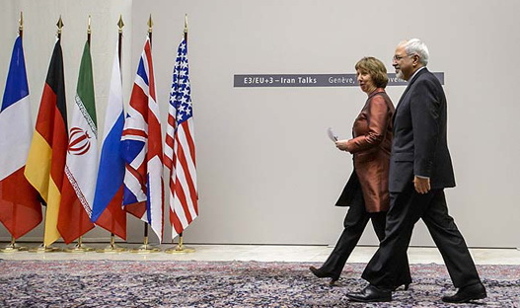
Iran and the five permanent members of the United Nations Security Council – China, Russia, Britain, France, and the United States – plus Germany are in talks to work out a final deal aimed at ending the longstanding dispute over Tehran’s nuclear energy program as a November 24 deadline approaches.

Last year, the two sides clinched an interim nuclear accord, which took effect on January 20 and expired six months later. However, they agreed to extend their talks until November 24 as they remained divided on a number of key issues.

Iran strongly condemns Iraq terrorist bombings

Iraq-bombing
Iraq-bombing

Iran’s Foreign Ministry has strongly condemned the deadly bombings against pilgrims in the holy Iraqi city of Karbala and expressed sympathy with the families of the victims.

On Monday, Iranian Foreign Ministry Spokeswoman Marzieh Afkham voiced the Islamic Republic’s firm support for the Iraqi nation and government in their fight against the ominous phenomenon of terrorism.

She said that national unity and solidarity among different Iraqi tribes and groups as well as the strong determination of the Iraqi government, nation and army in confronting terrorism can thwart the current plots against Iraq and the region.

Afkham also called on the international community to take a firm stance with regard to the fresh wave of terrorist attacks in Iraqi cities.

Earlier on Monday, three car bombs exploded simultaneously near government offices in Shia holy city of Karbala, killing at least 16 people and injuring 40 others.

Also on Monday, at least 17 people lost their lives and 28 others were injured after an assailant blew up an explosive device among worshipers leaving a Shia mosque in a commercial area in the center of Baghdad following midday prayers.

Iraq has been witnessing similar deadly incidents almost on a daily basis. Dozens of civilians, mostly in Shia neighborhoods, have lost their lives in Baghdad over the past week.

[…]

Agreement soon with Russia on atomic power plants

Ali Akbar Salehi

Director of the Atomic Energy Organization of Iran (AEOI) Ali Akbar Salehi said on Monday that agreements are to be finalized in the near future with Russia for constructing two new nuclear power plants in Iran.

Speaking to reporters, Salehi expressed hope that construction of the two future power plants will soon begin after finalization of the agreements between Tehran and Moscow.

“Talks are underway with Russians for the construction of the power plants which will generate 1,000 MW [of electricity],” he added.

Salehi, also a vice-president, estimated that construction of one of the two power plants will start before the end of the current Iranian calendar year (March 20, 2015) while the second one will begin in two years.

Rejecting claims that Russians are not reliable, Salehi said, “Russians are not unreliable partners. They shouldn’t be considered like that.”

Russia helped Iran construct its first nuclear power plant in the southern city of Bushehr based on a contract signed between Iran and the Russian Ministry for Atomic Energy in 1995. Russia’s Atomstroyexport was named as the main contractor.

However, the work was delayed several years because of technical and financial challenges as well as political pressure from the West.

The plant became officially operational and was connected to Iran’s national grid in September 2011, generating electricity at 40 percent its capacity.

In September 2013, Iran officially took over from Russia the first unit of its first 1,000-megawatt nuclear power station for two years.

Iranians produce anti-wrinkle cream from pomegranate extract

wrinkles
wrinkles

Tehran Medical University researchers have developed an anti-wrinkle cream from pomegranate extract which also rejuvenates skin.

The cream combines intense moisturizing with powerful defense against the sun’s harmful rays.

Dr. Jamaleddin Jamali, who led the research, said pomegranate contains antioxidant and collagen, which prevent elastin fibers from breaking.

He added that the researchers are also developing a cream and pill for treating acne from beehive.

Previously, Dr. Jamali’s team had produced a herbal antidepressant called Safromod from saffron flower and Safrotin, which reduces the symptoms of Alzheimer’s disease.

Elastin is a protein in connective tissue that is elastic and allows many body tissues to regain their shape after stretching or contracting. It helps skin to return to its original position when it is poked or pinched. In humans, elastin is encoded by the ELN gene.

Vitamin B and minerals found in pomegranates give nutrition and vitality to the skin and aid in the composition of collagen. It is effective in soothing and providing nutrients to help the skin remain supple and wrinkle-free.

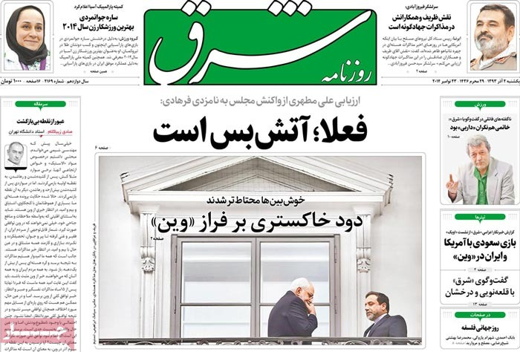
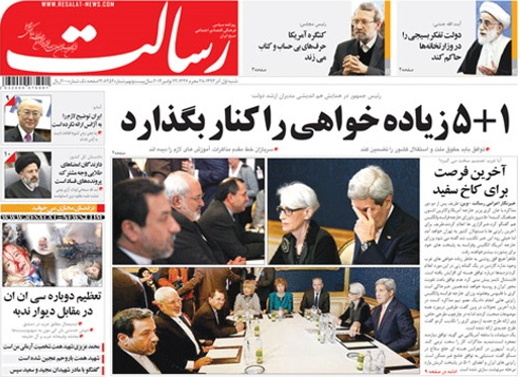
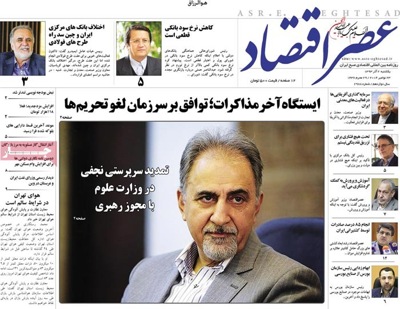
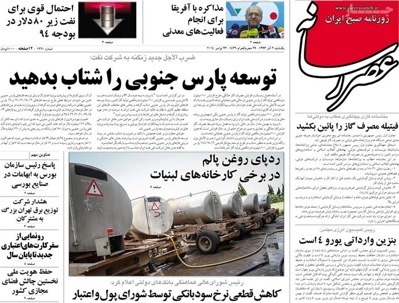
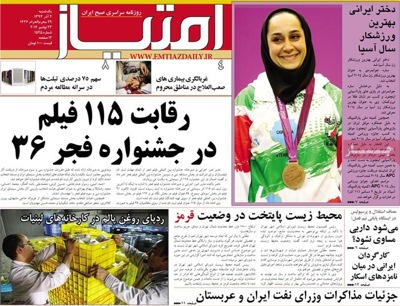
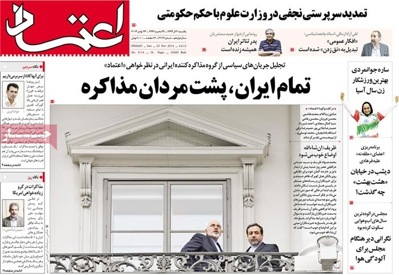
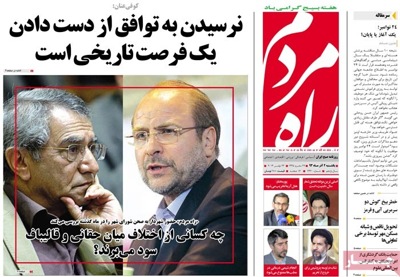
A look at Iranian newspaper front pages on Oct. 21

Iranian Newspapers Headlines

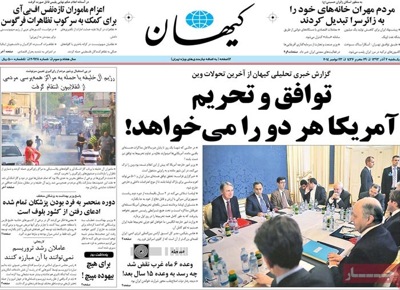
The comments of the Judiciary spokesman about recent acid attacks in Isfahan caught the attention of Iranian dailies on Tuesday. Meetings between Iranian officials including President Rouhani with the visiting Armenian prime minister were also among top stories of the day. Snowfall in a dozen provinces of the country also generated some headlines and put snapshots of snow-covered streets on the front pages of some dailies. Drawing as much attention was news that The New York Times has reported Obama will bypass Congress on Iran’s sanctions if a nuclear deal is reached.

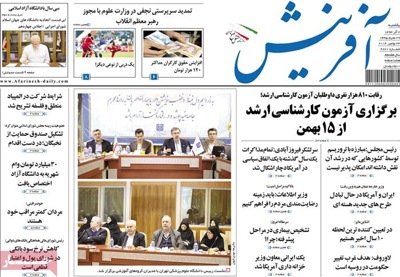
Afarinesh: “As far as foreign policy is concerned, the stage should be set to interact with the rest of the world,” said Chairman of the State Expediency Council Ayatollah Akbar Hashemi Rafsanjani.


Afarinesh newspaper 10 - 21


Afkar: “Secretary of the Supreme National Security Council Ali Shamkhani in a meeting with the UN special envoy to Syria has expressed Iran’s readiness for the fight against terrorists.”

Afkar: “We view Iran as a friend and a strategic partner,” said the Algerian ambassador to Tehran.


Afkar newspaper 10 - 21


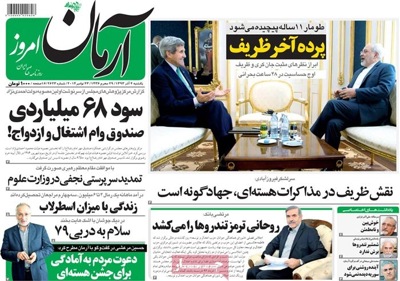
Arman-e Emrooz: “Violation of Islamic dress code is not behind [recent] acid attacks,” said the Judiciary spokesman.

Arman-e Emrooz: “Nuclear talks are more like a math course than a composition class,” an Iranian deputy foreign minister said in a statement aimed at the critics of the government’s handling of nuclear negotiations with P5+1.


Armane emruz newspaper 10 - 21


Asia: “The Ordre national du Mérite (The National Order of Merit) has been awarded to world-known Iranian illustrator, cartoonist and graphic designer Kambiz Derambakhsh.”


Asia newspaper 10 - 21


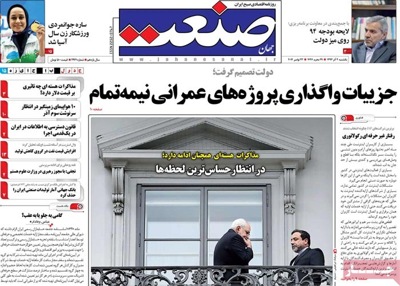
Asr-e Rasaneh: “Some 20,000 checks are bounced daily across the country,” said the secretary general of the Central Bank of Iran.

Asr-e Rasaneh: “We will make the oil industry self-sufficient in two years,” said the deputy oil minister.


Asre resaneh newspaper 10 - 21


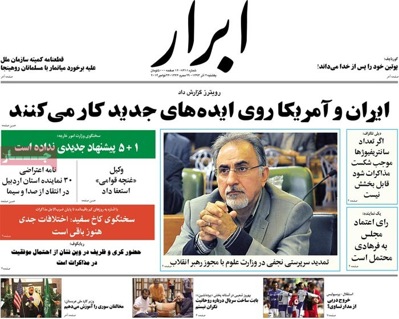
Asrar: “The government won’t cross the boundaries set by the Supreme Leader; it will draw on the views of clerics to devise its plans,” said Vice President for Supervision and Strategic Affairs Mohammad Bagher Nobakht.

Asrar: “We need 20 more power plants similar to Bushehr,” said the head of the Atomic Energy Organization.


Asrar newspaper 10 - 21


Ebtekar: “US military action and acts of terror committed by IS are doomed to failure,” said Major General Ghasem Soliemani, who heads the Quds Force of the Islamic Revolution Guard Corps.

Ebtekar: “The Judiciary will put the acid attacks case on a fast track.”

Ebtekar: “[European Union foreign policy chief] Catherine Ashton will continue leading nuclear talks with Iran until a deal is clinched.”


Ebtekar newspaper 10 - 21


Emtiaz: “Tehran will see temperatures fall as much as 10º Centigrade, the Islamic Republic of Iran Meteorological Organization (IRIMO) reported. A cold front has swept the country.”

Emtiaz: “Police are one step away from arresting the one(s) behind acid attacks.”


Emtiaz newspaper 10 - 21


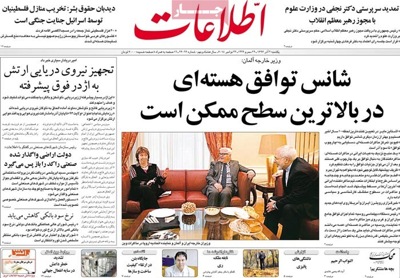
Ettela’at: “A deal on construction of two atomic facilities will be shortly signed with Russia,” said Director of the Atomic Energy Organization Ali Akbar Salehi.

Ettela’at: “Water shortage has prompted a number of people to evacuate their place of residence,” said the deputy energy minister.

Ettela’at: “Ayatollah Sistani is opposed to foreign troop presence in Iraq.”

Ettela’at: “Heavy snowfall has cut off 35 villages around Salmas, a city in West Azerbaijan Province.”


Ettelaat newspaper 10 - 21


Hadaf va Eghtesad: Hossein Entezami, the deputy minister of culture and Islamic guidance, has paid a bedside visit to Erfan Parviz-Ansari, the former editor-in-chief of Tehran Times, an English-language daily.


Hadafo eghtesad newspaper 10 - 21


Haft-e Sobh: “The suspicious death of the American correspondent of Press TV along the border of Turkey and Syria.”

Haft-e Sobh: In a marathon reattachment operation, surgeons in Tabriz have given back a worker his severed hand.

Haft-e Sobh: Entry tariffs at the border with Turkey have increased 3-fold, Iranian long-haul bus drivers have complained. “Forget overland trips to Turkey,” the daily advises the readers.


Hafte sobh newspaper 10 - 21


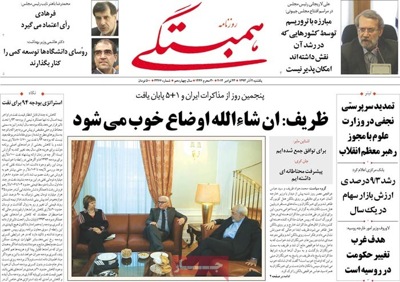
Hambastegi: “Terrorists are fighting a battle against civilizations and humanity,” said President Rouhani in a meeting with the Armenian prime minister.

Hambastegi: “Whether or not movies should hit the screen is determined by laws; we don’t need people to tell us what to do and what not to,” said Minister of Culture and Islamic Guidance Ali Jannati. His comments came after the head of parliament’s Cultural Committee appealed to the ministry to stop the screening of a few films.


Hambastegi newspaper 10 - 21


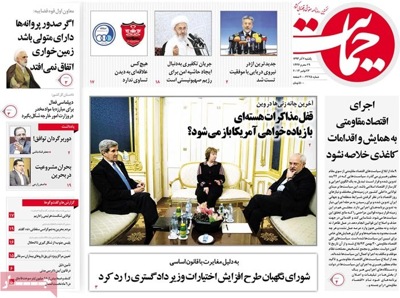
Hemayat: “Parliament is utterly determined to pull the plug on gas imports.”

Hemayat: “Death sentence is awaiting those behind acid attacks in Isfahan,” said Deputy Judiciary Chief Gholamhossein Mohseni Ejei.


Hemayat newspaper 10 - 21


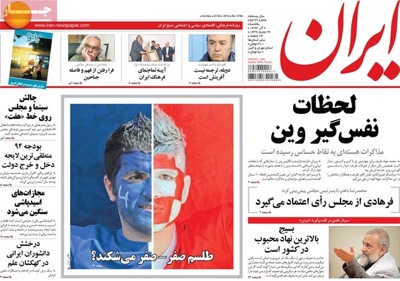
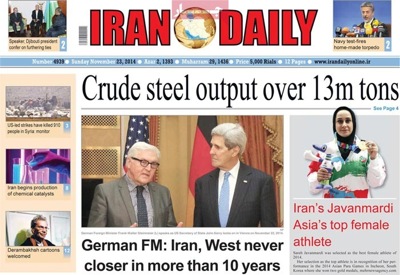
Iran Daily: “EU imports from Iran up 77%.”


Iran daily newspaper 10 - 21


Isfahan-e Emrooz: “Isfahan is home to different monotheistic religions; the peaceful coexistence of the followers of these religions is the source of honor for this city and today we stand ready to revive “Safakhaneh” [an old congregation hall located in a predominantly Christian neighborhood of Isfahan where followers of divine faiths used to gather for debate]. We are honored to have lived with our Christian brothers for hundreds of years here in Isfahan,” said the provincial governor of Isfahan.

Isfahan-e Emrooz: “Security agencies are monitoring the acid attacks,” said the Friday prayer leader of Isfahan.


Esfehan emruz newspaper 10 - 21


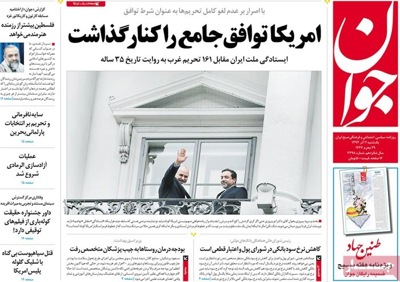
Javan: “Iraqi Prime Minister Haider al-Abadi has arrived in Iran on his first overseas trip as premier.”

Javan: “Armenian Prime Minister Hovik Abrahamyan has met with President Rouhani.”


Javan newspaper 10 - 21


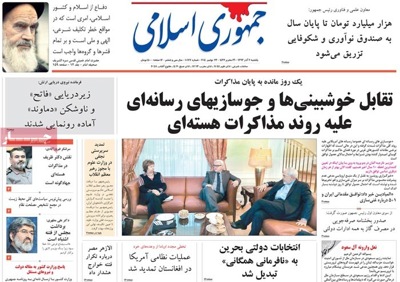
Jomhouri Islami: “Four individuals have been arrested in Isfahan in connection with the recent acid attacks,” said the deputy interior minister.


Jomhurie eslami newspaper 10 - 21


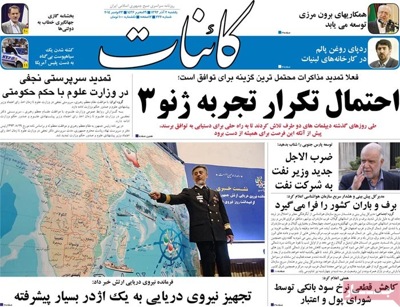
Kaenat: “Three individuals have been convicted of sedition for what happened after the 2009 presidential election.”

Kaenat: “A bloody day in Karbala: Eighty people were either wounded or sustained fatal injuries in a series of blasts in Iraq on October 20.”


Kaaenat newspaper 10 - 21


Kar va Kargar: “Iranian athletes have bagged 42 medals two days into the 2014 Asian Para Games in Incheon, South Korea.”


Karo kargar newspaper 10 - 21


Kasb va Kar: “Iranian tunnel constructors establish a link between Europe and China.” The daily has picked this headline to highlight exports of Iranian technical and engineering services to Kazakhstan.

Kasb va Kar: “Implementation of this unjust verdict against [senior Saudi cleric] Sheikh Nimr al-Nimr will mobilize the world of Islam against Saudi Arabia,” the Coordination Council of the Islamic Propagation Organization said.


Kasbo kar newspaper 10 - 21


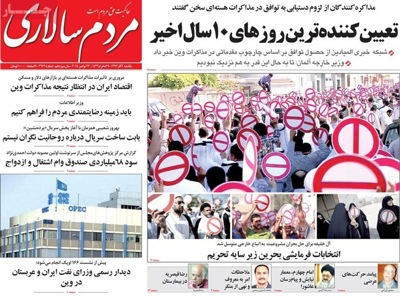
Mardomsalari: “Israel has started taking retrogressive steps in history,” said Chairman of the State Expediency Council Ayatollah Hashemi Rafsanjani.


Mardom salari newspaper 10 - 21


Payam-e Zaman: “Monitoring procedures should be intensified at border crossings to prevent contagious diseases from finding their way into the country,” highlighted the health minister.


Payame zaman newspaper 10 - 21


Resalat: “I do not want the Executives of Construction Party to share the fate of the Islamic Participation Front,” said former spokesman of the party Mohammad Hashemi, who has recently quit the post.

Resalat: “Enemies have failed to inflame insecurity along [Iran’s] borders,” said Commander of the Islamic Revolution Guard Corps Major General Mohammad Ali Jafari.


Resalat newspaper 10 - 21


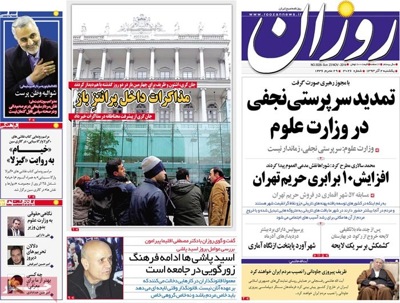
Roozan: “Under the previous government, the country’s economy was haphazard; a person who had no experience of running a grocery shop was put in charge of an auto-making corporation,” said Akbar Torkan, the chief advisor to President Rouhani.

Roozan: “Iran can ensure the security of the Middle East and Central Asia,” a member of parliament’s National Security Committee said.


Ruzan newspaper 10 - 21


Shahrara: “Lowering oil prices is the last tool Iran’s enemies are resorting to,” said government’s Spokesman Mohammad Bagher Nobakht.


shahre aara newspaper 10 - 21


Sharq: “Half of South Pars’ personnel lost their jobs when Ahmadinejad’s government was in office,” said the provincial governor of Bushehr.


SHARGH newspaper 10 - 21


SMT: “The new budget appropriated to vessel-building projects and revocation of ship leases will save the shipbuilding industry as much as $146 million.”


Samt newspaper 10 - 21


Tafahom: “Seventy percent of stock transactions are done online,” said the head of the Securities and Exchange Organization.


Tafahom newspaper 10 - 21


Tehran Times: “Iran and Armenia are to form a joint commission to boost trade ties.”


Tehran times newspaper 10 - 21


Vatan-e Emrooz: “Reports by [Iran’s] Press TV correspondent Serena Shim that [Turkish President] Recep Tayyip Erdogan supports IS have cost the journalist her life.”


Vatane emruz newspaper 10 - 21


Radicalism will return to the US and Europe (Part One)

West-ISIS
West-ISIS
Davood Feirahi
Davood Feirahi

Dr. Davood Feirahi, a political science researcher, says that ISIL has its roots inside the Muslim community, blaming a lack of religious development among Muslims for the emergence of radicalism at this level.

On October 12, Khabar Online posted an analysis of the current state of affairs in the Middle East followed by an interview with Dr. Feirahi which mainly revolves around the emergence of the Islamic State of Iraq and the Levant and the crisis which has swept the region. The following is PART ONE of the translation of the analysis and the Q and A:

ISIL has created a situation in the Middle East as a result of which many are offering prayers for the soul of [Osama] bin Laden, viewing Al-Qaeda as an organization far more honorable than the so-called Islamic State (IS). The sympathizers of Abu Bakr al-Baghdadi, the self-proclaimed Caliph of Muslims, have painted a new image of radicalism for the people around the world, portraying an extremely distorted picture of Islam in civilizational and religious concepts.

Different theories have been floated to explain the reasons behind the formation of such a dangerous phenomenon, and, as it is usually the case, the most striking and perhaps the most popular one is this: blame all problems on the enemy and denounce the West, the US in particular, as the mastermind of the recent crisis which has swept the Middle East, a precarious trend which seems unlikely to be confined to the Middle East.

However, Dr. Davood Feirahi’s take on that question differs. He is, for sure, one of the greatest, if not the most outstanding, professors of the Islamic political thought in Iran. Feirahi, a University of Tehran professor who had come to Café Khabar [the venue for holding interviews as well as exclusive and analytical round-tables at Khabar Online], argues that ISIL has taken roots inside the Muslim community, saying that failure on the part of Muslims to become developed religiously has given rise to radicalism allowing it to grow extensively.

Hojatoleslam Feirahi maintains that airstrikes unleashed by the US and its allies only help radicalism spill over, and this complicates efforts to keep the extremist current in check.

He underlined that to counter ISIL, Muslims should change their religious conduct. Such a change of heart should allow the opposing currents inside the governments to speak their mind, force authoritarian states to involve people in the administration of their homelands’ affairs, and ask various religious currents to do more to promote tolerance and moderation among themselves.

The Arab Middle East has turned into the cradle of religious extremism in the world, a region which is today witnessing Middle Ages-like behaviors. Various theories have been floated to explain why such a phenomenon has emerged, but these societies seem to have developed a special interest in extreme acts and radicalism. Why do the extremist theories resonate with people in the Middle East?

The Middle East is a special region and its governments and movements do not fit into any category. A separate file should be specifically opened for this region. The reason: this region is [viewed as] hegemony in the world. It means that global powers have interests in it, and events in this region soon translate into domestic developments in world powers.

It has caused the Middle East to be always gripped by interference, which either shapes a new order or disrupts the old world order. There are three reasons for this quality of the Middle East.

The first has to do with geopolitics. Needless to say, the Middle East carries much weight from this perspective. Secondly, this region’s economy and its oil are also an issue, and last but not least is the fact that this region is a place where a large number of emigrants head for the outside world; that is to say, crowds of people hailing from this region are living in developed countries such as the US, France, England, etc. These immigrants are the reason why any crisis in the Middle East can spread into developed world.

The three questions explained above are the reasons why this region has been globalized. Another important point is that the governments which have risen to power in this region have been extremely military, more or less secular and somewhat failed.

There are two problems associated with a failed state; first, it controls society and under the pretext of establishing social justice does not allow the democratic process to run its course. Moreover, the organization of their institutions allows corruption to thrive. Consequently social justice fails to prevail in society.

These states are failed whether they are religious or not. What matters is that these systems have, for some reasons, activated forces who tended to be part of the corridors of power, but have denied them the opportunity to flourish.

To elaborate more, I should say that the Iranian people used to not interfere in the administration of affairs prior to the Constitutional [Revolution] because they did not see it within their rights to get engaged. With the passage of time as national governments rose to power, people still remain unable tobe part of their country’s national and public affairs not because they don’t see it their right to do so but that they are not allowed to.

The non-interference in these two cases is not of the same nature. The latter has sparked off the radicalization of [political] currents, or has caused them to have secular leanings or radical religious tendencies. Religious currents are drastically radical because the failed states have had secular orientations. That’s why resistance found its way to the religious literature and words such as Jihad, Takfir [one Muslim declares another an unbeliever] and Hejrat [departure or emigration] were given added weight.

Mulling over how the concept of Jihad was put into active use during the course of history, we come to a point in time when [Anwar] Sadat and [Hosni] Mubarak were leading totalitarian regimes, and it could even be extended to the final days of [Gamal Abdel] Nasser [in Egypt].

Thus, we can hold up the hegemonic nature of the region and the presence of failed states as the two significant reasons why regional movements are playing a more active role. When the failed states are given support by the outside powers, the opposition makes use of religious literature in the first place; and secondly in launching an offensive against regional governments it attacks their Western supporters too.

It could be said that the connection between authoritarian systems in the region has manifested itself in two ways: opposition to the West and opposition to regional governments, which are the social and political foundations of radicalism in the Middle East.

The religious literature you just talked about could be acceptable, but the question that arises here is: What pushes such religious literature to opt for violence and radicalism?

People in the region have, for long, tried to advance their own will through ballot boxes, but this has proved a failure in most of the countries. Let me illustrate my point with the Algerian example or a Syrian crackdown in 1986, riots in Saudi Arabia, the recent crisis in Egypt, and the like.

You can see that the public will have always met with a heavy hammer. The hammer here has been a military force with no justification. This shows that radicalism has fallen asleep in countries where the governments are more likely to open up the [political] atmosphere.

Accordingly, I see a clear link between the [emergence of] ISIL, the failure of Mohamed Morsi [in Egypt] and the current crises in Libya. In most of these countries democratic efforts failed to serve as a [fitting] template to channel the energy the opposition was emitting. They failed. This energy is like a closed pot [on the stove]. They would, in the end, find some justification [for their failure] and that justification here comes in the form of radicalized measures rooted in religion.

If we seek to establish a relationship between a religious government and a secular state, we come to the conclusion that the two models have been both unsuccessful. Neither religious governments nor secular systems have fared well. In both models people have not played a remarkable role in the political process, and the two models ultimately lead to the rise to power of totalitarian dictatorships. What is the root of this?

This hinges mainly on the nature of governance in the Middle East and it doesn’t matter whether it’s religious or non-religious. When it comes to the religious model, experience has shown that as long as the governments in the region are led by Shiites, it can provoke a backlash among the Sunnis. In other words, the latter comes up with its own solution which is the formation of non-religious authoritarian governments led by Sunnis. Therefore, they seek an anti-Shiite and anti-Western version [of government].

There are no precedents for this. At the time of Al-Qaeda [when it was spreading terror across the world] the fight against Shiites hadn’t reached this [alarming] proportion. They were trying to portray the family of religion as an interrelated and united system.

I think it was predictable that radicalism was gathering pace. The current crackdowns rekindle the spread of radicalism. US airstrikes would not bring radicalism under control; rather they would create small uncontrollable cells which couldn’t be monitored. Radicalism seems likely to make a comeback to Europe and the US.

Experience suggests that concentration is to the detriment of these groups. They are again heading for Europe and we should wait for news [of attacks] coming out from towers or metros in Europe. Radicalism has struggled to fill the void created in the Middle East to establish a permanent territory for itself. However, if it senses that it couldn’t be the case, it would change, because radicalism comes with some rationality and it is nowhere near injudicious.

Once radicalism feels that concentration in a geographical location is not the solution, it would expand its efforts to swell its ranks. Although social currents cannot be meticulously defined, the bombing missions [of the US] seem to take the war back into the West.

Christians in Isfahan celebrate the 350th anniversary of a famous church

Iran-Isfahan-Vank church

A function was held in the predominantly Christian Jolfa neighborhood in Isfahan, central Iran on Monday to mark the 350th anniversary of the city’s Vank Cathedral. A senior Lebanese Christian cleric was on hand for the ceremony that brought together hundreds of the faithful. The following photo gallery contains images the Islamic Republic News Agency has released of the event:


Esfehan emruz newspaper 10 - 21Isfahan-e Emrooz Daily Front page: “Isfahan is home to different monotheistic religions; the peaceful coexistence of the followers of these religions is the source of honor for this city and today we stand ready to revive “Safakhaneh” [an old congregation hall located in a predominantly Christian neighborhood of Isfahan where followers of divine faiths used to gather for debate]. We are honored to have lived with our Christian brothers for hundreds of years here in Isfahan,” said the provincial governor of Isfahan.