Thursday, April 9, 2026
Home Blog Page 5031

Iran in the eyes of an American traveler

hafte sobh
hafte sobh

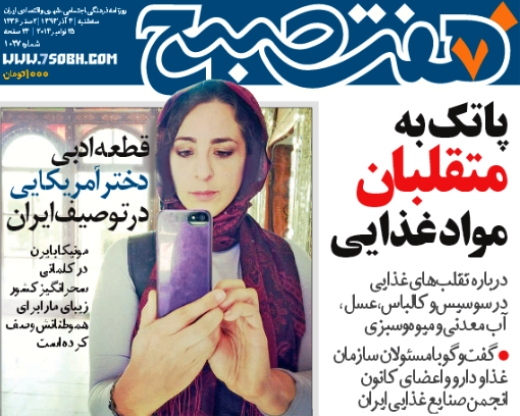
On November 25, the front page of Haft-e Sobh newspaper featured the translation of a piece on how American Monica Byrne has described Iran in her fantastic words. The simple, still very beautiful and emotion-filled, wording of this American novelist and playwright was good-enough reason for IFP to surf the net for the original piece. We eventually found it at http://www.lobelog.com/iran-reconciliation/. IFP decided to put the entire piece on its website, although the Persian-language paper had only parts of it translated:

Before I traveled to Iran, I didn’t want to read anything about Iran. Certainly nothing written by mainstream American news media, which often draws an absurdist caricature of the country. I wanted to arrive with an open heart.

But I knew that having an open heart wasn’t the same thing as an ignorant mind. I didn’t pretend to have more than a superficial knowledge of Iranian-American relations. I didn’t wish to gloss over the misdeeds of either country, including human rights abuses. I was just a writer, with three motivations:

  1. Travel is essential to my writing;
  2. I have Iranian friends in America who are passionate about their homeland, which made me curious; and
  3. for their sake and mine, I want reconciliation between our countries.

No small task, of course. Not when people from both countries have been working toward that goal ever since the 1979 revolution ousted a pro-American monarch and replaced it with an Islamic Republic.

The revolution has impacted a whole generation of people in both Iran and America. But a new generation – including my friends and I – born after 1979, don’t have a memory of the revolution, or the occupation of the US Embassy in Tehran. There’s no case to be made for ignorance, but there is a case to be made for innocence: To us, the estrangement of Iran and America makes neither political nor intuitive sense. America’s simultaneous fidelity to Saudi Arabia and Israel feels odd and hypocritical. While I was in Iran, I asked my guide to explain the reason behind the sanctions. He couldn’t really explain it. I researched the sanctions. I couldn’t even explain them to myself. They just seemed pointless and arbitrary.

An older generation resigns itself to everything being the way it is. A younger generation questions why any of it has to be.

So where do we begin? And by “we,” I don’t mean the nation states; I mean “we” as individual citizens. Do we seek common ground? I’m not going to insult everyone’s intelligence by saying Iranians are just like Americans. That not only implies that Iranian lives only have value insofar as they resemble American ones; it also obscures our differences, including the religious orientations of our current governments, and the effects those orientations have on the public and private behavior of individual citizens. Those differences are real and important.

Yet those differences are not a real barrier to reconciliation. And as an American, I see the primary responsibility for reconciliation in America’s court. We are far more ignorant about, and hostile toward Iranians than Iranians are toward us. That is our shame. Are there people in Iran who chant “Death to America”? Sure, I guess, somewhere. I didn’t meet any of them. Are there people in America who can’t even locate Iran on a map? Yes. I meet them every day.

The good news is that both countries have made small acts of good faith over time, which then led to acts of good faith among individual citizens; my homeland became a home for people of Iranian origin and descent. They grew up in (or came to) America and made friends, including me. Those friendships then inspired me to travel to Iran.

While staying near the historical city of Pasargad, the final resting place of Cyrus the Great, I had a wonderful experience playing the part of an American tourist in a documentary that happened to be shooting near my guesthouse. The producers gave me a verse of Hafez, the great Persian poet, to say in Farsi:

The Tomb of Hafez, Shiraz, Iran. Credit: Monica Byrne

Derakhte doosti benshan,

ke kame del be bar arad.

Which means:

Plant the tree of friendship,

and it will give the fruit of the heart’s desire.

Even now, two weeks after leaving Iran, the line still resonates with me. I’m not a politician. I don’t have the ear of anyone in power. The negotiations over Iran’s nuclear program are not accessible to me. But travel and friendship: these are tools that are available to me. They’re also available to millions of Americans, especially after Hassan Rouhani – known inside Iran as a moderate cleric with reformist ambitions ­– was elected president last year. By travel I don’t mean joining a mindless mega-tour group, whose members don’t interact with anyone except through the viewfinder of their cameras. I mean travel as a mindful and radical act: to seek one-on-one consensual reconciliation of Other and Self, of mutual transformation that leaves both parties more perfectly themselves than they were before.

The state will act at the level of the state, in Vienna or wherever. But individuals can act at the level of individuals, on American and Iranian soil: seeing and being seen, hearing and being heard, knowing and being known.

My last night in Iran, I went back to the Tomb of Hafez. The first time I’d gone was daytime, when tourists go; evening is when Iranians go.

The air was cool and electric. In the northeast corner of the courtyard, a square of rugs was set down for evening prayer. Up and down the steps of the tomb came students, artists, professors, pairs of women, pairs of men, parents with teenagers, parents with toddlers. A young couple – the girl wearing a scarf fashionably high on her head, the boy wearing all black, with a gold chain – walked up to the tomb and fidgeted there, unsure of how to behave. Some placed their fingers on the tomb, their lips moving. Others checked their smartphones, or took selfies. A man in a grey suit hovered by one of the columns, reciting Hafez to whoever would listen.

As per an Iranian tradition I’d read about, I circled the tomb seven times and then sat down, legs crossed, with my back to one of the pillars, and asked the question in my mind: How do Iran and America reconcile?

And then I opened my English translation of The Divan of Hafez, which my guide Mohamad had bought me as a gift. This was the first verse my eyes fell upon:

Joyous that day from when this desolate abode, I go:

The ease of soul, I seek: and for the sake of the Beloved I go.

The answer gave me chills.

But I didn’t have time to think more about it, because just then, the men who’d finished praying came to take a group picture on the steps of the tomb. They asked me where I was from, and like everyone who heard I was from America, were delighted and extremely welcoming. We could communicate very little, but they managed to tell me they were from nearby Estahban, a city famous for figs.

Our conversation drew onlookers. Soon it was a crowd of twenty or more. Someone asked if I spoke any Farsi. I got really excited because I remembered my line from the vineyard documentary, so I started:

Derakhte doosti benshan—

And the entire crowd finished it with me as if it were a song we’d long rehearsed.

—ke kame del be bar arad!

The man in the grey suit who’d been reciting Hafez behind us called “Yes! Yes! Thank you!” and rushed forward to pour peanuts and raisins into my hand.

A translator materialized; the crowd was now asking me why I’d come to Iran. “I want Iran and America to reconcile,” I said. Immediately applause broke out. “Tell your government!” someone called out. “I’m trying!” I said, waving my Moleskin. It felt like such a paltry gesture. But I have to believe that it was something. That these gestures of good faith would also come to bear fruit, like the gestures of good faith that had sent me there in the first place.

American news outlets often portray Iran as something like Mordor, the strange and unknown wasteland from J. R. R. Tolkien’s Middle Earth. The average American mostly follows suit. Now that I’ve been there, what can I say to that? Where can I even begin?

What I saw was a vast, gorgeous, brilliant country at the crossroads of the world, with an ancient culture seasoned by peoples from the north, south, east, and west who’d broken over Persia like waves for three thousand years. I fell in love with Hafez and the reverence of artists that his veneration represents. I fell in love with Iranian food (I’m rationing my remaining saffron sugar sticks like bars of gold). I fell in love with Iranian landscapes—Alamut, Abyaneh, Persepolis, Garmeh. I fell in love with Iranian places—the Zurkhaneh in Yazd, the homestay in Farahzad, the garden in Kashan. And Iranians themselves were unfailingly kind to me. How is it even possible that our peoples are still estranged? It makes no sense.

I spent my last night in Iran on the steps of Hafez’s tomb, talking. Men, women, mothers, fathers, teenagers, girls, boys, children—all eager to talk. A daughter translated, and a father filmed the impromptu interview. A son translated, and told me the meanings of all his family’s names. I ripped pages out of my Moleskin and wrote down my contact information for five, ten, twenty people; and got theirs in return. Blog, Gmail, Twitter, Facebook, Viber, Whatsapp, Instagram—we would find each other there (even if some of those applications are illegal in Iran). The men from Estahban returned with a handful of figs and poured them into my hand on top of the peanuts and raisins. My heart overflowed. I didn’t want to leave. In just thirty days, Iran had become beloved to me.

I’ll be back soon, inshallah. In the meantime, to every single American who is able, I echo Hafez:

For the sake of the Beloved, go.

 

Monica Byrne is a novelist, playwright, and traveler based in Durham, NC. Her first novel The Girl in the Road was published by Penguin Random House in May. She writes from home and abroad on her blog.

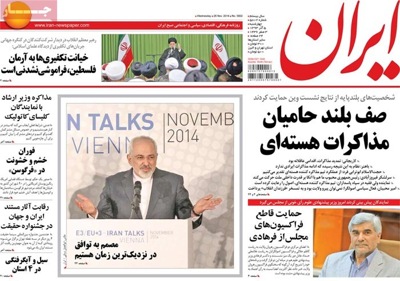
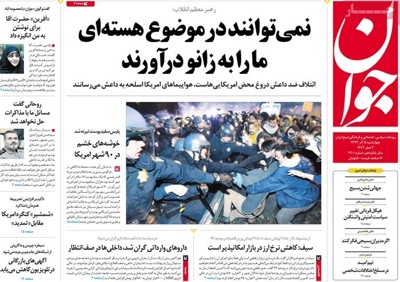
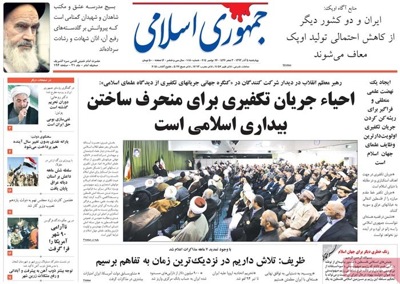
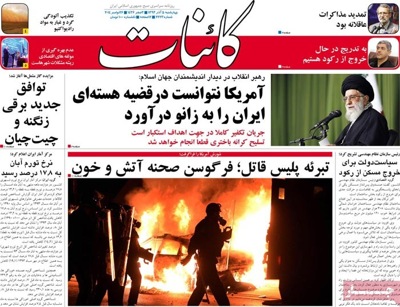
A look at Iranian newspaper front pages on Nov. 26

Iranian Newspapers Headlines

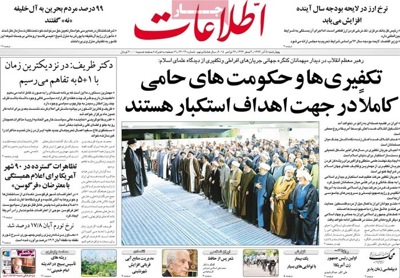
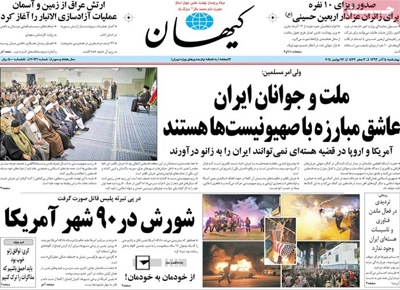
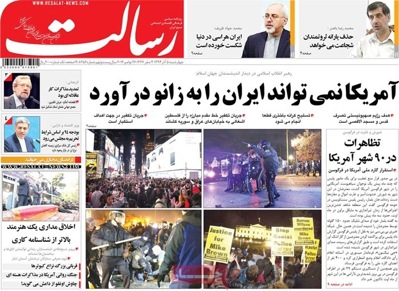
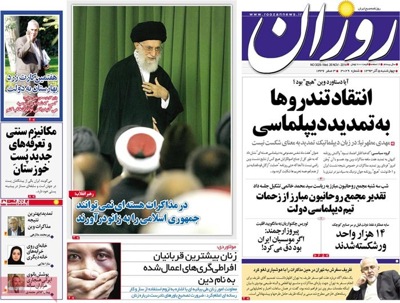
Comments by the Supreme Leader at a meeting with Muslim scholars from around the world in Iran for a conference on extremism dominated the front pages of Iranian dailies on Wednesday. In the meeting Ayatollah Khamenei said that extremists serve the interests of hegemonic powers and that the coalition formed to take on IS was a sham. Also on front pages was the news of unrest in Ferguson, Missouri following the decision of a grand jury not to indict Officer Darren Wilson, a white police officer who killed unarmed black teenager Michael Brown in August.

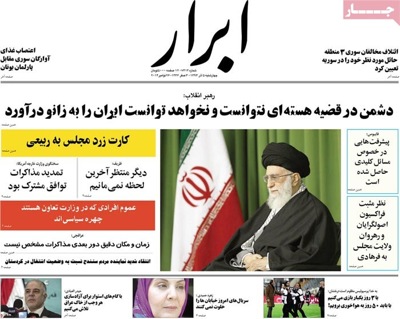
Abrar: “The venue and exact timing of the next round of talks with P5+1 have yet to be determined,” said Iranian Deputy Foreign Minister Seyyed Abbas Araghchi.


Abrar newspaper 11 - 26


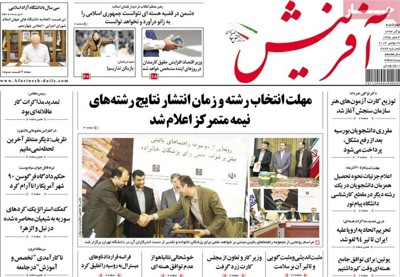
Afarinesh: “Extension of nuclear talks was the rational thing to do,” said Speaker of the Islamic Consultative Assembly Ali Larijani.

Afarinesh: Following the decision of Iran and P5+1 to extend their nuclear talks, EU sanctions against Tehran were suspended until July 2015.


Afarinesh newspaper 11 - 26


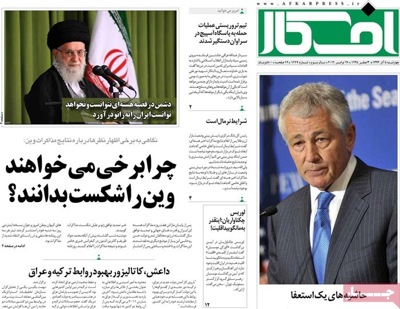
Afkar: “Members of a terrorist cell that staged an attack on a border guard station in Saravan [in southeastern Iran earlier this year] have been arrested,” said the deputy commander of the Islamic Revolution Guard Corps’ Ground Forces.


Afkar newspaper 11 - 26


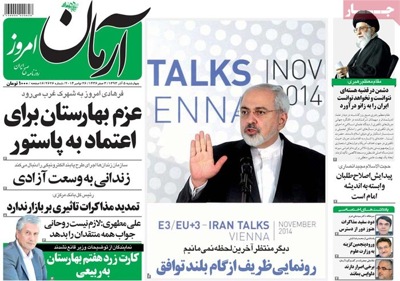
Arman-e Emrooz: “President Rouhani does not have to answer to every single critic of his performance,” said Ali Motahari, a principlist MP.


Armave emruz newspaper 11 - 26


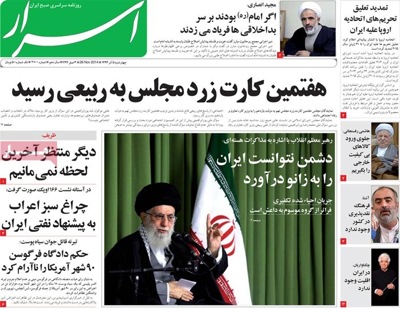
Asrar: The chairman of the Expediency Council has called for a ban on imports of low-quality products from abroad.


Asrar newspaper 11 - 26


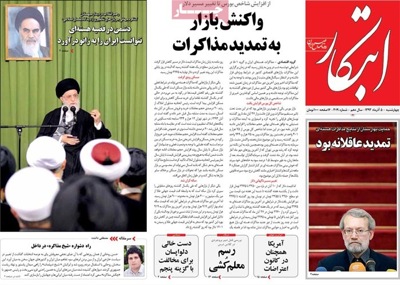
Ebtekar: “The enemy has failed to bring Iran to its knees over the nuclear issue,” the Supreme Leader told a host of Muslim scholars in Iran to attend a world conference on Takfirism and Extremism.


Ebtekar newspaper 11 - 26


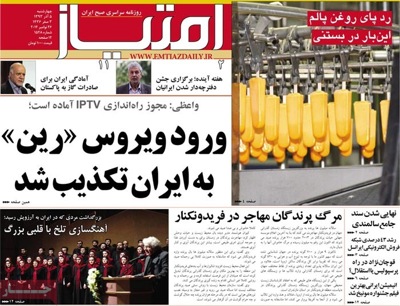
Emtiaz: “Iran stands ready to export natural gas to Pakistan,” said Oil Minister Bijan Namdar Zanganeh.


Emtiaz newspaper 11 - 26


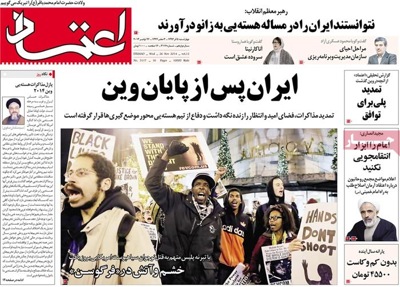
Etemad: “Extension of talks has kept hopes and anticipation alive; support for the nuclear negotiators is evident in the stands officials are adopting,” said the paper in a story headlined “Post-Vienna Iran”.

Etemad: Rage and flames in Ferguson, Missouri after a grand jury did not find probable cause to indict a white police officer who killed an unarmed black teenager in August.


Etemad newspaper 11 - 26


Ettela’at: “We’re determined to reach a deal with P5+1 soon,” said Foreign Minister Mohammad Javad Zarif.


Ettelaat newspaper 11 - 26


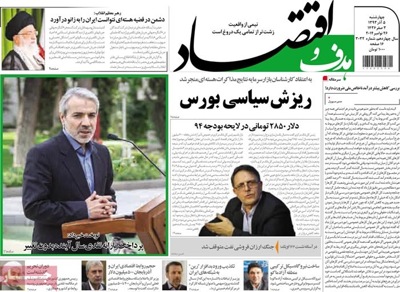
Hadaf va Eghtesad: The minister of communications has denied reports that Regin malware has found its way into the Iranian network.


Hadafo eghtesad newspaper 11 - 26


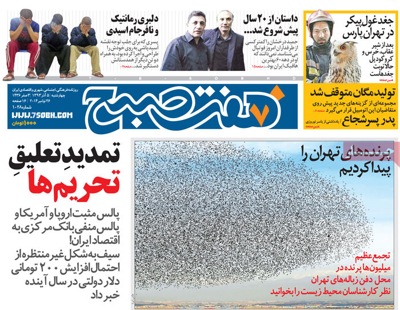
Haft-e Sobh: In unexpected comments the governor of the Central Bank of Iran has said that the official price of the US dollar is likely to rise by 2,000 rials next year [starting March 21, 2015].


Hafte sobh newspaper 11 - 26


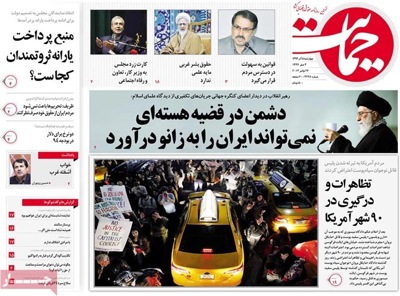
Hemayat: Parliament has yellow-carded the minister of labor, cooperatives and social welfare, a first step toward the impeachment of Ali Rabiei.


Hemayat newspaper 11 - 26


Iran: A number of parliamentary caucuses have thrown their weight behind Mohammad Farhadi, President Rouhani’s pick to lead the Ministry of Science, Research and Technology.


Iran newspaper 11 - 26


Javan: “Islamic Republic of Iran Broadcasting has decided to reduce the number of commercials it airs.”


Javan newspaper 11 - 26


Jomhouri Islami: Well-informed sources at OPEC say Iran and two other petroleum-exporting countries are likely to be exempt from a possible output cut of the organization.


Jomhorie eslami newspaper 11 - 26


Kaenat: “Inflation in the 30 days to November 20 stood at 17.8 percent,” reported the Statistical Center of Iran.


Kaenaat newspaper 11 - 26


Kayhan: “No doubt, Iranian nuclear facilities will remain operational,” said President Rouhani.


Kayhan newspaper 11 - 26


Resalat: “Next year’s budget will be sent to parliament based on assumptions that sanctions will remain in place,” said the minister of economy and finance.


Resalat newspaper 11 - 26


Roozan: “Women are the biggest victims of extremist acts committed in the name of religion,” said Iranian vice-president for women’s affairs.


Ruzan newspaper 11 - 26


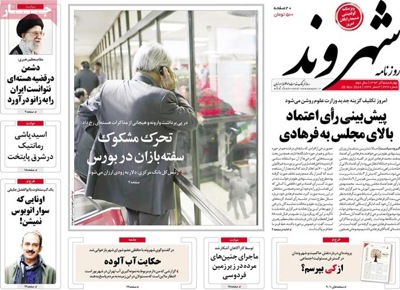
Shahrvand: Parliament is predicted to confirm Mohammad Farhadi as science minister with a wide margin.


Shahrvand newspaper 11 - 26


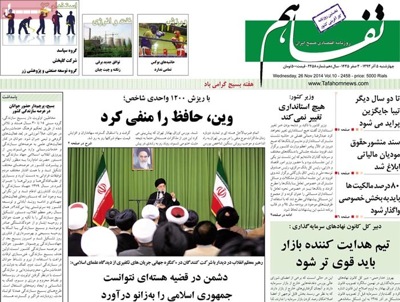
Tafahom: Tehran Stock Exchange shed 1,200 points in reaction to failure of Iran and P5+1 to clinch a comprehensive deal.


Tafahom newspaper 11 - 26


Iran animation bags award at Munich film festival

animation- Scale-Munich film festival

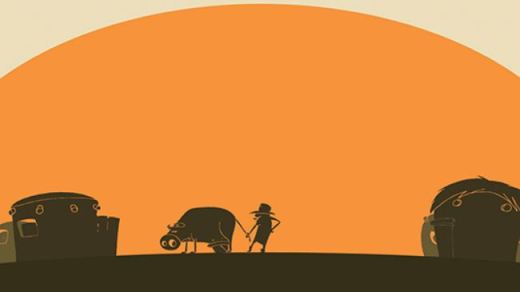
Iranian short animation Scale has scooped a prestigious award at the 2014 edition of Munich International Festival of Film Schools in Germany.

Directed by Amin Rahbar, the animation garnered the high-profile Climate Award of this year’s edition of the film event.

Scale is a two-minute film which was produced by cutout animation technique,” the director said.

Some 42 screen productions from 22 countries, displaying various themes, took part in the festival.

Scale has been screened and awarded at several international festivals including Hamburg Festival in Germany, Con i minuti contati Festival in Italy, and SHNIT Festival in Switzerland.

The jury congratulated Amin Rahbar on the successful artistic and technical realization of his film, saying, “In just one and a half minutes, the clip illustrates how drastically our environment has changed, the severe damage that has been done to it and the current consequences such as climate change.”

The Munich International Festival of Film Schools is held annually (November 16-22).

Farhadi receives vote of confidence

Farhadi

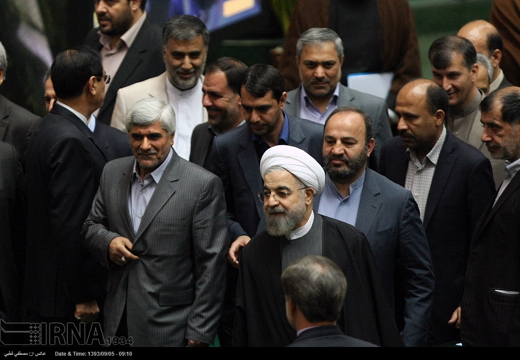
In an open session Wednesday Majlis (parliament) endorsed President Hassan Rouhani’s fifth nominee to head the Ministry of Science, Research and Technology.

The parliamentary session was held in the presence of President Rouhani during which he urged the lawmakers to support his nominee. It was attended by 235 lawmakers and chaired by Speaker Ali Larijani.

The chamber approved Mohammad Farhadi as the minister of science, research and technology with 197 votes in favor, 28 against, and 10 abstentions.

Farhadi needed 50 percent plus one of the votes to become minister.

Last Tuesday, Majlis turned down Rouhani’s fourth nominee Fakhreddin Ahmadi Danesh-Ashtiani.

Danesh-Ashtiani failed to obtain a vote of confidence when 171 lawmakers voted against him, 70 in favor, and 13 abstained.

Iran strongly supports Iraq in fight against terrorism: Deputy FM

Hassan Qashqavi
Hassan Qashqavi

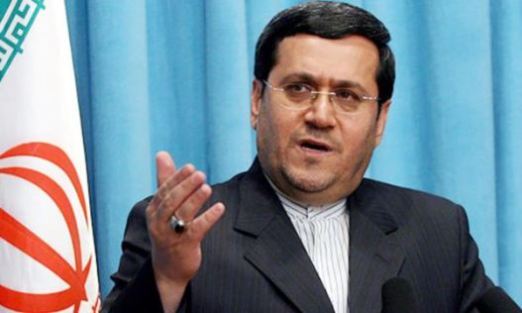
Hassan Qashghavi, a high-ranking Iranian diplomat who is in Baghdad, in a meeting with chairman of the Islamic Supreme Council of Iraq underlined Iran’s strong support for Iraqi government and people in the fight against terrorism.

Deputy Foreign Minister for Consular and Parliamentary Affairs Hassan Qashghavi, in a meeting with Ammar al-Hakim, offered congratulations on recent victories of the Iraqi military and people in the fight against terrorists and expressed hope for continuation of such victories.

Ammar al-Hakim, for his part, called Iran’s role in helping Iraqi government in fight against terrorist groups valuable and appreciated Iran’s support for Iraq.

He also underlined the necessity of promoting ties between the two countries in all fields.

[…]

Iran, Turkey will solve Syrian crisis politically: Official

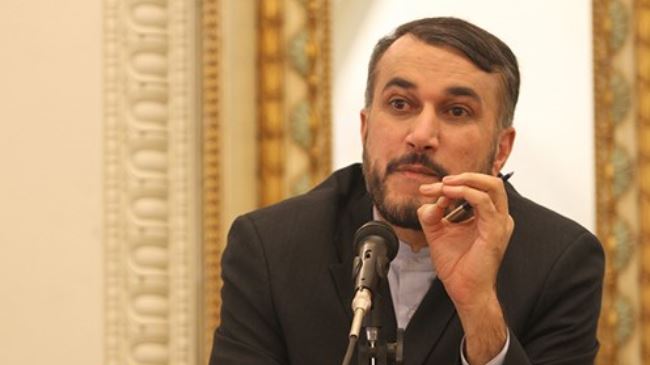
Hossein-Amir-Abdollahian

Iran’s Deputy Foreign Minister for Arab and African Affairs Hossein Amir-Abdollahian says the Islamic Republic and Turkey will succeed in finding a political solution to the Syrian crisis.

In a meeting Tuesday with Umit Yalcın, Director General for Bilateral Political Affairs at Turkey’s Foreign Ministry, the Iranian official said Tehran and Ankara play a strategic role in the Middle East and should stay in touch about regional developments.

“Given the [present] circumstances in the region, Tehran and Ankara can play a leading political role in settling the crises and we are ready to turn consultation in this regard into practical cooperation,” Amir-Abdollahian said.

Reiterating that the Syrian conflict should be solved through democratic ways without any military intervention, he said Iran backs “broad-based national dialog” and opposes foreign governments’ arming of the Syrian opposition.

The Iranian diplomat noted that any solution to the ongoing problems in the Middle East, particularly in Syria and Iraq, would not bear fruit without Iran’s involvement.

Amir-Abdollahian further expressed Iran’s determination to cooperate with Iraq in the fight against terrorism, saying, “We respect Iraq’s national unity, sovereignty, independence and territorial integrity and explicitly oppose measures by certain parties to disintegrate Iraq.”

The Turkish official, for his part, said Iran and Turkey share views on the importance of restoration of peace and stability to the region, maintenance of territorial integrity and security of Iraq and Syria and eradication of terrorism in the region.

Yalcın added that settlement of the ongoing problems in the Muslim world is a top priority in Tehran-Ankara cooperation.

[…]

Iran, China agree to broaden cooperation in fight against terrorism, money laundering

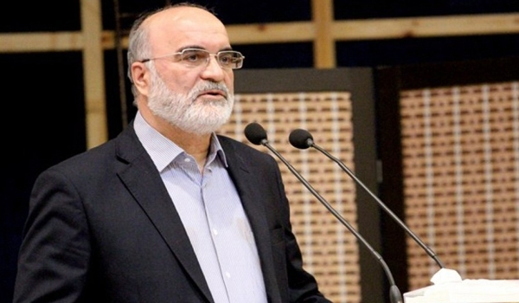
Nasser Seraj

Iranian and Chinese officials in a meeting in Tehran Tuesday agreed to increase cooperation in several areas, including in the campaign against money laundering and extradition of financial offenders.

The agreement was reached between Head of Iran’s General Inspectorate Nasser Seraj and Chinese Deputy Prosecutor General Jiang Xian Chu.

“We are willing to increase our cooperation in the campaign against financial and political corruption, terrorism and money laundering,” Seraj said during the meeting.

The senior Chinese official, for his part, pointed to the age-old relations between the two nations, and expressed hope that mutual cooperation would further expand in the fight against terrorism and financial corruption.

[…]

Trade between Iran and China last year was estimated at $45 billion.

Iran is currently China’s third largest supplier of crude, providing Beijing with roughly 12 percent of its total oil consumption annually.

Iran condemns raid on prominent Bahraini Shiite cleric’s house

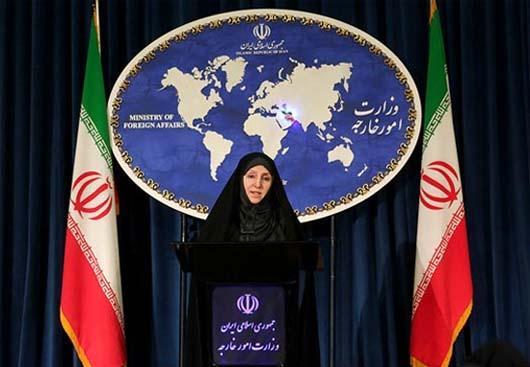
Iranian Foreign Ministry Spokeswoman Marziyeh Afkham

The Iranian Foreign Ministry on Tuesday strongly condemned Bahraini forces’ raid on the house of prominent Shiite cleric Ayatollah Sheikh Issa Ahmed Qassem a day earlier.

“Desecration of religious symbols and insulting popular religious leaders and scholars signify the Bahraini government’s failed security and ethnic approaches to dealing with peaceful protests by the people of the country,” Foreign Ministry Spokeswoman Marziyeh Afkham said.

Bahraini security forces raided the house of Ayatollah Sheikh Issa Qassem on Monday. Witnesses say regime forces even took photos of the ID cards of everyone who was inside the house in Diraz, west of the capital Manama.

The Iranian spokeswoman called on Bahraini authorities to show respect for the highly respected position of Muslim scholars and religious leadership in the country and punish those who committed this “unacceptable measure” [raid on Sheikh Issa’s house].

The raid on the home of the spiritual leader of the opposition al-Wefaq group came just a few days after people voted in an alternative election held by the main opposition parties of Bahrain.

The opposition had boycotted the parliamentary elections which were held with a low turnout on the same day across the tiny kingdom.

Why the nuclear talks failed? What is the takeaway? Daily answers

iran_nuclear_talks

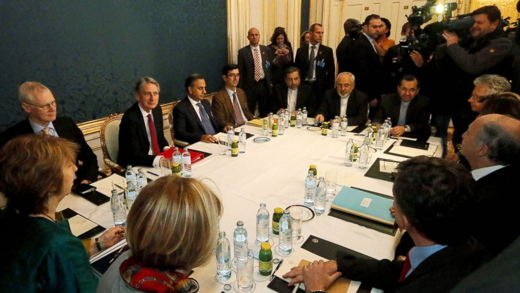
A comprehensive deal has once again eluded the representatives of Iran and P5+1who met almost for a week in the Austrian capital, Vienna to put the dispute over Iran’s nuclear program to rest, once and for all.

On Tuesday, Resalat, a principlist daily, published an opinion piece by Hanif Qaffari on the reasons why the parties to the talks failed to clinch a deal and on what the likely lesson of such failure is: in the US, Republicans and Democrats are cut from the same cloth and the showdown between Tehran and Washington will carry on. The following is a partial translation of the piece:

November 24, 2014 came and passed and a comprehensive nuclear deal between Iran and world powers remained elusive. Over the past four months, thanks to the West’s throw-a-wrench-into-the-works approach several opportunities have slipped away. In the talks held in New York, Vienna (round 7) and Muscat, Washington upstaged fellow P5+1 members and turned them into passive onlookers as the diplomatic marathon between Iran and the United States played itself out.

After four months, talks are practically back where they were at the close of Vienna 6: on the border between agreement and failure. In other words, we have to admit we are in a nuclear limbo which is only a little bit better framed than that of Vienna 6. There are six things worth remembering about the negotiators in Vienna:

1. The most important reason why parties to the talks failed to nail down a deal was the inability of the US and the European Troika to make a definite decision on Iranian rights which are enshrined in the charter of the International Atomic Energy Agency.

If such a decision had been made a day after the Geneva Interim Agreement was signed or even before the conclusion of that deal, the parties to the negotiations could have clinched an accord last year. But the US administration and other members of P5+1 pushed ahead with their excessive demands when it came to “supply of basic needs” and “removal of sanctions”. That trend continued into the most recent round of talks in Vienna. The ups and downs in the talks showed that the West has not made a final decision to sign a comprehensive deal.

2. A second factor that prevented the conclusion of a deal was the destructive role foreign players had in the talks. Meetings between American and Zionist officials on the one hand and the hasty arrival of Saudi Foreign Minister Saud al-Feisal in Vienna for a meeting with Secretary of State John Kerry showed that the seemingly behind-the-closed-doors talks were not confined to the conference rooms of Coburg Hotel in Vienna.

On the other hand, there were some mediators such as Omani Foreign Minister Youssef bin Alawi bin Abdullah, who tried to act as a catalyst, narrow the gap between the two sides and turn the static nuclear equation into a dynamic one. Former EU Foreign policy chief Javier Solana and former UN Secretary General Kofi Annan tried to inject momentum into the talks. But these mediators turned out to be not as powerful as behind-the-scene players such as David Albright and other people with links to America’s Zionist lobby.

3. That Chinese Foreign Minister Wang Yi arrived in Vienna just for the final day of the talks and Russia acted passively in the final round contributed to the failure of the talks too. Containing Western rebelliousness was a test these two countries spectacularly failed on. One can even say on some fronts they even joined Western rebelliousness. The negative role France played should not be overlooked either. The influence the Zionist regime has over the French Socialist party was partly to blame for the failure of the talks.

4. One of the things that stood out about the talks in Vienna was the leading role Western media played in the campaign against Iran. Since day one of the talks, the BBC openly talked about the likely failure of the parties to clinch a deal and described the extension of the deadline as inevitable. Other Western media such as Reuters, The New York Times and The Washington Post acted as if Iran’s acquisitiveness were to blame for the inconclusiveness of the talks.

That means we need to bolster our hand as far as public diplomacy goes. To that end, we need to monitor their game plan in a smarter way.

After Vienna 6, this marks the second time that the let-the-game-go-down-to-the-wire approach fails. That our negotiating team stuck to our principles and did not cross the red lines is praiseworthy. Still the fact that the other party did not change its game plan showed that recognition of Iran’s obvious nuclear rights is not on the agenda of the West.

In other words, the latest round of talks showed that lack of confidence in the West in the court of public opinion should go beyond being an assumption and turn into an undisputed belief. It is in light of such belief that Iran’s resistance against the West takes on meaning.

5. At this point in time transparency about what really happened in the talks is necessary more than ever before. The shelf life of the what-happens-in-the-talks-stays-in-the-conference-room tactic has run out and the public want to know about the behavior of every single party to the nuclear talks. They should be let in on the destructive and passive role of some of the players. Naturally, the country’s foreign policy machine should change tack, of course in a calculated way, in dealing with individual members of P5+1.

6. Except for insistence on excessive demands, a recent power shift on Capitol Hill did nothing to bring any change to the negotiating table on the American side. That means American hawks and doves are united in being anti-Iranian.

Some in the court of public opinion, and even some analysts did not know about such unity. Recent talks in Vienna provided a perfect opportunity to develop a better understanding of the fixtures and variables of America’s foreign policy. The former prevented American negotiators from acting logically at the negotiating table. The latter, as displayed by Kerry and Obama, was not weighty enough to lead to a final comprehensive deal.

The most important lesson one can draw from the talks is that in the court of public opinion in Iran, America’s two main parties are cut from the same cloth. So, the showdown between the Islamic Republic of Iran and the White House (where a Democratic president resides) and Capitol Hill (where Republicans are in control) will continue. A showdown that should not be allowed to drift into oblivion.

Nuclear deal and its impact on Iran’s relations with Arab nations

arabs

Shahrvand, a daily affiliated with Iran’s Red Crescent Society, carried an analytical piece – on November 25 – on concerns among some Arab countries about a yet-to-be-signed nuclear deal between Iran and P5+1. The following is a partial translation of the piece by Matin Moslem, an international relations expert:

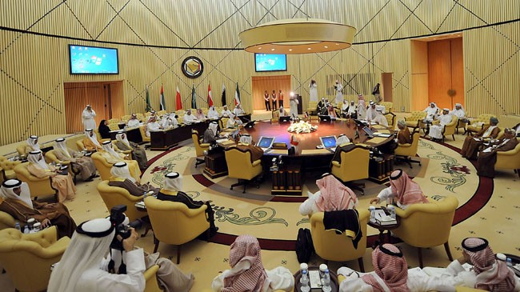
That the Arab image of the Middle East and the Persian Gulf region will definitely undergo change – what kind of change remains to be seen – in the aftermath of a nuclear deal with world powers has turned into a paramount, worrisome question which weighs heavily on the minds of the Arab countries.

In an interview with Bret Baier of Fox News, UAE Foreign Minister Shaikh Abdullah bin Zayed Al Nahyan on Sunday said, “We wake up on Tuesday morning and everyone, and I mean most of us, will ask the question, ‘what is Iran going to get out of it, not on the nuclear front but on the regional front?’”

Saudi Foreign Minister Saud al-Faisal has also made similar remarks of late, saying that the matter concerning Iran does not only concern America, rather it is more of a regional question which concerns Iran’s neighbors, and Washington should not bow to a deal that disregards Arab concerns.

Such stance might not reflect the viewpoint shared by all Arab regional nations, particularly the Arab states on the southern edge of the Persian Gulf. However, undoubtedly, it reveals the attitude of the most important of these countries, especially members of the Persian Gulf Cooperation Council.

[…]

Whether true or false, US allies in the region are under the impression that any agreement over quality, and not even quantity, between Iran and Washington either on a small or large scale will by itself deal a blow to their regional edge, especially in terms of their ties with America. Whether it’s true or not does not make much difference. They have their own interpretation of the developments and do not mull over whether such interpretations are true or not.

[…]

A Persian Gulf Arab diplomat living in Beirut whose government has very close and friendly relations with Tehran has stressed, “[…] We have told our fellow brothers in Riyadh and Sharjah that perhaps what is going on is not to our liking, but what could we possibly do? Are we going to bring about insecurity to the region simply because America has decided to shift only its policies, and not necessarily its strategy, toward Iran and the region? Such moves will bring forward our concerns faster than we expect and prompt America to change its strategy.”

[…]

November 24, regardless of the outcome of nuclear talks and their continuation in the future which is now definite [the talks have been extended for another 7 months], could be of great significance as far as Iran’s regional relations in the future are concerned.

[…]

As Emil Khoury, a political analyst of Beirut’s influential An-Nahar [an Arabic-language daily], pointed out, Iranian officials will deal with their neighbors from a more powerful position.