Friday, January 2, 2026
Home Blog Page 4947

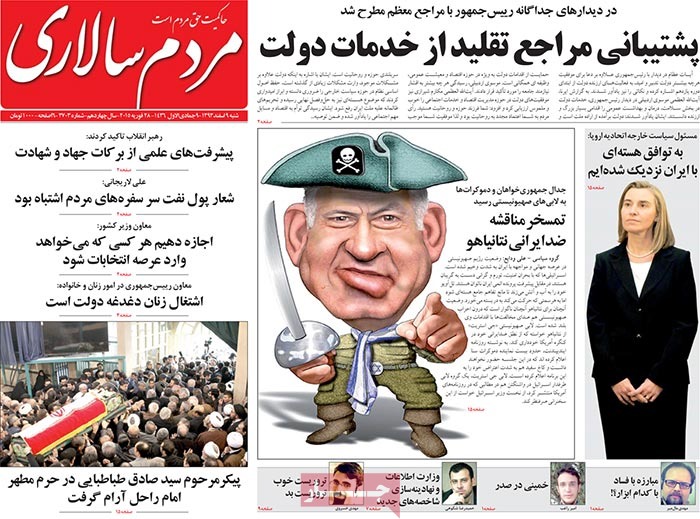
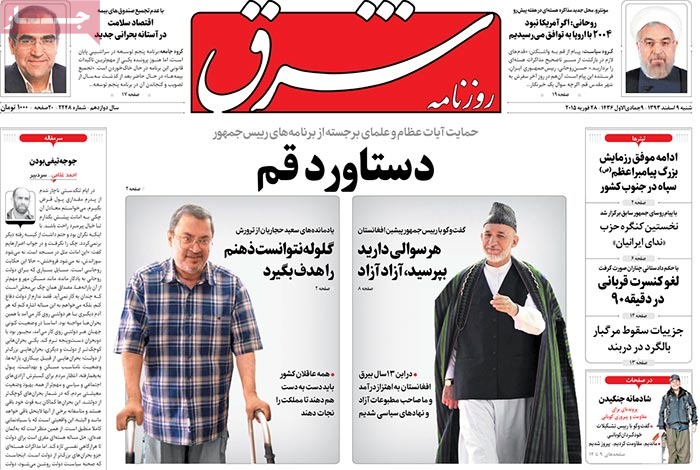
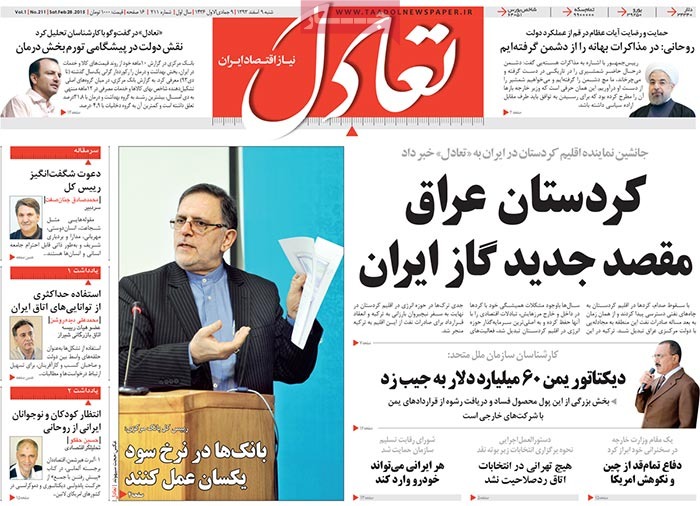
A look at Iranian newspaper front pages on Feb. 14

Iranian Newspapers Headlines

Air pollution in the southwest and government efforts to settle the problem dominated the front pages of Iranian newspapers on Saturday. At attack on a Shiite mosque in Pakistan along with the silence of some Western media outlets over the killings of three Muslims in Chapel Hill, North Carolina also appeared on the covers of dailies.


Abrar-e Eghtesadi: Iran opens talks with three world electricity giants.

Abrar-e Eghtesadi: European and US firms are forming coalitions to find their way back onto the Iranian market.


Abrare eghtesadi newspaper 2 - 14 - 2015


Aftab-e Yazd: Two senior government officials are to visit Iraq to follow up on efforts to tackle the problem of particulates.

The visits are part of broader efforts by the Rouhani administration to settle the air-related problems of Ahvaz, the provincial capital of Khuzestan. A dust storm in the city of late has reduced the quality of air there.

Aftab-e Yazd: Iran offers discount to secure new oil markets.


Aftabe yazd newspaper 2 - 14 - 2015


Asr-e Iranian: Western media have kept silent on the murder of three Muslims in the US.


Asre iranian newspaper 2 - 14 - 2015


Asr-e Rasaneh: The preferential trade deal between Iran and Turkey might be reviewed.

Asr-e Rasaneh: Car sales in Iran have registered a 32 percent hike.

Asr-e Rasaneh: Fourteen local consortiums stand ready to invest in a gas pipeline project to export natural gas to Iraq.


Asre resaneh newspaper 2 - 14 - 2015


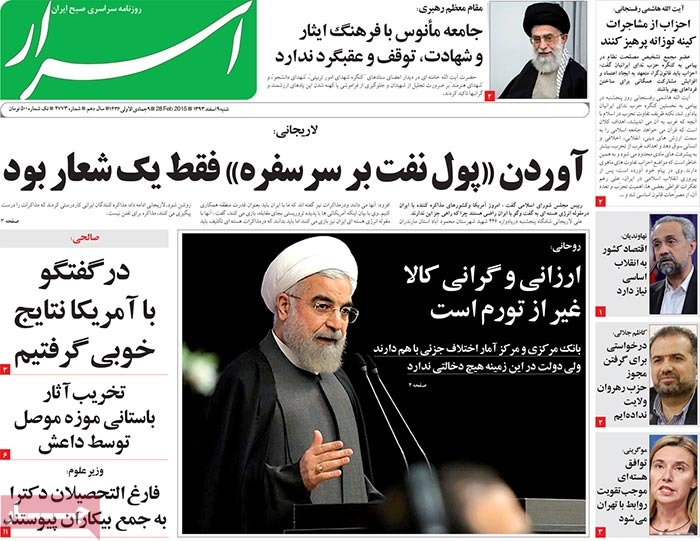
Asrar: “Faultfinding with the nuclear negotiating team is not logical,” said vice-president for parliamentary affairs.

Asrar: The European Union has imposed new sanctions on the National Iranian Tanker Company.


Asrar newspaper 2 - 14 - 2015


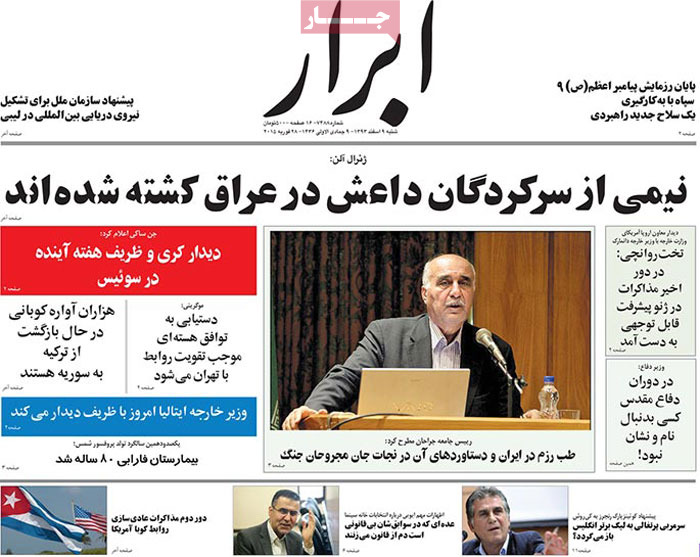
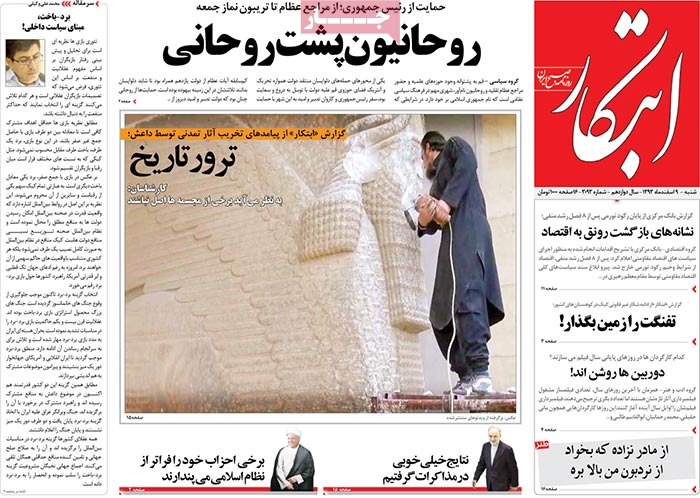
Ebtekar: “The Expediency Council is determined to supervise the workings of all three branches,” said the secretary of the council.

Ebtekar: Opponents of a nuclear deal are tight-lipped.

Following the recent comments of the Supreme Leader in which he supported a nuclear deal, the so-called Worriers [supporters of former President Mahmoud Ahmadinejad who are bitterly opposed to President Rouhani] are conspicuously absent in the media.


Ebtekar newspaper 2 - 14 - 2015


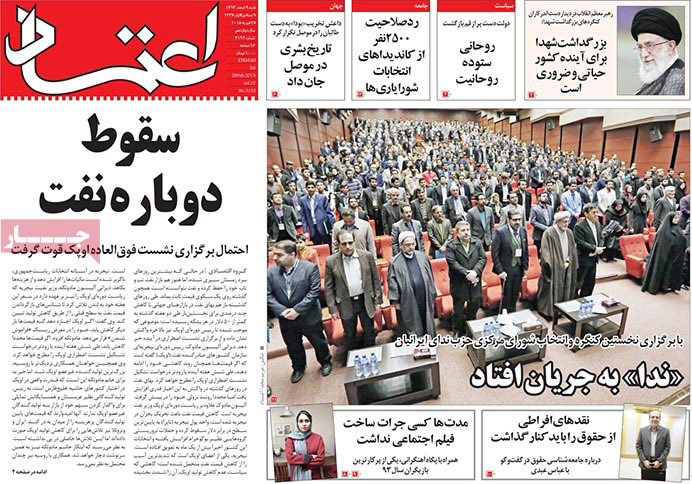
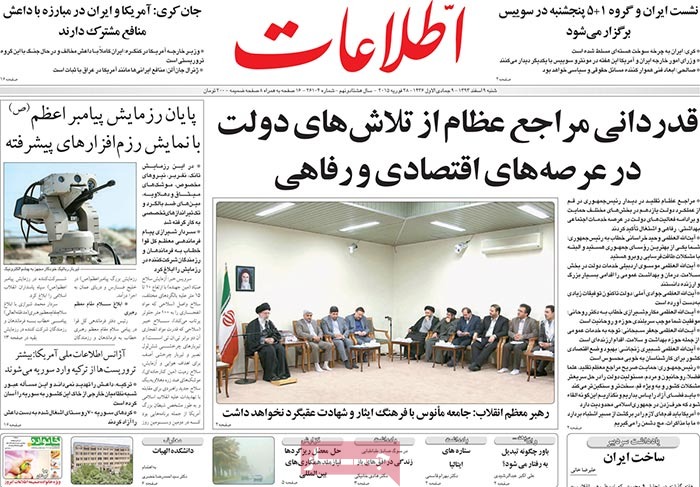
Ettela’at: Don’t shed the blood of innocent Muslims and non-Muslims.

In a message to the Iraqi army and popular forces fighting IS terrorists, Grand Ayatollah Sistani said those who specifically target non-Muslims are traitors.

Ettela’at: Iraq’s Patriotic Union of Kurdistan has sent a letter of appreciation to the Supreme Leader.

In the letter, the deputy secretary general of the union has said Iraqi Kurds owe a debt of gratitude to the Iranians.


Ettelaat newspaper 2 - 14 - 2015


Hamshahri: The West has once again resorted to sanctions.

Iranian students in Massachusetts were subjected to scientific sanctions, as the European Union placed the National Iranian Tanker Company on its sanctions list.


Hamshahri newspaper 2 - 14 - 2015


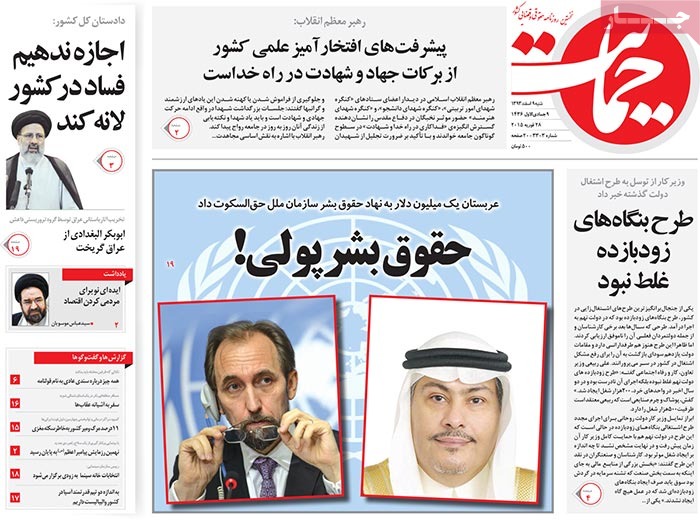
Hemayat: “A two-phase deal is a Western ploy to push excessive demands,” said the deputy judiciary chief.


Hemayat newspaper 2 - 14 - 2015


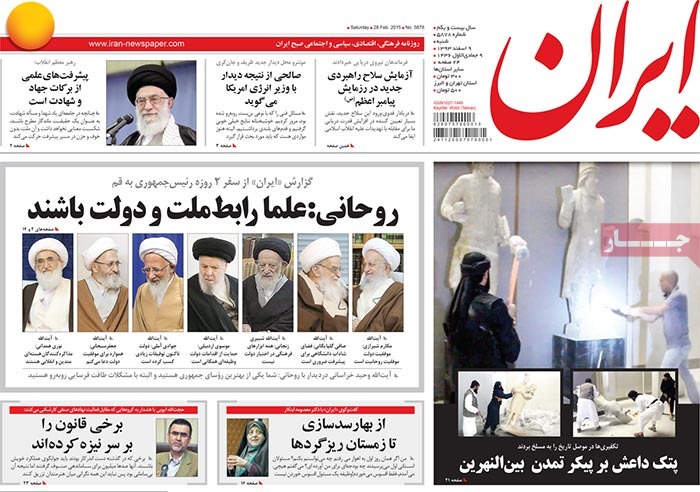
Iran: “The legitimate rights of non-Muslim tourists should be respected,” said the first vice-president.


Iran newspaper 2 - 14 - 2015


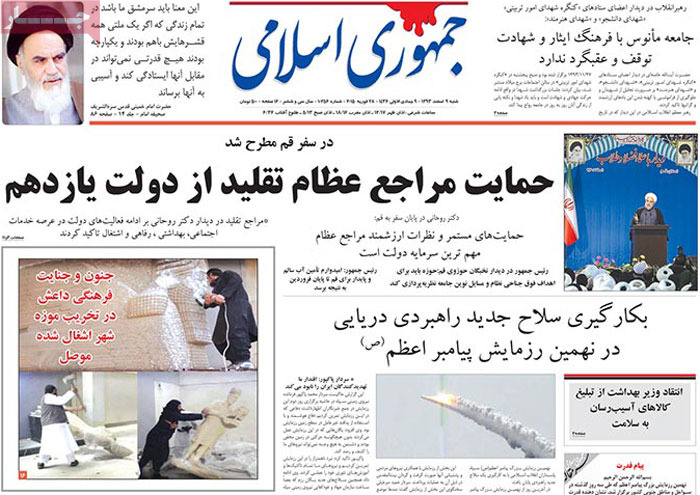
Jomhouri Islami: An attack on a Shiite mosque in Peshawar has left scores of worshippers dead or injured.

Jomhouri Islami: “There are no hurdles in the way of implementing the sentence of the former VP,” said the justice minister.


Jomhorie eslami newspaper 2 - 14 - 2015


Kaenat: The Iranian vice-president has met with Pope Francis.

Kaenat: Renowned director Majid Majidi has been named administrator of National Cinema School.


Kaaenat newspaper 2 - 14 - 2015


Khorasan: “By seeking a two-phase deal, the US seeks a repeat of the Oslo Accords,” said an advisor to the Supreme Leader.


Khorasan newspaper 2 - 14 - 2015


Sayeh: “The previous problems between parliament and government have been settled,” said the vice-president for parliamentary affairs.


Sayeh newspaper 2 - 14 - 2015


Shahrvand: Transfer of some $2.3 billion in oil money to four foreign countries

Fifteen months after the arrest of Babak Zanjani [who stands accused of massive corruption] his case has gotten more complicated with revelations that he has transferred oil money to foreign countries.

Shahrvand: The names of 7-15 million Iranians appear in no databanks.

This complicates efforts to eliminate high-income individuals from the list of people eligible for cash subsidies.


Shahrvand newspaper 2 - 14 - 2015


When the going gets soft, people go shopping

Nowrooz-Bazar

The New Year is approaching in Iran, and the annual yearend bonuses of white- and blue-collar workers are only days or weeks away. This has caused a lot of commotion in the capital where people are on the move to get prepared for the turn of the year.

On February 7, Mehr News Agency filed a report on market conditions and shopping destinations in the run-up to the New Year, saying that the shopping boom time is indicative that Iran is climbing out of recession. The following is a free translation of the report:


People are making planning to compile their shopping list and shopping malls are teeming with frenzied shoppers these days.

Some prefer early shopping to avoid the last-minute hustle and bustle of trade centers as well as the problems associated with late shopping.

Storekeepers hold winter sales or offer cut-rate items not to keep much inventory. They say their items suit every pocket, but people’s take is somewhat different. Sellers are happy that people have lost an appetite for foreign products thanks to the quality items Iranian producers have put on the market.

Those with limited budgets go after off-season shopping. Some buyers say they’ve seen no rise in prices over the past two months thanks to stable foreign exchange rates, although they admit that the prices of clothing have doubled in twelve months.

People’s rush to the market in the final days of the year and booming business are proof that Iran’s economy is climbing out of recession.

14 consortia ready to finance Iran-Iraq gas pipeline: Official

Iran-Gas-Iraq

A top Iranian energy official says a total of 14 domestic consortia have voiced readiness to finance the construction of a pipeline that will transport natural gas from Iran to its western neighbor, Iraq.

The groups of companies have already received the necessary documents related to investment in the project, and should offer their qualifications by the set deadline, Hamid Reza Araghi, an Iranian deputy oil minister and managing director of the National Iranian Gas Company (NIGC), said on Friday.

He added that the company qualifications will be later reviewed by NIGC, and companies capable of financing up to USD 1.5 billion will be declared eligible.

Araghi further noted that a total of USD 500 million is needed in order to start the project, adding that any interested party holding such a capital will be able to initiate the work and fulfill their obligations within the next two years.

The Iranian energy official pointed out that the investment will be gradually recouped once Iran starts pumping natural gas to Iraq, and upgrades the delivery.

Based on agreements signed between Tehran and Baghdad, seven million cubic meters (mcm) per day of Iran’s natural gas will be delivered to Iraq in the first phase, but the pipeline will finally carry 25 mcm of gas per day to Iraq.

According to NIGC managing director, the infrastructure needed for pumping Iran’s natural gas to Iraq will be ready by late April.

The 270-kilometer pipeline stretches from the village of Charmaleh, located in Iran’s western province of Kermanshah, into the town of Naft Shahr on the border with Iraq.

The pipeline, which is estimated to earn Iran $3.7 billion a year in revenues, will be fed by the massive offshore South Pars gas field in southern Iran.

The South Pars gas field is located in the Persian Gulf on the common border between Iran and Qatar. The field is estimated to contain about 14 trillion cubic meters of gas and 18 billion barrels of condensate.

A well that is doing well in attracting tourists (Photos)

Varzaneh

A 60-year-old man in Varzaneh, east of Isfahan – known for its traditional architecture and indigenous traditions – has renovated an ox-well complex (‘Gav Chah’ in Farsi), turning it into a tourist attraction.

The complex which features a well, an ox, some rope, a pulley and a bucket pumps water to nearby farmland, without producing air pollution.

Esfahanshargh.ir has filed a report on what Haj-Ibrahim has done to irrigate agricultural land which has also been a pull for tourists. What appears below is a brief translation of the report followed by a collection of photos of the process:

Haj-Ibrahim, who has restored an ox-well complex, says, “We can irrigate some 3,000 square meters of land twice a day through this traditional method which does not need electricity.”

An ox moves on a corridor with a slight slope, called Gav Chah, to take the water-filled bucket from the well. What is astonishing is that Haj-Ibrahim’s ox works only when his owner sings a song.

After restoration, the complex has managed – in a short period of time – to attract visitors who come to the historic city to see the place and its traditional irrigation method firsthand.

The urban structure in Varzaneh conforms to the Iranian architecture and people living there are known for their adherence to local traditions.


A new type of embryonic stem cells has been discovered in Iran

stem cells

On February 10, the Iranian Students News Agency (ISNA) quoted Head of Yazd Reproductive Sciences Institute Abbas Aflatoonian as saying, “Scientists at R&D of the Stem Cell Biology Department have discovered a new type of embryonic stem cells.” What comes next is the translation of what else the researcher said:

Two types of stem cells we chose to call Yazd 1 and Yazd 2 were already discovered a while ago, Aflatoonian said, adding “Embryonic stem cells are derived from a human fetus during blastocyst. These cells have the ability to turn into other cell types, that’s why they are called pluripotent stem cells; they are of tremendous importance because of their potency.”

He expressed hope that the recently discovered stem cells, Yazd1, Yazd 2, Yazd 3, will set the stage for fundamental studies in different fields such as cell therapy, pharmacology, toxicology, developmental biology and tissue engineering.

With the endeavors of some experts at Shahid Sadoughi University of Medical Sciences and following the launch of a research project aimed at studying the success of In Vitro Fertilization (IVF) in infertile couples, Yazd Reproductive Sciences Institute was established in October 1988.

The center was initially designed to develop the technology needed to address infertility in the country, help develop this science in the province and the country, and treat infertile couples who had to travel to Europe to get medical treatment. At present, some 9,000 couples refer to the center on the yearly basis to have their infertility problem solved.

Among the therapeutic achievements of the center are first Iranian IVF baby in 1990, first Iranian Intrauterine Insemination (IUI) baby using Electroejaculation in 1992, first Iranian baby using egg donation in 1994,first Iranian Intra-Cytoplasmic Sperm Injection (ICSI) baby in 1995, first Iranian baby using Percutaneous Epididymal Sperm Aspiration (PESA) and microinjection in 1996, first Iranian baby using Testicular Sperm Extraction (TESE) and microinjection in 1997, first Iranian baby using  Assisted Zona Hatching (AZH) in 1997, first Iranian baby using frozen embryo in 1997, first Iranian baby using Testicular Round Spermatid and microinjection in 1998 and first Iranian baby using In Vitro Maturation (IVM).

Pope: Free speech no excuse for insulting religions

Shahindokht Mollaverdi-Pope

Pope Francis has lashed out at those in the Western societies who keep justifying their insults against religions by resorting to notions such as freedom of expression.

In a Thursday meeting with Iran’s Vice President for Women and Family Affairs Shahindokht Molaverdi at the Vatican, the Pope stressed that freedom of expression does not mean insulting religions and religious sanctities.

The spiritual leader of the world’s Catholics has repeatedly expressed discontent with the growing trend of religious desecration in the West, which gained a new momentum in the wake of deadly terrorist attacks in France in early January.

On January 7, the office of French weekly magazine Charlie Hebdo came under assault by two gunmen. Some 12 people were killed in the incident, which was claimed by the al-Qaeda branch in Yemen.

A few days later, Charlie Hebdo published a blasphemous cartoon insulting Islam’s most revered figure Prophet Muhammad (PBUH).

Senior Muslim figures worldwide denounced both the terror assault against Charlie Hebdo and the magazine’s sacrilegious cartoon.

The Pope also condemned the publication of the image, saying, “You cannot provoke. You cannot insult the faith of others. You cannot make fun of the faith of others.”


Iran’s resolve in nuclear talks

The Pope also voiced support for Iran’s ongoing efforts to secure a comprehensive agreement with P5+1 over its nuclear program, saying he stands by the Iranian nation and government.

In January, the Pope expressed hope that an agreement could be reached soon between Iran and the six powers – Russia, China, France, Britain, the US and Germany.

Last December, Iran’s President Hassan Rouhani sent a message to the Pope and congratulated him on the anniversary of the birth of Jesus Christ, asking him for more sympathy and cooperation in establishing peace and security across the world.

We are neither proud nor complacent; we seek to compensate backwardness

Sorena Sattari
Sorena Sattari

Vice-President for Science and Technology and the President of the National Elites Foundation, Dr. Sorena Sattari, says that the public, scientists and the government have reached a consensus that they need to bring modern sciences out of books and use them to secure sustainable knowledge-based development.

On February 4, the website of the Iranian Science and Technology Department, an affiliate of the Presidential Office (isti.ir) released an opinion piece by Sattari on the state of Iran’s scientific progress. The following is the translation of the piece:

It is common knowledge these days that Iran has made remarkable achievements in science and technology in recent years. Enemies and friends, alike, admit that Iran’s scientific progress in different areas, especially in nanotechnology, is comparable with what it has achieved in nuclear technology. They describe it as a sign that a nation’s willpower is producing results.

The country has moved forward and achieved big gains in nuclear energy, nanotechnology, biotechnology and aerospace and this is because the public, scientists and the government have agreed that they should put in time and energy to bring these sciences out of books and use them to secure sustainable knowledge-based development for the country.

Today modern technologies have turned into a public discourse in Iran. This indicates that a consensus has been developed among the public, scientists and the government. Human experience shows that reaching a consensus is key to securing sustainable development in a country or to bringing the sales of raw materials to an end.

Constant support by the Supreme Leader for the country’s scientific development along with the contribution of government officials is indicative of the steely resolve of the Islamic Republic of Iran to make advancement on scientific and technological fronts.

The Leader expressed satisfaction with what has been done in the country in his inspection tour of a recent exhibition displaying Iran’s latest nanotechnology achievements, underlining three points: stability in management; accurate planning; and culture-building and dialogue creation.

The country can pull off success in political, economic and social areas like what it has gained in modern sciences and technologies such as nanotechnology, nuclear technology, biotechnology and aerospace. Iran can successfully ride out crises and challenges if these three factors come into play.

When there is consensus between society and the establishment, we can powerfully and successfully solve our issues with the world. Such a consensus can help us overcome various economic, political, social and environmental challenges.

The global economy has undergone fundamental changes thanks to new developments in oil markets, something which has affected oil-rich countries, including Iran. The Leader and the elite had already warned of this, saying a knowledge-based economy should be created as a sustainable replacement for oil.

What has unfolded recently can, at best, raise the alarm in the fabric of society and set the stage for creating a dialogue which seems likely to replace the previous interchange.

Today people are more receptive to talks on a knowledge-based economy than before. Besides senior government officials, the general public too eagerly pays attention to such a topic, and this can cement the overwhelming consensus between people and the government on boosting the knowledge-based economy.

The critical environmental challenges Iran is facing are the broad topic in society, not simply in scientific circles. We cannot tackle challenges such as air pollution or climate change unless they are treated as a national question and we mobilize all we have to that end.

What Iran has achieved in science, nanotechnology, nuclear technology and aerospace is a source of pride, but that is not enough. As the Supreme Leader said in his visit to the nano expo we should not be proud of and complacent with the status quo and the country’s headway; we should help Iran continue its fast march toward scientific gains.

“Although the talent of the Iranian youth and the pace of Iran’s scientific march are much higher than the world’s average – Iran ranks seventh in the world in terms of nanotechnology, for instance – we need to increase the speed of Iran’s scientific growth [to make up] for the country’s scientific backwardness over the course of history,” the Leader said.

Today’s achievements should be a model and motivation for our scientific activities in the future. We have to successfully rise to the occasion and overcome the challenges we face in different areas. Our experience has shown that our consensus on opening new doors is a guarantee for our success in the future.

Sorena Sattari is a scientist and inventor. He has a Ph.D. in Mechanical Engineering from Sharif University of Technology.

Quds Force Commander: ISIL nearing demise

General Ghasem Soleimani

Islamic Revolution Guards Corps (IRGC) Quds Force Commander Major General Ghasem Soleimani underlined that terrorist groups in the region, especially ISIL, are experiencing the last days of their lives.

“Given the heavy failures that ISIL and other terrorist groups in Iraq and Syria have sustained, we are sure that these groups are nearing the end of their life,” Soleimani said, addressing a ceremony on the occasion of the 36th anniversary of the victory of the Islamic Revolution in the southern province of Kerman on Wednesday.

He said that persuading and organizing the Takfiri groups to impair the face of Islam and create sedition and civil war among Muslims is the last weapon used by the arrogant powers.

In relevant remarks in October, General Soleimani underlined that the US moves in the region and the terrorist attacks by the ISIL would end in failure.

“I believe that both the US moves and the terrorist acts of the ISIL are doomed to failure because they are not in quest of truth,” General Soleimani told reporters in Tehran.

“Their solution will not lead to victory; we have all witnessed in Syria that the measures they adopted did not produce any fruit (for them),” he added.

General Soleimani underlined that the victories gained by Islam and the Islamic Republic of Iran had all been the result of their real quest of truth.

[…]

Over the last few years, Gen Soleimani’s role in Iran’s foreign affairs has become more public. These days he is the proud face of Iran, the go-to man when a crisis happens.

Iran has been providing advice and counseling to Syria and Iraq to help them in the war on terrorism.

A look at Iranian newspaper front pages on Feb. 12

Iranian Newspapers Headlines

Almost all Iranian dailies splashed on their front pages images of huge rallies across the nation to mark the victory of the Islamic Revolution 36 years ago.

Reformist newspapers called the rallies a declaration of public support for nuclear talks, but principlist dailies said the Iranians said no to the West. “The nation’s nuclear support”, “Iranians created yet another epic; more revolutionary than before”, “The nation’s fist on the table”, and “The peak of zeal and unity”, were some of the front page headlines on Thursday. Comments by President Rouhani at one such rally in Tehran drew a lot of front-page attention too.


Afarinesh: “We’d leave the negotiating table if the West made illegitimate demands,” said Ayatollah Akbar Hashemi Rafsanjani.

Afarinesh: “None of the establishment’s officials are opposed to a nuclear deal,” said Parliament Speaker Ali Larijani.


Afarinesh Newspapers-02-10-2015


Aftab-e Yazd: Crazy Face by Abolhassan Davoodi was named the best movie at Fajr International Film Festival.

Aftab-e Yazd: “No treason is worse than treason committed behind the scenes,” President Rouhani said.

The president made the comment at a huge rally in Tehran to mark the anniversary of the Islamic Revolution 36 years ago. A statement issued at the end of the rally supported nuclear talks between Iranian officials and P5+1.


Aftabe Yazd Newspapers-02-10-2015


Arman-e Emrooz: We don’t know what happened to petrodollars for five years.

The comment by First Vice-President Eshagh Jahangiri takes aim at the previous administration for its lack of accountability. “Oil sales brought in $118 billion in the 12 months to March 21, 2012 alone.”

Arman-e Emrooz: A deadly disease in chicken farms has sent prices soaring.

So far some 200,000 chickens have died of the disease.


Armane Emrooz Newspapers-02-10-2015


Etemad: “At the talks we have defended Iran’s independence,” said President Rouhani.

The comment came during the president’s speech at a rally in Tehran to mark the anniversary of the Revolution. “In the absence of freedom, Republicanism would be meaningless,” the president also said.


Ettemad Newspapers-02-10-2015


Ettela’at: The Supreme Leader has pardoned or commuted the sentences of some prisoners.

More than 1,000 inmates benefit from the decision made to mark the victory of the revolution.

Ettela’at: A special headquarters has been set up to deal with air pollution in Khuzestan province.


Ettelaat Newspapers-02-10-2015


Hamshahri: Iran and Iraq cooperate to counter the oil plot.


Hamshahri Newspapers-02-10-2015


Hemayat: “No power can defeat the Iranian nation,” said the Judiciary chief during a revolutionary rally in Tehran.

Hemayat: “Assertions that sanctions brought Iran to the negotiating table are untruthful,” said President Rouhani.


Hemayat Newspapers-02-10-2015


Iran: “We seek a deal that would guarantee Iranian interests,” said President Rouhani.


Iran Newspapers-02-10-2015


Javan: “With 50,000 volunteers, we’re ready to settle the problem of particulates,” said Basij Force Commander Brig. Gen. Mohammad Reza Naghdi.


Javan Newspapers-02-10-2015


Jomhouri Islami: Construction of a second [nuclear] power plant in Bushehr gets underway next fall.


Jomhouri Eslami Newspapers-02-10-2015


Kayhan: “Local production of vaccines will meet all domestic needs,” said the health minister.


Kayhan Newspapers-02-10-2015


Khorasan: The Supreme Leader has ordered officials to deal with air pollution in Khuzestan Province.

Khorasan: “IS is nearing the end of the line,” said Major Gen. Ghasem Soleimani, the commander of the Quds Force.

Khorasan: “Those who caused insecurity in Sistan and Baluchestan for eight years have been arrested,” said the governor general.


Khorasan Newspapers-02-10-2015


Shahrvand: “The Zionists are the only ones opposed to nuclear talks,” said the president.

Shahrvand: Those who develop breathing problems in Ahvaz [because of air pollution] are treated free of charge.


Shahrvand Newspapers-02-10-2015


UN says it’s ready to set up environmental database in Iran

UN-Environment

A workshop for the State of Environment (SOE) was held in Tehran with Mahnaz Mazaheri-Assadi, a vice-president of the Environmental Protection Organization for education and research affairs, Jacqueline McGlade, the director of the United Nations Environment Programme’s (UNEP) Division of Early Warning and Assessment, and a host of environment experts in attendance to review how Iran’s environment has changed over the last ten years.

The following is a partial translation of a report filed by doe.ir on February 8 on what was said in the workshop:

The Iranian official told the session that the Statistical Center of Iran has released – for the first time – several environmental parameters and that 700 terms which have been defined by the Statistics and Information Technology Office will be finalized soon.

She further said the Department of Environment has set up an environment databank center, stressing that the database should be shored up.

She said SOE reporting can be used in making the country’s macro policies on management of environmental resources, adding it can be also of use in moving toward a green economy.

For her part, McGlade said countries should submit their SOE at an Asia-Pacific Ministerial Conference on Environment and Development which is expected to be held soon.

Mohammad Zokaee, a faculty member at Shahid Beheshti University and the manager of SOE project, said the first such report came out in 2004 and the second one a year later. He said the third report covers the 2004-2013 period.

He further said that the report should be released regularly so that the country can monitor the improvement or deterioration of water, soil, biodiversity and human habitats.