Thursday, December 25, 2025
Home Blog Page 4944

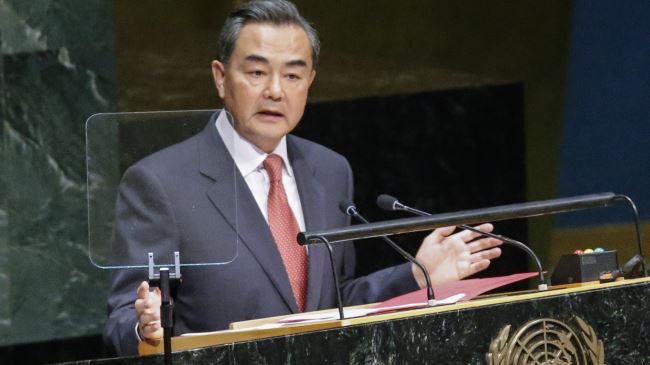
Talks on Iran N-issue at crucial stage: China FM

Wang-Yi

In his address to the 69th session of the United Nations General Assembly in New York, the top Chinese diplomat said any final deal aimed at ending the longstanding dispute over Iran’s civilian nuclear work should be “comprehensive,” “fair” and “balanced.”

Wang also called on all parties involved in the nuclear talks to show sincerity and make all efforts to iron out their differences and reach an “early” and “win-win” agreement.

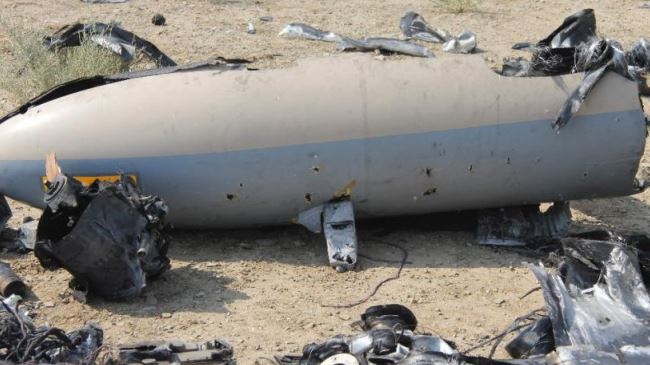
Downed Hermes drone sent no data outside Iran: IRGC cmdr.

Israeli drone
Israeli drone

On Monday, Commander of the Aerospace Division of the Islamic Revolution Guards Corps (IRGC) Brigadier General Amirali Hajizadeh said the spy drone had been designed to store data on its system, not to send information online; therefore, it was unable to transmit any data.

Last month, the IRGC forces managed to intercept and shoot down an Israeli unmanned aerial vehicle (UAV) which was heading to the Natanz nuclear facility in the central Iranian province of Isfahan.

Referring to the domestically produced version of a sophisticated US drone captured by Iran in 2011, the top general announced that the “final version” of the RQ-170 drone will be put into operation by the end of the current Iranian calendar year (started March 21, 2014).

On December 4, 2011, the Iranian military’s electronic warfare unit announced that it had successfully downed the American RQ-170 reconnaissance and spy drone in the eastern part of Iran with minimal damage.

In May, the IRGC unveiled a domestically developed version of the sophisticated US drone it captured back in 2011. The US RQ-170 Sentinel was reverse-engineered by IRGC experts in about two years.

The drone was one of America’s most advanced spy aircraft and its loss was considered a major embarrassment for Washington.

Iran is set for economic leap

Morteza Nahavandian
Morteza Nahavandian

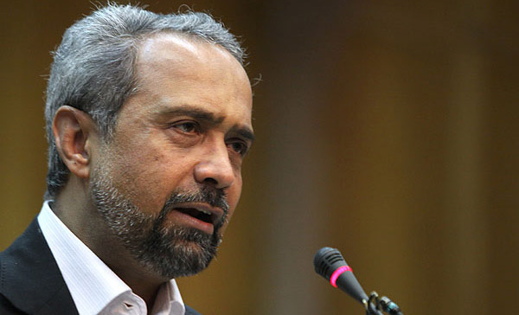
“Iran’s economy is getting itself prepared for a giant leap and Iranian expatriate students and elite should play a prominent role on this front,” President Rouhani’s Chief of Staff and head of the Presidential Office Mohammad Nahavandian said at a meeting with Iranian expatriate university professors and students in America.

“Bringing about stability and peace coupled with support for production is among serious policies of the government in the field of economy. This government is profoundly opposed to consumption-oriented economy,” he added.

Recalling the readiness of corporations from different countries to make it to Iran’s market and the promising reports released by international institutions about Iran’s economy, he underlined the opportunity to bolster the economy and develop the country.

“The government of Prudence and Hope is doggedly determined to clear all the hurdles and wants all scholars to enter the scene,” he concluded.

Iran foils BBC operation to steal Iranian documents

BBC-Logo-Media
BBC-Logo-Media

Iran’s Intelligence Ministry says it has thwarted attempts by the British Broadcasting Corporation (BBC) to steal Iran’s cultural, historical and art documents.

In line with efforts to make up for its failures, the Western media network has used its agents inside the country to pilfer historical documents from the country’s official archives, the ministry said on Sunday.

It added that the move, which was against media regulations and international law, has been monitored and nipped in the bud as a result of appropriate measures taken by the Iranian intelligence forces.

The ministry also noted that further information on the operation will be made public later.

Aviation official blames excessive load for Iran-140 crash

Iran-140 air plane
Iran-140 air plane

A senior Iranian aviation official said excessive load and a malfunctioning of the propeller caused the crash of Iran-140 (Antonov-140) passenger plane in Tehran in early August, while the head of Iran’s Civilian Aviation Organization blamed an engine failure for the accident.

On August 10, an Iranian airliner crashed in the vicinity of Tehran’s International Mehrabad Airport just outside the capital, leaving at least 39 dead.

“The plane should be loaded with standard load at the time of take-off and this weight should be reduced as the temperature goes up while investigations show that the plane was carrying an excessive load of cargo before taking off,” Head of Antonov-140 Crash Investigation Committee Mohammad Shahbazi told reporters on Sunday.

He reiterated that several other parameters such as technical faults and high temperature caused the plane to crash, and said, “The starboard engine of the plane which caused the crash has been taken to the laboratory (for further examination) and its parts have also been dismantled in front of the experts of the manufacturing company (Antonov).”

Shahbazi said that the airport’s altitude and high temperature also influenced the plane to crash.

Earlier today, Head of the Civil Aviation Organization of Iran Alireza Jahangirian announced that the data and information retrieved from the black-boxes of the Iran-140 revealed that the malfunctioning of the plane’s starboard engine has caused the incident.

“The initial information indicated that the pilot tried to keep the plane straight, but the aircraft fell down from a 45-meter height after he failed,” Jahangirian told reporters.

He noted that right after the plane crash a committee was set up to investigate the crash and 11 sub-committee groups also began probing the accident.

“Investigations by the committee show that the pilot tried hard to increase the altitude of the plane in order to prevent the crash, but the low speed and also because the plane was not in a straight position caused the plane to crash.

Earlier this month, Jahangirian said that the members of the committee had studied the results of eyewitness accounts and the (navigation) systems review of the Iran-140 plane and they had also studied the data of the FDR and CVR devices.

He noted that Iranian and foreign experts have obtained all the vital information of the Iranian passenger plane intact despite the heavy damage the plane sustained and the black box in the crash.

Yet, Jahangirian did not mention the details of the findings by the investigation committee then.

Jahangirian, who is also a deputy roads minister, said the parts and equipment of the plane were due to be sent to laboratories in Iran and abroad to go under metal fatigue and molecular tests.

He said the committee would have another session to study the findings and reports of other sub-committee groups as well.

The Iran-140 Sepahan Airliner had just taken off from Mehrabad Airport when it crashed on the outskirts of the capital at 09:20 (0450 GMT) on August 10.

The passenger plane, carrying 48 passengers and crew members, was bound for Tabas in Eastern Iran when it crashed in Azadi township just 5km to the West of Tehran.

Eye witness accounts said the pilot lost control at the end of the runway and crashed the plane into the ground although he managed to take off and fly for seconds.

Three of the victims died on the way to the hospital aboard a rescue helicopter. Nine of the passengers survived the incident, but were badly wounded.

Managing-Director of Iran’s Airport Company Mohammad Ilkhani said the plane was carrying 40 passengers and 8 crew (including the pilot, co-pilot, two flight technicians, two hostesses, and two flight security guards). Ilkhani confirmed that the pilot was about to take off at the end of the runway when he lost his starboard engine and crashed the plane a few seconds after take-off.

Ilkhani later informed FNA that the pilot had informed the control tower of an engine malfunction as he was taking off, but communication had been lost as the plane crashed.

The plane didn’t crash in residential areas of Azadi township instead it hit an open area in a military zone belonging to the Iranian Defense Industries 6km (4 miles) to the East of the airport and close to Tehran’s Azadi Sports Complex.

The fuselage had smashed into pieces during the incident with the tail landing into a street and the cockpit and front seats smashing into the concrete wall of a glass manufacturing factory.

Deputy Roads Minister Ahmad Majidi later said the Aviation Organization of Iran had sent a team to the crash scene immediately to study the possible cause of the incident, adding that the team found the black box.

On August 10, Iranian President Hassan Rouhani ordered the grounding of all Iran-140 passenger planes until a comprehensive investigation was carried out into the deadly crash.

On August 11, Iran banned all its Antonov-140 (which is known under the trademark Iran-140 as it is assembled in Iran) passenger planes from flying.

“President Hassan Rouhani has ordered a halt of Iran-140 flights until further notice,” Jahangirian said then.

Iranian Minister of Roads and Urban Development Abbas Ahmad Akhoundi was then tasked by the president to carry out a thorough investigation into the causes of the incident.

President Rouhani also ordered Health Minister Hassan Qazizadeh Hashemi to take all the necessary measures to provide the best medical care for those injured in the tragic accident.

US admits impossibility of anti-ISIL fight without Iran: Rafsanjani

Hashemi-Rafsanjani
Hashemi-Rafsanjani

Chairman of Iran’s Expediency Council says the United States has admitted that the fight against the ISIL terrorist group will fail without Iran’s help.
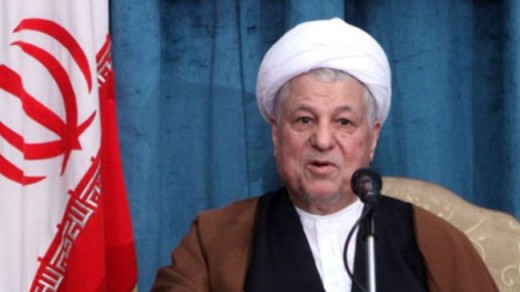
“The US acknowledges that if Iran does not help, this [US-led] coalition cannot eliminate ISIL,” Ayatollah Akbar Hashemi Rafsanjani said on Sunday.
Airstrikes cannot destroy a terrorist group as in recent days we have been witnessing the ISIL attack on the key Kurdish town of Kobani in Syria near the Turkish border, Rafsanjani added.
Referring to Iran’s role in easing recent tensions in Iraq, he also stressed that the Islamic Republic helped solve the problem of forming a new government in the Arab country.
Rafsanjani added that Iranians will be the key force on any battlefield against ISIL, adding, “I am not saying that we have deployed troops [in Iraq], but it was the consultations [offered] by Iran that liberated the Mosul Dam and the town of Amerli and the Americans know well that they could not do this job with aerial bombardment.”

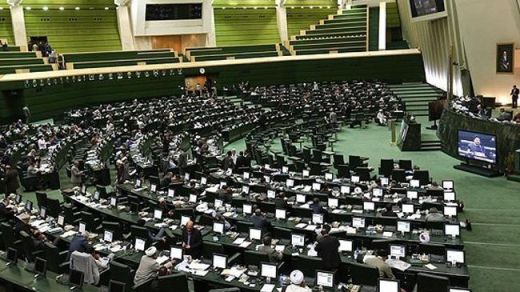
Iran MPs denounce UK Cameron’s allegations against Tehran

Iran-Majlis
Iran-Majlis

In his address to the UN General Assembly on Wednesday night, David Cameron claimed that “Iran’s support for terrorist organizations” needs to change.

“The absurd remarks by the British prime minister at the United Nations General Assembly showed that…Britain, which has been pursuing the will of the US and the Zionists for a long time, has not understood the reality of the Islamic Revolution,” a statement signed by 224 Iranian lawmakers read on Sunday.

The legislators denounced Cameron’s “vile, offensive and meddlesome” remarks and expressed confidence that the Iranian administration and nation would in unison continue the path of protecting the independence of Iran.

On September 25, Iran’s Foreign Ministry Spokeswoman Marzieh Afkham categorically rejected the British premier’s allegations and expressed regret that the UK government which has been supporting terrorist groups has passed an “inappropriate judgment” on Iran which has always been at the forefront of the campaign against the scourge of terrorism.

The Iranian lawmakers also hailed President Hassan Rouhani’s remarks at the UN General Assembly in support of the Iranian nation’s rights, particularly the country’s peaceful nuclear energy program.

“The president’s statements, which indicated the determination of the faithful and committed Iranian nation against the arrogant nature of hegemonic powers, conveyed this message that threats and sanctions have failed to affect…the resistance of this great nation,” the statement added.

Addressing the 69th annual session of the United Nations Assembly in New York on Thursday, President Rouhani said Iran’s nuclear case has no other solution but negotiation and “if there are parties that imagine other solutions to this issue,” they are greatly mistaken.

“Reaching a comprehensive nuclear deal with Iran is a historic opportunity for the West to prove that it is not against the progress and development of other [states],” said Rouhani, adding that a final agreement could convey a “message of peace” to the world.

US should come forward first for ties with Iran: Journalist

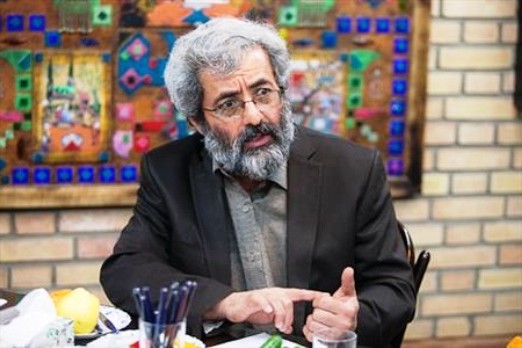
Abbas Salimi Namin
Abbas Salimi Namin

Arman-e Emrooz newspaper (in its 2,576th issue on September 24) ran an interview with Abbas Salimi Namin, [director of the Center for Contemporary History Studies, historian and a Principlist journalist] on Iran’s [direct] ties with the US, President Rouhani’s trip to New York and the conduct of hardliners. Here is the translation of the interview in its entirety:

Tehran-Washington ties are hot-button issues not only in Iran and the US, but also in other countries. How important would a likely resumption of ties be to the two nations and the international community?

What matters most for countries is to have interaction with other nations in order to pursue their stated objectives, but this does not mean they should close their eyes to realities on the ground and seek establishment of relations at any cost. As for ties with the United States, the Islamic Republic [of Iran] has always tried to see if such relations would be appropriate. That’s why the two nations still stay far from each other.

Well, the two nations have not had relations for years. Preparations should be in place if they possibly seek to hold ties. How do you view this?

If the status quo brings Iran to the conclusion that establishment of ties with the US does not harm its independence and dignity and that such relations come with some benefits, this would be seen as a politically correct decision.

Do such ties matter more for Tehran or Washington?

The Americans should come forward first because they are to blame for the bulk of problems between the two countries and the strained ties. They should show in practice that they have changed, something which seems highly unlikely [at the moment].

Ties between Iran and the US seem to have changed in one way or another.

The differences between the two nations are rooted in the historical animosity the US has borne against the Iranians. The fact that Washington has described the superiority of the Zionist regime as its top priority in the Middle East means it would not allow any other country to grow economically, politically and militarily and pursue its goals.

A question which arises here is: How can one accept that the US will seek to cooperate with Iran at a time when it intends to see all Islamic states in the region lag behind the Zionist regime? The Americans are struggling to strengthen the Zionists, whereas Zionism is the common enemy of all divine religions, Islam in particular. The terms for establishment of such ties have yet to change. Basically, we cannot wait for a change of heart in Washington in dealing with Iran.

They can begin to improve relations with Iran only when they drop their support for the Zionist regime. Of course there are some inside Iran who, intentionally or unintentionally, back the Americans, but it is not an orthodox move. They keep talking about establishment of ties or possible meetings between the two governments’ officials only to serve the US interests.

Are you saying ties with the US would bring no benefit for Iran?

Let me elaborate on the previous question a bit more. Why are some backing the Americans insistently trying to make the Iranian people believe the US has changed? If the Americans have changed, why don’t they admit the change themselves and only a group in Iran insists that they have?

They are saying that the atmosphere between the two nations has changed.

What kind of change? They hold up bilateral meetings between Iranian and US top diplomats, [President] Obama’s phone call with [President] Rouhani and the two sides’ more serious efforts toward arriving at a consensus in nuclear talks as the reason for what they claim.

To shed more light on the existing ballyhoo [on ties with the US] and prove that this America is the very America for which hostility toward Iran and its people is a top principle, the political system in Iran prepared for some meetings to practically test the Americans, trying to show that their words contradict their deeds. We can even say that they have openly and boldly said they take into account the interests of the Zionist regime. On what grounds do they say the Americans have changed for the better?

By better, they mean a relative improvement of atmosphere between the two countries.

It is not true at all. The atmosphere would get better when the Americans show more leniency toward the Iranian people. Following the talks, smiles, and so forth, the Iranian president himself said that the US insists on its enmity toward Iran. Despite the changes which are in place, they keep imposing sanctions on Iran, apply more pressure and try to aggravate the situation for Iran.

Some Principlists persistently want to see sanctions eased.

What matters is that something should be done in practice. One cannot only claim that the world has decided to recognize the rights of the Islamic Republic.

What is President Rouhani’s government expected to do when it comes to Iran-US relations?

Government officials, especially the president, do know that submission and compromise in dealing with the US are unjustifiable as long as Washington fails to correct its policies. If the eleventh government intends to seriously defend Iran’s national interests, it should stand up to the acquisitiveness of the West, the US included.

How was [President] Rouhani’s second New York trip different from his first?      

The big change was that optimism on the part of those close to Rouhani about a change of heart at the White House was less intense this time around, so unlike what happened last year, nothing was heard this year about a possible meeting between Rouhani and Obama. They used to think that a single meeting would be enough to solve all problems, but they have now understood they were wrong and learnt that they [the Americans] would do nothing to repair the [rocky] relations [between the two countries].

Despite what you think, the Democrats have openly taken a softer line as compared with the Republicans.

No. The White House, no matter whether a Republican is the boss or a Democrat like Obama, has always taken a specific line on the Middle East and that is defending Israel’s interests. That’s why although the US public opinion is seeking calm and détente, the US administration under pressure from the Israeli lobby puts Israel’s interests ahead of those of the US. As long as this trend persists, nothing will change.

Let’s talk about something other than the US. Do you see any logic in the eleventh government’s decision to give [top] priority to nuclear talks or …?

The prevailing mindset in the government was that they could reduce problems, especially economic restrictions, by easing sanctions, so they invested heavily in foreign policy.

One year on, they have learned that they should take everything into account. As a result, they seriously opted for the Resistance Economy and included interaction with non-Western countries in their plans. Now they are cooperating with such countries as India and China. They have also decided to tap into domestic potential and boost production.

Do you confirm that the current government began its tenure in tough times?

Severe sanctions were slapped on Iran to make it hard for the government to run the country, but it does not mean Iran cannot remove the problems. If we can stand the problems associated with production, we can have growth and progress as much as we need in order to stop relying on the West.

Another point is extremist measures by certain hardline groups who stand in the way of government and do not let it go ahead with its job. They are struggling to penetrate the government in order to find the opportunity to pursue their extremist agenda.

Who do you mean exactly?

I mean extremist members of the Reform Movement who thought the rise to power of the Rouhani administration could provide them with another opportunity to work toward their goals following eight years on the sidelines. I hope the government could act in a way not to let them obstruct the performance of the Cabinet.

Your words come at a time when concerns have been raised about those hardliners who are trying to vilify the government.

The truth is that the hardliners of rival factions have been reined in, and those who are seeking to paint a black picture of the Cabinet are not a headache for the government, so there is no need for any concern.

As for the hardliners in parliament, they are not strong enough to affect the Cabinet or the chamber through their words and deeds. For instance, when Ansar-e-Hezbollah decided to launch [motorbike] patrols to promote virtue, not only were they given no support by the Principlists, but also they came in for harsh criticism.

Concerns come with the territory given the behavior of the Principlists; for example, words spread on a nuclear agreement although everybody knows nuclear decisions are made by the high-ranking authorities and not the government alone, or a Cabinet minister was threatened with impeachment only because of his meeting with [former President] Khatami.

One should admit that some behaviors are not justifiable under any circumstances and failure to admit that is far from logical. But the words and deeds of some should not be regarded as what all Principlists stand for. The Principlist current is comprised of different groups. That’s why besides collective extremism over the past year we have also seen that logical-minded Principlists treat the government in a logical way. They have even tried to defend the government.

Anyway, you cannot turn a blind eye to some behaviors.

In a political atmosphere there are varying views and analyses. How they are managed is important. The onus to deal with obstructionists is on everybody. We need to carefully and properly distinguish between criticism and vilification. In conclusion, I should say we shouldn’t follow the US and this is our principle.

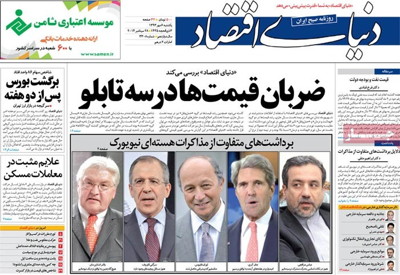
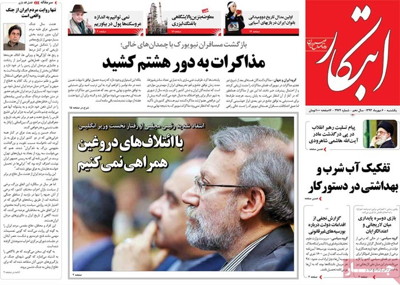
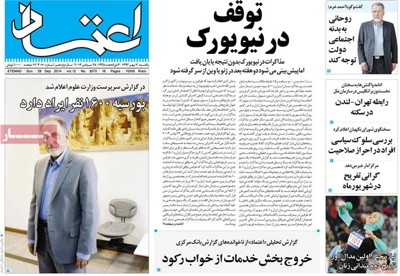
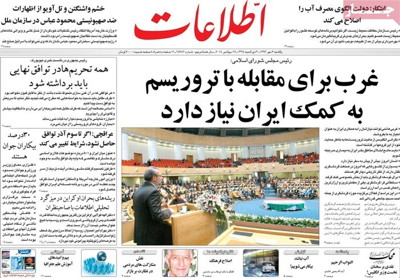
A look at Iranian newspaper front pages on Sept. 28

Iranian Newspapers headlines
Iranian Newspapers Headlines

Front page headlines of Iranian dailies on Sunday mostly focused on the 7th round of nuclear talks in New York and their failure to produce the intended results. The inconclusive negotiations drew remarks from different politicians and prompted them to adopt a wait-and-see approach until the 8th round of the talks later this year. Comments by Parliament Speaker Ali Larijani in response to the speech by British Prime Minister David Cameron at the UN General Assembly were among top stories. Drawing as much attention was the silver medal that Iranian female shot-putter Leila Rajabi bagged for the first time in the Asian Games. Another headline-grabbing story of the day was a message by the Supreme Leader to Ayatollah Mahmoud Hashemi Shahroudi, a top member of the Assembly of Experts, in which the leader expressed his heartfelt condolences on the passing of Ayatollah Shahroudi’s mother.

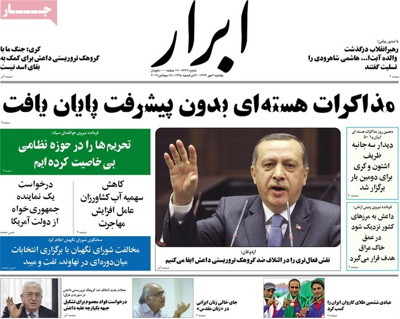
Abrar: “We have neutralized the sanctions imposed on the military sector,” said the commander of Aerospace Force of the Islamic Revolution Guard Corps.

Abrar: “If ISIL militants dare to approach Iran’s borders, we will target [their positions] deep in Iraqi territory,” warned the commander of the Iranian Army’s Ground Forces.


Abrar newspaper spet. 28


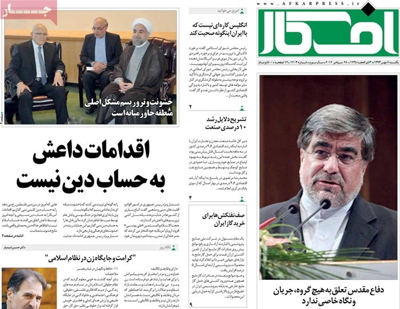
Afkar: “Britain is in no position to lecture Iran,” the Iranian parliament speaker says.


Afkar newspaper spet. 28


Aftab-e Yazd: “Do not get tough on foreign tourists,” an MP has urged officials.


Aftabe yazd newspaper spet. 28


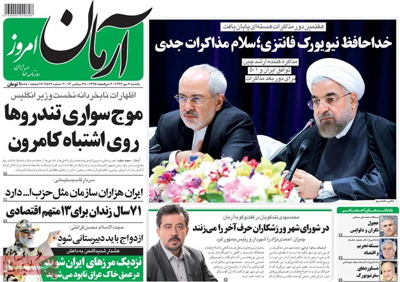
Arman-e Emrooz: “Seventy years behind bars for 13 convicted of corruption.” Thirteen people found guilty of a raft of charges including graft, bribery and forgery have been sentenced to 71 years in jail combined. According to the verdict, which is subject to appeal, the convicts will also have to pay hefty fines.


Arman newspaper spet. 28


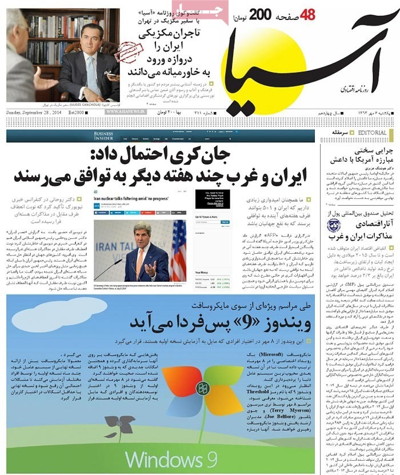
Asia: “Mexican businessmen see Iran as a gate to the Middle East,” the Mexican ambassador to Iran said in an interview with the daily.

Asia: “It remains our fervent hope that Iran and six powers can in the next weeks come to an agreement, said US Secretary of State John Kerry.


Asia newspaper sept. 28


Donyay-e Eghtesad: “Different interpretations on New York nuclear talks” is the report in which the daily quotes different politicians involved in the negotiations after the talks failed.

Deputy Iranian Foreign Minister Seyyed Abbas Araghchi: “We are yet to reach a common understanding about fundamental matters.”

US Secretary of State John Kerry: “It remains our fervent hope that Iran and six powers can in the next weeks come to an agreement.”

French Foreign Minister Laurent Fabius: “[There has been] no significant progress in nuclear talks.”

German Foreign Minister Frank-Walter Steinmeier: “We have never been so close to a deal as now.”


Donyaye eghtesad newspaper sept. 28


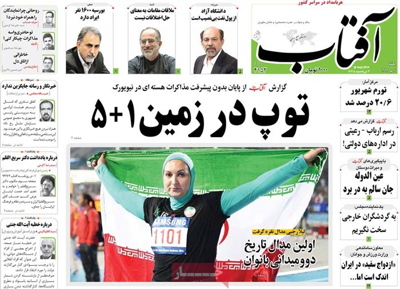
Ebtekar: “The New York passengers [Iran’s nuclear negotiating team] come back home empty-handed; talks have stretched into an 8th round.”

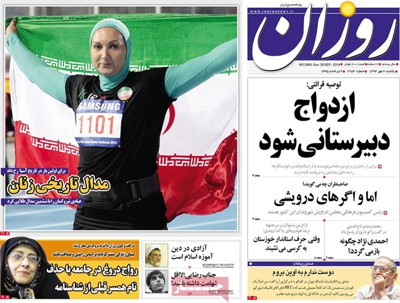
Ebtekar: “The first historic medal in track and field for Iranian women in the 2014 Asian Games.”

Ebtekar says a plan to separate drinking water from water for other purposes including bathing is on the agenda.


Ebtekar newspaper sept. 28


Etemad: “Scholarships of 1,600 students do not meet the required standards,” a report by the acting minister of science, research and technology revealed.


Etemad newspaper sept. 28


Ettela’at: “The government to modify water consumption patterns,” said Director of the Environment Protection Organization Masoumeh Ebtekar.


Etelaat newspaper sept. 28


Farhikhtegan: “The government is responsible for keeping people’s hope alive,” President Rouhani said at a meeting with Iranian expatriate university professors and students in America. He further said that countering Iranophobia is incumbent on all Iranians within and beyond the country’s borders.


Farhikhtegan newspaper sept. 28


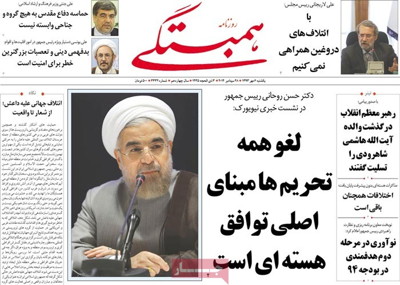
Hambastegi: “We won’t join hands with fake coalitions,” said Parliament Speaker Ali Larijani.


Hambastegi newspaper sept. 28


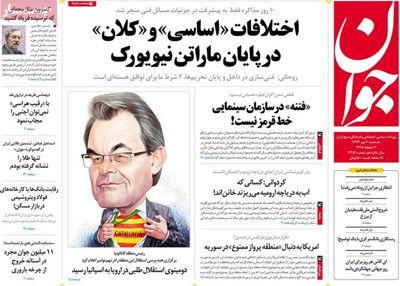
Javan: “Substantial and fundamental disagreements at the end of marathon New York talks” was the headline that the daily put on its front page after ten-day negotiations merely produced an agreement over technical details. Also, the daily quoted President Rouhani as saying, “[Uranium] enrichment in Iran and a total lifting of sanctions are the two conditions for a nuclear deal.”

Javan: “The domino effect of independence in Europe has been felt in Spain. Catalonia’s regional leader [Artur Mas] has scheduled an independence referendum for November 9.”


Javan newspaper sept. 28


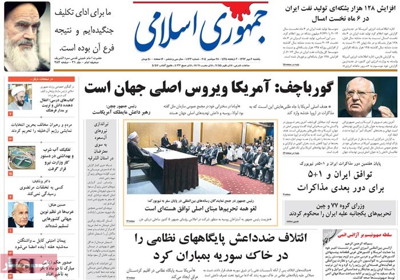
Jomhouri Islami: “Saudi security forces open fire on protesters in Eastern Province.”


Jomhorie eslami newspaper sept. 28


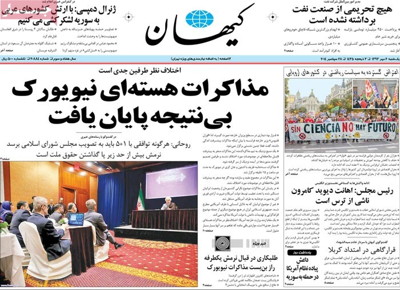
Kayhan: “No sanction has been lifted as far as oil industry is concerned,” said the director of the National Iranian Oil Company for international affairs.


Kayhan newspaper sept.  28


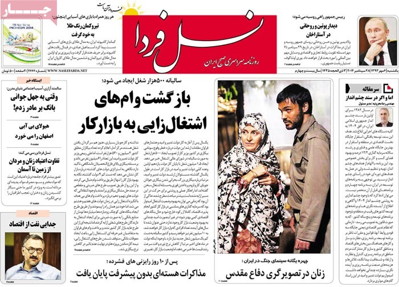
Nasl-e Farda: “Presidents Putin and Rouhani are to meet in Astrakhan.”


Nsle farda newspaper sept.  28


Roozan: Sadegh Zibakalam [a university professor] says he does not want to be sent to Evin Prison. “I am no hero; I am an ordinary citizen.” His comments came after he was sentenced, in a court of first instance, to 18 months in jail for “disturbing the public opinion” and “insulting the judiciary”.


Ruzan newspaper sept.  28


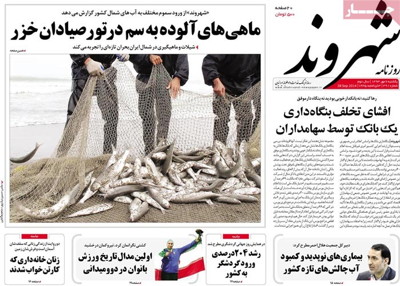
Shahrvand: “The flow of hazardous substances to Caspian waters has tainted the catch of commercial fishermen in northern Iran.”


Shahrvand newspaper sept. 28


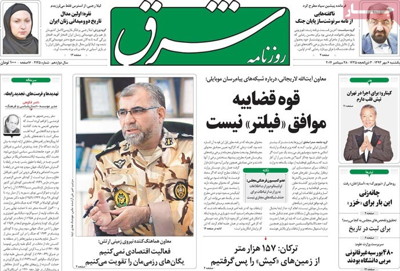
Sharq: “The Judiciary does not approve of filtering,” the deputy judiciary chief said on mobile applications mainly used for messaging and calling – Viber, WhatsApp and Tango.


Shargh newspaper sept. 28


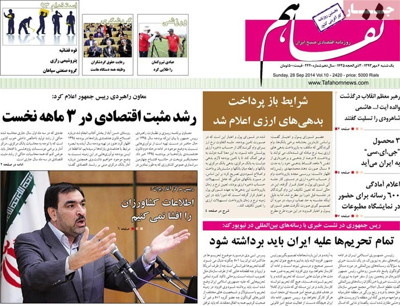
Tafahom: “All sanctions against Iran must be lifted,” President Rouhani said in an international press conference in New York.


Tafahom newspaper sept.  28


Larijani raps British PM for anti-Iran remarks

Ali Larijani
Ali Larijani

Iranian Parliament Speaker Ali Larijani lashed out at British Prime Minister David Cameron for his anti-Iran comments at the 69th annual meeting of the UN General Assembly in New York, and said such remarks are rooted in London’s intense fear of the terrorism which has been created by Britain.

In comments aimed at PM Cameron, Larijani said, “You shouldn’t speak like this; you are nervous and ISIL (the Islamic State of Iraq and the Levant) is its cause since you have helped it and now it has turned into a problem.”

Stressing that fearing a heinous group like ISIL is a true fear, he said the British officials who need Iran in their fight against the terrorist group shouldn’t speak like “Pharaohs” and use orders to meet their needs.

“Instead of admitting to your past mistakes in aiding the terrorists, you are now using a language which will not lead to meeting your needs,” Larijani said.

In relevant remarks on Thursday, Iranian Foreign Ministry Spokeswoman Marziyeh Afkham said that the recent statements by Cameron at his UN General Assembly speech indicated the continuation of London’s self-centered outlooks.

Afkham’s comments came after Cameron’s speech at the 69th session of the UN General Assembly on Wednesday about the fight against ISIL terrorist group in Iraq in which he raised anti-Iran allegations.