Saturday, December 27, 2025
Home Blog Page 4938

Muhammad is the most distinguished Iranian film in 35 years

Jannati-Mummad Movie

Minister of Culture and Islamic Guidance Ali Jannati has said that Muhammad, the Messenger of God is the greatest movie made in the Islamic Republic of Iran over the past 35 years.

The minister made the remarks after a special screening of Muhammad, the Messenger of God, a big-budget movie directed by Majid Majidi in Tehran attended by a host of officials and filmmakers. What comes below is the translation of the culture chief’s remarks as reported by Fars News Agency on February 9:

“The movie by Mr. Majidi can be called the best in Iran in the past 35 years. It is matchless in terms of content and theme, and it is an unparalleled motion picture in Iran from professional and technical aspects.

“The attention the movie pays to different periods of the Prophet’s life, from his childhood to the time he was designated as the messenger of God, clearly shows that the Muslim Prophet is the prophet of kindness and compassion; it also reveals that the prophecies in the Bible and Torah [the Old and New Testaments] about Islam’s prophet have been properly depicted in the movie.

“All followers of the past religions were waiting for [the emergence of] a great savior in Arabia. This movie is the first part of the Prophet’s life and we hope that a sequel which will cover the period that stretches from Muhammad’s designation as God’s messenger to his demise will be made as excellently as this one.”

In response to a question on whether Majidi will direct a sequel to Muhammad, the Messenger of God, the minister simply said he hopes so.

The director of the movie, for his part, said he was happy Muhammad, the Messenger of God hit the screen seven years after its filming started. “I hope the film will be able to show the generosity and kindness of the Prophet to the whole world.”

Ahvaz residents take their satirical war against dust storm to social networks

Ahvaz-7Sobh daily

Residents of Ahvaz, the provincial capital of Khuzestan near the border with Iraq, are reeling after the southwestern city was walloped by a dust storm that prompted officials to order schools and government offices closed.

In a bid to air their grievances and draw the attention of officials in the capital to their plight, they have resorted to satire on social networking sites.

“Eat your heart out, we have dust here in the air, but you don’t!” the caption of a photo featuring a man wearing a chemical mask said.

“We are dying,” a sentence on a coat of dust enveloping the trunk of a sedan said. “We are still alive,” read another.

“Good news for the residents of Khuzestan. In light of the fact that the recent dust storm will exterminate the residents of Khuzestan, there are plans to replace in six months the image of Asiatic Cheetah [an endangered species] that appears on the jersey of the national soccer team with the image of the last human survivor in the province.” It was signed the society to support the endangered species.

And a new menu of a restaurant in the city featured all manner of dust items including clay sauce, mud soup, etc.

Iran unveils new home-made training fighter

Iran home-made training fighter 1

Iran on Monday unveiled a new home-made combat fighter, named Saeqeh 2 (Thunderbolt 2), which will also be used for training purposes.

“The supersonic fighter jet which has been designed and built by the Defense Ministry’s aerospace industries organization in cooperation with the Islamic Republic of Iran’s Air Force will do close-range cover and backup in tactical missions as well as advanced pilot training missions,” Iranian Deputy Defense Minister Brigadier General Amir Hatami said, addressing the unveiling ceremony.
He said the aircraft has been built on the basis of a new design which has maximized its combat power, adding that the plane has also been equipped with advanced electro-avionics and weapons systems to train pilots for flying with the existing or new heavy fighters.
In relevant remarks on Sunday, a senior Iranian Air Force commander also announced that the country is planning to build a new high-tech combat aircraft capable of tracing US and Israeli modern and stealth planes.

[…]


Envoy dismisses report that fisherman shot dead by Turkmen police

Mousa Golpaygani

Iranian Ambassador to Turkmenistan Mohammad Muosa Golpayegani has rejected reports that Turkmen maritime police have recently killed an Iranian fisherman.

“The deadly incident in which an Iranian fisherman lost his life dates back a couple of years. In a meeting I had with the Turkmen foreign minister, he offered a letter of condolences by his president which reflected there was no hostility between Ashgabat and Tehran,” the envoy said.

He added, “In November 2014, an Iranian fishing boat strayed into Turkmenistan’s waters and was intercepted by Turkmen maritime police. Nobody was injured in this incident.”

He stated, “The November story has been mixed up with the old incident. Reports that the Iranian trawler has been confiscated and those on board are to be prosecuted are true. We are trying to have them pardoned.”

Iran ready to train Iraqi army: General

General Hossein Valivand

Commander of the elite Army Command and General Staff College (DAFOOS) Brigadier General Hossein Valivand said the academy is ready to train Iraqi army officers.

Speaking to IRNA, the general said the issue of training Iraqi officers was discussed in a recent visit to Tehran by Iraqi Defense Minister Khaled al-Obeidi.

Al-Obeidi paid a visit to Tehran on December 29 and called for more support from Iran for Iraq’s armed forces, saying cooperation between the two forces is a strategic need.

Minister of Defense Brigadier General Hossein Dehghan told his Iraqi counterpart that supporting Iraq’s armed forces is part of Iran’s defense and security strategies.

In response to a question whether the Iranian army has a program to train Iraq’s Kurdistan peshmergas, Valivand said DAFOOS is an elite military academy and is ready to cooperate with armed forces of friendly countries.

‘When our Defense Ministry signs a security defense contract with a country, then we can train officers of that country or send staff for training,’ said the general, adding that officers from Oman, Pakistan, and Syria are currently being trained in Iran.

He said Iranian officers also take training courses in China, Pakistan, and Oman.

Tehran, Montevideo deny report on Iran diplomat expulsion

Uruguay

On Friday, Israeli daily Haaretz quoted an unidentified Israeli official as saying that Uruguay had expelled a senior Iranian diplomat two weeks ago over last month’s planting of a fake bomb near Israel’s embassy in Montevideo.

However, Iran’s embassy in Montevideo rejected the report as false on Saturday, saying such media claims are aimed at creating Iranophobia and tarnishing the Islamic Republic’s international image.

In a similar statement on Friday, the Uruguayan government also denied having expelled an Iranian diplomat in relation to the fake bomb incident.

On January 8, the police in Uruguay discovered an object suggestive of a bomb near the new Israeli embassy located in the World Trade Center office complex in Montevideo.

Montevideo bomb squad officers detonated the fake bomb. Bomb brigade Lieutenant Colonel Alfredo Larramendi told reporters that the dummy bomb “never posed any danger,” but it might have been planted “there to see the response time” of responders, or to “size up the quality of the security of Israel’s embassy.”

Tehran has said in the past that Tel Aviv has ordered attacks against its own embassies in India and Georgia in order to damage Iran’s image in the host countries.

Iran makes anti-Alzheimerˈs drug from saffron, for 1st time in world

Iran-saffron
Iran-saffron

Researchers at Tehran University of Medical Sciences in cooperation with a science-based company made an anti-Alzheimer’s medicine from saffron on the back of a ten-year research.

The head of the research program, Jamaleddin Jalali said that the medicine is made of saffron, which is an Iranian herb whose countless medical benefits are mentioned by renowned Iranian scientists, including Avicenna in “the Canon of Medicine”.

Saffron has positive effect on human mood, helps sharpen memory, and improve eye-sight.

He said that the science-based company, Tehran University of Medical Sciences and the hospitals affiliated to that university launched numerous tests before the production of the herbal medicine ˈSafrotinˈ which can decrease the signs of the Alzheimerˈs disease noticeably.

Jalali said that there are only five effective medicines for the Alzheimerˈs disease in the world today and Safrotinˈs effects exactly match those of the best of its foreign equivalent medicines, minus their side-effects.

He referred to two famous anti-Alzheimerˈs medicines in the world, claiming that Safrotin is as effective, and that long-running clinical tests have proved the new medicineˈs efficiency.

He said that some three years ago an article about Safrotin was published in one of the most reputable scientific magazines of the world, which became a basis for the other researchers around the globe.

ˈFifty two documentaries in the field have been presented up to now and the medicine has been registered in EUˈs pharmacopeia, while at the 12th Avicenna Festival, it was praised as the top medical product of the year,ˈ added Jalali.

He said that the new drug for the Alzheimerˈs has also anti-cancer effects.

Seeking unilateral benefits ruins Iran talks, Putin says

Putin

“The crucial point is that nobody should try to derive unilateral benefit from the situation or to bargain out more than what is needed for a balanced and just resolution of this complicated issue,” Putin said in an interview with Egyptian Al-Ahram newspaper on Sunday.

Putin also said that the two sides have yet to find a final solution to the case despite the fact that they have made considerable progress in the talks over the past months.

“Substantial progress has been made [in talks between Iran and P5+1]. However, we have not managed yet to produce a final comprehensive solution either regarding the Iranian nuclear program itself or the prospects of lifting the sanctions,” Putin said.

He said, however, that Russia expects efforts in this field to continue for reaching a final deal.

The top Russian official also defended Iran’s right to have a peaceful nuclear program, saying that Moscow believes Iran can enrich uranium under the supervision of the IAEA.

Since an interim deal was agreed in Geneva in November 2013, Iran and P5+1 – the United States, the UK, China, France, Russia, and Germany — have missed two self-imposed deadlines to ink a final agreement.

The negotiating sides now seek to reach a high-level political agreement by April 1 and to confirm the full technical details of the accord by July 1.

The scale of Iran’s uranium enrichment and the timetable for the lifting of anti-Iran sanctions are seen as major sticking points in the talks.

Iran has so far suspended some of its nuclear enrichment program in return for certain sanctions relief.

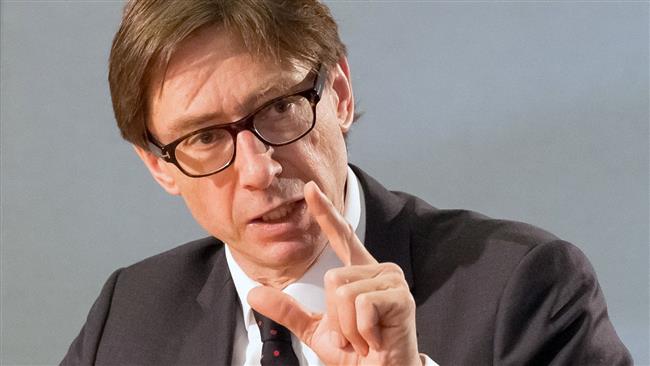
EU’s Mogherini: Time to show political will for Iran’s nuclear deal

Mogherini

European Union foreign policy chief Federica Mogherini underlined that Iran and six world powers should seize the opportunity, in their negotiations over Tehran’s nuclear energy program, to reach a comprehensive deal.

Speaking in the 51st Munich Security Conference on Sunday, Mogherini pointed to the ongoing talks between Iran and P5+1 (the five permanent UN Security Council members plus Germany) and said, “We cannot lose the opportunity.”

She further commented on the deadline for a nuclear deal between the two sides, and said, “Not much time is left. Now is the time to show a strong political will… now we are at a critical stage.”

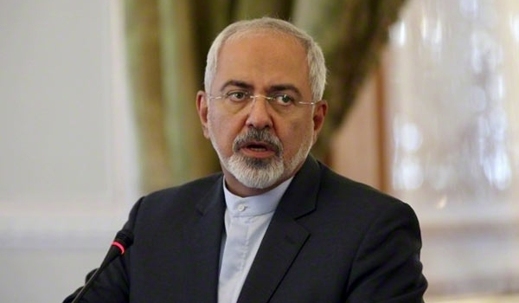
Earlier in a meeting with Iranian Foreign Minister Mohammad Javad Zarif on Saturday, Mogherini said that P5+1 has “strong political determination” to strike a deal with Iran.

She also noted that the long-awaited accord will have positive effects on the regional developments.

Iran and the six nations (alternatively known as E3+3) are in talks to hammer out a final agreement to end more than a decade of impasse over Tehran’s peaceful nuclear energy program.

Iran and the six powers look to reach a framework agreement in March and a final long-term deal by June 30.

Following an interim nuclear deal signed in Geneva in November 2013, two deadlines for a final, comprehensive deal have been missed, and now a third one is looming on July 1.

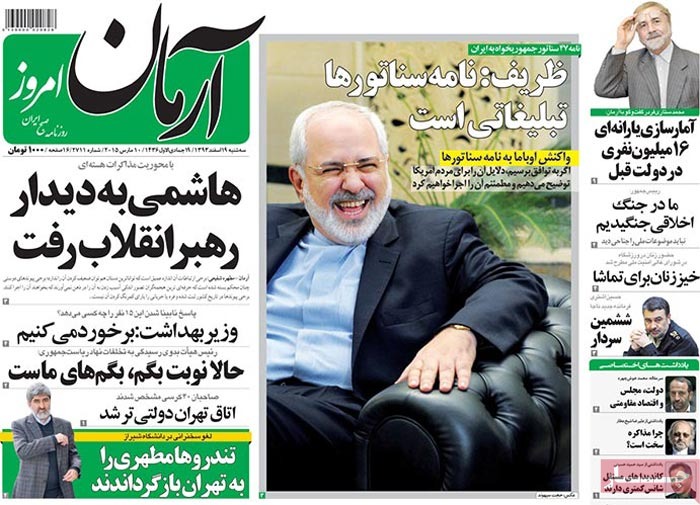
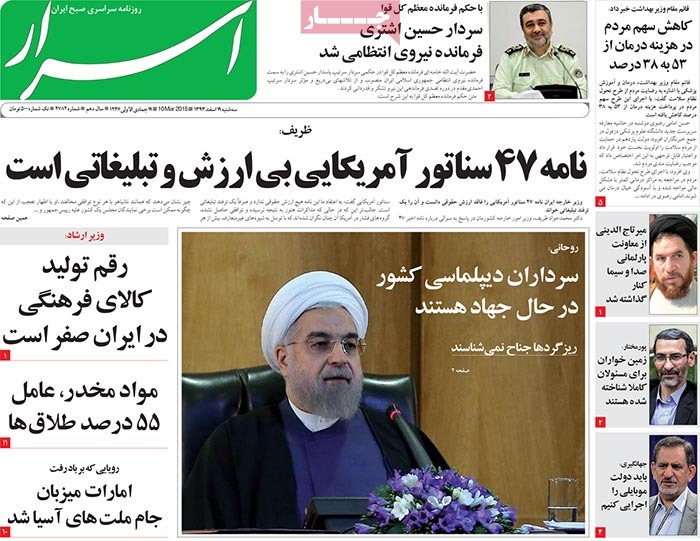
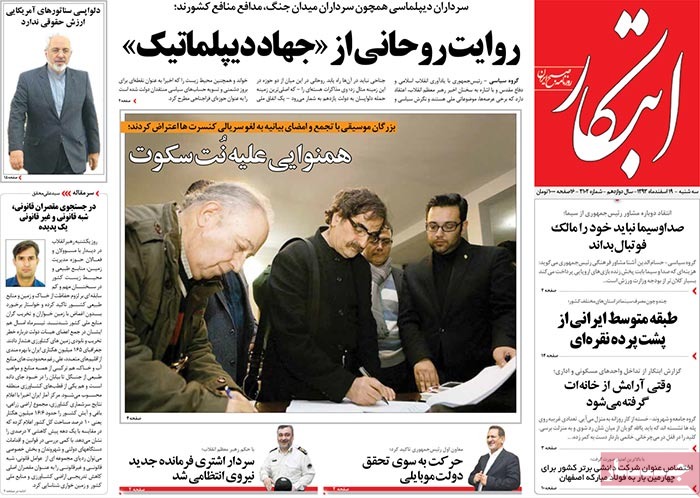
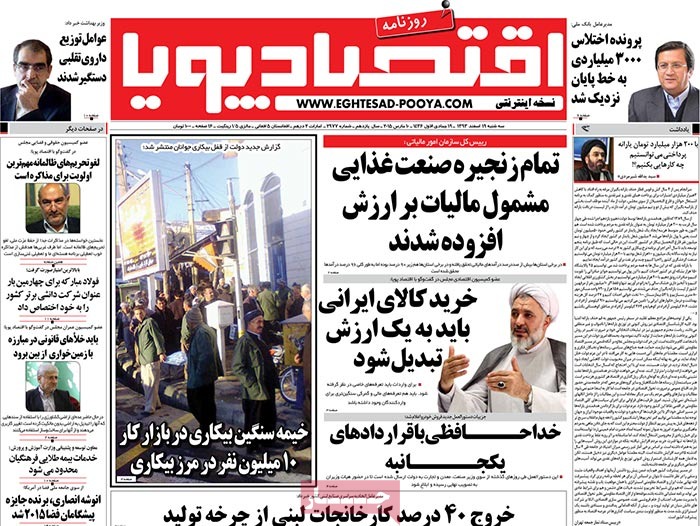
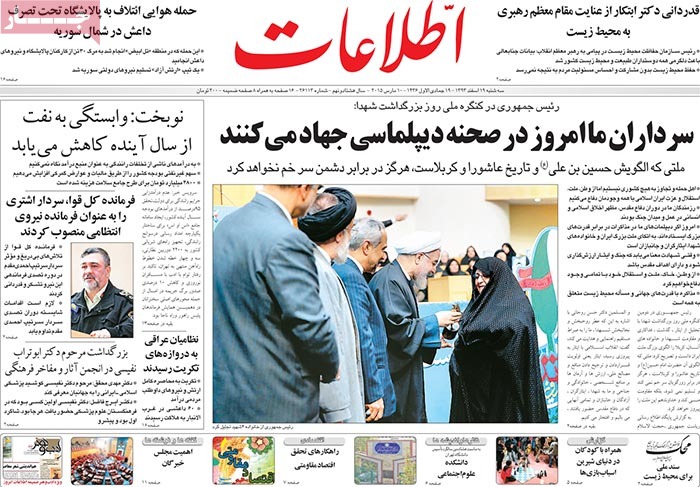
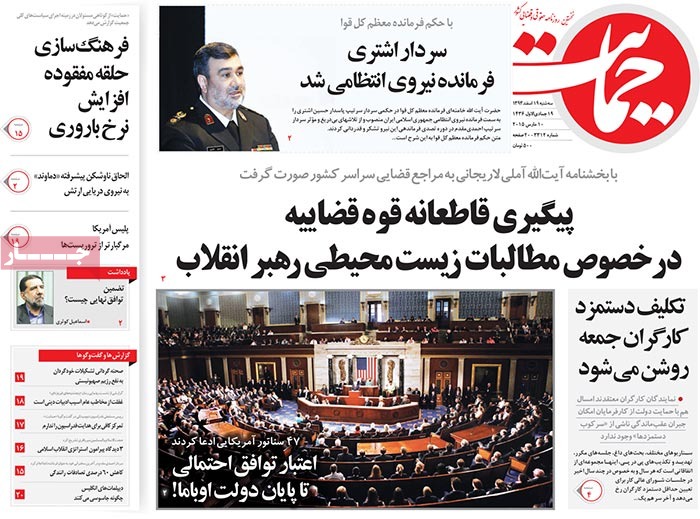
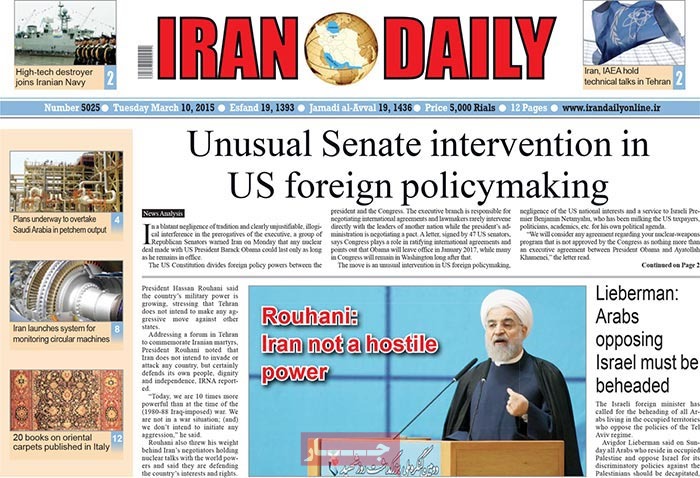
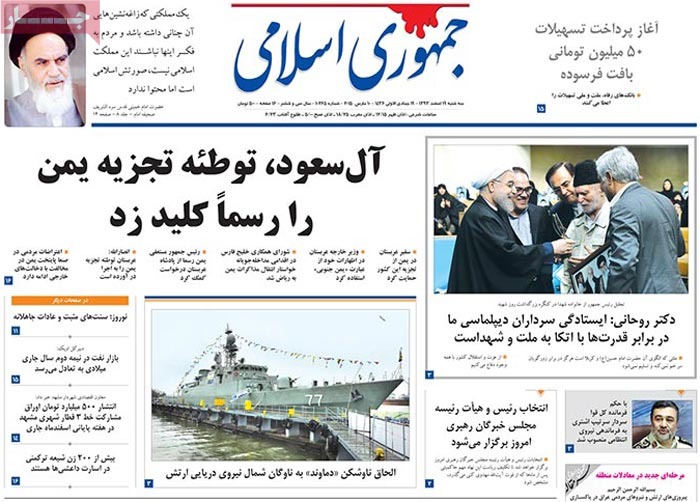
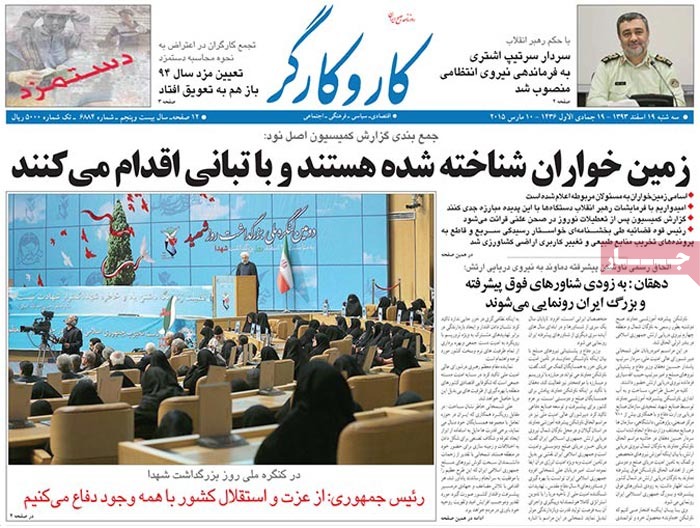
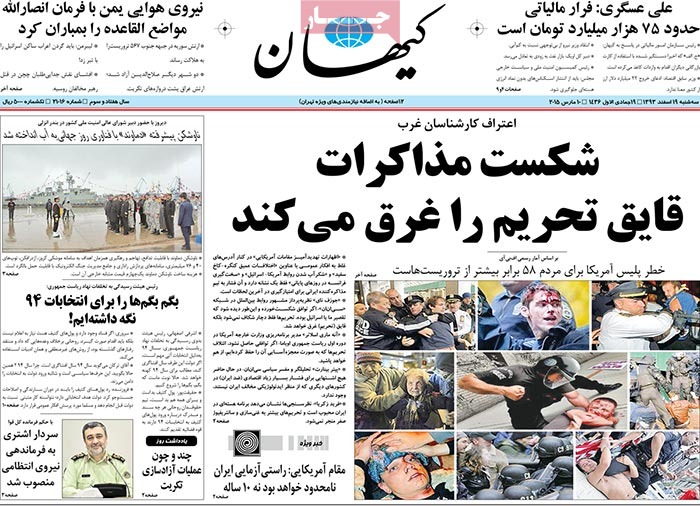
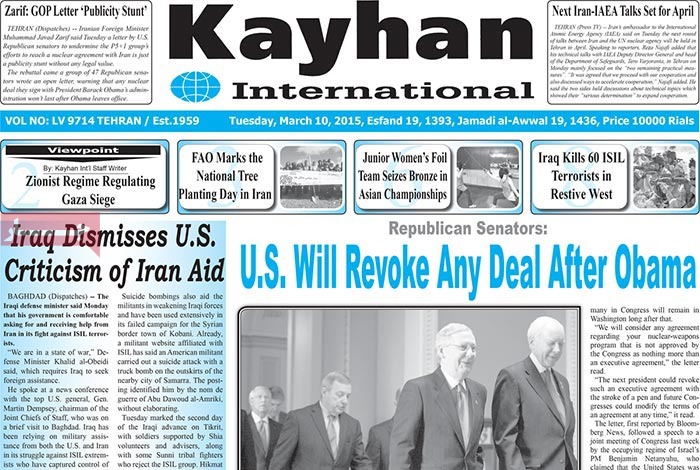
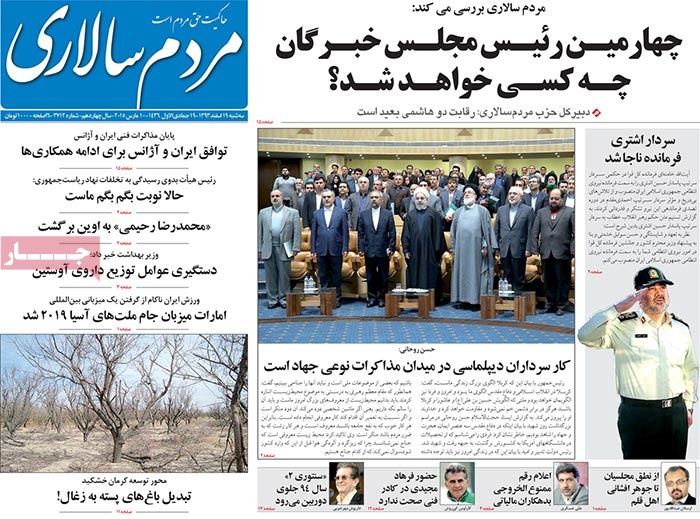
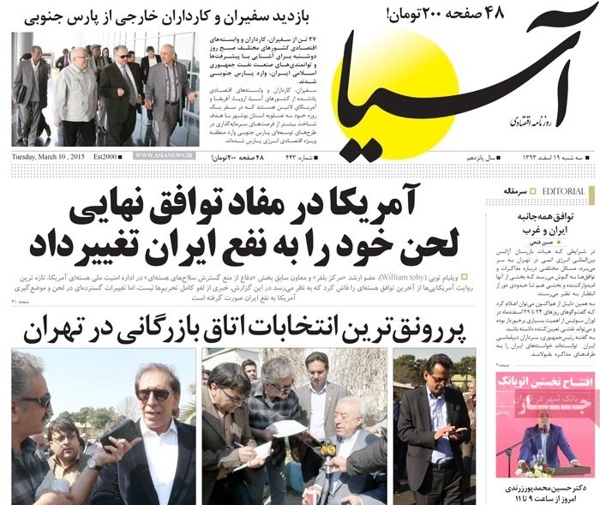
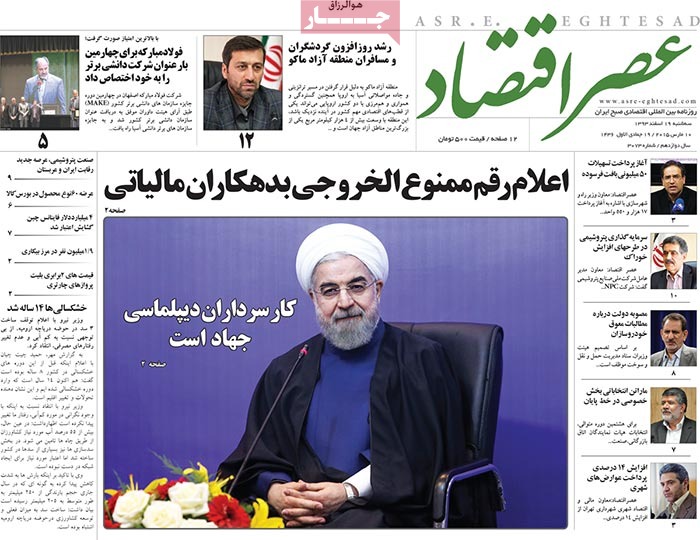
A look at Iranian newspaper front pages on Feb. 9

Iranian Newspapers Headlines

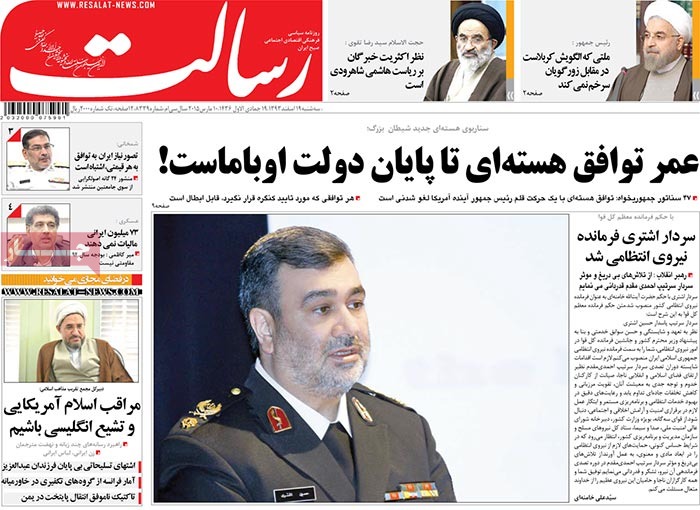
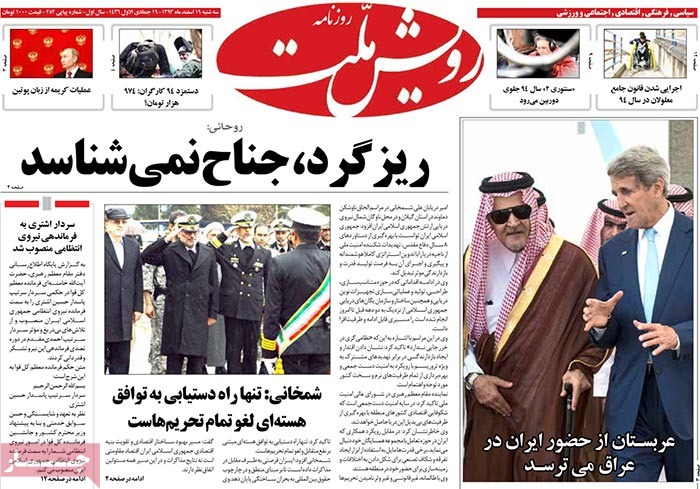
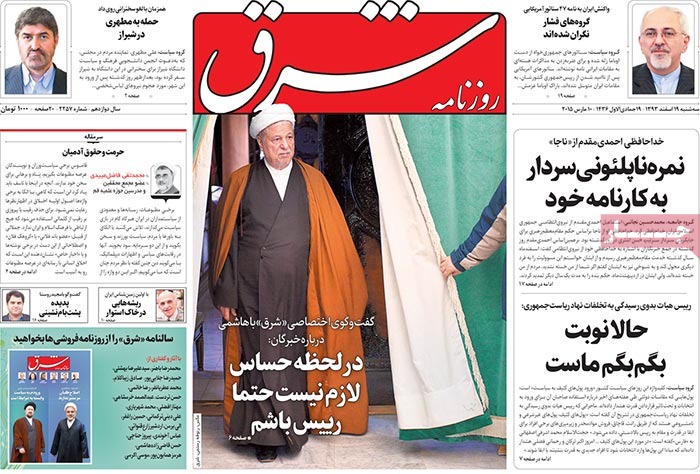
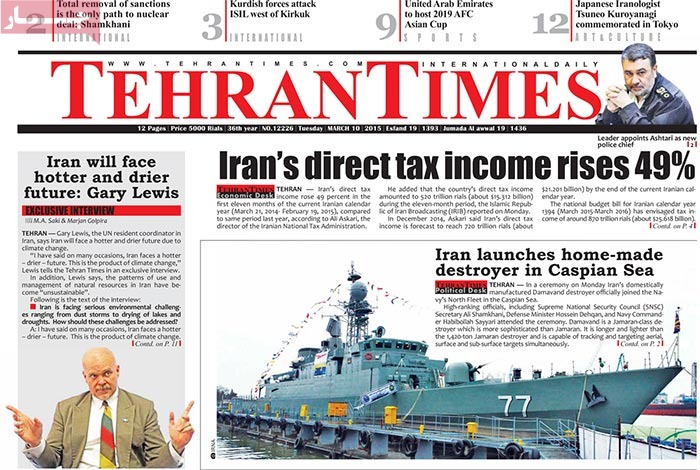
The Supreme Leader’s expression of support for a nuclear deal that would guarantee the dignity and progress of the Iranian nation and lift all sanctions “in the real sense of the word,” dominated the front pages of Iranian newspapers Monday. Foreign Minister Mohammad Javad Zarif’s comments that failure to clinch a nuclear deal “wouldn’t be the end of the world” along with President Rouhani’s reaction to critics of his nuclear policy also appeared on the covers of dailies.


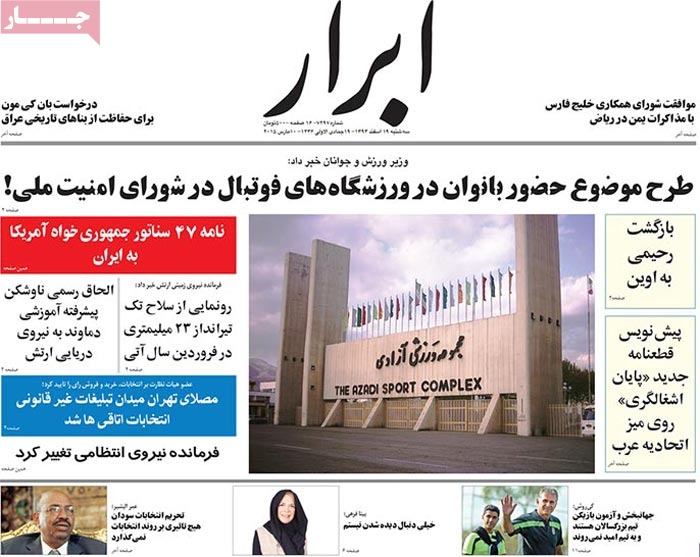
Abrar: “Failure of nuclear talks wouldn’t be the end of the world,” the Iranian FM said.

Abrar: The impeachment of [Minister of Roads and Urban Development Abbas] Akhoundi has been set in motion.


Abrar newspaper-02-08-2015


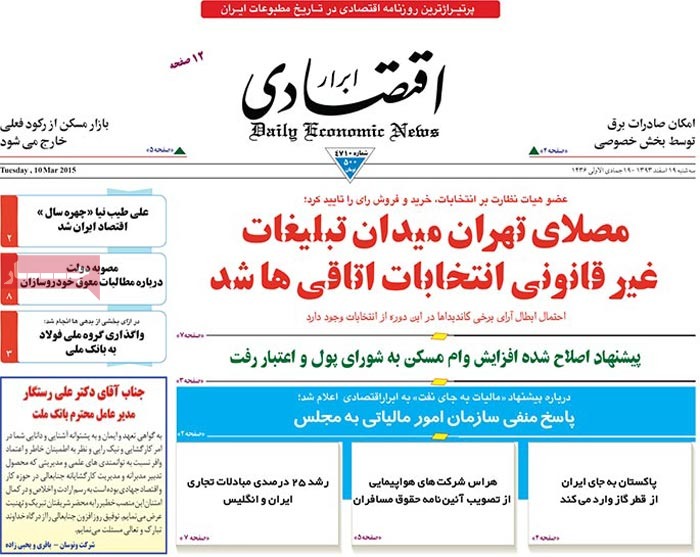
Abrar-e Eghtesadi: Trade exchanges between Iran and Italy will rise.


Abrar Eghtesadi newspaper-02-08-2015


Afarinesh: A dust cloud has forced the closedown of schools and government offices in Khuzestan Province.


Afarinesh newspaper-02-08-2015


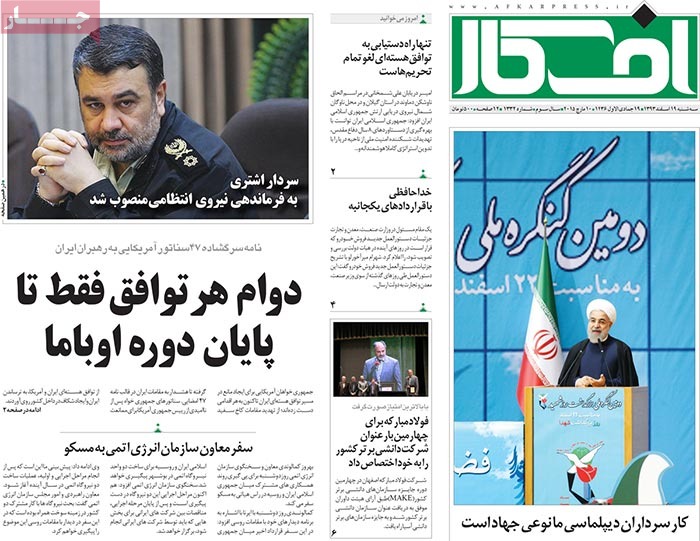
Afkar: A second phase of the war to sell oil cheap has gotten underway.


Afkar newspaper-02-08-2015


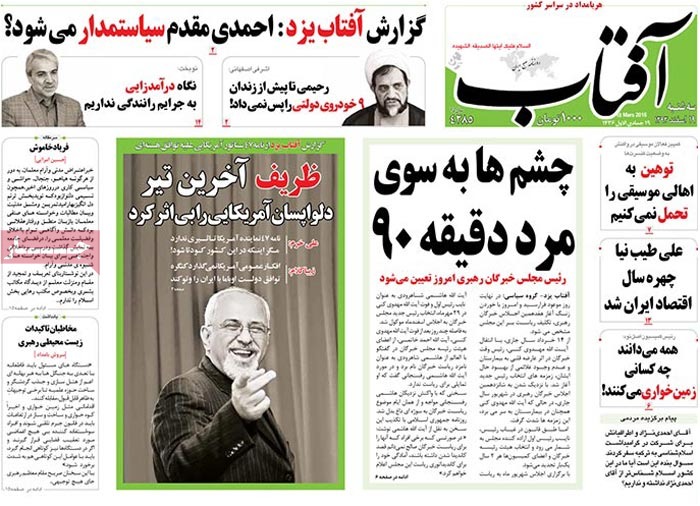
Aftab-e Yazd: “Learn how to be a real critic,” the president told those critical of his government’s nuclear policy.


Aftabe Yazd newspaper-02-08-2015


Arman-e Emrooz: “I would approve of a good deal,” said the Supreme Leader.

Arman-e Emrooz: What a stroll leads to is important

President Rouhani made the comment in reaction to principlists who have been coming down on his foreign minister for taking a walk with US Secretary of State John Kerry on the streets of Geneva last month.


Armane Emrooz newspaper-02-08-2015


Asrar: “Extension of talks would not serve anyone’s interests,” said Zarif.

Asrar: Copayment of individuals with Social Security insurance is to drop to zero.


Asrar newspaper-02-08-2015


Ettela’at: “We aim to have all sanctions removed,” said Foreign Minister Zarif.


Ettelaat newspaper-02-08-2015


Iran: “Time is right for a deal with Iran,” says Zarif [in a statement aimed at P5+1].

Iran: “We should not sideline the elite under one pretext or another,” said President Rouhani.

Iran newspaper-02-08-2015


Jomhouri Islami: “By acting wisely, we can achieve all goals of the revolution,” said Ayatollah Hashemi Rafsanjani.


Jomhouri Eslami newspaper-02-08-2015


Kaenat: Two companies alone account for 70 percent of all car imports.

Kaenat: Some 26 percent of addicts use psychedelic drugs.


Kaenat newspaper-02-08-2015


Kayhan: “Sanctions should be lifted in the real sense of the word,’ said the Supreme Leader.


Kayhan newspaper-02-08-2015


Resalat: “A nuclear deal should be transparent and come in one single stage,” said the Supreme Leader.


Resaalat newspaper-02-08-2015


Tafahom: The likelihood of a drop in interest rates in Iran [this year] has fallen to zero.


Tafahom newspaper-02-08-2015


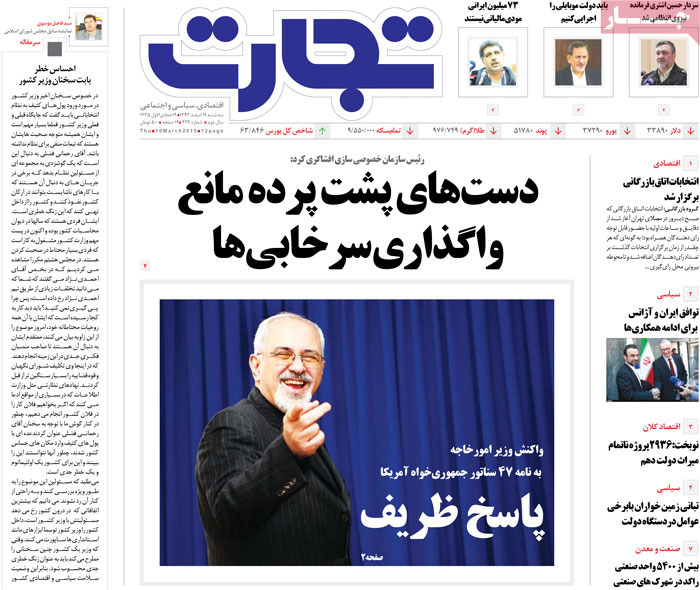
Tejarat: “In 2015 Iranian economy will grow and inflation will decline,” predicted Business Monitor.


Tejarat newspaper-02-08-2015