Saturday, December 27, 2025
Home Blog Page 4921

Afkham: Gov’t will not strike nuclear deal in violation of red lines

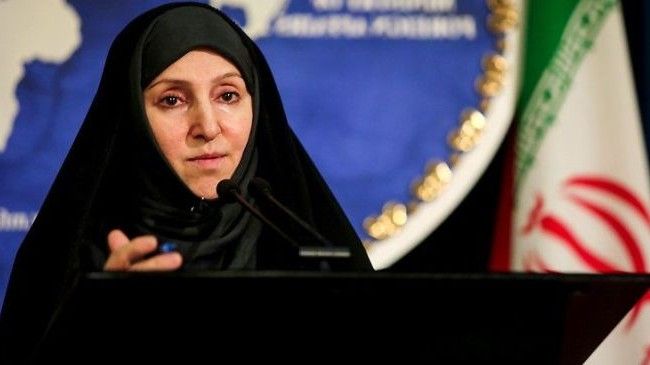
Iranian Foreign Ministry Spokeswoman Marziyeh Afkham

Foreign Ministry Spokeswoman Marzieh Afkham said on Tuesday that the government will not strike a nuclear deal in violation of the red lines.

Afkham dismissed speculations by political parties opposed to the government that the negotiating team had reached a nuclear accord in defiance of the red lines of the Islamic Republic of Iran.

“No agreement on any topic has yet been reached and the only point of accord is the name and title of the eventual agreement which is the Joint Action Comprehensive Plan.”

She said the negotiating team is well aware of the red lines of the Islamic Republic of Iran and is committed to observing them with full sensitivity.

She said that the alleged violation of the red lines by the negotiators is without basis, adding that the government reserves the right to take legal action against its opponents who speculate about nuclear talks with Western governments.

She noted that the negotiating team knows better than others that any accord irrespective of the red lines of the Islamic Republic of Iran will be null and void.

Sextet should take tough decision in nuclear talks

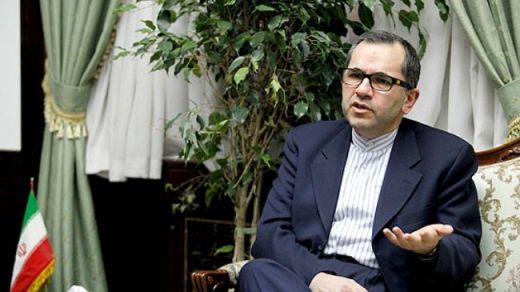
Iran-Takht-e-Ravanchi

The time has come for the world powers to make a tough decision on Iran’s peaceful nuclear energy program, an Iranian deputy foreign minister said.

“If they are supposed to make a tough decision, this is the right time, and this is doable if they are really open to negotiation,” Iran’s Deputy Foreign Minister for American and European Affairs Majid Takht Ravanchi said in an interview with state TV on Tuesday.

The diplomat, who is also a member of the Iranian team of nuclear negotiators engaged in the talks with six world powers, warned against the ongoing attempts to ruin the talks.

Takht Ravanchi also reiterated that the entire anti-Iran sanctions should be lifted at once in the wake of a final, comprehensive nuclear deal between Tehran and P5+1 (Russia, China, the US, Britain, France and Germany).

Iran will never agree that the sanctions would be divided into separate categories or be removed one by one, he underlined.

He further noted that a final deal on Tehran’s nuclear case would be possible before a November 24 deadline, provided that “the Westerners would be really after resolving the problem.”

The senior diplomat also dismissed the idea of extension of the nuclear talks, and said, “We do not think about extending the negotiations and try to achieve our favorable result in the definite time span.”

It came after IRNA on Monday quoted an unnamed Iranian nuclear negotiator as dismissing a report by the Los Angeles Times about the possibility of an extension of the talks.

“The paper’s report is not true and the extension of the negotiations is not on the agenda. All the attention is focused on the serious continuation of the negotiations until November 24,” the official had announced.

30-year jail sentence demanded for Indian murderers of Iranian

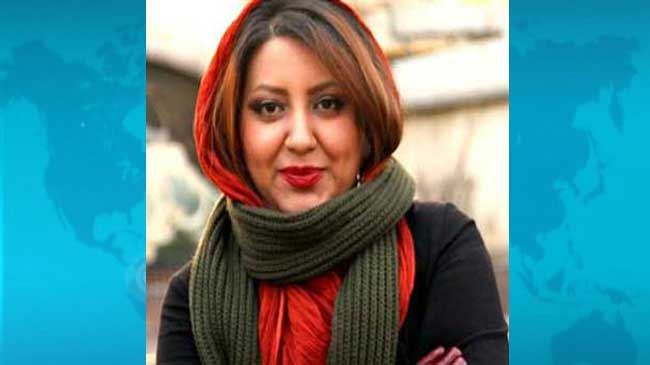
Mahtab-Savoji
Mahtab-Savoji

According to reports, the prosecutor asked the court for the jail sentence to be handed down to the Indian couple, Rajeshwar Singh and Gagandeep Kaur, who shared a Milan apartment with 29-year-old Iranian Mahtab Savoji back when they murdered her in January.

The presiding judge has reportedly set the next hearing session for December 11.

Police say the murder was the result of Savoji’s refusal to accept sexual propositions from the couple.

Savoji’s body was found stuffed in a suitcase in a canal in Venice on January 28.

The two Indians were caught on Venice train station cameras acting suspiciously and were arrested on February 3 by the Italian police as potential suspects in the murder case.

Italian police said the Indian couple initially denied any involvement in the murder of Savoji, but the evidence provided by the security camera footage was later used against them and led to their confessions.

A postmortem examination revealed that Savoji died of asphyxiation. No water was found in her lungs, which indicated to investigators that the Iranian woman must have been killed before she was dumped in the canal.

Savoji had been living in Milan to pursue a two-month course in costume designing at the renowned Italian Academy.

Iranian MP lashes out at purported nuclear deal between Iran and US

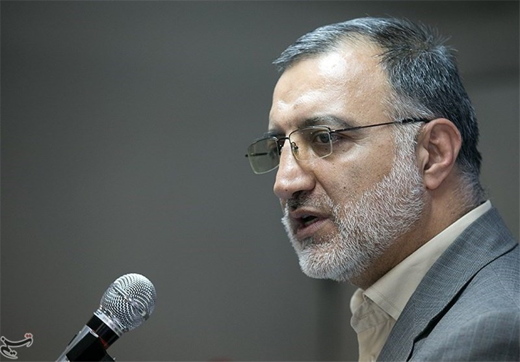
Zakani Majlis
Zakani Majlis

Tasnim, a news agency, reported on October 28 that an Iranian MP has said Tehran and Washington have reportedly clinched a nuclear deal which in his words “crosses the red lines of the Islamic establishment”. The following is the translation of the brief report:

Alireza Zakani, who represents Tehran in the Islamic Consultative Assembly, told an open session of parliament on Tuesday that he has heard from sources that the Iranian and American negotiators have finalized a nuclear deal. But the silence of the Iranian diplomacy machine in the face of American hallucination has emboldened the Great Satan to seek more and make more baseless allegations.

“That some individuals who are close to the nuclear case have sought to launch a campaign which suggests ‘any deal is better than no deal’ is humiliating and condemnable. We want the country’s security agencies to get to the bottom of the issue,” Zaklani said.

He went on to say that reports suggest the implicit agreement between the two sides “crosses the red lines of the Islamic establishment. That will certainly violate the rights of the Iranian people and trample their nuclear achievements.”

“Submission to the unfair demands of the US that Iran decrease and change the nature of its enrichment activity in return for the partial easing of sanctions is unacceptable and runs counter of the national interests of Iran and the Islamic establishment,” Zakani said.

Article 125 of the Constitution entitles the Islamic Consultative Assembly to vote on the international commitments of the government, he stated, adding, “Unfortunately, as far as the nuclear case is concerned the Islamic Consultative Assembly is kept in the dark and MPs are not being informed about what is going on. Failure of the executive branch to take note of the viewpoints of MPs will cause problems for which nuclear negotiators should be held accountable.”

In conclusion the MP called on IRIB (Islamic Republic of Iran Broadcasting) to organize expert debates to let the public in on what is really going on.

A look at Iranian newspaper front pages on Oct. 28

Iranian-Newspaper-Headlines

Snapshots and remarks of President Rouhani about the possibility of a nuclear deal between Iran and P5+1 in meetings with the new ambassadors of four European countries appeared on the front pages of most Iranian dailies on Tuesday. Good news about a drop in inflation rate also generated headlines. Speculations about whether or not the president’s proposed minister of science wins a vote of confidence in parliament were also pretty much in the news.

Abrar: “We have yet to figure out what kind of principlism former President Ahmadinejad practices!” said Parliament Vice-Speaker Mohammad Reza Bahonar.

Abrar: “An Iranian-American woman has been nominated as US ambassador to Sweden; Azita Rajizan, who was a fundraiser during Obama’s reelection campaign in 2012, needs the approval of Senate before taking charge of the US mission in Stockholm.”
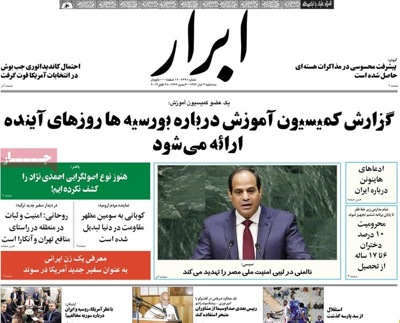
 

Abrar newspaper 10 - 28


Abrar-e Eghtesadi: “Inflation has slipped below 20 percent.”

Abrar-e Eghtesadi: “Iran’s Income Distribution Pyramid reveals that 7 million people are below the poverty line, suffering from grinding poverty with their food security at stake, whereas 6 million individuals are filthy rich, leading life similar to their American counterparts.”
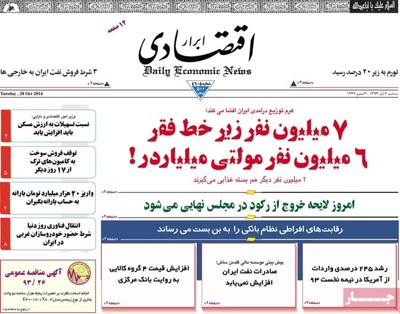
 

Abrare eghtesadi newspaper 10 - 28


Afkar: Some235 individuals, mostly students, have been hospitalized for poisoning in Zahedan. One-hundred-fifty of the patients who inhaled poisonous fumes have been discharged. Environmental health experts are investigating the incident.
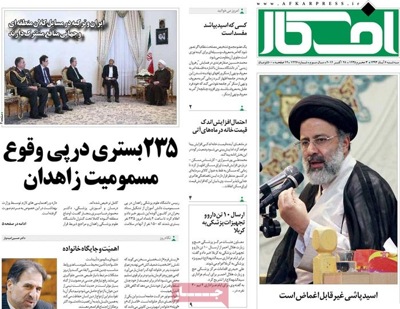
 

Afkar newspaper 10 - 28


Aftab-e Yazd: “One hundred minutes of anxiety and panic; Flight 550 of Aseman Airlines had a close shave. The Yerevan-bound Boeing 727 with 124 passengers and crew on board was forced to have an emergency landing at Tehran’s Mehrabad Airport 100 minutes into the flight in the early afternoon of October 27.”

Aftab-e Yazd: “Claims by principlists that the Supreme Cultural Revolution Council disapproves of Mahmoud Nili Ahmadabadi [President Rouhani’s pick for minister of science] are false.”
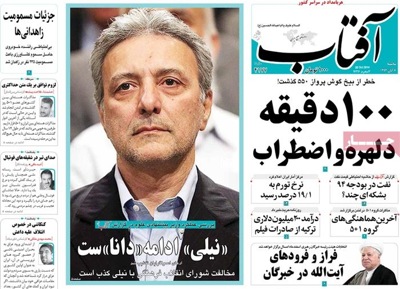
 

Aftabe yazd newspaper 10 - 28


Arman-e Emrooz: “Ten suspects have been taken into custody in connection with recent acid attacks.”
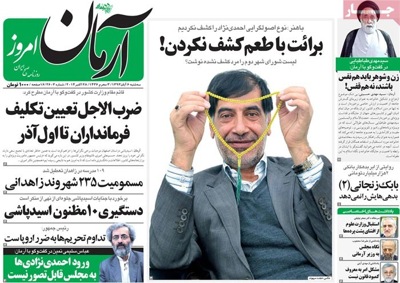
 

Armane emruz newspaper 10 - 28


Asia: “Iran has invited US automakers to take part in a second Iranian Auto Industry International Conference (IAIIC). Among other automotive giants, Mercedes, Volkswagen and Fiat have so far voiced readiness to attend.”

Asia: “Export and import permits will be granted with ease; with agents at ten fully-authorized customs offices across the country, hurdles will be cleared.”
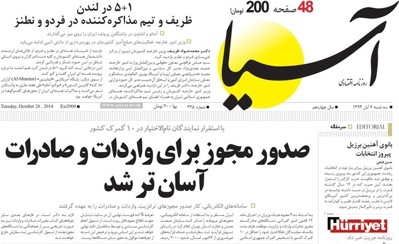
 

Asia newspaper 10 - 28


Asrar: “There has been tangible progress in expert-level talks between Iran and P5+1,” said an Iranian official.

Asrar: “A nuclear deal between Iran and P5+1 could be struck before the end of next month,” predicted President Rouhani.
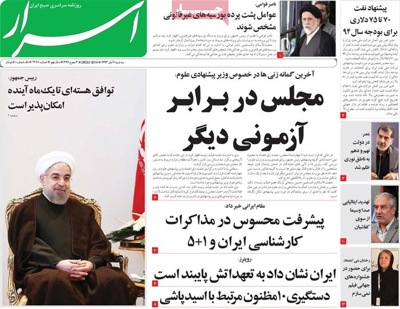
 

Asrar newspaper 10 - 28


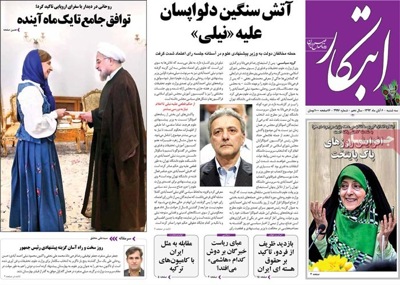
Ebtekar: “President Rouhani’s nominee to lead the Ministry of Science, Research and Technologyis coming under heavier fire as a vote of confidence by MPs approaches.”
 

Ebtekar newspaper 10 - 28


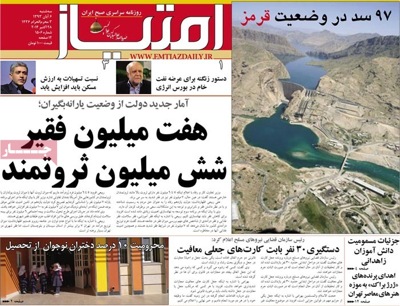
Emtiaz: “Ten percent of [Iranian] teenage girls do not have access to education.”
 

Emtiaz newspaper 10 - 28


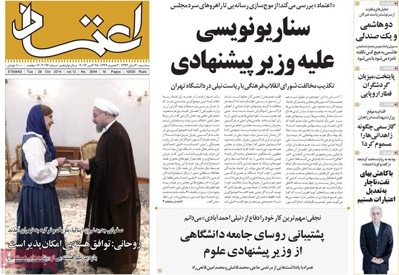
Etemad: “Ayatollah Hashemi has not told anyone whether or not he will field his candidacy for chairmanship of the Assembly of Experts [vacated after the passing of Ayatollah Mahdavi Kani],” said an official at the Public Relations Office of the State Expediency Council. Earlier, Ahmad Khatami, a principlist cleric, claimed that he had heard that Hashemi Rafsanjani was not going to run for the top job.”
 

Etemad newspaper 10 - 28


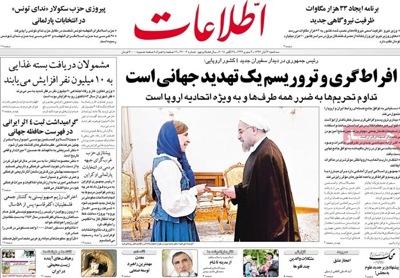
Ettela’at: In a meeting with the new Italian, Belgian, Norwegian, and Turkish ambassadors to Iran, President Rouhani underlined, “Continued sanctions will harm the interests of all sides, in particular the European Union.”

Ettela’at: “Dr. Mohammad Reza Omidkhah, an Iranian researcher and professor at the Department of Chemical Engineering at Tarbiat Modares University, has been recognized as a top international researcher.”
 

Ettelaat newspaper 10 - 28


Hambastegi: “We should make the most of the potential of social networks in our favor,” said Minister of Culture and Islamic Guidance Ali Jannati.

Hamshahri: “The second train carrying European tourists has arrived in Tehran.”

Hamshahri: “The production sector did not receive any share of the revenues raised by the Targeted Subsidies Plan between March 21 and September 22, 2014.”
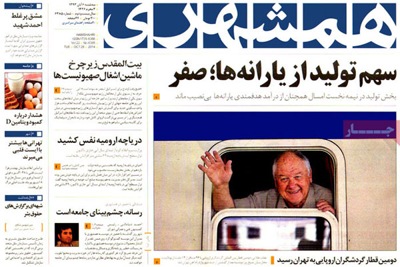
 

Hamshahri newspaper 10 - 28


Iran: “The knot over the rights to broadcast Premier League matches between national TV and Football Federation officials has yet to be untied.”
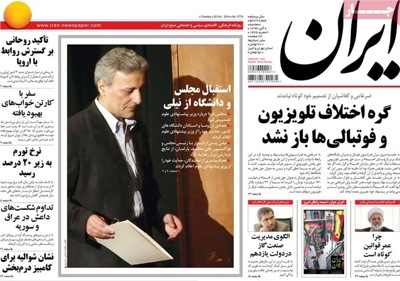
 

Iran newspaper 10 - 28


Iran News: “FM and nuclear negotiating team visit Fordo, Natanz sites.”

Iran News: “Austrian investors eyeing removal of sanctions to return to Iran market.”
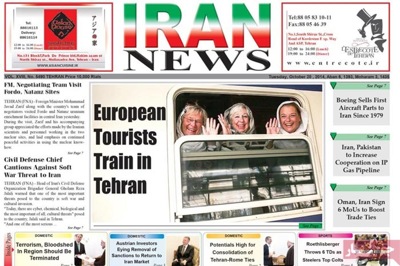
 

Iran news newspaper 10 - 28


Javan: “A plot to establish an ISIL Emirate in northern Lebanon has been foiled; ISIL terrorists suffered a heavy blow in Tripoli. Secretary General of Hezbollah Seyyed Hassan Nasrallah warned about the large-scale plot by terrorists in Tripoli.”
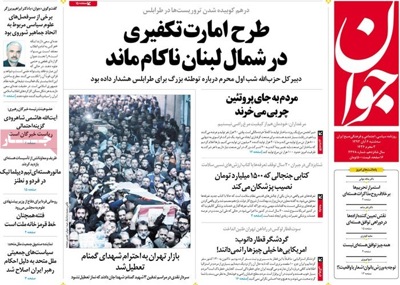
 

Javan newspaper 10 - 28


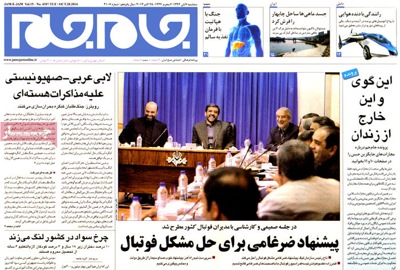
Jamejam: “An Arab-Zionist lobby against nuclear talks; hawks at Congress are sparking off a crisis.”
 

Jame jam newspaper 10 - 28


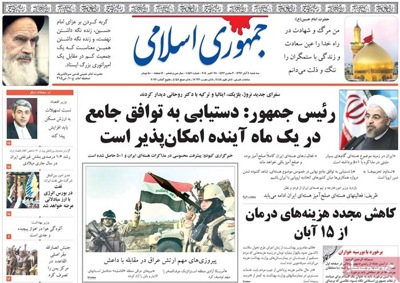
Jomhouri Islami: “Health costs will see another fall as of November 6,” vowed the deputy health minister.

Jomhouri Islami: “Air pollution in Ahvaz [capital of Khuzestan Province] is complicated and serious,” said Health Minister Seyyed Hassan Hashemi.

Jomhouri Islami: “Major victories of the Iraqi army in the battle against ISIL.”
 

Jomhurie eslami newspaper 10 - 28


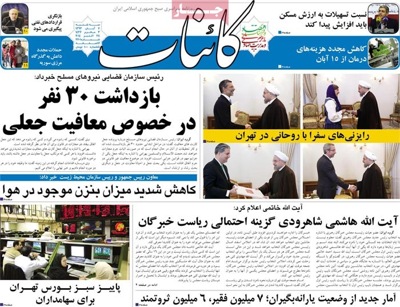
Kaenat: “Thirty people have been taken into custody in connection with the case involving fake military service exemption cards,” saidthe head of Judicial Organization of the Armed Forces.

Kaenat has quoted the director of the Environment Protection Organization as saying that the amount of benzene in the air has dropped sharply.
 

Kaaenat newspaper 10 - 28


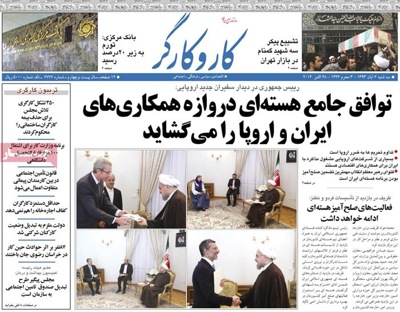
Kar va Kargar: “Iran’s peaceful activities will carry on,” said Foreign Minister Mohammad Javad Zarif during a visit to Fordo and Natanz nuclear facilities.
 

Karo kargar newspaper 10 - 28


Kayhan: “Liberation of Jurf al-Sakhar [southwest of Baghdad] during Ashura Operation has turned heads globally.” Iranian general Ghasem Soleimani is said to have played a key role in the operation.
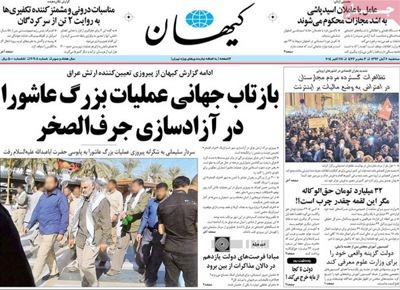
 

Kayhan newspaper 10 - 28


Qods: “Policies of United Nations Population Fund (UNFPA) in Iran have been modified in keeping with the guidelines issued by the Supreme Leader.”
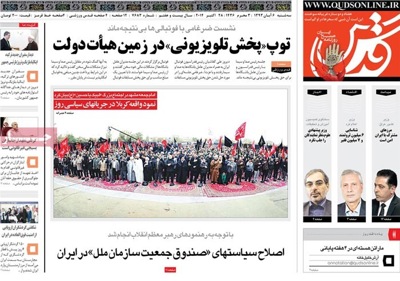
 

Ghods newspaper 10 - 28


Roozan: “Iranian expatriate investors have taken President Rouhani up on his offer; Capital of Iranian expats living in the UAE is en route to Arvand Free Zone.”
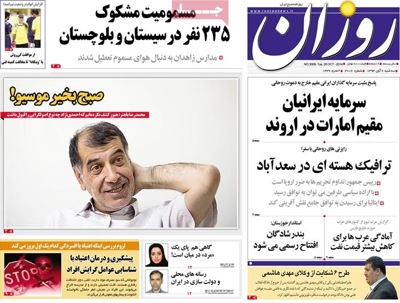
 

Ruzan newspaper 10 - 28


Sharq: “The suspects already arrested were not behind recent acid attacks,” said the provincial governor of Isfahan.

Sharq: “After two individuals filed complaints about the harmful effects of satellite-signal-jamming equipment, Tehran’s Prosecutorial Office stepped in to investigate the case.”
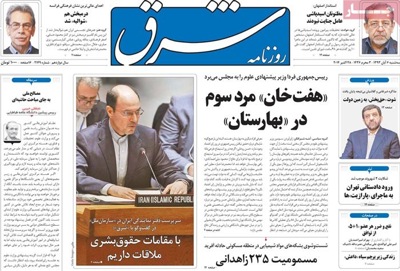
 

Shargh newspaper 10 - 28


SMT: The director general of the International Affairs Department at the National Iranian Oil Company says experts have suggested that next year’s budget be drafted based on oil prices of between $70 and $75 per barrel.
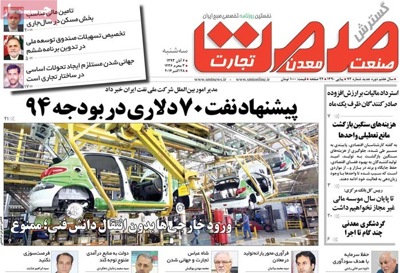

 

Samt newspaper 10 - 28


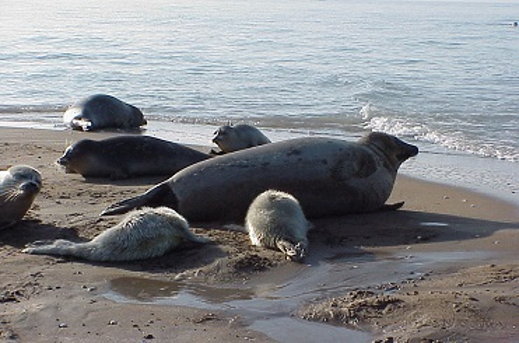
Iran calls on fellow Caspian states to help save Caspian seals

Iran caspian sea seals

Caspian seal, an endangered species in the world’s largest landlocked sea, is facing the threat of extinction due to excessive hunting.

Amir Sayyadi Shirazi, a veterinary expert, said in addition to global warming which is an environmental factor endangering the Caspian seal, “overhunting poses a grave threat to these animals. The safe places where seals give birth have been destroyed in Russia and Turkmenistan. Seal meat is used in fox-breeding farms in Russia and some Turkmen people believe that the fat under the seal’s skin is good for treating arthritis, which of course has no scientific basis.”

Shirazi criticized the Caspian littoral states for exploiting the Caspian environment and said, “We have formed a rescue group an objective of which is to enhance relations among countries in order to save the Caspian seal.”

“In 2008, a British organization estimated the number of seals in the Caspian Sea at 100,000,” he said, “but considering the drop in their ranks over the years, their number is predicted to be between 70 and 80 thousand now.”

“In Kazakhstan and Russia seal hunting licenses are issued, but we must prohibit hunting to preserve this endangered species,” said Vahid Kheirabadi, the head of the Wildlife Administration at the Department of Environment in Golestan Province.

“The Caspian Sea is shared among five countries and one country cannot deal with all the pollution issues on its own,” Kheirabadi asserted, “All five countries must cooperate to resolve these environmental issues.”

Lovely, Unique Wildlife of Iran’s Mazandaran Province

Lovely, Unique Wildlife of Iran Mazandaran Province

The news website of Iran Environment and Wildlife Watch has filed a brief report coupled with a photo gallery of wonderful wildlife in the northern province of Mazandaran on October 11. What appears below is the translation of the report:

Aside from mountaineering, Chakad, a group of young volunteer environmentalists, has been actively involved in helping environmental police ensure wildlife safety in the heights of the provincial capital of Sari since 2009.

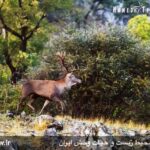
The group has made special contribution to the protection of the provincial wildlife during the mating season of red deer – between early September and late October. During this period male deer get involved in frequent territorial fights and make a sound like that of cows to attract female deer.

Because of the secretion of hormones during the mating season, red deer are less alert to threats, something which makes them more vulnerable to hunters. To hunt the animals, poachers lie in ambush and mimic the sound of male deer to lure the prey. As soon as the deer show up, poachers pull the trigger. Young male deer that are often defeated by their old rivals make easy targets for poachers, too. To protect the deer against poachers, the environmental police in the northern forests of Iran put up makeshift tents in crucial spots and step up efforts to shield deer from human threats.

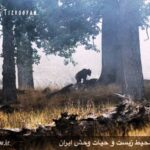
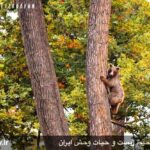
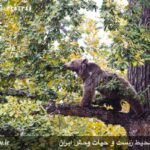
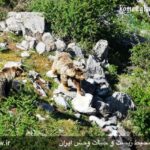
Apart from protecting the forests and mountain regions in Sari, members of this group – Komeil Ghasempour, Hamed Tizrooyan, Kaveh Ateni, Jaber Sabokrooh, and Mohammad Bozorgzadeh – have snapped beautiful and exclusive photos and shot videos of biological diversity and natural behavior of precious species like brown bears, red deer and roebucks.

What is special about the photos taken by this group is that it has used special techniques and invested a lot of time and patience to catch the animals unawares.

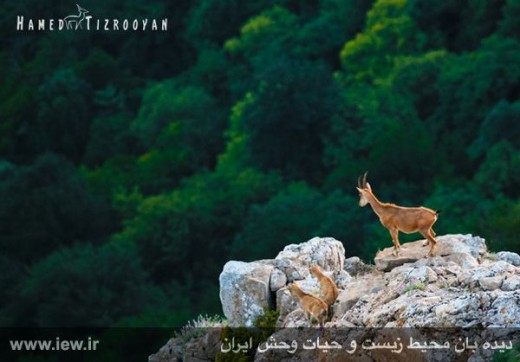
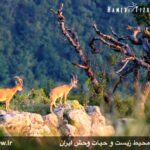
Among other photos below, you can see a young brown bear climbing up a tree to eat fruit, big and relentless male red deer during the mating season, a female wild goat and her kids standing on a rock in the heights, rare miniature deer of roebuck and bears which are peacefully asleep in the shade of a tree.

All the photos of this report were taken in 2014, mostly during the mating season of red deer.


Ayatollah Khamenei stresses unity among Muslim states

Iran-Leader
Iran-Leader

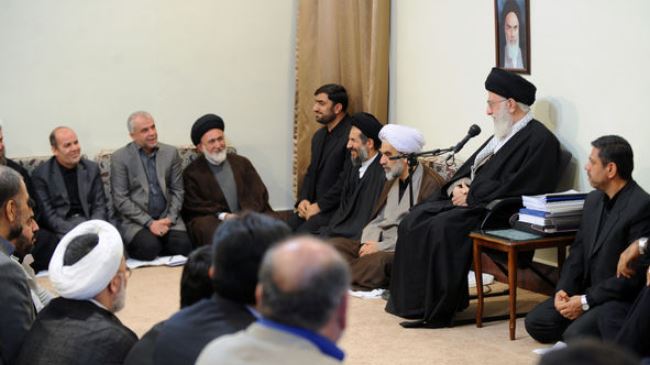
Leader of the Islamic Revolution Ayatollah Seyyed Ali Khamenei has underscored the need for unity among all Muslim countries amid enemy plots to create rift in the Islamic Ummah.

Addressing a group of Iranian Hajj officials in Tehran on Tuesday, Ayatollah Khamenei described Islamic unity as “the Islamic Republic’s fundamental slogan”, which means that Muslim states should set aside enmities and stand by each other in dealing with key global issues.

The Leader further described Hajj pilgrimage as an opportunity that must be seized in order to foil enemy plots, which are hatched to separate Iran from the rest of the Muslim world.

“Raising a barrier between the Islamic Republic [of Iran] and the rest of the Muslim world is one of the ploys [used by] the enemies of unity in the Islamic Ummah,” the Leader stated, adding that every Muslim is obligated to make efforts to help raze this “fake barrier.”

Ayatollah Khamenei also warned of false enemy propaganda aimed at spreading illusions about Iran and Shia Islam.

Rafsanjani denies reports he is unwilling to become chairman of Assembly of Experts

Hashemi Rafsanjani
Hashemi Rafsanjani

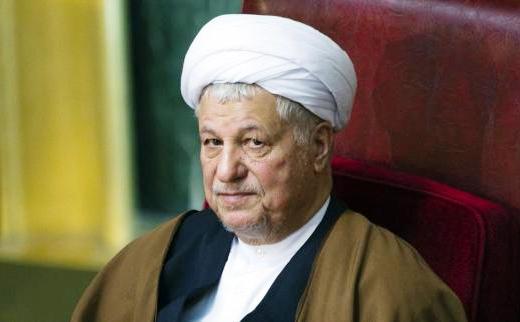
One day after Ayatollah Ahmad Khatami, an influential member of the Assembly of Experts, said Ayatollah Rafsanjani seems unwilling to take over as chairman of the assembly, Hashemi Rafsanjani, a former president who led the assembly until March 2011, said he would field his candidacy for the post if individuals he deem unfit for the top job threw their hats in the ring. The following is a brief announcement which appeared on the official website of Ayatollah Rafsanjani (hashemirafsanjani.ir):

A source close to Chairman of the Expediency Council Ayatollah Hashemi Rafsanjani has denied the statement of another member of the assembly [a reference to Principlist Ayatollah Ahmad Khatami] that Rafsanjani seems unwilling to run for chairman of the assembly.

“In response to a question as to whether he would run for the top job at the Assembly of Experts, Ayatollah Rafsanjani has simply said, ‘In case individuals I deem unfit make a run for the chairmanship of the assembly, I would field my candidacy too,'” the source said.

[The top job at the Assembly of Experts was vacated last week when Ayatollah Mohammad-Reza Mahdavi Kani passed away after slipping into a coma in early June.]

Two key capital owners whose biggest asset is the trust of a nation

Haft-e Sobh-Zarif-Soleimani

In an article on October 21, Haft-e Sobh, a Tehran-based daily, described Foreign Minister Mohammad Javad Zarif and Ghasem Soleimani, the commander of the Quds Force, a division ofthe Islamic Revolution Guard Corps, as the biggest capital owners of the country. The following is the translation of the article by the daily’s Kamal Bordbar:

These two individuals are the biggest capital owners in Iran. At an important juncture in the history of the region when all neighboring countries are grappling with war and unrest and Iran is subjected to all kinds of foreign threats, these two individuals who reflect the diplomatic potential and the military prowess of the nation are accumulating their capital by the day.

The representatives of these two important state institutions – the diplomacy machine and the military – did not have this much capital for years. The capital in question does not come in the form of dollars or oil. It is made of trust, unprecedented social trust which is building around these two representatives of our nation on the international stage at a time when the region is going through tough times.

One year ago when Mohammad Javad Zarif started running the nuclear marathon his optimistic assessments about the talks and the unraveling of sanctions drew pessimism from principlists and those who adhered to the faith more strictly. But the middle-class was expecting this mild-mannered, active man to pave the way for more acceptability of its ideas on the international stage.

On the other hand, principlists, radicals and more religious strata of society pessimistically sought traces of compromise in the way Zarif handled the talks. The telephone conversation between Presidents Rouhani and Obama and images of Zarif smiling next to [US Secretary of State] John Kerry deepened that pessimism.

With the Syrian war flaring up, the middle-class supporters of Zarif looked on, in a way that was anything but confident, as Iran helped keep Bashar al-Assad in power. Regional and Western media propaganda depicted the opponents of Assad as selfless freedom-fighters who were putting their lives on the line for the liberation of their country. They also alleged that for totalitarian reasons Iran was cooperating with Russia and China to help Assad hold on to power.

It came as the principlists and orthodox Muslims were eagerly following news about the resistance Lebanese Hezbollah put up and the role Iranian Quds Force advisers were playing in relieving key Syrian cities under siege. Back then the line of diplomacy which was led by a hardworking diplomat who smiled readily and the military line led by a mysterious general were diverse. It seemed that social gaps in Iranian society were nowhere near closing and new excavations had widened the gap between the two groups.

One year on, things have changed. The same regional developments which were supposed to weaken Iran have resulted in unbelievable convergence. ISIL’s invasion of Iraq and animosity between Iranian society and this stone-hearted group which was the most powerful of three aligned against Assad spelled an end to illusions.

The freedom-fighters of the past were now a bunch of brutal beasts that readily beheaded and maimed humans. They used different methods to show the grudge they held against Shiites and even Iranians. When ISIL captured Jalawla, Iraq and positioned itself 40 km from the Iranian border, the same pessimistic middle class began to appreciate the international arm of the Islamic Revolution Guard Corps and the pacifying role of the white-haired general: Ghasem Soleimani.

That even shed light on the fact that Hezbollah was different from other militant groups in the region. That was how Soleimani secured the trust of new sections of society. That trust was not simply placed in him, but in the troops he commanded. And praise for his role began to pour onto social networking sites and peaked.

On the other hand, the skipper of Iran’s diplomacy ship proved that at critical moments in negotiations he would not submit to blackmail. The tireless diplomat emerged from one meeting only to go into another and put on the same smile, but his words were now tinged with traces of doubt and pessimism. He was now trying to counter the diplomatic attacks and saber-rattling of the other side. Those doubts which centered on the intentions of the Western side stemmed from his knowledge about what the other party had in mind.

Zarif and his men developed an increasingly coherent approach and cleared themselves of accusations they were too lenient. That was how the more religious stratum of society set aside the pessimistic lens through which they had always looked at this cheerful diplomat and concluded that the top diplomat and his men had no intention of selling Iranian national interests short.

At the same time the middle-class that supported Zarif realized that Iran had done nothing to push the nuclear talks into a deadlock. Other factors played a role in this gradual convergence too. The decline in the grandeur of Turkey, which depicted itself as an example of modern Islamism for years and a duplicate of Iran’s Islamic society, helped expedite the convergence in the country.

Turkey’s policy to help ISIL and its hypocritical indifference to the massacre of the Kurdish minority in Iraq and Syria at the hands of ISIL, coupled with its deadly crackdown on Kurds which left 33 people dead, revealed the unseen angle of Turkey’s Islamic liberal democracy in the court of public opinion in Iran.

This gradual, mild convergence has not remained hidden to others. There are still some media outlets overseas that put the slightest display of divergence in an ideological light and play up differences.

There are some quick-tempered radicals who pay no heed to the convergence that has formed in the country and to the critical stage the region is going through. They insist, with their trademark inconsiderateness, on ideological differences and describe any civil action as a conspiracy. Their reaction to the likely reasons behind what happened in Isfahan [a recent spate of acid attacks on women in this central city] was one such example. It was similar to their reaction last year to what was probably a mistake on the part of a famous elegist.

Developments overseas and the competence of our representatives on various fronts should be credited for convergence in our society and the unprecedented accumulation of social capital at home. Still, some foreign media and some at home are resorting to differences to beat the drum of division.

Back to the protagonists of our story: At a time when the region is witnessing bloodletting and war, these two men enjoy unprecedented popular support. On diplomatic and military fronts, these two individuals are representing the dreams of millions of Iranians to make the world a better place.