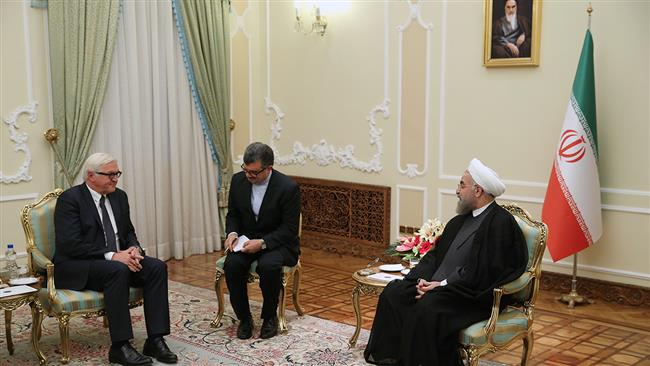
The German foreign minister has said that his Tehran trip carries one key message: the world is seriously pursuing efforts to terminate sanctions against Iran.
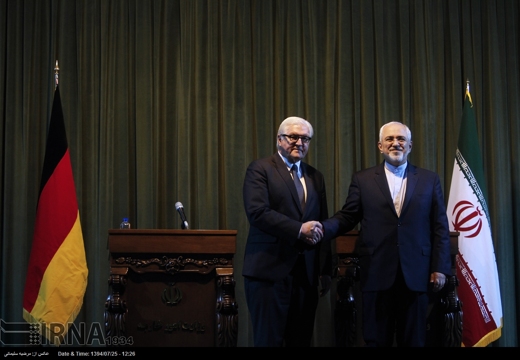
Foreign Minister Frank-Walter Steinmeier arrived in Tehran on Saturday to talk with Iranian officials about the outlook of Iran’s ties with the world after the Joint Comprehensive Plan of Action (JCPOA) and Berlin-Tehran ties. Prior to his trip he said in an exclusive interview with Iran newspaper on Friday that by clinching the Iran nuclear deal, all negotiating countries showed they have the political will to end the nuclear dispute and open a new chapter in their ties. The following is the translation of the interview in its entirety:
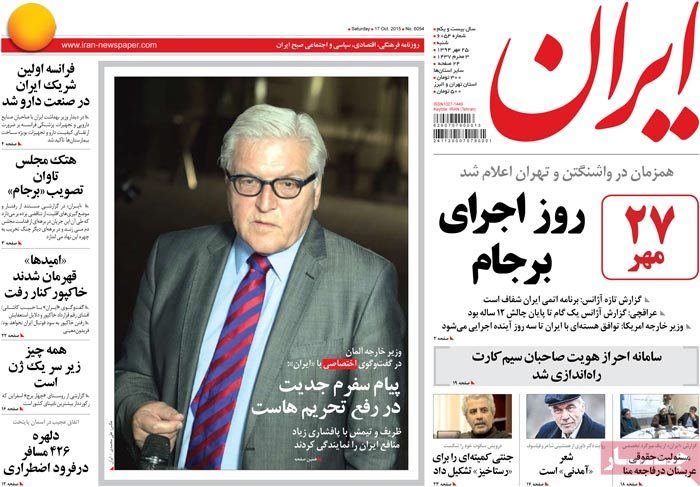
Q: Has a new chapter opened for Iran and Germany in their diplomatic ties?
A: This is the first official visit of a German foreign minister to Iran in more than ten years. There is a long list of issues the two sides can talk about, among them: implementation of the Vienna nuclear accord, exchange of political viewpoints, boosting economic ties and developing cultural exchanges. We have opened talks on a cultural agreement. A quick breakthrough can signify that we are seeking to build our ties based on new, bigger foundations.
More than anything else, I hope we can make progress on the ways to reduce conflicts in Syria, Iraq, Yemen and Afghanistan which pose a threat to the stability of the entire region and have resulted in the biggest refugee crisis since the Second World War.
Germany has assumed a heavy responsibility in accepting refugees and offering humanitarian assistance [to stricken people]. Iran which holds political sway in the region has a great responsibility to find a solution to serve the interests of peoples. We believe peaceful coexistence with all neighbors, Israel included, are in line with such coexistence.
Q: German Vice Chancellor and Minister for Economic Affairs and Energy Sigmar Gabriel was the first Western official who came to Tehran after the Iran nuclear deal. Does it mean that German officials attach special significance to economic ties with Iran?
A: With no doubt! Iran and Germany have many things, including on the economic front, to exchange. You can find very few countries in the world whose survival is as much tied to global trade as Germany. Like in the past, the German companies are popular in Iran. A number of German firms had a strong position in and close trade ties with Iran before the nuclear dispute emerged.
Naturally after years of inactivity caused by the nuclear dispute, the German industries are very much interested in reviewing the opportunities that will arise in post-sanctions Iran. We also wanted to convey this message: We are determined to lift the sanctions. If Iran keeps its side of the bargain, the economic situation will rapidly and remarkably pay off and this will set the stage for the revival and improvement of economic relations.
Q: Prior to the Iran nuclear deal, the German Chamber of Commerce and Industry predicted that the volume of Berlin-Tehran trade transactions will reach €12 billion in a year after the conclusion of a nuclear accord, with German imports from Iran accounting for half of that volume. What are Germany’s main imports from Iran and where does oil stand in your country’s imports?
A: Today Iran’s exports half of what it used to send to global oil markets before the introduction of sanctions. We know that speedy modernization of the oil sector is of great significance to Iran so that it can export more oil and boost what lies at the core of its foreign revenues. That’s why Iran is trying to take in foreign investment, including from Germany. I think it would be more sensible for Iran to diversify its economy. I believe in addition to [different] forms of energy, the German market can absorb other [Iranian] products and services.
Q: Tehran is interested in foreign investment and imports of technology. What areas are the Germans more interested in when it comes to investment and technology transfer?
A: During a recent visit to Bonn, an Iranian deputy oil minister put the estimated volume of investment needed in the oil sector alone at €100 billion. A large number of medium- and large-sized German firms are interested in using their experience and capital to get involved in this sector in the long run. Clearly, the stage should be set for investment, but I see enormous potential for cooperation in this sector.
German firms want long-term involvement; they are not fixated on short-term profits. That is why they want stability and legal guarantees for investment. Iran is interested in developing renewable energies. As you know Germany’s energy transformation project has given it a pioneering position. In fact, German companies are at the forefront of renewable energy technology in the world. Besides, development of transportation infrastructure will be of great importance. Economic growth requires modern transportation modes compatible with modern needs.
Iran also needs to be connected via land, sea and air to continental transportation corridors. German firms have good experience in this regard.
Q: Can the settlement of Iran’s nuclear case through dialogue serve as a model for solutions to regional crises involving warring parties and big powers?
A: The Vienna accord revealed one thing, to say the least: in our time and in the world’s crisis-hit regions, diplomacy can settle the disputes through peaceful means and work out ways to compromise, even in a place where two distrustful, hostile sides [of the conflict] have lined up against each other.
Nuclear talks demonstrated that a framework such as E3+3 helps – if parties involved show willingness – to leave behind the deep political divisions among different players and focus on common interests. We jointly decided in New York to hold talks with Iran on regional issues within the framework of E3+3.
Whether and how this model can be used for other disputes cannot be determined now. But what is certain is the fact that the region urgently needs mechanisms to facilitate dialogue between warring parties and pave the way for peaceful solutions to the disputes.
When the Munich Security Conference Core Group Meeting is held for the first time in Tehran on Saturday, we will raise the same issue. The MSC Core Group Meeting which is a unique meeting of its kind will bring together representatives of governments and security experts from around the world.
The Syrian crisis has turned into a crisis of attrition in the region whose impacts can be traced to the waves of the Syrian refugees who are fleeing to European countries, including Germany. The influx of the refugees has made Europe more determined to solve the Syrian crisis.
Q: Where does Germany stand when it comes to Iran’s participation in international efforts to take on ISIS?
A: It is no secret that Germany and Iran do not see eye to eye as far as the Syrian question is concerned. Nonetheless, we all need to pursue one common goal: bloodshed should come to an end and Syria should survive as a country in which people from all ethnic and religious background can one day live together. But this will not become a reality as long as the main players [in the crisis] simply stress military solutions.
I wish Iran tapped into the influence it holds and made the Syrian government come to the negotiating table so that the country can enter a political transition period. We can successfully take on extremist ISIS terrorists – who grow amid the chaos by the day like a cancerous tumor – when we can bring fratricide in Syria to an end.
The most urgent thing [we can do] for the Syrian people is that decisions of the UN Security Council on the protection of civilian lives can be finally enforced. When cluster bombs and artillery attacks against residential areas are stopped, relief workers can be easily dispatched to all regions [in that country]. We can also properly tap into Iran’s assistance in this regard.
Q: What are the main reasons behind the breakthrough that was produced in nuclear talks?
A: The two sides were distrustful of each other at the beginning of the talks and they were deeply divided over core issues at the negotiations. It was important to create a win-win situation. The two sides reached a political agreement that it was possible to arrive at a deal which could serve the interests of all sides. The international community was seeking guarantees that Iran was not moving toward developing a bomb and Iran wanted to see the back of sanctions and a better prospect for its non-military atomic program.
When an agreement serves the interests of the two sides, diplomacy can step in and work out a solution in a calm atmosphere, even when the two sides do not trust each other or show hostility toward each other. That’s why I am hopeful that we can overcome other crises in the region. To that end, more than anything else we need political farsightedness, courage and an insight that [resorting to] war and violence and relying on military solutions will bring neither peace nor stability anywhere, even in Syria.
Q: What do you think the challenges would be in the way of implementing the joint executive plans? Are you optimistic about compliance by the two sides with the agreement?
A: By the Vienna accord, all negotiating countries – especially the United States and Iran – proved that we have the political power and will to terminate the nuclear dispute and open a new chapter in ties between our countries. Another point which makes me even more optimistic is that all sides have remained committed to the Geneva Statement for about two years.
Honesty propels me to add this: the real test has yet to come. As of Sunday, the basic rules of the Vienna accord are officially put into force. A few months after the two sides openly honor their commitments in practice, we can say that the Vienna accord has been a success. It is now Iran’s turn to meet the conditions the two sides agreed on for lifting [Iran] sanctions.
Q: How do you evaluate the performance of FM Zarif and Iran’s nuclear team in the talks?
A: Javad Zarif is a tough negotiator. It would not be an enjoyable task to want to sell him a second-hand car, but toughness alone is not an art and does not lead to success. The outstanding achievement of Zarif and his team was that they insistently represented Iran’s interests. At the same time, they were insistently looking for solutions acceptable to both sides.
Another factor which contributed to a breakthrough in the talks was that since the fall of 2013 we were of the belief that – even during the toughest conditions – that the other side [Iran] is honestly willing to reach an agreement.
Q: Germany played a key role in reducing differences and the conclusiveness of the talks. As a person who was present during most of the meetings, when do you think the hardest times were, the time when the negotiators faced tough times and the risk of failure threatened the talks?
A: Trust cannot be built overnight. It takes time. We sat together for weeks in Geneva, Lausanne, Vienna and elsewhere and we often held talks into the wee hours to exchange our viewpoints. As you may know, some records were broken during the nuclear talks.
It is no secret that finding a solution to [the question of] uranium enrichment was the result of tough talks. The same thing holds true about transparency measures. All commitments under the deal should be verifiable. These are the two issues we spent hours to hammer out in Lausanne. In the end, we managed to work out a solution acceptable to all parties.