Thursday, January 1, 2026
Home Blog Page 4688

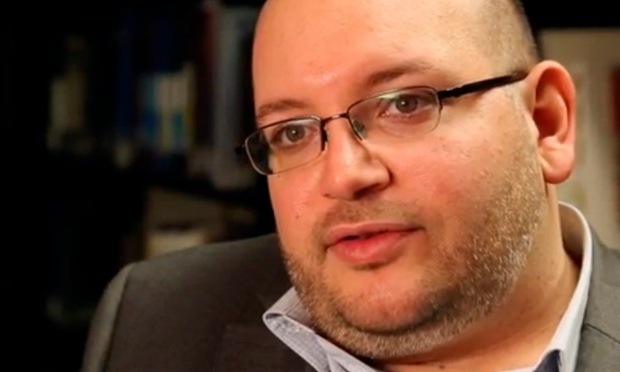
Jason Rezaian sentenced to jail in Iran

Jason Rezaian

Iran’s Judiciary says The Washington Post reporter, who is in detention for spying among other charges, has been sentenced to imprisonment.

“Jason Rezaian’s verdict has been issued, but he has not been formally notified of it,” Gholamhossein Mohseni Ejeie, the spokesman for the Judiciary, said on Sunday.

The official added that the verdict includes prison term, saying he could not reveal the details of the ruling.

The 39-year-old Iranian-American faced charges of “espionage, collaboration with hostile governments, gathering classified information and spreading propaganda against the Islamic Republic,” his lawyer Leila Ahsan said.

The Post correspondent, who had been working for the paper in Tehran since 2012, was arrested on July 22, 2014 along with his wife, Yeganeh Salehi, and a female photographer. The women were released on bail in October 2014.


Terrorist crimes have nothing to do with Islam: Leader

Leader

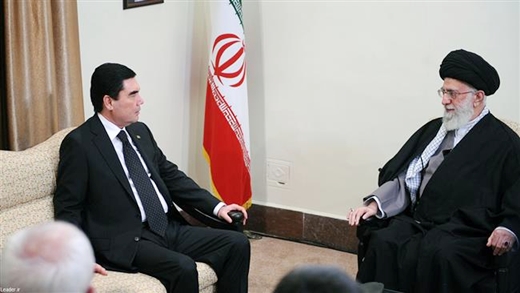
Leader of the Islamic Revolution Ayatollah Seyyed Ali Khamenei says the atrocities committed by Takfiri terrorists have nothing to do with Islam.

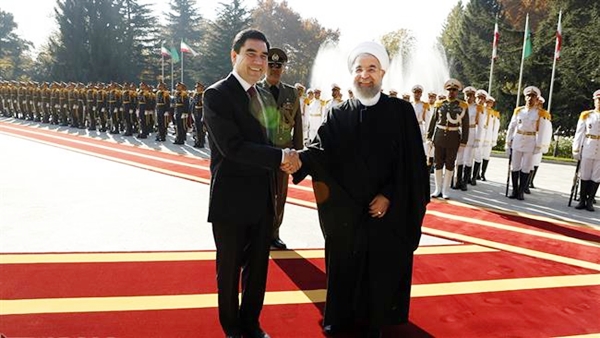
The Leader made the remarks in a meeting with visiting Turkmen President Gurbanguly Berdimuhamedow in Tehran on Sunday.

Ayatollah Khamenei said the terrorist groups’ savage crimes, such as beheading and torching people, show that they know nothing about Islam, noting, “Islam is the religion of fraternity, kindness and seeking the best for others and these crimes have nothing to do with Islam.”

“In countering the violent terrorism and barbarism [committed] by Daesh [IS] and like-minded Takfiri groups committing these crimes in the name of Islam, people should be given the chance to practice rightful Islamic activities,” said the Leader.

The best way for blocking the infiltration of the Takfiri currents, the Leader said, is to bolster genuine Islamic ideologies, which he described as “moderate and sensible.”

Ayatollah Khamenei also described the nations of Iran and neighboring Turkmenistan as close relatives and underscored the need for the two countries to take “effective and practical” steps with a view to implementing bilateral agreements.

The Leader underlined the necessity for Iran and Turkmenistan to further cooperation amid tense conditions prevailing in the region.

“Iran-Turkmenistan border are frontiers of peace and calm, and are reason for the two sides’ peace of mind and the possibility of using the Iran route for access to the Persian Gulf and high seas is a valuable opportunity for Turkmenistan,” said Ayatollah Khamenei.

For his part, the Turkmen president described as unfavorable the ongoing political conditions in the region and noted that Daesh and its followers are foreigners to the teachings of Islam. He expressed regret that certain governments are supporting the Daesh terrorists.

Berdimuhamedow also expressed delight with his meeting with Ayatollah Khamenei, saying Iran and Turkmenistan maintain historically good ties.

He welcomed Ayatollah Khamenei’s description of Iranian and Turkmen nations as close relatives and said the implementation of the recommendations of the Leader during previous visits have born fruitful results.

The Turkmen leader also said that some countries are interested in becoming linked to high seas through Iran and Turkmenistan.

The Turkmen head of state had last met with Ayatollah Khamenei during a 2012 visit to the Islamic Republic.

Gurbanguly arrived in Tehran earlier in the day on a visit aimed at boosting the bilateral ties.

So far during the visit, Iran and Turkmenistan have signed nine memorandums of understanding for the expansion of cooperation in different fields, including the health and medical sector, media, power transfer, sports, transportation, and housing.

During his stay, the Turkmen president is also to attend the third Gas Exporting Countries Forum (GECF) summit, which is to be held in the capital on Monday, with nine heads of states, including Russia’s President Vladimir Putin in attendance.

The West made a strategic mistake: promotion of a fake Islam

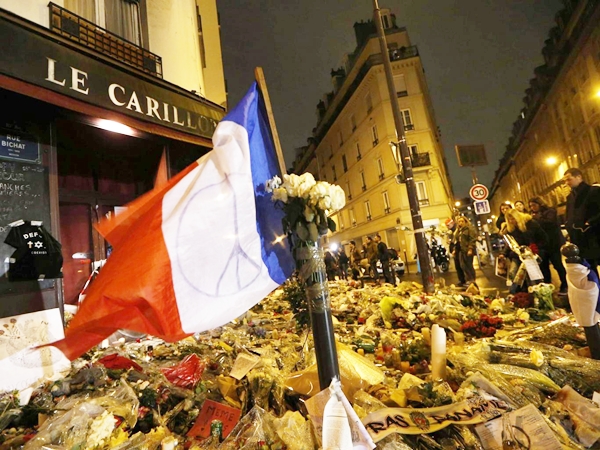
Paris-attacks-web

An Iranian expert says that the Europeans have tried in recent years to stop the spread of Islam by painting a frightful picture of it. To that end, he says, they have introduced a violent and horrific version of Islam [and a negative image of its followers] through a media blitz.

Mohammad Esmaili Dehaghi Mohammad Esmaili Dehaghi made the comment in an opinion piece published by Tasnim News Agency on November 21 on the Paris terror attacks and its aftermath. The following is the translation of part of that piece:

After the identity of those behind the multiple terror attacks in Paris was established, it was revealed that some of the perpetrators are of European background. This shows one key point: The West has ignored one unavoidable reality, something the Western leaders have overlooked so far.

The strategic mistake the West has made comes from its miscalculation of the way it should deal with growing Islamism. The West has played a [dangerous] game which has eventually threatened the security of Europe.

In recent years the Europeans have tried to stem the spread of Islam by frightening people from Islam. To reach their goals, they have launched a media campaign and presented a violent and scary reading of Islam [and identified its followers as violent and dreadful]. What they’ve done is known as Islamophobia about which hundreds of articles have been penned.

By the same token, scores of films, TV series and propaganda packages including graphic designs, caricatures and far-from-reality reports which center on Islamophobia were made with which the readership is sufficiently familiar.

By launching such poisoned media blitz, they expected to see people turn their back on Islam and the spread of Islam halted. Unfortunately their propaganda campaign did work to a great extent and somehow slowed down the growth of Islamism in Europe.

But in practice, these poisoned propaganda bred yet another incident: criminals and murderers embraced the fake Islam the West propaganda machine had introduced.

[…]

Following the release of images featuring the details of crimes committed at the hands of Takfiri groups in Syria and Iraq, the European citizens who had been interested in such groups started to [leave their homeland to] join the [terror] groups. Perhaps today we would not have witnessed incidents like what played out in Paris, if the European leaders had done something to bring back their nationals [after they were recruited by ISIS] instead of adopting a double-standard approach to terrorism.

To put it simply, I should say that Europe has no way out but to choose one of these two options sooner or later:

First, Europe has to accept the continuation of Islamophobia and reverse propaganda which will lead to the recruitment by the Takfiri groups of criminals and killers, and as a result the repeat of terror attacks in Paris and Turkey.

Second, Europe should admit its past propaganda mistakes and introduce the real Islam, something which will bring to an end the joining of violence seekers to the Takfiri groups. As a matter of course, when the real Islam is introduced to nations, Islamism will grow among people in Europe because the genuine Islam by itself is a messenger of peace and friendship among nations.

It is worth mentioning that the central theme and the original content of Islam are so much attractive that the entire Arabian Peninsula warmly welcomed Islam after the holy Muslim Prophet set out his mission and the divine faith was rapidly promoted in the world. It all happened in a short period of time when there was no Internet or other forms of communications.

If seems logical if the European leaders inevitably try to protect the lives of their citizens and ensure the security in their continent by choosing the second option: introduction of the real Islam. [They are expected to make a good choice], but the Zionist lobby and its deep-rooted enmity toward Islam is highly unlikely to let the European leaders make such a decision.

Man kicks habit, employs former peers

Mohammad-S-0

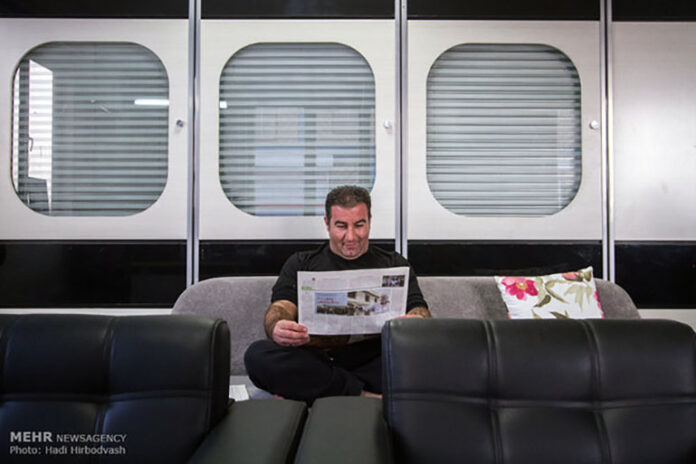
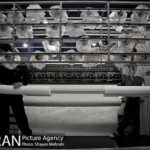
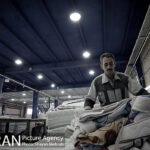
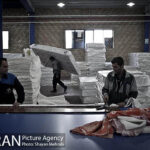
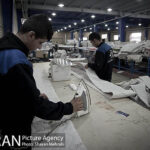
Mohammad Saghafi owns a mattress company in which former drug addicts account for up to 90 percent of staff.

By his own account, Mohammad began smoking at the tender young age of nine. At 12 he first experienced opium and was a regular meth user between 2001 and 2009. Today is at the helm of a high-flying company.

The following is the translation of a report Mehr News Agency has filed on the successful entrepreneur:

It was after kicking the drug habit that Mohammad Saghafi started a new life. Expanding the small workshop his brother owned was the most momentous happening in his life. “Soon after quitting drugs, I busied myself with work. In a short period of time, the workshop’s staff of 10-156 workers swelled to 150. In two years, the once-small workshop joined the list of the country’s top mattress brands. We launched a furniture line too.”

Staff is what distinguishes their plant from others. “More than 90 percent of workers in the plant have a past like me: those who were at the end of their rope because of addiction. I did what I did because we were in the same boat.”

Mohammad has been clean for six full years. He works full time running the business which employs former rough-sleeping addicts. He leads a very happy life with his wife and three daughters.


Iran, Turkmenistan sign 9 memorandums of understanding

e062e630-a1c6-4811-859d-5dbff9a19cc3

Iran and Turkmenistan have signed nine memorandums of understanding for the expansion of cooperation in different fields.

The agreements were signed in Tehran on Sunday in the presence of President Hassan Rouhani and his Turkmen counterpart Gurbanguli Berdymukhamedow, who arrived in the capital earlier in the day for the third summit of the Gas Exporting Countries Forum (GECF).

Iran’s Minister of Health Hassan Ghazizadeh Hashemi and his Turkmen counterpart, Nurmuhammet Amannepesow, inked an agreement to boost bilateral cooperation in the health sector.

Iran’s Minister of Communications and Information Technology Mahmoud Vaezi and his Turkmen counterpart, Bayramgeldi Owezow, signed an agreement for the expansion of postal services between the two countries.

The director of the World Service of Islamic Republic of Iran Broadcasting (IRIB), Mohammad Akhgari, and head of Turkmenistan’s state-run radio and television, Maksat Altayev, inked an agreement to boost cooperation in the field of media.

Under the agreement, the two countries will exchange radio and television products, produce new items, and participate in media events.

The other agreements covered power transfer, sports, transportation and housing.

Migratory birds arrive in northern Iran (PHOTOS)

Migratory birds0

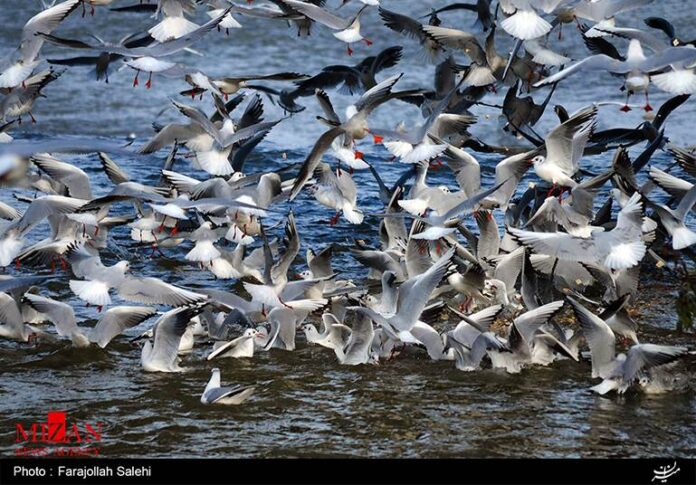
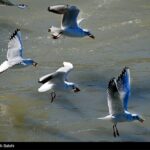
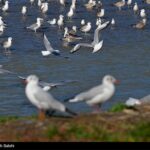
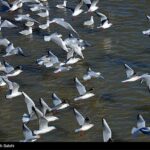
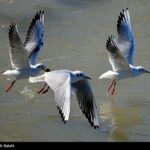
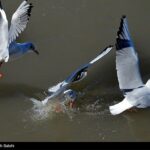
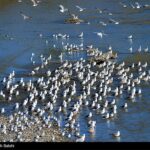
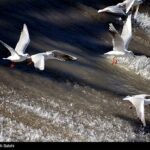
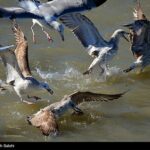
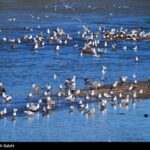
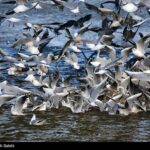
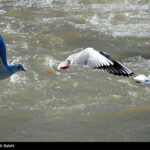
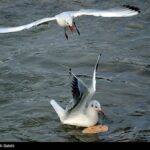
Over 4,000 migratory birds call the Cheshmeh Kileh River in the northern town of Tonekabon, in Mazandaran Province, their winter home.

The migratory birds arrive from Siberia in autumn to spend the winter in northern Iran which has milder weather.

The following images of the migratory birds have been released by mizanonline.ir:

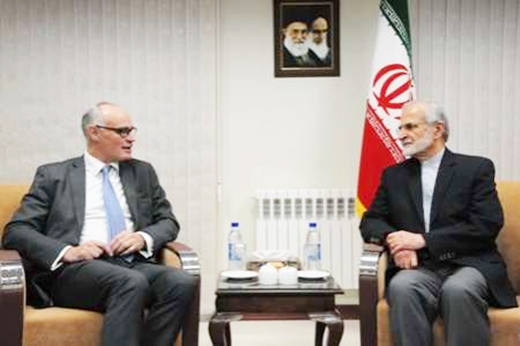
Kharrazi: West needs to get familiar with real Islam

Kharrazi

The West needs to be familiarized with real Islam, not what the extremist groups, which are supported by some regional countries, are portraying, said the head of Iran’s Strategic Council on Foreign Relations.

“In order to confront the terrorism Europe faces, the first step is to cut off the financial and military aid provided to the terrorists by certain regional countries,” Kamal Kharrazi told visiting Chairman of the British Parliament’s Foreign Affairs Committee Crispin Blunt on Saturday.

Blunt accompanied by a British parliamentary delegation is in Tehran on a three-day visit.

“Certain countries follow a strategy of promoting Wahhabism in other countries by establishing religious schools that brainwash young people, especially in poorer nations,” Kharrazi said, adding that such institutions should be banned.

Many graduates of these religious schools are under the influence of Wahhabism, as is the case with many terrorist groups operating in the Middle East today, he said.

Kharrazi said that Western countries have turned a blind eye on such activities.

“These activities have created instability in the region and other parts of the world, including in Europe,” he added.

For their part, members of the British parliamentary delegation hailed the nuclear deal between Iran and P5+1, expressing hope that the agreement could pave the way for further expansion of ties between the Islamic Republic and the West.

A look at Iranian newspaper front pages on Nov. 22

Iranian Newspapers Headlines

Comments by Foreign Minister Mohammad Javad Zarif – at a ceremony to mark the anniversary of the UN – that the two recent UN resolutions against Iran were among the bitter comedies of our time made front page headlines in Iranian newspapers on Sunday. The Iranian dailies also gave coverage to a ministerial meeting of the Gas Exporting Countries Forum and Iran’s proposals for the global energy markets.


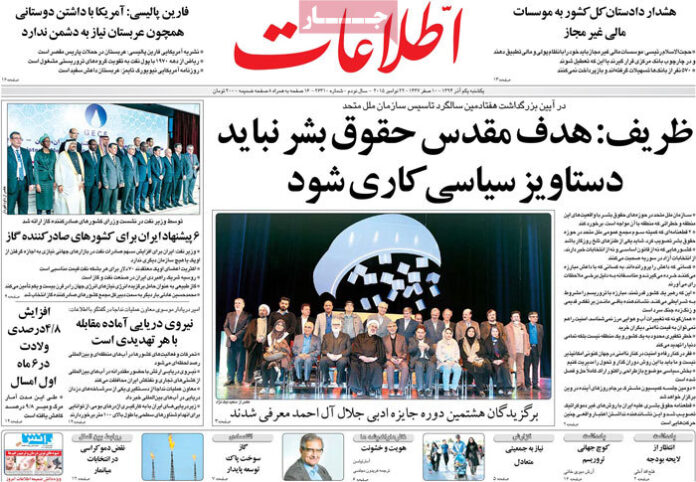
Ettela’at: The holy objective of human rights should not be used as a tool for political purposes, said the foreign minister at a ceremony in Tehran to mark the 70th anniversary of the United Nations establishment.

Mohammad Javad Zarif further said that a rights resolution against Iran was approved through undemocratic methods, adding this shows such measures lack credibility.
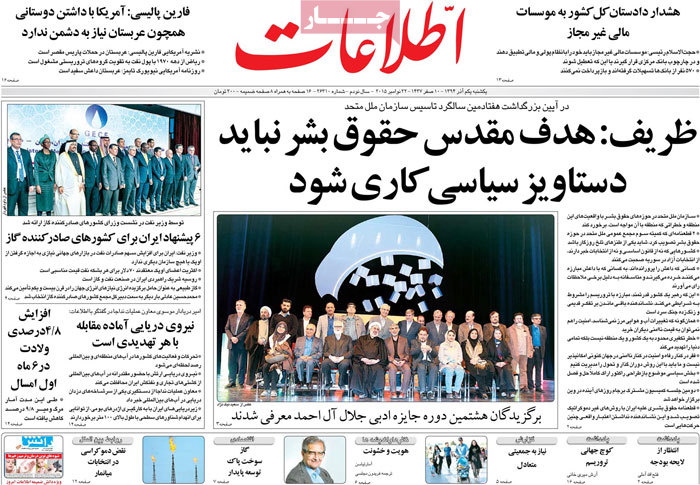
Highlights of Ettela’at newspaper on Nov. 22

A look at Iranian newspaper front pages on Nov. 22


Abrar: Rouhani will host seven presidents in Tehran [in the summit of the Gas Exporting Countries Forum on Monday].
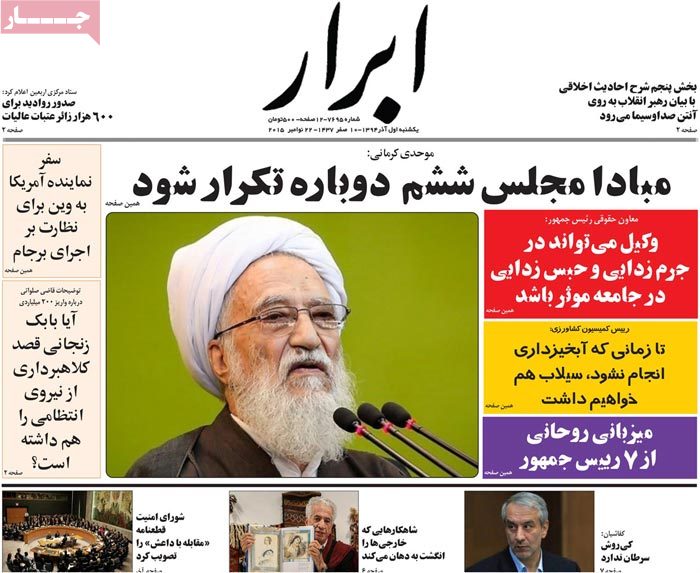
 

A look at Iranian newspaper front pages on Nov. 22


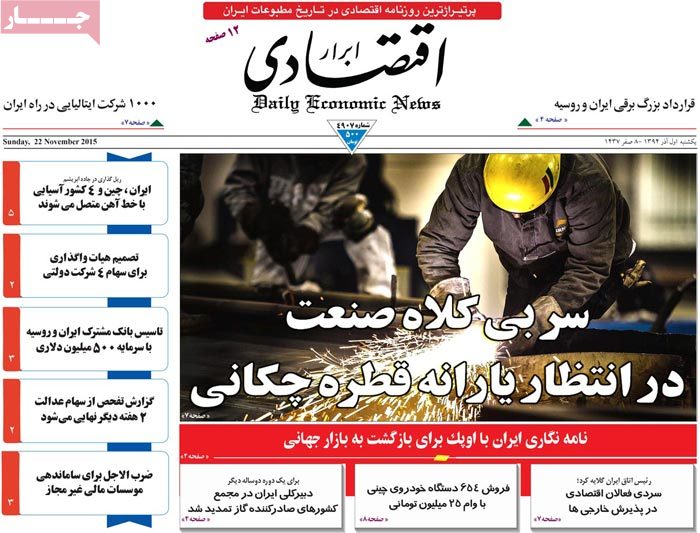
Abrar-e Eghtesadi: Iran, China and four Asian countries will be connected via rail along the ancient Silk Road.
 

A look at Iranian newspaper front pages on Nov. 22


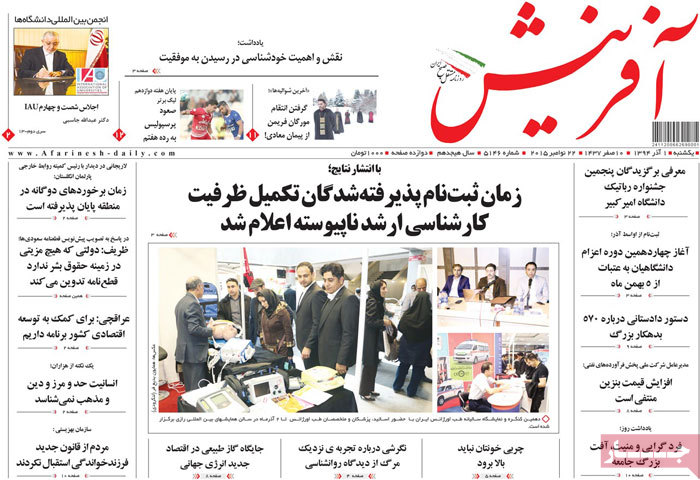
Afarinesh: The time has come to an end for adopting double-standard policies on the region, said Speaker Ali Larijani in a meeting with the chair of the UK Parliament’s Foreign Affairs Committee.
 

A look at Iranian newspaper front pages on Nov. 22


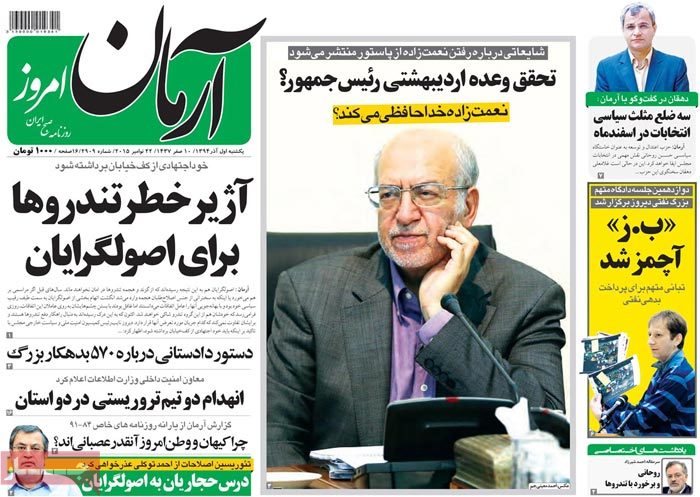
Arman-e Emrooz: Rumormongering about the departure of the industry minister

Will the president make good on his promise in May? Will [Mohammad Reza] Nematzadeh leave office?
 

A look at Iranian newspaper front pages on Nov. 22


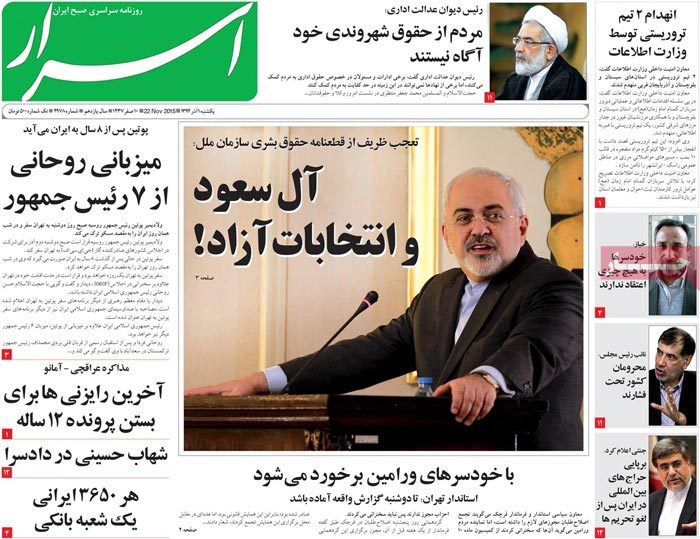
Asrar: People are not aware of their civil rights, said the director of the Administrative Court of Justice.

Asrar: There is one bank branch for every 3,650 Iranians.
 

A look at Iranian newspaper front pages on Nov. 22


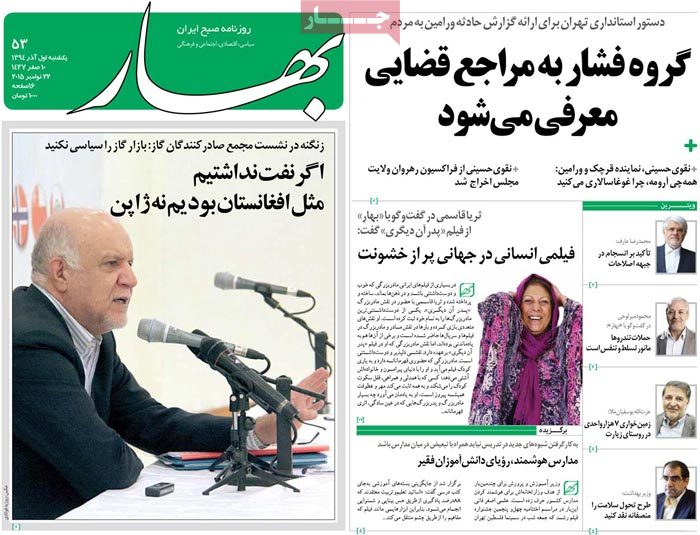
Bahar: Tehran Governor General has ordered the report on Varamin incident be made public, saying that the pressure group will be referred to judicial officials.

Varamin MP Hossein Naghavi Hosseini: Calm is the order of the day. Why do you make a fuss?

Naghavi Hosseini has been expelled from the Followers of the Leader [Rahrovan-e Velayat], a principlist caucus in the Islamic Consultative Assembly.

Bahar: The health minister has called for the Healthcare Transformation Plan to be critiqued fairly.
 

A look at Iranian newspaper front pages on Nov. 22


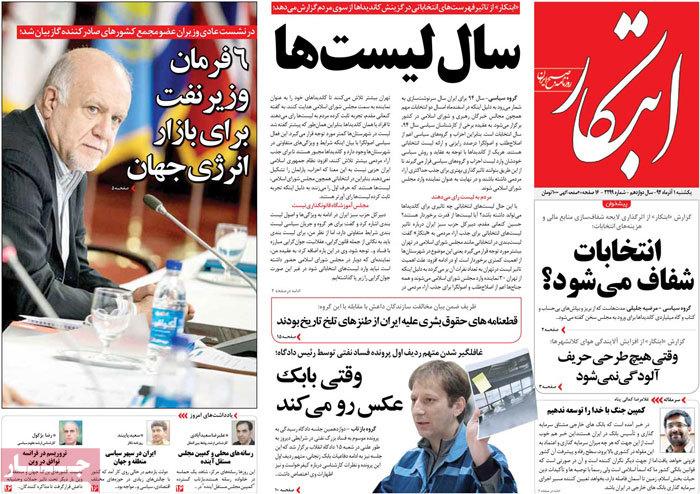
Ebtekar: Six orders of Iran’s oil minister for the world’s energy market
 

A look at Iranian newspaper front pages on Nov. 22


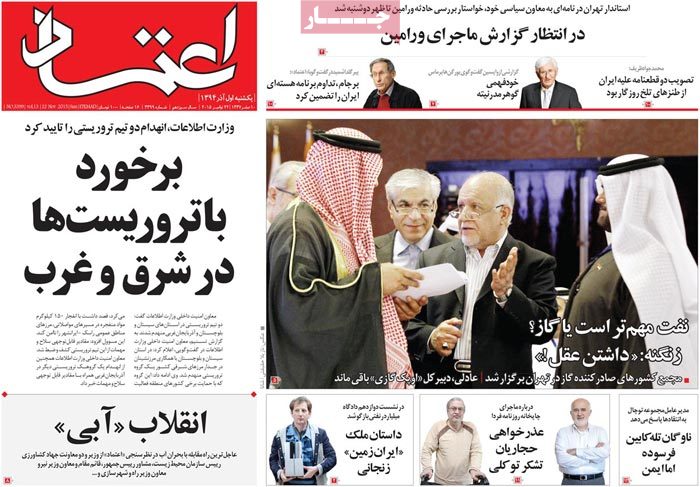
Etemad: “Oil is more important or gas?” Zanganeh: Wisdom!

Etemad: Tehran Governor General has called – in a letter to his deputy – for an investigation into what happened in Varamin on Friday, saying the report should be ready by Monday noon.

[An authorized gathering of Reformists in Varamin, Tehran Province on Friday came under attack allegedly by hardline Principlists who tried to disrupt the gathering].
 

A look at Iranian newspaper front pages on Nov. 22


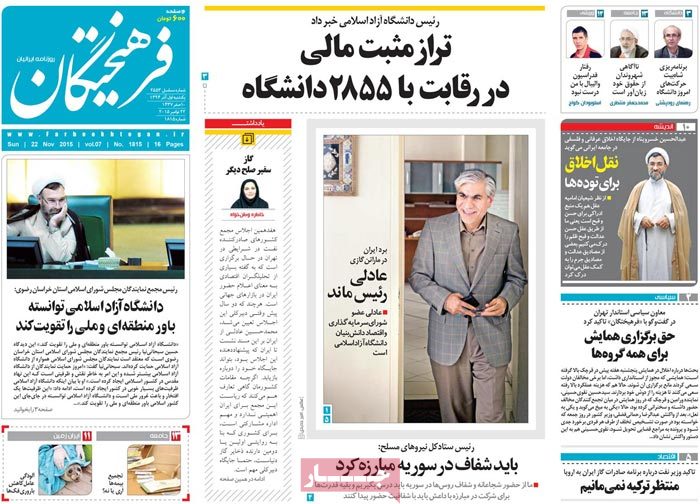
Farhikhtegan: Chief of Staff of the Iranian armed forces Major General Hassan Firouzabadi has said that the fight in Syria should be transparent.

He further said that we need to learn a lesson from the brave, transparent presence of the Russians in Syria and that other powers should be transparently present in the fight against ISIS.
 

A look at Iranian newspaper front pages on Nov. 22


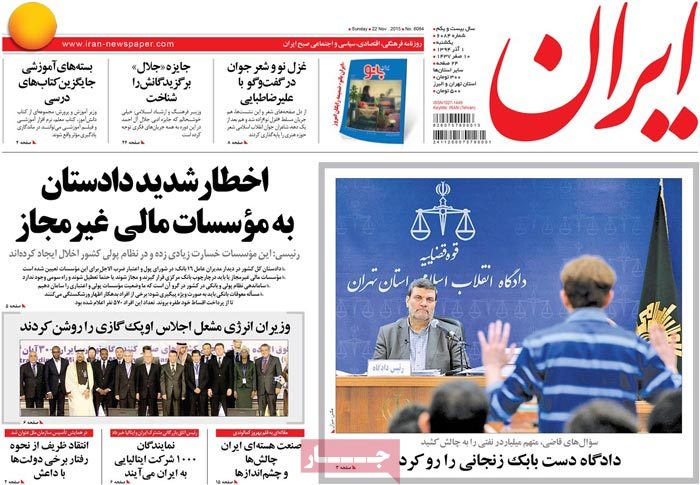
Iran: Court revealed the true intentions of Babak Zanjani [who is on trial for massive corruption].

Questions by the judge in the case of Babak Zanjani challenged the so-called oil defendant.
 

A look at Iranian newspaper front pages on Nov. 22


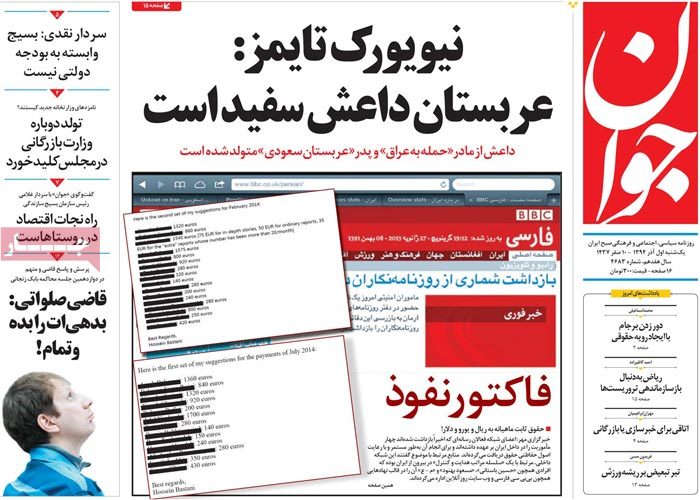
Javan: Basij is not dependent on government budget, said Mohammad Reza Naghdi, the commander of the volunteer force.
 

A look at Iranian newspaper front pages on Nov. 22


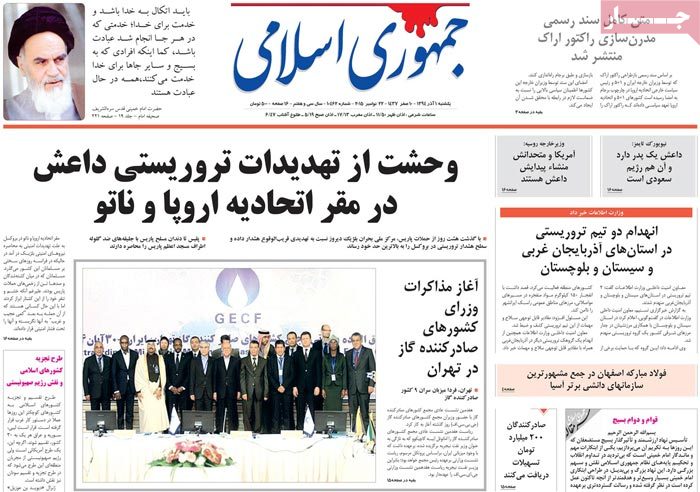
Jomhouri Islami: “Daesh [has a mother: the invasion of Iraq. But it also] has a father: Saudi Arabia [and its religious-industrial complex],” wrote The New York Times.
 

A look at Iranian newspaper front pages on Nov. 22


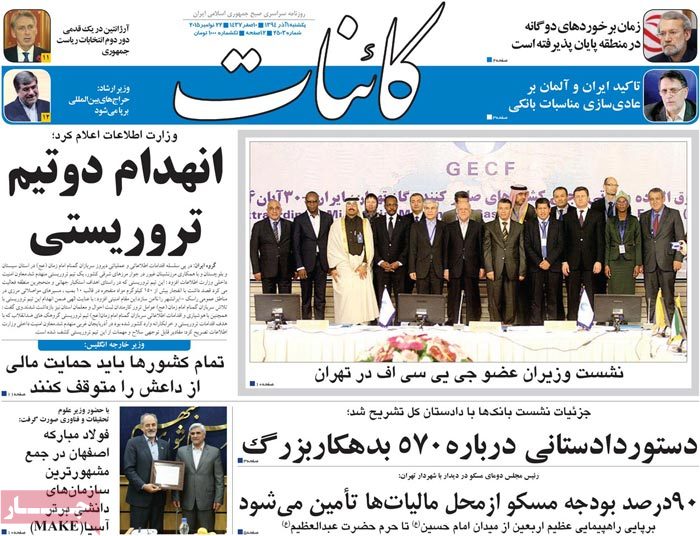
Kaenat: Iran and Germany stress the need for normalization of banking relations.
 

A look at Iranian newspaper front pages on Nov. 22


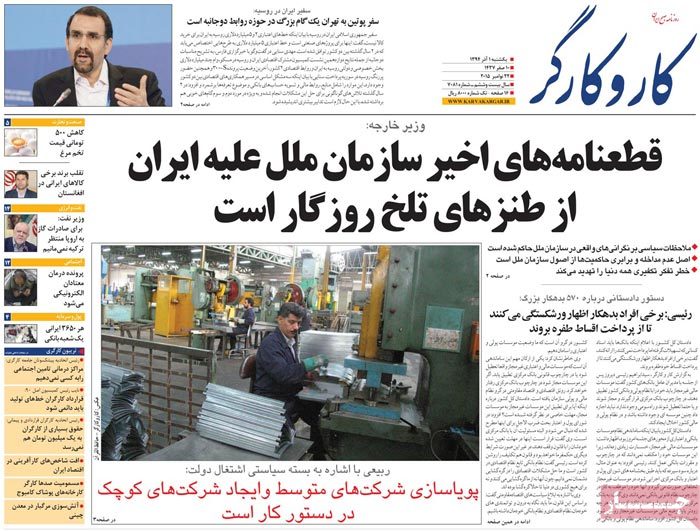
Kar va Kargar: The trip by President Putin to Tehran is a big step toward [boosting] mutual ties, said the Iranian ambassador to Moscow.
 

A look at Iranian newspaper front pages on Nov. 22


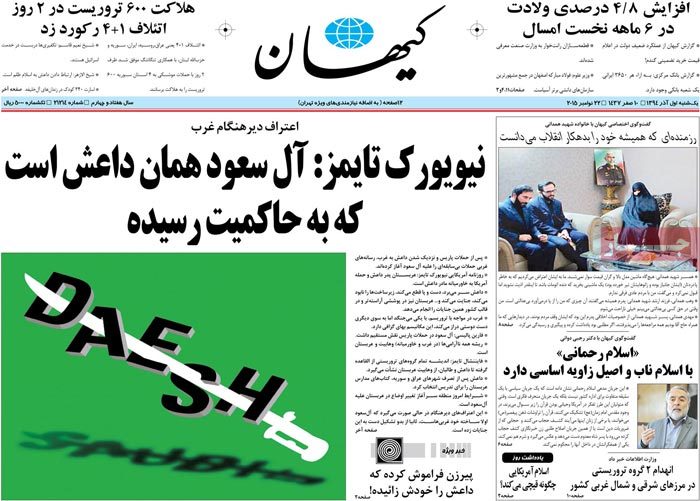
Kayhan: The Intelligence Ministry has announced that its agents have busted two terrorist groups near the country’s eastern and northwestern borders.
 

A look at Iranian newspaper front pages on Nov. 22


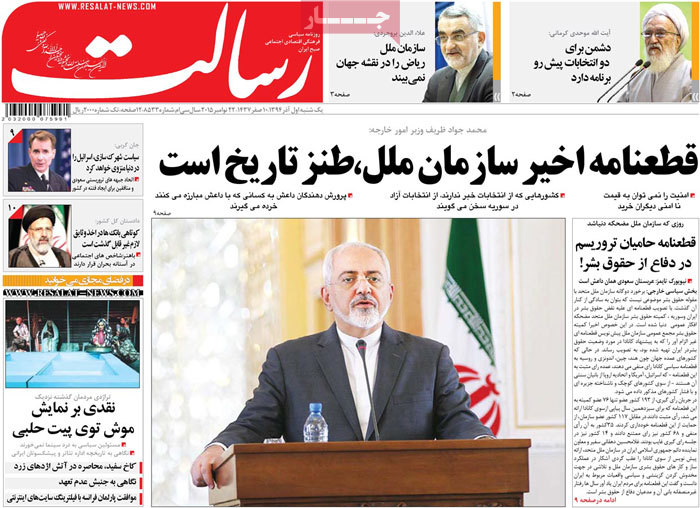
Resalat: Those who have nurtured ISIS blame those who take on ISIS, said the Iranian top diplomat.

FM Zarif: Those countries which know nothing about elections speak of free elections in Syria.
 

A look at Iranian newspaper front pages on Nov. 22


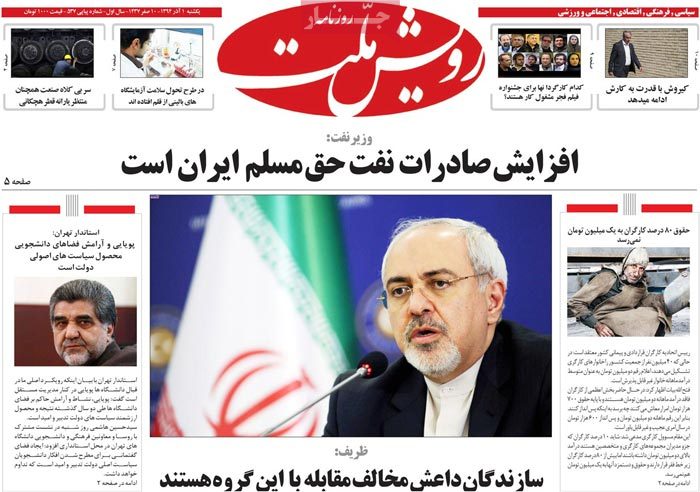
Rooyesh Mellat: The oil minister has said that raising crude exports is Iran’s inalienable right.
 

A look at Iranian newspaper front pages on Nov. 22


Saheb Ghalam: The minister of culture and Islamic guidance has said that international auctions will be held in Iran.
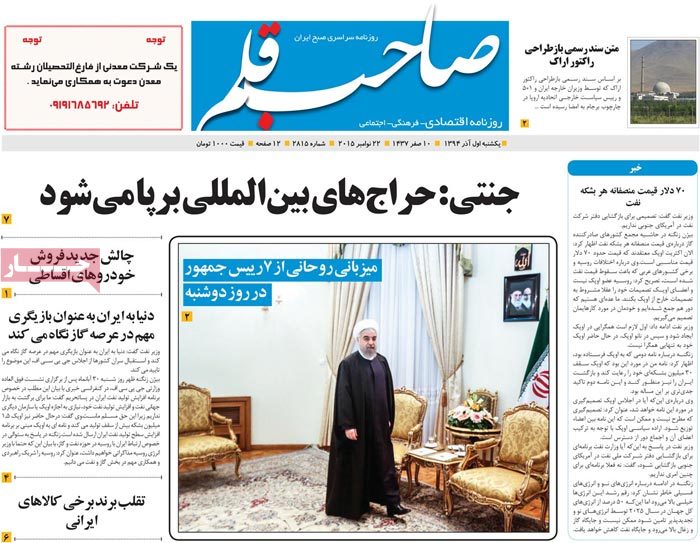
 

A look at Iranian newspaper front pages on Nov. 22


Shahrvand: The controversy over the release of an image showing a man taking drugs in Tehran Subway

Tehran’s subway system has turned into a corridor of social ills.
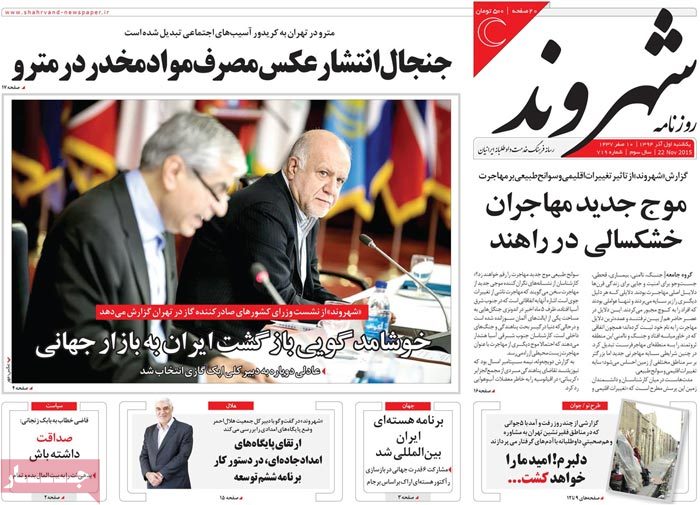
 

A look at Iranian newspaper front pages on Nov. 22


Highlights of Ettela’at newspaper on Nov. 22

Ettelaat

 The holy objective of human rights should not be used as a tool for political purposes, said the foreign minister at a ceremony in Tehran to mark the 70th anniversary of the United Nations establishment.

Mohammad Javad Zarif further said that a rights resolution against Iran was approved through undemocratic methods, adding this shows such measures lack credibility.

 The winners of the Jalal Al-e Ahmad Literary Award [presented yearly to the best Iranian authors] were announced.

 The prosecutor general has sounded a note of warning to unauthorized financial institutes.
Ebrahim Raeisi has said that the unauthorized financial institutes should adapt themselves to the country’s monetary and financial system and act within the frameworks set by the Central Bank or they will risk shutdown.
 Foreign Policy: “With allies like this [Saudi Arabia], who needs enemies?”

The US magazine wrote in an article (November 20): “Since the 1970s, the Saudi government and its allied religious establishment have exported their extremist version of Sunni Islam around the world — all financed by their oil money.”

 The Iranian oil minister has put forward six proposals for [adoption by] the gas exporting countries.

Bijan Namdar Zanganeh said in a ministerial meeting of the Gas Exporting Countries Forum (GECF) that Iran’s does not need the permission of OPEC or any other organization to raise its crude exports to global markets.

 The second-in-command in the Iranian navy has said that the naval forces are prepared to counter any threat [against the country].

Rear Admiral Seyyed Mahmoud Mousavi told Ettela’at that Iran constantly monitors the activities and movements of other countries in regional and international waters.

 Iran posted a 4.8 percent increase in the number of births in the six months to September 23.

The country’s death rate was down by 9.8 percent in the same period.


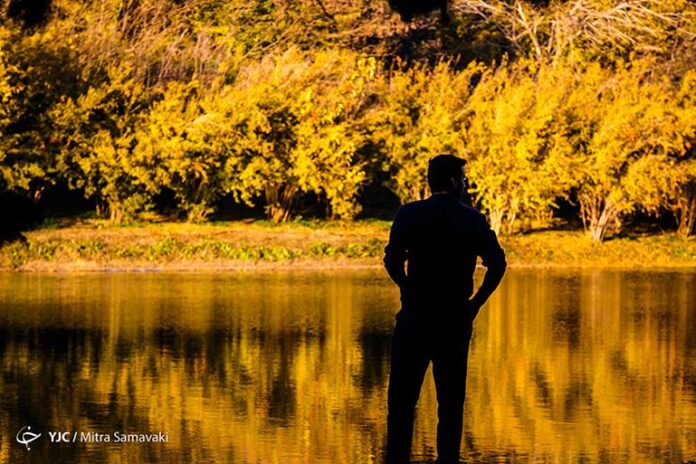
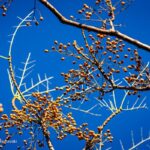
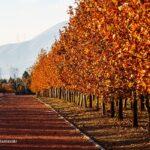
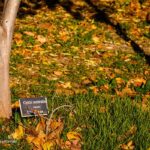
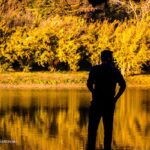
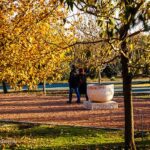
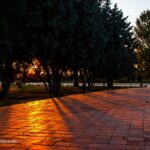
Breathtaking fall scenery in Botanical Garden (PHOTOS)

Botanical Garden0

The National Botanical Garden in suburban Tehran is the largest in the Middle East.

The garden, which is 145 hectares in area, also doubles as a genetic bank for plants which are on the verge of extinction.

The following images of the fall in the garden have been released by Young Journalists Club: